EP0944293A1 - Method for determining the simmering and boiling points of a foodstuff in a cooking vessel - Google Patents
Method for determining the simmering and boiling points of a foodstuff in a cooking vessel Download PDFInfo
- Publication number
- EP0944293A1 EP0944293A1 EP98200853A EP98200853A EP0944293A1 EP 0944293 A1 EP0944293 A1 EP 0944293A1 EP 98200853 A EP98200853 A EP 98200853A EP 98200853 A EP98200853 A EP 98200853A EP 0944293 A1 EP0944293 A1 EP 0944293A1
- Authority
- EP
- European Patent Office
- Prior art keywords
- frequency range
- boiling
- noise
- frequencies
- frequency
- Prior art date
- Legal status (The legal status is an assumption and is not a legal conclusion. Google has not performed a legal analysis and makes no representation as to the accuracy of the status listed.)
- Withdrawn
Links
- 238000010411 cooking Methods 0.000 title claims abstract description 54
- 238000009835 boiling Methods 0.000 title claims abstract description 42
- 238000000034 method Methods 0.000 title claims abstract description 26
- 238000010438 heat treatment Methods 0.000 claims abstract description 23
- 239000007788 liquid Substances 0.000 claims abstract description 7
- 230000009172 bursting Effects 0.000 claims abstract description 5
- 230000008569 process Effects 0.000 claims description 11
- 238000001228 spectrum Methods 0.000 claims description 11
- 238000012935 Averaging Methods 0.000 claims description 4
- 230000005587 bubbling Effects 0.000 claims description 4
- 230000015572 biosynthetic process Effects 0.000 claims description 3
- 239000000203 mixture Substances 0.000 claims description 3
- 230000033228 biological regulation Effects 0.000 claims description 2
- 238000001816 cooling Methods 0.000 claims description 2
- 238000001514 detection method Methods 0.000 claims description 2
- 230000007613 environmental effect Effects 0.000 claims 1
- 230000007423 decrease Effects 0.000 abstract description 3
- 235000013305 food Nutrition 0.000 description 11
- 238000011156 evaluation Methods 0.000 description 10
- 230000007704 transition Effects 0.000 description 5
- 238000010586 diagram Methods 0.000 description 4
- XLYOFNOQVPJJNP-UHFFFAOYSA-N water Substances O XLYOFNOQVPJJNP-UHFFFAOYSA-N 0.000 description 4
- 239000002775 capsule Substances 0.000 description 3
- 239000002241 glass-ceramic Substances 0.000 description 3
- 238000013461 design Methods 0.000 description 2
- 238000005259 measurement Methods 0.000 description 2
- 238000012545 processing Methods 0.000 description 2
- 229910001220 stainless steel Inorganic materials 0.000 description 2
- 239000010935 stainless steel Substances 0.000 description 2
- 238000010792 warming Methods 0.000 description 2
- 244000052616 bacterial pathogen Species 0.000 description 1
- 230000008901 benefit Effects 0.000 description 1
- 230000008859 change Effects 0.000 description 1
- 238000004140 cleaning Methods 0.000 description 1
- 230000001934 delay Effects 0.000 description 1
- 230000001419 dependent effect Effects 0.000 description 1
- 238000001914 filtration Methods 0.000 description 1
- 229910052736 halogen Inorganic materials 0.000 description 1
- 150000002367 halogens Chemical class 0.000 description 1
- 230000001788 irregular Effects 0.000 description 1
- 230000002045 lasting effect Effects 0.000 description 1
- 230000007246 mechanism Effects 0.000 description 1
- 235000015927 pasta Nutrition 0.000 description 1
- 230000000630 rising effect Effects 0.000 description 1
- 239000007787 solid Substances 0.000 description 1
- 230000003595 spectral effect Effects 0.000 description 1
- 230000002123 temporal effect Effects 0.000 description 1
- 235000013311 vegetables Nutrition 0.000 description 1
- 238000005406 washing Methods 0.000 description 1
Images

Classifications
-
- H—ELECTRICITY
- H05—ELECTRIC TECHNIQUES NOT OTHERWISE PROVIDED FOR
- H05B—ELECTRIC HEATING; ELECTRIC LIGHT SOURCES NOT OTHERWISE PROVIDED FOR; CIRCUIT ARRANGEMENTS FOR ELECTRIC LIGHT SOURCES, IN GENERAL
- H05B3/00—Ohmic-resistance heating
- H05B3/68—Heating arrangements specially adapted for cooking plates or analogous hot-plates
- H05B3/74—Non-metallic plates, e.g. vitroceramic, ceramic or glassceramic hobs, also including power or control circuits
- H05B3/746—Protection, e.g. overheat cutoff, hot plate indicator
-
- H—ELECTRICITY
- H05—ELECTRIC TECHNIQUES NOT OTHERWISE PROVIDED FOR
- H05B—ELECTRIC HEATING; ELECTRIC LIGHT SOURCES NOT OTHERWISE PROVIDED FOR; CIRCUIT ARRANGEMENTS FOR ELECTRIC LIGHT SOURCES, IN GENERAL
- H05B2213/00—Aspects relating both to resistive heating and to induction heating, covered by H05B3/00 and H05B6/00
- H05B2213/04—Heating plates with overheat protection means
-
- H—ELECTRICITY
- H05—ELECTRIC TECHNIQUES NOT OTHERWISE PROVIDED FOR
- H05B—ELECTRIC HEATING; ELECTRIC LIGHT SOURCES NOT OTHERWISE PROVIDED FOR; CIRCUIT ARRANGEMENTS FOR ELECTRIC LIGHT SOURCES, IN GENERAL
- H05B2213/00—Aspects relating both to resistive heating and to induction heating, covered by H05B3/00 and H05B6/00
- H05B2213/07—Heating plates with temperature control means
Definitions
- the invention relates to a method for determining the boiling point and Cooking point of a liquid taken up in a cooking vessel or a mixture of liquid and cookware for regulation of a cooking process in one on one with at least one Controllable heating device equipped hotplate Cooking vessel, wherein when the filled cooking vessel is heated caused by the formation and bursting of steam bubbles Noise with the help of at least one vibration-sensitive Sensors are detected.
- the heating devices operated, for example, with electrical energy conventional hobs are usually done manually adjustable, timed circuit breakers controlled. There is no feedback of the actually existing Temperature of the cooking zones or the food. The user is forced to continuously adjust the setting manually so that even cooking is achieved. Among other things when cooking vegetables or pasta it is relatively difficult to cook without overcooking. Therefore, it is often necessary the food only simmering at a temperature below to keep the cooking point.
- a procedure based on the procedure is desirable of a user or cook.
- the user knows the characteristic that announces the upcoming cooking point Noise when the first boiling bubbles appear at the bottom of the cooking vessel.
- the familiar, hissing sound that So-called bubble boiling is caused by locally exceeding the temperature-dependent Vapor pressure at the bottom of the pot, resulting in local small boiling delays caused by bladder germs.
- the transition from bubble boiling to bubbly cooking changes Amplitude and spectral composition of the noise.
- the present invention is therefore based on the problem of a Finding a process that is independent of cooking the cooking location, the type of food, the amount of food, the cooking vessel, the hotplate and disturbing ambient noises, the onset of boiling or cooking is precisely recognized and measurement signals are generated, which is reliably an actuator for controlling a hotplate heater can influence.
- the solution to the problem is achieved in that the cooking process resulting noise into a lower, low-frequency and dividing an upper, high frequency range, wherein in each area either for the entire bandwidth or for multiple frequencies and / or smaller frequency ranges from the Frequency spectrum the amplitudes are measured.
- Each from the Amplitudes of the lower and the upper frequency range become one Average formed.
- the two calculated averages will be regularly compared with each other, being in the bladder boiling phase the mean of the lower frequency range below the mean of the upper frequency range while it is behaves the other way round in the bubbling boiling phase.
- the heating phase is after the time at which the mean of the lower frequency range is the mean of the upper frequency range exceeds the energy supply for the heating device interrupted or throttled while in the cooling phase after the time when the average of the upper frequency range exceeds the average of the lower frequency range, the energy supply is resumed or increased.
- At least one Vibration sensitive sensor every time the controllable is switched off Heater over at least a period of at least a second recorded ambient noise, its frequencies in the frequency ranges necessary for boiling and boiling point detection lie.
- the frequencies of the ambient noise are determined from those necessary for the boiling and cooking point determination Filtered out frequency ranges.
- the amplitudes of the frequencies that are filtered out are used for averaging the lower and upper frequency ranges are not taken into account.
- This procedure is based on the physical processes during the Boiling and cooking process adapted and takes advantage of the fact that every phase of the cooking process - depending on the watery food - a typical sound can be assigned. From approx. 90 ° C, based on Normal pressure, a typical boiling noise forms, the a high frequency hiss and a significant increase in Total volume is recognizable from approx. 96 ° C. At the transition to bubbling cooking become the previous sound by the Bursting of the steam bubbles rising to the surface low-frequency vibrations superimposed. The bursting of the Steam bubbles also cause the cooking vessel to vibrate at low frequencies on.
- the physical process described here is extensive regardless of the cooking location, the type of watery food, on the shape, size, type and cleaning status of the cooking vessel and from the hotplate.
- the latter can e.g. a halogen heating element, have a heating coil or a gas burner as a heating device.
- the lower one Range between 100 and 1000 Hz and the other upper range between 1000 and 5000 Hz.
- the amplitudes can be within a frequency range from 3 to 10 frequencies or frequency intervals can be measured.
- the frequencies or frequency intervals to be measured are chosen so that at least the typical for the design of the hob Spurious vibrations can be avoided.
- a frequency interval is usually a fraction of an octave.
- a "learning phase” precedes the process.
- the learning phase begins each time the heater is switched on. Part of the period before the first boiling sound lies, the or the vibration-sensitive sensors one or more short periods of time the current ambient noise on.
- the sound level of the disturbing noise frequencies, those necessary for the determination of boiling and boiling points Frequency ranges are used in the evaluation not considered.
- one or more Sensors on the device carrying the cooking vessel Cooking area can be arranged.
- the sensor or sensors are as Microphones and / or accelerometers formed.
- the device carrying the cooking vessel is, for example, a glass ceramic plate, a gas burner rack or an electric hot plate.
- the sensor or sensors are in, under or arranged on it.
- the sensors are preferably outside or mounted on the edge of the heatable cooking zone.
- FIG. 1 shows a glass ceramic electric hob (1) with a Radiant heater (2) and its connections to a power source.
- a cooking vessel (7) on the hob (1).
- Below the hob (1) is next to the cooking zone at a distance of approx. 35 mm
- a microphone capsule (10) is arranged from the outer edge of the radiator (2).
- the microphone capsule (10) is on an assembly (11) for the signal processing and evaluation connected.
- the signal levels are proportional to the sound pressure preamplified fed to a frequency analysis unit.
- the frequency resolution is, for example, a 1/12 octave.
- the heating process will divided into three warming phases.
- the first phase is the so-called warm water phase, the upper limit temperature of 70 ° c is defined.
- the second phase is the so-called Simmer phase, in the food is hotter than 90 ° C, but the boiling temperature has not yet reached.
- the third phase is the so-called cooking phase. In it has the food to be cooked or the food to be cooked Liquid reaches the boiling or boiling temperature.
- the lower and upper levels are in the hot water phase for itself under a common limit level. In contrast this results in total noise levels in the two hotter phases, which exceed twice the limit value, where the overall level is generally somewhat higher in the simmer phase is. Furthermore, the lower level is lower in the simmer phase than the upper level. In the cooking phase it is the other way round.
- the switching or control information is in the control unit (12) compared with the power selection on the control element (3) and corresponding to a circuit breaker or regulator (4) for energizing supplied to the heating device (2).
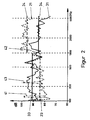
- FIG. It sets a sound spectrum for a bubble boiling and Cooking noise from a liter of water in a medium-sized, stainless steel pot not covered with a lid.
- the ordinate in the diagram shows the sound pressure level in "dB" plotted against the frequency in "Hz".
- the dashed Curve (21) shows the total noise level during bubble boiling.
- the solid curve (31) gives the level curve at bubbling boiling again. Both for the lower frequency range from 100-1000 Hz as well as for the upper range of 1000-5000 Hz are the range averages for the simmering and cooking phases through the straight line sections running parallel to the abscissa (23, 24) and (33, 34).
- the diagram clearly shows that in the so-called simmer phase the average sound pressure level (24) in the upper frequency range is about 12 dB higher than the average sound pressure level (23) in the lower frequency range. In contrast lies in the Cooking phase the average sound pressure level (33) in the upper frequency range about 5 dB lower than in the lower one. It can also be seen that here the overall noise level in the simmer phase which is the cooking phase.
- the noise (41) and (42) are by a Coffee grinder generated. This is the higher frequency noise (42) generated by the mill motor, while the low-frequency, broadband noise (41) caused by the striking mechanism becomes.
- the noise (43) represents the noise of one flinging washing machine. All three listed as examples Kitchen noises have a lasting impact on frequency evaluation, since they take too long to be evaluated of several short time intervals not as background noise would be recognized. You deceive in the simmer phase Sound level spectrum that corresponds to the cooking phase. Hence would the heater without suppressing this noise turned down too early.
Landscapes
- Chemical & Material Sciences (AREA)
- Engineering & Computer Science (AREA)
- Ceramic Engineering (AREA)
- Electric Stoves And Ranges (AREA)
- Cookers (AREA)
Abstract
Description
Die Erfindung betrifft ein Verfahren zur Ermittlung des Siede- und Kochpunkts einer in einem Gargefäß aufgenommenen Flüssigkeit oder einem Gemenge aus Flüssigkeit und Kochgütern für die Regelung eines Kochvorganges in einem auf einer mit einer zumindest steuerbaren Heizvorrichtung ausgestatteten Kochstelle stehenden Gargefäß, wobei die bei einem Aufheizen des befüllten Gargefäßes durch das Entstehen und Zerplatzen von Dampfblasen verursachten Geräusche mit Hilfe mindestens eines schwingungsempfindlichen Sensors erfaßt werden.The invention relates to a method for determining the boiling point and Cooking point of a liquid taken up in a cooking vessel or a mixture of liquid and cookware for regulation of a cooking process in one on one with at least one Controllable heating device equipped hotplate Cooking vessel, wherein when the filled cooking vessel is heated caused by the formation and bursting of steam bubbles Noise with the help of at least one vibration-sensitive Sensors are detected.
Die beispielsweise mit elektrischer Energie betriebenen Heizvorrichtungen herkömmlicher Kochfelder werden meist durch manuell einstellbare, zeitlich getaktete Leistungsschalter angesteuert. Es erfolgt hierbei keine Rückmeldung der tatsächlich vorhandenen Temperatur der Kochzonen oder des Kochgutes. Der Benutzer ist gezwungen, die Einstellung manuell ständig so nachzuführen, daß ein gleichmäßiges Kochen erreicht wird. U.a. beim Kochen von Gemüse oder Teigwaren ist es relativ schwierig, den Kochvorgang ohne Überkochen aufrechtzuerhalten. Daher ist es oft erforderlich, das Kochgut nur simmernd auf einer Temperatur unterhalb des Kochpunkts zu halten.The heating devices operated, for example, with electrical energy conventional hobs are usually done manually adjustable, timed circuit breakers controlled. There is no feedback of the actually existing Temperature of the cooking zones or the food. The user is forced to continuously adjust the setting manually so that even cooking is achieved. Among other things when cooking vegetables or pasta it is relatively difficult to cook without overcooking. Therefore, it is often necessary the food only simmering at a temperature below to keep the cooking point.
Wünschenswert ist ein Verfahren, das sich an der Vorgehensweise eines Benutzers bzw. Kochs orientiert. Der Benutzer kennt erfahrungsgemäß das den bevorstehenden Kochpunkt ankündigende, charakteristische Geräusch beim Auftreten der ersten Siedebläschen am Boden des Kochgefäßes. Das bekannte, zischende Geräusch, das sog. Blasensieden, entsteht durch lokales Überschreiten des temperaturabhängigen Dampfdrucks am Topfboden, resultierend in örtlich an Blasenkeimen ausgelösten, kleinen Siedeverzügen. Kurze Zeit später ändert sich das Geräusch beim Übergang zu einem sprudelnden Kochen, wenn also die Blasen vom Topfboden abreißen, aufsteigen und an der Flüssigkeitsoberfläche aufplatzen. Beim Übergang vom Blasensieden zum sprudelnden Kochen ändert sich die Amplitude und die spektrale Zusammensetzung des Geräusches.A procedure based on the procedure is desirable of a user or cook. Experience has shown that the user knows the characteristic that announces the upcoming cooking point Noise when the first boiling bubbles appear at the bottom of the cooking vessel. The familiar, hissing sound that So-called bubble boiling is caused by locally exceeding the temperature-dependent Vapor pressure at the bottom of the pot, resulting in local small boiling delays caused by bladder germs. Short Time later the noise changes when you transition to one bubbly boiling, so when the bubbles tear off the bottom of the pot, rise and burst at the surface of the liquid. At the The transition from bubble boiling to bubbly cooking changes Amplitude and spectral composition of the noise.
Hierzu ist aus der nicht vorveröffentlichten DE 196 38 355.2 ein Verfahren bekannt, bei dem aus einem im Bereich des Temperaturregelpunktes erfaßten Geräuschfrequenzspektrum ein begrenzter, oberer Frequenzbereich und ein davon zumindest teilweise abweichender, begrenzter unterer Frequenzbereich in je eine Auswertestrecke überführt wird. Die Amplituden dieser beiden Frequenzbereiche werden ausgewertet. Die beiden Auswerteergebnisse werden zueinander in ein Verhältnis gesetzt. Bei einer Veränderung dieses Verhältnisses wird aufgrund der Abnahme der Amplitudenstärke des unteren Frequenzbereichs und/oder der Zunahme der Amplitudenstärke des oberen Frequenzbereichs die Wärmezufuhr abgesenkt und bei Veränderung der Verhältnisbildung aufgrund von Zunahme der Amplitudenstärke des unteren Frequenzbereichs und/oder Abnahme der Amplitudenstärke des oberen Frequenzbereichs die Wärmezufuhr angehoben. Das Verfahren ist anfällig gegen unregelmäßig auftretende Störgeräusche, deren Frequenzen im auszuwertenden Geräuschfrequenzspektrum liegen.For this purpose, from the unpublished DE 196 38 355.2 a method is known in which in the range of the temperature control point recorded noise frequency spectrum a limited, upper frequency range and one of them at least partially deviating, limited lower frequency range in one evaluation section each is transferred. The amplitudes of these two frequency ranges are evaluated. The two evaluation results are related to each other. When there is a change this ratio is due to the decrease in amplitude strength of the lower frequency range and / or the increase in Amplitude strength of the upper frequency range the heat input lowered and when the ratio formation changes due to Increase in the amplitude strength of the lower frequency range and / or decrease in the amplitude strength of the upper frequency range the heat supply increased. The process is fragile against irregular noise, their frequencies lie in the noise frequency spectrum to be evaluated.
Der vorliegenden Erfindung liegt daher das Problem zugrunde, ein Verfahren zu finden, das bei einem Kochvorgang, unabhängig von dem Kochort, der Kochgutart, der Kochgutmenge, dem Kochgefäß, der Kochstelle und störenden Umgebungsgeräuschen, das Einsetzen des Siedens bzw. Kochens präzise erkennt und Meßsignale generiert, die zuverlässig ein Stellglied zur Regelung einer Kochstellenheizung beeinflussen können. The present invention is therefore based on the problem of a Finding a process that is independent of cooking the cooking location, the type of food, the amount of food, the cooking vessel, the hotplate and disturbing ambient noises, the onset of boiling or cooking is precisely recognized and measurement signals are generated, which is reliably an actuator for controlling a hotplate heater can influence.
Die Lösung des Problems wird dadurch erzielt, daß das beim Kochvorgang entstehende Geräusch in einen unteren, niederfrequenten und einen oberen, hochfrequenten Bereich aufgeteilt wird, wobei in jedem Bereich entweder für die gesamte Bandbreite oder für mehrere Frequenzen und/oder kleinere Frequenzbereiche aus dem Frequenzspektrum die Amplituden gemessen werden. Jeweils aus den Amplituden des unteren und des oberen Frequenzbereiches wird ein Mittelwert gebildet. Die beiden errechneten Mittelwerte werden regelmäßig miteinander verglichen, wobei in der Phase des Blasensiedens der Mittelwert des unteren Frequenzbereichs unterhalb des Mittelwerts des oberen Frequenzbereichs liegt, während es sich in der Phase des sprudelnden Kochens umgekehrt verhält. In der Aufheizphase wird nach dem Zeitpunkt, an dem der Mittelwert des unteren Frequenzbereichs den Mittelwert des oberen Frequenzbereichs übersteigt, die Energiezufuhr für die Heizvorrichtung unterbrochen oder gedrosselt, während in der Abkühlphase nach dem Zeitpunkt, an dem der Mittelwert des oberen Frequenzbereichs den Mittelwert des unteren Frequenzbereichs übersteigt, die Energiezufuhr wieder aufgenommen oder erhöht wird.The solution to the problem is achieved in that the cooking process resulting noise into a lower, low-frequency and dividing an upper, high frequency range, wherein in each area either for the entire bandwidth or for multiple frequencies and / or smaller frequency ranges from the Frequency spectrum the amplitudes are measured. Each from the Amplitudes of the lower and the upper frequency range become one Average formed. The two calculated averages will be regularly compared with each other, being in the bladder boiling phase the mean of the lower frequency range below the mean of the upper frequency range while it is behaves the other way round in the bubbling boiling phase. In the heating phase is after the time at which the mean of the lower frequency range is the mean of the upper frequency range exceeds the energy supply for the heating device interrupted or throttled while in the cooling phase after the time when the average of the upper frequency range exceeds the average of the lower frequency range, the energy supply is resumed or increased.
Um Störeinflüsse auszuschalten, wird mit mindestens einem schwingungsempfindlichen Sensor bei jedem Abschalten der steuerbaren Heizvorrichtung über mindestens eine Zeitspanne von wenigstens einer Sekunde Umgebungsgeräusche erfaßt, deren Frequenzen in den für die Siede- und Kochpunktdetektion notwendigen Frequenzbereichen liegen. Die Frequenzen der Umgebungsgeräusche werden aus den für die Siede- und Kochpunktermittlung notwendigen Frequenzbereichen herausgefiltert. Die Amplituden der herausgefilterten Frequenzen werden bei den Mittelwertbildungen der unteren und oberen Frequenzbereiche nicht berücksichtigt. To eliminate interference, use at least one Vibration sensitive sensor every time the controllable is switched off Heater over at least a period of at least a second recorded ambient noise, its frequencies in the frequency ranges necessary for boiling and boiling point detection lie. The frequencies of the ambient noise are determined from those necessary for the boiling and cooking point determination Filtered out frequency ranges. The amplitudes of the frequencies that are filtered out are used for averaging the lower and upper frequency ranges are not taken into account.
Dieses Verfahren ist an die physikalischen Vorgänge während des Siede- und Kochvorganges angepaßt und nutzt die Tatsache, daß jeder Phase des Kochvorganges - abhängig vom wässrigen Kochgut - ein typisches Geräusch zuzuordnen ist. Ab ca. 90° C, bezogen auf Normaldruck, bildet sich ein typisches Siedegeräusch aus, das an einem hochfrequenten Zischen und einem deutlichen Anstieg der Gesamtlautstärke ab ca. 96° C erkennbar ist. Beim Übergang zum sprudelnden Kochen werden dem bisherigen Geräusch die durch das Aufplatzen der an die Oberfläche gestiegenen Dampfblasen entstehenden tieffrequenteren Schwingungen überlagert. Das Platzen der Dampfblasen regt zudem das Gargefäß zu niederfrequenten Vibrationen an. Der hier beschriebene physikalische Vorgang ist weitgehend unabhängig vom Kochort, der Art des wässrigen Kochguts, von der Form, Größe, Art und Reinigungszustand des Gargefäßes und von der Kochstelle. Letztere kann z.B. eine Halogenheizstab, eine Heizspirale oder einen Gasbrenner als Heizvorrichtung haben.This procedure is based on the physical processes during the Boiling and cooking process adapted and takes advantage of the fact that every phase of the cooking process - depending on the watery food - a typical sound can be assigned. From approx. 90 ° C, based on Normal pressure, a typical boiling noise forms, the a high frequency hiss and a significant increase in Total volume is recognizable from approx. 96 ° C. At the transition to bubbling cooking become the previous sound by the Bursting of the steam bubbles rising to the surface low-frequency vibrations superimposed. The bursting of the Steam bubbles also cause the cooking vessel to vibrate at low frequencies on. The physical process described here is extensive regardless of the cooking location, the type of watery food, on the shape, size, type and cleaning status of the cooking vessel and from the hotplate. The latter can e.g. a halogen heating element, have a heating coil or a gas burner as a heating device.
Innerhalb der Aufteilung der beiden Frequenzbereiche liegt der untere Frequenzbereich unterhalb von 1000 Hz, während der obere Frequenzbereich darüber liegt. Hierbei kann zum einen der untere Bereich zwischen 100 und 1000 Hz liegen und zum anderen der obere Bereich zwischen 1000 und 5000 Hz. Die zu messenden Bereiche müssen jedoch nicht aneinandergrenzen.The lies within the division of the two frequency ranges lower frequency range below 1000 Hz, while the upper Frequency range lies above. On the one hand, the lower one Range between 100 and 1000 Hz and the other upper range between 1000 and 5000 Hz. The ranges to be measured however, do not have to adjoin one another.
Ferner können innerhalb eines Frequenzbereiches die Amplituden von 3 bis 10 Frequenzen oder Frequenzintervallen gemessen werden. Die zu messenden Frequenzen oder Frequenzintervalle werden so gewählt, daß zumindest die für die Bauart der Kochstelle typischen Störschwingungen ausgespart werden. Ein Frequenzintervall ist in der Regel ein Bruchteil einer Oktave.Furthermore, the amplitudes can be within a frequency range from 3 to 10 frequencies or frequency intervals can be measured. The frequencies or frequency intervals to be measured are chosen so that at least the typical for the design of the hob Spurious vibrations can be avoided. A frequency interval is usually a fraction of an octave.
Um eine negative Beeinträchtigung der Siede- und Kochpunktermittlung durch Störschwingungen, die nicht bauarttypisch sind, zu vermeiden wird dem Verfahren eine "Lernphase" vorgeschaltet. Die Lernphase beginnt mit jedem Einschalten der Heizvorrichtung. In einem Teil des Zeitraumes, der vor den ersten Siedegeräuschen liegt, nimmt der oder die schwingungsempfindlichen Sensoren über eine oder mehrere kurze Zeitspannen die momentan vorhandenen Umgebungsgeräusche auf. Die Schallpegel der störenden Geräuschfrequenzen, die in den für die Siede- und Kochpunktermittlung notwendigen Frequenzbereichen liegen, werden bei der Auswertung nicht berücksichtigt.To have a negative impact on the boiling and boiling point determination due to interference vibrations that are not typical of the design, a "learning phase" precedes the process. The learning phase begins each time the heater is switched on. Part of the period before the first boiling sound lies, the or the vibration-sensitive sensors one or more short periods of time the current ambient noise on. The sound level of the disturbing noise frequencies, those necessary for the determination of boiling and boiling points Frequency ranges are used in the evaluation not considered.
Zur Erfassung der durch Erwärmung des Kochguts erzeugten Geräusche, einschließlich der Störgeräusche, können ein oder mehrere Sensoren an der das Gargefäß tragenden Vorrichtung der Kochstelle angeordnet sein. Der oder die Sensoren sind dabei als Mikrofone und/oder Beschleunigungsaufnehmer ausgebildet. Die das Gargefäß tragende Vorrichtung ist beispielsweise eine Glaskeramikplatte, ein Gasbrennergestell oder eine elektrische Heizplatte. Je nach Vorrichtung sind der oder die Sensoren in, unter oder auf ihr angeordnet. Vorzugsweise werden die Sensoren außerhalb oder am Rand der aufheizbaren Kochzone montiert.To record the noises generated by heating the food, including noise, one or more Sensors on the device carrying the cooking vessel Cooking area can be arranged. The sensor or sensors are as Microphones and / or accelerometers formed. The the The device carrying the cooking vessel is, for example, a glass ceramic plate, a gas burner rack or an electric hot plate. Depending on the device, the sensor or sensors are in, under or arranged on it. The sensors are preferably outside or mounted on the edge of the heatable cooking zone.
Weitere Einzelheiten der Erfindung ergeben sich aus dem nachfolgend beschriebenen und schematisch dargestellten Ausführungsbeispiel.
Figur 1- Kochstelle mit Gargefäß und schematischer Beschaltung.
Figur 2- Schallspektrums-Diagramm mit Störgeräuschen für einen mittelgroßen Edelstahltopf mit einer einlitrigen Wasserbefüllung.
- Figure 1
- Cooking area with cooking vessel and schematic wiring.
- Figure 2
- Sound spectrum diagram with noise for a medium-sized stainless steel pot with a single liter water filling.
Figur 1 zeigt ein Glaskeramik-Elektrokochfeld (1) mit einem Strahlungsheizkörper (2) und dessen Anschlüsse an eine Stromquelle. Auf dem Kochfeld (1) steht ein Gargefäß (7). Unterhalb dem Kochfeld (1) ist neben der Kochzone im Abstand von ca. 35 mm vom Außenrand des Heizkörpers (2) eine Mikrofonkapsel (10) angeordnet. Die Mikrofonkapsel (10) ist an eine Baugruppe (11) für die Signalverarbeitung und -auswertung angeschlossen. In dieser Baugruppe werden die dem Schalldruck proportionalen Signalpegel vorverstärkt einer Frequenzanalyseeinheit zugeführt. Die Frequenzauflösung beträgt beispielsweise eine 1/12 Oktave.Figure 1 shows a glass ceramic electric hob (1) with a Radiant heater (2) and its connections to a power source. There is a cooking vessel (7) on the hob (1). Below the hob (1) is next to the cooking zone at a distance of approx. 35 mm A microphone capsule (10) is arranged from the outer edge of the radiator (2). The microphone capsule (10) is on an assembly (11) for the signal processing and evaluation connected. In this The signal levels are proportional to the sound pressure preamplified fed to a frequency analysis unit. The frequency resolution is, for example, a 1/12 octave.
Die in den verschiedenen Erwärmungsphasen für mehrere Frequenzen und/oder Frequenzintervalle oder den jeweiligen Frequenzbereich über eine festgelegte Zeitspanne von beispielsweise 1 sec gemessen Pegel werden - ggf. über einen A/D-Wandler digitalisiert - getrennt für den unteren und oberen Frequenzbereich erfaßt und gemittelt. So ergibt sich bezogen auf den unteren Frequenzbereich ein sog. unterer Pegel und bezogen auf den oberen Frequenzbereich ein sog. oberer Pegel. Beide Pegel werden während dem Aufheizen des Kochgutes überwacht. Der Aufheizvorgang wird dabei in drei Erwärmungsphasen aufgeteilt. Die erste Phase ist die sog. Warmwasserphase, deren obere Grenztemperatur mit 70° c definiert wird. Die zweite Phase ist die sog. Simmerphase, in der das Kochgut heißer als 90° C ist, jedoch die Siedetemperatur noch nicht erreicht hat. Die dritte Phase ist die sog. Kochphase. In ihr hat das Kochgut bzw. die das Kochgut aufnehmende Flüssigkeit die Siede- bzw. Kochtemperatur erreicht.The in the different heating phases for multiple frequencies and / or frequency intervals or the respective frequency range measured over a fixed period of time, for example 1 sec Levels are digitized - if necessary using an A / D converter - recorded separately for the lower and upper frequency range and averaged. This results in relation to the lower frequency range a so-called lower level and related to the upper frequency range a so-called upper level. Both levels are during monitored the heating of the food. The heating process will divided into three warming phases. The first phase is the so-called warm water phase, the upper limit temperature of 70 ° c is defined. The second phase is the so-called Simmer phase, in the food is hotter than 90 ° C, but the boiling temperature has not yet reached. The third phase is the so-called cooking phase. In it has the food to be cooked or the food to be cooked Liquid reaches the boiling or boiling temperature.
In der Warmwasserphase liegen der untere und der obere Pegel jeweils für sich unter einem gemeinsamen Grenzpegel. Im Gegensatz hierzu ergeben sich in den beiden heißeren Phasen Gesamtgeräuschpegel, die den doppelten Grenzpegelwert übersteigen, wobei der Gesamtpegel im allgemeinen in der Simmerphase etwas höher ist. Des weiteren ist in der Simmerphase der untere Pegel kleiner als der obere Pegel. In der Kochphase ist es umgekehrt. The lower and upper levels are in the hot water phase for itself under a common limit level. In contrast this results in total noise levels in the two hotter phases, which exceed twice the limit value, where the overall level is generally somewhat higher in the simmer phase is. Furthermore, the lower level is lower in the simmer phase than the upper level. In the cooking phase it is the other way round.
Die Verhältnisse der unteren und oberen Pegelwerte sowie der Gesamtpegelwerte zu dem Grenzpegelwert und dessen Vielfache können neben dem Vergleich der unteren und oberen Pegelwerte in den drei Erwärmungsphasen zur Plausibilitätskontrolle herangezogen werden.The ratios of the lower and upper level values as well as the total level values to the limit level value and its multiples in addition to comparing the lower and upper level values in the three warming phases were used for plausibility checks become.
Zur Ermittlung des jeweiligen unteren und oberen Pegels werden
hierbei die einzelnen Meßwerte einer Filterung durch zwei Bandpässe
mit den Eckfrequenzen 100/1000 Hz und 1/5 kHz unterzogen.To determine the respective lower and upper level
the individual measured values of filtering through two bandpasses
with the
Zur Unterdrückung von einzelnen, relativ kurzen Störungen durch Fremdschall wird neben dem zeitlichen Mitteln der einzelnen Meßwerte eine zusätzliche Mittelung und Auswertung von mehreren Zeitintervallen durchgeführt. Erst wenn beispielsweise über 5 bis 10 Zeitintervalle die Bedingungen zum Erkennen des Übergangs vom Blasensieden zum sprudelnden Kochen - ggf. einschließlich der Plausibilitätsprüfung über den doppelten Grenzpegelwert - unverändert bleiben, wird ein Signal für eine Regeleinheit (12) zur Regelung der Heizleistung der Heizvorrichtung (2) generiert. Die Auswertung und Verarbeitung der analogen Signale erfolgt digital mit Hilfe eines Microcontrollers, eines Signalprozessors oder eines sonstigen programmierbaren Logikbausteins.To suppress individual, relatively short disturbances In addition to the temporal averaging of the individual measured values, extraneous noise is generated an additional averaging and evaluation of several Time intervals carried out. Only if, for example, over 5 up to 10 time intervals the conditions for recognizing the transition from bubble boiling to bubbly cooking - including, if necessary the plausibility check above the double limit value - remain unchanged, a signal for a control unit (12) generated to control the heating power of the heating device (2). The analog signals are evaluated and processed digitally with the help of a microcontroller, a signal processor or another programmable logic module.
In der Regeleinheit (12) wird die Schalt- oder Regelinformation mit der Leistungsvorwahl am Bedienungselement (3) verglichen und entsprechend einem Leistungsschalter oder -regler (4) zur Bestromung der Heizvorrichtung (2) zugeführt.The switching or control information is in the control unit (12) compared with the power selection on the control element (3) and corresponding to a circuit breaker or regulator (4) for energizing supplied to the heating device (2).
In Figur 2 ist ein Schallspektrums-Diagramm dargestellt. Es stellt jeweils ein Schallspektum für ein Blasensiede- und ein Kochgeräusch von einem Liter Wasser in einem mittelgroßen , nicht mit einem Deckel abgedeckten Edelstahltopf dar. A sound spectrum diagram is shown in FIG. It sets a sound spectrum for a bubble boiling and Cooking noise from a liter of water in a medium-sized, stainless steel pot not covered with a lid.
Im Diagramm ist auf der Ordinate der Schalldruckpegel in "dB" über der Frequenz in "Hz" aufgetragen. Es sind zwei verschieden dargestellte Kurven (21) und (31) zu erkennen. Die gestrichelte Kurve (21) zeigt die Gesamtgeräuschpegel während des Blasensiedens. Die durchgezogene Kurve (31) gibt den Pegelverlauf beim sprudelnden Kochen wieder. Sowohl für den unteren Frequenzbereich von 100-1000 Hz als auch für den oberen Bereich von 1000-5000 Hz sind für die Simmer- und Kochphasen die Bereichsmittelwerte durch die parallel zur Abszisse verlaufenden Geradenabschnitte (23, 24) und (33, 34) dargestellt.The ordinate in the diagram shows the sound pressure level in "dB" plotted against the frequency in "Hz". There are two different curves (21) and (31) shown. The dashed Curve (21) shows the total noise level during bubble boiling. The solid curve (31) gives the level curve at bubbling boiling again. Both for the lower frequency range from 100-1000 Hz as well as for the upper range of 1000-5000 Hz are the range averages for the simmering and cooking phases through the straight line sections running parallel to the abscissa (23, 24) and (33, 34).
Dem Diagramm ist deutlich zu entnehmen, daß in der sog. Simmerphase der mittlere Schalldruckpegel (24) im oberen Frequenzbereich um ca. 12 dB höher liegt als der mittlere Schalldruckpegel (23) im unteren Frequenzbereich. Dagegen liegt in der Kochphase der mittlere Schalldruckpegel (33) im oberen Frequenzbereich um ca. 5 dB niedriger als im unteren. Auch ist erkennbar, daß hier der Gesamtgeräuschpegel in der Simmerphase über dem der Kochphase liegt.The diagram clearly shows that in the so-called simmer phase the average sound pressure level (24) in the upper frequency range is about 12 dB higher than the average sound pressure level (23) in the lower frequency range. In contrast lies in the Cooking phase the average sound pressure level (33) in the upper frequency range about 5 dB lower than in the lower one. It can also be seen that here the overall noise level in the simmer phase which is the cooking phase.
In Figur 2 sind ca. bei den Frequenzen 120 Hz, 250 Hz und 1050 Hz die Störgeräusche (41), (43) und (42) strichpunktiert eingezeichnet. Die Störgeräusche (41) und (42) werden durch eine Kaffeemühle erzeugt. Hierbei wird das höherfrequente Geräusch (42) durch den Mühlenmotor erzeugt, während das niederfrequente, breitbandige Geräusch (41) durch das Schlagwerk verursacht wird. Das Störgeräusch (43) repräsentiert den Lärm einer schleudernden Waschmaschine. Alle drei beispielhaft aufgeführten Küchengeräusche beeinflussen die Frequenzauswertung nachhaltig, da sie zu lange andauern, als daß sie bei der beschriebenen Auswertung von mehreren, kurzen Zeitintervallen nicht als Störgeräusche erkannt würden. Sie täuschen in der Simmerphase ein Schallpegelspektrum vor, das der Kochphase entspricht. Folglich würde ohne ein Unterdrücken dieser Störgeräusche die Heizvorrichtung zu früh heruntergeregelt. In Figure 2 are approximately at the frequencies 120 Hz, 250 Hz and 1050 Hz the noise (41), (43) and (42) dash-dotted drawn. The noise (41) and (42) are by a Coffee grinder generated. This is the higher frequency noise (42) generated by the mill motor, while the low-frequency, broadband noise (41) caused by the striking mechanism becomes. The noise (43) represents the noise of one flinging washing machine. All three listed as examples Kitchen noises have a lasting impact on frequency evaluation, since they take too long to be evaluated of several short time intervals not as background noise would be recognized. You deceive in the simmer phase Sound level spectrum that corresponds to the cooking phase. Hence would the heater without suppressing this noise turned down too early.
Durch das Erfassen der Störgeräusche kurz nach dem Anschalten der Heizvorrichtung bzw. der Kochplatte, also zeitlich noch vor der Simmerphase, können deren Frequenzen bei der Auswertung berücksichtigt werden. Je nach Ausbaustufe der Auswerteelektronik besteht auch die Möglichkeit, die in der Umgebung der Kochplatte öfters - z.B. an verschiedenen Tagen - erfaßten Störgeräusche über einen längeren Zeitraum zu speichern und sie innerhalb dieses Zeitraumes auch dann bei jedem Kochvorgang zu berücksichtigen, wenn die jeweilige Störgeräuchmessung negativ verlief. In diesem Fall kann beispielsweise eine erst in der Simmerphase eingeschaltete Kaffeemühle das Erkennen des Übergangs von der Siede- zur Kochphase nicht irritieren. Selbstverständlich können die über die Störgeräusch gesammelten Informationen in der Auswerteeinheit auch gelöscht werden, wenn diese Störgeräusche über einen längeren Zeitraum ausbleiben. By detecting the noise just after switching on the heating device or the hotplate, i.e. before the simmer phase, their frequencies can be taken into account in the evaluation become. Depending on the level of evaluation electronics there is also the possibility of being in the vicinity of the hotplate more often - e.g. on different days - recorded noise save for a long period of time and keep them within this Period should also be taken into account with every cooking process, if the respective noise measurement was negative. In In this case, for example, one can only be in the simmer phase switched on coffee grinder recognizing the transition from the Do not irritate the boiling phase. Of course you can the information collected about the noise in the evaluation unit also be deleted when this noise is over stay away for a long period of time.
- 11
- Glaskeramik-ElektrokochfeldGlass ceramic electric hob
- 22nd
- Strahlungsheizkörper, HeizvorrichtungRadiant heater, heater
- 33rd
- BedienungselementControl element
- 44th
- Leistungsschalter oder -reglerCircuit breaker or regulator
- 77
- Gargefäß, TopfCooking vessel, pot
- 1010th
- Mikrofonkapsel, MikrofonMicrophone capsule, microphone
- 1111
- Baugruppe für die Signalverarbeitung und -auswertungModule for signal processing and -evaluation
- 1212th
- RegeleinheitControl unit
- 2121
- Schallpegelspektrum für die SimmerphaseSound level spectrum for the simmer phase
- 2323
- mittlerer Schalldruckpegel der Simmerphase im unteren Frequenzbereich (100-1000 Hz)mean sound pressure level of the simmer phase in lower frequency range (100-1000 Hz)
- 2424th
- mittlerer Schalldruckpegel der Simmerphase im oberen Frequenzbereich (1000-5000 Hz)mean sound pressure level of the simmer phase in upper frequency range (1000-5000 Hz)
- 3131
- Schallpegelspektrum für die KochphaseSound level spectrum for the cooking phase
- 3333
- mittlerer Schalldruckpegel der Kochphase im unteren Frequenzbereich (100-1000 Hz)average sound pressure level during the cooking phase lower frequency range (100-1000 Hz)
- 3434
- mittlerer Schalldruckpegel der Kochphase im oberen Frequenzbereich (1000-5000 Hz)average sound pressure level during the cooking phase upper frequency range (1000-5000 Hz)
- 41-4341-43
- StörgeräuscheNoise
Claims (8)
dadurch gekennzeichnet,
characterized,
Priority Applications (2)
| Application Number | Priority Date | Filing Date | Title |
|---|---|---|---|
| DE19638355A DE19638355C2 (en) | 1996-09-19 | 1996-09-19 | Method for determining the boiling point and boiling point of a food item in a cooking vessel |
| EP98200853A EP0944293A1 (en) | 1996-09-19 | 1998-03-16 | Method for determining the simmering and boiling points of a foodstuff in a cooking vessel |
Applications Claiming Priority (2)
| Application Number | Priority Date | Filing Date | Title |
|---|---|---|---|
| DE19638355A DE19638355C2 (en) | 1996-09-19 | 1996-09-19 | Method for determining the boiling point and boiling point of a food item in a cooking vessel |
| EP98200853A EP0944293A1 (en) | 1996-09-19 | 1998-03-16 | Method for determining the simmering and boiling points of a foodstuff in a cooking vessel |
Publications (1)
| Publication Number | Publication Date |
|---|---|
| EP0944293A1 true EP0944293A1 (en) | 1999-09-22 |
Family
ID=26029565
Family Applications (1)
| Application Number | Title | Priority Date | Filing Date |
|---|---|---|---|
| EP98200853A Withdrawn EP0944293A1 (en) | 1996-09-19 | 1998-03-16 | Method for determining the simmering and boiling points of a foodstuff in a cooking vessel |
Country Status (2)
| Country | Link |
|---|---|
| EP (1) | EP0944293A1 (en) |
| DE (1) | DE19638355C2 (en) |
Cited By (1)
| Publication number | Priority date | Publication date | Assignee | Title |
|---|---|---|---|---|
| CN112021913A (en) * | 2019-06-03 | 2020-12-04 | 浙江苏泊尔家电制造有限公司 | Cooking appliance control method and cooking appliance |
Families Citing this family (18)
| Publication number | Priority date | Publication date | Assignee | Title |
|---|---|---|---|---|
| US6236025B1 (en) | 1999-03-19 | 2001-05-22 | General Electric Company | Acoustic sensing system for boil state detection and method for determining boil state |
| US6118104A (en) * | 1999-03-19 | 2000-09-12 | General Electric Company | Method and apparatus for boil state detection based on acoustic signal features |
| US6433693B1 (en) | 2000-07-31 | 2002-08-13 | General Electric Company | Apparatus and method for boil phase detection based on acoustic signal features |
| DE102007058936A1 (en) * | 2007-12-07 | 2009-06-10 | BSH Bosch und Siemens Hausgeräte GmbH | Sensor device for household appliance, particularly kitchen stove and steam baking oven, has connection alternative for acoustic sensor to detect noise of household appliance |
| WO2011069695A1 (en) * | 2009-12-07 | 2011-06-16 | Msx Technology Ag | Method for controlling a cooking process |
| ES2566532T3 (en) | 2011-11-04 | 2016-04-13 | BSH Hausgeräte GmbH | Cooking appliance |
| SI23956A (en) | 2011-12-02 | 2013-06-28 | Albin Smrke | Control device for cooking with steam sensor |
| SI24062A (en) | 2012-04-24 | 2013-10-30 | Gorenje Gospodinjski Aparati D.D. | The process of determining the conditions of cooking and a system for determining the conditions of cooking |
| EP2765826B1 (en) | 2013-02-08 | 2017-04-12 | BSH Hausgeräte GmbH | Cooking assistance system with mobile measuring unit |
| CH707603A1 (en) | 2013-02-12 | 2014-08-15 | Wmf Württembergische Metallwarenfabrik Ag | A method for monitoring and / or controlling a beverage maker and beverage preparation for implementing the method. |
| DE102013223857A1 (en) * | 2013-11-21 | 2014-11-27 | E.G.O. Elektro-Gerätebau GmbH | Method and device for detecting the properties of a cooking pot with respect to heat loss |
| EP2925087A1 (en) | 2014-03-24 | 2015-09-30 | BSH Hausgeräte GmbH | Acoustic cooking assistance system |
| DE102014114901A1 (en) * | 2014-10-14 | 2016-04-14 | Frima International Ag | Cooking appliance and method for detecting a process parameter of a cooking process |
| DE102015105452A1 (en) * | 2015-04-10 | 2016-10-13 | Miele & Cie. Kg | Method for operating a hob and a hob |
| DE102015109053B4 (en) | 2015-06-09 | 2018-04-05 | Miele & Cie. Kg | Cooking field device and method of operation |
| NL2015069B1 (en) * | 2015-07-01 | 2017-01-30 | Douwe Egberts Bv | A method of preparing a beverage and a device for preparing a beverage. |
| NL2015068B1 (en) | 2015-07-01 | 2017-01-30 | Douwe Egberts Bv | A system for heating and frothing a beverage, a device for heating and frothing a beverage suitable for being used in such a system, a froth wand suitable for being used in such a system and a method of preparing a beverage using such a system. |
| WO2025238002A1 (en) | 2024-05-16 | 2025-11-20 | BSH Hausgeräte GmbH | Hob device, hob, and method for operating a hob device |
Citations (3)
| Publication number | Priority date | Publication date | Assignee | Title |
|---|---|---|---|---|
| DE3146638A1 (en) * | 1981-11-25 | 1983-07-07 | Gerhard 7000 Stuttgart Brüggen | Boiling point control device for cooking stoves to save energy |
| US4952766A (en) * | 1987-10-26 | 1990-08-28 | Microwave Products Of America, Inc. | Sensor and pop detector for microwave popcorn control |
| US5324906A (en) * | 1991-12-21 | 1994-06-28 | Goldstar Co., Ltd. | Method for controlling a heating of high frequency cooker and apparatus thereof |
Family Cites Families (4)
| Publication number | Priority date | Publication date | Assignee | Title |
|---|---|---|---|---|
| DE6600354U (en) * | 1968-10-05 | 1969-01-16 | Busch Jaeger Duerener Metall | COOKING POINT CONTROLLER FOR HEATED COOKING POTS |
| DE3811925C1 (en) * | 1988-04-09 | 1989-03-02 | Kurt Wolf & Co Kg, 7547 Wildbad, De | |
| US5067474A (en) * | 1990-09-28 | 1991-11-26 | Chi Lei L | Boiling detecting devices for a stove |
| DE4439777A1 (en) * | 1994-11-07 | 1996-05-15 | Bosch Siemens Hausgeraete | Sensor-controlled glass ceramic electric cooker |
-
1996
- 1996-09-19 DE DE19638355A patent/DE19638355C2/en not_active Expired - Fee Related
-
1998
- 1998-03-16 EP EP98200853A patent/EP0944293A1/en not_active Withdrawn
Patent Citations (3)
| Publication number | Priority date | Publication date | Assignee | Title |
|---|---|---|---|---|
| DE3146638A1 (en) * | 1981-11-25 | 1983-07-07 | Gerhard 7000 Stuttgart Brüggen | Boiling point control device for cooking stoves to save energy |
| US4952766A (en) * | 1987-10-26 | 1990-08-28 | Microwave Products Of America, Inc. | Sensor and pop detector for microwave popcorn control |
| US5324906A (en) * | 1991-12-21 | 1994-06-28 | Goldstar Co., Ltd. | Method for controlling a heating of high frequency cooker and apparatus thereof |
Cited By (1)
| Publication number | Priority date | Publication date | Assignee | Title |
|---|---|---|---|---|
| CN112021913A (en) * | 2019-06-03 | 2020-12-04 | 浙江苏泊尔家电制造有限公司 | Cooking appliance control method and cooking appliance |
Also Published As
| Publication number | Publication date |
|---|---|
| DE19638355C2 (en) | 1998-08-20 |
| DE19638355A1 (en) | 1998-04-02 |
Similar Documents
| Publication | Publication Date | Title |
|---|---|---|
| EP0944293A1 (en) | Method for determining the simmering and boiling points of a foodstuff in a cooking vessel | |
| EP0541166B1 (en) | Assembly to control the heat supply of a cooking vessel | |
| EP2510413B1 (en) | Method for controlling a cooking process | |
| DE10253198B4 (en) | Method and device for thermal monitoring of an inductively heated cooking vessel | |
| DE60116712T2 (en) | INDUCTION HEATING DEVICE | |
| CH677165A5 (en) | ||
| EP2590473B1 (en) | Cooking device | |
| EP2460388B1 (en) | Hotplate having at least two heating zones | |
| CH669297A5 (en) | METHOD FOR CONTROLLING AND REGULATING THE HEATING OUTPUT IN THE HEATING PHASE OF A COOKING VESSEL. | |
| WO2001014798A1 (en) | Control device for a cooker | |
| EP1001226A2 (en) | Ultrasonic sensor for smoke extracting hoods | |
| EP2801884A2 (en) | Automatic regulation of cooking processes | |
| EP0780081B2 (en) | Method for the automatic regulation of heatable cooking surfaces | |
| DE102015109053B4 (en) | Cooking field device and method of operation | |
| DE112007001158B4 (en) | Device and method for controlling and / or regulating a heating power of a heating element of a cooktop | |
| EP2765826A1 (en) | Cooking assistance system with mobile measuring unit | |
| EP3031298A1 (en) | Cooking device and method for operating a cooking device | |
| DE102004015993B4 (en) | Microwave oven and method of operating a microwave oven | |
| EP1351555A2 (en) | State detection device on a panel or a wall of an appliance | |
| EP1768461A1 (en) | Method to generate, process and evaluate a temperature-correlated signal and corresponding device | |
| DE102020121090A1 (en) | System comprising a cooktop and a cooking vessel, and method of operating a system | |
| DE102020001783A1 (en) | Hob support system | |
| DE202020001070U1 (en) | Hob support system | |
| DE102022129549A1 (en) | Sensor-controlled hob | |
| DE202022106277U1 (en) | Sensor-controlled hob |
Legal Events
| Date | Code | Title | Description |
|---|---|---|---|
| PUAI | Public reference made under article 153(3) epc to a published international application that has entered the european phase |
Free format text: ORIGINAL CODE: 0009012 |
|
| AK | Designated contracting states |
Kind code of ref document: A1 Designated state(s): CH DE FR GB LI |
|
| AX | Request for extension of the european patent |
Free format text: AL;LT;LV;MK;RO;SI |
|
| 17P | Request for examination filed |
Effective date: 20000316 |
|
| AKX | Designation fees paid |
Free format text: CH DE FR GB LI |
|
| 17Q | First examination report despatched |
Effective date: 20010726 |
|
| GRAH | Despatch of communication of intention to grant a patent |
Free format text: ORIGINAL CODE: EPIDOS IGRA |
|
| GRAH | Despatch of communication of intention to grant a patent |
Free format text: ORIGINAL CODE: EPIDOS IGRA |
|
| STAA | Information on the status of an ep patent application or granted ep patent |
Free format text: STATUS: THE APPLICATION HAS BEEN WITHDRAWN |
|
| 18W | Application withdrawn |
Effective date: 20030408 |