EP0943034B1 - Method for drying of paper and dry end of a paper machine - Google Patents
Method for drying of paper and dry end of a paper machine Download PDFInfo
- Publication number
- EP0943034B1 EP0943034B1 EP97946772A EP97946772A EP0943034B1 EP 0943034 B1 EP0943034 B1 EP 0943034B1 EP 97946772 A EP97946772 A EP 97946772A EP 97946772 A EP97946772 A EP 97946772A EP 0943034 B1 EP0943034 B1 EP 0943034B1
- Authority
- EP
- European Patent Office
- Prior art keywords
- dryer
- paper web
- paper
- curling
- web
- Prior art date
- Legal status (The legal status is an assumption and is not a legal conclusion. Google has not performed a legal analysis and makes no representation as to the accuracy of the status listed.)
- Expired - Lifetime
Links
- 238000001035 drying Methods 0.000 title claims abstract description 86
- 238000000034 method Methods 0.000 title claims abstract description 48
- 239000011248 coating agent Substances 0.000 claims abstract description 15
- 238000000576 coating method Methods 0.000 claims abstract description 14
- 238000004513 sizing Methods 0.000 claims abstract description 7
- 230000000712 assembly Effects 0.000 claims abstract description 6
- 238000000429 assembly Methods 0.000 claims abstract description 6
- 238000003490 calendering Methods 0.000 claims abstract description 3
- 230000000694 effects Effects 0.000 claims description 17
- 238000001704 evaporation Methods 0.000 claims description 16
- 230000008020 evaporation Effects 0.000 claims description 16
- XLYOFNOQVPJJNP-UHFFFAOYSA-N water Substances O XLYOFNOQVPJJNP-UHFFFAOYSA-N 0.000 claims description 14
- 238000007664 blowing Methods 0.000 claims description 9
- 238000001816 cooling Methods 0.000 claims description 9
- 238000009833 condensation Methods 0.000 claims description 5
- 230000005494 condensation Effects 0.000 claims description 5
- 238000009692 water atomization Methods 0.000 claims description 5
- 238000005259 measurement Methods 0.000 claims description 2
- 239000003595 mist Substances 0.000 claims 2
- 238000005507 spraying Methods 0.000 claims 2
- 230000001276 controlling effect Effects 0.000 description 10
- 230000001105 regulatory effect Effects 0.000 description 10
- 230000015572 biosynthetic process Effects 0.000 description 5
- 230000008901 benefit Effects 0.000 description 3
- 230000005484 gravity Effects 0.000 description 3
- 238000010438 heat treatment Methods 0.000 description 3
- 239000007921 spray Substances 0.000 description 3
- 230000008859 change Effects 0.000 description 2
- 238000010276 construction Methods 0.000 description 2
- 230000004048 modification Effects 0.000 description 2
- 238000012986 modification Methods 0.000 description 2
- 238000009423 ventilation Methods 0.000 description 2
- 238000013459 approach Methods 0.000 description 1
- 238000004140 cleaning Methods 0.000 description 1
- 238000011161 development Methods 0.000 description 1
- 230000008030 elimination Effects 0.000 description 1
- 238000003379 elimination reaction Methods 0.000 description 1
- 238000005516 engineering process Methods 0.000 description 1
- 239000004744 fabric Substances 0.000 description 1
- 239000000835 fiber Substances 0.000 description 1
- 239000012467 final product Substances 0.000 description 1
- 230000009916 joint effect Effects 0.000 description 1
- 238000004519 manufacturing process Methods 0.000 description 1
- 230000035699 permeability Effects 0.000 description 1
- 230000002265 prevention Effects 0.000 description 1
- 230000008569 process Effects 0.000 description 1
- 230000009257 reactivity Effects 0.000 description 1
- 239000007787 solid Substances 0.000 description 1
Images




Classifications
-
- D—TEXTILES; PAPER
- D21—PAPER-MAKING; PRODUCTION OF CELLULOSE
- D21F—PAPER-MAKING MACHINES; METHODS OF PRODUCING PAPER THEREON
- D21F5/00—Dryer section of machines for making continuous webs of paper
- D21F5/02—Drying on cylinders
- D21F5/04—Drying on cylinders on two or more drying cylinders
-
- D—TEXTILES; PAPER
- D21—PAPER-MAKING; PRODUCTION OF CELLULOSE
- D21F—PAPER-MAKING MACHINES; METHODS OF PRODUCING PAPER THEREON
- D21F9/00—Complete machines for making continuous webs of paper
Definitions
- the invention concerns a method for drying of paper, which method comprises the following steps:
- the invention also concerns a dry end of a paper machine, which comprises a forward dryer section and a finishing section, which finishing section comprises a coating/surface-sizing equipment, an after-dryer, a calender, and a reeling station, and the dry end of the paper machine further comprises elements and/or assemblies and combinations formed out of said elements and at least one steam box in view of controlling the curling of the paper web at least in the area of the finishing section.
- twin-wire draw and/or single-wire draw is/are employed.
- twin-wire draw the groups of drying cylinders comprise two wires, which press the web one from above and the other one from below against heated cylinder faces. Between the rows of drying cylinders, which are usually horizontal rows, the web has free and unsupported draws, which are susceptible of fluttering, which may cause web breaks, in particular so when the web is still relatively moist and, therefore, of low strength.
- each group of drying cylinders includes just one drying wire, on whose support the web runs through the whole group so that the drying wire presses the web on the drying cylinders against the heated cylinder faces, whereas on the reversing cylinders or rolls between the drying cylinders the web remains at the side of the outside curve.
- the drying cylinders are placed outside the wire loop, and the reversing cylinders or rolls inside said loop.
- the tendency of curling of paper is already affected in connection with the web formation, in particular at the sheet formation stage (for example, the applicant's Sym-FormerTM) by means of selection of the difference in speed between the slice jet and the wire, and by means of other running parameters.
- the sheet formation stage for example, the applicant's Sym-FormerTM
- a suitable initial curl form is regulated for the sheet in order that the curling of the paper after one-sided or double-sided copying could be optimized.
- the reactivity of curling i.e. the extent to which curling occurs per unit of change in moisture content, is affected to a greater extent by means of a multi-layer structure of the paper, which is produced in connection with the web formation in the wet end.
- the object of the present invention is to provide a dry end of a paper machine in which no inverted groups are needed at all, but which, however, meets all other requirements that are imposed.
- the object of the present invention is to approach these problems from a new point of view and to suggest novel solutions for said problems, which solutions are contrary to conventional modes of thinking.
- FI Patent Application No. 935340 methods in the drying of a paper web and dryer sections for a paper web are described, wherein, after the press section, the paper web is dried in a number of successive groups with single-wire draw, and according to one embodiment the paper web is dried from the side of its bottom face over the entire length by means of said contact drying cylinders, and the paper web is dried from the side of its top face on the draw or draws of the paper web free from the wire, and/or the paper web is dried from the side of its top face by to the top face of the paper web applying a drying air flow through the drying wire.
- a method for drying a surface-treated paper web or equivalent in an after-dryer of a paper machine as well as a dryer section of a paper machine for applying the method, wherein, in view of compensating for a tendency of curling of the paper web, in the after-dryer the paper web is dried in a dryer group/groups making use of a normal single-wire draw, and that, in connection with or after the drying, the paper web is treated by means of a device/devices in order to compensate for a tendency of curling of the paper web, which devices are, for example, a steam box, a blower unit, a moistening device, and/or a soft calender.
- devices are, for example, a steam box, a blower unit, a moistening device, and/or a soft calender.
- FI Patent Application No. 963024 a method for drying a paper to be surface-treated, in particular fine paper, in an after-dryer in a paper machine is described as well as an after-dryer in a paper machine for carrying out the method, wherein, after the surface-sizing or coating, the paper web is dried by means of an upwards open inverted group with single-wire draw, in which connection the tendency of curling formed in the paper web in the forward dryer section can be substantially eliminated and/or compensated for.
- the method in accordance with the invention is mainly characterized in that, in the method, the effect of said steam box is intensified by cooling the web prior to said steam box.
- the forward dryer section in the dry end of the paper machine is exclusively based on dryer groups with single-wire draw, in which case the removal of broke takes place all the time by the force of gravity and does, thus, not cause problems.
- the single-wire draw in the forward dryer section the paper web is constantly supported by a wire, whereby the runnability is improved and it is possible to increase the running speed.
- both the forward dryer section and the after-dryer have been accomplished exclusively by means of dryer groups with normal single-wire draw.
- blowing through the wire is employed for regulating the curling; from above the different cylinders hot air is blown out of impingement blow devices, and evaporation takes place through the wire and affects the drying and, thus, the curling of the paper.
- steam boxes and possibly blowings of moist air taken from the forward dryer section are employed for controlling the curling.
- a lower support belt has also been added to a dryer group, which belt circulates against the lower faces of the reversing rolls while guided by its own guide rolls, and which support belt is so impermeable that it prevents evaporation of water out of the web from its lower face, whereby the tendency of curling can be controlled.
- the forward dryer section is composed of dryer groups with single-wire draw, as is the after-dryer, in the after-dryer, in view of controlling the curling
- steam boxes have been fitted, by whose means steam with a content of energy is blown against the web in the area of the reversing cylinders.
- one or several drying cylinders can also be cylinders with adjustable temperature, i.e. cooling/heating cylinders. Between the dryer section and a calender, there can also be an additional steam box in view of controlling the curling.
- moist air or any other, equivalent medium such as a device that blows moist air that is brought from the forward dryer, or, for example, a separate water atomizing box, by whose means water is sprayed by means of air as small drops towards the web, or an airborne type hood to be placed underneath.
- a what is called "spreader bar" at one side or both sides of the paper web in order to work the curling of the paper web mechanically. In this way in particular the curling of the web in the longitudinal direction is affected.
- the spreader bar can also be of a spreader roll type, in which case the effect on cross-direction curling can be enhanced.
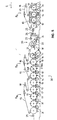
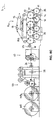
- Figure 5 is a schematic illustration of an exemplifying embodiment of the invention as an illustration in part of the after-dryer of a paper machine.
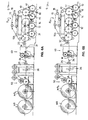
- FIGS 6A to 6C are schematic illustrations of exemplifying embodiments of the invention, in which figures the last dryer group in the after-dryer and the machine reel-up are shown.
- FIGS 6D to 6E are schematic illustrations of exemplifying embodiments of the invention, in which figures the whole of the dry end of a paper machine is shown from the forward dryer section to the machine reel-up.
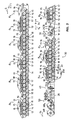
- the paper web W is brought into the forward dryer section D1 from the press section onto the drying wire 15 of the first group R 0 with single-wire draw, to which wire the web is attached by the effect of the vacuum in the suction boxes 13.
- the forward dryer section includes 7 groups R 0 ...r 6 with single-wire draw, and the web W has closed draws over the group gaps between said groups.
- the machine direction i.e. the direction of progress of the of the web W is denoted with the arrow S.
- all the groups R 0 ...R N with single-wire draw are so-called normal groups, in which the, for example, steam-heated smooth-faced drying cylinders 10 are placed in the upper horizontal row and the reversing suction cylinders 11 are placed in the lower horizontal row.
- Each normal group R 0 ...R N has a drying wire 15 of its own, which is guided by the guide rolls 18.
- the drying wires 15 press the web W to be dried on the drying cylinders 10 against the smooth heated faces of the cylinders, and on the reversing cylinders 11 the web W remains at the side of the outside curve on the outside face of the wire 15.
- the web W is kept reliably on the support of the wire 15 against the effect of centrifugal forces by the effect of the vacuum present on the grooved faces 12 of the reversing cylinders 11 or on the perforated mantle of an equivalent suction roll, whereby cross-direction shrinkage of the web W is also counteracted.
- suction cylinders 11 particularly favourably are used the suction cylinders which are marketed by the applicant with the trade mark "VAC-ROLL”TM and which have no inside suction boxes, and with respect to the details of the constructions of said suction cylinders reference is made to the applicant's FI Patent No. 83,680 (equivalent to US Pats. Nos. 5,022,163 and 5,172,491 ).
- the support contact between the web W and the drying wire 15 is kept adequate also on the straight draws between the drying cylinders 10 and the reversing cylinders 11 by, at least on the runs from the drying cylinders 10 to the reversing cylinders 11, making use of blow-suction boxes 17, by means of which boxes formation of pressures induced by the wire 15 is also prevented in the closing wedge-shaped nip spaces between the wire 15 and the cylinder 11 mantles.
- Blow-suction boxes 17 are understood as blow boxes whose air blowing produces a vacuum, and said boxes 17 do not communicate with sources of vacuum.
- blow-suction boxes 17 which are marketed by the applicant with the trade mark "UNO RUN BLOW BOX”TM
- Blow-box solutions of other types, in themselves known, are also included in the scope of the overall concept of the present invention.
- blow boxes 16 are also employed in the gaps between the reversing cylinders 11, by means of which boxes 16 said gap spaces are air-conditioned and evaporation from the web W is promoted.
- the faces of the drying cylinders 10 are kept clean by doctors 14.
- suction zone should preferably be extended over an area wider than the turning sector of the drying wire 15 and the web, so that the suction effect and the free flow of air can be extended into said wedge spaces, for the purposes mentioned above.
- the dry end of a paper machine in accordance with the invention includes a finishing unit D2 placed after the forward dryer D1, which finishing unit includes a machine reel-up 50, for example a Pope-type reel-up.
- a machine reel that is being produced on-line by means of the reel-up 50 is denoted with the reference MR 0
- one complete machine reel is denoted with the reference MR.
- the web W is brought to the machine reel-up 50 through the calender 40 from an after-dryer 30, which is placed after the coating device 20 in the finishing section D 2 .
- the paper web W which has been dried to a dry solids content of k 2 ⁇ 96...99 %, is passed over paper guide rolls 25 and over a measurement beam 26, which is placed between said guide rolls 25 and which measures the property profiles of the paper, into a coating device 20, which is, for example, a coating device marketed by the applicant with the name Sym-SizerTM.
- the coating device 20 includes two coating rolls 21 and 22 placed one opposite to the other, and size feed devices 23 and 24 are placed in connection with both of said rolls so that the paper web W is coated from both sides in the coating nip NS between the rolls 21 and 22.
- the web W is partly moistened in the coating nip NS from both sides. Then, the web W, which was dried in the forward dryer D1 asymmetrically from the side of its bottom face W and which has a tendency of curling, is treated into such a state that its internal strains are partly relaxed or at least substantially reduced.
- the forward dryer section D 1 is exclusively composed of dryer groups R 0 ...R 6 with single-wire draw; in which the paper web W runs meandering from a drying cylinder 10 onto a reversing roll 11 and onto a drying cylinder 10 and so on.
- the dryer groups R 0 ...R 6 in connection with some of the drying cylinders 10 in the groups, upper impingement blow equipments 19 have been fitted in order to regulate the curling, by means of which impingement blow equipments 19 hot air is blown towards the web W, and evaporation takes place through the wire 15 thus regulating the curling.
- the after-dryer 30 in the finishing section D 2 is also exclusively composed of dryer groups R 21 ,R 22 ,R 23 with single-wire draw, in connection with which groups an option has been arranged for an impingement blow equipment 19A for possible requirement of additional regulation of curling.
- the curling is controlled by means of steam boxes 31.
- an infra dryer 32 has been fitted.
- one steam box 31 has been fitted before the web W is passed to the calender 40.
- Impingement drying can be used in the forward dryer section D 1 also for requirements of additional capacity, for example for increased running speed and for two-sided drying.
- the blowings from the impingement blow devices 19 also affect the regulation of curling so that ventilation is provided in the web area, in which case the evaporation is less one-sided.
- the wire 15 must be as open as possible, and when the web runs, for example, at a speed of 25 metres per second, the blow velocity of the blow air must be 25 to 150 metres per second, optimally about 100 metres per second.
- the blow angle of the nozzles of the impingement blow devices 19 is chosen optimally based on the wire properties that are used, on the running speed of the machine, and on other parameters.
- the blow air can be outdoor air or heated air, up to 400 °C, preferably of a temperature of 70...200 °C.
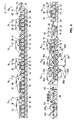
- the forward dryer section D 1 is similar to that shown in Fig. 1, but here the after-dryer 30 is also provided with impingement blow devices 19.
- the last dryer group R 23 in the after-dryer 30 a lower support belt 33 has been arranged, by means of which belt evaporation of water out of the bottom face of the web W is prevented, whereby the curling is regulated.
- the lower support belt 33 is a tight belt, which prevents removal of moisture through the bottom face, in which case the moisture is removed from the opposite side of the web W; thus, since the belt 33 prevents evaporation from the bottom face, the web W is curled towards the bottom face. It is a further advantage of the support belt 33 that here the web runs between two belts 33,15, in which case the web W is supported particularly well.
- a support belt 33 When a support belt 33 is used, its guide rolls 33A are placed at a lower level, approximately at the same level as the bottom edges of the reversing cylinders, in which case the removal of broke is easy as the belt 33 operates as a broke conveyor at the same time.
- the support belt 33 is preferably provided with a drive of its own, in which case its tension can be regulated as required.
- the support belt 33 is preferably a dense wire, whose permeability is low, or a smooth-faced belt.
- the temperature of the belt 33 can be adjusted, it can be cooled and/or heated as required when the curling is controlled. In this connection it is also favourably possible to introduce moist air into the area between the belt 33 and the reversing cylinders 11, whereby the process can be made more efficient.
- the forward dryer section D 1 in the exemplifying embodiment shown in Fig. 3 is similar to those shown in Figs. 1 and 2, but in this exemplifying embodiment the last two dryer groups R 32 ,R 33 in the after-dryer 30 have been formed as dryer groups with twin-wire draw, by means of which groups, thus, the curling is regulated.
- the dryer cylinders 10A, 10B are fitted in two rows, and the cylinders in each row have a wire circulation 15A, 15B of their own guided by the guide rolls 18A,18B, and between the rows the web W has free unsupported draws.
- impingement blow devices 19 have been fitted in the forward dryer section in connection with the drying cylinders 10 in the upper row in view of regulating the curling, increasing the capacity, and providing two-sided drying.
- the exemplifying embodiment shown in Fig. 4 is similar to that shown in Fig. 3, but in this embodiment, in view of controlling the curling, impingement blow equipments 19 have been provided additionally in connection with the first dryer group R 21 in the after-dryer.
- the steam temperature in the cylinders 10 is rather low, in which case the impingement blow devices 19 also provide additional capacity for heating the web W.
- the impingement blow devices 19 of course in connection with all the embodiments described here, that their temperatures can be regulated quickly, in which case, for example, change of the machine from one paper grade to another is quicker, whereby additional production is achieved.
- a larger ratio of diameter of drying cylinder to diameter of reversing roll (D syl /D tela in Fig. 5) is employed, compared with the forward dryer section D 1 , in which case a more uniform evaporation is provided at the top/bottom side, and thereby the curling can be controlled.
- the after-dryer 30 in the finishing section D 2 is composed of two dryer groups R 21 ,R 22 with single-wire draw.
- steam boxes 31 have also been arranged in order to control the curling.
- the exemplifying embodiment as shown in Fig. 5 can be fitted as an after-dryer 30 in connection with the forward dryers D 1 illustrated in the figures described above.
- the drying cylinders 10 have preferably adjustable steam pressures, and, if necessary, it is possible to use impingement blow devices 19 also in connection with these drying cylinders 10 in order to increase the capacity.
- impingement blow devices 19 At the side of the reversing cylinders 11, if necessary, it is possible to provide additional moisture, for example, by bringing moist air from the forward dryer section D 1 , by using a water atomizing equipment, support belts, or equivalent arrangements that have been described above and will be described later.
- an infra dryer 32 is fitted, by whose means the web W is dried intensively from the top side.
- a what is called spreader bar 34 has been fitted also in connection with the web, by means of which bar 34 the longitudinal curling of the web W is worked mechanically.
- the spreader bar 34 is a profiling roll, for example of the spreader roll type, in which case, in order to work the longitudinal curling, by its means it is also easy to act upon the cross-direction curling by means of mechanical working.
- a spreader bar 34 can be fitted at either side of the web or at both sides.
- the exemplifying embodiment shown in Fig. 6D comprises a forward dryer section D 1 with single-wire draw, in which options have been arranged for possible impingement blow devices 19A.
- the regulation of curling has been arranged by means of steam boxes 31 and a water spray device 35 fitted in connection with the last dryer group R 23 in the after-dryer 30.
- the after-dryer there are optional provisions for impingement blow equipments 19A.
- the last two groups R 22 ,R 23 in the after-dryer 30 are provided with lower support belts 33, which prevent evaporation of water, and, moreover, in connection with the last dryer group, steam boxes 31 and a water spray device 35 have been fitted.
- the emphasis is in particular on the control of curling before the calender 40 while the web W is cool.
- a particularly efficient combination is achieved, because, the hotter the web W is, the less readily is the steam condensed, in which connection, when cooling cylinders are used, efficient condensation of the steam is obtained.
- the web W tends to be curled towards the side at which drying takes place last.
- the curling can be affected at different stages in different ways so as to obtain an optimal application.
- the web W can be moistened so that, in the final end of the dryer section, the face(s) of one or several drying cylinders is/are moistened, for example, by means of a water atomizing device fitted preferably in connection with a doctor 14, and the water fed out of said atomizer is vaporized and enters efficiently into contact with the web by the effect of the pressure caused by the wire.
- a water atomizing device fitted preferably in connection with a doctor 14
- the water fed out of said atomizer is vaporized and enters efficiently into contact with the web by the effect of the pressure caused by the wire.
- the patent FI 70,275 related to the present invention instructs to control the temperature of the drying wire so that the drying efficiency can be affected. Similarly, by means of the temperature of the drying wire it is possible to control the unequalsidedness of drying. According to the present invention, in the after-dryer there are devices by whose means the temperature of the drying wire or wires and, thereby, the curling are affected.
- the wire can be heated, for example, by means of a steam box. For cooling, it is possible to use, for example, the methods and devices known from said FI Patent 70,275 .
- the curling can also be controlled by adjusting the humidity and temperature of the air blown through UNORUNTM blow boxes.
- unequalsided evaporation and curling of the web can be affected by means of the humidity of the air in the hood surrounding the web from different sides.
Landscapes
- Paper (AREA)
- Drying Of Solid Materials (AREA)
Abstract
Description
Claims (28)
- A method for drying of paper, which method comprises the following steps:characterized in that, in the method, the effect of said steam box is intensified by cooling the web prior to said steam box.a) the paper web (W) to be dried is passed from the press section into a forward dryer section (D1), in which the paper web (W) is dried from the side of its bottom face in dryer groups (R1...RN) that apply a normal single-wire draw, said forward dryer section (D1) comprising exclusively single-wire groups (R1...RN) with normal single-wire draw,b) from the forward dryer section (D1) the paper web (W) is passed into a finishing section (D2), in which the paper web (W) is coated/surface-sized by means of a coating/surface-sizing equipment (20), dried in an after-dryer section (30), in which the paper web (W) is dried in at least one dryer group (R21) that applies a normal single-wire draw, after which the paper web (W) is calendered in a calender (40) and passed to a reeling station (50), in which the paper web (W) is reeled into a machine reel (MR), andc) the curling of the paper web is controlled by means of elements (19;32;33;34;35;36;Dsyl,Dtela) and/or by means of assemblies and combinations formed out of said elements and by means of at least one steam box (31) at least in the area of the finishing section (D2),
- A method as claimed in claim 1, characterized in that, in connection with the feed of said steam, in order to intensify the condensation, a cooling cylinder with adjustable temperature is employed.
- A method as claimed in claim 1 or 2, characterized in that the temperature of the paper web (W) is lowered by means of moistening.
- A method as claimed in any one of the claims 1 to 3, characterized in that, in the method, the curling of the paper web (W) is affected by means of impingement blow devices (19) placed in the forward dryer section (D1) above a drying cylinder (10)/cylinders, by means of which devices (19) preferably hot, moist air is blown towards the paper web (W).
- A method as claimed in any one of the claims 1 to 4, characterized in that in the after-dryer (30) the curling of the paper web (W) is controlled by means of steam boxes (31), by whose means steam with a content of energy is blown onto the paper web (W) which runs in connection with the reversing cylinders (11) in at least one dryer group (R21,R23) with single-wire draw in the after-dryer (30).
- A method as claimed in any one of the claims 1 to 5, characterized in that, in the method, the curling of the paper web is controlled by means of a lower support wire or belt (33) fitted in at least one dryer group (R21,R22,R23) in the after-dryer (30), by means of which support wire/belt evaporation of moisture downwards from the paper web (W) is prevented.
- A method as claimed in claim 1, characterized in that, in the method, in an after-dryer (30) with at least three dryer groups, the curling of the paper web (W) is controlled in the last two dryer groups in the after-dryer (30), which groups have been arranged as dryer groups (R23,R33) that apply twin-wire draw, the paper web (W) being dried both from the side of its top face and from the side of its bottom face.
- A method as claimed in any one of the claims 1 to 7, characterized in that in the after-dryer (30) the curling of the paper web (W) is controlled by means of an impingement blow equipment (19) placed above a drying cylinder (10) / cylinders (10) in at least one dryer group (R21,R22,R23) with a normal single-wire draw in the after-dryer (30).
- A method as claimed in any one of the claims 1 to 8, characterized in that, in the method, the curling of the paper web (W) is controlled in the dryer groups in the after-dryer (30) so that the paper web (W) is guided over such drying cylinders (10) and reversing rolls (11) whose diameter ratio (Dsyl;Dtela) has been made larger as compared with the forward dryer section (D1) in order that a more uniform drying could be achieved.
- A method as claimed in any one of the preceding claims, characterized in that, in the method, the curling of the paper web is affected by spraying water mist into connection with the paper web (W) by means of a water atomizing device/devices (35) in the after-dryer (30).
- A method as claimed in any one of the preceding claims, characterized in that, in the method, the curling of the paper web (W) is affected by means of through drying of the paper web (W) by means of an infrared dryer (32) before the paper web (W) is passed into the calender (40).
- A method as claimed in any one of the preceding claims, characterized in that, in the method, the curling of the paper web (W) is controlled by blowing moist air towards the paper web (W), which air has preferably been brought from the forward dryer section (D1), by the intermediate of hoods (36) placed in connection with at least one dryer group (R21,R22,R23) in the after-dryer.
- A method as claimed in any one of the preceding claims, characterized in that, in the method, the curling of the paper web (W) is controlled by means of a spreader bar (34), by whose means the paper web (W) is worked mechanically.
- A method as claimed in any one of the claims 1 to 5 or 7 to 13, characterized in that the forward dryer section is exclusively composed of normal groups with single-wire draw that are open towards the bottom, and/or that, in the method, in the after-dryer (30), the paper web (W) is dried substantially exclusively by means of dryer groups (R21,R22,R23) with normal single-wire draw.
- A dry end of a paper machine, which comprises a forward dryer section (D1) and a finishing section (D2), which finishing section (D2) comprises a coating/surface-sizing equipment (20), an after-dryer (30), a calender (40), and a reeling station (50), and the dry end of a paper machine further comprises elements (19;32;33;34;35;36;Dsyl,Dtela) and/or assemblies and combinations formed out of said elements and at least one steam box (31) in view of controlling the curling of the paper web (W) at least in the area of the finishing section (D2), characterized in that said dry end of a paper machine comprises elements for lowering the temperature of the web (W) prior to said steam box in order to intensify the effect of said steam box.
- A dry end of a paper machine as claimed in claim 15, characterized in that, in connection with said supply of steam, in order to intensify the condensation, a cooling cylinder of adjustable temperature is used.
- A dry end of a paper machine as claimed in claim 15 or 16, characterized in that the dry end comprises elements for lowering the temperature of the web (W) by means of moistening.
- A dry end of a paper machine as claimed in any one of the claims 15 to 17, characterized in that the dry end comprises an impingement blow equipment (19) fitted in connection with at least one dryer group above a drying cylinder (10) /cylinders (10) in the forward dryer section (D1) and/or in the after-dryer (30).
- A dry end of a paper machine as claimed in any one of the claims 15 or 18, characterized in that the dry end comprises at least one steam box (31) fitted in the, after-dryer (30) in order to blow steam towards the paper web (W) in connection with the groups (R21,R22,R23) with single-wire draw in the after-dryer (30).
- A dry end of a paper machine as claimed in any one of the claims 15 to 19, characterized in that the dry end comprises at least one support wire or belt (33) fitted in a dryer group (R21,R22,R23) in the after-dryer (30) in order to prevent evaporation of moisture from the paper web (W) downwards.
- A dry end of a paper machine as claimed in any one of the claims 15 to 20, characterized in that the last two dryer groups in the after-dryer (30) are dryer groups (R32,R33) with twin-wire draw.
- A dry end of a paper machine as claimed in any one of the claims 15 to 20, characterized in that in the after-dryer the ratio (Dsyl;Dtela) of the diameter of the drying cylinders is higher than said ratio in the forward dryer section.
- A dry end of a paper machine as claimed in any one of the claims 15 to 22, characterized in that the dry end includes a water atomizing device / devices (35) for the purpose of spraying water mist into connection with the paper web (W) in view of controlling the curling.
- A dry end of a paper machine as claimed in any one of the claims 15 to 23, characterized in that the after-dryer includes an infra dryer (32), which is placed before the paper web is passed into the calender (40).
- A dry end of a paper machine as claimed in any one of the claims 15 to 23, characterized in that the dry end comprises hoods (36) fitted in connection with at least one dryer group in the after-dryer (30) in view of blowing moist air brought from the forward dryer section (D1) towards the paper web.
- A dry end of a paper machine as claimed in any one of the claims 15 to 25, characterized in that in the after-dryer a spreader bar (34) is fitted for working the paper web mechanically and for controlling the curling-of the paper web.
- A dry end of a paper machine as claimed in any one of the claims 15 to 20 or 22 to 26, characterized in that the after-dryer (30) comprises exclusively dryer groups (R21,R22,R23) with a normal single-wire draw.
- A method as claimed in any one of the claims 1 to 14 or a dry end of a paper machine as claimed in any one of the claims 15 to 27, characterized in that said dryer section and auxiliary devices are controlled based on on-line or off-line measurements of curling and quality in view of achieving an optimal ultimate overall quality.
Applications Claiming Priority (3)
| Application Number | Priority Date | Filing Date | Title |
|---|---|---|---|
| FI964830 | 1996-12-03 | ||
| FI964830A FI105935B (en) | 1996-12-03 | 1996-12-03 | Procedure for drying paper and drying in paper machine |
| PCT/FI1997/000745 WO1998027273A1 (en) | 1996-12-03 | 1997-12-02 | Method for drying of paper and dry end of a paper machine |
Publications (3)
| Publication Number | Publication Date |
|---|---|
| EP0943034A1 EP0943034A1 (en) | 1999-09-22 |
| EP0943034B1 true EP0943034B1 (en) | 2002-10-23 |
| EP0943034B2 EP0943034B2 (en) | 2008-12-03 |
Family
ID=8547198
Family Applications (1)
| Application Number | Title | Priority Date | Filing Date |
|---|---|---|---|
| EP97946772A Expired - Lifetime EP0943034B2 (en) | 1996-12-03 | 1997-12-02 | Method for drying of paper and dry end of a paper machine |
Country Status (11)
| Country | Link |
|---|---|
| EP (1) | EP0943034B2 (en) |
| JP (1) | JP3650131B2 (en) |
| KR (1) | KR100391045B1 (en) |
| CN (1) | CN1096529C (en) |
| AT (1) | ATE226660T1 (en) |
| AU (1) | AU5189798A (en) |
| BR (1) | BR9713820A (en) |
| CA (1) | CA2274228C (en) |
| DE (1) | DE69716634T3 (en) |
| FI (1) | FI105935B (en) |
| WO (1) | WO1998027273A1 (en) |
Families Citing this family (26)
| Publication number | Priority date | Publication date | Assignee | Title |
|---|---|---|---|---|
| US5983523A (en) * | 1997-03-27 | 1999-11-16 | Valmet Corporation | Method for controlling curl of paper in a dryer section of a paper machine and a paper or board machine |
| FI103999B1 (en) * | 1997-04-22 | 1999-10-29 | Valmet Corp | Drying unit and drying unit applying them |
| US6038789A (en) * | 1997-05-15 | 2000-03-21 | Valmet Corporation | Method for controlling the curl of paper and a paper or board machine line that applies the method |
| US5992040A (en) * | 1998-02-11 | 1999-11-30 | Beloit Technologies, Inc. | Drying section apparatus |
| EP1125020B1 (en) | 1998-08-04 | 2004-11-17 | Metso Paper, Inc. | Method and arrangement for handling paper or cardboard webs |
| FI106269B (en) | 1999-05-10 | 2000-12-29 | Valmet Corp | Blow arrangement and method for compensating the curl tendency of paper or cardboard webs and a paper or cardboard machine |
| FI991096A7 (en) * | 1999-05-12 | 2000-11-13 | Valmet Corp | Method for producing paper, especially fine paper, and paper machine line, especially for producing fine paper |
| FI121674B (en) * | 2003-01-09 | 2011-02-28 | Metso Paper Inc | Method and apparatus for wetting a moving paper or cardboard web |
| DE10325572A1 (en) * | 2003-06-05 | 2004-12-23 | Voith Paper Patent Gmbh | Process and assembly to make fibrous paper or carton has a final drying stage with short two-line drying unit with water spray jets |
| DE10347953A1 (en) * | 2003-10-15 | 2005-05-19 | Voith Paper Patent Gmbh | Process to prepare a moving web of tissue, paper or carton for a smoothing process by contact cooling and exposure to hot moist air |
| DE102004017807A1 (en) * | 2004-04-13 | 2005-10-27 | Voith Paper Patent Gmbh | dry arrangement |
| JP4651314B2 (en) * | 2004-06-15 | 2011-03-16 | レンゴー株式会社 | Surface smoothing equipment for paper and paperboard |
| DE102006049078A1 (en) * | 2006-10-13 | 2008-04-17 | Voith Patent Gmbh | Apparatus and method for producing a fibrous web |
| DE102006049025A1 (en) * | 2006-10-13 | 2008-04-17 | Voith Patent Gmbh | Apparatus and method for producing a fibrous web |
| DE102006049026A1 (en) * | 2006-10-13 | 2008-04-17 | Voith Patent Gmbh | Apparatus and method for producing a fibrous web |
| DE102008000133A1 (en) * | 2008-01-23 | 2009-07-30 | Voith Patent Gmbh | drying section |
| DE202008005359U1 (en) * | 2008-04-17 | 2008-07-10 | Metso Paper, Inc. | Arrangement for adjusting the curvature of the paper / board web for a heat-sensitive product |
| KR101016727B1 (en) * | 2008-07-30 | 2011-02-25 | 솔거특수지(주) | Method for manufacturing carrier paper for electronic material manufacturing process, apparatus for same and carrier paper manufactured accordingly |
| FI125147B (en) * | 2011-08-31 | 2015-06-15 | Valmet Technologies Inc | System and process for making paper or cardboard |
| CN102888777A (en) * | 2012-10-23 | 2013-01-23 | 河南江河纸业股份有限公司 | High-speed paper machine drying part |
| EP2765237B1 (en) | 2013-02-06 | 2016-11-23 | Valmet Technologies, Inc. | Method for producing a fiber web and production line for producing a fiber web |
| FR3022564B1 (en) * | 2014-06-18 | 2017-06-30 | Allimand | METHOD FOR DRYING CIGARETTE PAPER STRIP AND CIGARETTE PAPER THUS OBTAINED |
| WO2018171959A1 (en) * | 2017-03-21 | 2018-09-27 | Voith Patent Gmbh | Web treatment |
| DE102018119383A1 (en) * | 2018-08-09 | 2020-02-13 | Voith Patent Gmbh | Machine and method for producing a corrugated base paper web |
| CN112127200A (en) * | 2020-09-30 | 2020-12-25 | 湖北中烟工业有限责任公司 | A humidification system for humidifying inner lining paper with saturated steam |
| CN114622434A (en) * | 2022-04-18 | 2022-06-14 | 广东理文造纸有限公司 | Hot cylinder temperature control coating device and temperature control method thereof |
Family Cites Families (10)
| Publication number | Priority date | Publication date | Assignee | Title |
|---|---|---|---|---|
| US3948721A (en) † | 1974-09-03 | 1976-04-06 | Winheim Karl H | Method and apparatus for wetting the web in paper making machines |
| WO1987002722A1 (en) † | 1985-11-06 | 1987-05-07 | Scott Paper Company | Method of finishing paper utilizing substrata thermal molding |
| FI91900C (en) * | 1990-12-17 | 1994-08-25 | Valmet Paper Machinery Inc | Process at the drying portion of a paper machine to reduce the curvature tendency and drying portion of the paper intended to carry out the procedure |
| DE4112537C2 (en) † | 1991-04-17 | 1994-06-01 | Escher Wyss Gmbh | Smoothness generating device |
| FI95061C (en) † | 1993-03-08 | 1995-12-11 | Valmet Paper Machinery Inc | Method of calendering paper web and calender for application of the method |
| FI103820B1 (en) * | 1993-11-30 | 1999-09-30 | Valmet Paper Machinery Inc | Procedures for drying a paper web and drying parts for paper machine |
| FI93876C (en) * | 1994-03-25 | 1995-06-12 | Valmet Paper Machinery Inc | Drying section in paper machine, where there are cylinder groups with simple twisting |
| DE4415581C2 (en) * | 1994-05-04 | 1995-12-07 | Voith Gmbh J M | Paper coating device |
| FI98387C (en) * | 1995-02-01 | 1997-06-10 | Valmet Corp | Process for making surface-treated paper, especially fine paper, and dry end for a paper machine |
| FI104276B (en) * | 1995-04-12 | 1999-12-15 | Valmet Corp | Drying party concept and process for drying a paper web / cardboard web |
-
1996
- 1996-12-03 FI FI964830A patent/FI105935B/en active
-
1997
- 1997-12-02 CN CN97180247A patent/CN1096529C/en not_active Expired - Fee Related
- 1997-12-02 BR BR9713820-7A patent/BR9713820A/en not_active IP Right Cessation
- 1997-12-02 AU AU51897/98A patent/AU5189798A/en not_active Abandoned
- 1997-12-02 EP EP97946772A patent/EP0943034B2/en not_active Expired - Lifetime
- 1997-12-02 WO PCT/FI1997/000745 patent/WO1998027273A1/en not_active Ceased
- 1997-12-02 JP JP52708098A patent/JP3650131B2/en not_active Expired - Fee Related
- 1997-12-02 CA CA002274228A patent/CA2274228C/en not_active Expired - Fee Related
- 1997-12-02 AT AT97946772T patent/ATE226660T1/en active
- 1997-12-02 KR KR10-1999-7003902A patent/KR100391045B1/en not_active Expired - Fee Related
- 1997-12-02 DE DE69716634T patent/DE69716634T3/en not_active Expired - Lifetime
Also Published As
| Publication number | Publication date |
|---|---|
| JP3650131B2 (en) | 2005-05-18 |
| EP0943034B2 (en) | 2008-12-03 |
| FI964830A7 (en) | 1998-06-04 |
| CN1239527A (en) | 1999-12-22 |
| KR100391045B1 (en) | 2003-07-12 |
| KR20000053015A (en) | 2000-08-25 |
| DE69716634T3 (en) | 2009-07-16 |
| CA2274228C (en) | 2007-03-27 |
| AU5189798A (en) | 1998-07-15 |
| ATE226660T1 (en) | 2002-11-15 |
| FI105935B (en) | 2000-10-31 |
| BR9713820A (en) | 2000-03-14 |
| CA2274228A1 (en) | 1998-06-25 |
| EP0943034A1 (en) | 1999-09-22 |
| CN1096529C (en) | 2002-12-18 |
| FI964830A0 (en) | 1996-12-03 |
| WO1998027273A1 (en) | 1998-06-25 |
| DE69716634T2 (en) | 2003-06-26 |
| JP2001505630A (en) | 2001-04-24 |
| DE69716634D1 (en) | 2002-11-28 |
Similar Documents
| Publication | Publication Date | Title |
|---|---|---|
| US6001421A (en) | Method for drying paper and a dry end of a paper machine | |
| EP0943034B2 (en) | Method for drying of paper and dry end of a paper machine | |
| EP0916763B1 (en) | Method for producing surface-treated paper and dry end of a paper machine | |
| US5968590A (en) | Method for drying a surface-treated paper web in an after-dryer of a paper machine and after-dryer of a paper machine | |
| US5775001A (en) | Dryer sections of a paper machine | |
| US6038789A (en) | Method for controlling the curl of paper and a paper or board machine line that applies the method | |
| WO1999032714A1 (en) | Method and apparatus for drying a paper web | |
| US6061927A (en) | Method for controlling curl of paper in a dryer section of a paper machine | |
| EP1012383B1 (en) | Method for control of the curl of paper in the dryer section of a paper machine and paper or board machine | |
| CA2336034A1 (en) | Dryer section | |
| US6193840B1 (en) | Method for producing surface-treated paper | |
| WO1998012380A1 (en) | Method for drying a surface-treated paper web or equivalent in an after-dryer of a paper machine and after-dryer carrying out the method in a paper machine | |
| US20060118257A1 (en) | Method for control of the curl of paper in the treatment of surface-sized paper, and finishing section of a paper machine | |
| US6094838A (en) | Curl and profile correction with high velocity hoods | |
| US5925407A (en) | Method for drying a surface-treated paper web in an after-dryer of a paper machine and after-dryer of a paper machine | |
| WO1998051857A1 (en) | Method for controlling the curl of paper and a paper or board machine line that applies the method | |
| US6280576B1 (en) | After-dryer in a paper machine | |
| WO2000000696A1 (en) | Method and apparatus for moistening the paper web in the drying section | |
| WO1998004777A1 (en) | Method for drying a paper to be surface-treated, in particular fine paper, in an after-dryer in a paper machine, and an after-dryer in a paper machine for carrying out the method |
Legal Events
| Date | Code | Title | Description |
|---|---|---|---|
| PUAI | Public reference made under article 153(3) epc to a published international application that has entered the european phase |
Free format text: ORIGINAL CODE: 0009012 |
|
| 17P | Request for examination filed |
Effective date: 19990504 |
|
| AK | Designated contracting states |
Kind code of ref document: A1 Designated state(s): AT DE ES FR GB IT PT SE |
|
| 17Q | First examination report despatched |
Effective date: 20010808 |
|
| RAP1 | Party data changed (applicant data changed or rights of an application transferred) |
Owner name: METSO PAPER, INC. |
|
| GRAG | Despatch of communication of intention to grant |
Free format text: ORIGINAL CODE: EPIDOS AGRA |
|
| GRAG | Despatch of communication of intention to grant |
Free format text: ORIGINAL CODE: EPIDOS AGRA |
|
| GRAH | Despatch of communication of intention to grant a patent |
Free format text: ORIGINAL CODE: EPIDOS IGRA |
|
| GRAH | Despatch of communication of intention to grant a patent |
Free format text: ORIGINAL CODE: EPIDOS IGRA |
|
| GRAA | (expected) grant |
Free format text: ORIGINAL CODE: 0009210 |
|
| AK | Designated contracting states |
Kind code of ref document: B1 Designated state(s): AT DE ES FR GB IT PT SE |
|
| PG25 | Lapsed in a contracting state [announced via postgrant information from national office to epo] |
Ref country code: FR Free format text: LAPSE BECAUSE OF FAILURE TO SUBMIT A TRANSLATION OF THE DESCRIPTION OR TO PAY THE FEE WITHIN THE PRESCRIBED TIME-LIMIT Effective date: 20021023 |
|
| REF | Corresponds to: |
Ref document number: 226660 Country of ref document: AT Date of ref document: 20021115 Kind code of ref document: T |
|
| REG | Reference to a national code |
Ref country code: GB Ref legal event code: FG4D |
|
| REF | Corresponds to: |
Ref document number: 69716634 Country of ref document: DE Date of ref document: 20021128 |
|
| PG25 | Lapsed in a contracting state [announced via postgrant information from national office to epo] |
Ref country code: PT Free format text: LAPSE BECAUSE OF FAILURE TO SUBMIT A TRANSLATION OF THE DESCRIPTION OR TO PAY THE FEE WITHIN THE PRESCRIBED TIME-LIMIT Effective date: 20030123 Ref country code: GB Free format text: LAPSE BECAUSE OF NON-PAYMENT OF DUE FEES Effective date: 20030123 |
|
| PG25 | Lapsed in a contracting state [announced via postgrant information from national office to epo] |
Ref country code: ES Free format text: LAPSE BECAUSE OF FAILURE TO SUBMIT A TRANSLATION OF THE DESCRIPTION OR TO PAY THE FEE WITHIN THE PRESCRIBED TIME-LIMIT Effective date: 20030429 |
|
| PLBQ | Unpublished change to opponent data |
Free format text: ORIGINAL CODE: EPIDOS OPPO |
|
| PLBI | Opposition filed |
Free format text: ORIGINAL CODE: 0009260 |
|
| EN | Fr: translation not filed | ||
| GBPC | Gb: european patent ceased through non-payment of renewal fee | ||
| PLAX | Notice of opposition and request to file observation + time limit sent |
Free format text: ORIGINAL CODE: EPIDOSNOBS2 |
|
| 26 | Opposition filed |
Opponent name: VOITH PAPER PATENT GMBH Effective date: 20030723 |
|
| PLAX | Notice of opposition and request to file observation + time limit sent |
Free format text: ORIGINAL CODE: EPIDOSNOBS2 |
|
| PLBB | Reply of patent proprietor to notice(s) of opposition received |
Free format text: ORIGINAL CODE: EPIDOSNOBS3 |
|
| APBP | Date of receipt of notice of appeal recorded |
Free format text: ORIGINAL CODE: EPIDOSNNOA2O |
|
| APAH | Appeal reference modified |
Free format text: ORIGINAL CODE: EPIDOSCREFNO |
|
| APBQ | Date of receipt of statement of grounds of appeal recorded |
Free format text: ORIGINAL CODE: EPIDOSNNOA3O |
|
| APAH | Appeal reference modified |
Free format text: ORIGINAL CODE: EPIDOSCREFNO |
|
| APBU | Appeal procedure closed |
Free format text: ORIGINAL CODE: EPIDOSNNOA9O |
|
| PGFP | Annual fee paid to national office [announced via postgrant information from national office to epo] |
Ref country code: IT Payment date: 20071221 Year of fee payment: 11 |
|
| PGFP | Annual fee paid to national office [announced via postgrant information from national office to epo] |
Ref country code: SE Payment date: 20071213 Year of fee payment: 11 |
|
| PUAH | Patent maintained in amended form |
Free format text: ORIGINAL CODE: 0009272 |
|
| STAA | Information on the status of an ep patent application or granted ep patent |
Free format text: STATUS: PATENT MAINTAINED AS AMENDED |
|
| 27A | Patent maintained in amended form |
Effective date: 20081203 |
|
| AK | Designated contracting states |
Kind code of ref document: B2 Designated state(s): AT DE ES FR GB IT PT SE |
|
| REG | Reference to a national code |
Ref country code: ES Ref legal event code: FD2A Effective date: 20021203 |
|
| PG25 | Lapsed in a contracting state [announced via postgrant information from national office to epo] |
Ref country code: SE Free format text: LAPSE BECAUSE OF NON-PAYMENT OF DUE FEES Effective date: 20081203 |
|
| PGFP | Annual fee paid to national office [announced via postgrant information from national office to epo] |
Ref country code: AT Payment date: 20121212 Year of fee payment: 16 |
|
| PG25 | Lapsed in a contracting state [announced via postgrant information from national office to epo] |
Ref country code: IT Free format text: LAPSE BECAUSE OF NON-PAYMENT OF DUE FEES Effective date: 20081202 |
|
| PGFP | Annual fee paid to national office [announced via postgrant information from national office to epo] |
Ref country code: DE Payment date: 20131220 Year of fee payment: 17 |
|
| REG | Reference to a national code |
Ref country code: AT Ref legal event code: MM01 Ref document number: 226660 Country of ref document: AT Kind code of ref document: T Effective date: 20131202 |
|
| PG25 | Lapsed in a contracting state [announced via postgrant information from national office to epo] |
Ref country code: AT Free format text: LAPSE BECAUSE OF NON-PAYMENT OF DUE FEES Effective date: 20131202 |
|
| REG | Reference to a national code |
Ref country code: DE Ref legal event code: R119 Ref document number: 69716634 Country of ref document: DE |
|
| PG25 | Lapsed in a contracting state [announced via postgrant information from national office to epo] |
Ref country code: DE Free format text: LAPSE BECAUSE OF NON-PAYMENT OF DUE FEES Effective date: 20150701 |