EP0930014B1 - Pâte à gâteau avec matière grasse ajoutée et son procédé de preparation - Google Patents
Pâte à gâteau avec matière grasse ajoutée et son procédé de preparation Download PDFInfo
- Publication number
- EP0930014B1 EP0930014B1 EP98403083A EP98403083A EP0930014B1 EP 0930014 B1 EP0930014 B1 EP 0930014B1 EP 98403083 A EP98403083 A EP 98403083A EP 98403083 A EP98403083 A EP 98403083A EP 0930014 B1 EP0930014 B1 EP 0930014B1
- Authority
- EP
- European Patent Office
- Prior art keywords
- fat
- dough
- added
- mixer
- mixture
- Prior art date
- Legal status (The legal status is an assumption and is not a legal conclusion. Google has not performed a legal analysis and makes no representation as to the accuracy of the status listed.)
- Expired - Lifetime
Links
- 238000000034 method Methods 0.000 title claims description 94
- 238000004519 manufacturing process Methods 0.000 title claims description 7
- 239000000203 mixture Substances 0.000 claims abstract description 59
- 230000003068 static effect Effects 0.000 claims abstract description 42
- 239000003995 emulsifying agent Substances 0.000 claims abstract description 22
- WQZGKKKJIJFFOK-GASJEMHNSA-N Glucose Natural products OC[C@H]1OC(O)[C@H](O)[C@@H](O)[C@@H]1O WQZGKKKJIJFFOK-GASJEMHNSA-N 0.000 claims abstract description 19
- 239000008103 glucose Substances 0.000 claims abstract description 18
- 235000000346 sugar Nutrition 0.000 claims abstract description 18
- 235000013312 flour Nutrition 0.000 claims abstract description 15
- 239000006188 syrup Substances 0.000 claims abstract description 14
- 235000020357 syrup Nutrition 0.000 claims abstract description 14
- 239000004615 ingredient Substances 0.000 claims abstract description 12
- XLYOFNOQVPJJNP-UHFFFAOYSA-N water Substances O XLYOFNOQVPJJNP-UHFFFAOYSA-N 0.000 claims abstract description 11
- 150000003839 salts Chemical class 0.000 claims abstract description 9
- 239000002245 particle Substances 0.000 claims description 19
- 230000036961 partial effect Effects 0.000 claims description 14
- 230000010354 integration Effects 0.000 claims description 12
- 238000002156 mixing Methods 0.000 claims description 12
- 238000004458 analytical method Methods 0.000 claims description 11
- 239000000843 powder Substances 0.000 claims description 10
- 230000002829 reductive effect Effects 0.000 claims description 10
- 238000002360 preparation method Methods 0.000 claims description 9
- 230000009471 action Effects 0.000 claims description 8
- 238000002347 injection Methods 0.000 claims description 8
- 239000007924 injection Substances 0.000 claims description 8
- 238000011144 upstream manufacturing Methods 0.000 claims description 5
- 238000005273 aeration Methods 0.000 claims description 3
- 238000010561 standard procedure Methods 0.000 claims 1
- 235000010855 food raising agent Nutrition 0.000 abstract 1
- 230000008569 process Effects 0.000 description 56
- 238000012360 testing method Methods 0.000 description 30
- 239000003921 oil Substances 0.000 description 16
- 235000019198 oils Nutrition 0.000 description 16
- 235000013601 eggs Nutrition 0.000 description 13
- 239000007788 liquid Substances 0.000 description 8
- 238000002844 melting Methods 0.000 description 6
- 230000008018 melting Effects 0.000 description 6
- 230000001953 sensory effect Effects 0.000 description 6
- 241000209504 Poaceae Species 0.000 description 5
- 238000010411 cooking Methods 0.000 description 5
- 238000005259 measurement Methods 0.000 description 5
- 235000011837 pasties Nutrition 0.000 description 5
- 229920002472 Starch Polymers 0.000 description 4
- 235000019219 chocolate Nutrition 0.000 description 4
- 239000008107 starch Substances 0.000 description 4
- 235000019698 starch Nutrition 0.000 description 4
- 241001323319 Psen Species 0.000 description 3
- 240000008042 Zea mays Species 0.000 description 3
- 230000008901 benefit Effects 0.000 description 3
- 235000013339 cereals Nutrition 0.000 description 3
- 239000012530 fluid Substances 0.000 description 3
- 230000004907 flux Effects 0.000 description 3
- 238000001033 granulometry Methods 0.000 description 3
- 230000000670 limiting effect Effects 0.000 description 3
- 239000000463 material Substances 0.000 description 3
- UDHXJZHVNHGCEC-UHFFFAOYSA-N Chlorophacinone Chemical compound C1=CC(Cl)=CC=C1C(C=1C=CC=CC=1)C(=O)C1C(=O)C2=CC=CC=C2C1=O UDHXJZHVNHGCEC-UHFFFAOYSA-N 0.000 description 2
- 235000019483 Peanut oil Nutrition 0.000 description 2
- 235000019484 Rapeseed oil Nutrition 0.000 description 2
- 240000004808 Saccharomyces cerevisiae Species 0.000 description 2
- 235000014680 Saccharomyces cerevisiae Nutrition 0.000 description 2
- UIIMBOGNXHQVGW-UHFFFAOYSA-M Sodium bicarbonate Chemical compound [Na+].OC([O-])=O UIIMBOGNXHQVGW-UHFFFAOYSA-M 0.000 description 2
- 235000015895 biscuits Nutrition 0.000 description 2
- 238000010924 continuous production Methods 0.000 description 2
- 235000005911 diet Nutrition 0.000 description 2
- 230000000378 dietary effect Effects 0.000 description 2
- 235000014113 dietary fatty acids Nutrition 0.000 description 2
- 238000009826 distribution Methods 0.000 description 2
- 230000000694 effects Effects 0.000 description 2
- 150000002148 esters Chemical class 0.000 description 2
- 238000011156 evaluation Methods 0.000 description 2
- 229930195729 fatty acid Natural products 0.000 description 2
- 239000000194 fatty acid Substances 0.000 description 2
- 150000004665 fatty acids Chemical class 0.000 description 2
- 235000001727 glucose Nutrition 0.000 description 2
- 238000000386 microscopy Methods 0.000 description 2
- 239000011088 parchment paper Substances 0.000 description 2
- 235000014594 pastries Nutrition 0.000 description 2
- 239000000312 peanut oil Substances 0.000 description 2
- 230000006798 recombination Effects 0.000 description 2
- 238000005215 recombination Methods 0.000 description 2
- 238000010008 shearing Methods 0.000 description 2
- 150000008163 sugars Chemical class 0.000 description 2
- 238000011282 treatment Methods 0.000 description 2
- 210000003462 vein Anatomy 0.000 description 2
- IIZPXYDJLKNOIY-JXPKJXOSSA-N 1-palmitoyl-2-arachidonoyl-sn-glycero-3-phosphocholine Chemical class CCCCCCCCCCCCCCCC(=O)OC[C@H](COP([O-])(=O)OCC[N+](C)(C)C)OC(=O)CCC\C=C/C\C=C/C\C=C/C\C=C/CCCCC IIZPXYDJLKNOIY-JXPKJXOSSA-N 0.000 description 1
- OWEGMIWEEQEYGQ-UHFFFAOYSA-N 100676-05-9 Natural products OC1C(O)C(O)C(CO)OC1OCC1C(O)C(O)C(O)C(OC2C(OC(O)C(O)C2O)CO)O1 OWEGMIWEEQEYGQ-UHFFFAOYSA-N 0.000 description 1
- GUBGYTABKSRVRQ-XLOQQCSPSA-N Alpha-Lactose Chemical compound O[C@@H]1[C@@H](O)[C@@H](O)[C@@H](CO)O[C@H]1O[C@@H]1[C@@H](CO)O[C@H](O)[C@H](O)[C@H]1O GUBGYTABKSRVRQ-XLOQQCSPSA-N 0.000 description 1
- 240000002791 Brassica napus Species 0.000 description 1
- PHOQVHQSTUBQQK-SQOUGZDYSA-N D-glucono-1,5-lactone Chemical compound OC[C@H]1OC(=O)[C@H](O)[C@@H](O)[C@@H]1O PHOQVHQSTUBQQK-SQOUGZDYSA-N 0.000 description 1
- QSJXEFYPDANLFS-UHFFFAOYSA-N Diacetyl Chemical group CC(=O)C(C)=O QSJXEFYPDANLFS-UHFFFAOYSA-N 0.000 description 1
- GUBGYTABKSRVRQ-QKKXKWKRSA-N Lactose Natural products OC[C@H]1O[C@@H](O[C@H]2[C@H](O)[C@@H](O)C(O)O[C@@H]2CO)[C@H](O)[C@@H](O)[C@H]1O GUBGYTABKSRVRQ-QKKXKWKRSA-N 0.000 description 1
- GUBGYTABKSRVRQ-PICCSMPSSA-N Maltose Natural products O[C@@H]1[C@@H](O)[C@H](O)[C@@H](CO)O[C@@H]1O[C@@H]1[C@@H](CO)OC(O)[C@H](O)[C@H]1O GUBGYTABKSRVRQ-PICCSMPSSA-N 0.000 description 1
- 206010039424 Salivary hypersecretion Diseases 0.000 description 1
- CZMRCDWAGMRECN-UGDNZRGBSA-N Sucrose Chemical compound O[C@H]1[C@H](O)[C@@H](CO)O[C@@]1(CO)O[C@@H]1[C@H](O)[C@@H](O)[C@H](O)[C@@H](CO)O1 CZMRCDWAGMRECN-UGDNZRGBSA-N 0.000 description 1
- 229930006000 Sucrose Natural products 0.000 description 1
- TVXBFESIOXBWNM-UHFFFAOYSA-N Xylitol Natural products OCCC(O)C(O)C(O)CCO TVXBFESIOXBWNM-UHFFFAOYSA-N 0.000 description 1
- 238000013019 agitation Methods 0.000 description 1
- 239000008346 aqueous phase Substances 0.000 description 1
- 238000010923 batch production Methods 0.000 description 1
- 238000010009 beating Methods 0.000 description 1
- FFBHFFJDDLITSX-UHFFFAOYSA-N benzyl N-[2-hydroxy-4-(3-oxomorpholin-4-yl)phenyl]carbamate Chemical compound OC1=C(NC(=O)OCC2=CC=CC=C2)C=CC(=C1)N1CCOCC1=O FFBHFFJDDLITSX-UHFFFAOYSA-N 0.000 description 1
- WQZGKKKJIJFFOK-VFUOTHLCSA-N beta-D-glucose Chemical compound OC[C@H]1O[C@@H](O)[C@H](O)[C@@H](O)[C@@H]1O WQZGKKKJIJFFOK-VFUOTHLCSA-N 0.000 description 1
- GUBGYTABKSRVRQ-QUYVBRFLSA-N beta-maltose Chemical compound OC[C@H]1O[C@H](O[C@H]2[C@H](O)[C@@H](O)[C@H](O)O[C@@H]2CO)[C@H](O)[C@@H](O)[C@@H]1O GUBGYTABKSRVRQ-QUYVBRFLSA-N 0.000 description 1
- 210000000601 blood cell Anatomy 0.000 description 1
- 230000001055 chewing effect Effects 0.000 description 1
- 230000000052 comparative effect Effects 0.000 description 1
- 235000009508 confectionery Nutrition 0.000 description 1
- 238000010276 construction Methods 0.000 description 1
- 238000007796 conventional method Methods 0.000 description 1
- 235000014510 cooky Nutrition 0.000 description 1
- 239000008121 dextrose Substances 0.000 description 1
- 235000019820 disodium diphosphate Nutrition 0.000 description 1
- GYQBBRRVRKFJRG-UHFFFAOYSA-L disodium pyrophosphate Chemical compound [Na+].[Na+].OP([O-])(=O)OP(O)([O-])=O GYQBBRRVRKFJRG-UHFFFAOYSA-L 0.000 description 1
- 238000006073 displacement reaction Methods 0.000 description 1
- 235000014103 egg white Nutrition 0.000 description 1
- 210000000969 egg white Anatomy 0.000 description 1
- 239000000796 flavoring agent Substances 0.000 description 1
- 235000019634 flavors Nutrition 0.000 description 1
- 238000011010 flushing procedure Methods 0.000 description 1
- 238000005194 fractionation Methods 0.000 description 1
- 235000012209 glucono delta-lactone Nutrition 0.000 description 1
- 239000000182 glucono-delta-lactone Substances 0.000 description 1
- 229960003681 gluconolactone Drugs 0.000 description 1
- 230000007062 hydrolysis Effects 0.000 description 1
- 238000006460 hydrolysis reaction Methods 0.000 description 1
- 229910052500 inorganic mineral Inorganic materials 0.000 description 1
- 238000009434 installation Methods 0.000 description 1
- 238000004898 kneading Methods 0.000 description 1
- 239000008101 lactose Substances 0.000 description 1
- 239000000787 lecithin Substances 0.000 description 1
- 235000010445 lecithin Nutrition 0.000 description 1
- 229940067606 lecithin Drugs 0.000 description 1
- 239000000845 maltitol Substances 0.000 description 1
- VQHSOMBJVWLPSR-WUJBLJFYSA-N maltitol Chemical compound OC[C@H](O)[C@@H](O)[C@@H]([C@H](O)CO)O[C@H]1O[C@H](CO)[C@@H](O)[C@H](O)[C@H]1O VQHSOMBJVWLPSR-WUJBLJFYSA-N 0.000 description 1
- 235000010449 maltitol Nutrition 0.000 description 1
- 229940035436 maltitol Drugs 0.000 description 1
- 238000005399 mechanical ventilation Methods 0.000 description 1
- HEBKCHPVOIAQTA-UHFFFAOYSA-N meso ribitol Natural products OCC(O)C(O)C(O)CO HEBKCHPVOIAQTA-UHFFFAOYSA-N 0.000 description 1
- 239000011707 mineral Substances 0.000 description 1
- 235000010755 mineral Nutrition 0.000 description 1
- 239000002674 ointment Substances 0.000 description 1
- 210000000056 organ Anatomy 0.000 description 1
- 238000003921 particle size analysis Methods 0.000 description 1
- 235000015927 pasta Nutrition 0.000 description 1
- 239000012071 phase Substances 0.000 description 1
- 229920000223 polyglycerol Chemical class 0.000 description 1
- 238000004321 preservation Methods 0.000 description 1
- 230000000135 prohibitive effect Effects 0.000 description 1
- 230000035755 proliferation Effects 0.000 description 1
- 239000002994 raw material Substances 0.000 description 1
- 238000011084 recovery Methods 0.000 description 1
- 230000009467 reduction Effects 0.000 description 1
- 208000026451 salivation Diseases 0.000 description 1
- 238000005070 sampling Methods 0.000 description 1
- 229910000030 sodium bicarbonate Inorganic materials 0.000 description 1
- 235000017557 sodium bicarbonate Nutrition 0.000 description 1
- 239000007787 solid Substances 0.000 description 1
- 238000003756 stirring Methods 0.000 description 1
- 239000000126 substance Substances 0.000 description 1
- 239000005720 sucrose Substances 0.000 description 1
- 230000009747 swallowing Effects 0.000 description 1
- 230000008961 swelling Effects 0.000 description 1
- 230000002522 swelling effect Effects 0.000 description 1
- 238000010998 test method Methods 0.000 description 1
- 238000012549 training Methods 0.000 description 1
- 238000009423 ventilation Methods 0.000 description 1
- 239000000811 xylitol Substances 0.000 description 1
- 235000010447 xylitol Nutrition 0.000 description 1
- HEBKCHPVOIAQTA-SCDXWVJYSA-N xylitol Chemical compound OC[C@H](O)[C@@H](O)[C@H](O)CO HEBKCHPVOIAQTA-SCDXWVJYSA-N 0.000 description 1
- 229960002675 xylitol Drugs 0.000 description 1
Images



Classifications
-
- A—HUMAN NECESSITIES
- A21—BAKING; EDIBLE DOUGHS
- A21D—TREATMENT OF FLOUR OR DOUGH FOR BAKING, e.g. BY ADDITION OF MATERIALS; BAKING; BAKERY PRODUCTS
- A21D8/00—Methods for preparing or baking dough
- A21D8/02—Methods for preparing dough; Treating dough prior to baking
-
- A—HUMAN NECESSITIES
- A21—BAKING; EDIBLE DOUGHS
- A21D—TREATMENT OF FLOUR OR DOUGH FOR BAKING, e.g. BY ADDITION OF MATERIALS; BAKING; BAKERY PRODUCTS
- A21D13/00—Finished or partly finished bakery products
- A21D13/50—Solidified foamed products, e.g. meringues
Definitions
- the present invention relates to a new cake batter with fat added, capable of being obtained by expansion.
- the present invention also relates to a process for preparing a dough plentiful with added fat, intended in particular for making sponge cakes, spoon cookies, boudoirs etc ...
- the present invention also relates to a device for implementing of this process.
- a floury dough of the kind indicated at the beginning it is known to prepare a mixture of all the ingredients, which typically include eggs, flour, sugar and added fat, such as rapeseed oil, and subjecting this mixture to the action of a device called a "blower" which causes a mechanical ventilation of the mixture.
- a paste is thus obtained incorporating gas bubbles without necessarily having to resort to the chemical action of yeasts.
- Mixtures incorporating added fat offer a fairly high resistance to swelling. It is known to compensate for this resistance by means of emulsifiers that are incorporated into the mixture before expansion.
- the expansion corresponds substantially to a strong agitation step shear, obtained by the action of a rotor rotating at high speed.
- the known process provides, after cooking under certain conditions, a dough whose texture is perceived as pasty and not very melting. We could think of improve the "melting" character of the dough obtained, and reduce its pasty character by increasing the proportion of fat added in the initial mixture. But this is dietary disadvantage. In addition, the initial mixture will be found all the more resistant to the swelling action and it will therefore be necessary to increase so concomitantly the proportion of emulsifiers to avoid the increase in the density of product obtained.
- the purpose of the present invention is to get out of this dilemma by proposing a continuous process and a device for preparing an expanded dough can be light, airy and melting with a proportion of fat which can be reduced and an emulsifier level can be reduced, or even canceled.
- GB-A-970 715 relates to dry preparations for sponge cake, it is ie pre-mixes for the preparation of cakes.
- the use of these premixes is such that the fat is added with the flour, yeast and sugar after beating the egg whites.
- the process for continuously preparing an expanded dough, with added fat, including an expansion step applied to a mixture of dough ingredients is characterized in that after the expansion step we proceed to a step of integration of the added fat.
- the expansion step splits fat into extremely small globules with a diameter on the order of a micron.
- these particles are too small to release fat into the consumer's mouth. This seems explain the loss of fondant and the feeling of mushiness that is felt even with relatively high proportion of added fat.
- this drawback is remedied by integrating the fat added in a step following the expansion.
- the emulsifiers are not no longer necessary to complete the expansion stage. Even if we have totally removed the emulsifiers, the expanded dough and the cooked product obtained can be significantly less dense than with the conventional process. However, in the framework of the invention, provide a certain proportion of emulsifiers to improve the conservation of the product.
- shear which is calculated by dividing the speed of circulation of the fluid by the hydraulic diameter. It is considered that the shear which accompanies the expansion stage is typically from 800 to 1500s -1 .
- the shearing involved in the step of integrating the added fat is much lower than that involved in the bulking step, and is advantageously between 20s -1 and 100s -1 , preferably being of 50s -1 .
- a shear of less than 20s -1 generally does not ensure a homogeneous distribution of the fatty matter added to the mixture previously expanded.
- certain known mixers which simply have the effect of giving the fluid a helical movement in a conduit, have proved to be ineffective for the implementation of the invention.
- a shear greater than 100 s -1 tends to disperse the added fatty matter into globules whose volume is too small to be optimal with regard to the organoleptic qualities sought, in particular the "melting" character and the “airy” character sought.
- the invention therefore provides a process for preparing cake dough in which ingredients are continuously mixed, allowing the process to be perfectly controlled, therefore repeatable. Control of continuous shearing thanks to the process allows just sufficient mechanical work to be applied to the required mixture ingredients with perfect regularity.
- the continuous process therefore has an important advantage over batch process, also called "batch” process, which is a delicate operation and difficult to control and which can lead to an irregularity between the different products finished resulting from the conduct of a production.
- a discontinuous process is limiting in an industrial setting.
- a static mixer allows, by subjecting the product at an acceptable pressure for the preservation of its quality, to ensure a good distribution of the fat added in the expanded mixture in the form of globules whose average diameter is preferably from 5 to 25 ⁇ m.
- the amount of fat added is preferably substantially understood from 2 to 20%, in particular from 2 to 10% of the total weight of the raw dough resulting from the stage integration.
- the amount of fat added is between 2% and 20%, in particular from 2 to 10%, which corresponds to the content of known products, the qualities organoleptics of the product obtained are improved.
- the feeling of fondant is significantly increased.
- the density of the product may be lower, thanks to better ventilation during the expansion stage, even in the absence emulsifiers.
- the amount of fat is added in an amount less than 15%, and notably less than or equal to 10%, and more particularly in an amount of 2 to 10%, and in particular from 2 to 8%.
- the quantity of added fat is from 5 to 10%.
- the method makes it possible to make a more dietetic product with at least organoleptic qualities equivalent to those of previous products.
- the process according to the invention makes it possible to choose to a large extent the degree of aeration obtained by the expansion step, by simply adjusting the air flow which is injected into mixing during this step.
- the aeration is adjusted so that the density of the raw dough obtained after the integration step is between 400 and 800 kg / m 3 .
- the device for manufacturing a expanded pulp by implementing the method according to the first aspect comprising a profiteer mounted between a mixture inlet and a raw dough outlet, is characterized in that it comprises a moderate shear mixer mounted downstream of the buzzer, and a fat injection device opening out between the buzzer and the mixer.
- the mixer is of the static type, and preferably comprises, in the path of the dough, organs which subdivide the dough flow into partial flows, subject neighboring flows to different deviations, and recombine partial flows initially distant from each other.
- a mixer is particularly suitable for make a forced mixture of the expanded dough on the one hand and the added fat on the other hand.
- we can measure the mixing action so as to obtain the added fat for the desired size of blood cells. This proved to be possible without the pressure to be applied in upstream of the static mixer reaches a prohibitive value.
- the number of divisions of flow defined by the mixer can be between 20 and 300 divisions, preferably between 100 and 200 divisions.
- the mixer has a length of 600mm, a diameter of 50mm and defines 180 flow subdivisions for a flow rate of 200kg / h.
- This flow corresponds to a speed of 4cm / s for a density of 700kg / m 3 and 5cm / s for a density of 550 kg / m 3 .
- the number of flow subdivisions defined by the mixer must, depending on test, be slightly increased when the flow rate and therefore the section increase, by so that initial fat pockets that are likely to be larger at the inlet of the larger diameter static mixer is reduced to the size of globules required at the mixer outlet.
- the subdivisions defined by the mixer are counted additively. For example, two successive elements producing 15 subdivisions each are considered to operate 30 subdivisions in all.
- the pump located upstream of the overrun may be sufficient to provide the pressure required for entry of static mixer. If, however, it is feared that a too high pressure in the blower, a recovery pump can be placed between the the oil injection port, or between the oil injection port and the inlet of the static mixer.
- This pump can be variably activated by a control loop tending to maintain a constant pressure in the blower.
- a sensor of the mixing pressure in the blower is installed.
- the device comprises an overrun 1 can be of conventional construction with a casing 2 defining an inlet 3 for the an abundant mixture, connected for example to the outlet of a mixing installation, and an outlet 4 for the expanded mixture.
- Housing 2 has conformations internal stators 6 which cooperate with rotor conformations 7 carried by a central shaft 8.
- a motor whose action is illustrated by arrow 9 is coupled in rotation with the shaft 8.
- At the inlet 3 of the overrun 1 is connected a tubing air injection 11 connected to the outlet of a compressed air source (not shown) via a mass flow regulator 12.
- Input 3 of the buzzer 1 is connected to the output of a metering pump, for example a positive displacement pump.
- An overrun of this type is generally known and will not be described with more detail. detail.
- the output 4 of the buzzer 1 is connected to the input 13 of a static mixer 14, the outlet 16 of which leads to the sponge cake, or other expanded pastry obtained, towards a dough use station, such as a station in baking molds.
- An added fat injection device 17 has an outlet 18 emerging in the path of the expanded mixture between the outlet 4 of the overrun 1 and the input 13 of the static mixer 14.
- the oil injection device 17 comprises a pump 19, the inlet 21 of which is connected to an oil reserve, not shown, and the outlet 22 leads to orifice 18 via a non-return valve 23 preventing any flow from orifice 18 to pump 19.
- Pump 19 is a metering pump allowing to adjust with sufficient precision the oil flow injected according to the mass flow of blown mixture leaving the blower 1.
- the flow control device 12 air is added to the mixture to the entry of the buzzer 1 in a proportion determined according to the desired density for the expanded dough at the outlet of the static mixer 14.
- the mixture arriving at the entry 3 is devoid of added fat. In other words, it only contains the fat which is an inherent part of the other ingredients used and in particular of eggs.
- the added fat injected by the device 17 can have any desired consistency, in particular liquid, for example rapeseed or peanut oil, or be more pasty and have, for example, the consistency of an ointment.
- the added fat must have a liquid or pasty consistency such as that it can be pumpable. It should therefore be noted that the added fat does not not in a powdery state.
- the expanded dough and the added fat tend to form upstream of the static mixer 14 of the separate phases.
- the static mixer 14 has for function to fractionate this flow many times to form many partial flows which are recombined with each other, then subdivided again and so on. There is thus obtained at the outlet 16 of the static mixer 14 an expanded pulp in which the added fat is in the form of globules, the diameter of which is preferably from 5 to 25 ⁇ m.
- FIG. 2 illustrates a static mixer 14 of a type known per se, commercially available from SULZER under the designation "SMX".
- the mixer 14 comprises a tubular body 30 forming an outer enclosure and delimiting the volume reserved for flow.
- Successive elements 24 are arranged in the tubular body 30. These elements 24 have the function of subdividing the flow into multiple partial flows, to deflect these partial flows, and to recombine these partial flows in such a way that flow veins that were originally adjacent to each other are separated whereas veins initially distant are on the contrary caused to converge and to mix.
- Each element 24 has blades obliques 27 which deflect the partial flows in two opposite directions compared to the axial plane.
- the successive elements 24 are rotated 90 ° relative to each other around the axis of the tubular body 30 so that the above-mentioned axial plane is itself rotated 90 ° from one element 24 to the next.
- the elements 24 are fixed in the tubular body 23.
- the energy necessary for ensuring flow, fractionation into partial flows, deflection of partial flows and their recombination is provided by the pressure prevailing upstream of the static mixer 14.
- each element 24 has a length of 55mm and divides the flux sixteen times. It has been found appropriate to use eleven successive elements 24 so as to divide the flux one hundred and seventy-six times over a length of mixture which is 600 mm. Under these conditions, the pressure necessary for the inlet of the mixer 14 is low enough not to degrade the quality of expansion of the mixture. On the other hand, the globules of added fat have at the outlet of the mixer 14 the desired size, between 5 and 25 ⁇ m. The shear, which is calculated by dividing the speed of the flow by the hydraulic diameter, is then 50s -1 in the static mixer.
- the dotted line in FIG. 1 illustrates the possibility of providing a pump for resumption 29 between the outlet 4 of the overrun 1 and the orifice 18 of oil injection.
- a captor pressure 28 measuring the pressure of the mixture in the blower 1 influence by example the supply voltage of pump 29 as a function of the difference between the pressure measured and a setpoint Pc displayed for this pressure.
- the pump is preferably a pump of the type with two lobe-shaped rotors, or other type producing very reduced shear.
- Sugar is understood to mean in particular sucrose, lactose, dextrose, maltose, xylitol, maltitol, or a mixture of these sugars.
- glucose syrup we mean a mixture of sugars from hydrolysis starch (Cf. "Industrial guide to industrial confectionery", by PH. Bryselbout and Y. Fabry, Tome 1, SEPAIC Edition, legal deposit n ° 5689)
- Glucose syrup is used in liquid form or in dehydrated form and preferably in liquid form.
- leavening powder is meant the products chosen from baking soda, sodium acid pyrophosphate. You can also use leavening effect powders delay such as glucono- ⁇ -lactone.
- emulsifier we define the products chosen from mono and diglycerides fatty acids, sucroester, diacetyl tartaric ester of mono and diglyceride, lecithin, or polyglycerol esters of fatty acids.
- the paste of the invention has a reduced density limit of at least 10% for a determined composition, compared to a dough prepared with the same ingredients used in the same amount, according to a conventional process such as that described in the examples.
- the reduction in the limiting density of the dough of the invention compared to the classic pasta is generally 10% to 40%, especially 20% to 30%.
- Lightness is measured by the density of the product. It's about a standardized characteristic which can be determined by a sensory analysis test (see “Examples”), assessing the importance of the feeling of compactness, heaviness and thickness of the product.
- the fondant is a standardized characteristic which corresponds to the evaluation of the time from a solid state to a liquid or semi-liquid state, or the evaluation of the ease of swallowing.
- This characteristic can be determined by a sensory analysis test (see “Examples”) consisting, after chewing, of evaluating the state of the product after salivation (liquid or pasty), and the ease with which it can be swallowed.
- the invention relates to any baked cake dough with added fat such as that obtained by the method according to the invention and described above.
- a baked cake dough with fat according to the invention contains advantageously from 2% to 15% fat and does not contain an emulsifier.
- a cake dough baked with fat added according to the invention contains 2% to 15% fat, 0% to 1% of emulsifier and its flux is improved.
- a baked cake dough contains less than 10% fat and 0% to 1% of emulsifier.
- the raw dough is advantageously prepared according to the process described above.
- paste a mixture obtained from a portion of dry ingredients and especially flour, and secondly liquid ingredients, especially water or of ingredients containing water, in particular eggs, which mixture has undergone work mechanical kneading.
- dry ingredients such as flour are hydrated by the addition of water and there is a continuous aqueous phase in the mixture allowing the cohesion of the whole.
- Raw dough contains 20 to 50% water and in particular 25 to 35% water.
- the raw dough according to the invention is distinguished from the raw dough obtained according to a conventional process, in particular insofar as the average diameter of the globules of fat in the raw dough of the invention is from 5 ⁇ m to 25 ⁇ m, while the average diameter of fat globules in a raw dough prepared by a conventional process is from 1 ⁇ m to 5 ⁇ m.
- the method of the invention makes it possible to go in the direction increasing the particle size of the added fat.
- the dough intended to be expanded in batch is prepared with a planetary mixer (Hobart) equipped with a sheet.
- the previously prepared dough is filled with a continuous overrun (Minimondo by Mondomix).
- the characteristics of the process are as follows: Debit 20 kg / h Head speed 550 rpm Internal pressure 3 Bars Entered dough temperature 18 ° C Bulk dough temperature 24 ° C Cooling temperature 7 ° C Dough density 650 g / l Limit density test 1 600 g / l Limit density test 3 650 g / l Limit density test 5 650 g / l
- the removal is done in a strip on parchment paper, followed by static cooking: Drop width 24 mm Removal thickness 5 mm baking 7 minutes at 200 ° C in a static oven.
- the dough intended to be expanded in batch is prepared with a planetary mixer (Hobart), equipped with a sheet.
- the oil is not incorporated into the dough because it is mixed after proliferation.
- the previously prepared dough is overrun by an overrun continuous (Minimondo by Mondomix).
- an oil injector followed by static mixers. We regulates the oil flow so as to respect the rate provided for in the formula.
- the characteristics of the process are as follows: Debit 20 kg / h Head speed 550 rpm Internal pressure 4 Bars Entered dough temperature 18 ° C Oil injected temperature 22 ° C Bulk dough temperature 24 ° C Cooling temperature 7 ° C Dough density 600 g / l Limit density test 2 500 g / l Limit density test 4 500 g / l Limit density test 6 500 g / l
- Type Sulzer SMX Diameter 20 mm Mixing length 25 cm Driving speed 1.4 cm.s -1
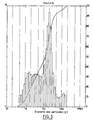
- the diameter of fat globules is within a narrow range. With the process of the invention: 5 to 25 ⁇ m; with a standard process: 1 to 5 ⁇ m.
- the measurements are discriminating enough to distinguish the difference between the two processes.
- 50% of the fat has a diameter less than 16.8 ⁇ m.
- 50% of the fat has a diameter less than 12.4 ⁇ m.
- the two curves have a majority peak at around 20 ⁇ m. he it is certainly the fat of eggs which undergoes the same profusion in both cases. We find the same population of fat globules (same diameter).
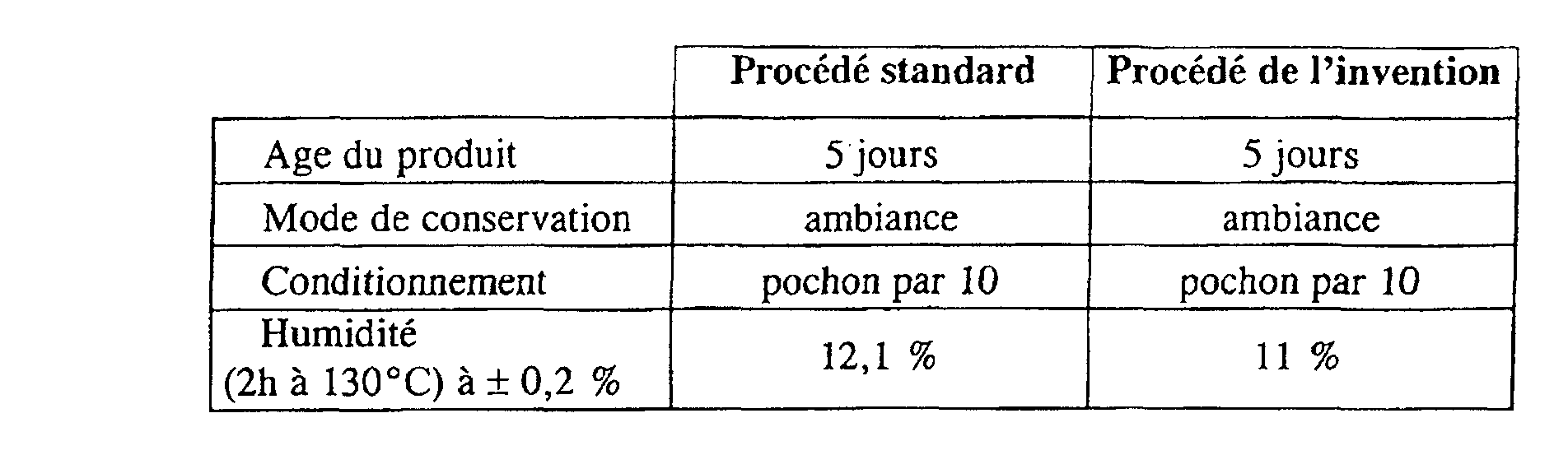
- the aim of the study is to compare, for an equal percentage of fat, the texture of the sponge cake obtained with two different processes (standard process and method of the invention).
- the percentage of fat studied is 5%.
- the laboratory that performed this test is the Danone Biscuits Laboratory / Sensory Analysis Service, whose accreditation number is 1-99236.
- Test 51T (A) - Model at 5% fat: - Genoese model Chocolate Barquette Type 5% fat Standard process - Genoese model Chocolate Barquette Type 5% fat
- Test 51T (B) - Model containing 15% fat: - Genoese model Chocolate Barquette type 15% fat Standard process - Genoese model Chocolate Barquette type 15% fat Method of the invention
- Type of jury Specialized Texture Expert Jury.
- Method of sampling the samples come from several packages.
- static mixer according to the invention has an important influence on the characteristics texture of products.
- Test on products with 5% fat the jury perceived several significant differences between the two samples at 5% material fatty: the test (process of the invention) is perceived to be significantly lighter and more melting as the product prepared by a standard process.
Landscapes
- Life Sciences & Earth Sciences (AREA)
- Engineering & Computer Science (AREA)
- Food Science & Technology (AREA)
- Bakery Products And Manufacturing Methods Therefor (AREA)
- Confectionery (AREA)
- Noodles (AREA)
- Edible Oils And Fats (AREA)
Description
- son caractère continu,
- le faible taux de cisaillement par rapport aux procédés de l'art antérieur,
- une taille de particules supérieure à celle résultant de la mise en oeuvre des procédés de l'art antérieur.
- la Figure 1 est une vue d'ensemble d'un dispositif selon l'invention, en représentation schématique, et
- la Figure 2 est une vue schématique en perspective d'un exemple de mélangeur statique convenant pour la mise en oeuvre du procédé selon l'invention.
- 2 % à 25 % d'eau,
- 20 % à 40 % de farine,
- 10 % à 35 % d'oeuf,
- 0 % à 45 % de sucre,
- 0 % à 45 % de sirop de glucose,
- 2 % à 20 % de matière grasse, notamment 5 % à 15 %,
- 0 % à 1 % de poudre levante,
- 0 % à 1 % d'émulsifiant,
- 0 % à 1 % de sel,
- sa densité est inférieure à 300 g/l,
- la densité pour une composition déterminée est diminuée de 10 % à 40 %, notamment de 20 % à 30 %, par rapport à la densité d'une pâte fabriquée selon les procédés classiques et ayant la même susdite composition déterminée,
- elle présente une légèreté plus grande qu'une pâte de même composition mais préparée selon un procédé classique.
- elle est plus légère qu'une pâte de même composition mais préparée selon un procédé classique,
- elle est plus fondante qu'une pâte de même composition mais préparée selon un procédé classique.
- 20 % à 40 % de farine,
- 10 % à 45 % d'oeuf,
- 0 % à 45 % de sucre,
- 0 % à 45 % de sirop de glucose, la quantité sucre + sirop de glucose étant de 15 % à 45 %,
- 2 % à 20 % de matière grasse, notamment de 5 % à 15 %,
- 0 % à 1 % de poudre levante,
- 0 % à 1 % d'émulsifiant,
- 0 % à 1 % de sel,
- sa densité est de 400 à 800 g/l,
- le diamètre moyen des globules de matière grasse est de 5 µm à 25 µm.
- 90 % du volume des particules ont un diamètre inférieur à 60 µm,
- 70 % du volume des particules ont un diamètre supérieur à 10 µm,
- 50 % du volume des particules ont un diamètre supérieur à 16,8 µm et 50 % du volume des particules ont un diamètre inférieur à 16,8 µm.
- 90 % du volume des particules ont un diamètre inférieur à 38,98 µm,
- 70 % du volume des particules ont un diamètre inférieur à 20 µm,
- 50 % du volume des particules ont un diamètre inférieur à 12 µm.
- la Figure 1 est une vue d'ensemble d'un dispositif selon l'invention,
- la Figure 2 est une schématique en perspective d'un exemple de mélangeur statique,
- les Figures 3 et 4 représentent les résultats de granulométrie laser ; en ordonnées on a indiqué le volume de particules de matière grasses en fonction du diamètre (abscisse) exprimé en µ ; la Figure 3 correspond à de la pâte crue préparée selon un standard ; la Figure 4 correspond à de la pâte crue obtenue selon le procédé de l'invention,
- la Figure 5 représente le profil linéaire multiple obtenu dans un test d'analyse sensorielle. La courbe en trait plein correspond à un produit à 5 % de matière grasse obtenu selon le procédé standard et celle en traits pointillés correspond à un produit à 5 % de matière grasse obtenu selon le procédé de l'invention.
| Essais réalisés | ||
| Essai | % matières grasses | Procédé |
| 1 | 5 % | Standard |
| 2 | Avec mélangeurs statiques | |
| 3 | 10 % | Standard |
| 4 | Avec mélangeurs statiques | |
| 5 | 15% | Standard |
| 6 | Avec mélangeurs statiques |
| Formules utilisées pour les essais | |||
| Essais | 1 et 2 | 3 et 4 | 5 et 6 |
| Matières premières | % | % | % |
| Farine | 36 | 34 | 32 |
| oeufs | 26 | 25 | 23,5 |
| Sucre | 25 | 23 | 22 |
| Sirop de glucose | 7 | 7 | 6,5 |
| Huile d'arachide | 5 | 10 | 15 |
| Poudre levante | 0,4 | 0,4 | 0,4 |
| Sel | 0,3 | 0,3 | 0,3 |
| Mono et diglycérides | 0,3 | 0,3 | 0,3 |
| Total | 100,00 | 100,00 | 100,00 |
| Prémélange de la pâte standard | ||
| Etape | Durée | Matière |
| 1 | 1 minute Vitesse 1 | oeuf, sucre, sirop de glucose, sel |
| 2 | 1 minute Vitesse 1 | Huile |
| 3 | 5 minutes Vitesse 1 | farine, mono et diglycérides, poudres levantes |
| Température de la pâte : 18°C Vitesse 1 = 42 tpm. |
| Débit | 20 kg/h |
| Vitesse de tête | 550 tpm |
| Pression interne | 3 Bars |
| Température pâte entrée | 18°C |
| Température pâte foisonnée | 24°C |
| Température refroidissement | 7°C |
| Densité pâte | 650 g/l |
| Densité limite essai 1 | 600 g/l |
| Densité limite essai 3 | 650 g/l |
| Densité limite essai 5 | 650 g/l |
| Largeur dépose | 24 mm |
| Epaisseur dépose | 5 mm |
| Cuisson | 7 minutes à 200°C en four statique. |
| Prémélange de la pâte pour essais avec mélangeurs statiques | ||
| Etape | Durée | Matière |
| 1 | 1 minute Vitesse 1 | oeuf, sucre, sirop de glucose, sel |
| 2 | 5 minutes Vitesse 1 | farine, mono et diglycérides, poudres levantes |
| Température de la pâte : 18°C Vitesse 1 = 42 tpm. |
| Débit | 20 kg/h |
| Vitesse de tête | 550 tpm |
| Pression interne | 4 Bars |
| Température pâte entrée | 18°C |
| Température huile injectée | 22°C |
| Température pâte foisonnée | 24°C |
| Température refroidissement | 7°C |
| Densité pâte | 600 g/l |
| Densité limite essai 2 | 500 g/l |
| Densité limite essai 4 | 500 g/l |
| Densité limite essai 6 | 500 g/l |
| Type | SMX de Sulzer |
| Diamètre | 20 mm |
| Longueur de mélange | 25 cm |
| Vitesse de conduite | 1,4 cm.s-1 |
| Largeur dépose | 24 mm |
| Epaisseur dépose | 5 mm |
| Cuisson | 7 minutes à 200°C en four statique |
| Résultats sur produits finis | ||||||
| Essais | 1 | 2 | 3 | 4 | 5 | 6 |
| % d'huile | 5 % | 10 % | 5 % | |||
| Procédé | Standard | Invention | Standard | Invention | Standard | Invention |
| Densité produit | 0,218 | 0,169 | 0,272 | 0,163 | 0,247 | 0,191 |
| ± 0,014 | ± 0,01 | ± 0,03 | ± 0,01 | ± 0,03 | ± 0,008 |
- la matière grasse ajoutée (huile),
- la matière grasse provenant des oeufs,
- les grains d'amidon provenant de la farine.
| - Maquette génoise Type Barquette Chocolat 5 % de matière grasse Procédé standard | - Maquette génoise Type Barquette Chocolat 5 % de matière grasse Procédé de l'invention |
| - Maquette génoise Type Barquette Chocolat 15 % de matière grasse Procédé standard | - Maquette génoise Type Barquette Chocolat 15 % de matière grasse Procédé de l'invention |

| Variable | LEGÉRETÉ |
| Invention 5 % M.G. | (37.20) |
| Standard 5 % M.G. | (32.33) |
| Variable | FONDANT |
| Invention 5 % M.G. | (39.33) |
| Standard 5 % M.G. | (29.20) |
Claims (29)
- Procédé pour préparer en continu une pâte à gâteau foisonnée, avec matière grasse ajoutée, comprenant une étape de foisonnement appliquée à un mélange des ingrédients de la pâte, caractérisé en ce qu'après l'étape de foisonnement on procède à une étape d'intégration de la matière grasse ajoutée, la matière grasse étant ajoutée en quantité inférieure à 15 %, et notamment inférieure ou égale à 10 %, et plus particulièrement de 2 à 10 %, et notamment de 2 à 8 %.
- Procédé selon la revendication 1, caractérisé par l'absence de matière grasse ajoutée dans ledit mélange au moment où on lui applique le foisonnement.
- Procédé selon la revendication 1 ou 2, caractérisé en ce qu'on intègre la matière grasse par une étape de mélange impliquant un cisaillement très inférieur à celui impliqué par l'étape de foisonnement.
- Procédé selon l'une des revendications 1 à 3, caractérisé en ce que le cisaillement impliqué par l'étape d'intégration de la matière grasse ajoutée est compris entre 20s-1 et 100s-1.
- Procédé selon l'une des revendications 1 à 3, caractérisé en ce que le cisaillement impliqué par l'étape d'intégration de la matière grasse ajoutée est égal à 50 s-1.
- Procédé selon l'une des revendications 1 à 4, caractérisé en ce que l'étape d'intégration de la matière grasse ajoutée utilise un mélangeur statique (14).
- Procédé selon la revendication 6, caractérisé en ce qu'on fait progresser le mélange foisonné et la matière grasse à une vitesse comprise entre 0,5 et 20cm/s à travers le mélangeur statique (14).
- Procédé selon la revendication 6, caractérisé en ce qu'on fait progresser le mélange foisonné et la matière grasse à une vitesse comprise entre 3 et 5 cm/s à travers le mélangeur statique (14).
- Procédé selon l'une des revendications 6 à 8, caractérisé en ce que pour un mélangeur statique ayant un diamètre intérieur de 50mm, on soumet le flux à l'action d'éléments (24) définissant 20 à 300 divisions.
- Procédé selon l'une des revendications 6 à 8, caractérisé en ce que pour un mélangeur statique ayant un diamètre intérieur de 50mm, on soumet le flux à l'action d'éléments (24) définissant 100 à 200 divisions.
- Procédé selon l'une des revendications 1 à 10, caractérisé par l'absence d'émulsifiants dans ledit mélange.
- Procédé selon l'une des revendications 1 à 11, caractérisé en ce que l'étape d'intégration de la matière grasse ajoutée est menée de façon à obtenir à l'issue de cette étape des globules de matière grasse ayant un diamètre compris de 5 à 25 µm.
- Procédé selon l'une des revendications 1 à 12, caractérisé en ce que la quantité de matière grasse ajoutée est comprise de 2 à 20 % du poids total de la pâte crue issue de l'étape d'intégration.
- Procédé selon l'une des revendications 1 à 13, caractérisé en ce que la quantité de matière grasse ajoutée est comprise de 5 à 10% du poids total de la pâte crue issue de l'étape d'intégration.
- Procédé selon l'une des revendications 1 à 14, caractérisé en ce qu'au cours de l'étape de foisonnement on règle l'aération de façon que la densité de la pâte crue obtenue après l'étape d'intégration soit comprise de 400 à 800 kg/m3.
- Dispositif pour la fabrication d'une pâte à gâteau foisonnée par mise en oeuvre du procédé selon l'une des revendications 1 à 15, comprenant un foisonneur (1) monté entre une entrée de mélange (3) et une sortie de pâte crue (16), caractérisé en ce qu'il comprend un mélangeur à cisaillement modéré (14) monté en aval du foisonneur (1), et un dispositif d'injection de matière grasse (17) débouchant entre le foisonneur (1) et le mélangeur (14).
- Dispositif selon la revendication 16, caractérisé en ce que le mélangeur est de type statique.
- Dispositif selon la revendication 17, caractérisé en ce que le mélangeur statique (14) est conçu pour former 20 à 300 divisions, de préférence 100 à 200 divisions du flux entre l'entrée (13) et la sortie (16) du mélangeur (14).
- Dispositif selon la revendication 17 ou 18, caractérisé en ce que le mélangeur (14) est conçu pour former 200 à 300 divisions du flux par mètre de longueur et présente une longueur de mélange de 0,1 à 1m.
- Dispositif selon l'une des revendications 17 à 19, caractérisé en ce que le mélangeur (14) a un diamètre de 50 mm et définit une longueur de mélange qui est de 600mm.
- Dispositif selon l'une des revendications 17 à 20, caractérisé en ce que le mélangeur (14) comprend dans le trajet de la pâte des éléments (24) qui subdivisent le flux de pâté en flux partiels, font diverger des flux partiels voisins, et recombinent des flux partiels initialement distants l'un de l'autre.
- Dispositif selon l'une des revendications 17 à 21, caractérisé par une pompe de reprise (29) entre le foisonneur (1) et le mélangeur statique (14).
- Pâte à gâteau cuite, avec matière grasse ajoutée, ayant la composition suivante :sous réserve que la quantité sucre + sirop de glucose soit de 15 % à 45 %,2 % à 25 % d'eau,10 % à 40 % de farine,12 % à 35 % d'oeuf,0 % à 45 % de sucre,0 % à 45 % de sirop de glucose,2 % à 10 % de matière grasse, notamment 2 % à 8 %,0 % à 1 % de poudre levante,0 % à 1 % d'émulsifiant,0 % à 1 % de sel,
et présentant les caractéristiques suivantes :sa densité est inférieure à 300 g/l,la densité pour une composition déterminée est diminuée de 10 % à 40 %, notamment de 20 % à 30 %, par rapport à la densité d'une pâte fabriquée selon les procédés classiques et ayant la même susdite composition déterminée, - Pâte à gâteau cuite, avec matière grasse ajoutée, telle qu'obtenue par le procédé selon l'une quelconque des revendications 1à15.
- Pâte à gâteau cuite, avec matière grasse ajoutée, selon l'une des revendications 23 ou 24, dans laquelle le taux de matière grasse est de 2 % à 15 %, notamment de 2 à 10 %, et ne contenant pas d'émulsifiants.
- Pâte à gâteau cuite, avec matière grasse ajoutée, selon l'une des revendications 23 ou 24, dans laquelle le taux de matières grasses est de 2 % à 15 %, notamment de 2 à 10 %, contenant de 0 % à 1 % d'émulsifiant et dont le fondant est amélioré.
- Pâte à gâteau, avec matière grasse ajoutée, selon l'une des revendications 23 ou 24, dans laquelle le taux de matière grasse est inférieur à 10 % et contenant de 0 % à 1 % d'émulsifiant.
- Pâte crue (avant cuisson) pour la préparation de pâte à gâteau avec matière grasse ajoutée, ayant la composition suivante :et présentant les caractéristiques suivantes :20 % à 40 % de farine,10 % à 45 % d'oeuf,0 % à 45 % de sucre,20 % à 50 % d'eau, et notamment de 25 % à 35 % d'eau,0 % à 45 % de sirop de glucose, la quantité sucre + sirop de glucose étant de 15 % à 45 %,2 % à 10 % de matière grasse, notamment de 2 % à 8 %,0 % à 1 % de poudre levante,0 % à 1 % d'émulsifiant,0 % à 1 % de sel,sa densité est de 400 à 800 g/lle diamètre moyen des globules de matière grasse est de 5 µm à 25 µm.
- Pâte crue pour la préparation de pâte à gâteau cuite avec matière grasse ajoutée selon la revendication 28, ayant les caractéristiques suivantes en analyse granulométrique laser :90 % du volume des particules ont un diamètre inférieur à 60 µm,70 % du volume des particules on un diamètre supérieur à 10 µm,50 % du volume des particules ont un diamètre supérieur à 16,8 µm et 50 % du volume des particules ont un diamètre inférieur à 16,8 µm.
Applications Claiming Priority (2)
| Application Number | Priority Date | Filing Date | Title |
|---|---|---|---|
| FR9715698A FR2772234B1 (fr) | 1997-12-11 | 1997-12-11 | Pate a gateau avec matiere grasse ajoutee et son procede de preparation |
| FR9715698 | 1997-12-11 |
Publications (2)
| Publication Number | Publication Date |
|---|---|
| EP0930014A1 EP0930014A1 (fr) | 1999-07-21 |
| EP0930014B1 true EP0930014B1 (fr) | 2003-10-29 |
Family
ID=9514477
Family Applications (1)
| Application Number | Title | Priority Date | Filing Date |
|---|---|---|---|
| EP98403083A Expired - Lifetime EP0930014B1 (fr) | 1997-12-11 | 1998-12-08 | Pâte à gâteau avec matière grasse ajoutée et son procédé de preparation |
Country Status (5)
| Country | Link |
|---|---|
| EP (1) | EP0930014B1 (fr) |
| AT (1) | ATE252838T1 (fr) |
| DE (1) | DE69819291T2 (fr) |
| ES (1) | ES2209086T3 (fr) |
| FR (1) | FR2772234B1 (fr) |
Families Citing this family (3)
| Publication number | Priority date | Publication date | Assignee | Title |
|---|---|---|---|---|
| FR2802057B1 (fr) * | 1999-12-08 | 2003-02-07 | Lu | Procede de fabrication par foisonnement d'un produit alimentaire cuit alveolaire |
| FR2825582B1 (fr) * | 2001-06-06 | 2005-03-18 | Foco | Methode de preparation de gateau a pate jaune |
| FR2931621A1 (fr) * | 2008-05-30 | 2009-12-04 | Ulice | Composition agro-alimentaire, procede de fabrication et ses applications. |
Family Cites Families (2)
| Publication number | Priority date | Publication date | Assignee | Title |
|---|---|---|---|---|
| US3078168A (en) * | 1960-01-25 | 1963-02-19 | Procter & Gamble | Angel food cake mixes |
| US3505079A (en) * | 1967-10-12 | 1970-04-07 | Pillsbury Co | Dry,free-flowing baking mix and process for preparing same |
-
1997
- 1997-12-11 FR FR9715698A patent/FR2772234B1/fr not_active Expired - Fee Related
-
1998
- 1998-12-08 AT AT98403083T patent/ATE252838T1/de not_active IP Right Cessation
- 1998-12-08 ES ES98403083T patent/ES2209086T3/es not_active Expired - Lifetime
- 1998-12-08 DE DE69819291T patent/DE69819291T2/de not_active Expired - Lifetime
- 1998-12-08 EP EP98403083A patent/EP0930014B1/fr not_active Expired - Lifetime
Also Published As
| Publication number | Publication date |
|---|---|
| EP0930014A1 (fr) | 1999-07-21 |
| FR2772234B1 (fr) | 2000-06-02 |
| DE69819291T2 (de) | 2004-07-29 |
| FR2772234A1 (fr) | 1999-06-18 |
| ES2209086T3 (es) | 2004-06-16 |
| DE69819291D1 (de) | 2003-12-04 |
| ATE252838T1 (de) | 2003-11-15 |
Similar Documents
| Publication | Publication Date | Title |
|---|---|---|
| RU2348156C1 (ru) | Способ производства вафельных бисквитных изделий | |
| EP1307105B1 (fr) | Procede de fabrication d'un produit alimentaire aere et produit ainsi obtenu | |
| DE69627029T2 (de) | Verfahren zur verminderung der bildung von sirup in gekühlten teigwaren | |
| EP0113056A1 (fr) | Biscuit et son procédé de fabrication | |
| FR2941845B1 (fr) | Pate cuite comprenant une farine specifique | |
| KR20150094764A (ko) | 겨 및 배아 향미 및 질감 개선 | |
| US3694227A (en) | Method for making dough | |
| CA3178238A1 (fr) | Substitut d'?uf a base de microalgues | |
| RU92015162A (ru) | Поликомпонентная пищевая добавка для хлебобулочных изделий из пшеничной муки и способ ее приготовления | |
| EP0037753B1 (fr) | Sucroglycérides mis sur support, leur procédé d'obtention et leur application | |
| EP3086653B1 (fr) | Procédé de fabrication d'une composition lipidique sans huile de palme, son utilisation dans un produit alimentaire | |
| EP1246543A1 (fr) | Procede et dispositif de fabrication d'un produit alimentaire a texture interne alveolee - application au pain sans gluten | |
| EP0091331A1 (fr) | Nouvelle préparation de sucroglycérides sous forme fluide, son procédé d'obtention et ses applications | |
| EP0930014A1 (fr) | Pâte à gâteau avec matière grasse ajoutée et son procédé de preparation | |
| US8859028B2 (en) | Coated food particle and method for making a swirl | |
| CA2631056A1 (fr) | Ameliorant de panification | |
| EP0234284B1 (fr) | Procédé pour l'aromatisation d'aliments | |
| FR2523134A1 (fr) | Nouvelle preparation de sucroglycerides sous forme fluide, son procede d'obtention et ses applications | |
| JP7460353B2 (ja) | 重いもち食感を有する油ちょうベーカリー食品の配合及び製造方法 | |
| RU2264130C2 (ru) | Ароматизирующая пищевая добавка и способ ее получения | |
| FR3029742A1 (fr) | Composition culinaire exempte de gluten | |
| RU2240695C2 (ru) | Состав для приготовления печенья с фруктовой начинкой | |
| FR2651964A1 (fr) | Association comprenant un edulcorant thermolabile et un produit vegetal riche en fibres alimentaires, son procede de preparation et son utilisation en formulations alimentaires. | |
| FR3160300A1 (fr) | Liant alimentaire | |
| JPH10248481A (ja) | パン類の製造方法 |
Legal Events
| Date | Code | Title | Description |
|---|---|---|---|
| PUAI | Public reference made under article 153(3) epc to a published international application that has entered the european phase |
Free format text: ORIGINAL CODE: 0009012 |
|
| AK | Designated contracting states |
Kind code of ref document: A1 Designated state(s): AT BE CH DE DK ES FI FR GB GR IE IT LI LU MC NL PT SE |
|
| AX | Request for extension of the european patent |
Free format text: AL;LT;LV;MK;RO;SI |
|
| 17P | Request for examination filed |
Effective date: 19991217 |
|
| AKX | Designation fees paid |
Free format text: AT BE CH DE DK ES FI FR GB GR IE IT LI LU MC NL PT SE |
|
| RAP1 | Party data changed (applicant data changed or rights of an application transferred) |
Owner name: LU |
|
| 17Q | First examination report despatched |
Effective date: 20020715 |
|
| RAP1 | Party data changed (applicant data changed or rights of an application transferred) |
Owner name: LU FRANCE |
|
| GRAH | Despatch of communication of intention to grant a patent |
Free format text: ORIGINAL CODE: EPIDOS IGRA |
|
| GRAS | Grant fee paid |
Free format text: ORIGINAL CODE: EPIDOSNIGR3 |
|
| GRAA | (expected) grant |
Free format text: ORIGINAL CODE: 0009210 |
|
| AK | Designated contracting states |
Kind code of ref document: B1 Designated state(s): AT BE CH DE DK ES FI FR GB GR IE IT LI LU MC NL PT SE |
|
| PG25 | Lapsed in a contracting state [announced via postgrant information from national office to epo] |
Ref country code: IE Free format text: LAPSE BECAUSE OF FAILURE TO SUBMIT A TRANSLATION OF THE DESCRIPTION OR TO PAY THE FEE WITHIN THE PRESCRIBED TIME-LIMIT Effective date: 20031029 Ref country code: AT Free format text: LAPSE BECAUSE OF FAILURE TO SUBMIT A TRANSLATION OF THE DESCRIPTION OR TO PAY THE FEE WITHIN THE PRESCRIBED TIME-LIMIT Effective date: 20031029 |
|
| REG | Reference to a national code |
Ref country code: GB Ref legal event code: FG4D Free format text: NOT ENGLISH |
|
| REG | Reference to a national code |
Ref country code: CH Ref legal event code: EP |
|
| REG | Reference to a national code |
Ref country code: CH Ref legal event code: NV Representative=s name: ABREMA AGENCE BREVETS ET MARQUES GANGUILLET & HUMP |
|
| REG | Reference to a national code |
Ref country code: IE Ref legal event code: FG4D Free format text: FRENCH |
|
| REF | Corresponds to: |
Ref document number: 69819291 Country of ref document: DE Date of ref document: 20031204 Kind code of ref document: P |
|
| PG25 | Lapsed in a contracting state [announced via postgrant information from national office to epo] |
Ref country code: LU Free format text: LAPSE BECAUSE OF NON-PAYMENT OF DUE FEES Effective date: 20031208 |
|
| GBT | Gb: translation of ep patent filed (gb section 77(6)(a)/1977) |
Effective date: 20031204 |
|
| PG25 | Lapsed in a contracting state [announced via postgrant information from national office to epo] |
Ref country code: MC Free format text: LAPSE BECAUSE OF NON-PAYMENT OF DUE FEES Effective date: 20031231 |
|
| PG25 | Lapsed in a contracting state [announced via postgrant information from national office to epo] |
Ref country code: SE Free format text: LAPSE BECAUSE OF FAILURE TO SUBMIT A TRANSLATION OF THE DESCRIPTION OR TO PAY THE FEE WITHIN THE PRESCRIBED TIME-LIMIT Effective date: 20040129 Ref country code: GR Free format text: LAPSE BECAUSE OF FAILURE TO SUBMIT A TRANSLATION OF THE DESCRIPTION OR TO PAY THE FEE WITHIN THE PRESCRIBED TIME-LIMIT Effective date: 20040129 Ref country code: DK Free format text: LAPSE BECAUSE OF FAILURE TO SUBMIT A TRANSLATION OF THE DESCRIPTION OR TO PAY THE FEE WITHIN THE PRESCRIBED TIME-LIMIT Effective date: 20040129 |
|
| REG | Reference to a national code |
Ref country code: ES Ref legal event code: FG2A Ref document number: 2209086 Country of ref document: ES Kind code of ref document: T3 |
|
| REG | Reference to a national code |
Ref country code: IE Ref legal event code: FD4D |
|
| PLBE | No opposition filed within time limit |
Free format text: ORIGINAL CODE: 0009261 |
|
| STAA | Information on the status of an ep patent application or granted ep patent |
Free format text: STATUS: NO OPPOSITION FILED WITHIN TIME LIMIT |
|
| 26N | No opposition filed |
Effective date: 20040730 |
|
| PG25 | Lapsed in a contracting state [announced via postgrant information from national office to epo] |
Ref country code: PT Free format text: LAPSE BECAUSE OF NON-PAYMENT OF DUE FEES Effective date: 20040329 |
|
| REG | Reference to a national code |
Ref country code: DE Ref legal event code: R082 Ref document number: 69819291 Country of ref document: DE Representative=s name: BUSCHHOFF-HENNICKE-ALTHAUS, DE |
|
| REG | Reference to a national code |
Ref country code: DE Ref legal event code: R082 Ref document number: 69819291 Country of ref document: DE Representative=s name: BUSCHHOFF-HENNICKE-ALTHAUS, DE Effective date: 20120829 Ref country code: DE Ref legal event code: R081 Ref document number: 69819291 Country of ref document: DE Owner name: GENERALE BISCUIT, SOCIETE PAR ACTIONS SIMPLIFI, FR Free format text: FORMER OWNER: LU FRANCE, RIS ORANGIS, FR Effective date: 20120829 |
|
| REG | Reference to a national code |
Ref country code: FR Ref legal event code: TP Owner name: GENERALE BISCUIT, FR Effective date: 20121017 |
|
| REG | Reference to a national code |
Ref country code: GB Ref legal event code: 732E Free format text: REGISTERED BETWEEN 20130523 AND 20130529 |
|
| PGFP | Annual fee paid to national office [announced via postgrant information from national office to epo] |
Ref country code: FI Payment date: 20131230 Year of fee payment: 16 Ref country code: ES Payment date: 20131226 Year of fee payment: 16 Ref country code: NL Payment date: 20131226 Year of fee payment: 16 |
|
| REG | Reference to a national code |
Ref country code: CH Ref legal event code: PUE Owner name: GENERALE BISCUIT, FR Free format text: FORMER OWNER: LU FRANCE, FR |
|
| REG | Reference to a national code |
Ref country code: NL Ref legal event code: V1 Effective date: 20150701 |
|
| REG | Reference to a national code |
Ref country code: NL Ref legal event code: V1 Effective date: 20150701 |
|
| PG25 | Lapsed in a contracting state [announced via postgrant information from national office to epo] |
Ref country code: FI Free format text: LAPSE BECAUSE OF NON-PAYMENT OF DUE FEES Effective date: 20141208 |
|
| PG25 | Lapsed in a contracting state [announced via postgrant information from national office to epo] |
Ref country code: NL Free format text: LAPSE BECAUSE OF NON-PAYMENT OF DUE FEES Effective date: 20150701 |
|
| REG | Reference to a national code |
Ref country code: FR Ref legal event code: PLFP Year of fee payment: 18 |
|
| PGFP | Annual fee paid to national office [announced via postgrant information from national office to epo] |
Ref country code: CH Payment date: 20151228 Year of fee payment: 18 |
|
| REG | Reference to a national code |
Ref country code: ES Ref legal event code: FD2A Effective date: 20160129 |
|
| PG25 | Lapsed in a contracting state [announced via postgrant information from national office to epo] |
Ref country code: ES Free format text: LAPSE BECAUSE OF NON-PAYMENT OF DUE FEES Effective date: 20141209 |
|
| REG | Reference to a national code |
Ref country code: DE Ref legal event code: R079 Ref document number: 69819291 Country of ref document: DE Free format text: PREVIOUS MAIN CLASS: A21D0013080000 Ipc: A21D0013800000 |
|
| REG | Reference to a national code |
Ref country code: FR Ref legal event code: PLFP Year of fee payment: 19 |
|
| PG25 | Lapsed in a contracting state [announced via postgrant information from national office to epo] |
Ref country code: IT Free format text: LAPSE BECAUSE OF NON-PAYMENT OF DUE FEES Effective date: 20151208 |
|
| REG | Reference to a national code |
Ref country code: CH Ref legal event code: PL |
|
| PG25 | Lapsed in a contracting state [announced via postgrant information from national office to epo] |
Ref country code: IT Free format text: LAPSE BECAUSE OF NON-PAYMENT OF DUE FEES Effective date: 20151208 |
|
| PGRI | Patent reinstated in contracting state [announced from national office to epo] |
Ref country code: IT Effective date: 20170710 |
|
| PG25 | Lapsed in a contracting state [announced via postgrant information from national office to epo] |
Ref country code: LI Free format text: LAPSE BECAUSE OF NON-PAYMENT OF DUE FEES Effective date: 20161231 Ref country code: CH Free format text: LAPSE BECAUSE OF NON-PAYMENT OF DUE FEES Effective date: 20161231 |
|
| REG | Reference to a national code |
Ref country code: FR Ref legal event code: PLFP Year of fee payment: 20 |
|
| PGFP | Annual fee paid to national office [announced via postgrant information from national office to epo] |
Ref country code: FR Payment date: 20171227 Year of fee payment: 20 |
|
| PGFP | Annual fee paid to national office [announced via postgrant information from national office to epo] |
Ref country code: BE Payment date: 20171227 Year of fee payment: 20 Ref country code: GB Payment date: 20171227 Year of fee payment: 20 |
|
| PGFP | Annual fee paid to national office [announced via postgrant information from national office to epo] |
Ref country code: DE Payment date: 20171229 Year of fee payment: 20 |
|
| PGFP | Annual fee paid to national office [announced via postgrant information from national office to epo] |
Ref country code: IT Payment date: 20171221 Year of fee payment: 20 |
|
| REG | Reference to a national code |
Ref country code: DE Ref legal event code: R071 Ref document number: 69819291 Country of ref document: DE |
|
| REG | Reference to a national code |
Ref country code: GB Ref legal event code: PE20 Expiry date: 20181207 |
|
| REG | Reference to a national code |
Ref country code: BE Ref legal event code: MK Effective date: 20181208 |
|
| PG25 | Lapsed in a contracting state [announced via postgrant information from national office to epo] |
Ref country code: GB Free format text: LAPSE BECAUSE OF EXPIRATION OF PROTECTION Effective date: 20181207 |