EP0929144B1 - Verfahren und System zur Motorantriebsregelung - Google Patents
Verfahren und System zur Motorantriebsregelung Download PDFInfo
- Publication number
- EP0929144B1 EP0929144B1 EP98310465A EP98310465A EP0929144B1 EP 0929144 B1 EP0929144 B1 EP 0929144B1 EP 98310465 A EP98310465 A EP 98310465A EP 98310465 A EP98310465 A EP 98310465A EP 0929144 B1 EP0929144 B1 EP 0929144B1
- Authority
- EP
- European Patent Office
- Prior art keywords
- motor
- pwm
- switching timing
- signal
- pwm signal
- Prior art date
- Legal status (The legal status is an assumption and is not a legal conclusion. Google has not performed a legal analysis and makes no representation as to the accuracy of the status listed.)
- Expired - Lifetime
Links
- 238000000034 method Methods 0.000 title description 3
- 230000001360 synchronised effect Effects 0.000 description 13
- 238000010586 diagram Methods 0.000 description 10
- 238000007599 discharging Methods 0.000 description 8
- 238000003079 width control Methods 0.000 description 7
- 239000003990 capacitor Substances 0.000 description 3
- 230000003247 decreasing effect Effects 0.000 description 2
- 230000010355 oscillation Effects 0.000 description 2
- 230000000694 effects Effects 0.000 description 1
- 230000003287 optical effect Effects 0.000 description 1
Images


Classifications
-
- H—ELECTRICITY
- H02—GENERATION; CONVERSION OR DISTRIBUTION OF ELECTRIC POWER
- H02P—CONTROL OR REGULATION OF ELECTRIC MOTORS, ELECTRIC GENERATORS OR DYNAMO-ELECTRIC CONVERTERS; CONTROLLING TRANSFORMERS, REACTORS OR CHOKE COILS
- H02P6/00—Arrangements for controlling synchronous motors or other dynamo-electric motors using electronic commutation dependent on the rotor position; Electronic commutators therefor
- H02P6/06—Arrangements for speed regulation of a single motor wherein the motor speed is measured and compared with a given physical value so as to adjust the motor speed
Definitions
- the present invention relates to a motor drive control system that carry out a motor drive control digitally by use of a PWM (Pulse Width Moduration) drive.
- PWM Pulse Width Moduration
- a PWM drive frequency has been generated by an oscillation circuit e.g., an RC oscillation circuit using a resistance and a capacitor, thereby controlling the digital speed control non-synchronously with each set of switching timing of the motor.
- an oscillation circuit e.g., an RC oscillation circuit using a resistance and a capacitor
- JP-A-08047284 discloses a drive device of a brushless motor.
- the drive device includes output transistors (Tr) Q1-Q6 for supplying a current to a motor coil and PWM control part 50 for generating a power supply side voltage VM of an output transistor (Tr) Q1-Q6.
- the document suggests mutual interference of a PWM signal and FG signal, which shows the present rotational frequency of a motor, causes the rotation irregularity in the brushless motor.
- To prevent the rotation irregularity in a motor due to the mutual interference of signals by initialising the triangular wave of a PWM control part based on a reference clock used for PLL control.
- JP-A-0823694 discloses a speed control device of a DC brushless motor.
- a speed control device of the DC brushless motor includes a driving portion 3 which drives the DC brushless motor with a PWM signal.
- the document suggests that the speed control device of DC brushless motor adjusts the frequency of the PWM control signal automatically to the detected speed of the motor.
- an object of the present invention is to provide a motor drive control system in which the drive switching timing of each phase of the motor and the PWM drive frequency are synchronized with each other.
- Another object of the present invention is to provide a motor drive control system in which PWM drive pulse numbers of the respective phases of motor are identified.
- Fig. 1 is a block diagram showing a basic configuration of a motor drive control system according to the present invention.
- the reference numeral 101 denotes a phase switching timing signal generating portion for generating a phase switching timing signal
- 102 a driver for performing motor drive
- 103 a motor
- 104 a PWM signal generating portion for generating a PWM clock
- 105 is a synchronizing means for synchronizing a phase switching timing with a PWM clock.
- the PWM clock generated from the PWM signal generating portion 104 uses the phase switching timing signal synchronous with the phase switching timing a phase switching timing signal which is synchronized with the phase switching timing by the synchronizing means 105.
- FIG. 1 A first embodiment concretely showing the block of the motor drive control system shown in Fig. 1 will now be described with reference to Figs. 2 to 4 herein below.
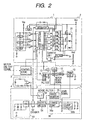
- Fig. 2 is a motor drive control circuit block diagram concretely showing a block of a motor drive control system shown in Fig. 1.
- the reference numeral 1 denotes a phase switching timing signal generating portion for generating a phase switching timing signal
- 2 a driver for performing motor 21 drive
- 3 a motor drive control logic portion
- 4 an FG detecting portion for generating a rotational signal in response to the rotation of the motor
- 5 a speed control portion.
- the motor drive control system shown in Fig. 1 is configured by well known techniques.
- One such well known technique involves a motor driver "HA13605" commercially available from Hitachi, Ltd. as one example.
- the speed control portion includes a reference clock generating portion 51 (clock generator 51), a divider 52 which divides a reference clock from the reference clock generating portion, a noise filter 53, a discremeter 54, a speed monitor 55, and a charging/discharging circuit 56.
- the discremeter 54 compares a clock from the clock generator 51, divided with the divider 52, with a rotational signal from the FG detecting portion through the noise filter 53.
- the charging/discharging circuit 56 consists of a charge pump 56a, a clamp circuit 56b, resistance, and a capacitance. When the charging/discharging circuit 56 has no speed above a desired speed, it is charged to increase the voltage, on the other hand, when the charging/discharging circuit 56 has a speed above a desired speed, it is discharged to decrease the voltage.
- This voltage generates a level signal which determines the pulse width of the PWM clock pulse signal which will be described later.
- a motor ready signal is output.
- the reference numeral 7 denotes a phase switching logic portion in the phase switching timing signal generating portion 1, and 8 an output buffer of a hole amplifier.
- the reference numeral 6 denotes a PWM frequency generating portion.
- the reference numeral 9 denotes a PLL circuit that is a first PWM frequency generating circuit. This PLL circuit 9 generates the first PWM clock having constant times the phase switching timing signal based on the phase switching timing signal generated by the phase switching timing signal generating portion 1.
- the reference numeral 10 denotes a second PWM frequency generating circuit which generates a second PWM clock.
- the reference numeral 11 is a switching circuit, which switches the second PWM clock generated by the second PWM frequency generating circuit 10 to the first PWM clock generated by the PLL circuit 9, which is the first PWM frequency generating circuit, in response to the rotational speed of the motor, detected by the speed control portion 5.
- the reference numeral 12 denotes a chopping wave generating circuit which shapes a PWM frequency from the switching circuit 11 to a triangular wave.
- the reference numeral 13 denotes a pulse width control portion which can vary the drive pulse width, for controlling the rotational signal of the motor in response to the level signal from the speed control portion 5.
- the second PWM clock generated by the second PWM frequency generating circuit 10 through the switching circuit 11 is supplied to the driver 2 through the pulse width control portion 13.
- the driver 2 switches phases in response to a phase switching timing signal from the phase switching timing signal generating portion 1 to drive the motor 21, in response to the second PWM clock generated by the PWM signal generating portion 104.
- this motor drive is output a rotational signal through the noise filter 53.
- This rotational signal is compared with a value divided with the divider 52, with the discremeter 54.
- a desired speed can be obtained. If it is found by the above comparison that a desired speed is not obtained, the charging/discharging circuit 56 is charged to increase the voltage. This voltage becomes a level signal which determines the pulse width of a second PWM clock signal.
- a chopping wave is generated by the chopping wave generating circuit 12 and the second PWM clock can be varied by this chopping wave and the level signal of the charging/discharging circuit 56 so that the drive pulse width is increased in the pulse width control portion 13.
- the pulse width of the second PWM clock signal is increased, whereby driving of the motor 21 allows the speed of the motor 21 to increase. Accordingly, when the motor speed reaches the desired one, a motor ready signal is output from a speed monitor 55.
- the switching circuit 11 is switched from the second PWM clock to the first PWM clock generated from the PLL circuit 9 which is the first PWM signal generating means, by receiving the motor ready signal.
- the first PWM clock generated from the PLL circuit 9 is applied to the driver 2 through the switching circuit 11, and the driver 2 is phase-switched by a phase switching timing signal from the phase switching timing signal generating portion 1. Then driving of the motor 21 is performed in response to the first PWM clock generated by the PLL circuit 9.
- the PLL circuit 9 since the PLL circuit 9 generates a first PWM clock which is a constant-fold overage the phase switching timing signal in response to the phase switching timing signal generated by the phase switching timing signal generating portion 1, the first PWM clock is synchronized with the phase switching timing signal. For example, when a frequency is varied to six-fold, the motor drive pulse of each phase becomes six pulses equally.
- the second PWM clock is controlled by a frequency generated by the second PWM frequency generating circuit 10.
- the frequency is switched to the PWM frequency generated by use of the motor ready signal from the speed control portion 5.
- the wave in this PWM frequency is shaped to a chopping wave by use of the PWM-controlled chopping wave generating circuit 12.
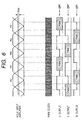
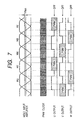
- Fig. 7 shows a non-synchronous state before being switched to the PWM frequency by use of the switching circuit. Even if the same drive pulse is applied to each phase, since the PWM clock timing is different from the switching timing of each phase, integrated values of the respective phase pulses are differentiated from each other. As the result, since the number of pulses becomes small for the drive time of each phase of the motor rotating at a high speed and small rotational torque of the motor has driving force differences, rotational irregularities of the motor occur due to the integrated value differences.
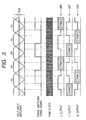
- the PWM frequency After switching of the PWM frequency, which is a characteristic of the present invention, the PWM frequency has a relation of constant-fold over the phase switching timing, as shown in Fig. 3. Therefore, the numbers of the PWM drive pulses of the respective phases become the same and the time from the switching timing until the first drive pulse can be identified at each phase.
- the integrated values of the pulses of the phases are equalized. Accordingly, the accuracy of the rotational speed control of the motor and the stability of the motor can be enhanced.
- synchronization of the PWM clock with the phase switching timing is obtained by the reference clock signal from the reference clock generating portion and an FG signal, which is a rotational signal from the FG detecting portion, based on the motor rotation.
- Fig. 5 is a motor drive control circuit block diagram concretely showing a block of a motor drive control system in Fig. 1.
- the same elements as in the first embodiment are denoted by the same references as therein and concrete descriptions are omitted.
- the differences between the first embodiment and second embodiment resides in a PWM frequency generating portion 14.
- a reference clock generated by a reference clock generating portion 51 is divided to be PWM clocks.
- the PWM clocks are shaped to chopping waves by a chopping wave generating circuit 16 and transmitted to a pulse width control portion 17.
- the motor rotational control is performed so that the reference clock is synchronized with an FG signal which is a detecting signal for the rotation of the motor.
- the FG signal ffg is n (integer)-fold over the number of revolutions of the motor.
- the phase switched number per revolution of the motor corresponds to a number N of one phase per revolution of the motor.
- the PWM frequency fqwm has a relation to the reference clock fosc.
- the drive timing of each phase can be synchronized with the PWM frequency, whereby a PWM frequency synchronized with the phase switching timing can be generated from the reference clock by only use of the divider.
- the cost up and complicatedness of circuits can be prevented, and also, the rotational irregularities of the motor can be decreased as in embodiment 1. Further, the rotational accuracy and stability can be enhanced.
- the PWM clock divided with the divider 15 is supplied to the driver 2 through the chopping wave generating circuit 16 and the pulse width control portion 17.
- the driver 2 switches phases in response to a phase switching timing signal from the phase switching timing signal generating portion 1 to drive the motor 21, in response to the PWM clock divided with the divider 16.
- this motor drive is output a rotational signal through the noise filter 53.
- This rotational signal is compared with a value divided with the divider 52, with the discremeter 54. If it is found by the above comparison that a desired speed is not obtained, the charging/discharging circuit 56 is charged to increase the voltage.
- This voltage becomes a level signal which determines the pulse width of a PWM clock signal.
- a chopping wave is generated by the chopping wave generating circuit 16 and the PWM clock can be varied by this chopping wave and the level signal of the charging/discharging circuit 56 so that the drive pulse width is increased in the pulse width control portion 17.
- the pulse width of the PWM clock signal is increased, whereby driving of the motor 21 allows the speed of the motor 21 to increase. Accordingly, when the motor speed reaches the desired one, that is, when the clock pulse is equalized with one pulse of the rotational signal, the drive pulse width becomes a constant width through the pulse width control portion 17.
- the PWM clock having a constant drive pulse width is applied to the driver 2 through the switching circuit 11, and the driver 2 is phase-switched by a phase switching timing signal from the phase switching timing signal generating portion 1. Then driving of the motor 21 is performed in response to the PWM clock having the constant drive pulse width.
- the drive switching timing of each phase and the PWM drive frequency are synchronized to each other, and the PWM pulse number of each phase is equalized to each other. Further, the time from the phase switching timing until the first pulse can be also equalized to each other.
- a motor having a large number of revolutions occurs rotational irregularities of the rotation of motor when controlled non-synchronously.
- a large PWM pulse number for switching timing of each phase cannot be used due to the switching speed and loss, the on-time of a non-synchronous pulse of each phase is different from each other and the motor is effected by the pulse deviations whereby rotational irregularities of the motor are increased.
- the motor uses a resistance and a capacitor, variance in frequency which is derived from the irregularities of the device and the change of properties by temperature can be prevented. As the result, while preventing the cost up and the complicatedness of circuits, rotational irregularities of the motor can be decreased and a motor rotational control having a high accuracy can be realized.
- the present invention is effective to perform a high accurate rotational control of a drive motor for an optical disk device having a high rotation of the motor and a polygon drive motor for a laser printer, digital copy machine etc.
Landscapes
- Engineering & Computer Science (AREA)
- Power Engineering (AREA)
- Control Of Motors That Do Not Use Commutators (AREA)
- Control Of Ac Motors In General (AREA)
Claims (5)
- Antriebsregelungssystem für einen Motor (21, 103), mit einer Ansteuerungseinrichtung (2, 102) zur Durchführung einer Phasenumschaltung des Motors unter Verwendung eines Phasenschaltzeitsignals einer Phasenschaltzeiterzeugungseinrichtung (1, 101), und einer Geschwindigkeitssteuerung des Motors (21, 103) in Abhängigkeit von einem mittels einer PWM-Signalerzeugungseinrichtung (6, 104) erzeugten PWM-Signal, dadurch gekennzeichnet, dass die PWM-Signalerzeugungseinrichtung eingerichtet ist zur Erzeugung des PWM-Signals in Synchronismus mit dem Phasenschaltzeitsignal, wobei die PWM-Signalfrequenz ein konstantes Mehrfaches der Phasenschaltzeitsignalfrequenz ist.
- Motorantriebsregelungssystem für einen Motor (21, 103) nach Anspruch 1, wobei die Anzahl der Pulse des PWM-Signals in jeder Phase gleich ist.
- Motorantriebsregelungssystem für einen Motor (21, 103) nach einem der vorhergehenden Ansprüche, ferner mit:einer Erfassungseinrichtung (4) zur Erfassung einer Drehzahl des Motors, wobei die Pulsbreite des PWM-Signals durch die PWM-Signalerzeugungseinrichtung (6, 104) verändert werden kann zur Steuerung der Drehzahl des Motors in Abhängigkeit von der mittels der Erfassungseinrichtung erfassten Drehzahl des Motors.
- Motorantriebsregelungssystem nach Anspruch 1, für einen Motor (21, 103), ferner mit:einer zweiten PWM-Signalerzeugungseinrichtung (10) zur Erzeugung eines zweiten PWM-Signals,einer Erfassungseinrichtung (4) zur Erfassung einer Drehzahl des Motors, undeiner Schalteinrichtung (11) zum Schalten des mittels der zweiten PWM-Signalerzeugungseinrichtung erzeugten zweiten PWM-Signals zu dem mittels der PWM-Signalerzeugungseinrichtung erzeugten PWM-Signal in Abhängigkeit von der mittels der Erfassungseinrichtung erfassten Drehzahl des Motors.
- Motorantriebsregelungssystem für einen Motor (21, 103) nach einem der vorhergehenden Ansprüche, wobei die Phasenschaltzeiterzeugungseinrichtung (1, 101) das Phasenschaltzeitsignal in Abhängigkeit von einer Ausgabe eines Hole-Verstärkers erzeugt.
Applications Claiming Priority (2)
| Application Number | Priority Date | Filing Date | Title |
|---|---|---|---|
| JP36524797 | 1997-12-19 | ||
| JP36524797 | 1997-12-19 |
Publications (3)
| Publication Number | Publication Date |
|---|---|
| EP0929144A2 EP0929144A2 (de) | 1999-07-14 |
| EP0929144A3 EP0929144A3 (de) | 2000-04-12 |
| EP0929144B1 true EP0929144B1 (de) | 2006-04-26 |
Family
ID=18483793
Family Applications (1)
| Application Number | Title | Priority Date | Filing Date |
|---|---|---|---|
| EP98310465A Expired - Lifetime EP0929144B1 (de) | 1997-12-19 | 1998-12-18 | Verfahren und System zur Motorantriebsregelung |
Country Status (3)
| Country | Link |
|---|---|
| US (1) | US6054820A (de) |
| EP (1) | EP0929144B1 (de) |
| DE (1) | DE69834312T2 (de) |
Families Citing this family (1)
| Publication number | Priority date | Publication date | Assignee | Title |
|---|---|---|---|---|
| JP2004242432A (ja) * | 2003-02-06 | 2004-08-26 | Canon Inc | Dcモータ駆動装置 |
Family Cites Families (11)
| Publication number | Priority date | Publication date | Assignee | Title |
|---|---|---|---|---|
| EP0071941B1 (de) * | 1981-08-03 | 1986-01-22 | Hitachi, Ltd. | Vorrichtung zum Antrieb eines bürstenlosen Mehrphasenmotors mit unterdrückter Drehmomentwelligkeit |
| US4546293A (en) * | 1982-08-24 | 1985-10-08 | Sundstrand Corporation | Motor control for a brushless DC motor |
| US4608527A (en) * | 1982-12-20 | 1986-08-26 | Sundstrand Corporation | Phase advance waveform generator for brushless DC actuator system controller |
| CH670343A5 (de) * | 1986-08-20 | 1989-05-31 | Saia Ag | |
| US5677605A (en) * | 1989-08-22 | 1997-10-14 | Unique Mobility, Inc. | Brushless DC motor using phase timing advancement |
| JPH0471386A (ja) * | 1990-07-09 | 1992-03-05 | Yamamoto Denki Kk | 同期電動機の製御装置 |
| JPH06113596A (ja) * | 1992-09-29 | 1994-04-22 | Canon Inc | ステップモータ |
| US5448141A (en) * | 1994-03-18 | 1995-09-05 | North Carolina State University | Adjustable speed drive for residential applications |
| JPH0823694A (ja) * | 1994-07-07 | 1996-01-23 | Hitachi Ltd | 直流ブラシレスモータの速度制御装置 |
| JPH0847284A (ja) * | 1994-07-29 | 1996-02-16 | Matsushita Electric Ind Co Ltd | ブラシレスモータの駆動装置 |
| US5625424A (en) * | 1994-11-14 | 1997-04-29 | Texas Instruments Incorporated | Digital motor controller for color wheel |
-
1998
- 1998-12-17 US US09/213,862 patent/US6054820A/en not_active Expired - Fee Related
- 1998-12-18 DE DE69834312T patent/DE69834312T2/de not_active Expired - Lifetime
- 1998-12-18 EP EP98310465A patent/EP0929144B1/de not_active Expired - Lifetime
Also Published As
| Publication number | Publication date |
|---|---|
| DE69834312D1 (de) | 2006-06-01 |
| EP0929144A2 (de) | 1999-07-14 |
| US6054820A (en) | 2000-04-25 |
| DE69834312T2 (de) | 2007-01-11 |
| EP0929144A3 (de) | 2000-04-12 |
Similar Documents
| Publication | Publication Date | Title |
|---|---|---|
| EP0589630B1 (de) | Automatische Einstellung der Kommutierungsverzögerung für einen bürstenlosen Gleichstrommotor | |
| EP0558261B1 (de) | Verfahren und Einrichtung zur Verriegelung eines Phasenregelkreises mit einer Ablenkfrequenz | |
| US5703449A (en) | Controller for brushless DC motor without position sensor | |
| EP0780033B1 (de) | Verfahren und vorrichtung zur minimierung drehmomentschwankungen in einem bürstenlose gleichstrommotor mit phasestromüberklappung | |
| US6420847B1 (en) | Device for detection of current or voltage on a PWM driven winding with reduced jitter and related methods | |
| EP0240455B1 (de) | Drehzahlregelung für einen bürstenlosen Motor | |
| KR0154854B1 (ko) | 언밸런스드 클럭을 사용한 센서리스 브러시리스 직류 모터의 스타트-업 회로 | |
| JP2502620B2 (ja) | ブラシレスモ―タの駆動装置 | |
| US6196650B1 (en) | Sensorless motor driving circuit having a comparative phase lock loop arrangement | |
| JPH07112360B2 (ja) | Pwmインバ−タの制御方法および装置 | |
| JP3360946B2 (ja) | ブラシレスモータの制御回路 | |
| JPS5981712A (ja) | 制御方式 | |
| EP0881761B1 (de) | Regler für bürstenlosen Gleichstrommotor ohne Positionsgeber | |
| EP0929144B1 (de) | Verfahren und System zur Motorantriebsregelung | |
| US5661359A (en) | Vibration type motor device | |
| JP3692923B2 (ja) | モータドライバ | |
| JP3733255B2 (ja) | モータ駆動制御装置 | |
| JP2722750B2 (ja) | ブラシレスモータの駆動装置 | |
| US6998799B2 (en) | System and method for improved motor control | |
| JPH0519388B2 (de) | ||
| US4998053A (en) | Method and apparatus for reducing a current break in a leg that is not participating in the commutation of a three-phase block current fed synchronous machine | |
| JP4194698B2 (ja) | 多相電動機の整流方法および整流回路装置 | |
| JP2940281B2 (ja) | ブラシレス直流モータの駆動装置 | |
| JPH08275571A (ja) | モータ駆動回路 | |
| JP3285371B2 (ja) | センサレス・ブラシレスdcモータ駆動回路 |
Legal Events
| Date | Code | Title | Description |
|---|---|---|---|
| PUAI | Public reference made under article 153(3) epc to a published international application that has entered the european phase |
Free format text: ORIGINAL CODE: 0009012 |
|
| AK | Designated contracting states |
Kind code of ref document: A2 Designated state(s): DE FR GB IT |
|
| AX | Request for extension of the european patent |
Free format text: AL;LT;LV;MK;RO;SI |
|
| PUAL | Search report despatched |
Free format text: ORIGINAL CODE: 0009013 |
|
| AK | Designated contracting states |
Kind code of ref document: A3 Designated state(s): AT BE CH CY DE DK ES FI FR GB GR IE IT LI LU MC NL PT SE |
|
| AX | Request for extension of the european patent |
Free format text: AL;LT;LV;MK;RO;SI |
|
| RIC1 | Information provided on ipc code assigned before grant |
Free format text: 7H 02P 6/06 A, 7H 02P 7/63 B |
|
| 17P | Request for examination filed |
Effective date: 20000824 |
|
| AKX | Designation fees paid |
Free format text: DE FR GB IT |
|
| 17Q | First examination report despatched |
Effective date: 20030731 |
|
| GRAP | Despatch of communication of intention to grant a patent |
Free format text: ORIGINAL CODE: EPIDOSNIGR1 |
|
| GRAS | Grant fee paid |
Free format text: ORIGINAL CODE: EPIDOSNIGR3 |
|
| GRAA | (expected) grant |
Free format text: ORIGINAL CODE: 0009210 |
|
| AK | Designated contracting states |
Kind code of ref document: B1 Designated state(s): DE FR GB IT |
|
| REG | Reference to a national code |
Ref country code: GB Ref legal event code: FG4D |
|
| RIC1 | Information provided on ipc code assigned before grant |
Ipc: H02P 27/08 20060101ALI20060308BHEP Ipc: H02P 6/06 20060101AFI20060308BHEP |
|
| REF | Corresponds to: |
Ref document number: 69834312 Country of ref document: DE Date of ref document: 20060601 Kind code of ref document: P |
|
| ET | Fr: translation filed | ||
| PGFP | Annual fee paid to national office [announced via postgrant information from national office to epo] |
Ref country code: IT Payment date: 20061231 Year of fee payment: 9 |
|
| PLBE | No opposition filed within time limit |
Free format text: ORIGINAL CODE: 0009261 |
|
| STAA | Information on the status of an ep patent application or granted ep patent |
Free format text: STATUS: NO OPPOSITION FILED WITHIN TIME LIMIT |
|
| 26N | No opposition filed |
Effective date: 20070129 |
|
| PGFP | Annual fee paid to national office [announced via postgrant information from national office to epo] |
Ref country code: FR Payment date: 20061218 Year of fee payment: 9 |
|
| REG | Reference to a national code |
Ref country code: FR Ref legal event code: ST Effective date: 20081020 |
|
| PG25 | Lapsed in a contracting state [announced via postgrant information from national office to epo] |
Ref country code: FR Free format text: LAPSE BECAUSE OF NON-PAYMENT OF DUE FEES Effective date: 20071231 |
|
| PG25 | Lapsed in a contracting state [announced via postgrant information from national office to epo] |
Ref country code: IT Free format text: LAPSE BECAUSE OF NON-PAYMENT OF DUE FEES Effective date: 20071218 |
|
| PGFP | Annual fee paid to national office [announced via postgrant information from national office to epo] |
Ref country code: GB Payment date: 20101223 Year of fee payment: 13 |
|
| PGFP | Annual fee paid to national office [announced via postgrant information from national office to epo] |
Ref country code: DE Payment date: 20101231 Year of fee payment: 13 |
|
| GBPC | Gb: european patent ceased through non-payment of renewal fee |
Effective date: 20111218 |
|
| REG | Reference to a national code |
Ref country code: DE Ref legal event code: R119 Ref document number: 69834312 Country of ref document: DE Effective date: 20120703 |
|
| PG25 | Lapsed in a contracting state [announced via postgrant information from national office to epo] |
Ref country code: GB Free format text: LAPSE BECAUSE OF NON-PAYMENT OF DUE FEES Effective date: 20111218 Ref country code: DE Free format text: LAPSE BECAUSE OF NON-PAYMENT OF DUE FEES Effective date: 20120703 |