EP0927848A2 - Verstärkter Isolierschlauch - Google Patents
Verstärkter Isolierschlauch Download PDFInfo
- Publication number
- EP0927848A2 EP0927848A2 EP97120556A EP97120556A EP0927848A2 EP 0927848 A2 EP0927848 A2 EP 0927848A2 EP 97120556 A EP97120556 A EP 97120556A EP 97120556 A EP97120556 A EP 97120556A EP 0927848 A2 EP0927848 A2 EP 0927848A2
- Authority
- EP
- European Patent Office
- Prior art keywords
- interior tube
- flexible hose
- hose
- plastic
- threads
- Prior art date
- Legal status (The legal status is an assumption and is not a legal conclusion. Google has not performed a legal analysis and makes no representation as to the accuracy of the status listed.)
- Withdrawn
Links
- 239000004033 plastic Substances 0.000 claims abstract description 63
- 229920003023 plastic Polymers 0.000 claims abstract description 63
- XLYOFNOQVPJJNP-UHFFFAOYSA-N water Substances O XLYOFNOQVPJJNP-UHFFFAOYSA-N 0.000 claims abstract description 40
- 239000011162 core material Substances 0.000 claims abstract description 23
- 239000000126 substance Substances 0.000 claims abstract description 23
- 239000012530 fluid Substances 0.000 claims abstract description 17
- 239000007789 gas Substances 0.000 claims abstract description 15
- 238000000034 method Methods 0.000 claims description 15
- 239000000463 material Substances 0.000 claims description 8
- 229920002554 vinyl polymer Polymers 0.000 claims description 5
- 229910001369 Brass Inorganic materials 0.000 claims description 3
- 239000004809 Teflon Substances 0.000 claims description 3
- 239000010951 brass Substances 0.000 claims description 3
- NTXGQCSETZTARF-UHFFFAOYSA-N buta-1,3-diene;prop-2-enenitrile Chemical compound C=CC=C.C=CC#N NTXGQCSETZTARF-UHFFFAOYSA-N 0.000 claims description 3
- 229920000728 polyester Polymers 0.000 claims description 3
- 125000000391 vinyl group Chemical group [H]C([*])=C([H])[H] 0.000 claims description 3
- 239000007788 liquid Substances 0.000 claims description 2
- 238000004519 manufacturing process Methods 0.000 abstract description 19
- 229910001220 stainless steel Inorganic materials 0.000 description 19
- 239000010935 stainless steel Substances 0.000 description 19
- 229910052782 aluminium Inorganic materials 0.000 description 13
- XAGFODPZIPBFFR-UHFFFAOYSA-N aluminium Chemical compound [Al] XAGFODPZIPBFFR-UHFFFAOYSA-N 0.000 description 13
- 230000002787 reinforcement Effects 0.000 description 10
- 229910052751 metal Inorganic materials 0.000 description 8
- 239000002184 metal Substances 0.000 description 8
- 239000004677 Nylon Substances 0.000 description 6
- 238000005260 corrosion Methods 0.000 description 6
- 230000007797 corrosion Effects 0.000 description 6
- 229920001778 nylon Polymers 0.000 description 6
- RYGMFSIKBFXOCR-UHFFFAOYSA-N Copper Chemical compound [Cu] RYGMFSIKBFXOCR-UHFFFAOYSA-N 0.000 description 5
- 238000009954 braiding Methods 0.000 description 5
- 229910052802 copper Inorganic materials 0.000 description 5
- 239000010949 copper Substances 0.000 description 5
- XEEYBQQBJWHFJM-UHFFFAOYSA-N Iron Chemical compound [Fe] XEEYBQQBJWHFJM-UHFFFAOYSA-N 0.000 description 4
- 239000002253 acid Substances 0.000 description 3
- 230000008901 benefit Effects 0.000 description 3
- 238000010276 construction Methods 0.000 description 3
- 239000003599 detergent Substances 0.000 description 3
- 229920000915 polyvinyl chloride Polymers 0.000 description 3
- 239000004800 polyvinyl chloride Substances 0.000 description 3
- 150000007513 acids Chemical class 0.000 description 2
- 230000009471 action Effects 0.000 description 2
- 230000003247 decreasing effect Effects 0.000 description 2
- 229920001971 elastomer Polymers 0.000 description 2
- 238000001125 extrusion Methods 0.000 description 2
- 229910052742 iron Inorganic materials 0.000 description 2
- 230000004048 modification Effects 0.000 description 2
- 238000012986 modification Methods 0.000 description 2
- 229920002943 EPDM rubber Polymers 0.000 description 1
- 235000012206 bottled water Nutrition 0.000 description 1
- 230000006835 compression Effects 0.000 description 1
- 238000007906 compression Methods 0.000 description 1
- 238000001816 cooling Methods 0.000 description 1
- 229920001577 copolymer Polymers 0.000 description 1
- 238000002788 crimping Methods 0.000 description 1
- 239000003651 drinking water Substances 0.000 description 1
- 238000009434 installation Methods 0.000 description 1
- 239000000314 lubricant Substances 0.000 description 1
- 230000007246 mechanism Effects 0.000 description 1
- 150000002739 metals Chemical class 0.000 description 1
- 229920005615 natural polymer Polymers 0.000 description 1
- 210000002445 nipple Anatomy 0.000 description 1
- 239000003209 petroleum derivative Substances 0.000 description 1
- 230000008569 process Effects 0.000 description 1
- 230000003014 reinforcing effect Effects 0.000 description 1
- 238000003860 storage Methods 0.000 description 1
- 229920001059 synthetic polymer Polymers 0.000 description 1
- 229920001897 terpolymer Polymers 0.000 description 1
Images



Classifications
-
- D—TEXTILES; PAPER
- D04—BRAIDING; LACE-MAKING; KNITTING; TRIMMINGS; NON-WOVEN FABRICS
- D04C—BRAIDING OR MANUFACTURE OF LACE, INCLUDING BOBBIN-NET OR CARBONISED LACE; BRAIDING MACHINES; BRAID; LACE
- D04C1/00—Braid or lace, e.g. pillow-lace; Processes for the manufacture thereof
- D04C1/06—Braid or lace serving particular purposes
-
- F—MECHANICAL ENGINEERING; LIGHTING; HEATING; WEAPONS; BLASTING
- F16—ENGINEERING ELEMENTS AND UNITS; GENERAL MEASURES FOR PRODUCING AND MAINTAINING EFFECTIVE FUNCTIONING OF MACHINES OR INSTALLATIONS; THERMAL INSULATION IN GENERAL
- F16L—PIPES; JOINTS OR FITTINGS FOR PIPES; SUPPORTS FOR PIPES, CABLES OR PROTECTIVE TUBING; MEANS FOR THERMAL INSULATION IN GENERAL
- F16L11/00—Hoses, i.e. flexible pipes
- F16L11/04—Hoses, i.e. flexible pipes made of rubber or flexible plastics
- F16L11/10—Hoses, i.e. flexible pipes made of rubber or flexible plastics with reinforcements not embedded in the wall
Definitions
- the present invention relates to an improved reinforced hose for conducting fluids and gases there through and a method of manufacturing such a hose more particularly, the present invention relates to a reinforced hose that possesses several advantageous attributes--such as, improved flexibility increased resistivity to internal pressure and rupture, simplified manufacturing methods, decreased manufacturing costs, decreased weight, and increased resistance to corrosion. Also provided is a novel electrically-insulating connection between a city water main or other water supply line and an appliance such as a water heater.
- hoses are simple ducts or tubes manufactured from materials such as rubber or plastic.
- hoses are unable to withstand relatively high internal pressures resulting from the conduction of fluids or gases through the hoses at high velocities.
- reinforced hoses may be employed.
- Certain conventional reinforced hoses apply a braided layer of nylon or various metal wires about a tube.
- Hoses reinforced with nylon have relatively low resistances to high internal pressures.
- Hoses reinforced with aluminum are similarly unable to resist relatively high pressures.
- aluminum reinforced hoses are highly susceptible to corrosion, especially when in the presence of acids or detergents. Because of these and other disadvantages, nylon and aluminum reinforced hoses are only used in limited applications.
- Hoses reinforced with stainless steel due in part to their relatively high resistance to pressures, have enjoyed more commercial success than their nylon and aluminum counterparts. While stainless steel reinforced hoses are able to withstand higher pressures than aluminum and nylon reinforced hoses, they possess several undesirable attributes.
- First, such hoses are relatively inflexible. That is, stainless steel reinforced hoses can kink and permanently disfigure if contorted in various manners. This results in the restriction of flow of liquids or gases through the hose.
- manufacturing a hose having a metal reinforcement is relatively cumbersome and costly in light of the necessary difficult task of twisting the metal into a braid about the hose.
- stainless steel hoses are susceptible to corrosion under certain conditions.
- an improved reinforced hose for conducting fluids or gases is provided.
- the reinforced hose of the present invention includes an interior tube and an outer covering.
- the interior tube has an inner bore, in which fluids are conducted, and an outer surface.
- the outer covering is disposed directly about the outer surface of the interior tube for reinforcing the interior tube to resist rupture and provide enhanced flexibility, and is comprised of threads formed by disposing a plastic substance about a core material. Such plastic threads are formed into one or more braided layers.
- the outer covering includes a single braided layer of plastic threads. That is, no intermediate layers are preferably interposed between the interior tube and the outer covering.
- the plastic substance and core material employed to form the plastic threads are specifically selected.
- the plastic substance comprises a vinyl or polyvinyl substance
- the core material comprises a plastic or polymeric material. More preferably, the plastic substance comprises polyvinyl chloride, whereas the core material comprises polyester filaments.
- the interior tube may, for example, comprise ethylene-propylene-compound diene, acrylonitrile-butadiene or Teflon TM .
- each strand includes less than seven (7) threads. More preferably, each strand includes between about two (2) and five (5) threads. Most preferably, each strand includes between about two (2) and three (3) threads.
- the gauge of the threads used to form the outer covering of the improved reinforced hose are empirically selected based on various factors.
- the gauge of the threads ranges from about 0.005 of an inch to 0.060 of an inch. More preferably, the gauge of the threads ranges from about 0.010 of an inch to 0.040 of an inch. Most preferably, the gauge of the braided threads ranges from about 0.015 of an inch to 0.030 of an inch.
- the tension with which the outer covering is disposed about the interior tube is also empirically selected based on various factors. Preferably, such tension ranges from about one to two pounds. More preferably, such tension is approximately 1.5 pounds.
- a method of manufacturing the improved reinforced hose includes: (1) providing an interior tube having an inner bore, in which fluids are conducted, and an outer surface; (2) disposing a plastic substance about a core material to form plastic threads; and (3) interweaving the plastic threads about the outer surface of the interior tube to form one or more braided layers that reinforce the interior tube.
- the plastic substance is disposed about the core material by an extrusion technique.
- an electrically-insulating connection is made between the water main and an appliance such as a water heater.
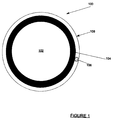
- Figure 1 illustrates a cross-sectional view of an improved reinforced hose 100, in accordance with a preferred embodiment of the present invention.
- the reinforced hose illustrated in Figure 1 includes an interior tube 104, having an inner bore 102, in which fluids and/or gases may be conducted therethrough.
- the interior tube 104 should be impervious and flexible, and is preferably comprised of a natural or synthetic polymer, copolymer or terpolymer. Selection of the interior tube 104 is based on the type of fluid or gas being conducted through the inner bore 102.
- the interior tube 104 may comprise ethylene-propylene-compound diene (EPDM), or another plastic or rubber material, may be used when potable water is conducted through the inner bore 102.
- EPDM ethylene-propylene-compound diene
- acrylonitrile-butadiene may be used to conduct gaseous or petroleum products through the inner bore 102.
- the inner tube 104 may comprise Teflon TM when used to conduct chemicals.
- An outer covering is disposed directly over, and surrounding, the outer surface of the interior tube 104.
- Such outer covering 108 is formed about the interior tube 104 to enable the hose 100 to withstand significant internal pressures through the inner bore 102 of the interior tube 104.
- the outer covering 108 is comprised of a plurality of plastic threads.
- An exemplary plastic thread 106 is illustrated in Figure 1.
- Such threads 106 are preferably interwoven to form a braided layer, or otherwise suitably interlaced together, to form the outer covering 108.
- the outer covering 108 may include more than one braided layer formed about the interior tube 104. However, for most applications, a single braided layer of interwoven threads 106 is sufficient to provide the necessary reinforcement.
- no intermediate layers should be interposed between the interior tube 104 and the outer covering 108. Furthermore, no layers are preferably disposed above and surrounding the outer covering 108.
- the flexibility of the reinforced hose 100 establishes a union between lines and pipes in an efficient and facilitated manner without having to resort to the use of conventional pipes and tubing.
- the reinforced hose 100 disclosed herein is especially applicable for use in the supply of fluids.
- the hoses may be employed to distribute water to domestic sanitary appliances, such as toilets and sinks.
- domestic sanitary appliances such as toilets and sinks.
- gas such as heaters, stoves and dryers.
- Figure 1A illustrates an enlarged sectional view of the outer covering 108 of the improved reinforced hose 100 of Figure 1, in accordance with a preferred embodiment of the present invention.
- the outer covering 108 of the reinforced hose 100 includes multiple plastic threads 106 that are grouped or united into strands 120.
- the strands 120 are preferably braided about the interior tube 104 pursuant to the "two over, two under" method of braiding. Such method allows for the threads 106 included in each strand 120 to flatten out during the braiding operation and form rounded curves so that sharp bends are avoided.
- FIG 1B illustrates a perspective view of the improved reinforced hose 100 of Figure 1, in accordance with a preferred embodiment of the present invention.
- the reinforced hose 100 is provided with fittings 110 at both ends of the hose.
- fittings 110 are fastened to the reinforced hose 100 by crimping the fittings 110 to the ends.
- Figure 2 illustrates a cross-sectional view of a plastic thread 106 of the reinforced hose 100 of Figure 1, in accordance with a preferred embodiment of the present invention.
- the plastic threads 106 which form the outer covering 108 of the improved reinforced hose 100, are preferably formed by extruding a plastic substance 204 over a core material 202, as explained in more detail below.
- the plastic substance 204 thus forms the exterior of the threads 106, while the core material 202 forms the interior of the threads 106.
- the plastic substance 204 comprises a vinyl or polyvinyl substance. More preferably, the plastic substance 204 comprises polyvinyl chloride.
- the core material 202 comprises a plastic or polymeric material. More preferably, the core material 202 comprises a multi filament polyester material. Alternatively, the core material 202 may be formed from another plastic material, such as nylon.
- the plastic substance 204 is preferably extruded individually over the core materials 202. That is, the core materials 202 are not collectively treated with the plastic substance 204. More specifically, the plastic substance 204 is not extruded over the core material 202 after the core material 202 has been disposed about the interior tube 104.
- Gauges or diameters of the plastic threads 106 have been empirically selected in accordance with a preferred embodiment of the present invention.
- the plastic threads 106 are formed to possess a gauge or diameter ranging from about 0.005 of an inch to about 0.060 of an inch. More preferably, the plastic threads possess a gauge ranging from about 0.010 of an inch to about 0.040 of an inch. Most preferably, the plastic threads possess a gauge ranging from about 0.015 of an inch to about 0.030 of an inch.
- Tensions with which the outer covering 108 is disposed about the interior tube 104 have been empirically selected in accordance with a preferred embodiment of the present invention.
- such tension is between about 1 to about 2 pounds. More preferably, such tension is approximately 1.5 pounds.
- These tension values provide a greater flexibility and resistance to rupture in the reinforced hose 100 of the present invention.
- these preferred tension values are significantly less than the tensions employed in connection with stainless steel and aluminum reinforced hoses.
- coverage area Values for the portion of the outside surface of interior tube 104 that is covered by the outer covering 108 (hereinafter referred to as "coverage area") have been empirically selected in accordance with a preferred embodiment of the present invention.
- the coverage area is between about 75% and 100%. More preferably, the coverage area is between about 90% and 100%. Most preferably, the coverage area is approximately 95%.
- Table 1 provides examples of reinforced hoses 100 made in accordance with a preferred embodiment of the present invention.
- the number of threads 106 in a strand 120 employed in the reinforcement layer 108 is empirically selected, in accordance with a preferred embodiment of the present invention.
- the number of threads 106 united in a particular strand 120 were empirically selected based on an outer diameter of the interior tube 104 ranging from 0.400 to 0.800 of an inch, a gauge of the threads 106 ranging from 0.020 to 0.025 of an inch, and twenty-four (24) strands used to form the braided layer.
- threads 106 are included in a strand. More preferably, between about two (2) and five (5) threads 106 are included in a strand. Most preferably, between about two (2) and three (3) threads 106 are included in a strand, as indicated in Table 1.
- the process of extruding the outer covering 204 over the core material 202 to form the plastic threads 106 is the initial step of the manufacturing process.
- the resulting thread 106 is cooled to room temperature. Such cooling may, for example, be provided by placing the thread 106 under water after extrusion.
- one or more threads are united to form a strand 120, which is then wound around a bobbin or spool.
- the characteristics of the threads 106 in a strand 120 -- including the number and gauge -- are empirically selected based on numerous factors, such as the outer diameter of the interior tube 104 and the number of strands 120 used to form a braided layer of the outer covering 108.
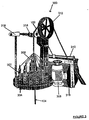
- FIG 3 illustrates an assembly for manufacturing the reinforcement hose of Figure 1 and its associated method, in accordance with a preferred embodiment of the present invention.
- the assembly 300 illustrated in Figure 3 includes a series of bobbins 302, about which the plastic threads 106 are stored, that are disposed on a platform 304.
- the bobbins 302, each supplying a strand 120 of threads 106, are operable to rotate about their own axis.
- An interior tube 104 is directed through an aperture in the platform 304 and through a guide 306 disposed above the platform 304.
- a motor 308 is mechanically connected to the platform 304 as well as a pulley 312.
- the braiding formed about the interior tube 104 is formed by interweaving the strand 120 of threads 106 from each bobbin 302 about the outside surface of the interior tube 104. This is accomplished by rotating the platform 304 by motor 308 around the interior tube 104. Each braided layer is therefore formed by the circulation of the bobbins 302 around the interior tube 104. As a consequence, the reinforced hose 100 is generated.
- connection terminals 112 may be placed at either end of the hose 100 to enable connection of the hose 100 to various other connectors. Such connection terminals 112 may be secured to the ends of the hose 100 by fittings 110 using a pneumatic or hydraulic mechanisms, or other techniques known in the art, to ensure that the hose 100 will be able to resist high pressures and not render leaks.
- the aforementioned manufacturing method is inexpensive and simplified when compared to those employed to manufacture conventional reinforced hoses, such as hoses reinforced by stainless steel braids. This is primarily attributable to the fact that the plastic threads 106 have a significantly greater flexibility and lesser weight than stainless steel wires. Because of such improved resistance, the assembly 300 is able to operate at significantly higher rates and speeds, than it is capable of operating to form the stainless steel braids, since the problem of a broken thread is encountered infrequently. Further, the plastic threads 106 of the present invention, unlike aluminum and stainless steel wires, do not require the application of lubricants to the bobbins 302 so as to decrease friction between the metallic wires of conventional reinforced hoses.
- the assembly 300 is not subjected to wear and tear that it would be if metal wires were used to form the braiding layer.
- the improved reinforced hose of the present invention which employs plastic threads 106, is superior when compared to hoses bearing stainless steel or aluminum reinforcements.
- the plastic reinforced hose when compared to the stainless steel and aluminum reinforced hoses, the plastic reinforced hose: (1) possesses a markedly higher burst pressure; (2) a weight of approximately half that of a stainless steel reinforced hose; (3) a cost of manufacturing (not including cost of reinforcements) that is 20% and 30% less than the cost of manufacturing stainless steel and aluminum reinforced hoses, respectively; (4) a higher degree of resistivity to corrosion as well as detergents and acids; (5) a greater degree of flexibility; and (6) the ability to bend without causing a permanent distortion in the reinforcement and, in turn, restricting the flow through the hose.
- stainless steel threads (which are generally preferred to aluminum threads because of poor resistivity attributes and relatively low burst pressures) cost significantly more than the plastic reinforced threads 106. When considered, this further increases the cost of manufacture relative to a plastic reinforced hose 100.
- Figure 4 illustrates a hot water heater 400 water conduit 401 conducting water into the water heater, and water conduit 402 conducting the hot water from the water heater.
- Conduits 401 and 402 can be made out of copper, galvanized iron or brass.
- the hot water heater 400 has a water outlet 403 and a water inlet 404 comprising short conductive female fittings, nipples, threaded pipe fittings, or other fittings known in the art.
- the water outlet 403 and the water inlet 404 can be dielectrically connected to the conduits 401 and 402 by the means of reinforced hoses 100 an accordance with this embodiment:
- the fittings 405 located at each end of the reinforced hose 100 provides high security and fluid tight connections, they can be male fittings, compression fittings, female fittings or other fittings known in the art. These fittings are preferably made of brass, but can also be made of other materials. For example, stainless steel, copper or galvanized iron may be used.
- the novel reinforced hose 100 provides an easy, reliable economical electrically-insulating connection between a water line and a hot water heater or other appliance.
Landscapes
- Engineering & Computer Science (AREA)
- General Engineering & Computer Science (AREA)
- Mechanical Engineering (AREA)
- Manufacturing & Machinery (AREA)
- Textile Engineering (AREA)
- Rigid Pipes And Flexible Pipes (AREA)
Applications Claiming Priority (2)
| Application Number | Priority Date | Filing Date | Title |
|---|---|---|---|
| US08/891,461 US5899236A (en) | 1995-09-28 | 1997-07-10 | Reinforced, electrically insulating hose |
| US891461 | 1997-07-10 |
Publications (2)
| Publication Number | Publication Date |
|---|---|
| EP0927848A2 true EP0927848A2 (de) | 1999-07-07 |
| EP0927848A3 EP0927848A3 (de) | 1999-12-15 |
Family
ID=25398233
Family Applications (1)
| Application Number | Title | Priority Date | Filing Date |
|---|---|---|---|
| EP97120556A Withdrawn EP0927848A3 (de) | 1997-07-10 | 1997-11-24 | Verstärkter Isolierschlauch |
Country Status (2)
| Country | Link |
|---|---|
| US (1) | US5899236A (de) |
| EP (1) | EP0927848A3 (de) |
Families Citing this family (15)
| Publication number | Priority date | Publication date | Assignee | Title |
|---|---|---|---|---|
| US6206048B1 (en) * | 2000-01-25 | 2001-03-27 | Larry F. Bobenhausen | Method for repairing a bead lock hose fitting |
| NL1017986C2 (nl) * | 2001-05-03 | 2002-12-03 | Pipelife Nederland Bv | Versterkte pijp voor overdruk. |
| US6619331B1 (en) * | 2002-11-20 | 2003-09-16 | Jagan N. Suchdev | Water delivery tube assembly |
| USD499465S1 (en) | 2003-09-04 | 2004-12-07 | Teknor Apex Company | Garden hose |
| US20070051418A1 (en) * | 2005-09-02 | 2007-03-08 | Rowles Brian A | Multilayer tubes |
| US20080110518A1 (en) * | 2006-05-02 | 2008-05-15 | Timothy Hamilton | Gas conduit system |
| US20080178957A1 (en) * | 2007-01-31 | 2008-07-31 | Masco Corporation Of Indiana | Tube assembly |
| USD605737S1 (en) * | 2007-10-12 | 2009-12-08 | Neoperl Gmbh | Braided hose |
| US20100243088A1 (en) * | 2009-03-30 | 2010-09-30 | Gary Wu | Composite Faucet Body Assembly and the Method for Making It |
| BR112012003882A2 (pt) | 2009-08-21 | 2016-03-29 | Titeflex Corp | tubo dissipador de energia, métodos de fabricação de tubulação dissipadora de energia, método de instalação e dispositivos de vedação de um tubo dissipador de energia |
| US20140251482A1 (en) * | 2013-03-06 | 2014-09-11 | Durst Corporation, Inc. | Fluid Supply Hoses Having a Heat-Shrunk, Antifungal Outer Cover and Method for Making Same |
| US11022237B2 (en) * | 2017-02-27 | 2021-06-01 | Titeflex Commercial Inc. | Hose assemblies with reduced axial stress |
| US12018774B2 (en) | 2019-12-16 | 2024-06-25 | Refined Technologies, Inc. | Steam hose with internal liner for chemical cleaning |
| US12007147B2 (en) * | 2021-08-19 | 2024-06-11 | A. O. Smith Corporation | Flexible connectors for water heater |
| USD1093558S1 (en) | 2022-08-17 | 2025-09-16 | A. O. Smith Corporation | Set of water line connections for a water heater |
Citations (1)
| Publication number | Priority date | Publication date | Assignee | Title |
|---|---|---|---|---|
| US4991876A (en) | 1989-07-28 | 1991-02-12 | Euroflex, S.A. | Connector assembly for hot water heaters and other appliances |
Family Cites Families (20)
| Publication number | Priority date | Publication date | Assignee | Title |
|---|---|---|---|---|
| US459509A (en) * | 1891-09-15 | Henry w | ||
| US2009075A (en) * | 1934-06-02 | 1935-07-23 | Anaconda Wire & Cable Co | Expansible woven tubing |
| US2754848A (en) * | 1953-06-11 | 1956-07-17 | Boston Woven Hose & Rubber Co | Fire hose and method of making |
| US3060973A (en) * | 1958-07-17 | 1962-10-30 | Weatherhead Co | Fabric reinforced rubber tube |
| GB1175042A (en) * | 1966-03-11 | 1969-12-23 | Compoflex Co Ltd | Improvements in or relating to Flexible Hose or Tubing |
| IT1012676B (it) * | 1974-05-21 | 1977-03-10 | Pirelli | Tubo per impianti di frenatura di autoveicoli |
| US3972757A (en) * | 1974-09-16 | 1976-08-03 | Uniroyal Inc. | Manufacture of vulcanized elastomeric hose |
| US4159027A (en) * | 1975-02-27 | 1979-06-26 | Caillet Pierre G | Flexible hose for connecting sanitary appliances |
| US4275937A (en) * | 1979-09-19 | 1981-06-30 | Parker-Hannifin Corporation | Hose with braided reinforcement |
| US4567917A (en) * | 1981-07-13 | 1986-02-04 | Stratoflex, Inc. | Hose with wire braid reinforcement |
| US4589688A (en) * | 1981-09-02 | 1986-05-20 | Fillpro Products, Inc. | Plumbing hookup kit |
| US4431031A (en) * | 1982-03-29 | 1984-02-14 | Amco Corporation | Pre-rinse hose |
| US4804212A (en) * | 1986-11-06 | 1989-02-14 | Stratoflex, Inc. | Crimped hose fitting |
| GB2204888A (en) * | 1987-05-18 | 1988-11-23 | Textilver Sa | Fibre reinforced matrix |
| US4905736A (en) * | 1987-06-01 | 1990-03-06 | Yokohama Rubber Co., Ltd. | Hose construction |
| US4817997A (en) * | 1987-06-25 | 1989-04-04 | Ingram Thomas L | Hose coupling |
| US5024419A (en) * | 1989-07-24 | 1991-06-18 | Euroflex, S.A. | Faucet connector assembly |
| US5660210A (en) * | 1992-03-05 | 1997-08-26 | Toyoda Gosei Co., Ltd. | Layered rubber hose with reinforcing |
| US5413147A (en) * | 1993-04-29 | 1995-05-09 | Parker-Hannifin Corporation | Flexible hose and fitting assembly |
| US5622210A (en) * | 1995-06-12 | 1997-04-22 | Lsp Products Group, Inc. | Flexible hose with composite core |
-
1997
- 1997-07-10 US US08/891,461 patent/US5899236A/en not_active Expired - Lifetime
- 1997-11-24 EP EP97120556A patent/EP0927848A3/de not_active Withdrawn
Patent Citations (1)
| Publication number | Priority date | Publication date | Assignee | Title |
|---|---|---|---|---|
| US4991876A (en) | 1989-07-28 | 1991-02-12 | Euroflex, S.A. | Connector assembly for hot water heaters and other appliances |
Also Published As
| Publication number | Publication date |
|---|---|
| US5899236A (en) | 1999-05-04 |
| EP0927848A3 (de) | 1999-12-15 |
Similar Documents
| Publication | Publication Date | Title |
|---|---|---|
| US5899236A (en) | Reinforced, electrically insulating hose | |
| US5803129A (en) | Reinforced hose | |
| US7631666B1 (en) | Reinforced flexible hose with leakage indicator and method of making same | |
| US5931200A (en) | Connector system for attachment of flexible hose to PEX supply line | |
| US6302152B1 (en) | Flexible connector with improved braided sheathing | |
| EP0748972B1 (de) | Flexibler Schlauch mit einer Seele aus Verbundwerkstoff | |
| US4341578A (en) | Method of hose production | |
| EP0148100B1 (de) | Textilverstärkter Schlauch und Methode zu seiner Herstellung | |
| US11739864B2 (en) | Hose having a tensile strength braided layer | |
| GB2034433A (en) | Method of hose production and product | |
| US20050087250A1 (en) | Reinforced flexible hose and method of making same | |
| EP0629805A2 (de) | Biegsamer Schlauch | |
| CN110858507B (zh) | 具有嵌入式特征结构的线缆软管 | |
| EP1156252A1 (de) | Schlauch, insbesondere für wässernanwendungen | |
| US6170533B1 (en) | Wiremesh reinforcement-plastic composite pipe component and method for making the same | |
| JPH02102987A (ja) | 発泡チューブ | |
| US20050247362A1 (en) | Well hose with embedded electrical conductors | |
| CN202349418U (zh) | 高低压一体管 | |
| JP2010144882A (ja) | ホース及びホースの製造方法 | |
| JP2004144180A (ja) | 耐キンク性ホース | |
| JPH1163318A (ja) | 樹脂ホースおよび樹脂ホースアセンブリー | |
| CN222977636U (zh) | 用于二板注塑机冷却软管 | |
| CN113639105A (zh) | 一种加强型复合管 | |
| US3500868A (en) | Flexible conduit | |
| JPH11257552A (ja) | 樹脂ホースおよび樹脂ホースアセンブリ |
Legal Events
| Date | Code | Title | Description |
|---|---|---|---|
| PUAI | Public reference made under article 153(3) epc to a published international application that has entered the european phase |
Free format text: ORIGINAL CODE: 0009012 |
|
| AK | Designated contracting states |
Kind code of ref document: A2 Designated state(s): AT BE CH DE DK ES FI FR GB GR IE IT LI LU MC NL PT SE |
|
| AX | Request for extension of the european patent |
Free format text: AL;LT;LV;MK;RO;SI |
|
| PUAL | Search report despatched |
Free format text: ORIGINAL CODE: 0009013 |
|
| RIC1 | Information provided on ipc code assigned before grant |
Free format text: 6F 16L 25/02 A, 6F 16L 11/115 B, 6F 16L 11/08 B, 6D 04C 1/02 B, 6F 16L 33/207 B |
|
| AK | Designated contracting states |
Kind code of ref document: A3 Designated state(s): AT BE CH DE DK ES FI FR GB GR IE IT LI LU MC NL PT SE |
|
| AX | Request for extension of the european patent |
Free format text: AL;LT;LV;MK;RO;SI |
|
| AKX | Designation fees paid | ||
| REG | Reference to a national code |
Ref country code: DE Ref legal event code: 8566 |
|
| STAA | Information on the status of an ep patent application or granted ep patent |
Free format text: STATUS: THE APPLICATION IS DEEMED TO BE WITHDRAWN |
|
| 18D | Application deemed to be withdrawn |
Effective date: 20000601 |