EP0927158B1 - Amphiphile verbindungen mit mindestens zwei hydrophilen und mindestens zwei hydrophoben gruppen auf der basis von dicarbonsäurediamiden - Google Patents
Amphiphile verbindungen mit mindestens zwei hydrophilen und mindestens zwei hydrophoben gruppen auf der basis von dicarbonsäurediamiden Download PDFInfo
- Publication number
- EP0927158B1 EP0927158B1 EP97933692A EP97933692A EP0927158B1 EP 0927158 B1 EP0927158 B1 EP 0927158B1 EP 97933692 A EP97933692 A EP 97933692A EP 97933692 A EP97933692 A EP 97933692A EP 0927158 B1 EP0927158 B1 EP 0927158B1
- Authority
- EP
- European Patent Office
- Prior art keywords
- amphiphilic compounds
- equal
- independently
- formula
- another
- Prior art date
- Legal status (The legal status is an assumption and is not a legal conclusion. Google has not performed a legal analysis and makes no representation as to the accuracy of the status listed.)
- Expired - Lifetime
Links
- 0 CCC(CC)(*C(C(NP)=O)N=O)C(C(*P)=O)[N+](C)[O-] Chemical compound CCC(CC)(*C(C(NP)=O)N=O)C(C(*P)=O)[N+](C)[O-] 0.000 description 3
Classifications
-
- A—HUMAN NECESSITIES
- A61—MEDICAL OR VETERINARY SCIENCE; HYGIENE
- A61Q—SPECIFIC USE OF COSMETICS OR SIMILAR TOILETRY PREPARATIONS
- A61Q19/00—Preparations for care of the skin
- A61Q19/10—Washing or bathing preparations
-
- A—HUMAN NECESSITIES
- A61—MEDICAL OR VETERINARY SCIENCE; HYGIENE
- A61K—PREPARATIONS FOR MEDICAL, DENTAL OR TOILETRY PURPOSES
- A61K8/00—Cosmetics or similar toiletry preparations
- A61K8/18—Cosmetics or similar toiletry preparations characterised by the composition
- A61K8/30—Cosmetics or similar toiletry preparations characterised by the composition containing organic compounds
- A61K8/46—Cosmetics or similar toiletry preparations characterised by the composition containing organic compounds containing sulfur
- A61K8/466—Cosmetics or similar toiletry preparations characterised by the composition containing organic compounds containing sulfur containing sulfonic acid derivatives; Salts
-
- A—HUMAN NECESSITIES
- A61—MEDICAL OR VETERINARY SCIENCE; HYGIENE
- A61Q—SPECIFIC USE OF COSMETICS OR SIMILAR TOILETRY PREPARATIONS
- A61Q5/00—Preparations for care of the hair
- A61Q5/02—Preparations for cleaning the hair
-
- C—CHEMISTRY; METALLURGY
- C07—ORGANIC CHEMISTRY
- C07C—ACYCLIC OR CARBOCYCLIC COMPOUNDS
- C07C309/00—Sulfonic acids; Halides, esters, or anhydrides thereof
- C07C309/01—Sulfonic acids
- C07C309/02—Sulfonic acids having sulfo groups bound to acyclic carbon atoms
- C07C309/03—Sulfonic acids having sulfo groups bound to acyclic carbon atoms of an acyclic saturated carbon skeleton
- C07C309/17—Sulfonic acids having sulfo groups bound to acyclic carbon atoms of an acyclic saturated carbon skeleton containing carboxyl groups bound to the carbon skeleton
-
- C—CHEMISTRY; METALLURGY
- C09—DYES; PAINTS; POLISHES; NATURAL RESINS; ADHESIVES; COMPOSITIONS NOT OTHERWISE PROVIDED FOR; APPLICATIONS OF MATERIALS NOT OTHERWISE PROVIDED FOR
- C09K—MATERIALS FOR MISCELLANEOUS APPLICATIONS, NOT PROVIDED FOR ELSEWHERE
- C09K23/00—Use of substances as emulsifying, wetting, dispersing, or foam-producing agents
- C09K23/22—Amides or hydrazides
- C09K23/24—Amides of higher fatty acids with aminoalkylated sulfonic acids
-
- C—CHEMISTRY; METALLURGY
- C11—ANIMAL OR VEGETABLE OILS, FATS, FATTY SUBSTANCES OR WAXES; FATTY ACIDS THEREFROM; DETERGENTS; CANDLES
- C11D—DETERGENT COMPOSITIONS; USE OF SINGLE SUBSTANCES AS DETERGENTS; SOAP OR SOAP-MAKING; RESIN SOAPS; RECOVERY OF GLYCEROL
- C11D1/00—Detergent compositions based essentially on surface-active compounds; Use of these compounds as a detergent
- C11D1/02—Anionic compounds
- C11D1/12—Sulfonic acids or sulfuric acid esters; Salts thereof
- C11D1/28—Sulfonation products derived from fatty acids or their derivatives, e.g. esters, amides
Definitions
- the invention relates to amphiphilic compounds with at least two hydrophilic and at least two hydrophobic groups based on dicarboxylic acid diamides.
- anionic, cationic, nonionic are amphiphilic substances and zwitterionic compounds.
- the vast majority of these substances consist of a hydrophilic head group and at least one hydrophobic part.
- amphiphilic substances there are ecological reasons, e.g. B. regarding the reduction packaging and transport costs, the need for ever greater impact to achieve per mass of substance used. Since an optimization by mixing If amphiphilic substances are only continued to a very limited extent, new amphiphilic substances are included higher efficiency is required. In particular, therefore, substances with lower critical micelle concentrations and / or lower surface and interfacial tensions can be found in order to be able to significantly reduce the amounts of active substance used.
- cationic surface-active compounds can be obtained by adding long-chain alkyl halides to permethylated alkylenediamines [R. Zana, M. Benrraou, R. Rueff, Langmuir, 7 (1991) 1072; R. Zana, Y. Talmon, Nature, 362 (1993) 228; E. Alami, G Beinert, P. Marie, R. Zana, Langmuir, 9 (1993) 1465].
- Anionic surfactant compounds with at least two hydrophilic and at least one two hydrophobic groups have been prepared on the basis of diglycidyl ethers (US Pat. No. 5,160 450, JP 01 304 033, JP 4 124 165).
- diglycidyl ethers are considered toxicologically unsafe and are quite expensive.
- epichlorohydrin is used for their manufacture, leading to leads to large amounts of residues, so that these compounds under ecotoxicological like economic aspects are no longer up to date.
- esters of ⁇ -sulfocarboxylic acids and polyalkylene oxide glycol ethers among which amphiphilic compounds are also described in US-A-3,246,023.
- the Almost universal properties are attributed to the named compounds. So they should inter alia as emulsifiers for insecticides, crop protection agents and herbicides, as additives for petro products and rubber latices, as foam inhibitors, as aids in road construction, at of concrete and paper production, as mercerization aids, as corrosion inhibitors, as Aid in the production of cosmetic formulations and generally also as a cleaning agent suitable in hard water.
- amphiphilic compounds at least two Have hydrophilic and at least two hydrophobic groups, the amphiphilic compounds have a very high efficiency, based on the amount used, and above that out of technically easily available raw materials without a large amount of unwanted by-products can be produced.
- amphiphilic dicarboxylic acid diamides their main body can be prepared from dicarboxylic acids or their esters and alkylamines.
- the Corresponding amides can be sulfonated and then neutralized.
- amphiphilic compounds according to the invention are compounds of the general formula I. where R 1 , R 2 and R 3 in formula I have the meanings described below: R 1 and R 3 independently of one another represent an unbranched or branched, saturated or unsaturated hydrocarbon radical having 8 to 22 carbon atoms.
- the substituents R 1 and R 3 are in particular the radicals n-octyl, n-nonyl, n-decyl, n-undecyl, n-dodecyl, n-tridecyl, n-tetradecyl, n-pentadecyl, n-hexadecyl, n -Heptadecyl, n-octadecyl, n-nonadecyl, n-eicosyl, n-henicosyl, n-docosyl and their branched chain isomers and the corresponding mono-, di- or tri-unsaturated radicals.
- amphiphilic compounds according to the invention are usually characterized by extremely low critical micelle concentrations (CMC) and very low surface and interfacial tensions (e.g. against paraffin) from what their special structure - at least two hydrophilic groups and at least two hydrophobic groups got to.
- CMC critical micelle concentrations
- paraffin very low surface and interfacial tensions
- amphiphilic compounds according to this invention are particularly suitable as emulsifiers, Demulsifiers, detergents, dispersants and hydrotropics in industry and household, for example in the fields of metal processing, ore mining, surface finishing, Washing and cleaning, cosmetics, medicine and food processing and preparation.
- non-ionic surface-active substances that can be used for a combination are fatty acid glycerides, Fatty acid polyglycerides, fatty acid esters, ethoxylates of higher alcohols,
- Polyoxyethylene fatty acid glycerides Polyoxyethylene propylene glycol fatty acid esters, polyoxyethylene sorbitan fatty acid esters, Polyoxyethylene castor oil or hardened castor oil derivatives, Polyoxyethylene lanolin derivatives, polyoxyethylene fatty acid amides, polyoxyethylene alkyl amines, Alkanolamines, alkylamine oxides, derivatives of protein hydrolyzates, hydroxy mixed ethers, alkyl polyglycosides and called alkyl glucamides.
- anionic surfactants used for combinations soaps, ether carboxylic acids and their salts, alkyl sulfonates, ⁇ -olefin sulfonates, Sulfonates of higher fatty acid esters, higher alcohol sulfates, alcohol ether sulfates, hydroxy mixed ether sulfates, Alkanoyl and alkenoyl sarcosinates, salts of phosphate esters, Taurides, isethionates, linear alkylbenzenesulfonates, cumene sulfonates, alkylarylsulfonates, sulfates called the polyoxyethylene fatty acid amides and salts of acylamino acids.
- cationic surfactants for combinations alkyltrimethylammonium salts, dialkyldimethylammonium salts, Alkyldimethylbenzylammonium salts, alkylpyridinium salts, alkylisoquinolinium salts, Benzethonium chlorides and cationic acylamino acid derivatives called.
- ampholytic surfactants for combinations Amino acids, betaines, sulfobetaines, imidazoline derivatives, soybean lipids can be used and called lecithin.
- amphiphilic compounds according to the invention can also be used on their own can be combined with each other
- additives can also be used in the amphiphilic compounds according to the invention be added.
- Such additives are specially selected for a formulation and usually include inorganic salts, such as sodium chloride and sulfate, and builders, Hydrotropics, UV absorbers, plasticizers, chelating agents, viscosity modifiers, fragrances and enzymes.
- the above compounds can be amidated by dicarboxylic acids or their esters with alkylamines and by at least double sulfonation of the dicarboxylic acid dialkylamides produce. Both ways are feasible, both, preferably, sulfonation of alkyl dicarboxylic acid (alkyl radical with 1 to 6 carbon atoms) with subsequent amidation with longer alkylaminopolyalkoxylates or alkylamines, as well as the sulfonation of already finished basic framework. With aqueous alkali or alkaline earth metal hydroxides or aqueous Ammonia or alkanolamines are neutralized. If necessary, the products are in substance or, preferably, in aqueous solution with hydrogen peroxide (0.1 to 2.0%, based on Solid) bleached.
Landscapes
- Chemical & Material Sciences (AREA)
- Organic Chemistry (AREA)
- Health & Medical Sciences (AREA)
- Life Sciences & Earth Sciences (AREA)
- Animal Behavior & Ethology (AREA)
- General Health & Medical Sciences (AREA)
- Public Health (AREA)
- Veterinary Medicine (AREA)
- Engineering & Computer Science (AREA)
- Chemical Kinetics & Catalysis (AREA)
- Oil, Petroleum & Natural Gas (AREA)
- Wood Science & Technology (AREA)
- Dermatology (AREA)
- Birds (AREA)
- Epidemiology (AREA)
- Materials Engineering (AREA)
- Detergent Compositions (AREA)
- Organic Low-Molecular-Weight Compounds And Preparation Thereof (AREA)
- Emulsifying, Dispersing, Foam-Producing Or Wetting Agents (AREA)
- Cosmetics (AREA)
- Agricultural Chemicals And Associated Chemicals (AREA)
Description

- unverzweigte oder verzweigte Alkylenketten der Formel II
- Alicyclen gemäß der Formel IV
- gegebenenfalls substituierte Aromaten gemäß der Formel VI
- n in der Formel I steht für die Zahl 1.
- R2 kann weiterhin einem Methyl- oder Ethylester einer Polycarbonsäure (MW 500 bis 100 000, vorzugsweise 500 bis 1 000) entstammen, deren α-Kohlenstoffatome zwischen 0 und 100 %, bevorzugt zwischen 10 und 60 % sulfoniert worden sind; in diesem Fall liegt n zwischen 1 und 25 000.
- M und M' stehen für Alkali-, Ammonium-, Alkanolammonium oder ½ Erdalkaliion.
Claims (7)
- Amphiphile Verbindungen der allgemeinen Formel Iin der R1 und R3 unabhängig voneinander einen unverzweigten oder verzweigten, gesättigten oder ungesättigten Kohlenwasserstoffrest mit 8 bis 22 Kohlenstoffatomen,
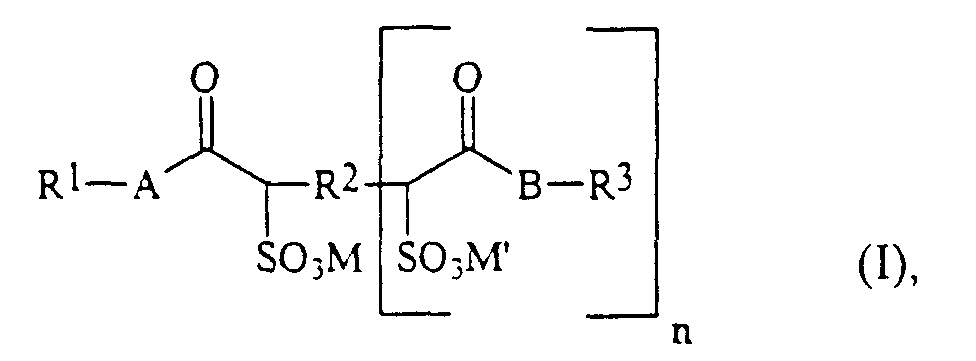 R2bedeuteteine unverzweigte oder verzweigte Alkylenkette der Formel IIeinen Alicyclus gemäß der Formel IV
oder einenunsubstituierten oder substituierten Aromaten gemäß der Formel VI
oder einem Methyl- oder Ethylester einer Polycarbonsäure (MW 500 bis 100 000) entstammt, deren α-Kohlenstoffatome zwischen 0 und 100 %, bevorzugt zwischen 10 und 60 % sulfoniert worden sind,M und M' für ein Alkali-, Ammonium-, Alkanolammonium- oder ½ Erdalkaliion steht,A und B unabhängig voneinander -NH-, -NR4- (mit R4 = Methyl, Ethyl, Propyl, Butyl oder Methoxyethyl, Methoxypropyl, Ethoxypropyl), -N(R5)-O(C2H4O)α(C3H6O)β- ( mit α = 0 bis 20 und β = 0 bis 20, wobei α und β nicht gleichzeitig 0 sind und R5 gleich R4 oder gleich -O(C2H4O)α(C3H6O)β-H, mit den vorgenannten Bedingungen), oder -C(O)N(R5)-O(C2H4O)α(C3H6O)β- bedeuten
und n für die Zahl 1 steht, oder im Falle der Polycarbosäure zwischen 1 und 25 000 liegt. - Verwendung der amphiphilen Verbindungen nach Anspruch 1 als Emulgator.
- Verwendung der amphiphilen Verbindungen nach Anspruch 1 als Demulgator.
- Verwendung der amphiphilen Verbindungen nach Anspruch 1 als Hilfsmittel bei der Metallbearbeitung, Erzgewinnung oder Oberflächenveredelung.
- Verwendung der amphiphilen Verbindungen nach Anspruch 1 als Textilhilfsmittel oder für das Reinigen und Waschen von Textilien.
- Verwendung der amphiphilen Verbindungen nach Anspruch 1 für das Reinigen von harten Oberflächen.
- Verwendung der amphiphilen Verbindungen nach Anspruch 1 für das Reinigen und Waschen von Haut und Haar.
Applications Claiming Priority (3)
| Application Number | Priority Date | Filing Date | Title |
|---|---|---|---|
| DE19633497 | 1996-08-20 | ||
| DE19633497A DE19633497A1 (de) | 1996-08-20 | 1996-08-20 | Amphiphile Verbindungen mit mindestens zwei hydrophilen und mindestens zwei hydrophoben Gruppen auf der Basis von Dicarbonsäurediestern |
| PCT/EP1997/003933 WO1998007689A1 (de) | 1996-08-20 | 1997-07-19 | Amphiphile verbindungen mit mindestens zwei hydrophilen und mindestens zwei hydrophoben gruppen auf der basis von dicarbonsäurediestern |
Publications (2)
| Publication Number | Publication Date |
|---|---|
| EP0927158A1 EP0927158A1 (de) | 1999-07-07 |
| EP0927158B1 true EP0927158B1 (de) | 2001-10-31 |
Family
ID=7803099
Family Applications (1)
| Application Number | Title | Priority Date | Filing Date |
|---|---|---|---|
| EP97933692A Expired - Lifetime EP0927158B1 (de) | 1996-08-20 | 1997-07-19 | Amphiphile verbindungen mit mindestens zwei hydrophilen und mindestens zwei hydrophoben gruppen auf der basis von dicarbonsäurediamiden |
Country Status (7)
| Country | Link |
|---|---|
| US (1) | US6323363B1 (de) |
| EP (1) | EP0927158B1 (de) |
| JP (1) | JP2000516624A (de) |
| AT (1) | ATE207890T1 (de) |
| DE (2) | DE19633497A1 (de) |
| ES (1) | ES2166554T3 (de) |
| WO (1) | WO1998007689A1 (de) |
Families Citing this family (1)
| Publication number | Priority date | Publication date | Assignee | Title |
|---|---|---|---|---|
| DE19647060A1 (de) * | 1996-11-14 | 1998-05-20 | Huels Chemische Werke Ag | Verwendung von anionischen Geminitensiden in Formulierungen für Wasch-, Reinigungs- und Körperpflegemittel |
Family Cites Families (10)
| Publication number | Priority date | Publication date | Assignee | Title |
|---|---|---|---|---|
| US2028091A (en) * | 1933-07-28 | 1936-01-14 | American Cyanamid & Chem Corp | Esters of sulphodicarboxylic acids |
| US2192906A (en) * | 1937-09-17 | 1940-03-12 | Du Pont | Diamides of aliphatic sulpho-and sulphato-dicarboxylic acids and processes of preparing them |
| US3246023A (en) * | 1962-05-03 | 1966-04-12 | Petrolite Corp | Ester of an alpha-sulfocarboxylic acid and a polyalkyleneoxide glycol ether |
| DE1276637B (de) * | 1964-12-14 | 1968-09-05 | Henkel & Cie Gmbh | Verfahren zur Herstellung von Salzen von aliphatischen ª‡-Sulfo-ª‰-ketocarbonsaeureestern |
| JPH01304033A (ja) | 1988-05-30 | 1989-12-07 | Lion Corp | 二疎水鎖二親水基型界面活性剤 |
| DE3932492A1 (de) | 1989-09-28 | 1991-05-02 | Henkel Kgaa | Salze von sulfonierten estern von dicarbonsaeuren mit ungesaettigten fettalkoholen bzw. -alkoxylaten, verfahren zu ihrer herstellung und ihre verwendung als oberflaechenaktive mittel |
| JP2907517B2 (ja) | 1990-09-12 | 1999-06-21 | 鐘紡株式会社 | 二鎖または三鎖二親水基型化合物 |
| US5160450A (en) | 1990-12-05 | 1992-11-03 | Lion Corporation | Surface-active agents having two hydrophobic chains and two hydrophilic groups |
| JPH073287A (ja) * | 1993-06-18 | 1995-01-06 | Lion Corp | 洗浄剤組成物 |
| DE19505367A1 (de) * | 1995-02-17 | 1996-10-24 | Huels Chemische Werke Ag | Amphiphile Verbindungen mit mindestens zwei hydrophilen und mindestens zwei hydrophoben Gruppen auf der Basis von Dicarbonsäurediestern |
-
1996
- 1996-08-20 DE DE19633497A patent/DE19633497A1/de not_active Withdrawn
-
1997
- 1997-07-19 US US09/242,547 patent/US6323363B1/en not_active Expired - Fee Related
- 1997-07-19 EP EP97933692A patent/EP0927158B1/de not_active Expired - Lifetime
- 1997-07-19 DE DE59705216T patent/DE59705216D1/de not_active Expired - Fee Related
- 1997-07-19 JP JP10510310A patent/JP2000516624A/ja not_active Ceased
- 1997-07-19 WO PCT/EP1997/003933 patent/WO1998007689A1/de not_active Ceased
- 1997-07-19 AT AT97933692T patent/ATE207890T1/de not_active IP Right Cessation
- 1997-07-19 ES ES97933692T patent/ES2166554T3/es not_active Expired - Lifetime
Also Published As
| Publication number | Publication date |
|---|---|
| ES2166554T3 (es) | 2002-04-16 |
| WO1998007689A1 (de) | 1998-02-26 |
| JP2000516624A (ja) | 2000-12-12 |
| DE19633497A1 (de) | 1998-02-26 |
| ATE207890T1 (de) | 2001-11-15 |
| EP0927158A1 (de) | 1999-07-07 |
| DE59705216D1 (de) | 2001-12-06 |
| US6323363B1 (en) | 2001-11-27 |
Similar Documents
| Publication | Publication Date | Title |
|---|---|---|
| EP0804279B1 (de) | Amphiphile verbindungen mit mindestens zwei hydrophilen und mindestens zwei hydrophoben gruppen auf der basis von amiden | |
| EP0809625B1 (de) | Anionische amphiphile verbindungen mit mindestens zwei hydrophilen und mindestens zwei hydrophoben gruppen auf der basis von dicarbonsäurediamiden | |
| EP0885185B1 (de) | Betain-geminitenside auf der basis von aminen | |
| WO1994006899A1 (de) | Detergensgemische | |
| DE69416159T2 (de) | Isethionatester von alkylalkoxycarbonsäuren als milde tenside | |
| EP0793647B1 (de) | Amphiphile verbindungen mit mindestens zwei hydrophilen und mindestens zwei hydrophoben gruppen auf der basis von di-, oligo- oder polyolethern | |
| EP0876328B1 (de) | Amphiphile verbindungen mit mehreren hydrophilen und hydrophoben gruppen auf der basis von kohlensäurederivaten | |
| EP0836590B1 (de) | Amphiphile verbindungen mit mehreren hydrophilen und hydrophoben gruppen auf der basis von alkoxylierten aminen und/oder amiden und di-, oligo- oder polycarbonsäuren | |
| EP0809628B1 (de) | Amphiphile verbindungen mit mindestens zwei hydrophilen und mindestens zwei hydrophoben gruppen auf der basis von dicarbonsäurediestern | |
| DE4111811A1 (de) | Citronensaeurefettalkoholesterpolyglykolether- sulfosuccinate, verfahren zu ihrer herstellung und ihre verwendung | |
| DE19517046C1 (de) | Tenside mit quartärer Stickstoffgruppe | |
| EP0875500A2 (de) | Quaternierte Fettsäureamidoaminethoxylate | |
| EP1516915A1 (de) | Hochkonzentrierte wässrige Lösung amphoterer Tenside | |
| WO1997007089A1 (de) | Amphiphile verbindungen mit mehreren hydrophilen und hydrophoben gruppen auf der basis von aminobernsteinsäurederivaten | |
| DE19532293A1 (de) | Anionische amphiphile Verbindungen mit mehreren hydrophilen und hydrophoben Gruppen auf der Basis von Acetylenderivaten | |
| DE19633497A1 (de) | Amphiphile Verbindungen mit mindestens zwei hydrophilen und mindestens zwei hydrophoben Gruppen auf der Basis von Dicarbonsäurediestern | |
| EP0779836A1 (de) | Milde detergensgemische | |
| DE69511387T2 (de) | Neue glycinderivate, zwischenprodukte dazu, sowie diese enthaltenden reinigungszusammensetzungen | |
| EP0977732B1 (de) | Amphiphile verbindungen mit mindestens zwei hydrophilen und mindestens zwei hydrophoben gruppen auf der basis von di-, oligo- oder polyenen | |
| DE4445133A1 (de) | Amphiphile Verbindungen mit mindestens zwei hydrophilen und mindestens zwei hydrophoben Gruppen auf der Basis von Estern | |
| EP0726890B1 (de) | Verfahren zur herstellung von detergensgemischen | |
| EP0771346A1 (de) | Detergensgemische mit verbesserter reinigungsleistung |
Legal Events
| Date | Code | Title | Description |
|---|---|---|---|
| PUAI | Public reference made under article 153(3) epc to a published international application that has entered the european phase |
Free format text: ORIGINAL CODE: 0009012 |
|
| 17P | Request for examination filed |
Effective date: 19990311 |
|
| AK | Designated contracting states |
Kind code of ref document: A1 Designated state(s): AT BE CH DE ES FR GB IT LI NL |
|
| RTI1 | Title (correction) |
Free format text: AMPHIPHILIC COMPOUNDS WITH AT LEAST TWO HYDROPHILIC AND AT LEAST TWO HYDROPHOBIC GROUPS BASED ON DICARBOXYCLIC ACID DIAMIDES |
|
| GRAG | Despatch of communication of intention to grant |
Free format text: ORIGINAL CODE: EPIDOS AGRA |
|
| GRAG | Despatch of communication of intention to grant |
Free format text: ORIGINAL CODE: EPIDOS AGRA |
|
| GRAH | Despatch of communication of intention to grant a patent |
Free format text: ORIGINAL CODE: EPIDOS IGRA |
|
| 17Q | First examination report despatched |
Effective date: 20010118 |
|
| GRAH | Despatch of communication of intention to grant a patent |
Free format text: ORIGINAL CODE: EPIDOS IGRA |
|
| RAP1 | Party data changed (applicant data changed or rights of an application transferred) |
Owner name: SASOL GERMANY GMBH |
|
| GRAA | (expected) grant |
Free format text: ORIGINAL CODE: 0009210 |
|
| AK | Designated contracting states |
Kind code of ref document: B1 Designated state(s): AT BE CH DE ES FR GB IT LI NL |
|
| REF | Corresponds to: |
Ref document number: 207890 Country of ref document: AT Date of ref document: 20011115 Kind code of ref document: T |
|
| REG | Reference to a national code |
Ref country code: CH Ref legal event code: EP |
|
| REF | Corresponds to: |
Ref document number: 59705216 Country of ref document: DE Date of ref document: 20011206 |
|
| REG | Reference to a national code |
Ref country code: GB Ref legal event code: IF02 |
|
| GBT | Gb: translation of ep patent filed (gb section 77(6)(a)/1977) |
Effective date: 20020107 |
|
| ET | Fr: translation filed | ||
| REG | Reference to a national code |
Ref country code: CH Ref legal event code: NV Representative=s name: TROESCH SCHEIDEGGER WERNER AG |
|
| REG | Reference to a national code |
Ref country code: ES Ref legal event code: FG2A Ref document number: 2166554 Country of ref document: ES Kind code of ref document: T3 |
|
| PLBE | No opposition filed within time limit |
Free format text: ORIGINAL CODE: 0009261 |
|
| STAA | Information on the status of an ep patent application or granted ep patent |
Free format text: STATUS: NO OPPOSITION FILED WITHIN TIME LIMIT |
|
| 26N | No opposition filed | ||
| PGFP | Annual fee paid to national office [announced via postgrant information from national office to epo] |
Ref country code: FR Payment date: 20090720 Year of fee payment: 13 Ref country code: ES Payment date: 20090724 Year of fee payment: 13 |
|
| PGFP | Annual fee paid to national office [announced via postgrant information from national office to epo] |
Ref country code: NL Payment date: 20090724 Year of fee payment: 13 Ref country code: GB Payment date: 20090724 Year of fee payment: 13 Ref country code: CH Payment date: 20090727 Year of fee payment: 13 Ref country code: AT Payment date: 20090723 Year of fee payment: 13 |
|
| PGFP | Annual fee paid to national office [announced via postgrant information from national office to epo] |
Ref country code: DE Payment date: 20090929 Year of fee payment: 13 |
|
| PGFP | Annual fee paid to national office [announced via postgrant information from national office to epo] |
Ref country code: BE Payment date: 20090728 Year of fee payment: 13 |
|
| PGFP | Annual fee paid to national office [announced via postgrant information from national office to epo] |
Ref country code: IT Payment date: 20090730 Year of fee payment: 13 |
|
| BERE | Be: lapsed |
Owner name: *SASOL GERMANY G.M.B.H. Effective date: 20100731 |
|
| REG | Reference to a national code |
Ref country code: NL Ref legal event code: V1 Effective date: 20110201 |
|
| REG | Reference to a national code |
Ref country code: CH Ref legal event code: PL |
|
| GBPC | Gb: european patent ceased through non-payment of renewal fee |
Effective date: 20100719 |
|
| REG | Reference to a national code |
Ref country code: FR Ref legal event code: ST Effective date: 20110331 |
|
| PG25 | Lapsed in a contracting state [announced via postgrant information from national office to epo] |
Ref country code: DE Free format text: LAPSE BECAUSE OF NON-PAYMENT OF DUE FEES Effective date: 20110201 Ref country code: CH Free format text: LAPSE BECAUSE OF NON-PAYMENT OF DUE FEES Effective date: 20100731 Ref country code: LI Free format text: LAPSE BECAUSE OF NON-PAYMENT OF DUE FEES Effective date: 20100731 |
|
| REG | Reference to a national code |
Ref country code: DE Ref legal event code: R119 Ref document number: 59705216 Country of ref document: DE Effective date: 20110201 |
|
| PG25 | Lapsed in a contracting state [announced via postgrant information from national office to epo] |
Ref country code: AT Free format text: LAPSE BECAUSE OF NON-PAYMENT OF DUE FEES Effective date: 20100719 Ref country code: NL Free format text: LAPSE BECAUSE OF NON-PAYMENT OF DUE FEES Effective date: 20110201 Ref country code: FR Free format text: LAPSE BECAUSE OF NON-PAYMENT OF DUE FEES Effective date: 20100802 Ref country code: IT Free format text: LAPSE BECAUSE OF NON-PAYMENT OF DUE FEES Effective date: 20100719 |
|
| PG25 | Lapsed in a contracting state [announced via postgrant information from national office to epo] |
Ref country code: BE Free format text: LAPSE BECAUSE OF NON-PAYMENT OF DUE FEES Effective date: 20100731 |
|
| PG25 | Lapsed in a contracting state [announced via postgrant information from national office to epo] |
Ref country code: GB Free format text: LAPSE BECAUSE OF NON-PAYMENT OF DUE FEES Effective date: 20100719 |
|
| REG | Reference to a national code |
Ref country code: ES Ref legal event code: FD2A Effective date: 20110818 |
|
| PG25 | Lapsed in a contracting state [announced via postgrant information from national office to epo] |
Ref country code: ES Free format text: LAPSE BECAUSE OF NON-PAYMENT OF DUE FEES Effective date: 20100720 |