EP0920138A2 - Tail-biting Faltungskode-Dekodierverfahren und -system - Google Patents
Tail-biting Faltungskode-Dekodierverfahren und -system Download PDFInfo
- Publication number
- EP0920138A2 EP0920138A2 EP98309627A EP98309627A EP0920138A2 EP 0920138 A2 EP0920138 A2 EP 0920138A2 EP 98309627 A EP98309627 A EP 98309627A EP 98309627 A EP98309627 A EP 98309627A EP 0920138 A2 EP0920138 A2 EP 0920138A2
- Authority
- EP
- European Patent Office
- Prior art keywords
- encoding
- score
- tailbiting
- decoding
- state
- Prior art date
- Legal status (The legal status is an assumption and is not a legal conclusion. Google has not performed a legal analysis and makes no representation as to the accuracy of the status listed.)
- Granted
Links
Images


Classifications
-
- H—ELECTRICITY
- H03—ELECTRONIC CIRCUITRY
- H03M—CODING; DECODING; CODE CONVERSION IN GENERAL
- H03M13/00—Coding, decoding or code conversion, for error detection or error correction; Coding theory basic assumptions; Coding bounds; Error probability evaluation methods; Channel models; Simulation or testing of codes
- H03M13/65—Purpose and implementation aspects
- H03M13/6508—Flexibility, adaptability, parametrability and configurability of the implementation
-
- H—ELECTRICITY
- H03—ELECTRONIC CIRCUITRY
- H03M—CODING; DECODING; CODE CONVERSION IN GENERAL
- H03M13/00—Coding, decoding or code conversion, for error detection or error correction; Coding theory basic assumptions; Coding bounds; Error probability evaluation methods; Channel models; Simulation or testing of codes
- H03M13/03—Error detection or forward error correction by redundancy in data representation, i.e. code words containing more digits than the source words
- H03M13/23—Error detection or forward error correction by redundancy in data representation, i.e. code words containing more digits than the source words using convolutional codes, e.g. unit memory codes
-
- H—ELECTRICITY
- H03—ELECTRONIC CIRCUITRY
- H03M—CODING; DECODING; CODE CONVERSION IN GENERAL
- H03M13/00—Coding, decoding or code conversion, for error detection or error correction; Coding theory basic assumptions; Coding bounds; Error probability evaluation methods; Channel models; Simulation or testing of codes
- H03M13/37—Decoding methods or techniques, not specific to the particular type of coding provided for in groups H03M13/03 - H03M13/35
- H03M13/39—Sequence estimation, i.e. using statistical methods for the reconstruction of the original codes
- H03M13/41—Sequence estimation, i.e. using statistical methods for the reconstruction of the original codes using the Viterbi algorithm or Viterbi processors
- H03M13/413—Sequence estimation, i.e. using statistical methods for the reconstruction of the original codes using the Viterbi algorithm or Viterbi processors tail biting Viterbi decoding
Definitions
- a computer program product for decoding tailbiting convolutional codes, wherein said set of tailbiting convolutional codes is encoded by a convolutional encoder having a plurality of encoding states
- said computer program product comprising: program code means for assigning an identical starting score to each of said encoding states; program code means for performing a Viterbi algorithm once on a tailbiting convolutional code to associate an ending score with each of said encoding states; program code means for selecting a subset of said encoding states, wherein said ending score of each encoding state within said subset meets a certain criterion; program code means for determining a best encoding state from said subset to be an initial encoding state for said tailbiting convolutional code; and program code means for decoding said tailbiting convolutional code utilizing a Trellis path associated with said best encoding state.
- the present invention may be implemented in any cellular telephone communications network. As will be understood by those skilled in the art, the present invention is applicable to cellular base stations, cellular subscriber units, and more generally, any communications systems that must decode tailbiting convolutional codes.
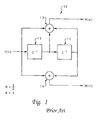
- convolutional encoder 10 includes two single-bit memory cells 11, 12 and two adder circuits 13, 14 .
- Memory cell 11 and adder circuits 13, 14 first receive a sequence of information signals, /(n) , to be encoded.
- Memory cell 11 then provides its contents to memory cell 12 with each new information signal memory cell 11 receives.
- convolutional encoder 10 Because only three bits are utilized to determine a two-bit output, convolutional encoder 10 , having two memories, is said to have a "constraint length" of three. In addition, convolutional encoder 10 is also known as a "rate 1 ⁇ 2" convolutional encoder because for every information signal bit to be encoded, it produces two bits of output signal.
- FIG. 2 there is illustrated a Trellis diagram that depicts the operation of the convolutional encoder shown in Figure 1 .
- the Trellis diagram describes how the states of the convolutional encoder ("encoder") can change from one information signal bit time to the next.
- a state of the encoder is simply the contents of the encoder memory cells at any one time, read as a state "word.”
- On both the left and right sides of the Trellis diagram are the allowable states of the encoder-00, 01, 10, and 11.
- the states shown on the left side of the Trellis diagram represent the current state of the encoder, while the states on the right side of the Trellis diagram represent the next state of the encoder.
- the encoder is in state 00 when the two previous signal bits are both zero (i.e., the contents of memory cells 11 and 12 in Figure 1 are both Os). If the current signal bit is a one, the arrival of a next subsequent signal bit will move the encoder to state 10 . In other words, with the arrival of the next subsequent signal bit, the bit in memory cell 12 is replaced by the bit from memory cell 11 (a zero), and the bit in memory cell 11 is replaced by the current bit (a ⁇ one). This transition is indicated by the diagonal line beginning at the current state 00 on the top left of the Trellis diagram and extending downward and across to the next state 10, the second state from the bottom on the right side of the Trellis diagram.
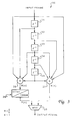
- convolutional encoder 30 includes five single-bit memory cells 31-35 , two adder circuits 36 , 37 , a puncture element 38 , and a multiplexer 39 . Data frames are input via memory cells 31 and output via multiplexer 39 .
- puncture element 38 By utilizing a puncture element 38 , only one M(n) is output as P(n) per every five N(n)s such that the data throughput of convolutional encoder 30 is significantly higher than the traditional convolutional encoder shown in Figure 1 .
- the Trellis diagram for convolutional encoder 30 will be similar to that shown in Figure 2 .
- a convolutional decoder When operating on non-tailbiting codes, a convolutional decoder has the luxury of assuming that convolutional encoder 30 was in encoding state 00000 when a first signal bit was transmitted. However, this is no longer the case with tailbiting codes.
- convolutional encoder 30 may have started in any of the 32 possible encoding states with approximately equal probability.
- the tailbiting convolutional codes may be encoded by a high-rate punctured tailbiting convolutional encoder having, for example, 32 encoding states such as the one shown in Figure 3 .
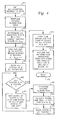
- Each of the 32 possible encoding states of the convolutional encoder is associated with an identical starting score. The starting score can be any number, as long as it is the same for all encoding states.
- the encoding state with the lowest ending score is determined, as illustrated in block 43 , and may be denoted as S min .
- All encoding states with an ending score that satisfies the condition S i - S min ⁇ K are grouped under a set of encoding states denoted as ⁇ set, as shown in block 44 . All the encoding states in ⁇ are then marked as "untested,” as depicted in block 45 .
- the classical Viterbi algorithm is then performed to provide an ending score and a Trellis path for each encoding state, as depicted in block 48 .
- the best ending score and the associated Trellis path for encoding-state-under-test are recorded, as illustrated in block 49 .
- the encoding-state-under-test is then marked as "tested,” as shown in block 50 .
- the steps shown in block 47 through block 50 will be performed for all "untested" encoding states within ⁇ .
- the present invention provides an accurate, efficient method that a tailbiting convolutional decoder may utilize to decode tailbiting convolutional codes.
- the decoder in the present invention first associates an initial score with each of the 2 M possible starting states of the encoder.
- the decoder then executes a Viterbi algorithm once in order to determine a new set of 2 M ending scores.
- this set of scores outlines a probability density function that indicates the most likely starting states of the encoder. In particular, if Sx is the ending score for state X, then the probability that the encoder started in state X is given by:
- the decoder can select a smaller subset, ⁇ , of the 2 M states whose Sx scores are minimal (i.e., whose p(x) values are maximal).
- the Viterbi algorithm is exhaustively executed on each of the starting states in ⁇ . Because the number of states in ⁇ is a much smaller than 2 M , the total execution time is dramatically reduced as compared to the prior art, while the accuracy is essentially unaffected. As a result, the method of the present invention is able to find, with very high probability, the maximum likelihood path of an encoder.
- the method of the present invention works equally well on low-rate (e.g., rate 1/2) and high-rate (e.g., rate 4/5) convolutional codes, in which hard-decision decoding techniques are utilized. It also works well if soft-decision techniques are utilized.
- signal bearing media include without limitation recordable type media, such as floppy disks or CD ROMs, and transmission type media, such as analog or digital communications links.
Landscapes
- Physics & Mathematics (AREA)
- Probability & Statistics with Applications (AREA)
- Engineering & Computer Science (AREA)
- Theoretical Computer Science (AREA)
- Error Detection And Correction (AREA)
- Detection And Correction Of Errors (AREA)
Applications Claiming Priority (2)
| Application Number | Priority Date | Filing Date | Title |
|---|---|---|---|
| US08/979,414 US6256764B1 (en) | 1997-11-26 | 1997-11-26 | Method and system for decoding tailbiting convolution codes |
| US979414 | 1997-11-26 |
Publications (3)
| Publication Number | Publication Date |
|---|---|
| EP0920138A2 true EP0920138A2 (de) | 1999-06-02 |
| EP0920138A3 EP0920138A3 (de) | 2001-10-10 |
| EP0920138B1 EP0920138B1 (de) | 2006-10-11 |
Family
ID=25526881
Family Applications (1)
| Application Number | Title | Priority Date | Filing Date |
|---|---|---|---|
| EP98309627A Expired - Lifetime EP0920138B1 (de) | 1997-11-26 | 1998-11-24 | Tail-biting Faltungskode-Dekodierverfahren und -system |
Country Status (4)
| Country | Link |
|---|---|
| US (1) | US6256764B1 (de) |
| EP (1) | EP0920138B1 (de) |
| CA (1) | CA2250602A1 (de) |
| DE (1) | DE69836119T2 (de) |
Cited By (3)
| Publication number | Priority date | Publication date | Assignee | Title |
|---|---|---|---|---|
| WO2010045032A1 (en) * | 2008-10-13 | 2010-04-22 | Qualcomm Incorporated | Modified maximum-likelihood decoding for tail biting convolutional (tbcc) codes |
| RU2466497C2 (ru) * | 2007-11-02 | 2012-11-10 | Телефонактиеболагет Лм Эрикссон (Пабл) | Сверточные коды с задаваемой концевой комбинацией битов, прямой связью и оптимальным спектром расстояний |
| US8312358B2 (en) | 2009-09-08 | 2012-11-13 | Huawei Technologies Co., Ltd. | Tail-biting decoding method and device |
Families Citing this family (7)
| Publication number | Priority date | Publication date | Assignee | Title |
|---|---|---|---|---|
| US6114756A (en) * | 1998-04-01 | 2000-09-05 | Micron Technology, Inc. | Interdigitated capacitor design for integrated circuit leadframes |
| US7224702B2 (en) * | 2000-08-30 | 2007-05-29 | The Chinese University Of Hong Kong | System and method for error-control for multicast video distribution |
| ITBG20050009A1 (it) * | 2005-02-23 | 2006-08-24 | Milano Politecnico | Sistema e metodo di trasmissione e ricezione a divisione di codice |
| CN101047472B (zh) | 2006-03-31 | 2013-02-06 | 世意法(北京)半导体研发有限责任公司 | 使用搜索深度维特比算法对咬尾卷积码的解码方法 |
| CN101635611B (zh) * | 2009-09-02 | 2013-06-05 | 中兴通讯股份有限公司 | 一种信道译码方法和装置 |
| CN102668612B (zh) * | 2009-11-27 | 2016-03-02 | 高通股份有限公司 | 增加无线通信中的容量 |
| US8543895B2 (en) * | 2010-02-10 | 2013-09-24 | Qualcomm Incorporated | List Viterbi decoding of tail biting convolutional codes |
Family Cites Families (10)
| Publication number | Priority date | Publication date | Assignee | Title |
|---|---|---|---|---|
| US5159610A (en) * | 1989-05-12 | 1992-10-27 | Codex Corporation | Trellis precoding for modulation systems |
| US5208816A (en) * | 1989-08-18 | 1993-05-04 | At&T Bell Laboratories | Generalized viterbi decoding algorithms |
| US5349589A (en) * | 1991-07-01 | 1994-09-20 | Ericsson Ge Mobile Communications Inc. | Generalized viterbi algorithm with tail-biting |
| US5287374A (en) * | 1992-04-30 | 1994-02-15 | Hughes Aircraft Company | Identification of encoder type through observation of data received |
| US5475388A (en) * | 1992-08-17 | 1995-12-12 | Ricoh Corporation | Method and apparatus for using finite state machines to perform channel modulation and error correction and entropy coding |
| US5355376A (en) | 1993-02-11 | 1994-10-11 | At&T Bell Laboratories | Circular viterbi decoder |
| US5530707A (en) * | 1994-03-09 | 1996-06-25 | At&T Corp. | Area-efficient decoders for rate-k/n convolutional codes and other high rate trellis codes |
| US5615286A (en) * | 1995-05-05 | 1997-03-25 | Bell Communications Research, Inc. | Method for determining a most likely sequence of states |
| US5721746A (en) * | 1996-04-19 | 1998-02-24 | General Electric Company | Optimal soft-output decoder for tail-biting trellis codes |
| US5721745A (en) * | 1996-04-19 | 1998-02-24 | General Electric Company | Parallel concatenated tail-biting convolutional code and decoder therefor |
-
1997
- 1997-11-26 US US08/979,414 patent/US6256764B1/en not_active Expired - Lifetime
-
1998
- 1998-10-16 CA CA002250602A patent/CA2250602A1/en not_active Abandoned
- 1998-11-24 DE DE69836119T patent/DE69836119T2/de not_active Expired - Fee Related
- 1998-11-24 EP EP98309627A patent/EP0920138B1/de not_active Expired - Lifetime
Non-Patent Citations (3)
| Title |
|---|
| COX R V ET AL: "AN EFFICIENT ADAPTIVE CIRCULAR VITERBI ALGORITHM FOR DECODING GENERALIZED TAILBITING CONVOLUTIONAL CODES" IEEE TRANSACTIONS ON VEHICULAR TECHNOLOGY,US,IEEE INC. NEW YORK, vol. 43, no. 1, 1 February 1994 (1994-02-01), pages 57-68, XP000450947 ISSN: 0018-9545 * |
| HOWARD H. MA, PH.D. DISSERTATION: "Generalized tail-biting convolutional codes" 1985 , UNIVERSITY OF MASSACHUSETTS , AMHERST XP002168142 * page 98, line 13 - page 110, line 20 * * figure 16 * * |
| QIANG WANG ET AL: "AN EFFICIENT MAXIMUM LIKELIHOOD DECODING ALGORITHM FOR GENERALIZED TAIL BITING CONVOLUTIONAL CODES INCLUDING QUASICYCLIC CODES" IEEE TRANSACTIONS ON COMMUNICATIONS,US,IEEE INC. NEW YORK, vol. 37, no. 8, 1 August 1989 (1989-08-01), pages 875-879, XP000047627 ISSN: 0090-6778 * |
Cited By (5)
| Publication number | Priority date | Publication date | Assignee | Title |
|---|---|---|---|---|
| RU2466497C2 (ru) * | 2007-11-02 | 2012-11-10 | Телефонактиеболагет Лм Эрикссон (Пабл) | Сверточные коды с задаваемой концевой комбинацией битов, прямой связью и оптимальным спектром расстояний |
| US8375280B2 (en) | 2007-11-02 | 2013-02-12 | Telefonaktiebolaget L M Ericsson (Publ) | Optimum distance spectrum feedforward tail-biting convolutional codes |
| WO2010045032A1 (en) * | 2008-10-13 | 2010-04-22 | Qualcomm Incorporated | Modified maximum-likelihood decoding for tail biting convolutional (tbcc) codes |
| US8726138B2 (en) | 2008-10-13 | 2014-05-13 | Qualcomm Incorporated | Methods and systems for modified maximum-likelihood based TBCC decoding |
| US8312358B2 (en) | 2009-09-08 | 2012-11-13 | Huawei Technologies Co., Ltd. | Tail-biting decoding method and device |
Also Published As
| Publication number | Publication date |
|---|---|
| DE69836119D1 (de) | 2006-11-23 |
| EP0920138B1 (de) | 2006-10-11 |
| US6256764B1 (en) | 2001-07-03 |
| DE69836119T2 (de) | 2007-03-01 |
| CA2250602A1 (en) | 1999-05-26 |
| EP0920138A3 (de) | 2001-10-10 |
Similar Documents
| Publication | Publication Date | Title |
|---|---|---|
| US6891484B2 (en) | Method of decoding a variable-length codeword sequence | |
| US5355376A (en) | Circular viterbi decoder | |
| US6888901B2 (en) | Apparatus and method for stopping iterative decoding in a CDMA mobile communication system | |
| RU2216851C2 (ru) | Итеративный декодер и способ итеративного декодирования для коммуникационной системы | |
| US7657824B2 (en) | Method for puncturing an LDPC channel code | |
| JP3154679B2 (ja) | 連接符号の誤り訂正復号装置及び復号方法 | |
| EP0927464B1 (de) | Faltungsdekodierung, deren endzustand von in mehrfachkodierungsbursts selektiv eingesetzten crc-bits entschieden wird | |
| CN1886926B (zh) | 用于计算接收信号误码率的方法和设备 | |
| US5436918A (en) | Convolutional encoding/decoding apparatus with fixed bit insertion | |
| US8122327B2 (en) | Symbol-level soft output viterbi algorithm (SOVA) and a simplification on SOVA | |
| KR20060032464A (ko) | 효율적인 저밀도 패리티 검사 코드 복호 방법 및 장치 | |
| US6950975B2 (en) | Acceleration of convergence rate with verified bits in turbo decoding | |
| EP0945989A1 (de) | Viterbi-Dekodierung | |
| EP0920138B1 (de) | Tail-biting Faltungskode-Dekodierverfahren und -system | |
| US6378106B1 (en) | Viterbi decoding using single-wrong-turn correction | |
| US6058501A (en) | Error detecting device for viterbi decoder | |
| EP0983655B1 (de) | Bitdetektionsverfahren in einem funkkommunikationssystem | |
| US7228489B1 (en) | Soft viterbi Reed-Solomon decoder | |
| JP2715398B2 (ja) | 誤り訂正符復号化装置 | |
| JPH07254861A (ja) | ヴィタビ復号方法及び畳み込み符号化伝送方法 | |
| US20050050433A1 (en) | Method of decoding a data word | |
| US6912257B1 (en) | Apparatus and method for normalizing metric values in a component decoder in a mobile communication system | |
| US7032165B2 (en) | ACS unit in a decoder | |
| KR100893053B1 (ko) | 길쌈 부호화 및 복호화를 위한 프레임 구성 및 에러 검출방법 | |
| Zadeh et al. | An iterative M-algorithm based decoder for convolutional codes |
Legal Events
| Date | Code | Title | Description |
|---|---|---|---|
| PUAI | Public reference made under article 153(3) epc to a published international application that has entered the european phase |
Free format text: ORIGINAL CODE: 0009012 |
|
| AK | Designated contracting states |
Kind code of ref document: A2 Designated state(s): AT BE CH CY DE DK ES FI FR GB GR IE IT LI LU MC NL PT SE Kind code of ref document: A2 Designated state(s): DE FR GB |
|
| AX | Request for extension of the european patent |
Free format text: AL;LT;LV;MK;RO;SI |
|
| RAP3 | Party data changed (applicant data changed or rights of an application transferred) |
Owner name: NORTEL NETWORKS CORPORATION |
|
| RAP1 | Party data changed (applicant data changed or rights of an application transferred) |
Owner name: NORTEL NETWORKS LIMITED |
|
| PUAL | Search report despatched |
Free format text: ORIGINAL CODE: 0009013 |
|
| AK | Designated contracting states |
Kind code of ref document: A3 Designated state(s): AT BE CH CY DE DK ES FI FR GB GR IE IT LI LU MC NL PT SE |
|
| AX | Request for extension of the european patent |
Free format text: AL;LT;LV;MK;RO;SI |
|
| RIC1 | Information provided on ipc code assigned before grant |
Free format text: 7H 03M 13/00 A, 7H 03M 13/12 B, 7H 03M 13/41 B |
|
| 17P | Request for examination filed |
Effective date: 20020410 |
|
| AKX | Designation fees paid |
Free format text: DE FR GB |
|
| R17P | Request for examination filed (corrected) |
Effective date: 20020410 |
|
| RBV | Designated contracting states (corrected) |
Designated state(s): DE FR GB |
|
| RAP1 | Party data changed (applicant data changed or rights of an application transferred) |
Owner name: NORTEL NETWORKS LIMITED |
|
| GRAP | Despatch of communication of intention to grant a patent |
Free format text: ORIGINAL CODE: EPIDOSNIGR1 |
|
| RIC1 | Information provided on ipc code assigned before grant |
Ipc: H03M 13/00 20060101AFI20060427BHEP |
|
| GRAS | Grant fee paid |
Free format text: ORIGINAL CODE: EPIDOSNIGR3 |
|
| GRAA | (expected) grant |
Free format text: ORIGINAL CODE: 0009210 |
|
| AK | Designated contracting states |
Kind code of ref document: B1 Designated state(s): DE FR GB |
|
| REG | Reference to a national code |
Ref country code: GB Ref legal event code: FG4D |
|
| PGFP | Annual fee paid to national office [announced via postgrant information from national office to epo] |
Ref country code: FR Payment date: 20061103 Year of fee payment: 9 |
|
| PGFP | Annual fee paid to national office [announced via postgrant information from national office to epo] |
Ref country code: GB Payment date: 20061108 Year of fee payment: 9 |
|
| REF | Corresponds to: |
Ref document number: 69836119 Country of ref document: DE Date of ref document: 20061123 Kind code of ref document: P |
|
| PGFP | Annual fee paid to national office [announced via postgrant information from national office to epo] |
Ref country code: DE Payment date: 20061130 Year of fee payment: 9 |
|
| ET | Fr: translation filed | ||
| PLBE | No opposition filed within time limit |
Free format text: ORIGINAL CODE: 0009261 |
|
| STAA | Information on the status of an ep patent application or granted ep patent |
Free format text: STATUS: NO OPPOSITION FILED WITHIN TIME LIMIT |
|
| 26N | No opposition filed |
Effective date: 20070712 |
|
| GBPC | Gb: european patent ceased through non-payment of renewal fee |
Effective date: 20071124 |
|
| PG25 | Lapsed in a contracting state [announced via postgrant information from national office to epo] |
Ref country code: DE Free format text: LAPSE BECAUSE OF NON-PAYMENT OF DUE FEES Effective date: 20080603 |
|
| REG | Reference to a national code |
Ref country code: FR Ref legal event code: ST Effective date: 20080930 |
|
| PG25 | Lapsed in a contracting state [announced via postgrant information from national office to epo] |
Ref country code: GB Free format text: LAPSE BECAUSE OF NON-PAYMENT OF DUE FEES Effective date: 20071124 |
|
| PG25 | Lapsed in a contracting state [announced via postgrant information from national office to epo] |
Ref country code: FR Free format text: LAPSE BECAUSE OF NON-PAYMENT OF DUE FEES Effective date: 20071130 |