EP0920006A2 - Imformationsaufzeichnungsmedium, und Gerät und Verfahren zur Wiedergabe desselben - Google Patents
Imformationsaufzeichnungsmedium, und Gerät und Verfahren zur Wiedergabe desselben Download PDFInfo
- Publication number
- EP0920006A2 EP0920006A2 EP98309770A EP98309770A EP0920006A2 EP 0920006 A2 EP0920006 A2 EP 0920006A2 EP 98309770 A EP98309770 A EP 98309770A EP 98309770 A EP98309770 A EP 98309770A EP 0920006 A2 EP0920006 A2 EP 0920006A2
- Authority
- EP
- European Patent Office
- Prior art keywords
- information
- audio
- video
- substantial
- reproducing
- Prior art date
- Legal status (The legal status is an assumption and is not a legal conclusion. Google has not performed a legal analysis and makes no representation as to the accuracy of the status listed.)
- Granted
Links
Images




Classifications
-
- G—PHYSICS
- G11—INFORMATION STORAGE
- G11B—INFORMATION STORAGE BASED ON RELATIVE MOVEMENT BETWEEN RECORD CARRIER AND TRANSDUCER
- G11B27/00—Editing; Indexing; Addressing; Timing or synchronising; Monitoring; Measuring tape travel
- G11B27/10—Indexing; Addressing; Timing or synchronising; Measuring tape travel
- G11B27/19—Indexing; Addressing; Timing or synchronising; Measuring tape travel by using information detectable on the record carrier
- G11B27/28—Indexing; Addressing; Timing or synchronising; Measuring tape travel by using information detectable on the record carrier by using information signals recorded by the same method as the main recording
- G11B27/32—Indexing; Addressing; Timing or synchronising; Measuring tape travel by using information detectable on the record carrier by using information signals recorded by the same method as the main recording on separate auxiliary tracks of the same or an auxiliary record carrier
- G11B27/327—Table of contents
- G11B27/329—Table of contents on a disc [VTOC]
-
- G—PHYSICS
- G11—INFORMATION STORAGE
- G11B—INFORMATION STORAGE BASED ON RELATIVE MOVEMENT BETWEEN RECORD CARRIER AND TRANSDUCER
- G11B19/00—Driving, starting, stopping record carriers not specifically of filamentary or web form, or of supports therefor; Control thereof; Control of operating function ; Driving both disc and head
- G11B19/02—Control of operating function, e.g. switching from recording to reproducing
- G11B19/12—Control of operating function, e.g. switching from recording to reproducing by sensing distinguishing features of or on records, e.g. diameter end mark
-
- G—PHYSICS
- G11—INFORMATION STORAGE
- G11B—INFORMATION STORAGE BASED ON RELATIVE MOVEMENT BETWEEN RECORD CARRIER AND TRANSDUCER
- G11B20/00—Signal processing not specific to the method of recording or reproducing; Circuits therefor
- G11B20/10—Digital recording or reproducing
-
- G—PHYSICS
- G11—INFORMATION STORAGE
- G11B—INFORMATION STORAGE BASED ON RELATIVE MOVEMENT BETWEEN RECORD CARRIER AND TRANSDUCER
- G11B20/00—Signal processing not specific to the method of recording or reproducing; Circuits therefor
- G11B20/10—Digital recording or reproducing
- G11B20/12—Formatting, e.g. arrangement of data block or words on the record carriers
-
- G—PHYSICS
- G11—INFORMATION STORAGE
- G11B—INFORMATION STORAGE BASED ON RELATIVE MOVEMENT BETWEEN RECORD CARRIER AND TRANSDUCER
- G11B27/00—Editing; Indexing; Addressing; Timing or synchronising; Monitoring; Measuring tape travel
- G11B27/10—Indexing; Addressing; Timing or synchronising; Measuring tape travel
- G11B27/102—Programmed access in sequence to addressed parts of tracks of operating record carriers
- G11B27/105—Programmed access in sequence to addressed parts of tracks of operating record carriers of operating discs
-
- G—PHYSICS
- G11—INFORMATION STORAGE
- G11B—INFORMATION STORAGE BASED ON RELATIVE MOVEMENT BETWEEN RECORD CARRIER AND TRANSDUCER
- G11B27/00—Editing; Indexing; Addressing; Timing or synchronising; Monitoring; Measuring tape travel
- G11B27/10—Indexing; Addressing; Timing or synchronising; Measuring tape travel
- G11B27/19—Indexing; Addressing; Timing or synchronising; Measuring tape travel by using information detectable on the record carrier
- G11B27/28—Indexing; Addressing; Timing or synchronising; Measuring tape travel by using information detectable on the record carrier by using information signals recorded by the same method as the main recording
- G11B27/32—Indexing; Addressing; Timing or synchronising; Measuring tape travel by using information detectable on the record carrier by using information signals recorded by the same method as the main recording on separate auxiliary tracks of the same or an auxiliary record carrier
- G11B27/322—Indexing; Addressing; Timing or synchronising; Measuring tape travel by using information detectable on the record carrier by using information signals recorded by the same method as the main recording on separate auxiliary tracks of the same or an auxiliary record carrier used signal is digitally coded
-
- G—PHYSICS
- G11—INFORMATION STORAGE
- G11B—INFORMATION STORAGE BASED ON RELATIVE MOVEMENT BETWEEN RECORD CARRIER AND TRANSDUCER
- G11B20/00—Signal processing not specific to the method of recording or reproducing; Circuits therefor
- G11B20/00086—Circuits for prevention of unauthorised reproduction or copying, e.g. piracy
-
- G—PHYSICS
- G11—INFORMATION STORAGE
- G11B—INFORMATION STORAGE BASED ON RELATIVE MOVEMENT BETWEEN RECORD CARRIER AND TRANSDUCER
- G11B2220/00—Record carriers by type
- G11B2220/20—Disc-shaped record carriers
- G11B2220/25—Disc-shaped record carriers characterised in that the disc is based on a specific recording technology
- G11B2220/2537—Optical discs
- G11B2220/2562—DVDs [digital versatile discs]; Digital video discs; MMCDs; HDCDs
Definitions
- the present invention relates to an information record medium, and more particularly relates to a reproduction of audio information from a video DVD.
- video DVD i.e., a disc based on a DVD-Video standard
- a record medium for recording video information such as a movie since it has a large memory capacity.
- an audio DVD i.e., a disc based on a DVD-audio standard
- a record medium for not recording the video information such as a movie but recording audio information such as music. It is possible to record onto just one audio DVD the audio information corresponding to a plurality of CDs (Compact Discs) since it has a large memory capacity as a DVD. Further, it is also possible to record the audio information corresponding to a music CD of a soundtrack version of a movie in addition to the video information such as a movie.
- the above mentioned video DVD is reproduced by a video DVD player (i.e., a player for outputting video and audio), while the above mentioned audio DVD is reproduced by an audio DVD player (i.e., a player for outputting just audio).
- a conventional video DVD player cannot reproduce a disc recorded by the audio DVD format, while the audio DVD player cannot reproduce a conventional video DVD recorded by the video DVD format.
- an information record medium provided with: substantial information including video information and audio information which are related to each other; first reproduction control information to simultaneously reproduce the video information and the audio information out of the substantial information; and second reproduction control information to reproduce only the audio information out of the substantial information.
- a reproducing apparatus which is capable of reproducing both of the video information and the audio information, reproduces both of them on the basis of the first reproduction control information.
- a reproducing apparatus which is capable of only reproducing the audio information, reproduces only the audio information on the basis of the second reproduction control information. Therefore, in accordance with the capability of the reproducing apparatus, it is possible to reproduce the same information record medium.
- the first reproduction control information and the second reproduction control information prescribe a reproduction of a same portion of the substantial information.
- the first reproduction control information divides the substantial information into a plurality of first information units and prescribes a reproduction control of the first information units
- the second reproduction control information divides the substantial information into a plurality of second information units, which are different from the first information units, and prescribes a reproduction control of the second information units.
- the second reproduction control information prescribes a reproduction of the substantial information in a reproduction order, which is different from that of the first reproduction control information, with respect to a same portion of the substantial information.
- the information record medium is further provided with another substantial information including only audio information.
- the above object of the present invention can be also achieved by a first information reproducing apparatus for reproducing the above described information record medium of the present invention.
- the first information reproducing apparatus is provided with: a reading device for reading the substantial information, the first reproduction control information and the second reproduction control information from the information record medium; and a reproducing device for reproducing the substantial information in accordance with the first reproduction control information when a reproduction of the video information and the audio information is instructed, and reproducing the substantial information in accordance with the second reproduction control information when a reproduction of only the audio information is instructed.
- the above object of the present invention can be also achieved by a second information reproducing apparatus for reproducing the above described information record medium of the present invention.
- the second information reproducing apparatus is provided with: a reading device for reading the substantial information and the first reproduction control information from the information record medium; and a reproducing device for reproducing the substantial information in accordance with the first reproduction control information when a reproduction of the video information and the audio information is instructed.
- the above object of the present invention can be also achieved by a third information reproducing apparatus for reproducing the above described information record medium of the present invention.
- the third information reproducing apparatus is provided with: a reading device for reading the substantial information and the second reproduction control information from the information record medium; and a reproducing device for reproducing the substantial information in accordance with the second reproduction control information when a reproduction of only the audio information is instructed.
- the above object of the present invention can be also achieved by a first information reproducing method for reproducing the above described information record medium of the present invention.
- the first information reproducing method is provided with: a reading process for reading the substantial information, the first reproduction control information and the second reproduction control information from the information record medium; and a reproducing process for reproducing the substantial information in accordance with the first reproduction control information when a reproduction of the video information and the audio information is instructed, and reproducing the substantial information in accordance with the second reproduction control information when a reproduction of only the audio information is instructed.
- the above object of the present invention can be also achieved by a second information reproducing method for reproducing the above described information record medium of the present invention.
- the second information reproducing method is provided with: a reading process for reading the substantial information and the first reproduction control information from the information record medium; and a reproducing process for reproducing the substantial information in accordance with the first reproduction control information when a reproduction of the video information and the audio information is instructed.
- the above object of the present invention can be also achieved by a third information reproducing method for reproducing the above described information record medium of the present invention.
- the third information reproducing method is provided with: a reading process for reading the substantial information and the second reproduction control information from the information record medium; and a reproducing process for reproducing the substantial information in accordance with the second reproduction control information when a reproduction of only the audio information is instructed.
- the video information and the audio information, or only the audio information can be selectively reproduced from a same information record medium, so that the user can reproduce the same information record medium by a plurality of reproducing methods.
- the second information reproducing apparatus and the second information reproducing method it is possible to perform the audio reproduction by the video DVD player without discrepancy in the same manner as the audio DVD.
- the third information reproducing apparatus and the third information reproducing method it is possible to reproduce the audio information of the video DVD without discrepancy by the audio DVD player.
- a physical format of the record format on the video DVD is explained with reference to FIG. 1.
- a video DVD 1 is provided with a lead in area LI at its most inner circumferential portion and a lead out area LO at its most outer circumferential portion, between which video information and audio information are recorded such that they are divided into a plurality of VTSs (Video Title Sets) 3, each of which has a unique ID (Identification) number (i.e. VTS#1 to VTS#n).
- VTSs Video Title Sets
- the VTS 3 is a set (bundle) of titles (each of which is one production or one work which an author or producer intends to offer to the audience), which are related to each other (e.g., attributes, such as the number, the specification, the corresponding languages etc. of the audio information and the video information included therein are the same to each other).
- a VMG (Video Manager) 2 is recorded.
- information recorded in the video manager 2 for example, information related to the whole video and audio information recorded on the video DVD 1, such as a menu for showing a name of each title, information for preventing an illegal copy, an access table for directly accessing each title and so on, is recorded.
- VTS 3 is recorded such that it is divided into a plurality of VOBs (Video Objects) 10, each of which has an ID number (VOB ID#1, VOB ID#2, ...), and VTSI (Video Title Set Information) 11 disposed ahead of the VOBs 10.
- VOBs Video Objects
- VTSI Video Title Set Information
- a data portion constructed by a plurality of VOBs 10 is defined as a VOB set (VOBS) as shown in FIG. 1.
- VTSI 11 In the VTSI 11 recorded at the head of the VTS 3, information such as PGCI (ProGram Chain Information), which is various information related to a program chain as a logical division obtained by combining a plurality of cells (the "cell” will be described later in detail), is recorded.
- PGCI ProGram Chain Information
- one VOB 10 is constructed of a plurality of cells 20, each of which has an ID number (cell ID#1, cell ID#2, ).
- One cell 20 is constructed of a plurality of VOB units (VOBUs) 30, each of which has an ID number (VOBU#1, VOBU#2, ).
- the VOB unit 30 is an information unit, each of which includes the video information, the audio information and sub picture information (which is defined as information of a sub picture such as a subtitle of a movie etc.), or only includes a navi-pack which is described layer.
- One VOB unit 30 is provided with: a navi-pack (a navigation pack) 41 for storing various control data whose control object is the video information etc. included in the VOBU 30; a video pack 42 for storing video data as the video information; an audio pack 43 for storing audio data as the audio information; and a sub picture pack 44 for sub picture data as the sub picture information.
- a navi-pack a navigation pack 41 for storing various control data whose control object is the video information etc. included in the VOBU 30
- a video pack 42 for storing video data as the video information
- an audio pack 43 for storing audio data as the audio information
- a sub picture pack 44 for sub picture data as the sub picture information.
- a reading-start time information so-called as a SCR (System Clock reference), which indicates a reading-start time on a reproduction time axis to start reading the data included in each pack P from a track buffer of a reproducing apparatus described layer and inputting it into respective one of buffers, a start code indicating a start of each pack P and the like are recorded.
- SCR System Clock reference
- the navi-pack 41 is provided with: a DSI (Data Search Information) packet 51 including search information to search a video image or an audio sound desired to be displayed or sound-outputted (concretely, search information such as an address, where the video or audio to be displayed or sound-outputted is recorded, on the DVD 1); and a PCI (Presentation Control Information) packet 50 including information related to a display control at a time of displaying the video image or outputting the audio sound, which is searched on the basis of the information of the DSI packet 51.
- DSI Data Search Information
- PCI Presentation Control Information
- Each video pack 42 included in one VOB unit 30 consist of at least one GOP (Group Of Pictures).
- the GOP is a minimum picture unit, which can be independently reproduced and which is determined by a standard based on the MPEG (Moving Picture Experts Group) 2 method.
- the MPEG 2 method is a picture compression method adopted at a time of recording the video information onto the DVD 1 in the present embodiment.
- each division can be freely set according to the author's intention, so as to perform recording on the basis of these set divisions.
- the variegated reproduction can be performed.
- a logical format (logical structure) constructed by combining the information recorded by the physical divisions shown in FIG. 1 is explained with reference to FIG. 2.
- the information is not actually recorded on the DVD 1 in the logical structure of FIG. 2. Instead, information (e.g. access information or time information) to reproduce each data shown in FIG. 1 by combining them (especially combining the cells 20) in the logical structure shown in FIG. 2, is recorded on the DVD 1, especially in the VTSI 11.
- One program 60 is logically constructed on the basis of the author's intention by selecting and combining a plurality of cells 20 among the physical structures explained by use of FIG. 1. It is also possible for the author to define a gathering of one or more programs 60 as a minimum unit, which can be freely selected to be watched or listened to by the audience and which is referred to as a PTT (ParT of Title).
- the number of each cell 20 at a time of treating the cell 20 on the physical format shown in FIG. 1, the number is treated as the cell ID number (which is indicated by cell ID # in FIG. 1).
- the number is treated as the cell number in the order of description in the PGCI described later.
- the aforementioned PGCI ProGram Chain Information
- the PGCI includes information indicating: the reproduction order of the cells 20 for each program 60 at a time of reproducing each program 60 (by this reproduction order, a unique program number (#1, #2, ...) is assigned to each program 60); an address which is a record position of each cell 20 on the DVD 1; the number of the cell 20 positioned at the head of one program 60 to be firstly reproduced; and so on.
- the substantial video and audio data etc. are included as a combination of the programs 60 (in other words, the combination of the cells 20) other than the above mentioned PGCI.
- one title 62 is logically constructed of one or a plurality of PGCs 61 (PGC #1, PGC#2, ...) as shown in FIG. 2.
- the title 62 is, for example, a unit corresponding to one movie, and is completed information which the author would like to offer to the audience of the DVD 1.
- one VTS 63 is logically constructed of one or a plurality of titles 62 (title #1, title #2, ...) as shown in FIG. 2.
- the information included in one VTS 63 shown in FIG. 2 corresponds to information included in one VTS 3 shown in FIG. 1. Namely, all information included in the logical VTS 63 shown in FIG. 2 is recorded as one VTS 3 in the DVD 1 shown in FIG. 1.
- the author specifies the information divided in the physical structure on the DVD 1 on the basis of the above described logical format, the video image and/or the music for the audience to watch and/or listen to is to be formed.
- an audio DVD 200 as an embodiment is provided with the lead in area LI at its most inner circumferential portion and the lead out area LO at its most outer circumferential portion, between which one volume space is recorded.
- an audio zone is always recorded.
- the audio information is recorded such that it is divided into a plurality of ATSs (Audio Title Sets) 230, each of which has a unique ID (Identification) number (i.e. ATS#1 to ATS#n).
- a UDF (User Disc Format) 201 for managing the format of the file recorded on the audio DVD 200 is recorded, and, next to it, an AMG (Audio Manager) 202 is recorded.
- AMG Audio Manager
- information recorded in the AMG 202 for example, information related to the whole audio information recorded on the audio DVD 200, such as a menu for showing a name of each item, information for preventing an illegal copy, an access table for directly accessing each title and so on, is recorded.
- One ATS 203 is recorded such that it is divided into a plurality of AOBs (Audio Objects) 210, each of which has an ID number (AOB ID#1, AOB ID#2, ...), and ATSI (Audio Title Set Information) 211 disposed ahead of the AOBs 210.
- AOBs Audio Objects
- ATSI Audio Title Set Information
- AOB set a data portion constructed by a plurality of AOBs 210 is defined as an AOB set (AOBS) as shown in FIG. 3.
- the AOB set is the substantial portion of the audio information
- the ATS 211 is the managing and controlling information of the AOB set consisting of a plurality of AOBs 210.
- APGCI Audio ProGram Chain Information
- APGCI Audio ProGram Chain Information
- One cell 220 consists of a plurality of audio packs 230 each of which has been packed, or an audio pack 230 and real time information pack 231.
- the audio pack 230 is a data pack into which the audio information to be recorded onto the audio DVD has been packed by each predetermined size, and includes audio information digitized by a linear PCM for example.
- the real time information pack 231 text information, BPM (Beat Per Minutes) information, hand clap information and the like are included.
- each division can be freely set according to the author's intention, so as to perform recording the record information onto the audio DVD 200 on the basis of these set divisions.
- the variegated reproduction can be performed.
- the information is not actually recorded on the audio DVD 200 in the logical structure of FIG. 4. Instead, the audio information is recorded on the audio DVD in the physical format shown in FIG. 3, and the information to reproduce the audio information is recorded in the aforementioned AMG 202 and the ATSI 211 in the logical format shown in FIG. 4.
- An index 259 is constructed by selecting and combining one cell 220 or a plurality of cells 220 among the physical structure explained with reference to FIG. 3.
- the index 259 can be used as the music number, and is the minimum unit which can be accessed by the user.
- one track 260 is logically constructed.
- the track 260 is an information unit corresponding to one music composition. The user can select an arbitrary track (music composition) and directly access it.
- the number of each cell 220 at a time of treating the cell 220 on the physical format shown in FIG. 3, the number is treated as the cell ID number (which is indicated by cell ID # in FIG. 3).
- the number is treated as the cell number in the order of description in the APGCI described later.
- the track (music composition) 260 is an information unit including a plurality of cells, and is a group of cells having certain common attributes to each other. Namely, the attributes of all of the cells in one track 260 are the same to each other. Further, all of the cells included in the track 260 are recorded adjacent to each other within the same object.
- One title 261 is logically constructed of one track 260 or a plurality of tracks 260. However, the title 261 itself is not recognized as a unit of access by the user. Therefore, it is not possible to access an arbitrary title by specifying the title number.
- the attribute of each track 260 constructing the title 261 can be defined independently within 8 patterns at the maximum. Namely, the attribute as the audio information such as the channel number, the quantization method, the sampling frequency and the like may be changed for each track (i.e., each music composition).
- the aforementioned APGCI is defined by the unit of this title 261.
- the attribute of each track 260, the reproduction order of the cells 220 in each track 260 when reproducing each track 260, the address which is the recording position of each cell 220 on the audio DVD 220, the number of the cell 220 at the head to be reproduced on one track 260, the reproducing method of each track 260 and various commands are included.
- the substantial audio information is included as the combination of the tracks 260 (i.e., the combination of the cells 220) other than the above mentioned APGCI.
- One title group 262 is logically constructed by one or a plurality of titles 261.
- the title group 262 is the maximum unit which the user can access, and can be defined up to 9 groups at the maximum within one volume.
- This title group 262 is constructed by one or a plurality of titles 261 which are collected on the basis of a certain relationship, and all of the titles 261 within the title group 262 are continuously reproduced. For example, it is possible to collect as one title group the music compositions of a particular singer, a particular composer or the like.
- One volume 262 is logically constructed by one or a plurality of title groups 262.
- the volume 262 is an information unit corresponding to one album (DVD).
- the actual audio information included in one title shown in FIG. 4 is recorded within one ATS 203 shown in FIG. 3 on the audio DVD.
- the author specifies the information divided in the physical structure on the audio DVD 200 on the basis of the above described logical format, the music for the audience to listen to is to be formed.
- the disc shapes and the information recording methods are the same to each other between there 4 kinds of discs, and only the contents of these 4 kinds of discs are different from each other.
- FIG. 5 schematically shows the physical formats of these 4 kinds of the DVDs.
- the video DVD is shown at the top stage of FIG. 5.
- the video information and the audio information to be simultaneously reproduced such as a movie are recorded. Therefore, on the recording area between the lead in area LI and the lead out area LO, the video information and the audio information within a plurality of the VTSs are recorded other than the management information, and that the VMG including the managing/controlling information for these VTSs is also recorded.
- the video information is recorded as the video pack and the audio information is recorded as the audio pack.
- the video DVD provided with audio navigation as one kind of video discs is shown at the second top stage of FIG. 5, which enables a reproduction of the video information (including the audio information accompanying it) such as a movie in the same manner as the mere video DVD, and which also enables the reproduction of only the audio information within the record information by the audio DVD player.
- This one portion of the record information which can be reproduced by the audio DVD player is called as an "audio play part".
- the video information is recorded in the form of a plurality of VTSs in conformity to the video DVD shown in FIG. 1.
- the AMG including the reproduction controlling information to reproduce only the audio information within the recorded VTS and the ATSI as the reproduction controlling information (hereinbelow, it is referred to as an "audio navigation information") are recorded, but the AOB which is the substantial portion of the audio information is not recorded.
- the navigation information for the audio information (more concretely, the audio pack within each VOB (refer to FIG. 1)) included in each VTS within the video DVD provided with the audio navigation is recorded.
- the audio only DVD is shown at the third top stage of FIG. 5.
- the audio information is recorded as a plurality of ATSs other than the managing information, and that the AMG including the managing/controlling information for these ATSs is also recorded. Further, one or a plurality of AOBs as the substantial portion of the audio information are included in each ATS.
- the audio and video DVD is shown at the bottom stage of FIG. 5, which enables not only the reproduction of the audio information accompanied with the video reproduction by the video DVD player, in the same manner as the video DVD provided with the audio navigation, but also the reproduction of only the audio information of the audio play part by the audio DVD player.
- the point different from the video DVD provided with the audio navigation is that the record area of the disc is divided into the audio area to which only the audio information is recorded and the video area to which the video information is recorded, and that the navigation information in the audio area and the navigation information in the video area which are different from each other are recorded.
- the audio information is recorded such that it is included in the VOB recorded on the basis of the video DVD format as aforementioned and is recorded together with the video information. Then, in order to reproduce only the audio information of the audio play part within the VOB, the navigation information for the audio information recorded within the VOB is prepared within the ATSI as the APGCI in the aforementioned audio DVD, and is managed by the AMG. Therefore, the video DVD provided with the audio navigation is basically such a disc that the navigation information to reproduce only the audio information of the audio play part included in the video DVD is added to the video DVD.
- the audio and video DVD there are the audio area to which the audio information is recorded in conformity to the audio DVD format, and the video area to which the video is recorded in conformity to the video DVD format.
- the audio area only the audio information is recorded by the format based on the audio DVD shown in FIG. 3. Namely, the substantial portion of the audio information is recorded as a plurality of ATSs.
- the ATSI including the navigation information for the substantial audio information in each ATS is also recorded, and is managed by the AMG. Namely, in the audio area, the audio information is recorded in accordance with the audio DVD format explained with reference to FIG. 3 and FIG. 4.
- the video information (which includes the audio information accompanying to it) is recorded as a plurality of VTSs.
- the VTSI including the navigation information for the substantial information in each VTS is also recorded, and is managed by the VMG.
- the video information (including the audio information accompanying to it) is recorded in accordance with the video DVD format explained with reference to FIG. 1 and FIG. 2.
- the video information (including the audio information accompanying to it) is reproduced according to the VMG and the VTSI within the video area in case of reproducing the video information by use of the video DVD player.
- the audio information is reproduced by the audio DVD player from the audio and video DVD
- the audio information within the AOB is reproduced according to the ATSI which is the navigation information within the ATS and the AMG in the audio area in the same manner as the audio DVD.
- the audio information of the audio play part recorded in the VTS within the video area is reproduced according to the AMG and the ATSI.
- the video and audio are reproduced in the same manner as the conventional video DVD by the video DVD player with respect to the same work while only the audio information of the audio play part is reproduced by the audio DVD player.
- the concrete reproducing method thereof will be described later.
- the object indicates the substantial information such as the video information, the audio information etc., or the like recorded on the DVD.
- the double management means managing those objects on the basis of two ways of navigation information so as to reproduce it.
- the physical format of the video DVD provided with the audio navigation and the navigation information included in it are indicated.
- the video DVD provided with the audio navigation has the physical recording format in which the navigation information to reproduce only the audio information is added to the record information of the video DVD.
- the video DVD provided with the audio navigation has the ATSI 211 which is the navigation information of the audio information included in the VTS 3 and the AMG 202 which is the management information thereof in addition to the VOB 10 which is the substantial portion of the video information, the VTSI 11 which is the reproduction controlling information thereof and the VMG 2 which is the managing information.
- the titles in the video DVD provided with the audio navigation are categorized into two.
- One category thereof is the ordinary title of the video DVD in case of reproducing it by the video DVD player (hereinafter, it is referred to as a "video title (VTT)").
- Another category is the title to reproduce only the audio information of the audio play part recorded within the VOB by the audio DVD player (hereinafter, it is referred to as an "audio only title (AOTT)").
- the AMG 202 includes the AMGI (AMG Information) 240 which is the substantial portion of the managing information.
- the AMGI 240 includes: an AMGI management table 241 including the file size, the recording address etc., of the AMGI 240; an audio title (ATT) search pointer table 242; and an audio only title (AOTT) search pointer table 243.
- the audio title is the general name of the audio only title consisting of only the audio information and the AV title (AVTT) consisting of the audio information including the video information accompanied to it.
- AVTT AV title
- the ATT is for a compatible player which can reproduce both of the audio DVD and the video DVD.
- the ATT search pointer table 242 includes: ATT search pointer information 244 including the information such as the number of the ATT search pointers; and a plurality of ATT search pointers 245.
- ATT search pointer information 244 including the information such as the number of the ATT search pointers
- the abbreviation in a bracket within each ATT search pointer indicates the kind of the title corresponding to the pertinent search pointer for the sake of the explanation here.
- the titles in all of the ATT search pointers are the AOTTs.
- the AOTT search pointer table 243 includes: AOTT search pointer information 246 including the information such as the number of the AOTT search pointers etc.,; and a plurality of AOTT search pointers 247.
- AOTT search pointer information 246 including the information such as the number of the AOTT search pointers etc.
- AOTT search pointers 247 include the information such as the number of the AOTT search pointers etc., and a plurality of AOTT search pointers 247.
- FIG. 6 the abbreviation in a bracket within each AOTT search pointer indicates the kind of the title corresponding to the pertinent search pointer for the sake of the explanation here.
- the titles in all of the AOTT search pointers are the AOTTs.
- the positions on the search pointer tables respectively of the title ATT and the title AOTT corresponding to the same work are the same to each other.
- the ATT search pointer on the ATT search pointer table 242 and the ATT search pointer on the AOTT search pointer table 243 are corresponding to each other.
- the ATT search pointer 245 and the AOTT search pointer 247 indicate the APGC logically constituting the title which is the object thereof. More concretely, in this case, the title #11 indicated by the ATT search pointer #1 and the AOTT search pointer #1 is the AOTT title. Therefore, as this AOTT search pointer #1 specifies the ATS number in which the pertinent title is included and the title number within the ATS, the APGCI is specified within the ATSI 211 corresponding to the pertinent title. Thus, at the time of reproducing, as only the audio pack 43 of the audio play part by reproducing only the audio pack 43 within the VOB 11 in accordance with the APGCI specified by the AOTT search AOTT pointer, only the audio information is reproduced (refer to FIG. 6, the paths of "A1" and "A2").
- VTT video title
- the video DVD provided with the audio navigation is basically the video DVD
- the VMG 2 is firstly referred to in order to reproduce the ordinary video title to reproduce the video information together with the audio information.
- the VMG 2 includes the VMGI (VMG Information) 21 which is the substantial portion of the managing information.
- the VMGI 21 includes: a VMGI management table 211 including the file size, the recording address etc., of the VMGI 21; and a title (TT) search pointer table 212.
- the TT search pointer table 212 includes: TT search pointer information 214 including the information such as the number of the TT search pointers; and a plurality of TT search pointers 215.
- TT search pointer information 214 including the information such as the number of the TT search pointers
- the abbreviation in a bracket within each TT search pointer indicates the kind of the title corresponding to the pertinent search pointer for the sake of the explanation here.
- the titles in all of the TT search pointers on the video DVD are the VTTs.
- the positions on the search pointer tables respectively of the title ATT and the title AOTT corresponding to the same work may not have any relationship to each other. It is possible to define the contents and the orders on the ATT search pointer table of the AMGI and the TT search pointer table of the VMGI independently from each other.
- the TT search pointer 215 indicates the PGC logically constituting the title which is the object thereof. More concretely, in this case, the title #2 indicated by the TT search pointer #2 is the VTT title i.e., the title in which the audio information is to be reproduced together with the video information. Therefore, as this TT search pointer specifies the number of the VTS 3 and the title number within the VTS 3, the PGCI is specified within the VTSI 11 corresponding to the pertinent title. Thus, the video DVD player obtains this PGCI and reproduces the pertinent title as the video information with the audio information by use of the video pack, audio pack etc., within the VOB (refer to FIG. 6, the paths of "B1" and "B2").
- FIG. 7 indicates a concept of the program in case of reproducing one VOB as the audio information with the video information in accordance with the PGCI and in case of reproducing the same one VOB as only the audio information of the audio play part in accordance with the APGCI.
- the video data, the sub picture data and the audio data are included in the VOB.
- the reproduction control thereof is performed on the basis of he PGCI described within the VTSI.
- the VOB is divided into 6 pieces of video cells #1 to #6, the video program #1 is constructed by the video cell #1, the video program #2 is constructed by the video cells #2 to #4, and the video program #3 is constructed by the video cell #6.
- the reproduction is performed in accordance with this kind of PGCI.
- each audio program prescribed by the APGCI is constructed by one or more than two of audio cells.
- the audio cell may be prescribed to be different (independent) from the video cell with respect to the same one object (VOB).
- VOB the same one object
- the starting position, the ending position and the like of each audio cell may be set independently from any of the video cells.
- the reproduction order of the audio cells prescribed by the APCGI may be defined independently from the reproduction order of the video cells prescribed by the PGCI.
- the audio program #1 is constructed by the audio cells #1 and #2
- the audio program #2 is constructed by the audio cell #3.
- the APGCI includes the information such as the record position, the reproduction order and so on of the audio cells included in these audio programs, so that the reproduction of the audio information is performed on the basis of the APGCI.
- the record position of one particular video data and the record position of the audio data corresponding to the reproduction time of the video data are different from each other.
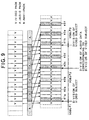
- FIG. 9 shows this physical arrangement.
- an example of recording the navi-pack, the video pack and the audio pack within one VOBU is illustrated.
- the VOBU#2 is prescribed by the navi-packs 41a and 41b, between which a plurality of video packs and audio packs are multiplexed.
- the video data is recorded as a plurality of video packs, and the audio packs including the corresponding audio data are recorded within a predetermined range from these video packs.
- the video data of the video packs are temporarily stored in a buffer, and are outputted in synchronization with the corresponding audio data within the audio packs. Therefore, as shown in FIG. 9, there may happen such a case that the audio data corresponding to the video data within one VOB is recorded in another VOB next to this one VOB because of this shift of the record position.
- the audio packs 43a and 43b included in the VOBU #2 correspond to the video data within the VOBU #1.
- the audio packs 43e and 43f corresponding to the video data within the VOBU #2 are positioned within the next VOBU #3. Therefore, if one cell to reproduce only the information were prescribed on the basis of the VOBU of the video information, the audio information within the cell immediately before it would be reproduced.
- the physical position of the audio cell and the physical position of the video cell can be independently defined.
- the division of the audio cell is prescribed at a position immediately before the audio pack 43c which is the head of the audio information corresponding to the VOBU #2.
- the audio cells are defined independently from the video cells prescribed by the group of the VOBUs. By this, the audio data within a preceding VOBU can be prevented from being reproduced.
- the double management is performed with respect to the same object by virtue of the video and audio navigations. Further, in accompaniment with the double management, the physical and logical boundaries between the video cell and the audio cell can be independently prescribed.
- the physical and logical boundaries of the video cell defined by the PGCI and the audio cell defined by the APGCI are coincident or not coincident to each other, it is possible to freely combine the video and audio cells by the unit of the cell respectively. By this, it is possible to effectively reproduce the video information (accompanied by the audio sound) or reproduce only the audio information from the same object (VOBU).
- the present invention can be applied to the audio and video DVD. Namely, as shown in FIG. 5, in case of the audio and video DVD, while the information is recorded by the video DVD format within the video area, the navigation information for reproducing the information in the video area and the navigation information for reproducing only the audio information are recorded in the ATT search pointer table and the AOTT search pointer table respectively in the AMG. Therefore, in case of reproducing the information in the video area by use of the navigation information in the AMG in the audio and video DVD, the present invention can be applied in the just same manner as the above explained video DVD provided with the audio navigation.
- a video DVD player as the present embodiment is provided with: an optical pickup 80; a demodulate and correct unit 81; stream switches 82 and 84; a track buffer 83; a system buffer 85; a demultiplexer 86; a VBV (Video Buffer Verifier) buffer 87; a video decoder 88; a sub picture buffer 89; a sub picture decoder 90; a mixer 91; an audio buffer 92; an audio decoder 93; an input unit 98; a display unit 99; a system controller 100; a drive controller 101; a spindle motor 102; and a slider motor 103.
- the construction shown in FIG. 10 only illustrates the portions related to the video and audio reproduction of the video DVD player.
- the description and the detailed explanation as for servo circuits to servo-control the optical pickup 80, the spindle motor 102, the slider motor 103 and the like are omitted since they are constructed in the same manner as the conventional arts.
- the optical pickup 80 includes a laser diode, a polarization beam splitter, an objective lens, a photo-detector and the like not illustrated, and irradiates a light beam B as a reproduction light with respect to the DVD 1.
- the optical pickup 80 receives a reflection light of the light beam B from the DVD 1, and outputs a detection signal Sp corresponding to information pits formed on the DVD 1.
- the tracking servo control and the focus servo control are operated with respect to the objective lens etc. of the optical pickup 80 in the same manner as the conventional art so that the light beam B can be irradiated precisely onto the information track of the DVD 1 and that the light beam B can be focused on the information record surface of the DVD 1.
- the detection signal Sp outputted from the optical pickup 80 is inputted to the demodulate and correct unit 81, where a signal demodulation process and an error correct process are applied to it to generate a demodulation signal Sdm, which is outputted to the stream switch 82 and the system buffer 85.
- the opening and closing operation of the stream switch 82, to which the demodulation signal Sdm is inputted, is controlled by a switch signal Ssw1 from the drive controller 101.
- the stream switch 82 passes therethrough the inputted demodulation signal Sdm as it is to the track buffer 83.
- the demodulation signal Sdm is not outputted therethrough, so that unnecessary or useless information (signal) is not inputted to the track buffer 83.
- the track buffer 83 to which the demodulation signal Sdm is inputted, consists of a FIFO (First In First Out) memory, for example.
- the track buffer 83 temporarily stores the inputted demodulation signal Sdm, and continuously outputs the stored demodulation signal Sdm when the stream switch 84 is closed.
- the opening and closing operation of the stream switch 84, to which the demodulation signal Sdm is continuously inputted, is controlled by a switch signal Ssw2 from the system controller 100 such that the various buffers at its posterior stage may not be overflown or, on the contrary, may not become empty to stop the decoding process, in the separating process by the demultiplexer 86.
- the system buffer 85 to which the demodulation signal Sdm is inputted in parallel with the track buffer 83, accumulates the management information (e.g. the VMG 2 etc.,) or the VTSI 11 of each VTS 3 which are detected firstly upon loading the DVD 1 and which are related to the whole information recorded on the DVD 1. Then, the system buffer 85 outputs the accumulated data as a control information Sc to the system controller 100, and temporarily stores the DSI data 51 for each navi-pack 41 during the reproduction, to output it also as the control information Sc to the system controller 100.
- the management information e.g. the VMG 2 etc.,
- VTSI 11 the VTSI 11 of each VTS 3 which are detected firstly upon loading the DVD 1 and which are related to the whole information recorded on the DVD 1.
- the system buffer 85 outputs the accumulated data as a control information Sc to the system controller 100, and temporarily stores the DSI data 51 for each navi-pack 41 during the reproduction, to output it also as the control information Sc to the system controller 100
- the demultiplexer 86 to which the demodulation signal Sdm is continuously inputted through the stream switch 84, separates the video data, the audio data, the sub picture data and the PCI data for each navi-pack 41 respectively from the inputted demodulation signal Sdm, and outputs them as a video signal Sv, a sub picture signal Ssp, an audio signal Sad and a PCI signal Spc respectively to the VBV buffer 87, the sub picture buffer 89 and the audio buffer 92.
- the demultiplexer 86 extracts the pack header, the packet header and the like from each pack (including the audio pack 43), and each packet, and outputs the information included in them as the header signal Shd to the system controller 100.
- the VBV buffer 87 to which the video signal Sv is inputted, consists of a FIFO memory, for example.
- the VBV buffer 87 temporarily stores the video signal Sv and outputs it to the video decoder 88.
- the VBV buffer 87 compensates the difference or fluctuation in the data amount between respective pictures of the video signal Sv compressed by the MPEG 2 method. Then, the video signal Sv in which the differences in the data amount are compensated, is outputted to the video decoder 88, and is decoded by the MPEG 2 method to be outputted as a decoded video signal Svd to the mixer 91.
- the sub picture buffer 89 to which the sub picture signal Ssp is inputted, temporarily stores the inputted sub picture signal Ssp, and outputs it to the sub picture decoder 90.
- the sub picture buffer 89 is to synchronize the sub picture information included in the sub picture signal Ssp with the video information corresponding to the sub picture information, and to output it. Then, the sub picture signal Ssp synchronized with the video information is inputted to the sub picture decoder 90 and is decoded to be outputted as a decoded sub picture signal Sspd to the mixer 91.
- the decoded video signal Svd outputted from the video decoder 88 and the decoded sub picture signal Sspd outputted from the sub picture decoder 90 (which is in synchronization with the corresponding decoded video signal Svd) are mixed together by the mixer 91, and are outputted as a final video signal Svp to be displayed to a display device such as a CRT (Cathode Ray Tube) device not illustrated.
- a display device such as a CRT (Cathode Ray Tube) device not illustrated.
- the audio buffer 92 to which the audio signal Sad is inputted, consists of a FIFO memory, for example.
- the audio buffer 92 temporarily stores the audio signal Sad and outputs it to the audio decoder 93.
- the audio buffer 92 is to synchronize the audio signal Sad with the video signal Sv or the sub picture signal Ssp including the corresponding video information, on the basis of the header control signal Shc outputted from the system controller 100, and delays the audio signal Sad in accordance with the output condition of the corresponding video information. Then, the audio signal Sad, which is time-adjusted to synchronize with the corresponding video information, is outputted to the audio decoder 93. Then, a reproducing process based on the linear PCM method is applied thereat to the audio signal Sad on the basis of the header control signal Shc, and it is outputted as a decoded audio signal Sadd to a speaker etc. not illustrated.
- FIG. 11 the same constitutional elements as those in FIG. 10 carry the same reference numerals, and the explanations thereof are omitted.
- the structure at the later stage of the demultiplexer 86 of the audio DVD player is different from that of the video DVD player in FIG. 10.
- the structure other than that of the audio DVD player in FIG. 11 is the same as that of the video DVD player in FIG. 10. Accordingly, the structure at the later stage of the demultiplexer 86 is explained here.
- the demultiplexer 86 to which the demodulation signal Sdm is continuously inputted through the stream switch 84, extracts the audio information for each pack from the demodulation signal Sdm, and outputs it to the audio buffer 92 as the audio signal Sad.
- the audio buffer 92 to which the audio signal Sad is inputted, consists of a FIFO memory, for example.
- the audio buffer 92 temporarily stores the audio signal Sad and outputs it to the audio decoder 93. Then, a reproducing process based on the linear PCM method is applied thereat to the audio signal Sad on the basis of the header control signal Shc, and it is outputted as a decoded audio signal Sadd to a speaker etc. not illustrated.
- the real time information such as the real time text etc., is outputted from the demultiplexer 86 to the RTI buffer 95.
- the data temporarily stored in the RTI buffer 95 is outputted to the RTI decoder 96 on the basis of the control signal Shc outputted from the system controller 100, so that the lyrics etc., of the song is displayed on the display device which is not illustrated.
- a pause signal Sca is outputted from the system controller 100 to the audio decoder 93. Then, the audio decoder 93 temporarily stops the output of the demodulated audio signal Sadd.
- the system controller 100 refers to the AOTT search pointer table in the AMGI 240. Since the AOTT search pointer #1 is described in the first title #1 as a matter of course, only the AOTT title i.e., only the audio information is the title to be reproduced. Therefore, the contents of the ATSI 211 which is the specified destination of the AOTT search pointer #1 is referred to (through the path A1 in FIG. 6), and the corresponding APGCI is obtained. Since the obtained APGCI includes the reproduction control information indicating the combination and the reproduction order of a plurality of cells in the VOB 10 etc., the specified audio packs are reproduced in the specified order according to the APGCI.
- the system controller 100 When the reproduction of the title #1 is finished, the system controller 100 refers s to the AOTT search pointer #2 of the title #2. After that, the same operations are repeated to continue the reproduction. When the title to be reproduce is finished, the system controller 100 finishes the reproducing process.
- the system controller 100 refers to the TT search pointer table 214 in the VMGI 21. Since the TT search pointer #1 is the search pointer for the VTT which is the title to reproduce the audio information with the video information, the system controller 100 jumps to the VTSI 11 which is the destination specified by the pertinent TT search pointer #1 (through the path B1 in FIG. 6), so as to obtain the corresponding PGCI. Then, the cells in the VOB 10 is reproduced in the order according to the obtained PGCI (through the path B2 in FIG. 6).
- the system controller 100 refers to the TT search pointer #2 of the title #2. After that, the same operations are repeated to continue the reproduction.
- the system controller 100 finishes the reproducing process.
Landscapes
- Engineering & Computer Science (AREA)
- Signal Processing (AREA)
- Signal Processing For Digital Recording And Reproducing (AREA)
- Television Signal Processing For Recording (AREA)
- Management Or Editing Of Information On Record Carriers (AREA)
- Signal Processing Not Specific To The Method Of Recording And Reproducing (AREA)
Priority Applications (1)
| Application Number | Priority Date | Filing Date | Title |
|---|---|---|---|
| EP05017679A EP1596394B1 (de) | 1997-11-28 | 1998-11-30 | Informationsaufzeichnungsmedium, und Gerät/Verfahren zur Wiedergabe/Aufnahme desselben |
Applications Claiming Priority (3)
| Application Number | Priority Date | Filing Date | Title |
|---|---|---|---|
| JP32801097 | 1997-11-28 | ||
| JP32801097A JP3437426B2 (ja) | 1997-11-28 | 1997-11-28 | 情報記録媒体並びに情報再生装置及び情報再生方法 |
| JP328010/97 | 1997-11-28 |
Related Child Applications (1)
| Application Number | Title | Priority Date | Filing Date |
|---|---|---|---|
| EP05017679A Division EP1596394B1 (de) | 1997-11-28 | 1998-11-30 | Informationsaufzeichnungsmedium, und Gerät/Verfahren zur Wiedergabe/Aufnahme desselben |
Publications (3)
| Publication Number | Publication Date |
|---|---|
| EP0920006A2 true EP0920006A2 (de) | 1999-06-02 |
| EP0920006A3 EP0920006A3 (de) | 2000-08-16 |
| EP0920006B1 EP0920006B1 (de) | 2007-03-21 |
Family
ID=18205510
Family Applications (2)
| Application Number | Title | Priority Date | Filing Date |
|---|---|---|---|
| EP98309770A Expired - Lifetime EP0920006B1 (de) | 1997-11-28 | 1998-11-30 | Imformationsaufzeichnungsmedium, und Gerät und Verfahren zur Wiedergabe desselben |
| EP05017679A Expired - Lifetime EP1596394B1 (de) | 1997-11-28 | 1998-11-30 | Informationsaufzeichnungsmedium, und Gerät/Verfahren zur Wiedergabe/Aufnahme desselben |
Family Applications After (1)
| Application Number | Title | Priority Date | Filing Date |
|---|---|---|---|
| EP05017679A Expired - Lifetime EP1596394B1 (de) | 1997-11-28 | 1998-11-30 | Informationsaufzeichnungsmedium, und Gerät/Verfahren zur Wiedergabe/Aufnahme desselben |
Country Status (5)
| Country | Link |
|---|---|
| US (2) | US7194196B2 (de) |
| EP (2) | EP0920006B1 (de) |
| JP (1) | JP3437426B2 (de) |
| CN (2) | CN1691182B (de) |
| DE (1) | DE69837375T2 (de) |
Cited By (4)
| Publication number | Priority date | Publication date | Assignee | Title |
|---|---|---|---|---|
| WO2001013376A1 (en) * | 1999-08-18 | 2001-02-22 | Sony Corporation | Optical recording medium, and method and apparatus for reproduction |
| EP1148502A2 (de) | 2000-04-05 | 2001-10-24 | Pioneer Corporation | Informationsaufzeichnungsmedium, Informationsaufzeichnungsgerät und Verfahren, und Informationswiedergabegerät und Verfahren |
| SG96187A1 (en) * | 1999-06-25 | 2003-05-23 | Ibm | Method and apparatus for a randomizer for dvd video |
| WO2005038803A1 (en) * | 2003-10-18 | 2005-04-28 | Samsung Electronics Co., Ltd. | Data reproducing apparatus of arbitrarily reproducing audio data and method threof |
Families Citing this family (14)
| Publication number | Priority date | Publication date | Assignee | Title |
|---|---|---|---|---|
| JP3437426B2 (ja) * | 1997-11-28 | 2003-08-18 | パイオニア株式会社 | 情報記録媒体並びに情報再生装置及び情報再生方法 |
| US6574417B1 (en) * | 1999-08-20 | 2003-06-03 | Thomson Licensing S.A. | Digital video processing and interface system for video, audio and ancillary data |
| US7133598B1 (en) | 1999-08-20 | 2006-11-07 | Thomson Licensing | Method for converting packetized video data and corresponding navigation data into a second data format |
| KR100618984B1 (ko) * | 1999-12-21 | 2006-08-31 | 삼성전자주식회사 | 동시 재생을 위한 부가 정보를 저장하는 저장 매체,기록/재생 방법 및 장치 |
| KR100618986B1 (ko) | 1999-12-21 | 2006-09-01 | 삼성전자주식회사 | 동시 재생을 위한 부가 정보를 저장하는 저장 매체,기록/재생 방법 및 장치 |
| KR100608043B1 (ko) * | 1999-12-31 | 2006-08-02 | 삼성전자주식회사 | 오디오 데이터를 비디오 데이터와 연결해서 재생 가능한데이터 구조로 기록된 기록 매체, 기록/재생 방법 및 장치 |
| US7904194B2 (en) | 2001-02-09 | 2011-03-08 | Roy-G-Biv Corporation | Event management systems and methods for motion control systems |
| KR100509723B1 (ko) * | 2002-03-23 | 2005-08-23 | 주식회사 레인콤 | 비디오 시디의 오디오 패킷을 독립적으로 재생하기 위한방법 및 장치 |
| US7580614B2 (en) * | 2002-12-09 | 2009-08-25 | Kabushiki Kaisha Toshiba | Information playback apparatus having expansion information storage unit and information playback method |
| JP2004215111A (ja) * | 2003-01-07 | 2004-07-29 | Pioneer Electronic Corp | 情報記録媒体、情報再生装置及び方法、並びにコンピュータプログラム |
| US8027349B2 (en) | 2003-09-25 | 2011-09-27 | Roy-G-Biv Corporation | Database event driven motion systems |
| US20060064503A1 (en) | 2003-09-25 | 2006-03-23 | Brown David W | Data routing systems and methods |
| JP2005278152A (ja) * | 2004-02-25 | 2005-10-06 | Matsushita Electric Ind Co Ltd | 映像音声再生装置及び映像音声再生方法 |
| JP2005346767A (ja) * | 2004-05-31 | 2005-12-15 | Toshiba Corp | 情報再生装置及び情報再生方法 |
Family Cites Families (19)
| Publication number | Priority date | Publication date | Assignee | Title |
|---|---|---|---|---|
| US4777537A (en) * | 1985-10-21 | 1988-10-11 | Sony Corporation | Signal recording apparatus and method |
| JPH0297183A (ja) * | 1988-10-04 | 1990-04-09 | Asahi Optical Co Ltd | 電子スチルカメラ |
| JP3463352B2 (ja) | 1993-07-23 | 2003-11-05 | ソニー株式会社 | 再生装置 |
| BR9505850A (pt) * | 1994-02-28 | 1996-02-13 | Sony Corp | Processo e aparelho de gravação de dados,meio de gravação de dados e processo e aparelho de reprodução de dados para reproduzir um meio de gravação de dados |
| US5778142A (en) * | 1994-11-24 | 1998-07-07 | Kabushiki Kaisha Toshiba | Large capacity recording medium, method and apparatus for reproducing data from a large-capacity recording medium, and method and apparatus for recording data on a large-capacity recording medium |
| TW305043B (de) * | 1995-09-29 | 1997-05-11 | Matsushita Electric Industrial Co Ltd | |
| KR100322853B1 (ko) * | 1996-01-08 | 2002-06-24 | 니시무로 타이죠 | 정보기록매체및기록방법및재생장치 |
| JP3373719B2 (ja) | 1996-03-21 | 2003-02-04 | 株式会社東芝 | オーディオ信号記録方法及び媒体及び再生装置及び方法 |
| JP3707137B2 (ja) | 1996-07-04 | 2005-10-19 | ソニー株式会社 | 記録媒体、再生装置 |
| DE29619764U1 (de) | 1996-11-13 | 1997-01-16 | Reger, Gerd, 80803 München | Digital Video Disc (DUD) für Audio-CD-Spieler |
| KR100247345B1 (ko) * | 1997-01-28 | 2000-03-15 | 윤종용 | 디브이디오디오디스크재생장치및방법 |
| US6381403B1 (en) | 1997-01-31 | 2002-04-30 | Victor Company Of Japan, Ltd. | Audio disk of improved data structure and reproduction apparatus thereof |
| US6741796B1 (en) * | 1997-03-25 | 2004-05-25 | Samsung Electronics, Co., Ltd. | DVD-Audio disk, and apparatus and method for playing the same |
| CN1170431C (zh) | 1997-03-25 | 2004-10-06 | 三星电子株式会社 | Dvd音频盘再现方法及记录和再现装置 |
| US6636474B1 (en) | 1997-07-16 | 2003-10-21 | Victor Company Of Japan, Ltd. | Recording medium and audio-signal processing apparatus |
| US6222805B1 (en) | 1997-08-07 | 2001-04-24 | Matsushita Electric Industrial Co., Ltd. | Optical disk, reproduction apparatus, and reproduction method |
| US6738561B1 (en) | 1997-11-21 | 2004-05-18 | Victor Company Of Japan, Ltd. | Recording medium and signal processing apparatus |
| CN1293538C (zh) * | 1997-11-21 | 2007-01-03 | 日本胜利株式会社 | 音频信号的编码装置、唱盘以及盘重放装置 |
| JP3437426B2 (ja) * | 1997-11-28 | 2003-08-18 | パイオニア株式会社 | 情報記録媒体並びに情報再生装置及び情報再生方法 |
-
1997
- 1997-11-28 JP JP32801097A patent/JP3437426B2/ja not_active Expired - Lifetime
-
1998
- 1998-11-27 US US09/200,430 patent/US7194196B2/en not_active Expired - Lifetime
- 1998-11-28 CN CN2005100673708A patent/CN1691182B/zh not_active Expired - Lifetime
- 1998-11-28 CN CNB98126526XA patent/CN100470638C/zh not_active Expired - Lifetime
- 1998-11-30 EP EP98309770A patent/EP0920006B1/de not_active Expired - Lifetime
- 1998-11-30 DE DE69837375T patent/DE69837375T2/de not_active Expired - Lifetime
- 1998-11-30 EP EP05017679A patent/EP1596394B1/de not_active Expired - Lifetime
-
2007
- 2007-01-22 US US11/655,918 patent/US20070116434A1/en not_active Abandoned
Cited By (7)
| Publication number | Priority date | Publication date | Assignee | Title |
|---|---|---|---|---|
| SG96187A1 (en) * | 1999-06-25 | 2003-05-23 | Ibm | Method and apparatus for a randomizer for dvd video |
| US6574424B1 (en) | 1999-06-25 | 2003-06-03 | International Business Machines Corporation | Method and apparatus for a randomizer for DVD video |
| WO2001013376A1 (en) * | 1999-08-18 | 2001-02-22 | Sony Corporation | Optical recording medium, and method and apparatus for reproduction |
| EP1148502A2 (de) | 2000-04-05 | 2001-10-24 | Pioneer Corporation | Informationsaufzeichnungsmedium, Informationsaufzeichnungsgerät und Verfahren, und Informationswiedergabegerät und Verfahren |
| EP1148502A3 (de) * | 2000-04-05 | 2003-01-29 | Pioneer Corporation | Informationsaufzeichnungsmedium, Informationsaufzeichnungsgerät und Verfahren, und Informationswiedergabegerät und Verfahren |
| US7280740B2 (en) | 2000-04-05 | 2007-10-09 | Pioneer Corporation | Information recording medium, information recording apparatus and method, information reproducing apparatus and method, computer data signal embodied in a carrier wave |
| WO2005038803A1 (en) * | 2003-10-18 | 2005-04-28 | Samsung Electronics Co., Ltd. | Data reproducing apparatus of arbitrarily reproducing audio data and method threof |
Also Published As
| Publication number | Publication date |
|---|---|
| JPH11164243A (ja) | 1999-06-18 |
| CN100470638C (zh) | 2009-03-18 |
| HK1021243A1 (zh) | 2000-06-02 |
| US20070116434A1 (en) | 2007-05-24 |
| DE69837375T2 (de) | 2007-07-12 |
| EP0920006B1 (de) | 2007-03-21 |
| US20020181937A1 (en) | 2002-12-05 |
| EP0920006A3 (de) | 2000-08-16 |
| CN1691182A (zh) | 2005-11-02 |
| CN1221948A (zh) | 1999-07-07 |
| JP3437426B2 (ja) | 2003-08-18 |
| CN1691182B (zh) | 2010-11-24 |
| EP1596394A2 (de) | 2005-11-16 |
| EP1596394A3 (de) | 2006-11-29 |
| US7194196B2 (en) | 2007-03-20 |
| DE69837375D1 (de) | 2007-05-03 |
| HK1077670A1 (en) | 2006-02-17 |
| EP1596394B1 (de) | 2011-07-13 |
Similar Documents
| Publication | Publication Date | Title |
|---|---|---|
| US20070116434A1 (en) | Information record medium, and apparatus for and method of reproducing the same | |
| US6760540B2 (en) | Information storage medium and apparatus for reproducing the same | |
| JP3403636B2 (ja) | 情報記録媒体及びその再生装置 | |
| JP3816571B2 (ja) | 情報記録装置及び情報記録方法並びに情報再生装置及び情報再生方法 | |
| JP3437522B2 (ja) | 情報記録媒体並びに情報再生装置及び情報再生方法 | |
| JP3872421B2 (ja) | 情報記録媒体及びその再生装置及び再生方法 | |
| JP3464472B2 (ja) | 情報記録媒体並びに情報再生装置及び情報再生方法 | |
| HK1077670B (en) | Information record medium, and apparatus/method for reproducing/recording the same | |
| JP4072547B2 (ja) | 情報記録装置及び情報記録方法並びに情報再生装置及び情報再生方法 | |
| JP2002313030A (ja) | 情報記録媒体及びその再生装置 | |
| HK1021243B (en) | Apparatus for information reproduction and information reproduction method | |
| HK1021769B (en) | Information storage medium and apparatus for reproducing the same | |
| JP2003339025A (ja) | 情報記録媒体並びに情報再生装置及び再生方法 | |
| HK1024973B (en) | Data recording medium and data reproducing apparatus |
Legal Events
| Date | Code | Title | Description |
|---|---|---|---|
| PUAI | Public reference made under article 153(3) epc to a published international application that has entered the european phase |
Free format text: ORIGINAL CODE: 0009012 |
|
| AK | Designated contracting states |
Kind code of ref document: A2 Designated state(s): DE FR GB |
|
| AX | Request for extension of the european patent |
Free format text: AL;LT;LV;MK;RO;SI |
|
| PUAL | Search report despatched |
Free format text: ORIGINAL CODE: 0009013 |
|
| AK | Designated contracting states |
Kind code of ref document: A3 Designated state(s): AT BE CH CY DE DK ES FI FR GB GR IE IT LI LU MC NL PT SE |
|
| AX | Request for extension of the european patent |
Free format text: AL;LT;LV;MK;RO;SI |
|
| 17P | Request for examination filed |
Effective date: 20010104 |
|
| AKX | Designation fees paid |
Free format text: DE FR GB |
|
| 17Q | First examination report despatched |
Effective date: 20050204 |
|
| GRAP | Despatch of communication of intention to grant a patent |
Free format text: ORIGINAL CODE: EPIDOSNIGR1 |
|
| GRAS | Grant fee paid |
Free format text: ORIGINAL CODE: EPIDOSNIGR3 |
|
| GRAA | (expected) grant |
Free format text: ORIGINAL CODE: 0009210 |
|
| AK | Designated contracting states |
Kind code of ref document: B1 Designated state(s): DE FR GB |
|
| REG | Reference to a national code |
Ref country code: GB Ref legal event code: FG4D |
|
| REF | Corresponds to: |
Ref document number: 69837375 Country of ref document: DE Date of ref document: 20070503 Kind code of ref document: P |
|
| REG | Reference to a national code |
Ref country code: GB Ref legal event code: 746 Effective date: 20071106 |
|
| PLBE | No opposition filed within time limit |
Free format text: ORIGINAL CODE: 0009261 |
|
| STAA | Information on the status of an ep patent application or granted ep patent |
Free format text: STATUS: NO OPPOSITION FILED WITHIN TIME LIMIT |
|
| 26N | No opposition filed |
Effective date: 20071227 |
|
| REG | Reference to a national code |
Ref country code: FR Ref legal event code: PLFP Year of fee payment: 18 |
|
| REG | Reference to a national code |
Ref country code: FR Ref legal event code: PLFP Year of fee payment: 19 |
|
| REG | Reference to a national code |
Ref country code: FR Ref legal event code: PLFP Year of fee payment: 20 |
|
| PGFP | Annual fee paid to national office [announced via postgrant information from national office to epo] |
Ref country code: FR Payment date: 20171012 Year of fee payment: 20 Ref country code: DE Payment date: 20171121 Year of fee payment: 20 |
|
| PGFP | Annual fee paid to national office [announced via postgrant information from national office to epo] |
Ref country code: GB Payment date: 20171129 Year of fee payment: 20 |
|
| REG | Reference to a national code |
Ref country code: DE Ref legal event code: R071 Ref document number: 69837375 Country of ref document: DE |
|
| REG | Reference to a national code |
Ref country code: GB Ref legal event code: PE20 Expiry date: 20181129 |
|
| PG25 | Lapsed in a contracting state [announced via postgrant information from national office to epo] |
Ref country code: GB Free format text: LAPSE BECAUSE OF EXPIRATION OF PROTECTION Effective date: 20181129 |