EP0916964A2 - Eliminierung von Stabjalousie-Artefakten bei der dreidimensionalen Magnetresonanzbildgebung mit schnellen Echos - Google Patents
Eliminierung von Stabjalousie-Artefakten bei der dreidimensionalen Magnetresonanzbildgebung mit schnellen Echos Download PDFInfo
- Publication number
- EP0916964A2 EP0916964A2 EP98308921A EP98308921A EP0916964A2 EP 0916964 A2 EP0916964 A2 EP 0916964A2 EP 98308921 A EP98308921 A EP 98308921A EP 98308921 A EP98308921 A EP 98308921A EP 0916964 A2 EP0916964 A2 EP 0916964A2
- Authority
- EP
- European Patent Office
- Prior art keywords
- slab
- magnetic resonance
- fraction
- data lines
- phase
- Prior art date
- Legal status (The legal status is an assumption and is not a legal conclusion. Google has not performed a legal analysis and makes no representation as to the accuracy of the status listed.)
- Withdrawn
Links
Images



Classifications
-
- G—PHYSICS
- G01—MEASURING; TESTING
- G01R—MEASURING ELECTRIC VARIABLES; MEASURING MAGNETIC VARIABLES
- G01R33/00—Arrangements or instruments for measuring magnetic variables
- G01R33/20—Arrangements or instruments for measuring magnetic variables involving magnetic resonance
- G01R33/44—Arrangements or instruments for measuring magnetic variables involving magnetic resonance using nuclear magnetic resonance [NMR]
- G01R33/48—NMR imaging systems
- G01R33/483—NMR imaging systems with selection of signals or spectra from particular regions of the volume, e.g. in vivo spectroscopy
- G01R33/4833—NMR imaging systems with selection of signals or spectra from particular regions of the volume, e.g. in vivo spectroscopy using spatially selective excitation of the volume of interest, e.g. selecting non-orthogonal or inclined slices
- G01R33/4835—NMR imaging systems with selection of signals or spectra from particular regions of the volume, e.g. in vivo spectroscopy using spatially selective excitation of the volume of interest, e.g. selecting non-orthogonal or inclined slices of multiple slices
-
- G—PHYSICS
- G01—MEASURING; TESTING
- G01R—MEASURING ELECTRIC VARIABLES; MEASURING MAGNETIC VARIABLES
- G01R33/00—Arrangements or instruments for measuring magnetic variables
- G01R33/20—Arrangements or instruments for measuring magnetic variables involving magnetic resonance
- G01R33/44—Arrangements or instruments for measuring magnetic variables involving magnetic resonance using nuclear magnetic resonance [NMR]
- G01R33/48—NMR imaging systems
- G01R33/54—Signal processing systems, e.g. using pulse sequences ; Generation or control of pulse sequences; Operator console
- G01R33/56—Image enhancement or correction, e.g. subtraction or averaging techniques, e.g. improvement of signal-to-noise ratio and resolution
- G01R33/561—Image enhancement or correction, e.g. subtraction or averaging techniques, e.g. improvement of signal-to-noise ratio and resolution by reduction of the scanning time, i.e. fast acquiring systems, e.g. using echo-planar pulse sequences
- G01R33/5615—Echo train techniques involving acquiring plural, differently encoded, echo signals after one RF excitation, e.g. using gradient refocusing in echo planar imaging [EPI], RF refocusing in rapid acquisition with relaxation enhancement [RARE] or using both RF and gradient refocusing in gradient and spin echo imaging [GRASE]
Definitions
- the present invention relates to magnetic resonance imaging.
- the Fast Spin Echo (FSE) imaging technique is a state-of-art technique, widely used in magnetic resonance imaging (MRI) applications.
- the technique provides a good tradeoff between shorter imaging time and distinct soft tissue contrast.
- 3D FSE was developed in order to cover a larger volume within a given longer repetition time, to improve signal-to-noise (SNR) and spatial resolution in the slice direction.
- SNR signal-to-noise
- a series of 3D slabs are combined to form the volume image.
- the 3D FSE technique suffers a problem of discontinuous boundaries (i.e., non-uniform signal intensity modulation) or venetian blind artifacts across the volume coverage, particularly the slab boundaries.
- Venetian blind artifacts involve signal intensity oscillations along the z-direction which degrades image quality and leads to falsified morphology and tissue contrast.
- the main causes of venetian blind artifacts in 3D FSE are i) imperfect RF pulses which result in amplitude fall-off and aliasing along the z-axis at the edge of each volume, ii) inconsistent repetition time leading to non-uniform steady-state of spins in the overlapped regions, and iii) physical fluid motion in vivo.
- Slab (volume) overlapping means an oversampling along z-axis is performed (typically defined by sampling ratio).
- the oversampled slices will be discarded or blanked due to phase aliasing and amplitude fall-off.
- the oversampling strategy introduces slab overlapping regions in which the steady-state of spins is different with that of non-overlapping volumes, and is very hard to remove.
- the steady state of spins in the overlapped regions is dependent on slab overlap, the total number of volumes (even or odd), and the acquisition order (the particular interleaved acquisition technique for multi-volume 3D FSE).
- slab overlap suffers from a time penalty thereby slowing down the scanning. This means longer imaging time is needed to cover the same volume. For these reasons, a larger slab overlap (oversampling) technique is a non-robust and time-consuming solution.
- a method of magnetic imaging includes applying a first resonance excitation pulse to excite magnetic resonance in a first slab, manipulating the excited magnetic resonance to generate a series of echoes which are phase encoded in accordance with a first fraction of phase encoding steps in k-space, exciting magnetic resonance in a second slab displaced from the first slab, manipulating the excited magnetic resonance in the second slab to generate a series of data lines which are phase encoded with a second fraction of phase encode gradient steps of a complete data set, exciting magnetic resonance in a third slab which partially overlaps the first slab, manipulating the excited magnetic resonance in the third slab to generate a series of data lines which are phase encoded with a third fraction of the data lines of a complete data set, the third fraction being different from the first fraction, inducing magnetic resonance in a fourth slab which is only partially overlapping the second slab, manipulating the magnetic resonance induced in the fourth slab to generate a plurality of data lines which correspond to a fourth fraction of a complete data set
- a magnetic resonance imaging apparatus includes mechanism for generating a magnetic field in an examination region.
- a radio frequency pulse controller and transmitter induces dipoles in the examination region to resonance such that radio frequency resonance signals are generated.
- Gradient magnetic field coils and a gradient magnetic field controller generate at least phase and read magnetic field gradient pulses in orthogonal directions across the examination region.
- a receiver receives and demodulates the radio frequency magnetic resonance signals, and an image processor reconstructs image representations.
- the image processor includes a mechanism for applying a first resonance excitation pulse to excite magnetic resonance in a first slab, a mechanism for manipulating the excited magnetic resonance to generate a series of echoes which are phase encoded in accordance with a first fraction of phase encoding steps in k-space, a mechanism for exciting magnetic resonance in a second slab displaced from the first slab, a mechanism for manipulating the excited magnetic resonance in the second slab to generate a series of data lines which are phase encoded with a second fraction of phase encode gradient steps of a complete data set, a mechanism for exciting magnetic resonance in a third slab which partially overlaps the first slab, a mechanism for manipulating the excited magnetic resonance in the third slab to generate a series of data lines which are phase encoded with a third fraction of the data lines of a complete data set, the third fraction being different from the first fraction, a mechanism for inducing magnetic resonance in a fourth slab which is only partially overlapping the second slab, a mechanism for manipulating the magnetic resonance induced in the fourth slab to generate a plurality of data
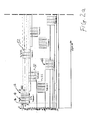
- a radio frequency pulse 10 is applied concurrently with appropriate slab select pulses in the z-direction to limit excitation to a first slab 12 which is four units thick in the z-direction, i.e. within slices 1, 2, 3 and 4 of Figure 2.
- a multiple echo data acquisition sequence 14 is applied.
- a fast spin echo technique is applied in which a radio frequency inversion pulse is applied to induce a first echo which is phase encoded to generate a first data line 16.
- Another radio frequency inversion pulse is applied along with a phase encoding pulse to generate a second data line 18 which is phase encoded with the fifth phase encode gradient step, in the illustrated embodiment.
- the inversion pulses and phase encode gradient pulses are applied to generate a data line at every fourth phase encode creating step, i.e. at phase encode gradient steps 1, 5, 9, etc.
- a radio frequency pulse and slab select gradient pulse combination 20 is applied to excite resonance in a second slab 22 which spans slices 9, 10, 11 and 12 in the illustrated embodiment.
- the second excited slab is displaced by four steps in the z-direction from the first slab.
- a multi-echo data acquisition sequence 24 is then applied to acquire a plurality of data lines. Again in the illustrated embodiment, the data lines would be first, fifth, ninth, etc. phase encode steps are acquired.
- a radio frequency excitation pulse and slice select gradient combination 30 are applied to excite resonance in a slab 32 which spans slices 5-8, in the illustrated embodiment.
- a multi-echo data acquisition sequence 34 again generates echoes with appropriate phase encodings to generate data lines phase encoded with the first, fifth, ninth, etc. phase encode steps.
- a fourth radio frequency excitation and slab select gradient pulse combination 40 are applied to excite resonance in a fourth slab 42 which spans slices 13, 14, 15 and 16.
- a multi-echo data acquisition sequence 44 has again applied generated data lines which are phase encoded with the first, fifth, ninth, etc. phase encode gradient steps. It is to be appreciated that this process can be continued through fifth or even a larger number of slabs. In fact, cycling through five slabs is advantageous in that by exciting resonance in slabs 1, 3, 5, 2, 4, etc., the time interval between exciting resonance in contiguous slabs is increased.
- a radio frequency RF pulse and slab select gradient pulse combination 50 are then applied to excite resonance in a slab 52 which spans slices 2, 3, 4, and 5. It will be noted that slabs 12 and 52 are offset by one slice or z-direction increment.
- a multi-echo data acquisition sequence 54 is applied to again generate data lines which are phase encoded with every fourth phase encode gradient step. However, the phase encode steps which are encoded are the second, sixth, tenth, etc.
- This process is repeated to generate magnetic resonance data lines in slabs which are offset by one z-increment or slice, which data lines are phase encoded with different phase encode gradient steps.
- a total of 16 resonance excitation and multi-echo data acquisition sequences are applied to generate a data set shown diagrammatically as 60 in Figure 2b. It will be seen that the data sets corresponding to the first, second, third, seventeenth, eighteenth and nineteenth slices or z-increments are incomplete.
- the data set corresponding to the first slice has only one quarter of the data lines of a pulse data set; the data set corresponding to the second slice has half the data lines; the data set corresponding to the third slice has three quarters of the data lines.
- These data sets can be zero filled or interpolated, but it is preferred that the reconstructed image data corresponding to the six slices be discarded.
- phase encoded the first, fifth, ninth, etc. phase encode gradient steps will have a discontinuity in the z-direction between the fourth and fifth z-increment or slice, between the eighth and nine z-increment or slice, between the twelfth and thirteen z-increment or slice and after the sixteenth z-increment or slice. That is, by stacking the like phase encoded data lines from the slabs 12, 32, 22, 42, an elongated data line is generated with potential discontinuities as described. However, the data lines generated at the second, sixth, tenth, etc.
- phase encode gradient steps will have discontinuities between the fifth and sixth z-increment or slice, the ninth and tenth z-increment or slice, the thirteen and fourteenth z-increment or slice.
- the data lines generated with the third, seventh, eleventh, etc. phase encode gradient steps will have their discontinuities between the sixth and seventh z-gradient increment or slice, between the tenth and eleventh z-gradient increment slice and between the fourteenth and fifteenth z-gradient or slice. In this manner, the z-direction discontinuities are staggered. Because the discontinuities are staggered, uniformly, the effect of the discontinuities is averaged or blended and the venetian blind effect is inhibited.
- each slab may cycle between a larger or smaller number of slabs.
- data lines can be phase encoded with a different fraction of the phase encode gradient steps. Increasing the distance between phase encode gradient steps in each slab increases the length of the imaging sequence by requiring more repetitions but smooths and reduces the potential for venetian blind artifacts.
- collecting a larger percentage of the data lines in each slab shortens the time of the imaging sequence, but increases the effect of the discontinuities.
- a data line is generated with the first y-phase encode gradient step and each of the sixteen z-phase encode gradient steps, with the fifth y-phase encode gradient step and each of the sixteen z-encode gradient steps. It is to be appreciated that one may take a quarter of the data lines by intermixing the z-and y-phase encode gradient steps in other orders. For example, as illustrated in Figure 3, data lines can be collected with the phase encoding step along the z-axis with as much phase encoding as time in sequence permits being collected along the y-axis.
- phase collecting a quarter of the data lines in each excitation it is preferred to collect sixteen data lines per acquisition depending on the subject matter examined and the total number of steps in case phase collecting a quarter of the data lines in each excitation may not be practical.
- resonance is excited repeatedly in the same slab until the quarter of the data lines are collected.
- a smaller fraction of the data lines are collected after excitation.
- resonance is excited in a different slab. After obtaining the smaller fraction of data lines from all of the slabs, the first slab is again excited to obtain an additional fraction of the data lines for each physical slab.
- the shifted interleaved multi-volume acquisition for 3D fast spin echo (SIMUVA) technique of the present invention extends the SLINKY (z- Sl iding In terleaved k Y ) 3D acquisition technique to a general 3D multiple slab or volume acquisition, such as 3D FSE, in order to suppress venetian blind artifacts (VBA) or slab boundary artifacts (SBA) caused by imperfect response of RF pulses, inconsistent repetition time or spin steady-state across the volume coverage, or physical fluid motion in vivo, e.g., CSF.
- VBA venetian blind artifacts
- SBA slab boundary artifacts
- the SIMUVA acquisition technique transforms non-uniform slab profiles into periodic functions along the k Y phase encoding direction where the function changes very slowly from slice to slice. After performing a Fourier transform, periodic amplitude modulations lead to less signal intensity oscillations than the original slab profile.
- 3D MRA a "thin slab” slices in the slice or z-direction continuously and periodically as many times as the desired volume is covered.
- 3D FSE multiple "thin-slabs” are slid only one period or designated times which is usually the number of shots, to accomplish the entire data acquisition.
- k Z encoding (z-views) is arranged in the most inner loop. For a fixed shot, all z-encodings will be collected before sliding to the next z position (i.e., performed before thin slabs "walk” to the next z position). The interval between slidings or shifts is N Z x T R . After N Z shifts or slidings, which should be equal to the number of shots, the acquisition is accomplished.
- k Y coding (y-views) is arranged in the most inner loop.
- all y-encoding steps or shots are collected.
- Volume will be shifted by each shot.
- the interval between shifts or slidings in this mode becomes T R .
- Volume sliding is performed periodically (cycle) in spatial position. After N Z sliding cycles all phase encoding steps are collected and, the acquisition is accomplished.
- SIMUVA 3D fast spin echo
- N S the number of slidings
- N Z the number of slidings
- N S N Z /2
- the wasted slices are proportional to N S , which exactly equals to N S -1.
- the wasted slices means that they do not contribute to final volume coverage.
- N Y N S x N G
- N G is the number of k Y lines per each group or per each sliding
- N S is the number of slidings. This equation indicates that the total number of k Y phase encoding steps should be completely divided by the number of slidings N S .
- N G is equal to ETL.
- phase encoding order (k Y map) there are variety of phase encoding order arrangements, depending on desired T 1 - or T 2 -weighted images.
- the arrangements can be divided into two categories: uniformly segmented arrangement (band) and arbitrary arrangement. This can be characterized by a parameter ⁇ N Y which describes the ⁇ k Y of adjacent echoes, e.g. first echo and second echo.
- Figures 4a and 4b show two cases of the segmented arrangement in which ⁇ N Y fulfills the condition of evenly allocated k Y -lines per each shot, no matter what order of the segments or bands in k-space are.
- One obstacle of using SIMUVA is the phase error introduced by the re-mapping the slab profile into the k Y -axis. Since the slab profile could be understood as a complex function, the phase error across the slab is then converted into a periodic function along the k Y phase encoding direction too as the amplitude modulation. This phase error is absolutely removed prior to Y-FFT as shown in Figures 5a and 5b.
- FE Field Echo
- this kind of phase error is mainly caused by a single RF pulse (for excitation) and can be therefore simply corrected by using a lookup table (pre-calibration) or using navigator echoes.
- this phase error is complex. Concerning only the RF pulses, at least RF pulse (excitation or refocus) might contribute to such phase changes. That is, this phase error might be echo position dependent. To understand the source of phase error and then to correct the conventional phase correction (remove biased phase error from echo to echo) in FSE must be modified to absolute correction if relative correction is used.
- the reference phase is chosen as zero.
- a Z-FFT is preferably performed first (the X-FFT does not influence the data sorting by using this technique). Since raw data is usually stored as a regular 3D matrix in buffer during acquisition while slabs or volumes are sliding and k Y lines are collected in an interleaved fashion, therefore data must be resorted in z-k Y space prior to Y-FFT. This means that k Y lines which belong to designated interleaf must be forced to "walk" corresponding number of buffers in a memory, and also inserted to correct k Y position as illustrated in Figure 8. Such data sorting involves intermatrices operation, depending on buffered data format. But since in computer technology resorting is purely a data shifting operation in a buffer, it does not decrease the reconstruction efficiency.
- slab shifting is realized by changing the centre frequency of RF pulse and optionally additional phase offset due 3D imaging.
- the linear phase introduced by frequency shifting is corrected in order to avoid the violation of phase encoding relationship along k Z -axis (aliasing).
- the ⁇ can be corrected in the reconstruction step instead of directly applying the phase during excitation.
- the ⁇ f and ⁇ must be applied to all RF pulses, excitation and refocus.
- a magnetic resonance imaging system includes the main magnet 70, preferably a cryogenic magnet, for generating a temporally constant main magnetic field through an examination region 72.
- a series of gradient coils 74 in conjunction with gradient amplifiers 76 generate gradient magnetic fields across the examination region.
- Gradient amplifiers typically generate current pules which result in corresponding gradient magnetic field pulses along the x-, y-, and z-axis for slab selection, phase encoding, and read out or frequency encoding.
- Radio frequency coils 78 and a radio frequency transmitter 80 generate RF excitation pulses for exciting magnetic resonance and inversion or other pulses from manipulating the magnetic resonance.
- a sequence control processor 82 generates appropriate RF and gradient pulse sequences, such as illustrated in conjunction with Figures 1-3.
- a frequency shift circuit 84 selectively shifts the centres frequency of the radio frequency pulses for incrementing the position of the slabs in the z-direction.
- a receiver 90 receives and demodulates the magnetic resonance signals from each slab to generate a corresponding series of data lines which are stored in one of a series of memories 92.
- a phase correction processor 94 corrects phase errors in each of the volumes and at the interface between volumes in accordance with Figures 7a and 7b.
- a data sorter 96 sorts a phase corrected volume data in accordance with Figure 9 and stores it in an accumulated memory 98 which corresponds to diagrammatic element 60 of Figure 2.
- a data correction look up table 99 corrects the data in accordance with a series of phantom calibration images.
- a reconstruction processor 100 implements a three dimensional Fourier transform reconstruction algorithm to reconstruct the data lines into a volumetric image representation which is stored in image memory 102.
- a video processor 104 under operator control selects one or more slices, projection images, surface renderings, or the like from data in the image memory and converts it into appropriate format for display on a video monitor 106.
- a specific phantom is used in order to examine if the data sorting and correction is correct or whether there is aliasing.
- a uniform phantom is then used to evaluate the suppression of venetian blind artifacts.
- the spatial resolution phantom is used to investigate the PSF effect, blurring, ghost level, etc.
- a flow phantom is used to examine the image quality, i.e. consistent CNR, under simulated CSF condition (slow, pulsatile flow).
- multiple spin echo signals are used to encode several phase encoding lines (views) in k-space, referred to as an FSE view shot.
- an FSE view shot With the imaging technique of the present invention, multiple thin slabs or volumes are slid in the slab direction by one slice thickness at every one (or several) FSE view shot. How many FSE view shots before a multi-slab sliding occurs, is controlled by parameters. This interleaving factor directly affects the effectiveness and efficiency of the technique as well as the arrangement/design of the FSE phase encoding view map in k-space.
- the shifted interleaved multi-volume acquisition (multi-volume slicing and interleaved phase-encoding acquisition) for 3D fast spin echo (SIMUVA) technique of the above-described embodiment has a number of advantages.
- One advantage is the provision of a 3D FSE imaging technique which eliminates venetian blind artifacts in 3D FSE resulting in better quality images with consistent CNR and flow contrast (C-Spine imaging) along the z-direction.
- Another advantage is the provision of a 3D FSE imaging technique which maps signal intensity modulation along the z-direction in the image domain onto one phase encoding axis in k-space.
- Yet another advantage is the provision of a 3D FSE imaging technique which provides equalized signal modulation from slice to slice and less disturbances in the reconstructed images.
Landscapes
- Physics & Mathematics (AREA)
- General Physics & Mathematics (AREA)
- High Energy & Nuclear Physics (AREA)
- Condensed Matter Physics & Semiconductors (AREA)
- Nuclear Medicine, Radiotherapy & Molecular Imaging (AREA)
- Radiology & Medical Imaging (AREA)
- Engineering & Computer Science (AREA)
- Signal Processing (AREA)
- General Health & Medical Sciences (AREA)
- Health & Medical Sciences (AREA)
- Optics & Photonics (AREA)
- Spectroscopy & Molecular Physics (AREA)
- Magnetic Resonance Imaging Apparatus (AREA)
Applications Claiming Priority (2)
| Application Number | Priority Date | Filing Date | Title |
|---|---|---|---|
| US08/970,192 US6043654A (en) | 1997-11-14 | 1997-11-14 | Multi-volume slicing and interleaved phase-encoding acquisition for 3 D fast spin echo (FSE) |
| US970192 | 1997-11-14 |
Publications (2)
| Publication Number | Publication Date |
|---|---|
| EP0916964A2 true EP0916964A2 (de) | 1999-05-19 |
| EP0916964A3 EP0916964A3 (de) | 2000-04-12 |
Family
ID=25516560
Family Applications (1)
| Application Number | Title | Priority Date | Filing Date |
|---|---|---|---|
| EP98308921A Withdrawn EP0916964A3 (de) | 1997-11-14 | 1998-10-30 | Eliminierung von Stabjalousie-Artefakten bei der dreidimensionalen Magnetresonanzbildgebung mit schnellen Echos |
Country Status (3)
| Country | Link |
|---|---|
| US (1) | US6043654A (de) |
| EP (1) | EP0916964A3 (de) |
| JP (1) | JPH11253423A (de) |
Cited By (2)
| Publication number | Priority date | Publication date | Assignee | Title |
|---|---|---|---|---|
| CN101843488A (zh) * | 2009-03-02 | 2010-09-29 | 西门子公司 | 利用磁共振设备进行体积片段的成像方法和装置 |
| CN101937065A (zh) * | 2010-06-30 | 2011-01-05 | 华东师范大学 | 一种快速磁共振3d成像方法 |
Families Citing this family (25)
| Publication number | Priority date | Publication date | Assignee | Title |
|---|---|---|---|---|
| JP3987223B2 (ja) * | 1998-12-28 | 2007-10-03 | 株式会社日立メディコ | 核磁気共鳴イメージング装置 |
| US6424153B1 (en) * | 1999-11-23 | 2002-07-23 | Koninklijke Philips Electronics, N.V. | On-the-fly removal of data inconsistency with k-space oversampling and demodulation in MRI acquisitions |
| US6292684B1 (en) * | 1999-12-14 | 2001-09-18 | Ge Medical Systems Global Technology Company, Llc | Respiratory displacement and velocity measurement using navigator MRI echo signals |
| ITSV20000017A1 (it) * | 2000-04-17 | 2001-10-17 | Esaote Spa | Metodo e macchina per il rilevamento d'immagini in risonanza magnetica nucleare |
| US6795723B1 (en) | 2000-05-22 | 2004-09-21 | Koninklijke Philips Electronics, N.V. | Interleaved phase encoding acquisition for MRI with controllable artifact suppression and flexible imaging parameter selection |
| US6564082B2 (en) * | 2001-04-19 | 2003-05-13 | General Electric Company | Method for incremental field-of-view-MR imaging |
| US6650116B2 (en) | 2001-04-20 | 2003-11-18 | Regents Of The University Of Minnesota | Method and system for NMR using adiabatic RF pulses producing spatially quadratic phase |
| US6728569B2 (en) | 2001-10-25 | 2004-04-27 | Evanston Northwestern Healthcare Corp. | Scoutless whole-body imaging with fast positioning |
| JP2005522250A (ja) * | 2002-04-08 | 2005-07-28 | コーニンクレッカ フィリップス エレクトロニクス エヌ ヴィ | 複数の基礎データセットから複合オブジェクトデータセットを形成するデータ処理 |
| DE10328423B4 (de) * | 2003-06-25 | 2006-09-28 | Universitätsklinikum Freiburg | Verfahren zur kernspintomographischen Aufnahme von bewegten Objekten |
| US7603156B2 (en) * | 2003-07-02 | 2009-10-13 | Ge Medical Systems Global Technology Co., Llc | Systems and methods for phase encode placement |
| US7075299B1 (en) * | 2003-12-12 | 2006-07-11 | General Electric Company | Method and apparatus to correct amplitude modulation in multi-echo magnetic resonance imaging |
| US7348774B2 (en) * | 2004-05-25 | 2008-03-25 | Esaote, S.P.A. | Method and an apparatus for image acquisition and display by means of nuclear magnetic resonance imaging |
| US20070055138A1 (en) * | 2005-08-22 | 2007-03-08 | Edelman Robert R | Accelerated whole body imaging with spatially non-selective radio frequency pulses |
| JP4249215B2 (ja) * | 2006-10-06 | 2009-04-02 | ジーイー・メディカル・システムズ・グローバル・テクノロジー・カンパニー・エルエルシー | 磁気共鳴イメージング装置 |
| WO2009094304A2 (en) * | 2008-01-23 | 2009-07-30 | The Regents Of The University Of Colorado | Susceptibility weighted magnetic resonance imaging of venous vasculature |
| CN101520499B (zh) * | 2008-02-29 | 2011-12-07 | 西门子(中国)有限公司 | 磁共振成像中去除伪影的方法和装置 |
| JP5925529B2 (ja) * | 2011-03-31 | 2016-05-25 | 株式会社東芝 | 磁気共鳴イメージング装置 |
| US8502536B2 (en) * | 2011-04-08 | 2013-08-06 | Wisconsin Alumni Research Foundation | Method for accelerated high resolution chemical species separation for magnetic resonance imaging |
| DE102012216773B4 (de) * | 2012-09-19 | 2018-11-08 | Siemens Healthcare Gmbh | Aufnahme von mindestens zwei Messdatensätzen eines Untersuchungsobjekts mittels einer Magnetresonanzanlage |
| KR101967242B1 (ko) | 2012-11-14 | 2019-04-09 | 삼성전자주식회사 | 자기공명영상 시스템 및 자기공명영상 방법 |
| KR102001063B1 (ko) | 2012-11-14 | 2019-07-17 | 삼성전자주식회사 | 자기공명영상 시스템 및 자기공명영상 방법 |
| KR101537536B1 (ko) * | 2013-10-25 | 2015-07-20 | 삼성전자주식회사 | 의료 영상 장치의 영상 처리 방법 및 그 의료 영상 장치 |
| US20150374247A1 (en) * | 2014-06-30 | 2015-12-31 | Samsung Electronics Co., Ltd. | Method of measuring blood flow velocity performed by medical imaging apparatus, and the medical imaging apparatus |
| WO2016139113A1 (en) * | 2015-03-04 | 2016-09-09 | Koninklijke Philips N.V. | Acoustic radiation force imaging |
Family Cites Families (6)
| Publication number | Priority date | Publication date | Assignee | Title |
|---|---|---|---|---|
| US4665367A (en) * | 1985-08-16 | 1987-05-12 | Technicare Corporation | Multiplexed magnetic resonance imaging of volumetric regions |
| US5167232A (en) * | 1990-08-07 | 1992-12-01 | Ihc Hospitals, Inc. | Magnetic resonance angiography by sequential multiple thin slab three dimensional acquisition |
| US5270654A (en) * | 1991-07-05 | 1993-12-14 | Feinberg David A | Ultra-fast multi-section MRI using gradient and spin echo (grase) imaging |
| DE4137217C2 (de) * | 1991-11-13 | 1993-10-07 | Hennig Juergen | Verfahren der Kernspin-Tomographie |
| JP3526350B2 (ja) * | 1994-08-08 | 2004-05-10 | 株式会社東芝 | 磁気共鳴イメージング装置 |
| US5881728A (en) * | 1996-07-26 | 1999-03-16 | Wisconsin Alumni Research Foundation | Digital subtraction magnetic resonance angiography with image artifact suppression |
-
1997
- 1997-11-14 US US08/970,192 patent/US6043654A/en not_active Expired - Fee Related
-
1998
- 1998-10-30 EP EP98308921A patent/EP0916964A3/de not_active Withdrawn
- 1998-11-09 JP JP10317684A patent/JPH11253423A/ja active Pending
Cited By (4)
| Publication number | Priority date | Publication date | Assignee | Title |
|---|---|---|---|---|
| CN101843488A (zh) * | 2009-03-02 | 2010-09-29 | 西门子公司 | 利用磁共振设备进行体积片段的成像方法和装置 |
| CN101843488B (zh) * | 2009-03-02 | 2014-08-13 | 西门子公司 | 利用磁共振设备进行体积片段的成像方法和装置 |
| CN101937065A (zh) * | 2010-06-30 | 2011-01-05 | 华东师范大学 | 一种快速磁共振3d成像方法 |
| CN101937065B (zh) * | 2010-06-30 | 2012-08-08 | 华东师范大学 | 一种快速磁共振3d成像方法 |
Also Published As
| Publication number | Publication date |
|---|---|
| JPH11253423A (ja) | 1999-09-21 |
| EP0916964A3 (de) | 2000-04-12 |
| US6043654A (en) | 2000-03-28 |
Similar Documents
| Publication | Publication Date | Title |
|---|---|---|
| US6043654A (en) | Multi-volume slicing and interleaved phase-encoding acquisition for 3 D fast spin echo (FSE) | |
| US5270654A (en) | Ultra-fast multi-section MRI using gradient and spin echo (grase) imaging | |
| CN105005011B (zh) | 在三维快速自旋回波中的混合采集的磁共振成像方法 | |
| CN109814058B (zh) | 磁共振系统和在其中生成检查对象的磁共振图像的方法 | |
| KR101663853B1 (ko) | 3d 모자이크 세그먼트화 및 3d 내비게이터 위상 정정을 이용한 확산 강조 자기 공명 이미징 | |
| US8072214B2 (en) | Method for magnetic resonance imaging using sequential excitation and refocusing | |
| US6037771A (en) | Sliding thin-slab acquisition of three-dimensional MRA data | |
| US20020060567A1 (en) | Magnetic resonance method for forming a fast dynamic image | |
| JP5828763B2 (ja) | 磁気共鳴イメージング装置および磁気共鳴イメージング方法 | |
| JP3850495B2 (ja) | Nmrデータから画像を生成する方法及び装置 | |
| US5055789A (en) | Magnetic resonance imaging system | |
| JPH11113877A (ja) | 核磁気共鳴イメージング方法 | |
| JP2020522344A (ja) | 並列マルチスライスmr撮像 | |
| CN114895228A (zh) | 基于多段同时激发的磁共振成像方法、装置、设备及介质 | |
| US6424153B1 (en) | On-the-fly removal of data inconsistency with k-space oversampling and demodulation in MRI acquisitions | |
| US7154269B1 (en) | Iterative method for correction of geometric distortion resulting from phase evolution during segmented echo planar nuclear magnetic resonance imaging and apparatus therefor | |
| JP4290782B2 (ja) | 磁気共鳴イメージング装置 | |
| US11474178B2 (en) | Method for generating a magnetic resonance image | |
| Mugler III | Improved three‐dimensional GRASE imaging with the SORT phase‐encoding strategy | |
| JP2002085376A (ja) | 核磁気共鳴イメージング装置および方法 | |
| JP3588690B2 (ja) | 磁気共鳴装置 | |
| US6313629B1 (en) | Prescan calibration of spatially dependent data errors in single echo sequences | |
| US6795723B1 (en) | Interleaved phase encoding acquisition for MRI with controllable artifact suppression and flexible imaging parameter selection | |
| JP3707829B2 (ja) | 磁気共鳴イメージング装置 | |
| Kim et al. | Volumetric T2‐weighted spin echo imaging with improved SNR using localized quadratic encoding and a spiral readout trajectory |
Legal Events
| Date | Code | Title | Description |
|---|---|---|---|
| PUAI | Public reference made under article 153(3) epc to a published international application that has entered the european phase |
Free format text: ORIGINAL CODE: 0009012 |
|
| AK | Designated contracting states |
Kind code of ref document: A2 Designated state(s): DE FR NL |
|
| AX | Request for extension of the european patent |
Free format text: AL;LT;LV;MK;RO;SI |
|
| PUAL | Search report despatched |
Free format text: ORIGINAL CODE: 0009013 |
|
| AK | Designated contracting states |
Kind code of ref document: A3 Designated state(s): AT BE CH CY DE DK ES FI FR GB GR IE IT LI LU MC NL PT SE |
|
| AX | Request for extension of the european patent |
Free format text: AL;LT;LV;MK;RO;SI |
|
| 17P | Request for examination filed |
Effective date: 20001004 |
|
| AKX | Designation fees paid |
Free format text: DE FR NL |
|
| RAP1 | Party data changed (applicant data changed or rights of an application transferred) |
Owner name: MARCONI MEDICAL SYSTEMS, INC. |
|
| RAP1 | Party data changed (applicant data changed or rights of an application transferred) |
Owner name: PHILIPS MEDICAL SYSTEMS (CLEVELAND), INC. |
|
| RAP1 | Party data changed (applicant data changed or rights of an application transferred) |
Owner name: KONINKLIJKE PHILIPS ELECTRONICS N.V. |
|
| 17Q | First examination report despatched |
Effective date: 20040713 |
|
| STAA | Information on the status of an ep patent application or granted ep patent |
Free format text: STATUS: THE APPLICATION IS DEEMED TO BE WITHDRAWN |
|
| 18D | Application deemed to be withdrawn |
Effective date: 20050124 |