EP0912922B1 - Verfahren und system zum durchführen einer booleschen operation auf bitketten unter benutzung einer maximalen bitscheibe - Google Patents
Verfahren und system zum durchführen einer booleschen operation auf bitketten unter benutzung einer maximalen bitscheibe Download PDFInfo
- Publication number
- EP0912922B1 EP0912922B1 EP96941388A EP96941388A EP0912922B1 EP 0912922 B1 EP0912922 B1 EP 0912922B1 EP 96941388 A EP96941388 A EP 96941388A EP 96941388 A EP96941388 A EP 96941388A EP 0912922 B1 EP0912922 B1 EP 0912922B1
- Authority
- EP
- European Patent Office
- Prior art keywords
- bit
- slice
- input
- bit slice
- resultant
- Prior art date
- Legal status (The legal status is an assumption and is not a legal conclusion. Google has not performed a legal analysis and makes no representation as to the accuracy of the status listed.)
- Expired - Lifetime
Links
Images







Classifications
-
- G—PHYSICS
- G06—COMPUTING OR CALCULATING; COUNTING
- G06F—ELECTRIC DIGITAL DATA PROCESSING
- G06F7/00—Methods or arrangements for processing data by operating upon the order or content of the data handled
Definitions
- the present invention relates to a method and system for performing a boolean operation on bit strings, and in particular, to a method and system for performing a boolean operation on bit strings using a maximal bit slice.
- Bit strings can be used in a relational database management system ("RDBMS") to represent instances of data items occurring within records stored in the database.
- RDBMS relational database management system
- the conventional approach to data storage utilizes collections of tables organized into rows and columns of data. Each column contains a particular type of information while each row consists of individual records of disparate information from each of the columns. Rows are contiguously stored as identically structured records.
- This record-oriented approach imposes large input and output (I/O) requirements, requires complex indexing schemes and demands periodic retuning and denormalization of the data.
- a method for representing data in an RDBMS that substantially reduces these problems is described in WO 89/04013.
- the database is structured using a column-oriented approach that separates data values from their use in the database tables using bit strings. Rather than storing information as contiguous records, the data is stored in a columnar organization.
- the data values that make up each table are separated using bit strings that each represent a unique value in a row from each of the columns. Within each bit string, a binary bit value indicates an incidence of a columnar value within a given record (or row).
- a common form of a query process involves a boolean operation operating on a pair of bit strings to form a resultant bit string that represents those database records that satisfy the conditions of the query.
- bit strings can be compressed, encoded and processed according to a boolean operation as disclosed in U.S. Patent 5,036,457 to Glaser et al..
- An uncompressed binary bit string is converted into a compressed binary bit form consisting of either a run or an impulse.
- a boolean operation is performed on pairs of impulses in compressed form using an iterative looping construct to form a resultant bit string. This technique is significantly faster than operating on each bit, one at a time, as is typically done in the art.
- a pair of compressed impulses are obtained from a pair of encoded bit strings and the impulse with the shorter (called "minimal") length is selected.
- the boolean operation is performed for the number of bits in the minimal length impulse and a resultant bit string of this minimal length is formed. This cycle is repeated for each of the remaining minimal length impulses.
- the total number of cycles required to perform the boolean operation equals approximately the sum of the number of impulses in the two input bit strings.
- the present invention improves upon the prior art by providing a method and system for performing a boolean operation on bit strings using a maximal length impulse instead of a minimal length impulse.
- a first aspect of the invention is a method as defined in independent claim 1.
- a second one is defined in independent claim 15. Further embodiments of the invention are specified in the appended dependent claims.
- the present invention is concerned with a system and a method using a computer for performing a boolean operation on a series of bit strings to form a resultant bit string.
- Each such bit string is divided into input bit slices.
- the resultant bit string is divided into resultant bit slices.
- An action is determined according to the boolean operation based on a first such input bit slice from a first such bit string and on a second such input bit slice from a second such bit string.
- the input bit slice with a longer bit length is selected from between the first input bit slice and the second input bit slice.
- the longer input bit slice and a plurality of the input bit slices in the bit string having the input bit slice with a shorter bit length are processed according to the determined action for up to a number of bits in at least one such bit string equaling the longer bit length to form at least one such resultant bit slice.
- an embodiment of the present invention performs a boolean operation on a pair of bit strings A 40 and B 46 to form a resultant bit string C 52.
- Both of the bit strings A and B are represented by a series of input bit slices 41a, 47a-j which, in the present example, are processed as runs (runs and impulses are further described hereinbelow).
- the pair of bit strings A 40 and B 46 are processed, according to the boolean operation, by selecting from each of the pair of bit strings A 40 and B 46 the bit slice 41a having the longer length 44, and by processing this input bit slice 41a against one or more input bit slices 47a-j in the other bit string 46 for up to a number of bits equaling the longer length 41a and a series of at least one resultant bit slice 53a-j is formed as a result.
- the resultant bit slice 53a creates an impulse for output, it is preferably further processed to provide an encoded, storage-efficient format.
- Bit string refers to a series of binary bits.
- Ring refers to a bit string of one or more contiguous bits of the same binary value (or gender).
- “Impulse” refers to a bit string of one or more contiguous bits of the same binary value (or gender) followed by an ending bit having a binary value opposite the bits of the same binary value.
- “Characteristic type” refers to an indicator that categorizes a bit string as either a run or an impulse.
- Gender refers to an indicator that indicates the binary value of a run or an impulse and is also interchangeably referred to as "polarity.”
- Uncompressed form refers to a one-dimensional array of binary bits that is either a run or an impulse.
- Press form refers to a representation of a run or an impulse that indicates: (1) polarity, (2) characteristic type and (3) length.
- Encoded form refers to one or more contiguous impulses stored in a packed format.
- FIG. 1 A computer system is depicted in FIG. 1 having a programmable computer and computer programs for performing boolean operations on a pair of bit strings in accordance with the present invention.
- the computer system includes a programmable microprocessor 2, display 3, keyboard entry device 11 for the microprocessor 2 and an external storage device 12 for the storage or buffering of the bit strings.
- Conversion hardware, software or firmware and boolean operation hardware, software or firmware are housed in a computer platform 10 (shown in phantom lines) built into the microprocessor 2.
- the computer platform 10 coordinates the various activities related to performing boolean operations on bit strings, such as shown in U.S. Patent No. 5,306,457 to Glaser et al.
- the computer platform 10 is a general purpose programmable computer constructed on a printed circuit board which can easily be employed within most standard computer systems, including personal, mini and mainframe computers with computer program software for directing its operations as disclosed herein. It is also envisioned that the computer platform 10 can be a special purpose computer formed' on an integrated circuit chip (or set of chips) or executable computer code burned into a read-only memory (ROM) chip that can be read in by conventional means or as microcode.
- ROM read-only memory
- the computer platform 10 includes an encoder/decoder 14, an optional secondary memory 16 (which can be located external to the computer platform 10) interconnected to an optional buffer memory 18 by buses 15 and 27, a boolean Logic Unit (BLU) 20, a canonical processing unit 25 and a system coordinator 26.
- BLU boolean Logic Unit
- the computer platform 10 is formed and ready for processing.
- the external storage device 12 is a permanent or buffer storage unit, typically a hard disk, for storing encoded bit strings.
- the bit strings are representative of organized data in a relational database.
- the contents of the external device 12 are loaded by a bus 13 to the computer platform 10 and into the encoder/decoder 14 which separates encoded bit strings into one or more compressed impulses.
- An impulse is described throughout this document as having an ending bit, but the description applies equally to an impulse having a starting bit.
- the terms "polarity” and “gender” are used interchangeably and simply refer to binary value.
- the routines executed by the encoder/decoder 14 for encoding/decoding the bit strings into/from one of four different encoded impulse formats are described in U.S. Patent No. 5,036,457 to Glaser et al.
- the optional secondary memory 16 stores the compressed bit strings for future boolean operations and can be a memory component included in the host computer or a memory component included within the computer platform 10.
- the buffer memory 18 is another memory area for holding a compressed bit string temporarily before processing the bit string at the BLU 20 or before storing the bit string into the secondary memory 16 after processing.
- the BLU 20 performs boolean operations on the two bit strings by utilizing a BLU embodiment implemented on a microprocessor (not shown), such as an Intel Pentium®. Some or all of the boolean operations can be much more efficiently implemented in hardware. However, even if the boolean operations are implemented primarily in software, the BLU 20 can perform the boolean operations more efficiently in terms of storage, speed and so forth than presently known techniques for performing boolean operations on compressed bit strings. The BLU 20 can take full advantage of the latest components, such as 32-bit or 64-bit microprocessors with very fast clock speeds.
- the resultant bit slice is sent by a bus 21 to the canonical processing unit 25 which is essentially a pair of buffers for temporary holding resultant compressed (but not encoded) bit slices until they can be combined into a compressed impulse.
- the impulse is output by a bus 23 to the buffer memory 18 for encoding.
- the system coordinator 26 controls the processing of data on the computer platform 10.
- the operation of the bus system and the operation of the components on the computer platform 10 are controlled by software programs in the system coordinator 26.
- the dotted lines of FIG. 2 leading out from the system coordinator 26 show its control over the various components.
- FIGS. 3A and 3B a pair of uncompressed and compressed bit strings are shown pictorially as binary bit values 33, 36 and as binary valued wave forms 33', 36'.
- the binary bit values will be referred to throughout this document, but the same description applies interchangeably to binary valued wave forms.
- bit slices are a run 34 and an impulse 35. These are both raw bit strings as described above.
- Each bit slice such as the run 34 or the impulse 35, can be represented by attributes 5, 6, 7 describing the slice in a compressed form.
- a boolean operation can be performed using attributes 5, 6, 7 without the need to uncompress the bit slice.
- the input attributes include: a characteristic type rS 5; a gender gS 6; and a length lS 7.
- the characteristic type rS 5 "0" or “1” indicates the slice is, respectively, an impulse 35 or a run 34.
- the gender gS 6 "0" or “1” identifies the gender of the one or more contiguous bits preceding the ending bit.
- the length lS 7 indicates the number of bits occurring in the slice.
- each slice 34, 35 in the string is formed by serially reading into a memory (not shown) one or more contiguous bits of the same gender, that is, a run 34, and counting the contiguous bits until a single bit of gender opposite that of the run 34, that is, an ending bit, is read.
- the attributes 5, 6, 7 are created as each impulse of a bit string is converted from uncompressed to compressed form.
- a "0" is stored in the characteristic type rS 5 to indicate a bit string that is an impulse 35 as well as the appropriate gender for the run 34 in the gender gS 6 and the bit count as the length lS 7.
- the resultant bit string can optionally be converted back into an uncompressed bit string 33.
- rA rB (lA > lB)
- Equations (1) and (2) return either a "0" or “1” to indicate that the slices A and B are to be processed as an impulse 35 or a run 34, respectively, and store the returned values as the characteristic types rA 42 and rB 48.
- Equality that is, equal lengths of 44, 50, is represented by the boolean condition ⁇ rA & ⁇ rB which indicates that both bit slices are impulses of the same length.
- Raw bit strings (block 120) are converted into compressed impulses (block 122) by bit string converter means 121, preferably the processor 2.
- Encoded bit strings (block 123) are decoded into compressed impulses (block 122) by decoder means 124, preferably the encoder/decoder 14.
- Boolean operations 125 are performed in accordance with the present invention on pairs of compressed impulses (block 122) to form resultant compressed impulses (block 126).
- the resultant compressed impulses (block 126) are encoded translated into bit strings (block 128) by encoder means 127, preferably the encoder/decoder 14.
- a pair of bit strings A 40 and B 46 are iteratively processed using the length of the longest ("maximal") current bit slice 41a during each cycle of a main program loop to form a resultant bit string 52, 58, 64.
- the pair of bit strings A 40 and B 46 and each resultant bit string 52, 58, 64 are shown pictorially as binary bit values 40, 46, 52, 58, 64 and as binary valued wave forms 40', 46', 52', 58', 64'.
- the binary bit values will be referred to throughout this document, but the same description applies interchangeably to binary valued wave forms.
- the resultant attributes 54, 55, 56 for each resultant bit slice 53a-j in the resultant bit string C 52 is determined by five output functions, described in further detail below.
- the output from each function is based on input parameters obtained from the input attributes 42, 43, 44, 48, 49, 50 associated with each input bit slice 41a, 47a-j.
- the number of bits processed during each cycle can be very large, significant speed up over the minimal length impulse technique can be achieved.
- FIGS. 7A, 7B, 7C, 8A, 8B, 8C, 9A, 9B and 9C Three items of information must be known or ascertained to determine the input parameters: the desired boolean operation illustrated in FIGS. 7A, 7B, 7C, 8A, 8B, 8C, 9A, 9B and 9C; the input attributes 42, 43, 44 for each input bit slice 41a in the bit string A 40; and the input attributes 48, 49, 50 for each input bit slice 47a in the bit string B 46.
- FIGS. 7A, 8A, 9A and 10A Three elementary boolean operations are implemented: an AND illustrated in FIGS. 7A, 8A, 9A and 10A; an OR illustrated in FIGS. 7B, 8B, 9B and 10B; and an XOR (exclusive OR) illustrated in FIGS. 7C, 8C, 9C, 10C and 11.
- boolean operators or derivations can be performed such as shown in Table 1.
- boolean operations on more than two inputs are envisioned.
- further boolean operators include NAND (complemented AND), NOR (complemented OR), XNOR (complemented XOR), XAND (exclusive AND), and XNAND (complemented exclusive AND).
- Derivations include equivalent or combinational boolean operators formed by applying conventional boolean algebraic properties and theorems, such as the additive, commutative and distributive properties or DeMorgan's Theorem. The foregoing list is not exhaustive and still further boolean operations are possible within the scope of the present invention as claimed.
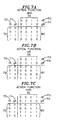
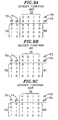
- each action or output function is presented in a Karnaugh map, one map for each type of boolean operation AND, OR and XOR.
- Each Karnaugh map is a table consisting of rows and columns. Referring by way of example to FIG. 7A, each row is indexed by the characteristic type rA 70 and the gender gA 71 from the input attributes 42, 43 for each bit slice 41a in the bit string A 40. Each column is indexed by the characteristic type rB 73 and the gender gB 74 from the input attributes 48, 49 for each bit slice 47a-j in the bit string B 46.
- a characteristic type and gender pair rA, gA 72 from the bit string A 40 and a characteristic type and gender pair rB, gB 75 for the bit string B 46 are specified to identify one of the rows 72 and one of the columns 75 in the Karnaugh map.
- the output of each function is indicated by a binary bit at the intersection of the row 72 and the column 75.
- Karnaugh maps indicating the type of action to be performed for boolean AND, OR and XOR operations are respectively shown in FIGS. 7A, 7B and 7C.
- the action can be either a copy action or a scan action.
- the input bit slice with the maximum, that is, longer length is selected between pairs of input bit slices, such as bit slices 41a, 47a, for each of the pair of input bit strings A 40 and B 46.
- a copy action is performed if the individual genders and lengths of the one or more input bit slices from the shorter bit slice need to be taken into consideration. Otherwise, a scan action is performed. However, if the lengths of the input bit slices are equal, either a scan or a copy action can be performed. In such cases, a scan action is preferred because it operates faster than a copy action.
- a one value (“1") indicates that the input bit string will be copied, slice-by-slice, up to a number of bits equaling the longer bit length.
- the input bit slice with the longer bit length is ignored since the resultant bit slices are based on the attributes for each of the one or more shorter input bit slices.
- a zero value (“0") indicates that the shorter input bit string must be scanned up to a number of bits equaling length lC .
- the gender of one or more shorter input bit slices is ignored for the output since the resultant bit slice is based on the attributes of the length lC .
- Karnaugh maps indicating the characteristic type rC 54, 60, 66 of the resultant bit slice 53a-j, 59a-j, 65a-j for boolean AND, OR and XOR operations respectively are shown in FIGS. 8A, 8B and 8C.
- a characteristic type can either be a run or an impulse. Accordingly, the situations in which a run or an impulse is output in the resultant bit slice are tabulated in the Karnaugh maps 85, 86, 87 as a one value ("1") for a run and a zero value ("0") for an impulse.
- Karnaugh maps indicating the gender gC 55, 61, 67 of the resultant bit slice 53a-j, 59a-j, 65a-j for boolean AND, OR and XOR operations are respectively shown in FIGS. 9A, 9B and 9C. Accordingly, the appropriate genders are tabulated in the Karnaugh maps 90, 91, 92 as a one value ("1") and zero value ("0"), respectively.
- Karnaugh maps indicating whether a "take” bit is required for boolean AND, OR and XOR operations are respectively shown in FIGS. 10A, 10B and 10C.
- a take bit is a single bit value that is subtracted from the longer bit length 44 in accordance with equation (3), described above.
- the take bit is a function of the lengths lA 44 and lB 50 of the input bit slices 41a, 47a from each of the pair of bit strings A 40 and B 46. If the lengths are not equal, a take bit is set to "1", otherwise it is set to "0". Accordingly, the situations in which a take bit is (or is not) required are tabulated in the Karnaugh maps 95, 96, 97 as a one value ("1") and a zero value ("0"), respectively.
- a Karnaugh map indicating whether a "flip" action must be performed for a boolean XOR operation is shown in FIG. 11.
- a flip action as represented by a flip bit, means that the gender of the resultant bit slice 65a-i must be complemented by "flipping" the gender of each bit being output or determined from the current bit slice 47a-j. Accordingly, the situations in which a flip action is (or is not) performed are tabulated (as flip bits) in the Karnaugh map 102 as a one value ("1") and a zero value (“0"), respectively.
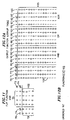
- the Karnaugh maps for the five output functions of FIGS. 7A, 7B, 7C, 8A, 8B, 8C, 9A, 9B, 9C, 10A, 10B, 10C and 11 are combined into the output function lookup table shown in FIG. 12A.
- the first column is indexed by the characteristic type rA 70 and the gender gA 71 from the input attributes 42, 43 for each bit slice 41a in the bit string A 40 and the characteristic type rB 73 and the gender gB 74 for the input attributes 48, 49 for each bit slice 47a-j in the bit string B 46.
- the columns for the boolean AND, OR and XOR operations contain the outputs for the functions corresponding to the action a 80, 81, 82, the characteristic type rC 85, 86, 87, the gender gC 90, 91, 92, the take bit t 95, 96, 97 and flip bit f 100, 101, 102.
- a characteristic type rA and gender gA pair from the bit string A 40 and a characteristic type rB and gender gB pair for the bit string B 46 are specified to select a row 106 in the lookup table.
- the output of each function 105 is at the intersection of the row 106 and the column corresponding to the output function for the selected boolean operation.
- FIG. 13 for ease of understanding, a table pictorially representing the Output Function Lookup Table of FIG. 12A is shown. It is indexed in the same manner as the lookup table using a characteristic type rA and gender gA pair from the bit string A 40 and a characteristic type rB and gender gB pair for the bit string B 46.
- the action, characteristic type rC and gender gC of the resultant bit slice, take bit and flip bit are described textually 115 in columns 110, 111 and 112 organized by the boolean operations AND, OR and XOR, respectively.
- the respective input attributes 42, 43, 44, 48, 49, 50 for each of the input bit slices 41a, 47a, and in particular, the characteristic types rA 42 and rB 48, genders gA 43 and gB 49 and lengths lA 44 and lB 50 are illustrated graphically in column 113.
- the outputs 115 of each of the output functions is described at the intersection of the row 114 matching the input attributes and the column 110, 111, 112 matching the selected boolean operation.
- FIG. 13 pictorially shows the binary valued wave forms for the pair of bit slices and is therefore easy to understand in light of the examples.
- the desired boolean operation is an AND 110.
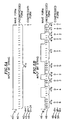
- the pair of input bit strings A 40 and B 46 are shown in FIGS. 5A and 5B.
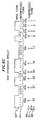
- the resultant bit string C 52 is shown in FIG. 6A.
- a first bit slice 41a is selected from the bit string A 40 and a second bit slice 47a is selected from the bit string B 46.
- the first bit slice 41a has input attributes comprising a characteristic type rA 42 equaling "1" (indicating that the first bit slice 41a is a run up to the length of the shorter bit slice) which was calculated from equation (1), a gender gA 43 of "1" (indicating that the first bit slice 41a contains a run having a polarity of "1”) and a length lA 44 of 34 bits.
- the second bit slice up to the length of the shorter bit slice 47a has input attributes comprising a characteristic type rB 48 of "0" (indicating that the second bit slice 47a is an impulse up to the length of the shorter bit slice), a gender gB 49 of "0" (indicating that the second bit slice 47a contains a run having a polarity of "0") and a length lB 50 of 6 bits.
- the row 114 equating to "1100" (formed by combining rA, gA, rB and gB into the bit string "1100") in FIG. 13 is selected to determine the outputs from the output functions for an AND operation (column 110). Since the first bit slice 41a has a longer bit length lA 44 than the second bit slice 47a, each of the shorter bit slices 47a-j in the bit string B 46 will be copied up to a number of bits equaling the length lA 44 of the first bit slice 41a minus a take bit, that is, for 33 bits, to the resultant bit slice C 52. Upon completion of the copy, a single bit will remain in the first bit slice 41a while the second bit slice will have become bit slice 47j of which one bit (with implied trailing zero bits) remains.
- bit slice 41a has a longer bit length 1A 44 (including implied trailing zeroes) than the shorter bit slice 47j, the shorter bit slice 47j in the bit string B 46 will be scanned after which an end-of-input condition will be detected and the operation completed.
- the desired boolean operation is an OR 111.
- the pair of input bit strings A 40 and B 46 are shown in FIGS. 5A and 5B.
- the resultant bit string C 52 is shown in FIG. 6A.
- a first bit slice 41a is selected from the bit string A 40 and a second bit slice 47a is selected from the bit string B 46.
- the first bit slice 41a has input attributes comprising a characteristic type rA 42 equaling "1" (indicating that the first bit slice 41a is a run up to the length of the shorter bit slice) which was calculated from equation (1), a gender gA 43 of "1" (indicating that the first bit slice 41a contains a run having a polarity of "1”) and a length lA 44 of 34 bits.
- the second bit slice up to the length of the shorter bit slice 47a has input attributes comprising a characteristic type rB 48 of "0" (indicating that the second bit slice 47a is an impulse up to the length of the shorter bit slice), a gender gB 49 of "0" (indicating that the second bit slice 47a contains a run having a polarity of "0") and a length lB 50 of 6 bits.
- the row 114 equating to "1100" in FIG. 13 is selected to determine the outputs from the output functions for an OR operation (column 111). Since the first bit slice 41a has a longer bit length lA 44 than the second bit slice 47a, each of the shorter bit slices 47a-j in the bit string B 46 will be scanned up to a number of bits equaling the length lA 44 of the first bit slice 41a minus a take bit, that is, for 33 bits, to the resultant bit slice C 58. Upon completion of the scan, a single bit will remain in the first bit slice 41a while the second bit slice will have become bit slice 47j of which one bit remains.
- bit slice 41a has a longer bit length lA 44 (including implied trailing zeroes) than the shorter bit slice 47j, the shorter bit slice 47j in the bit string B 46 will be copied after which an end-of-input condition will be detected and the operation completed.
- the pair of input bit strings A 40 and B 46 are shown in FIGS. 5A and 5B.
- the resultant bit string C 52 is shown in FIG. 6A.
- a first bit slice 41a is selected from the bit string A 40 and a second bit slice 47a is selected from the bit string B 46.
- the first bit slice 41a has input attributes comprising a characteristic type rA 42 equaling "1" (indicating that the first bit slice 41a is a run up to the length of the shorter bit slice) which was calculated from equation (1), a gender gA 43 of "1" (indicating that the first bit slice 41a contains a run having a polarity of "1”) and a length lA 44 of 34 bits.
- the second bit slice up to the length of the shorter bit slice 47a has input attributes comprising a characteristic type rB 48 of "0" (indicating that the second bit slice 47a is an impulse up to the length of the shorter bit slice), a gender gB 49 of "0" (indicating that the second bit slice 47a contains a run having a polarity of "0") and a length lB 50 of 6 bits.
- the row 114 equating to "1100" in FIG. 13 is selected to determine the outputs from the output functions for an XOR operation (column 112). Since the first bit slice 41a has a longer bit length lA 44 than the second bit slice 47a, each of the shorter bit slices 47a-j in the bit string B 46 will be copied up to a number of bits equaling the length lA 44 of the first bit slice 41a minus a take bit, that is, for 33 bits, to the resultant bit slice C 64 since the flip bit is indicated. Upon completion of the copy, a single bit will remain in the first bit slice 41a while the second bit slice will have become bit slice 47j of which one bit remains.
- bit slice 41a has a longer bit length lA 44 (including implied trailing zeroes) than the shorter bit slice 47j, the shorter bit slice 47j in the bit string B 46 will be copied after which an end-of-input condition will be detected and the operation completed.
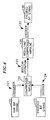
- FIGS. 14-16 The structure of a computer program for use in the system of FIG. 1 and a process created by the computer program for performing a boolean operation in accordance with the present invention is shown diagrammatically in the flow diagrams of FIGS. 14-16.
- the process for performing boolean operations 110, 111, 112 on a pair of bit strings A and B to form a resultant bit string C is shown in FIG. 14. Its purpose is to iteratively process, according to the boolean operation, bit slices from the pair of bit strings A and B for up to a number of bits equaling a maximal bit slice with length lC during each cycle.
- bit strings A 40 and B 46 including their respective input attributes 42, 43, 44, 48, 49, 50, are stored in the secondary memory 16 and staged in the buffer memory 18 prior to being loaded into the BLU 20 for processing.
- the main program loop (blocks 150-166) is now entered. Bit slices 41a, 47a are selected, one from each of the bit strings A 40 and B 46, and their input attributes, comprising their respective lengths lA 44 and lB 50, genders gA 43 and gB 49, and characteristic types rA 42 and rB 48 are determined (block 150).
- the genders gA 43 and gB 49 are dependent on their respective complement indicator flags cA and cB and are used to invert if the latter flags are set (block 151). Based on these input attributes, the type of action to be performed (scan or copy) 80, 81, 82, the characteristic type rC 85, 86, 87 and gender gC 90, 91, 92 of the resultant bit slice 53a-j, 59a-b, 65a-j and whether a take bit 95, 96, 97 or flip bit 100, 101, 102 are required are determined (block 152).
- a data structure is shown describing a two dimensional array functions[3][16] (3 columns and 16 rows) for storing the actions a , characteristic types rC , genders gC , take bits t and flip bits f shown in the lookup table of FIG. 12A.
- the three columns are for indicating the desired boolean operation (AND, OR or XOR) and the 16 rows are for storing the actions a , characteristic types rC, genders gC , take bits t and flip bits f corresponding to the desired boolean operation.
- the array functions[3][16] is indexed by the desired boolean operation to select a column and by the characteristic type rA and gender gA of bit string A 40 and the characteristic type rB and gender gB of bit string B 46 to select a row.
- the array functions[3][16] is stored in the external storage device 12 and is read into the secondary memory 16 when the computer program software is loaded at program startup.
- the input bit slice with a longer bit length is selected from between the input bit slices 41a, 47a for the pair of bit strings A 40 and B 46 by comparing their respective bit lengths lA 44 and lB 50 (block 153). If input bit slice 41a from the bit string A 40 has the longer bit length lA 44, the bit length lC 56, 62, 68 of the resultant bit slice 53a, 59a, 65a is set to equal the bit slice length lA 44 (block 154).
- bit slice 47a from the bit string B 46 has the longer bit length lB 50
- bit strings A 40 and B 46 and their complement indicator flags cA and cB are swapped (block 155) because, by convention, the bit string with the bit slice having the longer bit length is always considered to be the bit string A.
- bit length lC 56, 62, 68 of the resultant bit slice 53a, 59a, 65a is set to equal the bit length lB 50 (block 156).
- the take bit 95, 96, 97 is determined and if the take bit is non-zero (block 157), the length lC 56, 62, 68 of the resultant bit slice 53a, 59a, 65a is decremented (block 158) and the length lA 44 of the longer bit slice 41a is reduced by the length lC 56, 62, 68 of the resultant bit slice 47a, 53a, 65a (block 159). Otherwise, if the take bit is zero (block 157), the next input bit slice following bit slice 41a, if any (in the bit string 40 shown in FIG. 5A, there is no next input bit slice) of bit string A 40, that is, the bit string having the longer bit slice, is obtained from secondary memory 16 (block 160).
- a copy action (as determined in block 152) is required (block 161)
- a number of bits equaling 33 (the length lC 56, 62, 68 of the resultant bit slice 53a-i, 65a-i) are copied from the bit string B 46 (block 162), as further described below in connection with FIG. 15.
- a scan action (as determined in block 152) is required (block 161)
- a number of bits equaling 33 (the length lC 56, 62, 68 of the resultant bit slice 59a) are scanned from the bit string B 46 (block 163), as further described below in connection with FIG. 16.
- the remaining bits in the bit string A 40 are processed (block 165) by outputting the remaining bits of bit string A 40 into the canonical processor 25, whereupon the program terminates. Otherwise, if the end of the bit string B 46 is not detected (block 164) and if the end of the bit string A 40 is detected (block 166) as indicated by the end-of-input variable eoiA, the remaining bits of the bit string B 46 are processed (block 167) by copying the remaining bits of bit string B 46 into the canonical processor 25, whereupon the program terminates. Otherwise, if the end of the bit string A 40 is not detected (block 166), control resumes at the top of the main program loop (blocks 151-166) for the next set of input bit slices 41a, 47j, if any.
- a procedure for performing a copy action (block 162) based on the above process is shown in FIG. 15. Its purpose is to copy, slice-by-slice, a number of bits from the bit string B 46 equaling the length lC 56, 62, 68 of the resultant bit slice 53a, 59a, 65a for the resultant bit string C 52, 58, 64.
- the gender gC 55, 61, 67, characteristic type rC 54, 60, 66 and length lC 56, 62, 68 of the resultant bit slice 53a, 59a, 65a are stored into the program variables g, r and len, respectively (block 180).
- the loop (blocks 181-190) for processing each of the one or more input bit slices 47a-j in the bit string B 46 begins.
- the characteristic type rB 48 and length lB 50 for the current input bit slice 47a are copied to the characteristic type rC 54, 66 and length lC 56, 68 of the current resultant bit slice 53a, 65a (blocks 181 and 182, respectively).
- the value in the program variable len is reduced by the length lB 50 of the current bit slice 47a-i (block 183).
- the gender gC 55, 67 of the resultant bit slice 53a, 65a is set to the same gender gB 49 as the current input bit slice 47a-i, but if either the flip bit 100, 101, 102 or the complement indicator flag cB are on, the gender gC 55, 67 of the resultant bit slice 53a, 65a is complemented (block 184).
- the current resultant bit slice 53a, 65a is output to the canonical processor 25, comprising a characteristic type rC 54, 66, gender gC 55, 67 and length lC 56, 68 (block 185) and the next input bit slice 47b of the bit string B 46 is obtained (block 186).
- the processing loop (blocks 181-190) is exited to block 188.
- the characteristic type rC 54, 66 and gender gC 55, 67 of the resultant bit slice 53a, 65a are set to the characteristic type and gender stored (in block 180) in the program variables r and g (blocks 188 and 189, respectively).
- the gender gC 55, 67 of the resultant bit slice 53a, 65a is complemented (block 189).
- the length in the program variable len is compared to the length lB 48 of the current input bit slice 47b-i. If the stored length len is less than the current input bit slice length lB 50, the processing loop (blocks 181-190) is exited. Otherwise, processing continues at the beginning of the processing loop (blocks 181-190).
- the characteristic type rC 54, 66 and gender gC 55, 67 of the resultant bit slice 53a, 65a are set to the value one ("1") and the gender gB 49 of the current input bit slice 47b-i (blocks 191 and 192, respectively).
- the gender gC 55, 67 of the resultant bit slice 53a, 65a is complemented (block 192).
- the length lB 50 of the current input bit slice 47b-i is reduced by the value in the program variable len (block 193).
- the length lC 56, 68 of the resultant bit slice 53a, 65a is set to the length in the program variable len (block 194) and the current resultant bit slice 53a, 65a is output to the canonical processor 25, comprising a characteristic type rC 54, 66, gender gC 55, 67 and length lC 56, 68 (block 195).
- the length lB 50, characteristic type rB 48, gender gB 49 and end-of-input variable eoiB for the bit string B 46 are returned (block 196).
- a procedure for performing a scan (block 163) based on the above process is shown in FIG. 16. Its purpose is to scan one or more of the input bit slices 47a-j in the bit string B 46 for up to a number of bits equaling the length lC .
- the current resultant bit slice 59a is output to the canonical processor 25 comprising a characteristic type rC 60, a gender gC 61 and a length lC 62 (block 200).
- the loop (blocks 201-204) for processing the one or more shorter input bit slices 47a-i in the bit string B 46 begins. First, the length lC 62 of the resultant bit slice 59a is reduced by a number of bits equaling the length lB 50 of the bit string B 46 (block 201). The next input bit slice 47b of the input bit string B 46 is obtained (block 202). If the end of the bit string B is detected (block 203) as indicated by the end-of-input variable eoiB, the processing loop (blocks 201-204) is exited.
- processing continues at the beginning of the processing loop (blocks 201-204). Otherwise, the processing loop (blocks 201-204) is exited and the length lB 50 of the current input bit slice 47b-i is reduced by the number of bits equaling the length lC 62 of the resultant bit slice 59a (block 205).
- the length lB 50, characteristic type rB 48, gender gB 49 and end-of-input variable eoiB B 46 are returned (block 206).
- Boolean Operator Boolean Equation 1 FALSE (0) 2 AND (A ⁇ B) 3 AND NOT (A ⁇ ⁇ B) 4 PASS A (A) 5 NOT AND ( ⁇ A ⁇ B) 6 PASS B (B) 7 XOR (A ⁇ B) 8 OR (A ⁇ B) 9 NOR ( ⁇ A ⁇ ⁇ B) 10 XNOR ⁇ (A ⁇ B) 11 NOT B ⁇ B 12 OR NOT (A ⁇ ⁇ B) 13 NOT A ⁇ A 14 NOT OR ( ⁇ A ⁇ B) 15 NAND ⁇ (A ⁇ B) 16 TRUE (1)
Landscapes
- Engineering & Computer Science (AREA)
- Theoretical Computer Science (AREA)
- Physics & Mathematics (AREA)
- General Engineering & Computer Science (AREA)
- General Physics & Mathematics (AREA)
- Compression, Expansion, Code Conversion, And Decoders (AREA)
- Information Retrieval, Db Structures And Fs Structures Therefor (AREA)
- Apparatus For Radiation Diagnosis (AREA)
Claims (15)
- Verfahren, das folgende Schritte umfasst:Verwendung eines Computers (10) zum Betreiben eines relationalen Datenbankverwaltungssystems zur Durchführung einer Booleschen Operation an komprimierten Bitketten (A40, B46), um eine resultierende Bitkette (C52) zu bilden, wobei die komprimierten Bitketten organisierte Daten im relationalen Datenbankverwaltungssystem repräsentieren, die resultierende Bitkette (C52) Aufzeichnungen im relationalen Datenbankverwaltungssystem repräsentiert, die die Bedingungen einer Suchfrage von einem Benutzer zufriedenstellen, jede derartige komprimierte Bitkette in Eingabebitscheiben (41a) geteilt ist, wobei jede Eingabebitscheibe durch Attribute (5,6,7) repräsentiert wird, die resultierende Bitkette in resultierende Bitscheiben (47 a-j) geteilt ist; besagtes Verfahren dadurch gekennzeichnet ist, dass der Schritt der Verwendung eines Computers weiter folgende Schritte umfasst:Bestimmen einer Aktion gemäßder Booleschen Operation (125) auf der Basis einer ersten Eingabebitscheibe ab einer ersten komprimierten Bitkette, die organisierte Daten im relationalen Datenbankverwaltungssystem repräsentiert und einer zweiten Eingabebitscheibe ab einer zweiten komprimierten Bitkette, die organisierte Daten im relationalen Datenbankverwaltungssystem repräsentiert; wobei besagte Aktion eine Kopieraktion bzw. eine Scan-Aktion ist;Eingabeattribute (42, 43) für jede Eingabebitscheibe (41, 47 a-j) in der ersten komprimierte Bitkette, undEingabeattribute für jede Eingabebitscheibe in der zweiten komprimierte Bitkette,wobei der Bestimmungsschritt die Aktion auf der Basis der Booleschen Operation und Attribute , die die erste Eingabebitscheibe repräsentieren und auf der zweiten Eingabebitscheibe,Selektieren der Eingabebitscheibe (41 a) mit einer längerer Bitlänge (44) zwischen der ersten Eingabebitscheibe und der zweiten Eingabebitscheibe spezifiziert; undVerarbeiten, gemäß der bestimmten Aktion, der längeren Eingabebitscheibe (41a) und einer Vielheit der Eingabebitscheiben (47 a-j) in der Bitkette, die die Eingabebitscheibe mit einer kürzeren Bitlänge aufweist, wobei der Verarbeitungsschritt die Attribute gemäß der bestimmten Aktion, für bis zu einer Anzahl von Bits in der Bitkette (41a) mit der längeren Bitlänge (44), verarbeitet, um wenigstens eine resultierende Bitscheibe für die resultierende Bitkette zu bilden, die die Bedingungen der Benutzersuchfrage zufriedenstellt.
- Verfahren nach Anspruch 1, wobei die Eingabeattribute (42, 43) für sowohl die erste Eingabebitscheibe als auch die zweite Eingabebitscheibe jeweils einen charakterisierten Typ (rA42, rB48) umfassen, das Verfahren weiter den Schritt des Vergleichens des charakteristischen Typs für die erste Eingabebitscheibe mit dem charakteristischen Typs für die zweite Eingabebitscheibe zur Bestimmung der Aktion umfasst.
- Verfahren nach Anspruch 1, wobei die Eingabeattribute (42, 43) für jede Eingabebitscheibe (41, 47 a-j) ein Genus (g56) zur Anzeige des Binärwerts von Bits in der entsprechenden Eingabebitscheibe umfassen, das Verfahren weiter den Schritt des Vergleichens des Genus für die erste Eingabebitscheibe mit dem Genus für die zweite Eingabebitscheibe zur Bestimmung der Aktion umfasst.
- Verfahren nach Anspruch 1, wobei die Eingabeattribute für jede Eingabebitscheibe eine Bitlänge (44) umfassen, das Verfahren weiter den Schritt des Vergleichens der Bitlänge für die erste Eingabebitscheibe mit der Bitlänge für die zweite Eingabebitscheibe zur Bestimmung der Aktion umfasst.
- Verfahren nach Anspruch 1, wobei wenigstens eine der Eingabebitscheiben einen Impuls umfasst, jeder derartige Impuls (35) wenigstens ein zusammenhängendes Binärbit desselben Binärwerts umfasst, dem ein Binärbit des entgegengesetzten Binärwerts an einem Ende des wenigstens einem zusammenhängenden Binärbit folgt und wobei der Verarbeitungsschritt den Schritt der Verarbeitung des Impulses (35) umfasst.
- Verfahren nach Anspruch 1, wobei der Bestimmungsschritt wenigstens ein resultierendes Attribut (54, 55, 56) für jede resultierende Bitscheibe spezifiziert, die die resultierende Bitkette repräsentiert.
- Verfahren nach Anspruch 6, wobei die resultierenden Attribute für jede resultierende Bitscheibe (53a) einen charakteristischen Typ zur Anzeige eines einer Vielheit von charakteristischen Typen für die resultierende Bitscheibe umfassen, der Verarbeitungsschritt den Schritt der Bestimmung des charakteristischen Typs umfasst.
- Verfahren nach Anspruch 6, wobei die resultierenden Attribute für jede resultierende Bitscheibe ein Genus (g56) zur Anzeige eines einer Vielheit von Genera für die resultierende Bitscheibe umfasst, der Verarbeitungsschritt den Schritt der Bestimmung des Genus umfasst.
- Verfahren nach Anspruch 6, wobei die resultierenden Attribute für jede resultierende Bitscheibe eine Bitlänge (IS7) zur Anzeige einer Anzahl von Bits für die resultierende Bitscheibe umfassen, der Verarbeitungsschritt den Schritt der Bestimmung der Bitlänge (IS7) umfasst.
- Verfahren nach einem der Ansprüche 3 oder 7, wobei der charakteristische Typ entweder einen Lauf (34) oder einen Impuls (35) repräsentiert.
- Verfahren nach Anspruch 1, wobei der Verarbeitungsschritt den Schritt der Durchführung einer Kopieraktion auf einer Vielheit der Eingabebitscheiben in der Bitkette umfasst, die die Eingabebitscheibe mit einer kürzeren Bitlänge (47 a-j) aufweist.
- Verfahren nach Anspruch 1, wobei der Verarbeitungsschritt den Schritt der Durchführung einer Scan-Aktion auf der längeren Eingabebitscheibe (41a) umfasst.
- Verfahren nach Anspruch 1, wobei das Verfahren weiter umfasst:Bestimmen, ob eine Flip-Funktion auf der ersten Eingabebitscheibe ab der ersten Bitkette und auf der zweiten Eingabebitscheibe ab der zweiten Bitkette beruhend erforderlich ist; undDurchführen, während des Verarbeitungsschritts, der Flip-Funktion auf der ersten Eingabebitscheibe oder der zweiten Eingabebitscheibe, wenn die Flip-Funktion erforderlich ist.
- Verfahren nach Anspruch 1, wobei das Verfahren weiter umfasst:Bestimmen, ob eine Übernahmefunktion auf der ersten Eingabebitscheibe ab der ersten komprimierten Bitkette und auf der zweiten Eingabebitscheibe ab der zweiten komprimierten Bitkette beruhend erforderlich ist; undDurchführen, während des Verarbeitungsschritts, der Übernahmefunktion auf der resultierenden Bitscheibe und auf der ersten Eingabebitscheibe oder der zweiten Eingabebitscheibe, wenn die Übernahmefunktion erforderlich ist.
- System, das folgendes umfasst:ein relationales Datenbankverwaltungssystem (10), umfassend:einen Speicher (16, 17), der eine Vielheit komprimierter Datenketten speichert, wobei jede organisierte Daten im relationalen Datenbankverwaltungssystem repräsentiert und jede in Eingabebitscheiben geteilt ist:wobei das Bestimmungsmittel die Aktion beruhend auf der Booleschen Operation und Attributen, die die erste Eingabebitscheibe repräsentieren, und auf der zweiten Eingabebitscheibe spezifiziert,Mittel zur Durchführung einer Booleschen Operation (20) auf einer der komprimierten Bitketten, um eine resultierende Bitkette (52) zu formen, wobei die resultierende Bitkette Aufzeichnungen im relationalen Datenbankverwaltungssystem repräsentiert, die die Bedingungen einer Suchfrage seitens eines Benutzers zufriedenstellt, die resultierende Bitkette in resultierende Bitscheiben (53 a-j) geteilt wird, wobei jede Eingabebitscheibe durch Attribute (5, 6, 7) repräsentiert ist, gekennzeichnet durchMittel zur Bestimmung einer Aktion gemäßder Booleschen Operation (125) auf der Basis einer ersten Eingabebitscheibe (41a, 47 a-j) ab einer ersten komprimierten Bitkette (40, 47), die organisierte Daten im relationalen Datenbankverwaltungssystem repräsentiert und auf einer zweiten Eingabebitscheibe ab einer zweiten komprimierten Bitkette, die organisierte Daten im relationalen Datenbankverwaltungssystem repräsentiert; wobei besagte Aktion entweder eine Kopieraktion bzw. eine Scan-Aktion ist;Eingabeattribute (42, 43) für jede Eingabebitscheibe (41, 47 a-j) in der ersten komprimierte Bitkette, undEingabeattribute für jede Eingabebitscheibe in der zweiten komprimierte Bitkette,
Mittel zum Selektieren, zwischen der ersten Eingabebitscheibe und der zweiten Eingabebitscheibe, der Eingabebitscheibe mit einer längerer Bitlänge; und
Mittel zum Verarbeiten, gemäß der bestimmten Aktion, der längeren Eingabebitscheibe und einer Vielheit der Eingabebitscheiben in der Bitkette, die die Eingabebitscheibe mit einer kürzeren Bitlänge aufweist, wobei das Verarbeitungsmittel die Attribute gemäß der durch das Bestimmungsmittel spezifizierten Aktion, fiir bis zu eine Anzahl von Bits in der Bitkette mit der längeren Bitlänge verarbeitet, um wenigstens eine resultierende Bitscheibe für die resultierende Bitkette zu bilden, die die Bedingungen der Benutzersuchfrage zufriedenstellt.
Applications Claiming Priority (3)
| Application Number | Priority Date | Filing Date | Title |
|---|---|---|---|
| US56600595A | 1995-12-01 | 1995-12-01 | |
| US566005 | 1995-12-01 | ||
| PCT/US1996/018509 WO1997021170A1 (en) | 1995-12-01 | 1996-11-18 | Method and system for performing a boolean operation on bit strings using a maximal bit slice |
Publications (3)
| Publication Number | Publication Date |
|---|---|
| EP0912922A1 EP0912922A1 (de) | 1999-05-06 |
| EP0912922A4 EP0912922A4 (de) | 2000-03-15 |
| EP0912922B1 true EP0912922B1 (de) | 2003-04-09 |
Family
ID=24261049
Family Applications (1)
| Application Number | Title | Priority Date | Filing Date |
|---|---|---|---|
| EP96941388A Expired - Lifetime EP0912922B1 (de) | 1995-12-01 | 1996-11-18 | Verfahren und system zum durchführen einer booleschen operation auf bitketten unter benutzung einer maximalen bitscheibe |
Country Status (6)
| Country | Link |
|---|---|
| US (1) | US6035311A (de) |
| EP (1) | EP0912922B1 (de) |
| JP (2) | JP2000515654A (de) |
| AU (1) | AU707738B2 (de) |
| DE (1) | DE69627391T2 (de) |
| WO (1) | WO1997021170A1 (de) |
Families Citing this family (10)
| Publication number | Priority date | Publication date | Assignee | Title |
|---|---|---|---|---|
| US6378127B1 (en) * | 1998-09-21 | 2002-04-23 | Microsoft Corporation | Software installation and validation using custom actions |
| US7467155B2 (en) * | 2005-07-12 | 2008-12-16 | Sand Technology Systems International, Inc. | Method and apparatus for representation of unstructured data |
| US20080030382A1 (en) * | 2006-07-17 | 2008-02-07 | Shu-Kai Yang | Real Number Coding Apparatus |
| US10031938B2 (en) | 2006-12-04 | 2018-07-24 | International Business Machines Corporation | Determining Boolean logic and operator precedence of query conditions |
| US8229940B2 (en) * | 2007-07-16 | 2012-07-24 | International Business Machines Corporation | Query predicate generator to construct a database query predicate from received query conditions |
| US9626421B2 (en) | 2007-09-21 | 2017-04-18 | Hasso-Plattner-Institut Fur Softwaresystemtechnik Gmbh | ETL-less zero-redundancy system and method for reporting OLTP data |
| US9053466B2 (en) | 2007-10-31 | 2015-06-09 | International Business Machines Corporation | Publishing and subscribing to calendar events information via categorical mapping methodology |
| US8229867B2 (en) * | 2008-11-25 | 2012-07-24 | International Business Machines Corporation | Bit-selection for string-based genetic algorithms |
| US10514914B2 (en) * | 2017-08-29 | 2019-12-24 | Gsi Technology Inc. | Method for min-max computation in associative memory |
| CN109962711B (zh) * | 2019-04-09 | 2022-07-08 | 深圳市道通智能航空技术股份有限公司 | 一种数据压缩方法、电子设备及存储介质 |
Family Cites Families (2)
| Publication number | Priority date | Publication date | Assignee | Title |
|---|---|---|---|---|
| US5036457A (en) * | 1987-09-24 | 1991-07-30 | Nucleus International Corporation | Bit string compressor with boolean operation processing capability |
| WO1989004013A1 (en) * | 1987-10-09 | 1989-05-05 | Nucleus International Corporation | A relational database representation with relational database operation capability |
-
1996
- 1996-11-18 DE DE69627391T patent/DE69627391T2/de not_active Expired - Lifetime
- 1996-11-18 EP EP96941388A patent/EP0912922B1/de not_active Expired - Lifetime
- 1996-11-18 WO PCT/US1996/018509 patent/WO1997021170A1/en not_active Ceased
- 1996-11-18 AU AU10547/97A patent/AU707738B2/en not_active Ceased
- 1996-11-18 JP JP09521291A patent/JP2000515654A/ja not_active Withdrawn
-
1997
- 1997-11-12 US US08/968,051 patent/US6035311A/en not_active Expired - Lifetime
-
2006
- 2006-03-01 JP JP2006055239A patent/JP4044586B2/ja not_active Expired - Fee Related
Also Published As
| Publication number | Publication date |
|---|---|
| EP0912922A4 (de) | 2000-03-15 |
| WO1997021170A1 (en) | 1997-06-12 |
| AU707738B2 (en) | 1999-07-15 |
| JP2000515654A (ja) | 2000-11-21 |
| US6035311A (en) | 2000-03-07 |
| JP2006155663A (ja) | 2006-06-15 |
| DE69627391D1 (de) | 2003-05-15 |
| DE69627391T2 (de) | 2004-03-04 |
| JP4044586B2 (ja) | 2008-02-06 |
| AU1054797A (en) | 1997-06-27 |
| EP0912922A1 (de) | 1999-05-06 |
Similar Documents
| Publication | Publication Date | Title |
|---|---|---|
| US5349659A (en) | Hierarchical ordering of logical elements in the canonical mapping of net lists | |
| EP0688105B1 (de) | Bitfolgekompressor geeignet für boolesche Operationen | |
| EP0149213A2 (de) | Vektorprozessor | |
| JPS5924356A (ja) | デ−タ・レコ−ドの探索方法 | |
| AU707738B2 (en) | Method and system for performing a boolean operation on bit strings using a maximal bit slice | |
| EP0961966B1 (de) | N-weg verarbeitung von bitketten in einer datenflussarchitektur | |
| EP0568374A2 (de) | Parallelisierter Grössevergleicher zum Vergleichen einer Binärzahl mit einer bestimmten Zahl | |
| CA2239157C (en) | Method and system for performing a boolean operation on bit strings using a maximal bit slice | |
| JPS6142031A (ja) | ソ−ト処理装置 | |
| US20210082082A1 (en) | Data processing method and processing circuit | |
| JP3012357B2 (ja) | シフト量検出回路 | |
| US6240540B1 (en) | Cyclic redundancy check in a computer system | |
| US5357235A (en) | Parallelized magnitude comparator | |
| AU620365B2 (en) | Bit string compressor with boolean operation processing capability | |
| JPS5844417Y2 (ja) | チエンジデイテクタ入力モジユ−ル | |
| JPS63187334A (ja) | 文字列パタ−ンマツチング装置 | |
| JP2926803B2 (ja) | ソート処理方法 | |
| JPH0467660B2 (de) | ||
| JPH02158987A (ja) | フロッピーディスクファイルのデータ件数検索装置 | |
| JPH0844542A (ja) | 論理演算処理方法 | |
| JPS6295628A (ja) | インデクスキ−管理方式 | |
| JPS607315B2 (ja) | デイジタル相関検出器 | |
| JPH0792738B2 (ja) | 正規化回路 | |
| JPH03216729A (ja) | 電子計算機 | |
| JPH01220026A (ja) | nビット演算装置 |
Legal Events
| Date | Code | Title | Description |
|---|---|---|---|
| PUAI | Public reference made under article 153(3) epc to a published international application that has entered the european phase |
Free format text: ORIGINAL CODE: 0009012 |
|
| 17P | Request for examination filed |
Effective date: 19980701 |
|
| AK | Designated contracting states |
Kind code of ref document: A1 Designated state(s): BE CH DE FR GB IT LI |
|
| A4 | Supplementary search report drawn up and despatched |
Effective date: 20000202 |
|
| AK | Designated contracting states |
Kind code of ref document: A4 Designated state(s): BE CH DE FR GB IT LI |
|
| RIC1 | Information provided on ipc code assigned before grant |
Free format text: 7G 06F 7/38 A, 7G 06F 7/00 B, 7H 03M 7/46 B |
|
| 17Q | First examination report despatched |
Effective date: 20011127 |
|
| GRAG | Despatch of communication of intention to grant |
Free format text: ORIGINAL CODE: EPIDOS AGRA |
|
| GRAG | Despatch of communication of intention to grant |
Free format text: ORIGINAL CODE: EPIDOS AGRA |
|
| GRAH | Despatch of communication of intention to grant a patent |
Free format text: ORIGINAL CODE: EPIDOS IGRA |
|
| GRAH | Despatch of communication of intention to grant a patent |
Free format text: ORIGINAL CODE: EPIDOS IGRA |
|
| GRAA | (expected) grant |
Free format text: ORIGINAL CODE: 0009210 |
|
| AK | Designated contracting states |
Designated state(s): BE CH DE FR GB IT LI |
|
| PG25 | Lapsed in a contracting state [announced via postgrant information from national office to epo] |
Ref country code: IT Free format text: LAPSE BECAUSE OF FAILURE TO SUBMIT A TRANSLATION OF THE DESCRIPTION OR TO PAY THE FEE WITHIN THE PRESCRIBED TIME-LIMIT;WARNING: LAPSES OF ITALIAN PATENTS WITH EFFECTIVE DATE BEFORE 2007 MAY HAVE OCCURRED AT ANY TIME BEFORE 2007. THE CORRECT EFFECTIVE DATE MAY BE DIFFERENT FROM THE ONE RECORDED. Effective date: 20030409 Ref country code: BE Free format text: LAPSE BECAUSE OF FAILURE TO SUBMIT A TRANSLATION OF THE DESCRIPTION OR TO PAY THE FEE WITHIN THE PRESCRIBED TIME-LIMIT Effective date: 20030409 |
|
| REG | Reference to a national code |
Ref country code: GB Ref legal event code: FG4D |
|
| REG | Reference to a national code |
Ref country code: CH Ref legal event code: EP |
|
| ET | Fr: translation filed | ||
| PLBE | No opposition filed within time limit |
Free format text: ORIGINAL CODE: 0009261 |
|
| STAA | Information on the status of an ep patent application or granted ep patent |
Free format text: STATUS: NO OPPOSITION FILED WITHIN TIME LIMIT |
|
| 26N | No opposition filed |
Effective date: 20040112 |
|
| REG | Reference to a national code |
Ref country code: CH Ref legal event code: PFA Owner name: SAND TECHNOLOGY INC. Free format text: SAND TECHNOLOGY SYSTEMS INTERNATIONAL, INC.#4141 SHERBROOKE STREET W, SUITE 410#WESTMOUNT, QUEBEC H3Z 1B8 (CA) -TRANSFER TO- SAND TECHNOLOGY INC.##WESTMOUNT, QUEBEC H3Z 3L5 (CA) Ref country code: CH Ref legal event code: NV Representative=s name: BUECHEL, KAMINSKI & PARTNER PATENTANWAELTE ESTABLI |
|
| REG | Reference to a national code |
Ref country code: CH Ref legal event code: PFA Owner name: SAND TECHNOLOGY INC. Free format text: SAND TECHNOLOGY INC.# #WESTMOUNT, QUEBEC H3Z 3L5 (CA) -TRANSFER TO- SAND TECHNOLOGY INC.# #WESTMOUNT, QUEBEC H3Z 3L5 (CA) |
|
| PGFP | Annual fee paid to national office [announced via postgrant information from national office to epo] |
Ref country code: CH Payment date: 20121126 Year of fee payment: 17 Ref country code: DE Payment date: 20121128 Year of fee payment: 17 Ref country code: FR Payment date: 20121206 Year of fee payment: 17 |
|
| PGFP | Annual fee paid to national office [announced via postgrant information from national office to epo] |
Ref country code: GB Payment date: 20121126 Year of fee payment: 17 |
|
| REG | Reference to a national code |
Ref country code: CH Ref legal event code: PL |
|
| GBPC | Gb: european patent ceased through non-payment of renewal fee |
Effective date: 20131118 |
|
| PG25 | Lapsed in a contracting state [announced via postgrant information from national office to epo] |
Ref country code: CH Free format text: LAPSE BECAUSE OF NON-PAYMENT OF DUE FEES Effective date: 20131130 Ref country code: LI Free format text: LAPSE BECAUSE OF NON-PAYMENT OF DUE FEES Effective date: 20131130 |
|
| REG | Reference to a national code |
Ref country code: FR Ref legal event code: ST Effective date: 20140731 |
|
| PG25 | Lapsed in a contracting state [announced via postgrant information from national office to epo] |
Ref country code: DE Free format text: LAPSE BECAUSE OF NON-PAYMENT OF DUE FEES Effective date: 20140603 |
|
| REG | Reference to a national code |
Ref country code: DE Ref legal event code: R119 Ref document number: 69627391 Country of ref document: DE Effective date: 20140603 |
|
| PG25 | Lapsed in a contracting state [announced via postgrant information from national office to epo] |
Ref country code: FR Free format text: LAPSE BECAUSE OF NON-PAYMENT OF DUE FEES Effective date: 20131202 Ref country code: GB Free format text: LAPSE BECAUSE OF NON-PAYMENT OF DUE FEES Effective date: 20131118 |