EP0910587B1 - Polymerization with living characteristics - Google Patents
Polymerization with living characteristics Download PDFInfo
- Publication number
- EP0910587B1 EP0910587B1 EP97932627A EP97932627A EP0910587B1 EP 0910587 B1 EP0910587 B1 EP 0910587B1 EP 97932627 A EP97932627 A EP 97932627A EP 97932627 A EP97932627 A EP 97932627A EP 0910587 B1 EP0910587 B1 EP 0910587B1
- Authority
- EP
- European Patent Office
- Prior art keywords
- optionally substituted
- group
- dithiobenzoate
- polymer
- polymerization
- Prior art date
- Legal status (The legal status is an assumption and is not a legal conclusion. Google has not performed a legal analysis and makes no representation as to the accuracy of the status listed.)
- Expired - Lifetime
Links
- 238000006116 polymerization reaction Methods 0.000 title claims description 89
- -1 thiocarbonylthio compound Chemical class 0.000 claims abstract description 190
- 229920000642 polymer Polymers 0.000 claims abstract description 124
- 239000000178 monomer Substances 0.000 claims abstract description 89
- 238000000034 method Methods 0.000 claims abstract description 71
- 238000012546 transfer Methods 0.000 claims abstract description 64
- 150000003254 radicals Chemical class 0.000 claims abstract description 57
- 230000008569 process Effects 0.000 claims abstract description 37
- 238000010526 radical polymerization reaction Methods 0.000 claims abstract description 27
- FPYJFEHAWHCUMM-UHFFFAOYSA-N maleic anhydride Chemical compound O=C1OC(=O)C=C1 FPYJFEHAWHCUMM-UHFFFAOYSA-N 0.000 claims abstract description 8
- VZCYOOQTPOCHFL-OWOJBTEDSA-N Fumaric acid Chemical compound OC(=O)\C=C\C(O)=O VZCYOOQTPOCHFL-OWOJBTEDSA-N 0.000 claims abstract description 7
- VZCYOOQTPOCHFL-UHFFFAOYSA-N trans-butenedioic acid Natural products OC(=O)C=CC(O)=O VZCYOOQTPOCHFL-UHFFFAOYSA-N 0.000 claims abstract description 7
- 125000000391 vinyl group Chemical group [H]C([*])=C([H])[H] 0.000 claims abstract description 3
- 229920002554 vinyl polymer Polymers 0.000 claims abstract description 3
- 239000012986 chain transfer agent Substances 0.000 claims description 55
- 150000001875 compounds Chemical class 0.000 claims description 40
- 229910052799 carbon Inorganic materials 0.000 claims description 38
- 230000015572 biosynthetic process Effects 0.000 claims description 21
- 238000003786 synthesis reaction Methods 0.000 claims description 20
- 229920001400 block copolymer Polymers 0.000 claims description 19
- 125000003178 carboxy group Chemical group [H]OC(*)=O 0.000 claims description 17
- 125000001424 substituent group Chemical group 0.000 claims description 17
- 230000007246 mechanism Effects 0.000 claims description 16
- 125000003118 aryl group Chemical group 0.000 claims description 14
- 125000000623 heterocyclic group Chemical group 0.000 claims description 13
- OKTJSMMVPCPJKN-UHFFFAOYSA-N Carbon Chemical compound [C] OKTJSMMVPCPJKN-UHFFFAOYSA-N 0.000 claims description 12
- 229920001577 copolymer Polymers 0.000 claims description 12
- 125000000547 substituted alkyl group Chemical group 0.000 claims description 12
- 229910052739 hydrogen Inorganic materials 0.000 claims description 11
- 125000004423 acyloxy group Chemical group 0.000 claims description 10
- 239000001257 hydrogen Substances 0.000 claims description 10
- 125000004453 alkoxycarbonyl group Chemical group 0.000 claims description 9
- 125000005161 aryl oxy carbonyl group Chemical group 0.000 claims description 9
- 125000004435 hydrogen atom Chemical class [H]* 0.000 claims description 9
- 150000003839 salts Chemical class 0.000 claims description 9
- 125000003107 substituted aryl group Chemical group 0.000 claims description 9
- NINIDFKCEFEMDL-UHFFFAOYSA-N Sulfur Chemical compound [S] NINIDFKCEFEMDL-UHFFFAOYSA-N 0.000 claims description 8
- 125000003545 alkoxy group Chemical group 0.000 claims description 8
- 229910052717 sulfur Inorganic materials 0.000 claims description 8
- 125000004663 dialkyl amino group Chemical group 0.000 claims description 7
- 125000004356 hydroxy functional group Chemical group O* 0.000 claims description 7
- 239000011593 sulfur Substances 0.000 claims description 7
- 125000001931 aliphatic group Chemical group 0.000 claims description 6
- 125000004414 alkyl thio group Chemical group 0.000 claims description 6
- 125000003917 carbamoyl group Chemical group [H]N([H])C(*)=O 0.000 claims description 6
- 229910052736 halogen Inorganic materials 0.000 claims description 6
- 150000002367 halogens Chemical class 0.000 claims description 6
- 229920001519 homopolymer Polymers 0.000 claims description 5
- 229920006395 saturated elastomer Polymers 0.000 claims description 5
- LSNNMFCWUKXFEE-UHFFFAOYSA-M Bisulfite Chemical compound OS([O-])=O LSNNMFCWUKXFEE-UHFFFAOYSA-M 0.000 claims description 4
- 239000004593 Epoxy Substances 0.000 claims description 4
- 125000002252 acyl group Chemical group 0.000 claims description 4
- 125000003342 alkenyl group Chemical group 0.000 claims description 4
- 125000004093 cyano group Chemical group *C#N 0.000 claims description 4
- 125000002524 organometallic group Chemical group 0.000 claims description 4
- 125000001997 phenyl group Chemical group [H]C1=C([H])C([H])=C(*)C([H])=C1[H] 0.000 claims description 4
- 229910052710 silicon Inorganic materials 0.000 claims description 4
- 125000006702 (C1-C18) alkyl group Chemical group 0.000 claims description 3
- 125000004178 (C1-C4) alkyl group Chemical group 0.000 claims description 3
- ZAMOUSCENKQFHK-UHFFFAOYSA-N Chlorine atom Chemical compound [Cl] ZAMOUSCENKQFHK-UHFFFAOYSA-N 0.000 claims description 3
- XFXPMWWXUTWYJX-UHFFFAOYSA-N Cyanide Chemical compound N#[C-] XFXPMWWXUTWYJX-UHFFFAOYSA-N 0.000 claims description 3
- XUIMIQQOPSSXEZ-UHFFFAOYSA-N Silicon Chemical compound [Si] XUIMIQQOPSSXEZ-UHFFFAOYSA-N 0.000 claims description 3
- 125000002877 alkyl aryl group Chemical group 0.000 claims description 3
- 125000005333 aroyloxy group Chemical group 0.000 claims description 3
- 125000003710 aryl alkyl group Chemical group 0.000 claims description 3
- 125000004104 aryloxy group Chemical group 0.000 claims description 3
- 239000000460 chlorine Substances 0.000 claims description 3
- 229910052801 chlorine Inorganic materials 0.000 claims description 3
- 230000003247 decreasing effect Effects 0.000 claims description 3
- 125000001475 halogen functional group Chemical group 0.000 claims description 3
- 239000010703 silicon Substances 0.000 claims description 3
- 125000005415 substituted alkoxy group Chemical group 0.000 claims description 3
- 229920000028 Gradient copolymer Polymers 0.000 claims description 2
- 230000001788 irregular Effects 0.000 claims description 2
- 239000003795 chemical substances by application Substances 0.000 abstract description 22
- PPBRXRYQALVLMV-UHFFFAOYSA-N Styrene Chemical compound C=CC1=CC=CC=C1 PPBRXRYQALVLMV-UHFFFAOYSA-N 0.000 description 162
- 238000006243 chemical reaction Methods 0.000 description 149
- KOBJYYDWSKDEGY-UHFFFAOYSA-N 2-phenylpropan-2-yl benzenecarbodithioate Chemical compound C=1C=CC=CC=1C(C)(C)SC(=S)C1=CC=CC=C1 KOBJYYDWSKDEGY-UHFFFAOYSA-N 0.000 description 113
- 238000002360 preparation method Methods 0.000 description 104
- 239000011550 stock solution Substances 0.000 description 90
- UHOVQNZJYSORNB-UHFFFAOYSA-N Benzene Chemical compound C1=CC=CC=C1 UHOVQNZJYSORNB-UHFFFAOYSA-N 0.000 description 87
- OZAIFHULBGXAKX-UHFFFAOYSA-N 2-(2-cyanopropan-2-yldiazenyl)-2-methylpropanenitrile Chemical compound N#CC(C)(C)N=NC(C)(C)C#N OZAIFHULBGXAKX-UHFFFAOYSA-N 0.000 description 66
- HEDRZPFGACZZDS-MICDWDOJSA-N Trichloro(2H)methane Chemical compound [2H]C(Cl)(Cl)Cl HEDRZPFGACZZDS-MICDWDOJSA-N 0.000 description 64
- 229920002223 polystyrene Polymers 0.000 description 52
- 239000004793 Polystyrene Substances 0.000 description 51
- 239000000203 mixture Substances 0.000 description 51
- ZCKPFAYILJKXAT-UHFFFAOYSA-N benzyl benzenecarbodithioate Chemical class C=1C=CC=CC=1C(=S)SCC1=CC=CC=C1 ZCKPFAYILJKXAT-UHFFFAOYSA-N 0.000 description 44
- 239000000243 solution Substances 0.000 description 43
- QEZSTBGQYFCJCW-UHFFFAOYSA-N 1-phenylethyl benzenecarbodithioate Chemical compound C=1C=CC=CC=1C(C)SC(=S)C1=CC=CC=C1 QEZSTBGQYFCJCW-UHFFFAOYSA-N 0.000 description 42
- 229920003229 poly(methyl methacrylate) Polymers 0.000 description 40
- 239000004926 polymethyl methacrylate Substances 0.000 description 40
- RTZKZFJDLAIYFH-UHFFFAOYSA-N Diethyl ether Chemical compound CCOCC RTZKZFJDLAIYFH-UHFFFAOYSA-N 0.000 description 39
- VVQNEPGJFQJSBK-UHFFFAOYSA-N Methyl methacrylate Chemical compound COC(=O)C(C)=C VVQNEPGJFQJSBK-UHFFFAOYSA-N 0.000 description 39
- 239000003999 initiator Substances 0.000 description 36
- XLYOFNOQVPJJNP-UHFFFAOYSA-N water Substances O XLYOFNOQVPJJNP-UHFFFAOYSA-N 0.000 description 33
- VLKZOEOYAKHREP-UHFFFAOYSA-N n-Hexane Chemical compound CCCCCC VLKZOEOYAKHREP-UHFFFAOYSA-N 0.000 description 32
- 239000003708 ampul Substances 0.000 description 26
- IDSLBLWCPSAZBL-UHFFFAOYSA-N 2-cyanopropan-2-yl benzenecarbodithioate Chemical compound N#CC(C)(C)SC(=S)C1=CC=CC=C1 IDSLBLWCPSAZBL-UHFFFAOYSA-N 0.000 description 25
- 125000005022 dithioester group Chemical group 0.000 description 25
- IJGRMHOSHXDMSA-UHFFFAOYSA-N Atomic nitrogen Chemical compound N#N IJGRMHOSHXDMSA-UHFFFAOYSA-N 0.000 description 24
- XEKOWRVHYACXOJ-UHFFFAOYSA-N Ethyl acetate Chemical compound CCOC(C)=O XEKOWRVHYACXOJ-UHFFFAOYSA-N 0.000 description 24
- 239000012988 Dithioester Substances 0.000 description 22
- WYURNTSHIVDZCO-UHFFFAOYSA-N Tetrahydrofuran Chemical compound C1CCOC1 WYURNTSHIVDZCO-UHFFFAOYSA-N 0.000 description 22
- RQHIATCHLVCVQX-UHFFFAOYSA-N [2,4,5-tris(benzenecarbonothioylsulfanylmethyl)phenyl]methyl benzenecarbodithioate Chemical compound C=1C=CC=CC=1C(=S)SCC(C(=CC=1CSC(=S)C=2C=CC=CC=2)CSC(=S)C=2C=CC=CC=2)=CC=1CSC(=S)C1=CC=CC=C1 RQHIATCHLVCVQX-UHFFFAOYSA-N 0.000 description 21
- VDLOXZRCFJZRJH-UHFFFAOYSA-N benzyl ethanedithioate Chemical compound CC(=S)SCC1=CC=CC=C1 VDLOXZRCFJZRJH-UHFFFAOYSA-N 0.000 description 21
- CQEYYJKEWSMYFG-UHFFFAOYSA-N butyl acrylate Chemical compound CCCCOC(=O)C=C CQEYYJKEWSMYFG-UHFFFAOYSA-N 0.000 description 21
- 238000005227 gel permeation chromatography Methods 0.000 description 21
- 239000002904 solvent Substances 0.000 description 21
- 125000002496 methyl group Chemical group [H]C([H])([H])* 0.000 description 20
- PNEYBMLMFCGWSK-UHFFFAOYSA-N Alumina Chemical compound [O-2].[O-2].[O-2].[Al+3].[Al+3] PNEYBMLMFCGWSK-UHFFFAOYSA-N 0.000 description 18
- BJLZTFQVZCGVOS-UHFFFAOYSA-N 2-[4-[2-(benzenecarbonothioylsulfanyl)propan-2-yl]phenyl]propan-2-yl benzenecarbodithioate Chemical compound C=1C=C(C(C)(C)SC(=S)C=2C=CC=CC=2)C=CC=1C(C)(C)SC(=S)C1=CC=CC=C1 BJLZTFQVZCGVOS-UHFFFAOYSA-N 0.000 description 17
- MDFLMFRGXQRZII-UHFFFAOYSA-N ethyl 2-(benzenecarbonothioylsulfanyl)-2-methylpropanoate Chemical compound CCOC(=O)C(C)(C)SC(=S)C1=CC=CC=C1 MDFLMFRGXQRZII-UHFFFAOYSA-N 0.000 description 17
- 230000000977 initiatory effect Effects 0.000 description 17
- 239000003921 oil Substances 0.000 description 17
- 229920001485 poly(butyl acrylate) polymer Polymers 0.000 description 17
- 230000001902 propagating effect Effects 0.000 description 17
- 239000011541 reaction mixture Substances 0.000 description 17
- VFXXTYGQYWRHJP-UHFFFAOYSA-N 4,4'-azobis(4-cyanopentanoic acid) Chemical compound OC(=O)CCC(C)(C#N)N=NC(C)(CCC(O)=O)C#N VFXXTYGQYWRHJP-UHFFFAOYSA-N 0.000 description 16
- YNKQCPNHMVAWHN-UHFFFAOYSA-N 4-(benzenecarbonothioylsulfanyl)-4-cyanopentanoic acid Chemical compound OC(=O)CCC(C)(C#N)SC(=S)C1=CC=CC=C1 YNKQCPNHMVAWHN-UHFFFAOYSA-N 0.000 description 16
- 239000003480 eluent Substances 0.000 description 16
- VZGDMQKNWNREIO-UHFFFAOYSA-N tetrachloromethane Chemical compound ClC(Cl)(Cl)Cl VZGDMQKNWNREIO-UHFFFAOYSA-N 0.000 description 16
- FNBPLKKPMRILKY-UHFFFAOYSA-N (4-ethenylphenyl)methyl benzenecarbodithioate Chemical compound C1=CC(C=C)=CC=C1CSC(=S)C1=CC=CC=C1 FNBPLKKPMRILKY-UHFFFAOYSA-N 0.000 description 15
- QGJOPFRUJISHPQ-UHFFFAOYSA-N Carbon disulfide Chemical compound S=C=S QGJOPFRUJISHPQ-UHFFFAOYSA-N 0.000 description 15
- OKKJLVBELUTLKV-UHFFFAOYSA-N Methanol Chemical compound OC OKKJLVBELUTLKV-UHFFFAOYSA-N 0.000 description 15
- 238000002474 experimental method Methods 0.000 description 15
- 229910052757 nitrogen Inorganic materials 0.000 description 15
- ZWEHNKRNPOVVGH-UHFFFAOYSA-N 2-Butanone Chemical compound CCC(C)=O ZWEHNKRNPOVVGH-UHFFFAOYSA-N 0.000 description 14
- ZMXDDKWLCZADIW-UHFFFAOYSA-N N,N-Dimethylformamide Chemical compound CN(C)C=O ZMXDDKWLCZADIW-UHFFFAOYSA-N 0.000 description 14
- 238000004440 column chromatography Methods 0.000 description 14
- 239000000047 product Substances 0.000 description 14
- 230000002829 reductive effect Effects 0.000 description 14
- FIUNVVREDGDHKO-UHFFFAOYSA-N tert-butylsulfanyl benzenecarbodithioate Chemical compound CC(C)(C)SSC(=S)C1=CC=CC=C1 FIUNVVREDGDHKO-UHFFFAOYSA-N 0.000 description 14
- XBEIANFIOZTEDE-UHFFFAOYSA-N 2-(benzenecarbonothioylsulfanyl)acetic acid Chemical compound OC(=O)CSC(=S)C1=CC=CC=C1 XBEIANFIOZTEDE-UHFFFAOYSA-N 0.000 description 13
- NYGBMYHGSPZAOG-UHFFFAOYSA-N benzyl diethoxyphosphorylmethanedithioate Chemical compound CCOP(=O)(OCC)C(=S)SCC1=CC=CC=C1 NYGBMYHGSPZAOG-UHFFFAOYSA-N 0.000 description 11
- 238000007720 emulsion polymerization reaction Methods 0.000 description 11
- 238000012719 thermal polymerization Methods 0.000 description 11
- WTJNIKFLROSWDK-UHFFFAOYSA-N 2,4,4-trimethylpentan-2-yl benzenecarbodithioate Chemical compound CC(C)(C)CC(C)(C)SC(=S)C1=CC=CC=C1 WTJNIKFLROSWDK-UHFFFAOYSA-N 0.000 description 10
- SOGAXMICEFXMKE-UHFFFAOYSA-N Butylmethacrylate Chemical compound CCCCOC(=O)C(C)=C SOGAXMICEFXMKE-UHFFFAOYSA-N 0.000 description 10
- DBMJMQXJHONAFJ-UHFFFAOYSA-M Sodium laurylsulphate Chemical compound [Na+].CCCCCCCCCCCCOS([O-])(=O)=O DBMJMQXJHONAFJ-UHFFFAOYSA-M 0.000 description 10
- XMWOUBDVYDUJHC-UHFFFAOYSA-N [2,3,4,5,6-pentakis(benzenecarbonothioylsulfanylmethyl)phenyl]methyl benzenecarbodithioate Chemical compound C=1C=CC=CC=1C(=S)SCC(C(=C(CSC(=S)C=1C=CC=CC=1)C(CSC(=S)C=1C=CC=CC=1)=C1CSC(=S)C=2C=CC=CC=2)CSC(=S)C=2C=CC=CC=2)=C1CSC(=S)C1=CC=CC=C1 XMWOUBDVYDUJHC-UHFFFAOYSA-N 0.000 description 10
- 125000001797 benzyl group Chemical group [H]C1=C([H])C([H])=C(C([H])=C1[H])C([H])([H])* 0.000 description 10
- 239000000839 emulsion Substances 0.000 description 10
- 238000013467 fragmentation Methods 0.000 description 10
- 238000006062 fragmentation reaction Methods 0.000 description 10
- 239000007787 solid Substances 0.000 description 10
- LFQSCWFLJHTTHZ-UHFFFAOYSA-N Ethanol Chemical compound CCO LFQSCWFLJHTTHZ-UHFFFAOYSA-N 0.000 description 9
- YXFVVABEGXRONW-UHFFFAOYSA-N Toluene Chemical compound CC1=CC=CC=C1 YXFVVABEGXRONW-UHFFFAOYSA-N 0.000 description 9
- 238000004458 analytical method Methods 0.000 description 9
- ZGRWZUDBZZBJQB-UHFFFAOYSA-N benzenecarbodithioic acid Chemical compound SC(=S)C1=CC=CC=C1 ZGRWZUDBZZBJQB-UHFFFAOYSA-N 0.000 description 9
- LAKYXBYUROTWBI-UHFFFAOYSA-N bis(benzylsulfanyl)methanethione Chemical compound C=1C=CC=CC=1CSC(=S)SCC1=CC=CC=C1 LAKYXBYUROTWBI-UHFFFAOYSA-N 0.000 description 9
- 238000010968 computed tomography angiography Methods 0.000 description 9
- 238000009826 distribution Methods 0.000 description 9
- JTUKWQIDYANLFR-UHFFFAOYSA-N 2-phenylpropan-2-yl 4-chlorobenzenecarbodithioate Chemical compound C=1C=CC=CC=1C(C)(C)SC(=S)C1=CC=C(Cl)C=C1 JTUKWQIDYANLFR-UHFFFAOYSA-N 0.000 description 8
- 0 CCCC*(C)=N Chemical compound CCCC*(C)=N 0.000 description 8
- HEDRZPFGACZZDS-UHFFFAOYSA-N Chloroform Chemical compound ClC(Cl)Cl HEDRZPFGACZZDS-UHFFFAOYSA-N 0.000 description 8
- KZADRVFIZVYCCA-UHFFFAOYSA-N [4-(benzenecarbonothioylsulfanylmethyl)phenyl]methyl benzenecarbodithioate Chemical compound C=1C=CC=CC=1C(=S)SCC(C=C1)=CC=C1CSC(=S)C1=CC=CC=C1 KZADRVFIZVYCCA-UHFFFAOYSA-N 0.000 description 8
- 125000000217 alkyl group Chemical group 0.000 description 8
- 230000000694 effects Effects 0.000 description 8
- 239000003039 volatile agent Substances 0.000 description 8
- CSNNHWWHGAXBCP-UHFFFAOYSA-L Magnesium sulfate Chemical compound [Mg+2].[O-][S+2]([O-])([O-])[O-] CSNNHWWHGAXBCP-UHFFFAOYSA-L 0.000 description 7
- 239000007864 aqueous solution Substances 0.000 description 7
- 239000003153 chemical reaction reagent Substances 0.000 description 7
- 238000010550 living polymerization reaction Methods 0.000 description 7
- QYZFTMMPKCOTAN-UHFFFAOYSA-N n-[2-(2-hydroxyethylamino)ethyl]-2-[[1-[2-(2-hydroxyethylamino)ethylamino]-2-methyl-1-oxopropan-2-yl]diazenyl]-2-methylpropanamide Chemical compound OCCNCCNC(=O)C(C)(C)N=NC(C)(C)C(=O)NCCNCCO QYZFTMMPKCOTAN-UHFFFAOYSA-N 0.000 description 7
- 241000894007 species Species 0.000 description 7
- VNBWEOAYODTHCS-UHFFFAOYSA-N 2-(4-chlorophenyl)propan-2-yl benzenecarbodithioate Chemical compound C=1C=C(Cl)C=CC=1C(C)(C)SC(=S)C1=CC=CC=C1 VNBWEOAYODTHCS-UHFFFAOYSA-N 0.000 description 6
- YMWUJEATGCHHMB-UHFFFAOYSA-N Dichloromethane Chemical compound ClCCl YMWUJEATGCHHMB-UHFFFAOYSA-N 0.000 description 6
- 239000011369 resultant mixture Substances 0.000 description 6
- NNADJWNJTLVMSL-UHFFFAOYSA-N tert-butyl benzenecarbodithioate Chemical compound CC(C)(C)SC(=S)C1=CC=CC=C1 NNADJWNJTLVMSL-UHFFFAOYSA-N 0.000 description 6
- 229920002818 (Hydroxyethyl)methacrylate Polymers 0.000 description 5
- RLPYLDPCIHDUQA-UHFFFAOYSA-N 1-(benzenecarbonothioylsulfanyl)ethyl acetate Chemical compound CC(=O)OC(C)SC(=S)C1=CC=CC=C1 RLPYLDPCIHDUQA-UHFFFAOYSA-N 0.000 description 5
- SMZOUWXMTYCWNB-UHFFFAOYSA-N 2-(2-methoxy-5-methylphenyl)ethanamine Chemical compound COC1=CC=C(C)C=C1CCN SMZOUWXMTYCWNB-UHFFFAOYSA-N 0.000 description 5
- NIXOWILDQLNWCW-UHFFFAOYSA-N 2-Propenoic acid Natural products OC(=O)C=C NIXOWILDQLNWCW-UHFFFAOYSA-N 0.000 description 5
- WOBHKFSMXKNTIM-UHFFFAOYSA-N Hydroxyethyl methacrylate Chemical compound CC(=C)C(=O)OCCO WOBHKFSMXKNTIM-UHFFFAOYSA-N 0.000 description 5
- KYIKRXIYLAGAKQ-UHFFFAOYSA-N abcn Chemical compound C1CCCCC1(C#N)N=NC1(C#N)CCCCC1 KYIKRXIYLAGAKQ-UHFFFAOYSA-N 0.000 description 5
- XYLMUPLGERFSHI-UHFFFAOYSA-N alpha-Methylstyrene Chemical compound CC(=C)C1=CC=CC=C1 XYLMUPLGERFSHI-UHFFFAOYSA-N 0.000 description 5
- 239000012267 brine Substances 0.000 description 5
- 238000012662 bulk polymerization Methods 0.000 description 5
- 239000008367 deionised water Substances 0.000 description 5
- 229910021641 deionized water Inorganic materials 0.000 description 5
- 239000000284 extract Substances 0.000 description 5
- 238000010528 free radical solution polymerization reaction Methods 0.000 description 5
- 238000010438 heat treatment Methods 0.000 description 5
- 230000004048 modification Effects 0.000 description 5
- 238000012986 modification Methods 0.000 description 5
- 229910052700 potassium Inorganic materials 0.000 description 5
- 238000000746 purification Methods 0.000 description 5
- 239000012429 reaction media Substances 0.000 description 5
- HPALAKNZSZLMCH-UHFFFAOYSA-M sodium;chloride;hydrate Chemical compound O.[Na+].[Cl-] HPALAKNZSZLMCH-UHFFFAOYSA-M 0.000 description 5
- 238000010557 suspension polymerization reaction Methods 0.000 description 5
- 238000010626 work up procedure Methods 0.000 description 5
- KAKZBPTYRLMSJV-UHFFFAOYSA-N Butadiene Chemical compound C=CC=C KAKZBPTYRLMSJV-UHFFFAOYSA-N 0.000 description 4
- CERQOIWHTDAKMF-UHFFFAOYSA-N Methacrylic acid Chemical compound CC(=C)C(O)=O CERQOIWHTDAKMF-UHFFFAOYSA-N 0.000 description 4
- BAPJBEWLBFYGME-UHFFFAOYSA-N Methyl acrylate Chemical compound COC(=O)C=C BAPJBEWLBFYGME-UHFFFAOYSA-N 0.000 description 4
- 229920003171 Poly (ethylene oxide) Polymers 0.000 description 4
- 229920002319 Poly(methyl acrylate) Polymers 0.000 description 4
- JUJWROOIHBZHMG-UHFFFAOYSA-N Pyridine Chemical compound C1=CC=NC=C1 JUJWROOIHBZHMG-UHFFFAOYSA-N 0.000 description 4
- UIIMBOGNXHQVGW-UHFFFAOYSA-M Sodium bicarbonate Chemical compound [Na+].OC([O-])=O UIIMBOGNXHQVGW-UHFFFAOYSA-M 0.000 description 4
- WQDUMFSSJAZKTM-UHFFFAOYSA-N Sodium methoxide Chemical compound [Na+].[O-]C WQDUMFSSJAZKTM-UHFFFAOYSA-N 0.000 description 4
- 229920002125 Sokalan® Polymers 0.000 description 4
- 239000000654 additive Substances 0.000 description 4
- 230000008901 benefit Effects 0.000 description 4
- QARVLSVVCXYDNA-UHFFFAOYSA-N bromobenzene Chemical compound BrC1=CC=CC=C1 QARVLSVVCXYDNA-UHFFFAOYSA-N 0.000 description 4
- 239000010779 crude oil Substances 0.000 description 4
- XWWIKNHJHKAIEI-UHFFFAOYSA-N dibenzyl benzene-1,4-dicarbodithioate Chemical compound C=1C=C(C(=S)SCC=2C=CC=CC=2)C=CC=1C(=S)SCC1=CC=CC=C1 XWWIKNHJHKAIEI-UHFFFAOYSA-N 0.000 description 4
- 239000012990 dithiocarbamate Substances 0.000 description 4
- OEBAUBJJYHXAHH-UHFFFAOYSA-N ethyl 2-ethanethioylsulfanylacetate Chemical compound CCOC(=O)CSC(C)=S OEBAUBJJYHXAHH-UHFFFAOYSA-N 0.000 description 4
- 238000001704 evaporation Methods 0.000 description 4
- 230000008020 evaporation Effects 0.000 description 4
- 239000012634 fragment Substances 0.000 description 4
- 229920000578 graft copolymer Polymers 0.000 description 4
- 239000005457 ice water Substances 0.000 description 4
- 229940088644 n,n-dimethylacrylamide Drugs 0.000 description 4
- USHAGKDGDHPEEY-UHFFFAOYSA-L potassium persulfate Chemical compound [K+].[K+].[O-]S(=O)(=O)OOS([O-])(=O)=O USHAGKDGDHPEEY-UHFFFAOYSA-L 0.000 description 4
- 230000002441 reversible effect Effects 0.000 description 4
- 159000000000 sodium salts Chemical class 0.000 description 4
- 238000003756 stirring Methods 0.000 description 4
- YLQBMQCUIZJEEH-UHFFFAOYSA-N tetrahydrofuran Natural products C=1C=COC=1 YLQBMQCUIZJEEH-UHFFFAOYSA-N 0.000 description 4
- KOZCZZVUFDCZGG-UHFFFAOYSA-N vinyl benzoate Chemical compound C=COC(=O)C1=CC=CC=C1 KOZCZZVUFDCZGG-UHFFFAOYSA-N 0.000 description 4
- 238000004260 weight control Methods 0.000 description 4
- VYDCAOMTIYRSAG-UHFFFAOYSA-N 1-(4-methoxyphenyl)ethyl benzenecarbodithioate Chemical compound C1=CC(OC)=CC=C1C(C)SC(=S)C1=CC=CC=C1 VYDCAOMTIYRSAG-UHFFFAOYSA-N 0.000 description 3
- ZYXBMZWOPXQKMJ-UHFFFAOYSA-N 4-chlorobenzenecarbodithioic acid Chemical compound SC(=S)C1=CC=C(Cl)C=C1 ZYXBMZWOPXQKMJ-UHFFFAOYSA-N 0.000 description 3
- CSCPPACGZOOCGX-UHFFFAOYSA-N Acetone Chemical compound CC(C)=O CSCPPACGZOOCGX-UHFFFAOYSA-N 0.000 description 3
- WEVYAHXRMPXWCK-UHFFFAOYSA-N Acetonitrile Chemical compound CC#N WEVYAHXRMPXWCK-UHFFFAOYSA-N 0.000 description 3
- NIXOWILDQLNWCW-UHFFFAOYSA-M Acrylate Chemical compound [O-]C(=O)C=C NIXOWILDQLNWCW-UHFFFAOYSA-M 0.000 description 3
- OMPJBNCRMGITSC-UHFFFAOYSA-N Benzoylperoxide Chemical compound C=1C=CC=CC=1C(=O)OOC(=O)C1=CC=CC=C1 OMPJBNCRMGITSC-UHFFFAOYSA-N 0.000 description 3
- 239000002174 Styrene-butadiene Substances 0.000 description 3
- XTXRWKRVRITETP-UHFFFAOYSA-N Vinyl acetate Chemical compound CC(=O)OC=C XTXRWKRVRITETP-UHFFFAOYSA-N 0.000 description 3
- 239000002253 acid Substances 0.000 description 3
- 125000004429 atom Chemical group 0.000 description 3
- 235000019400 benzoyl peroxide Nutrition 0.000 description 3
- GKCPCPKXFGQXGS-UHFFFAOYSA-N ditert-butyldiazene Chemical compound CC(C)(C)N=NC(C)(C)C GKCPCPKXFGQXGS-UHFFFAOYSA-N 0.000 description 3
- 238000011067 equilibration Methods 0.000 description 3
- MEGHWIAOTJPCHQ-UHFFFAOYSA-N ethenyl butanoate Chemical compound CCCC(=O)OC=C MEGHWIAOTJPCHQ-UHFFFAOYSA-N 0.000 description 3
- ZOOODBUHSVUZEM-UHFFFAOYSA-N ethoxymethanedithioic acid Chemical class CCOC(S)=S ZOOODBUHSVUZEM-UHFFFAOYSA-N 0.000 description 3
- 239000007788 liquid Substances 0.000 description 3
- 229920002521 macromolecule Polymers 0.000 description 3
- 125000001570 methylene group Chemical group [H]C([H])([*:1])[*:2] 0.000 description 3
- YLGYACDQVQQZSW-UHFFFAOYSA-N n,n-dimethylprop-2-enamide Chemical compound CN(C)C(=O)C=C YLGYACDQVQQZSW-UHFFFAOYSA-N 0.000 description 3
- 239000003208 petroleum Substances 0.000 description 3
- 239000012071 phase Substances 0.000 description 3
- 230000035484 reaction time Effects 0.000 description 3
- DGJRGQJQZVPKOR-UHFFFAOYSA-N s-tert-butyl benzenecarbothioate Chemical compound CC(C)(C)SC(=O)C1=CC=CC=C1 DGJRGQJQZVPKOR-UHFFFAOYSA-N 0.000 description 3
- 238000007086 side reaction Methods 0.000 description 3
- 238000002798 spectrophotometry method Methods 0.000 description 3
- 238000001228 spectrum Methods 0.000 description 3
- 229920003048 styrene butadiene rubber Polymers 0.000 description 3
- 239000004094 surface-active agent Substances 0.000 description 3
- 125000000999 tert-butyl group Chemical group [H]C([H])([H])C(*)(C([H])([H])[H])C([H])([H])[H] 0.000 description 3
- GFPGDQCOIGCDGB-UHFFFAOYSA-N tetraethyl hepta-1,6-diene-1,3,3,5-tetracarboxylate Chemical compound CCOC(=O)C(=C)CC(C(=O)OCC)(C(=O)OCC)CC(=C)C(=O)OCC GFPGDQCOIGCDGB-UHFFFAOYSA-N 0.000 description 3
- RBZMSGOBSOCYHR-UHFFFAOYSA-N 1,4-bis(bromomethyl)benzene Chemical group BrCC1=CC=C(CBr)C=C1 RBZMSGOBSOCYHR-UHFFFAOYSA-N 0.000 description 2
- 125000001140 1,4-phenylene group Chemical group [H]C1=C([H])C([*:2])=C([H])C([H])=C1[*:1] 0.000 description 2
- GBGTVZFBNVQHOI-UHFFFAOYSA-N 1-phenylpropan-2-yl benzenecarbodithioate Chemical compound C=1C=CC=CC=1C(=S)SC(C)CC1=CC=CC=C1 GBGTVZFBNVQHOI-UHFFFAOYSA-N 0.000 description 2
- YAJYJWXEWKRTPO-UHFFFAOYSA-N 2,3,3,4,4,5-hexamethylhexane-2-thiol Chemical compound CC(C)C(C)(C)C(C)(C)C(C)(C)S YAJYJWXEWKRTPO-UHFFFAOYSA-N 0.000 description 2
- JKNCOURZONDCGV-UHFFFAOYSA-N 2-(dimethylamino)ethyl 2-methylprop-2-enoate Chemical compound CN(C)CCOC(=O)C(C)=C JKNCOURZONDCGV-UHFFFAOYSA-N 0.000 description 2
- XNWFRZJHXBZDAG-UHFFFAOYSA-N 2-METHOXYETHANOL Chemical compound COCCO XNWFRZJHXBZDAG-UHFFFAOYSA-N 0.000 description 2
- XDSDCTDECRVDTB-UHFFFAOYSA-N 2-bromo-2-methylpropanenitrile Chemical compound CC(C)(Br)C#N XDSDCTDECRVDTB-UHFFFAOYSA-N 0.000 description 2
- NLHHRLWOUZZQLW-UHFFFAOYSA-N Acrylonitrile Chemical compound C=CC#N NLHHRLWOUZZQLW-UHFFFAOYSA-N 0.000 description 2
- 239000004342 Benzoyl peroxide Substances 0.000 description 2
- GAWIXWVDTYZWAW-UHFFFAOYSA-N C[CH]O Chemical group C[CH]O GAWIXWVDTYZWAW-UHFFFAOYSA-N 0.000 description 2
- QOSSAOTZNIDXMA-UHFFFAOYSA-N Dicylcohexylcarbodiimide Chemical compound C1CCCCC1N=C=NC1CCCCC1 QOSSAOTZNIDXMA-UHFFFAOYSA-N 0.000 description 2
- VGGSQFUCUMXWEO-UHFFFAOYSA-N Ethene Chemical compound C=C VGGSQFUCUMXWEO-UHFFFAOYSA-N 0.000 description 2
- JIGUQPWFLRLWPJ-UHFFFAOYSA-N Ethyl acrylate Chemical compound CCOC(=O)C=C JIGUQPWFLRLWPJ-UHFFFAOYSA-N 0.000 description 2
- 239000005977 Ethylene Substances 0.000 description 2
- MHAJPDPJQMAIIY-UHFFFAOYSA-N Hydrogen peroxide Chemical compound OO MHAJPDPJQMAIIY-UHFFFAOYSA-N 0.000 description 2
- RRHGJUQNOFWUDK-UHFFFAOYSA-N Isoprene Chemical compound CC(=C)C=C RRHGJUQNOFWUDK-UHFFFAOYSA-N 0.000 description 2
- FYYHWMGAXLPEAU-UHFFFAOYSA-N Magnesium Chemical compound [Mg] FYYHWMGAXLPEAU-UHFFFAOYSA-N 0.000 description 2
- CERQOIWHTDAKMF-UHFFFAOYSA-M Methacrylate Chemical compound CC(=C)C([O-])=O CERQOIWHTDAKMF-UHFFFAOYSA-M 0.000 description 2
- GYCMBHHDWRMZGG-UHFFFAOYSA-N Methylacrylonitrile Chemical compound CC(=C)C#N GYCMBHHDWRMZGG-UHFFFAOYSA-N 0.000 description 2
- 239000002202 Polyethylene glycol Substances 0.000 description 2
- CDBYLPFSWZWCQE-UHFFFAOYSA-L Sodium Carbonate Chemical compound [Na+].[Na+].[O-]C([O-])=O CDBYLPFSWZWCQE-UHFFFAOYSA-L 0.000 description 2
- PMZURENOXWZQFD-UHFFFAOYSA-L Sodium Sulfate Chemical compound [Na+].[Na+].[O-]S([O-])(=O)=O PMZURENOXWZQFD-UHFFFAOYSA-L 0.000 description 2
- 238000010521 absorption reaction Methods 0.000 description 2
- 150000001252 acrylic acid derivatives Chemical class 0.000 description 2
- ROOXNKNUYICQNP-UHFFFAOYSA-N ammonium persulfate Chemical compound [NH4+].[NH4+].[O-]S(=O)(=O)OOS([O-])(=O)=O ROOXNKNUYICQNP-UHFFFAOYSA-N 0.000 description 2
- WPYMKLBDIGXBTP-UHFFFAOYSA-N benzoic acid Chemical compound OC(=O)C1=CC=CC=C1 WPYMKLBDIGXBTP-UHFFFAOYSA-N 0.000 description 2
- AGEZXYOZHKGVCM-UHFFFAOYSA-N benzyl bromide Chemical compound BrCC1=CC=CC=C1 AGEZXYOZHKGVCM-UHFFFAOYSA-N 0.000 description 2
- KCXMKQUNVWSEMD-UHFFFAOYSA-N benzyl chloride Chemical compound ClCC1=CC=CC=C1 KCXMKQUNVWSEMD-UHFFFAOYSA-N 0.000 description 2
- 229940073608 benzyl chloride Drugs 0.000 description 2
- WPKWPKDNOPEODE-UHFFFAOYSA-N bis(2,4,4-trimethylpentan-2-yl)diazene Chemical compound CC(C)(C)CC(C)(C)N=NC(C)(C)CC(C)(C)C WPKWPKDNOPEODE-UHFFFAOYSA-N 0.000 description 2
- MTAZNLWOLGHBHU-UHFFFAOYSA-N butadiene-styrene rubber Chemical compound C=CC=C.C=CC1=CC=CC=C1 MTAZNLWOLGHBHU-UHFFFAOYSA-N 0.000 description 2
- 239000001273 butane Substances 0.000 description 2
- 125000000484 butyl group Chemical group [H]C([*])([H])C([H])([H])C([H])([H])C([H])([H])[H] 0.000 description 2
- DKVNPHBNOWQYFE-UHFFFAOYSA-N carbamodithioic acid Chemical compound NC(S)=S DKVNPHBNOWQYFE-UHFFFAOYSA-N 0.000 description 2
- 125000004432 carbon atom Chemical group C* 0.000 description 2
- 238000001460 carbon-13 nuclear magnetic resonance spectrum Methods 0.000 description 2
- 239000003638 chemical reducing agent Substances 0.000 description 2
- 238000004587 chromatography analysis Methods 0.000 description 2
- 238000000576 coating method Methods 0.000 description 2
- ONCCWDRMOZMNSM-FBCQKBJTSA-N compound Z Chemical compound N1=C2C(=O)NC(N)=NC2=NC=C1C(=O)[C@H]1OP(O)(=O)OC[C@H]1O ONCCWDRMOZMNSM-FBCQKBJTSA-N 0.000 description 2
- 238000001816 cooling Methods 0.000 description 2
- 238000007334 copolymerization reaction Methods 0.000 description 2
- 238000007872 degassing Methods 0.000 description 2
- 239000002270 dispersing agent Substances 0.000 description 2
- 150000004659 dithiocarbamates Chemical class 0.000 description 2
- 229920001002 functional polymer Polymers 0.000 description 2
- 125000005843 halogen group Chemical group 0.000 description 2
- BXWNKGSJHAJOGX-UHFFFAOYSA-N hexadecan-1-ol Chemical compound CCCCCCCCCCCCCCCCO BXWNKGSJHAJOGX-UHFFFAOYSA-N 0.000 description 2
- 239000003112 inhibitor Substances 0.000 description 2
- CCERQOYLJJULMD-UHFFFAOYSA-M magnesium;carbanide;chloride Chemical compound [CH3-].[Mg+2].[Cl-] CCERQOYLJJULMD-UHFFFAOYSA-M 0.000 description 2
- 238000004519 manufacturing process Methods 0.000 description 2
- 150000002734 metacrylic acid derivatives Chemical class 0.000 description 2
- FQPSGWSUVKBHSU-UHFFFAOYSA-N methacrylamide Chemical compound CC(=C)C(N)=O FQPSGWSUVKBHSU-UHFFFAOYSA-N 0.000 description 2
- ZQMHJBXHRFJKOT-UHFFFAOYSA-N methyl 2-[(1-methoxy-2-methyl-1-oxopropan-2-yl)diazenyl]-2-methylpropanoate Chemical compound COC(=O)C(C)(C)N=NC(C)(C)C(=O)OC ZQMHJBXHRFJKOT-UHFFFAOYSA-N 0.000 description 2
- 230000011987 methylation Effects 0.000 description 2
- 238000007069 methylation reaction Methods 0.000 description 2
- 238000005580 one pot reaction Methods 0.000 description 2
- 239000007800 oxidant agent Substances 0.000 description 2
- 229910052760 oxygen Inorganic materials 0.000 description 2
- PNJWIWWMYCMZRO-UHFFFAOYSA-N pent‐4‐en‐2‐one Natural products CC(=O)CC=C PNJWIWWMYCMZRO-UHFFFAOYSA-N 0.000 description 2
- ANRQGKOBLBYXFM-UHFFFAOYSA-M phenylmagnesium bromide Chemical compound Br[Mg]C1=CC=CC=C1 ANRQGKOBLBYXFM-UHFFFAOYSA-M 0.000 description 2
- 229920002939 poly(N,N-dimethylacrylamides) Polymers 0.000 description 2
- 239000004584 polyacrylic acid Substances 0.000 description 2
- 229920001223 polyethylene glycol Polymers 0.000 description 2
- 235000019394 potassium persulphate Nutrition 0.000 description 2
- 229940080818 propionamide Drugs 0.000 description 2
- 238000010926 purge Methods 0.000 description 2
- UMJSCPRVCHMLSP-UHFFFAOYSA-N pyridine Natural products COC1=CC=CN=C1 UMJSCPRVCHMLSP-UHFFFAOYSA-N 0.000 description 2
- 230000009257 reactivity Effects 0.000 description 2
- 238000001953 recrystallisation Methods 0.000 description 2
- 238000012552 review Methods 0.000 description 2
- 238000000518 rheometry Methods 0.000 description 2
- 229910000030 sodium bicarbonate Inorganic materials 0.000 description 2
- 235000017557 sodium bicarbonate Nutrition 0.000 description 2
- 239000000725 suspension Substances 0.000 description 2
- WGTYBPLFGIVFAS-UHFFFAOYSA-M tetramethylammonium hydroxide Chemical compound [OH-].C[N+](C)(C)C WGTYBPLFGIVFAS-UHFFFAOYSA-M 0.000 description 2
- LWIHDJKSTIGBAC-UHFFFAOYSA-K tripotassium phosphate Chemical compound [K+].[K+].[K+].[O-]P([O-])([O-])=O LWIHDJKSTIGBAC-UHFFFAOYSA-K 0.000 description 2
- 238000005292 vacuum distillation Methods 0.000 description 2
- QEQBMZQFDDDTPN-UHFFFAOYSA-N (2-methylpropan-2-yl)oxy benzenecarboperoxoate Chemical compound CC(C)(C)OOOC(=O)C1=CC=CC=C1 QEQBMZQFDDDTPN-UHFFFAOYSA-N 0.000 description 1
- PSGCQDPCAWOCSH-UHFFFAOYSA-N (4,7,7-trimethyl-3-bicyclo[2.2.1]heptanyl) prop-2-enoate Chemical compound C1CC2(C)C(OC(=O)C=C)CC1C2(C)C PSGCQDPCAWOCSH-UHFFFAOYSA-N 0.000 description 1
- OAPFBXRHYINFDV-MDZDMXLPSA-N (e)-bis[(2-methylpropan-2-yl)oxy]diazene Chemical compound CC(C)(C)O\N=N\OC(C)(C)C OAPFBXRHYINFDV-MDZDMXLPSA-N 0.000 description 1
- XJOUCILNLRXRTF-UHFFFAOYSA-N 1,2,3,4,5,6-hexakis(bromomethyl)benzene Chemical compound BrCC1=C(CBr)C(CBr)=C(CBr)C(CBr)=C1CBr XJOUCILNLRXRTF-UHFFFAOYSA-N 0.000 description 1
- UTXIKCCNBUIWPT-UHFFFAOYSA-N 1,2,4,5-tetrakis(bromomethyl)benzene Chemical compound BrCC1=CC(CBr)=C(CBr)C=C1CBr UTXIKCCNBUIWPT-UHFFFAOYSA-N 0.000 description 1
- ADFXKUOMJKEIND-UHFFFAOYSA-N 1,3-dicyclohexylurea Chemical compound C1CCCCC1NC(=O)NC1CCCCC1 ADFXKUOMJKEIND-UHFFFAOYSA-N 0.000 description 1
- ZENYUPUKNXGVDY-UHFFFAOYSA-N 1,4-bis(prop-1-en-2-yl)benzene Chemical compound CC(=C)C1=CC=C(C(C)=C)C=C1 ZENYUPUKNXGVDY-UHFFFAOYSA-N 0.000 description 1
- AYMDJPGTQFHDSA-UHFFFAOYSA-N 1-(2-ethenoxyethoxy)-2-ethoxyethane Chemical compound CCOCCOCCOC=C AYMDJPGTQFHDSA-UHFFFAOYSA-N 0.000 description 1
- ZRZHXNCATOYMJH-UHFFFAOYSA-N 1-(chloromethyl)-4-ethenylbenzene Chemical compound ClCC1=CC=C(C=C)C=C1 ZRZHXNCATOYMJH-UHFFFAOYSA-N 0.000 description 1
- XMWGTKZEDLCVIG-UHFFFAOYSA-N 1-(chloromethyl)naphthalene Chemical compound C1=CC=C2C(CCl)=CC=CC2=C1 XMWGTKZEDLCVIG-UHFFFAOYSA-N 0.000 description 1
- JNPCNDJVEUEFBO-UHFFFAOYSA-N 1-butylpyrrole-2,5-dione Chemical compound CCCCN1C(=O)C=CC1=O JNPCNDJVEUEFBO-UHFFFAOYSA-N 0.000 description 1
- WQDGTJOEMPEHHL-UHFFFAOYSA-N 1-chloro-4-prop-1-en-2-ylbenzene Chemical compound CC(=C)C1=CC=C(Cl)C=C1 WQDGTJOEMPEHHL-UHFFFAOYSA-N 0.000 description 1
- UAJRSHJHFRVGMG-UHFFFAOYSA-N 1-ethenyl-4-methoxybenzene Chemical compound COC1=CC=C(C=C)C=C1 UAJRSHJHFRVGMG-UHFFFAOYSA-N 0.000 description 1
- 125000001637 1-naphthyl group Chemical group [H]C1=C([H])C([H])=C2C(*)=C([H])C([H])=C([H])C2=C1[H] 0.000 description 1
- ALBUGSTYEGCCLZ-UHFFFAOYSA-N 1-phenylprop-2-enyl benzenecarbodithioate Chemical compound C=1C=CC=CC=1C(C=C)SC(=S)C1=CC=CC=C1 ALBUGSTYEGCCLZ-UHFFFAOYSA-N 0.000 description 1
- HIDBROSJWZYGSZ-UHFFFAOYSA-N 1-phenylpyrrole-2,5-dione Chemical compound O=C1C=CC(=O)N1C1=CC=CC=C1 HIDBROSJWZYGSZ-UHFFFAOYSA-N 0.000 description 1
- 238000005160 1H NMR spectroscopy Methods 0.000 description 1
- FXNDIJDIPNCZQJ-UHFFFAOYSA-N 2,4,4-trimethylpent-1-ene Chemical compound CC(=C)CC(C)(C)C FXNDIJDIPNCZQJ-UHFFFAOYSA-N 0.000 description 1
- XMNIXWIUMCBBBL-UHFFFAOYSA-N 2-(2-phenylpropan-2-ylperoxy)propan-2-ylbenzene Chemical compound C=1C=CC=CC=1C(C)(C)OOC(C)(C)C1=CC=CC=C1 XMNIXWIUMCBBBL-UHFFFAOYSA-N 0.000 description 1
- JAHNSTQSQJOJLO-UHFFFAOYSA-N 2-(3-fluorophenyl)-1h-imidazole Chemical compound FC1=CC=CC(C=2NC=CN=2)=C1 JAHNSTQSQJOJLO-UHFFFAOYSA-N 0.000 description 1
- UBVXGEPLHAUASI-UHFFFAOYSA-N 2-(4-chlorophenyl)propyl benzenecarbodithioate Chemical compound C=1C=C(Cl)C=CC=1C(C)CSC(=S)C1=CC=CC=C1 UBVXGEPLHAUASI-UHFFFAOYSA-N 0.000 description 1
- SJIXRGNQPBQWMK-UHFFFAOYSA-N 2-(diethylamino)ethyl 2-methylprop-2-enoate Chemical compound CCN(CC)CCOC(=O)C(C)=C SJIXRGNQPBQWMK-UHFFFAOYSA-N 0.000 description 1
- DPBJAVGHACCNRL-UHFFFAOYSA-N 2-(dimethylamino)ethyl prop-2-enoate Chemical compound CN(C)CCOC(=O)C=C DPBJAVGHACCNRL-UHFFFAOYSA-N 0.000 description 1
- GOXQRTZXKQZDDN-UHFFFAOYSA-N 2-Ethylhexyl acrylate Chemical compound CCCCC(CC)COC(=O)C=C GOXQRTZXKQZDDN-UHFFFAOYSA-N 0.000 description 1
- LDQYWNUWKVADJV-UHFFFAOYSA-N 2-[(1-amino-2-methyl-1-oxopropan-2-yl)diazenyl]-2-methylpropanamide;dihydrate Chemical compound O.O.NC(=O)C(C)(C)N=NC(C)(C)C(N)=O LDQYWNUWKVADJV-UHFFFAOYSA-N 0.000 description 1
- MZGMQAMKOBOIDR-UHFFFAOYSA-N 2-[2-(2-hydroxyethoxy)ethoxy]ethyl 2-methylprop-2-enoate Chemical compound CC(=C)C(=O)OCCOCCOCCO MZGMQAMKOBOIDR-UHFFFAOYSA-N 0.000 description 1
- VETIYACESIPJSO-UHFFFAOYSA-N 2-[2-(2-hydroxyethoxy)ethoxy]ethyl prop-2-enoate Chemical compound OCCOCCOCCOC(=O)C=C VETIYACESIPJSO-UHFFFAOYSA-N 0.000 description 1
- XWDCBDKBTQPOBI-UHFFFAOYSA-N 2-cyanopropyl benzenecarbodithioate Chemical compound N#CC(C)CSC(=S)C1=CC=CC=C1 XWDCBDKBTQPOBI-UHFFFAOYSA-N 0.000 description 1
- XUDBVJCTLZTSDC-UHFFFAOYSA-N 2-ethenylbenzoic acid Chemical compound OC(=O)C1=CC=CC=C1C=C XUDBVJCTLZTSDC-UHFFFAOYSA-N 0.000 description 1
- WDQMWEYDKDCEHT-UHFFFAOYSA-N 2-ethylhexyl 2-methylprop-2-enoate Chemical compound CCCCC(CC)COC(=O)C(C)=C WDQMWEYDKDCEHT-UHFFFAOYSA-N 0.000 description 1
- IEVADDDOVGMCSI-UHFFFAOYSA-N 2-hydroxybutyl 2-methylprop-2-enoate Chemical compound CCC(O)COC(=O)C(C)=C IEVADDDOVGMCSI-UHFFFAOYSA-N 0.000 description 1
- OMIGHNLMNHATMP-UHFFFAOYSA-N 2-hydroxyethyl prop-2-enoate Chemical compound OCCOC(=O)C=C OMIGHNLMNHATMP-UHFFFAOYSA-N 0.000 description 1
- AQKYLAIZOGOPAW-UHFFFAOYSA-N 2-methylbutan-2-yl 2,2-dimethylpropaneperoxoate Chemical compound CCC(C)(C)OOC(=O)C(C)(C)C AQKYLAIZOGOPAW-UHFFFAOYSA-N 0.000 description 1
- IXPWKHNDQICVPZ-UHFFFAOYSA-N 2-methylhex-1-en-3-yne Chemical compound CCC#CC(C)=C IXPWKHNDQICVPZ-UHFFFAOYSA-N 0.000 description 1
- RUMACXVDVNRZJZ-UHFFFAOYSA-N 2-methylpropyl 2-methylprop-2-enoate Chemical compound CC(C)COC(=O)C(C)=C RUMACXVDVNRZJZ-UHFFFAOYSA-N 0.000 description 1
- BQQGVSONEPNPAB-UHFFFAOYSA-N 3-(diethoxymethylsilyl)propyl 2-methylprop-2-enoate Chemical compound CCOC(OCC)[SiH2]CCCOC(=O)C(C)=C BQQGVSONEPNPAB-UHFFFAOYSA-N 0.000 description 1
- UIVRRNUEJAYDMX-UHFFFAOYSA-N 3-(diethoxymethylsilyl)propyl prop-2-enoate Chemical compound CCOC(OCC)[SiH2]CCCOC(=O)C=C UIVRRNUEJAYDMX-UHFFFAOYSA-N 0.000 description 1
- VLZDYNDUVLBNLD-UHFFFAOYSA-N 3-(dimethoxymethylsilyl)propyl 2-methylprop-2-enoate Chemical compound COC(OC)[SiH2]CCCOC(=O)C(C)=C VLZDYNDUVLBNLD-UHFFFAOYSA-N 0.000 description 1
- HHHPYRGQUSPESB-UHFFFAOYSA-N 3-(dimethoxymethylsilyl)propyl prop-2-enoate Chemical compound COC(OC)[SiH2]CCCOC(=O)C=C HHHPYRGQUSPESB-UHFFFAOYSA-N 0.000 description 1
- WHLXWNNASHWYEM-UHFFFAOYSA-N 3-[di(propan-2-yloxy)methylsilyl]propyl 2-methylprop-2-enoate Chemical compound CC(C)OC(OC(C)C)[SiH2]CCCOC(=O)C(C)=C WHLXWNNASHWYEM-UHFFFAOYSA-N 0.000 description 1
- PAOULKYBFBZLBP-UHFFFAOYSA-N 3-[di(propan-2-yloxy)methylsilyl]propyl prop-2-enoate Chemical compound CC(C)OC(OC(C)C)[SiH2]CCCOC(=O)C=C PAOULKYBFBZLBP-UHFFFAOYSA-N 0.000 description 1
- RSSKWJGDNCKSCC-UHFFFAOYSA-N 3-di(propan-2-yloxy)silylpropyl 2-methylprop-2-enoate Chemical compound CC(C)O[SiH](OC(C)C)CCCOC(=O)C(C)=C RSSKWJGDNCKSCC-UHFFFAOYSA-N 0.000 description 1
- KIUQKRVLTQTVDR-UHFFFAOYSA-N 3-di(propan-2-yloxy)silylpropyl prop-2-enoate Chemical compound CC(C)O[SiH](OC(C)C)CCCOC(=O)C=C KIUQKRVLTQTVDR-UHFFFAOYSA-N 0.000 description 1
- SLDXSSRFNABVCN-UHFFFAOYSA-N 3-diethoxysilylpropyl 2-methylprop-2-enoate Chemical compound CCO[SiH](OCC)CCCOC(=O)C(C)=C SLDXSSRFNABVCN-UHFFFAOYSA-N 0.000 description 1
- DACWUGOLTNQROR-UHFFFAOYSA-N 3-diethoxysilylpropyl prop-2-enoate Chemical compound CCO[SiH](OCC)CCCOC(=O)C=C DACWUGOLTNQROR-UHFFFAOYSA-N 0.000 description 1
- BZCWFJMZVXHYQA-UHFFFAOYSA-N 3-dimethoxysilylpropyl 2-methylprop-2-enoate Chemical compound CO[SiH](OC)CCCOC(=O)C(C)=C BZCWFJMZVXHYQA-UHFFFAOYSA-N 0.000 description 1
- HNVMCAHOYIOFAQ-UHFFFAOYSA-N 3-dimethoxysilylpropyl prop-2-enoate Chemical compound CO[SiH](OC)CCCOC(=O)C=C HNVMCAHOYIOFAQ-UHFFFAOYSA-N 0.000 description 1
- GNSFRPWPOGYVLO-UHFFFAOYSA-N 3-hydroxypropyl 2-methylprop-2-enoate Chemical compound CC(=C)C(=O)OCCCO GNSFRPWPOGYVLO-UHFFFAOYSA-N 0.000 description 1
- QZPSOSOOLFHYRR-UHFFFAOYSA-N 3-hydroxypropyl prop-2-enoate Chemical compound OCCCOC(=O)C=C QZPSOSOOLFHYRR-UHFFFAOYSA-N 0.000 description 1
- OFNISBHGPNMTMS-UHFFFAOYSA-N 3-methylideneoxolane-2,5-dione Chemical compound C=C1CC(=O)OC1=O OFNISBHGPNMTMS-UHFFFAOYSA-N 0.000 description 1
- ZJWCURYIRDLMTM-UHFFFAOYSA-N 3-tributoxysilylpropyl 2-methylprop-2-enoate Chemical compound CCCCO[Si](OCCCC)(OCCCC)CCCOC(=O)C(C)=C ZJWCURYIRDLMTM-UHFFFAOYSA-N 0.000 description 1
- YFISHOAHNLGUEL-UHFFFAOYSA-N 3-tributoxysilylpropyl prop-2-enoate Chemical compound CCCCO[Si](OCCCC)(OCCCC)CCCOC(=O)C=C YFISHOAHNLGUEL-UHFFFAOYSA-N 0.000 description 1
- URDOJQUSEUXVRP-UHFFFAOYSA-N 3-triethoxysilylpropyl 2-methylprop-2-enoate Chemical compound CCO[Si](OCC)(OCC)CCCOC(=O)C(C)=C URDOJQUSEUXVRP-UHFFFAOYSA-N 0.000 description 1
- XDQWJFXZTAWJST-UHFFFAOYSA-N 3-triethoxysilylpropyl prop-2-enoate Chemical compound CCO[Si](OCC)(OCC)CCCOC(=O)C=C XDQWJFXZTAWJST-UHFFFAOYSA-N 0.000 description 1
- XDLMVUHYZWKMMD-UHFFFAOYSA-N 3-trimethoxysilylpropyl 2-methylprop-2-enoate Chemical compound CO[Si](OC)(OC)CCCOC(=O)C(C)=C XDLMVUHYZWKMMD-UHFFFAOYSA-N 0.000 description 1
- KBQVDAIIQCXKPI-UHFFFAOYSA-N 3-trimethoxysilylpropyl prop-2-enoate Chemical compound CO[Si](OC)(OC)CCCOC(=O)C=C KBQVDAIIQCXKPI-UHFFFAOYSA-N 0.000 description 1
- VHYFNPMBLIVWCW-UHFFFAOYSA-N 4-Dimethylaminopyridine Chemical compound CN(C)C1=CC=NC=C1 VHYFNPMBLIVWCW-UHFFFAOYSA-N 0.000 description 1
- JLBJTVDPSNHSKJ-UHFFFAOYSA-N 4-Methylstyrene Chemical compound CC1=CC=C(C=C)C=C1 JLBJTVDPSNHSKJ-UHFFFAOYSA-N 0.000 description 1
- MAGFQRLKWCCTQJ-UHFFFAOYSA-N 4-ethenylbenzenesulfonic acid Chemical compound OS(=O)(=O)C1=CC=C(C=C)C=C1 MAGFQRLKWCCTQJ-UHFFFAOYSA-N 0.000 description 1
- NDWUBGAGUCISDV-UHFFFAOYSA-N 4-hydroxybutyl prop-2-enoate Chemical compound OCCCCOC(=O)C=C NDWUBGAGUCISDV-UHFFFAOYSA-N 0.000 description 1
- PGFZYOCLSPEKSN-UHFFFAOYSA-N 5,5-dimethyl-1,3-diazabicyclo[2.2.0]hex-3-ene dihydrochloride Chemical compound Cl.Cl.CC1(C)CN2CN=C12 PGFZYOCLSPEKSN-UHFFFAOYSA-N 0.000 description 1
- RSWGJHLUYNHPMX-UHFFFAOYSA-N Abietic-Saeure Natural products C12CCC(C(C)C)=CC2=CCC2C1(C)CCCC2(C)C(O)=O RSWGJHLUYNHPMX-UHFFFAOYSA-N 0.000 description 1
- HRPVXLWXLXDGHG-UHFFFAOYSA-N Acrylamide Chemical compound NC(=O)C=C HRPVXLWXLXDGHG-UHFFFAOYSA-N 0.000 description 1
- 239000005711 Benzoic acid Substances 0.000 description 1
- 102100026735 Coagulation factor VIII Human genes 0.000 description 1
- CWYNVVGOOAEACU-UHFFFAOYSA-N Fe2+ Chemical compound [Fe+2] CWYNVVGOOAEACU-UHFFFAOYSA-N 0.000 description 1
- 101000911390 Homo sapiens Coagulation factor VIII Proteins 0.000 description 1
- UFHFLCQGNIYNRP-UHFFFAOYSA-N Hydrogen Chemical compound [H][H] UFHFLCQGNIYNRP-UHFFFAOYSA-N 0.000 description 1
- NHTMVDHEPJAVLT-UHFFFAOYSA-N Isooctane Chemical compound CC(C)CC(C)(C)C NHTMVDHEPJAVLT-UHFFFAOYSA-N 0.000 description 1
- YIVJZNGAASQVEM-UHFFFAOYSA-N Lauroyl peroxide Chemical compound CCCCCCCCCCCC(=O)OOC(=O)CCCCCCCCCCC YIVJZNGAASQVEM-UHFFFAOYSA-N 0.000 description 1
- CNCOEDDPFOAUMB-UHFFFAOYSA-N N-Methylolacrylamide Chemical compound OCNC(=O)C=C CNCOEDDPFOAUMB-UHFFFAOYSA-N 0.000 description 1
- WHNWPMSKXPGLAX-UHFFFAOYSA-N N-Vinyl-2-pyrrolidone Chemical compound C=CN1CCCC1=O WHNWPMSKXPGLAX-UHFFFAOYSA-N 0.000 description 1
- 206010067482 No adverse event Diseases 0.000 description 1
- CTQNGGLPUBDAKN-UHFFFAOYSA-N O-Xylene Chemical group CC1=CC=CC=C1C CTQNGGLPUBDAKN-UHFFFAOYSA-N 0.000 description 1
- 229920000390 Poly(styrene-block-methyl methacrylate) Polymers 0.000 description 1
- ZLMJMSJWJFRBEC-UHFFFAOYSA-N Potassium Chemical compound [K] ZLMJMSJWJFRBEC-UHFFFAOYSA-N 0.000 description 1
- KHPCPRHQVVSZAH-HUOMCSJISA-N Rosin Natural products O(C/C=C/c1ccccc1)[C@H]1[C@H](O)[C@@H](O)[C@@H](O)[C@@H](CO)O1 KHPCPRHQVVSZAH-HUOMCSJISA-N 0.000 description 1
- KEAYESYHFKHZAL-UHFFFAOYSA-N Sodium Chemical compound [Na] KEAYESYHFKHZAL-UHFFFAOYSA-N 0.000 description 1
- BZHJMEDXRYGGRV-UHFFFAOYSA-N Vinyl chloride Chemical compound ClC=C BZHJMEDXRYGGRV-UHFFFAOYSA-N 0.000 description 1
- NJSSICCENMLTKO-HRCBOCMUSA-N [(1r,2s,4r,5r)-3-hydroxy-4-(4-methylphenyl)sulfonyloxy-6,8-dioxabicyclo[3.2.1]octan-2-yl] 4-methylbenzenesulfonate Chemical compound C1=CC(C)=CC=C1S(=O)(=O)O[C@H]1C(O)[C@@H](OS(=O)(=O)C=2C=CC(C)=CC=2)[C@@H]2OC[C@H]1O2 NJSSICCENMLTKO-HRCBOCMUSA-N 0.000 description 1
- IAXXETNIOYFMLW-COPLHBTASA-N [(1s,3s,4s)-4,7,7-trimethyl-3-bicyclo[2.2.1]heptanyl] 2-methylprop-2-enoate Chemical compound C1C[C@]2(C)[C@@H](OC(=O)C(=C)C)C[C@H]1C2(C)C IAXXETNIOYFMLW-COPLHBTASA-N 0.000 description 1
- LXEKPEMOWBOYRF-UHFFFAOYSA-N [2-[(1-azaniumyl-1-imino-2-methylpropan-2-yl)diazenyl]-2-methylpropanimidoyl]azanium;dichloride Chemical compound Cl.Cl.NC(=N)C(C)(C)N=NC(C)(C)C(N)=N LXEKPEMOWBOYRF-UHFFFAOYSA-N 0.000 description 1
- 239000000853 adhesive Substances 0.000 description 1
- 230000001070 adhesive effect Effects 0.000 description 1
- 230000002411 adverse Effects 0.000 description 1
- 125000005196 alkyl carbonyloxy group Chemical group 0.000 description 1
- 229910001870 ammonium persulfate Inorganic materials 0.000 description 1
- 235000019395 ammonium persulphate Nutrition 0.000 description 1
- YOQLRQUGJROXRV-UHFFFAOYSA-N benzenecarbodithioic acid;4-cyanopentanoic acid Chemical compound N#CC(C)CCC(O)=O.SC(=S)C1=CC=CC=C1 YOQLRQUGJROXRV-UHFFFAOYSA-N 0.000 description 1
- 125000000499 benzofuranyl group Chemical group O1C(=CC2=C1C=CC=C2)* 0.000 description 1
- 235000010233 benzoic acid Nutrition 0.000 description 1
- ISAOCJYIOMOJEB-UHFFFAOYSA-N benzoin Chemical class C=1C=CC=CC=1C(O)C(=O)C1=CC=CC=C1 ISAOCJYIOMOJEB-UHFFFAOYSA-N 0.000 description 1
- RWCCWEUUXYIKHB-UHFFFAOYSA-N benzophenone Chemical compound C=1C=CC=CC=1C(=O)C1=CC=CC=C1 RWCCWEUUXYIKHB-UHFFFAOYSA-N 0.000 description 1
- 239000012965 benzophenone Substances 0.000 description 1
- 125000001164 benzothiazolyl group Chemical group S1C(=NC2=C1C=CC=C2)* 0.000 description 1
- 125000004196 benzothienyl group Chemical group S1C(=CC2=C1C=CC=C2)* 0.000 description 1
- PASDCCFISLVPSO-UHFFFAOYSA-N benzoyl chloride Chemical compound ClC(=O)C1=CC=CC=C1 PASDCCFISLVPSO-UHFFFAOYSA-N 0.000 description 1
- AOJOEFVRHOZDFN-UHFFFAOYSA-N benzyl 2-methylprop-2-enoate Chemical compound CC(=C)C(=O)OCC1=CC=CC=C1 AOJOEFVRHOZDFN-UHFFFAOYSA-N 0.000 description 1
- MRVHGCMXWNDJBQ-UHFFFAOYSA-N benzyl carbamodithioate Chemical compound NC(=S)SCC1=CC=CC=C1 MRVHGCMXWNDJBQ-UHFFFAOYSA-N 0.000 description 1
- GCTPMLUUWLLESL-UHFFFAOYSA-N benzyl prop-2-enoate Chemical compound C=CC(=O)OCC1=CC=CC=C1 GCTPMLUUWLLESL-UHFFFAOYSA-N 0.000 description 1
- 230000001588 bifunctional effect Effects 0.000 description 1
- 238000010504 bond cleavage reaction Methods 0.000 description 1
- INLLPKCGLOXCIV-UHFFFAOYSA-N bromoethene Chemical compound BrC=C INLLPKCGLOXCIV-UHFFFAOYSA-N 0.000 description 1
- 229940045348 brown mixture Drugs 0.000 description 1
- 239000006227 byproduct Substances 0.000 description 1
- 238000004364 calculation method Methods 0.000 description 1
- 150000001732 carboxylic acid derivatives Chemical class 0.000 description 1
- 230000003197 catalytic effect Effects 0.000 description 1
- 229960000541 cetyl alcohol Drugs 0.000 description 1
- 239000007795 chemical reaction product Substances 0.000 description 1
- YACLQRRMGMJLJV-UHFFFAOYSA-N chloroprene Chemical compound ClC(=C)C=C YACLQRRMGMJLJV-UHFFFAOYSA-N 0.000 description 1
- 238000009833 condensation Methods 0.000 description 1
- 230000005494 condensation Effects 0.000 description 1
- 238000005260 corrosion Methods 0.000 description 1
- 230000007797 corrosion Effects 0.000 description 1
- 125000004122 cyclic group Chemical group 0.000 description 1
- BLCKNMAZFRMCJJ-UHFFFAOYSA-N cyclohexyl cyclohexyloxycarbonyloxy carbonate Chemical compound C1CCCCC1OC(=O)OOC(=O)OC1CCCCC1 BLCKNMAZFRMCJJ-UHFFFAOYSA-N 0.000 description 1
- 230000007423 decrease Effects 0.000 description 1
- 230000003412 degenerative effect Effects 0.000 description 1
- LXCYSACZTOKNNS-UHFFFAOYSA-N diethoxy(oxo)phosphanium Chemical compound CCO[P+](=O)OCC LXCYSACZTOKNNS-UHFFFAOYSA-N 0.000 description 1
- 125000000118 dimethyl group Chemical group [H]C([H])([H])* 0.000 description 1
- 125000002147 dimethylamino group Chemical group [H]C([H])([H])N(*)C([H])([H])[H] 0.000 description 1
- IPZJQDSFZGZEOY-UHFFFAOYSA-N dimethylmethylene Chemical compound C[C]C IPZJQDSFZGZEOY-UHFFFAOYSA-N 0.000 description 1
- SCUZIHSJSPFAIB-UHFFFAOYSA-L dipotassium;dioxido(sulfanylidene)-$l^{4}-sulfane Chemical compound [K+].[K+].[O-]S([S-])=O SCUZIHSJSPFAIB-UHFFFAOYSA-L 0.000 description 1
- 239000006185 dispersion Substances 0.000 description 1
- 238000012674 dispersion polymerization Methods 0.000 description 1
- 238000007323 disproportionation reaction Methods 0.000 description 1
- 239000012153 distilled water Substances 0.000 description 1
- 238000010894 electron beam technology Methods 0.000 description 1
- 229920006351 engineering plastic Polymers 0.000 description 1
- IOLQWGVDEFWYNP-UHFFFAOYSA-N ethyl 2-bromo-2-methylpropanoate Chemical compound CCOC(=O)C(C)(C)Br IOLQWGVDEFWYNP-UHFFFAOYSA-N 0.000 description 1
- SUPCQIBBMFXVTL-UHFFFAOYSA-N ethyl 2-methylprop-2-enoate Chemical compound CCOC(=O)C(C)=C SUPCQIBBMFXVTL-UHFFFAOYSA-N 0.000 description 1
- PQJJJMRNHATNKG-UHFFFAOYSA-N ethyl bromoacetate Chemical compound CCOC(=O)CBr PQJJJMRNHATNKG-UHFFFAOYSA-N 0.000 description 1
- 239000004744 fabric Substances 0.000 description 1
- 239000012467 final product Substances 0.000 description 1
- XUCNUKMRBVNAPB-UHFFFAOYSA-N fluoroethene Chemical compound FC=C XUCNUKMRBVNAPB-UHFFFAOYSA-N 0.000 description 1
- 239000006260 foam Substances 0.000 description 1
- 125000002541 furyl group Chemical group 0.000 description 1
- 239000011521 glass Substances 0.000 description 1
- VOZRXNHHFUQHIL-UHFFFAOYSA-N glycidyl methacrylate Chemical compound CC(=C)C(=O)OCC1CO1 VOZRXNHHFUQHIL-UHFFFAOYSA-N 0.000 description 1
- 125000001188 haloalkyl group Chemical group 0.000 description 1
- GEAWFZNTIFJMHR-UHFFFAOYSA-N hepta-1,6-diene Chemical class C=CCCCC=C GEAWFZNTIFJMHR-UHFFFAOYSA-N 0.000 description 1
- 238000003384 imaging method Methods 0.000 description 1
- 239000012535 impurity Substances 0.000 description 1
- 238000010348 incorporation Methods 0.000 description 1
- 125000001041 indolyl group Chemical group 0.000 description 1
- 239000013033 iniferter Substances 0.000 description 1
- 230000003993 interaction Effects 0.000 description 1
- INQOMBQAUSQDDS-UHFFFAOYSA-N iodomethane Chemical compound IC INQOMBQAUSQDDS-UHFFFAOYSA-N 0.000 description 1
- 229940119545 isobornyl methacrylate Drugs 0.000 description 1
- 238000002955 isolation Methods 0.000 description 1
- CFHGBZLNZZVTAY-UHFFFAOYSA-N lawesson's reagent Chemical compound C1=CC(OC)=CC=C1P1(=S)SP(=S)(C=2C=CC(OC)=CC=2)S1 CFHGBZLNZZVTAY-UHFFFAOYSA-N 0.000 description 1
- 230000000670 limiting effect Effects 0.000 description 1
- 238000012886 linear function Methods 0.000 description 1
- 229910052943 magnesium sulfate Inorganic materials 0.000 description 1
- 238000012423 maintenance Methods 0.000 description 1
- 230000014759 maintenance of location Effects 0.000 description 1
- 238000005259 measurement Methods 0.000 description 1
- 239000002609 medium Substances 0.000 description 1
- 238000002844 melting Methods 0.000 description 1
- 230000008018 melting Effects 0.000 description 1
- 229910052751 metal Inorganic materials 0.000 description 1
- 239000002184 metal Substances 0.000 description 1
- VNWKTOKETHGBQD-UHFFFAOYSA-N methane Natural products C VNWKTOKETHGBQD-UHFFFAOYSA-N 0.000 description 1
- 125000000956 methoxy group Chemical group [H]C([H])([H])O* 0.000 description 1
- 125000001160 methoxycarbonyl group Chemical group [H]C([H])([H])OC(*)=O 0.000 description 1
- LVHBHZANLOWSRM-UHFFFAOYSA-N methylenebutanedioic acid Natural products OC(=O)CC(=C)C(O)=O LVHBHZANLOWSRM-UHFFFAOYSA-N 0.000 description 1
- 239000002480 mineral oil Substances 0.000 description 1
- 235000010446 mineral oil Nutrition 0.000 description 1
- 238000004776 molecular orbital Methods 0.000 description 1
- DPLUMPJQXVYXBH-UHFFFAOYSA-N n,n-diethyl-2-phenylethenamine Chemical compound CCN(CC)C=CC1=CC=CC=C1 DPLUMPJQXVYXBH-UHFFFAOYSA-N 0.000 description 1
- VXRNYQMFDGOGSI-UHFFFAOYSA-N n-(1,3-dihydroxy-2-methylpropan-2-yl)-2-[[1-[(1,3-dihydroxy-2-methylpropan-2-yl)amino]-2-methyl-1-oxopropan-2-yl]diazenyl]-2-methylpropanamide Chemical compound OCC(C)(CO)NC(=O)C(C)(C)N=NC(C)(C)C(=O)NC(C)(CO)CO VXRNYQMFDGOGSI-UHFFFAOYSA-N 0.000 description 1
- WVFLGSMUPMVNTQ-UHFFFAOYSA-N n-(2-hydroxyethyl)-2-[[1-(2-hydroxyethylamino)-2-methyl-1-oxopropan-2-yl]diazenyl]-2-methylpropanamide Chemical compound OCCNC(=O)C(C)(C)N=NC(C)(C)C(=O)NCCO WVFLGSMUPMVNTQ-UHFFFAOYSA-N 0.000 description 1
- DNTMQTKDNSEIFO-UHFFFAOYSA-N n-(hydroxymethyl)-2-methylprop-2-enamide Chemical compound CC(=C)C(=O)NCO DNTMQTKDNSEIFO-UHFFFAOYSA-N 0.000 description 1
- BUGISVZCMXHOHO-UHFFFAOYSA-N n-[1,3-dihydroxy-2-(hydroxymethyl)propan-2-yl]-2-[[1-[[1,3-dihydroxy-2-(hydroxymethyl)propan-2-yl]amino]-2-methyl-1-oxopropan-2-yl]diazenyl]-2-methylpropanamide Chemical compound OCC(CO)(CO)NC(=O)C(C)(C)N=NC(C)(C)C(=O)NC(CO)(CO)CO BUGISVZCMXHOHO-UHFFFAOYSA-N 0.000 description 1
- 125000004108 n-butyl group Chemical group [H]C([H])([H])C([H])([H])C([H])([H])C([H])([H])* 0.000 description 1
- VQGWOOIHSXNRPW-UHFFFAOYSA-N n-butyl-2-methylprop-2-enamide Chemical compound CCCCNC(=O)C(C)=C VQGWOOIHSXNRPW-UHFFFAOYSA-N 0.000 description 1
- YRVUCYWJQFRCOB-UHFFFAOYSA-N n-butylprop-2-enamide Chemical compound CCCCNC(=O)C=C YRVUCYWJQFRCOB-UHFFFAOYSA-N 0.000 description 1
- YPHQUSNPXDGUHL-UHFFFAOYSA-N n-methylprop-2-enamide Chemical compound CNC(=O)C=C YPHQUSNPXDGUHL-UHFFFAOYSA-N 0.000 description 1
- QQZXAODFGRZKJT-UHFFFAOYSA-N n-tert-butyl-2-methylprop-2-enamide Chemical compound CC(=C)C(=O)NC(C)(C)C QQZXAODFGRZKJT-UHFFFAOYSA-N 0.000 description 1
- XFHJDMUEHUHAJW-UHFFFAOYSA-N n-tert-butylprop-2-enamide Chemical compound CC(C)(C)NC(=O)C=C XFHJDMUEHUHAJW-UHFFFAOYSA-N 0.000 description 1
- KKFHAJHLJHVUDM-UHFFFAOYSA-N n-vinylcarbazole Chemical compound C1=CC=C2N(C=C)C3=CC=CC=C3C2=C1 KKFHAJHLJHVUDM-UHFFFAOYSA-N 0.000 description 1
- 150000002825 nitriles Chemical class 0.000 description 1
- 125000000449 nitro group Chemical group [O-][N+](*)=O 0.000 description 1
- 239000012454 non-polar solvent Substances 0.000 description 1
- 229920001778 nylon Polymers 0.000 description 1
- 239000012044 organic layer Substances 0.000 description 1
- 239000013110 organic ligand Substances 0.000 description 1
- 239000012074 organic phase Substances 0.000 description 1
- 230000003647 oxidation Effects 0.000 description 1
- 238000007254 oxidation reaction Methods 0.000 description 1
- RPQRDASANLAFCM-UHFFFAOYSA-N oxiran-2-ylmethyl prop-2-enoate Chemical compound C=CC(=O)OCC1CO1 RPQRDASANLAFCM-UHFFFAOYSA-N 0.000 description 1
- 239000003973 paint Substances 0.000 description 1
- 238000005192 partition Methods 0.000 description 1
- 230000000737 periodic effect Effects 0.000 description 1
- 150000002978 peroxides Chemical class 0.000 description 1
- QIWKUEJZZCOPFV-UHFFFAOYSA-N phenyl 2-methylprop-2-enoate Chemical compound CC(=C)C(=O)OC1=CC=CC=C1 QIWKUEJZZCOPFV-UHFFFAOYSA-N 0.000 description 1
- WRAQQYDMVSCOTE-UHFFFAOYSA-N phenyl prop-2-enoate Chemical compound C=CC(=O)OC1=CC=CC=C1 WRAQQYDMVSCOTE-UHFFFAOYSA-N 0.000 description 1
- 229920002120 photoresistant polymer Polymers 0.000 description 1
- 239000000049 pigment Substances 0.000 description 1
- 125000003386 piperidinyl group Chemical group 0.000 description 1
- 239000002798 polar solvent Substances 0.000 description 1
- 229920000233 poly(alkylene oxides) Polymers 0.000 description 1
- 229920001490 poly(butyl methacrylate) polymer Polymers 0.000 description 1
- 229920001610 polycaprolactone Polymers 0.000 description 1
- 239000004632 polycaprolactone Substances 0.000 description 1
- 239000004417 polycarbonate Substances 0.000 description 1
- 229920000515 polycarbonate Polymers 0.000 description 1
- 229920000728 polyester Polymers 0.000 description 1
- 229920000139 polyethylene terephthalate Polymers 0.000 description 1
- 239000005020 polyethylene terephthalate Substances 0.000 description 1
- 230000000379 polymerizing effect Effects 0.000 description 1
- 229920000193 polymethacrylate Polymers 0.000 description 1
- 229920002635 polyurethane Polymers 0.000 description 1
- 239000004814 polyurethane Substances 0.000 description 1
- 239000011591 potassium Substances 0.000 description 1
- DJEHXEMURTVAOE-UHFFFAOYSA-M potassium bisulfite Chemical compound [K+].OS([O-])=O DJEHXEMURTVAOE-UHFFFAOYSA-M 0.000 description 1
- 229940099427 potassium bisulfite Drugs 0.000 description 1
- 235000010259 potassium hydrogen sulphite Nutrition 0.000 description 1
- 238000001556 precipitation Methods 0.000 description 1
- BWJUFXUULUEGMA-UHFFFAOYSA-N propan-2-yl propan-2-yloxycarbonyloxy carbonate Chemical compound CC(C)OC(=O)OOC(=O)OC(C)C BWJUFXUULUEGMA-UHFFFAOYSA-N 0.000 description 1
- QLNJFJADRCOGBJ-UHFFFAOYSA-N propionamide Chemical compound CCC(N)=O QLNJFJADRCOGBJ-UHFFFAOYSA-N 0.000 description 1
- NHARPDSAXCBDDR-UHFFFAOYSA-N propyl 2-methylprop-2-enoate Chemical compound CCCOC(=O)C(C)=C NHARPDSAXCBDDR-UHFFFAOYSA-N 0.000 description 1
- PNXMTCDJUBJHQJ-UHFFFAOYSA-N propyl prop-2-enoate Chemical compound CCCOC(=O)C=C PNXMTCDJUBJHQJ-UHFFFAOYSA-N 0.000 description 1
- 238000000425 proton nuclear magnetic resonance spectrum Methods 0.000 description 1
- 238000005086 pumping Methods 0.000 description 1
- 125000003373 pyrazinyl group Chemical group 0.000 description 1
- 125000004076 pyridyl group Chemical group 0.000 description 1
- 125000000719 pyrrolidinyl group Chemical group 0.000 description 1
- 238000006862 quantum yield reaction Methods 0.000 description 1
- 125000005493 quinolyl group Chemical group 0.000 description 1
- 230000005855 radiation Effects 0.000 description 1
- 238000007348 radical reaction Methods 0.000 description 1
- 229920005604 random copolymer Polymers 0.000 description 1
- 229920013730 reactive polymer Polymers 0.000 description 1
- 239000012966 redox initiator Substances 0.000 description 1
- 238000011160 research Methods 0.000 description 1
- XWGJFPHUCFXLBL-UHFFFAOYSA-M rongalite Chemical compound [Na+].OCS([O-])=O XWGJFPHUCFXLBL-UHFFFAOYSA-M 0.000 description 1
- 230000007017 scission Effects 0.000 description 1
- 239000000565 sealant Substances 0.000 description 1
- 238000004088 simulation Methods 0.000 description 1
- 239000002002 slurry Substances 0.000 description 1
- 239000000344 soap Substances 0.000 description 1
- 229910000029 sodium carbonate Inorganic materials 0.000 description 1
- 239000012312 sodium hydride Substances 0.000 description 1
- 229910000104 sodium hydride Inorganic materials 0.000 description 1
- XFTALRAZSCGSKN-UHFFFAOYSA-M sodium;4-ethenylbenzenesulfonate Chemical compound [Na+].[O-]S(=O)(=O)C1=CC=C(C=C)C=C1 XFTALRAZSCGSKN-UHFFFAOYSA-M 0.000 description 1
- 238000000638 solvent extraction Methods 0.000 description 1
- 238000004611 spectroscopical analysis Methods 0.000 description 1
- 230000002269 spontaneous effect Effects 0.000 description 1
- 239000003381 stabilizer Substances 0.000 description 1
- 239000007858 starting material Substances 0.000 description 1
- 239000011115 styrene butadiene Substances 0.000 description 1
- 150000003440 styrenes Chemical class 0.000 description 1
- 239000000758 substrate Substances 0.000 description 1
- 239000013589 supplement Substances 0.000 description 1
- 239000000375 suspending agent Substances 0.000 description 1
- OPQYOFWUFGEMRZ-UHFFFAOYSA-N tert-butyl 2,2-dimethylpropaneperoxoate Chemical compound CC(C)(C)OOC(=O)C(C)(C)C OPQYOFWUFGEMRZ-UHFFFAOYSA-N 0.000 description 1
- NMOALOSNPWTWRH-UHFFFAOYSA-N tert-butyl 7,7-dimethyloctaneperoxoate Chemical compound CC(C)(C)CCCCCC(=O)OOC(C)(C)C NMOALOSNPWTWRH-UHFFFAOYSA-N 0.000 description 1
- SWAXTRYEYUTSAP-UHFFFAOYSA-N tert-butyl ethaneperoxoate Chemical compound CC(=O)OOC(C)(C)C SWAXTRYEYUTSAP-UHFFFAOYSA-N 0.000 description 1
- WMXCDAVJEZZYLT-UHFFFAOYSA-N tert-butylthiol Chemical compound CC(C)(C)S WMXCDAVJEZZYLT-UHFFFAOYSA-N 0.000 description 1
- CIHOLLKRGTVIJN-UHFFFAOYSA-N tert‐butyl hydroperoxide Chemical compound CC(C)(C)OO CIHOLLKRGTVIJN-UHFFFAOYSA-N 0.000 description 1
- 229920002725 thermoplastic elastomer Polymers 0.000 description 1
- 125000001544 thienyl group Chemical group 0.000 description 1
- 150000003556 thioamides Chemical class 0.000 description 1
- CMWCOKOTCLFJOP-UHFFFAOYSA-N titanium(3+) Chemical compound [Ti+3] CMWCOKOTCLFJOP-UHFFFAOYSA-N 0.000 description 1
- JOXIMZWYDAKGHI-UHFFFAOYSA-N toluene-4-sulfonic acid Chemical compound CC1=CC=C(S(O)(=O)=O)C=C1 JOXIMZWYDAKGHI-UHFFFAOYSA-N 0.000 description 1
- KHPCPRHQVVSZAH-UHFFFAOYSA-N trans-cinnamyl beta-D-glucopyranoside Natural products OC1C(O)C(O)C(CO)OC1OCC=CC1=CC=CC=C1 KHPCPRHQVVSZAH-UHFFFAOYSA-N 0.000 description 1
- 230000007704 transition Effects 0.000 description 1
- 125000005039 triarylmethyl group Chemical group 0.000 description 1
- 229920000428 triblock copolymer Polymers 0.000 description 1
- 229910000404 tripotassium phosphate Inorganic materials 0.000 description 1
- 235000019798 tripotassium phosphate Nutrition 0.000 description 1
- 238000001665 trituration Methods 0.000 description 1
- 239000003643 water by type Substances 0.000 description 1
Classifications
-
- C—CHEMISTRY; METALLURGY
- C08—ORGANIC MACROMOLECULAR COMPOUNDS; THEIR PREPARATION OR CHEMICAL WORKING-UP; COMPOSITIONS BASED THEREON
- C08K—Use of inorganic or non-macromolecular organic substances as compounding ingredients
- C08K5/00—Use of organic ingredients
- C08K5/36—Sulfur-, selenium-, or tellurium-containing compounds
- C08K5/38—Thiocarbonic acids; Derivatives thereof, e.g. xanthates ; i.e. compounds containing -X-C(=X)- groups, X being oxygen or sulfur, at least one X being sulfur
-
- C—CHEMISTRY; METALLURGY
- C07—ORGANIC CHEMISTRY
- C07C—ACYCLIC OR CARBOCYCLIC COMPOUNDS
- C07C327/00—Thiocarboxylic acids
- C07C327/36—Esters of dithiocarboxylic acids
-
- C—CHEMISTRY; METALLURGY
- C07—ORGANIC CHEMISTRY
- C07C—ACYCLIC OR CARBOCYCLIC COMPOUNDS
- C07C329/00—Thiocarbonic acids; Halides, esters or anhydrides thereof
-
- C—CHEMISTRY; METALLURGY
- C07—ORGANIC CHEMISTRY
- C07F—ACYCLIC, CARBOCYCLIC OR HETEROCYCLIC COMPOUNDS CONTAINING ELEMENTS OTHER THAN CARBON, HYDROGEN, HALOGEN, OXYGEN, NITROGEN, SULFUR, SELENIUM OR TELLURIUM
- C07F9/00—Compounds containing elements of Groups 5 or 15 of the Periodic Table
- C07F9/02—Phosphorus compounds
- C07F9/28—Phosphorus compounds with one or more P—C bonds
- C07F9/38—Phosphonic acids [RP(=O)(OH)2]; Thiophosphonic acids ; [RP(=X1)(X2H)2(X1, X2 are each independently O, S or Se)]
- C07F9/40—Esters thereof
- C07F9/4003—Esters thereof the acid moiety containing a substituent or a structure which is considered as characteristic
- C07F9/4062—Esters of acids containing the structure -C(=X)-P(=X)(XR)2 or NC-P(=X)(XR)2, (X = O, S, Se)
- C07F9/4065—Esters of acids containing the structure -C(=X)-P(=X)(XR)2, (X = O, S, Se)
-
- C—CHEMISTRY; METALLURGY
- C08—ORGANIC MACROMOLECULAR COMPOUNDS; THEIR PREPARATION OR CHEMICAL WORKING-UP; COMPOSITIONS BASED THEREON
- C08F—MACROMOLECULAR COMPOUNDS OBTAINED BY REACTIONS ONLY INVOLVING CARBON-TO-CARBON UNSATURATED BONDS
- C08F12/00—Homopolymers and copolymers of compounds having one or more unsaturated aliphatic radicals, each having only one carbon-to-carbon double bond, and at least one being terminated by an aromatic carbocyclic ring
- C08F12/02—Monomers containing only one unsaturated aliphatic radical
- C08F12/04—Monomers containing only one unsaturated aliphatic radical containing one ring
- C08F12/06—Hydrocarbons
- C08F12/08—Styrene
-
- C—CHEMISTRY; METALLURGY
- C08—ORGANIC MACROMOLECULAR COMPOUNDS; THEIR PREPARATION OR CHEMICAL WORKING-UP; COMPOSITIONS BASED THEREON
- C08F—MACROMOLECULAR COMPOUNDS OBTAINED BY REACTIONS ONLY INVOLVING CARBON-TO-CARBON UNSATURATED BONDS
- C08F2/00—Processes of polymerisation
- C08F2/38—Polymerisation using regulators, e.g. chain terminating agents, e.g. telomerisation
-
- C—CHEMISTRY; METALLURGY
- C08—ORGANIC MACROMOLECULAR COMPOUNDS; THEIR PREPARATION OR CHEMICAL WORKING-UP; COMPOSITIONS BASED THEREON
- C08F—MACROMOLECULAR COMPOUNDS OBTAINED BY REACTIONS ONLY INVOLVING CARBON-TO-CARBON UNSATURATED BONDS
- C08F293/00—Macromolecular compounds obtained by polymerisation on to a macromolecule having groups capable of inducing the formation of new polymer chains bound exclusively at one or both ends of the starting macromolecule
-
- C—CHEMISTRY; METALLURGY
- C08—ORGANIC MACROMOLECULAR COMPOUNDS; THEIR PREPARATION OR CHEMICAL WORKING-UP; COMPOSITIONS BASED THEREON
- C08F—MACROMOLECULAR COMPOUNDS OBTAINED BY REACTIONS ONLY INVOLVING CARBON-TO-CARBON UNSATURATED BONDS
- C08F293/00—Macromolecular compounds obtained by polymerisation on to a macromolecule having groups capable of inducing the formation of new polymer chains bound exclusively at one or both ends of the starting macromolecule
- C08F293/005—Macromolecular compounds obtained by polymerisation on to a macromolecule having groups capable of inducing the formation of new polymer chains bound exclusively at one or both ends of the starting macromolecule using free radical "living" or "controlled" polymerisation, e.g. using a complexing agent
Definitions
- This invention relates to a free radical polymerization process with characteristics of a living polymerization system in that it is capable of producing polymers of pre-determined molecular weight with narrow molecular weight distribution (low polydispersity), and, by successively adding different monomers. can be used to make block polymers.
- the process can be used to produce polymers of more complex architecture, including variously branched homo- and copolymers.
- Novel chain transfer agents for use in the process are also claimed.
- Living polymerizations provide the maximum degree of control for the synthesis of polymers with predictable well defined structures. The characteristics of a living polymerization are discussed by Quirk and Lee ( Polymer International 27 , 359 (1992)) who give the following experimentally observable criteria:
- Living polymerization processes can be used to produce polymers of narrow molecular weight distribution containing one or more monomer sequences whose length and composition are controlled by the stoichiometry of the reaction and the degree of conversio. Homopolymers, random copolymers or block polymers can be produced with a high degree of control and with low polydispersity. Swarc ( Adv. Polym. Sci. 49 , 1 (1983)) stated that living polymerization to give polymers of narrow molecular weight distribution requires the absence of chain transfer and termination reactions, the elementary reactions being only initiation and propagation, which take place uniformly with respect to all growing polymer chains.
- Block copolymer syntheses by free radical polymerization in the presence of certain dithiocarbamate or xanthate derivatives as initiator-transfer agents-chain terminators (iniferters) have been described.
- the dithiocarbamate or xanthate derivative is used as a photochemical initiator.
- the dithiocarbamates for example, benzyl dithiocarbamate
- the product triarylmethyl radical is known to be a poor initiator of radical polymerization. They are thus ineffective in the context of this invention.
- Rizzardo et al. Macromol. Symp . 98 , 101 (1995) review polymerization in the presence of addition-fragmentation chain transfer agents but do not mention the possibility of low polydispersity products.
- Polymers or oligomers of the following structure are known as macromonomers.
- This invention concerns a process for the synthesis of polymers of the general Formula: and comprising contacting:
- Preferred is a process as described for controlling polydispersity by varying the ratio of the number of molecules of (ii) to (iii) as follows:
- the monomer moieties and value of q in the monomer repeating unit(s) derived from those in (i) are selected so that:
- the invention also concerns chain transfer agents designated hereafter as (5), (6), (7), (8), (9), (10), (11), (14), (15), (17), (18), (19), (22), (23), (24), (25), (28) and (29).
- the invention also concerns polymers of Formulae A and B with substituents as defined above.
- R• and R'• are derived from free radical leaving group(s) that initiate free radical polymerization, R-(Q) q • and R'-(Q) q • being the free radical leaving group(s) that initiate free radical polymerization.
- Preferred polymers are random, block (most preferred), graft, star and gradient copolymers; most especially those having chain-end functionality.
- Compounds of Formulae C and D can be used to produce branched, homo- or copolymers with the number of arms being less than or equal to p in C and m in D.
- polymer chains formed by any mechanism is meant: condensation polymers such as polyesters (for example, polycaprolactone, polyethylene terephthalate), polycarbonates, poly(alkylene oxide)s [for example, poly(ethylene oxide), poly(tetramethylene oxide)], nylons, polyurethanes and chain polymers such as poly(meth)acrylates and polystyrenics.
- condensation polymers such as polyesters (for example, polycaprolactone, polyethylene terephthalate), polycarbonates, poly(alkylene oxide)s [for example, poly(ethylene oxide), poly(tetramethylene oxide)], nylons, polyurethanes and chain polymers such as poly(meth)acrylates and polystyrenics.
- Cyclopolymerizable monomers are compounds which contain two or more unsaturated linkages suitably disposed to allow propagation by a sequence of intramolecular and intermolecular addition steps leading the the incorporation of cyclic units into the polymer backbone.
- Most compounds of this class are 1,6-dienes such as - diallylammonium salts (e.g., diallyldimethylammonium chloride), substituted 1,6-heptadienes (e.g., 6-dicyano-1,6-heptadiene, 2,4,4,6-tetrakis(ethoxycarbonyl)-1,6-heptadiene) and monomers of the following generic structure where substituents K, K', L, E, E' are chosen such that the monomer undergoes cyclopolymerization.
- substituents K, K', L, E, E' are chosen such that the monomer undergoes cyclopolymerization.
- monomers see Moad and Solomon "The Chemistry of Free Radical Polymerization", Pergamon, London, 1995, pp 162-170.
- organometallic species a moiety containing one or more metal atoms from Groups III and IV of the Periodic Table and transition elements and organic ligands, preferably species such as Si(X) 3 , Ge(X) 3 and Sn(X) 3 which can be good radical leaving groups and initiate polymerization.
- Chain transfer agents applicable in this invention are designated as CTAs hereinafter.
- Propagating radicals P n • are produced by radical polymerization. These can react reversibly with the chain transfer agent RA to form an intermediate radical P n A(•)R which fragments to give a radical R• (which adds monomer to reinitiate polymerization) and a new transfer agent P n A.
- This new transfer agent P n A has similar characteristics to the original transfer agent RA in that it reacts with another propagating radical P m • to form an intermediate radical P n A(•)P m which fragments to regenerate P n • and form a new transfer agent P m A which has similar characteristics to RA.
- This process provides a mechanism for chain equilibration and accounts for the polymerization having living characteristics.
- This invention provides a free radical polymerization process with living characteristics which process comprises polymerizing one or more free radically polymerizable monomers in the presence of a source of initiating free radicals and a chain transfer agent (CTA) of Formula C or D which CTA during the polymerization reacts with the initiating or propagating radicals to give both a new radical that initiates further polymerization and a polymeric CTA also of Formula C or D (where R is the former initiating or propagating radical) with similar characteristics to the original CTA, the reaction conditions being chosen so that the ratio of the total number of initiator-derived radicals to the number of CTA molecules is maintained at a minimum value consistent with achieving an acceptable rate of polymerization, preferably less than 0.1, and the chain transfer constants of the CTAs are greater than 0.1, preferably greater than 1, and more preferably, greater than 10.
- Initiating radicals are free radicals that are derived from the initiator or other species which add monomer to produce propagating radicals.
- Propagating radicals are radical species that have added one or more monomer units and are capable of adding further monomer units.
- the source of initiating radicals can be any suitable method of generating free radicals such as the thermally induced homolytic scission of a suitable compound(s) (thermal initiators such as peroxides, peroxyesters, or azo compounds), the spontaneous generation from monomer (e.g. , styrene), redox initiating systems, photochemical initiating systems or high energy radiation such as electron beam, X- or gamma-radiation.
- the initiating system is chosen such that under the reaction conditions there is no substantial adverse interaction of the initiator or the initiating radicals with the transfer agent under the conditions of the experiment.
- the initiator should also have the requisite solubility in the reaction medium or monomer mixture.
- Thermal initiators are chosen to have an appropriate half life at the temperature of polymerization. These initiators can include one or more of the following compounds: 2,2'-azobis(isobutyronitrile), 2,2'-azobis(2-cyano-2-butane), dimethyl 2,2'-azobisdimethylisobutyrate, 4,4'-azobis(4-cyanopentanoic acid), 1,1'-azobis(cyclohexanecarbonitrile), 2-(t-butylazo)-2-cyanopropane, 2,2'-azobis[2-methyl-N-( 1,1 )-bis(hydoxymethyl)-2-hydroxyethyl] propionamide, 2,2'-azobis[2-methyl-N-hydroxyethyl)]-propionamide, 2,2'-azobis(N,N'-dimethyleneisobutyramidine) dihydrochloride, 2,2'-azobis(2-amidinopropane) dihydrochloride, 2,2'-azobis(N,N'-
- Photochemical initiator systems are chosen to have the requisite solubility in the reaction medium or monomer mixture and have an appropriate quantum yield for radical production under the conditions of the polymerization.
- Examples include benzoin derivatives, benzophenone, acyl phosphine oxides, and photo-redox systems.
- Redox initiator systems are chosen to have the requisite solubility in the reaction medium or monomer mixture and have an appropriate rate of radical production under the conditions of the polymerization; these initiating systems can include combinations of the following oxidants and reductants:
- the process of the invention can be applied to any monomers or monomer combinations which are susceptible to free-radical polymerization.
- Such monomers include those with the general structure: where U and V are as defined above.
- the monomers are selected from the group that consists of maleic anhydride, N-alkylmaleimide, N-arylmaleimide, dialkyl fumarate and cyclopolymerizable monomers.
- Specific monomers or comonomers include the following: methyl methacrylate, ethyl methacrylate, propyl methacrylate (all isomers), butyl methacrylate (all isomers), 2-ethylhexyl methacrylate, isobornyl methacrylate, methacrylic acid, benzyl methacrylate, phenyl methacrylate, methacrylonitrile, alpha-methylstyrene.
- R, R', R", Z, Z' in Formulae A-D and U, V, R" in the monomer do not take part in the polymerization reactions but form part of the terminal groups of the polymer chains and may be capable of subsequent chemical reaction.
- the low polydispersity polymer containing any such reactive group is thereby able to undergo further chemical transformation, such as being joined with another polymer chain.
- Suitable reactive substituents include: epoxy, hydroxy, alkoxy, acyl, acyloxy, carboxy (and salts), sulfonic acid (and salts), alkylcarbonyloxy, isocyanato, cyano, silyl, halo, and dialkylamino.
- the substituents may be non-reactive such as alkoxy, alkyl or aryl.
- Reactive groups should be chosen such that there is no adverse reaction with the CTA under the conditions of the experiment.
- groups such as primary or secondary ammo -NH 2 ,-NHalkyl) under some conditions may react with dithioesters to give thioamides thus destroying the CTA.
- alkyl groups referred to in this specification may be branched or unbranched and contain from 1 to 18 carbon atoms.
- Alkenyl groups may be branched or unbranched and contain from 2 to 18 carbon atoms.
- Saturated, unsaturated, or aromatic carbocyclic or heterocyclic rings may contain from 3 to 14 atoms.
- Heterocyclic or “heterocyclyl” means a ring structure containing 3 to 10 atoms at least one of which is selected from O, N and S, which may or may not be aromatic.
- aromatic "heterocyclyl” moieties are pyridyl, furanyl, thienyl, piperidinyl, pyrrolidinyl, pyrazoyl, benzthiazolyl, indolyl, benzofuranyl, benzothiophenyl, pyrazinyl, quinolyl, and the like, optionally substituted with one or more alkyl, haloalkyl, halo, nitro, or cyano groups.
- Ph means phenyl.
- J is a fragment derived from an initiating or propagating radical.
- a key feature of the invention is the retention of the active thiocarbonylthio end group[-C(S)-S-] in the polymeric product.
- the invention thus also provides a route to block polymers as illustrated, for example, in Scheme 3.
- J is a fragment derived from an initiating or a propagating radical.
- the choice of the CTA compound is important in synthesis of low polydispersity polymers.
- the preferred dithioesters and related compounds give chain transfer with high chain transfer constants.
- the transfer constant for the addition-fragmentation chain transfer process is >0.1.
- the polydispersity obtained under a given set of reaction conditions is sensitive to the value of the transfer constant. Lower polydispersities will result from the use of reagents with higher transfer constants.
- Benzyl dithiobenzoate derivatives have transfer constants which are estimated to be >20 in polymerization of styrene or acrylate esters. Higher transfer constants also allow greater flexibility in the choice of reaction conditions. For reagents with low chain transfer constants, the use of feed addition is advantageous to obtain low polydispersities.
- the chain transfer activity of CTAs of Formula C or D is a function of the substituents R and Z and the particular propagating radical.
- R should be chosen so as to be a free radical leaving group under the polymerization conditions (and yet retain ability to reinitiate polymerization - see below).
- dithiobenzoate CTAs (RA in Scheme I) where A is PhCS 2 - and R is -C(Me) 2 Ph, -C(Me) 2 CN, -C(Me) 2 CO 2 Alkyl, -C(Me) 2 CH 2 C(Me) 3 ,-C(Me) 3 , -C(Me)HPh, -CH 2 Ph, -CH 2 CO 2 H are all effective in giving narrowed polydispersity and molecular weight control under batch polymerization conditions (see Examples).
- These R groups are poor free radical leaving groups with respect to the MMA propagating radical.
- the poly(methyl methacrylate) block is made first in order to make a narrow polydispersity block copolymer.
- reaction is carried out under conditions whereby the monomer is fed to maintain a lower monomer to CTA ratio, reagents with lower transfer constants can be used successfully.
- a polystyrene polymeric CTA has been successfully converted to poly(methyl methacrylate -block -styrene) under feed polymerization conditions.
- Z in formulae C and D should be chosen to give a high reactivity of the double bond towards addition (while not slowing the rate of fragmentation to the extent that there is an unacceptable retardation of polymerization - see below).
- Factors c) and d), as set out above, determine whether or not there is retardation of polymerization and the extent of any retardation. If the overall rate of reinitiation is greater than or equal to the rate of propagation there will be no retardation. These factors will be influenced by the substituents R and Z in formulae C and D and the nature of the propagating radical.
- the CTA should preferably partition in favour of the organic (monomer) phase and yet have sufficient aqueous solubility that it is able to distribute between the monomer droplet phase and the polymerization locus.
- reaction temperature will influence the rate parameters discussed above. For example, higher reaction temperatures will typically increase the rate of fragmentation. Conditions should be chosen such that the number of chains formed from initiator-derived radicals is minimized to an extent consistent with obtaining an acceptable rate of polymerization. Termination of polymerization by radical-radical reaction will lead to chains which contain no active group and therefore cannot be reactivated. The rate of radical-radical termination is proportional to the square of the radical concentration. Furthermore, in the synthesis of block star or branched polymers, chains formed from initiator-derived radicals will constitute a linear homopolymer impurity in the final product. These reaction conditions therefore require careful choice of the initiator concentration and, where appropriate, the rate of the initiator feed.
- the concentration of initiator(s) and other reaction conditions should be chosen such that the molecular weight of polymer formed in the absence of the CTA is at least twice that formed in its presence. In polymerizations where termination is solely by disproportionation, this equates to choosing an initiator concentration such that the total moles of initiating radicals formed during the polymerization is less than 0.5 times that of the total moles of CTA. More preferably, conditions should be chosen such that the molecular weight of polymer formed in the absence of the CTA is at least 5-fold that formed in its presence ([initiating radicals]/[CTA] ⁇ 0.2).
- the polydispersity can be controlled by varying the number of moles of CTA to the number of moles initiating radicals. Lower polydispersities are obtained by increasing this ratio; higher polydispersities are obtained by decreasing this ratio.
- the polymerization process according to the present invention is performed under the conditions typical of conventional free-radical polymerization.
- Polymerization employing the above described CTAs is suitably carried out with temperatures during the reaction in the range -20 to 200°C, preferably in the range 40-160°C.
- the process of this invention can be carried out in emulsion, solution or suspension in either a batch, semi-batch, continuous, or feed mode. Otherwise-conventional procedures can be used to produce narrow polydispersity polymers.
- the CTA is added before polymerization is commenced.
- the reactor is typically charged with CTA and monomer or medium plus monomer.
- the desired amount of initiator is added to the mixture is then added the desired amount of initiator and the mixture is heated for a time which is dictated by the desired conversion and molecular weight.
- Polymers with broad, yet controlled, polydispersity or with multimodal molecular weight distribution can be produced by controlled addition of the CTA over the course of the polymerization process.
- the medium will often be predominantly water and the conventional stabilizers, dispersants and other additives can be present.
- the reaction medium can be chosen from a wide range of media to suit the monomer(s) being used.
- the use of feed polymerization conditions allows the use of CTAs with lower transfer constants and allows the synthesis of block polymers that are not readily achieved using batch polymerization processes.
- the reaction can be carried out as follows. The reactor is charged with the chosen medium, the CTA and optionally a portion of the monomer(s). Into a separate vessel is placed the remaining monomer(s). Initiator is dissolved or suspended in reaction medium in another separate vessel. The medium in the reactor is heated and stirred while the monomer + medium and initiator + medium are introduced, for example by a syringe pump or other pumping device. The rate and duration of feed is determined largely by the quantity of solution, the desired monomer/CTA/initiator ratio and the rate of the polymerization. When the feed is complete, heating can be continued for an additional period.
- the polymer can be isolated by stripping off the medium and unreacted monomer(s) or by precipitation with a . non-solvent.
- the polymer solution/emulsion can be used as such, if appropriate to its application.
- the invention has wide applicability in the field of free radical polymerization and can be used to produce polymers and compositions for coatings, including clear coats and base coat finishes or paints for automobiles and other vehicles or maintenance finishes for a wide variety of substrates.
- coatings can further include pigments, durability agents, corrosion and oxidation inhibitors, rheology control agents, metallic flakes and other additives.
- Block and star, and branched polymers can be used as compatibilisers, thermoplastic elastomers, dispersing agents or rheology control agents. Additional applications for polymers of the invention are in the fields of imaging, electronics(e.g., photoresists), engineering plastics, adhesives, sealants, and polymers in general.
- Preferred chain transfer agents applicable in the process of this invention are as follows: and wherein Z is phenyl.
- Dithiobenzoic acid and 4-chlorodithiobenzoic acid were prepared according to known procedures. For instance, see the method described in German Patent 1,274,121 (1968); (CA70: 3573v).
- Phenyl magnesium bromide was prepared from bromobenzene (62.8 g) and magnesium turnings (10 g) in dry tetrahydrofuran (300 mL). The solution was warmed to 40 °C and carbon disulfide (30.44 g) was added over 15 minutes whilst maintaining the reaction temperature at 40°C. To the resultant dark brown mixture was added benzyl bromide (76.95 g) over 15 minutes. The reaction temperature was raised to 50 °C and maintained at that temperature for a further 45 minutes. Ice water (1.5L) was added and the organic products extracted with diethyl ether (total 2L).
- Hexakis(thiobenzoylthiomethyl)benzene was prepared from hexakis(bromomethyl)benzene according to the method described for the preparation of benzyl dithiobenzoate (3) with the modification that the reaction mixture was heated at 50°C for 3 hours. After the usual work-up, recrystallization from chloroform/ethanol gave the title compound as a red solid (77% yield), m.p. 222-224 °C (dec).
- 1,4-Bis(thiobenzoylthiomethyl)benzene was prepared from a,a'-dibromo-p-xylene according to the method described for the preparation of benzyl dithiobenzoate (3) with the modification that the reaction mixture was heated at 40°C for 1.5 hours. After the usual work-up, recrystallization from ethanol gave the title compound as a red solid (66.7% yield), m.p. 95-97°C. 1 H-nmr (CDCl 3 ) d (ppm): 4.60 (s, 4H); 7.34-7.60 (m, 6H) and 8.00 (m, 4H).
- 1,2,4,5-Tetrakis(thiobenzoylthiomethyl)benzene was prepared from 1,2,4,5-tetrakis-(bromomethyl)benzene according to the method described for the preparation of benzyl dithiobenzoate (3) with the modification that the reaction mixture was heated at 40 °C for 1 hour. The usual work-up gave a red solid which was recrystallized from 1:4 benzene/ethanol to give 1,2,4,5-tetrakis(thiobenzoylthiomethyl)benzene (47% yield), m.p. 142-143.5 °C (dec).
- 1,4-diisopropenylbenzene (3.96 g) was added to a solution of dithiobenzoic acid (8 g) in carbon tetrachloride (50 mL) and the mixture heated at 70 °C for 16 hours. Removal of the solvent, followed by trituration with 1:2 diethyl ether/ n -hexane allowed isolation of the title compound as a purple solid (2.87 g, 24.6% yield), m.p. 143-145 °C (dec).
- Methyl magnesium chloride (10 mL, 3M solution in THF) was diluted with THF (10 mL) and the resulting solution warmed to 40 °C. Carbon disulfide (2.28 g, 0.03 mol) was added over 10 minutes while maintaining the reaction temperature at 40 °C. The reaction was cooled to room temperature before adding benzyl bromide (5.1 g, 0.03 mol) over 15 minutes. The reaction temperature was increased to 50 °C and maintained for a further 45 minutes. Water (100 mL) was added and the organic products extracted with n -hexane (3 X 60 mL). The combined organic extracts were washed with water, brine and dried over anhydrous magnesium sulfate.
- Methyl magnesium chloride (10 mL, 3M solution in THF) was diluted with THF (10 mL) and the resulting solution warmed to 40 °C.
- Carbon disulfide (2.28 g, 0.03 mol) was added over 10 minutes while maintaining the reaction temperature at 40 °C.
- the reaction was cooled to room temperature before adding ethyl bromoacetate (5.01 g, 0.03 mol) over 15 minutes.
- the reaction temperature was increased to 50 °C and maintained for a further 4 hours.
- Water (100 mL) was added and the organic products were extracted with ethyl acetate (3 X 60 mL). The combined organic extracts were washed with water, brine and dried over anhydrous magnesium sulfate.
- Phenyl magnesium bromide was prepared from bromobenzene (6.28 g, 0.04 mol) and magnesium turnings (1 g) in dry THF (30 mL). The solution was warmed to 40°C and carbon disulfide (3.05 g, 0.04 mol) was added over 15 minutes while maintaining the reaction temperature at 40°C. To the resultant dark brown solution was added ethyl a-bromoisobutyrate (7 g, 0.036 mol). The reaction temperature was raised to 80°C and maintained for 60 hours. Ice water (50 mL) was added and the organic products were extracted with diethyl ether (3 X 50 mL).
- 2-Bromo-2-cyanopropane was prepared by the procedure of Chrzaszczewska and Popiel ( Roczniki Chem., 7 , 74-8 (1927); Chem. Abstr ., (1928) 22:1343 6 ).
- 2-Cyanoprop-2-yl dithiobenzoate (15) was prepared from 2-bromo-2-cyanopropane by a method similar to that used to prepare compound (14) with the modification that the reaction was maintained at 50°C for 24 hours.
- a mixture of 3- & 4-vinylbenzyl dithiobenzoate (19) was synthesized from a mixture of 3- & 4-(chloromethyl)styrene by a procedure similar to that used for compound (14) .
- the reaction was maintained at 50°C for 24 hours.
- work-up and column chromatography aluminium oxide (activity II-III), n -hexane/diethyl ether 49:1 eluent) the mixture of 3- & 4-vinylbenzyl dithiobenzoate (19) was obtained in 42% yield as a red oil.
- the title compound (20) was prepared by adapting the procedure described by Grisley, J. Org. Chem ., 26 , 2544 (1961).
- Compound (24) can be made by a procedure analogous to that used for preparation of compounds (14) and (15) . m.p. 97-99°C. 1 H-nmr(CDCl 3 ) ⁇ (ppm) 1.95 (s, 3H); 2.40-2.80 (m, 4H); 7.42 (m, 2H); 7.60 (m, 1H) and 7.91 (m, 2H).
- the sodium salt of tetrathioterephthalic acid was obtained from the reaction of a, a'-dibromo- p -xylene (6.6 g, 25 mmol), elemental sulfur (3.2 g, 0.1 mol), and sodium methoxide (25% in methanol, 24 mL, 0.1 mol) in methanol (30 mL) at 70 °C for 5 hours.
- the reaction mixture was evaporated to dryness and then dissolved in acetonitrile (50 mL). This was treated with benzyl chloride (6.3 g, 50 mmol) at room temperature for 16 hours.
- the suspension was filtered, the solid collected and extracted with chloroform/water.
- Examples 19-88 represent non-limiting examples which demonstrate the operation of the process and the products obtainable thereby.
- M n , M w and M w /M n are used to indicate the number and weight average molecular weights and the polydispersity respectively.
- the end groups can be observed in polymers with degree of polymerization 2 1000 by UV-Visible spectrophotometry.
- Gel permeation chromatography coupled with UV-Visible spectrophotometry enables a measurement of the purity of block copolymers in these cases.
- Stock solutions (I) of azobisisobutyronitrile (6.6 mg) in benzene (50 mL) and (II) of 1-phenylethyl dithiobenzoate (4) (87.6 mg) in benzene (50 mL) were prepared. Aliquots of stock solution (I) (2 mL) and stock solution (II) (6 mL) were transferred to ampoules containing methyl acrylate (2 mL) which were degassed, sealed and heated at 60 °C for the times specified in Table 2 below.
- a stock solution (I) of azobisisobutyronitrile (13.4 mg) in benzene (50 mL) and a stock solution (II) of 1-phenylethyl dithiobenzoate (4) (50.6 mg) in benzene (50 mL) were prepared. Aliquots of solution (I) (10 mL) and solution (II) (20 mL) were added to a reaction vessel containing n -butyl acrylate (20mL). The reaction mixture was degassed, sealed and heated at 60°C for 2 hours, to give poly( n -butyl acrylate) (2.48 g, 13.9% conversion) with M n 33,600, M w 37,800 and M w /M n 1.13.
- Stock solution (I) of azobisisobutyronitrile (6.64 mg) in N,N-dimethylformamide (DMF) (25 mL) and stock solution (II) of 1-phenylethyl dithiobenzoate (4) (17.7 mg) in DMF (25 mL) were prepared. Aliquots of stock solution (I) (2 mL), stock solution (II) (6 mL) and acrylic acid (2 mL) were placed in a reaction vessel. The reaction mixture was degassed, sealed and heated at 60°C for 4 hours. After removal of the solvent and excess monomer, poly(acrylic acid) (0.37 g, 17.5% conversion) was obtained.
- Polystyrene was prepared under the conditions used for Example 5 with 2-phenylprop-2-yl dithiobenzoate (5) (11.4 mg per ampoule) in place of benzyl dithiobenzoate. Results are shown in Table 4 below.
- Example 25 was repeated with a threefold higher concentration of 1-phenylethyl dithiobenzoate (4) (75.6 mg) in the stock solution.
- the results are summarized in the Table 6 below.
- Example 26 was repeated with 2-phenylprop-2-yl dithiobenzoate (5) in place of 1-phenylethyl dithiobenzoate (4) (same molar concentration). The results are listed in Table 7. Molecular weight and conversion data for polystyrene prepared with 2-phenylprop-2-yl dithiobenzoate (5) at 100°C Entry time/hr M n M w M w /M n % Conv. 1 2 1 520 1 690 1.12 4.3 2 6 5 680 6 140 1.08 14.3 3 20 13 800 14 900 1.08 39.9 4 64 25 000 28 100 1.12 81.0 5 119 26 000 30 000 1.14 88.0
- a 5-neck reaction vessel fitted with a stirrer, condenser and thermocouple was charged with water (75 g) and sodium dodecyl sulfate (5 g of 10% aqueous solution). The mixture was degassed under nitrogen at 80_C for 40 minutes. A solution of 4,4'-azobis(4-cyanopentanoic acid) (0.14 g) and benzyl dithiobenzoate (3) (0.215 g) in styrene (3.7 g) was added as a single shot.
- Example 28 was repeated with a higher concentration of benzyl dithiobenzoate (3) (0.854 g).
- the isolated polystyrene had M n 3 010; M w /M n 1.20 at 19% conversion.
- the molecular weight and polydispersity data are summarised in Table 10 below.
- a 5-neck reaction vessel fitted with a stirrer, condenser and thermocouple was charged with water (75 g) and sodium dodecyl sulfate (5 g of 10% aqueous solution). The mixture was degassed under nitrogen at 80_C for 40 minutes. A solution of 4,4'-azobis(4-cyanopentanoic acid) (0.14 g) and benzyl dithioacetate (0.155 g) in styrene (3.7 g) was added as a single shot.
- the polystyrene (M n 20300, M w /M n 1.15) used in this experiment was prepared by bulk polymerization of styrene (100 mL) at 60°C for 30.5 hours with azobisisobutyronitrile (28.17 mg) as initiator in the presence of benzyl dithiobenzoate (3) (228 mg).
- polystyrene 0.5 g, M n 20300, M w /M n 1.15, prepared as described in Example 36
- 4-methylstyrene 2 mL
- azobisisobutyronitrile 2.5 mg
- benzene 0.5 mL
- the resulting mixture was degassed, sealed and heated at 60°C for 3 hours. Volatiles were removed under reduced pressure to give poly(styrene- block -4-methylstyrene) (0.81 g, 17.1% conversion, M n 25 400 and M w /M n 1.19).
- Poly(methyl methacrylate) (M n 17408, M w /M n 1.20) was perpared under the conditions described for Example 19 with a reaction time of 4 h.
- This polymer (1.7 g) was dissolved in ethyl acetate and the solution transferred to an ampoule. The ethyl acetate was removed under reduced pressure and azobisisobutyronitrile (2.82 mg) and styrene (10 mL) were added. The ampoule was degassed, sealed and heated at 60°C for 20 hours.
- poly(methyl methacrylate- block -styrene) was obtained (3.9 g, 23.5% conversion) with M n 35 000; M w 44 000 ; M w /M n 1.24.
- a stock solution of 1,1'-azobis(1-cyclohexanecarbonitrile) (8.03 mg) in benzene (10 mL) was prepared. Aliquots (1 mL) of the stock solution were added to ampoules containing n -butyl acrylate (4 mL), 1,4-bis(thiobenzoylthiomethyl)benzene (8) (12.7 mg) and benzene (5 mL). The contents of the ampoules were degassed, sealed and heated at 90°C for the times given in Table 12 below.
- Stock solution (I) of 1,1'-azobis(1-cyclohexanecarbonitrile) (10.09 mg) in benzene (25 mL), and stock solution (II) of 1,4-bis(2-thiobenzoylthioprop-2-yl)benzene (10) (175.1 mg) in benzene (25 mL) were prepared. Aliquots of stock solution (I) (2 mL) and stock solution (II) (4 mL) were added to ampoules containing n -butyl acrylate (4 mL). The ampoules were degassed, sealed and heated at 90°C for the times shown in Table 13 below.
- Example 19 The method of Example 19 was used with 2-(ethoxycarbonyl)prop-2-yl dithiobenzoate (14) (same molar concentrations). Results are summarized in Table 17 below.
- Example 19 The method of Example 19 was used with 2-cyanoprop-2-yl dithiobenzoate (15) (same molar concentrations). Results are summarized in Table 18 below.
- Example 19 The experimental conditions described in Example 19 (same molar concentrations) were used to prepare low polydispersity poly(methyl methacrylate) with 2-(4-chlorophenyl)prop-2-yl dithiobenzoate (18) . Results are summarized in Table 19 below. Molecular weight and conversion data for poly(methyl methacrylate) prepared with 2-(4-chlorophenyl)propyl dithiobenzoate (18) at 60 °C. Entry time/hr M n M w /M n % Conv. M n (calc) 1 2 8 840 1.25 15.1 9 390 2 4 16 200 1.17 31.0 19 330 3 8 30 400 1.13 63.3 39 260 4 16 52 800 1.14 >95 59 205
- Example 19 The experimental conditions described in Example 19 (same molar concentrations) were used to prepare low polydispersity poly(methyl methacrylate) with tert -butyl trithioperbenzoate (21) . After heating at 60 °C for 16 hours, poly(methyl methacrylate) was obtained (62.8% conversion; Mn 92 000; M w /M n 1.34).
- Example 19 The experimental conditions described in Example 19 (same molar concentrations) were used to prepare low polydispersity poly(methyl methacrylate) with 2-phenylprop-2-yl 4-chlorodithiobenzoate (22) . After heating at 60 °C for 16 hours, poly(methyl methacrylate) was obtained (95 % conversion; Mn 55 000; M w /M n 1.07).
- Example 19 The experimental conditions described in Example 19 (same molar concentrations) were used to prepare low polydispersity poly(methyl methacrylate) with 2-phenylprop-2-yl 1-dithionaphthalate (23) . After heating at 60 °C for 16 hours, poly(methyl methacrylate) was obtained (95 % conversion; Mn 57500; M w /M n 1.10).
- Example 53 was repeated with the exception that the dithioester used was 2,4,4-trimethylpent-2-yl dithiobenzoate (17) (same molar concentrations).
- the results are summarized in Table 24 below.
- a stock solution of styrene (10 mL) and S-benzyl diethoxyphosphinyldithioformate (20) (30.9 mg) was prepared. Aliquots (2 mL) of the stock solution were transferred to ampoules which were degassed and sealed. The first three ampoules (Table 25, entries 1-3), were heated at 100 °C and the final ampoule (Table 25, entry 4), was heated at 120 °C. Samples were removed at the time intervals indicated in the Table below and analyzed by GPC. The molecular weight increased linearly with % conversion and narrow. polydispersities are maintained throughout the polymerization.
- Example 27 was repeated with the exception that the reaction temperature used was 110 °C instead of 100 °C. After 16 hours at 110 °C, polystyrene (55% conversion) with M n 14 400 and M w /M n 1.04 was obtained.
- Stock solution (I) was prepared by dissolving 2,2'-azobis(2-methylpropane) (10 mg) in vinyl benzoate (10 mL).
- Stock solution (II) was prepared by dissolving 2-cyanoprop-2-yl dithiobenzoate (15) (160 mg) in vinyl benzoate (10 mL).
- a mixture comprising stock solution (I) (0.14 mL), stock solution (II) (2.75 mL) and vinyl benzoate (3 g) was added to an ampoule. The ampoule was degassed, sealed and heated at 150 °C for 48 hours. The resultant viscous liquid was reduced in vacuo to poly(vinyl benzoate).
- Stock solution (I) was prepared by dissolving 2,2'-azobis(2-methylpropane) (10 mg) in vinyl butyrate (10 mL). A mixture comprising of stock solution (I) (0.14 mL), 2-cyanoprop-2-yl dithiobenzoate (15) (50 mg) and vinyl butyrate (5.9 g) was added to an ampoule. The ampoule was degassed, sealed and heated at 150 °C for 48 hours. The resultant viscous liquid was reduced in vacuo to poly(vinyl butyrate). M n 1 051, M w 1 326, M w /M n 1.26, 5% conversion.
- a stock solution of 4,4'-azobis(4-cyanopentanoic acid) (23.4 mg) and p -styrenesulfonic acid sodium salt (4.99 g) in distilled water (25 mL) was prepared.
- An aliquot of the stock solution (10 mL) was transferrred to a conical flask containing sodium salt of 4-cyano-4-(thiobenzoylthio)pentanoic acid (50 mg). This solution was divided into two equal parts and transferred to two ampoules.
- a control experiment was carried out by placing an aliquot (5 mL) of the stock solution to another ampoule. The ampoules were degassed, sealed and heated at 70 °C for the periods of time indicated in Table 31 below.
- the following example illustrates synthesis of a quaternary copolymer.
- a stock solution was prepared comprising methyl methacrylate (1.5 g), isobutyl methacrylate (3.38 g), hydroxyethyl methacrylate (1.5 g), styrene (1.13 g), 2-butanone (2 g), azobisisobutyronitrile (0.05 g) and 2-phenylprop-2-yl dithiobenzoate (5) (0.163 g).
- Aliquots (4.5 g) of the stock solution were placed into ampoules which were degassed, sealed and heated at 60°C for 1 and 24 hours.
- the quaternary copolymer was isolated by evaporation and characterized by GPC analysis. Results are summarized in Table 34 below.
- the polymerization was carried out at 50 °C and after 8 hours, SBR copolymers were obtained having M w /M n of 1.17 when dithioester (4) was used as the chain transfer agent, and M w /M n 2.08 when tert -dodecyl mercaptan was used as chain transfer agent. Some retardation is observed with respect to the control polymerization.
- the following two examples illustrate the synthesis of triblock copolymers from a bifunctional chain transfer agent.
- a linear polymer with thiobenzoylthio groups at each end is prepared.
- the second step provides an ABA triblock.
- Step 1 Preparation of low polydispersity poly(methyl methacrylate) with a dithioester group at each end
- Step 2 Preparation ofpoly(styrene-block-methyl methacrylate-block-styrene)
- the 8 hour poly(methyl methacrylate) sample (1.55 g, M n 23 600, M w /M n 1.18) was dissolved in ethyl acetate and transferred to an ampoule. The solvent was removed under reduced pressure and azobisisobutyronitrile (3.1 mg) and styrene (10 mL) were added. The resulting solution was degassed, sealed and heated at 60°C for 20 hours. After removal of all the volatiles, the title block copolymer (orange pink colour foam) was isolated (3.91 g, 26% conversion), M n 59 300, M w /M n 1.76 (trimodal).
- Step 1 Preparation of low polydispersity poly (methyl methacrylate) with a dithioester group at each end
- Step 2 Preparation of narrow polydispersity poly(hydroxyethyl methacrylate-block-methyl methacrylate-block-hydroxyethyl methacrylate)
- the following example illustrates the synthesis of star block copolymers with a soft inner core (n-butyl acrylate) and hard outer shell (styrene).
- Step 1 Star Polymers of n-Butyl Acrylate
- Step 2 Star Block Copolymers of n-Butyl Acrylate and Styrene
- the star poly(n-butyl acrylate) (0.5 g, M n 23248, M w /M n 2.22) and styrene (2 mL) were transferred into an ampoule degassed, sealed and heated at 110°C for 16 hours. After removal of all the volatiles, the star block copolymer was obtained (1.3 g, 71.4% conversion) with M n 82 500 and M w /M n 2.16.
- the following example demontrates the synthesis of a graft copolymer based on the use of a polymer chain with pendant dithioester groups.
- Step 1 poly(methyl methacrylate-co-vinylbenzyl dithiobenzoate)
- Step 2 Poly(methyl methacrylate-graft-styrene)
- a 5-necked reaction vessel fitted with a condenser, thermocouple, and mechanical stirrer was charged with water (14.8 g), sodium dodecyl sulfate (3.0g of 10% aqueous solution) and 2-phenylprop-2-yl dithiobenzoate (5) (0.325 g) and the mixture degassed under nitrogen at 90°C for 50 minutes. Feeds of methyl methacrylate (37.5 mL, 0.316mL/min) and 4,4'-azobis(4-cyanopentanoic acid) (900 mg) in water (85 g, 0.312mL/min) were then commenced.
- a 5-necked reaction vessel fitted with a condenser, thermocouple, and mechanical stirrer was charged with water (37.5 g) and sodium dodecyl sulfate (3g of 10% aqueous solution).
- the mixture was degassed at 80°C under nitrogen for 40 minutes and a solution of 4,4'-azobis(4-cyanopentanoic acid) (71 mg) and 2-phenylprop-2-yl dithiobenzoate (5) (18.1 mg) in methyl methacrylate (1.6 g) was added as a single shot. Further 2-phenylprop-2-yl dithiobenzoate (5) (108 mg) in methyl methacrylate (2.5 g) was then added over 10 minutes.
- a feed of methyl methacrylate (15 g) was commenced at a rate of 0.188mL/min by syringe pump. This was followed immediately by a feed of styrene (24 mL) at a rate of 0.2mL /min. Further initiator (31.5 mg) was added every 90 minutes during the feed periods. The reaction was held at 80°C for a further 120 minutes. The reaction mixture was sampled periodically to provide samples for GPC analysis (see Table 37 below).
- Feeds of butyl methacrylate (16 g, 0.2485 mL/min) was then added by syringe pump. Further portions of 4,4'-azobis(4-cyanopentanoic acid) were added at 82 minutes (35 mg) and on completion of the monomer feed at 142 minutes (20 mg). Feeds of styrene (15 g, 0.2mL/min) and 4,4'-azobis(4-cyanopentanoic acid) in water (38.7 g, 0.472mL/min) were then commenced. On completion of the feeds the reaction mixture was held at 80°C for a further 90 minutes. The reaction mixture was sampled periodically for GPC analysis.
- n-Butyl acrylate (10 g), ethyl acetate (10 g), azobisisobutyronitrile (50 mg) and 1-phenylethyl dithiobenzoate (4) were placed in a 100mL 3-neck round bottom flask equipped with a condenser, mechanical stirrer and thermocouple, and degassed with nitrogen over 40 minutes with stirring. The flask was then placed in a pre-heated water bath at 60°C . After 60 minutes a solution of n-butyl acrylate (10 g) in ethyl acetate (5 g) was added over 3 hours (0.088 mL/min) by syringe pump.
- Methyl methacrylate (15 mL), 2-butanone (5 mL), azobisisobutyronitrile (20 mg) and 2-phenylprop-2-yl dithiobenzoate (5) (0.53 g) were placed in a 250mL multi-neck round bottom flask equipped with a condenser, mechanical stirrer and thermocouple, and degassed with nitrogen over 40 minutes with stirring. The mixture was then placed in a pre heated water bath at 80°C. A solution of azobisisobutyronitrile (26.7 mg) in methyl methacrylate (40 mL) and 2-butanone (13.3 mL) was then added over 4 hours (0.222mL/min).
- the following example demonstrates the effectiveness of dithioesters in providing living characteristics in the suspension polymerization of methyl methacrylate.
- the molecular weight In order to achieve a low polydispersity the molecular weight must substantially smaller than the control molecular weight.
- This example illustrates a suspension polymerization with VAZO® 64 initiator and an ACRYLSOL® A1 polyacrylic acid suspension agent.
- the molecular weight of the product is controlled with 2-phenylprop-2-yl dithiobenzoate (5).
- the components employed are as follows where 2-phenylprop-2-yl dithiobenzoate (5) is used at 0.10 by weight of monomer: Parts by Weight Part 1 Deionized water 1490.39 ACRYLSOL® A1 49.68 Subtotal 1540.07 Part 2 methyl methacrylate 451.13 2-phenylprop-2- yl dithiobenzoate 0.45 Subtotal 451.58 Part 3 VAZO® 64 3.10 Deionized water 3.10 Subtotal 6.20 Final Total 1997.85
- the initiator VAZO® 64 is commercially available from DuPont (Wilmington, DE) and ACRYLSOL® A is commercially available from Rohm & Haas (Philadelphia, PA).
- methyl methacrylate monomer a low molecular weight polyacrylic acid, and deionized water.
- the multi-bladed stirrer is engaged and increased in speed to about 800 rpm.
- the contents of the flask are heated to 65°C and the initiator is added.
- the contents are heated to 80°C and maintained at that temperature for two hours.
- the contents of the flask are filtered through cloth and washed with deionized water.
- the solid polymer is placed in an oven to dry.
- the reaction product obtained is 451.13 parts (23.41%) solids, the remainder being deionized water solvent.
- a 5-neck reaction vessel fitted with a stirrer, condenser and thermocouple was charged with water (75 g) and sodium dodecyl sulfate (215.2 mg), cetyl alcohol (53 mg), sodium bicarbonate (16.7 mg). The mixture was then homogenized for 10 minutes. Styrene (18.84 g) was added and the mixture homogenized for a further 5 minutes. The reaction mixture was stirred (300 rpm) for 40 minutes while the temperature was raised to 70 °C. Benzyl dithiobenzoate (3) (107 mg) and 2,2'-azobis(2-cyano-2-butane) (40.7 mg) were then added.
Landscapes
- Chemical & Material Sciences (AREA)
- Organic Chemistry (AREA)
- Health & Medical Sciences (AREA)
- Chemical Kinetics & Catalysis (AREA)
- Medicinal Chemistry (AREA)
- Polymers & Plastics (AREA)
- Crystallography & Structural Chemistry (AREA)
- Biochemistry (AREA)
- Life Sciences & Earth Sciences (AREA)
- General Health & Medical Sciences (AREA)
- Molecular Biology (AREA)
- Polymerisation Methods In General (AREA)
- Addition Polymer Or Copolymer, Post-Treatments, Or Chemical Modifications (AREA)
- Graft Or Block Polymers (AREA)
- Organic Low-Molecular-Weight Compounds And Preparation Thereof (AREA)
- Road Signs Or Road Markings (AREA)
- Dental Preparations (AREA)
Abstract
Description

as initiators of polymerization to yield block polymers which may have low polydispersity (all examples have Mw/Mn3 1.4). These compounds have a very weak carbon-sulfur bond that cleaves under polymerization conditions to give a stable triarylmethyl radical and a thiocarbonylthiyl radical. The product triarylmethyl radical is known to be a poor initiator of radical polymerization. They are thus ineffective in the context of this invention.
Rizzardo et al. (Macromol. Symp. 98, 101 (1995)) review polymerization in the presence of addition-fragmentation chain transfer agents but do not mention the possibility of low polydispersity products.
Polymers or oligomers of the following structure are known as macromonomers.
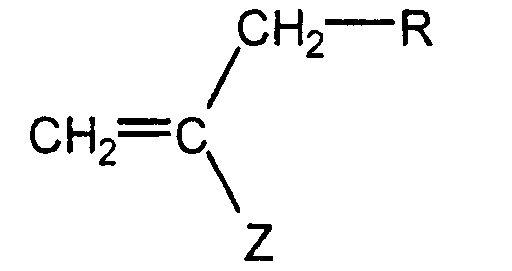
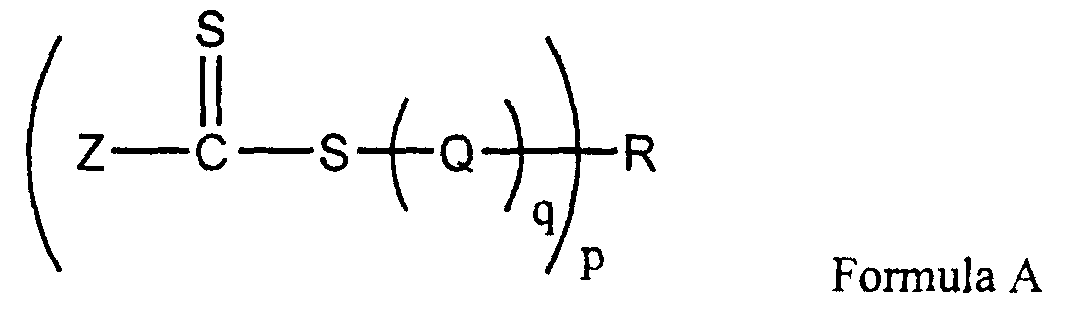


the polymer of Formula A being made by contacting (i), (ii)C and (iii) and the polymer of Formula B being made by contacting (i), (ii) D and (iii);
wherein:
- Z is selected from the group consisting of hydrogen, chlorine, optionally substituted alkyl, optionally substituted aryl, optionally substituted heterocyclyl, optionally substituted alkylthio, optionally substituted alkoxycarbonyl, optionally substituted aryloxycarbonyl (-COOR"), carboxy (-COOH), optionally substituted acyloxy (-O2CR"), optionally substituted carbamoyl (-CONR"2), cyano (-CN), dialkyl- or diaryl- phosphonato [-P(=O)OR"2], dialkyl- or diaryl-phosphinato [-P(=O)R"2], and a polymer chain formed by any mechanism;
- Z' is a m-valent moiety derived from a member of the group consisting of optionally substituted alkyl, optionally substituted aryl and a polymer chain; where the connecting moieties are selected from the group that consists of aliphatic carbon, aromatic carbon, and sulfur;
- Q is selected from the group consisting of
and repeating units from maleic anhydride, N-alkylmaleimide, N-arylmaleimide, dialkyl fumarate and cyclopolymerizable monomers;

- U is selected from the group consisting of hydrogen, halogen, optionally substituted C1-C4 alkyl wherein the substituents are independently selected from the group that consists of hydroxy, alkoxy, aryloxy (OR"), carboxy, acyloxy, aroyloxy (O2CR"), alkoxy- carbonyl and aryloxy-carbonyl (CO2R");
- V is selected from the group consisting of hydrogen, R", CO2H, CO2R", COR" , CN, CONH2, CONHR", CONR"2, O2CR", OR" and halogen;
- R is selected from the group consisting of optionally substituted alkyl; an optionally substituted saturated, unsaturated or aromatic carbocyclic or heterocyclic ring; optionally substituted alkylthio; optionally substituted alkoxy; optionally substituted dialkylamino; an organometallic species; and a polymer chain prepared by any polymerization mechanism; in compounds C and D, R• is a free-radical leaving group that initiates free radical polymerization;
- R" is selected from the group consisting of optionally substituted C1-C18 alkyl, C2-C18 alkenyl, aryl, heterocyclyl, aralkyl, alkaryl wherein the substituents are independently selected from the group that consists of epoxy, hydroxy, alkoxy, acyl, acyloxy, carboxy (and salts), sulfonic acid (and salts), alkoxy- or aryloxy-carbonyl, isocyanato, cyano, silyl, halo, and dialkylamino;
- q is 1 or an integer greater than 1;
- p is 1 or an integer greater than 1; when p≥2, then R=R';
- m is an integer ≥2; and
- R' is a p-valent moiety derived from a member of the group consisting of optionally substituted alkyl, optionally substituted aryl and a polymer chain; where the connecting moieties are selected from the group consisting of aliphatic carbon, aromatic carbon, silicon, and sulfur; in compounds C and D, R'• is a free radical leaving group that initiates free radical polymerization.


2,2'-azobis(isobutyronitrile), 2,2'-azobis(2-cyano-2-butane), dimethyl 2,2'-azobisdimethylisobutyrate, 4,4'-azobis(4-cyanopentanoic acid), 1,1'-azobis(cyclohexanecarbonitrile), 2-(t-butylazo)-2-cyanopropane, 2,2'-azobis[2-methyl-N-( 1,1 )-bis(hydoxymethyl)-2-hydroxyethyl] propionamide, 2,2'-azobis[2-methyl-N-hydroxyethyl)]-propionamide, 2,2'-azobis(N,N'-dimethyleneisobutyramidine) dihydrochloride, 2,2'-azobis(2-amidinopropane) dihydrochloride, 2,2'-azobis(N,N'-dimethyleneisobutyramine), 2,2'-azobis(2-methyl-N-[1,1-bis(hydroxymethyl)-2-hydroxyethyl] propionamide), 2,2'-azobis(2-methyl-N-[1,1-bis(hydroxymethyl) ethyl] propionamide), 2,2'-azobis[2-methyl-N-(2-hydroxyethyl) propionamide], 2,2'-azobis(isobutyramide) dihydrate, 2,2'-azobis(2,2,4-trimethylpentane), 2,2'-azobis(2-methylpropane), t-butyl peroxyacetate, t-butyl peroxybenzoate, t-butyl peroxyoctoate, t-butyl peroxyneodecanoate, t-butylperoxy isobutyrate, t-amyl peroxypivalate, t-butyl peroxypivalate, di-isopropyl peroxydicarbonate, dicyclohexyl peroxydicarbonate, dicumyl peroxide, dibenzoyl peroxide, dilauroyl peroxide, potassium peroxydisulfate, ammonium peroxydisulfate, di-t-butyl hyponitrite, dicumyl hyponitrite.

methyl methacrylate, ethyl methacrylate, propyl methacrylate (all isomers), butyl methacrylate (all isomers), 2-ethylhexyl methacrylate, isobornyl methacrylate, methacrylic acid, benzyl methacrylate, phenyl methacrylate, methacrylonitrile, alpha-methylstyrene. methyl acrylate, ethyl acrylate, propyl acrylate (all isomers), butyl acrylate (all isomers), 2-ethylhexyl acrylate, isobornyl acrylate, acrylic acid, benzyl acrylate, phenyl acrylate, acrylonitrile, styrene, functional methacrylates, acrylates and styrenes selected from glycidyl methacrylate, 2-hydroxyethyl methacrylate, hydroxypropyl methacrylate (all isomers), hydroxybutyl methacrylate (all isomers), N,N-dimethylaminoethyl methacrylate, N,N-diethylaminoethyl methacrylate, triethyleneglycol methacrylate, itaconic anhydride, itaconic acid, glycidyl acrylate, 2-hydroxyethyl acrylate, hydroxypropyl acrylate (all isomers), hydroxybutyl acrylate (all isomers), N,N-dimethylaminoethyl acrylate, N,N-diethylaminoethyl acrylate, triethyleneglycol acrylate, methacrylamide, N-methylacrylamide, N,N-dimethylacrylamide, N-tert-butylmethacrylamide, N-n-butylmethacrylamide, N-methylolmethacrylamide, N-ethylolmethacrylamide. N-tert-butylacrylamide, N-n-butylacrylamide, N-methylolacrylamide, N-ethylolacrylamide, vinyl benzoic acid (all isomers), diethylaminostyrene (all isomers), alpha-methylvinyl benzoic acid (all isomers), diethylamino alpha-methylstyrene (all isomers). p-vinylbenzene sulfonic acid, p-vinylbenzene sulfonic sodium salt, trimethoxysilylpropyl methacrylate, triethoxysilylpropyl methacrylate, tributoxysilylpropyl methacrylate, dimethoxymethylsilylpropyl methacrylate, diethoxymethylsilylpropylmethacrylate, dibutoxymethylsilylpropyl methacrylate, diisopropoxymethylsilylpropyl methacrylate, dimethoxysilylpropyl methacrylate, diethoxysilylpropyl methacrylate, dibutoxysilylpropyl methacrylate, diisopropoxysilylpropyl methacrylate, trimethoxysilylpropyl acrylate, triethoxysilylpropyl acrylate, tributoxysilylpropyl acrylate, dimethoxymethylsilylpropyl acrylate, diethoxymethylsilylpropyl acrylate, dibutoxymethylsilylpropyl acrylate, diisopropoxymethylsilylpropyl acrylate, dimethoxysilylpropyl acrylate, diethoxysilylpropyl acrylate, dibutoxysilylpropyl acrylate, diisopropoxysilylpropyl acrylate, vinyl acetate, vinyl butyrate, vinyl benzoate, vinyl chloride, vinyl fluoride, vinyl bromide, maleic anhydride, N-phenylmaleimide, N-butylmaleimide, N-vinylpyrrolidone, N-vinylcarbazole, butadiene, isoprene, chloroprene, ethylene, propylene.


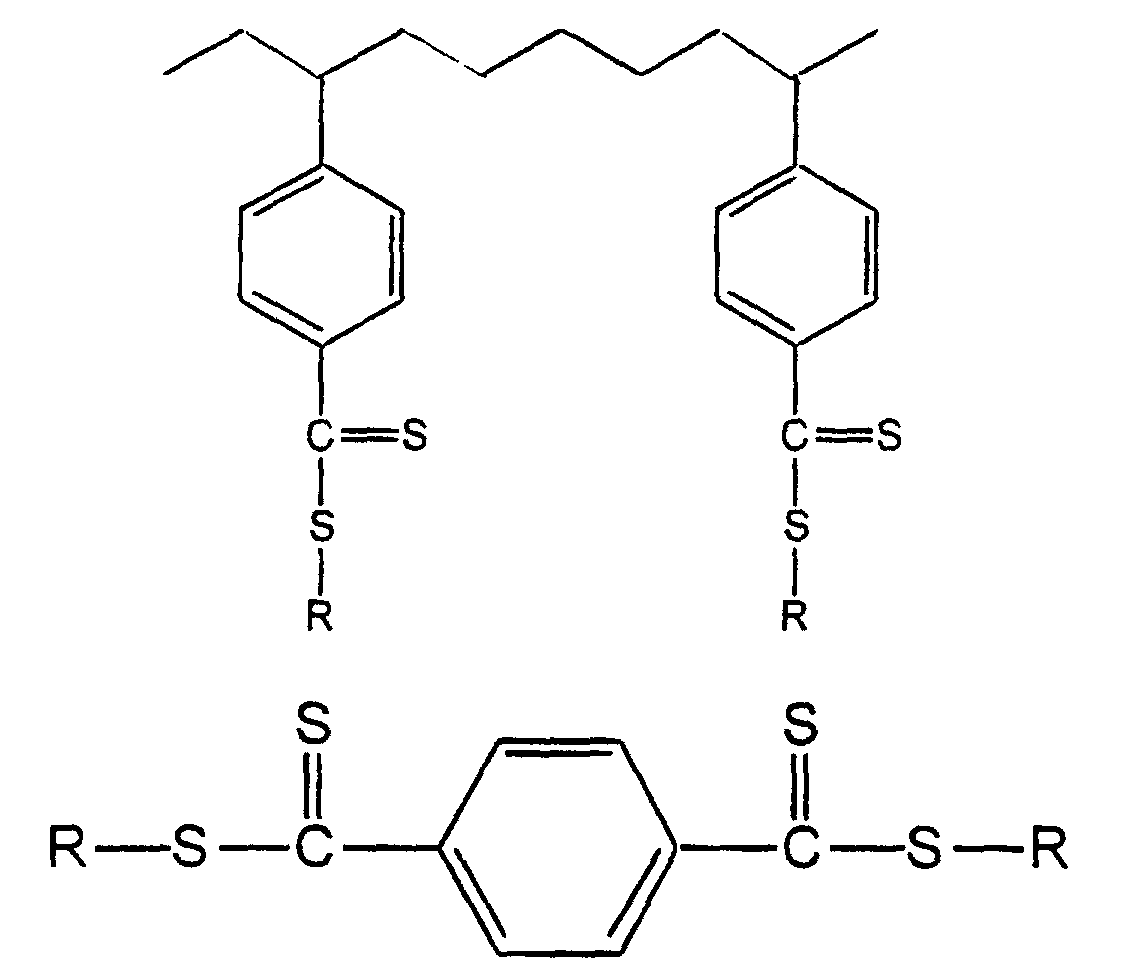


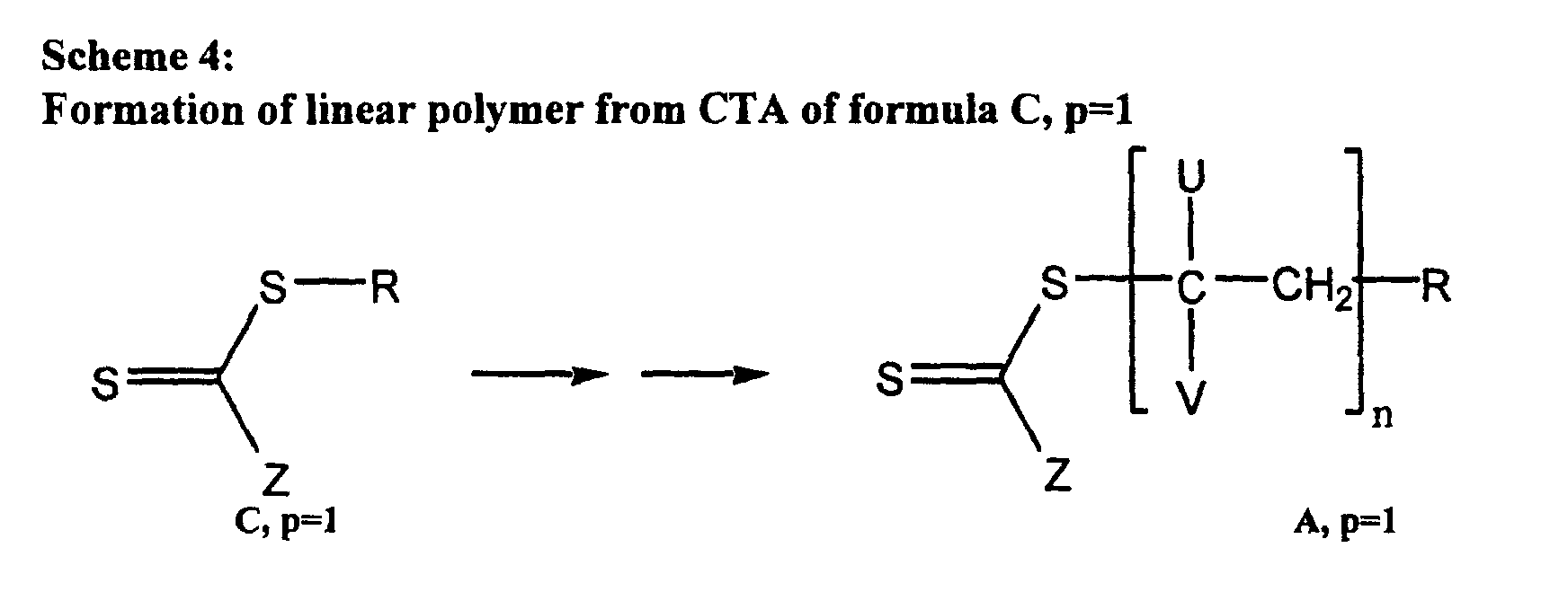
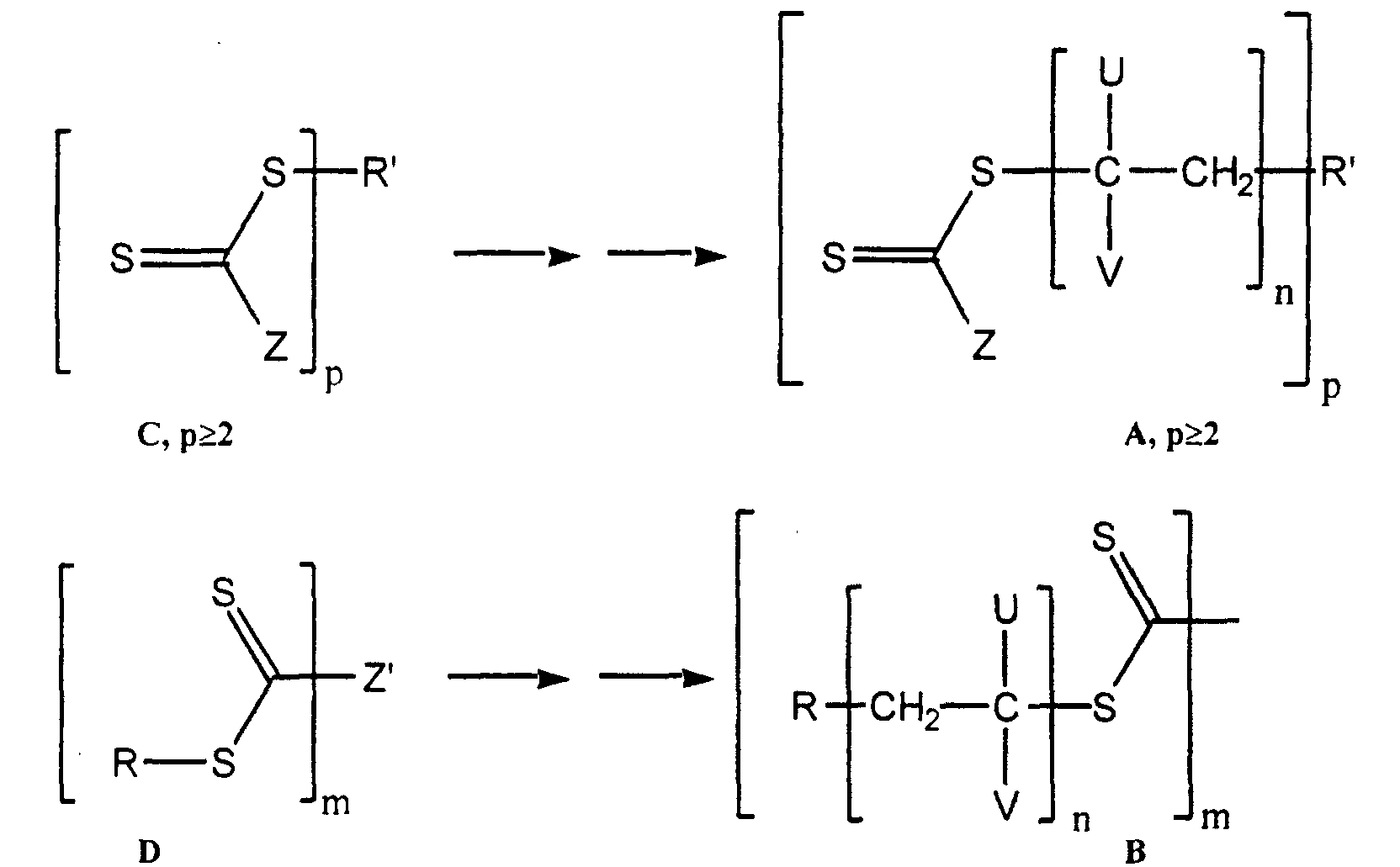
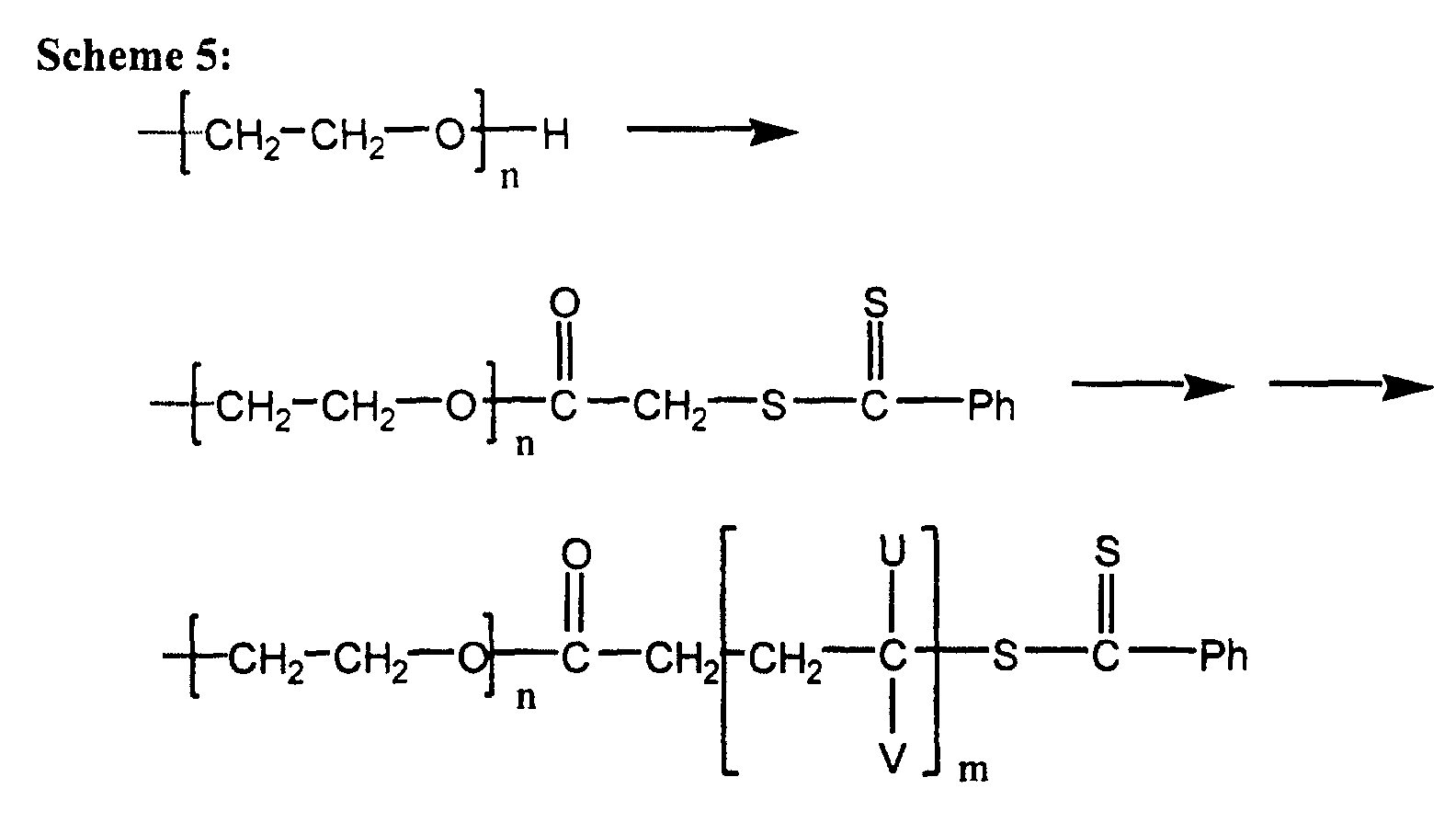
Note that this form of molecular weight control is very different to that seen in free radical polymerization in the presence of conventional transfer agents.
- End-functional polymers
- Block and multiblock and gradient polymers
- Star polymers
- Graft or branched polymers.
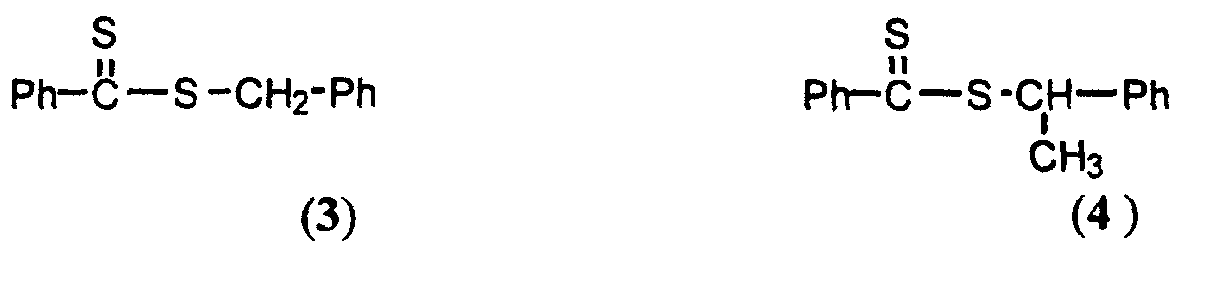






| Molecular weight and conversion data for poly(methyl methacrylate) prepared with 2-phenylprop-2-yl dithiobenzoate (5) at 60°C | |||||
| Entry | time/hr | Mn | Mw/Mn | % Conv. | Mn (calc) |
| 1 | 2 | 9 800 | 1.27 | 13.5 | 8 410 |
| 2 | 4 | 18 000 | 1.19 | 27.3 | 17 000 |
| 3 | 8 | 29 800 | 1.15 | 51.5 | 32 100 |
| 4 | 16 | 56 200 | 1.12 | 95.0 | 59 200 |
| Molecular weight and conversion data for poly(methyl acrylate) prepared with 1-phenylethyl dithiobenzoate (4) at 60°C | ||||
| Entry | time/hr | Mn | Mw/Mn | % Conv. |
| 1 | 20 | 13 500 | 1.11 | 26.2 |
| 2 | 64 | 28 800 | 1.13 | 52.9 |
| 3 | 110 | 32 700 | 1.16 | 63.8 |
| Molecular weight and conversion data for polystyrene prepared with benzyl dithiobenzoate at 60°C | ||||
| Entry | time /hr | Mn | Mw/Mn | % Conv. |
| 1 (control) | 1 | 164 000 | 1.83 | 1.61 |
| 2 | 1 | 1 500 | 1.36 | 0.68 |
| 3 | 2 | 2 260 | 1.27 | 1.49 |
| 4 | 4 | 3 630 | 1.24 | 3.46 |
| 5 | 8 | 6 020 | 1.21 | 6.92 |
| 6 | 12 | 8 900 | 1.16 | 10.60 |
| 7 | 16 | 11 780 | 1.16 | 13.66 |
| 8 | 20 | 14 380 | 1.13 | 17.16 |
| 9 | 30 | 18 500 | 1.12 | 22.43 |
| 10 | 50 | 25 200 | 1.17 | 31.82 |
| 11 | 100 | 33 400 | 1.13 | 42.32 |
| Molecular weight and conversion data for polystyrene prepared with 2-phenylprop-2-yl dithiobenzoate at 60°C | ||||
| Entry | time/hr | Mn | Mw/Mn | % Conv. |
| 1 (control) | 1 | 285 000 | 1.63 | 1.67 |
| 2 | 1 | 833 | 1.12 | 0.49 |
| 3 | 4 | 4 510 | 1.09 | 3.74 |
| 4 | 20 | 21 500 | 1.14 | 19.45 |
| 5 | 50 | 40 000 | 1.17 | 37.49 |
| 6 | 100 | 52 000 | 1.18 | 57.33 |
| Molecular weight and conversion data for polystyrene prepared with 1-phenylethyl dithiobenzoate (4) at 100°C | |||||
| Entry | time/hr | Mn | Mw | Mw/Mn | % Conv. |
| 1 (Control) | 6 | 227 000 | 434 000 | 1.91 | 21.7 |
| 2 | 6 | 5 800 | 6 300 | 1.09 | 9.7 |
| 3 | 20 | 22 000 | 25 000 | 1.15 | 36.8 |
| 4 | 64 | 38 500 | 47 000 | 1.22 | 70.6 |
| 5 | 120 | 50 000 | 61 000 | 1.23 | 91.9 |
| Molecular weight and conversion data for polystyrene prepared with 1-phenylethyl dithiobenzoate (4) at 100°C | |||||
| Entry | time/hr | Mn | Mw | Mw/Mn | % Conv. |
| 1 | 6 | 3 440 | 37 30 | 1.08 | 12.3 |
| 2 | 20 | 10 000 | 11 000 | 1.08 | 35.0 |
| 3 | 64.5 | 22 000 | 24 000 | 1.10 | 65.6 |
| 4 | 120 | 27 000 | 31 000 | 1.16 | 87.6 |
| Molecular weight and conversion data for polystyrene prepared with 2-phenylprop-2-yl dithiobenzoate (5) at 100°C | |||||
| Entry | time/hr | Mn | Mw | Mw/Mn | % Conv. |
| 1 | 2 | 1 520 | 1 690 | 1.12 | 4.3 |
| 2 | 6 | 5 680 | 6 140 | 1.08 | 14.3 |
| 3 | 20 | 13 800 | 14 900 | 1.08 | 39.9 |
| 4 | 64 | 25 000 | 28 100 | 1.12 | 81.0 |
| 5 | 119 | 26 000 | 30 000 | 1.14 | 88.0 |
| Molecular weight and conversion data for polystyrene prepared with benzyl dithioacetate(12) at 60°C | |||||
| Entry | time/hr | Mn | Mw | Mw/Mn | % Conv. |
| 1 | 2 | 6 840 | 11 800 | 1.72 | 1.8 |
| 2 | 4 | 8 570 | 13 500 | 1.58 | 5.0 |
| 3 | 16 | 19 000 | 25 000 | 1.32 | 16.5 |
| 4 | 40 | 30 000 | 37 000 | 1.24 | 28.9 |
| Molecular weight and conversion data for poly(n-butyl acrylate) prepared with benzyl dithiobenzoate (3) at 60°C | |||||
| Entry | time/hr | Mn | Mw/Mn | Mn (calc) | % Conv. |
| 1 | 2 | 26 000 | 1.12 | 25 866 | 11.4 |
| 2 | 8 | 92 000 | 1.14 | 90 760 | 40.0 |
| Molecular weight and conversion data for poly(N,N-dimethyl acrylamide) prepared with benzyl dithiobenzoate (3) at 60°C | |||||||
| Entry | Solution (I) (mL) | Solution (II) (mL) | CTA (mg) | Mn | Mw/Mn | Mn (calc) | % Conv. |
| 1 | 0 | 10 | 2 | 35 000 | 1.14 | 30 266 | 12.9 |
| 2 | 5 | 5 | 1 | 135 000 | 1.23 | 120 597 | 25.7 |
| 3 | 7.5 | 2.5 | 0.5 | 224 000 | 1.44 | 293 742 | 31.3 |
| 4 (control) | 10 | 0 | 0 | 833 000 | 2.59 | - | 76.9 |
| Molecular weight and conversion data for polystyrene prepared with benzyl dithioacetate in emulsion at 80°C | ||||
| Entry | Reaction time /min | Mn | Mw/Mn | % Conversion |
| 1 | 75 | 21 000 | 1.27 | 97a |
| 2 | 120 | 29 000 | 1.26 | 98a |
| 3 | 180 | 35 000 | 1.33 | >99 |
| 4 | 240 | 37 000 | 1.35 | >99 |
| 5 | 270 | 38 000 | 1.34 | >99 |
| 6 | 360 | 36 000 | 1.38 | >99 |
| Molecular weight and conversion data for poly(n-butyl acrylate)prepared with 1,4-bis(thiobenzoylthiomethyl)benzene (8) at 90°C | |||||
| Entry | time/hr | Mn | Mw/Mn | Mn (calc) | % Conv. |
| 1 | 1 | 5 090 | 1.21 | 5 079 | 4.4 |
| 2 | 5 | 57 000 | 1.32 | 65 571 | 56.8 |
| Molecular weight and conversion data for poly(n-butyl acrylate)prepared with 1,4-bis(2-thiobenzoylthioprop-2-yl)benzene (10) at 90°C | |||||
| Entry | time/hr | Mn | Mw/Mn | Mn (calc) | % Conv. |
| 1 | 5 | 937 | 1.13 | 952 | 1.6 |
| 2 | 16 | 28 000 | 1.21 | 27 365 | 46.0 |
| 3 | 42 | 41 000 | 1.37 | 43 904 | 73.8 |
| Molecular weight and conversion data for star polystyrene prepared with hexakis(thiobenzoylthiomethyl)benzene (7) at 100°C | |||||
| Entry | time/hr | Mn | Mw | Mw/Mn | % Conv. |
| 1 | 6 | 1 350 | 1 530 | 1.13 | 0.33 |
| 2 | 20 | 34 100 | 46 500 | 1.36 | 27.5 |
| 3 | 64 | 80 000 | 133 000 | 1.67 | 72.1 |
| Molecular weight and conversion data for star polystyrene prepared with 1,2,4,5-tetrakis(thiobenzoylthiomethyl)benzene (9) at 100°C | ||||||
| Entry | time/hr | Mn | Mw | Mw/Mn | Mn (calc) | % Conv. |
| 1 | 6 | 989 | 1 100 | 1.11 | - | 0.88 |
| 2 | 20 | 26 000 | 31 100 | 1.20 | 27 257 | 22.0 |
| 3 | 64 | 67 500 | 87 600 | 1.30 | 90 814 | 73.3 |
| Molecular weight and conversion data for star polystyrene prepared with 1,2,4,5-tetrakis(thiobenzoylthiomethyl)benzene (9) at 120°C | ||||||
| Entry | time/hr | Mn | Mw | Mw/Mn | Mn (calc) | % Conv. |
| 1 | 6 | 43 000 | 55 000 | 1.29 | 51416 | 41.5 |
| 2 | 20 | 75 000 | 109 000 | 1.44 | 100353 | 81.0 |
| 3 | 64 | 80 000 | 119 000 | 1.49 | 109770 | 88.6 |
| Molecular weight and conversion data for poly(methyl methacrylate) prepared with 2-(ethoxycarbonyl)prop-2-yl dithiobenzoate (14) at 60°C | ||||
| Entry | time/hr | Mn | Mw/Mn | % Conv. |
| 1 | 2 | 30 000 | 1.89 | 22.7 |
| 2 | 4 | 35 000 | 1.72 | 37.1 |
| 3 | 8 | 40 000 | 1.66 | 67.4 |
| 4 | 16 | 53 000 | 1.48 | >95 |
| Molecular weight and conversion data for poly(methyl methacrylate) prepared with 2-cyanoprop-2-yl dithiobenzoate (15) at 60°C | ||||
| Entry | time/hr | Mn | Mw/Mn | % Conv. |
| 1 | 2 | 9 200 | 1.26 | 16.2 |
| 2 | 4 | 17 000 | 1.19 | 39.4 |
| 3 | 8 | 30 000 | 1.17 | 68.6 |
| 4 | 16 | 52 000 | 1.16 | >90 |
| Molecular weight and conversion data for poly(methyl methacrylate) prepared with 2-(4-chlorophenyl)propyl dithiobenzoate (18) at 60 °C. | |||||
| Entry | time/hr | Mn | Mw/Mn | % Conv. | Mn (calc) |
| 1 | 2 | 8 840 | 1.25 | 15.1 | 9 390 |
| 2 | 4 | 16 200 | 1.17 | 31.0 | 19 330 |
| 3 | 8 | 30 400 | 1.13 | 63.3 | 39 260 |
| 4 | 16 | 52 800 | 1.14 | >95 | 59 205 |
| Molecular weight and conversion data for poly(methyl methacrylate) prepared with 2-phenylprop-2-yl dithiobenzoate (5) at 60 °C. | ||||
| Entry | time/hr | Mn | Mw/Mn | % Conv. |
| 1 (control) | 2 | 453 000 | 1.81 | 11.1 |
| 2 | 2 | 6 080 | 1.40 | 6.8 |
| 3 | 4 | 10 300 | 1.28 | 14.8 |
| 4 | 8 | 20 000 | 1.17 | 33.4 |
| 5 | 16 | 41 000 | 1.13 | 77.9 |
| Molecular weight and conversion data for poly(methyl methacrylate) prepared with 2-phenylprop-2-yl dithiobenzoate (5) at 60 °C in various solvents | |||||
| Dithioester (g) | Time (hr) | Solvent | Mn | Mw/Mn | % Conv. |
| 1.00 | 63.58 | Benzene | 3 200 | 1.17 | 79.8 |
| 0.40 | 24 | Benzene | 6 600 | 1.21 | 95.0 |
| 1.00 | 63.58 | 2-butanone | 2 800 | 1.17 | 61.3 |
| 0.40 | 24 | 2-butanone | 6 300 | 1.19 | 90.2 |
Results are summarized in Table 22 below.
| Molecular weight and conversion data for poly(methyl methacrylate) prepared with 2-phenylprop-2-yl dithiobenzoate (5) at 60 °C in benzene | ||||
| Entry | time/hr | parameter | control (no CTA) | with CTA (5) |
| 1 | 2 | Mn | 98400 | 2880 |
| MW/Mn | 1.83 | 1.31 | ||
| % Conv. | 20.3 | 10.7 | ||
| 2 | 4 | Mn | 88500 | 4570 |
| MW/Mn | 1.84 | 1.24 | ||
| % Conv. | 35.3 | 23.5 | ||
| 3 | 16 | Mn | 69800 | 9250 |
| MW/Mn | 1.86 | 1.29 | ||
| % Conv. | 82.3 | 71.6 | ||
| 4 | 30 | Mn | 58400 | 11720 |
| MW/Mn | 1.91 | 1.25 | ||
| % Conv. | 95.0 | 88.7 |
| Molecular weight and conversion data for polystyrene prepared with 2-(ethoxycarbonyl)prop-2-yl dithiobenzoate (14) at 60 °C | ||||
| Entry | time/hr | Mn | Mw/Mn | % Conv. |
| 1 | 2 | 1 630 | 1.13 | 1.90 |
| 2 | 4 | 3 500 | 1.12 | 4.02 |
| 3 | 20 | 24 200 | 1.15 | 26.35 |
| Molecular weight and conversion data for polystyrene prepared with 2,4,4-trimethylpent-2-yl dithiobenzoate (17) at 60 °C | ||||
| Entry | time/hr | Mn | Mw/Mn | % Conv. |
| 1 | 2 | 495 | 1.13 | 0.57 |
| 2 | 4 | 1 180 | 1.14 | 1.28 |
| 3 | 20 | 17 400 | 1.19 | 18.55 |
| Molecular weight and conversion data for polystyrene prepared with benzyldiethoxyphosphinyldithioformate (20) at 100 °C | ||||
| Entry | Time/hr | Mn | Mw/Mn | % Conv. |
| 1 | 6 | 15 900 | 1.11 | 12.1 |
| 2 | 20 | 46 100 | 1.13 | 38.0 |
| 3 | 64 | 79 300 | 1.25 | 77.8 |
| 4 | 22 | 73 500 | 1.37 | 88.9 |
| Molecular weight and conversion data for polystyrene prepared with carboxymethyl dithiobenzoate (27) at 100 °C | ||||
| Entry | time/hr | Mn | Mw/Mn | % Conv. |
| 1 | 6 | 3 900 | 1.49 | 11.4 |
| 2 | 64 | 7 400 | 1.34 | 42.5 |
| Molecular weight and conversion data for polystyrene prepared with 4-cyano-4-(thiobenzoylthio)pentanoic acid (24) at 100°C | ||||
| Entry | time/hr | Mn | Mw/Mn | % Conv. |
| 1 | 6 | 2 500 | 1.05 | 19.7 |
| 2 | 64 | 8 900 | 1.05 | 61.3 |
| Molecular weight and conversion data for polystyrene prepared with dibenzyl trithiocarbonate (26) at 110°C | ||||
| Entry | time/hr | Mn | Mw/Mn | % Conv. |
| 1 | 6 | 11,000 | 1.21 | 54 |
| 2 | 16 | 17,000 | 1.15 | 81 |
| Molecular weight and conversion data for poly(n-butyl acrylate) prepared with tert-butyl trithiophenylperformate (21) at 60°C | ||||
| Entry | time/hr | Mn | Mw/Mn | % Conv. |
| 1 | 2 | 12 700 | 1.12 | 6.8 |
| 2 | 8 | 78 000 | 1.07 | 40.5 |
| 3 | 16 | 118 000 | 1.14 | 61.2 |
| 4 | 40 | 174 000 | 1.24 | 81.7 |
| Molecular weight and conversion data for poly(N,N- dimethylaminoethyl methacrylate) prepared with 2-phenylprop-2-yl dithiobenzoate (5) at 60°C | ||||
| Entry | time/hr | Mn | Mw/Mn | % Conv. |
| 1 (Control) | 2 | 13 000 | 40.2 | 45.6 |
| 2 | 2 | 11 600 | 1.19 | 30.2 |
| 3 | 4 | 15 900 | 1.19 | 49.6 |
| 4 | 16 | 28 000 | 1.21 | 91.9 |
| Molecular weight and conversion data for poly(p-styrenesulfonic acid sodium salt) prepared with 4-cyano-4-(thiobenzoylthio)pentanoic acid at 70°C in aqueous solution | ||||
| Entry | time/hr | Mn | Mw/Mn | %Conv. |
| 1 (control) | 1 | 73 000 | 2.27 | 96.0 |
| 2 | 4 | 8 000 | 1.13 | 73.4 |
| 3 | 14.25 | 10 500 | 1.20 | 84.1 |
| Molecular weight and conversion data for poly(methyl methacrylate-co-styrene) prepared with 2-phenylprop-2-yl dithiobenzoate (5) at 60°C | ||||
| Entry | time/hr | parameter | control (no CTA) | with CTA (5) |
| 1 | 5 | Mn | 123 200 | 10 100 |
| MW/Mn | 1.67 | 1.21 | ||
| % Conv. | 16.8 | 9.9 | ||
| 2 | 10 | Mn | 125 900 | 20 200 |
| MW/Mn | 1.75 | 1.17 | ||
| % Conv. | 32.2 | 22.8 | ||
| 3 | 15 | Mn | 148 800 | 26 900 |
| MW/Mn | 1.82 | 1.22 | ||
| % Conv. | 46.9 | 34.2 | ||
| 4 | 20 | Mn | 257 000 | 33 800 |
| MW/Mn | 2.39 | 1.21 | ||
| % Conv. | 91.2 | 43.1 |
| Molecular weight and conversion data for poly(acrylonitrile-co- styrene) prepared with 2-phenylprop-2-yl dithiobenzoate (5) at 100°C | ||||
| Entry | time/hr | Mn | Mw/Mn | % Conv. |
| 1 (control) | 18 | 424 000 | 1.70 | 96.0 |
| 2 | 4 | 20 100 | 1.04 | 26.0 |
| 3 | 8 | 33 000 | 1.05 | 42.0 |
| 4 | 18 | 51 400 | 1.07 | 70.7 |
| Molecular weight and conversion data for poly(hydroxethyl methacrylate-co-isobutyl methacrylate-co-methyl methacrylate-co-styrene) prepared with 2-phenylprop-2-yl dithiobenzoate (5) at 60°C | ||||
| Entry | time/hr | Mn | Mw/Mn | % Conversion |
| 1 | 1 | 633 | 1.23 | - |
| 2 | 24 | 11 300 | 1.47 | >99 |
| Molecular weight and conversion data for poly(methyl methacrylate) prepared with 1,4-bis(2-thiobenzoylthioprop-2-yl)benzene (10) at 60°C | ||||
| Entry | time/hr | Mn | Mw/Mn | % Conv. |
| 1 | 2 | 5 400 | 1.32 | 9.8 |
| 2 | 4 | 12 200 | 1.22 | 23.3 |
| 3 | 8 | 23 600 | 1.18 | 49.9 |
| 4 | 16 | 45 800 | 1.15 | 98.5 |
1H-nmr analysis indicates an average of 3.5 thiobenzoylthio groups per polymer chain.
| Molecular weight and conversion data for poly(methyl methacrylate) prepared with 2-phenylprop-2-yl dithiobenzoate (5) at 90°C in emulsion | |||||
| Entry | MMA added (mL) | Mn | Mw | Mw/Mn | % Conv |
| 1 | 20.5 | 3 550 | 4 530 | 1.27 | 14.2 |
| 2 | 37.5 | 12 000 | 15 800 | 1.32 | 41.4 |
| 3 | final | 26 000 | 34 900 | 1.33 | 89.8 |
| Molecular weight and conversion data for poly(methyl methacrylate) and poly(methyl methacrylate-block-styrene) prepared with 2- phenylprop-2-yl dithiobenzoate (5) at 80°C in emulsion | ||||||
| Entry | Sample | Mn | Mw | Mw/Mn | %Conv | Mn (calc) |
| 1 | +7.5 g MMA | 9 350 | 11 430 | 1.22 | 43 | 9 430 |
| 2 | + 15 g MMA | 25 000 | 38 600 | 1.54 | 85 | 31 022 |
| 3 | +6 mL styrene | 36 000 | 61 000 | 1.68 | >99 | 46 790 |
| 4 | +12 mL styrene | 49 000 | 92 000 | 1.86 | >99 | 57 171 |
| 5 | +18 mL styrene | 52 000 | 107 000 | 2.06 | >99 | 67 552 |
| 6 | +24 mL styrene | 72 000 | 162 000 | 2.24 | >99 | 77 553 |
| 7 | Final | 72 000 | 159 000 | 2.21 | >99 | 77 553 |
| Molecular weight and conversion data for poly(butyl methacrylate) and poly(butyl methacrylate-block-styrene) prepared with phenylprop-2-yl dithiobenzoate (5) at 80°C in emulsion | ||||||
| Entry | Sample | Mn | Mw | Mw/Mn | % Conv | Mn (calc) |
| 1 | +10.9 mL BMA | 26 000 | 39 000 | 1.50 | 54 | 22 585 |
| 2 | +16.01 g BMA | 63 000 | 77 000 | 1.22 | 95 | 57 742 |
| 3 | final | 65 500 | 81 000 | 1.23 | >99 | 60 876 |
| 4 | +11.4 mL Styrene | 70 500 | 115 000 | 1.63 | 84 | 91 846 |
| 5 | +15 g Styrene | 78 000 | 136 000 | 1.74 | 84 | 98 579 |
| 6 | Reactio n Final | 103 000 | 177 000 | 1.73 | >99 | 105 710 |
| Molecular weight and conversion data for poly(styrene) and poly(methyl methacrylate-block-styrene) prepared with benzyl dithioacetate in emulsion | ||||||
| Entry | Sample | Mn | Mw | MW/Mn | % Conv | Mn (calc) |
| 1 | +6 mL styrene | 7 690 | 10 500 | 1.37 | 43 | 4 560 |
| 2 | +12mL styrene | 22 000 | 29 000 | 1.33 | 89 | 1 824 |
| 3 | +15 mL styrene | 24 000 | 32 000 | 1.35 | >99 | 25 480 |
| 4 | +7.5 mL MMA | 35 000 | 49 000 | 1.41 | 92 | 36 390 |
| 5 | +15 mL MMA | 39 000 | 61 000 | 1.56 | 84 | 45 513 |
| 6 | Final | 41 000 | 65 000 | 1.57 | 87 | 47 620 |
| Molecular weight and conversion data for poly(n-butyl acrylate) prepared with 1-phenylethyl dithiobenzoate (4) at 60°C in ethyl acetate | ||||||
| Entry | time/ min | Mn | Mw | Mw/Mn | % Conv | Mn (calc) |
| 1 | 60 | 3 500 | 3 900 | 1.10 | 6.7 | 2 431 |
| 2 | 120 | 6 300 | 6 900 | 1.09 | 13.5 | 6 471 |
| 3 | 180 | 9 600 | 10 900 | 1.13 | 19.3 | 11 578 |
| 4 | 240 | 14 600 | 16 900 | 1.15 | 22.9 | 16 514 |
| 5 | 300 | 18 800 | 23 000 | 1.20 | 34.6 | 24 955 |
| 6 | 300 | 21 700 | 25 800 | 1.19 | 45.0 | 32 410 |
| Molecular weight and conversion data for poly(methyl methacrylate) prepared with 2-phenylprop-2-yl dithiobenzoate (5) at 60°C in 2-butanone | ||||||
| Entry | time/min | Mn | Mw | Mw/Mn | % Conv | Mn (calc) |
| 1 | 60 | 1 280 | 1 550 | 1.20 | 12.9 | 1 549 |
| 2 | 120 | 1 860 | 2 340 | 1.26 | 12.4 | 2 085 |
| 3 | 180 | 2 900 | 3 730 | 1.28 | 23.5 | 5 074 |
| 4 | 240 | 4 100 | 5 200 | 1.27 | 32.0 | 8 445 |
| 5 | final | 5 400 | 6 800 | 1.26 | 29.7 | 7 838 |
| Parts by Weight | |
| Part 1 | |
| Deionized water | 1490.39 |
| ACRYLSOL® A1 | 49.68 |
| Subtotal | 1540.07 |
| Part 2 | |
| methyl methacrylate | 451.13 |
| 2-phenylprop-2- yl dithiobenzoate | 0.45 |
| Subtotal | 451.58 |
| Part 3 | |
| VAZO® 64 | 3.10 |
| Deionized water | 3.10 |
| Subtotal | 6.20 |
| Final Total | 1997.85 |
| Molecular weight data for poly(methyl methacrylate) prepared with 2-phenylprop-2-yl dithiobenzoate (5) by suspension polymerization | |||
| Entry | 2-phenylprop-2-yl dithiobenzoate (5) Mn/ Mw/ wt % | Mn | |
| 1 | 0 | 82 000 | 3.75 |
| 2 | 0.10 | 52 000 | 2.01 |
| 3 | 0.50 | 26 500 | 2.13 |
| 4 | 1.00 | 16 200 | 1.31 |
| 5 | 0 | 82 800 | 3.70 |
| 6 | 0 | 9 300 | 3.76 |
| 7 | 1.00 | 14 900 | 1.52 |
| 8 | 1.00 | 15 500 | 1.30 |
| 9 | 2.00 | 9 150 | 1.24 |
| 10 | 2.00 | 9 490 | 1.30 |
| Molecular weight and conversion data for poly(n-butyl acrylate) prepared with 2-phenylprop-2-yl dithiobenzoate (5) at 80°C in 2-butanone | |||||
| Entry | Dithioester | [CTA] x 10-3 M | Mn | Mw/Mn | Conv % |
| 1 | (5) | 0.74 | 67 000 | 1.84 | 40.2 |
| 2 | (5) | 1.54 | 52 000 | 1.56 | 38.4 |
| 3 | (5) | 2.94 | 30 000 | 1.26 | 25.0 |
| 4 | none | 0 | 86 000 | 2.45 | 51.6 |
| Molecular weight and conversion data for polystyrene prepared with various dithioesters at 110°C in toluene | ||||||
| Entry | CTA | time (min) | Mn | Mw/Mn | Conv % | [CTA] x 10-2 M |
| 1 | 2-cyanoprop-2-yl dithiobenzoate (15) | 60 | 2 330 | 1.08 | 15.4 | 2.2 |
| 2 | 2-cyanoprop-2-yl dithiobenzoate (15) | 120 | 4 100 | 1.07 | 27.2 | 2.2 |
| 3 | 2-phenylprop-2-yl dithiobenzoate (5) | 60 | 2 010 | 1.07 | 1.40 | 1.8 |
| 4 | 2-phenylprop-2-yl dithiobenzoate (5) | 120 | 3 250 | 1.07 | 16.9 | 1.8 |
| 5 | none | 60 | 62 000 | 1.57 | 21.3 | 0 |
| 6 | none | 120 | 68 000 | 1.62 | 28.2 | 0 |
| Molecular weight and conversion data for poly(n-butyl acrylate) prepared with various dithioesters at 80°C in in 2-butanone | ||||||
| Entry | CTA | time (min) | Mn | Mw/Mn | Conv % | [CTA) x 10-2 M |
| 1 | 2-phenylprop-2-yl dithiobenzoate (5) | 60 | 275 | 1.11 | 2.1 | 2.4 |
| 2 | 2-phenylprop-2-yl dithiobenzoate (5) | 120 | 555 | 1.20 | 3.6 | 2.4 |
| 3 | benzyl dithiobenzoate (3) | 60 | 790 | 1.16 | 3.2 | 2.6 |
| 4 | benzyl dithiobenzoate (3) | 120 | 1 397 | 1.21 | 7.3 | 2.6 |
| 5 | benzyl dithioacetate (12) | 60 | 3 550 | 1.18 | 25.1 | 3.4 |
| 6 | benzyl dithioacetate (12) | 120 | 6 100 | 1.17 | 49.8 | 3.4 |
| 7 | none | 60 | 76 000 | 2.63 | 67.8 | 0 |
| 8 | none | 120 | 89 000 | 2.34 | 80.8 | 0 |
| Molecular weight and conversion data for polystyrene prepared with benzyl dithiobenzoate (3) in mini-emulsion at 70°C | ||||
| Entry | time /min | Mn | Mw/Mn | % Conversion |
| 1 | 60 | 2 080 | 1.78 | 7 |
| 2 | 120 | 2 980 | 1.21 | 11 |
| 3 | 180 | 4 450 | 1.11 | 14 |
| 4 | 360 | 6 470 | 1.23 | 33 |
Claims (10)
- A process for the synthesis of polymers selected from the group consisting of:and
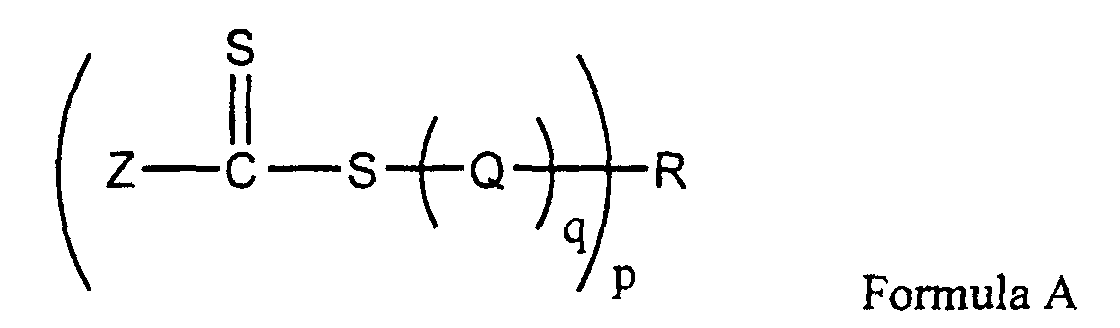 comprising contacting:
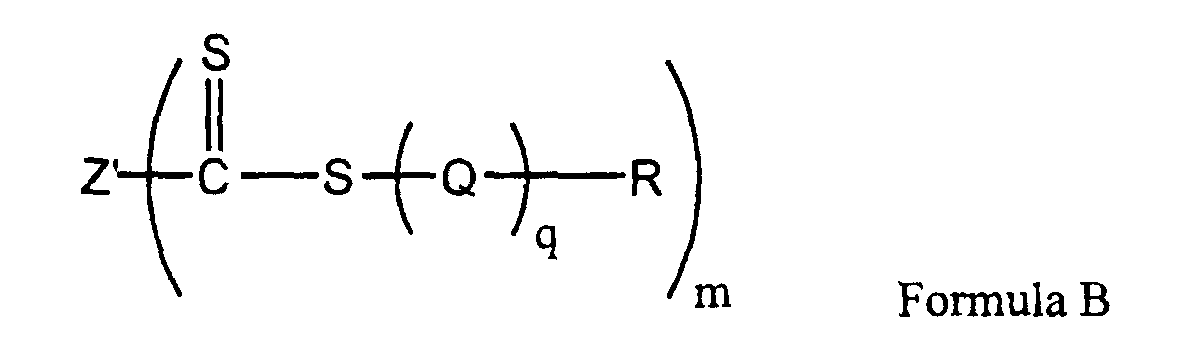 controlling the polydispersity of the polymer being formed by varying the ratio of the number of molecules of (ii) to the number of molecules of (iii);(i) a monomer having repeating units, Q, selected from the group consisting of vinyl monomers of structure CH2=CUV, maleic anhydride, N-alkylmaleimide, N-arylmaleimide, dialkyl fumarate and cyclopolymerizable monomers;(ii) a thiocarbonylthio compound selected from:and
 having a chain transfer constant greater than about 0.1; and
 (iii) free radicals produced from a free radical source; and
the polymer of Formula A being made by contacting (i), (ii)C and (iii) and the polymer of Formula B being made by contacting (i), (ii) D and (iii);
wherein:Z is selected from the group consisting of hydrogen, chlorine, optionally substituted alkyl, optionally substituted aryl, optionally substituted heterocyclyl, optionally substituted alkylthio, optionally substituted alkoxycarbonyl, optionally substituted aryloxycarbonyl (-COOR"), carboxy (-COOH), optionally substituted acyloxy (-O2CR"), optionally substituted carbamoyl (-CONR"2), cyano (-CN), dialkyl- or diaryl- phosphonato [-P(=O)OR"2], dialkyl- or diaryl-phosphinato [-P(=O)R"2], and a polymer chain formed by any mechanism;Z' is a m-valent moiety derived from a member of the group consisting of optionally substituted alkyl, optionally substituted aryl and a polymer chain; where the connecting moieties are selected from the group that consists of aliphatic carbon, aromatic carbon, and sulfur;Q is selected from the group consisting ofand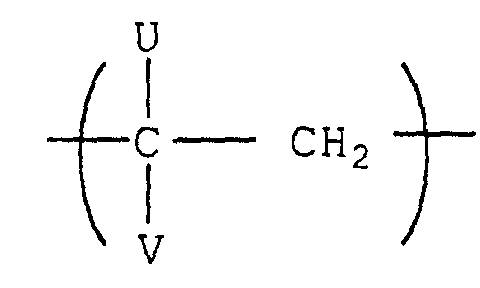
repeating units from maleic anhydride, N-alkylmaleimide, N-arylmaleimide, dialkyl fumarate and cyclopolymerizable monomers;U is selected from the group consisting of hydrogen, halogen, optionally substituted C1-C4 alkyl wherein the substituents are independently selected from the group that consists of hydroxy, alkoxy, aryloxy (OR"), carboxy, acyloxy, aroyloxy (O2CR"), alkoxy- carbonyl and aryloxy-carbonyl (CO2R");V is selected from the group consisting of hydrogen, R", CO2H, CO2R", COR", CN, CONH2, CONHR", CONR"2, O2CR", OR" and halogen;R is selected from group consisting of optionally substituted alkyl; an optionally substituted saturated, unsaturated or aromatic carbocyclic or heterocyclic ring; optionally substituted alkylthio; optionally substituted alkoxy; optionally substituted dialkylamino; an organometallic species; and a polymer chain prepared by any polymerization mechanism; in compounds C and D, R• is a free-radical leaving group that initiates free radical polymerization;R" is selected from the group consisting of optionally substituted C1-C18 alkyl, C2-C18 alkenyl, aryl, heterocyclyl, aralkyl, alkaryl wherein the substituents are independently selected from the group that consists of epoxy, hydroxy, alkoxy, acyl, acyloxy, carboxy (and salts), sulfonic acid (and salts), alkoxy- or aryloxy-carbonyl, isocyanato, cyano, silyl, halo, and dialkylamino;q is 1 or an integer greater than 1;p is 1 or an integer greater than 1; when p≥2 then R=R';m is an integer ≥2; andR' is a p-valent moiety selected from a member of the group consisting of optionally substituted alkyl, optionally substituted aryl and a polymer chain; where the connecting moieties are selected from the group consisting of aliphatic carbon, aromatic carbon, silicon, and sulfur; in compounds C and D, R'• is a free radical leaving group that initiates free radical polymerization. - A process according to Claim 1 comprising controlling polydispersity by varying the ratio of the number of molecules of (ii) to (iii) as follows:(a) lower polydispersity by increasing the ratio of (ii) to (iii); and(b) increase polydispersity by decreasing the ratio of (ii) to (iii).
- A process according to Claim 2 comprising increasing the ratio of (ii) to (iii) and obtaining a polymer having a polydispersity below about 1.5.
- A process according to Claim 1 comprising selecting the following monomer repeating unit:from (i).

- A process according to Claim 1 comprising selecting the monomer units Q and the value of q so that when q≥1 and Q is a single monomer species, then the polymer is homopolymer; when q≥2 and Q is selected from 2 or more different monomer species in irregular sequence then the polymer is copolymer; and when q≥2 and Q is selected from 2 or more different monomer species in which each different monomer or group of monomers appears in a discrete sequence then the polymer is block copolymer.
- A process according to Claim 1 wherein the thiocarbonylthio compound is selected from the group consisting of:








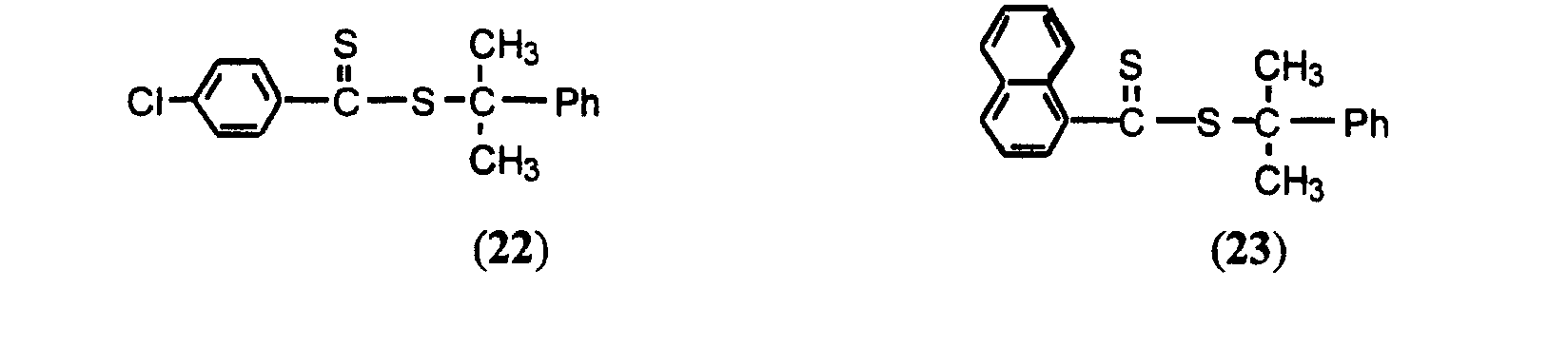

 and
and wherein Z is phenyl.
- A chain transfer agent selected from the group consisting of:








 and
and wherein Z is phenyl.
- A polymer of the Formulaand
 wherein:
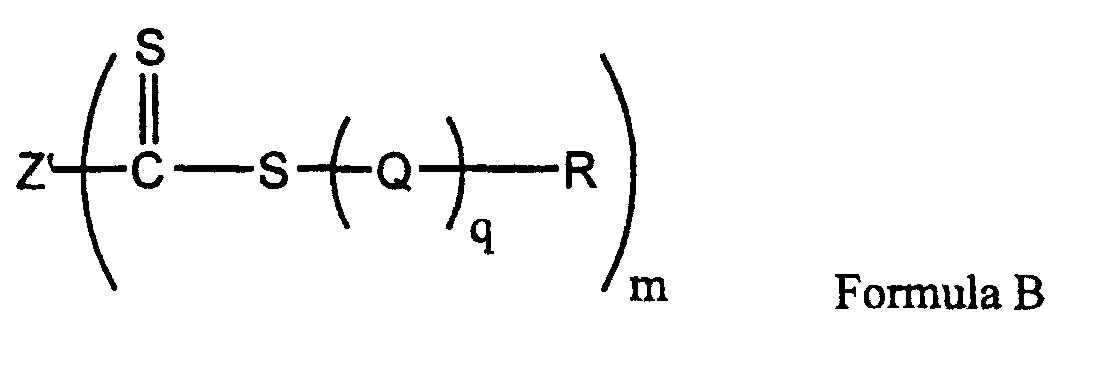 Z is selected from the group consisting of hydrogen, chlorine, optionally substituted alkyl, optionally substituted aryl, optionally substituted heterocyclyl, optionally substituted alkylthio, optionally substituted alkoxycarbonyl or optionally substituted aryloxycarbonyl (-COOR"), carboxy (-COOH), optionally substituted acyloxy (-O2CR"), optionally substituted carbamoyl (-CONR"2), cyano (-CN), dialkyl- or diaryl- phosphonato [-P(=O)OR"2], dialkyl- or diaryl-phosphinato [-P(=O)R"2], and a polymer chain formed by any mechanism;Z' is a m-valent moiety derived from a member of the group consisting of optionally substituted alkyl, optionally substituted aryl and a polymer chain; where the connecting moieties are selected from the group that consistes of aliphatic carbon, aromatic carbon, and sulfur;Q is selected from the group consisting ofand repeating units from maleic anhydride, N-alkylmaleimide, N-arylmaleimide, dialkyl fumarate and cyclopolymerizable monomers;
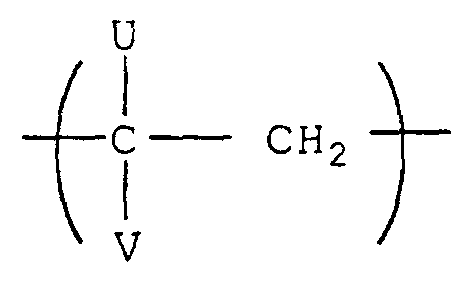 U is selected from the group consisting of hydrogen, halogen, optionally substituted C1-C4 alkyl, wherein the substituents are independently selected from the group consisting of hydroxy, alkoxy, aryloxy (OR"), carboxy, acyloxy, aroyloxy (O2CR"), alkoxy-carbonyl and aryloxy-carbonyl (CO2R");V is selected from the group consisting of hydrogen, R", CO2H, CO2R", COR" , CN, CONH2, CONHR", CONR"2, O2CR", OR" and halogen;R is selected from the group consisting of optionally substituted alkyl; an optionally substituted saturated, unsaturated or aromatic carbocyclic or heterocyclic ring; optionally substituted alkylthio; optionally substituted alkoxy; optionally substituted dialkylamino; an organometallic species; and a polymer chain prepared by any polymerization mechanism; R• being derived from a free radical leaving group that initiates free radical polymerization;R" is selected from the group consisting of optionally substituted C1-C18 alkyl, C2-C18 alkenyl, aryl, heterocyclyl, aralkyl, alkaryl wherein the substituents are independently selected from the group that consists of epoxy, hydroxy, alkoxy, acyl, acyloxy, carboxy (and salts), sulfonic acid (and salts), alkoxy- or aryloxy-carbonyl, isocyanato, cyano, silyl, halo, and dialkylamino;q is 1 or an integer greater than 1;p is 1 or an integer greater than 1; when p≥2, then R=R';m is an integer ≥2; andR' is a p-valent moiety derived from a member of the group consisting of optionally substituted alkyl, optionally substituted aryl and a polymer chain; where the connecting moieties are selected from the group consisting of aliphatic carbon, aromatic carbon, silicon, and sulfur; R'• being derived from a free radical leaving group that initiates free radical polymerization.
 - A polymer according to Claim 8 selected from the group consisting of random, block, graft, star and gradient copolymer.
- A polymer according to Claim 9 having end group functionality.
Applications Claiming Priority (7)
| Application Number | Priority Date | Filing Date | Title |
|---|---|---|---|
| AUPO0933/96 | 1996-07-10 | ||
| AUPO093396 | 1996-07-10 | ||
| AUPO0933A AUPO093396A0 (en) | 1996-07-10 | 1996-07-10 | Polymerization with living characteristics |
| AUPO1109/96 | 1996-07-18 | ||
| AUPO1109A AUPO110996A0 (en) | 1996-07-18 | 1996-07-18 | Polymerization with living characteristics |
| AUPO110996 | 1996-07-18 | ||
| PCT/US1997/012540 WO1998001478A1 (en) | 1996-07-10 | 1997-07-03 | Polymerization with living characteristics |
Publications (2)
| Publication Number | Publication Date |
|---|---|
| EP0910587A1 EP0910587A1 (en) | 1999-04-28 |
| EP0910587B1 true EP0910587B1 (en) | 2001-12-12 |
Family
ID=25645213
Family Applications (1)
| Application Number | Title | Priority Date | Filing Date |
|---|---|---|---|
| EP97932627A Expired - Lifetime EP0910587B1 (en) | 1996-07-10 | 1997-07-03 | Polymerization with living characteristics |
Country Status (13)
| Country | Link |
|---|---|
| US (4) | US7714075B1 (en) |
| EP (1) | EP0910587B1 (en) |
| JP (1) | JP3639859B2 (en) |
| KR (1) | KR100479628B1 (en) |
| CN (3) | CN100473646C (en) |
| AT (1) | ATE210684T1 (en) |
| BR (1) | BR9710219A (en) |
| CA (1) | CA2259559C (en) |
| DE (1) | DE69709110T2 (en) |
| ES (1) | ES2166092T3 (en) |
| NZ (1) | NZ333277A (en) |
| TW (1) | TW384292B (en) |
| WO (1) | WO1998001478A1 (en) |
Cited By (6)
| Publication number | Priority date | Publication date | Assignee | Title |
|---|---|---|---|---|
| EP0991683B2 (en) † | 1997-06-23 | 2007-05-09 | Rhodia Chimie | Method for block polymer synthesis by controlled radical polymerisation |
| US7408013B2 (en) | 2003-09-23 | 2008-08-05 | Commonwealth Scientific And Industrial Research Organization | Low-polydispersity photoimageable polymers and photoresists and processes for microlithography |
| US7696292B2 (en) | 2003-09-22 | 2010-04-13 | Commonwealth Scientific And Industrial Research Organisation | Low-polydispersity photoimageable acrylic polymers, photoresists and processes for microlithography |
| US8034534B2 (en) | 2006-08-14 | 2011-10-11 | E.I. Du Pont De Nemours And Company | Fluorinated polymers for use in immersion lithography |
| EP3018151A1 (en) | 2014-11-06 | 2016-05-11 | Universiteit Gent | Process for preparing inert raft polymers |
| US10968173B2 (en) | 2016-07-07 | 2021-04-06 | Iowa State University Research Foundation, Inc. | Thiocarbonylthio compounds as chain transfer agents suitable for raft polymerization |
Families Citing this family (489)
| Publication number | Priority date | Publication date | Assignee | Title |
|---|---|---|---|---|
| IL139666A0 (en) * | 1997-07-21 | 2002-02-10 | Commw Scient Ind Res Org | Synthesis of dithioester chain transfer agents and use of bis (thioacyl) disulfides or dithioesters as chain transfer agents |
| ES2277678T3 (en) | 1997-12-18 | 2007-07-16 | E.I. Du Pont De Nemours And Company | POLYMERIZATION PROCESS WITH LIVING CHARACTERISTICS AND POLYMERS OBTAINED BY THIS PROCESS. |
| FR2773161B1 (en) * | 1997-12-31 | 2000-01-21 | Rhodia Chimie Sa | PROCESS FOR THE SYNTHESIS OF BLOCK POLYMERS |
| US6812291B1 (en) | 1997-12-31 | 2004-11-02 | Rhodia Chimie | Method for block polymer synthesis by controlled radical polymerization from dithiocarbamate compounds |
| AUPP337298A0 (en) * | 1998-05-07 | 1998-05-28 | University Of Melbourne, The | Process for microgel preparation |
| US6399731B2 (en) | 1998-10-08 | 2002-06-04 | The University Of Akron | Chain transfer agents and its use in polymer synthesis |
| PL196869B1 (en) | 1998-12-18 | 2008-02-29 | Basf Ag | Method for producing a polymer reaction product |
| EP1144462B1 (en) | 1998-12-23 | 2004-08-11 | BASF Coatings AG | Coating agent |
| DE69833800T3 (en) | 1998-12-29 | 2013-08-22 | Minnesota Mining And Mfg. Co. | MELT ADHESIVES FROM BLOCK COPOLYMERS, METHOD FOR THEIR PRODUCTION AND OBJECTS THEREFOR |
| US6734256B1 (en) | 1998-12-29 | 2004-05-11 | 3M Innovative Properties Company | Block copolymer hot-melt processable adhesives, methods of their preparation, and articles therefrom |
| US6472486B2 (en) | 1999-03-09 | 2002-10-29 | Symyx Technologies, Inc. | Controlled stable free radical emulsion polymerization processes |
| US7939601B1 (en) | 1999-05-26 | 2011-05-10 | Rhodia Inc. | Polymers, compositions and methods of use for foams, laundry detergents, shower rinses, and coagulants |
| AU781532B2 (en) | 1999-05-26 | 2005-05-26 | Rhodia Inc. | Block polymers, compositions and methods of use for foams, laundry detergents, shower rinses and coagulants |
| US7241729B2 (en) | 1999-05-26 | 2007-07-10 | Rhodia Inc. | Compositions and methods for using polymeric suds enhancers |
| FR2794464B1 (en) * | 1999-06-04 | 2005-03-04 | Rhodia Chimie Sa | PROCESS FOR THE SYNTHESIS OF BLOCK POLYMERS BY CONTROLLED RADICAL POLYMERIZATION USING THIOETHER THIONES |
| FR2794463B1 (en) * | 1999-06-04 | 2005-02-25 | Rhodia Chimie Sa | PROCESS FOR THE SYNTHESIS OF POLYMERS BY CONTROLLED RADICAL POLYMERIZATION USING HALOGENATED XANTHATES |
| DE19930066A1 (en) | 1999-06-30 | 2001-01-11 | Basf Coatings Ag | Color and / or effect multi-layer coating, process for their preparation and their use |
| DE19930067A1 (en) | 1999-06-30 | 2001-01-11 | Basf Coatings Ag | Coating material and its use for the production of filler layers and stone chip protection primers |
| DE19930664A1 (en) | 1999-07-02 | 2001-01-11 | Basf Coatings Ag | Clear varnish and its use for the production of clear varnishes and color and / or effect multilayer varnishes |
| DE19930665A1 (en) | 1999-07-02 | 2001-01-11 | Basf Coatings Ag | Basecoat and its use for the production of color and / or effect basecoats and multi-layer coating |
| US6716948B1 (en) | 1999-07-31 | 2004-04-06 | Symyx Technologies, Inc. | Controlled-architecture polymers and use thereof as separation media |
| WO2001009204A2 (en) * | 1999-07-31 | 2001-02-08 | Symyx Technologies, Inc. | Controlled-architecture polymers and use thereof as separation media |
| FR2802208B1 (en) | 1999-12-09 | 2003-02-14 | Rhodia Chimie Sa | PROCESS FOR THE SYNTHESIS OF POLYMERS BY CONTROLLED RADICAL POLYMERIZATION USING XANTHATES |
| FR2802209B1 (en) * | 1999-12-10 | 2002-03-01 | Rhodia Chimie Sa | LATEX WITH MODIFIED SURFACE CHEMISTRY AND REDISPERSABLE POWDERS, THEIR PRODUCTION AND THEIR USES |
| DE19959923A1 (en) | 1999-12-11 | 2001-06-28 | Basf Coatings Ag | Aqueous primary dispersions and coating materials, processes for their preparation and their use |
| DE19959927A1 (en) | 1999-12-11 | 2002-02-07 | Basf Coatings Ag | Aqueous primary dispersions and coating materials, processes for their preparation and their use |
| DE19961063A1 (en) | 1999-12-17 | 2001-07-12 | Basf Ag | Process for the preparation of a polymeric reaction product |
| US6369158B1 (en) | 1999-12-22 | 2002-04-09 | The Goodyear Tire & Rubber Company | Dibenzyltrithiocarbonate molecular weight regulator for emulsion polymerization |
| JP4768104B2 (en) * | 2000-02-03 | 2011-09-07 | 日東電工株式会社 | Non-crosslinked adhesive composition, method for producing the same and adhesive sheet |
| DE10005819A1 (en) | 2000-02-10 | 2001-08-23 | Basf Coatings Ag | Aqueous primary dispersions, processes for their preparation and their use |
| US7335788B2 (en) | 2000-02-16 | 2008-02-26 | Lubrizol Advanced Materials, Inc. | S-(α, α′-disubstituted-α″-acetic acid) substituted dithiocarbonate derivatives for controlled radical polymerizations, process and polymers made therefrom |
| US6596899B1 (en) | 2000-02-16 | 2003-07-22 | Noveon Ip Holdings Corp. | S,S′BIS-(α, α′-DISUBSTITUTED-α″-ACETIC ACID)- TRITHIOCARBONATES AND DERIVATIVES AS INITIATOR-CHAIN TRANSFER AGENT-TERMINATOR FOR CONTROLLED RADICAL POLYMERIZATIONS AND THE PROCESS FOR MAKING THE SAME |
| US7205368B2 (en) | 2000-02-16 | 2007-04-17 | Noveon, Inc. | S-(α, α′-disubstituted-α′ ′-acetic acid) substituted dithiocarbonate derivatives for controlled radical polymerizations, process and polymers made therefrom |
| US7495050B2 (en) | 2000-02-16 | 2009-02-24 | Lubrizol Advanced Materials, Inc. | Associative thickeners for aqueous systems |
| US7557235B2 (en) | 2000-02-16 | 2009-07-07 | Lubrizol Advanced Materials, Inc. | Hydroxyl-terminated thiocarbonate containing compounds, polymers, and copolymers, and polyurethanes and urethane acrylics made therefrom |
| JP4806486B2 (en) * | 2000-02-28 | 2011-11-02 | 日東電工株式会社 | Ultraviolet crosslinking adhesive composition and method for producing the same, and adhesive sheet and method for producing the same |
| KR100385724B1 (en) * | 2000-03-06 | 2003-05-27 | 주식회사 엘지화학 | Dithioesters and method for polymerization of vinyl polymer using the same |
| US6533415B2 (en) * | 2000-03-21 | 2003-03-18 | Menicon Co., Ltd. | Ocular lens material having hydrophilic surface and process for preparing the same |
| AUPQ679400A0 (en) * | 2000-04-07 | 2000-05-11 | Commonwealth Scientific And Industrial Research Organisation | Microgel synthesis |
| US7064151B1 (en) | 2000-04-07 | 2006-06-20 | E. I. Du Pont De Nemours And Company | Process of microgel synthesis and products produced therefrom |
| DE10018078A1 (en) | 2000-04-12 | 2001-11-08 | Basf Coatings Ag | Molding compositions and process for the production of moldings |
| DE10018601A1 (en) | 2000-04-14 | 2001-10-25 | Basf Coatings Ag | Aqueous primary dispersion and coating agent useful in motor vehicle manufacture, is prepared by radical (co)polymerization of monomers dispersed in an aqueous dispersion of the cross-linking agent |
| JP4768102B2 (en) * | 2000-04-24 | 2011-09-07 | 日東電工株式会社 | UV-crosslinking type pressure-sensitive adhesive composition, process for producing the same, and pressure-sensitive adhesive sheets |
| JP4768103B2 (en) * | 2000-06-06 | 2011-09-07 | 日東電工株式会社 | Adhesive composition, its adhesive sheet and method for producing them |
| US6458968B2 (en) | 2000-06-09 | 2002-10-01 | Rensselaer Polytechnic Institute | Dithiocarboxylic ester synthetic process |
| DE10030217A1 (en) * | 2000-06-20 | 2002-01-03 | Beiersdorf Ag | Process for the production of polyacrylates |
| DE10036801A1 (en) | 2000-07-28 | 2002-02-07 | Tesa Ag | Acrylic PSAs with a narrow molecular weight distribution |
| DE10036802A1 (en) | 2000-07-28 | 2002-02-07 | Tesa Ag | PSAs based on block copolymers with the structure P (A) -P (B) -P (A) |
| JP4631137B2 (en) * | 2000-08-01 | 2011-02-16 | 日東紡績株式会社 | ALLYLAMINE POLYMER HAVING TERMINAL MERCAPTO GROUP AND PROCESS FOR PRODUCING THE SAME |
| FR2814168B1 (en) * | 2000-09-18 | 2006-11-17 | Rhodia Chimie Sa | PROCESS FOR THE SYNTHESIS OF BLOCK POLYMERS BY CONTROLLED RADICAL POLYMERIZATION IN THE PRESENCE OF A DISULFIDE COMPOUND |
| US6376631B1 (en) | 2000-09-27 | 2002-04-23 | Rhodia, Inc. | Processes to control the residual monomer level of copolymers of tertiary amino monomer with a vinyl-functional monomer |
| US6518364B2 (en) | 2000-09-28 | 2003-02-11 | Symyx Technologies, Inc. | Emulsion living-type free radical polymerization, methods and products of same |
| US6380335B1 (en) * | 2000-09-28 | 2002-04-30 | Symyx Technologies, Inc. | Control agents for living-type free radical polymerization, methods of polymerizing and polymers with same |
| US6395850B1 (en) | 2000-09-28 | 2002-05-28 | Symyx Technologies, Inc. | Heterocycle containing control agents for living-type free radical polymerization |
| US6569969B2 (en) | 2000-09-28 | 2003-05-27 | Symyx Technologies, Inc. | Control agents for living-type free radical polymerization, methods of polymerizing and polymers with same |
| US6767968B1 (en) | 2000-10-03 | 2004-07-27 | Symyx Technologies, Inc. | ABA-type block copolymers having a random block of hydrophobic and hydrophilic monomers and methods of making same |
| FR2816311B1 (en) | 2000-11-06 | 2003-01-17 | Rhodia Chimie Sa | SYNTHESIS OF BLOCK POLYMERS OBTAINED BY CONTROLLED RADICAL POLYMERIZATION |
| JP4768115B2 (en) * | 2000-12-01 | 2011-09-07 | 日東電工株式会社 | Ultraviolet crosslinking adhesive composition and method for producing the same, and adhesive sheet and method for producing the same |
| DE10106567A1 (en) | 2001-02-13 | 2002-08-22 | Basf Coatings Ag | Aqueous primary dispersion essentially or completely free of volatile organic substances, process for their preparation and their use |
| DE10106566A1 (en) | 2001-02-13 | 2002-08-22 | Basf Coatings Ag | Aqueous coating material substantially or completely free of volatile organic substances, process for its preparation and its use |
| US6579947B2 (en) | 2001-02-20 | 2003-06-17 | Rhodia Chimie | Hydraulic fracturing fluid comprising a block copolymer containing at least one water-soluble block and one hydrophobic block |
| DE10109067A1 (en) | 2001-02-24 | 2002-09-12 | Tesa Ag | PSA with low outgassing behavior |
| EP1236742A1 (en) | 2001-02-28 | 2002-09-04 | Bayer Ag | Controlled free-radical polymerization products using new control agents |
| FR2821620B1 (en) * | 2001-03-02 | 2003-06-27 | Coatex Sas | PROCESS FOR CONTROLLED RADICAL POLYMERIZATION OF ACRYLIC ACID AND ITS SALTS, THE LOW POLYDISPERSITY POLYMERS OBTAINED, AND THEIR APPLICATIONS |
| JP4889867B2 (en) | 2001-03-13 | 2012-03-07 | 株式会社カネカ | Method for producing vinyl polymer having alkenyl group at terminal, vinyl polymer and curable composition |
| US6765076B2 (en) | 2001-03-20 | 2004-07-20 | Rensselaer Polytechnic Institute | Transition metal superoxides |
| WO2002081561A1 (en) * | 2001-04-04 | 2002-10-17 | Kaneka Corporation | Thermoplastic resin composition and elastomer composition |
| US6992138B2 (en) | 2001-05-31 | 2006-01-31 | Kaneka Corporation | Polyurethane polymer |
| US6914110B2 (en) | 2001-05-31 | 2005-07-05 | Kaneka Corporation | Process for producing polymer having crosslinkable silyl group and curable composition |
| DE10126651A1 (en) | 2001-06-01 | 2002-12-12 | Basf Coatings Ag | Use of copolymers with diphenylethylene units as emulsifiers for the production of powder slurry and coating powder for use in coating materials, adhesives and sealants, e.g. for painting cars |
| DE10129608A1 (en) | 2001-06-20 | 2003-05-28 | Tesa Ag | Stripable systems based on acrylic block copolymers |
| FR2826593B1 (en) * | 2001-06-27 | 2004-04-16 | Rhodia Chimie Sa | DISPERSION COMPRISING AN EMULSION HAVING AQUEOUS PHASE OF HIGH IONIC FORCE, PREPARATION AND USE |
| FR2826658B1 (en) * | 2001-06-29 | 2003-09-05 | Rhodia Chimie Sa | SYNTHESIS OF POLYMERS BY RADIATION CHANNEL IN MINIEMULSION CONTROL |
| FR2829494B1 (en) | 2001-07-13 | 2005-10-28 | Rhodia Chimie Sa | AQUEOUS COMPOSITIONS COMPRISING A CHEMICAL MICRO-GEL ASSOCIATED WITH A POLYMER FOR PONDING, PREPARATION AND USE |
| WO2003008474A1 (en) | 2001-07-16 | 2003-01-30 | Kaneka Corporation | Block copolymer |
| US6596809B2 (en) | 2001-07-20 | 2003-07-22 | Symyx Technologies, Inc. | Cellulose copolymers that modify fibers and surfaces and methods of making same |
| WO2003011918A1 (en) * | 2001-07-31 | 2003-02-13 | Kaneka Corporation | Polymer containing vinyl sulfide group and curable composition |
| FR2829137B1 (en) | 2001-08-28 | 2003-12-19 | Rhodia Chimie Sa | RADICAL POLYMERIZATION PROCESS CARRIED OUT IN THE PRESENCE OF DISULPHIDE COMPOUNDS |
| DE10149083A1 (en) | 2001-10-05 | 2003-04-17 | Tesa Ag | Acrylic PSAs with a narrow molecular weight distribution |
| DE10149084A1 (en) | 2001-10-05 | 2003-06-18 | Tesa Ag | UV crosslinkable acrylic hot melt pressure sensitive adhesive with narrow molecular weight distribution |
| JP3971593B2 (en) | 2001-10-10 | 2007-09-05 | 株式会社カネカ | Curable composition |
| WO2003037963A1 (en) * | 2001-10-30 | 2003-05-08 | Kaneka Corporation | Silicone-containing block copolymer |
| DE10153677A1 (en) | 2001-10-31 | 2003-05-15 | Tesa Ag | Double sided tape |
| EP1452550A4 (en) * | 2001-11-14 | 2005-03-30 | Kaneka Corp | Curable composition |
| DE10156088A1 (en) | 2001-11-16 | 2003-06-05 | Tesa Ag | Oriented acrylic block copolymers |
| JP2003155463A (en) * | 2001-11-21 | 2003-05-30 | Kanegafuchi Chem Ind Co Ltd | Emulsion type adhesive |
| JP2005510596A (en) | 2001-11-24 | 2005-04-21 | テサ・アクチエンゲゼルシヤフト | Cross-linking of polyacrylates initiated by photoinitiators |
| IL162557A0 (en) * | 2001-12-21 | 2005-11-20 | Univ Sydney | Aqueous dispersions of polymer particles |
| WO2003062280A2 (en) | 2002-01-25 | 2003-07-31 | Lg Chem, Ltd. | Water-soluble dithioesters and method for polymerization thereof |
| US6762263B2 (en) | 2002-02-01 | 2004-07-13 | Atofina Chemicals, Inc. | High-solids coatings resins via controlled radical polymerization |
| AU2003206170A1 (en) | 2002-02-04 | 2003-09-02 | Lg Chem, Ltd. | Organic-inorganic nanocomposite and preparation thereof |
| US6855840B2 (en) * | 2002-02-11 | 2005-02-15 | University Of Southern Mississippi | Chain transfer agents for raft polymerization in aqueous media |
| US20030158078A1 (en) | 2002-02-11 | 2003-08-21 | Jeanne Chang | Detergent composition comprising a block copolymer |
| US7138468B2 (en) | 2002-03-27 | 2006-11-21 | University Of Southern Mississippi | Preparation of transition metal nanoparticles and surfaces modified with (CO)polymers synthesized by RAFT |
| US6720429B2 (en) * | 2002-04-24 | 2004-04-13 | Industrial Technology Research Institute | Thiocarbonylthio compound and living free radical polymerization using the same |
| DE10227338B4 (en) | 2002-06-19 | 2006-05-24 | Byk-Chemie Gmbh | Use of polyacrylate-modified polysiloxanes as flow control agents in coating compositions |
| DE10234246A1 (en) | 2002-07-27 | 2004-02-05 | Tesa Ag | Pressure-sensitive adhesive material for bonding transparent substrates, e.g. in liquid crystal displays and other optical applications, comprises block copolymers with blocks of different refractive index |
| FR2843314B1 (en) | 2002-08-06 | 2004-09-24 | Rhodia Chimie Sa | SYNTHESIS OF STATISTICAL MICROGELS BY CONTROLLED RADICAL POLYMERIZATION |
| DE10237000A1 (en) | 2002-08-13 | 2004-02-26 | Tesa Ag | Production of contact adhesive comprises adding metal compound to polyacrylate with carbon-sulfur-carbon sequence |
| DE10237950A1 (en) * | 2002-08-20 | 2004-03-11 | Tesa Ag | Polyacrylate contact adhesive useful for making adhesive tape comprises a base-reactive polyacrylate thermally crosslinked with a photochemically generated base |
| DE10243666A1 (en) | 2002-09-20 | 2004-04-01 | Bayer Ag | dithiocarbamic acid esters |
| FR2846973B1 (en) | 2002-11-07 | 2004-12-17 | Rhodia Chimie Sa | ANTI-WRINKLE COMPOSITION COMPRISING A COPOLYMER WITH CONTROLLED ARCHITECTURE FOR TEXTILE FIBER ARTICLES |
| US6806320B2 (en) | 2002-11-15 | 2004-10-19 | 3M Innovative Properties Company | Block copolymer melt-processable compositions, methods of their preparation, and articles therefrom |
| BRPI0316929B8 (en) * | 2002-12-04 | 2016-05-17 | Dsm Ip Assets Bv | laser light absorber additive, its preparation process, laser recordable composition, object, paste or latex |
| FR2848556B1 (en) | 2002-12-13 | 2006-06-16 | Bio Merieux | CONTROLLED RADICAL POLYMERIZATION PROCESS |
| FR2848557B1 (en) | 2002-12-13 | 2006-07-07 | Atofina | SOLUBLE OR AT LEAST DISPERSIBLE GRADIENT COPOLYMERS IN WATER AS IN ORGANIC SOLVENTS |
| ITMI20022703A1 (en) * | 2002-12-20 | 2004-06-21 | Enitecnologie Spa | PROCEDURE FOR THE LIVING RADICAL POLYMERIZATION OF HYPHOLICALLY UNSATURATED MONOMERS. |
| WO2004056880A1 (en) * | 2002-12-23 | 2004-07-08 | Stichting Dutch Polymer Institute | Process for the preparation of a multiblock copolymer |
| JP2004220009A (en) * | 2002-12-28 | 2004-08-05 | Jsr Corp | Radiation-sensitive resin composition |
| US9348226B2 (en) | 2002-12-28 | 2016-05-24 | Jsr Corporation | Radiation-sensitive resin composition |
| DE10314898A1 (en) * | 2003-01-29 | 2004-08-12 | Tesa Ag | Pressure-sensitive adhesive tapes for bonding printing plates and processes for their production |
| US6841695B2 (en) | 2003-03-18 | 2005-01-11 | Rohmax Additives Gmbh | Process for preparing dithioesters |
| DE10314776A1 (en) * | 2003-03-31 | 2004-10-14 | Rohmax Additives Gmbh | Lubricating oil composition with good rubbing properties |
| US6762257B1 (en) * | 2003-05-05 | 2004-07-13 | 3M Innovative Properties Company | Azlactone chain transfer agents for radical polymerization |
| US6753391B1 (en) * | 2003-05-05 | 2004-06-22 | 3M Innovative Properties Company | Ring-opened azlactone chain transfer agents for radical polymerization |
| US20040248039A1 (en) * | 2003-05-08 | 2004-12-09 | Sounik James R. | Photoresist compositions and processes for preparing the same |
| US7834113B2 (en) | 2003-05-08 | 2010-11-16 | E. I. Du Pont De Nemours And Company | Photoresist compositions and processes for preparing the same |
| DE10322830A1 (en) * | 2003-05-19 | 2004-12-09 | Tesa Ag | Process for the continuous production of polymers from vinyl compounds by bulk or solvent polymerization |
| WO2004108770A1 (en) * | 2003-05-30 | 2004-12-16 | Rensselaer Polytechnic Institute | Low odor chain transfer agents for controlled radical polymerization |
| DE10327198A1 (en) | 2003-06-17 | 2005-01-13 | Tesa Ag | Repulpable PSAs |
| GB0314472D0 (en) | 2003-06-20 | 2003-07-23 | Warwick Effect Polymers Ltd | Polymer |
| JP2009513725A (en) | 2003-06-24 | 2009-04-02 | ポリマーズ オーストラリア プロプライアタリー リミティド | Acrylic dispersants in nanocomposites |
| EP1641849A1 (en) * | 2003-06-26 | 2006-04-05 | Symyx Technologies, Inc. | Photoresist polymers and compositions having acrylic- or methacrylic-based polymeric resin prepared by a living free radical process |
| WO2005003192A1 (en) | 2003-06-26 | 2005-01-13 | Symyx Technologies, Inc. | Synthesis of photoresist polymers |
| WO2005000924A1 (en) | 2003-06-26 | 2005-01-06 | Symyx Technologies, Inc. | Photoresist polymers |
| DE602004008468T2 (en) | 2003-06-26 | 2008-05-21 | Jsr Corp. | Photoresist Compositions |
| DE10357323A1 (en) | 2003-12-05 | 2005-06-30 | Tesa Ag | PSA |
| DE10357322A1 (en) | 2003-12-05 | 2005-06-30 | Tesa Ag | Two-layer pressure-sensitive adhesive |
| DE10359350A1 (en) | 2003-12-16 | 2005-07-14 | Tesa Ag | PSA |
| DE10359973A1 (en) | 2003-12-18 | 2005-07-21 | Tesa Ag | Adhesive material for use on adhesive tape, comprises an acrylate block copolymer comprising (co)polymer blocks with low softening points, which exist in microphase-separated domains under usage conditions |
| US20070299221A1 (en) * | 2003-12-23 | 2007-12-27 | Sebastien Perrier | Polymerisation Using Chain Transfer Agents |
| DE102004001412A1 (en) | 2004-01-09 | 2005-08-25 | Tesa Ag | Pressure-sensitive adhesive based on an acrylate polymer blend |
| NL1025250C2 (en) * | 2004-01-15 | 2005-07-18 | Univ Eindhoven Tech | Multi-functional and bi-functional dithiocarboxylate compounds, monofunctional alkoxycarbonyl dithiocarbamate compound, a process for the preparation of alkoxycarbonyl dithiocarbamate compounds as well as a process for preparing multiblock copolymers by radical polymerization. |
| US7632905B2 (en) | 2004-04-09 | 2009-12-15 | L'oreal S.A. | Block copolymer, composition comprising it and cosmetic treatment process |
| FR2871470B1 (en) | 2004-06-11 | 2007-01-12 | Oreal | GRADIENT COPOLYMER, COMPOSITION AND COSMETIC PROCESS FOR MAKE-UP OR CARE |
| FR2872039B1 (en) * | 2004-06-23 | 2006-08-04 | Rhodia Chimie Sa | COSMETIC COMPOSITION COMPRISING POLYORGANOSILOXANE AND USES THEREOF |
| DE502005007001D1 (en) | 2004-06-23 | 2009-05-14 | Tesa Ag | MEDICAL BIOSENSOR TO BE INVESTIGATED BY BIOLOGICAL FLUIDS |
| US7255920B2 (en) | 2004-07-29 | 2007-08-14 | 3M Innovative Properties Company | (Meth)acrylate block copolymer pressure sensitive adhesives |
| US7605212B2 (en) | 2004-09-09 | 2009-10-20 | Tesa Se | Method for producing contact adhesive masses containing acrylic |
| DE102004044085A1 (en) | 2004-09-09 | 2006-03-16 | Tesa Ag | Pressure-sensitive adhesive with dual crosslinking mechanism |
| CN101087812B (en) | 2004-10-25 | 2013-03-06 | 卢布里佐尔公司 | Process for preparing polymers and compositions thereof |
| EP1833868B1 (en) | 2004-10-25 | 2013-04-17 | The Lubrizol Corporation | Star polymers and compositions thereof |
| CN1301272C (en) * | 2004-10-25 | 2007-02-21 | 苏州大学 | Reversible addition-fragmentation chain transfer free radical polymerization method |
| US7279446B2 (en) | 2004-11-15 | 2007-10-09 | Rhodia Inc. | Viscoelastic surfactant fluids having enhanced shear recovery, rheology and stability performance |
| JP4788129B2 (en) * | 2004-11-19 | 2011-10-05 | 東ソー株式会社 | Chloroprene-based polymer and process for producing the same |
| RU2401281C2 (en) | 2005-01-11 | 2010-10-10 | Циба Спешиалти Кемикэлз Холдинг Инк. | Method for post-modification of homo- and copolymers obtained via free-radical polymerisation controlled processes |
| US7345186B2 (en) | 2005-01-18 | 2008-03-18 | The Goodyear Tire & Rubber Company | Oxathiazaphospholidine free radical control agent |
| TWI530759B (en) | 2005-01-24 | 2016-04-21 | 富士軟片股份有限公司 | Positive-type photoresist composition suitable for immersion exposure and pattern forming method using same |
| JP5227587B2 (en) * | 2005-01-25 | 2013-07-03 | 株式会社カネカ | Ultrafine metal particle-containing resin composition and method for producing the composition |
| US7674843B2 (en) * | 2005-02-04 | 2010-03-09 | Agfa Graphics Nv | Stable pigment dispersions |
| US7678845B2 (en) * | 2005-02-04 | 2010-03-16 | Agfa Graphics Nv | Stable pigment dispersions |
| WO2006086646A2 (en) | 2005-02-10 | 2006-08-17 | The Regents Of The University Of Colorado, A Body Corporate | Stress relaxation in crosslinked polymers |
| US8877830B2 (en) | 2005-02-10 | 2014-11-04 | The Regents Of The University Of Colorado, A Body Corporate | Stress relief for crosslinked polymers |
| JP4923496B2 (en) * | 2005-02-18 | 2012-04-25 | Jsr株式会社 | Radiation sensitive resin composition for color filter and color filter |
| GB0505367D0 (en) * | 2005-03-16 | 2005-04-20 | Combining Co The Ltd | A method for producing a grafted polymer coating |
| US7410694B2 (en) | 2005-04-11 | 2008-08-12 | Tesa Aktiengesellschaft | Adhesive |
| WO2006122344A1 (en) * | 2005-05-20 | 2006-11-23 | Newsouth Innovations Pty Ltd | Polymerisation agent |
| WO2006128644A1 (en) * | 2005-05-30 | 2006-12-07 | Giovanna Pirri | Polymer coating and functionalization of solid surfaces |
| JP4908786B2 (en) * | 2005-06-22 | 2012-04-04 | 三井化学株式会社 | Olefin polymer and process for producing the same |
| FR2887892B1 (en) | 2005-07-04 | 2007-09-07 | Biomerieux Sa | FLUORESCENT POLYMERS IN AQUEOUS SOLUTION AND PROCESS FOR THE PREPARATION OF SOLUBLE FLUORESCENT POLYMERS IN AQUEOUS SOLUTION |
| FR2887888A1 (en) * | 2005-07-04 | 2007-01-05 | Biomerieux Sa | NOVEL FUNCTIONALIZED TRANSFER AGENTS FOR RAFT-CONTROLLED RADICULAR POLYMERIZATION, RAFT METHODS USING SUCH TRANSFER AGENTS AND POLYMERS THAT CAN BE OBTAINED BY SUCH PROCESSES |
| US20090036608A1 (en) * | 2005-07-08 | 2009-02-05 | Tosoh Corporation | Chloroprene-based block copolymer, soapless polychloroprene-based latex, and processes for producing the same |
| JP2007039654A (en) * | 2005-07-08 | 2007-02-15 | Tosoh Corp | Chloroprene block copolymer and process for producing the same |
| JPWO2007023919A1 (en) * | 2005-08-24 | 2009-02-26 | 株式会社カネカ | Stabilizer composition for synthetic resin |
| KR20080050588A (en) * | 2005-08-26 | 2008-06-09 | 카네기 멜론 유니버시티 | Electrically Conductive Block Copolymers and Controlled Radical Polymerization |
| DE102005041528A1 (en) | 2005-08-31 | 2007-03-01 | Rohmax Additives Gmbh | Multi-arm star-shaped polymer for use as lubricating oil additive, e.g. viscosity modifier or dispersant, has at least three arms containing units derived from esters of higher alkanols and unsaturated carboxylic acids |
| KR101213358B1 (en) * | 2005-09-08 | 2012-12-17 | 제이에스알 가부시끼가이샤 | Radiation-sensitive resin composition and color filters |
| FR2893025B1 (en) * | 2005-11-10 | 2010-12-03 | Arkema | PROCESS FOR THE PREPARATION OF TRITHIOCARBONATE-TYPE ODOR-FREE OR ODOR-ORIENATED ESTERS |
| JP4978946B2 (en) * | 2006-02-08 | 2012-07-18 | 株式会社 資生堂 | Ionic polymer for GPC standard |
| JP4688697B2 (en) * | 2006-03-03 | 2011-05-25 | 東洋合成工業株式会社 | Dithioester derivative, chain transfer agent, and method for producing radical polymerizable polymer using the same |
| US7718432B2 (en) | 2006-03-22 | 2010-05-18 | The University Of Southern Mississippi | Non-immunogenic, hydrophilic/cationic block copolymers and uses thereof |
| KR20070097742A (en) * | 2006-03-29 | 2007-10-05 | 주식회사 엘지화학 | Dispersant for preparing vinyl chloride resin and method for preparing vinyl chloride resin using same |
| SG170774A1 (en) | 2006-04-03 | 2011-05-30 | Univ Sydney | Polymer product and interfacial polymerisation process using raft agent |
| DE102006021200A1 (en) | 2006-05-06 | 2007-11-15 | Byk-Chemie Gmbh | Use of copolymers as adhesion promoters in paints |
| JP5415945B2 (en) | 2006-07-11 | 2014-02-12 | ローディア インコーポレイティド | Aqueous dispersions of composite coacervates that impart unique properties on solid surfaces and contain inorganic solid particles and copolymers |
| JP2008089741A (en) * | 2006-09-29 | 2008-04-17 | Jsr Corp | Radiation sensitive resin composition and color filter |
| EA019366B1 (en) | 2006-11-13 | 2014-03-31 | Басф Се | Application of block copolymers based on vinyl lactams and vinyl acetate as solubilizers, composition of agrochemical ingredients comprising block copolymer based on polyvinyl lactam and polyvinyl acetate, method for controlling undesired insect or mite attack on plants and/or for controlling phytopathogenic fungi and method for controlling undesired plant growth |
| CN103319867A (en) * | 2006-11-21 | 2013-09-25 | 阿科玛股份有限公司 | Translucent and opaque impact modifiers for polylactic acid |
| CN1959419B (en) * | 2006-12-01 | 2010-05-19 | 臧玉伦 | Current measurement instrument |
| US8017141B2 (en) | 2006-12-15 | 2011-09-13 | Advanced Cardiovascular Systems, Inc. | Coatings of acrylamide-based copolymers |
| FR2910475B1 (en) * | 2006-12-22 | 2009-02-20 | Arkema France | COPOLYMERS BASED ON METHACRYLATE UNITS, PROCESS FOR THEIR PREPARATION AND USES THEREOF |
| DE102006062439A1 (en) | 2006-12-27 | 2008-07-03 | Byk-Chemie Gmbh | Comb (block) copolymers |
| DE102006062440A1 (en) | 2006-12-27 | 2008-07-03 | Byk-Chemie Gmbh | Polymer mixture useful as a wetting agent or dispersant, especially for pigments or fillers, comprises a comb polymer and a copolymer |
| DE102006062441A1 (en) | 2006-12-27 | 2008-07-03 | Byk-Chemie Gmbh | Modified comb copolymers |
| US7335714B1 (en) | 2007-01-18 | 2008-02-26 | The Goodyear Tire & Rubber Company | Sulfine control agents for synthesizing polymers |
| FR2923487B1 (en) * | 2007-11-09 | 2009-12-04 | Rhodia Operations | AMPHOLYTE COPOLYMER WITH CONTROLLED ARCHITECTURE |
| US10678132B2 (en) | 2007-03-14 | 2020-06-09 | Fujifilm Corporation | Resin for hydrophobilizing resist surface, method for production thereof, and positive resist composition containing the resin |
| JP5162290B2 (en) | 2007-03-23 | 2013-03-13 | 富士フイルム株式会社 | Resist composition and pattern forming method using the same |
| US8182975B2 (en) | 2007-03-28 | 2012-05-22 | Fujifilm Corporation | Positive resist composition and pattern forming method using the same |
| DE102007019131A1 (en) | 2007-04-20 | 2008-10-23 | Tesa Ag | Double-sided pressure-sensitive adhesive tape |
| AU2008254809B2 (en) * | 2007-05-17 | 2013-06-27 | Diversey, Inc. | Surface coating system and method |
| FI122734B (en) | 2007-05-21 | 2012-06-15 | Kemira Oyj | Process chemical for use in the manufacture of paper or board |
| JP2009001776A (en) | 2007-06-11 | 2009-01-08 | Rohm & Haas Co | Aqueous emulsion polymer associative thickener |
| DE102007046223A1 (en) | 2007-09-26 | 2009-04-02 | Evonik Rohmax Additives Gmbh | Use of comb polymer comprising repeating units derived from polyolefin-based macro-monomer and repeating units derived from low molecular monomers comprising e.g. styrene monomer, to reduce fuel consumption in motor vehicles |
| DE102007032120A1 (en) | 2007-07-09 | 2009-01-15 | Evonik Rohmax Additives Gmbh | Use of comb polymer comprising polyolefin-based macro-monomer derived from repeating units and repeating units derived from low molecular monomers comprising e.g. styrene monomer, to reduce the fuel consumption in motor vehicles |
| BRPI0814541A2 (en) | 2007-07-13 | 2015-01-27 | Kemira Oyj | MINERAL DISPERSANTS AND METHODS FOR PREPARING MINERAL FOLDERS USING THE SAME |
| DE102007036856A1 (en) | 2007-08-06 | 2009-02-26 | Evonik Rohmax Additives Gmbh | Use of ester-group-containing polymers as antifatigue additives |
| DE102007038458A1 (en) | 2007-08-14 | 2009-02-19 | Tesa Ag | composite element |
| DE102007039535A1 (en) | 2007-08-21 | 2009-02-26 | Evonik Röhm Gmbh | Process for the preparation of pentablock copolymers with (meth) acrylate-based OH-functionalized blocks |
| DE102007043048A1 (en) | 2007-09-11 | 2009-03-12 | Byk-Chemie Gmbh | Polypropylene-containing polyethers and their mixtures with poly (meth) acrylates as powder coating development agent |
| DE102007045168A1 (en) | 2007-09-20 | 2009-04-02 | Tesa Ag | Transparent tape |
| DE102007045166A1 (en) | 2007-09-20 | 2009-04-02 | Tesa Ag | Transparent tape |
| FR2921663A1 (en) | 2007-10-02 | 2009-04-03 | Bluestar Silicones France Soc | POLYORGANOSILOXANES WITH PIPERIDINE FUNCTION WITHOUT CUTANE CONTACT TOXICITY AND USE OF THE SAME IN COSMETIC COMPOSITIONS |
| DE102007062447A1 (en) | 2007-12-20 | 2009-06-25 | Tesa Ag | Double-sided pressure-sensitive adhesive tape for liquid crystal display systems |
| DE102008007713A1 (en) | 2008-02-04 | 2009-08-06 | Byk-Chemie Gmbh | Wetting and dispersing agent |
| KR20100137520A (en) | 2008-03-20 | 2010-12-30 | 애버리 데니슨 코포레이션 | Acrylic polymer with controlled position of functional groups |
| JP5114283B2 (en) * | 2008-05-01 | 2013-01-09 | 三菱レイヨン株式会社 | Method for producing 2-cyanoprop-2-yldithiobenzoate and polymerization method using the same |
| JP5643188B2 (en) | 2008-05-09 | 2014-12-17 | ロディア オペレーションズRhodia Operations | Hybrid nanoscale particles |
| DE102008002016A1 (en) | 2008-05-28 | 2009-12-03 | Evonik Röhm Gmbh | Process for the preparation of silyl-functionalized (meth) acrylate-based ABA triblock copolymers |
| KR101617479B1 (en) * | 2008-05-30 | 2016-05-02 | 쓰리엠 이노베이티브 프로퍼티즈 컴파니 | Adhesive compositions with multiple tackifiers |
| US8912273B2 (en) | 2008-06-17 | 2014-12-16 | Basf Se | Process for the preparation of an aqueous polymer dispersion |
| WO2009156277A1 (en) | 2008-06-23 | 2009-12-30 | Basf Se | Pigment dispersants with modified copolymers |
| AU2009262359B2 (en) | 2008-06-26 | 2014-07-03 | Commonwealth Scientific And Industrial Research Organisation | Conducting and semiconducting organic materials |
| EP2308932B1 (en) | 2008-06-27 | 2012-11-28 | Dainichiseika Color & Chemicals Mfg. Co., Ltd. | Method for producing dye polymer, dye polymer and use of the same |
| FR2934154B1 (en) * | 2008-07-23 | 2010-08-13 | Rhodia Operations | THERMOSENSITIVE EMULSIONS |
| JP5733608B2 (en) | 2008-07-28 | 2015-06-10 | 大日精化工業株式会社 | Method for producing polymer dispersant |
| JP5223082B2 (en) | 2008-08-05 | 2013-06-26 | 大日精化工業株式会社 | Pigment dispersion, block polymer and method for producing the same |
| FR2934861B1 (en) * | 2008-08-05 | 2012-12-28 | Arkema France | NEW MODIFIERS CHOCKS OF THE HEART-ECORCE TYPE FOR TRANSPARENT POLYMERIC MATRICES. |
| WO2010019563A1 (en) * | 2008-08-11 | 2010-02-18 | The University Of Akron | Synthesis of arborescent polymers via controlled inimer-type reversible addition-fragmentation chain transfer (raft) polymerization |
| EP2160946A1 (en) | 2008-09-09 | 2010-03-10 | Polymers CRC Limited | Process for the preparation of an antimicrobial article |
| EP2160945A1 (en) | 2008-09-09 | 2010-03-10 | Polymers CRC Limited | Antimicrobial Article |
| JP5632378B2 (en) | 2008-09-26 | 2014-11-26 | ロディア オペレーションズRhodia Operations | Abrasive composition for chemical mechanical polishing and use thereof |
| FR2937336B1 (en) | 2008-10-22 | 2011-06-10 | Rhodia Operations | COMPOSITION FOR HOUSEHOLD CARE COMPRISING A CATIONIC NANOGEL |
| EP2182011A1 (en) * | 2008-10-29 | 2010-05-05 | Basf Se | Production process for aqueous poly(acrylic acid) solutions by means of controlled radical polymerisation |
| US8211996B2 (en) | 2008-12-01 | 2012-07-03 | The Regents Of The University Of California | Well-defined donor-acceptor rod-coil diblock copolymer based on P3HT containing C60 |
| WO2010077678A2 (en) * | 2008-12-08 | 2010-07-08 | University Of Washington | Omega-functionalized polymers, junction-functionalized block copolymers, polymer bioconjugates, and radical chain extension polymerization |
| US20100162693A1 (en) | 2008-12-31 | 2010-07-01 | Michael Paul W | Method of reducing torque ripple in hydraulic motors |
| US20110296743A1 (en) | 2009-01-13 | 2011-12-08 | Evonik Rohmax Additives Gmbh | Fuel compositions having improved cloud point and improved storage properties |
| NZ594255A (en) | 2009-01-23 | 2013-09-27 | Commw Scient Ind Res Org | RAFT polymerisation |
| DE102009006593A1 (en) | 2009-01-29 | 2010-08-05 | Tesa Se | Process for the corrosion protection treatment of metal surfaces |
| DE102009007589A1 (en) | 2009-02-05 | 2010-08-12 | Tesa Se | Transfer-pressure-sensitive adhesive tape and method for producing a pressure-sensitive adhesive tape |
| DE102009001447A1 (en) | 2009-03-10 | 2010-09-16 | Evonik Rohmax Additives Gmbh | Use of comb polymers to improve the load carrying capacity |
| DE102009001446A1 (en) | 2009-03-10 | 2010-09-23 | Evonik Rohmax Additives Gmbh | Use of comb polymers as antifatigue additives |
| JP5552153B2 (en) | 2009-03-25 | 2014-07-16 | ビック−ケミー ゲゼルシャフト ミット ベシュレンクテル ハフツング | Composition comprising a stable polyol mixture |
| JPWO2010119970A1 (en) * | 2009-04-13 | 2012-10-22 | 日本カーバイド工業株式会社 | Thiocarbonyl compound, method for producing polymer using the same, and polymer thereof |
| DE102009002730A1 (en) | 2009-04-29 | 2010-11-04 | Evonik Rohmax Additives Gmbh | Preparing copolymer, useful as additive for e.g. mineral oil and ester oil, comprises polymerizing a monomer composition (comprising e.g. ethylenically unsaturated ester compounds and comonomer) in the presence of alkyl(ene) compounds |
| DE102009021912A1 (en) | 2009-05-19 | 2010-12-02 | Byk-Chemie Gmbh | From oxetane-based macromonomers available polymers, processes for their preparation and their use as additives in coating materials and plastics |
| DE102009021913A1 (en) | 2009-05-19 | 2010-12-02 | Byk-Chemie Gmbh | Terminal unsaturated, oxetane-based macromonomers and process for their preparation |
| EP2444427A4 (en) | 2009-06-16 | 2014-07-23 | Denki Kagaku Kogyo Kk | POLYCHLOROPRENE, PROCESS FOR PRODUCING THE SAME, AND ADHESIVES CONTAINING THE SAME |
| EP2264082A1 (en) | 2009-06-19 | 2010-12-22 | BYK-Chemie GmbH | Terminal unsaturated glycidol-based marcomonomers, polymers obtained from them, manufacture and use |
| KR101093676B1 (en) * | 2009-08-07 | 2011-12-15 | 세종대학교산학협력단 | Method for producing olefinic segment copolymer |
| US9023914B2 (en) | 2009-09-17 | 2015-05-05 | Lanxess Deutschland Gmbh | Nitrile rubbers and production thereof in organic solvents |
| EP2385074A1 (en) | 2010-05-07 | 2011-11-09 | LANXESS Deutschland GmbH | Nitrile rubbers and production of same in organic solvents |
| EP2298824A1 (en) | 2009-09-17 | 2011-03-23 | LANXESS Deutschland GmbH | Nitrile rubbers and production of same in organic solvents |
| EP2305753B1 (en) | 2009-09-25 | 2012-02-29 | Evonik RohMax Additives GmbH | A composition to improve cold flow properties of fuel oils |
| DE102009055061A1 (en) | 2009-12-21 | 2011-06-22 | Evonik Degussa GmbH, 45128 | New initiation procedure for the polymerization of (meth) acrylates |
| KR20120103720A (en) | 2009-12-22 | 2012-09-19 | 비와이케이-케미 게엠베하 | Composition comprising stable polyol mixtures |
| DE102010001040A1 (en) | 2010-01-20 | 2011-07-21 | Evonik RohMax Additives GmbH, 64293 | (Meth) acrylate polymers for improving the viscosity index |
| US8309630B2 (en) * | 2010-01-25 | 2012-11-13 | Hewlett-Packard Development Company, L.P. | Polymer-encapsulated pigment |
| US20110184096A1 (en) * | 2010-01-25 | 2011-07-28 | Sivapackia Ganapathiappan | Coated pigment composition |
| US20110192076A1 (en) | 2010-02-05 | 2011-08-11 | Evonik Rohmax Additives Gmbh | Composition having improved filterability |
| JP5825640B2 (en) | 2010-03-02 | 2015-12-02 | 大日精化工業株式会社 | Alkoxysilyl group-containing block copolymer, process for producing the block copolymer, resin-treated pigment, and pigment dispersion |
| EP2368916B1 (en) | 2010-03-25 | 2012-08-22 | LANXESS International SA | Process for the production of water and solvent-free nitrile rubbers |
| US10316114B2 (en) | 2010-03-30 | 2019-06-11 | Basf Se | End-functionalized polymers |
| DE102010028195A1 (en) | 2010-04-26 | 2011-10-27 | Evonik Rohmax Additives Gmbh | Lubricant for transmissions |
| RU2572620C2 (en) | 2010-04-26 | 2016-01-20 | Эвоник РоМакс Эддитивс ГмбХ | Polymer applicable as viscosity index improver |
| JP2013533603A (en) | 2010-05-05 | 2013-08-22 | コモンウェルス サイエンティフィック アンドインダストリアル リサーチ オーガナイゼーション | Polymer-based organic electroluminescent device |
| WO2011146450A1 (en) | 2010-05-19 | 2011-11-24 | Avery Dennison Corporation | Ordered architectures in acrylic polymers |
| DE102010049642A1 (en) | 2010-07-21 | 2012-01-26 | Byk-Chemie Gmbh | Composition, preferably pigment preparation useful in cosmetic preparations, comprises at least a dispersion medium, preferably water, at least a pigment and at least a comb polymer |
| DE102010038615A1 (en) | 2010-07-29 | 2012-02-02 | Evonik Rohmax Additives Gmbh | Polyalkyl (meth) acrylate for improving lubricating oil properties |
| EP2423234A1 (en) * | 2010-08-31 | 2012-02-29 | LANXESS Deutschland GmbH | Rubber blends from different nitrile rubbers |
| WO2012037596A1 (en) * | 2010-09-22 | 2012-03-29 | Commonwealth Scientific And Industrial Research Organisation | Continuous flow polymerisation process |
| FR2965264B1 (en) | 2010-09-27 | 2013-11-29 | Rhodia Operations | CONTROLLED RADICAL POLYMERIZATION OF N-VINYL LACTAMS IN AQUEOUS MEDIUM |
| FR2965564B1 (en) | 2010-09-30 | 2012-10-26 | Rhodia Operations | PREPARATION OF HIGH-MASS HYDROPHILIC POLYMERS BY CONTROLLED RADICAL POLYMERIZATION |
| EP2623531B1 (en) | 2010-09-30 | 2016-11-16 | Kaneka Corporation | Composition containing branched polymer for vibration-damping material |
| CN103201362A (en) | 2010-10-29 | 2013-07-10 | 赢创油品添加剂有限公司 | Diesel engine with improved performance |
| WO2012066084A1 (en) | 2010-11-17 | 2012-05-24 | Byk-Chemie Gmbh | Copolymers which can be obtained from urethane-based, polysiloxane-containing macromonomers, processes for the preparation thereof and their use |
| WO2012076676A1 (en) | 2010-12-10 | 2012-06-14 | Evonik Rohmax Additives Gmbh | A viscosity index improver comprising a polyalkyl(meth)acrylate polymer |
| WO2012076285A1 (en) | 2010-12-10 | 2012-06-14 | Evonik Rohmax Additives Gmbh | A lubricant composition |
| DE102011003855A1 (en) | 2011-02-09 | 2012-08-09 | Evonik Rohmax Additives Gmbh | Process for dewaxing mineral oil compositions |
| WO2012130535A1 (en) | 2011-03-25 | 2012-10-04 | Evonik Rohmax Additives Gmbh | A composition to improve oxidation stability of fuel oils |
| DE102011007102A1 (en) | 2011-04-11 | 2012-10-11 | Evonik Degussa Gmbh | Controlled imine base initiated polymerization |
| JP6165409B2 (en) * | 2011-04-27 | 2017-07-19 | 日立化成株式会社 | Acrylic resin having polyglycidyl block at both ends, method for producing the same, and resin composition using the same |
| DE102011075969A1 (en) | 2011-05-17 | 2012-11-22 | Evonik Rohmax Additives Gmbh | Friction-improving polymers for DLC-coated surfaces |
| DE102011076364A1 (en) | 2011-05-24 | 2012-11-29 | Evonik Rohmax Additives Gmbh | Lubricant composition with phosphate-functionalized polymers |
| US9868862B2 (en) | 2011-05-25 | 2018-01-16 | Diversey, Inc. | Surface coating system and method of using surface coating system |
| DE102011077927A1 (en) | 2011-06-21 | 2012-12-27 | Tesa Se | Process for the reversible covalent crosslinking of adhesives |
| EP2723779B1 (en) | 2011-06-22 | 2015-01-14 | BYK-Chemie GmbH | Surface-active comb copolymers |
| US10025181B2 (en) | 2011-06-27 | 2018-07-17 | Dow Global Technologies Llc | Polymer composition and photoresist comprising same |
| EP2551338A1 (en) | 2011-07-27 | 2013-01-30 | Henkel AG & Co. KGaA | Laundry detergent compositions with stain removal properties |
| EP2554558A1 (en) | 2011-08-02 | 2013-02-06 | Lanxess Deutschland GmbH | Method for producing nitrile rubbers in organic solvents |
| US9758597B2 (en) | 2011-08-05 | 2017-09-12 | The Regents Of The University Of Colorado, A Body Corporate | Reducing polymerization-induced shrinkage stress by reversible addition-fragmentation chain transfer |
| RU2586743C2 (en) | 2011-08-23 | 2016-06-10 | Зм Инновейтив Пропертиз Компани | Dental compositions containing addition-fragmentation agents |
| KR20140051357A (en) | 2011-08-26 | 2014-04-30 | 애로우헤드 리서치 코오포레이션 | Poly(vinyl ester) polymers for in vivo nucleic acid delivery |
| CN102952236B (en) * | 2011-08-29 | 2017-07-07 | 南开大学 | It is suitable to molecular blotting polymer microsphere resin of water solution system and preparation method thereof |
| US8962726B2 (en) | 2011-10-12 | 2015-02-24 | Canon Kabushiki Kaisha | Compound having bisazo skeleton, pigment dispersant containing the compound, pigment composition, pigment dispersion, ink and resist composition for color filter |
| US8815484B2 (en) | 2011-10-12 | 2014-08-26 | Canon Kabushiki Kaisha | Toner including compound having bisazo skeleton |
| KR101939108B1 (en) | 2011-10-14 | 2019-01-16 | 애버리 데니슨 코포레이션 | Controlled architecture polymers |
| BR112014009835B1 (en) | 2011-10-24 | 2021-03-02 | Rhodia Operations | process of preparing amphiphilic block polymers by controlled micellar radical polymerization, block polymer and use of the polymer |
| US20130109816A1 (en) | 2011-10-28 | 2013-05-02 | E.I. Du Pont De Nemours And Company | Processes for removing sulfur-containing end groups from polymers |
| DE102011086502A1 (en) | 2011-11-16 | 2013-05-16 | Tesa Se | Process for the preparation of undyed polyacrylate adhesives having a narrow molecular weight distribution |
| DE102011086503A1 (en) | 2011-11-16 | 2013-05-16 | Tesa Se | Process for the preparation of cohesive polyacrylate adhesives having a narrow molecular weight distribution |
| CN104105718B (en) | 2011-12-14 | 2017-05-10 | 联邦科学和工业研究组织 | RAFT polymers |
| US8759451B2 (en) | 2011-12-21 | 2014-06-24 | The Goodyear Tire & Rubber Company | Method of making a graft copolymer |
| WO2013092588A1 (en) | 2011-12-21 | 2013-06-27 | Solvay Sa | Process for the preparation of a vinylidene chloride polymer composite |
| BR112014014967B1 (en) | 2011-12-21 | 2020-12-15 | Centre National De La Recherche Scientifique | PROCESS FOR THE PREPARATION OF A VINYLIDENE CHLORIDE POLYMER |
| US8415432B1 (en) | 2011-12-21 | 2013-04-09 | The Goodyear Tire & Rubber Company | Rubber composition and pneumatic tire |
| MX350257B (en) | 2012-01-18 | 2017-08-31 | Univ Iowa State Res Found Inc | THERMOPLASTIC ELASTOMEROS THROUGH POLYMERIZATION OF TRANSFER RADICALS OF ATOMOS OF VEGETABLE OIL. |
| EP2807177B1 (en) | 2012-01-27 | 2019-11-13 | The Regents of The University of California | Stabilization of biomolecules using sugar polymers |
| EP2809698B1 (en) | 2012-01-31 | 2016-01-27 | Rhodia Operations | Dispersed phase polymerisation of halogenated vinyl monomers in the presence of live reactive stabilisers |
| US9487598B2 (en) | 2012-01-31 | 2016-11-08 | Rhodia Operations | Live poly(n-vinyl lactam) reactive stabilizers for dispersed phase polymerization |
| ITBO20120066A1 (en) | 2012-02-10 | 2013-08-11 | Consiglio Nazionale Ricerche | PROCEDURE FOR THE TREATMENT OF A POLYMER |
| US9587105B2 (en) | 2012-02-23 | 2017-03-07 | Basf Se | Fluorinated acrylate block copolymers with low dynamic surface tension |
| EP2634635A1 (en) | 2012-02-29 | 2013-09-04 | Canon Kabushiki Kaisha | Magenta toner containing compound having azo skeleton |
| KR20140127338A (en) | 2012-02-29 | 2014-11-03 | 캐논 가부시끼가이샤 | Azo compound, pigment dispersant containing the azo compound, pigment composition, pigment dispersion and toner |
| EP2634632A1 (en) | 2012-02-29 | 2013-09-04 | Canon Kabushiki Kaisha | Black toner containing compound having azo skeleton |
| EP2634633B1 (en) | 2012-02-29 | 2015-07-01 | Canon Kabushiki Kaisha | Cyan toner containing compound having azo skeleton |
| EP2634198B1 (en) | 2012-03-02 | 2014-09-17 | Suntech Co., Ltd. | Copolymers containing phosphorylcholine groups and methods of preparing and using the same |
| CN102604309B (en) * | 2012-03-07 | 2014-04-09 | 厦门大学 | Hydrophobic and oleophobic polymer film and preparing method thereof |
| FR2987837B1 (en) * | 2012-03-09 | 2014-03-14 | Rhodia Operations | RADICAL CONTROLLED POLYMERIZATION IN WATER-IN-WATER DISPERSION |
| AU2012377385A1 (en) | 2012-04-18 | 2014-01-23 | Arrowhead Research Corporation | Poly(acrylate) polymers for in vivo nucleic acid delivery |
| US20150059238A1 (en) | 2012-04-27 | 2015-03-05 | Evonik Oil Additives Gmbh | Use of cold flow improver compositions for fuels, blends thereof with biofuels and formulations thereof |
| WO2013170932A1 (en) | 2012-05-14 | 2013-11-21 | Merck Patent Gmbh | Particles for electrophoretic displays |
| KR20150018581A (en) | 2012-06-06 | 2015-02-23 | 반더빌트 케미칼스, 엘엘씨 | Fuel efficient lubricating oil |
| DE102012210774A1 (en) | 2012-06-25 | 2014-01-02 | Evonik Industries Ag | Polymerization with latent initiators |
| DE102012212883A1 (en) | 2012-07-23 | 2014-05-15 | Tesa Se | Foamed adhesive tape for bonding to non-polar surfaces |
| JP5937549B2 (en) * | 2012-08-31 | 2016-06-22 | ダウ グローバル テクノロジーズ エルエルシー | Photoacid generator compound, polymer containing terminal group containing photoacid generator compound, and production method |
| JP6031420B2 (en) | 2012-08-31 | 2016-11-24 | ダウ グローバル テクノロジーズ エルエルシー | Polymer containing terminal group containing photoacid generator, photoresist containing said polymer and device manufacturing method |
| CA2884715A1 (en) | 2012-09-13 | 2014-03-20 | Evonik Oil Additives Gmbh | A composition to improve low temperature properties and oxidation stability of vegetable oils and animal fats |
| FR2995899B1 (en) | 2012-09-26 | 2014-10-03 | Coatex Sas | PROCESS FOR POLYMERIZING (METH) ACRYLIC ACID IN SOLUTION, POLYMER SOLUTIONS OBTAINED AND USES THEREOF |
| US9414996B2 (en) | 2012-11-12 | 2016-08-16 | 3M Innovative Properties Company | Dental compositions comprising addition-fragmentation agents |
| CN103833915B (en) * | 2012-11-20 | 2018-04-13 | 南开大学 | Molecularly imprinted polymer nano particle suitable for pure biological sample and preparation method thereof |
| ES2584839T5 (en) | 2013-02-04 | 2025-04-22 | Evonik Operations Gmbh | Cold flow improver with broad applicability in mineral diesel, biodiesel and blends thereof |
| KR20150123269A (en) | 2013-02-25 | 2015-11-03 | 더 유니버서티 어브 퀸슬랜드 | Lithographically produced features |
| EP2970538B1 (en) | 2013-03-15 | 2021-10-20 | DuPont Electronics, Inc. | Polymerization process protection means |
| CN105229038A (en) | 2013-03-15 | 2016-01-06 | 艾利丹尼森公司 | Acrylic Block Copolymer |
| FR3004458A1 (en) | 2013-04-11 | 2014-10-17 | Rhodia Operations | FRACTURING FLUIDS BASED ON ASSOCIATIVE POLYMERS AND SURFACTANTS LABILES |
| CN105164212A (en) | 2013-04-30 | 2015-12-16 | 佳能株式会社 | Compound having azo skeleton structure, pigment-dispersing agent, pigment composition, pigment dispersion, and toner |
| BR112015028368B1 (en) | 2013-05-20 | 2020-12-15 | Iowa State University Research Foundation, Inc. | THERMOPLASTIC ELASTOMERS THROUGH POLYMERIZATION OF TRIGLYCERIDES BY REVERSIBLE FRAGMENTATION-ADDITION CHAIN TRANSFER |
| JP2016525154A (en) | 2013-06-24 | 2016-08-22 | ベーイプシロンカー ヘミー ゲゼルシャフト ミット ベシュレンクター ハフトゥング | Adhesion enhancing additive and coating composition containing the same |
| US9593243B2 (en) | 2013-08-28 | 2017-03-14 | Canon Kabushiki Kaisha | Compound, pigment dispersing agent, pigment composition, pigment dispersion and toner containing said compound |
| US10087328B2 (en) | 2013-08-29 | 2018-10-02 | Canon Kabushiki Kaisha | Compound having azo skeleton, pigment dispersant, pigment composition, pigment dispersion, and toner |
| EP2851377A1 (en) | 2013-09-19 | 2015-03-25 | Synthomer Deutschland GmbH | Triblock copolymers by RAFT polymerization in miniemulsion |
| DE102013219495A1 (en) | 2013-09-27 | 2015-04-02 | Tesa Se | Pressure-sensitive adhesive for low-energy or rough surfaces |
| DE102013219491A1 (en) | 2013-09-27 | 2015-04-02 | Tesa Se | Reversible PSA |
| FR3011555A1 (en) | 2013-10-04 | 2015-04-10 | Rhodia Operations | POLYMER SEQUENCES FOR FILTRAT CONTROL |
| FR3012450B1 (en) | 2013-10-30 | 2017-10-13 | Commissariat Energie Atomique | ELECTRODE MATERIAL FOR ORGANIC BATTERY |
| JP2015117356A (en) | 2013-11-18 | 2015-06-25 | 株式会社リコー | Method for producing polymer, polymer product, particle, film, molded part and fiber |
| CN103819390A (en) * | 2013-11-25 | 2014-05-28 | 南京工业大学 | Synthesis method of RAFT chain transfer agent containing terminal hydroxyl |
| DE102013224774A1 (en) | 2013-12-03 | 2015-06-03 | Tesa Se | Multi-layered product |
| MX2016008340A (en) | 2013-12-23 | 2016-12-15 | Cytec Ind Inc | Polyacrylonitrile (pan) polymers with low polydispersity index (pdi) and carbon fibers made therefrom. |
| EP2896637A1 (en) | 2014-01-21 | 2015-07-22 | Rhodia Operations | Copolymer comprising units of type A deriving from carboxylic acid monomers and units of type B deriving from sulfonic acid monomers |
| CN105960440A (en) | 2014-02-03 | 2016-09-21 | E.I.内穆尔杜邦公司 | Compositions for high speed printing of conductive materials for electronic circuitry type applications, and methods relating |
| US9715187B2 (en) | 2014-04-01 | 2017-07-25 | Canon Kabushiki Kaisha | Method of producing a compound having a colorant structure, and toner containing a compound obtained by the production method |
| KR20160147722A (en) | 2014-04-21 | 2016-12-23 | 히타치가세이가부시끼가이샤 | Block polymer |
| WO2015173194A1 (en) | 2014-05-12 | 2015-11-19 | Solvay Specialty Polymers Italy S.P.A. | Fluoroelastomers |
| WO2015173193A1 (en) | 2014-05-12 | 2015-11-19 | Solvay Specialty Polymers Italy S.P.A. | Method for the controlled polymerization of fluoromonomers |
| US9732169B2 (en) | 2014-07-22 | 2017-08-15 | University Of South Carolina | Raft agents and their use in the development of polyvinylpyrrolidone grafted nanoparticles |
| JP6606084B2 (en) | 2014-09-17 | 2019-11-13 | クラレノリタケデンタル株式会社 | Dental polymerizable composition |
| JP6593931B2 (en) * | 2014-09-30 | 2019-10-23 | 国立大学法人 筑波大学 | Poly (ethylene glycol) -b-poly (halomethylstyrene), derivatives thereof and production |
| FR3027309B1 (en) | 2014-10-17 | 2018-08-10 | Rhodia Operations | POLYFUNCTIONAL POLYMERS BASED ON PHOSPHONATE UNITS AND AMINE UNITS |
| US9758636B2 (en) | 2014-12-16 | 2017-09-12 | Rebel, Inc. | High-transparent, thermoplastically processible polymer compositions |
| EP3034573A1 (en) | 2014-12-16 | 2016-06-22 | ALLNEX AUSTRIA GmbH | Flow modifier for coating compositions |
| CN104403037B (en) * | 2014-12-19 | 2018-04-13 | 华东理工大学 | Topological structure polymer and its preparation method and application |
| US9618867B2 (en) | 2015-02-20 | 2017-04-11 | Canon Kabushiki Kaisha | Pigment dispersion and toner |
| EP3061775B1 (en) | 2015-02-27 | 2018-12-12 | Canon Kabushiki Kaisha | Polymer including phthalocyanine structure, method for producing the polymer, pigment composition, pigment dispersion, and toner |
| FR3034768B1 (en) | 2015-04-07 | 2017-05-05 | Rhodia Operations | POLYMER SEQUENCES FOR FILTRAT CONTROL |
| FR3034777A1 (en) | 2015-04-07 | 2016-10-14 | Rhodia Operations | POLYMER SEQUENCES FOR FILTRAT CONTROL AND RHEOLOGY |
| FR3034776A1 (en) | 2015-04-07 | 2016-10-14 | Rhodia Operations | POLYMER SEQUENCES FOR FILTRAT CONTROL |
| EP3292189A2 (en) | 2015-05-04 | 2018-03-14 | Rhodia Operations | Copolymers for lubricating metals |
| FR3037074B1 (en) | 2015-06-03 | 2017-07-14 | Rhodia Operations | SUSPENSION AGENTS OBTAINED BY MICELLAR POLYMERIZATION |
| US9696624B2 (en) * | 2015-07-29 | 2017-07-04 | Rohm And Haas Electronic Materials Llc | Nanoparticle-polymer resists |
| WO2017036612A1 (en) | 2015-08-31 | 2017-03-09 | Byk-Chemie Gmbh | Copolymers containing polyether-polysiloxane macromonomer units, process of their preparation and their use in coating compositions and polymeric moulding compounds |
| JP7101615B2 (en) | 2015-08-31 | 2022-07-15 | ビイク-ヒエミー ゲゼルシャフト ミツト ベシユレンクテル ハフツング | Copolymers with polysiloxane macromonomer units, methods of making the copolymers, and the use of the copolymers in coating compositions and polymer molding compounds. |
| MX394023B (en) * | 2015-09-24 | 2025-03-21 | Sika Tech Ag | Copolymers having phosphorus group-carrying monomeric units |
| FR3043083B1 (en) | 2015-10-30 | 2019-04-19 | Rhodia Operations | SOLUBLE AMPHIPHILIC SEQUENCE POLYMERS IN HIGHLY SALT MEDIA |
| DE102015222028A1 (en) | 2015-11-09 | 2017-05-11 | Tesa Se | Cationically polymerizable polyacrylates containing alkoxysilane groups and their use |
| CN108697074A (en) | 2015-12-10 | 2018-10-23 | 阿达玛马克西姆股份有限公司 | Polyelectrolyte layer-forming block copolymers, compositions and uses thereof |
| WO2017103635A1 (en) | 2015-12-16 | 2017-06-22 | Rhodia Poliamida E Especialidades Ltda | Emulsifier system for explosive emulsions |
| JP6254239B2 (en) | 2016-02-29 | 2017-12-27 | 大日精化工業株式会社 | Polymer production method |
| EP3430102A1 (en) | 2016-03-18 | 2019-01-23 | 3M Innovative Properties Company | Adhesive compositions with (meth) acrylic-based block copolymers |
| DE102016207550A1 (en) | 2016-05-02 | 2017-11-02 | Tesa Se | Functionalized (co) polymers for adhesive systems and adhesive tapes |
| DE102016207540A1 (en) | 2016-05-02 | 2017-11-02 | Tesa Se | Water-vapor-blocking adhesive with highly functionalized poly (meth) acrylate |
| DE102016207548A1 (en) | 2016-05-02 | 2017-11-02 | Tesa Se | Curable adhesive and reactive adhesive tapes based thereon |
| EP3481872B1 (en) | 2016-07-11 | 2020-04-08 | 3M Innovative Properties Company | Polymeric material and methods of making using controlled radical initiators |
| SG11201901623TA (en) | 2016-08-31 | 2019-03-28 | Evonik Oil Additives Gmbh | Comb polymers for improving noack evaporation loss of engine oil formulations |
| EA201991006A1 (en) | 2016-11-29 | 2020-02-03 | Родиа Оперейшнс | POLYMER SYSTEMS FOR PARTICLE DISPERSION |
| EP3555245B1 (en) | 2016-12-19 | 2020-10-28 | Evonik Operations GmbH | Lubricating oil composition comprising dispersant comb polymers |
| JP7008062B2 (en) | 2017-02-21 | 2022-01-25 | 株式会社Provigate | High-sensitivity biosensor |
| JP6245719B1 (en) | 2017-03-24 | 2017-12-13 | 大日精化工業株式会社 | Polymer production method |
| WO2018183261A1 (en) * | 2017-03-27 | 2018-10-04 | Iowa State University Research Foundation, Inc. | Macro-raft chain transfer agents as anionic polymerization terminators |
| CN110167982B (en) * | 2017-03-30 | 2022-10-04 | 电化株式会社 | Block copolymer and method for producing block copolymer |
| WO2018180547A1 (en) | 2017-03-30 | 2018-10-04 | Sdpグローバル株式会社 | Molecular-weight controlling agent for radical polymerization, method for producing polymer using same, and polymer |
| FR3064641A1 (en) | 2017-04-03 | 2018-10-05 | Rhodia Operations | ASSOCIATION FOR FILTRAT CONTROL AND GAS MIGRATION |
| WO2019012031A1 (en) | 2017-07-14 | 2019-01-17 | Evonik Oil Additives Gmbh | Comb polymers comprising imide functionality |
| WO2019017470A1 (en) | 2017-07-21 | 2019-01-24 | デンカ株式会社 | Chloroprene polymer and production method therefor |
| US11396572B2 (en) | 2017-07-31 | 2022-07-26 | Denka Company Limited | Block copolymer and production method for block copolymer |
| FR3070043B1 (en) | 2017-08-09 | 2019-08-16 | Rhodia Operations | FORMULATION CONTAINING AN ASSOCIATIVE POLYMER |
| ES2847382T3 (en) | 2017-09-04 | 2021-08-03 | Evonik Operations Gmbh | New viscosity index improvers with defined molecular weight distributions |
| ES2906198T3 (en) | 2017-09-14 | 2022-04-13 | Chemetall Gmbh | Method for pretreating aluminum materials, in particular aluminum wheels |
| FR3071500B1 (en) * | 2017-09-27 | 2020-05-15 | Arkema France | SYNTHESIS OF POLY LATEX (VINYLIDENE FLUORIDE) WITHOUT SURFACTANT BY RAFT EMULSION POLYMERIZATION |
| FR3071850B1 (en) | 2017-10-02 | 2020-06-12 | Total Marketing Services | COMPOSITION OF FUEL ADDITIVES |
| FR3072095B1 (en) | 2017-10-06 | 2020-10-09 | Total Marketing Services | COMPOSITION OF FUEL ADDITIVES |
| WO2019081277A1 (en) | 2017-10-23 | 2019-05-02 | Basf Se | Aqueous silicone polymer emulsion |
| FR3073522B1 (en) | 2017-11-10 | 2019-12-13 | Total Marketing Services | NOVEL COPOLYMER AND ITS USE AS A FUEL ADDITIVE |
| JP7153665B2 (en) | 2017-11-15 | 2022-10-14 | 株式会社クラレ | (Meth)acrylic block copolymer and active energy ray-curable composition containing the same |
| US10717863B2 (en) | 2017-11-21 | 2020-07-21 | Yong Ba | Mucoadhesive and/or sol-gel co-hydrogel systems including fluoroalkylated (Rf) polyethylene glycol (PEG) and Rf-PEG-poly(acrylic acid) (PAA) copolymers, and methods of making the same and of drug delivery using the same |
| FR3074498B1 (en) | 2017-12-06 | 2020-09-11 | Total Marketing Services | COMPOSITION OF FUEL ADDITIVES |
| FR3074499B1 (en) | 2017-12-06 | 2020-08-28 | Total Marketing Services | USE OF A SPECIAL COPOLYMER TO PREVENT DEPOSITS ON THE VALVES OF INDIRECT GASOLINE INJECTION ENGINES |
| FR3074497B1 (en) | 2017-12-06 | 2020-09-11 | Total Marketing Services | COMPOSITION OF FUEL ADDITIVES |
| EP3498808B1 (en) | 2017-12-13 | 2020-05-13 | Evonik Operations GmbH | Viscosity index improver with improved shear-resistance and solubility after shear |
| EP3728512B1 (en) | 2017-12-19 | 2024-07-03 | Energy Solutions (US) LLC | Aqueous formulations of surfactants and associative polymers for the assisted recovery of petroleum |
| DE102017223147A1 (en) | 2017-12-19 | 2019-06-19 | Tesa Se | Surface protection film with foam layer |
| WO2019126255A1 (en) | 2017-12-20 | 2019-06-27 | Rhodia Operations | Polymeric systems for particle dispersion |
| CN111511817A (en) | 2017-12-20 | 2020-08-07 | 3M创新有限公司 | Polymer substrates having attached thiocarbonylthio-containing groups |
| WO2019123177A1 (en) | 2017-12-20 | 2019-06-27 | 3M Innovative Properties Company | Polymeric substrates with attached polymeric chains |
| FR3075813B1 (en) | 2017-12-21 | 2021-06-18 | Total Marketing Services | USE OF CROSS-LINKED POLYMERS TO IMPROVE THE COLD PROPERTIES OF FUELS OR FUELS |
| JP7093975B2 (en) | 2017-12-27 | 2022-07-01 | 国立大学法人山形大学 | Zwitterionic polymers, their production methods, and protein stabilizers containing zwitterionic polymers |
| AR114185A1 (en) | 2018-01-23 | 2020-07-29 | Adama Makhteshim Ltd | SYNTHESIS OF 5-CHLORINE-2 - [(3,4,4-TRIFLUORO-3-BUTEN-1-IL) THIO] -THAZOLE |
| FR3079833B1 (en) | 2018-04-10 | 2020-10-09 | Rhodia Operations | GELIFIED AQUEOUS COMPOSITION FOR OIL EXTRACTION |
| FR3083238A1 (en) | 2018-07-02 | 2020-01-03 | Rhodia Operations | PROGRESSIVE RELEASE OF POLYMER CHAINS IN A LIQUID MEDIUM |
| JP2022501519A (en) | 2018-07-05 | 2022-01-06 | ケメタル ゲゼルシャフト ミット ベシュレンクテル ハフツング | A method of treating a metal surface with an acidic aqueous composition to improve corrosion resistance. |
| US12049571B2 (en) | 2018-07-05 | 2024-07-30 | Specialty Operations France | Method for treating metallic surfaces with an acidic aqueous composition and a post rinsing composition to improve corrosion resistance |
| AU2019306752B2 (en) | 2018-07-17 | 2025-06-19 | Polyanalytik Inc. | Synthetic method for the preparation of rheological modifying polymers and the use thereof |
| JP7242216B2 (en) | 2018-08-23 | 2023-03-20 | 株式会社ダイセル | Polymer production method |
| EP3783040B1 (en) | 2018-08-31 | 2024-08-21 | Denka Company Limited | Copolymer of chloroprene monomer and unsaturated nitrile compound, composition containing copolymer, vulcanization molded body of composition, and use of vulcanization molded body |
| WO2020049132A1 (en) | 2018-09-07 | 2020-03-12 | Chemetall Gmbh | Method for treating surfaces of aluminum containing substrates |
| MX2021002641A (en) | 2018-09-07 | 2021-05-12 | Chemetall Gmbh | Method for treating surfaces of aluminum containing substrates. |
| DE102018216868A1 (en) | 2018-10-01 | 2020-04-02 | Tesa Se | Latent reactive adhesive film |
| CN112888809A (en) | 2018-10-08 | 2021-06-01 | 凯密特尔有限责任公司 | Method for nickel-free phosphating of metal surfaces and composition for use in such a method |
| CN112930420A (en) | 2018-10-08 | 2021-06-08 | 凯密特尔有限责任公司 | Method for nickel-free phosphating of metal surfaces and composition for use in such a method |
| CA3115384A1 (en) | 2018-10-11 | 2020-04-16 | Rhodia Operations | Polymer dispersion by controlled radical polymerization |
| FR3087788B1 (en) | 2018-10-24 | 2021-06-25 | Total Marketing Services | FUEL ADDITIVES ASSOCIATION |
| KR20210092249A (en) | 2018-11-13 | 2021-07-23 | 에보닉 오퍼레이션스 게엠베하 | Random copolymer for use as a base oil or lubricant additive |
| CA3123036A1 (en) | 2018-12-20 | 2020-06-25 | Stijn COERTJENS | Adhesive with high filler content |
| US11667734B2 (en) | 2019-02-14 | 2023-06-06 | Drexel University | Oxygen tolerant and room temperature raft through alkylborane initiation |
| KR20210134679A (en) | 2019-02-28 | 2021-11-10 | 로디아 오퍼레이션스 | Composition for high stabilization of emulsion |
| FR3093514A1 (en) | 2019-03-05 | 2020-09-11 | Rhodia Operations | Suspension of associative polymers for the treatment of underground formations |
| ES2876205T3 (en) | 2019-03-11 | 2021-11-12 | Evonik Operations Gmbh | Poly (Alkyl Methacrylate) Viscosity Index Improvers |
| CN113557284A (en) | 2019-03-12 | 2021-10-26 | 罗地亚经营管理公司 | Stabilized Friction Reducer Emulsion |
| CN113631595B (en) | 2019-03-15 | 2023-04-11 | 罗地亚经营管理公司 | Polymer composition and use thereof |
| MX2021011416A (en) | 2019-03-20 | 2021-10-13 | Evonik Operations Gmbh | Polyalkyl(meth)acrylates for improving fuel economy, dispersancy and deposits performance. |
| WO2020236816A1 (en) * | 2019-05-22 | 2020-11-26 | Momentive Performance Materials Inc. | Thioester-functional organic polymers, method for preparing and compositions thereof |
| CN114206955B (en) | 2019-07-23 | 2024-01-30 | 能源解决方案(美国)有限责任公司 | Method for controlling the production of excess water and aqueous fluids in oil and gas wells |
| EP3778839B1 (en) | 2019-08-13 | 2021-08-04 | Evonik Operations GmbH | Viscosity index improver with improved shear-resistance |
| GB2587330B (en) | 2019-09-12 | 2024-04-10 | Design Blue Ltd | Protective cover for a 5G wireless telecommunications device and methods for reducing signal attenuation using the same |
| FR3101882B1 (en) | 2019-10-14 | 2022-03-18 | Total Marketing Services | Use of particular cationic polymers as fuel and fuel additives |
| DE102019215890A1 (en) | 2019-10-16 | 2021-04-22 | Tesa Se | Curable adhesive and reactive adhesive tapes based thereon |
| WO2021113069A1 (en) | 2019-12-02 | 2021-06-10 | Solvay Usa Inc. | Polymer dispersions for oilfield friction reduction |
| DE102019219166B4 (en) | 2019-12-09 | 2023-08-24 | Tesa Se | Structural PSA and its use |
| US11685874B2 (en) | 2019-12-16 | 2023-06-27 | Infineum International Limited | High viscosity index comb polymer viscosity modifiers and methods of modifying lubricant viscosity using same |
| US11384311B2 (en) | 2019-12-16 | 2022-07-12 | Infineum International Limited | High viscosity index comb polymer viscosity modifiers and methods of modifying lubricant viscosity using same |
| US11365273B2 (en) | 2019-12-16 | 2022-06-21 | Infineum International Limited | High viscosity index comb polymer viscosity modifiers and methods of modifying lubricant viscosity using same |
| EP4077507B1 (en) | 2019-12-20 | 2026-04-22 | Specialty Operations France | Process for fragmenting a polymer |
| US11613662B2 (en) | 2020-02-13 | 2023-03-28 | Canon Kabushiki Kaisha | Aqueous ink, ink cartridge and ink jet recording method |
| DE102020203952A1 (en) | 2020-03-26 | 2021-09-30 | Tesa Se | Latent reactive adhesive film |
| DE102020205568B4 (en) | 2020-04-30 | 2022-10-06 | Tesa Se | Block copolymer-based pressure-sensitive adhesive and process for its production |
| JP7820306B2 (en) | 2020-04-30 | 2026-02-25 | ダウ グローバル テクノロジーズ エルエルシー | Process for preparing olefin-acrylate block copolymers by RAFT polymerization |
| PL3907269T3 (en) | 2020-05-05 | 2023-09-11 | Evonik Operations Gmbh | Hydrogenated linear polydiene copolymers as base stock or lubricant additives for lubricant compositions |
| CN111533830B (en) * | 2020-05-07 | 2022-04-05 | 吉林化工学院 | A kind of molecular weight regulator for emulsion polymerization and preparation method thereof |
| CN111662419A (en) * | 2020-07-09 | 2020-09-15 | 江苏亚琛材料科技有限公司 | Preparation method of mud powder resistant polycarboxylic acid water reducer |
| JP2023538760A (en) | 2020-08-25 | 2023-09-11 | メルク パテント ゲゼルシャフト ミット ベシュレンクテル ハフツング | Fluorine-containing polymer |
| MX2023004398A (en) | 2020-10-23 | 2023-07-11 | Energy Solutions Us Llc | Polymeric systems having enhanced viscosity and proppant transport properties. |
| KR102435480B1 (en) * | 2020-10-23 | 2022-08-24 | 금호석유화학 주식회사 | Composition for emulsion polymerization and compounded rubber prepared using the same |
| ES2993898T3 (en) | 2020-11-18 | 2025-01-13 | Evonik Operations Gmbh | Compressor oils with high viscosity index |
| EP4060009B1 (en) | 2021-03-19 | 2023-05-03 | Evonik Operations GmbH | Viscosity index improver and lubricant compositions thereof |
| CA3218468A1 (en) | 2021-05-12 | 2022-11-17 | Basf Se | Compositions, comprising platelet-shaped transition metal particles |
| CN117957305A (en) | 2021-06-30 | 2024-04-30 | 日油株式会社 | Cell detachment agents and cell separation methods |
| FR3125296A1 (en) | 2021-07-13 | 2023-01-20 | Rhodia Operations | Preparation of amphiphilic block polymers by reverse micellar radical polymerization |
| EP4119640B1 (en) | 2021-07-16 | 2023-06-14 | Evonik Operations GmbH | Lubricant additive composition containing polyalkylmethacrylates |
| WO2023007128A1 (en) | 2021-07-27 | 2023-02-02 | Convatec Limited | Intermittent catheters |
| WO2023007131A1 (en) | 2021-07-27 | 2023-02-02 | Convatec Limited | Intermittent catheters |
| EP4146708B1 (en) | 2021-07-29 | 2023-09-13 | Evonik Operations GmbH | Process for preparing low molecular weight polyacrylates and products thereof |
| EP4423176A1 (en) | 2021-10-26 | 2024-09-04 | Basf Se | A method for producing interference elements |
| JP2024541400A (en) | 2021-11-22 | 2024-11-08 | ソルベイ スペシャルティ ポリマーズ イタリー エス.ピー.エー. | Silicon Anode Binder |
| WO2023089133A1 (en) | 2021-11-22 | 2023-05-25 | Solvay Specialty Polymers Italy S.P.A. | Silicon anode binder |
| WO2023099630A1 (en) | 2021-12-03 | 2023-06-08 | Evonik Operations Gmbh | Boronic ester modified polyalkyl(meth)acrylate polymers |
| EP4441176B1 (en) | 2021-12-03 | 2025-10-01 | Evonik Operations GmbH | Boronic ester modified polyalkyl(meth)acrylate polymers |
| EP4441177B1 (en) | 2021-12-03 | 2025-08-06 | Evonik Operations GmbH | Boronic ester modified polyalkyl(meth)acrylate polymers |
| EP4441179A1 (en) | 2021-12-03 | 2024-10-09 | TotalEnergies OneTech | Lubricant compositions |
| EP4441178B1 (en) | 2021-12-03 | 2025-05-14 | TotalEnergies OneTech | Lubricant compositions |
| WO2023099637A1 (en) | 2021-12-03 | 2023-06-08 | Totalenergies Onetech | Lubricant compositions |
| GB2613819B (en) * | 2021-12-15 | 2024-08-07 | Univ Stellenbosch | Terpolymers for lipid nanodisc formation |
| CN114163369A (en) * | 2021-12-17 | 2022-03-11 | 武汉工程大学 | Preparation method of sulfur/oxygen ester group-containing aromatic hydrocarbon compound |
| KR20250047785A (en) | 2022-08-08 | 2025-04-04 | 에보니크 오퍼레이션즈 게엠베하 | Polyalkyl (meth)acrylate-based polymers with improved low-temperature properties |
| EP4321602B1 (en) | 2022-08-10 | 2024-09-11 | Evonik Operations GmbH | Sulfur free poly alkyl(meth)acrylate copolymers as viscosity index improvers in lubricants |
| EP4583933A1 (en) | 2022-09-07 | 2025-07-16 | Unomedical A/S | Fluoropolymer medical devices |
| EP4583934A1 (en) | 2022-09-07 | 2025-07-16 | Unomedical A/S | Medical devices |
| WO2024052249A1 (en) | 2022-09-08 | 2024-03-14 | Specialty Operations France | Battery electrode and method of making the same |
| CN120322534A (en) | 2022-12-07 | 2025-07-15 | 赢创运营有限公司 | Sulfur-free dispersant polymers for industrial applications |
| EP4682535A1 (en) | 2023-03-16 | 2026-01-21 | NOF Corporation | Extracellular vesicle dissociating agent and extracellular vesicle purification method |
| KR20250082289A (en) | 2023-11-30 | 2025-06-09 | (주)경인양행 | A process of RAFT polymerization or post-treatment for suppressing deprotection caused by RAFT agent |
| KR20250082845A (en) | 2023-11-30 | 2025-06-09 | (주)경인양행 | A batch-type process of post-treatment for deprotection due to RAFT agent |
| DE102023136366A1 (en) | 2023-12-21 | 2025-06-26 | Tesa Se | Process for producing a multiphase polymer system |
| EP4658739A1 (en) | 2024-02-19 | 2025-12-10 | Evonik Operations GmbH | Low volatility comb polymer composition for engine oils |
| EP4658738A1 (en) | 2024-02-19 | 2025-12-10 | Evonik Operations GmbH | Low volatility comb polymer composition for engine oils |
| WO2025181033A1 (en) | 2024-02-27 | 2025-09-04 | Syensqo Specialty Polymers Italy S.p.A. | Silicon anode binder |
| US20260035493A1 (en) | 2024-08-01 | 2026-02-05 | Infineum International Limited | Amine containing copolymers via radical polymerization and methods of use thereof |
| DE102024127406A1 (en) | 2024-09-23 | 2026-03-26 | Tesa Se | Adhesive |
Family Cites Families (13)
| Publication number | Priority date | Publication date | Assignee | Title |
|---|---|---|---|---|
| US2396997A (en) | 1942-11-11 | 1946-03-19 | Goodrich Co B F | Polymerization of unsaturated organic compounds in the presence of sulphur-containing modifiers of polymerization |
| GB1282493A (en) * | 1969-10-28 | 1972-07-19 | Unilever Ltd | A process for the preparation of dithioesters |
| US4252814A (en) * | 1979-07-05 | 1981-02-24 | American Cyanamid Company | Ovicidal and larvicidal cyanomethyl thioesters |
| FR2547302B1 (en) * | 1983-06-10 | 1987-12-31 | Elf Aquitaine | MONO- AND DITHIOIC ESTERS, THEIR PREPARATION AND APPLICATIONS |
| JPH0753846B2 (en) * | 1988-06-20 | 1995-06-07 | 株式会社クラレ | Sulfur-containing adhesive |
| CN1031269C (en) * | 1990-11-09 | 1996-03-13 | 株式会社日本触媒 | Polymerization inhibitor and inhibiting method for vinyl compound |
| JPH04198303A (en) | 1990-11-27 | 1992-07-17 | Sanyo Chem Ind Ltd | Polymerization initiator and polymerization process |
| DE69225591T2 (en) | 1991-02-06 | 1999-01-07 | The Commonwealth Scientific And Industrial Research Organization, Campbell | POLYMERIZATION CONTROL |
| EP1795543A1 (en) | 1992-05-01 | 2007-06-13 | E.I.Du pont de nemours and company | Preparing crosslinkable polymers employing marcromonomer chain transfer agents |
| US5264530A (en) | 1992-05-01 | 1993-11-23 | E. I. Du Pont De Nemours And Company | Process of polymerization in an aqueous system |
| AUPM930394A0 (en) | 1994-11-09 | 1994-12-01 | Commonwealth Scientific And Industrial Research Organisation | Block copolymer synthesis |
| DE10030217A1 (en) * | 2000-06-20 | 2002-01-03 | Beiersdorf Ag | Process for the production of polyacrylates |
| WO2004108770A1 (en) * | 2003-05-30 | 2004-12-16 | Rensselaer Polytechnic Institute | Low odor chain transfer agents for controlled radical polymerization |
-
1997
- 1997-07-03 EP EP97932627A patent/EP0910587B1/en not_active Expired - Lifetime
- 1997-07-03 BR BR9710219A patent/BR9710219A/en not_active IP Right Cessation
- 1997-07-03 JP JP50539898A patent/JP3639859B2/en not_active Expired - Lifetime
- 1997-07-03 NZ NZ333277A patent/NZ333277A/en not_active IP Right Cessation
- 1997-07-03 CA CA002259559A patent/CA2259559C/en not_active Expired - Lifetime
- 1997-07-03 WO PCT/US1997/012540 patent/WO1998001478A1/en not_active Ceased
- 1997-07-03 KR KR19997000145A patent/KR100479628B1/en not_active Expired - Fee Related
- 1997-07-03 CN CNB2003101161553A patent/CN100473646C/en not_active Expired - Lifetime
- 1997-07-03 ES ES97932627T patent/ES2166092T3/en not_active Expired - Lifetime
- 1997-07-03 CN CNB2005100670273A patent/CN1331851C/en not_active Expired - Lifetime
- 1997-07-03 AT AT97932627T patent/ATE210684T1/en not_active IP Right Cessation
- 1997-07-03 US US09/762,833 patent/US7714075B1/en not_active Expired - Fee Related
- 1997-07-03 DE DE69709110T patent/DE69709110T2/en not_active Expired - Lifetime
- 1997-07-03 CN CNB971976015A patent/CN1137144C/en not_active Expired - Lifetime
- 1997-08-01 TW TW086109745A patent/TW384292B/en not_active IP Right Cessation
-
2004
- 2004-02-23 US US10/784,425 patent/US7250479B2/en not_active Expired - Fee Related
-
2007
- 2007-05-25 US US11/805,949 patent/US7666962B2/en not_active Expired - Fee Related
- 2007-05-25 US US11/805,929 patent/US7662986B2/en not_active Expired - Fee Related
Cited By (6)
| Publication number | Priority date | Publication date | Assignee | Title |
|---|---|---|---|---|
| EP0991683B2 (en) † | 1997-06-23 | 2007-05-09 | Rhodia Chimie | Method for block polymer synthesis by controlled radical polymerisation |
| US7696292B2 (en) | 2003-09-22 | 2010-04-13 | Commonwealth Scientific And Industrial Research Organisation | Low-polydispersity photoimageable acrylic polymers, photoresists and processes for microlithography |
| US7408013B2 (en) | 2003-09-23 | 2008-08-05 | Commonwealth Scientific And Industrial Research Organization | Low-polydispersity photoimageable polymers and photoresists and processes for microlithography |
| US8034534B2 (en) | 2006-08-14 | 2011-10-11 | E.I. Du Pont De Nemours And Company | Fluorinated polymers for use in immersion lithography |
| EP3018151A1 (en) | 2014-11-06 | 2016-05-11 | Universiteit Gent | Process for preparing inert raft polymers |
| US10968173B2 (en) | 2016-07-07 | 2021-04-06 | Iowa State University Research Foundation, Inc. | Thiocarbonylthio compounds as chain transfer agents suitable for raft polymerization |
Also Published As
| Publication number | Publication date |
|---|---|
| KR20000023688A (en) | 2000-04-25 |
| BR9710219A (en) | 1999-08-10 |
| JP2000515181A (en) | 2000-11-14 |
| CA2259559C (en) | 2004-11-09 |
| TW384292B (en) | 2000-03-11 |
| US20040171777A1 (en) | 2004-09-02 |
| US20080139764A1 (en) | 2008-06-12 |
| US7250479B2 (en) | 2007-07-31 |
| WO1998001478A1 (en) | 1998-01-15 |
| CN1500813A (en) | 2004-06-02 |
| US20080139836A1 (en) | 2008-06-12 |
| ATE210684T1 (en) | 2001-12-15 |
| US7662986B2 (en) | 2010-02-16 |
| CN1673216A (en) | 2005-09-28 |
| ES2166092T3 (en) | 2002-04-01 |
| DE69709110T2 (en) | 2002-04-25 |
| MX9900425A (en) | 1999-07-31 |
| CN1331851C (en) | 2007-08-15 |
| KR100479628B1 (en) | 2005-04-06 |
| US7666962B2 (en) | 2010-02-23 |
| CA2259559A1 (en) | 1998-01-15 |
| EP0910587A1 (en) | 1999-04-28 |
| CN100473646C (en) | 2009-04-01 |
| CN1228787A (en) | 1999-09-15 |
| US7714075B1 (en) | 2010-05-11 |
| MX213455B (en) | 2003-04-01 |
| DE69709110D1 (en) | 2002-01-24 |
| JP3639859B2 (en) | 2005-04-20 |
| CN1137144C (en) | 2004-02-04 |
| NZ333277A (en) | 2000-09-29 |
Similar Documents
| Publication | Publication Date | Title |
|---|---|---|
| US7662986B2 (en) | Polymerization with living characteristics | |
| US6747111B2 (en) | Polymerization process with living characteristics and polymers made therefrom | |
| US6596899B1 (en) | S,S′BIS-(α, α′-DISUBSTITUTED-α″-ACETIC ACID)- TRITHIOCARBONATES AND DERIVATIVES AS INITIATOR-CHAIN TRANSFER AGENT-TERMINATOR FOR CONTROLLED RADICAL POLYMERIZATIONS AND THE PROCESS FOR MAKING THE SAME | |
| US7498456B2 (en) | S-(α, α′-disubstituted-α″-acetic acid) substituted dithiocarbonate derivatives for controlled radical polymerization, process and polymers made therefrom | |
| EP1950232A1 (en) | Process for the preparation of graft copolymers by Reversible Addition Fragmentation Chain Transfer (RAFT) and Ring Opening Polymerisation (ROP) | |
| JP5095942B2 (en) | S-([alpha], [alpha] '-disubstituted- [alpha] "-acetic acid) -substituted dithiocarbonate derivatives for controlled radical polymerization, process and polymers prepared therefrom | |
| JP2006503971A5 (en) | ||
| AU728717B2 (en) | Polymerization with living characteristics | |
| JP4961707B2 (en) | Resin synthesis | |
| MXPA99000425A (en) | Polymerization with growth characteristics |
Legal Events
| Date | Code | Title | Description |
|---|---|---|---|
| PUAI | Public reference made under article 153(3) epc to a published international application that has entered the european phase |
Free format text: ORIGINAL CODE: 0009012 |
|
| 17P | Request for examination filed |
Effective date: 19990107 |
|
| AK | Designated contracting states |
Kind code of ref document: A1 Designated state(s): AT BE CH DE DK ES FI FR GB GR IE IT LI LU MC NL PT SE |
|
| GRAG | Despatch of communication of intention to grant |
Free format text: ORIGINAL CODE: EPIDOS AGRA |
|
| 17Q | First examination report despatched |
Effective date: 20001208 |
|
| GRAG | Despatch of communication of intention to grant |
Free format text: ORIGINAL CODE: EPIDOS AGRA |
|
| GRAH | Despatch of communication of intention to grant a patent |
Free format text: ORIGINAL CODE: EPIDOS IGRA |
|
| GRAH | Despatch of communication of intention to grant a patent |
Free format text: ORIGINAL CODE: EPIDOS IGRA |
|
| GRAA | (expected) grant |
Free format text: ORIGINAL CODE: 0009210 |
|
| AK | Designated contracting states |
Kind code of ref document: B1 Designated state(s): AT BE CH DE DK ES FI FR GB GR IE IT LI LU MC NL PT SE |
|
| PG25 | Lapsed in a contracting state [announced via postgrant information from national office to epo] |
Ref country code: GR Free format text: LAPSE BECAUSE OF FAILURE TO SUBMIT A TRANSLATION OF THE DESCRIPTION OR TO PAY THE FEE WITHIN THE PRESCRIBED TIME-LIMIT Effective date: 20011212 Ref country code: FI Free format text: LAPSE BECAUSE OF FAILURE TO SUBMIT A TRANSLATION OF THE DESCRIPTION OR TO PAY THE FEE WITHIN THE PRESCRIBED TIME-LIMIT Effective date: 20011212 |
|
| REF | Corresponds to: |
Ref document number: 210684 Country of ref document: AT Date of ref document: 20011215 Kind code of ref document: T |
|
| REG | Reference to a national code |
Ref country code: CH Ref legal event code: EP |
|
| REG | Reference to a national code |
Ref country code: GB Ref legal event code: IF02 |
|
| REG | Reference to a national code |
Ref country code: IE Ref legal event code: FG4D |
|
| REF | Corresponds to: |
Ref document number: 69709110 Country of ref document: DE Date of ref document: 20020124 |
|
| ET | Fr: translation filed | ||
| REG | Reference to a national code |
Ref country code: CH Ref legal event code: NV Representative=s name: RITSCHER & PARTNER AG PATENTANWAELTE |
|
| PG25 | Lapsed in a contracting state [announced via postgrant information from national office to epo] |
Ref country code: PT Free format text: LAPSE BECAUSE OF FAILURE TO SUBMIT A TRANSLATION OF THE DESCRIPTION OR TO PAY THE FEE WITHIN THE PRESCRIBED TIME-LIMIT Effective date: 20020312 Ref country code: DK Free format text: LAPSE BECAUSE OF FAILURE TO SUBMIT A TRANSLATION OF THE DESCRIPTION OR TO PAY THE FEE WITHIN THE PRESCRIBED TIME-LIMIT Effective date: 20020312 |
|
| REG | Reference to a national code |
Ref country code: ES Ref legal event code: FG2A Ref document number: 2166092 Country of ref document: ES Kind code of ref document: T3 |
|
| PG25 | Lapsed in a contracting state [announced via postgrant information from national office to epo] |
Ref country code: LU Free format text: LAPSE BECAUSE OF NON-PAYMENT OF DUE FEES Effective date: 20020703 Ref country code: IE Free format text: LAPSE BECAUSE OF NON-PAYMENT OF DUE FEES Effective date: 20020703 |
|
| PLBE | No opposition filed within time limit |
Free format text: ORIGINAL CODE: 0009261 |
|
| STAA | Information on the status of an ep patent application or granted ep patent |
Free format text: STATUS: NO OPPOSITION FILED WITHIN TIME LIMIT |
|
| 26N | No opposition filed | ||
| PG25 | Lapsed in a contracting state [announced via postgrant information from national office to epo] |
Ref country code: MC Free format text: LAPSE BECAUSE OF NON-PAYMENT OF DUE FEES Effective date: 20030201 |
|
| REG | Reference to a national code |
Ref country code: IE Ref legal event code: MM4A |
|
| PGFP | Annual fee paid to national office [announced via postgrant information from national office to epo] |
Ref country code: AT Payment date: 20050713 Year of fee payment: 9 |
|
| PGFP | Annual fee paid to national office [announced via postgrant information from national office to epo] |
Ref country code: CH Payment date: 20060628 Year of fee payment: 10 |
|
| PG25 | Lapsed in a contracting state [announced via postgrant information from national office to epo] |
Ref country code: AT Free format text: LAPSE BECAUSE OF NON-PAYMENT OF DUE FEES Effective date: 20060703 |
|
| PGFP | Annual fee paid to national office [announced via postgrant information from national office to epo] |
Ref country code: IT Payment date: 20060731 Year of fee payment: 10 |
|
| PGFP | Annual fee paid to national office [announced via postgrant information from national office to epo] |
Ref country code: ES Payment date: 20070824 Year of fee payment: 11 |
|
| REG | Reference to a national code |
Ref country code: GB Ref legal event code: 732E |
|
| PGFP | Annual fee paid to national office [announced via postgrant information from national office to epo] |
Ref country code: SE Payment date: 20060705 Year of fee payment: 10 Ref country code: NL Payment date: 20070703 Year of fee payment: 11 |
|
| REG | Reference to a national code |
Ref country code: CH Ref legal event code: PL |
|
| EUG | Se: european patent has lapsed | ||
| PGFP | Annual fee paid to national office [announced via postgrant information from national office to epo] |
Ref country code: BE Payment date: 20071008 Year of fee payment: 11 |
|
| PG25 | Lapsed in a contracting state [announced via postgrant information from national office to epo] |
Ref country code: SE Free format text: LAPSE BECAUSE OF NON-PAYMENT OF DUE FEES Effective date: 20070704 Ref country code: LI Free format text: LAPSE BECAUSE OF NON-PAYMENT OF DUE FEES Effective date: 20070731 Ref country code: CH Free format text: LAPSE BECAUSE OF NON-PAYMENT OF DUE FEES Effective date: 20070731 |
|
| REG | Reference to a national code |
Ref country code: FR Ref legal event code: TP Ref country code: FR Ref legal event code: CA |
|
| NLV4 | Nl: lapsed or anulled due to non-payment of the annual fee |
Effective date: 20090201 |
|
| PG25 | Lapsed in a contracting state [announced via postgrant information from national office to epo] |
Ref country code: NL Free format text: LAPSE BECAUSE OF NON-PAYMENT OF DUE FEES Effective date: 20090201 |
|
| REG | Reference to a national code |
Ref country code: ES Ref legal event code: FD2A Effective date: 20080704 |
|
| PG25 | Lapsed in a contracting state [announced via postgrant information from national office to epo] |
Ref country code: IT Free format text: LAPSE BECAUSE OF NON-PAYMENT OF DUE FEES Effective date: 20070703 |
|
| PG25 | Lapsed in a contracting state [announced via postgrant information from national office to epo] |
Ref country code: ES Free format text: LAPSE BECAUSE OF NON-PAYMENT OF DUE FEES Effective date: 20080704 |
|
| PG25 | Lapsed in a contracting state [announced via postgrant information from national office to epo] |
Ref country code: BE Free format text: LAPSE BECAUSE OF NON-PAYMENT OF DUE FEES Effective date: 20080731 |
|
| REG | Reference to a national code |
Ref country code: FR Ref legal event code: PLFP Year of fee payment: 20 |
|
| PGFP | Annual fee paid to national office [announced via postgrant information from national office to epo] |
Ref country code: GB Payment date: 20160629 Year of fee payment: 20 |
|
| PGFP | Annual fee paid to national office [announced via postgrant information from national office to epo] |
Ref country code: FR Payment date: 20160628 Year of fee payment: 20 |
|
| PGFP | Annual fee paid to national office [announced via postgrant information from national office to epo] |
Ref country code: DE Payment date: 20160628 Year of fee payment: 20 |
|
| REG | Reference to a national code |
Ref country code: DE Ref legal event code: R071 Ref document number: 69709110 Country of ref document: DE |
|
| REG | Reference to a national code |
Ref country code: GB Ref legal event code: PE20 Expiry date: 20170702 |
|
| PG25 | Lapsed in a contracting state [announced via postgrant information from national office to epo] |
Ref country code: GB Free format text: LAPSE BECAUSE OF EXPIRATION OF PROTECTION Effective date: 20170702 |