EP0909005A2 - A bearing assembly for an ultra quiet electric motor - Google Patents
A bearing assembly for an ultra quiet electric motor Download PDFInfo
- Publication number
- EP0909005A2 EP0909005A2 EP98118731A EP98118731A EP0909005A2 EP 0909005 A2 EP0909005 A2 EP 0909005A2 EP 98118731 A EP98118731 A EP 98118731A EP 98118731 A EP98118731 A EP 98118731A EP 0909005 A2 EP0909005 A2 EP 0909005A2
- Authority
- EP
- European Patent Office
- Prior art keywords
- bearing
- housing
- electric motor
- armature
- sleeve
- Prior art date
- Legal status (The legal status is an assumption and is not a legal conclusion. Google has not performed a legal analysis and makes no representation as to the accuracy of the status listed.)
- Withdrawn
Links
Images



Classifications
-
- H—ELECTRICITY
- H02—GENERATION; CONVERSION OR DISTRIBUTION OF ELECTRIC POWER
- H02K—DYNAMO-ELECTRIC MACHINES
- H02K5/00—Casings; Enclosures; Supports
- H02K5/24—Casings; Enclosures; Supports specially adapted for suppression or reduction of noise or vibrations
-
- F—MECHANICAL ENGINEERING; LIGHTING; HEATING; WEAPONS; BLASTING
- F16—ENGINEERING ELEMENTS AND UNITS; GENERAL MEASURES FOR PRODUCING AND MAINTAINING EFFECTIVE FUNCTIONING OF MACHINES OR INSTALLATIONS; THERMAL INSULATION IN GENERAL
- F16C—SHAFTS; FLEXIBLE SHAFTS; ELEMENTS OR CRANKSHAFT MECHANISMS; ROTARY BODIES OTHER THAN GEARING ELEMENTS; BEARINGS
- F16C23/00—Bearings for exclusively rotary movement adjustable for aligning or positioning
- F16C23/02—Sliding-contact bearings
- F16C23/04—Sliding-contact bearings self-adjusting
- F16C23/043—Sliding-contact bearings self-adjusting with spherical surfaces, e.g. spherical plain bearings
-
- F—MECHANICAL ENGINEERING; LIGHTING; HEATING; WEAPONS; BLASTING
- F16—ENGINEERING ELEMENTS AND UNITS; GENERAL MEASURES FOR PRODUCING AND MAINTAINING EFFECTIVE FUNCTIONING OF MACHINES OR INSTALLATIONS; THERMAL INSULATION IN GENERAL
- F16C—SHAFTS; FLEXIBLE SHAFTS; ELEMENTS OR CRANKSHAFT MECHANISMS; ROTARY BODIES OTHER THAN GEARING ELEMENTS; BEARINGS
- F16C35/00—Rigid support of bearing units; Housings, e.g. caps, covers
- F16C35/02—Rigid support of bearing units; Housings, e.g. caps, covers in the case of sliding-contact bearings
-
- H—ELECTRICITY
- H02—GENERATION; CONVERSION OR DISTRIBUTION OF ELECTRIC POWER
- H02K—DYNAMO-ELECTRIC MACHINES
- H02K5/00—Casings; Enclosures; Supports
- H02K5/04—Casings or enclosures characterised by the shape, form or construction thereof
- H02K5/16—Means for supporting bearings, e.g. insulating supports or means for fitting bearings in the bearing-shields
- H02K5/167—Means for supporting bearings, e.g. insulating supports or means for fitting bearings in the bearing-shields using sliding-contact or spherical cap bearings
- H02K5/1672—Means for supporting bearings, e.g. insulating supports or means for fitting bearings in the bearing-shields using sliding-contact or spherical cap bearings radially supporting the rotary shaft at both ends of the rotor
Definitions
- the present invention relates generally to electric motors for automotive applications, and, more-particularly, to an electric motor incorporating vibration reduction and acoustic engineering principles to effectively minimize component vibration and noise generated during operation.
- Fractional HP direct current electric motors are commonly used in the automotive industry to power heating,ventilation and/or for air conditioning systems, radiator engine cooling fans, etc... These motors generally include an outer frame or housing and an armature mounted for rotational movement within the housing. An electric current is carried through electromagnetic windings of the armature to create an electromagnetic field which cooperates with permanently fixed magnets disposed within the housing to cause rotation of the armature and consequent powering of the system.
- the present invention is directed to a high speed electric motor for automotive applications that is designed to effectively minimize vibration of its component parts and thus suppress noise generated during its operation.
- the present invention relates to a bearing assembly for an electric motor of the type including a housing defining an internal chamber, an armature disposed within the internal chamber and having a rotatable shaft, and magnet means for inducing rotational movement of the armature shaft.
- the bearing assembly includes a bearing member for supporting the armature shaft for rotational movement and a bearing housing defining an internal bore that accommodates at least a portion of the bearing member.
- the bearing housing may comprise a vibration energy absorbing material, and is dimensioned such that an inner wall portion of the bearing housing defining the internal bore is in contacting engagement with an outer surface of the bearing member to facilitate absorption of vibration energy from the bearing member.
- the bearing housing preferably includes a base defining a central axis, and a plurality of mounting projections, e.g., three, extending from the base.
- the mounting projections are configured to surround at least a portion of the bearing member to facilitate retention of the bearing member within the bearing housing.
- the mounting projections are dimensioned such that a gap is defined between the portion of the bearing member and the mounting projections to permit adjusting movement of the bearing member within the bearing housing.
- the mounting projections are preferably equidistantly arranged about the central axis of the base.
- the base includes arcuate groove defined in a outer surface adjacent each mounting projection for facilitating flexing movement of the mounting projections. Energy absorbing material may least partially surrounds the bearing housing to absorb residual acoustic energy.
- the electric motor for automotive applications and characterized by exhibiting minimal acoustic noise radiation includes a housing having housing end portions and defining an internal chamber, an armature disposed within the internal chamber and having an armature shaft and an armature core, and a sleeve bearing assembly mounted adjacent one of the housing end portions for supporting the armature shaft for rotational movement within the housing.
- the sleeve bearing assembly includes a sleeve bearing member defining a opening that receives an end portion of the armature shaft and a sleeve bearing housing.
- the sleeve bearing housing includes a base defining a central axis and having a internal bore for accommodating the bearing member.
- the base is dimensioned such that a inner wall portion of the bearing housing defining the internal bore is in contacting engagement with an outer surface of the bearing member.
- a plurality of mounting projections preferably extends in a general axial direction from the base and are arranged to surround it least a portion of the bearing member to facilitate retention of the bearing member within the internal bore.
- the mounting projections are dimensioned such that a gap is defined between the portion of the bearing member and the mounting projections to permit adjusting movement of the bearing member within the bearing housing.
- the sleeve bearing assembly may include a retainer member engageable with the one housing end portion for retaining the sleeve bearing housing therewithin.
- the sleeve bearing housing may include an arcuate groove defined in outer surface of the base.
- the motor may further include a noise absorbing member disposed between the sleeve bearing assembly and the armature core of the armature. The noise absorbing member is adapted to absorb noise from the sleeve bearing assembly to substantially acoustically isolate the one housing end portion containing the sleeve bearing assembly.
- the motor of the present invention advantageously incorporates acoustic engineering principles to dramatically minimize vibration and noise levels emitted by the motor, thus decreasing the noise level in the interior of an automotive vehicle.
- the motor may be adapted for a number of different automotive applications including heat, ventilation, air conditioning systems, radiator engine cooling fans etc...
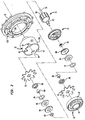
- FIGS. 1-3 illustrate the ultra quiet electric motor in accordance with the principles of the present invention.
- FIGS. 1-2 are cross-sectional and exploded views respectively of the motor and
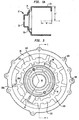
- FIG. 3 is a rear axial plan view of the motor.
- the cross-sectional view of FIG. 1 is taken along the lines 1-1 of FIG. 3.
- Motor 10 includes housing or casing 12 defining an internal cavity 14, end cap 16 mounted to the rear end of the housing 12 to enclose the cavity 14 and armature assembly 18 supported for rotational movement within the housing 12 by front and rear bearing assemblies 20, 22.
- Motor 10 further includes brush card assembly 24 mounted adjacent end cap 16 and commutator 26 which cooperates with the brush card assembly 24 to supply electric current to armature assembly 18.
- a mounting flange 28 is connected to housing 14 for operatively connecting or mounting motor 10 to a supporting portion of the automotive vehicle.
- housing 12 has housing front end 12a which defines a closed central hub portion 30 and a stepped region 32 characterized by a plurality of steps extending from the hub portion 30 to the main portion of the housing 12.
- Central hub portion 30 is structured to facilitate mounting of bearing assembly 20 as discussed in detail below.
- Stepped region 32 increases the effective length or area of housing front end 12a and consequently enhances absorption of vibration energy emanating from front bearing assembly 20.
- Housing 12 further includes a plurality of ventilation apertures 34 extending through housing front end 12a and first cut-out portion 36 (FIG. 2) defined in housing rear end 12b.
- First cut-out portion 36 accommodates vent tube 38 (FIG. 3) which is positioned within the first cut-out portion 36 and retained therein by and cap 16 and brush card assembly 24.
- Ventilation apertures 34 and vent tube 38 provide sufficient circulation of air over armature assembly 18 to cool the assembly components during operation.
- Housing 12 also defines second cut-out portion 40 and diametrically opposed radially depending mounting legs 42. Second cut-out portion 40 receives electrical connector 44. Mounting legs 42 facilitate mounting of end cap 16 and brush card assembly 24 to housing as discussed below.
- Housing 12 is advantageously dimensioned to be in-line with passive noise cancellation principles to increase the near field reactive acoustic field around the motor.
- the phase angle been acoustic pressure and particle velocity fields determines the contents of active and reactive intensity of the nearfield acoustic propagation. The greater the strength of the reactive field the greater the control on the noise propagation as created by the motor components to the farfield.
- the phase angle is related at least in part to the housing dimensions and, if appropriately selected, the strength of the reactive intensity field may be maximized causing the destruction of the active intensity field generated by the motor components.
- housing 12 is basically of cylindrical form
- the surface vibration generated on housing 12 may be regarded as a series of rotating sinusoidal waves of displacement on the cylindrical surface of the machine.
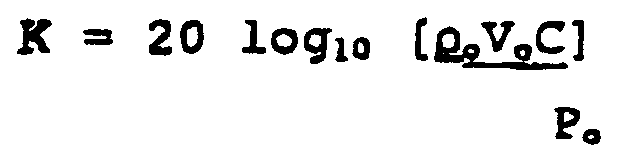
- the phase difference between sound pressure and particle velocity is represented by the following formula:
- FIG. 4 is a graph of the values generated by the program, which depicts how phase angle varies with length/diameter ratio of the housing 12 while other parameters are kept constant. As shown by the graph, it is possible to create a reactive near field around the electric motor by selecting the dimensions of the housing 12.
- the length "2b" of the main cylindrical section 12c i.e., the cylindrical section with the greatest diameter of the housing 12 ranges from about 0.50 to about 0.80, more preferably 0.73, the length or distance of the inner diameter "2a" of the main cylindrical section 12c (compared to conventional housing of electric motors which typically have a length to diameter ratio of about 1.25) to produce a phase angle of between about 60° and 70°, more preferably about 65°.
- the phase angle of about 65° has proven effective in achieving noise cancellation objectives. It is to be appreciated however that any length to diameter ratio of less than about 1.25 is contemplated to be within the scope of the present invention including ratios less than 1.1, 1.0, 0.9 etc.
- End cap 16 defines central hub portion 44 and a stepped region 46 extending outwardly from the central hub portion.
- Central hub portion 44 is similar to structure and function to the central hub portion 30 of the front end of housing 12 , i.e., it facilitates mounting of rear bearing assembly 22.
- End cap 16 further defines peripheral lip portion 48 which extends circumferentially about the end cap 16.
- Peripheral lip portion 48 is advantageously dimensioned to minimize surface vibration of end cap 16 as will be discussed below.
- Peripheral lip portion 48 includes cut-out portion 50 (FIGS. 6 and 7)which corresponds to second cut-out portion 40 of housing 12 to accommodate electrical connector 44.
- End cap 16 further defines a stamped pattern about central hub portion 44 consisting of a series of alternating elongated arcuate raised portions 52 and depressions 54.
- the raised portions 52 include peripheral arcuate portions 52a and radial portions 52b.
- This stamped pattern facilities absorption of vibratory movement created by rear bearing assembly 22 and achieves passive noise cancellation and reduction in surface vibration level.
- the stamped pattern also helps to shift the natural frequency of the component into a frequency of high end.
- the transformation of surface vibration to airborne sound is a function of 1) the amplitude of vibration and 2) the radiation efficiency of the source.
- End cap 16 is advantageously dimensioned to increase its damping characteristics.
- the stamped pattern of alternating raised portions 52 and depressions 54 impedes the flow of vibratory energy.
- the stamped pattern helps to split the large vibrating source transferred to end cap 16 into a number of small vibrating sources, thus, in effect, reducing overall surface vibration levels of the end cap.
- the stamped pattern works to reduce the overall noise level by making use of the phase variation between the created small vibrating elemental sources. Further, by mutual stiffening with the entire area surface, vibration levels on each small area is also reduced.
- the stamped pattern of the end cap 16 effectively decreases the surface vibration level of the radiating structure. More specifically, arcuate raised portions 52 and depressions 54 effectively decrease the surface vibration level measured six-(6) fold compared to conventional production end caps.
- Armature assembly 18 includes armature shaft 56 and armature 58 mounted about the armature shaft 56.
- Armature shaft 56 consists of shaft end sections 60, 62 and shaft intermediate section 64 (shown in phantom).
- a tube-like structure 65 surrounds intermediate shaft section 64 and functions as an insulator to insulate armature 58 from the shaft 56.
- the tube-like structure 65 is preferably formed from two separate tubes positioned over shaft section 64.
- shaft end sections 60, 62 and intermediate section 64 are a homogenous structural member, however, shaft 56 may comprise individual sections 60, 62 and 64 joined by conventional means.
- Armature shaft 56 may also be a single unit.
- the overall length of armature shaft 56 is reduced by about 20% relative to conventional units. This reduction facilitates dynamic balancing of the rotor, reduction in mass of rotating part, etc..., thereby minimizing vibratory movement of the shaft and noise generation.
- Armature 58 may be any conventional armature and consists of an armature core housing a number of stacked, laminations with set of insulation-coated wire windings wound thereabout. The laminations may be treated with inductive heating if desired. Armature 58 is coaxially mounted about shaft 56. A mounting plate (not shown) may be provided for structural connection of the armature core and windings to intermediate shaft section 64. Armature 58 is in electrical contact with commutator 26 and rotates in response to the magnetic field provided by magnets "m" mounted within housing 12. Armature 58 may be axially centered relative to magnets "m” or may be off-center with respect to the magnets "m” whereby the armature 58 is pre-loaded to one side.
- Each bearing assembly 20, 22 is identical with respect to their component parts.
- Each bearing assembly 20, 22 includes sleeve bearing housing 66 and sleeve bearing 68 supported within the bearing housing.
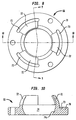
- bearing housing 66 includes annular base 70 and a plurality (e.g., 3) of arcuate mounting projections 72 extending from the base.
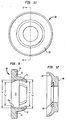
- Annular base 70 has a relatively large cross-sectional dimension and defines internal bore 74 which is configured to generally correspond to the outer dimension of sleeve bearing 68 (both in the radial and axial directions).
- bearing housing 66 receives sleeve bearing 68 in a manner whereby the bearing housing wall portion or receiving wall portion 74a defining internal bore 74 is in contacting engagement with the sleeve bearing portion received therein.
- a substantial surface area of bearing sleeve 68 is in contact with bearing housing 66. This feature facilitates transfer of acoustic vibration energy from sleeve bearing 68 to bearing housing 66 as will be discussed in greater detail below.
- Annular base 70 defines a first dimension or diameter "a" at one end and a second dimension "b" at the other end.
- Mounting projections 72 of bearing housing 66 are also dimensioned to follow the configuration of the outer surface of sleeve bearing 68.
- the internal dimension defined by mounting projections 72 is slightly greater that internal bore 74 of annular base 70 and the outer dimension of sleeve bearing 68 as best depicted in FIG. 9 thus providing a slight gap or clearance between the sleeve bearing 68 and the mounting projections 72.
- mounting projections define internal dimension "c" and internal dimension "d” which are greater than corresponding respective dimensions "a", "b” of the annular base 70. This clearance permits adjusting radial movement of sleeve bearing 66 during rotation of armature shaft 56, i.e., it provides self aligning of the bearing system.
- a plurality (e.g., three) of arcuate grooves 73 are formed in the outer surface of annular base 70.
- Grooves 73 serve two functions: 1) the grooves 73 increase the effective length of each mounting projections 72 thus facilitating flexing movement of the mounting projections 72 during assembly and during radial movement of sleeve bearings 66 during operation of the motor, and 2) the grooves 73 may accommodate a retainer to mount the bearing assemblies 20, 22 within their respective housing component.
- Bearing housing 66 is preferably fabricated from a plastic material to reduce vibration transmission and to permit absorption of vibration energy transferred through sleeve bearing 66 from armature shaft 56. As indicated above, vibration energy transfer is controlled by the dimensioning of internal bore 74 of bearing housing 66 and made by injection molding. In a preferred embodiment, bearing housing 66 is fabricated from a polymeric material. Bearing housing 66 also serves to prevent direct contact of sleeve bearing 68 with housing front end 12a (or end cap 16). In particular, enlarged base 70 of bearing housing 66 contacts the inner surface of front end 12a (or end cap 16) and distributes the load (of vibration) on housing front end 12a (or the end cap 16) by bearing 68.
- enlarged base 70 advantageously increases the effective area of a surface contact between the bearing assembly 20, 22 and the housing front end 12a (or end cap) 16) thus distributing the load and minimizing vibration experienced by the housing front end 12a (or end cap 16).
- a bearing housing isolator 76 (FIGS. 1 and 2) may be wrapped about bearing housing 66.
- Housing isolator 76 is preferably fabricated from an energy (e.g., acoustic) absorbing material such as felt, foam (acoustic) or similar material and is intended to absorb or dampen residual acoustic energy emanating from bearing housing 66.
- Bearing housing retainer 78 is preferably fabricated from a resilient spring material (such as spring steel) and is configured to frictionally engage the interior of the respective central hub portion 30, 44.
- Bearing housing retainer 78 may be a variety of configurations and may be at least partially accommodated within arcuate grooves 73 formed in the surface of enlarged base 70.
- an anti-vibration/dampening (AVD) washer 80 is positioned about armature shaft 56 proximate each sleeve bearing 68.
- AVD washer 80 is preferably press fit into armature shaft 56 and serves dual functions: 1) arcuate surface 82 of AVD washer 80 directs any oil which may leak from sleeve bearings 68 back to the bearing thus increasing bearing life; and 2) the AVD washer dampens axial vibration on armature shaft by acting as an elastic spring. This in turn minimizes any excessive noise created at the sleeve bearings 68 by the shaft movement in the axial direction.
- At least one resilient washer 84 may be positioned between AVD washer 80 and sleeve bearing 66 to accommodate thrust movement of armature shaft 56 during operation. Suitable material for washer 84 includes elastomeric or plastic materials.
- a noise absorption member 86 is positioned adjacent AVD washer 80.
- Noise absorption member 86 is preferably a ring configuration defining an internal aperture for receiving at least a portion of AVD washer 80.
- Noise absorption member 86 is preferably fabricated from noise absorbing material such as felt, fiber glass, etc.
- a holder 88 positively fixes noise absorption member 86 within housing front end 12 along end cap 16.
- Holder 88 is preferably fabricated from a resilient material, e.g., spring steel or a polymeric material, which frictionally engages corresponding inner surfaces of housing front end 12a (or end cap 16) to retain noise absorbing member 86 therewithin.
- Noise retaining member 86 acoustically isolates front or rear bearing assemblies 20, 22 from the armature section of the motor to absorb residual noise generated by the respective bearing assembly 20, 22.
- Brush card assembly 24 is intended to be an isolator of vibration energy flow between end cap 16, housing 14 and the brush tube assembly.
- Brush card assembly 24 includes a generally annular shaped brush card mount 90 and a brush card 92 which is supported by the mount.
- Brush card mount 90 is preferably fabricated from an elastomeric or polymeric material formed through injection molding techniques and capable of absorbing dampening vibration energy flow.
- Brush plate 92 may be mounted within brush card mount 90 during the molding process to connect the two components.
- Brush plate 92 includes structure, identified generally by reference numeral 94, (e.g., mounting projections, etc...) to support a plurality of brushes (not shown) to contact commutator 26.
- Brush plate 92 may be any conventional plate arrangement.
- Brush card mount 90 includes a first annular portion 96 defining peripheral surface 98.
- First annular portion 96 is dimensioned to be positioned within peripheral lip portion 48 of end cap 16 in the assembled condition of the motor depicted in FIG. 1, and is advantageously dimensioned to correspond to the inner dimension of the peripheral lip portion 48 whereby the peripheral lip portion 48 is in contacting engagement with the peripheral surface 98 of the first annular portion 96.
- vibration energy carried through end cap 16 and peripheral lip portion 48 is conveyed to first annular portion 96 of brush card mount 90 to be dampened or absorbed by the brush mount.
- Brush card mount 90 further includes a second annular portion 100 which defines a diameter greater than the diameter of first annular portion 96. In the assembled position of the motor, second annular portion 100 is interposed between end cap 16 and housing rear end 12b to absorb vibratory energy transfer between the two components.
- Brush card mount 90 includes first and second cut-outs 102, 104 to respectively receive electrical connector 44 and vent tube assembly 38.
- Brush card mount 90 further includes diametrically opposed mounting recesses 106 defined between mounting nubs 108 to receive radially depending mounting legs 42 of housing 12.
- a pair of mounting fasteners 110 e.g., bolts
- Fasteners 110 may be threaded at their distal ends to threadably engage an internal threaded aperture of housing mounting leg 42.
- a cylindrical rigid spacer 112 surrounds at least an intermediate portion of each fastener 110.
- Spacer 112 maintains a predetermined distance between end cap 16 and housing 12 thereby ensuring that brush plate 92 and the brushes supported thereby are in general perpendicular relation to commutator 26. This facilitates proper orientation of the brushes with commutator 26 to maintain desired continuous electrical contact. Spacer 112 also serves to absorb vibration energy transfer between end cap 16 and housing 12.
- the electric motor of the present invention efficiently reduces acoustic energy transfer and noise level generated during the operation of the electric motor through the incorporation of vibration energy reduction and noise reduction principles. More particularly, the unique configuration of front and rear bearing assemblies 20, 22 minimizes vibration energy transfer to housing front end 12a and end cap 16. Any residual noise which may be generated is absorbed by and isolated within the respective bearing area by noise absorbing members 86. Transfer of vibration energy through the housing front end 12a is reduced by the stepped region of the front end 12a while transfer of energy through the end cap 16 is reduced by the stamped pattern on the face of the end cap 16. Vibration and acoustic energy transfer between the end cap 16, housing 14 and brush plate is minimized by the brush card mold assembly 24.
- Mounting flange 28 includes an internal lip 114 defining a bore which receives the housing 12 of the electric motor. Internal lip 114 is secured to the outer surface of housing 12 by conventional means including welding, adhesives etc...
- the peripheral area of mounting flange 28 has a stamped pattern consisting of a series of alternating generally rectangular shaped depressions 116 and arcuate depressions 118 (FIG. 3).
- the arcuate depressions 118 extend in a radial direction (i.e., arcuate depressions have a radial component 118a greater than a peripheral component 118b).
- Depressions 116, 118 function to effectively divide the flange into a plurality of sections which in effect separates the large vibrating source transferred to flange 28 into smaller vibrating sources.
- the stamping pattern effectively stiffens the flange to also reduce surface vibration levels.
- Mounting flange 28 also reduces the noise level by making use of the phase variation or difference between the created small vibrating sources. The vibration levels of the structure is thereby decreased, consequently, decreasing the sound pressure level SPL (f) at a particular frequency.
- stamped pattern helps to shift the natural frequency of the component into a frequency of high end.
- a plurality of mounting apertures 120 extend through the extreme outer surface of the flange 28 for mounting to the vehicle flame.
- the electric motor of the present invention has proven to be quite effective in minimizing noise generated by the motor.
- the electric motor 10 of the present invention has been measured to generate a noise level less than 37 DBA overall when taken at 10 cm distances from the motor surface.
- Current motor noise specification stands at about 40 DBA thus representing a substantial decrease with the present motor.
Landscapes
- Engineering & Computer Science (AREA)
- General Engineering & Computer Science (AREA)
- Power Engineering (AREA)
- Mechanical Engineering (AREA)
- Motor Or Generator Frames (AREA)
Abstract
Description


The accurate value of K is established by computing and by verification using similar noise sources; and
Claims (14)
- A bearing assembly for an electric motor of the type including a housing defining an internal chamber; an armature disposed within the internal chamber and having a rotatable shaft; and magnet means for inducing rotational movement of the armature shaft, the bearing assembly comprising:a bearing member for supporting the armature shaft for rotational movement; anda bearing housing defining an internal bore that accommodates at least a portion of the bearing member, the bearing housing comprising a vibration energy absorbing material, and being dimensioned such that an inner wall portion of the bearing housing defining the internal bore is in contacting engagement with an outer surface of the bearing member to facilitate absorption of vibration energy from the sleeve member bearing.
- The bearing assembly according to claim 1 wherein the bearing housing includes a base defining a central axis, and a plurality of mounting projections extending from the base, the mounting projections configured to surround at least a portion of the bearing member to facilitate retention of the bearing member within the bearing housing.
- The bearing assembly according to claim 2 wherein the mounting projections are dimensioned such that a gap is defined between the portion of the bearing member and the mounting projections to permit adjusting movement of the bearing member within the bearing housing.
- The bearing assembly according to claim 3 including three mounting projections equidistantly arranged about the central axis of the base.
- The beating assembly according to claim 3 wherein the base includes at least one arcuate groove defined in an outer surface thereof adjacent one of the mounting projections to facilitate flexing movement of the one mounting projection.
- The bearing assembly according to claim 3 further including energy absorbing material at least partially surrounding the bearing housing to dampen residual acoustic energy.
- An electric motor for automotive applications and characterized by exhibiting minimal acoustic noise radiation which comprises:a housing having housing end portions and defining an internal chamber;an armature disposed within the internal chamber and having an armature shaft and an armature core; anda sleeve bearing assembly mounted adjacent one of the housing end portions for supporting the armature shaft for rotational movement within the housing, the sleeve bearing assembly including;a sleeve bearing member defining an opening that receives an end portion of the armature shaft; anda sleeve bearing housing, including:a base defining a central axis and having an internal bore for accommodating the bearing member and being dimensioned such that an inner wall portion of the bearing housing defining the internal bore is in contacting engagement with an outer surface of the bearing member; anda plurality of mounting projections extending in a general axial direction from the base, the mounting projections arranged to surround at least a portion of the bearing member to facilitate retention of the bearing member within the internal bore.
- The bearing assembly according to claim 7 wherein the mounting projections are dimensioned such that a gap is defined between the portion of the bearing member and the mounting projections to permit adjusting movement of the bearing member within the bearing housing.
- The electric motor according to claim 7 wherein the sleeve bearing assembly includes a retainer member engageable with the one housing end portion for retaining the sleeve bearing housing therewithin.
- The electric motor according to claim 9 wherein the sleeve bearing housing includes an arcuate groove defined in an outer surface of the base adjacent each mounting projection.
- The electric motor according to claim 10 wherein the retainer member is at least partially accommodated within the arcuate grooves of the base.
- The electric motor according to claim 7 further including a noise absorbing member disposed between the sleeve bearing assembly and the armature core of the armature, the noise absorbing member adapted to absorb noise from the sleeve bearing assembly to substantially acoustically isolate the one housing end portion containing the sleeve bearing assembly.
- The electric motor according to claim 7 including an end cap mounted to the other of the housing end portions, the end cap having a second bearing sleeve assembly mounted therein.
- The electric motor according to claim 7 wherein the base of the sleeve bearing housing comprises a vibration energy absorbing material.
Applications Claiming Priority (2)
| Application Number | Priority Date | Filing Date | Title |
|---|---|---|---|
| US947234 | 1986-12-29 | ||
| US08/947,234 US5917258A (en) | 1997-10-08 | 1997-10-08 | Bearing assembly for an ultra quiet electric motor |
Publications (2)
| Publication Number | Publication Date |
|---|---|
| EP0909005A2 true EP0909005A2 (en) | 1999-04-14 |
| EP0909005A3 EP0909005A3 (en) | 1999-06-23 |
Family
ID=25485792
Family Applications (1)
| Application Number | Title | Priority Date | Filing Date |
|---|---|---|---|
| EP98118731A Withdrawn EP0909005A3 (en) | 1997-10-08 | 1998-10-05 | A bearing assembly for an ultra quiet electric motor |
Country Status (2)
| Country | Link |
|---|---|
| US (1) | US5917258A (en) |
| EP (1) | EP0909005A3 (en) |
Cited By (4)
| Publication number | Priority date | Publication date | Assignee | Title |
|---|---|---|---|---|
| GB2425156A (en) * | 2005-04-11 | 2006-10-18 | Askoll Holding Srl | Bearing arrangement for an electric motor |
| DE102013021186A1 (en) | 2013-12-17 | 2014-07-31 | Daimler Ag | Internal rotor-type electric machine i.e. permanent magnet-excited synchronous machine, for use as e.g. traction motor in motor vehicle, has stator, rotor, and sound absorption device arranged at surface of stator and/or rotor |
| CN103368316B (en) * | 2012-04-06 | 2016-01-13 | 中山市普阳电子科技有限公司 | Motor apparatus |
| EP2984741B1 (en) * | 2013-02-27 | 2023-04-12 | Pierburg GmbH | Motor for an egr valve |
Families Citing this family (20)
| Publication number | Priority date | Publication date | Assignee | Title |
|---|---|---|---|---|
| DK9600125U4 (en) * | 1996-04-11 | 1997-07-25 | Interroll A S | Drum Motor |
| US6252321B1 (en) * | 1999-06-23 | 2001-06-26 | General Electric Company | Endshield assembly with alignable bearing for an electric motor |
| US6376952B1 (en) * | 1999-07-14 | 2002-04-23 | E. I. Du Pont De Nemours And Company | Bearing system for a rotating shaft |
| US6700255B1 (en) | 1999-11-12 | 2004-03-02 | E. I. Du Pont De Nemours And Company | Bearing system with flexible bearing bracket |
| US6518686B2 (en) * | 2001-02-23 | 2003-02-11 | Valeo Electrical Systems, Inc. | Electric motor including unitary brush card bushing holder |
| GB0125402D0 (en) * | 2001-10-23 | 2001-12-12 | Johnson Electric Sa | Electric motor |
| CN1784937B (en) * | 2003-05-06 | 2011-09-28 | 利纳克有限公司 | An actuator |
| DE112004002423D2 (en) * | 2003-10-10 | 2006-08-24 | Bosch Gmbh Robert | electric motor |
| US7005769B1 (en) | 2004-09-28 | 2006-02-28 | Siemens Vdo Automotive Inc. | Sleeve bearing assembly with acoustic/vibration decoupling and endplay adjustment |
| US7196438B2 (en) * | 2005-05-12 | 2007-03-27 | Emerson Electric Co. | Resilient isolation members and related methods of reducing acoustic noise and/or structural vibration in an electric machine |
| EP1744082B1 (en) * | 2005-07-15 | 2011-06-29 | Brose Fahrzeugteile GmbH & Co. KG, Würzburg | Actuator, especially for a motor vehicle |
| TWI373903B (en) * | 2008-09-23 | 2012-10-01 | Sunonwealth Electr Mach Ind Co | Inner-rotor type fan |
| GB201006329D0 (en) * | 2010-04-16 | 2010-06-02 | Rolls Royce Plc | A mounting arrangement for an electrical machine |
| US20120111650A1 (en) * | 2010-11-04 | 2012-05-10 | Motoczysz | Drive System |
| DE102011076081A1 (en) * | 2011-05-18 | 2012-11-22 | Robert Bosch Gmbh | Thrust washer for an electric machine |
| CN105449909B (en) | 2014-09-24 | 2020-01-31 | 雷勃美国公司 | Axial flux motor bearing mounting system and method |
| FR3029963B1 (en) * | 2014-12-11 | 2020-01-17 | Valeo Systemes De Controle Moteur | ELECTRIC MACHINE |
| DE102016012246A1 (en) * | 2016-10-14 | 2018-04-19 | Thyssenkrupp Ag | Electromechanical power steering with sprung bearing arrangement |
| CN118971474B (en) * | 2024-08-09 | 2025-10-10 | 珠海格力电器股份有限公司 | A vibration-damping end cover structure and a motor using the same |
| CN120474246A (en) * | 2025-05-12 | 2025-08-12 | 明程电机技术(深圳)有限公司 | A motor aerodynamic active noise reduction structure and system |
Family Cites Families (30)
| Publication number | Priority date | Publication date | Assignee | Title |
|---|---|---|---|---|
| GB215229A (en) * | 1923-07-26 | 1924-05-08 | George Shakespeare Wilkinson | Improvements in or relating to crank shaft bearings |
| DE1119997B (en) * | 1960-05-02 | 1961-12-21 | Licentia Gmbh | Vibration-isolating installation of electric motors |
| US3337165A (en) * | 1965-03-26 | 1967-08-22 | Victor Company Of Japan | Vibration damping device |
| DE1475393B2 (en) * | 1965-07-26 | 1972-03-02 | Licentia Patent Verwaltungs GmbH, 6000 Frankfurt | ARRANGEMENT FOR VIBRATION ISOLATING A FIXING OF A SMALL MOTOR TO A DEVICE |
| DE1488452A1 (en) * | 1965-11-09 | 1969-04-10 | Bosch Gmbh Robert | Collector motor that can be operated with alternating current |
| DE1675010A1 (en) * | 1968-02-06 | 1972-04-13 | Siemens Ag | Arrangement for the damping of vibrations transmitted via a shaft bearing |
| US4186319A (en) * | 1977-04-26 | 1980-01-29 | General Electric Company | Dynamoelectric machine end shield |
| US4112321A (en) * | 1977-07-26 | 1978-09-05 | Electrohome Limited | Brush holder and brush assembly for a dynamoelectric machine |
| DE2756531A1 (en) * | 1977-12-19 | 1979-06-21 | Siemens Ag | MOTORIZED WINDOW REGULATORS, IN PARTICULAR FOR INSTALLATION IN THE DOORS OF MOTOR VEHICLES |
| DE2847099A1 (en) * | 1978-10-30 | 1980-05-14 | Siemens Ag | BRACKET FOR CALOT BEARING |
| US4368931A (en) * | 1980-07-24 | 1983-01-18 | Plus Manufacturing Co., Inc. | Self aligning press in bearing structures |
| US4631433A (en) * | 1985-05-06 | 1986-12-23 | General Electric Company | Plastic end shield with thermal barrier for dynamoelectric machines |
| US4801833A (en) * | 1985-12-12 | 1989-01-31 | Eaton Stamping Company | Motor end cap |
| US4665332A (en) * | 1986-05-20 | 1987-05-12 | Seti, Inc. | Electric generator assembly for a projectile |
| US4845396A (en) * | 1986-08-19 | 1989-07-04 | Capsonic Group, Inc. | Motor brush holder assembly |
| IT214296Z2 (en) * | 1988-05-17 | 1990-04-24 | Spal Srl | SUPPORT STRUCTURE AND SIDE CLOSURE FOR ELECTRIC MOTORS |
| US4885948A (en) * | 1988-07-11 | 1989-12-12 | United Technologies Electro Systems, Inc. | Stabilized motor driven actuator |
| US4823032A (en) * | 1988-08-01 | 1989-04-18 | General Motors Corporation | End frame and stator assembly for a dynamoelectric machine |
| US5113104A (en) * | 1989-10-19 | 1992-05-12 | General Electric Company | Structured product dynamoelectric machine |
| US5237231A (en) * | 1989-10-19 | 1993-08-17 | General Electric Company | Structured product dynamoelectric machine |
| US5049770A (en) * | 1990-03-26 | 1991-09-17 | General Motors Corporation | Electric motor-driven impeller-type air pump |
| US5204567A (en) * | 1990-07-09 | 1993-04-20 | Asmo Co., Ltd. | Brushless motor with resilient shaft end-play absorber |
| US5235227A (en) * | 1991-01-23 | 1993-08-10 | Panavision International L.P. | Noise and vibration dampened electric motor such as for use with a sound movie camera |
| US5126607A (en) * | 1991-03-22 | 1992-06-30 | Ncr Corporation | Stepper motor vibration isolator |
| JPH0617355U (en) * | 1992-07-29 | 1994-03-04 | 株式会社三協精機製作所 | DC motor |
| EP0586723B1 (en) * | 1992-09-07 | 1995-05-17 | Siemens Aktiengesellschaft | Brush holder with noise damping, in particular for a small commutator motor |
| JPH0652361U (en) * | 1992-12-24 | 1994-07-15 | マブチモーター株式会社 | Small motor |
| JP3435182B2 (en) * | 1993-01-20 | 2003-08-11 | 株式会社日立製作所 | Small electric motor and blower using the same |
| GB9311823D0 (en) * | 1993-06-08 | 1993-07-28 | Johnson Electric Sa | An electric motor casing incorporating a bearing retainer |
| US5414317A (en) * | 1993-10-29 | 1995-05-09 | Eaton Stamping Company | Electric motor with brush card isolated from endframe |
-
1997
- 1997-10-08 US US08/947,234 patent/US5917258A/en not_active Expired - Fee Related
-
1998
- 1998-10-05 EP EP98118731A patent/EP0909005A3/en not_active Withdrawn
Cited By (5)
| Publication number | Priority date | Publication date | Assignee | Title |
|---|---|---|---|---|
| GB2425156A (en) * | 2005-04-11 | 2006-10-18 | Askoll Holding Srl | Bearing arrangement for an electric motor |
| GB2425156B (en) * | 2005-04-11 | 2009-02-04 | Askoll Holding Srl | Variable speed synchronous electric motor with rotor immersed in a fluid, particularly for pumps |
| CN103368316B (en) * | 2012-04-06 | 2016-01-13 | 中山市普阳电子科技有限公司 | Motor apparatus |
| EP2984741B1 (en) * | 2013-02-27 | 2023-04-12 | Pierburg GmbH | Motor for an egr valve |
| DE102013021186A1 (en) | 2013-12-17 | 2014-07-31 | Daimler Ag | Internal rotor-type electric machine i.e. permanent magnet-excited synchronous machine, for use as e.g. traction motor in motor vehicle, has stator, rotor, and sound absorption device arranged at surface of stator and/or rotor |
Also Published As
| Publication number | Publication date |
|---|---|
| EP0909005A3 (en) | 1999-06-23 |
| US5917258A (en) | 1999-06-29 |
Similar Documents
| Publication | Publication Date | Title |
|---|---|---|
| EP0909007B1 (en) | Ultra quiet electric motor for automotive applications | |
| US5917258A (en) | Bearing assembly for an ultra quiet electric motor | |
| EP0910153B1 (en) | An end cap for an ultra quiet electric motor | |
| US5905320A (en) | Housing for an ultra quiet electric motor | |
| US5914550A (en) | Mounting flange for an ultra quiet electric motor | |
| EP1202436B1 (en) | Miniature electric motor with reduced noise emission | |
| US7328474B2 (en) | Electric toothbrush with linear oscillator | |
| JP6726630B2 (en) | Blower motor unit for air conditioning | |
| US7659644B2 (en) | Brushless motor and manufacturing method thereof | |
| US5977666A (en) | Electric motor having brush noise absorption system | |
| US9985495B2 (en) | Apparatus for mounting a motor such that vibrations are decoupled | |
| CN207884413U (en) | Motor | |
| JP4294866B2 (en) | fan | |
| JPH11252851A (en) | Motor for electric power steering system | |
| JP2014171365A (en) | Stator, electric motor, and motor with speed reducer | |
| KR20230140662A (en) | Exterior rotor Motor | |
| JPH11289735A (en) | Brushless motor | |
| US7157825B1 (en) | Motor | |
| US20030042804A1 (en) | Three layer vibration damping washer for an electric motor | |
| JP7178547B2 (en) | brushless motor | |
| JP3503794B2 (en) | motor | |
| KR101104072B1 (en) | A motor | |
| KR19980021757U (en) | Motor anti-vibration device | |
| JP2025000371A (en) | Rotary electric machine holding device | |
| JP2001054253A (en) | Motor floating support structure |
Legal Events
| Date | Code | Title | Description |
|---|---|---|---|
| PUAI | Public reference made under article 153(3) epc to a published international application that has entered the european phase |
Free format text: ORIGINAL CODE: 0009012 |
|
| AK | Designated contracting states |
Kind code of ref document: A2 Designated state(s): DE FR GB IT |
|
| AX | Request for extension of the european patent |
Free format text: AL;LT;LV;MK;RO;SI |
|
| PUAL | Search report despatched |
Free format text: ORIGINAL CODE: 0009013 |
|
| AK | Designated contracting states |
Kind code of ref document: A3 Designated state(s): AT BE CH CY DE DK ES FI FR GB GR IE IT LI LU MC NL PT SE |
|
| AX | Request for extension of the european patent |
Free format text: AL;LT;LV;MK;RO;SI |
|
| RIC1 | Information provided on ipc code assigned before grant |
Free format text: 6H 02K 5/167 A, 6F 16C 27/06 B, 6H 02K 7/08 B |
|
| 17P | Request for examination filed |
Effective date: 19990922 |
|
| AKX | Designation fees paid |
Free format text: DE FR GB IT |
|
| RAP1 | Party data changed (applicant data changed or rights of an application transferred) |
Owner name: SIEMENS VDO AUTOMOTIVE INC. |
|
| 17Q | First examination report despatched |
Effective date: 20031204 |
|
| GRAP | Despatch of communication of intention to grant a patent |
Free format text: ORIGINAL CODE: EPIDOSNIGR1 |
|
| STAA | Information on the status of an ep patent application or granted ep patent |
Free format text: STATUS: THE APPLICATION IS DEEMED TO BE WITHDRAWN |
|
| 18D | Application deemed to be withdrawn |
Effective date: 20060427 |