EP0907538B1 - Seat valve for hydraulic braking systems of motor vehicles - Google Patents
Seat valve for hydraulic braking systems of motor vehicles Download PDFInfo
- Publication number
- EP0907538B1 EP0907538B1 EP97927146A EP97927146A EP0907538B1 EP 0907538 B1 EP0907538 B1 EP 0907538B1 EP 97927146 A EP97927146 A EP 97927146A EP 97927146 A EP97927146 A EP 97927146A EP 0907538 B1 EP0907538 B1 EP 0907538B1
- Authority
- EP
- European Patent Office
- Prior art keywords
- valve
- seat
- pressure
- retaining member
- closure member
- Prior art date
- Legal status (The legal status is an assumption and is not a legal conclusion. Google has not performed a legal analysis and makes no representation as to the accuracy of the status listed.)
- Expired - Lifetime
Links
- 239000012530 fluid Substances 0.000 claims description 11
- 230000000694 effects Effects 0.000 claims description 5
- 238000000034 method Methods 0.000 claims description 3
- 230000003313 weakening effect Effects 0.000 claims description 2
- 230000003134 recirculating effect Effects 0.000 claims 3
- 230000004913 activation Effects 0.000 claims 1
- 230000000717 retained effect Effects 0.000 claims 1
- 230000005284 excitation Effects 0.000 description 5
- 230000009172 bursting Effects 0.000 description 4
- 238000000465 moulding Methods 0.000 description 3
- 238000004519 manufacturing process Methods 0.000 description 2
- 238000007493 shaping process Methods 0.000 description 2
- 230000000903 blocking effect Effects 0.000 description 1
- 230000006378 damage Effects 0.000 description 1
- 230000001419 dependent effect Effects 0.000 description 1
- 210000003746 feather Anatomy 0.000 description 1
- 238000005429 filling process Methods 0.000 description 1
- 238000010438 heat treatment Methods 0.000 description 1
- 239000002184 metal Substances 0.000 description 1
- 125000006850 spacer group Chemical group 0.000 description 1
Images
Classifications
-
- B—PERFORMING OPERATIONS; TRANSPORTING
- B60—VEHICLES IN GENERAL
- B60T—VEHICLE BRAKE CONTROL SYSTEMS OR PARTS THEREOF; BRAKE CONTROL SYSTEMS OR PARTS THEREOF, IN GENERAL; ARRANGEMENT OF BRAKING ELEMENTS ON VEHICLES IN GENERAL; PORTABLE DEVICES FOR PREVENTING UNWANTED MOVEMENT OF VEHICLES; VEHICLE MODIFICATIONS TO FACILITATE COOLING OF BRAKES
- B60T8/00—Arrangements for adjusting wheel-braking force to meet varying vehicular or ground-surface conditions, e.g. limiting or varying distribution of braking force
- B60T8/32—Arrangements for adjusting wheel-braking force to meet varying vehicular or ground-surface conditions, e.g. limiting or varying distribution of braking force responsive to a speed condition, e.g. acceleration or deceleration
- B60T8/34—Arrangements for adjusting wheel-braking force to meet varying vehicular or ground-surface conditions, e.g. limiting or varying distribution of braking force responsive to a speed condition, e.g. acceleration or deceleration having a fluid pressure regulator responsive to a speed condition
- B60T8/36—Arrangements for adjusting wheel-braking force to meet varying vehicular or ground-surface conditions, e.g. limiting or varying distribution of braking force responsive to a speed condition, e.g. acceleration or deceleration having a fluid pressure regulator responsive to a speed condition including a pilot valve responding to an electromagnetic force
- B60T8/3615—Electromagnetic valves specially adapted for anti-lock brake and traction control systems
- B60T8/363—Electromagnetic valves specially adapted for anti-lock brake and traction control systems in hydraulic systems
-
- F—MECHANICAL ENGINEERING; LIGHTING; HEATING; WEAPONS; BLASTING
- F16—ENGINEERING ELEMENTS AND UNITS; GENERAL MEASURES FOR PRODUCING AND MAINTAINING EFFECTIVE FUNCTIONING OF MACHINES OR INSTALLATIONS; THERMAL INSULATION IN GENERAL
- F16K—VALVES; TAPS; COCKS; ACTUATING-FLOATS; DEVICES FOR VENTING OR AERATING
- F16K31/00—Actuating devices; Operating means; Releasing devices
- F16K31/02—Actuating devices; Operating means; Releasing devices electric; magnetic
- F16K31/06—Actuating devices; Operating means; Releasing devices electric; magnetic using a magnet, e.g. diaphragm valves, cutting off by means of a liquid
- F16K31/0644—One-way valve
- F16K31/0655—Lift valves
- F16K31/0665—Lift valves with valve member being at least partially ball-shaped
Definitions
- the invention relates to a seat valve for hydraulic Motor vehicle braking systems with wheel slip control according to the preamble of claim 1.
- a seat valve of the generic type is already out of the US-A-4,056,255.
- the poppet valve points to Locking the valve closing member in its open position a permanent magnet attached in the area of the magnetic core whose magnetic circuit depends on the magnetic circuit of one magnet coil attached below the permanent magnet determines the switching position of the seat valve.
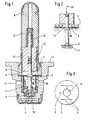
- valve housing 1 shows a sectional view of a seat valve on a much larger scale
- the cartridge design has a valve housing 1, in the lower end of which Valve seat body 4 is attached.
- the valve seat body 4 facing end face portion of the valve housing 1 closed by means of a dome-like valve sleeve 8, which with its open end section between the valve housing 1 and a socket inserted into the valve housing 1 caulked is kept and sealed.
- a disc-shaped Holding part 2 pressure-tight clamped, the Center opening 15 of a tappet-shaped valve closing member 3 is permeated.
- the valve closing member 3 is with his one end in the illustration of the valve seat body 4 spaced, with which a pressure medium connection between that located below the valve seat body 4 Pressure medium channel 10 and that above the valve seat body 4 in the valve housing 1 radially opening pressure medium channel 11 exists.
- the switching position of the seat valve shown 1 thus shows the essence of the invention, according to which in Valve housing 1 is a holding part 2 is fixed, according to the Actuation of the valve closing member 3 from the closed Basic position in the operating position shown in the illustration, the valve closing member 3 in the valve seat body 4 lifted position locked.
- the locking of the holding part 2 on the tappet-shaped section of the valve closing member 3 can be both positive and / or non-positive.
- valve closing element 3 in its open position is done by electromagnetic Excitation of a mounted on the valve sleeve 8, valve coil not shown in the drawing.
- FIG. 2 shows the deformation of the Holding part 2 under the effect of the bursting pressure in the pressure chamber 7, the tongue-like gaping apart of the holding part 2 leads in the area of its central opening 15, which is Can release valve closing member 3 from the holding part 2 and under Effect of the spring 14 in the direction of the valve closing position is moved. So far with regard to Fig. 2 not on all details is received, these still correspond to those in embodiments shown for their essence for the seat valve according to Fig. 1.
- FIG. 3 shows a top view of that known from FIG. 1 Holding part 2.
- Leave outside the pane contour of holding part 2 preferably attached on both sides of the central opening 15 Notches in the surface of the holding part 2 recognize that with appropriate hydraulic pressurization form the predetermined breaking points 5. This is done accordingly the representation of the holding part known from FIG. 2 the desired, tongue-shaped extension of the holding part 2 in the area of the central opening 15.
- the expansion of the Center opening 15 can both after the bursting by appropriate shaping of the predetermined breaking points 5 as also by appropriate heat treatment, preferably consisting of an anti-magnetic thin sheet metal part 2 can be influenced specifically.
- the holding part 2 an aperture 6, which ensures that during the evacuation process within both pressure medium channels 10,11 not only the one facing the pressure medium channels 10,11 Pressure chamber 7, but also the one above the holding part 2 evacuated into the valve sleeve 8 extending pressure chamber 7 ' can be. This is also an evacuation of the relative small pressure chamber 7 'ensured.
- valve closing member 3 Under Effect of the spring 14 first on the valve seat body 4. So far no impermissible leakage losses from the pressure medium channel 10 to Pressure medium channel 11 enter, is by electromagnetic Excitation of the seat valve, the valve closing member 3 from the valve seat body 4 lifted off and shown in the illustration locked in Fig. 1. Stuck in this state it until the evacuation and filling of the brake system and Commissioning in the motor vehicle. As already mentioned, will the locking of the holding part 2 on the valve closing member 3 canceled when the burst pressure is reached. With that is under Reference to the illustration of FIG. 2 ensures that the seat valve is ready for operation with the brakes.
- the valve closing member 3 can then within the framework of a blocking pressure control or traction control only for the duration of one acting on the magnet armature Current pulse open and picks up after completion electromagnetic excitation unimpeded by action the spring 14 its valve position closed in the basic position on.
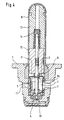
- FIG. 4 An alternative embodiment of the seat valve starts Fig. 4 out.
- this is essentially disc-shaped designed holding part 2 both on the outer circumference and a collar or webs also in the area of the central opening 15 has, which is on the outer circumference of the holding part 2 in the area of the valve housing 1 and in the area of the center opening 15 support on the end face of the magnet armature 12.
- Depending on the space available can either be on the web or Collar area on the outer circumference or on the inner circumference of the holding part 2 can be dispensed with.
- the web or collar height is at least the required Opening stroke of the valve closing member 3 corresponds to the desired evacuation as well as high pressure filling of the Ensure pressure medium channels 10.11.
- the holding part 2 also has at least one end face side annular cross-sectional weakening that the function a predetermined breaking point 5 takes over.
- the holding part 2 is preferably made of a plastic that after evacuation of the channels and cavities in the area of the seat valve is exposed to the hydraulic filling pressure and the broken down into two hollow bodies when the burst pressure is reached.
- the inner hollow body supported on the magnet armature 12 is attached by means of a valve closing member 3 Molding 16 secured, while the outer hollow body as shown on the ring filter and thus also in the original position remains in the valve housing 1.
- the invention thus leads to the result that the secondary circuit, i.e. the brake pipe section between the in Home position closed seat valve and the downstream Pressure medium device according to the return flow principle working brake system remarkably easy evacuated and can be filled if the seat valve by means of a effective rupture disc for the time phase of the Evacuation and filling remains open.
- the holding part or the filling pressure of the brake system can be designed so that after filling the secondary circuit, the holding part the predetermined breaking points burst, causing the valve lifter to the valve closing member is released from the holding part and which closes the seat valve.
- an increased hydraulic if necessary Pressure pulse during filling for the destruction of the holding part can be integrated cost-effectively.
Landscapes
- Engineering & Computer Science (AREA)
- Physics & Mathematics (AREA)
- Electromagnetism (AREA)
- Mechanical Engineering (AREA)
- General Engineering & Computer Science (AREA)
- Fluid Mechanics (AREA)
- Transportation (AREA)
- Valves And Accessory Devices For Braking Systems (AREA)
- Magnetically Actuated Valves (AREA)
Abstract
Description
Die Erfindung betrifft ein Sitzventil für hydraulische Kraftfahrzeug-Bremsanlagen mit Radschlupfregelung nach dem Oberbegriff des Patentanspruchs 1.The invention relates to a seat valve for hydraulic Motor vehicle braking systems with wheel slip control according to the preamble of claim 1.
Die bisher für hydraulische Kraftfahrzeugbremsanlagen mit Radschlupfregelung verwendeten, in ihrer Grundstellung normalerweise geschlossenen Sitzventile haben den Nachteil, daß zum Zwecke der Evakuierung und Befüllung der Bremsanlage jeweils zeit- und kostenaufwendige Maßnahmen getroffen werden müssen, die dafür sorgen, daß das Sitzventil solange geöffnet bleibt, bis der Evakuierungs- und Befüllprozeß für die hydraulische Bremsanlage abgeschlossen ist. Ein Sitzventil der beschriebenen Art geht beispielhaft aus der DE 44 08 166 A1 hervor.The previously used for hydraulic motor vehicle brake systems Wheel slip control normally used in their home position closed seat valves have the disadvantage that for the purpose of evacuating and filling the brake system in each case time-consuming and costly measures are taken must ensure that the poppet valve remains open for as long as possible remains until the evacuation and filling process for the hydraulic brake system is complete. A seat valve the type described is exemplified by DE 44 08 166 A1.
Als Abhilfemaßnahme für vorgenanntes Problem ist bereits aus der DE 43 37 133 A1 bekannt, zum Evakuieren und Befüllen der Bremsanlage das in der Grundstellung geschlossene Sitzventil mittels eines in Richtung des Bremsdruckgebers öffnenden Rückschlagventil zu überbrücken. Dies hat jedoch den Nachteil, daß erhebliche konstruktive Veränderungen an der Bremsanlage erforderlich sind.As a remedy for the above problem is already over DE 43 37 133 A1 known for evacuating and filling the Brake system the seat valve closed in the basic position by means of an opening in the direction of the brake pressure sensor Bridge check valve. However, this has the disadvantage that significant constructive changes to the Brake system are required.
Ein Sitzventil der gattungsbildenden Art ist bereits aus der US-A-4,056,255 bekannt geworden. Das Sitzventil weist zur Arretierung des Ventilschließgliedes in seiner Offenstellung einen im Bereich des Magnetkerns angebrachten Permanentmagneten auf, dessen Magnetkreis abhängig vom Magnetkreis einer unterhalb des Permanentmagneten angebrachten Magnetspule die Schaltstellung des Sitzventil bestimmt.A seat valve of the generic type is already out of the US-A-4,056,255. The poppet valve points to Locking the valve closing member in its open position a permanent magnet attached in the area of the magnetic core whose magnetic circuit depends on the magnetic circuit of one magnet coil attached below the permanent magnet determines the switching position of the seat valve.
Daher ist es die Aufgabe der Erfindung, ein Sitzventil für hydraulische Kraftfahrzeugbremsanlagen mit Radschlupfregelung der angegebenen Art dahingehend zu verbessern, daß mit geringen zeit- und kostenaufwendigen Maßnahmen sowie mit möglichst einfachen Mitteln ein Evakuieren und Befüllen der normalerweise vom Sitzventil getrennten Druckmittelkanäle gewährleistet ist.It is therefore the object of the invention to provide a seat valve for hydraulic motor vehicle brake systems with wheel slip control to improve the specified type so that with low time and costly measures as well as with the simplest possible means of evacuating and filling the pressure medium ducts normally separated from the poppet valve is guaranteed.
Diese Aufgabe wird für ein Sitzventil der eingangs genannten
Art mit den kennzeichnenden Merkmalen des Patentanspruchs 1
gelöst, ein entsprechen des Verfahren wird in Patentanspruch 7
offenbart.This task is for a seat valve of the type mentioned
Kind with the characterizing features of claim 1
solved, a corresponding to the method is in
Weitere Merkmale der Erfindung gehen im nachfolgenden anhand der Beschreibung mehrerer Ausführungsbeispiele hervor.Further features of the invention are described below the description of several embodiments.
- Fig. 1Fig. 1
- ein mittels erfindungsgemäßem Halteteil in Offenstellung arretiertes Sitzventil,a holding part according to the invention in the open position locked seat valve,
- Fig. 2Fig. 2
- den Erfindungsgegenstand nach Fig. 1 nach Evakuierung und Befüllung der am Sitzventil angeschlossenen Druckmittelkanäle,1 after evacuation and filling those connected to the poppet valve Pressure fluid channels,
- Fig. 3Fig. 3
- eine Draufsicht auf eine Ausführungsform für das erfindungsgemäße Halteteil,a plan view of an embodiment for the holding part according to the invention,
- Fig. 4Fig. 4
- eine weitere Ausführungsform eines im Sitzventil integrierten Halteteils.a further embodiment of a seat valve integrated holding part.
Die Fig. 1 zeigt in einer Schnittdarstellung ein Sitzventil
in erheblich vergrößertem Maßstab, das in Patronenbauweise
ein Ventilgehäuse 1 aufweist, in dessen unterem Ende ein
Ventilsitzkörper 4 befestigt ist. Der vom Ventilsitzkörper 4
abgewandte Stirnflächenabschnitt des Ventilgehäuses 1 ist
mittels einer domartigen Ventilhülse 8 verschlossen, die mit
ihrem offenen Endabschnitt zwischen dem Ventilgehäuse 1 und
einer in das Ventilgehäuse 1 eingesetzten Buchse verstemmt
gehalten und gedichtet ist. Zwischen der Buchse 9 und einer
Bohrungsstufe im Ventilgehäuse 1 befindet sich ein scheibenförmiges
Halteteil 2 druckmitteldicht eingespannt, dessen
Mittenöffnung 15 von einem stößelförmigen Ventilschließglied
3 durchdrungen ist. Das Ventilschließglied 3 ist mit seinem
einen Ende in der abbildungsgemäßen Darstellung vom Ventilsitzkörper
4 beabstandet, womit eine Druckmittelverbindung
zwischen dem unterhalb des Ventilsitzkörpers 4 gelegenen
Druckmittelkanal 10 und dem oberhalb des Ventilsitzkörpers 4
in das Ventilgehäuse 1 radial einmündenden Druckmittelkanal
11 besteht. Die abgebildete Schaltstellung des Sitzventils
nach Fig. 1 zeigt somit das Wesen der Erfindung, wonach im
Ventilgehäuse 1 ein Halteteil 2 fixiert ist, das nach der
Betätigung des Ventilschließgliedes 3 aus der geschlossenen
Grundstellung heraus in die abbildungsgemäße Betriebsstellung,
das Ventilschließglied 3 in der vom Ventilsitzkörper 4
abgehobenen Stellung arretiert. Die Arretierung des Halteteils
2 am stößelförmigen Abschnitt des Ventilschließgliedes
3 kann sowohl form- und/oder kraftschlüssig erfolgen. Im
abgebildeten Ausführungsbeispiel wird hierzu vorgeschlagen,
den sich in der Schließstellung des Sitzventils unterhalb
des Halteteils 2 erstreckenden Stößelabschnitt mit einer
Gummierung 17 zu versehen, wodurch beim Betätigen des Sitzventils
in die abbildungsgemäße offene Betriebsstellung gute
Haftbedingungen zwischen dem gummierten Abschnitt am Stößel
und der Mittenöffnung 15 im Halteteil 2 gewährleistet sind,
die für ein sicheres Verharren des Ventilschließgliedes 3 in
der Offenstellung sorgen. Die Ansteuerung des Ventilschließgliedes
3 in seine Offenstellung geschieht durch elektromagnetische
Erregung einer auf der Ventilhülse 8 angebrachten,
in der Zeichnung nicht weiter dargestellten Ventilspule.
Die elektrische Bestromung der Ventilspule sorgt zwangsläufig
für das Anlegen des am Ventilschließglied 3 angebrachten
Magnetankers 12 am Magnetkern 13, der sich innerhalb
eines Teilbereichs der Ventilhülse 8 bis in den domförmigen
Abschnitt erstreckt. Zwischen dem Magnetkern 13 und
dem Magnetanker 12 befindet sich eine Feder 14, die nach
bedarfsgerechtem Lösen des Ventilschließgliedes 3 vom Halteteil
2 für ein sicheres Verschließen des Ventilsitzkörpers 4
sorgt. Die Darstellung nach Fig. 1 zeigt somit das Sitzventil
in einer die Druckmittelkanäle 10,11 hydraulisch verbindenden
Stellung, die während der gesamten Zeitphase zur Evakuierung
und Befüllung der Druckmittelkanäle 10,11 - ohne
elektromagnetische Erregung des Sitzventils - beibehalten
wird. Dies geschieht durch die Arretierungswirkung des Halteteils
2 am Ventiischließglied 3 solange, bis der auf die
untere Stirnfläche des Halteteils 2 im Druckraum 7 anstehende
Befülldruck den Berstdruck des Halteteils 2 erreicht hat.1 shows a sectional view of a seat valve
on a much larger scale, the cartridge design
has a valve housing 1, in the lower end of which
Valve
Die Fig. 2 zeigt in Bezugnahme auf Fig. 1 die Verformung des
Halteteils 2 unter Wirkung des Berstdrucks im Druckraum 7,
der zu einem zungenartigen Auseinanderklaffen des Halteteils
2 im Bereich seiner Mittenöffnung 15 führt, womit sich das
Ventilschließglied 3 vom Halteteil 2 lösen kann und unter
Wirkung der Feder 14 in Richtung der Ventilschließstellung
bewegt wird. Soweit bezüglich Fig. 2 nicht auf alle Einzelheiten
eingegangen wird, entsprechen diese dennoch den in
ihrem Wesen gezeigten Ausführungsformen für das Sitzventil
nach Fig. 1.FIG. 2 shows the deformation of the
Die Fig. 3 zeigt eine Draufsicht des aus Fig. 1 bekannten
Halteteils 2. Außer der Scheibenkontur des Halteteils 2 lassen
sich vorzugsweise beiderseits der Mittenöffnung 15 angebrachte
Einkerbungen in der Oberfläche des Halteteils 2
erkennen, die bei entsprechender hydraulischer Druckbeaufschlagung
die Sollbruchstellen 5 bilden. Damit erfolgt entsprechend
der aus Fig. 2 bekannten Darstellung des Halteteils
die gewünschte, zungenförmige Erweiterung des Halteteils
2 im Bereich der Mittenöffnung 15. Die Erweiterung der
Mittenöffnung 15 kann nach Eintreten des Berstfalles sowohl
durch entsprechende Formgebung der Sollbruchstellen 5 als
auch durch entsprechende Wärmebehandlung, des vorzugsweise
aus einem antimagnetischen Dünnblechteil bestehenden Halteteils
2 gezielt beeinflußt werden. Ferner weist das Halteteil
2 eine Blendenöffnung 6 auf, die dafür sorgt, daß während
des Evakuiervorgangs innerhalb beider Druckmittelkanäle
10,11 nicht nur der den Druckmittelkanälen 10,11 zugewandte
Druckraum 7, sondern auch der oberhalb des Halteteils 2 sich
in die Ventilhülse 8 erstreckende Druckraum 7' evakuiert
werden kann. Damit ist auch eine Evakuierung des relativ
kleinen Druckraums 7' sichergestellt.FIG. 3 shows a top view of that known from FIG. 1
Holding
Zur Vorprüfung des Sitzventils nach seiner Herstellung auf
Dichtigkeit befindet sich das Ventilschließglied 3 unter
Wirkung der Feder 14 zunächst am Ventilsitzkörper 4. Soweit
keine unzulässigen Leckverluste vom Druckmittelkanal 10 zum
Druckmittelkanal 11 eintreten, wird durch elektromagnetische
Erregung des Sitzventils das Ventilschließglied 3 vom Ventilsitzkörper
4 abgehoben und in der abbildungsgemäßen Darstellung
nach Fig. 1 arretiert. In diesem Zustand verharrt
es bis zur Evakuierung und Befüllung der Bremsanlage und
Inbetriebnahme im Kraftfahrzeug. Wie bereits erwähnt, wird
die Arretierung des Halteteils 2 am Ventilschließglied 3
beim Erreichen des Berstdrucks aufgehoben. Damit ist unter
Verweis auf die Darstellung nach Fig. 2 dafür gesorgt, daß
das Sitzventil für den Bremsenbetrieb funktionsbereit ist.
Das Ventilschließglied 3 kann sodann im Rahmen einer Blokkierdruckregelung
oder Antriebsschlupfregelung ausschließlich
für die Zeitdauer eines auf den Magnetanker einwirkenden
Stromimpuls geöffnet werden und nimmt nach Beendigung
der elektromagnetischen Erregung ungehindert durch Wirkung
der Feder 14 seine in der Grundstellung geschlossene Ventilposition
ein.To pre-test the seat valve after its manufacture
Tightness is the
Eine alternative Ausführungsform des Sitzventils geht aus
Fig. 4 hervor. Dieses unterscheidet sich von der Darstellung
des Sitzventils nach Fig. 1 durch eine wesentlich vereinfachte
Arretierung des Ventilschließgliedes 3 in Offenstellung
mittels eines als Distanzscheibe ausgeführten, relativ
einfach und damit billig herzustellenden Halteteils 2. Hierzu
sieht die Erfindung vor, daß das im wesentlichen scheibenförmig
gestaltete Halteteil 2 sowohl am Außenumfang als
auch im Bereich der Mittenöffnung 15 einen Kragen bzw. Stege
aufweist, die sich am Außenumfang des Halteteils 2 im Bereich
des Ventilgehäuses 1 und im Bereich der Mittenöffnung
15 an der Stirnfläche des Magnetankers 12 abstützen. Je nach
den Bauraumverhältnissen kann entweder auf den Steg bzw.
Kragenbereich am Außenumfang oder am Innenumfang des Halteteils
2 verzichtet werden. Hierbei ist jedoch zu beachten,
daß die Steg- bzw. Kragenhöhe zumindest dem erforderlichen
Öffnungshub des Ventilschließgliedes 3 entspricht, um die
gewünschte Evakuierung als auch Hochdruckbefüllung der
Druckmittelkanäle 10,11 zu gewährleisten. Das Halteteil 2
weist ferner zumindest auf einer Stirnflächenseite eine
ringförmige Querschnittsschwächung auf, die die Funktion
einer Sollbruchstelle 5 übernimmt. Das Halteteil 2 ist vorzugsweise
aus einem Kunststoff hergestellt, der nach Evakuierung
der Kanäle und Hohlräume im Bereich des Sitzventils
dem hydraulischen Befülldruck ausgesetzt wird und der sich
bei Erreichen des Berstdruckes in zwei Hohlkörper zerlegt.
Der innere, sich am Magnetanker 12 abstützende Hohlkörper
wird mittels eines am Ventilschließglied 3 angebrachten
Formteils 16 gesichert, während der äußere Hohlkörper abbildungsgemäß
am Ringfilter und damit gleichfalls in der
ursprünglichen Position im Ventilgehäuse 1 verharrt. Unter
Wirkung der Feder 14 kann sodann das am Magnetanker 12 verharrende,
innere Hohlteil gelöst vom äußeren Hohlteil in
Richtung auf den Ventilsitzkörper 4 bewegt werden und seine
die Druckmittelkanäle 10,11 trennende Grundstellung einnehmen.
Eine erneute Freigabe des Ventilsitzkörpers 4 geschieht
im nachfolgenden ausschließlich in Abhängigkeit einer elektromagnetischen
Erregung des Magnetankers 12 sowohl zum
Zwecke der Funktionsüberprüfung der Bremsanlage als auch im
Falle einer Radschlupfregelung. Ergänzend wird darauf hingewiesen,
daß analog zur Ausführungsform des Halteteils nach
Fig. 1 bis 3 auch das nunmehr in Fig. 4 vorgestellte Halteteil
2 in der abbildungsgemäßen Darstellung von Fig. 4 an
den Kontaktflächen zu den benachbarten Teilen druckmitteldicht
anliegt oder mit diesen verbunden ist. Eine Evakuierung
des sich in die Ventilhülse 8 erstreckenden Druckraums
7' kann sodann gleichfalls mittels einer Blendenöffnung 6 im
Halteteil 2 als auch durch entsprechende Formgebung des elastischen
Formteils 16 nach Art einer Rückschlagventilwirkung
erfolgen. Soweit nicht auf alle Einzelheiten des in Fig. 4
dargestellten Sitzventils eingegangen wurde, entspricht dieses
in seinem Wesen der zu Fig. 1 erläuterten Ausführungsform.An alternative embodiment of the seat valve starts
Fig. 4 out. This differs from the illustration
1 by a much simplified
Locking the
Die Erfindung führt somit zu dem Ergebnis, daß der Sekundärkreis, d.h. der Bremsleitungsabschnitt zwischen dem in Grundstellung geschlossenen Sitzventil und der nachgeschalteten Druckmitteleinrichtung einer nach dem Rückförderprinzip arbeitenden Bremsanlage verblüffend einfach evakuiert und befüllt werden kann, wenn das Sitzventil mittels eines als Berstscheibe wirksamen Halteteils für die Zeitphase der Evakuierung und Befüllung geöffnet bleibt. Das Halteteil bzw. der Fülldruck der Bremsanlage läßt sich so auslegen, daß nach dem Befüllen des Sekundärkreises das Halteteil an den Sollbruchstellen aufplatzt, wodurch der Ventilstößel mit dem Ventilschließglied vom Halteteil freigegeben wird und womit das Sitzventil schließt. Zur Sicherstellung der Berstund damit der Schließfunktion für das Sitzventil kann je nach Auslegung der Bremsanlage ggf. ein erhöhter hydraulischer Druckimpuls während der Befüllung für das Zerstören des Halteteils sorgen. Das Halteteil, insbesondere als Kunststoffteil ausgeführt, kann ohne erheblichen Aufwand in bestehende Sitzventile kostengünstig integriert werden. The invention thus leads to the result that the secondary circuit, i.e. the brake pipe section between the in Home position closed seat valve and the downstream Pressure medium device according to the return flow principle working brake system amazingly easy evacuated and can be filled if the seat valve by means of a effective rupture disc for the time phase of the Evacuation and filling remains open. The holding part or the filling pressure of the brake system can be designed so that after filling the secondary circuit, the holding part the predetermined breaking points burst, causing the valve lifter to the valve closing member is released from the holding part and which closes the seat valve. To ensure the bursting so that the closing function for the seat valve can ever After designing the brake system, an increased hydraulic if necessary Pressure pulse during filling for the destruction of the holding part. The holding part, especially as Plastic part can be carried out without considerable effort existing seat valves can be integrated cost-effectively.
- 11
- Ventilgehäusevalve housing
- 22
- Halteteilholding part
- 33
- VentilschließgliedValve closure member
- 44
- VentilsitzkörperValve seat body
- 55
- SollbruchstelleBreaking point
- 66
- Blendenöffnungaperture
- 7,7'7,7 '
- Druckraumpressure chamber
- 88th
- Ventilhülsevalve sleeve
- 99
- BuchseRifle
- 1010
- DruckmittelkanalPressure fluid channel
- 1111
- DruckmittelkanalPressure fluid channel
- 1212
- Magnetankerarmature
- 1313
- Magnetkernmagnetic core
- 1414
- Federfeather
- 1515
- Mittenöffnungcenter opening
- 1616
- Formteilmolding
- 1717
- Gummierunggumming
Claims (7)
- Seat valve for automotive vehicle hydraulic brake systems with wheel slip control, including a valve housing (1) accommodating at least one valve seat member (4) and a valve closure member (3), the said valve closure member (3) in its basic position normally bearing against the valve seat member (4) so that a pressure fluid connection between a first and at least one second pressure fluid channel (10, 11) is separated, the valve closure member (3) has lifted from the valve seat member (4) in the operating position and establishes the above-mentioned pressure fluid connection between the pressure fluid channels (10, 11), wherein a retaining member (2) is fixed in the valve housing (1) and locks the valve closure member (3) in the position lifted from the valve seat member (4),
characterized in that the retaining member (2), under the effect of a defined hydraulic pressure in the valve housing (1), exhibits a change in shape in which the valve closure member (3) is released by the retaining member (2). - Seat valve as claimed in claim 1,
characterized in that the retaining member (2), after activation of the valve closure member (3) into the open position, is in positive and/or operative engagement with a tappet portion of the valve closure member (3). - Seat valve as claimed in claim 1 or claim 2,
characterized in that the retaining member (2) includes at least one local cross-sectional weakening, preferably preset breaking point (5), by which the valve closure member (3) is released from the retaining member (2) under the action of a defined hydraulic pressure in the valve housing (1). - Seat valve as claimed in claim 1,
characterized in that a spring (14) which acts in the direction of the valve seat member (4) is mounted on the valve closure member (3). - Seat valve as claimed in anyone of the preceding claims 1 to 3,
characterized in that in the retaining member (2) and/or between the retaining member (2) and the valve closure member (3), there is provision of at least one orifice (6) which provides a pressure balance between the pressure chambers (7, 7') on either side of the retaining member (2) with a time delay. - Seat valve as claimed in anyone of the preceding claims 1 to 3,
characterized in that the retaining member (2) is designed as a rupture disc which is retained in the valve housing (1) in a pressure-tight relationship to its point of attachment. - Method of operating a hydraulic brake system that acts according to the recirculating principle for wheel slip control, including a seat valve which, in its basic position, normally keeps a pressure fluid channel separated that leads from a wheel brake to a recirculating pump,
characterized in that during evacuation of the brake system, the seat valve is locked by means of a retaining member (2) in an operating position opening the pressure fluid connection between the wheel brake and the recirculating pump, and in that locking between the seat valve and the retaining member (2) is separated after the pressure fluid channel (10, 11) is filled with brake fluid and a defined hydraulic pressure is reached.
Applications Claiming Priority (3)
| Application Number | Priority Date | Filing Date | Title |
|---|---|---|---|
| DE19625965 | 1996-06-28 | ||
| DE19625965A DE19625965A1 (en) | 1996-06-28 | 1996-06-28 | Seat valve for hydraulic motor vehicle brake systems |
| PCT/EP1997/002937 WO1998000325A1 (en) | 1996-06-28 | 1997-06-06 | Seat valve for hydraulic braking systems of motor vehicles |
Publications (2)
| Publication Number | Publication Date |
|---|---|
| EP0907538A1 EP0907538A1 (en) | 1999-04-14 |
| EP0907538B1 true EP0907538B1 (en) | 2002-04-03 |
Family
ID=7798306
Family Applications (1)
| Application Number | Title | Priority Date | Filing Date |
|---|---|---|---|
| EP97927146A Expired - Lifetime EP0907538B1 (en) | 1996-06-28 | 1997-06-06 | Seat valve for hydraulic braking systems of motor vehicles |
Country Status (3)
| Country | Link |
|---|---|
| EP (1) | EP0907538B1 (en) |
| DE (2) | DE19625965A1 (en) |
| WO (1) | WO1998000325A1 (en) |
Family Cites Families (11)
| Publication number | Priority date | Publication date | Assignee | Title |
|---|---|---|---|---|
| GB199541A (en) * | 1922-04-19 | 1923-06-28 | Alfred Edward Farrow | Improvements in and relating to safety valves |
| GB808577A (en) * | 1956-03-27 | 1959-02-04 | Rotol Ltd | Improvements in or relating to hydraulic safety valves |
| US4056255A (en) * | 1975-05-08 | 1977-11-01 | Lace Donald A | Valve actuator |
| DE2945911A1 (en) * | 1979-11-14 | 1981-05-27 | Robert Bosch Gmbh, 7000 Stuttgart | DIRECTLY CONTROLLED LOCKING VALVE WORKING AS A PRESSURE LIMITING AND INLET VALVE |
| DE3312054A1 (en) * | 1983-04-02 | 1984-10-11 | Gebrüder Sulzer AG, Winterthur | Reversing valve controlling the through-flow of a pressure medium |
| GB8618301D0 (en) * | 1986-07-26 | 1986-09-03 | Eaton Sa Monaco | Three-port fluid valve |
| GB8800389D0 (en) * | 1988-01-08 | 1988-02-10 | Lucas Ind Plc | Bleeding of anti-skid braking systems |
| DE4204417A1 (en) * | 1990-09-07 | 1993-08-19 | Teves Gmbh Alfred | Low drag control valve e.g. for hydraulic ABS brakes - has control needle in widened bore with guide blocks each end spaced by spring |
| DE4337133C2 (en) * | 1993-10-30 | 2002-10-02 | Bosch Gmbh Robert | Hydraulic brake system |
| DE4342565A1 (en) * | 1993-12-14 | 1995-06-22 | Bosch Gmbh Robert | Vertical operating support axis |
| DE4408166A1 (en) * | 1994-03-11 | 1995-09-14 | Teves Gmbh Alfred | Pressure control device |
-
1996
- 1996-06-28 DE DE19625965A patent/DE19625965A1/en not_active Withdrawn
-
1997
- 1997-06-06 EP EP97927146A patent/EP0907538B1/en not_active Expired - Lifetime
- 1997-06-06 DE DE59706876T patent/DE59706876D1/en not_active Expired - Fee Related
- 1997-06-06 WO PCT/EP1997/002937 patent/WO1998000325A1/en not_active Ceased
Also Published As
| Publication number | Publication date |
|---|---|
| EP0907538A1 (en) | 1999-04-14 |
| DE59706876D1 (en) | 2002-05-08 |
| WO1998000325A1 (en) | 1998-01-08 |
| DE19625965A1 (en) | 1998-01-02 |
Similar Documents
| Publication | Publication Date | Title |
|---|---|---|
| EP1056631B1 (en) | Magnetic valve for slip-control hydraulic braking systems in vehicles | |
| DE3920766C2 (en) | Vacuum brake booster for a slip-controlled brake system | |
| EP0923475B1 (en) | Electromagnetic valve for an automotive hydraulic braking system with traction control | |
| EP0951412B1 (en) | Magnetic valve | |
| EP0632770B1 (en) | Electromagnetic valve, especially for hydraulic brake systems with slip control | |
| DE19531010B4 (en) | Solenoid valve, in particular for a slip-controlled, hydraulic brake system for motor vehicles | |
| EP0971833A1 (en) | Electromagnetic valve with integrated non-return valve | |
| EP1115604B1 (en) | Solenoid valve, especially for an anti-slip automotive hydraulic braking system | |
| DE19955888A1 (en) | Magnetic valve for slip-free hydraulic braking system for car comprises main valve and check valve with rigid valve body and tapering hollow valve seat, valve body being fitted with elastomeric sealing ring | |
| EP0504357B1 (en) | Brake master cylinder for an anti-lock hydraulic braking system | |
| DE19802464A1 (en) | Magnetically operated hydraulic valve for automotive use | |
| EP0752942B1 (en) | Electromagnetically operated valve, especially for controlled-slip hydraulic brake systems in motor vehicles | |
| DE19635690B4 (en) | Solenoid valve for a slip-controlled, hydraulic vehicle brake system | |
| WO1995012509A1 (en) | Pressure control valve | |
| DE4433364A1 (en) | Electromagnetically actuated valve, in particular for slip-controlled hydraulic brake systems in motor vehicles | |
| DE19531009A1 (en) | Solenoid valve for motor vehicle hydraulic slip-controlled brakes | |
| DE19511455A1 (en) | Solenoid valve in a hydraulic brake system for motor vehicles | |
| EP0983174B1 (en) | Hydraulic vehicle braking system with wheel slip control, and a valve for a braking system of this type | |
| WO1997018977A1 (en) | Hydraulic vehicle brake system with wheel slip control | |
| EP0907538B1 (en) | Seat valve for hydraulic braking systems of motor vehicles | |
| EP0796186A1 (en) | Electromagnetically controlled valve, in particular for antislip hydraulic braking systems in motor vehicles | |
| EP0720549A1 (en) | Electromagnetically actuated valve, especially for hydraulic antiskid braking systems in motor vehicles | |
| EP0915793B1 (en) | Hydraulic motor vehicle braking system with wheel slip regulation | |
| DE19703759A1 (en) | Multi-way control valve | |
| DE19824500B4 (en) | Solenoid valve |
Legal Events
| Date | Code | Title | Description |
|---|---|---|---|
| PUAI | Public reference made under article 153(3) epc to a published international application that has entered the european phase |
Free format text: ORIGINAL CODE: 0009012 |
|
| 17P | Request for examination filed |
Effective date: 19990128 |
|
| AK | Designated contracting states |
Kind code of ref document: A1 Designated state(s): DE FR GB |
|
| RAP1 | Party data changed (applicant data changed or rights of an application transferred) |
Owner name: CONTINENTAL TEVES AG & CO. OHG |
|
| GRAG | Despatch of communication of intention to grant |
Free format text: ORIGINAL CODE: EPIDOS AGRA |
|
| 17Q | First examination report despatched |
Effective date: 20010528 |
|
| GRAG | Despatch of communication of intention to grant |
Free format text: ORIGINAL CODE: EPIDOS AGRA |
|
| GRAH | Despatch of communication of intention to grant a patent |
Free format text: ORIGINAL CODE: EPIDOS IGRA |
|
| GRAG | Despatch of communication of intention to grant |
Free format text: ORIGINAL CODE: EPIDOS AGRA |
|
| GRAH | Despatch of communication of intention to grant a patent |
Free format text: ORIGINAL CODE: EPIDOS IGRA |
|
| REG | Reference to a national code |
Ref country code: GB Ref legal event code: IF02 |
|
| GRAH | Despatch of communication of intention to grant a patent |
Free format text: ORIGINAL CODE: EPIDOS IGRA |
|
| GRAA | (expected) grant |
Free format text: ORIGINAL CODE: 0009210 |
|
| AK | Designated contracting states |
Kind code of ref document: B1 Designated state(s): DE FR GB |
|
| PG25 | Lapsed in a contracting state [announced via postgrant information from national office to epo] |
Ref country code: GB Free format text: LAPSE BECAUSE OF FAILURE TO SUBMIT A TRANSLATION OF THE DESCRIPTION OR TO PAY THE FEE WITHIN THE PRESCRIBED TIME-LIMIT Effective date: 20020403 |
|
| REF | Corresponds to: |
Ref document number: 59706876 Country of ref document: DE Date of ref document: 20020508 |
|
| ET | Fr: translation filed | ||
| ET | Fr: translation filed | ||
| GBV | Gb: ep patent (uk) treated as always having been void in accordance with gb section 77(7)/1977 [no translation filed] |
Effective date: 20020403 |
|
| PLBE | No opposition filed within time limit |
Free format text: ORIGINAL CODE: 0009261 |
|
| STAA | Information on the status of an ep patent application or granted ep patent |
Free format text: STATUS: NO OPPOSITION FILED WITHIN TIME LIMIT |
|
| 26N | No opposition filed |
Effective date: 20030106 |
|
| PGFP | Annual fee paid to national office [announced via postgrant information from national office to epo] |
Ref country code: FR Payment date: 20030618 Year of fee payment: 7 |
|
| PGFP | Annual fee paid to national office [announced via postgrant information from national office to epo] |
Ref country code: DE Payment date: 20030630 Year of fee payment: 7 |
|
| PG25 | Lapsed in a contracting state [announced via postgrant information from national office to epo] |
Ref country code: DE Free format text: LAPSE BECAUSE OF NON-PAYMENT OF DUE FEES Effective date: 20050101 |
|
| PG25 | Lapsed in a contracting state [announced via postgrant information from national office to epo] |
Ref country code: FR Free format text: LAPSE BECAUSE OF NON-PAYMENT OF DUE FEES Effective date: 20050228 |
|
| REG | Reference to a national code |
Ref country code: FR Ref legal event code: ST |