EP0906570B1 - Process to eliminate haemoglobin errors when analysing medical samples - Google Patents
Process to eliminate haemoglobin errors when analysing medical samples Download PDFInfo
- Publication number
- EP0906570B1 EP0906570B1 EP97925972A EP97925972A EP0906570B1 EP 0906570 B1 EP0906570 B1 EP 0906570B1 EP 97925972 A EP97925972 A EP 97925972A EP 97925972 A EP97925972 A EP 97925972A EP 0906570 B1 EP0906570 B1 EP 0906570B1
- Authority
- EP
- European Patent Office
- Prior art keywords
- mmol
- determination
- wavelength
- sample
- measurement
- Prior art date
- Legal status (The legal status is an assumption and is not a legal conclusion. Google has not performed a legal analysis and makes no representation as to the accuracy of the status listed.)
- Expired - Lifetime
Links
Classifications
-
- G—PHYSICS
- G01—MEASURING; TESTING
- G01N—INVESTIGATING OR ANALYSING MATERIALS BY DETERMINING THEIR CHEMICAL OR PHYSICAL PROPERTIES
- G01N33/00—Investigating or analysing materials by specific methods not covered by groups G01N1/00 - G01N31/00
- G01N33/48—Biological material, e.g. blood, urine; Haemocytometers
- G01N33/50—Chemical analysis of biological material, e.g. blood, urine; Testing involving biospecific ligand binding methods; Immunological testing
- G01N33/72—Chemical analysis of biological material, e.g. blood, urine; Testing involving biospecific ligand binding methods; Immunological testing involving blood pigments, e.g. haemoglobin, bilirubin or other porphyrins; involving occult blood
- G01N33/721—Haemoglobin
-
- C—CHEMISTRY; METALLURGY
- C12—BIOCHEMISTRY; BEER; SPIRITS; WINE; VINEGAR; MICROBIOLOGY; ENZYMOLOGY; MUTATION OR GENETIC ENGINEERING
- C12Q—MEASURING OR TESTING PROCESSES INVOLVING ENZYMES, NUCLEIC ACIDS OR MICROORGANISMS; COMPOSITIONS OR TEST PAPERS THEREFOR; PROCESSES OF PREPARING SUCH COMPOSITIONS; CONDITION-RESPONSIVE CONTROL IN MICROBIOLOGICAL OR ENZYMOLOGICAL PROCESSES
- C12Q1/00—Measuring or testing processes involving enzymes, nucleic acids or microorganisms; Compositions therefor; Processes of preparing such compositions
-
- C—CHEMISTRY; METALLURGY
- C12—BIOCHEMISTRY; BEER; SPIRITS; WINE; VINEGAR; MICROBIOLOGY; ENZYMOLOGY; MUTATION OR GENETIC ENGINEERING
- C12Q—MEASURING OR TESTING PROCESSES INVOLVING ENZYMES, NUCLEIC ACIDS OR MICROORGANISMS; COMPOSITIONS OR TEST PAPERS THEREFOR; PROCESSES OF PREPARING SUCH COMPOSITIONS; CONDITION-RESPONSIVE CONTROL IN MICROBIOLOGICAL OR ENZYMOLOGICAL PROCESSES
- C12Q1/00—Measuring or testing processes involving enzymes, nucleic acids or microorganisms; Compositions therefor; Processes of preparing such compositions
- C12Q1/26—Measuring or testing processes involving enzymes, nucleic acids or microorganisms; Compositions therefor; Processes of preparing such compositions involving oxidoreductase
- C12Q1/32—Measuring or testing processes involving enzymes, nucleic acids or microorganisms; Compositions therefor; Processes of preparing such compositions involving oxidoreductase involving dehydrogenase
-
- G—PHYSICS
- G01—MEASURING; TESTING
- G01N—INVESTIGATING OR ANALYSING MATERIALS BY DETERMINING THEIR CHEMICAL OR PHYSICAL PROPERTIES
- G01N33/00—Investigating or analysing materials by specific methods not covered by groups G01N1/00 - G01N31/00
- G01N33/48—Biological material, e.g. blood, urine; Haemocytometers
- G01N33/50—Chemical analysis of biological material, e.g. blood, urine; Testing involving biospecific ligand binding methods; Immunological testing
- G01N33/52—Use of compounds or compositions for colorimetric, spectrophotometric or fluorometric investigation, e.g. use of reagent paper and including single- and multilayer analytical elements
-
- G—PHYSICS
- G01—MEASURING; TESTING
- G01N—INVESTIGATING OR ANALYSING MATERIALS BY DETERMINING THEIR CHEMICAL OR PHYSICAL PROPERTIES
- G01N33/00—Investigating or analysing materials by specific methods not covered by groups G01N1/00 - G01N31/00
- G01N33/48—Biological material, e.g. blood, urine; Haemocytometers
- G01N33/50—Chemical analysis of biological material, e.g. blood, urine; Testing involving biospecific ligand binding methods; Immunological testing
- G01N33/70—Chemical analysis of biological material, e.g. blood, urine; Testing involving biospecific ligand binding methods; Immunological testing involving creatine or creatinine
Definitions
- the invention relates to a method for determining an analyte in a sample containing free hemoglobin, the Determination by an optical bichromatic measurement at a Main and a secondary measuring wavelength is done.
- this method for determining the parameters of ammonia, Creatine kinase and isoenzymes thereof and lactate dehydrogenase and isoenzymes thereof in a medical sample, e.g. B. one Serum or plasma sample, suitable.
- One of these methods is that when measuring in automated analyzers in addition to the first measuring wavelength (Main measuring wavelength) often a second measuring wavelength (secondary measuring wavelength) is used, by means of which the interference interfering substances such as hemoglobin, bilirubin and lipemia can be eliminated or at least minimized.
- Clin Chem 25/6, 951-959 (1979) refers to the Secondary wavelength to be chosen so that it is close to the absorption minimum of the chromogen and close to the absorption maximum of Interfering substance should be.
- main wavelength 340 nm is a secondary wavelength of 380 nm is recommended because the interfering substances are here absorb similarly as at 340 nm.
- the object on which the invention is based was achieved by a method for determining an analyte in a free Sample containing hemoglobin by optical bichromatic Measurement at a main and a secondary measuring wavelength, where that a secondary measurement wavelength of above 475 nm is used, where there are absorption bands of hemoglobin.
- Preferred secondary measuring wavelengths for the method according to the invention are in the range of 546 ⁇ 10 nm, in particular 546 ⁇ 5 nm and in the range of 570 ⁇ 10 nm and in particular 570 ⁇ 5 nm. Most preferred are the wavelengths 546 or 570 nm.
- the selection of the wavelengths according to the invention as secondary measuring wavelengths was surprising since the from the state of the art Technology (e.g. device settings for the Boehringer Mannheim / Hitachi 717 analyzer as recommended in the package insert for reagent for the determination of creatine kinase, Order no. 1 273 248, Boehringer Mannheim Diagnostica catalog 1997) known secondary measurement wavelength of 405 nm, at which absorption by hemoglobin is also taking place the greatest disturbances are obtained from hemoglobin.
- state of the art Technology e.g. device settings for the Boehringer Mannheim / Hitachi 717 analyzer as recommended in the package insert for reagent for the determination of creatine kinase, Order no. 1 273 248, Boehringer Mannheim Diagnostica catalog 1997) known secondary measurement wavelength of 405 nm, at which absorption by hemoglobin is also taking place the greatest disturbances are obtained from hemoglobin.
- the interference suppression method according to the invention is for methods suitable in which the determination of the analyte by optical Measurement takes place, in particular by optical measurement at a Main wavelength in the UV range.
- This is particularly preferred Procedure performed on tests based on a measurement of the Increase or decrease in the concentration of NADH or NADPH in the Sample based.
- one is preferred Main measuring wavelength in the range of 340 ⁇ 10 nm.
- the method according to the invention is suitable for determination any sample that contains free hemoglobin.
- samples are hemolytic serum or plasma samples or samples containing a blood substitute.
- blood substitutes that are within the meaning of the present Invention fall under the term "free hemoglobin" are derivatized, polymerized, modified or cross-linked Derivatives of hemoglobins, especially human hemoglobin or bovine hemoglobin, e.g. B. DCL hemoglobin (diaspirin crosslinked hemoglobin), as well as recombinantly produced hemoglobin.
- the method is used to determine the content of an analyte, selected from the group consisting of ammonia, creatine kinase and isoenzymes thereof and lactate dehydrogenase and isoenzymes thereof.
- the determination of ammonia by the method according to the invention is preferably carried out according to the enzymatic UV method (Da Fonseca-Wollheim F., Z.Klin.Chem.Klin.Biochem. 11 (1973) 421).
- the creatine kinase (CK) is preferably determined according to the "Optimized Standard Method" of the German Society for clinical chemistry (J.Clin.Chem.Clin.Biochem. 15 (1977), 249). Determination of the creatine kinase isoenzyme CK-MB is preferably carried out according to the immunological UV method (Würzburg U. et al., Klin. Wschr. 54 (1976), 357).
- LDH lactate dehydrogenase
- HBDH lactate dehydrogenase Isoenzyme
- the sample according to the invention is preferred a serum or plasma sample is used, especially one human serum or plasma sample.
- an automatic analyzer can be, e.g. B. on a Boehringer Mannheim / Hitachi 704- or 717 analyzer. With such analyzers easily the most preferred secondary measuring wavelengths of 546 or 570 nm can be set.
- Part of a serum pool was containing a hemoglobin Solution so offset that a hemoglobin content of 2,000 mg / dl was reached. Another, equally large part of the serum pool was treated with the equivalent amount of a NaCl solution (154 mmol / l) was added. Both parts were subsequently mixed together in different proportions, that a Hb concentration series was formed from 11 samples, whereby one sample contained no Hb and the highest sample contained 2,000 mg / dl Hb.
- test was carried out as follows: 20 ⁇ l sample were added 200 ul reagent 1 and after 5 min 50 ul reagent 2 added. The The analyte was determined after a period of further 40 sec. A main measurement wavelength of 340 nm was used for the measurement and secondary measuring wavelengths of 405 nm, 480 mn, 505 nm, 600 nm, 660 nm and 700 nm (comparison) as well as 546 nm and 570 nm (Invention) used.
- test was carried out as follows: 7 ⁇ l of sample were added 250 ul reagent 1 and after 5 min 50 ul reagent 2 added. The The analyte was determined after a period of further 2 min.
- a main measurement wavelength of 340 nm was used for the measurement and secondary measuring wavelengths of 405 nm, 480 mn, 505 nm, 600 nm, 660 nm and 700 nm (comparison) as well as 546 nm and 570 nm (Invention) used.
- test was carried out as follows: 12 ⁇ l of sample were added 250 ul reagent 1 and after 5 min 50 ul reagent 2 added. The The analyte was determined after a period of further 3 min.
- a main measurement wavelength of 340 nm was used for the measurement and secondary measuring wavelengths of 405 nm, 480 mn, 505 nm, 600 nm, 660 nm and 700 nm (comparison) as well as 546 nm and 570 nm (Invention) used.
- test was carried out as follows: 5 ⁇ l sample was added 250 ul reagent 1 and after 5 min 50 ul reagent 2 added. The The analyte was determined after a period of further 60 sec. A main measuring wavelength of 340 nm was used for the measurement and secondary measuring wavelengths of 405 nm, 480 mn, 505 nm, 600 nm, 660 nm and 700 nm (comparison) as well as 546 nm and 570 nm (Invention) used.
- test was carried out as follows: 5 ⁇ l sample was added 250 ul reagent 1 and after 5 min 50 ul reagent 2 added. The The analyte was determined after a period of further 60 sec. A main measuring wavelength of 340 nm was used for the measurement and secondary measuring wavelengths of 405 nm, 480 mn, 505 nm, 600 nm, 660 nm and 700 nm (comparison) as well as 546 nm and 570 nm (Invention) used.
Landscapes
- Health & Medical Sciences (AREA)
- Life Sciences & Earth Sciences (AREA)
- Engineering & Computer Science (AREA)
- Chemical & Material Sciences (AREA)
- Immunology (AREA)
- Hematology (AREA)
- Molecular Biology (AREA)
- Biomedical Technology (AREA)
- Urology & Nephrology (AREA)
- Biochemistry (AREA)
- Biotechnology (AREA)
- Organic Chemistry (AREA)
- Microbiology (AREA)
- General Health & Medical Sciences (AREA)
- Physics & Mathematics (AREA)
- Analytical Chemistry (AREA)
- Medicinal Chemistry (AREA)
- Zoology (AREA)
- General Physics & Mathematics (AREA)
- Pathology (AREA)
- Food Science & Technology (AREA)
- Proteomics, Peptides & Aminoacids (AREA)
- Cell Biology (AREA)
- Wood Science & Technology (AREA)
- Biophysics (AREA)
- Bioinformatics & Cheminformatics (AREA)
- General Engineering & Computer Science (AREA)
- Genetics & Genomics (AREA)
- Investigating Or Analysing Biological Materials (AREA)
- Measuring Or Testing Involving Enzymes Or Micro-Organisms (AREA)
- Investigating Or Analysing Materials By Optical Means (AREA)
- Ultra Sonic Daignosis Equipment (AREA)
Abstract
Description
Die Erfindung betrifft ein Verfahren zur Bestimmung eines Analyten in einer freies Hämoglobin enthaltenden Probe, wobei die Bestimmung durch eine optische bichromatische Messung bei einer Haupt- und einer Nebenmeßwellenlänge erfolgt. Insbesondere ist dieses Verfahren zur Bestimmung der Parameter Ammoniak, Creatinkinase und Isoenzymen davon und Lactat-Dehydrogenase und Isoenzymen davon in einer medizinischen Probe, z. B. einer Serum- oder Plasmaprobe, geeignet.The invention relates to a method for determining an analyte in a sample containing free hemoglobin, the Determination by an optical bichromatic measurement at a Main and a secondary measuring wavelength is done. In particular is this method for determining the parameters of ammonia, Creatine kinase and isoenzymes thereof and lactate dehydrogenase and isoenzymes thereof in a medical sample, e.g. B. one Serum or plasma sample, suitable.
Es ist allgemein bekannt, daß durch Hämolyse die Bestimmung einer Vielzahl von Analyten in teilweise erheblichem Maße gestört ist. Um dennoch unverfälschte Meßwerte zu erhalten, wurden in der Vergangenheit unterschiedliche Verfahren zur Hämolyse-Entstörung publiziert.It is well known that the determination by hemolysis a large number of analytes in some cases to a considerable extent is disturbed. In order to obtain genuine measurement values, different procedures have been used in the past Hemolysis suppression published.
Eines dieser Verfahren besteht darin, daß bei der Messung in automatisierten Analysegeräten neben der ersten Meßwellenlänge (Hauptmeßwellenlänge) häufig eine zweite Meßwellenlänge (Nebenmeßwellenlänge) benutzt wird, mittels derer der Störeinfluß interferierender Substanzen wie Hämoglobin, Bilirubin und Lipämie beseitigt oder zumindest minimiert werden kann.One of these methods is that when measuring in automated analyzers in addition to the first measuring wavelength (Main measuring wavelength) often a second measuring wavelength (secondary measuring wavelength) is used, by means of which the interference interfering substances such as hemoglobin, bilirubin and lipemia can be eliminated or at least minimized.
Eine Anforderung dabei ist, daß die zu messende Substanz bei der Nebenwellenlänge möglichst wenig absorbiert, die Störsubstanz dagegen möglichst in gleicher Höhe absorbiert wie bei der Hauptwellenlänge (Praxistechnik: Photometer für die Ärztliche Praxis, Deutscher Ärzteverlag 1977, Seiten 41-42).A requirement here is that the substance to be measured at the secondary wavelength absorbed as little as possible, the interfering substance on the other hand, absorbed as much as possible as in the main wavelength (practical technology: photometer for medical use Praxis, Deutscher Ärzteverlag 1977, pages 41-42).
Im DIA-Letter (Boehringer Mannheim) Nr. 70 (1985) wird erwähnt, daß die Nebenwellenlänge möglichst nahe der Hauptwellenlänge liegen sollte, da in der Regel dann die Störsubstanz bei Haupt- und Nebenwellenlänge ähnliche Extinktionen aufweist.DIA Letter (Boehringer Mannheim) No. 70 (1985) mentions that the secondary wavelength is as close as possible to the main wavelength should lie, because then usually the interfering substance has similar extinctions at the main and secondary wavelength.
In Clin Chem 25/6, 951-959 (1979) wird darauf verwiesen, die Nebenwellenlänge so zu wählen, daß diese nahe des Absorptionsminimums des Chromogens und nahe des Absorptionsmaximums der Störsubstanz liegen sollte. In diesem Zusammenhang wird für die Glucosebestimmung (Hauptwellenlänge 340 nm) eine Nebenwellenlänge von 380 nm empfohlen, da hier die Störsubstanzen ähnlich absorbieren wie bei 340 nm.Clin Chem 25/6, 951-959 (1979) refers to the Secondary wavelength to be chosen so that it is close to the absorption minimum of the chromogen and close to the absorption maximum of Interfering substance should be. In this context, for the glucose determination (main wavelength 340 nm) is a secondary wavelength of 380 nm is recommended because the interfering substances are here absorb similarly as at 340 nm.
Kritisch wird dagegen in Eur J Clin Chem Clin Biochem 31/9, 595-601 (1993) gesehen, UV-Tests mit einer Nebenwellenlänge von 380 nm zu vermessen, da in diesem Fall die Umwandlung von Hb-O2 in Meth-Hb zu spektralen Veränderungen bei 380 nm und damit zu Fehlmessungen führt. Für Tests, die auf Messung von NAD(P)H-Abnahme oder -Zunahme beruhen, wird deshalb eine Nebenwellenlänge empfohlen, die jenseits der sogenannten Soret-Region liegt, wie z. B. 475 nm.On the other hand, it is critical in Eur J Clin Chem Clin Biochem 31/9, 595-601 (1993) to measure UV tests with a secondary wavelength of 380 nm, since in this case the conversion of Hb-O 2 to meth-Hb increases spectral changes at 380 nm and thus leads to incorrect measurements. For tests based on the measurement of NAD (P) H decrease or increase, a secondary wavelength is therefore recommended, which lies beyond the so-called Soret region, such as. B. 475 nm.
Alle zuvor beschriebenen Verfahren beziehen sich auf die Entstörung von durch Hämolyse verursachten Fehlmessungen. Mit der Bereitstellung von Blutersatzmitteln auf Basis von Hämoglobin stellt sich die Frage nach der Beseitigung von Störungen durch natives oder synthetisches Hämoglobin bzw. Hb-analogen Verbindungen noch weit brisanter als bisher. Solche Störungen treten dann nämlich einerseits auch in nicht hämolytischem Probenmaterial und andererseits auch in weit höherem Grad auf als bei nativer Hämolyse, da bei Therapie mit Blutersatzmitteln der Hb-Gehalt im Blutserum oder -plasma bis zu 2.000 mg/dl betragen kann.All of the methods described above relate to interference suppression of incorrect measurements caused by hemolysis. With the Provision of blood substitutes based on hemoglobin the question arises of how to remedy faults native or synthetic hemoglobin or Hb-analogous compounds even more explosive than before. Such disorders then occur on the one hand also in non-hemolytic Sample material and on the other hand to a much higher degree than with native hemolysis, since therapy with blood substitutes the Hb content in the blood serum or plasma up to Can be 2,000 mg / dl.
Außerdem wurde festgestellt, daß bei der Messung bestimmter Analyten, wie etwa Ammoniak, Creatinkinase und Isoenzymen davon sowie Lactat-Dehydrogenase und Isoenzymen davon die Verwendung einer Nebenmeßwellenlänge von 475 nm oder höher, z. B. bei 480, 505, 600, 660 oder 700 nm, nicht ohne weiteres eine ausreichende Hämoglobinentstörung erzielt. Da diese Parameter im Rahmen der Herz-Kreislauf- und Notfalldiagnostik sowie der Diagnostik von mit Blutersatzmitteln therapierten Patienten von essentieller Bedeutung sind, war es die Aufgabe der vorliegenden Erfindung, ein einfaches Verfahren zur Beseitigung von Störungen bereitzustellen, die durch natives Hämoglobin oder auf synthetischem Hb- bzw. Hb-analogen Verbindungen basierenden Blutersatzmitteln, insbesondere bei Messung der oben genannten Analyten hervorgerufen werden.It was also found that when measuring certain Analytes such as ammonia, creatine kinase and isoenzymes thereof, and lactate dehydrogenase and isoenzymes thereof Using a secondary measurement wavelength of 475 nm or higher, e.g. B. at 480, 505, 600, 660 or 700 nm, not easily achieved adequate hemoglobin disruption. Because these parameters as part of cardiovascular and emergency diagnostics and the diagnosis of those treated with blood substitutes Patients are essential, it was the job of the present invention, a simple method of disposal to provide disorders caused by native hemoglobin or on synthetic Hb or Hb analogue compounds based blood substitutes, especially when measuring of the analytes mentioned above.
Gelöst wurde die der Erfindung zugrunde liegende Aufgabe durch ein Verfahren zur Bestimmung eines Analyten in einer freies Hämoglobin enthaltenden Probe durch optische bichromatische Messung bei einer Haupt- und einer Nebenmeßwellenlänge, wobei daß man eine Nebenmeßwellenlänge von oberhalb 475 nm verwendet, bei der sich Absorptionsbanden von Hämoglobin befinden.The object on which the invention is based was achieved by a method for determining an analyte in a free Sample containing hemoglobin by optical bichromatic Measurement at a main and a secondary measuring wavelength, where that a secondary measurement wavelength of above 475 nm is used, where there are absorption bands of hemoglobin.
Bevorzugte Nebenmeßwellenlängen für das erfindungsgemäße Verfahren liegen im Bereich von 546 ± 10 nm, insbesondere 546 ± 5 nm sowie im Bereich von 570 ± 10 nm und insbesondere 570 ± 5 nm. Am meisten bevorzugt sind die Wellenlängen 546 bzw. 570 nm.Preferred secondary measuring wavelengths for the method according to the invention are in the range of 546 ± 10 nm, in particular 546 ± 5 nm and in the range of 570 ± 10 nm and in particular 570 ± 5 nm. Most preferred are the wavelengths 546 or 570 nm.
Die Auswahl der erfindungsgemäßen Wellenlängen als Nebenmeßwellenlängen war überraschend, da bei der aus dem Stand der Technik (beispielsweise Geräteeinstellungen für das Boehringer Mannheim/Hitachi 717-Analysegerät laut Empfehlungen der Pakkungsbeilage für Reagenz zur Bestimmung von Creatinkinase, Bestellnr. 1 273 248, Boehringer Mannheim Diagnostica Katalog 1997) bekannten Nebenmeßwellenlänge von 405 nm, bei welcher ebenfalls eine Absorption durch Hämoglobin stattfindet, gerade die größten Störungen durch Hämoglobin erhalten werden. Weiterhin wird in der oben genannten Publikation Eur J Clin Chem Clin Biochem darauf hingewiesen, daß zur Entstörung von Hämoglobin gerade eine Nebenmeßwellenlänge verwendet werden sollte, die jenseits der Soret-Region (der Hauptabsorptionsbande von Hämoglobin) liegt, so daß es allenfalls naheliegend wäre, als Nebenmeßwellenlänge solche Wellenlängen zu wählen, wo sich überhaupt keine Absorptionsbanden von Hämoglobin befinden. The selection of the wavelengths according to the invention as secondary measuring wavelengths was surprising since the from the state of the art Technology (e.g. device settings for the Boehringer Mannheim / Hitachi 717 analyzer as recommended in the package insert for reagent for the determination of creatine kinase, Order no. 1 273 248, Boehringer Mannheim Diagnostica catalog 1997) known secondary measurement wavelength of 405 nm, at which absorption by hemoglobin is also taking place the greatest disturbances are obtained from hemoglobin. Farther is mentioned in the above-mentioned publication Eur J Clin Chem Clin Biochem noted that to suppress hemoglobin a secondary measuring wavelength should be used, that beyond the Soret region (the main absorption band of hemoglobin), so that it would at best be obvious to select such wavelengths as secondary measurement wavelengths where there are no absorption bands of hemoglobin at all.
Die erfindungsgemäße Entstörungsmethode ist für Verfahren geeignet, bei denen die Bestimmung des Analyten durch optische Messung erfolgt, insbesondere durch optische Messung bei einer Hauptwellenlänge im UV-Bereich. Besonders bevorzugt wird das Verfahren bei Tests durchgeführt, die auf einer Messung der Zu- oder Abnahme der Konzentration von NADH oder NADPH in der Probe beruhen. In diesem Fall verwendet man bevorzugt eine Hauptmeßwellenlänge im Bereich von 340 ± 10 nm.The interference suppression method according to the invention is for methods suitable in which the determination of the analyte by optical Measurement takes place, in particular by optical measurement at a Main wavelength in the UV range. This is particularly preferred Procedure performed on tests based on a measurement of the Increase or decrease in the concentration of NADH or NADPH in the Sample based. In this case, one is preferred Main measuring wavelength in the range of 340 ± 10 nm.
Das erfindungsgemäße Verfahren eignet sich zur Bestimmung beliebiger Proben, in denen freies Hämoglobin vorliegt. Beispiele für solche Proben sind hämolytische Serum- oder Plasmaproben oder Proben, die ein Blutersatzmittel enthalten. Beispiele für Blutersatzmittel, die im Sinne der vorliegenden Erfindung unter den Begriff "freies Hämoglobin" fallen, sind derivatisierte, polymerisierte, modifizierte oder quervernetzte Derivate von Hämoglobinen, insbesondere von Humanhämoglobin oder Rinderhämoglobin, z. B. DCL-Hämoglobin (Diaspirincrosslinked-Hämoglobin), sowie rekombinant hergestelltes Hämoglobin.The method according to the invention is suitable for determination any sample that contains free hemoglobin. Examples for such samples are hemolytic serum or plasma samples or samples containing a blood substitute. Examples for blood substitutes that are within the meaning of the present Invention fall under the term "free hemoglobin" are derivatized, polymerized, modified or cross-linked Derivatives of hemoglobins, especially human hemoglobin or bovine hemoglobin, e.g. B. DCL hemoglobin (diaspirin crosslinked hemoglobin), as well as recombinantly produced hemoglobin.
In einer bevorzugten Ausführungsform des erfindungsgemäßen Verfahrens bestimmt man den Gehalt eines Analyten, ausgewählt aus der Gruppe bestehend aus Ammoniak, Creatinkinase und Isoenzymen davon und Lactat-Dehydrogenase und Isoenzymen davon.In a preferred embodiment of the invention The method is used to determine the content of an analyte, selected from the group consisting of ammonia, creatine kinase and isoenzymes thereof and lactate dehydrogenase and isoenzymes thereof.
Die Bestimmung von Ammoniak durch das erfindungsgemäße Verfahren erfolgt vorzugsweise nach der enzymatischen UV-Methode (Da Fonseca-Wollheim F., Z.Klin.Chem.Klin.Biochem. 11 (1973) 421).The determination of ammonia by the method according to the invention is preferably carried out according to the enzymatic UV method (Da Fonseca-Wollheim F., Z.Klin.Chem.Klin.Biochem. 11 (1973) 421).
Die Bestimmung der Creatinkinase (CK) erfolgt vorzugsweise nach der "Optimierten Standard-Methode" der Deutschen Gesellschaft für klinische Chemie (J.Clin.Chem.Clin.Biochem. 15 (1977), 249). Die Bestimmung des Creatinkinase-Isoenzyms CK-MB erfolgt vorzugsweise nach der immunologischen UV-Methode (Würzburg U. et al., Klin. Wschr. 54 (1976), 357). The creatine kinase (CK) is preferably determined according to the "Optimized Standard Method" of the German Society for clinical chemistry (J.Clin.Chem.Clin.Biochem. 15 (1977), 249). Determination of the creatine kinase isoenzyme CK-MB is preferably carried out according to the immunological UV method (Würzburg U. et al., Klin. Wschr. 54 (1976), 357).
Die Bestimmung von Lactat-Dehydrogenase (LDH) oder des Lactat-Dehydrogenase Isoenzyms (HBDH) (1-Hydroxybutyrat-Dehydrogenase) erfolgt vorzugsweise nach der "Optimierten Standard-Methode" der Deutschen Gesellschaft für Klinische Chemie (Z.Klin. Chem.Klin.Biochem. 8 (1970), 658 und 10 (1972), 182).Determination of lactate dehydrogenase (LDH) or lactate dehydrogenase Isoenzyme (HBDH) (1-hydroxybutyrate dehydrogenase) is preferably carried out according to the "optimized standard method" the German Society for Clinical Chemistry (Z.Klin. Chem.Klin.Biochem. 8 (1970), 658 and 10 (1972), 182).
Als Probe wird beim erfindungsgemäßen Verfahren vorzugsweise eine Serum- oder Plasmaprobe eingesetzt, insbesondere eine humane Serum- oder Plasmaprobe.The sample according to the invention is preferred a serum or plasma sample is used, especially one human serum or plasma sample.
Ein besonderer Vorteil des erfindungsgemäßen Verfahrens besteht darin, daß es in einem Analyseautomaten durchgeführt werden kann, z. B. an einem Boehringer Mannheim/Hitachi 704- oder 717-Analysegerät. Bei derartigen Analysegeräten können ohne weiteres die besonders bevorzugten Nebenmeßwellenlängen von 546 bzw. 570 nm eingestellt werden.There is a particular advantage of the method according to the invention in that it is carried out in an automatic analyzer can be, e.g. B. on a Boehringer Mannheim / Hitachi 704- or 717 analyzer. With such analyzers easily the most preferred secondary measuring wavelengths of 546 or 570 nm can be set.
Weiterhin wird die Erfindung durch die nachfolgenden Beispiele erläutert:The invention is further illustrated by the following examples explains:
Ein Teil eines Serumpools wurde mit einer Hämoglobin-haltigen Lösung derart versetzt, daß ein Hämoglobingehalt von 2.000 mg/dl erreicht wurde. Ein anderer, gleich großer Teil des Serumpools wurde mit der äquivalenten Menge einer NaCl-Lösung (154 mmol/l) versetzt. Beide Teile wurden anschließend in unterschiedlichem Verhältnis derart miteinander vermischt, daß eine Hb-Konzentrationsreihe aus 11 Proben entstand, wobei eine Probe kein Hb und die höchste Probe 2.000 mg/dl Hb enthielt. Part of a serum pool was containing a hemoglobin Solution so offset that a hemoglobin content of 2,000 mg / dl was reached. Another, equally large part of the serum pool was treated with the equivalent amount of a NaCl solution (154 mmol / l) was added. Both parts were subsequently mixed together in different proportions, that a Hb concentration series was formed from 11 samples, whereby one sample contained no Hb and the highest sample contained 2,000 mg / dl Hb.
Die Bestimmung wurde an einem Boehringer Mannheim/Hitachi 717-Analysegerät durchgeführt. Es wurden folgende Reagenzien verwendet:
- Reagenz 1:
- 150 mmol/l Triethanolamin-Puffer, pH 8,6; 15 mmol/l α-Ketoglutarat; 1,5 mmol/l ADP
- Reagenz 2:
- 150 mmol/l Triethanolamin-Puffer; pH 8,6; 15 mmol/l α-Ketoglutarat; 1,5 mmol/l ADP; 0,31 mmol/l NADPH; ≥ 24 U/ml Glutamat-Dehydrogenase (GLDH)
- Reagent 1:
- 150 mmol / l triethanolamine buffer, pH 8.6; 15 mmol / l α-ketoglutarate; 1.5 mmol / l ADP
- Reagent 2:
- 150 mmol / l triethanolamine buffer; pH 8.6; 15 mmol / l α-ketoglutarate; 1.5 mmol / l ADP; 0.31 mmol / l NADPH; ≥ 24 U / ml glutamate dehydrogenase (GLDH)
Die Testdurchführung war wie folgt: Zu 20 µl Probe wurden 200 µl Reagenz 1 und nach 5 min 50 µl Reagenz 2 gegeben. Die Bestimmung des Analyten erfolgte nach einer Dauer von weiteren 40 sec. Zur Messung wurden eine Hauptmeßwellenlänge von 340 nm und Nebenmeßwellenlängen von 405 nm, 480 mn, 505 nm, 600 nm, 660 nm und 700 nm (Vergleich) sowie von 546 nm und 570 nm (Erfindung) verwendet.The test was carried out as follows: 20 µl sample were added 200 ul reagent 1 and after 5 min 50 ul reagent 2 added. The The analyte was determined after a period of further 40 sec. A main measurement wavelength of 340 nm was used for the measurement and secondary measuring wavelengths of 405 nm, 480 mn, 505 nm, 600 nm, 660 nm and 700 nm (comparison) as well as 546 nm and 570 nm (Invention) used.
Das Ergebnis dieser Bestimmung ist in Tabelle 1 gezeigt. Es ist zu erkennen, daß bei Verwendung der erfindungsgemäßen Meßwellenlängen von 546 bzw. 570 nm eine deutlich verbesserte Wiederfindung (recovery) als bei den anderen Meßwellenlängen erreicht wurde.The result of this determination is shown in Table 1. It it can be seen that when using the invention Measuring wavelengths of 546 or 570 nm significantly improved Recovery than with the other measuring wavelengths was achieved.
Die Bestimmung wurde an einem Boehringer Mannheim/Hitachi 717-Analysegerät durchgeführt. Es wurden folgende Reagenzien verwendet:
- Reagenz 1:
- 110 mmol/l Imidazol-Puffer; pH 6,7; 20,5 mmol/l Glucose; 2,05 mmol/l EDTA; 2,5 mmol/l ADP; 6,1 mmol/l AMP; 12 µmol/l Diadenosinpentaphosphat; 2,5 mmol/l NADP; 25 mmol/l N-Acetylcystein; ≥ 3,1 U/ml Hexokinase (HK); ≥ 1,8 U/ml Glucose-6-phosphat-Dehydrogenase (G6P-DH)
- Reagenz 2:
- 25 mmol/l Imidazol-Puffer; pH 7,5; 20,5 mmol/l Glucose; 2,05 mmol/l EDTA; 61 mmol/l Mg2+; 184 mmol/l Creatinphosphat
- Reagent 1:
- 110 mmol / l imidazole buffer; pH 6.7; 20.5 mmol / l glucose; 2.05 mmol / l EDTA; 2.5 mmol / l ADP; 6.1 mmol / l AMP; 12 µmol / l diadenosine pentaphosphate; 2.5 mmol / l NADP; 25 mmol / l N-acetylcysteine; ≥ 3.1 U / ml hexokinase (HK); ≥ 1.8 U / ml glucose-6-phosphate dehydrogenase (G6P-DH)
- Reagent 2:
- 25 mmol / l imidazole buffer; pH 7.5; 20.5 mmol / l glucose; 2.05 mmol / l EDTA; 61 mmol / l Mg 2+ ; 184 mmol / l creatine phosphate
Die Testdurchführung war wie folgt: Zu 7 µl Probe wurden 250 µl Reagenz 1 und nach 5 min 50 µl Reagenz 2 gegeben. Die Bestimmung des Analyten erfolgte nach einer Dauer von weiteren 2 min. Zur Messung wurden eine Hauptmeßwellenlänge von 340 nm und Nebenmeßwellenlängen von 405 nm, 480 mn, 505 nm, 600 nm, 660 nm und 700 nm (Vergleich) sowie von 546 nm und 570 nm (Erfindung) verwendet.The test was carried out as follows: 7 μl of sample were added 250 ul reagent 1 and after 5 min 50 ul reagent 2 added. The The analyte was determined after a period of further 2 min. A main measurement wavelength of 340 nm was used for the measurement and secondary measuring wavelengths of 405 nm, 480 mn, 505 nm, 600 nm, 660 nm and 700 nm (comparison) as well as 546 nm and 570 nm (Invention) used.
Das Ergebnis dieser Bestimmung ist in Tabelle 2 gezeigt. Es ist zu erkennen, daß bei Verwendung der erfindungsgemäßen Meßwellenlängen von 546 bzw. 570 nm eine deutlich verbesserte Wiederfindung (recovery) als bei den anderen Meßwellenlängen erreicht wurde.The result of this determination is shown in Table 2. It it can be seen that when using the invention Measuring wavelengths of 546 or 570 nm significantly improved Recovery than with the other measuring wavelengths was achieved.
Die Bestimmung wurde an einem Boehringer Mannheim/Hitachi 717-Analysegerät durchgeführt. Es wurden folgende Reagenzien verwendet:
- Reagenz 1:
- 110 mmol/l Imidazol-Puffer; pH 6,7; 21 mmol/l Glucose; 11 mmol/l Mg2+; 2,1 mmol/l EDTA; 2,4 mmol/l ADP; 6,0 mmol/l AMP; 12 µmol/l Diadenosinpentaphosphat; 2,4 mmol/l NADP; 24 mmol/l N-Acetylcystein; ≥ 3,0 U/ml HK; ≥ 1,8 U/ml G6P-DH; Antikörper, Hemmkapazität gegen CK-M bis 2000 U/l
- Reagenz 2:
- 110 mmol/l Imidazol-Puffer; pH 6,7; 21 mmol/l Glucose; 2,1 mmol/l EDTA; 11 mmol/l Mg2+; 186 mmol/l Creatinphosphat
- Reagent 1:
- 110 mmol / l imidazole buffer; pH 6.7; 21 mmol / l glucose; 11 mmol / l Mg 2+ ; 2.1 mmol / l EDTA; 2.4 mmol / l ADP; 6.0 mmol / l AMP; 12 µmol / l diadenosine pentaphosphate; 2.4 mmol / l NADP; 24 mmol / l N-acetylcysteine; ≥ 3.0 U / ml HK; ≥ 1.8 U / ml G6P-DH; Antibody, inhibitory capacity against CK-M up to 2000 U / l
- Reagent 2:
- 110 mmol / l imidazole buffer; pH 6.7; 21 mmol / l glucose; 2.1 mmol / l EDTA; 11 mmol / l Mg 2+ ; 186 mmol / l creatine phosphate
Die Testdurchführung war wie folgt: Zu 12 µl Probe wurden 250 µl Reagenz 1 und nach 5 min 50 µl Reagenz 2 gegeben. Die Bestimmung des Analyten erfolgte nach einer Dauer von weiteren 3 min. Zur Messung wurden eine Hauptmeßwellenlänge von 340 nm und Nebenmeßwellenlängen von 405 nm, 480 mn, 505 nm, 600 nm, 660 nm und 700 nm (Vergleich) sowie von 546 nm und 570 nm (Erfindung) verwendet.The test was carried out as follows: 12 μl of sample were added 250 ul reagent 1 and after 5 min 50 ul reagent 2 added. The The analyte was determined after a period of further 3 min. A main measurement wavelength of 340 nm was used for the measurement and secondary measuring wavelengths of 405 nm, 480 mn, 505 nm, 600 nm, 660 nm and 700 nm (comparison) as well as 546 nm and 570 nm (Invention) used.
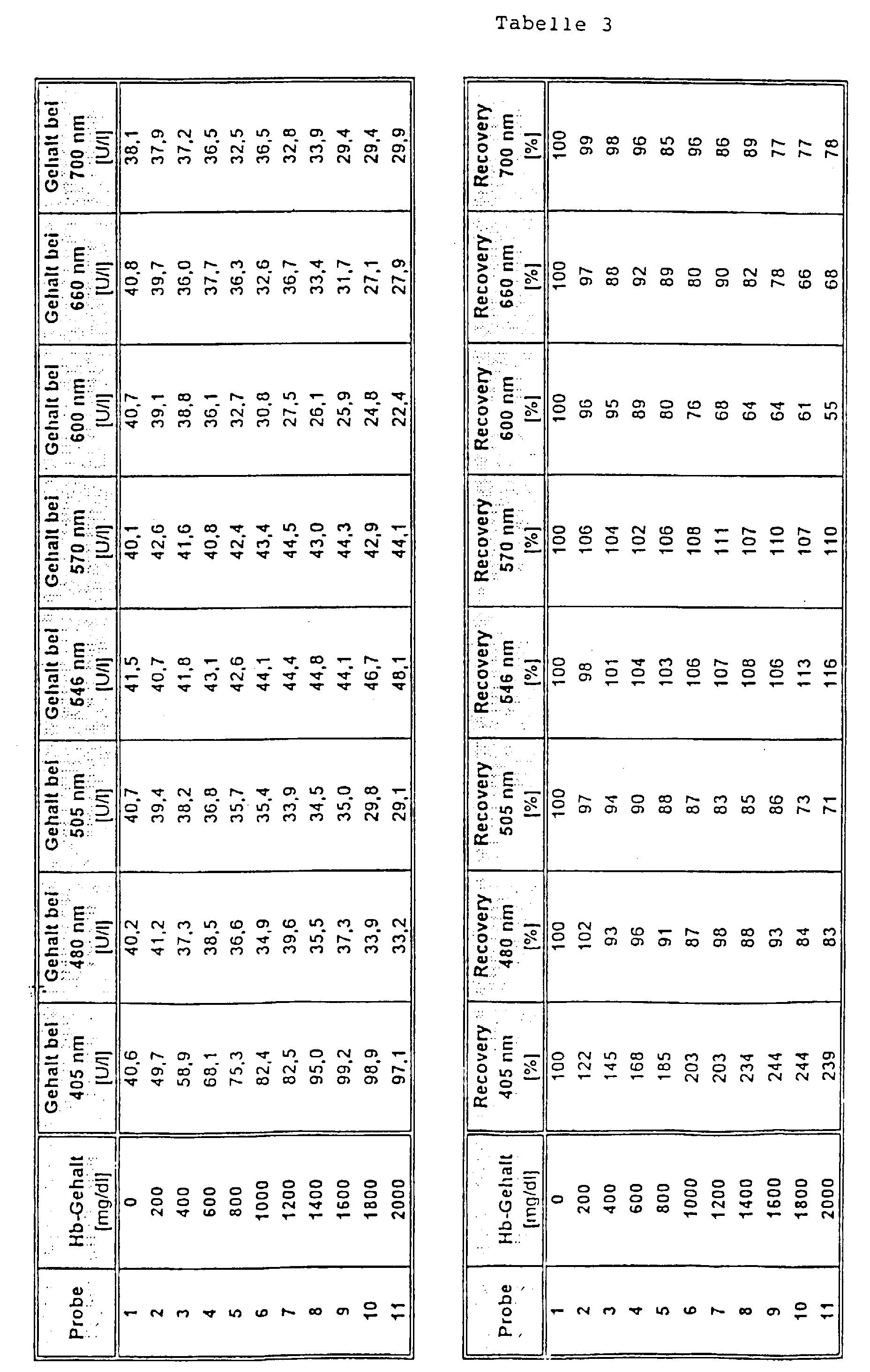
Das Ergebnis dieser Bestimmung ist in Tabelle 3 gezeigt. Es ist zu erkennen, daß bei Verwendung der erfindungsgemäßen Meßwellenlängen von 546 bzw. 570 nm eine deutlich verbesserte Wiederfindung (recovery) als bei den anderen Meßwellenlängen erreicht wurde.The result of this determination is shown in Table 3. It it can be seen that when using the invention Measuring wavelengths of 546 or 570 nm significantly improved Recovery than with the other measuring wavelengths was achieved.
Die Bestimmung wurde an einem Boehringer Mannheim/Hitachi 717-Analysegerät durchgeführt. Es wurden folgende Reagenzien verwendet:
- Reagenz 1:
- 68 mmol/l Phosphat-Puffer; pH 7,5; ≥ 0,73 mmol/l Pyruvat
- Reagenz 2:
- ≥ 1,1 mmol/l NADH
- Reagent 1:
- 68 mmol / l phosphate buffer; pH 7.5; ≥ 0.73 mmol / l pyruvate
- Reagent 2:
- ≥ 1.1 mmol / l NADH
Die Testdurchführung war wie folgt: Zu 5 µl Probe wurden 250 µl Reagenz 1 und nach 5 min 50 µl Reagenz 2 gegeben. Die Bestimmung des Analyten erfolgte nach einer Dauer von weiteren 60 sec. Zur Messung wurden eine Hauptmeßwellenlänge von 340 nm und Nebenmeßwellenlängen von 405 nm, 480 mn, 505 nm, 600 nm, 660 nm und 700 nm (Vergleich) sowie von 546 nm und 570 nm (Erfindung) verwendet.The test was carried out as follows: 5 µl sample was added 250 ul reagent 1 and after 5 min 50 ul reagent 2 added. The The analyte was determined after a period of further 60 sec. A main measuring wavelength of 340 nm was used for the measurement and secondary measuring wavelengths of 405 nm, 480 mn, 505 nm, 600 nm, 660 nm and 700 nm (comparison) as well as 546 nm and 570 nm (Invention) used.
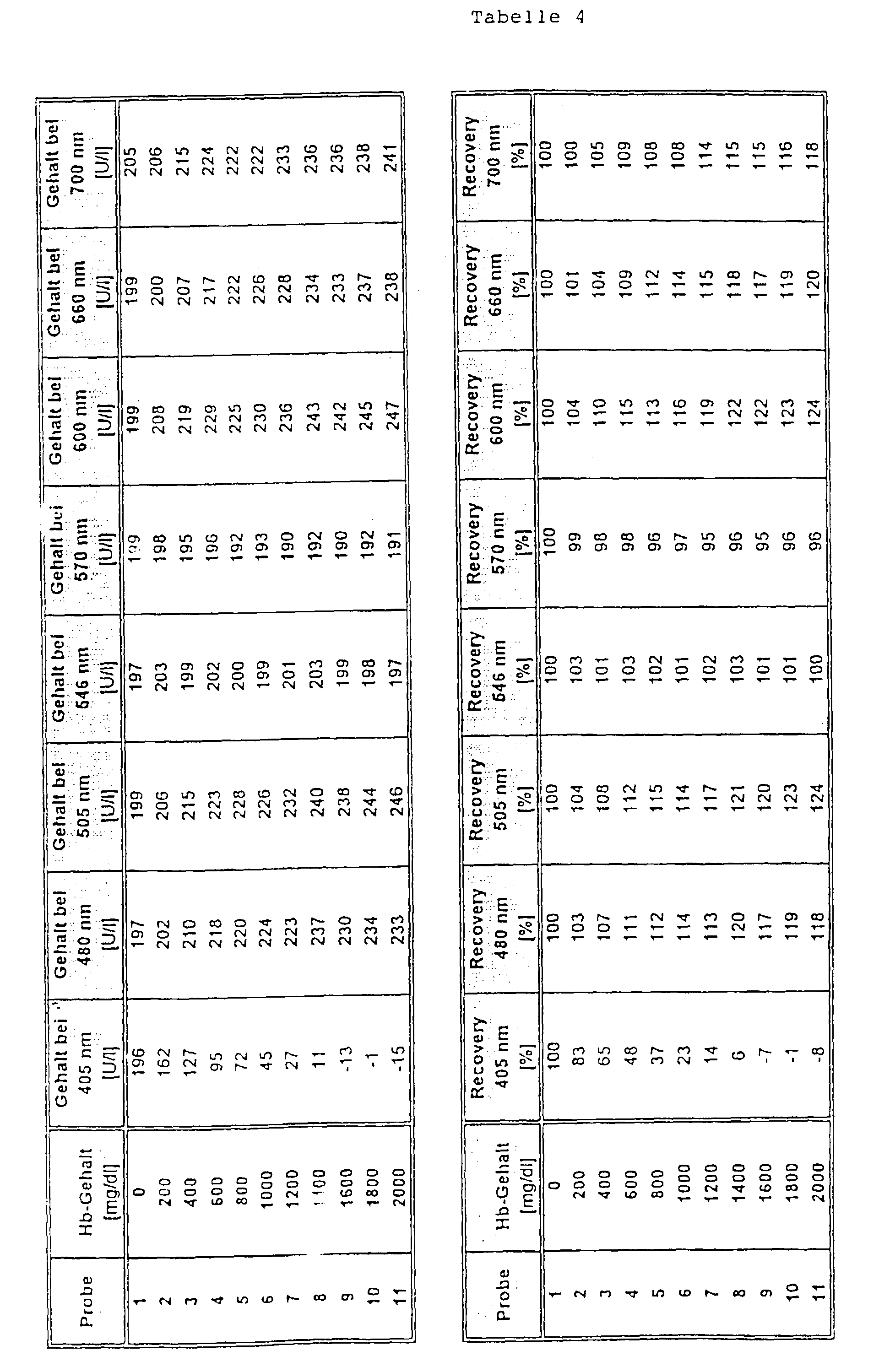
Das Ergebnis dieser Bestimmung ist in Tabelle 4 gezeigt. Es ist zu erkennen, daß bei Verwendung der erfindungsgemäßen Meßwellenlängen von 546 bzw. 570 nm eine deutlich verbesserte Wiederfindung (recovery) als bei den anderen Meßwellenlängen erreicht wurde.The result of this determination is shown in Table 4. It it can be seen that when using the invention Measuring wavelengths of 546 or 570 nm significantly improved Recovery than with the other measuring wavelengths was achieved.
Die Bestimmung wurde an einem Boehringer Mannheim/Hitachi 717-Analysegerät durchgeführt. Es wurden folgende Reagenzien verwendet:
- Reagenz 1:
- 68 mmol/l Phosphat-Puffer; pH 7,5; 3,7 mmol/l α-Oxobutyrat
- Reagenz 2:
- ≥ 1,1 mmol/l NADH
- Reagent 1:
- 68 mmol / l phosphate buffer; pH 7.5; 3.7 mmol / l α-oxobutyrate
- Reagent 2:
- ≥ 1.1 mmol / l NADH
Die Testdurchführung war wie folgt: Zu 5 µl Probe wurden 250 µl Reagenz 1 und nach 5 min 50 µl Reagenz 2 gegeben. Die Bestimmung des Analyten erfolgte nach einer Dauer von weiteren 60 sec. Zur Messung wurden eine Hauptmeßwellenlänge von 340 nm und Nebenmeßwellenlängen von 405 nm, 480 mn, 505 nm, 600 nm, 660 nm und 700 nm (Vergleich) sowie von 546 nm und 570 nm (Erfindung) verwendet.The test was carried out as follows: 5 µl sample was added 250 ul reagent 1 and after 5 min 50 ul reagent 2 added. The The analyte was determined after a period of further 60 sec. A main measuring wavelength of 340 nm was used for the measurement and secondary measuring wavelengths of 405 nm, 480 mn, 505 nm, 600 nm, 660 nm and 700 nm (comparison) as well as 546 nm and 570 nm (Invention) used.
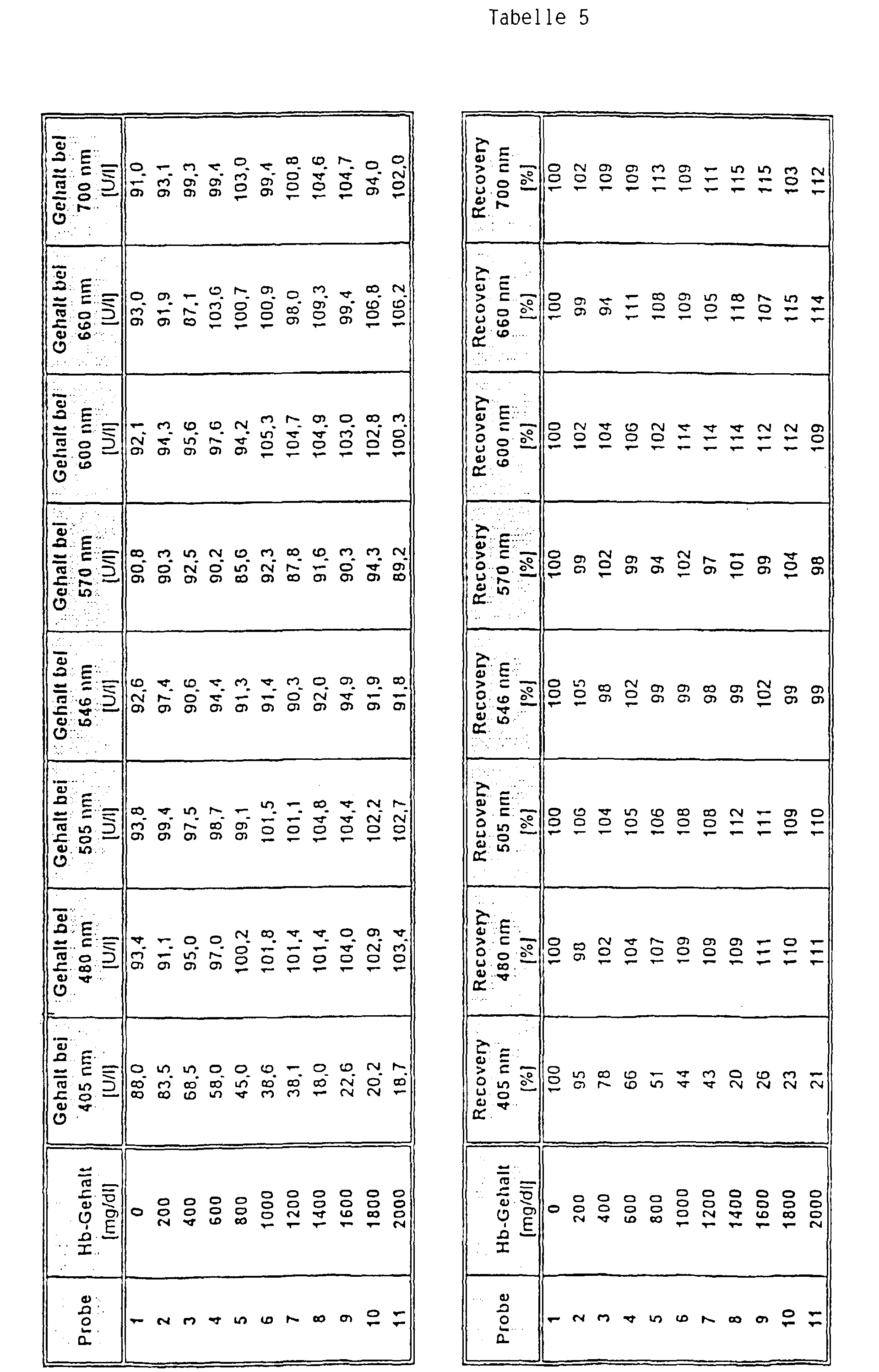
Das Ergebnis dieser Bestimmung ist in Tabelle 5 gezeigt. Es
ist zu erkennen, daß bei Verwendung der erfindungsgemäßen
Meßwellenlängen von 546 bzw. 570 nm eine deutlich verbesserte
Wiederfindung (recovery) als bei den anderen Meßwellenlängen
erreicht wurde.


Claims (12)
- Method for the determination of an analyte in a sample containing free haemoglobin by optical bichromatic measurement at a main and secondary wavelength,
wherein
a secondary wavelength above 475 nm is used at which absorption bands of haemoglobin are located. - Method as claimed in claim 1,
wherein
a secondary wavelength in the range of 546 ± 10 nm is used. - Method as claimed in claim 1,
wherein
a secondary wavelength in the range of 570 ± 10 nm is used. - Method as claimed in one of the claims 1-3,
wherein
a test is carried out which is based on a measurement of the increase or decrease of the concentration of NADH or NADPH in the sample. - Method as claimed in claim 4,
wherein
a main wavelength in the range of 340 ± 10 nm is used. - Method as claimed in one of the claims 1-5,
wherein
the content of an analyte is determined selected from the group comprising ammonia, creatine kinase and isoenzymes thereof and lactate dehydrogenase and isoenzymes thereof. - Method as claimed in claim 6,
wherein
ammonia is determined. - Method as claimed in claim 6,
wherein
creatine kinase or/and the creatine kinase isoenzyme CK-MB is determined. - Method as claimed in claim 6,
wherein
lactate dehydrogenase or/and the lactate dehydrogenase isoenzyme HBDH is determined. - Method as claimed in one of the claims 1-9,
wherein
a sample is determined which contains a blood substitute. - Method as claimed in one of the claims 1-10,
wherein
the determination is carried out on a serum or plasma sample. - Method as claimed in one of the claims 1-11,
wherein
the determination is carried out in an automated analyzer.
Applications Claiming Priority (3)
| Application Number | Priority Date | Filing Date | Title |
|---|---|---|---|
| DE19622090 | 1996-05-31 | ||
| DE19622090A DE19622090A1 (en) | 1996-05-31 | 1996-05-31 | Methods for eliminating hemoglobin disorders when analyzing medical samples |
| PCT/EP1997/002835 WO1997045733A1 (en) | 1996-05-31 | 1997-05-30 | Process to eliminate haemoglobin errors when analysing medical samples |
Publications (2)
| Publication Number | Publication Date |
|---|---|
| EP0906570A1 EP0906570A1 (en) | 1999-04-07 |
| EP0906570B1 true EP0906570B1 (en) | 2001-01-10 |
Family
ID=7795917
Family Applications (1)
| Application Number | Title | Priority Date | Filing Date |
|---|---|---|---|
| EP97925972A Expired - Lifetime EP0906570B1 (en) | 1996-05-31 | 1997-05-30 | Process to eliminate haemoglobin errors when analysing medical samples |
Country Status (17)
| Country | Link |
|---|---|
| EP (1) | EP0906570B1 (en) |
| JP (1) | JPH11510902A (en) |
| KR (1) | KR20000010767A (en) |
| CN (1) | CN1216614A (en) |
| AT (1) | ATE198670T1 (en) |
| AU (1) | AU3093597A (en) |
| CA (1) | CA2255851A1 (en) |
| CZ (1) | CZ389598A3 (en) |
| DE (2) | DE19622090A1 (en) |
| DK (1) | DK0906570T3 (en) |
| ES (1) | ES2154463T3 (en) |
| HU (1) | HUP9903344A2 (en) |
| IL (1) | IL127275A0 (en) |
| NZ (1) | NZ331491A (en) |
| PL (1) | PL330220A1 (en) |
| TW (1) | TW407202B (en) |
| WO (1) | WO1997045733A1 (en) |
Families Citing this family (3)
| Publication number | Priority date | Publication date | Assignee | Title |
|---|---|---|---|---|
| DE19846300A1 (en) | 1998-10-08 | 2000-04-13 | Roche Diagnostics Gmbh | Optical assay for determining alkaline phosphatase in samples uses a specified primary measurement wavelength in combination with a rate blank correction |
| DE19846301A1 (en) * | 1998-10-08 | 2000-04-13 | Roche Diagnostics Gmbh | Optical assay for determining alkaline phosphatase in samples uses specified primary and secondary measurement wavelengths |
| CN113502318A (en) * | 2021-08-19 | 2021-10-15 | 东软威特曼生物科技(南京)有限公司 | Creatine kinase isoenzyme CK-MB detection kit and detection method thereof |
Family Cites Families (1)
| Publication number | Priority date | Publication date | Assignee | Title |
|---|---|---|---|---|
| US4627014A (en) * | 1984-04-09 | 1986-12-02 | Eastman Kodak Company | Method and apparatus for determination of an analyte and method of calibrating such apparatus |
-
1996
- 1996-05-31 DE DE19622090A patent/DE19622090A1/en not_active Withdrawn
-
1997
- 1997-05-06 TW TW086105993A patent/TW407202B/en active
- 1997-05-30 EP EP97925972A patent/EP0906570B1/en not_active Expired - Lifetime
- 1997-05-30 AU AU30935/97A patent/AU3093597A/en not_active Abandoned
- 1997-05-30 HU HU9903344A patent/HUP9903344A2/en unknown
- 1997-05-30 WO PCT/EP1997/002835 patent/WO1997045733A1/en not_active Ceased
- 1997-05-30 PL PL97330220A patent/PL330220A1/en unknown
- 1997-05-30 KR KR1019980708889A patent/KR20000010767A/en not_active Ceased
- 1997-05-30 NZ NZ331491A patent/NZ331491A/en unknown
- 1997-05-30 JP JP9541629A patent/JPH11510902A/en active Pending
- 1997-05-30 DK DK97925972T patent/DK0906570T3/en active
- 1997-05-30 CZ CZ983895A patent/CZ389598A3/en unknown
- 1997-05-30 ES ES97925972T patent/ES2154463T3/en not_active Expired - Lifetime
- 1997-05-30 CN CN97193845A patent/CN1216614A/en active Pending
- 1997-05-30 DE DE59702900T patent/DE59702900D1/en not_active Expired - Fee Related
- 1997-05-30 IL IL12727597A patent/IL127275A0/en unknown
- 1997-05-30 AT AT97925972T patent/ATE198670T1/en not_active IP Right Cessation
- 1997-05-30 CA CA002255851A patent/CA2255851A1/en not_active Abandoned
Non-Patent Citations (2)
| Title |
|---|
| ANONYMOUS: "DIAGNOSTIK KATALOG", 1997, BOEHRINGER MANNHEIM DIAGNOSTIKA, MANNHEIM BRD * |
| ANONYMOUS:"Geräteinstellungen für das Boehringer Mannheim/Hitachi 717-Analysegerät", 01. Juni 1996, BOEHRINGER MANNHEIM, MANNHEIM BRD * |
Also Published As
| Publication number | Publication date |
|---|---|
| CZ389598A3 (en) | 1999-07-14 |
| DE59702900D1 (en) | 2001-02-15 |
| HUP9903344A2 (en) | 2001-03-28 |
| PL330220A1 (en) | 1999-05-10 |
| TW407202B (en) | 2000-10-01 |
| JPH11510902A (en) | 1999-09-21 |
| AU3093597A (en) | 1998-01-05 |
| NZ331491A (en) | 1999-04-29 |
| CA2255851A1 (en) | 1997-12-04 |
| DE19622090A1 (en) | 1997-12-04 |
| EP0906570A1 (en) | 1999-04-07 |
| KR20000010767A (en) | 2000-02-25 |
| DK0906570T3 (en) | 2001-03-05 |
| IL127275A0 (en) | 1999-09-22 |
| ES2154463T3 (en) | 2001-04-01 |
| CN1216614A (en) | 1999-05-12 |
| WO1997045733A1 (en) | 1997-12-04 |
| ATE198670T1 (en) | 2001-01-15 |
Similar Documents
| Publication | Publication Date | Title |
|---|---|---|
| DE1698180C3 (en) | Process for the production of a blood serum reference standard | |
| EP0695805B1 (en) | Method for analysing a medical sample, preventing disturbancies caused by hemolysis | |
| DE69032422T2 (en) | Reagent composition, method and kits for the quantification of magnesium or calcium and magnesium | |
| EP0250991B1 (en) | Method for the specific determination of serum fructosamine content and suitable reagent mixture | |
| DE69419192T2 (en) | Method for the determination of hemoglobin adducts | |
| EP0906569B1 (en) | Process for the analysis of medical samples containing haemoglobin | |
| DE19713088C1 (en) | Method and blood collection vessel for the preparation of blood samples for the homocysteine and / or folate determination | |
| EP0906570B1 (en) | Process to eliminate haemoglobin errors when analysing medical samples | |
| EP0309882A2 (en) | Method for the specific determination of the serum-fructose amine content and reagent mixture therefor | |
| EP1119641B1 (en) | Method for determining alkaline phosphatase and eliminating haemoglobin disturbances | |
| DE3874611T2 (en) | METHOD AND REAGENT FOR DETERMINING LD-1 ISOENZYME. | |
| DE68927381T2 (en) | REAGENT FOR USE IN THE LD-1 TEST PROCEDURE | |
| EP0797098B1 (en) | Method for stabilizing bilirubin in control sera and calibrators | |
| DE69817449T2 (en) | Method and reagent for the determination of direct bilirubin | |
| EP0351605B1 (en) | Quantitative determination of phosphorus | |
| EP0906567B1 (en) | Process to eliminate haemoglobin errors during the determination of albumin | |
| EP1119640B1 (en) | Method for determining alkaline phosphatase | |
| EP0294714B1 (en) | Use of polyvinylpyrrolidone (pvp) to reduce turbidity of sera, sera containing pvp and process for their production | |
| DE69016265T2 (en) | Methods for the determination of isoenzymes. | |
| US4725555A (en) | Zinc protoporphyrin test system | |
| WO1998002570A1 (en) | Blood substitute suppression by peroxides | |
| DE19622091A1 (en) | Accurate measurement of albumin in solution also containing haemoglobin | |
| DE19623955A1 (en) | Stabilised control or standard solutions of bilirubin | |
| DE19611458A1 (en) | Stabilised control or standard solutions of bilirubin | |
| DE1813848B2 (en) | DIAGNOSTIC AGENT AND METHOD FOR DETERMINATION OF GLUCOSE IN HAEMOLYZED BLOOD |
Legal Events
| Date | Code | Title | Description |
|---|---|---|---|
| PUAI | Public reference made under article 153(3) epc to a published international application that has entered the european phase |
Free format text: ORIGINAL CODE: 0009012 |
|
| 17P | Request for examination filed |
Effective date: 19980814 |
|
| AK | Designated contracting states |
Kind code of ref document: A1 Designated state(s): AT BE CH DE DK ES FI FR GB IE IT LI NL PT SE |
|
| GRAG | Despatch of communication of intention to grant |
Free format text: ORIGINAL CODE: EPIDOS AGRA |
|
| 17Q | First examination report despatched |
Effective date: 20000229 |
|
| GRAG | Despatch of communication of intention to grant |
Free format text: ORIGINAL CODE: EPIDOS AGRA |
|
| GRAH | Despatch of communication of intention to grant a patent |
Free format text: ORIGINAL CODE: EPIDOS IGRA |
|
| GRAH | Despatch of communication of intention to grant a patent |
Free format text: ORIGINAL CODE: EPIDOS IGRA |
|
| GRAA | (expected) grant |
Free format text: ORIGINAL CODE: 0009210 |
|
| AK | Designated contracting states |
Kind code of ref document: B1 Designated state(s): AT BE CH DE DK ES FI FR GB IE IT LI NL PT SE |
|
| PG25 | Lapsed in a contracting state [announced via postgrant information from national office to epo] |
Ref country code: FI Free format text: LAPSE BECAUSE OF FAILURE TO SUBMIT A TRANSLATION OF THE DESCRIPTION OR TO PAY THE FEE WITHIN THE PRESCRIBED TIME-LIMIT Effective date: 20010110 |
|
| REF | Corresponds to: |
Ref document number: 198670 Country of ref document: AT Date of ref document: 20010115 Kind code of ref document: T |
|
| REG | Reference to a national code |
Ref country code: CH Ref legal event code: NV Representative=s name: A. BRAUN, BRAUN, HERITIER, ESCHMANN AG PATENTANWAE Ref country code: CH Ref legal event code: EP |
|
| GBT | Gb: translation of ep patent filed (gb section 77(6)(a)/1977) |
Effective date: 20010110 |
|
| REG | Reference to a national code |
Ref country code: IE Ref legal event code: FG4D Free format text: GERMAN |
|
| REF | Corresponds to: |
Ref document number: 59702900 Country of ref document: DE Date of ref document: 20010215 |
|
| REG | Reference to a national code |
Ref country code: DK Ref legal event code: T3 |
|
| REG | Reference to a national code |
Ref country code: ES Ref legal event code: FG2A Ref document number: 2154463 Country of ref document: ES Kind code of ref document: T3 |
|
| ITF | It: translation for a ep patent filed | ||
| PG25 | Lapsed in a contracting state [announced via postgrant information from national office to epo] |
Ref country code: PT Free format text: LAPSE BECAUSE OF FAILURE TO SUBMIT A TRANSLATION OF THE DESCRIPTION OR TO PAY THE FEE WITHIN THE PRESCRIBED TIME-LIMIT Effective date: 20010410 |
|
| ET | Fr: translation filed | ||
| PLBE | No opposition filed within time limit |
Free format text: ORIGINAL CODE: 0009261 |
|
| STAA | Information on the status of an ep patent application or granted ep patent |
Free format text: STATUS: NO OPPOSITION FILED WITHIN TIME LIMIT |
|
| REG | Reference to a national code |
Ref country code: GB Ref legal event code: IF02 |
|
| 26N | No opposition filed | ||
| PGFP | Annual fee paid to national office [announced via postgrant information from national office to epo] |
Ref country code: SE Payment date: 20020508 Year of fee payment: 6 |
|
| PGFP | Annual fee paid to national office [announced via postgrant information from national office to epo] |
Ref country code: DK Payment date: 20020514 Year of fee payment: 6 |
|
| PGFP | Annual fee paid to national office [announced via postgrant information from national office to epo] |
Ref country code: NL Payment date: 20020529 Year of fee payment: 6 Ref country code: IE Payment date: 20020529 Year of fee payment: 6 |
|
| PGFP | Annual fee paid to national office [announced via postgrant information from national office to epo] |
Ref country code: BE Payment date: 20020717 Year of fee payment: 6 |
|
| PG25 | Lapsed in a contracting state [announced via postgrant information from national office to epo] |
Ref country code: IE Free format text: LAPSE BECAUSE OF NON-PAYMENT OF DUE FEES Effective date: 20030530 |
|
| PG25 | Lapsed in a contracting state [announced via postgrant information from national office to epo] |
Ref country code: SE Free format text: LAPSE BECAUSE OF NON-PAYMENT OF DUE FEES Effective date: 20030531 Ref country code: BE Free format text: LAPSE BECAUSE OF NON-PAYMENT OF DUE FEES Effective date: 20030531 |
|
| BERE | Be: lapsed |
Owner name: *ROCHE DIAGNOSTICS G.M.B.H. Effective date: 20030531 |
|
| PG25 | Lapsed in a contracting state [announced via postgrant information from national office to epo] |
Ref country code: NL Free format text: LAPSE BECAUSE OF NON-PAYMENT OF DUE FEES Effective date: 20031201 Ref country code: DK Free format text: LAPSE BECAUSE OF NON-PAYMENT OF DUE FEES Effective date: 20031201 |
|
| REG | Reference to a national code |
Ref country code: DK Ref legal event code: EBP |
|
| EUG | Se: european patent has lapsed | ||
| NLV4 | Nl: lapsed or anulled due to non-payment of the annual fee |
Effective date: 20031201 |
|
| REG | Reference to a national code |
Ref country code: IE Ref legal event code: MM4A |
|
| PGFP | Annual fee paid to national office [announced via postgrant information from national office to epo] |
Ref country code: FR Payment date: 20040510 Year of fee payment: 8 |
|
| PGFP | Annual fee paid to national office [announced via postgrant information from national office to epo] |
Ref country code: AT Payment date: 20040512 Year of fee payment: 8 |
|
| PGFP | Annual fee paid to national office [announced via postgrant information from national office to epo] |
Ref country code: ES Payment date: 20040518 Year of fee payment: 8 |
|
| PGFP | Annual fee paid to national office [announced via postgrant information from national office to epo] |
Ref country code: GB Payment date: 20040526 Year of fee payment: 8 |
|
| PGFP | Annual fee paid to national office [announced via postgrant information from national office to epo] |
Ref country code: CH Payment date: 20040527 Year of fee payment: 8 |
|
| PGFP | Annual fee paid to national office [announced via postgrant information from national office to epo] |
Ref country code: DE Payment date: 20040610 Year of fee payment: 8 |
|
| PG25 | Lapsed in a contracting state [announced via postgrant information from national office to epo] |
Ref country code: IT Free format text: LAPSE BECAUSE OF NON-PAYMENT OF DUE FEES;WARNING: LAPSES OF ITALIAN PATENTS WITH EFFECTIVE DATE BEFORE 2007 MAY HAVE OCCURRED AT ANY TIME BEFORE 2007. THE CORRECT EFFECTIVE DATE MAY BE DIFFERENT FROM THE ONE RECORDED. Effective date: 20050530 Ref country code: GB Free format text: LAPSE BECAUSE OF NON-PAYMENT OF DUE FEES Effective date: 20050530 Ref country code: AT Free format text: LAPSE BECAUSE OF NON-PAYMENT OF DUE FEES Effective date: 20050530 |
|
| PG25 | Lapsed in a contracting state [announced via postgrant information from national office to epo] |
Ref country code: LI Free format text: LAPSE BECAUSE OF NON-PAYMENT OF DUE FEES Effective date: 20050531 Ref country code: ES Free format text: LAPSE BECAUSE OF NON-PAYMENT OF DUE FEES Effective date: 20050531 Ref country code: CH Free format text: LAPSE BECAUSE OF NON-PAYMENT OF DUE FEES Effective date: 20050531 |
|
| PG25 | Lapsed in a contracting state [announced via postgrant information from national office to epo] |
Ref country code: DE Free format text: LAPSE BECAUSE OF NON-PAYMENT OF DUE FEES Effective date: 20051201 |
|
| REG | Reference to a national code |
Ref country code: CH Ref legal event code: PL |
|
| GBPC | Gb: european patent ceased through non-payment of renewal fee |
Effective date: 20050530 |
|
| PG25 | Lapsed in a contracting state [announced via postgrant information from national office to epo] |
Ref country code: FR Free format text: LAPSE BECAUSE OF NON-PAYMENT OF DUE FEES Effective date: 20060131 |
|
| REG | Reference to a national code |
Ref country code: FR Ref legal event code: ST Effective date: 20060131 |
|
| REG | Reference to a national code |
Ref country code: ES Ref legal event code: FD2A Effective date: 20050531 |