EP0906464B1 - Procede de fabrication et de traitement des textiles - Google Patents
Procede de fabrication et de traitement des textiles Download PDFInfo
- Publication number
- EP0906464B1 EP0906464B1 EP97929370A EP97929370A EP0906464B1 EP 0906464 B1 EP0906464 B1 EP 0906464B1 EP 97929370 A EP97929370 A EP 97929370A EP 97929370 A EP97929370 A EP 97929370A EP 0906464 B1 EP0906464 B1 EP 0906464B1
- Authority
- EP
- European Patent Office
- Prior art keywords
- poly
- family
- polymer
- hydroxy
- acids
- Prior art date
- Legal status (The legal status is an assumption and is not a legal conclusion. Google has not performed a legal analysis and makes no representation as to the accuracy of the status listed.)
- Expired - Lifetime
Links
- 239000004753 textile Substances 0.000 title claims abstract description 50
- 238000000034 method Methods 0.000 title claims abstract description 32
- 238000004519 manufacturing process Methods 0.000 title claims abstract description 20
- 229920000642 polymer Polymers 0.000 claims abstract description 45
- 229940061720 alpha hydroxy acid Drugs 0.000 claims abstract description 32
- 150000001280 alpha hydroxy acids Chemical class 0.000 claims abstract description 32
- 239000000203 mixture Substances 0.000 claims abstract description 30
- 239000012530 fluid Substances 0.000 claims abstract description 14
- 238000011282 treatment Methods 0.000 claims description 55
- 230000008569 process Effects 0.000 claims description 26
- CURLTUGMZLYLDI-UHFFFAOYSA-N Carbon dioxide Chemical compound O=C=O CURLTUGMZLYLDI-UHFFFAOYSA-N 0.000 claims description 22
- 239000012535 impurity Substances 0.000 claims description 14
- 229910002092 carbon dioxide Inorganic materials 0.000 claims description 10
- 239000001569 carbon dioxide Substances 0.000 claims description 10
- 238000009941 weaving Methods 0.000 claims description 9
- 241001465754 Metazoa Species 0.000 claims description 8
- 238000009987 spinning Methods 0.000 claims description 7
- 238000009940 knitting Methods 0.000 claims description 6
- 238000000746 purification Methods 0.000 claims description 6
- 238000005054 agglomeration Methods 0.000 claims description 5
- 230000002776 aggregation Effects 0.000 claims description 5
- 238000009954 braiding Methods 0.000 claims description 5
- -1 poly(α-hydroxy-acids) Polymers 0.000 claims 7
- 230000003750 conditioning effect Effects 0.000 claims 1
- 239000000835 fiber Substances 0.000 abstract description 34
- 239000012634 fragment Substances 0.000 description 40
- 229920000954 Polyglycolide Polymers 0.000 description 28
- 239000004633 polyglycolic acid Substances 0.000 description 28
- 238000004458 analytical method Methods 0.000 description 12
- 239000000126 substance Substances 0.000 description 12
- 239000007943 implant Substances 0.000 description 9
- 238000004833 X-ray photoelectron spectroscopy Methods 0.000 description 7
- 239000000463 material Substances 0.000 description 5
- 229920000747 poly(lactic acid) Polymers 0.000 description 5
- 239000000356 contaminant Substances 0.000 description 4
- 238000001125 extrusion Methods 0.000 description 4
- 230000004048 modification Effects 0.000 description 4
- 238000012986 modification Methods 0.000 description 4
- 238000012545 processing Methods 0.000 description 4
- 241000282412 Homo Species 0.000 description 3
- 229910052799 carbon Inorganic materials 0.000 description 3
- 239000002131 composite material Substances 0.000 description 3
- 229920001577 copolymer Polymers 0.000 description 3
- 230000008030 elimination Effects 0.000 description 3
- 238000003379 elimination reaction Methods 0.000 description 3
- 239000004744 fabric Substances 0.000 description 3
- 239000007789 gas Substances 0.000 description 3
- 238000002513 implantation Methods 0.000 description 3
- 239000007788 liquid Substances 0.000 description 3
- 244000005700 microbiome Species 0.000 description 3
- 239000002904 solvent Substances 0.000 description 3
- 230000002792 vascular Effects 0.000 description 3
- 238000005033 Fourier transform infrared spectroscopy Methods 0.000 description 2
- 229920000297 Rayon Polymers 0.000 description 2
- 239000000823 artificial membrane Substances 0.000 description 2
- 238000004140 cleaning Methods 0.000 description 2
- 238000011109 contamination Methods 0.000 description 2
- 239000000645 desinfectant Substances 0.000 description 2
- 238000009990 desizing Methods 0.000 description 2
- 239000003599 detergent Substances 0.000 description 2
- 230000004927 fusion Effects 0.000 description 2
- 229920001519 homopolymer Polymers 0.000 description 2
- 238000001192 hot extrusion Methods 0.000 description 2
- 230000036512 infertility Effects 0.000 description 2
- 210000003041 ligament Anatomy 0.000 description 2
- 125000002496 methyl group Chemical group [H]C([H])([H])* 0.000 description 2
- 229910052760 oxygen Inorganic materials 0.000 description 2
- 239000002964 rayon Substances 0.000 description 2
- 238000004626 scanning electron microscopy Methods 0.000 description 2
- 238000004659 sterilization and disinfection Methods 0.000 description 2
- 230000000007 visual effect Effects 0.000 description 2
- OKTJSMMVPCPJKN-UHFFFAOYSA-N Carbon Chemical compound [C] OKTJSMMVPCPJKN-UHFFFAOYSA-N 0.000 description 1
- 241000196324 Embryophyta Species 0.000 description 1
- UFHFLCQGNIYNRP-UHFFFAOYSA-N Hydrogen Chemical compound [H][H] UFHFLCQGNIYNRP-UHFFFAOYSA-N 0.000 description 1
- 238000004566 IR spectroscopy Methods 0.000 description 1
- 240000004808 Saccharomyces cerevisiae Species 0.000 description 1
- 240000008042 Zea mays Species 0.000 description 1
- 239000002253 acid Substances 0.000 description 1
- 239000000654 additive Substances 0.000 description 1
- 230000003416 augmentation Effects 0.000 description 1
- 239000011324 bead Substances 0.000 description 1
- 230000015572 biosynthetic process Effects 0.000 description 1
- 238000004061 bleaching Methods 0.000 description 1
- 210000000988 bone and bone Anatomy 0.000 description 1
- 230000000747 cardiac effect Effects 0.000 description 1
- 230000015556 catabolic process Effects 0.000 description 1
- 230000008859 change Effects 0.000 description 1
- 230000003247 decreasing effect Effects 0.000 description 1
- 230000007547 defect Effects 0.000 description 1
- 238000006731 degradation reaction Methods 0.000 description 1
- 230000000593 degrading effect Effects 0.000 description 1
- 238000010586 diagram Methods 0.000 description 1
- 238000000113 differential scanning calorimetry Methods 0.000 description 1
- 230000008034 disappearance Effects 0.000 description 1
- 238000004043 dyeing Methods 0.000 description 1
- 238000000605 extraction Methods 0.000 description 1
- 238000010035 extrusion spinning Methods 0.000 description 1
- 238000009950 felting Methods 0.000 description 1
- 238000010438 heat treatment Methods 0.000 description 1
- 229910052739 hydrogen Inorganic materials 0.000 description 1
- 239000001257 hydrogen Substances 0.000 description 1
- 230000008105 immune reaction Effects 0.000 description 1
- 238000002329 infrared spectrum Methods 0.000 description 1
- 238000005259 measurement Methods 0.000 description 1
- 239000011859 microparticle Substances 0.000 description 1
- 239000004005 microsphere Substances 0.000 description 1
- 238000006386 neutralization reaction Methods 0.000 description 1
- 229910052757 nitrogen Inorganic materials 0.000 description 1
- 210000000056 organ Anatomy 0.000 description 1
- 238000004806 packaging method and process Methods 0.000 description 1
- 230000037452 priming Effects 0.000 description 1
- 238000007639 printing Methods 0.000 description 1
- 238000001046 rapid expansion of supercritical solution Methods 0.000 description 1
- 238000004513 sizing Methods 0.000 description 1
- 229910052708 sodium Inorganic materials 0.000 description 1
- 238000001228 spectrum Methods 0.000 description 1
- 230000001954 sterilising effect Effects 0.000 description 1
- 238000005728 strengthening Methods 0.000 description 1
- 229910052717 sulfur Inorganic materials 0.000 description 1
- 238000012360 testing method Methods 0.000 description 1
- 238000001757 thermogravimetry curve Methods 0.000 description 1
- 231100000331 toxic Toxicity 0.000 description 1
- 230000002588 toxic effect Effects 0.000 description 1
- 238000005406 washing Methods 0.000 description 1
- 230000003313 weakening effect Effects 0.000 description 1
Classifications
-
- D—TEXTILES; PAPER
- D06—TREATMENT OF TEXTILES OR THE LIKE; LAUNDERING; FLEXIBLE MATERIALS NOT OTHERWISE PROVIDED FOR
- D06L—DRY-CLEANING, WASHING OR BLEACHING FIBRES, FILAMENTS, THREADS, YARNS, FABRICS, FEATHERS OR MADE-UP FIBROUS GOODS; BLEACHING LEATHER OR FURS
- D06L1/00—Dry-cleaning or washing fibres, filaments, threads, yarns, fabrics, feathers or made-up fibrous goods
-
- A—HUMAN NECESSITIES
- A61—MEDICAL OR VETERINARY SCIENCE; HYGIENE
- A61L—METHODS OR APPARATUS FOR STERILISING MATERIALS OR OBJECTS IN GENERAL; DISINFECTION, STERILISATION OR DEODORISATION OF AIR; CHEMICAL ASPECTS OF BANDAGES, DRESSINGS, ABSORBENT PADS OR SURGICAL ARTICLES; MATERIALS FOR BANDAGES, DRESSINGS, ABSORBENT PADS OR SURGICAL ARTICLES
- A61L27/00—Materials for grafts or prostheses or for coating grafts or prostheses
- A61L27/14—Macromolecular materials
- A61L27/18—Macromolecular materials obtained otherwise than by reactions only involving carbon-to-carbon unsaturated bonds
-
- Y—GENERAL TAGGING OF NEW TECHNOLOGICAL DEVELOPMENTS; GENERAL TAGGING OF CROSS-SECTIONAL TECHNOLOGIES SPANNING OVER SEVERAL SECTIONS OF THE IPC; TECHNICAL SUBJECTS COVERED BY FORMER USPC CROSS-REFERENCE ART COLLECTIONS [XRACs] AND DIGESTS
- Y10—TECHNICAL SUBJECTS COVERED BY FORMER USPC
- Y10T—TECHNICAL SUBJECTS COVERED BY FORMER US CLASSIFICATION
- Y10T442/00—Fabric [woven, knitted, or nonwoven textile or cloth, etc.]
- Y10T442/30—Woven fabric [i.e., woven strand or strip material]
- Y10T442/3976—Including strand which is stated to have specific attributes [e.g., heat or fire resistance, chemical or solvent resistance, high absorption for aqueous composition, water solubility, heat shrinkability, etc.]
-
- Y—GENERAL TAGGING OF NEW TECHNOLOGICAL DEVELOPMENTS; GENERAL TAGGING OF CROSS-SECTIONAL TECHNOLOGIES SPANNING OVER SEVERAL SECTIONS OF THE IPC; TECHNICAL SUBJECTS COVERED BY FORMER USPC CROSS-REFERENCE ART COLLECTIONS [XRACs] AND DIGESTS
- Y10—TECHNICAL SUBJECTS COVERED BY FORMER USPC
- Y10T—TECHNICAL SUBJECTS COVERED BY FORMER US CLASSIFICATION
- Y10T442/00—Fabric [woven, knitted, or nonwoven textile or cloth, etc.]
- Y10T442/60—Nonwoven fabric [i.e., nonwoven strand or fiber material]
- Y10T442/696—Including strand or fiber material which is stated to have specific attributes [e.g., heat or fire resistance, chemical or solvent resistance, high absorption for aqueous compositions, water solubility, heat shrinkability, etc.]
Definitions
- the invention relates to the manufacture and treatment of a textile structure containing at least one polymer from the poly ( ⁇ -hydroxy-acids) family, i.e. comprising textile fibers incorporating a portion at least one polymer from the family of poly ( ⁇ -hydroxy-acids).
- textile structure covers not only all textile structures obtained by assembling yarns or yarns of fibers (fabric, nonwoven, braid, knitting, tulle, composite %), in a fragmented or sheet form or even in reel, but also the threads, yarns, filaments, ropes, cables themselves, also referred to below generic with the term "son”.
- the textile structure obtained has the forms and the appearance desired, but incorporates many impurities unwanted and unnecessary, trapped in the structure, and which do not enter into the composition of the fibers or the structure.
- impurities there may be mentioned: impurities incorporated in the fibers when obtaining or the manufacture of the fibers themselves; the additives and intentionally incorporated impurities (e.g. sizing aid or antistatic) or not during the said assembly steps; organic contaminants or microorganisms ...
- these fragile textile fibers have sometimes, moreover, particular properties, sought for specific applications. This is the case in particular fibers containing at least one poly ( ⁇ -hydroxy-acid) which are biocompatible and / or biodegradable, especially acid fibers polyglycolic (PGA) with excellent bioresorption properties.
- poly ( ⁇ -hydroxy-acid) which are biocompatible and / or biodegradable, especially acid fibers polyglycolic (PGA) with excellent bioresorption properties.
- a textile structure containing at least one polymer of the family of poly ( ⁇ -hydroxy acids) can be subjected to a treatment with a composition of fluid (s) to the supercritical state without any damage to the structure.
- this treatment allows then to fully purify a single step such textile structure, not only preserving the physico-chemical integrity of the structure but even, of even more surprisingly, by improving its mechanical characteristics.
- the invention aims to propose a manufacturing process and a treatment of a textile structure containing at least one polymer from the poly ( ⁇ -hydroxy-acids) family allowing to obtain a pure textile structure and / or reinforced mechanical characteristics.
- the invention relates more particularly to offer effective, simple and inexpensive treatment for the purification of textile structures containing at least a polymer from the family of poly ( ⁇ -hydroxy acids) in ensuring the elimination of different physico-chemical compounds undesirable and, simultaneously, that of different organic and biochemical contaminants (microorganisms), while preserving the physico-chemical integrity of the structure.
- the invention aims to propose a total purification treatment process in one stage of textile structures containing at least one polymer from the family of poly ( ⁇ -hydroxy acids).
- the invention also relates in particular to propose a treatment of textile structures containing minus one polymer from the family of poly ( ⁇ -hydroxy acids) allowing to reinforce the mechanical resistance of these structures.
- the family of poly ( ⁇ -hydroxy acids) includes polymers of general formula: where R i is hydrogen or methyl. This family includes not only the homopolymers corresponding to this formula, but also the corresponding copolymers and the mixtures of these homopolymers and copolymers. Among these polymers, mention may be made of polyglycolic acid (PGA), and polylactic acids L-PLA, D-PLA, DL-PLA, and poly (lactide-coglycolite) PLA / GA copolymers.
- PGA polyglycolic acid
- L-PLA polylactic acids
- D-PLA D-PLA
- DL-PLA DL-PLA
- PLA poly (lactide-coglycolite) PLA / GA copolymers.
- polymers have similar properties.
- they are biocompatible and biodegradable.
- an implant of PGA is bioresorbable in a period of the order of 1 to 6 month.
- molecular which depends on each polymer or each polymer composition, they can be spun by extrusion and allow the fabrication of structures textiles.
- the invention also aims to propose such a process for obtaining textile structures containing in particular biodegradable textile structures or bioresorbable which can be included in the composition of implants (implantable parts) for humans or animals.
- the invention aims in particular to propose a treatment process before implantation of textile structures -especially yarn or structure woven and / or knitted and / or braided and / or agglomerated (not woven, composite) ...-, containing at least one polymer of the family of poly ( ⁇ -hydroxy acids), which guarantees the purity and sterility of these structures, preserving their physico-chemical and mechanical integrity.
- the invention also aims to provide a treatment process which does not require placing the pieces at high temperature, and which therefore can be implemented at low temperature (especially below 60 ° C).
- the invention also aims to provide a extremely clean treatment process produce no polluting or toxic effluents, and neither not dangerous for manipulators.
- the invention also aims to propose such a process which increases the possibilities of using textile fibers containing at least one polymer of the family of poly ( ⁇ -hydroxy acids), in particular for obtaining bioresorbable materials or parts implantable in the human or animal body.
- the invention relates to a process according to claim 1.
- the molecular weight of poly ( ⁇ -hydroxy-acid) polymers used in the composition of fibers allowing the structure to be obtained is particularly suitable sufficient - to allow assembly - especially the spinning by hot extrusion of fibers. Indeed, in particular, hot extrusion spinning of fibers from these polymers is only possible with satisfactory quality from of a certain molecular weight value which depends on the exact chemical composition of the polymers, and of the process assembly implemented.
- the molecular weight of the polymer must be conventionally greater than 30,000, in particular of the order of 120,000, for extrusion spinning hot threads for weaving.
- the fluids in the state supercritical can be defined as gases placed in temperature and pressure conditions such as their properties are intermediate between those of gases and those liquids. They are also called “dense gases” or “liquids expanded. "For a given chemical body, the precise point of the temperature-pressure diagram for which the two phases liquid and vapor form only one is called point critical. Beyond this critical temperature (Tc) and this critical pressure (Pc), the fluid is in the said state "Supercritical".
- it is chooses supercritical carbon dioxide as of composition of fluid (s) in the supercritical state.
- the invention also extends to a method of manufacturing according to claim 4.
- the textile structure contains at least a substantial proportion - notably more than 1% - of poly ( ⁇ -hydroxy acids).
- the structure textile contains fibers containing a significant proportion at least one polymer from the poly ( ⁇ -hydroxy-acids) family whose molecular weight is adapted to allow obtaining said structure.
- the invention is applicable whatever the proportion of polymer (s) from the poly ( ⁇ -hydroxy-acids) family, in particular of fibers of this (these) polymer (s), contained in the textile structure. Nevertheless, advantageously and according to the invention, the structure is produced with wires obtained by extrusion of poly ( ⁇ -hydroxy-acid (s)) fibers -in particular of PGA-, that is to say that the structure is formed 100% fiber comprising 100% poly ( ⁇ -hydroxy-acid (s)) -in particular of PGA-.
- packaging is carried out final of the structure after said treatment step.
- the structure is subject the structure to one and only one processing step after all the assembly steps to obtain the structure.
- the part is subjected to the treatment process immediately after completing all steps assembly and finishing to obtain said structure, and on the same site. So advantageously and according to the invention, said processing step is carried out immediately after manufacturing the part.
- the invention also extends to a structure bioresorbable textile containing at least one polymer of the family of poly ( ⁇ -hydroxy acids) obtained by at least one mechanical assembly step (spinning and / or braiding and / or knitting and / or weaving and / or agglomeration ...) of fibers textiles at least partially formed from fibers containing a proportion of at least one polymer from the family of poly ( ⁇ -hydroxy-acids) with suitable molecular weight to allow the obtaining of said structure, and having was obtained by a method according to the invention.
- the structure is formed by an assembly of wires obtained by extrusion of fibers containing - in particular made up of - at least one polymer from the family of poly ( ⁇ -hydroxy acids), the molecular weight is suitable for obtaining said structure, in particular a woven assembly and / or knitted and / or braided and / or agglomerated with threads.
- the structure is formed from a bioresorbable woven piece of PGA yarn.
- a textile structure according to the invention is both free impurities and physico-chemical characteristics and unaltered, even reinforced mechanical. Such a structure had not yet been obtainable in art prior.
- the invention thus relates to a sterile and pure piece including a textile structure of fibers containing at least one polymer from the family of poly ( ⁇ -hydroxy acids), according to the invention which is pure enough to be implantable in humans or animals, including at implantation sites particularly sensitive.
- Mechanical characteristics and physical-chemical properties of the room are similar or even improved over those of an unclean impure piece treated according to the invention.
- the invention also extends to the application of a treatment method according to the invention for the treatment before their implantation in the human body or animal, implants with a textile structure according to the invention, especially implants in the form of wires or implants with woven and / or knitted and / or braided and / or structure agglomerated, containing at least one polymer of the family bioresorbable poly ( ⁇ -hydroxy acids).
- the invention also extends to the application of a manufacturing process according to the invention for the manufacture of implants with a textile structure containing minus one polymer from the family of poly ( ⁇ -hydroxy acids).
- the invention also relates to a method of processing, manufacturing process, structure, and a part or an implant, characterized in combination, by all or part of the characteristics above or below mentioned.
- a fragment of this part is subjected to a treatment according to the invention by placing it in contact with a stream of supercritical carbon dioxide under a pressure of 2.8 ⁇ 10 7 Pa for 15 hours at 35 ° C. with an average flow rate of 54 , 6 kg / h of supercritical CO 2 . It can be seen by visual examination and by touch that the part is not altered from the point of view of its appearance, its flexibility and its resistance.
- a contamination analysis is then performed on the piece fragment thus treated. We notes the complete absence of aerobic microorganisms and mesophiles, and yeast and mold.
- a sterility check carried out on the piece fragment demonstrates that it is sterile after treatment.
- Two fragments of a piece of satin weave fabric are produced as indicated in example 1. The first is used raw at the end of the loom, while the second is subjected to the treatment with supercritical CO 2 of example 1.
- Viscosity is an indicator of the degradation of the textile structure of the woven piece. The higher the viscosity, the higher the molecular weight of the polymer is high and less the textile structure of the woven piece is degraded.
- PGA 100 (100% polyglycolic acid) yarns were treated with a stream of supercritical CO 2 for at least 12 hours at a temperature of 35 ° C. under a pressure of 2.7 ⁇ 10 7 to 2.8 ⁇ 10 7 Pa.
- the invention allows simultaneously purify and strengthen mechanical characteristics textile structures containing at least one polymer of the family of poly ( ⁇ -hydroxy acids) finds advantageous applications in all situations where we are looking for one and / or the other of these properties.
- woven pieces of PGA treated according to the invention are pure and bioresorbable and can enter in the composition of implants or constitute implants for humans or animals (artificial ligaments, patch, artificial membranes, vascular prostheses, cardiac or bone, ).
Landscapes
- Health & Medical Sciences (AREA)
- Chemical & Material Sciences (AREA)
- General Health & Medical Sciences (AREA)
- Engineering & Computer Science (AREA)
- Medicinal Chemistry (AREA)
- Oral & Maxillofacial Surgery (AREA)
- Transplantation (AREA)
- Epidemiology (AREA)
- Life Sciences & Earth Sciences (AREA)
- Animal Behavior & Ethology (AREA)
- Chemical Kinetics & Catalysis (AREA)
- Public Health (AREA)
- Veterinary Medicine (AREA)
- Dermatology (AREA)
- Textile Engineering (AREA)
- Chemical Or Physical Treatment Of Fibers (AREA)
- Treatments For Attaching Organic Compounds To Fibrous Goods (AREA)
- Artificial Filaments (AREA)
- Woven Fabrics (AREA)
- Materials For Medical Uses (AREA)
- Treatments Of Macromolecular Shaped Articles (AREA)
- Medicines Containing Plant Substances (AREA)
- Treatment Of Fiber Materials (AREA)
Description

- fragment témoin non traité : 732N - 727,5N - 730N, soit une valeur moyenne de 729,8N,
- fragment stérilisé aux rayons γ : 617,5N - 614N - 625N, soit une valeur moyenne de 618,8N,
- fragment traité selon l'invention : 762N - 732,5N - 735N, soit une valeur moyenne de 743,1N. Ainsi, contrairement à la stérilisation aux rayons γ qui diminue de plus de 15 % la résistance de la structure textile, le traitement selon l'invention augmente cette résistance d'environ 2 %. Ce phénomène ne trouve pas d'explication claire alors que le PGA en masse (brut non divisé) est normalement soluble dans le dioxyde de carbone supercritique, et que l'on s'attendait donc à ce que la résistance mécanique soit au contraire considérablement dégradée.
- Microscopie électronique à balayage (MEB) L'examen de la surface du fil brut de PGA montre la présence de quelques impuretés et de quelques défauts induits lors de la fabrication et/ou lors de la manipulation. Sur la surface de la pièce avant le traitement selon l'invention, on observe la présence d'impuretés en forme de billes à la surface des fils de la pièce, mais, en général, on observe une couche qui recouvre la surface des fils. Sur la pièce après le traitement selon l'invention, on observe quelques impuretés sans toutefois retrouver la couche d'impuretés recouvrant la surface de la pièce avant le traitement selon l'invention. La couche d'impuretés introduite lors du tissage est donc lavée lors du traitement selon l'invention par le dioxyde de carbone supercritique.
- Analyse XPS (ESCA) :
Les analyses XPS ont été effectuées
uniquement sur les fragments de pièce, le diamètre et la
texture du fil brut rendant l'analyse impossible. Des
analyses de survol et de haute résolution ont été
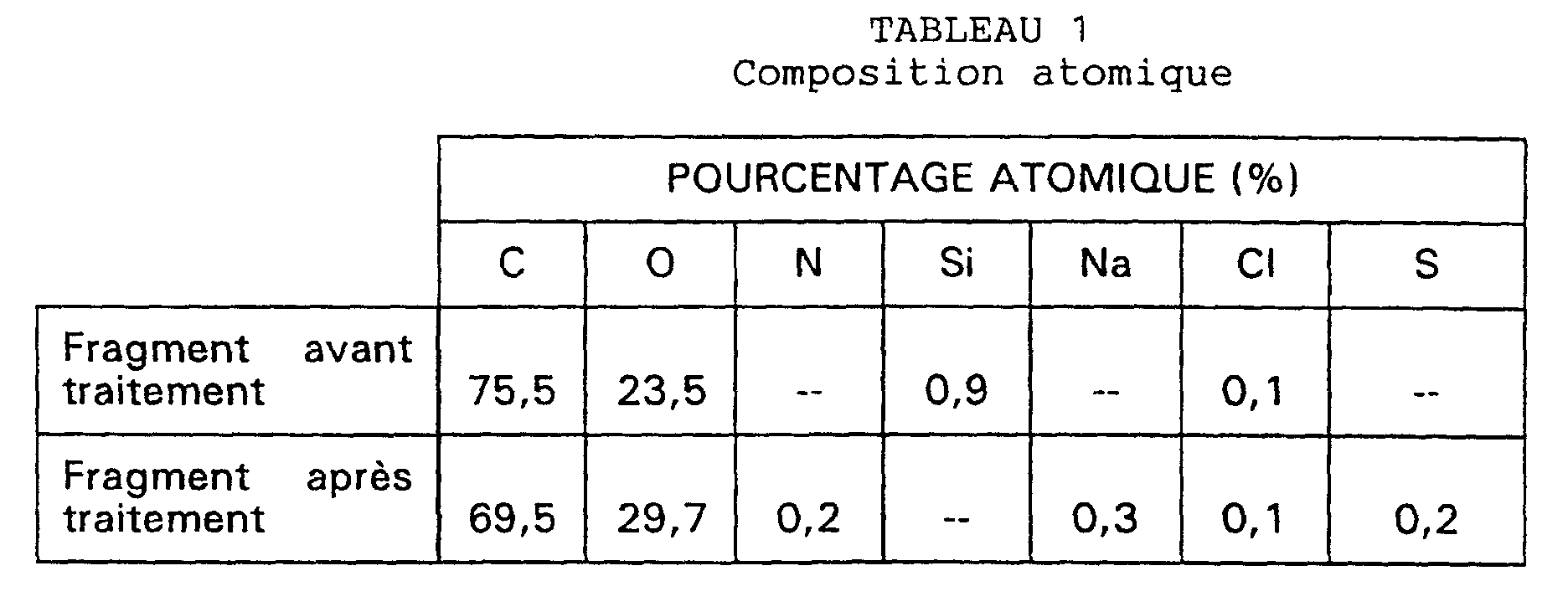
effectuées sur les deux fragments. Le tableau 1 suivant
donne la composition atomique de la surface de ces
fragments.
Ces résultats montrent que le traitement de l'invention entraíne une modification de la composition atomique de surface. En effet, il se produit une variation de la proportion de C et O ainsi que la disparition de Si au profit de N, de Na et de S. De plus, les deux fragments ont une composition de surface qui est éloignée de la composition théorique du PGA (50 % de C et 50 % de O). Ceci montre que la composition chimique de la surface des fragments avant traitement n'est pas formée de PGA pur et que cette composition chimique change suite au traitement selon l'invention.Les analyses à haute résolution du carbone (C1s) révèlent aussi que la surface de la pièce est modifiée par le traitement selon l'invention. En effet, le tableau 2 suivant montre que le pourcentage des liaisons C-C et C-O a diminué au profit des liaisons C=O après le traitement.

- Analyse FTIR : Les spectres infrarouges des deux fragments et du fil brut sont pratiquement identiques sauf pour ce qui est des bandes caractéristiques des groupes CH2 et CH3 (entre 2800 et 3100 cm-1). On remarque que la structure des bandes des trois échantillons est différente, et que le fragment avant le traitement a une structure différente de celle des deux autres échantillons. En effet, deux pics importants apparaissent à 2850 cm-1 et 2920 cm-1 après le tissage et puis disparaissent après le traitement selon l'invention. Le spectre du fragment après le traitement est peu différent de celui du fil brut.
- Analyse DSC :
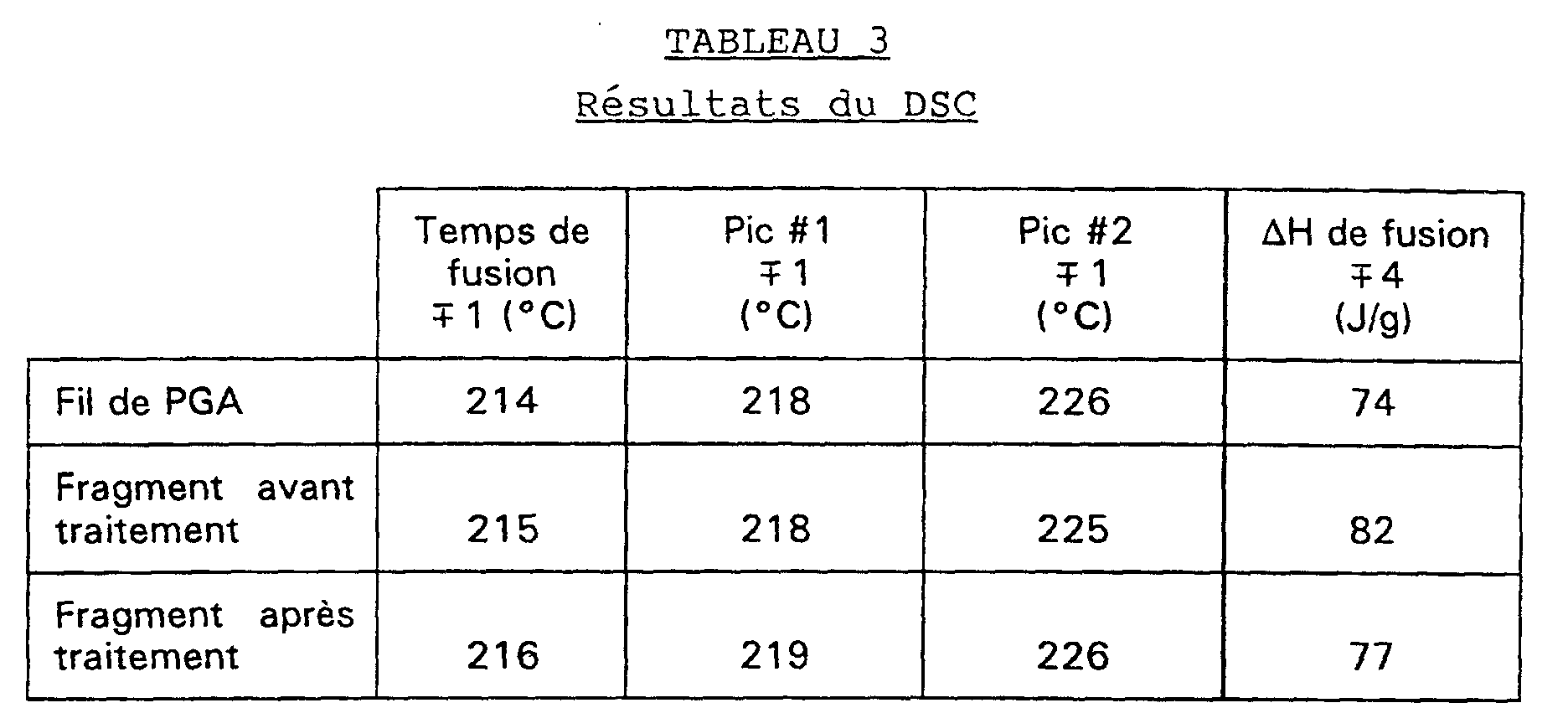
Le tableau 3 suivant résume les résultats
obtenus à partir des thermogrammes.
Il est à noter que les variations de valeur obtenues pour l'enthalpie de fusion ne sont pas significatives, compte tenu des incertitudes de mesure. En conséquence, ces résultats confirment que la structure interne du fil et des fragments de pièce tissée n'est pas modifiée par le traitement de l'invention.
- le traitement ne modifie pas la structure intrinsèque du second fragment et des fibres de PGA,
- les deux fragments renfermaient des contaminants de type hydrocarbures qui disparaissent dans le second fragment après le traitement selon l'invention,
- la qualité du nettoyage des fibres après le traitement selon l'invention est satisfaisante,
- le traitement induit une modification de la composition chimique de la surface des fils, probablement responsable d'une augmentation de la résistance mécanique.
| Fil brut de PGA | 1,09 dl/g |
| Fragment avant traitement | 1,16 dl/g |
| Fragment après traitement selon l'invention | 1,13 dl/g |
Claims (17)
- Procédé de traitement après sa fabrication d'une structure textile contenant au moins un polymère de la famille des poly(α-hydroxy-acides) obtenue par au moins une étape mécanique d'assemblage (filature et/ou tressage et/ou tricotage et/ou tissage et/ou agglomération...) de fibres textiles au moins partiellement formées de fibres contenant une proportion d'au moins un polymère de la famille des poly(α-hydroxy-acides) dont le poids moléculaire est adapté pour permettre l'obtention de ladite structure, procédé dans lequel on soumet la structure à au moins une étape de traitement lors de laquelle on la place au contact d'un courant d'une composition d'au moins un fluide à l'état supercritique, et on choisit ladite composition, et la durée du traitement pour éliminer les impuretés emprisonnées dans la structure afin de permettre son implantation ultérieure dans le corps humain ou animal, et pour au moins préserver l'intégrité de la structure.
- Procédé selon la revendication 1, caractérisé en ce qu'on utilise du dioxyde de carbone à l'état supercritique à titre de composition.
- Procédé selon la revendication 2, caractérisé en ce qu'on place la structure au contact d'un courant de dioxyde de carbone supercritique pendant une durée comprise entre 1 h et 24 h, notamment de l'ordre de 12 h.
- Procédé de fabrication d'une structure textile contenant au moins un polymère de la famille des poly(α-hydroxy-acides), dans lequel on réalise la structure par au moins une étape mécanique d'assemblage (filature et/ou tressage et/ou tricotage et/ou tissage et/ou agglomération...) de fibres textiles au moins partiellement formées de fibres contenant une proportion d'au moins un polymère de la famille des poly(α-hydroxy-acides) dont le poids moléculaire est adapté pour permettre l'obtention de ladite structure, procédé dans lequel après avoir effectué toutes les étapes d'assemblage permettant d'obtenir la structure, on soumet la structure à au moins une étape de traitement lors de laquelle on la place au contact d'un courant d'une composition d'au moins un fluide à l'état supercritique, et on choisit ladite composition et la durée du traitement pour éliminer les impuretés emprisonnées dans la structure afin de permettre son implantation ultérieure dans le corps humain ou animal, et pour au moins préserver l'intégrité physique de la structure.
- Procédé selon la revendication 4, caractérisé en ce qu'on réalise la structure par assemblage de fils obtenus par extrusion de fibres contenant au moins un polymère de la famille des poly(α-hydroxy-acides).
- Procédé selon l'une des revendications 4 et 5, caractérisé en ce qu'on réalise la structure avec des fils obtenus par extrusion de fibres de PGA.
- Procédé selon l'une des revendications 4 à 6, caractérisé en ce qu'on réalise le conditionnement final de la structure après ladite étape de traitement.
- Procédé selon l'une des revendications 4 à 7, caractérisé en ce qu'on soumet la structure à une et une seule étape de purification après toutes les étapes d'assemblage permettant d'obtenir la structure.
- Procédé selon l'une des revendications 4 à 8, caractérisé en ce qu'on soumet la structure à l'étape de traitement immédiatement après avoir effectué toutes les étapes d'assemblage et de finition pour l'obtention de la structure.
- Procédé selon l'une des revendications 1 à 9, caractérisé en ce qu'on effectue ladite étape de traitement immédiatement après la fabrication de la pièce.
- Procédé selon l'une des revendications 1 à 10, caractérisé en ce qu'on utilise du dioxyde de carbone à l'état supercritique à titre de composition de fluide(s) à l'état supercritique.
- Procédé selon la revendication 11, caractérisé en ce qu'on place la structure au contact d'un courant de dioxyde de carbone supercritique pendant une durée comprise entre 1 h et 24 h, notamment de l'ordre de 12 h.
- Structure textile biorésorbable contenant au moins un polymère de la famille des poly (α-hydroxy-acides) obtenue par au moins une étape mécanique d'assemblage (filature et/ou tressage et/ou tricotage et/ou tissage et/ou agglomération...) de fibres textiles au moins partiellement formées de fibres contenant une proportion d'au moins un polymère de la famille des poly(α-hydroxy-acides) dont le poids moléculaire est adapté pour permettre l'obtention de ladite structure, et ayant été obtenue par un procédé selon l'une des revendications 1 à 12.
- Structure selon la revendication 13, caractérisée en ce qu'elle est formée d'un assemblage de fils obtenus par extrusion de fibres contenant au moins un polymère de la famille des poly(α-hydroxy-acides).
- Structure selon l'une des revendications 13 et 14, caractérisée en ce qu'elle est formée avec des fils obtenus par extrusion de fibres de PGA.
- Structure selon l'une des revendications 13 à 15, caractérisée en ce qu'elle est formée d'une pièce tissée biorésorbable de fils de PGA.
- Pièce comprenant une structure textile selon l'une des revendications 13 à 16 suffisamment pure pour pouvoir être implantable chez l'homme ou l'animal.
Applications Claiming Priority (3)
| Application Number | Priority Date | Filing Date | Title |
|---|---|---|---|
| FR9607720 | 1996-06-18 | ||
| FR9607720A FR2749864B1 (fr) | 1996-06-18 | 1996-06-18 | Procedes de fabrication et de traitement d'une piece textile et applications |
| PCT/FR1997/001093 WO1997048848A1 (fr) | 1996-06-18 | 1997-06-17 | Procede de fabrication et de traitement des textiles |
Publications (2)
| Publication Number | Publication Date |
|---|---|
| EP0906464A1 EP0906464A1 (fr) | 1999-04-07 |
| EP0906464B1 true EP0906464B1 (fr) | 2002-01-09 |
Family
ID=9493281
Family Applications (1)
| Application Number | Title | Priority Date | Filing Date |
|---|---|---|---|
| EP97929370A Expired - Lifetime EP0906464B1 (fr) | 1996-06-18 | 1997-06-17 | Procede de fabrication et de traitement des textiles |
Country Status (10)
| Country | Link |
|---|---|
| US (1) | US6120558A (fr) |
| EP (1) | EP0906464B1 (fr) |
| JP (1) | JP2000512697A (fr) |
| AT (1) | ATE211782T1 (fr) |
| DE (1) | DE69709923T2 (fr) |
| DK (1) | DK0906464T3 (fr) |
| ES (1) | ES2171957T3 (fr) |
| FR (1) | FR2749864B1 (fr) |
| PT (1) | PT906464E (fr) |
| WO (1) | WO1997048848A1 (fr) |
Families Citing this family (17)
| Publication number | Priority date | Publication date | Assignee | Title |
|---|---|---|---|---|
| US6149864A (en) * | 1998-06-25 | 2000-11-21 | Massachusetts Institute Of Technology | Supercritical fluid sterilization method |
| US6924792B1 (en) * | 2000-03-10 | 2005-08-02 | Richard V. Jessop | Electrowetting and electrostatic screen display systems, colour displays and transmission means |
| US6517589B1 (en) * | 2000-11-14 | 2003-02-11 | China Textile Institute | Manufacturing method of coloring and lustering substance |
| US6679067B1 (en) | 2001-07-16 | 2004-01-20 | C W Holdings Llc | Cryogenic processes for treating pantyhose |
| GB0202233D0 (en) * | 2002-01-31 | 2002-03-20 | Smith & Nephew | Bioresorbable polymers |
| US7112463B2 (en) * | 2003-11-13 | 2006-09-26 | Honeywell International Inc. | Method for making devices using ink jet printing |
| US8328876B2 (en) | 2003-12-31 | 2012-12-11 | Warsaw Orthopedic, Inc. | Bone matrix compositions and methods |
| US20070075922A1 (en) | 2005-09-28 | 2007-04-05 | Jessop Richard V | Electronic display systems |
| CN101365499A (zh) | 2005-11-01 | 2009-02-11 | 骨骼技术股份有限公司 | 骨基质组合物和方法 |
| CA2690457C (fr) | 2007-06-15 | 2018-02-20 | Osteotech, Inc. | Compositions de matrice osseuse et methodes |
| WO2008157492A2 (fr) | 2007-06-15 | 2008-12-24 | Osteotech, Inc. | Os spongieux déminéralisé ostéo-inducteur |
| US9554920B2 (en) | 2007-06-15 | 2017-01-31 | Warsaw Orthopedic, Inc. | Bone matrix compositions having nanoscale textured surfaces |
| CA2945295C (fr) | 2007-06-15 | 2020-01-14 | Warsaw Orthopedic, Inc. | Procede de traitement d'un tissu |
| US9492278B2 (en) | 2007-07-10 | 2016-11-15 | Warsaw Orthopedic, Inc. | Delivery system |
| CA2702499A1 (fr) | 2007-10-19 | 2009-04-23 | Osteotech, Inc. | Compositions de matrice osseuse demineralisee et procedes |
| WO2010093959A2 (fr) | 2009-02-12 | 2010-08-19 | Osteotech, Inc. | Systemes de liberation, instruments et methodes d'utilisation associees |
| FR3043099B1 (fr) * | 2015-11-02 | 2020-12-11 | Teknimed Sas | Procede de desensimage de materiaux textiles a usage de dispositif medical implantable dans le corps humain |
Family Cites Families (21)
| Publication number | Priority date | Publication date | Assignee | Title |
|---|---|---|---|---|
| US4012194A (en) * | 1971-10-04 | 1977-03-15 | Maffei Raymond L | Extraction and cleaning processes |
| US4563489A (en) * | 1984-02-10 | 1986-01-07 | University Of California | Biodegradable organic polymer delivery system for bone morphogenetic protein |
| US4749522A (en) * | 1985-10-31 | 1988-06-07 | Angio-Medical Corporation | Supercritical fluid extraction of animal derived materials |
| JPH0781204B2 (ja) * | 1987-04-21 | 1995-08-30 | 株式会社バイオマテリアルユニバ−ス | ポリ乳酸繊維 |
| DE4004111C2 (de) * | 1989-02-15 | 1999-08-19 | Deutsches Textilforschzentrum | Verfahren zur Vorbehandlung von textilen Flächengebilden oder Garnen |
| DE3904514C2 (de) * | 1989-02-15 | 1999-03-11 | Oeffentliche Pruefstelle Und T | Verfahren zum Reinigen bzw. Waschen von Bekleidungsteilen o. dgl. |
| US4997446A (en) * | 1989-09-14 | 1991-03-05 | Intermedics Orthopedics, Inc. | Method and apparatus for osseous contour reconstruction |
| GB8928250D0 (en) * | 1989-12-14 | 1990-02-21 | Erba Carlo Spa | Use of supercritical fluids to obtain porous sponges of biodegradable polymers |
| US5279615A (en) * | 1991-06-14 | 1994-01-18 | The Clorox Company | Method and composition using densified carbon dioxide and cleaning adjunct to clean fabrics |
| US5431843A (en) * | 1991-09-04 | 1995-07-11 | The Clorox Company | Cleaning through perhydrolysis conducted in dense fluid medium |
| US5206341A (en) * | 1991-11-21 | 1993-04-27 | Southern Research Institute | Polymers from hydroxy acids and polycarboxylic acids |
| DE4238620C2 (de) * | 1992-11-16 | 2002-02-14 | Amann & Soehne | Verfahren zur Entnahme eines Textilgutes aus einem unter Druck stehenden Autoklaven sowie Vorrichtung zur Durchführung des Verfahrens |
| DE4314869A1 (de) * | 1993-05-05 | 1994-11-10 | Boehringer Ingelheim Kg | Verfahren zur Formgebung von thermoplastischen Kunststoffen, insbesondere von resorbierbaren Thermoplasten |
| US5985776A (en) * | 1993-08-02 | 1999-11-16 | Fiberweb France | Nonwoven based on polymers derived from lactic acid, process for manufacture and use of such a nonwoven |
| US5593778A (en) * | 1993-09-09 | 1997-01-14 | Kanebo, Ltd. | Biodegradable copolyester, molded article produced therefrom and process for producing the molded article |
| DE4333221B4 (de) * | 1993-09-30 | 2006-05-04 | Deutsches Textilforschungszentrum Nord-West E.V. | Verfahren zum Entfärben von Substraten aus Kunststoff, insbesondere Synthesefasern |
| DE4336941A1 (de) * | 1993-10-29 | 1995-05-04 | Wfk Inst Fuer Angewandte Forsc | Verfahren zur Verringerung der Konzentration an Tensiden und/oder Pyrogenen |
| GB9403135D0 (en) * | 1994-02-18 | 1994-04-06 | Univ Glasgow | Wound healing device |
| US5626861A (en) * | 1994-04-01 | 1997-05-06 | Massachusetts Institute Of Technology | Polymeric-hydroxyapatite bone composite |
| US5467492A (en) * | 1994-04-29 | 1995-11-21 | Hughes Aircraft Company | Dry-cleaning of garments using liquid carbon dioxide under agitation as cleaning medium |
| US5833891A (en) * | 1996-10-09 | 1998-11-10 | The University Of Kansas | Methods for a particle precipitation and coating using near-critical and supercritical antisolvents |
-
1996
- 1996-06-18 FR FR9607720A patent/FR2749864B1/fr not_active Expired - Fee Related
-
1997
- 1997-06-17 JP JP10502431A patent/JP2000512697A/ja not_active Ceased
- 1997-06-17 PT PT97929370T patent/PT906464E/pt unknown
- 1997-06-17 DK DK97929370T patent/DK0906464T3/da active
- 1997-06-17 AT AT97929370T patent/ATE211782T1/de not_active IP Right Cessation
- 1997-06-17 EP EP97929370A patent/EP0906464B1/fr not_active Expired - Lifetime
- 1997-06-17 DE DE69709923T patent/DE69709923T2/de not_active Expired - Fee Related
- 1997-06-17 WO PCT/FR1997/001093 patent/WO1997048848A1/fr not_active Ceased
- 1997-06-17 ES ES97929370T patent/ES2171957T3/es not_active Expired - Lifetime
- 1997-06-17 US US09/202,688 patent/US6120558A/en not_active Expired - Fee Related
Also Published As
| Publication number | Publication date |
|---|---|
| DE69709923T2 (de) | 2002-09-12 |
| PT906464E (pt) | 2002-06-28 |
| DE69709923D1 (de) | 2002-02-28 |
| FR2749864B1 (fr) | 1998-09-11 |
| WO1997048848A1 (fr) | 1997-12-24 |
| DK0906464T3 (da) | 2002-04-22 |
| ES2171957T3 (es) | 2002-09-16 |
| ATE211782T1 (de) | 2002-01-15 |
| JP2000512697A (ja) | 2000-09-26 |
| US6120558A (en) | 2000-09-19 |
| EP0906464A1 (fr) | 1999-04-07 |
| FR2749864A1 (fr) | 1997-12-19 |
Similar Documents
| Publication | Publication Date | Title |
|---|---|---|
| EP0906464A1 (fr) | Procede de fabrication et de traitement des textiles | |
| DE60223233T2 (de) | Verfahren zur Formung einer Seidenfaser | |
| Ohkawa et al. | Preparation of pure cellulose nanofiber via electrospinning | |
| Liu et al. | Poly (l-lactide-co-caprolactone)/tussah silk fibroin nanofiber vascular scaffolds with small diameter fabricated by core-spun electrospinning technology | |
| Mollahosseini et al. | Recycling of waste silk fibers towards silk fibroin fibers with different structures through wet spinning technique | |
| Vardhini et al. | Effect of alkali treatment on physical properties of banana fibre | |
| DE60316988D1 (de) | Verfahren zur herstellung und verfahren zur konvertierung von polyolefinfasern | |
| Okahisa et al. | Preparation of silk-fibroin nanofiber film with native β-sheet structure via a never dried-simple grinding treatment | |
| Kang et al. | Silver nanoparticles incorporated electrospun silk fibers | |
| Rahman et al. | Green degumming of silk by enzyme extracted from natural sources | |
| Suryanto et al. | FTIR analysis of alkali treatment on bacterial cellulose films obtained from pineapple peel juice | |
| Abdu et al. | Selected natural fibers and their electrospinning | |
| CN1338950A (zh) | 一种由线型聚氨酯嵌段共聚物组成的医用薄膜及其生产方法 | |
| Zhu et al. | Fabrication and osteoblastic adhesion behavior of regenerated silk fibroin/PLLA Nanofibrous scaffold by double syringe electrospinning | |
| FR2647815A1 (fr) | Fibre composite pour utilisation dans la production d'un filament superfin | |
| EP0695384B1 (fr) | Procede d'enrobage de fils et de fibres dans des objets textiles | |
| CN110982099A (zh) | 一种丝素/聚乳酸复合微孔膜材料及其制备方法和应用 | |
| Rahman et al. | Titanium dioxide particle-induced alkaline degradation of poly (ethylene terephthalate): application to medical textiles | |
| JP5012141B2 (ja) | ポリ乳酸原綿 | |
| JP2010095812A (ja) | 金属酸化物で被覆された繊維性材料を製造する方法、及びその方法によって得られた繊維性材料、並びに結合組織修復材料 | |
| Rakesh et al. | Study on mechanical properties of Himalayacalamus falconeri fiber-reinforced polylactic acid composites | |
| WO2017017381A1 (fr) | Filament multi-composant a base d'alginate | |
| de Matos Costa et al. | Electrospun membranes of polyhydroxybutyrate–niobium pentoxide as potential scaffolds for bone tissue engineering | |
| RU2854744C1 (ru) | Способ модификации шёлкового материала оксидными наночастицами | |
| FR3154418A1 (fr) | Procédé d’obtention de fibres libériennes élémentaires |
Legal Events
| Date | Code | Title | Description |
|---|---|---|---|
| PUAI | Public reference made under article 153(3) epc to a published international application that has entered the european phase |
Free format text: ORIGINAL CODE: 0009012 |
|
| 17P | Request for examination filed |
Effective date: 19981117 |
|
| AK | Designated contracting states |
Kind code of ref document: A1 Designated state(s): AT BE CH DE DK ES FI FR GB GR IE IT LI LU MC NL PT SE |
|
| 17Q | First examination report despatched |
Effective date: 19991004 |
|
| GRAG | Despatch of communication of intention to grant |
Free format text: ORIGINAL CODE: EPIDOS AGRA |
|
| GRAG | Despatch of communication of intention to grant |
Free format text: ORIGINAL CODE: EPIDOS AGRA |
|
| GRAH | Despatch of communication of intention to grant a patent |
Free format text: ORIGINAL CODE: EPIDOS IGRA |
|
| GRAH | Despatch of communication of intention to grant a patent |
Free format text: ORIGINAL CODE: EPIDOS IGRA |
|
| GRAA | (expected) grant |
Free format text: ORIGINAL CODE: 0009210 |
|
| REG | Reference to a national code |
Ref country code: GB Ref legal event code: IF02 |
|
| AK | Designated contracting states |
Kind code of ref document: B1 Designated state(s): AT BE CH DE DK ES FI FR GB GR IE IT LI LU MC NL PT SE |
|
| REF | Corresponds to: |
Ref document number: 211782 Country of ref document: AT Date of ref document: 20020115 Kind code of ref document: T |
|
| REG | Reference to a national code |
Ref country code: CH Ref legal event code: EP |
|
| REG | Reference to a national code |
Ref country code: IE Ref legal event code: FG4D Free format text: FRENCH |
|
| REF | Corresponds to: |
Ref document number: 69709923 Country of ref document: DE Date of ref document: 20020228 |
|
| REG | Reference to a national code |
Ref country code: DK Ref legal event code: T3 |
|
| REG | Reference to a national code |
Ref country code: CH Ref legal event code: PFA Free format text: BIOLAND SOCIETE A RESPONSABILITE LIMITEE TRANSFER- DEPUY BIOLAND SOCIETE ANONYME Ref country code: CH Ref legal event code: NV Representative=s name: BOVARD AG PATENTANWAELTE |
|
| GBT | Gb: translation of ep patent filed (gb section 77(6)(a)/1977) |
Effective date: 20020409 |
|
| RAP2 | Party data changed (patent owner data changed or rights of a patent transferred) |
Owner name: DEPUY BIOLAND |
|
| REG | Reference to a national code |
Ref country code: PT Ref legal event code: SC4A Free format text: AVAILABILITY OF NATIONAL TRANSLATION Effective date: 20020405 Ref country code: PT Ref legal event code: PD4A Free format text: DEPUY BIOLAND FR Effective date: 20020405 |
|
| NLT2 | Nl: modifications (of names), taken from the european patent patent bulletin |
Owner name: DEPUY BIOLAND |
|
| REG | Reference to a national code |
Ref country code: FR Ref legal event code: CJ Ref country code: FR Ref legal event code: CD |
|
| NLS | Nl: assignments of ep-patents |
Owner name: BIOLAND S.A. |
|
| NLT1 | Nl: modifications of names registered in virtue of documents presented to the patent office pursuant to art. 16 a, paragraph 1 |
Owner name: DEPUY BIOLAND S.A. |
|
| REG | Reference to a national code |
Ref country code: GR Ref legal event code: EP Ref document number: 20020401370 Country of ref document: GR |
|
| REG | Reference to a national code |
Ref country code: ES Ref legal event code: FG2A Ref document number: 2171957 Country of ref document: ES Kind code of ref document: T3 |
|
| PLBE | No opposition filed within time limit |
Free format text: ORIGINAL CODE: 0009261 |
|
| STAA | Information on the status of an ep patent application or granted ep patent |
Free format text: STATUS: NO OPPOSITION FILED WITHIN TIME LIMIT |
|
| BECA | Be: change of holder's address |
Free format text: 20020109 *DEPUY BIOLAND:132 ROUTE D'ESPAGNE, F-31100 TOULOUSE |
|
| BECH | Be: change of holder |
Free format text: 20020109 *DEPUY BIOLAND |
|
| 26N | No opposition filed | ||
| REG | Reference to a national code |
Ref country code: PT Ref legal event code: PC4A Free format text: BOOST, S.A. CH Effective date: 20030626 |
|
| REG | Reference to a national code |
Ref country code: FR Ref legal event code: TP |
|
| PGFP | Annual fee paid to national office [announced via postgrant information from national office to epo] |
Ref country code: NL Payment date: 20031208 Year of fee payment: 7 Ref country code: CH Payment date: 20031208 Year of fee payment: 7 Ref country code: FI Payment date: 20031208 Year of fee payment: 7 |
|
| PGFP | Annual fee paid to national office [announced via postgrant information from national office to epo] |
Ref country code: SE Payment date: 20031211 Year of fee payment: 7 Ref country code: AT Payment date: 20031211 Year of fee payment: 7 |
|
| PGFP | Annual fee paid to national office [announced via postgrant information from national office to epo] |
Ref country code: DK Payment date: 20031212 Year of fee payment: 7 |
|
| PGFP | Annual fee paid to national office [announced via postgrant information from national office to epo] |
Ref country code: MC Payment date: 20031218 Year of fee payment: 7 |
|
| PGFP | Annual fee paid to national office [announced via postgrant information from national office to epo] |
Ref country code: PT Payment date: 20031223 Year of fee payment: 7 |
|
| PGFP | Annual fee paid to national office [announced via postgrant information from national office to epo] |
Ref country code: LU Payment date: 20031229 Year of fee payment: 7 Ref country code: GR Payment date: 20031229 Year of fee payment: 7 |
|
| PGFP | Annual fee paid to national office [announced via postgrant information from national office to epo] |
Ref country code: IE Payment date: 20031231 Year of fee payment: 7 |
|
| PGFP | Annual fee paid to national office [announced via postgrant information from national office to epo] |
Ref country code: BE Payment date: 20040116 Year of fee payment: 7 |
|
| REG | Reference to a national code |
Ref country code: FR Ref legal event code: CA |
|
| REG | Reference to a national code |
Ref country code: CH Ref legal event code: PUE Owner name: BOOST SA Free format text: DEPUY BIOLAND SOCIETE ANONYME#132, ROUTE D'ESPAGNE#31100 TOULOUSE (FR) -TRANSFER TO- BOOST SA#RUE DU NANT 8, C/BERNEY CONSEIL SA,#1207 GENEVE (CH) Ref country code: CH Ref legal event code: PFA Owner name: DEPUY BIOLAND SOCIETE ANONYME Free format text: DEPUY BIOLAND#132, ROUTE D'ESPAGNE#31100 TOULOUSE (FR) -TRANSFER TO- DEPUY BIOLAND SOCIETE ANONYME#132, ROUTE D'ESPAGNE#31100 TOULOUSE (FR) |
|
| NLS | Nl: assignments of ep-patents |
Owner name: BOOST S.A. |
|
| REG | Reference to a national code |
Ref country code: GB Ref legal event code: 732E |
|
| PG25 | Lapsed in a contracting state [announced via postgrant information from national office to epo] |
Ref country code: LU Free format text: LAPSE BECAUSE OF NON-PAYMENT OF DUE FEES Effective date: 20040617 Ref country code: IE Free format text: LAPSE BECAUSE OF NON-PAYMENT OF DUE FEES Effective date: 20040617 Ref country code: FI Free format text: LAPSE BECAUSE OF NON-PAYMENT OF DUE FEES Effective date: 20040617 Ref country code: AT Free format text: LAPSE BECAUSE OF NON-PAYMENT OF DUE FEES Effective date: 20040617 |
|
| PG25 | Lapsed in a contracting state [announced via postgrant information from national office to epo] |
Ref country code: SE Free format text: LAPSE BECAUSE OF NON-PAYMENT OF DUE FEES Effective date: 20040618 |
|
| PG25 | Lapsed in a contracting state [announced via postgrant information from national office to epo] |
Ref country code: MC Free format text: LAPSE BECAUSE OF NON-PAYMENT OF DUE FEES Effective date: 20040630 Ref country code: LI Free format text: LAPSE BECAUSE OF NON-PAYMENT OF DUE FEES Effective date: 20040630 Ref country code: DK Free format text: LAPSE BECAUSE OF NON-PAYMENT OF DUE FEES Effective date: 20040630 Ref country code: CH Free format text: LAPSE BECAUSE OF NON-PAYMENT OF DUE FEES Effective date: 20040630 Ref country code: BE Free format text: LAPSE BECAUSE OF NON-PAYMENT OF DUE FEES Effective date: 20040630 |
|
| PG25 | Lapsed in a contracting state [announced via postgrant information from national office to epo] |
Ref country code: PT Free format text: LAPSE BECAUSE OF NON-PAYMENT OF DUE FEES Effective date: 20041217 |
|
| BERE | Be: lapsed |
Owner name: S.A. *BOOST Effective date: 20040630 |
|
| PG25 | Lapsed in a contracting state [announced via postgrant information from national office to epo] |
Ref country code: NL Free format text: LAPSE BECAUSE OF NON-PAYMENT OF DUE FEES Effective date: 20050101 |
|
| PG25 | Lapsed in a contracting state [announced via postgrant information from national office to epo] |
Ref country code: GR Free format text: LAPSE BECAUSE OF NON-PAYMENT OF DUE FEES Effective date: 20050105 |
|
| REG | Reference to a national code |
Ref country code: DK Ref legal event code: EBP |
|
| EUG | Se: european patent has lapsed | ||
| EUG | Se: european patent has lapsed | ||
| REG | Reference to a national code |
Ref country code: CH Ref legal event code: PL |
|
| REG | Reference to a national code |
Ref country code: PT Ref legal event code: MM4A Free format text: LAPSE DUE TO NON-PAYMENT OF FEES Effective date: 20041217 |
|
| NLV4 | Nl: lapsed or anulled due to non-payment of the annual fee |
Effective date: 20050101 |
|
| REG | Reference to a national code |
Ref country code: IE Ref legal event code: MM4A |
|
| PGFP | Annual fee paid to national office [announced via postgrant information from national office to epo] |
Ref country code: ES Payment date: 20090609 Year of fee payment: 13 |
|
| PGFP | Annual fee paid to national office [announced via postgrant information from national office to epo] |
Ref country code: IT Payment date: 20090527 Year of fee payment: 13 |
|
| PGFP | Annual fee paid to national office [announced via postgrant information from national office to epo] |
Ref country code: FR Payment date: 20090630 Year of fee payment: 13 |
|
| PGFP | Annual fee paid to national office [announced via postgrant information from national office to epo] |
Ref country code: GB Payment date: 20090526 Year of fee payment: 13 Ref country code: DE Payment date: 20090703 Year of fee payment: 13 |
|
| GBPC | Gb: european patent ceased through non-payment of renewal fee |
Effective date: 20100617 |
|
| REG | Reference to a national code |
Ref country code: FR Ref legal event code: ST Effective date: 20110228 |
|
| PG25 | Lapsed in a contracting state [announced via postgrant information from national office to epo] |
Ref country code: IT Free format text: LAPSE BECAUSE OF NON-PAYMENT OF DUE FEES Effective date: 20100617 |
|
| PG25 | Lapsed in a contracting state [announced via postgrant information from national office to epo] |
Ref country code: DE Free format text: LAPSE BECAUSE OF NON-PAYMENT OF DUE FEES Effective date: 20110101 |
|
| PG25 | Lapsed in a contracting state [announced via postgrant information from national office to epo] |
Ref country code: FR Free format text: LAPSE BECAUSE OF NON-PAYMENT OF DUE FEES Effective date: 20100630 |
|
| REG | Reference to a national code |
Ref country code: ES Ref legal event code: FD2A Effective date: 20110715 |
|
| PG25 | Lapsed in a contracting state [announced via postgrant information from national office to epo] |
Ref country code: ES Free format text: LAPSE BECAUSE OF NON-PAYMENT OF DUE FEES Effective date: 20110705 Ref country code: GB Free format text: LAPSE BECAUSE OF NON-PAYMENT OF DUE FEES Effective date: 20100617 |
|
| PG25 | Lapsed in a contracting state [announced via postgrant information from national office to epo] |
Ref country code: ES Free format text: LAPSE BECAUSE OF NON-PAYMENT OF DUE FEES Effective date: 20100618 |