EP0904988A2 - Corner bumper for use on movable and fixed objects - Google Patents
Corner bumper for use on movable and fixed objects Download PDFInfo
- Publication number
- EP0904988A2 EP0904988A2 EP98117611A EP98117611A EP0904988A2 EP 0904988 A2 EP0904988 A2 EP 0904988A2 EP 98117611 A EP98117611 A EP 98117611A EP 98117611 A EP98117611 A EP 98117611A EP 0904988 A2 EP0904988 A2 EP 0904988A2
- Authority
- EP
- European Patent Office
- Prior art keywords
- presented
- interiorly
- wall
- exteriorly
- elongate
- Prior art date
- Legal status (The legal status is an assumption and is not a legal conclusion. Google has not performed a legal analysis and makes no representation as to the accuracy of the status listed.)
- Withdrawn
Links
- 238000010008 shearing Methods 0.000 claims abstract description 11
- 239000011162 core material Substances 0.000 claims description 15
- 239000000463 material Substances 0.000 description 9
- 238000010276 construction Methods 0.000 description 4
- 230000001012 protector Effects 0.000 description 3
- 239000002184 metal Substances 0.000 description 2
- 239000007787 solid Substances 0.000 description 2
- 230000003466 anti-cipated effect Effects 0.000 description 1
- 238000013459 approach Methods 0.000 description 1
- 230000015572 biosynthetic process Effects 0.000 description 1
- 239000011152 fibreglass Substances 0.000 description 1
- 230000002452 interceptive effect Effects 0.000 description 1
- 239000004033 plastic Substances 0.000 description 1
- 229920003023 plastic Polymers 0.000 description 1
- 125000000391 vinyl group Chemical group [H]C([*])=C([H])[H] 0.000 description 1
- 229920002554 vinyl polymer Polymers 0.000 description 1
Images

Classifications
-
- E—FIXED CONSTRUCTIONS
- E02—HYDRAULIC ENGINEERING; FOUNDATIONS; SOIL SHIFTING
- E02B—HYDRAULIC ENGINEERING
- E02B3/00—Engineering works in connection with control or use of streams, rivers, coasts, or other marine sites; Sealings or joints for engineering works in general
- E02B3/20—Equipment for shipping on coasts, in harbours or on other fixed marine structures, e.g. bollards
- E02B3/26—Fenders
-
- B—PERFORMING OPERATIONS; TRANSPORTING
- B60—VEHICLES IN GENERAL
- B60R—VEHICLES, VEHICLE FITTINGS, OR VEHICLE PARTS, NOT OTHERWISE PROVIDED FOR
- B60R19/00—Wheel guards; Radiator guards, e.g. grilles; Obstruction removers; Fittings damping bouncing force in collisions
- B60R19/02—Bumpers, i.e. impact receiving or absorbing members for protecting vehicles or fending off blows from other vehicles or objects
-
- B—PERFORMING OPERATIONS; TRANSPORTING
- B60—VEHICLES IN GENERAL
- B60R—VEHICLES, VEHICLE FITTINGS, OR VEHICLE PARTS, NOT OTHERWISE PROVIDED FOR
- B60R19/00—Wheel guards; Radiator guards, e.g. grilles; Obstruction removers; Fittings damping bouncing force in collisions
- B60R19/02—Bumpers, i.e. impact receiving or absorbing members for protecting vehicles or fending off blows from other vehicles or objects
- B60R2019/026—Buffers, i.e. bumpers of limited extent
-
- Y—GENERAL TAGGING OF NEW TECHNOLOGICAL DEVELOPMENTS; GENERAL TAGGING OF CROSS-SECTIONAL TECHNOLOGIES SPANNING OVER SEVERAL SECTIONS OF THE IPC; TECHNICAL SUBJECTS COVERED BY FORMER USPC CROSS-REFERENCE ART COLLECTIONS [XRACs] AND DIGESTS
- Y02—TECHNOLOGIES OR APPLICATIONS FOR MITIGATION OR ADAPTATION AGAINST CLIMATE CHANGE
- Y02A—TECHNOLOGIES FOR ADAPTATION TO CLIMATE CHANGE
- Y02A30/00—Adapting or protecting infrastructure or their operation
- Y02A30/30—Adapting or protecting infrastructure or their operation in transportation, e.g. on roads, waterways or railways
Definitions
- This invention relates in general to certain new and useful improvements in corner bumpers used on movable objects for protecting stationary structures against impact by the movable object and, on fixed objects to protect a movable object or, for that matter, the fixed object against impact by another movable object.
- Automotive vehicles such as passenger automotive vehicles, and, for that matter, truck tractors are sometimes equipped with bumpers to preclude damage to a fixed structure, or otherwise, a stationary structure, upon engagement with that fixed or stationary structure, such as a building or a parked vehicle.
- portions of a vehicle are not equipped with bumpers, as for example, the upper portions of a truck and trailer and, particularly, the rear portion of a trailer which may be backed-up toward a fixed building structure. If the trailer should contact that fixed or other stationary structure, damage would result not only to the fixed or stationary structure, but potentially to the trailer, as well.
- corner protectors There have been certain proposed corner protectors, or so-called "corner bumpers".
- the only moderately partially effective corner protector which has been made available is one which is inflatable and uses air as a collapsible medium allowing the corner bumper to absorb the force of an impact.
- This commercially available corner protector comprises a pair of arms or elongate sections which are integrally connected to one another at common ends and includes a top wall to engage the corner of a truck trailer or otherwise the rear portion of a utility truck or a corner of a boat dock. Moreover, the interior of the elongate members is hollow and provided with a means to fill sealed pockets with air, much in the nature of a balloon.
- these commercially available bumpers only have a limited life span and, even though they may be formed of a relatively durable material, they can rupture upon sufficient impact, or otherwise, allowing an escape of the air cushion. In addition, and after a reasonable period of time, they will become brittle and crack, again leading to a lose of the air cushion and thereby become relatively ineffective and incapable of performing their intended function.
- corner bumper which utilizes a plurality of outwardly projecting elements, such as fingers, on the exterior surface thereof and which are designed to either deflect or compress upon engagement with a fixed or stationary structure upon contact.
- outwardly projecting elements are closely spaced apart from one another.
- these outwardly projecting fingers even though formed of a moderately thick and durable rubber material, do not effectively absorb the force of an impact and, frequently, will break off of the bumper, thereby again interfering with its function and operation.
- the present invention relates primarily to a corner bumper adapted for use on movable objects and also on fixed objects.
- the corner bumper can find use on movable objects in the nature of vehicles and which include, for example, truck tractors, truck trailers, single unit trucks and the like.
- the corner bumpers are designed for use on the corners of such movable objects but they are also effective for use on other edge portions of an object.
- The also find effective use on stationary objects to protect the movable object or the stationary object.
- the corner bumper of the invention are also effective for use on fixed objects or other stationary objects as, for example, boat docks, in order to protect a boat against impact.
- stationary structure is used in a broad sense to refer to any structure which may be in a stationary position when engaged by a movable object.
- an airplane is normally a moving object.
- it is temporarily a stationary or a fixed structure since it is parked and non-moving.
- the corner bumper of the invention is unique in that it reduces the possibility of a shearing action on the bumper which might otherwise cause a removal of the corner bumper from a secured position on a utility truck or other vehicle or a fixed object or a movable object.
- the bumper is uniquely designed so that its outer edges are relatively thin. As a result, any impact in the region of an edge of the bumper would likely avoid that edge and engage the greater surface area of the exterior side wall of the bumper, thereby precluding an actual shearing action.
- the exterior side walls of the bumper are actually shaped with a proper taper from the outer edge to the corner portion so that they actually reduce the likelihood of any shearing of the corner bumper from a secured position on a vehicle or other movable object.
- the corner bumper comprises a first elongate section having a first interiorly presented wall and first exteriorly presented wall.
- the bumper also includes a second elongate section connected to an end of the first elongate section and also has a second interiorly presented wall and a second exteriorly presented wall.
- the ends of the elongate sections which are connected together at a corner portion are preferably integrally formed together so that the two elongate sections constitute a single unit.
- the opposite ends, that is the unconnected ends of the elongate sections are generally free ends, but which are tapered to relatively thin edges so as to reduce the possibility of a shearing action, as previously described.
- C designates a corner bumper having a first elongate section 20 and a second elongate section 22.
- Each of the elongate sections 20 and 22 are generally identical in construction and are connected at common ends, preferably at approximately right angles relative to one another, as best shown in Figures 1 and 2 of the drawings. Consequently, portions of the one elongate section 20 will be described in detail, with it being understood that such description is applicable to the generally perpendicularly arranged other elongate section 22.
- the elongate 20 generally comprises an interior core 24 preferably formed of a relatively rigid yet compressible plastic or rubber material, such as vinyl, although any of the other previously identified materials could be employed for this purpose.
- the core integrally merges into an interiorly presented side wall 26, as shown in Figure 5, and an exteriorly presented side wall 28, as best shown in Figure 4.
- the elongate section 22 has an interiorly presented side wall 30 and an exteriorly presented side wall 32, and the side wall 32 of which extends to a common corner or joinder region 34, as hereinafter described.
- the exteriorly presented wall 32 of the elongate section 22 diverges outwardly from the interiorly presented wall 30, commencing from the relatively thin outer edge 38 almost until the region of the joinder 34. In this way, as the elongate sections increase from the outer ends, they progressively have a thicker cross-section.
- the outer corner portion 40 where the exterior walls 28 and 32 integrally merge is arcuate in shape as best illustrated in Figures 4 and 5 of the drawings.
- each of the exterior side wall surface 28 and 32 also taper inwardly toward the respective interiorly presented side wall surface 26 and 30, respectively, in the regions of their lower ends 44. In this way, there is, again, a reduced likelihood of causing a shearing action if a force of an impact should engage the corner bumper at any one of the lower edges.
- each of the elongate sections 20 and 22 are also provided with a large number of vertically arranged openings or channels, as best shown in Figures 1 and 5 of the drawings. Some of those openings terminate in the lower corner regions 44 as shown in Figures 1 and 3 of the drawings. Moreover, each of these openings 46 are generally circularly shaped, although other shaped openings could be employed, if desired. Moreover, it can be seen that the regions existing between each of the openings 46 form ribs 48. These ribs 48 are not necessarily of linear side walls, although the openings 46 do effectively form ribs 48 which extend between the respective interiorly presented walls and the exteriorly presented walls.
- the core material is chosen so that it will also have some degree of resiliency.
- the region of impact 50 in Figure 10 will generally return to its original shape, as shown in Figure 8, after the force which caused the impact has been removed.
- the grouping of a large number of openings in the region of joinder 34 has also been found to be preferable, since this is the region which typically receives the greatest impact.
- the density of the hole pattern can vary depending upon the materials of construction which are employed and the intended use of the corner bumper.
- the shape of the openings can also vary and are not necessarily limited to circular openings, but they could be triangular, rectangular, etc.
- the elongate sections 20 and 22 are each provided, adjacent their lower ends, with recesses 64 and aligned fastener receiving holes 66, which are sized to receive conventional fasteners, such as sheet metal screws or the like. In this way, the elongate sections can be secured to a movable object such as a truck trailer or a stationary object, such as a boat dock. These recesses and fastener receiving holes are located so that the corner bumpers can be secured to a movable object or a stationary object, or both.
- the corner bumper C is also provided with a top wall 68 which is comprised of a top lip 70 extending inwardly from the elongate section 20 and a top lip 72 extending inwardly from the elongate section 22 and which are again integrally joined in a joinder region 74.
- the top wall 68 may be secured to the elongate sections 20 and 22 or they may be integral therewith.
- the top wall 68 is formed of the same material used in the formation of the elongate sections 20 and 22.
- the lips 70 and 72 are each formed of a generally solid-core material and are not provided with openings in the same manner as the elongate sections 20 and 22. However, it should be understood that, if desired, the lips 70 and 72 could also be provided with holes in the same manner for purposes of collapsing in the event of an impact. However, it has been found that there is typically little likelihood of impact on the upper surface of the top wall 68 and that the material of construction is generally sufficient to compress and absorb the force of any impact.
- the top wall 68 is somewhat hemispherically shaped although it increases from relatively wide transverse ends 76 and 78 to the region of joinder 74.
- the exterior margin of the top wall 68 also conforms to that of the upper margin on the exterior walls 28 and 32 of each of the elongate sections 20 and 22, respectively.
- the lips 70 and 72 are each of a relatively thick crosssection, that is, from exterior wall to interior wall in the region of the joinder 74, and that there is a generally uniform but increasing divergence of the outer margins of the lips 70 and 72 as they progress from the respective ends 76 and 78 to the region of joinder 74.
- the lips 70 and 72 are each provided with recesses 80 and 82, respectively, along their upper surfaces and communicating fastener receiving openings 84 and 86 to receive conventional fasteners, such as sheet metal screws (not shown). Again, and although only two such fastener receiving recesses have been shown, it should be understood that any number of desired recesses can be employed.
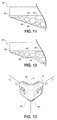
- Figure 13 illustrates the corner bumper C used on a movable object such as a truck T.
- the truck T has a pair of side walls 90 and 92 along with a top wall 94.
- the present invention has been largely described in connection with the use of the corner bumper on a movable object and, although that is unique application, the invention is also highly effective for use on fixed objects to protect against impact with a movable object.
- the corner bumper may be designed to protect the fixed object, such as a boat dock, or it may be designed to protect the boat against that impact or both. In either case, the corner bumper is highly effective.
Landscapes
- Engineering & Computer Science (AREA)
- General Engineering & Computer Science (AREA)
- Ocean & Marine Engineering (AREA)
- Mechanical Engineering (AREA)
- Environmental & Geological Engineering (AREA)
- Civil Engineering (AREA)
- Structural Engineering (AREA)
- Vibration Dampers (AREA)
- Building Environments (AREA)
- Vehicle Step Arrangements And Article Storage (AREA)
Abstract
Description
- This invention relates in general to certain new and useful improvements in corner bumpers used on movable objects for protecting stationary structures against impact by the movable object and, on fixed objects to protect a movable object or, for that matter, the fixed object against impact by another movable object.
- Automotive vehicles, such as passenger automotive vehicles, and, for that matter, truck tractors are sometimes equipped with bumpers to preclude damage to a fixed structure, or otherwise, a stationary structure, upon engagement with that fixed or stationary structure, such as a building or a parked vehicle. In many cases, however, portions of a vehicle are not equipped with bumpers, as for example, the upper portions of a truck and trailer and, particularly, the rear portion of a trailer which may be backed-up toward a fixed building structure. If the trailer should contact that fixed or other stationary structure, damage would result not only to the fixed or stationary structure, but potentially to the trailer, as well.
- This problem often occurs with utility trucks in various locations and, particularly, in airport environments. Frequently, after an aircraft reaches a parking area, several trucks are driven to that location in order to service the aircraft. Since the fuselage of the aircraft has a generally curved side walk, it is oftentimes difficult for a utility truck driver to properly estimate the distance of the rear of that truck to the aircraft. Consequently, impacts can readily arise with resultant damage to the aircraft.
- Even a slight dent in the fuselage of an aircraft can constitute serious damage inasmuch as it will interfere with the aerodynamics of the aircraft. Thus, any type of impact usually results in damage which, in turn, causes the necessity of repair. In the case of a boat which approaches a boat dock, unless protection is provided, even a relatively slight impact against a boat dock can crack the hull of a boat, particularly if made of fiberglass. As a result, and due to the fact that corner bumpers are not affective on the boats, as such, a corner bumper would be needed on a boat dock or the like.
- There have been certain proposed corner protectors, or so-called "corner bumpers". The only moderately partially effective corner protector which has been made available is one which is inflatable and uses air as a collapsible medium allowing the corner bumper to absorb the force of an impact.
- This commercially available corner protector comprises a pair of arms or elongate sections which are integrally connected to one another at common ends and includes a top wall to engage the corner of a truck trailer or otherwise the rear portion of a utility truck or a corner of a boat dock. Moreover, the interior of the elongate members is hollow and provided with a means to fill sealed pockets with air, much in the nature of a balloon.
- As may be anticipated, these commercially available bumpers only have a limited life span and, even though they may be formed of a relatively durable material, they can rupture upon sufficient impact, or otherwise, allowing an escape of the air cushion. In addition, and after a reasonable period of time, they will become brittle and crack, again leading to a lose of the air cushion and thereby become relatively ineffective and incapable of performing their intended function.
- There has been another proposed corner bumper which utilizes a plurality of outwardly projecting elements, such as fingers, on the exterior surface thereof and which are designed to either deflect or compress upon engagement with a fixed or stationary structure upon contact. These outwardly projecting elements are closely spaced apart from one another. However, these outwardly projecting fingers, even though formed of a moderately thick and durable rubber material, do not effectively absorb the force of an impact and, frequently, will break off of the bumper, thereby again interfering with its function and operation.
- The present invention relates primarily to a corner bumper adapted for use on movable objects and also on fixed objects. The corner bumper can find use on movable objects in the nature of vehicles and which include, for example, truck tractors, truck trailers, single unit trucks and the like. Preferably, the corner bumpers are designed for use on the corners of such movable objects but they are also effective for use on other edge portions of an object. The also find effective use on stationary objects to protect the movable object or the stationary object. Thus, the corner bumper of the invention are also effective for use on fixed objects or other stationary objects as, for example, boat docks, in order to protect a boat against impact.
- The term "stationary structure" is used in a broad sense to refer to any structure which may be in a stationary position when engaged by a movable object. Thus, for example, an airplane is normally a moving object. However, when parked at an airport hangar, it is temporarily a stationary or a fixed structure since it is parked and non-moving.
- The corner bumper of the invention is unique in that it reduces the possibility of a shearing action on the bumper which might otherwise cause a removal of the corner bumper from a secured position on a utility truck or other vehicle or a fixed object or a movable object. The bumper is uniquely designed so that its outer edges are relatively thin. As a result, any impact in the region of an edge of the bumper would likely avoid that edge and engage the greater surface area of the exterior side wall of the bumper, thereby precluding an actual shearing action. Moreover, the exterior side walls of the bumper are actually shaped with a proper taper from the outer edge to the corner portion so that they actually reduce the likelihood of any shearing of the corner bumper from a secured position on a vehicle or other movable object.
- The corner bumper comprises a first elongate section having a first interiorly presented wall and first exteriorly presented wall. The bumper also includes a second elongate section connected to an end of the first elongate section and also has a second interiorly presented wall and a second exteriorly presented wall. The ends of the elongate sections which are connected together at a corner portion are preferably integrally formed together so that the two elongate sections constitute a single unit. The opposite ends, that is the unconnected ends of the elongate sections, are generally free ends, but which are tapered to relatively thin edges so as to reduce the possibility of a shearing action, as previously described.
- Inasmuch as any impact with the exteriorly presented first and second walls of the corner bumper is likely to occur near the joined ends of the elongate sections at the corner portion, shearing action is relatively unlikely inasmuch as the corner bumper is tapered toward thin outer edges. If the shearing force would occur near an edge, it is likely to miss the edge, which is relatively thin, as aforesaid. However, if the shearing action occurs in an opposite direction, again the exteriorly presented side walls, they are tapered so as to preclude a shearing of the corner bumper from a secured position.
- The present invention also provides a generally solid interior core extending between the first interiorly presented side wall and the first exteriorly presented side wall. In like manner, a generally solid interior core exists between the second interiorly presented side wall and the second exteriorly presented side wall. A large number of openings are vertically formed within this inner core and, effectively in combination, form large voids or non-material areas and also effectively form ribs therebetween. These voids are open and in communication with an exterior portion, such as a bottom portion of the elongate sections and thus do not form sealed air pockets.
- The ribs which exist between the exteriorly and interiorly presented walls are effectively straddled by voids or open areas on both sides of the ribs. Because of this and the fact that the ribs are generally of proper size and thickness, they are partially collapsible or deflectable because of the voids and they help to absorb the force of an impact against the exteriorly presented wall of each elongate section.
- Having thus described the invention in general terms, reference will now be made to the accompanying drawings in which:
- Figure 1 is a perspective view showing the exterior portions of a corner bumper constructed in accordance with and embodied in the present invention;
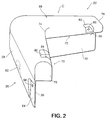
- Figure 2 is somewhat of an oblique perspective view taken from an end portion of one of the elongate sections of the corner bumper of the present invention;
- Figure 3 is a side elevational view of one of the elongate sections of the corner bumper of the present invention;
- Figure 4 is a top plan view of the corner bumper of the present invention;
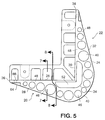
- Figure 5 is a bottom plan view of the corner bumper of the present invention;
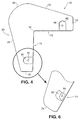
- Figure 6 is an enlarged fragmentary perspective view showing a portion of the fastening area on Figure 4 of the drawings;
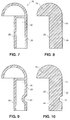
- Figure 7 is a vertical sectional view substantially taken along line 7-7 of Figure 5;
- Figure 8 is a vertical sectional view taken substantially along line 8-8 of Figure 5;
- Figure 9 is a vertical sectional view similar to Figure 7, but showing deflection of a portion of the side wall of the corner bumper upon an impact;
- Figure 10 is a vertical sectional view, similar to Figure 8, and showing deflection of a portion of the side wall upon an impact;
- Figure 11 is an enlarged fragmentary bottom plan view of a portion of one of the elongate sections of the corner bumper;
- Figure 12 is an enlarged fragmentary bottom plan view, similar to Figure 11, and showing collapsing of a portion of the structure upon impact; and
- Figure 13 is a fragmentary perspective view showing the mounting of a corner bumper of the invention on a corner portion of a movable object.
-
- Referring now in more detail and by reference characters to the drawings which illustrate one of the preferred embodiments of the present invention, C designates a corner bumper having a first
elongate section 20 and a secondelongate section 22. - Each of the
elongate sections elongate section 20 will be described in detail, with it being understood that such description is applicable to the generally perpendicularly arranged otherelongate section 22. - The elongate 20 generally comprises an
interior core 24 preferably formed of a relatively rigid yet compressible plastic or rubber material, such as vinyl, although any of the other previously identified materials could be employed for this purpose. The core integrally merges into an interiorly presentedside wall 26, as shown in Figure 5, and an exteriorly presentedside wall 28, as best shown in Figure 4. In like manner, theelongate section 22 has an interiorly presentedside wall 30 and an exteriorly presentedside wall 32, and theside wall 32 of which extends to a common corner orjoinder region 34, as hereinafter described. - The
side walls elongate section 20 merge into a relatively thinfree edge 36 at the right-hand end, reference being made to Figure 1. In like manner, the interiorly presentedwall 30 and the exteriorly presentedwall 32 of theelongate section 22 also merge into a relatively thin outer or freevertical edge 38, also as best shown in Figure 5 of the drawings. The thickness of theelongate sections joinder region 34, as is best illustrated by reference to Figure 5 of the drawings. In other words, commencing from the relativelythin end 36 of theelongate section 20, the exteriorly presentedwall 28 diverges away from the interiorly presentedwall 26, as best shown in Figure 5 of the drawings. In like manner, the exteriorly presentedwall 32 of theelongate section 22 diverges outwardly from the interiorly presentedwall 30, commencing from the relatively thinouter edge 38 almost until the region of thejoinder 34. In this way, as the elongate sections increase from the outer ends, they progressively have a thicker cross-section. - The
outer corner portion 40 where theexterior walls - By further reference to Figures 1 and 5 of the drawings, it can be seen that each of the exterior
side wall surface side wall surface - The
interior core 24 of each of theelongate sections lower corner regions 44 as shown in Figures 1 and 3 of the drawings. Moreover, each of theseopenings 46 are generally circularly shaped, although other shaped openings could be employed, if desired. Moreover, it can be seen that the regions existing between each of theopenings 46form ribs 48. Theseribs 48 are not necessarily of linear side walls, although theopenings 46 do effectively formribs 48 which extend between the respective interiorly presented walls and the exteriorly presented walls. - These openings or channels effectively open at their lower ends so that the openings or channels are constantly air filled at ambient pressure, as best shown in Figure 7 of the drawings. Nevertheless, upon an impact, as shown in Figure 9, it can be seen that the
openings 46 will compress in the region of the impact, as shown. Since the material of construction of the core is relatively elastic, these regions ofimpact 50 will return to their original undeflected position as shown in Figures 7 and 8 upon removal of the force resulting from the impact. - In addition to the foregoing, the core material is chosen so that it will also have some degree of resiliency. Thus, even in the regions wehere there are no openings, as shown in Figures 8 and 10, the region of
impact 50 in Figure 10 will generally return to its original shape, as shown in Figure 8, after the force which caused the impact has been removed. - The grouping of a large number of openings in the region of
joinder 34 has also been found to be preferable, since this is the region which typically receives the greatest impact. Again, the density of the hole pattern can vary depending upon the materials of construction which are employed and the intended use of the corner bumper. Further, and as indicated above, the shape of the openings can also vary and are not necessarily limited to circular openings, but they could be triangular, rectangular, etc. - The
elongate sections recesses 64 and alignedfastener receiving holes 66, which are sized to receive conventional fasteners, such as sheet metal screws or the like. In this way, the elongate sections can be secured to a movable object such as a truck trailer or a stationary object, such as a boat dock. These recesses and fastener receiving holes are located so that the corner bumpers can be secured to a movable object or a stationary object, or both. - The corner bumper C is also provided with a
top wall 68 which is comprised of atop lip 70 extending inwardly from theelongate section 20 and atop lip 72 extending inwardly from theelongate section 22 and which are again integrally joined in ajoinder region 74. Thetop wall 68 may be secured to theelongate sections top wall 68 is formed of the same material used in the formation of theelongate sections - The
lips elongate sections lips top wall 68 and that the material of construction is generally sufficient to compress and absorb the force of any impact. - The
top wall 68 is somewhat hemispherically shaped although it increases from relatively wide transverse ends 76 and 78 to the region ofjoinder 74. The exterior margin of thetop wall 68 also conforms to that of the upper margin on theexterior walls elongate sections - By further reference to Figure 2, it can be seen that the
lips joinder 74, and that there is a generally uniform but increasing divergence of the outer margins of thelips joinder 74. - The
lips recesses fastener receiving openings - Figure 13 illustrates the corner bumper C used on a movable object such as a truck T. In this case, the truck T has a pair of
side walls top wall 94. - The present invention has been largely described in connection with the use of the corner bumper on a movable object and, although that is unique application, the invention is also highly effective for use on fixed objects to protect against impact with a movable object. In this case, the corner bumper may be designed to protect the fixed object, such as a boat dock, or it may be designed to protect the boat against that impact or both. In either case, the corner bumper is highly effective.
Claims (14)
- An improved corner bumper [C] for use on one of a stationary object or a movable to prevent impact and resultant damage to the movable object or stationary object or both, and which comprises a pair of elongate sections [20] and [22] connected at a common end, said improved corner bumper characterized in that:a) said first elongate section [20] having a first interiorly presented wall [26] and a first exteriorly presented wall [28];b) said second elongate section [22] connected to an end of said first elongate section [20] such that the first and second sections have opposite ends [36] and [38] which are not connected to one another; andc) said second elongate section [22] having a second interiorly presented wall [30] and a second exteriorly presented wall [32], said second interiorly presented wall [30] being at an angle with respect to said first interiorly presented wall [26] to engage and allow for securement to the outer walls of a movable object or a stationary object and the exteriorly presented walls [28], [32] of each section being tapered inwardly from the connected ends to the opposite ends [36] and [38] so that a shear force applied to one or both of the exteriorly presented walls [28] and [32] will not force the corner bumper from a fixed and secured position on the object.
- The corner bumper of Claim 1 further characterized in that fastening means [66] is provided on each of said elongate sections [20] and [22] to allow those sections to be secured to a movable object or stationary object.
- The corner bumper of Claim 1 further characterized in that a top wall [68] extends over a portion of said first and second elongate sections and is sized to engage a top wall portion of the object to which it is secured.
- The corner bumper of Claim 1 further characterized in that the first and second interiorly presented walls [26], [30] are located at approximately right angles to one another.
- The corner bumper of Claim 4 further characterized in that a top wall [68] extends over portions of said first and second elongate sections [20], [22] and is sized to engage a top wall portion of a object to which it is secured, and said top wall is also generally perpendicularly arranged with respect to said first and second interiorly presented walls [26], [30].
- The corner bumper of Claim 1 further characterized in that said first interiorly presented wall [26] and first exteriorly presented wall [28] are tapered relative to one another to merge into a relatively thin end section [36] and that said second interiorly presented wall [30] and said second exteriorly presented wall [32] are tapered relative to one another to merge into a relatively thin end section [38] so as to reduce the possibility of a shearing action with respect to the bumper.
- The corner bumper of Claim 1 further characterized in that a plurality of ribbed portions [48] extend between said interiorly and exteriorly presented walls [28], [32] of each elongate section.
- The corner bumper of Claim 1 further characterized in that an interior core material extends between the exteriorly and interiorly presented walls [26], [30] of each elongate section [20], [22] and openings exist in said core material [24] and form ribs [48] between the interiorly and exteriorly presented walls of each elongate section, said ribs being of such thickness so as to be a least partially collapsible so as to absorb the force of an impact.
- An improved corner bumper C for use on one of a movable object or stationary object to prevent impact and resultant damage to the movable object or stationary object, or both, in accordance with Claim 1, characterized in that said second interiorly present wall [30] is at an angle with respect to said first interiorly presented wall [26] to engage the outer walls of a movable or stationary object to which it is secured.
- The improved corner bumper for use on one of a movable object or stationary object of Claim 9 further characterized in that said corner bumper comprises:a) an interior core material [24] extends between the interiorly and exteriorly presented walls of each elongate section; andb) means forms a plurality of openings [46] in said core material 24 and being of such size and spacing relative to one another to form a plurality of ribs [48] extending between the interiorly and exteriorly presented walls of each elongate section, said ribs [48] being of such size and thickness as to be partially collapsible to absorb the force of an impact against the exteriorly presented wall of each elongate section.
- The improved corner bumper of Claim 9 further characterized in that a top wall [68] extends over a portion of said first and second elongate sections [20] and [22] and is sized to engage a top wall portion of an object to which it is secured, the first and second interiorly presented walls [26], [30] are located at approximately right angles to one another, said top wall [68] is comprised of a first and second lip sections [70], [72] which are connected together at ends common to the connected ends of the exteriorly and interiorly presented walls and are of greater cross-sectional thickness in regions where the lips are connected to the respective elongate sections, and that said first and second elongate sections [20] and [22] are generally symmetrical to one another and that the connection [34] of the first and second elongate sections is an integral connection.
- An improved corner bumper C for use on one of a movable object or a stationary object to prevent impact and resultant damage to the stationary structure or movable object, or both, said corner bumper characterized in that:a) a first elongate section [20] having a first interiorly presented wall [26] and a first exteriorly presented wall [28];b) a second elongate section [22] connected to an end of said first elongate section such that the first and section sections [20], [22] have opposite ends [36], [38] which are not connected to one another;c) said second elongate section [22] having a second interiorly prsented wall [30] and a second exteriorly presented wall [32], said second interiorly presented wall [30] being at an angle with respect to said first interiorly presented wall [26] to engage the outer walls of a movable or a stationary object and the exteriorly presented walls [28], [32] of each section being tapered inwardly from the connected ends to the opposite ends [36], [38] so that shear force applied to one or both of the exteriorly presented walls will not force the corner bumper from a fixed and secured position on the object to which it is secured;d) an interior core material [24] extending between the interiorly and exteriorly walls of each elongate section; ande) means forming a plurality of openings [46] in said core material [24] and being of such size and spacing relative to one another to form a plurality of ribs [48] extending between the interiorly and exteriorly presented walls of each elongate section, said ribs [48] being of such size and thickness as to be partially collapsible to absorb the force of an impact against the exteriorly presented wall of each elongate section.
- The improved corner bumper C for use on one of a movable object or a stationary object of Claim 12 further characterized in that a top wall [68] extends over a portion of said first and second elongate sections [20], [22] and is sized to engage a top wall portion of movable object.
- The improved corner bumper C for use on one of a movable object or a stationary object of Claim 12 further characterized in that the first and second interiorly presented walls [26], [30] are located at approximately right angles from one another, and said top wall [68] is comprised of first and second lip sections which are connected together at ends common to the connected ends of the exteriorly and interiorly presented walls and are of greater cross-sectional thickness in regions where the lips are connected to the respective elongate sections.
Applications Claiming Priority (2)
| Application Number | Priority Date | Filing Date | Title |
|---|---|---|---|
| US939045 | 1978-09-01 | ||
| US08/939,045 US6036155A (en) | 1997-09-26 | 1997-09-26 | Corner bumper for use on movable objects |
Publications (2)
| Publication Number | Publication Date |
|---|---|
| EP0904988A2 true EP0904988A2 (en) | 1999-03-31 |
| EP0904988A3 EP0904988A3 (en) | 2001-05-09 |
Family
ID=25472447
Family Applications (1)
| Application Number | Title | Priority Date | Filing Date |
|---|---|---|---|
| EP98117611A Withdrawn EP0904988A3 (en) | 1997-09-26 | 1998-09-17 | Corner bumper for use on movable and fixed objects |
Country Status (6)
| Country | Link |
|---|---|
| US (1) | US6036155A (en) |
| EP (1) | EP0904988A3 (en) |
| KR (1) | KR19990029544A (en) |
| CN (1) | CN1215007A (en) |
| CA (1) | CA2248427A1 (en) |
| TW (1) | TW434158B (en) |
Cited By (5)
| Publication number | Priority date | Publication date | Assignee | Title |
|---|---|---|---|---|
| WO2005049453A1 (en) * | 2003-11-18 | 2005-06-02 | Innovation Central Pty Ltd | Resilient protector to protect a structure from an impact |
| EP1565352A4 (en) * | 2002-10-31 | 2007-03-28 | Shape Corp | A CORNER AT THE END OF A BUMPER SHAPING BUMPER HOLDER |
| AU2004290611B2 (en) * | 2003-11-18 | 2011-01-20 | Innovation Central Pty Ltd | Resilient protector to protect a structure from an impact |
| CN102051864A (en) * | 2010-12-09 | 2011-05-11 | 同济大学 | Novel energy-dissipating and collision-avoided steel sleeve box |
| US9414677B2 (en) | 2013-01-16 | 2016-08-16 | Southwest Agri-Plastics, Inc. | Impact barrier for a storage rack |
Families Citing this family (20)
| Publication number | Priority date | Publication date | Assignee | Title |
|---|---|---|---|---|
| US6378831B1 (en) * | 2000-05-11 | 2002-04-30 | John R Copeland, Jr. | Air-guard corner and edge protector |
| US20080253947A2 (en) * | 2003-05-20 | 2008-10-16 | Phillip Davis | Corner protector for preventing tearing of sterilization wrap wrapped around a sterilization tray |
| US20060130716A1 (en) * | 2003-10-20 | 2006-06-22 | Kent Ashby | Table |
| US20050285003A1 (en) * | 2004-06-28 | 2005-12-29 | Craw Charles M | Elastomeric device that reduces instrument movement |
| WO2007019233A2 (en) * | 2005-08-03 | 2007-02-15 | Quadion Corporation | Surgical tray corner protector |
| US20070287548A1 (en) | 2006-06-07 | 2007-12-13 | Premier Rinks, Inc. | Soft caps for dasher board assemblies |
| USD713060S1 (en) | 2006-06-07 | 2014-09-09 | Sport Systems Unlimited Corp. | Soft caps for dasher board |
| US7793598B2 (en) * | 2007-01-26 | 2010-09-14 | Strobl Jr Frederick P | Plastic panel, particularly for use as production pallet |
| KR100863215B1 (en) | 2007-05-04 | 2008-10-13 | 정도영 | Corner guards and caps attached to them |
| US20090200445A1 (en) * | 2008-02-13 | 2009-08-13 | Llewellyn Richard Benn | Inflatable Toddler Bumpers |
| US8721208B2 (en) * | 2008-02-25 | 2014-05-13 | Avery Dennison Corporation | Portable printer and methods |
| TWM344774U (en) * | 2008-07-11 | 2008-11-21 | Fruitshop Internat Corp | Soft protection cover |
| USD707105S1 (en) | 2009-05-15 | 2014-06-17 | Sports Systems Unlimited Corp. | H style divider matrix sleeve |
| US8201796B2 (en) * | 2009-08-20 | 2012-06-19 | Rhoost, Llc. | Corner protector |
| USD656007S1 (en) | 2011-01-05 | 2012-03-20 | Aspen Surgical Products, Inc. | Corner protector |
| US9180825B1 (en) * | 2014-09-05 | 2015-11-10 | Karen Jones | Vehicle door protective cushion |
| US10099599B2 (en) | 2015-08-19 | 2018-10-16 | Creative Solutions, Inc. | Cargo net anchor guard |
| USD860058S1 (en) * | 2018-01-31 | 2019-09-17 | Backsaver International, Inc. | Safety bumper for a trailer tailgate |
| US11079798B1 (en) * | 2020-12-21 | 2021-08-03 | Pioneer Square Brands, Inc. | Case for portable electronic computing device |
| US12516560B1 (en) * | 2024-07-03 | 2026-01-06 | Macneil Ip Llc | Wall protector |
Family Cites Families (15)
| Publication number | Priority date | Publication date | Assignee | Title |
|---|---|---|---|---|
| US2685147A (en) * | 1952-01-08 | 1954-08-03 | Colson Corp | Corner bumper |
| USD246625S (en) | 1976-05-21 | 1977-12-13 | Metropolitan Wire Corporation | Corner bumper |
| US4055362A (en) * | 1976-06-18 | 1977-10-25 | Metropolitan Wire Corporation | Bumper assembly for a rolling cart |
| US4072231A (en) * | 1977-02-17 | 1978-02-07 | Helms Hosea W | Corner protector |
| USD260590S (en) | 1979-07-06 | 1981-09-08 | Hobson Haydn H | Corner guard for furniture |
| FR2602653B1 (en) * | 1986-07-28 | 1989-12-01 | Varlet Marc | SAFETY SHOCK ABSORBER FOR CORNER OF TABLE OR FURNITURE |
| US4742916A (en) * | 1987-06-08 | 1988-05-10 | Kord Products Limited | Corner and edge protectors for rectangular articles |
| US4903686A (en) * | 1988-11-09 | 1990-02-27 | Thad Jennings | Outer hearth pad |
| USD302789S (en) | 1988-12-09 | 1989-08-15 | David Levine | Corner pad |
| US5149575A (en) * | 1990-10-17 | 1992-09-22 | Soifer Martin T | Corner edge bumpers |
| US5131669A (en) * | 1991-05-28 | 1992-07-21 | Unarco Industries, Inc. | Bumper assembly with resilient bumper for shopping cart |
| US5233804A (en) * | 1991-06-27 | 1993-08-10 | Miller Donald W | Corner protector assembly and retainer clip therefor |
| USD356946S (en) | 1993-03-04 | 1995-04-04 | Royalox International, Inc. | Corner guard |
| US5639072A (en) * | 1995-08-28 | 1997-06-17 | Mccall; Gary W. | Compressionally elastic plastic bumpers for furniture edges |
| USD412436S (en) | 1997-10-02 | 1999-08-03 | Jones Tsui | Corner bumper |
-
1997
- 1997-09-26 US US08/939,045 patent/US6036155A/en not_active Expired - Lifetime
-
1998
- 1998-09-04 KR KR1019980036500A patent/KR19990029544A/en not_active Withdrawn
- 1998-09-11 TW TW087115176A patent/TW434158B/en active
- 1998-09-17 EP EP98117611A patent/EP0904988A3/en not_active Withdrawn
- 1998-09-25 CA CA002248427A patent/CA2248427A1/en not_active Abandoned
- 1998-09-25 CN CN98120762A patent/CN1215007A/en active Pending
Non-Patent Citations (1)
| Title |
|---|
| None |
Cited By (7)
| Publication number | Priority date | Publication date | Assignee | Title |
|---|---|---|---|---|
| EP1565352A4 (en) * | 2002-10-31 | 2007-03-28 | Shape Corp | A CORNER AT THE END OF A BUMPER SHAPING BUMPER HOLDER |
| WO2005049453A1 (en) * | 2003-11-18 | 2005-06-02 | Innovation Central Pty Ltd | Resilient protector to protect a structure from an impact |
| US7770861B2 (en) | 2003-11-18 | 2010-08-10 | Innovation Central Pty Ltd | Resilient protector to protect a structure from an impact |
| AU2004290611B2 (en) * | 2003-11-18 | 2011-01-20 | Innovation Central Pty Ltd | Resilient protector to protect a structure from an impact |
| CN102051864A (en) * | 2010-12-09 | 2011-05-11 | 同济大学 | Novel energy-dissipating and collision-avoided steel sleeve box |
| US9414677B2 (en) | 2013-01-16 | 2016-08-16 | Southwest Agri-Plastics, Inc. | Impact barrier for a storage rack |
| US11013328B1 (en) | 2013-01-16 | 2021-05-25 | Southwest Agri-Plastics, Inc. | Impact barrier for a storage unit |
Also Published As
| Publication number | Publication date |
|---|---|
| EP0904988A3 (en) | 2001-05-09 |
| TW434158B (en) | 2001-05-16 |
| US6036155A (en) | 2000-03-14 |
| CA2248427A1 (en) | 1999-03-26 |
| CN1215007A (en) | 1999-04-28 |
| KR19990029544A (en) | 1999-04-26 |
Similar Documents
| Publication | Publication Date | Title |
|---|---|---|
| US6036155A (en) | Corner bumper for use on movable objects | |
| US6416094B1 (en) | Energy absorbing bumper | |
| US7624694B2 (en) | Resilient device | |
| US4225167A (en) | Vehicle bumpers with collapsible parts | |
| US20060017296A1 (en) | Multi-purpose impact absorbent units | |
| US6832570B2 (en) | Fender with compact spring element | |
| JP4461330B2 (en) | Vehicle forced stop device and vehicle forced stop method using the device | |
| RU2264310C2 (en) | Surface edge protective cover plate | |
| US5027736A (en) | Elastically deformable bumper system | |
| US4333674A (en) | Vehicle bumpers with collapsible parts | |
| HK1016549A (en) | Corner bumper for use on movable and fixed objects | |
| WO2019226214A1 (en) | Curved quarter fender rock guard | |
| KR200321305Y1 (en) | Underground driveway entrance shock absorber | |
| GB2336812A (en) | Bumper arrangement | |
| CN217500096U (en) | Fender for ocean platform | |
| US5931248A (en) | Durable roll-stabilizing keel system for hovercraft | |
| JP2518075Y2 (en) | Fender cover | |
| CN219772807U (en) | Underground mine ramp vehicle anti-collision buffer device | |
| EP0896907A1 (en) | A bumper | |
| JP4565129B2 (en) | Road separator block | |
| EP0183408B1 (en) | Attachment of skirt parts for surface-effect vehicles | |
| KR100491508B1 (en) | Guide rail for absorbing impact | |
| CN217997982U (en) | Anti-collision wharf | |
| JP2000159074A (en) | Scotch member | |
| JP4389775B2 (en) | Shock absorber for vehicle |
Legal Events
| Date | Code | Title | Description |
|---|---|---|---|
| PUAI | Public reference made under article 153(3) epc to a published international application that has entered the european phase |
Free format text: ORIGINAL CODE: 0009012 |
|
| AK | Designated contracting states |
Kind code of ref document: A2 Designated state(s): AT BE CH CY DE DK ES FI FR GB GR IE IT LI LU MC NL PT SE |
|
| AX | Request for extension of the european patent |
Free format text: AL;LT;LV;MK;RO;SI |
|
| PUAL | Search report despatched |
Free format text: ORIGINAL CODE: 0009013 |
|
| AK | Designated contracting states |
Kind code of ref document: A3 Designated state(s): AT BE CH CY DE DK ES FI FR GB GR IE IT LI LU MC NL PT SE |
|
| AX | Request for extension of the european patent |
Free format text: AL;LT;LV;MK;RO;SI |
|
| STAA | Information on the status of an ep patent application or granted ep patent |
Free format text: STATUS: THE APPLICATION IS DEEMED TO BE WITHDRAWN |
|
| 18D | Application deemed to be withdrawn |
Effective date: 20010331 |
|
| REG | Reference to a national code |
Ref country code: HK Ref legal event code: WD Ref document number: 1016549 Country of ref document: HK |