EP0904411B1 - References internes passives pour la detection de produits d'amplification d'acides nucleiques - Google Patents
References internes passives pour la detection de produits d'amplification d'acides nucleiques Download PDFInfo
- Publication number
- EP0904411B1 EP0904411B1 EP97927975A EP97927975A EP0904411B1 EP 0904411 B1 EP0904411 B1 EP 0904411B1 EP 97927975 A EP97927975 A EP 97927975A EP 97927975 A EP97927975 A EP 97927975A EP 0904411 B1 EP0904411 B1 EP 0904411B1
- Authority
- EP
- European Patent Office
- Prior art keywords
- fluorophore
- amplification
- nucleic acid
- polynucleotide
- acid amplification
- Prior art date
- Legal status (The legal status is an assumption and is not a legal conclusion. Google has not performed a legal analysis and makes no representation as to the accuracy of the status listed.)
- Expired - Lifetime
Links
- 230000003321 amplification Effects 0.000 title claims abstract description 117
- 238000003199 nucleic acid amplification method Methods 0.000 title claims abstract description 117
- 150000007523 nucleic acids Chemical class 0.000 title claims abstract description 64
- 102000039446 nucleic acids Human genes 0.000 title claims abstract description 61
- 108020004707 nucleic acids Proteins 0.000 title claims abstract description 61
- 238000001514 detection method Methods 0.000 title description 10
- 238000006243 chemical reaction Methods 0.000 claims abstract description 61
- 238000000034 method Methods 0.000 claims abstract description 39
- 108091033319 polynucleotide Proteins 0.000 claims abstract description 33
- 102000040430 polynucleotide Human genes 0.000 claims abstract description 33
- 239000002157 polynucleotide Substances 0.000 claims abstract description 33
- 238000012546 transfer Methods 0.000 claims abstract description 9
- GNBHRKFJIUUOQI-UHFFFAOYSA-N fluorescein Chemical compound O1C(=O)C2=CC=CC=C2C21C1=CC=C(O)C=C1OC1=CC(O)=CC=C21 GNBHRKFJIUUOQI-UHFFFAOYSA-N 0.000 claims description 15
- 239000002773 nucleotide Substances 0.000 claims description 15
- 125000003729 nucleotide group Chemical group 0.000 claims description 15
- WQZIDRAQTRIQDX-UHFFFAOYSA-N 6-carboxy-x-rhodamine Chemical compound OC(=O)C1=CC=C(C([O-])=O)C=C1C(C1=CC=2CCCN3CCCC(C=23)=C1O1)=C2C1=C(CCC1)C3=[N+]1CCCC3=C2 WQZIDRAQTRIQDX-UHFFFAOYSA-N 0.000 claims description 9
- 238000012544 monitoring process Methods 0.000 claims description 8
- BZTDTCNHAFUJOG-UHFFFAOYSA-N 6-carboxyfluorescein Chemical compound C12=CC=C(O)C=C2OC2=CC(O)=CC=C2C11OC(=O)C2=CC=C(C(=O)O)C=C21 BZTDTCNHAFUJOG-UHFFFAOYSA-N 0.000 claims description 7
- ABZLKHKQJHEPAX-UHFFFAOYSA-N tetramethylrhodamine Chemical compound C=12C=CC(N(C)C)=CC2=[O+]C2=CC(N(C)C)=CC=C2C=1C1=CC=CC=C1C([O-])=O ABZLKHKQJHEPAX-UHFFFAOYSA-N 0.000 claims 4
- VYXSBFYARXAAKO-UHFFFAOYSA-N ethyl 2-[3-(ethylamino)-6-ethylimino-2,7-dimethylxanthen-9-yl]benzoate;hydron;chloride Chemical compound [Cl-].C1=2C=C(C)C(NCC)=CC=2OC2=CC(=[NH+]CC)C(C)=CC2=C1C1=CC=CC=C1C(=O)OCC VYXSBFYARXAAKO-UHFFFAOYSA-N 0.000 claims 1
- 239000000523 sample Substances 0.000 abstract description 67
- 239000011541 reaction mixture Substances 0.000 abstract description 29
- 238000003556 assay Methods 0.000 abstract description 17
- 239000003153 chemical reaction reagent Substances 0.000 abstract description 15
- 239000000203 mixture Substances 0.000 abstract description 14
- 238000005259 measurement Methods 0.000 abstract description 13
- 230000015572 biosynthetic process Effects 0.000 abstract description 8
- 108091028043 Nucleic acid sequence Proteins 0.000 abstract description 3
- 239000011535 reaction buffer Substances 0.000 abstract 1
- 238000003752 polymerase chain reaction Methods 0.000 description 41
- 230000005284 excitation Effects 0.000 description 26
- 239000000835 fiber Substances 0.000 description 21
- 239000000975 dye Substances 0.000 description 18
- 108020004414 DNA Proteins 0.000 description 17
- 108091034117 Oligonucleotide Proteins 0.000 description 11
- 238000004458 analytical method Methods 0.000 description 10
- 230000003287 optical effect Effects 0.000 description 10
- 238000011160 research Methods 0.000 description 10
- 238000010438 heat treatment Methods 0.000 description 8
- WGTODYJZXSJIAG-UHFFFAOYSA-N tetramethylrhodamine chloride Chemical compound [Cl-].C=12C=CC(N(C)C)=CC2=[O+]C2=CC(N(C)C)=CC=C2C=1C1=CC=CC=C1C(O)=O WGTODYJZXSJIAG-UHFFFAOYSA-N 0.000 description 8
- 238000013459 approach Methods 0.000 description 7
- 230000003595 spectral effect Effects 0.000 description 7
- 230000005540 biological transmission Effects 0.000 description 6
- 239000000872 buffer Substances 0.000 description 6
- 150000001875 compounds Chemical class 0.000 description 6
- 238000013461 design Methods 0.000 description 6
- 230000000694 effects Effects 0.000 description 6
- 239000000463 material Substances 0.000 description 6
- JLCPHMBAVCMARE-UHFFFAOYSA-N [3-[[3-[[3-[[3-[[3-[[3-[[3-[[3-[[3-[[3-[[3-[[5-(2-amino-6-oxo-1H-purin-9-yl)-3-[[3-[[3-[[3-[[3-[[3-[[5-(2-amino-6-oxo-1H-purin-9-yl)-3-[[5-(2-amino-6-oxo-1H-purin-9-yl)-3-hydroxyoxolan-2-yl]methoxy-hydroxyphosphoryl]oxyoxolan-2-yl]methoxy-hydroxyphosphoryl]oxy-5-(5-methyl-2,4-dioxopyrimidin-1-yl)oxolan-2-yl]methoxy-hydroxyphosphoryl]oxy-5-(6-aminopurin-9-yl)oxolan-2-yl]methoxy-hydroxyphosphoryl]oxy-5-(6-aminopurin-9-yl)oxolan-2-yl]methoxy-hydroxyphosphoryl]oxy-5-(6-aminopurin-9-yl)oxolan-2-yl]methoxy-hydroxyphosphoryl]oxy-5-(6-aminopurin-9-yl)oxolan-2-yl]methoxy-hydroxyphosphoryl]oxyoxolan-2-yl]methoxy-hydroxyphosphoryl]oxy-5-(5-methyl-2,4-dioxopyrimidin-1-yl)oxolan-2-yl]methoxy-hydroxyphosphoryl]oxy-5-(4-amino-2-oxopyrimidin-1-yl)oxolan-2-yl]methoxy-hydroxyphosphoryl]oxy-5-(5-methyl-2,4-dioxopyrimidin-1-yl)oxolan-2-yl]methoxy-hydroxyphosphoryl]oxy-5-(5-methyl-2,4-dioxopyrimidin-1-yl)oxolan-2-yl]methoxy-hydroxyphosphoryl]oxy-5-(6-aminopurin-9-yl)oxolan-2-yl]methoxy-hydroxyphosphoryl]oxy-5-(6-aminopurin-9-yl)oxolan-2-yl]methoxy-hydroxyphosphoryl]oxy-5-(4-amino-2-oxopyrimidin-1-yl)oxolan-2-yl]methoxy-hydroxyphosphoryl]oxy-5-(4-amino-2-oxopyrimidin-1-yl)oxolan-2-yl]methoxy-hydroxyphosphoryl]oxy-5-(4-amino-2-oxopyrimidin-1-yl)oxolan-2-yl]methoxy-hydroxyphosphoryl]oxy-5-(6-aminopurin-9-yl)oxolan-2-yl]methoxy-hydroxyphosphoryl]oxy-5-(4-amino-2-oxopyrimidin-1-yl)oxolan-2-yl]methyl [5-(6-aminopurin-9-yl)-2-(hydroxymethyl)oxolan-3-yl] hydrogen phosphate Polymers Cc1cn(C2CC(OP(O)(=O)OCC3OC(CC3OP(O)(=O)OCC3OC(CC3O)n3cnc4c3nc(N)[nH]c4=O)n3cnc4c3nc(N)[nH]c4=O)C(COP(O)(=O)OC3CC(OC3COP(O)(=O)OC3CC(OC3COP(O)(=O)OC3CC(OC3COP(O)(=O)OC3CC(OC3COP(O)(=O)OC3CC(OC3COP(O)(=O)OC3CC(OC3COP(O)(=O)OC3CC(OC3COP(O)(=O)OC3CC(OC3COP(O)(=O)OC3CC(OC3COP(O)(=O)OC3CC(OC3COP(O)(=O)OC3CC(OC3COP(O)(=O)OC3CC(OC3COP(O)(=O)OC3CC(OC3COP(O)(=O)OC3CC(OC3COP(O)(=O)OC3CC(OC3COP(O)(=O)OC3CC(OC3COP(O)(=O)OC3CC(OC3CO)n3cnc4c(N)ncnc34)n3ccc(N)nc3=O)n3cnc4c(N)ncnc34)n3ccc(N)nc3=O)n3ccc(N)nc3=O)n3ccc(N)nc3=O)n3cnc4c(N)ncnc34)n3cnc4c(N)ncnc34)n3cc(C)c(=O)[nH]c3=O)n3cc(C)c(=O)[nH]c3=O)n3ccc(N)nc3=O)n3cc(C)c(=O)[nH]c3=O)n3cnc4c3nc(N)[nH]c4=O)n3cnc4c(N)ncnc34)n3cnc4c(N)ncnc34)n3cnc4c(N)ncnc34)n3cnc4c(N)ncnc34)O2)c(=O)[nH]c1=O JLCPHMBAVCMARE-UHFFFAOYSA-N 0.000 description 5
- 230000008901 benefit Effects 0.000 description 5
- 239000007850 fluorescent dye Substances 0.000 description 5
- 239000013615 primer Substances 0.000 description 5
- 102000053602 DNA Human genes 0.000 description 4
- 108010014303 DNA-directed DNA polymerase Proteins 0.000 description 4
- 102000016928 DNA-directed DNA polymerase Human genes 0.000 description 4
- TWRXJAOTZQYOKJ-UHFFFAOYSA-L Magnesium chloride Chemical compound [Mg+2].[Cl-].[Cl-] TWRXJAOTZQYOKJ-UHFFFAOYSA-L 0.000 description 4
- 108020005187 Oligonucleotide Probes Proteins 0.000 description 4
- -1 argon ion Chemical class 0.000 description 4
- 238000009833 condensation Methods 0.000 description 4
- 230000005494 condensation Effects 0.000 description 4
- 239000002751 oligonucleotide probe Substances 0.000 description 4
- 230000008569 process Effects 0.000 description 4
- 108060002716 Exonuclease Proteins 0.000 description 3
- 238000012408 PCR amplification Methods 0.000 description 3
- 238000011161 development Methods 0.000 description 3
- 102000013165 exonuclease Human genes 0.000 description 3
- 239000003269 fluorescent indicator Substances 0.000 description 3
- 238000007834 ligase chain reaction Methods 0.000 description 3
- 230000037361 pathway Effects 0.000 description 3
- 238000006862 quantum yield reaction Methods 0.000 description 3
- 238000010791 quenching Methods 0.000 description 3
- 230000000171 quenching effect Effects 0.000 description 3
- 238000005382 thermal cycling Methods 0.000 description 3
- FWMNVWWHGCHHJJ-SKKKGAJSSA-N 4-amino-1-[(2r)-6-amino-2-[[(2r)-2-[[(2r)-2-[[(2r)-2-amino-3-phenylpropanoyl]amino]-3-phenylpropanoyl]amino]-4-methylpentanoyl]amino]hexanoyl]piperidine-4-carboxylic acid Chemical compound C([C@H](C(=O)N[C@H](CC(C)C)C(=O)N[C@H](CCCCN)C(=O)N1CCC(N)(CC1)C(O)=O)NC(=O)[C@H](N)CC=1C=CC=CC=1)C1=CC=CC=C1 FWMNVWWHGCHHJJ-SKKKGAJSSA-N 0.000 description 2
- IJGRMHOSHXDMSA-UHFFFAOYSA-N Atomic nitrogen Chemical group N#N IJGRMHOSHXDMSA-UHFFFAOYSA-N 0.000 description 2
- OKTJSMMVPCPJKN-UHFFFAOYSA-N Carbon Chemical group [C] OKTJSMMVPCPJKN-UHFFFAOYSA-N 0.000 description 2
- 102000004190 Enzymes Human genes 0.000 description 2
- 108090000790 Enzymes Proteins 0.000 description 2
- 229910019142 PO4 Inorganic materials 0.000 description 2
- 108010006785 Taq Polymerase Proteins 0.000 description 2
- IQFYYKKMVGJFEH-XLPZGREQSA-N Thymidine Chemical group O=C1NC(=O)C(C)=CN1[C@@H]1O[C@H](CO)[C@@H](O)C1 IQFYYKKMVGJFEH-XLPZGREQSA-N 0.000 description 2
- OIRDTQYFTABQOQ-KQYNXXCUSA-N adenosine Chemical group C1=NC=2C(N)=NC=NC=2N1[C@@H]1O[C@H](CO)[C@@H](O)[C@H]1O OIRDTQYFTABQOQ-KQYNXXCUSA-N 0.000 description 2
- 239000007864 aqueous solution Substances 0.000 description 2
- 229910052799 carbon Inorganic materials 0.000 description 2
- 239000003795 chemical substances by application Substances 0.000 description 2
- 238000011109 contamination Methods 0.000 description 2
- 238000012864 cross contamination Methods 0.000 description 2
- 230000007423 decrease Effects 0.000 description 2
- 238000000295 emission spectrum Methods 0.000 description 2
- 238000006911 enzymatic reaction Methods 0.000 description 2
- 230000002068 genetic effect Effects 0.000 description 2
- 229910001629 magnesium chloride Inorganic materials 0.000 description 2
- 239000002777 nucleoside Substances 0.000 description 2
- 235000021317 phosphate Nutrition 0.000 description 2
- 150000003013 phosphoric acid derivatives Chemical group 0.000 description 2
- 229920000642 polymer Polymers 0.000 description 2
- 238000011897 real-time detection Methods 0.000 description 2
- 238000000926 separation method Methods 0.000 description 2
- 238000001228 spectrum Methods 0.000 description 2
- 235000011178 triphosphate Nutrition 0.000 description 2
- 239000001226 triphosphate Substances 0.000 description 2
- 239000011800 void material Substances 0.000 description 2
- QKNYBSVHEMOAJP-UHFFFAOYSA-N 2-amino-2-(hydroxymethyl)propane-1,3-diol;hydron;chloride Chemical compound Cl.OCC(N)(CO)CO QKNYBSVHEMOAJP-UHFFFAOYSA-N 0.000 description 1
- DWRXFEITVBNRMK-UHFFFAOYSA-N Beta-D-1-Arabinofuranosylthymine Natural products O=C1NC(=O)C(C)=CN1C1C(O)C(O)C(CO)O1 DWRXFEITVBNRMK-UHFFFAOYSA-N 0.000 description 1
- 239000003155 DNA primer Substances 0.000 description 1
- 239000003298 DNA probe Substances 0.000 description 1
- 238000001712 DNA sequencing Methods 0.000 description 1
- AHCYMLUZIRLXAA-SHYZEUOFSA-N Deoxyuridine 5'-triphosphate Chemical group O1[C@H](COP(O)(=O)OP(O)(=O)OP(O)(O)=O)[C@@H](O)C[C@@H]1N1C(=O)NC(=O)C=C1 AHCYMLUZIRLXAA-SHYZEUOFSA-N 0.000 description 1
- 108010010803 Gelatin Proteins 0.000 description 1
- 102000003960 Ligases Human genes 0.000 description 1
- 108090000364 Ligases Proteins 0.000 description 1
- 239000004743 Polypropylene Substances 0.000 description 1
- 108010066717 Q beta Replicase Proteins 0.000 description 1
- 238000012300 Sequence Analysis Methods 0.000 description 1
- NINIDFKCEFEMDL-UHFFFAOYSA-N Sulfur Chemical group [S] NINIDFKCEFEMDL-UHFFFAOYSA-N 0.000 description 1
- 239000007983 Tris buffer Substances 0.000 description 1
- 102000006943 Uracil-DNA Glycosidase Human genes 0.000 description 1
- 108010072685 Uracil-DNA Glycosidase Proteins 0.000 description 1
- 238000010521 absorption reaction Methods 0.000 description 1
- 230000002411 adverse Effects 0.000 description 1
- 238000000137 annealing Methods 0.000 description 1
- XKRFYHLGVUSROY-UHFFFAOYSA-N argon Substances [Ar] XKRFYHLGVUSROY-UHFFFAOYSA-N 0.000 description 1
- 229910052786 argon Inorganic materials 0.000 description 1
- 239000011324 bead Substances 0.000 description 1
- IQFYYKKMVGJFEH-UHFFFAOYSA-N beta-L-thymidine Natural products O=C1NC(=O)C(C)=CN1C1OC(CO)C(O)C1 IQFYYKKMVGJFEH-UHFFFAOYSA-N 0.000 description 1
- 230000000903 blocking effect Effects 0.000 description 1
- 150000007942 carboxylates Chemical group 0.000 description 1
- 230000008859 change Effects 0.000 description 1
- 238000003776 cleavage reaction Methods 0.000 description 1
- 238000010367 cloning Methods 0.000 description 1
- 230000000295 complement effect Effects 0.000 description 1
- 238000001816 cooling Methods 0.000 description 1
- 230000001351 cycling effect Effects 0.000 description 1
- NHVNXKFIZYSCEB-XLPZGREQSA-N dTTP Chemical compound O=C1NC(=O)C(C)=CN1[C@@H]1O[C@H](COP(O)(=O)OP(O)(=O)OP(O)(O)=O)[C@@H](O)C1 NHVNXKFIZYSCEB-XLPZGREQSA-N 0.000 description 1
- 238000004925 denaturation Methods 0.000 description 1
- 230000036425 denaturation Effects 0.000 description 1
- 238000010790 dilution Methods 0.000 description 1
- 239000012895 dilution Substances 0.000 description 1
- 238000006073 displacement reaction Methods 0.000 description 1
- 238000007876 drug discovery Methods 0.000 description 1
- ZMMJGEGLRURXTF-UHFFFAOYSA-N ethidium bromide Chemical compound [Br-].C12=CC(N)=CC=C2C2=CC=C(N)C=C2[N+](CC)=C1C1=CC=CC=C1 ZMMJGEGLRURXTF-UHFFFAOYSA-N 0.000 description 1
- 229960005542 ethidium bromide Drugs 0.000 description 1
- 238000007306 functionalization reaction Methods 0.000 description 1
- 229920000159 gelatin Polymers 0.000 description 1
- 239000008273 gelatin Substances 0.000 description 1
- 235000019322 gelatine Nutrition 0.000 description 1
- 235000011852 gelatine desserts Nutrition 0.000 description 1
- 150000004676 glycans Chemical class 0.000 description 1
- 125000002887 hydroxy group Chemical group [H]O* 0.000 description 1
- 238000005286 illumination Methods 0.000 description 1
- 239000003112 inhibitor Substances 0.000 description 1
- 230000000977 initiatory effect Effects 0.000 description 1
- 238000009830 intercalation Methods 0.000 description 1
- VMPHSYLJUKZBJJ-UHFFFAOYSA-N lauric acid triglyceride Natural products CCCCCCCCCCCC(=O)OCC(OC(=O)CCCCCCCCCCC)COC(=O)CCCCCCCCCCC VMPHSYLJUKZBJJ-UHFFFAOYSA-N 0.000 description 1
- 238000013507 mapping Methods 0.000 description 1
- MYWUZJCMWCOHBA-VIFPVBQESA-N methamphetamine Chemical compound CN[C@@H](C)CC1=CC=CC=C1 MYWUZJCMWCOHBA-VIFPVBQESA-N 0.000 description 1
- 239000000178 monomer Substances 0.000 description 1
- 229910052757 nitrogen Inorganic materials 0.000 description 1
- 230000010355 oscillation Effects 0.000 description 1
- NBIIXXVUZAFLBC-UHFFFAOYSA-K phosphate Chemical compound [O-]P([O-])([O-])=O NBIIXXVUZAFLBC-UHFFFAOYSA-K 0.000 description 1
- 239000010452 phosphate Substances 0.000 description 1
- 125000002467 phosphate group Chemical group [H]OP(=O)(O[H])O[*] 0.000 description 1
- 150000008300 phosphoramidites Chemical class 0.000 description 1
- 229920001184 polypeptide Polymers 0.000 description 1
- 229920001155 polypropylene Polymers 0.000 description 1
- 229920001282 polysaccharide Polymers 0.000 description 1
- 239000005017 polysaccharide Substances 0.000 description 1
- 229920000136 polysorbate Polymers 0.000 description 1
- 125000002924 primary amino group Chemical group [H]N([H])* 0.000 description 1
- 239000002987 primer (paints) Substances 0.000 description 1
- 102000004196 processed proteins & peptides Human genes 0.000 description 1
- 108090000765 processed proteins & peptides Proteins 0.000 description 1
- 238000012545 processing Methods 0.000 description 1
- 125000000714 pyrimidinyl group Chemical group 0.000 description 1
- 230000004044 response Effects 0.000 description 1
- 230000002441 reversible effect Effects 0.000 description 1
- 239000001022 rhodamine dye Substances 0.000 description 1
- 150000003839 salts Chemical class 0.000 description 1
- 230000007017 scission Effects 0.000 description 1
- 230000035945 sensitivity Effects 0.000 description 1
- 238000012882 sequential analysis Methods 0.000 description 1
- 239000007790 solid phase Substances 0.000 description 1
- 239000002904 solvent Substances 0.000 description 1
- 238000010183 spectrum analysis Methods 0.000 description 1
- 239000000126 substance Substances 0.000 description 1
- QAOWNCQODCNURD-UHFFFAOYSA-L sulfate group Chemical group S(=O)(=O)([O-])[O-] QAOWNCQODCNURD-UHFFFAOYSA-L 0.000 description 1
- 229910052717 sulfur Inorganic materials 0.000 description 1
- 239000011593 sulfur Substances 0.000 description 1
- 238000001308 synthesis method Methods 0.000 description 1
- 238000003786 synthesis reaction Methods 0.000 description 1
- 230000009897 systematic effect Effects 0.000 description 1
- 229940104230 thymidine Drugs 0.000 description 1
- 230000036962 time dependent Effects 0.000 description 1
- 125000002264 triphosphate group Chemical class [H]OP(=O)(O[H])OP(=O)(O[H])OP(=O)(O[H])O* 0.000 description 1
- LENZDBCJOHFCAS-UHFFFAOYSA-N tris Chemical compound OCC(N)(CO)CO LENZDBCJOHFCAS-UHFFFAOYSA-N 0.000 description 1
- XLYOFNOQVPJJNP-UHFFFAOYSA-N water Substances O XLYOFNOQVPJJNP-UHFFFAOYSA-N 0.000 description 1
Images


Classifications
-
- C—CHEMISTRY; METALLURGY
- C12—BIOCHEMISTRY; BEER; SPIRITS; WINE; VINEGAR; MICROBIOLOGY; ENZYMOLOGY; MUTATION OR GENETIC ENGINEERING
- C12Q—MEASURING OR TESTING PROCESSES INVOLVING ENZYMES, NUCLEIC ACIDS OR MICROORGANISMS; COMPOSITIONS OR TEST PAPERS THEREFOR; PROCESSES OF PREPARING SUCH COMPOSITIONS; CONDITION-RESPONSIVE CONTROL IN MICROBIOLOGICAL OR ENZYMOLOGICAL PROCESSES
- C12Q1/00—Measuring or testing processes involving enzymes, nucleic acids or microorganisms; Compositions therefor; Processes of preparing such compositions
- C12Q1/68—Measuring or testing processes involving enzymes, nucleic acids or microorganisms; Compositions therefor; Processes of preparing such compositions involving nucleic acids
- C12Q1/6844—Nucleic acid amplification reactions
- C12Q1/6851—Quantitative amplification
Definitions
- the invention relates generally to the field of nucleic acid amplification, and more particularly to a system for measuring in real time polynucleotide products from nucleic acid amplification processes, such as polymerase chain reaction (PCR).
- PCR polymerase chain reaction
- nucleic acid sequence analysis is becoming increasingly important in many research, medical, and industrial fields, e.g. Caskey, Science 236: 1223-1228 (1987); Landegren et al, Science, 242: 229-237 (1988); and Arnheim et al, Ann. Rev. Biochem., 61: 131-156 (1992).
- the development of several nucleic acid amplification schemes has played a critical role in this trend, e.g.
- PCR polymerase chain reaction
- Innis et al editors, PCR Protocols (Academic Press, New York, 1990); McPherson et al, editors, PCR: A Practical Approach (IRL Press, Oxford, 1991); ligation-based amplification techniques, Barany, PCR Methods and Applications 1: 5-16 (1991); and the like
- PCR in particular has become a research tool of major importance with applications in cloning, analysis of genetic expression, DNA sequencing, genetic mapping, drug discovery, and the like, e.g. Arnheim et al (cited above); Gilliland et al, Proc. Natl. Acad. Sci., 87: 2725-2729 (1990); Bevan et al, PCR Methods and Applications, 1: 222-228 (1992); Green et al, PCR Methods and Applications, 1: 77-90 (1991); Blackwell et al, Science, 250: 1104-1110 (1990).
- Fluorescer-quencher probe assays involve the measurement of the ratio of the fluorescence of the reporter,. i.e, the fluorescer, divided by the fluorescence of the quencher.
- Fluorescer-quencher probes are polynucleotides labeled with two (or more) different fluorescent indicators. The first fluorescent indicator, upon excitation, serves to excite the quencher, rather than produce an detectable fluorescence emission.
- the fluorescer-quencher probe hybridizes to a polynucleotide sequence for amplification in PCR or similar amplification reactions.
- the 5'-3' exonuclease activity of the enzyme used to catalyze the amplification reaction serves to cleave the polynucleotide probe, thereby removing the quencher from its close proximity to the fluorescer so that the signal from the fluorescer is no longer quenched.
- Detailed descriptions of nucleic acid amplification reactions employing fluorescer-quencher probes and fluorescer-quencher probes can be found in many publications, including Lee et al, Nucleic Acid Research, 21: 3761-3766 (1993), Livak et al, PCR Methods and Applications, 4:357-362 (1995).
- this internal reference includes that it does not interfere with the amplification process, that it generates a stable fluorescent signal throughout the thermal regimen of amplification, and that its fluorescence emission is distinguishable from all the fluorescers and quenchers used in the fluorescer-quencher probes.
- This last restriction generally means that compounds that could be used as internal references are not excited very efficiently at the wavelength used to excite the fluorescers in probes.
- This problem can be overcome by increasing the concentration of internal reference dye, but the high levels of fluorescent compound required may have adverse effects on the amplification process. Also, high concentrations of internal reference dye can mask the signal from fluorescers by inter-filter effect. Furthermore, many fluorophores are not highly soluble in aqueous solutions.
- the invention relates to the use of passive internal references in quantitating the formation of amplification products in a nucleic amplification reaction.
- the internal amplification reference molecules used according to the invention comprise a first and second fluorophore joined together through a backbone connector and do not hybridize in a sequence specific manner to the polynucleotide for amplification under nucleic acid amplification conditions .
- the first and second fluorophores are joined on the backbone in a configuration that permits the energy transfer from the first fluorophore to the second fluorophore.
- the backbone connector is selected so as not to bind to the target nucleic acid sequence under nucleic acid amplification conditions.
- the backbone connector is a polynucleotide.
- the invention also provides methods of measuring the amount of amplification product in nucleic acid amplification reactions employing fluoresce-quencher probe assays, including methods for the real-time measurement of amplification product formation.
- the methods comprise the step of adding a passive internal reference molecule to the amplification reaction mixture. The molecule does not hybridize to the polynucleotide for amplification under nucleic acid amplification conditions. Fluorescence of the second fluorophore on the internal reference may then be measured and used to calculate changes in fluorescence of the fluorophore on a fluorescer-quencher probe.
- the use of the internal reference of the invention permits the simultaneous use of multiple fluorescer-quencher probes in fluorescer-quencher probe assays.
- an excitation beam is focused into a reaction mixture containing (i) a fluorescent indicator capable of generating a first fluorescent signal whose intensity is proportional to the amount of an amplification product in the volume of the reaction mixture illuminated by the excitation beam and (ii) a fluorophore present on an internal amplification reference molecule, i.e., the second fluorophore, homogeneously distributed throughout the reaction mixture and capable of generating a second fluorescent signal proportional to the volume of reaction mixture illuminated by the excitation beam.
- the proportionality of the fluorescent intensities is for a constant set of parameters such as temperature, pH, salt concentration, and the like, that independently influence the fluorescent emissions of organic dyes.
- the excitation beam is focused into the reaction mixture by a lens through a portion of a wall of a closed reaction chamber containing the reaction mixture.
- the same lens collects the fluorescent signals generated by the fluorescer on a probe and the second fluorophore of the internal reference, in response to the excitation beam; thus, variability in the collected signal due to misalignment of excitation and collection optics is avoided.
- the lens directs the excitation beam through a portion of a wall of the closed reaction chamber which is not in contact with the reaction mixture, that portion of the wall is heated so that condensation from the reaction mixture does not form in the optical pathway of the fluorescent signals being collected by the lens, thereby removing another source of variability in the collected signal.
- the reaction chamber is a tube with a closed end, referred to herein as the bottom of the tube, and an open end, referred to herein as the top of the tube, which can be closed with a cap such that a leak-proof seal is formed.
- a closed reaction chamber is formed.
- the reaction mixture fills a portion of the tube, generally at the bottom of the tube, such that a void is left between the cap of the tube and a top surface of the reaction mixture, and (2) the lens without contacting the cap focuses the excitation beam through the cap into the reaction mixture through its top surface and collects the resulting fluorescence generated by the probes and the internal reference.
- the portion of the tube through which the excitation beam passes--the cap in this embodiment-- is heated to prevent the formation of condensation which would introduce an added source of variability in the measurement of the collected fluorescent signals.
- Potential variability that could arise from sequential analysis of the first and second fluorescent signals is eliminated by simultaneously analyzing the signals by spectrally separating the signal light onto an array of photo detectors, e.g. by diffracting the signal onto a charged-coupled device (CCD) array.
- CCD charged-coupled device
- an excitation beam generated by a single light source e.g. a laser
- a single light source e.g. a laser
- the same fiber optics can collect the fluorescent signals from the plurality of reaction chambers for analysis by a single detection and analysis system.
- the system is employed with the PCR amplification of nucleic acids.
- the system permits accurate real time monitoring of nucleic amplification reactions by providing apparatus and fluorescent reagents for generating a stable fluorescent signal proportional to the amount of amplification product and independent of variations in the volume of reaction mixture.
- the availability of data showing the progress of amplification reactions leads to more accurate estimates of relative starting concentrations of target nucleic acids, to rapid assessment of the efficiency of the amplification reactions, and opens the possibility of reduced reagent usage and feedback reaction control.
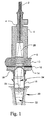
- Figure 1 diagrammatically illustrates a preferred embodiment of the sample interface components of the system of the invention.
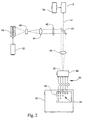
- Figure 2 diagrammatically illustrates a preferred embodiment for simultaneously monitoring a plurality of amplification reactions by sequentially interrogating reactions via a fiber optic multiplexer.
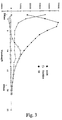
- Figure 3 shows spectrally separated fluorescent intensity data for a tetramethylrhodamine fluorophore, afluorescein fluorophore, and instrument background registered by a CCD array of the preferred embodiment described below.
- Figure 4 shows the time dependence of fluorescent signals from a fluorescein dye proportional to the amplification product (first fluorophore) and a tetramethylrhodamine dye employed as a second fluorophore during a typical PCR.
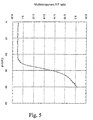
- Figure 5 shows the cycle dependence of the ratio of the intensities of the fluorescein and tetramethylrhodamine dyes from the same PCR whose time dependent data is shown in Figure 3.
- Figure 6 shows data relating the amount of amplification product to cycle number in separate PCRs having different starting concentrations of the same target nucleic acid.
- stable in reference to a fluorescent signal means that the root means square (RMS) deviation in the signal due to noise is less than or equal to two percent of the average signal magnitude. More preferably, stable means that the RMS deviation in the signal due to noise is less than or equal to one percent of the average signal magnitude.
- RMS root means square
- the invention relates to fluorescence-based systems for monitoring in real time the progress of a nucleic acid amplification reaction; however, such systems may also be used for end point measurements.
- the invention relates to the use of passive internal reference molecules to improve the accuracy and precision of the real time monitoring of nucleic acid amplification reactions.
- the subject reference molecules are "passive" in that the fluorescence of the reference molecule does not significantly change during the nucleic acid amplification reaction and do not hybridize in a sequence specific manner to the polynucleotide for amplification under nucleic acid amplification conditions.
- the use of internal reference molecules of the invention has significant advantages over only measuring the fluorescence of the quencher on the probe in fluorescer-quencher probe assay.
- One or more of such advantages can be found in selected embodiments of the invention.
- One such advantage is that the level of the fluorescent signal from the internal reference remains essentially constant throughout a fluorescer-quencher probe assay.
- Another advantage of the use of internal references of the invention is that it permits the simultaneous use of multiple fluorescer-quencher probes in a single amplification reaction.
- Another advantage of the use of internal amplification reference molecules of the invention is that it permits the use of fluorescer-quencher probes in which the quencher does not need to be a fluorescer, thereby increasing range of fluorescent molecules that can be used as fluorescers.
- the internal reference molecules used according to the invention comprise a first and second fluorophore joined together though a backbone connector so as to permit the transfer of energy from the first fluorophore to the second fluorophore.
- the backbone is selected so as to not significantly hybridize to the polynucleotide sequence for amplification in a given specific fluorescer-quencher probe assay during a nucleic acid amplification reaction.
- the first fluorophore may be any dye with suitable fluorescence properties covalently attached to a backbone connector, such as an oligonucleotide.
- a backbone connector such as an oligonucleotide.
- fluorophores covalently attached to oligonucleotides can be found, among other places, in the fluorescer-quencher probe approach described by Holland et al, Proc. Natl. Acad. Sci., 88: 7276-7280 (1991) and in international patent application publication number WO 95/21266.
- Dyes employed as second fluorophores include fluorescent dyes whose fluorescent characteristics are substantially unaffected by the presence or association with nucleic acids, particularly double stranded DNA. Such dyes may include virtually any fluorescent dye fulfilling this criterion which is also spectrally resolvable from whatever fluorophores that are employed on fluorescer-quencher probes. Dyes suitable as first fluorophores may also be suitable as second fluorophores. Similarly, dyes suitable as second fluorophores may also be suitable as first fluorophores. Preferred second fluorophores include rhodamine dyes and fluorescein dyes. More preferably, the second fluorophore is the latter being disclosed by Menchen et al, U.S. patent 5,188,934.
- the first and a second fluorophores are both covalently attached to an oligonucleotide, i.e., the backbone connector, as described by Lee et al, Nucleic Acid Research, 21: 3761-3766 (1993). More specifically, fluorescein is used as the first fluorophore and 6-carboxy-X-rhodamine (ROX) is used as the second fluorophore such that the ROX moiety substantially quenches any fluorescent emissions by the fluorescein moiety.
- ROX 6-carboxy-X-rhodamine
- an excitation beam is generated from the 488 nm emission line of an argon ion laser.
- the first fluorophore is fluorescein, e.g. 6-FAM (available from Applied Biosystems, Foster City), and the second fluorophore is either tetramethylrhodamine, 2',4',5',7',-tetrachloro-4,7-dichlorofluorescein or 6-carboxy-X-rhodamine.
- fluorescein e.g. 6-FAM (available from Applied Biosystems, Foster City)
- the second fluorophore is either tetramethylrhodamine, 2',4',5',7',-tetrachloro-4,7-dichlorofluorescein or 6-carboxy-X-rhodamine.
- the backbone connector of the internal reference is designed so as to bring the first fluorophore into close proximity with the second fluorophore so as to permit efficient energy transfer from the first fluorophore to the second fluorophore.
- transfer of energy between fluorophores is a function of 1/R 6 , where R is the distance between the fluorophores.
- Guidance concerning the selection of an appropriate distance for a given embodiment is found in numerous references on resonant energy transfer between fluorescent molecules and quenching molecules (also sometimes referred to as "donor" molecules and “acceptor” molecules, respectively), e.g. Stryer and Haugland, Proc. Natl. Acad.
- the backbone is usually, although not necessarily, a polymeric chain.
- backbones may be employed, such as nucleic acids, both RNA and DNA, various synthetic polynucleotide analogs, e.g., wherein oxygens may be substituted by sulfur, carbon, or nitrogen, phosphates, substituted by sulfate or carboxylates, etc., polypeptides, polysaccharides, and the like.
- the fluorophores may be joined to the backbone by appropriate functionalization of the fluorophores and/or the polymer building blocks. Detailed description of how to join fluorophores to various backbone can be found in, among other places, Bioconjugate Techniques, by G. T. Hermanson, Academic Press, San Diego (1996), European Patent Application publication 0 229 943 (published 1987), and Ju et al, Analytical Biochemistry, 231:131-140 (1995).
- the backbone connector is designed so as not to significantly hybridize in a sequence specific manner to the polynucleotides for amplification in given amplification reaction during the amplification reaction.
- the backbone connector may hybridize to the polynucleotides sequence for amplification, either before or after the amplification process.
- this potential problem exists only when the backbone connector is a polynucleotide (or a derivative thereof). If the backbone did specifically hybridize to the sequence for amplification, the backbone might significantly interfere with the ability of a fluorescer-quencher probe to hybridize to the polynucleotide sequence for amplification.
- Non-hybridizing polynucleotides for use as backbone connectors may readily be obtained by using polynucleotides that lack significant sequence homology to the polynucleotide sequence for amplification.
- Internal reference molecules having polynucleotides as backbones
- Internal reference molecules may be synthesized by a number, of approaches, e.g. Ozaki et al, Nucleic Acids Research, 20: 5205-5214 (1992); Agrawal et al, Nucleic Acids Research, 18: 5419-5423 (1990); or the like.
- Such synthesis methods are also applicable to the synthesis offluorescer-quencher probes.
- the oligonucleotide probes are synthesized on an automated solid phase DNA synthesizer using phosphoramidite chemistry, e.g. Applied Biosystems, Inc. model 392 or 394 DNA synthesizer (Foster City, CA).
- the first and second fluorophores can be covalently attached to predetermined nucleotide of an oligonucleotide by using nucleoside phosphoramidite monomers containing reactive groups.
- reactive groups can be on a phosphate, or phosphate analog, e.g. Agrawal et al (cited above), on the 5' hydroxyl when attachment is to the 5' terminal nucleotide, e.g. Fung et al, U.S. patent 4,757,141 or Hobbs Jr., U.S. patent 4,997,928, and on base moieties, e.g. as disclosed by Ruth, U.S.
- nucleotides having pyrimidine moieties are derivatized.
- the 3' terminal nucleotide of the oligonucleotide probe is blocked or rendered incapable of extension by a nucleic acid polymerase. Such blocking is conveniently carried out by the attachment of a phosphate group, e.g.
- ROX is used as the second fluorophore on the internal reference and the ROX moiety is attached at the 3' postion on the oligonucleotide.
- the 3' attachment of ROX to oligonucleotides is described in U.S. patent application 08/593,031.
- the separation of the first and second fluorophores within the internal molecules may vary depending on the nature of the first fluorophore and second fluorophores, the manner in which they are attached, the illumination source, and the like.
- the first and second fluorophore are preferably close enough so that substantially all, e.g. 90%, of the fluorescence from the first fluorophore is quenched.
- the distance between the first and second fluorophores should be within the range of 10-100 angstroms.
- the first and second fluorophores are separated by between about 4 to 10 nucleotides.
- the invention includes embodiments in which the number of nucleotides separating the fluorophores may be greater than 10.
- either the first or second fluorophore is attached to the 5' terminal nucleotide of the oligonucleotide probe.
- the first or second fluorophore may also be attached to the 3' terminal nucleotide.
- the first and second fluorophore are attached at internal site on the polynucleotide.
- the invention also includes embodiments in which the one of the two fluomphores is located at an internal site and the other fluorophore is attached to a terminus of the polynucleotide.
- Embodiments of the invention include the use of reagent compositions in nucleic acid amplification reactions.
- the compositions comprise the internal reference molecule of the invention and a nucleic acid amplification buffer.
- nucleic acid amplification buffer refers to a buffered aqueous solution that supports the enzymatic reaction or reactions required for a nucleic acid amplification reaction.
- the choice of buffer composition will vary in accordance with the particular enzyme selected for catalyzing the nucleic acid amplification reaction of interest. Nucleic acid amplification techniques are well known to persons of ordinary skill in the art of molecular biology.
- Suitable buffer compositions can be, among other places in the publications such as: PCR: A Practical Approach, Volume 1, eds. M.J. McPherson, P. Quirke, G.R Taylor, IRL Press (1991); PCR: A Practical Approach, Volume 2, eds. MJ. McPherson, P. Quirke, G.R. Taylor, IRL Press (1995), and PCR Primer, A Laboratory Manual, Eds. C.W. Diffenbach, G. S. Dveksler, Cold Spring Harbor Press (1995).
- nucleic acid amplification buffer for Taq DNA polymerase catalyzed amplification reactions is: 10 mM Tris (pH 8.4), 50mM KCl, 1.5 mM MgCl 2 , 0.01% gelatin; 0.01% NP40, and 0.01% Tween.
- concentration of internal reference molecule in the reagent composition is sufficiently high so as to produce a readily detectable signal from the second fluorophore on the internal reference molecule.
- compositions may further comprise one or more additional compounds required for the nucleic acid amplification reaction of interest, such compounds include: nucleotides, a template for amplification, fluorescer-quencher probes, and the like.
- the reagent compositions may be supplied in a concentrated form or in a form that does not require significant dilution prior to use.
- the reagent compositions may be used by adding additional compounds required for performing the assay of interest, such compounds include, a thermostable polymerase, nucleotides, a template for amplification, a fluorescer-quencher probes, and the like. After the addition of the necessary additional compounds, the reaction mixture may then be processed accordingly, e.g., thermocycling, so as to produced the desired amplification results.
- Fluorescer-quencher probe assays and the subject passive internal reference molecules may be used in conjunction with a variety of nucleic acid amplification systems.
- the assays require either the use of a nucleic acid polymerase with exonuclease activity or a population of double stranded DNA which increases during the course of the reaction being monitored.
- Exemplary amplification schemes that may be employed with the system of the invention include PCR, ligase-based amplification schemes, such as ligase chain reaction (LCR), Q-beta replicase-based amplification schemes, strand displacement amplification (SDA) schemes, such as described by Walker et al, Nucleic Acids Research, 20: 1691-1696 (1992), and the like.
- nucleic acid amplification schemes A comprehensive description of nucleic acid amplification schemes is provided by Keller and Manak, DNA Probes, Second Edition (Stockton Press, New York, 1993).
- the subject internal reference molecules are used in PCR employing fluorescer-quencher probes.
- the invention also provides methods for measuring the amount of polynucleotide amplification product in a polynucleotide amplification reaction, employing fluorescer-quencher probes.
- the subject methods are particularly advantageous for measuring the amplification product formation in real-time monitored nucleic acid amplification reactions.
- the subject methods are essentially the same as conventional nucleic acid amplification reactions employing fluorescer-quencher probes, except that the methods of the invention include the step of adding an internal reference to the amplification reaction.
- the addition step is performed prior to the initiation of the reaction, e.g., before the addition of the DNA polymerase.
- the fluorescence of the second fluorophore on the internal reference is measured so as to normalize the reaction for such factors that vary from reaction to reaction, e.g., volume or reagent quantities.
- the system may be generalized to include a plurality of fluorescent reporters, e.g. to monitor the simultaneous amplification of several target nucleic acids in a single reaction, so that a plurality of fluorescent intensity ratios are monitored.
- the second fluorophore on the internal reference must be different from the quencher on the fluorescer-quencher probe (or probes) used in the same assay.
- the first fluorophore on the internal reference may be the same or different than the fluorophore used as a reporter on the fluorescer-quencher probe.
- Kits make the practice of the claimed methods more reproducible and easier to perform.
- the kits generally comprise two or more reagents required for practicing the subject invention.
- Kits may supply reagents in pre-measured amounts so as to simplity the performance of the subject methods.
- kits typically contain detailed instructions for carrying out the methods of the invention.
- the kit comprises an internal reference of the invention and one or more of the following items fluorescer-quencher probes or a thermostable DNA polymerase suitable for use in fiuorescer-quencher probe assays, i.e., having 5'-3' exonuclease activity, such as Taq DNA polymerase.
- the kits of the invention may further comprise additional reagents that are necessary for performing the subject methods, such reagents include, but are not limited to dNTP mixtures, buffers, molecular size standards, wax beads, and the like.
- the real-time detection system includes a sample interface--that is, optical components operationally associated with a closed reaction chamber--which comprises a lens for focusing an excitation beam into the reaction mixture and for collecting the resulting fluorescence and a fiber optic for transmitting both the excitation beam from a light source to the lens and the fluorescent signals from the lens to a detection and analysis means.
- a closed reaction chamber which comprises a lens for focusing an excitation beam into the reaction mixture and for collecting the resulting fluorescence and a fiber optic for transmitting both the excitation beam from a light source to the lens and the fluorescent signals from the lens to a detection and analysis means.
- the reaction mixture is contained in a closed reaction chamber to prevent cross-sample contamination, or so-called "carryover.”
- the lens therefore focuses the excitation beam and collects fluorescence through a portion of a wall of the closed reaction chamber.
- the preferred reaction chamber is a tube, e.g. having the geometry and volume of a conventional Eppendorf tube.
- the tube is closed after the reaction mixture is added by attaching a cap to the open end of the tube.
- the lens directs the excitation beam and collects fluorescence through the cap of the tube, as illustrated in Figure 1.
- a first end fiber optic 2 is held by ferrule 4, housing 6, and plate 10 in a co-axial orientation with lens 8.
- a second end of fiber optic 2 (not shown) is operationally associated with a light source and detection and analysis means, discussed more fully below.
- the distance between the end face of fiber optic 2 and lens 8 is determined by several factors, including the numerical aperture of the fiber optic, the geometry of tube 18, the focal length of lens 8, the diameter of lens 8, and the like.
- lens 8 has a diameter of 8 mm and is composed of material BK7, available from Edmund Scientific (Barrington, NJ).
- Fiber optic 2 has a numerical aperture of .2.
- the design permits maximal transmission of excitation beam 28 to reaction mixture 22.
- lens 8, numerical aperture of fiber optic 2, and the distance between the end of fiber optic 2 and lens 8 are selected so that the diameter of lens 8 equals or exceeds the diameter of excitation beam 28 where beam 28 impinges on the lens (as illustrated in Figure 1).
- Excitation beam 28 is focused through cap 16, void 24, and top surface 26 of reaction mixture 22 to a region approximately 1-3 times the diameter of the fiber optic just below, e.g. 1-3 mm, surface 26.
- This degree of focusing is not a critical feature of the embodiment; it is a consequence of adapting the sample interface to the geometry and dimensions of a sample holder of a commercially available thermal cycler. In other embodiments, the geometry and dimension may permit a sharper focus into the reaction mixture.
- the lens may have a variety of shapes depending on particular embodiments.
- the lens may be a sphere, truncated sphere, cylinder, truncated cylinder, oblate spheroid, or truncated oblate spheroid, or the like, and may be composed of any suitably transparent refractive material, such as disclosed by Hlousek, U.S. patent 5,037,199; Hoppe et al, U.S. patent 4,747,87; Moring et al, U.S. patent 5,239,360; Hirschfield, U.S. patent 4,577,109; or like references.
- Fluorescent light generated by excitation beam 28 is collected by lens 8 along approximately the same optical pathway as that defined by excitation beam 28 and focused onto the end of fiber optic 2 for transmission to optical separation and analysis components of the system.
- the sample interface also includes means for heating the portion of the wall of the reaction chamber used for optical transmission in order to reduce variability due to scatter and/or absorption of the excitation beam and signal from condensation of reaction mixture components.
- the portion of the reaction chamber (tube 18) wall used for optical transmission is cap 16.
- heating element 12 and heat-conductive platen 14 are employed to heat cap 16.
- heating element 12 comprises resistance heating elements and temperature sensors that permit programmed controlled of the temperature of cap 16.
- Cap 16 is maintained at a temperature above the condensation points of the components of the reaction mixture. Generally, cap 16 may be maintained at a temperature in the range of 94-110°C.
- cap 16 is maintained at a temperature in the range of about 102°C to about 105°C since the principal solvent in the reaction mixture is usually water. More preferably, cap 16 is maintained at 103°C.
- the cap-heating components described above are thermally isolated from heating-conducting component 20 employed to cyclically control the temperature of reaction mixture 22.
- Exemplary criterion for material selection include (I) degree of thermal expansion, especially for amplification schemes employing thermal cycling, and its affect on the alignment of the optical components, (ii) optical transmission properties in the excitation wavelengths and fluorophore emission wavelengths employed, (iii) chemical inertness of the reaction chamber relative to components of the reaction mixture, (iv) degree to which critical reaction components, e.g. polymerases, target nucleic acids, would tend to adsorb onto chamber walls, (v) minimization of fluorescent materials in the optical pathway, and the like.
- tubes containing amplification reaction mixtures are made of polypropylene or like materials.
- sample interface shown in Figure 1 may be employed individually or it may be employed as one of a plurality of identical interfaces in a single instrument, as shown diagrammatically in Figure 2.
- individual sample interfaces 31, arrayed in holder 30 (which may, for example, be a heating block associated with thermal cycler 32, such as described in Mossa et al, European patent application No. 91311090.4, publ. No. 0488769 A2) are connected by fiber optics 34 to fiber optic multiplexer 36, which selectively permits transmission between individual fiber optics and port 35, e.g under user control via a programmed microprocessor.
- excitation beam 41 generated by light source 52 and controller 54, passes through beam splitter 40 and is focused onto port 35 by lens 38, where it is sequentially directed by fiber optic multiplexer 36 to each of a predetermined set, or subset, of fiber optics 34.
- a fluorescent signal generated in a reaction chambers is collected by lens 8 and focused onto a fiber optic which, in turn, transmits the signal to a detection and analysis means, possibly via a fiber optic multiplexer.
- a fluorescent signal collected by a sample interface is directed to fiber optic multiplexer 36 where it emerges through port 35 and is collected and collimated by lens 38.
- Lens 38 directs the fluorescent signal to beam splitter 40 which, in turn, selectively directs the signal through cut-off filter 42, which prevents light from the excitation beam from reaching the signal detection components.
- Beam splitter 40 may be a conventional dichroic mirror, a fully reflective mirror with an aperture to pass the excitation beam (e.g. as disclosed in U.S. patent 4,577,109), or like component.
- the fluorescent signal is directed by lens 44 to a spectral analyzer which spectrally separates the fluorescent signal and measures the intensities of a plurality of the spectral components of the signal.
- a spectral analyzer comprises means for separating the fluorescent signal into its spectral components, such as a prism, diffraction grating, or the like, and an array of photo-detectors, such as a diode array, a charge-coupled device (CCD) system, an array of bandpass filters and photomultiplier tubes, or the like.
- the spectral analyzer comprises diffraction grating 46 (e.g., model CP-140, Jobin-Yvon, NJ) and CCD array 48 (e.g., model S2135 Princeton Instruments, NJ), which is linked to CCD controller 50.
- An exemplary CCD array suitable for analyzing fluorescent signal from fluorescein and tetramethylrhodamine is partitioned into 21 collection bins which span the 500 nm to 650 nm region of the spectrum. Each bin collects light over a 8.5 nm window.
- 21 collection bins which span the 500 nm to 650 nm region of the spectrum. Each bin collects light over a 8.5 nm window.
- Many alternative configurations may also be employed.
- An exemplary application of a CCD array for spectral analysis is described in Karger et al, Nucleic Acids Research, 19: 4955-4962 (1991).
- Analyzing the fluorescent signal based on data collected by a spectral analyzer is desirable since components of the signal due to one or more reporter fluorophores (on fluorescer-quencher probes) and the second fluorophore (on the internal reference), from which intensity ratios are calculated, can be analyzed simultaneously and without the introduction of wavelength-specific system variability that might arise, e.g. by misalignment, in a system based on multiple beam splitters, filters, and photomultiplier tubes.
- a spectral analyzer permits the use of "virtual filters” or the programmed manipulation of data generated from the array of photo-detectors, wherein a plurality of discrete wavelength ranges are sampled--in analogy with physical bandpass filters-under programmable control via an associated microprocessor. This capability permits a high degree of flexibility in the selection of dyes as first and second fluorophores.
- the detection and analysis means may be any detection apparatus to provides a readout that reflect the ratio of intensities of the signals generated by the reporter and internal reference fluorophores.
- detection apparatus is well know in the art, as exemplified by U.S. patents 4,577,109 and 4,786,886 and references such as The Photonics Design & Applications Handbook, 39th Edition (Laurin Publishing Co., Pittsfield, MA, 1903):
- the system of the invention is employed to monitor PCRs, although it may also be employed with a variety of other amplification schemes, such as LCR.
- amplification schemes such as LCR.
- Descriptions of and guidance for conducting PCRs is provided in an extensive literature on the subject, e.g. including Innis et al (cited above) and McPherson et al (cited above).
- two oligonucleotides are used as primers for a series of synthetic reactions that are catalyzed by a DNA polymerase. These oligonucleotides typically have different sequences and are complementary to sequences that (I) lie on opposite strands of the template, or target, DNA and (ii) flank the segment of DNA that is to be amplified.
- the target DNA is first denatured by heating in the presence of a large molar excess of each of the two oligonucleotides and the four deoxynucleoside triphosphates (dNTPs).
- the reaction mixture is then cooled to a temperature that allows the oligonucleotide primers to anneal to their target sequences, after which the annealed primers are extended with DNA polymerase.
- the cycle of denaturation, annealing, and extension is then repeated many times, typically 25-40 times. Because the products of one round of amplification serve as target nucleic acids for the next, each successive cycle essentially doubles the amount of target DNA, or amplification product
- the first fluorophore is attached to an oligonucleotide probe with another non-fluorescent quenching molecule, instead of a second fluorophore.
- the second fluorophore could be virtually any spectrally resolvable fluorescent dye that did not interact with the amplification products.
- the following example is offered by way of illustration and refers to PCR amplification using a dually labelled probe.
- the probe represents a fluorescer - quencher probe, but is not a passive internal reference molecule accordings to the present invention.
- a 296 basepair segment of a target DNA encoding human -actin was amplified by PCR from various starting amounts in the range of 5x10 3 to 1x10 6 copies of target DNA.
- the following primers and probe were employed: wherein "FAM” indicates a fluorescein molecule coupled to the oligonucleotide by reacting an NHS-ester group attached to the fluorescein's 6 carbon with a 5'-aminophosphate attached to the 5'-terminal deoxyadenosine of the oligonucleotide in accordance with Fung et al, U.S.
- PCRs were carried out in 0.2 mL MicroAmp tubes (Perkin-Elmer, Norwalk, CT) with the following components: 10 mM Tris-HCl, pH 8.3, 50 mM KCl, 3.5 mM MgCl 2 , 200 M each of the nucleoside triphosphates (with dUTP substituted for dTTP in accordance with U.S. patent 5,03 5,996 to prevent carryover contamination), 300 nM each of forward and reverse primers, AmpliTaqTM (Perkin-Elmer, Norwalk, CT) at 0.05 U/L.
- Figure 3 illustrates data showing the emission spectra of the fluorescein and tetramethylrhodamine dyes employed as indicators above and fluorescence due to extraneous sources in the system.
- Figure 4 illustrates data showing fluorescein fluorescent intensity and tetramethylrhodamine fluorescent intensity as a function of cycle number.
- the high frequency oscillations in intensity reflect the temperature dependence of the fluorescent emission of the two dyes.
- An increase in base line fluorescence for both dyes between cycles 10 and 28 is a system-based variation.
- Figure 5 which illustrates the ratio of fluorescein-to-tetramethylrhodamine fluorescent intensity from the same data, the system-based variation is eliminated and the RMS of fluctuations in the readout signal, that is, the ratio of fluorescent intensities, is less than 1% of the average magnitude of the measured ratio.
- Figure 6 illustrates data from PCR of the -actin DNA starting from amounts ranging from 5000 target molecules to 10 target molecules as indicated in the figure.
Landscapes
- Chemical & Material Sciences (AREA)
- Life Sciences & Earth Sciences (AREA)
- Organic Chemistry (AREA)
- Engineering & Computer Science (AREA)
- Zoology (AREA)
- Wood Science & Technology (AREA)
- Proteomics, Peptides & Aminoacids (AREA)
- Health & Medical Sciences (AREA)
- Biophysics (AREA)
- Chemical Kinetics & Catalysis (AREA)
- Immunology (AREA)
- Microbiology (AREA)
- Molecular Biology (AREA)
- Analytical Chemistry (AREA)
- Physics & Mathematics (AREA)
- Biotechnology (AREA)
- Biochemistry (AREA)
- Bioinformatics & Cheminformatics (AREA)
- General Engineering & Computer Science (AREA)
- General Health & Medical Sciences (AREA)
- Genetics & Genomics (AREA)
- Measuring Or Testing Involving Enzymes Or Micro-Organisms (AREA)
- Saccharide Compounds (AREA)
Claims (17)
- Utilisation d'une molécule de référence interne passive pour le contrôle de la réaction d'amplification d'un polynucléotide cible, ladite molécule de référence interne passive comprenanttandis que le connecteur formant squelette relie les premier et deuxième fluorophores de façon à permettre le tansfert d'énergie du premier fluorophore au deuxième fluorophore, et que la molécule dans son ensemble n'hybride pas d'une manière spécifique d'une séquence au polynucléotide pour l'amplification dans des conditions d'amplification d'acides nucléiques.un premier fluorophore,un deuxième fluorophore, etun connecteur formant squelette,
- Utilisation selon la revendication 1, dans laquelle le connecteur formant squelette est un polynucléotide.
- Utilisation selon la revendication 2, dans laquelle le polynucléotide a une longueur de 2 à 25 nucléotides.
- Utilisation selon la revendication 3, dans laquelle le polynucléotide est (dT)8.
- Utilisation selon la revendication 1, dans laquelle le premier fluorophore est choisi dans le groupe consistant en la fluorescéine, la 6-carboxyfluorescéine, la 2',4',5',7'-tétrachloro-4,7-dichlorofluorescéine, la 2',7'-diméthoxy-4',5'-6-carboxyrhodamine (JOE), la N',N',N',N'-tétraméthyl-6-carboxyrhodamine (TAMRA) et la 6-carboxy-X-rhodamine (ROX).
- Utilisation selon la revendication 5, dans laquelle le premier fluorophore est la 6-carboxyfluorescéine.
- Utilisation selon la revendication 5, dans laquelle le deuxième fluorophore est choisi dans le groupe consistant en la fluorescéine, la 6-carboxyfluorescéine, la 2',4',5',7'-tétrachloro-4,7-dichlorofluorescéine, la 2',7'-diméthoxy-4',5'-6-carboxyrhodamine (JOE), la N',N',N',N'-tétraméthyl-6-carboxyrhodamine (TAMRA) et la 6-carboxy-X-rhodamine (ROX).
- Utilisation selon la revendication 6, dans laquelle le deuxième fluorophore est la 6-carboxy-X-rhodamine.
- Procédé pour la mesure de la quantité d'un produit d'amplification d'un polynucléotide pour amplification dans une réaction d'amplification d'acides nucléiques, ledit procédé comprenant l'étape d' addition d'une molécule de référence d'amplification interne passive àtandis que le connecteur formant squelette relie les premier et deuxième fluorophores de manière à permettre le transfert d'énergie du premier fluorophore au deuxième fluorophore, et que la totalité de la molécule n'hybride pas au polynucléotide pour amplification dans des conditions d'amplification d'acides nucléiques.la réaction d'amplification,ladite molécule de référence interne passive comprenantun premier fluorophore,un deuxième fluorophore, etun connecteur formant squelette,
- Procédé selon la revendication 9, dans lequel la réaction d'amplification d'acides nucléiques est mesurée en temps réel.
- Procédé selon la revendication 9, dans lequel le connecteur formant squelette est un polynucléotide.
- Procédé selon la revendication 10, dans lequel le polynucléotide a une longueur de 2 à 25 nucléotides.
- Procédé selon la revendication 12, dans lequel le polynucléotide est (dT)8.
- Procédé selon la revendication 9, dans lequel le premier fluorophore est choisi dans le groupe consistant en la fluorescéine, la 6-carboxyfluorescéine, la 2',4',5',7'-tétrachloro-4,7-dichlorofluorescéine, la 2',7'-diméthoxy-4',5'-6-carboxyrhodamine (JOE), la N',N',N',N'-tétraméthyl-6-carboxyrhodamine (TAMRA) et la 6-carboxy-X-rhodamine (ROX).
- Procédé selon la revendication 14, dans lequel le premier fluorophore est la 6-carboxyfluorescéine.
- Procédé selon la revendication 14, dans lequel le deuxième fluorophore est choisi dans le groupe consistant en la fluorescéine, la 6-carboxyfluorescéine, la 2',4',5',7'-tétrachloro-4,7-dichlorofluorescéine, la 2',7'-diméthoxy-4',5'-6-carboxyrhodamine (JOE), la N',N',N',N'-tétraméthyl-6-carboxyrhodamine (TAMRA) et la 6-carboxy-X-rhodamine (ROX).
- Procédé selon la revendication 15, dans lequel le deuxième fluorophore est la 6-carboxy-X-rhodamine.
Applications Claiming Priority (3)
| Application Number | Priority Date | Filing Date | Title |
|---|---|---|---|
| US08/657,989 US5736333A (en) | 1996-06-04 | 1996-06-04 | Passive internal references for the detection of nucleic acid amplification products |
| US657989 | 1996-06-04 | ||
| PCT/US1997/009648 WO1997046708A1 (fr) | 1996-06-04 | 1997-06-03 | References internes passives pour la detection de produits d'amplification d'acides nucleiques |
Publications (2)
| Publication Number | Publication Date |
|---|---|
| EP0904411A1 EP0904411A1 (fr) | 1999-03-31 |
| EP0904411B1 true EP0904411B1 (fr) | 2001-11-14 |
Family
ID=24639453
Family Applications (1)
| Application Number | Title | Priority Date | Filing Date |
|---|---|---|---|
| EP97927975A Expired - Lifetime EP0904411B1 (fr) | 1996-06-04 | 1997-06-03 | References internes passives pour la detection de produits d'amplification d'acides nucleiques |
Country Status (8)
| Country | Link |
|---|---|
| US (1) | US5736333A (fr) |
| EP (1) | EP0904411B1 (fr) |
| JP (1) | JP3454432B2 (fr) |
| AT (1) | ATE208826T1 (fr) |
| AU (1) | AU710782B2 (fr) |
| CA (1) | CA2256457C (fr) |
| DE (1) | DE69708285T2 (fr) |
| WO (1) | WO1997046708A1 (fr) |
Families Citing this family (86)
| Publication number | Priority date | Publication date | Assignee | Title |
|---|---|---|---|---|
| US6787304B1 (en) * | 1994-12-28 | 2004-09-07 | Georgetown University | Fluorometric assay for detecting nucleic acid cleavage |
| US20030165908A1 (en) * | 1994-12-30 | 2003-09-04 | Georgetown University | Fluorometric assay for detecting nucleic acid cleavage |
| US7133726B1 (en) * | 1997-03-28 | 2006-11-07 | Applera Corporation | Thermal cycler for PCR |
| US6080868A (en) | 1998-01-23 | 2000-06-27 | The Perkin-Elmer Corporation | Nitro-substituted non-fluorescent asymmetric cyanine dye compounds |
| CA2318880C (fr) * | 1998-02-04 | 2010-07-27 | Applied Biosystems, Llc | Determination d'un genotype d'un produit d'amplification sur des sites alleliques multiples |
| DE19811730A1 (de) * | 1998-03-18 | 1999-09-23 | November Ag Molekulare Medizin | Verfahren und Vorrichtung zum Identifizieren einer Markierung |
| US5952202A (en) * | 1998-03-26 | 1999-09-14 | The Perkin Elmer Corporation | Methods using exogenous, internal controls and analogue blocks during nucleic acid amplification |
| US6818437B1 (en) * | 1998-05-16 | 2004-11-16 | Applera Corporation | Instrument for monitoring polymerase chain reaction of DNA |
| ATE425448T1 (de) * | 1998-05-16 | 2009-03-15 | Applera Corp | Optisches gerät insbesondere zur überwachung von dns-polymerasekettenreaktionen |
| US7498164B2 (en) * | 1998-05-16 | 2009-03-03 | Applied Biosystems, Llc | Instrument for monitoring nucleic acid sequence amplification reaction |
| EP1619491B1 (fr) * | 1998-05-16 | 2009-03-11 | Applera Corporation | Instrument optique servant à surveiller des réactions de polymérase en chaîne d'ADN |
| US6066458A (en) * | 1998-05-18 | 2000-05-23 | Becton, Dickinson And Company | Methods, apparatus and computer program products for determining quantities of nucleic acid sequences in samples using standard curves and amplification ratio estimates |
| US6270730B1 (en) * | 1998-06-16 | 2001-08-07 | Northwest Engineering Inc. | Multi-well rotary synthesizer |
| US6271042B1 (en) | 1998-08-26 | 2001-08-07 | Alpha Innotech Corporation | Biochip detection system |
| GB9819417D0 (en) * | 1998-09-07 | 1998-10-28 | Secr Defence | Reaction method |
| DE19850593A1 (de) * | 1998-11-03 | 2000-05-04 | Biochip Technologies Gmbh | Verfahren zum Nachweis von Hybridisierungsereignissen bei DNA |
| US6387621B1 (en) * | 1999-04-27 | 2002-05-14 | University Of Utah Research Foundation | Automated analysis of real-time nucleic acid amplification |
| US6331393B1 (en) * | 1999-05-14 | 2001-12-18 | University Of Southern California | Process for high-throughput DNA methylation analysis |
| US7387891B2 (en) * | 1999-05-17 | 2008-06-17 | Applera Corporation | Optical instrument including excitation source |
| US20050279949A1 (en) * | 1999-05-17 | 2005-12-22 | Applera Corporation | Temperature control for light-emitting diode stabilization |
| US7423750B2 (en) * | 2001-11-29 | 2008-09-09 | Applera Corporation | Configurations, systems, and methods for optical scanning with at least one first relative angular motion and at least one second angular motion or at least one linear motion |
| US7410793B2 (en) * | 1999-05-17 | 2008-08-12 | Applera Corporation | Optical instrument including excitation source |
| US6440706B1 (en) | 1999-08-02 | 2002-08-27 | Johns Hopkins University | Digital amplification |
| US6586177B1 (en) * | 1999-09-08 | 2003-07-01 | Exact Sciences Corporation | Methods for disease detection |
| US6852986B1 (en) * | 1999-11-12 | 2005-02-08 | E. I. Du Pont De Nemours And Company | Fluorometer with low heat-generating light source |
| US6558509B2 (en) | 1999-11-30 | 2003-05-06 | Applied Materials, Inc. | Dual wafer load lock |
| US6919174B1 (en) * | 1999-12-07 | 2005-07-19 | Exact Sciences Corporation | Methods for disease detection |
| US7226732B2 (en) * | 2001-07-16 | 2007-06-05 | Cepheid | Methods, apparatus, and computer programs for verifying the integrity of a probe |
| US7635588B2 (en) * | 2001-11-29 | 2009-12-22 | Applied Biosystems, Llc | Apparatus and method for differentiating multiple fluorescence signals by excitation wavelength |
| US6635428B2 (en) * | 2001-12-04 | 2003-10-21 | Quest Diagnostics Investments Incorporated | Oligonucleotides and methods for detecting hepatitis B viral nucleic acids |
| US6946245B2 (en) | 2001-12-04 | 2005-09-20 | Quest Diagnostics Investments Incorporated | Oligonucleotides and methods for detecting hepatitis C viral nucleic acids |
| JP2005526253A (ja) * | 2002-05-17 | 2005-09-02 | アプレラ コーポレイション | 励起波長による複数の蛍光シグナルを分化するための装置および方法 |
| US7148043B2 (en) | 2003-05-08 | 2006-12-12 | Bio-Rad Laboratories, Inc. | Systems and methods for fluorescence detection with a movable detection module |
| US7417726B2 (en) * | 2003-09-19 | 2008-08-26 | Applied Biosystems Inc. | Normalization of data using controls |
| US20060029948A1 (en) * | 2003-09-19 | 2006-02-09 | Gary Lim | Sealing cover and dye compatibility selection |
| KR101041106B1 (ko) * | 2003-11-25 | 2011-06-13 | 한면기 | 핵산과 단백질의 신규한 실시간 탐지방법 |
| WO2005077125A2 (fr) * | 2004-02-11 | 2005-08-25 | Applera Corporation | Procedes et compositions de detection d'acides nucleiques |
| US20050255485A1 (en) * | 2004-05-14 | 2005-11-17 | Livak Kenneth J | Detection of gene duplications |
| DE502004007951D1 (de) * | 2004-08-18 | 2008-10-09 | Roche Diagnostics Gmbh | Verfahren zur Messung einer Nukleinsäureamplifikation in Real Time beinhaltend die Positionierung eines Reaktionsgefässes relativ zu einer Detektionseinheit |
| EP1791982B1 (fr) | 2004-09-21 | 2011-01-05 | Life Technologies Corporation | Quantification temps reel/point final a deux couleurs de micro-arn (miarn) |
| US8084260B2 (en) * | 2004-11-24 | 2011-12-27 | Applied Biosystems, Llc | Spectral calibration method and system for multiple instruments |
| FI20055043A0 (fi) * | 2005-01-31 | 2005-01-31 | Wallac Oy | Sovitelma mikrotiterkaivojen kuvausjärjestelmässä |
| US8263330B1 (en) | 2005-03-08 | 2012-09-11 | Quest Diagnostics Investments Incorporated | Detection of Mycobacterium tuberculosis complex nucleic acids |
| CA2842402C (fr) | 2005-03-10 | 2016-02-23 | Gen-Probe Incorporated | Systemes et procedes permettant d'effectuer des dosages afin de detecter ou de quantifier des analytes dans des echantillons |
| US7622079B2 (en) * | 2005-03-22 | 2009-11-24 | Applied Biosystems, Llc | Dual nest microplate spotter |
| DE102005047617A1 (de) * | 2005-10-05 | 2007-04-19 | Qiagen Gmbh | Polymerase-Kettenreaktions-Verfahren unter Einsatz einer DNA-Polymerase mit Proofreading-Eigenschaft |
| US7824858B2 (en) | 2006-01-23 | 2010-11-02 | Quest Diagnostics Investments Incorporated | Assay for mycobacterium avium/intracellulare nucleic acid |
| EP1878503A1 (fr) * | 2006-07-14 | 2008-01-16 | Roche Diagnostics GmbH | Elément capteur de température pour surveiller chauffage et refroidissement |
| EP2484781B1 (fr) | 2006-08-01 | 2017-08-23 | Applied Biosystems, LLC | Détection d'analytes et d'acides nucléiques |
| US8652782B2 (en) * | 2006-09-12 | 2014-02-18 | Longhorn Vaccines & Diagnostics, Llc | Compositions and methods for detecting, identifying and quantitating mycobacterial-specific nucleic acids |
| US8097419B2 (en) | 2006-09-12 | 2012-01-17 | Longhorn Vaccines & Diagnostics Llc | Compositions and method for rapid, real-time detection of influenza A virus (H1N1) swine 2009 |
| US8080645B2 (en) | 2007-10-01 | 2011-12-20 | Longhorn Vaccines & Diagnostics Llc | Biological specimen collection/transport compositions and methods |
| US9481912B2 (en) | 2006-09-12 | 2016-11-01 | Longhorn Vaccines And Diagnostics, Llc | Compositions and methods for detecting and identifying nucleic acid sequences in biological samples |
| WO2008128198A2 (fr) * | 2007-04-12 | 2008-10-23 | Usc Stevens - University Of Southern California | Analyse de la méthylation d'un adn au moyen d'un séquençage numérique au bisulfite et de la méthode methylight numérique |
| IL184478A (en) * | 2007-07-08 | 2017-07-31 | Hadasit Medical Res Services & Development Ltd | Preparations, methods and kits for identifying carriers of mutations in genes 1brca and 2brca and for the early detection of cancers associated with mutations in these genes |
| US11041215B2 (en) | 2007-08-24 | 2021-06-22 | Longhorn Vaccines And Diagnostics, Llc | PCR ready compositions and methods for detecting and identifying nucleic acid sequences |
| US9683256B2 (en) | 2007-10-01 | 2017-06-20 | Longhorn Vaccines And Diagnostics, Llc | Biological specimen collection and transport system |
| EP3058954B1 (fr) | 2007-08-27 | 2017-03-01 | Longhorn Vaccines and Diagnostics, LLC | Compositions immunogènes et procédés |
| US10004799B2 (en) | 2007-08-27 | 2018-06-26 | Longhorn Vaccines And Diagnostics, Llc | Composite antigenic sequences and vaccines |
| US7993831B2 (en) * | 2007-09-14 | 2011-08-09 | Asuragen, Inc. | Methods of normalization in microRNA detection assays |
| US11041216B2 (en) | 2007-10-01 | 2021-06-22 | Longhorn Vaccines And Diagnostics, Llc | Compositions and methods for detecting and quantifying nucleic acid sequences in blood samples |
| DK2195466T3 (da) | 2007-10-01 | 2013-01-14 | Longhorn Vaccines & Diagnostics Llc | Fremgangsmåde til opbevaring af biologiske prøver |
| EP2240613B1 (fr) | 2008-02-06 | 2013-09-11 | Ludwig-Maximilians-Universität München | Caractérisation thermo-optique de molécules d'acide nucléique |
| WO2009103003A2 (fr) * | 2008-02-15 | 2009-08-20 | Bio-Rad Laboratories, Inc. | Lecteur fluorescent de balayage avec système de diffuseur |
| WO2010083250A2 (fr) | 2009-01-13 | 2010-07-22 | Fluidigm Corporation | Analyse d'acides nucléiques de cellules uniques |
| US8906306B2 (en) | 2009-04-09 | 2014-12-09 | Roche Molecular Systems, Inc. | Fluid transfer control for real-time PCR |
| US8674080B2 (en) * | 2009-04-09 | 2014-03-18 | Roche Molecular Systems, Inc. | Dye composition for liquid transfer control |
| EP2622097B1 (fr) | 2010-09-29 | 2017-03-15 | Mor Research Applications Ltd. | Méthodes de pronostic, compositions et kits de prédiction d'une récidive de la leucémie aiguë lymphoblastique (lal) |
| WO2012083235A1 (fr) * | 2010-12-16 | 2012-06-21 | Bio-Rad Laboratories, Inc. | Colorant universel de référence pour amplification quantitative |
| WO2012142003A2 (fr) | 2011-04-15 | 2012-10-18 | Life Technologies Corporation | Ligature chimique |
| SG194722A1 (en) | 2011-05-09 | 2013-12-30 | Fluidigm Corp | Probe based nucleic acid detection |
| WO2012159025A2 (fr) | 2011-05-18 | 2012-11-22 | Life Technologies Corporation | Analyse de conformation de chromosome |
| WO2013030841A1 (fr) | 2011-09-04 | 2013-03-07 | Yissum Research Development Company Of The Hebrew Universitiy Of Jerusalem Ltd. | Méthodes de pronostic et compositions pour la prédiction de l'efficacité de traitement par un interféron chez un sujet |
| WO2013112916A1 (fr) | 2012-01-26 | 2013-08-01 | Longhorn Vaccines And Diagnostics, Llc | Séquences et vaccins antigéniques composites |
| JP2013153709A (ja) * | 2012-01-31 | 2013-08-15 | Fujirebio Inc | 等温核酸増幅反応における検出シグナルの補正方法 |
| US20150119447A1 (en) | 2012-05-09 | 2015-04-30 | Yissum Research Development Company Of The Hebrew University Of Jerusalem Ltd. | Clustered single nucleotide polymorphisms in the human acetylcholinesterase gene and uses thereof in diagnosis and therapy |
| US9085761B1 (en) | 2012-06-14 | 2015-07-21 | Affymetrix, Inc. | Methods and compositions for amplification of nucleic acids |
| DK2909339T3 (en) | 2012-10-18 | 2018-08-13 | Idexx Lab Inc | Kits comprehensive controls for nucleic acid amplification |
| US9069358B2 (en) | 2013-06-24 | 2015-06-30 | Biolytic Lab Performance, Inc. | System for controlling and optimizing reactions in solid phase synthesis of small molecules |
| US9353311B2 (en) | 2013-10-10 | 2016-05-31 | Bio-Rad Laboratories, Inc. | Composite visible colorant and method for quantitative amplification |
| EP3063297A1 (fr) | 2013-11-01 | 2016-09-07 | Yissum Research Development Company of The Hebrew University of Jerusalem Ltd. | Méthodes et trousses diagnostiques pour déterminer un schéma thérapeutique personnalisé pour un sujet souffrant d'un trouble pathologique |
| EP3175244A4 (fr) | 2014-07-30 | 2018-06-13 | Mor Research Applications Ltd. | Compositions pour le traitement de la leucémie lymphoblastique aiguë et procédés de leur utilisation |
| US9976136B2 (en) | 2015-05-14 | 2018-05-22 | Longhorn Vaccines And Diagnostics, Llc | Rapid methods for the extraction of nucleic acids from biological samples |
| EP3359690A4 (fr) | 2015-10-09 | 2019-06-26 | Genefron Ltd. | Méthodes et trousses de prédiction et de diagnostic d'une transmission congénitale du cytomégalovirus humain (hcmv) |
| US12485166B2 (en) | 2020-02-06 | 2025-12-02 | Longhorn Vaccines And Diagnostics, Llc | Vaccines for the treatment and prevention of zoonotic infections |
| WO2022087122A1 (fr) | 2020-10-20 | 2022-04-28 | Longhorn Vaccines And Diagnostics, Llc | Antigènes immunogènes |
Family Cites Families (6)
| Publication number | Priority date | Publication date | Assignee | Title |
|---|---|---|---|---|
| US5210015A (en) * | 1990-08-06 | 1993-05-11 | Hoffman-La Roche Inc. | Homogeneous assay system using the nuclease activity of a nucleic acid polymerase |
| FR2672128B1 (fr) * | 1991-01-28 | 1995-08-18 | Cis Bio Int | Procede de mesure de la luminescence emise dans un dosage par luminescence. |
| US5457027A (en) * | 1993-05-05 | 1995-10-10 | Becton, Dickinson And Company | Internal controls for isothermal nucleic acid amplification reactions |
| US5538848A (en) * | 1994-11-16 | 1996-07-23 | Applied Biosystems Division, Perkin-Elmer Corp. | Method for detecting nucleic acid amplification using self-quenching fluorescence probe |
| US5654419A (en) * | 1994-02-01 | 1997-08-05 | The Regents Of The University Of California | Fluorescent labels and their use in separations |
| CA2159830C (fr) * | 1994-04-29 | 2001-07-03 | Applied Biosystems, Llc | Systeme de detection en temps reel de produits d'amplification d'acides nucleiques |
-
1996
- 1996-06-04 US US08/657,989 patent/US5736333A/en not_active Expired - Lifetime
-
1997
- 1997-06-03 AU AU32302/97A patent/AU710782B2/en not_active Expired
- 1997-06-03 WO PCT/US1997/009648 patent/WO1997046708A1/fr not_active Ceased
- 1997-06-03 EP EP97927975A patent/EP0904411B1/fr not_active Expired - Lifetime
- 1997-06-03 AT AT97927975T patent/ATE208826T1/de not_active IP Right Cessation
- 1997-06-03 JP JP50082398A patent/JP3454432B2/ja not_active Expired - Lifetime
- 1997-06-03 DE DE69708285T patent/DE69708285T2/de not_active Expired - Lifetime
- 1997-06-03 CA CA002256457A patent/CA2256457C/fr not_active Expired - Lifetime
Also Published As
| Publication number | Publication date |
|---|---|
| CA2256457A1 (fr) | 1997-12-11 |
| EP0904411A1 (fr) | 1999-03-31 |
| WO1997046708A1 (fr) | 1997-12-11 |
| CA2256457C (fr) | 2003-10-07 |
| DE69708285T2 (de) | 2002-07-18 |
| ATE208826T1 (de) | 2001-11-15 |
| AU710782B2 (en) | 1999-09-30 |
| US5736333A (en) | 1998-04-07 |
| JP3454432B2 (ja) | 2003-10-06 |
| DE69708285D1 (de) | 2001-12-20 |
| AU3230297A (en) | 1998-01-05 |
| JP2000503857A (ja) | 2000-04-04 |
Similar Documents
| Publication | Publication Date | Title |
|---|---|---|
| AU710782B2 (en) | Passive internal references for the detection of nucleic acid amplification products | |
| US6015674A (en) | Apparatus and method for detecting nucleic acid amplification products | |
| EP1104487B1 (fr) | Procedes relatifs a des elements de controle internes exogenes pendant l'amplification d'acide nucleique | |
| US6171785B1 (en) | Methods and devices for hemogeneous nucleic acid amplification and detector | |
| US5972716A (en) | Fluorescence monitoring device with textured optical tube and method for reducing background fluorescence | |
| AU743543B2 (en) | Fluorimetric detection system of a nucleic acid | |
| EP0870063B1 (fr) | Technique fluorometrique de detection de systemes homogenes d'hybridation par reaction en chaine de la polymerase | |
| US5491063A (en) | Methods for in-solution quenching of fluorescently labeled oligonucleotide probes | |
| US20060040303A1 (en) | Reaction mixture for positioning a reaction vessel relative to a detection unit | |
| CA2329061C (fr) | Procede de controle exogene interne pendant l'amplification de l'acide nucleique | |
| Lee et al. | and T. Brown | |
| Bertone et al. | Single photon counting with a focus on biomedical applications |
Legal Events
| Date | Code | Title | Description |
|---|---|---|---|
| PUAI | Public reference made under article 153(3) epc to a published international application that has entered the european phase |
Free format text: ORIGINAL CODE: 0009012 |
|
| 17P | Request for examination filed |
Effective date: 19981202 |
|
| AK | Designated contracting states |
Kind code of ref document: A1 Designated state(s): AT BE CH DE DK ES FI FR GB GR IE IT LI LU MC NL PT SE |
|
| 17Q | First examination report despatched |
Effective date: 19990423 |
|
| GRAG | Despatch of communication of intention to grant |
Free format text: ORIGINAL CODE: EPIDOS AGRA |
|
| GRAG | Despatch of communication of intention to grant |
Free format text: ORIGINAL CODE: EPIDOS AGRA |
|
| GRAH | Despatch of communication of intention to grant a patent |
Free format text: ORIGINAL CODE: EPIDOS IGRA |
|
| RAP1 | Party data changed (applicant data changed or rights of an application transferred) |
Owner name: PE CORPORATION (NY) |
|
| GRAH | Despatch of communication of intention to grant a patent |
Free format text: ORIGINAL CODE: EPIDOS IGRA |
|
| GRAA | (expected) grant |
Free format text: ORIGINAL CODE: 0009210 |
|
| AK | Designated contracting states |
Kind code of ref document: B1 Designated state(s): AT BE CH DE DK ES FI FR GB GR IE IT LI LU MC NL PT SE |
|
| PG25 | Lapsed in a contracting state [announced via postgrant information from national office to epo] |
Ref country code: GR Free format text: LAPSE BECAUSE OF FAILURE TO SUBMIT A TRANSLATION OF THE DESCRIPTION OR TO PAY THE FEE WITHIN THE PRESCRIBED TIME-LIMIT Effective date: 20011114 Ref country code: FI Free format text: LAPSE BECAUSE OF FAILURE TO SUBMIT A TRANSLATION OF THE DESCRIPTION OR TO PAY THE FEE WITHIN THE PRESCRIBED TIME-LIMIT Effective date: 20011114 Ref country code: BE Free format text: LAPSE BECAUSE OF FAILURE TO SUBMIT A TRANSLATION OF THE DESCRIPTION OR TO PAY THE FEE WITHIN THE PRESCRIBED TIME-LIMIT Effective date: 20011114 Ref country code: AT Free format text: LAPSE BECAUSE OF FAILURE TO SUBMIT A TRANSLATION OF THE DESCRIPTION OR TO PAY THE FEE WITHIN THE PRESCRIBED TIME-LIMIT Effective date: 20011114 |
|
| REF | Corresponds to: |
Ref document number: 208826 Country of ref document: AT Date of ref document: 20011115 Kind code of ref document: T |
|
| REG | Reference to a national code |
Ref country code: CH Ref legal event code: EP |
|
| REG | Reference to a national code |
Ref country code: IE Ref legal event code: FG4D |
|
| REF | Corresponds to: |
Ref document number: 69708285 Country of ref document: DE Date of ref document: 20011220 |
|
| REG | Reference to a national code |
Ref country code: GB Ref legal event code: IF02 |
|
| PG25 | Lapsed in a contracting state [announced via postgrant information from national office to epo] |
Ref country code: PT Free format text: LAPSE BECAUSE OF FAILURE TO SUBMIT A TRANSLATION OF THE DESCRIPTION OR TO PAY THE FEE WITHIN THE PRESCRIBED TIME-LIMIT Effective date: 20020214 Ref country code: DK Free format text: LAPSE BECAUSE OF FAILURE TO SUBMIT A TRANSLATION OF THE DESCRIPTION OR TO PAY THE FEE WITHIN THE PRESCRIBED TIME-LIMIT Effective date: 20020214 |
|
| REG | Reference to a national code |
Ref country code: CH Ref legal event code: NV Representative=s name: E. BLUM & CO. PATENTANWAELTE |
|
| PG25 | Lapsed in a contracting state [announced via postgrant information from national office to epo] |
Ref country code: ES Free format text: LAPSE BECAUSE OF FAILURE TO SUBMIT A TRANSLATION OF THE DESCRIPTION OR TO PAY THE FEE WITHIN THE PRESCRIBED TIME-LIMIT Effective date: 20020530 |
|
| PG25 | Lapsed in a contracting state [announced via postgrant information from national office to epo] |
Ref country code: MC Free format text: LAPSE BECAUSE OF NON-PAYMENT OF DUE FEES Effective date: 20020603 Ref country code: LU Free format text: LAPSE BECAUSE OF NON-PAYMENT OF DUE FEES Effective date: 20020603 Ref country code: IE Free format text: LAPSE BECAUSE OF NON-PAYMENT OF DUE FEES Effective date: 20020603 |
|
| PLBE | No opposition filed within time limit |
Free format text: ORIGINAL CODE: 0009261 |
|
| STAA | Information on the status of an ep patent application or granted ep patent |
Free format text: STATUS: NO OPPOSITION FILED WITHIN TIME LIMIT |
|
| 26N | No opposition filed | ||
| REG | Reference to a national code |
Ref country code: IE Ref legal event code: MM4A |
|
| NLS | Nl: assignments of ep-patents |
Owner name: APPLERA CORPORATION |
|
| REG | Reference to a national code |
Ref country code: CH Ref legal event code: PUE Owner name: APPLERA CORPORATION Free format text: PE CORPORATION (NY)#850 LINCOLN CENTRE DRIVE#FOSTER CITY CALIFORNIA 94404 (US) -TRANSFER TO- APPLERA CORPORATION#850 LINCOLN CENTRE DRIVE#FOSTER CITY, CA 94404 (US) |
|
| REG | Reference to a national code |
Ref country code: FR Ref legal event code: TP |
|
| REG | Reference to a national code |
Ref country code: GB Ref legal event code: 732E |
|
| REG | Reference to a national code |
Ref country code: CH Ref legal event code: PFA Owner name: APPLERA CORPORATION Free format text: APPLERA CORPORATION#850 LINCOLN CENTRE DRIVE#FOSTER CITY, CA 94404 (US) -TRANSFER TO- APPLERA CORPORATION#850 LINCOLN CENTRE DRIVE#FOSTER CITY, CA 94404 (US) |
|
| REG | Reference to a national code |
Ref country code: GB Ref legal event code: 732E Free format text: REGISTERED BETWEEN 20090514 AND 20090520 |
|
| NLS | Nl: assignments of ep-patents |
Owner name: APPLIED BIOSYSTEMS, LLC Effective date: 20090813 |
|
| NLT1 | Nl: modifications of names registered in virtue of documents presented to the patent office pursuant to art. 16 a, paragraph 1 |
Owner name: APPLIED BIOSYSTEMS, INC. |
|
| REG | Reference to a national code |
Ref country code: GB Ref legal event code: 732E Free format text: REGISTERED BETWEEN 20100121 AND 20100127 |
|
| REG | Reference to a national code |
Ref country code: CH Ref legal event code: PUE Owner name: PPLIED BIOSYSTEMS INC. Free format text: APPLERA CORPORATION#850 LINCOLN CENTRE DRIVE#FOSTER CITY, CA 94404 (US) -TRANSFER TO- APPLIED BIOSYSTEMS INC.#850 LINCOLN CENTRE DRIVE#FOSTER CITY, CA 94404 (US) Ref country code: CH Ref legal event code: PUE Owner name: TOM ACQUISITION, LLC Free format text: APPLIED BIOSYSTEMS INC.#850 LINCOLN CENTRE DRIVE#FOSTER CITY, CA 94404 (US) -TRANSFER TO- ATOM ACQUISITION, LLC#850 LINCOLN CENTRE DRIVE#FOSTER CITY, CA 94404 (US) Ref country code: CH Ref legal event code: PFA Owner name: PPLIED BIOSYSTEMS, LLC Free format text: ATOM ACQUISITION, LLC#850 LINCOLN CENTRE DRIVE#FOSTER CITY, CA 94404 (US) -TRANSFER TO- APPLIED BIOSYSTEMS, LLC#5791 VAN ALLEN WAY#CARLSBAD, CA 92008 (US) |
|
| REG | Reference to a national code |
Ref country code: FR Ref legal event code: TP Ref country code: FR Ref legal event code: CD |
|
| REG | Reference to a national code |
Ref country code: FR Ref legal event code: PLFP Year of fee payment: 20 |
|
| PGFP | Annual fee paid to national office [announced via postgrant information from national office to epo] |
Ref country code: DE Payment date: 20160601 Year of fee payment: 20 Ref country code: GB Payment date: 20160601 Year of fee payment: 20 Ref country code: CH Payment date: 20160613 Year of fee payment: 20 |
|
| PGFP | Annual fee paid to national office [announced via postgrant information from national office to epo] |
Ref country code: NL Payment date: 20160610 Year of fee payment: 20 Ref country code: SE Payment date: 20160613 Year of fee payment: 20 Ref country code: FR Payment date: 20160516 Year of fee payment: 20 |
|
| PGFP | Annual fee paid to national office [announced via postgrant information from national office to epo] |
Ref country code: IT Payment date: 20160621 Year of fee payment: 20 |
|
| REG | Reference to a national code |
Ref country code: DE Ref legal event code: R071 Ref document number: 69708285 Country of ref document: DE |
|
| REG | Reference to a national code |
Ref country code: NL Ref legal event code: MK Effective date: 20170602 |
|
| REG | Reference to a national code |
Ref country code: CH Ref legal event code: PL |
|
| REG | Reference to a national code |
Ref country code: GB Ref legal event code: PE20 Expiry date: 20170602 |
|
| PG25 | Lapsed in a contracting state [announced via postgrant information from national office to epo] |
Ref country code: GB Free format text: LAPSE BECAUSE OF EXPIRATION OF PROTECTION Effective date: 20170602 |
|
| REG | Reference to a national code |
Ref country code: SE Ref legal event code: EUG |