EP0903578A2 - Verbindung und Kolonne für HPLC, ein Verfahren zur Herstellung einer Verbindung und Trennverfahren für verschiedene Chemikalien in einer Probe - Google Patents
Verbindung und Kolonne für HPLC, ein Verfahren zur Herstellung einer Verbindung und Trennverfahren für verschiedene Chemikalien in einer Probe Download PDFInfo
- Publication number
- EP0903578A2 EP0903578A2 EP98114945A EP98114945A EP0903578A2 EP 0903578 A2 EP0903578 A2 EP 0903578A2 EP 98114945 A EP98114945 A EP 98114945A EP 98114945 A EP98114945 A EP 98114945A EP 0903578 A2 EP0903578 A2 EP 0903578A2
- Authority
- EP
- European Patent Office
- Prior art keywords
- alkyl
- phenyl
- bonded
- composition
- silica gel
- Prior art date
- Legal status (The legal status is an assumption and is not a legal conclusion. Google has not performed a legal analysis and makes no representation as to the accuracy of the status listed.)
- Withdrawn
Links
Images





Classifications
-
- B—PERFORMING OPERATIONS; TRANSPORTING
- B01—PHYSICAL OR CHEMICAL PROCESSES OR APPARATUS IN GENERAL
- B01J—CHEMICAL OR PHYSICAL PROCESSES, e.g. CATALYSIS OR COLLOID CHEMISTRY; THEIR RELEVANT APPARATUS
- B01J20/00—Solid sorbent compositions or filter aid compositions; Sorbents for chromatography; Processes for preparing, regenerating or reactivating thereof
- B01J20/281—Sorbents specially adapted for preparative, analytical or investigative chromatography
- B01J20/286—Phases chemically bonded to a substrate, e.g. to silica or to polymers
-
- B—PERFORMING OPERATIONS; TRANSPORTING
- B01—PHYSICAL OR CHEMICAL PROCESSES OR APPARATUS IN GENERAL
- B01D—SEPARATION
- B01D15/00—Separating processes involving the treatment of liquids with solid sorbents; Apparatus therefor
- B01D15/08—Selective adsorption, e.g. chromatography
- B01D15/26—Selective adsorption, e.g. chromatography characterised by the separation mechanism
- B01D15/32—Bonded phase chromatography
- B01D15/325—Reversed phase
-
- B—PERFORMING OPERATIONS; TRANSPORTING
- B01—PHYSICAL OR CHEMICAL PROCESSES OR APPARATUS IN GENERAL
- B01J—CHEMICAL OR PHYSICAL PROCESSES, e.g. CATALYSIS OR COLLOID CHEMISTRY; THEIR RELEVANT APPARATUS
- B01J20/00—Solid sorbent compositions or filter aid compositions; Sorbents for chromatography; Processes for preparing, regenerating or reactivating thereof
- B01J20/281—Sorbents specially adapted for preparative, analytical or investigative chromatography
-
- B—PERFORMING OPERATIONS; TRANSPORTING
- B01—PHYSICAL OR CHEMICAL PROCESSES OR APPARATUS IN GENERAL
- B01J—CHEMICAL OR PHYSICAL PROCESSES, e.g. CATALYSIS OR COLLOID CHEMISTRY; THEIR RELEVANT APPARATUS
- B01J20/00—Solid sorbent compositions or filter aid compositions; Sorbents for chromatography; Processes for preparing, regenerating or reactivating thereof
- B01J20/30—Processes for preparing, regenerating, or reactivating
- B01J20/32—Impregnating or coating ; Solid sorbent compositions obtained from processes involving impregnating or coating
- B01J20/3231—Impregnating or coating ; Solid sorbent compositions obtained from processes involving impregnating or coating characterised by the coating or impregnating layer
- B01J20/3242—Layers with a functional group, e.g. an affinity material, a ligand, a reactant or a complexing group
- B01J20/3244—Non-macromolecular compounds
- B01J20/3246—Non-macromolecular compounds having a well defined chemical structure
-
- B—PERFORMING OPERATIONS; TRANSPORTING
- B01—PHYSICAL OR CHEMICAL PROCESSES OR APPARATUS IN GENERAL
- B01J—CHEMICAL OR PHYSICAL PROCESSES, e.g. CATALYSIS OR COLLOID CHEMISTRY; THEIR RELEVANT APPARATUS
- B01J2220/00—Aspects relating to sorbent materials
- B01J2220/50—Aspects relating to the use of sorbent or filter aid materials
- B01J2220/54—Sorbents specially adapted for analytical or investigative chromatography
Definitions
- the present invention relates generally to reversed-phase liquid chromatography. More specifically, the present invention relates to a chemical composition used as a stationary phase in the reversed-phase liquid chromatography, a method for preparing the composition, a column used in the liquid chromatography, and a method for performing the liquid chromatography.
- Reversed-phase liquid chromatography is the most popular separation method in liquid chromatography. More than 50 percent of all the applications in liquid chromatography are performed in reversed-phase mode. This popularity stems from a number of factors such as ease of use, rapid analysis time, and commercial availability of a large number of reversed-phase columns. Besides, the theory of reversed-phase liquid chromatography is also very well developed.
- silica gel based packing materials have limited range of pH stability (2.5 to 7.5). At low pH, the silica-carbon bonds break down leading to the erosion of the bonded phase. At high pH, on the other hand, the silica gel itself dissolves, resulting in a loss of bonded phases. In both these instances, there is a change in the chromatographic profile.
- silica-based alkyl bonded phases which are stable to extended range of pH have been synthesized.
- Popular alkyl bonded phases are pentyl, octyl, and octadecyl bonded silica gels (respectively C5, C8, and C18) which are stable in the range of pH 1.5 to 10.0.
- One aspect of the present invention provides a chemical compositon for use as a stationary phase in reversed-phase liquid chromatography, comprising a polymer-based chromatographic support which comprises chemically stable and porous particles having a surface, the surface of said particles having alkyl-phenyl bonded thereto, wherein said alkyl-phenyl has from five to ten methylene groups in the alkyl group.
- Another aspect of the present invention provides a column for separating a plurality of different chemicals in a sample, said column comprising a hollow tube with two open ends and a composition of alkyl-phenyl bonded stationary phase packed inside said hollow tube, wherein said alkyl-phenyl has from five to ten methylene groups in the alkyl group.
- Another aspect of the present invention provides a method for preparing a desired alkyl-phenyl bonded silica gel, wherein said alkyl-phenyl has five to ten methylene groups in the alkyl group, comprising reacting silica gel with a reactive alkyl-phenylsilane, wherein the alkyl group of said reactive alkyl-phenylsilane has the same number of methylene groups in the alkyl group as said desired alkyl-phenyl bonded silica gel has.
- compositions for use as a stationary phase in reversed-phase liquid chromatography comprising a polymer-based chromatographic support which comprises chemically stable and porous particles having a surface, wherein said surface of said particles has two or more different alkyl-phenyls bonded thereto, wherein said alkyl-phenyls have from five to ten methylene groups in their alkyl groups.
- the log P values of bonded phases indicate the retention capacity and the chemical stability.
- the log P values of chemically unstale phases such as propyl-phenyl, propyl-amino, propyl-cyano, and butyl-groups are small, and these phases show lesser retention and lower stability.
- the larger log P values mean higher hydrophobicity, and lead to longer retention and higher stability of the bonded phase.
- the low retentivity and stability of the conventional phenyl phases are the result of short alkyl chains, e.g. methyl, ethyl, and propyl used in attaching the phenyl group on the surface of the silica gel. Because of this low hydrophobicity, the unique selectivity of the phenyl phases cannot be fully realized.
- the reason for the instability of the short chain bonded phase can be understood from the effect of alkyl chain length on hydrogen bonding capacity of alkanols. Up to four methylene units (butyl groups) the hydrogen bonding capability of hydroxy groups is affected by the alkyl chain length, but the longer alkyl chain does not further affect the hydrogen bonding capability. As such, the butyl bonded phase is not stable in high pH solutions, but the stability of pentyl bonded phases is equivalent to octyl and octadecyl bonded phases.
- alkyl-phenyl bonded phases having 4 to 10 methylene groups in their alkyl group should theoretically lead to better stability and selectivity than propyl-phenyl, ethyl-phenyl, or methyl-phenyl bonded phase.
- alkyl-phenyl bonded phase, having five to ten methylene groups in the alkyl group have high stability and selectivity. More preferably, hexyl-phenyl and octyl phenyl have the ideal stability and selectivity.
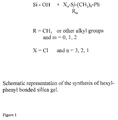
- alkyl-phenyl bonded silica gels can be synthesized using a variety of silylating reagents. The synthesis was carried out by reacting a mono-, di-, or tri- functional alkyl-phenylsilane with the silanol groups of silica gels in a suitable media under high temperature as depicted in FIG. 1.
- the functional groups are good leaving group such as halogens, methoxy, ethoxy, etc, and the alkyl-phenylsilane having one to three leaving groups, hereinafter, is refered as a "reactive alkyl-phenylsilane".
- the alkyl-phenyl bonded phases of the present invention shows chemical stability over extended pH range of 1.50 to 10.00 and has unique selectivity for the separation of organic molecules compared to other alkyl bonded phases.
- the stability and selectivity of alkyl-phenyl bonded phase of the present invention are not limited by the use of various polymer-based chromatographic supports such as silica gel, polystyrene-divinylbenzene copolymer, polyhydroxymethacrylate, cellulose, etc.
- various alkyl-phenyl bonded phases can be mixed to provide a mixed phase while maintaing their own selectivities and retaining capacities.
- the alkyl-phenyl bonded phases of the present invention have many advantages when applied to perform HPLC, in terms of its inertness (low silanophyllic activity), extended pH stability and unique selectivity.
- silica gel washed with 0.1 N hydrochloric acid (HCl) on a filter funnel followed by distilled and dionized water till the pH of wash was neutral (nearly 7.0). The silica gel was then washed with acetone and dried in an oven at 80°C under vacuum for 10 hours.
- HCl hydrochloric acid
- a dry 500 mL capacity round bottom flask was set up in a fume hood, and 20 grams of hexyl-phenyl methyldichlorosilane as a silytating agent for obtaining hexyl-phenyl bonded phase and 200 mL of dry toluene were added to it. The two were mixed thoroughly and the twenty grams of dried silica gel were added to the reaction mixture while continuously stirring the mixture. The flask was then attached to a condenser with water circulating through it and heated to boiling using a heating mantle. After allowing the reaction to proceed for 18 hours, the flask was cooled to room temperature and the silica gel which had hexyl-phenyl group on the surfaces was filtered.
- the hexyl-phenyl bonded silica gel was then washed with 100 mL dichloromethane, 100 mL methanol and 100 mL acetone and dried under vacuum at 80°C.
- a similar reaction and procedure were carried out to prepare propyl-phenyl bonded silica gel and octyl-phenyl bonded silica gel.
- the unreacted silanol groups on the surface of the silica gel were blocked by an end-capping step as follows: the bonded silica gel was added to a mixture of 40 mL of trimethylchlorosilane and 200 mL of toluene in a round bottom flask and reacted for 18 hours. At the end of the reaction, the silica gel was subjected to the washing/drying procedures as described earlier in the bonding step.
- the inertness and the chemical stability of the synthesized hexyl-phenyl bonded silica gel were studied by looking at the rention factors and peak shapes of pyridine, benzoic acid, 8-hydroxyquinoline, and naphthalene disclosed in T. Hanai, Encyclopedia of Analytical Science (1995), Academic Press, London, p. 2558 - 1567 which is hereby incorporated herein by reference.
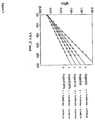
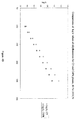
- the plots 20 and 25 in FIGs. 2A and 2B show chemical stability of hexyl-phenyl bonded phase in acidic and basic solutions.
- the lines 21 and 26 indicate retention time (t R ) for toluene, and the lines 22 and 27 represent retention factors (k) for toluene in acidic and basic solutions respectively.
- the lines 23 and 28 indicate peak asymmetry for toluene, and the lines 24 and 29 for pyridine. Asymmetry is a factor describing the shapes of chromatographic peaks, and the factor is the ratio of the distance between the peak apex and the back side of the chromatrographic curve and the front side of the curve at 10% peak height. As shown in FIGs.
- the retention time and retention factor for toluene was almost constant in continuous operation of more than 2,500 hours (more than 60,000 column volumes) both in 10 mM sodium phosphate buffer (pH 10) and 0.1% trifluoro acetic (pH 1.5) solutions.
- the peak shapes of toluene and pyridine were almost symmetric.
- the surface was also inert for trace metal sensitive test using 8-hydroxyquinoline, thereby showing a low level of metal contamination.
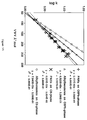
- the log k values of alkylbenzenes were measured by reversed-phase liquid chormatography in aqueous 80% acetonitrile at 40°C.
- the log k values were used for the analysis of hydrophobicity of bonded phases using van der Waals volumes of analytes as the standard.
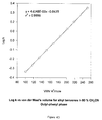
- the relations between log k values and van der Waals volumes of alkylbenzenes in different bonded phases are shown in FIG. 3.
- the relations indicate that the retention capacities related to hydrophobicity of hexyl-phenyl and propyl-phenyl bonded phases (respectively C6Ph and C3Ph) were less than that of the pentyl bonded phase (C5).
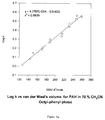
- the ratios of the slopes for the plot of log k values and van der Waals volumes indicated the difference of retention capacity of these bonded phases (calculated from FIG. 5).
- the retention capacity for alkylbenzenes was 1.27 (6.523/5.117) times greater than that for PAH on C6Ph phase.
- the retention capacity for alkylbenzenes was 1.73 (7.840/4.531) times greater than that for PAH on C8 phase. This means that PAHs were retained 1.36 (1.73/1.27) times on C6Ph phase than on C8 phase.
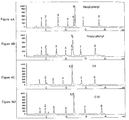
- the selectivity of the synthesized octyl-phenyl (C8Ph) bodned phase for alkylbenzenes in 70% and 80% aqueous acetonitrile are shown in FIG. 4C and 4D.
- the selectivity of octyl-phenyl (C8Ph) bonded phase for polyaromatic hydrocarbons (PAH) is shown in FIG. 5B.
- the octyl-phenyl phase was found to be less retentive than the hexyl phenyl phase for all the applications tested.
- the selectivities of the alkyl-phenyl and alkyl bonded phases were examined for the separation of antibacterial drugs.
- the mixtures of carbadox, thiamphenicol, furazolidone, oxolinic acid, sulfadimethoxine, sulfaquinoxaline, nalidixic acid and piromidic acid, which are respectively numbered as 1 to 8 in FIG. 6, were chromatographed using potassiumdihydrogen phosphate and acetonitrile mixtures.
- the total elution time was about 20 minutes in C3Ph, C6Ph, C8, C18, and C6Ph bonded phases as shown in FIGs. 6A, 6B, 6C, 6D, and 6E, respectively.
- the computer used for the molecular calculations were Macintosh 8100/100 running the CACheTM program including ProjectLeaderTM from Sony-Tektronix (Tokyo).
- Rlog P values were calculated by a method based on that proposed by Rekker.
- the van der Waals volumes were calculated by MOPAC-Blog P program provided by Sony-Tektronix.
- the molecules were first optimized by molecular mechanics calculation, and optimized again by MOPAC, then their van der Waals volumes and log P values were obtained with the Blog P program disclosed in CAChe Manual, Sony-Tektronix, (1995) which is hereby incorporated herein by reference. Properties for the calculation were selected according to the manual from CAChe Scientific.
- the liquid chromatograph was a model HP1090 from Hewlett-Packard (Palo Alto, California, USA), and the chemically-bonded silica gel columns, -C18, -C8 and -C5, -C6Ph, -C3Ph, 15 cm x 4.6 mm I.D., were from Phenomenex Inc. (Torrance, California, USA). Chemicals used were from Aldrich and ChemService. HPLC grade acetonitrile and water were from Fisher Scientific (Tustin, California, USA).
Landscapes
- Chemical & Material Sciences (AREA)
- Analytical Chemistry (AREA)
- Chemical Kinetics & Catalysis (AREA)
- Organic Chemistry (AREA)
- Solid-Sorbent Or Filter-Aiding Compositions (AREA)
- Treatment Of Liquids With Adsorbents In General (AREA)
- Organic Low-Molecular-Weight Compounds And Preparation Thereof (AREA)
Applications Claiming Priority (2)
| Application Number | Priority Date | Filing Date | Title |
|---|---|---|---|
| US08909267 US5993653C1 (en) | 1997-08-11 | 1997-08-11 | Composition and column used in hplc |
| US909267 | 1997-08-11 |
Publications (2)
| Publication Number | Publication Date |
|---|---|
| EP0903578A2 true EP0903578A2 (de) | 1999-03-24 |
| EP0903578A3 EP0903578A3 (de) | 2001-02-14 |
Family
ID=25426930
Family Applications (1)
| Application Number | Title | Priority Date | Filing Date |
|---|---|---|---|
| EP98114945A Withdrawn EP0903578A3 (de) | 1997-08-11 | 1998-08-07 | Verbindung und Kolonne für HPLC, ein Verfahren zur Herstellung einer Verbindung und Trennverfahren für verschiedene Chemikalien in einer Probe |
Country Status (3)
| Country | Link |
|---|---|
| US (2) | US5993653C1 (de) |
| EP (1) | EP0903578A3 (de) |
| JP (1) | JPH11108913A (de) |
Cited By (5)
| Publication number | Priority date | Publication date | Assignee | Title |
|---|---|---|---|---|
| WO2010059550A1 (en) * | 2008-11-19 | 2010-05-27 | Mallinckrodt Baker, Inc. | New chromatographic media based on phenoxy alkyl and alkoxy-or phenoxy-phenyl alkyl ligands |
| EP2570185A1 (de) * | 2011-09-15 | 2013-03-20 | InstrAction GmbH | Sorptionsmittel mit einem aromatischen Ringsystem auf dessen Oberfläche zur Reinigung organischer Moleküle |
| CN103752293A (zh) * | 2014-01-10 | 2014-04-30 | 常州南京大学高新技术研究院 | 双脲基/脲基-氨基甲酸酯型液相色谱固定相及其制备方法 |
| US9308520B2 (en) | 2005-12-16 | 2016-04-12 | Akzo Nobel N.V. | Silica based material |
| CN110441427A (zh) * | 2019-08-19 | 2019-11-12 | 生态环境部华南环境科学研究所 | 基于低温冷冻萃取技术检测尿液中未代谢多环芳烃的方法 |
Families Citing this family (23)
| Publication number | Priority date | Publication date | Assignee | Title |
|---|---|---|---|---|
| US7203732B2 (en) * | 1999-11-11 | 2007-04-10 | Miralink Corporation | Flexible remote data mirroring |
| TW454120B (en) * | 1999-11-11 | 2001-09-11 | Miralink Corp | Flexible remote data mirroring |
| US6987079B2 (en) * | 2001-08-14 | 2006-01-17 | W.R. Grace & Co.-Conn. | Supported catalyst systems |
| US6802966B2 (en) | 2001-08-14 | 2004-10-12 | W. R. Grace & Co. Conn. | Solid compositions for selective adsorption from complex mixtures |
| US7504364B2 (en) * | 2002-03-01 | 2009-03-17 | Receptors Llc | Methods of making arrays and artificial receptors |
| US20040137481A1 (en) * | 2002-09-16 | 2004-07-15 | Receptors Llc | Artificial receptor building blocks, components, and kits |
| US20060051802A1 (en) * | 2002-09-16 | 2006-03-09 | Receptors Llc | Artificial receptors, building blocks, and methods |
| US20050170385A1 (en) * | 2002-09-16 | 2005-08-04 | Receptors Llc | Artificial receptors including gradients |
| US20050037381A1 (en) * | 2002-09-16 | 2005-02-17 | Receptors Llc | Artificial receptors, building blocks, and methods |
| US20050136483A1 (en) * | 2003-09-03 | 2005-06-23 | Receptors Llc | Nanodevices employing combinatorial artificial receptors |
| US20050037429A1 (en) * | 2003-03-28 | 2005-02-17 | Receptors Llc | Artificial receptors including reversibly immobilized building blocks and methods |
| US20040161852A1 (en) * | 2003-02-14 | 2004-08-19 | Anderson Christopher G. | Method of assaying an Fe-Sugar complex |
| EP1613737A4 (de) * | 2003-03-28 | 2008-12-03 | Receptors Llc | Reversibel immobilisierte bausteine beinhaltend künstliche rezeptoren und verfahren |
| US20050242038A1 (en) * | 2004-04-30 | 2005-11-03 | Wu Chen | Novel stationary phases for use in high-performance liquid chromatography |
| US20060076296A1 (en) * | 2004-10-13 | 2006-04-13 | Wu Chen | Novel stationary phases for use in high-performance liquid chromatography |
| US7504365B2 (en) * | 2004-09-03 | 2009-03-17 | Receptors Llc | Combinatorial artificial receptors including tether building blocks |
| US7985715B2 (en) * | 2004-09-11 | 2011-07-26 | Receptors Llc | Combinatorial artificial receptors including peptide building blocks |
| US8308940B2 (en) | 2007-12-06 | 2012-11-13 | The Board Of Trustees Of The University Of Illinois | Chromatography devices and methods |
| US8062899B1 (en) * | 2007-12-31 | 2011-11-22 | NHK Laboratories, Inc. | Identification and quantitative determination of major chemical contaminants associated with L-Tryptophan |
| US20100305219A1 (en) * | 2009-06-02 | 2010-12-02 | The Board Of Trustees Of The University Of Illinois | Emulsions and foams using patchy particles |
| EP2462188A4 (de) | 2009-08-04 | 2016-11-23 | Waters Technologies Corp | Hochreine chromatographiematerialien mit einem ionisierbaren modifikator |
| US10159911B2 (en) | 2009-08-04 | 2018-12-25 | Waters Technologies Corporation | High purity chromatographic materials comprising an ionizable modifier |
| CN111632582B (zh) * | 2019-03-01 | 2023-02-28 | 月旭科技(上海)股份有限公司 | 硅胶反相色谱填料及其制备方法和应用 |
Family Cites Families (11)
| Publication number | Priority date | Publication date | Assignee | Title |
|---|---|---|---|---|
| SE413986B (sv) * | 1973-03-23 | 1980-07-07 | Exploaterings Ab Tbf | Sett att separera amfipatiska emnen innehallande bade hydrofila och hydrofoba grupper samt gelprodukt for genomforande av separationen |
| US4544499A (en) * | 1979-08-10 | 1985-10-01 | Pedro B. Macedo | Fixation by anion exchange of toxic materials in a glass matrix |
| US4950634A (en) * | 1988-02-11 | 1990-08-21 | Dow Corning Corporation | Method for producing dual zone materials by use of an organosilane mixture |
| US4867884A (en) * | 1988-02-24 | 1989-09-19 | The United States Of America As Represented By The Secretary Of Agriculture | Separation of cyclodextrins by affinity chromatography |
| IT1226605B (it) * | 1988-09-02 | 1991-01-25 | Eniricerche Spa | Agente silanizzante per la preparazione di supporti cromatografici. |
| US5011608A (en) * | 1988-11-18 | 1991-04-30 | Dragana Damjanovic | Biogenic amine assay using HPLC-ECD |
| JP2874297B2 (ja) * | 1989-12-18 | 1999-03-24 | 東ソー株式会社 | 逆相クロマトグラフィー用充填剤及びその製造方法 |
| US5252216A (en) * | 1992-03-24 | 1993-10-12 | Smithkline Beecham Corporation | Protein purification |
| US5374755A (en) * | 1992-07-17 | 1994-12-20 | Millipore Corporation | Liquid chromatography stationary phases with reduced silanol interactions |
| US5316680A (en) * | 1992-10-21 | 1994-05-31 | Cornell Research Foundation, Inc. | Multimodal chromatographic separation media and process for using same |
| US5429746A (en) * | 1994-02-22 | 1995-07-04 | Smith Kline Beecham Corporation | Antibody purification |
-
1997
- 1997-08-11 US US08909267 patent/US5993653C1/en not_active Expired - Fee Related
-
1998
- 1998-08-07 EP EP98114945A patent/EP0903578A3/de not_active Withdrawn
- 1998-08-11 JP JP10226702A patent/JPH11108913A/ja active Pending
-
1999
- 1999-09-27 US US09/405,747 patent/US20010054579A1/en not_active Abandoned
Cited By (10)
| Publication number | Priority date | Publication date | Assignee | Title |
|---|---|---|---|---|
| US9308520B2 (en) | 2005-12-16 | 2016-04-12 | Akzo Nobel N.V. | Silica based material |
| WO2010059550A1 (en) * | 2008-11-19 | 2010-05-27 | Mallinckrodt Baker, Inc. | New chromatographic media based on phenoxy alkyl and alkoxy-or phenoxy-phenyl alkyl ligands |
| EP2570185A1 (de) * | 2011-09-15 | 2013-03-20 | InstrAction GmbH | Sorptionsmittel mit einem aromatischen Ringsystem auf dessen Oberfläche zur Reinigung organischer Moleküle |
| WO2013037991A1 (en) * | 2011-09-15 | 2013-03-21 | Instraction Gmbh | Sorbent comprising crosslinked polyvinylamine on its surface for the purification of organic molecules |
| CN103958051A (zh) * | 2011-09-15 | 2014-07-30 | 因思特艾克申有限公司 | 用于有机分子提纯、表面上具有交联聚乙烯胺的吸附剂 |
| CN103958051B (zh) * | 2011-09-15 | 2017-07-07 | 因思特艾克申有限公司 | 用于有机分子提纯、表面上具有交联聚乙烯胺的吸附剂 |
| CN103752293A (zh) * | 2014-01-10 | 2014-04-30 | 常州南京大学高新技术研究院 | 双脲基/脲基-氨基甲酸酯型液相色谱固定相及其制备方法 |
| CN103752293B (zh) * | 2014-01-10 | 2016-03-23 | 常州南京大学高新技术研究院 | 双脲基/脲基-氨基甲酸酯型液相色谱固定相及其制备方法 |
| CN110441427A (zh) * | 2019-08-19 | 2019-11-12 | 生态环境部华南环境科学研究所 | 基于低温冷冻萃取技术检测尿液中未代谢多环芳烃的方法 |
| CN110441427B (zh) * | 2019-08-19 | 2022-02-08 | 生态环境部华南环境科学研究所 | 基于低温冷冻萃取技术检测尿液中未代谢多环芳烃的方法 |
Also Published As
| Publication number | Publication date |
|---|---|
| US20010054579A1 (en) | 2001-12-27 |
| EP0903578A3 (de) | 2001-02-14 |
| JPH11108913A (ja) | 1999-04-23 |
| US5993653A (en) | 1999-11-30 |
| US5993653C1 (en) | 2001-11-06 |
Similar Documents
| Publication | Publication Date | Title |
|---|---|---|
| US5993653A (en) | Composition and column used in HPLC | |
| Kopaciewicz et al. | Stationary phase contributions to retention in high-performance anion-exchange protein chromatography: ligand density and mixed mode effects | |
| Kirkland et al. | Controlled surface porosity supports with chemically-bonded organic stationary phases for gas and liquid chromatography | |
| Marcé et al. | Solid-phase extraction of polycyclic aromatic compounds | |
| Kele et al. | Repeatability and reproducibility of retention data and band profiles on six batches of monolithic columns | |
| Kawahara et al. | Titania and zirconia: possible new ceramic microparticulates for high-performance liquid chromatography | |
| Majors | Recent advances in HPLC packings and columns | |
| Engelhardt et al. | Chromatographic characterization of silica-based reversed phases | |
| Hennion et al. | Influence of the number and length of alkyl chains on the chromatographic properteis of hyrdrocarbonaceous bonded phases | |
| JP4796693B2 (ja) | 水溶液からの有機溶質の回収 | |
| O'Gara et al. | Embedded-polar-group bonded phases for high performance liquid chromatography | |
| WO2011012019A1 (zh) | 基于硅胶表面共聚反应的分离材料及其制备方法 | |
| McNeff et al. | Analytical advantages of highly stable stationary phases for reversed-phase LC | |
| EP0470255B1 (de) | Chromatographisches packungsmaterial und dessen herstellung | |
| Han et al. | An alternative approach for preparation of amide-embedded stationary phase for reversed-phase liquid chromatography | |
| Cox | Practical aspects of bonded phase chromatography | |
| CN101193698B (zh) | 用于固相萃取的极性官能化聚合物改性的多孔基质 | |
| CA2744145A1 (en) | New chromatographic media based on phenoxy alkyl and alkoxy-or phenoxy-phenyl alkyl ligands | |
| Jiang et al. | Mixed‐mode reversed‐phase and ion‐exchange monolithic columns for micro‐HPLC | |
| Engelhardt et al. | High speed liquid chromatography on alumina of different activity levels | |
| Faria et al. | New stationary phases for high-performance liquid chromatography based on poly (methyltetradecylsiloxane) thermally immobilized onto zirconized silica | |
| Buszewski et al. | Isolation and determination of sugars in Nicotiana tabacum on aminopropyl chemically bonded phase using SPE and HPLC | |
| KR20060124720A (ko) | 광학 이성체용 분리제 | |
| JP4700171B2 (ja) | 液体クロマトグラフィー用親水性ods充填剤の製造方法 | |
| Sýkora et al. | “Molded” porous polymer monoliths: A novel format for capillary gas chromatography stationary phases |
Legal Events
| Date | Code | Title | Description |
|---|---|---|---|
| PUAI | Public reference made under article 153(3) epc to a published international application that has entered the european phase |
Free format text: ORIGINAL CODE: 0009012 |
|
| AK | Designated contracting states |
Kind code of ref document: A2 Designated state(s): DE FR GB IT |
|
| AX | Request for extension of the european patent |
Free format text: AL;LT;LV;MK;RO;SI |
|
| PUAL | Search report despatched |
Free format text: ORIGINAL CODE: 0009013 |
|
| RIC1 | Information provided on ipc code assigned before grant |
Free format text: 7G 01N 30/00 A, 7G 01N 30/48 B |
|
| AK | Designated contracting states |
Kind code of ref document: A3 Designated state(s): AT BE CH CY DE DK ES FI FR GB GR IE IT LI LU MC NL PT SE |
|
| AX | Request for extension of the european patent |
Free format text: AL;LT;LV;MK;RO;SI |
|
| AKX | Designation fees paid |
Free format text: DE FR GB IT |
|
| STAA | Information on the status of an ep patent application or granted ep patent |
Free format text: STATUS: THE APPLICATION IS DEEMED TO BE WITHDRAWN |
|
| 18D | Application deemed to be withdrawn |
Effective date: 20010815 |