EP0903345B1 - Crystal form of N-(4-trifluoromethylphenyl)-5-methylisoxazole-4-carboxamid - Google Patents
Crystal form of N-(4-trifluoromethylphenyl)-5-methylisoxazole-4-carboxamid Download PDFInfo
- Publication number
- EP0903345B1 EP0903345B1 EP98114373A EP98114373A EP0903345B1 EP 0903345 B1 EP0903345 B1 EP 0903345B1 EP 98114373 A EP98114373 A EP 98114373A EP 98114373 A EP98114373 A EP 98114373A EP 0903345 B1 EP0903345 B1 EP 0903345B1
- Authority
- EP
- European Patent Office
- Prior art keywords
- modification
- compound
- formula
- cancer
- water
- Prior art date
- Legal status (The legal status is an assumption and is not a legal conclusion. Google has not performed a legal analysis and makes no representation as to the accuracy of the status listed.)
- Expired - Lifetime
Links
- 239000013078 crystal Substances 0.000 title claims description 18
- VHOGYURTWQBHIL-UHFFFAOYSA-N leflunomide Chemical compound O1N=CC(C(=O)NC=2C=CC(=CC=2)C(F)(F)F)=C1C VHOGYURTWQBHIL-UHFFFAOYSA-N 0.000 title description 8
- 238000012986 modification Methods 0.000 claims description 64
- 230000004048 modification Effects 0.000 claims description 64
- 150000001875 compounds Chemical class 0.000 claims description 29
- KFZMGEQAYNKOFK-UHFFFAOYSA-N Isopropanol Chemical compound CC(C)O KFZMGEQAYNKOFK-UHFFFAOYSA-N 0.000 claims description 18
- XLYOFNOQVPJJNP-UHFFFAOYSA-N water Substances O XLYOFNOQVPJJNP-UHFFFAOYSA-N 0.000 claims description 17
- OKKJLVBELUTLKV-UHFFFAOYSA-N Methanol Chemical compound OC OKKJLVBELUTLKV-UHFFFAOYSA-N 0.000 claims description 15
- 238000000034 method Methods 0.000 claims description 12
- 239000000203 mixture Substances 0.000 claims description 12
- 239000002904 solvent Substances 0.000 claims description 11
- ZWEHNKRNPOVVGH-UHFFFAOYSA-N 2-Butanone Chemical compound CCC(C)=O ZWEHNKRNPOVVGH-UHFFFAOYSA-N 0.000 claims description 9
- YXFVVABEGXRONW-UHFFFAOYSA-N Toluene Chemical compound CC1=CC=CC=C1 YXFVVABEGXRONW-UHFFFAOYSA-N 0.000 claims description 9
- 238000002360 preparation method Methods 0.000 claims description 8
- 238000002441 X-ray diffraction Methods 0.000 claims description 7
- 239000003814 drug Substances 0.000 claims description 7
- CSCPPACGZOOCGX-UHFFFAOYSA-N Acetone Chemical compound CC(C)=O CSCPPACGZOOCGX-UHFFFAOYSA-N 0.000 claims description 6
- YMWUJEATGCHHMB-UHFFFAOYSA-N Dichloromethane Chemical compound ClCCl YMWUJEATGCHHMB-UHFFFAOYSA-N 0.000 claims description 6
- XEKOWRVHYACXOJ-UHFFFAOYSA-N Ethyl acetate Chemical compound CCOC(C)=O XEKOWRVHYACXOJ-UHFFFAOYSA-N 0.000 claims description 6
- 239000000725 suspension Substances 0.000 claims description 5
- LFQSCWFLJHTTHZ-UHFFFAOYSA-N Ethanol Chemical compound CCO LFQSCWFLJHTTHZ-UHFFFAOYSA-N 0.000 claims description 4
- LRHPLDYGYMQRHN-UHFFFAOYSA-N N-Butanol Chemical compound CCCCO LRHPLDYGYMQRHN-UHFFFAOYSA-N 0.000 claims description 4
- 206010028980 Neoplasm Diseases 0.000 claims description 4
- 230000005540 biological transmission Effects 0.000 claims description 4
- 238000006243 chemical reaction Methods 0.000 claims description 4
- 229940079593 drug Drugs 0.000 claims description 4
- ZXEKIIBDNHEJCQ-UHFFFAOYSA-N isobutanol Chemical compound CC(C)CO ZXEKIIBDNHEJCQ-UHFFFAOYSA-N 0.000 claims description 4
- 206010039073 rheumatoid arthritis Diseases 0.000 claims description 4
- 206010006187 Breast cancer Diseases 0.000 claims description 3
- 238000005169 Debye-Scherrer Methods 0.000 claims description 3
- 206010020751 Hypersensitivity Diseases 0.000 claims description 3
- 208000007766 Kaposi sarcoma Diseases 0.000 claims description 3
- 206010058467 Lung neoplasm malignant Diseases 0.000 claims description 3
- 206010060862 Prostate cancer Diseases 0.000 claims description 3
- 201000004681 Psoriasis Diseases 0.000 claims description 3
- 206010040047 Sepsis Diseases 0.000 claims description 3
- 208000024780 Urticaria Diseases 0.000 claims description 3
- 206010046851 Uveitis Diseases 0.000 claims description 3
- 150000001298 alcohols Chemical class 0.000 claims description 3
- 230000007815 allergy Effects 0.000 claims description 3
- 208000006673 asthma Diseases 0.000 claims description 3
- 206010009887 colitis Diseases 0.000 claims description 3
- 150000002576 ketones Chemical class 0.000 claims description 3
- 206010027191 meningioma Diseases 0.000 claims description 3
- 208000008443 pancreatic carcinoma Diseases 0.000 claims description 3
- 206010039083 rhinitis Diseases 0.000 claims description 3
- 201000000849 skin cancer Diseases 0.000 claims description 3
- 208000023275 Autoimmune disease Diseases 0.000 claims description 2
- 208000026310 Breast neoplasm Diseases 0.000 claims description 2
- 201000003883 Cystic fibrosis Diseases 0.000 claims description 2
- 206010012438 Dermatitis atopic Diseases 0.000 claims description 2
- 206010033128 Ovarian cancer Diseases 0.000 claims description 2
- 206010061535 Ovarian neoplasm Diseases 0.000 claims description 2
- 206010061902 Pancreatic neoplasm Diseases 0.000 claims description 2
- 208000000236 Prostatic Neoplasms Diseases 0.000 claims description 2
- 206010039491 Sarcoma Diseases 0.000 claims description 2
- 208000000453 Skin Neoplasms Diseases 0.000 claims description 2
- 230000001154 acute effect Effects 0.000 claims description 2
- 239000007900 aqueous suspension Substances 0.000 claims description 2
- 201000008937 atopic dermatitis Diseases 0.000 claims description 2
- 208000019425 cirrhosis of liver Diseases 0.000 claims description 2
- 238000002425 crystallisation Methods 0.000 claims description 2
- 230000008025 crystallization Effects 0.000 claims description 2
- 230000001900 immune effect Effects 0.000 claims description 2
- 208000032839 leukemia Diseases 0.000 claims description 2
- 201000005202 lung cancer Diseases 0.000 claims description 2
- 208000020816 lung neoplasm Diseases 0.000 claims description 2
- 208000015486 malignant pancreatic neoplasm Diseases 0.000 claims description 2
- 201000006417 multiple sclerosis Diseases 0.000 claims description 2
- 201000002528 pancreatic cancer Diseases 0.000 claims description 2
- BDERNNFJNOPAEC-UHFFFAOYSA-N propan-1-ol Chemical compound CCCO BDERNNFJNOPAEC-UHFFFAOYSA-N 0.000 claims description 2
- 201000000596 systemic lupus erythematosus Diseases 0.000 claims description 2
- 208000001072 type 2 diabetes mellitus Diseases 0.000 claims description 2
- 208000003174 Brain Neoplasms Diseases 0.000 claims 1
- 208000005016 Intestinal Neoplasms Diseases 0.000 claims 1
- 201000011510 cancer Diseases 0.000 claims 1
- 201000002313 intestinal cancer Diseases 0.000 claims 1
- 230000001926 lymphatic effect Effects 0.000 claims 1
- 239000000546 pharmaceutical excipient Substances 0.000 claims 1
- 239000000243 solution Substances 0.000 description 11
- 238000010586 diagram Methods 0.000 description 6
- 238000004519 manufacturing process Methods 0.000 description 5
- 230000005855 radiation Effects 0.000 description 5
- 229910017488 Cu K Inorganic materials 0.000 description 4
- 229910017541 Cu-K Inorganic materials 0.000 description 4
- GUBGYTABKSRVRQ-QKKXKWKRSA-N Lactose Chemical compound OC[C@H]1O[C@@H](O[C@H]2[C@H](O)[C@@H](O)C(O)O[C@@H]2CO)[C@H](O)[C@@H](O)[C@H]1O GUBGYTABKSRVRQ-QKKXKWKRSA-N 0.000 description 4
- VYPSYNLAJGMNEJ-UHFFFAOYSA-N Silicium dioxide Chemical compound O=[Si]=O VYPSYNLAJGMNEJ-UHFFFAOYSA-N 0.000 description 4
- 229910052739 hydrogen Inorganic materials 0.000 description 4
- 239000001257 hydrogen Substances 0.000 description 4
- 229960000681 leflunomide Drugs 0.000 description 4
- 229920002472 Starch Polymers 0.000 description 3
- 239000000654 additive Substances 0.000 description 3
- 239000002775 capsule Substances 0.000 description 3
- 229920002678 cellulose Polymers 0.000 description 3
- 230000001419 dependent effect Effects 0.000 description 3
- 238000010899 nucleation Methods 0.000 description 3
- 239000000843 powder Substances 0.000 description 3
- 108010010803 Gelatin Proteins 0.000 description 2
- 240000008042 Zea mays Species 0.000 description 2
- 235000005824 Zea mays ssp. parviglumis Nutrition 0.000 description 2
- 235000002017 Zea mays subsp mays Nutrition 0.000 description 2
- XLOMVQKBTHCTTD-UHFFFAOYSA-N Zinc monoxide Chemical compound [Zn]=O XLOMVQKBTHCTTD-UHFFFAOYSA-N 0.000 description 2
- 239000004480 active ingredient Substances 0.000 description 2
- 239000013543 active substance Substances 0.000 description 2
- 238000013459 approach Methods 0.000 description 2
- 238000009835 boiling Methods 0.000 description 2
- 239000000969 carrier Substances 0.000 description 2
- 210000004027 cell Anatomy 0.000 description 2
- 239000001913 cellulose Substances 0.000 description 2
- 235000010980 cellulose Nutrition 0.000 description 2
- 239000011248 coating agent Substances 0.000 description 2
- 238000000576 coating method Methods 0.000 description 2
- 238000001816 cooling Methods 0.000 description 2
- 235000005822 corn Nutrition 0.000 description 2
- 239000006071 cream Substances 0.000 description 2
- 238000001514 detection method Methods 0.000 description 2
- 239000000539 dimer Substances 0.000 description 2
- 239000002552 dosage form Substances 0.000 description 2
- 239000003937 drug carrier Substances 0.000 description 2
- 238000009472 formulation Methods 0.000 description 2
- 239000008273 gelatin Substances 0.000 description 2
- 229920000159 gelatin Polymers 0.000 description 2
- 235000019322 gelatine Nutrition 0.000 description 2
- 235000011852 gelatine desserts Nutrition 0.000 description 2
- 238000010438 heat treatment Methods 0.000 description 2
- 238000002329 infrared spectrum Methods 0.000 description 2
- 239000000314 lubricant Substances 0.000 description 2
- HQKMJHAJHXVSDF-UHFFFAOYSA-L magnesium stearate Chemical compound [Mg+2].CCCCCCCCCCCCCCCCCC([O-])=O.CCCCCCCCCCCCCCCCCC([O-])=O HQKMJHAJHXVSDF-UHFFFAOYSA-L 0.000 description 2
- 239000000463 material Substances 0.000 description 2
- 239000002674 ointment Substances 0.000 description 2
- 239000006187 pill Substances 0.000 description 2
- 239000000377 silicon dioxide Substances 0.000 description 2
- 239000008107 starch Substances 0.000 description 2
- 235000019698 starch Nutrition 0.000 description 2
- 239000000126 substance Substances 0.000 description 2
- 235000000346 sugar Nutrition 0.000 description 2
- 239000000829 suppository Substances 0.000 description 2
- 238000002560 therapeutic procedure Methods 0.000 description 2
- 244000215068 Acacia senegal Species 0.000 description 1
- 229920000936 Agarose Polymers 0.000 description 1
- 241000416162 Astragalus gummifer Species 0.000 description 1
- 206010009944 Colon cancer Diseases 0.000 description 1
- 229920002261 Corn starch Polymers 0.000 description 1
- 201000004624 Dermatitis Diseases 0.000 description 1
- 239000001856 Ethyl cellulose Substances 0.000 description 1
- ZZSNKZQZMQGXPY-UHFFFAOYSA-N Ethyl cellulose Chemical compound CCOCC1OC(OC)C(OCC)C(OCC)C1OC1C(O)C(O)C(OC)C(CO)O1 ZZSNKZQZMQGXPY-UHFFFAOYSA-N 0.000 description 1
- 206010016654 Fibrosis Diseases 0.000 description 1
- 201000003741 Gastrointestinal carcinoma Diseases 0.000 description 1
- 229920000084 Gum arabic Polymers 0.000 description 1
- 206010019668 Hepatic fibrosis Diseases 0.000 description 1
- 238000004566 IR spectroscopy Methods 0.000 description 1
- 239000004952 Polyamide Substances 0.000 description 1
- 244000061456 Solanum tuberosum Species 0.000 description 1
- 235000002595 Solanum tuberosum Nutrition 0.000 description 1
- 229920001615 Tragacanth Polymers 0.000 description 1
- 238000000441 X-ray spectroscopy Methods 0.000 description 1
- 239000000205 acacia gum Substances 0.000 description 1
- 235000010489 acacia gum Nutrition 0.000 description 1
- 230000000996 additive effect Effects 0.000 description 1
- 208000026935 allergic disease Diseases 0.000 description 1
- WNROFYMDJYEPJX-UHFFFAOYSA-K aluminium hydroxide Chemical compound [OH-].[OH-].[OH-].[Al+3] WNROFYMDJYEPJX-UHFFFAOYSA-K 0.000 description 1
- 239000007864 aqueous solution Substances 0.000 description 1
- 235000012216 bentonite Nutrition 0.000 description 1
- 239000001506 calcium phosphate Substances 0.000 description 1
- 235000011010 calcium phosphates Nutrition 0.000 description 1
- 239000000378 calcium silicate Substances 0.000 description 1
- 229910052918 calcium silicate Inorganic materials 0.000 description 1
- OYACROKNLOSFPA-UHFFFAOYSA-N calcium;dioxido(oxo)silane Chemical compound [Ca+2].[O-][Si]([O-])=O OYACROKNLOSFPA-UHFFFAOYSA-N 0.000 description 1
- 125000002915 carbonyl group Chemical group [*:2]C([*:1])=O 0.000 description 1
- 238000005119 centrifugation Methods 0.000 description 1
- 239000003795 chemical substances by application Substances 0.000 description 1
- 208000029742 colonic neoplasm Diseases 0.000 description 1
- 239000000470 constituent Substances 0.000 description 1
- 238000007796 conventional method Methods 0.000 description 1
- 206010012601 diabetes mellitus Diseases 0.000 description 1
- 238000007598 dipping method Methods 0.000 description 1
- 201000010099 disease Diseases 0.000 description 1
- 208000037265 diseases, disorders, signs and symptoms Diseases 0.000 description 1
- 239000006185 dispersion Substances 0.000 description 1
- 238000004090 dissolution Methods 0.000 description 1
- 239000008298 dragée Substances 0.000 description 1
- 239000000839 emulsion Substances 0.000 description 1
- 238000005516 engineering process Methods 0.000 description 1
- 235000019325 ethyl cellulose Nutrition 0.000 description 1
- 229920001249 ethyl cellulose Polymers 0.000 description 1
- 239000000499 gel Substances 0.000 description 1
- 239000008187 granular material Substances 0.000 description 1
- 238000011081 inoculation Methods 0.000 description 1
- 206010025135 lupus erythematosus Diseases 0.000 description 1
- 201000010453 lymph node cancer Diseases 0.000 description 1
- ZLNQQNXFFQJAID-UHFFFAOYSA-L magnesium carbonate Chemical compound [Mg+2].[O-]C([O-])=O ZLNQQNXFFQJAID-UHFFFAOYSA-L 0.000 description 1
- 239000001095 magnesium carbonate Substances 0.000 description 1
- 229910000021 magnesium carbonate Inorganic materials 0.000 description 1
- 235000019359 magnesium stearate Nutrition 0.000 description 1
- 238000005259 measurement Methods 0.000 description 1
- 229940126601 medicinal product Drugs 0.000 description 1
- 239000003094 microcapsule Substances 0.000 description 1
- -1 paraffins Substances 0.000 description 1
- 239000006072 paste Substances 0.000 description 1
- 239000000049 pigment Substances 0.000 description 1
- 239000004014 plasticizer Substances 0.000 description 1
- 229920002647 polyamide Polymers 0.000 description 1
- 229920001223 polyethylene glycol Polymers 0.000 description 1
- 229920001296 polysiloxane Polymers 0.000 description 1
- 229920000036 polyvinylpyrrolidone Polymers 0.000 description 1
- 239000001267 polyvinylpyrrolidone Substances 0.000 description 1
- 235000013855 polyvinylpyrrolidone Nutrition 0.000 description 1
- 229920001592 potato starch Polymers 0.000 description 1
- 238000000634 powder X-ray diffraction Methods 0.000 description 1
- 238000003825 pressing Methods 0.000 description 1
- 238000001953 recrystallisation Methods 0.000 description 1
- 238000005070 sampling Methods 0.000 description 1
- 235000012239 silicon dioxide Nutrition 0.000 description 1
- 238000005507 spraying Methods 0.000 description 1
- 238000003756 stirring Methods 0.000 description 1
- 238000003860 storage Methods 0.000 description 1
- 150000008163 sugars Chemical class 0.000 description 1
- 208000024891 symptom Diseases 0.000 description 1
- 239000006188 syrup Substances 0.000 description 1
- 235000020357 syrup Nutrition 0.000 description 1
- 239000003826 tablet Substances 0.000 description 1
- 239000000454 talc Substances 0.000 description 1
- 229910052623 talc Inorganic materials 0.000 description 1
- 235000012222 talc Nutrition 0.000 description 1
- 238000002207 thermal evaporation Methods 0.000 description 1
- 239000000196 tragacanth Substances 0.000 description 1
- 235000010487 tragacanth Nutrition 0.000 description 1
- 229940116362 tragacanth Drugs 0.000 description 1
- 238000012546 transfer Methods 0.000 description 1
- QORWJWZARLRLPR-UHFFFAOYSA-H tricalcium bis(phosphate) Chemical class [Ca+2].[Ca+2].[Ca+2].[O-]P([O-])([O-])=O.[O-]P([O-])([O-])=O QORWJWZARLRLPR-UHFFFAOYSA-H 0.000 description 1
- 238000000870 ultraviolet spectroscopy Methods 0.000 description 1
- 235000019871 vegetable fat Nutrition 0.000 description 1
- 239000001993 wax Substances 0.000 description 1
- 229940100445 wheat starch Drugs 0.000 description 1
- 239000011787 zinc oxide Substances 0.000 description 1
- 235000014692 zinc oxide Nutrition 0.000 description 1
Images


Classifications
-
- C—CHEMISTRY; METALLURGY
- C07—ORGANIC CHEMISTRY
- C07D—HETEROCYCLIC COMPOUNDS
- C07D261/00—Heterocyclic compounds containing 1,2-oxazole or hydrogenated 1,2-oxazole rings
- C07D261/02—Heterocyclic compounds containing 1,2-oxazole or hydrogenated 1,2-oxazole rings not condensed with other rings
- C07D261/06—Heterocyclic compounds containing 1,2-oxazole or hydrogenated 1,2-oxazole rings not condensed with other rings having two or more double bonds between ring members or between ring members and non-ring members
- C07D261/10—Heterocyclic compounds containing 1,2-oxazole or hydrogenated 1,2-oxazole rings not condensed with other rings having two or more double bonds between ring members or between ring members and non-ring members with hetero atoms or with carbon atoms having three bonds to hetero atoms with at the most one bond to halogen, e.g. ester or nitrile radicals, directly attached to ring carbon atoms
- C07D261/18—Carbon atoms having three bonds to hetero atoms, with at the most one bond to halogen
-
- A—HUMAN NECESSITIES
- A61—MEDICAL OR VETERINARY SCIENCE; HYGIENE
- A61P—SPECIFIC THERAPEUTIC ACTIVITY OF CHEMICAL COMPOUNDS OR MEDICINAL PREPARATIONS
- A61P1/00—Drugs for disorders of the alimentary tract or the digestive system
-
- A—HUMAN NECESSITIES
- A61—MEDICAL OR VETERINARY SCIENCE; HYGIENE
- A61P—SPECIFIC THERAPEUTIC ACTIVITY OF CHEMICAL COMPOUNDS OR MEDICINAL PREPARATIONS
- A61P11/00—Drugs for disorders of the respiratory system
-
- A—HUMAN NECESSITIES
- A61—MEDICAL OR VETERINARY SCIENCE; HYGIENE
- A61P—SPECIFIC THERAPEUTIC ACTIVITY OF CHEMICAL COMPOUNDS OR MEDICINAL PREPARATIONS
- A61P11/00—Drugs for disorders of the respiratory system
- A61P11/06—Antiasthmatics
-
- A—HUMAN NECESSITIES
- A61—MEDICAL OR VETERINARY SCIENCE; HYGIENE
- A61P—SPECIFIC THERAPEUTIC ACTIVITY OF CHEMICAL COMPOUNDS OR MEDICINAL PREPARATIONS
- A61P13/00—Drugs for disorders of the urinary system
- A61P13/02—Drugs for disorders of the urinary system of urine or of the urinary tract, e.g. urine acidifiers
-
- A—HUMAN NECESSITIES
- A61—MEDICAL OR VETERINARY SCIENCE; HYGIENE
- A61P—SPECIFIC THERAPEUTIC ACTIVITY OF CHEMICAL COMPOUNDS OR MEDICINAL PREPARATIONS
- A61P15/00—Drugs for genital or sexual disorders; Contraceptives
-
- A—HUMAN NECESSITIES
- A61—MEDICAL OR VETERINARY SCIENCE; HYGIENE
- A61P—SPECIFIC THERAPEUTIC ACTIVITY OF CHEMICAL COMPOUNDS OR MEDICINAL PREPARATIONS
- A61P17/00—Drugs for dermatological disorders
-
- A—HUMAN NECESSITIES
- A61—MEDICAL OR VETERINARY SCIENCE; HYGIENE
- A61P—SPECIFIC THERAPEUTIC ACTIVITY OF CHEMICAL COMPOUNDS OR MEDICINAL PREPARATIONS
- A61P19/00—Drugs for skeletal disorders
-
- A—HUMAN NECESSITIES
- A61—MEDICAL OR VETERINARY SCIENCE; HYGIENE
- A61P—SPECIFIC THERAPEUTIC ACTIVITY OF CHEMICAL COMPOUNDS OR MEDICINAL PREPARATIONS
- A61P19/00—Drugs for skeletal disorders
- A61P19/02—Drugs for skeletal disorders for joint disorders, e.g. arthritis, arthrosis
-
- A—HUMAN NECESSITIES
- A61—MEDICAL OR VETERINARY SCIENCE; HYGIENE
- A61P—SPECIFIC THERAPEUTIC ACTIVITY OF CHEMICAL COMPOUNDS OR MEDICINAL PREPARATIONS
- A61P25/00—Drugs for disorders of the nervous system
-
- A—HUMAN NECESSITIES
- A61—MEDICAL OR VETERINARY SCIENCE; HYGIENE
- A61P—SPECIFIC THERAPEUTIC ACTIVITY OF CHEMICAL COMPOUNDS OR MEDICINAL PREPARATIONS
- A61P27/00—Drugs for disorders of the senses
- A61P27/02—Ophthalmic agents
-
- A—HUMAN NECESSITIES
- A61—MEDICAL OR VETERINARY SCIENCE; HYGIENE
- A61P—SPECIFIC THERAPEUTIC ACTIVITY OF CHEMICAL COMPOUNDS OR MEDICINAL PREPARATIONS
- A61P27/00—Drugs for disorders of the senses
- A61P27/02—Ophthalmic agents
- A61P27/14—Decongestants or antiallergics
-
- A—HUMAN NECESSITIES
- A61—MEDICAL OR VETERINARY SCIENCE; HYGIENE
- A61P—SPECIFIC THERAPEUTIC ACTIVITY OF CHEMICAL COMPOUNDS OR MEDICINAL PREPARATIONS
- A61P29/00—Non-central analgesic, antipyretic or antiinflammatory agents, e.g. antirheumatic agents; Non-steroidal antiinflammatory drugs [NSAID]
-
- A—HUMAN NECESSITIES
- A61—MEDICAL OR VETERINARY SCIENCE; HYGIENE
- A61P—SPECIFIC THERAPEUTIC ACTIVITY OF CHEMICAL COMPOUNDS OR MEDICINAL PREPARATIONS
- A61P3/00—Drugs for disorders of the metabolism
- A61P3/08—Drugs for disorders of the metabolism for glucose homeostasis
-
- A—HUMAN NECESSITIES
- A61—MEDICAL OR VETERINARY SCIENCE; HYGIENE
- A61P—SPECIFIC THERAPEUTIC ACTIVITY OF CHEMICAL COMPOUNDS OR MEDICINAL PREPARATIONS
- A61P3/00—Drugs for disorders of the metabolism
- A61P3/08—Drugs for disorders of the metabolism for glucose homeostasis
- A61P3/10—Drugs for disorders of the metabolism for glucose homeostasis for hyperglycaemia, e.g. antidiabetics
-
- A—HUMAN NECESSITIES
- A61—MEDICAL OR VETERINARY SCIENCE; HYGIENE
- A61P—SPECIFIC THERAPEUTIC ACTIVITY OF CHEMICAL COMPOUNDS OR MEDICINAL PREPARATIONS
- A61P31/00—Antiinfectives, i.e. antibiotics, antiseptics, chemotherapeutics
- A61P31/04—Antibacterial agents
-
- A—HUMAN NECESSITIES
- A61—MEDICAL OR VETERINARY SCIENCE; HYGIENE
- A61P—SPECIFIC THERAPEUTIC ACTIVITY OF CHEMICAL COMPOUNDS OR MEDICINAL PREPARATIONS
- A61P35/00—Antineoplastic agents
-
- A—HUMAN NECESSITIES
- A61—MEDICAL OR VETERINARY SCIENCE; HYGIENE
- A61P—SPECIFIC THERAPEUTIC ACTIVITY OF CHEMICAL COMPOUNDS OR MEDICINAL PREPARATIONS
- A61P37/00—Drugs for immunological or allergic disorders
-
- A—HUMAN NECESSITIES
- A61—MEDICAL OR VETERINARY SCIENCE; HYGIENE
- A61P—SPECIFIC THERAPEUTIC ACTIVITY OF CHEMICAL COMPOUNDS OR MEDICINAL PREPARATIONS
- A61P37/00—Drugs for immunological or allergic disorders
- A61P37/02—Immunomodulators
-
- A—HUMAN NECESSITIES
- A61—MEDICAL OR VETERINARY SCIENCE; HYGIENE
- A61P—SPECIFIC THERAPEUTIC ACTIVITY OF CHEMICAL COMPOUNDS OR MEDICINAL PREPARATIONS
- A61P37/00—Drugs for immunological or allergic disorders
- A61P37/08—Antiallergic agents
-
- A—HUMAN NECESSITIES
- A61—MEDICAL OR VETERINARY SCIENCE; HYGIENE
- A61P—SPECIFIC THERAPEUTIC ACTIVITY OF CHEMICAL COMPOUNDS OR MEDICINAL PREPARATIONS
- A61P43/00—Drugs for specific purposes, not provided for in groups A61P1/00-A61P41/00
Definitions
- the X-ray diffraction diagram of modification 2 recorded with Cu-K ⁇ 1 radiation is shown in FIG. 1.
- the STADI P dual-circuit diffractometer from Stoe (Darmstadt, Germany) or the computer-supported single-crystal diffractometer R3 m / V from Siemens (radiation Mo K ⁇ ) were used to record the diagram
- the infrared spectrum of modification 2 of the compound of formula I (1 mg in 300 mg KBr) recorded with an infrared spectrophotometer shows the following main bands (unit cm -1 ): 1321 1481 672 3201 1607 3355 763 701 1109 1264 908 948 1065 1384 754 511 1536 1361 592 733 1663 852 427 960 1241 1014 3111 1779 1410 3297 3065 1811 1160 877 3221 484 1691 940 974 3442 831 3274 3129 3434 1188 894 628
- the specified wave numbers are arranged in increasing intensity.
- the infrared spectrum of modification 2 of the compound of formula I according to Example 1 is also shown in FIG. 3, the transmission in% being given in the ordinate and the wave number in cm ⁇ 1 in the abscissa.
- the compound of formula I crystallizes in modification 2 in space group P2 1 / c with 8 molecules in the unit cell.
- the two molecules have a very different conformation.
- the angles of the five and six rings with the central carbonyl group are 5.4 ° and 2.1 ° or 23.4 ° and 23.1 °. The latter twist creates the steric conditions for hydrogen bonding between the two molecules to be possible.
- the compound of formula I crystallizes in modification 1 in space group P2 1 / c with 4 molecules in the unit cell.
- the molecule is essentially planar.
- the angle between the planar atomic groups is less than 2.4 °.
- the molecules are arranged in stacks in the crystal.
- the molecules lie in stacks next to one another and are arranged in an antiparallel manner.
- Very weak hydrogen bonds link the dimers in the crystal structure (NH ... N: 3.1444 ⁇ ).
- the X-ray diffraction diagrams also allow the amount of the Modification 2 in a mixture containing both modifications.
- For quantitative Determination is suitable for the line at 8.35 ° 2 theta of modification 1 and the line at 16.1 ° 2 theta of modification 2.
- the detection limit of this method is about 0.3% modification 2 in crystals with modification 1.
- Modification 2 is more water-soluble than modification 1. At 37 ° C, 38 mg / l of modification 2 can be dissolved, while modification 1 25 mg / l go into solution. Modification 2 is also in the temperature range from -15 ° C to +40 ° C, preferably from 20 ° C to 40 ° C, stable and is not in Modification 1 converted
- the modification 2 according to the invention of the compound of the formula I is obtained, for example, by heating a suspension of the crystals of the modification 1 or mixtures of the modifications 1 and 2 of the compound of the formula I in a solvent to a temperature of about 10 ° C. to 40 ° C., preferably 15 ° C to 30 ° C, especially from 20 ° C to 25 ° C.
- the production speed is essentially dependent on the temperature. Solvents in which the compound of the formula I dissolves poorly are advantageous.
- water can be used or aqueous solutions with (C 1 -C 4 ) alcohols, for example methanol, ethanol, propanol, isopropanol, butanol or isobutanol and / or with ketones such as acetone or methyl ethyl ketone.
- alcohols for example methanol, ethanol, propanol, isopropanol, butanol or isobutanol and / or with ketones such as acetone or methyl ethyl ketone.
- ketones such as acetone or methyl ethyl ketone
- the complete conversion of modification 1 into modification 2 is from Temperature dependent and usually lasts at a temperature of 20 ° C 36 hours to 65 hours, preferably from 48 hours to 60 hours.
- the reaction is checked by X-ray or IR spectroscopy using samples taken during treatment.
- modification 2 of the compound of formula I is to dissolve modification 1 or mixtures of modifications 1 and 2 in a solvent and then to flash-cool them to temperatures of about -5 ° C. to -25 ° C.
- Suitable solvents are, for example, water-miscible solvents such as (C 1 -C 4 ) alcohols, but also ketones such as acetone or methyl ethyl ketone or other solvents such as ethyl acetate, toluene or dichloromethane.
- the dissolving process takes place at room temperature from 20 ° C. to 25 ° C. or else elevated temperatures up to the boiling point of the solvent under normal pressure or under increased or reduced pressure.
- the solution obtained is optionally filtered in order to separate undissolved constituents or crystals of leflunomide.
- the filtered solution is then cooled so quickly that only crystals of modification 2 are formed.
- a sufficient cooling method is, for example, that the filtered solution is placed in a vessel which is cooled to -15 ° C, or by spraying the filtered solution in a room cooled to -10 ° C, or cooling the solution under vacuum condensation conditions.
- a preferred method is to introduce the compound of the formula I into methanol and to carry out the dissolution process at the boiling point of methanol under normal pressure or reduced pressure; then filter the hot solution and transfer the filtered solution so slowly into a vessel that has been cooled to -15 ° C.
- Crystallization can be carried out without seeding with crystals of modification 2 or preferably by seeding with crystals of modification 2. The seeding takes place in a cooled vessel.
- the amount of inoculation material depends on the amount of solution and can be easily determined by a person skilled in the art.
- the abovementioned processes are also suitable for converting mixtures containing modification 1 and 2 into an essentially pure modification 2 of the compound of the formula I.
- the invention also relates to medicinal products characterized by an effective one Content of modification 2 of the compound of formula I, together with a pharmaceutically suitable and physiologically compatible carrier, additive and / or active substances and auxiliary substances.
- the pharmaceuticals according to the invention characterized by an effective Content of modification 2 of the compound of formula I show the same Efficacy compared to people with rheumatoid arthritis treatment with a drug, characterized by an effective Content of modification 1 of the compound of formula I.
- the invention further relates to a method for producing the medicament, the characterized in that modification 2 of the compound of Formula I and a pharmaceutical carrier to a pharmaceutical Dosage form processed.
- the medicament according to the invention can be in the form of a dosage unit
- Dosage forms such as capsules (including microcapsules), tablets (including Dragees and pills) or suppositories are present, with the use of capsules the capsule material performs the function of the carrier and the content e.g. as Powder, gel, emulsion, dispersion or suspension can be present.
- oral (peroral) formulations with the To produce modification 2 of the compound of formula I, the calculated Contain the amount of active ingredient together with a pharmaceutical carrier.
- a suitable formulation (suppository) for rectal therapy can also be applied.
- transdermal application in the form of ointments, Creams or oral application of tablets or suspensions that the contain preparation according to the invention, possible.
- ointments, pastes, creams and powders can be the usual ones Contain carriers, e.g. animal and vegetable fats, waxes, paraffins, Starch, tragacanth, cellulose derivatives, polyethylene glycols, silicones, bentonites, Talc, zinc oxide, milk sugar, silica, aluminum hydroxide, calcium silicate and Polyamide powder or mixtures of these substances.
- Contain carriers e.g. animal and vegetable fats, waxes, paraffins, Starch, tragacanth, cellulose derivatives, polyethylene glycols, silicones, bentonites, Talc, zinc oxide, milk sugar, silica, aluminum hydroxide, calcium silicate and Polyamide powder or mixtures of these substances.
- the tablets, pills or granules can be prepared using conventional methods such as Pressing, dipping or fluidized bed processes or boiler coating are produced and contain carriers and other common additives such as gelatin, agarose, Starch (e.g. potato, corn or wheat starch), cellulose such as ethyl cellulose, Silicon dioxide, various sugars such as milk sugar, magnesium carbonate and / or Calcium phosphates.
- the coating solution usually consists of sugar and / or Corn syrup and mostly still contains gelatin, gum arabic, Polyvinyl pyrrolidone, synthetic cellulose esters, surface-active substances, Plasticizers, pigments and similar additives according to the state of the Technology.
- any customary flow regulation, Lubricants or lubricants such as magnesium stearate and release agents can be used.
- the dosage to be used is of course dependent on different ones Factors such as the living being to be treated (i.e. human or animal), age, Weight, general health, the severity of symptoms, the treating disease, the type of concomitant treatment with others Medicines, or the frequency of treatment.
- the dosages are in generally several times a day and preferably once to three times a day administered.
- the appropriate therapy is e.g. in the administration of one, two or 3 individual doses of a preparation consisting of N- (4-trifluoromethylphenyl) -5-methyl-isoxazole-4-carboxamide in modification 2 in a lot from 2 to 150 mg, preferably 10 to 100 mg, in particular 10 to 50 mg.
- the amount of active components naturally depends on the number of Individual doses and also depending on the illness to be treated.
- the Single dose can also consist of several, administered simultaneously Dosing units exist.
- Fig. 1 shows the X-ray diffraction pattern obtained and is typical of the Modification 2 of the compound of formula I.
- Water-moist leflunomide is first dissolved in raw isopropanol / water (corresponding to 16 kg leflunomide, raw, dry, in 28 l isopropanol plus the amount Water, which together with the water content of the moist product Total water volume of 9 l results).
- the mixture is then heated to 78 ° C to 82 ° C, 25 minutes (min) at this Temperature stirred and then already in a pressure funnel into one same temperature heated kettle filtered.
- the print hopper will match the quantity Rinsed isopropanol, which together with inserted isopropanol (iPrOH) IPrOH / water ratio of 4: 1 (here 4 l).
- iPrOH isopropanol
- Table 1 shows the results of 4 approaches. approach Initial concentration IPrOH / H 2 O ratio Final concentration proportion of Crystals modification 2 yield [g / l] [g / l] [%] [%] 1 600 4: 1 600 nb 73.2 2nd 600 3: 1 563 ⁇ 0.4 71.4 3rd 400 2: 1 333 ⁇ 0.4 70.5 4th 400 0.8: 1 222 ⁇ 0.4 85.6
Landscapes
- Health & Medical Sciences (AREA)
- Chemical & Material Sciences (AREA)
- Organic Chemistry (AREA)
- Life Sciences & Earth Sciences (AREA)
- Animal Behavior & Ethology (AREA)
- Veterinary Medicine (AREA)
- Chemical Kinetics & Catalysis (AREA)
- General Chemical & Material Sciences (AREA)
- Medicinal Chemistry (AREA)
- Nuclear Medicine, Radiotherapy & Molecular Imaging (AREA)
- Public Health (AREA)
- Pharmacology & Pharmacy (AREA)
- General Health & Medical Sciences (AREA)
- Engineering & Computer Science (AREA)
- Bioinformatics & Cheminformatics (AREA)
- Immunology (AREA)
- Diabetes (AREA)
- Pulmonology (AREA)
- Endocrinology (AREA)
- Emergency Medicine (AREA)
- Hematology (AREA)
- Obesity (AREA)
- Ophthalmology & Optometry (AREA)
- Physical Education & Sports Medicine (AREA)
- Rheumatology (AREA)
- Pain & Pain Management (AREA)
- Neurology (AREA)
- Neurosurgery (AREA)
- Biomedical Technology (AREA)
- Oncology (AREA)
- Dermatology (AREA)
- Urology & Nephrology (AREA)
- Orthopedic Medicine & Surgery (AREA)
- Communicable Diseases (AREA)
- Reproductive Health (AREA)
- Pharmaceuticals Containing Other Organic And Inorganic Compounds (AREA)
- Heterocyclic Carbon Compounds Containing A Hetero Ring Having Nitrogen And Oxygen As The Only Ring Hetero Atoms (AREA)
- Organic Low-Molecular-Weight Compounds And Preparation Thereof (AREA)
Description
Die Erfindung betrifft eine neue gut lösliche Kristallmodifikation (Modifikation 2) der
Verbindung der Formel I
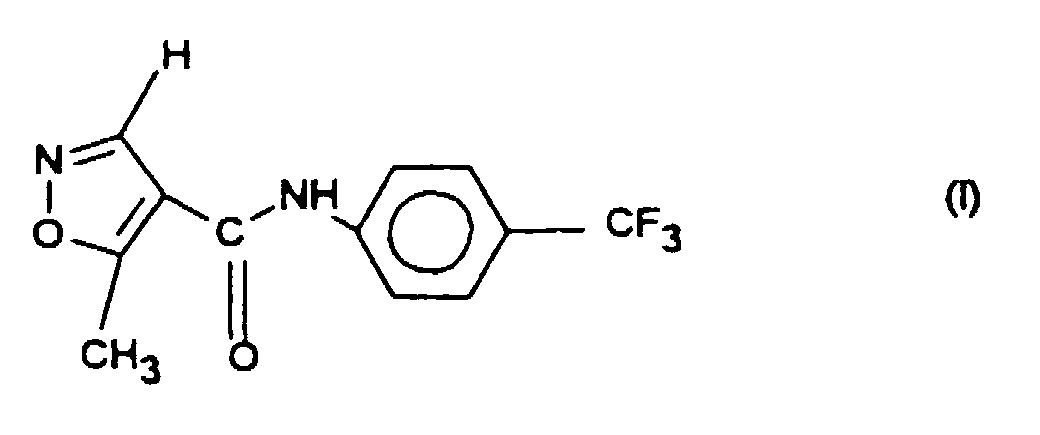
- Linien starker Intensität:
- 10,65; 14,20; 14,80; 16,10; 21,70; 23,15; 24,40; 24, 85; 25,50; 25,85; 26,90; 29,85
- Linien mittlerer Intensität:
- 7,40; 9,80; 13,10; 15,45; 16,80; 20,70; 21,45; 22,80; 23,85; 27,25; 28,95
- Lines of intense intensity:
- 10.65; 14.20; 14.80; 16.10; 21.70; 23.15; 24.40; 24, 85; 25.50; 25.85; 26.90; 29.85
- Medium intensity lines:
- 7.40; 9.80; 13.10; 15.45; 16.80; 20.70; 21.45; 22.80; 23.85; 27.25; 28.95
Das mit Cu-Kα1-Strahlung aufgenommene Röntgenbeugungsdiagramm der
Modifikation 2 ist in Figur 1 dargestellt. Zur Aufnahme des Diagramms wurden das
Zweikreisdiffraktometer STADI P der Firma Stoe (Darmstadt, Deutschland) oder das
rechnergestützte Einkristalldiffraktometer R3 m/V der Firma Siemens (eingesetzte
Strahlung Mo Kα) verwendet The X-ray diffraction diagram of
Das Infrarot-Spektrum der Modifikation 2 der Verbindung der Formel I(1 mg in
300 mg KBr) aufgenommen mit einem Infrarot-Spektrophotometer zeigt die
folgenden Hauptbanden (Einheit cm-1):
Die angegebenen Wellenzahlen sind in ansteigender Intensität angeordnet.
Das Infrarot-Spektrum der Modifikation 2 der Verbindung der Formel I gemäß
Beispiel 1 ist ferner in Figur 3 dargestellt, wobei in der Ordinate die Transmission in
% und auf der Abszisse die Wellenzahl in cm -1 angegeben wurde.The specified wave numbers are arranged in increasing intensity. The infrared spectrum of
Die Verbindung der Formel I kristallisiert in der Modifikation 2 in der Raumgruppe
P21/c mit 8 Molekülen in der Elementarzelle. Die Moleküle der Verbindung der
Formel I liegen als Dimere vor, die aus den Einzelmolekülen durch Bildung einer
-C=O...HN-Wasserstoffbrückenbindung (2,938 Å) hervorgehen, wobei die zwei
Molekülebenen praktisch senkrecht zueinander stehen (91,2°). Die beiden Moleküle
haben eine stark unterschiedliche Konformation. Die Winkel der Fünf- und
Sechsringe mit der zentralen Carbonylgruppe betragen 5,4 ° und 2,1 °
beziehungsweise 23,4 ° und 23,1°. Die letztere Verdrillung schafft die sterische
Voraussetzungen dafür, daß die Wasserstoffbrückenbindung zwischen den beiden
Molekülen möglich wird. The compound of formula I crystallizes in
Die Verbindung der Formel I ist an sich bekannt und wird auch als Leflunomid (HWA 486) bezeichnet. Sie kann auf die in US 4,284,786 beschriebene Weise erhalten werden. Die durch Umkristallisation aus beispielsweise Toluol hergestellten Kristalle fallen jedoch in der Kristallmodifikation 1 an. Das Röntgenbeugungsdiagramm (Cu-Kα1Strahlung) der Modifikation 1 ist in Figur 2 wiedergegeben und weist charakteristische Linien bei folgenden Beugungswinkeln 2 Theta (°) auf:
- Linien starker Intensität:
- 16,70; 18,90; 23,00; 23,65; 29,05
- Linien mittlerer Intensität:
- 8,35; 12,65; 15,00; 15,30; 18,35; 21,25; 22,15; 24,10; 24,65; 25,45; 26,65; 27,40; 28,00; 28,30
- Lines of intense intensity:
- 16.70; 18.90; 23.00; 23.65; 29.05
- Medium intensity lines:
- 8.35; 12.65; 15.00; 15.30; 18.35; 21.25; 22.15; 24.10; 24.65; 25.45; 26.65; 27.40; 28.00; 28.30
Die Verbindung der Formel I kristallisiert in der Modifikation 1 in der Raumgruppe
P21/c mit 4 Molekülen in der Elementarzelle. Das Molekül ist im wesentlichen planar.
Der Winkel zwischen den planaren Atomgruppen ist kleiner als 2,4°. Die Moleküle
sind im Kristall in Stapeln angeordnet Die Moleküle liegen in Stapeln
nebeneinander und sind in einer antiparallelen Art angeordnet. Sehr schwache
Wasserstoffbrückenbindungen verbinden die Dimere im Kristallverband (NH ... N:
3,1444 Å). Die C=O-Gruppe ist an keiner Wasserstoffbrückenbindung beteiligt.The compound of formula I crystallizes in
Die Röntgenbeugungsdiagramme erlauben ferner die Bestimmung der Menge der
Modifikation 2 in einer Mischung, enthaltend beide Modifikationen. Zur quantitativen
Bestimmung eignet sich die Linie bei 8,35° 2 Theta der Modifikation 1 und die Linie
bei 16,1° 2 Theta der Modifikation 2. Bildet man das Verhältnis der Peakhöhen und
korreliert man es mit dem Gehalt an der Modifikation so erhält man eine Eichgerade.
Die Nachweisgrenze dieser Methode liegt bei etwa 0,3 % Modifikation 2 in Kristallen
mit Modifikation 1.The X-ray diffraction diagrams also allow the amount of the
Die Modifikation 2 ist im Vergleich zur Modifikation 1 besser wasserlöslich. Bei
37 °C lassen sich 38 mg/l der Modifikation 2 lösen, während von Modifikation 1
25 mg/l in Lösung gehen. Femer ist die Modifikation 2 in dem Temperatürbereich
von -15 °C bis +40 °C, bevorzugt von 20 °C bis 40 °C, stabil und wird nicht in
Modifikation 1 umgewandelt
Die erfindungsgemäße Modifikation 2 der Verbindung der Formel I erhält man
beispielsweise durch Erwärmen einer Suspension der Kristalle der Modifikation 1
oder Mischungen der Modifikationen 1 und 2 der Verbindung der Formel I in einem
Lösungsmittel auf eine Temperatur von etwa 10 °C bis 40 °C, bevorzugt 15 °C bis
30 °C, insbesondere von 20 °C bis 25 °C. Die Herstellgeschwindigkeit ist im
wesentlichen von der Temperatur abhängig. Vorteilhaft sind Lösemittel, in denen
sich die Verbindung der Formel I schlecht löst. Beispielsweise kann Wasser
verwendet werden oder wäßrige Lösungen mit (C1-C4)-Alkoholen, z.B. Methanol,
Ethanol, Propanol, Isopropanol, Butanol oder Isobutanol und/oder mit Ketonen wie
Aceton oder Methylethylketon . In der Regel erfolgt das Erwärmen in wäßriger
Suspension, zweckmäßigerweise unter Rühren oder Schütteln. Die
Temperaturbehandlung erfolgt so lange, bis die Modifikation 1 vollständig in die
Modifikation 2 überführt istThe
Die vollständige Überführung der Modifikation 1 in die Modifikation 2 ist von der
Temperatur abhängig und dauert in der Regel bei einer Temperatur von 20 °C von
36 Stunden bis 65 Stunden, bevorzugt von 48 Stunden bis 60 Stunden. Die
Kontrolle der Reaktion erfolgt röntgenographisch oder IR-spektroskopisch mittels
während der Behandlung entnommener Proben.The complete conversion of
Ein weiteres Verfahren zur Herstellung der Modifikation 2 der Verbindung der
Formel I besteht darin, die Modifikation 1 oder Mischungen der Modifikationen 1 und
2 in einem Lösungsmittel zu lösen und dann schockartig auf Temperaturen von etwa
-5 °C bis -25 °C abzukühlen. Als Lösungsmittel geeignet sind beispielsweise mit
Wasser mischbare Lösungsmittel wie (C1-C4)-Alkohole, aber auch Ketone wie
Aceton oder Methylethylketon oder andere Lösungsmittel wie Ethylacetat, Toluol
oder Dichlormethan. Der Lösungsvorgang erfolgt bei Raumtemperatur von 20 °C bis
25 °C oder auch erhöhten Temperaturen bis zum Siedepunkt des Lösemittels unter
Normaldruck oder unter erhöhten oder verminderten Druck. Die erhaltene Lösung
wird gegebenenfalls filtriert um ungelöste Bestandteile oder Kristalle von Leflunomid
abzutrennen. Danach wird die filtrierte Lösung so schnell abgekühlt, daß sich nur
Kristalle der Modifikation 2 bilden. Ein ausreichendes Abkühlverfahren besteht
beispielsweise darin, daß die filtrierte Lösung in ein Gefäß, das auf -15 °C gekühlt
ist, eingebracht wird, oder durch Versprühen der filtrierten Lösung in einen auf -10
°C gekühlten Raum, oder Abkühlung der Lösung unter Vakuumkondensationsbedingungen.
Ein bevorzugtes Verfahren besteht darin die Verbindung der Formel I
in Methanol einzubringen und den Lösungsvorgang bei Siedetemperatur von
Methanol unter Normaldruck oder verminderten Druck durchzuführen; anschließend
die heiße Lösung zu filtrieren und die filtrierte Lösung so langsam in ein Gefäß, das
auf -15 °C gekühlt ist, zu überführen, daß die Temperatur der erhaltenen
Kristallsuspension auf nicht mehr als -10 °C steigt Die ausgefallenen Kristalle
werden dann mehrfach mit Methanol gewaschen und unter verminderten Druck
getrocknet Die Kristallisation kann ohne Animpfen mit Kristallen der Modifikation 2
erfolgen oder bevorzugt durch Animpfen mit Kristallen der Modifikation 2. Das
Animpfen erfolgt im abgekühlten Gefäß. Die Menge des Animpfmaterials hängt von
der Menge der Lösung ab und kann von einem Fachmann leicht ermittelt werden.
Die obengenannten Verfahren eignen sich auch zur Umwandlung von Mischungen,
enthaltend Modifikation 1 und 2, in eine im wesentlichen reine Modifikation 2 der
Verbindung der Formel I. Another method for producing
Die erfindungsgemäße Modifikation 2 der Verbindung der Formel I eignet sich beispielsweise zur Behandlung von
- akuten immunologischen Ereignissen wie Sepsis, Allergie, Graft-versus-Host- und Host-versus-Graft-Reaktionen
- Autoimmunerkrankungen, insbesondere rheumatoide Arthritis, systemischem Lupus erythematodes, multipler Sklerose
- Psoriasis, atopischer Dermatitis, Asthma, Urtikaria, Rhinitis, Uveitis
- Typ II-Diabetes
- Leberfibrose, zystischer Fibrose, Kolitis
- Krebserkrankungen wie Lungenkrebs, Leukämie, Eierstockkrebs, Sarkome, Kaposi's Sarkom, Meningiom, Darmkrebs, Lymphknotenkrebs, Himtumore, Brustkrebs, Pankreaskrebs, Prostatakrebs oder Hautkrebs.
- acute immunological events such as sepsis, allergy, graft-versus-host and host-versus-graft reactions
- Autoimmune diseases, especially rheumatoid arthritis, systemic lupus erythematosus, multiple sclerosis
- Psoriasis, atopic dermatitis, asthma, urticaria, rhinitis, uveitis
- Type II diabetes
- Liver fibrosis, cystic fibrosis, colitis
- Cancers such as lung cancer, leukemia, ovarian cancer, sarcomas, Kaposi's sarcoma, meningioma, colon cancer, lymph node cancer, him tumor, breast cancer, pancreatic cancer, prostate cancer or skin cancer.
Die Erfindung betrifft auch Arzneimittel, gekennzeichnet durch einen wirksamen
Gehalt an der Modifikation 2 der Verbindung der Formel I, zusammen mit einem
pharmazeutisch geeigneten und physiologisch verträglichen Trägerstoff, Zusatzstoff
und/oder Wirk- und Hilfsstoffen.The invention also relates to medicinal products characterized by an effective one
Content of
Die erfindungsgemäßen Arzneimittel, gekennzeichnet durch einen wirksamen
Gehalt an der Modifikation 2 der Verbindung der Formel I, zeigen die gleiche
Wirksamkeit an Menschen, die an rheumatischer Arthritis leiden, im Vergleich mit
der Behandlung mit einem Arzneimittel, gekennzeichnet durch einen wirksamen
Gehalt an der Modifikation 1 der Verbindung der Formel I. The pharmaceuticals according to the invention, characterized by an effective
Content of
Die Erfindung betrifft ferner ein Verfahren zur Herstellung des Arzneimittels, das
dadurch gekennzeichnet ist, daß man die Modifikation 2 der Verbindung der
Formel I und einen pharmazeutischen Träger zu einer pharmazeutischen
Darreichungsform verarbeitet.The invention further relates to a method for producing the medicament, the
characterized in that
Das erfindungsgemäße Arzneimittel kann als Dosiereinheit in Form von
Arzneiformen wie Kapseln (einschließlich Mikrokapseln), Tabletten (einschließlich
Dragees und Pillen) oder Zäpfchen vorliegen, wobei bei Verwendung von Kapseln
das Kapselmaterial die Funktion des Trägers wahrnehmen und der Inhalt z.B. als
Pulver, Gel, Emulsion, Dispersion oder Suspension vorliegen kann. Besonders
vorteilhaft und einfach ist es jedoch, orale (perorale) Formulierungen mit der
Modifikation 2 der Verbindung der Formel I herzustellen, die die berechneten
Menge des Wirkstoffs zusammen mit einem pharmazeutischen Träger enthalten.
Auch eine entsprechende Formulierung (Zäpfchen) für die rektale Therapie kann
angewandt werden. Ebenso ist die transdermale Applikation in Form von Salben,
Cremes oder orale Applikation von Tabletten oder Suspensionen, die die
erfindungsgemäße Zubereitung enthalten, möglich.The medicament according to the invention can be in the form of a dosage unit
Dosage forms such as capsules (including microcapsules), tablets (including
Dragees and pills) or suppositories are present, with the use of capsules
the capsule material performs the function of the carrier and the content e.g. as
Powder, gel, emulsion, dispersion or suspension can be present. Especially
However, it is advantageous and simple to use oral (peroral) formulations with the
To produce
Salben, Pasten, Cremes und Puder können neben den Wirkstoffen die üblichen Trägerstoffe enthalten, z.B. tierische und pflanzliche Fette, Wachse, Paraffine, Stärke, Traganth, Zellulosederivate, Polyethylenglykole, Silicone, Bentonite, Talkum, Zinkoxid, Milchzucker, Kieselsäure, Aluminiumhydroxid, Kalziumsilikat und Polyamidpulver oder Gemische dieser Stoffe.In addition to the active ingredients, ointments, pastes, creams and powders can be the usual ones Contain carriers, e.g. animal and vegetable fats, waxes, paraffins, Starch, tragacanth, cellulose derivatives, polyethylene glycols, silicones, bentonites, Talc, zinc oxide, milk sugar, silica, aluminum hydroxide, calcium silicate and Polyamide powder or mixtures of these substances.
Die Tabletten, Pillen oder Granulatkörper können nach üblichen Verfahren wie Preß-, Tauch- oder Wirbelbettverfahren oder Kesseldragierung hergestellt werden und enthalten Trägermittel und andere übliche Hilfsstoffe wie Gelatine, Agarose, Stärke (z.B. Kartoffel-, Mais- oder Weizenstärke), Cellulose wie Ethylcellulose, Siliziumdioxid, verschiedene Zucker wie Milchzucker, Magnesiumcarbonat und/oder Kalziumphosphate. Die Dragierlösung besteht gewöhnlich aus Zucker und/oder Stärkesirup und enthält meistens noch Gelatine, Gummi arabicum, Polyvinylpyrrolidon, synthetische Celluloseester, oberflächenaktive Substanzen, Weichmacher, Pigmente und ähnliche Zusätze entsprechend dem Stand der Technik. Zur Herstellung der Zubereitungen kann jedes übliche Fließregulierungs-, Schmier- oder Gleitmittel wie Magnesiumstearat und Trennmittel verwendet werden.The tablets, pills or granules can be prepared using conventional methods such as Pressing, dipping or fluidized bed processes or boiler coating are produced and contain carriers and other common additives such as gelatin, agarose, Starch (e.g. potato, corn or wheat starch), cellulose such as ethyl cellulose, Silicon dioxide, various sugars such as milk sugar, magnesium carbonate and / or Calcium phosphates. The coating solution usually consists of sugar and / or Corn syrup and mostly still contains gelatin, gum arabic, Polyvinyl pyrrolidone, synthetic cellulose esters, surface-active substances, Plasticizers, pigments and similar additives according to the state of the Technology. For the preparation of the preparations, any customary flow regulation, Lubricants or lubricants such as magnesium stearate and release agents can be used.
Die anzuwendende Dosierung ist selbstverständlich abhängig von verschiedenen Faktoren wie dem zu behandelnden Lebewesen (d.h. Mensch oder Tier), Alter, Gewicht, allgemeiner Gesundheitszustand, dem Schweregrad der Symptome, der zu behandelnden Erkrankung, der Art der begleitenden Behandlung mit anderen Arzneimitteln, oder der Häufigkeit der Behandlung. Die Dosierungen werden im allgemeinen mehrfach pro Tag und vorzugsweise einmal bis dreimal pro Tag verabreicht.The dosage to be used is of course dependent on different ones Factors such as the living being to be treated (i.e. human or animal), age, Weight, general health, the severity of symptoms, the treating disease, the type of concomitant treatment with others Medicines, or the frequency of treatment. The dosages are in generally several times a day and preferably once to three times a day administered.
Die geeignete Therapie besteht somit z.B. in der Verabreichung von einer, zwei
oder 3 Einzeldosierungen einer Zubereitung bestehend aus N-(4-Trifluormethylphenyl)-5-methyl-isoxazol-4-carboxamid
in der Modifikation 2 in einer Menge
von 2 bis 150 mg, bevorzugt 10 bis 100 mg, insbesondere 10 bis 50 mg.The appropriate therapy is e.g. in the administration of one, two
or 3 individual doses of a preparation consisting of N- (4-trifluoromethylphenyl) -5-methyl-isoxazole-4-carboxamide
in
Die Menge der Wirkkomponenten hängt naturgemäß von der Zahl der Einzeldosierungen und auch von der zu behandelnden Krankheit ab. Die Einzeldosierung kann auch aus mehreren, gleichzeitig verabreichten Dosiereinheiten bestehen.The amount of active components naturally depends on the number of Individual doses and also depending on the illness to be treated. The Single dose can also consist of several, administered simultaneously Dosing units exist.
Etwa 40 mg der Verbindung der Formel I hergestellt gemäß US 4,284,786 wurden mit 40 ml Wasser in Flaschen (Volumen 45 ml) geschüttelt. Das Schütteln der verschlossenen Flaschen erfolgte bei 15 - 25 °C im Wasserbad. Nach 48 Stunden wurde eine Probe entnommen, gefiltert, getrocknet und ein Pulver-Röntgen-Beugungsdiagramm angefertigt. Die Messung erfolgte mit dem Zweikreisdiffraktometer STADI P der Firma Stoe (Darmstadt, Deutschland) mit Cu-Kα1-Strahlung im Debye-Scherrer Strahlengang und Transmission. About 40 mg of the compound of the formula I prepared in accordance with US 4,284,786 were shaken with 40 ml of water in bottles (volume 45 ml). The sealed bottles were shaken at 15-25 ° C in a water bath. After 48 hours, a sample was taken, filtered, dried and a powder X-ray diffraction pattern was made. The measurement was carried out using the STADI P dual-circuit diffractometer from Stoe (Darmstadt, Germany) with Cu-K α1 radiation in the Debye-Scherrer beam path and transmission.
Fig. 1 zeigt das erhaltene Röntgenbeugungsdiagramm und ist typische für die
Modifikation 2 der Verbindung der Formel I.Fig. 1 shows the X-ray diffraction pattern obtained and is typical of the
Proben der Modifikation 2 wurden wie in Beispiel 1 hergestellt und bei
verschiedenen Temperaturen und Luftfeuchtigkeit gelagert Nach den genannten
Zeiten wurden Proben entnommen und ein Röntgenbeugungsdiagramm wurde wie
in Beispiel 1 angefertigt. Tabelle 1 zeigt die Ergebnisse.
Wasserfeuchtes Leflunomid, wird roh zunächst in Isopropanol/Wasser gelöst (entsprechend 16 kg Leflunomid, roh, trocken, in 28 l Isopropanol plus die Menge Wasser, die zusammen mit dem Wassergehalt des feuchten Produktes eine Gesamt-Wassermenge von 9 l ergibt).Water-moist leflunomide is first dissolved in raw isopropanol / water (corresponding to 16 kg leflunomide, raw, dry, in 28 l isopropanol plus the amount Water, which together with the water content of the moist product Total water volume of 9 l results).
Anschließend wird auf 78°C bis 82°C erwärmt, 25 Minuten (min) bei dieser Temperatur gerührt und dann über einen Drucktrichter in einen ebenfalls schon auf gleiche Temperatur geheizten Kessel filtriert. Der Drucktrichter wird mit der Menge Isopropanol nachgespült, die zusammen mit eingesetztem Isopropanol (iPrOH) ein Verhältnis von iPrOH/Wasser von 4:1 ergeben (hier 4 l). Danach wird ebenfalls auf 78°C bis 82°C vorgeheiztes Wasser zugesetzt (32 l, ergibt iPrOH/Wasser = 0,8:1). Dabei trübt sich die Lösung bereits, die dann in 20 min auf etwa 65°C gekühlt, etwa 40 min bei dieser Temperatur gehalten, danach in 70 min auf etwa 40°C gekühlt und noch 20 min nachgerührt wird. Das Produkt wird durch Zentrifugation isoliert.The mixture is then heated to 78 ° C to 82 ° C, 25 minutes (min) at this Temperature stirred and then already in a pressure funnel into one same temperature heated kettle filtered. The print hopper will match the quantity Rinsed isopropanol, which together with inserted isopropanol (iPrOH) IPrOH / water ratio of 4: 1 (here 4 l). After that, too Added preheated water at 78 ° C to 82 ° C (32 l, gives iPrOH / water = 0.8: 1). The solution becomes cloudy, which then cools to about 65 ° C in about 20 minutes Maintained at this temperature for 40 min, then cooled to about 40 ° C. in 70 min and is stirred for a further 20 min. The product is isolated by centrifugation.
Tabelle 1 zeigt die Ergebnisse von 4 Ansätzen.
Claims (9)
- A Modification 2 of the compound of the formula Iwhich, in the transmission X-ray diffraction pattern obtained with a focusing Debye-Scherrer beam and Cu-Kα1-radiation, has lines at the following diffraction angles 2 theta (°):

- Lines of strong intensity:
- 10.65; 14.20; 14.80; 16.10; 21.70; 23.15; 24.40; 24.85; 25.50; 25.85; 26.90; 29.85
- Lines of medium intensity:
- 7.40; 9.80; 13.10; 15.45; 16.80; 20.70; 21.45; 22.80; 23.85; 27.25; 28.95.
- A process for the preparation of Modification 2 of the compound of the formula I as claimed in claim 1, wherein a solution containing the compound of the formula I which is not present in Modification 2 or mixtures of Modifications 1 and 2 is cooled abruptly to a temperature of less than -5°C to -25°C.
- The process for the preparation of Modification 2 of the compound of the formula I as claimed in claim 1, wherein a suspension containing the compound of the formula I which is not present in Modification 2 or mixtures of Modifications 1 and 2 is heated to a temperature of from 10°C to 40°C.
- The process as claimed in claim 3, wherein an aqueous suspension is heated.
- The process as claimed in claim 2, wherein the solvents used are water-miscible solvents, such as (C1-C4)alcohols, e.g. methanol, ethanol, propanol, isopropanol, butanol or isobutanol, in particular isopropanol, as well as ketones, such as acetone or methyl ethyl ketone, or mixtures of the solvents with water or water-immiscible solvents, such as ethyl acetate, toluene or dichloromethane.
- The process as claimed in claims 2 and 5, wherein an aqueous mixture containing from about 40 % to 90 % of isopropanol is used.
- The process as claimed in claims 2, 5 and 6, wherein the crystallization is carried out in the presence of crystals of Modification 2 of the compound of the formula I.
- A drug containing Modification 2 of the compound of the formula I as claimed in claim 1 and a physiologically acceptable excipient.
- The use of Modification 2 of the compound of the formula I as claimed in claim 1 for the preparation of a drug for the treatment of acute immunological episodes, such as sepsis, allergies, graft-versus-host- and host-versus-graft-reactions, autoimmune diseases, in particular rheumatoid arthritis, systemic lupus erythematosus, multiple sclerosis, psoriasis, atopic dermatitis, asthma, urticaria, rhinitis, uveitis, type II diabetes, liver fibrosis, cystic fibrosis, colitis, cancers, such as lung cancer, leukemia, ovarian cancer, sarcomas, Kaposi's sarcoma, meningioma, intestinal cancer, lymphatic cancer, brain tumors, breast cancer, pancreatic cancer, prostate cancer or skin cancer.
Priority Applications (1)
| Application Number | Priority Date | Filing Date | Title |
|---|---|---|---|
| EP99117098A EP0987256B1 (en) | 1997-08-08 | 1998-07-31 | Crystal form of N-(4-trifluoromethylphenyl)-5-methylisoxazole-4-carboxamid |
Applications Claiming Priority (4)
| Application Number | Priority Date | Filing Date | Title |
|---|---|---|---|
| DE19734438 | 1997-08-08 | ||
| DE19734438A DE19734438A1 (en) | 1997-08-08 | 1997-08-08 | New crystal modification 2 of leflunomid has better water solubility than modification 1 and is stable over wide temperature range |
| DE19756093 | 1997-12-17 | ||
| DE1997156093 DE19756093A1 (en) | 1997-12-17 | 1997-12-17 | New crystal modification 2 of leflunomid |
Related Child Applications (1)
| Application Number | Title | Priority Date | Filing Date |
|---|---|---|---|
| EP99117098A Division EP0987256B1 (en) | 1997-08-08 | 1998-07-31 | Crystal form of N-(4-trifluoromethylphenyl)-5-methylisoxazole-4-carboxamid |
Publications (2)
| Publication Number | Publication Date |
|---|---|
| EP0903345A1 EP0903345A1 (en) | 1999-03-24 |
| EP0903345B1 true EP0903345B1 (en) | 2000-10-04 |
Family
ID=26038983
Family Applications (2)
| Application Number | Title | Priority Date | Filing Date |
|---|---|---|---|
| EP98114373A Expired - Lifetime EP0903345B1 (en) | 1997-08-08 | 1998-07-31 | Crystal form of N-(4-trifluoromethylphenyl)-5-methylisoxazole-4-carboxamid |
| EP99117098A Expired - Lifetime EP0987256B1 (en) | 1997-08-08 | 1998-07-31 | Crystal form of N-(4-trifluoromethylphenyl)-5-methylisoxazole-4-carboxamid |
Family Applications After (1)
| Application Number | Title | Priority Date | Filing Date |
|---|---|---|---|
| EP99117098A Expired - Lifetime EP0987256B1 (en) | 1997-08-08 | 1998-07-31 | Crystal form of N-(4-trifluoromethylphenyl)-5-methylisoxazole-4-carboxamid |
Country Status (28)
| Country | Link |
|---|---|
| US (5) | US6060494A (en) |
| EP (2) | EP0903345B1 (en) |
| JP (2) | JPH11124372A (en) |
| KR (2) | KR100544041B1 (en) |
| CN (2) | CN1089759C (en) |
| AR (1) | AR015418A1 (en) |
| AT (2) | ATE207065T1 (en) |
| AU (1) | AU752764B2 (en) |
| BR (1) | BR9806568A (en) |
| CA (1) | CA2245267C (en) |
| CZ (3) | CZ301426B6 (en) |
| DE (2) | DE59800287D1 (en) |
| DK (2) | DK0987256T3 (en) |
| ES (2) | ES2150808T3 (en) |
| GR (1) | GR3034814T3 (en) |
| HK (1) | HK1049481B (en) |
| HU (2) | HU229232B1 (en) |
| ID (1) | ID20667A (en) |
| IL (1) | IL125671A (en) |
| NO (1) | NO310871B1 (en) |
| NZ (1) | NZ331270A (en) |
| PL (1) | PL192126B1 (en) |
| PT (2) | PT903345E (en) |
| RU (1) | RU2224753C2 (en) |
| SK (2) | SK282641B6 (en) |
| TR (2) | TR199801513A2 (en) |
| TW (1) | TW593288B (en) |
| UA (1) | UA54411C2 (en) |
Families Citing this family (21)
| Publication number | Priority date | Publication date | Assignee | Title |
|---|---|---|---|---|
| DK0987256T3 (en) * | 1997-08-08 | 2002-02-11 | Aventis Pharma Gmbh | Crystal form of N- (4-trifluoromethylphenyl) -5-methylisoxazole-4-carboxylic acid amide |
| DE19908527C2 (en) | 1999-02-26 | 2001-08-30 | Aventis Pharma Gmbh | Process for the crystallization of N- (4-trifluoromethylphenyl) -5-methyl-isoxazole-4-carboxamide |
| US6610718B2 (en) | 1999-12-16 | 2003-08-26 | Teva Pharmaceutical Industries Ltd. | Processes for making- and a new crystalline form of- leflunomide |
| HRP20020671A2 (en) * | 2000-02-15 | 2004-12-31 | Teva Pharma | A method for synthesizing leflunomide |
| US7022725B2 (en) | 2000-11-17 | 2006-04-04 | Takeda Pharmaceutical Company Limited | Isoxazole derivatives |
| GB0123571D0 (en) | 2001-04-05 | 2001-11-21 | Aventis Pharm Prod Inc | Use of (Z)-2-cyano-3-hydroxy-but-2-enoic acid-(4'-trifluoromethylphenyl)-amide for treating multiple sclerosis |
| US7429593B2 (en) | 2001-09-14 | 2008-09-30 | Shionogi & Co., Ltd. | Utilities of amide compounds |
| US20050158371A1 (en) * | 2002-02-12 | 2005-07-21 | Sumitomo Pharmaceuticals Co., Ltd. | Novel external agent |
| JPWO2003068239A1 (en) * | 2002-02-12 | 2005-06-02 | 住友製薬株式会社 | New topical agent |
| US20060135547A1 (en) * | 2003-03-12 | 2006-06-22 | Toth Zoltan G | Stable pharmaceutical compositions of desloratadine and processes for preparation of polymorphic forms of desloratadine |
| US20040242619A1 (en) * | 2003-03-12 | 2004-12-02 | Toth Zoltan G. | Processes for preparation of polymorphic forms of desloratadine |
| JP4223428B2 (en) * | 2004-03-31 | 2009-02-12 | 富士通メディアデバイス株式会社 | Filter and manufacturing method thereof |
| WO2007067710A1 (en) * | 2005-12-08 | 2007-06-14 | Amphora Discovery Corporation | Certain chemical entities, compositions, and methods for modulating trpv1 |
| CN101143834B (en) * | 2006-09-15 | 2010-09-08 | 欣凯医药化工中间体(上海)有限公司 | Polymorphism for N-(4-trifluoromethylphenyl)-2-cyano-3-hydroxycrotonamide sodium salt and preparation method thereof |
| AU2009224247B2 (en) * | 2008-03-10 | 2013-12-12 | Takeda Pharmaceutical Company Limited | Crystal of benzimidazole compound |
| JP2013505213A (en) | 2009-09-18 | 2013-02-14 | サノフイ | (Z) -2-Cyano-3-hydroxy-but-2-enoic acid- (4'-trifluoromethylphenyl) -amide tablet formulation with improved stability |
| CN103977594B (en) * | 2014-06-03 | 2016-02-17 | 江苏九九久科技股份有限公司 | A kind of method for crystallising |
| US9895370B2 (en) * | 2015-11-19 | 2018-02-20 | Pharmedix.Co., Ltd | Pharmaceutical composition for preventing or treating of cirrhosis of liver comprising G protein coupled receptor 119 ligand as an active ingredient |
| CN109180599A (en) * | 2018-09-03 | 2019-01-11 | 深圳市新阳唯康科技有限公司 | A kind of leflunomide crystal compound and preparation method thereof |
| CN112898215B (en) * | 2021-02-04 | 2022-11-08 | 美罗药业股份有限公司 | Preparation method of leflunomide crystal form I |
| CN114716388B (en) * | 2021-11-04 | 2024-02-13 | 江苏冠军科技集团股份有限公司 | A kind of sulfonamide-silver compound and preparation method thereof |
Family Cites Families (29)
| Publication number | Priority date | Publication date | Assignee | Title |
|---|---|---|---|---|
| ES448386A1 (en) * | 1975-06-05 | 1978-04-16 | Hoechst Ag | 5-Methyl-isoxazole-4-carboxylic acid anilides |
| NL186239B (en) * | 1975-06-05 | Hoechst Ag | PROCESS FOR THE PREPARATION OF A MEDICINAL PRODUCT WITH ANTIFLOGISTICAL AND / OR ANALGETICAL ACTION AND PROCEDURE FOR THE PREPARATION OF A 2-HYDROXYETHYLIDE ENCYANAACETIC ANILIDE SUITABLE FOR USE IN THIS PROCESS. | |
| DE2524959C2 (en) * | 1975-06-05 | 1983-02-10 | Hoechst Ag, 6000 Frankfurt | 5-methyl-isoxazole-4-carboxylic acid anilides, process for their preparation, agents containing these compounds |
| DE2525959A1 (en) * | 1975-06-11 | 1977-02-10 | Focke Pfuhl Verpack Automat | PACKAGING FOR CIGARETTES, CIGARILLOS ETC. |
| DE2854439A1 (en) * | 1978-12-16 | 1980-07-03 | Hoechst Ag | AN ISOXAZOLE DERIVATIVE, METHOD FOR THE PRODUCTION THEREOF, AGENT AND USE THEREOF |
| IL63968A (en) * | 1980-10-01 | 1985-10-31 | Glaxo Group Ltd | Form 2 ranitidine hydrochloride,its preparation and pharmaceutical compositions containing it |
| US4935434A (en) * | 1988-01-26 | 1990-06-19 | Bristol-Myers Company | Antiarthritic isoxazole-4-carboxamides |
| US5583150A (en) * | 1989-08-18 | 1996-12-10 | Alcon Laboratories, Inc. | 5-methyl-isoxazole-4-carboxylic acid anilides and 2-hydroxyethylidene-cyano acetic anilides for the treatment of ocular diseases |
| ES2102367T3 (en) * | 1990-05-18 | 1997-08-01 | Hoechst Ag | AMIDAS OF ISOXAZOL-4-CARBOXILIC ACIDS AND AMIDAS OF HIDROXIALQUILIDEN-CIANOACETIC ACIDS, MEDICINES CONTAINING THESE COMPOUNDS AND THEIR USE. |
| GB9115377D0 (en) * | 1991-07-17 | 1991-09-04 | Rhone Poulenc Agriculture | New compositions of matter |
| DE4127737A1 (en) * | 1991-08-22 | 1993-02-25 | Hoechst Ag | MEDICINAL PRODUCTS FOR TREATMENT OF REPELLATION REACTIONS IN ORGAN PLANTING |
| GB9209330D0 (en) * | 1992-04-30 | 1992-06-17 | Roussel Lab Ltd | Chemical compounds |
| ES2124801T3 (en) * | 1993-01-08 | 1999-02-16 | Hoechst Ag | USE OF LEFLUNOMIDE FOR THE INHIBITION OF THE ALPHA TUMOR NECROSIS FACTOR. |
| EP0607777B1 (en) * | 1993-01-08 | 1998-12-09 | Hoechst Aktiengesellschaft | Use of leflunomid for the inhibition of interleukin 8 |
| ES2124800T3 (en) * | 1993-01-08 | 1999-02-16 | Hoechst Ag | USE OF LEFLUNOMIDE FOR INTERLEUKIN 1 BETA INHIBITION. |
| TW314467B (en) * | 1993-03-31 | 1997-09-01 | Hoechst Ag | |
| GB9320299D0 (en) * | 1993-10-01 | 1993-11-17 | Roussel Lab Ltd | Isoxazole derivatives |
| US5610173A (en) * | 1994-01-07 | 1997-03-11 | Sugen, Inc. | Formulations for lipophilic compounds |
| KR100365064B1 (en) * | 1994-10-17 | 2003-04-11 | 훽스트파마슈티칼스앤드케미칼스가부시키가이샤 | Prevention and treatment of type I allergic diseases |
| AR001982A1 (en) * | 1995-02-06 | 1998-01-07 | Smithkline Beecham Plc | PAROXETINE CHLORHYDRATE ANHYDRATED, AND PROCEDURE FOR ITS PREPARATION |
| DE19539638A1 (en) * | 1995-10-25 | 1997-04-30 | Hoechst Ag | The use of isoxazole and crotonic acid amide derivatives for the treatment of cancer |
| US6316479B1 (en) * | 1997-05-19 | 2001-11-13 | Sugen, Inc. | Isoxazole-4-carboxamide compounds active against protein tryosine kinase related disorders |
| HRP980291A2 (en) * | 1997-06-16 | 1999-04-30 | Lin-Hua Zhang | Crystalline roxifiban |
| DK0987256T3 (en) * | 1997-08-08 | 2002-02-11 | Aventis Pharma Gmbh | Crystal form of N- (4-trifluoromethylphenyl) -5-methylisoxazole-4-carboxylic acid amide |
| US6096770A (en) * | 1998-08-03 | 2000-08-01 | American Home Products Corporation | Anthranilic acid analogs |
| DE19908527C2 (en) * | 1999-02-26 | 2001-08-30 | Aventis Pharma Gmbh | Process for the crystallization of N- (4-trifluoromethylphenyl) -5-methyl-isoxazole-4-carboxamide |
| US6610718B2 (en) * | 1999-12-16 | 2003-08-26 | Teva Pharmaceutical Industries Ltd. | Processes for making- and a new crystalline form of- leflunomide |
| HRP20020671A2 (en) * | 2000-02-15 | 2004-12-31 | Teva Pharma | A method for synthesizing leflunomide |
| US6727272B1 (en) * | 2002-07-15 | 2004-04-27 | Unitech Pharmaceuticals, Inc. | Leflunomide analogs for treating rheumatoid arthritis |
-
1998
- 1998-07-31 DK DK99117098T patent/DK0987256T3/en active
- 1998-07-31 PT PT98114373T patent/PT903345E/en unknown
- 1998-07-31 PT PT99117098T patent/PT987256E/en unknown
- 1998-07-31 ES ES98114373T patent/ES2150808T3/en not_active Expired - Lifetime
- 1998-07-31 AT AT99117098T patent/ATE207065T1/en active
- 1998-07-31 AT AT98114373T patent/ATE196764T1/en active
- 1998-07-31 ES ES99117098T patent/ES2166205T3/en not_active Expired - Lifetime
- 1998-07-31 DE DE59800287T patent/DE59800287D1/en not_active Expired - Lifetime
- 1998-07-31 DK DK98114373T patent/DK0903345T3/en active
- 1998-07-31 EP EP98114373A patent/EP0903345B1/en not_active Expired - Lifetime
- 1998-07-31 EP EP99117098A patent/EP0987256B1/en not_active Expired - Lifetime
- 1998-07-31 DE DE59801792T patent/DE59801792D1/en not_active Expired - Lifetime
- 1998-08-05 CZ CZ20032983A patent/CZ301426B6/en not_active IP Right Cessation
- 1998-08-05 CZ CZ20032982A patent/CZ301514B6/en not_active IP Right Cessation
- 1998-08-05 IL IL12567198A patent/IL125671A/en not_active IP Right Cessation
- 1998-08-05 CZ CZ19982468A patent/CZ292943B6/en not_active IP Right Cessation
- 1998-08-06 TW TW087112927A patent/TW593288B/en not_active IP Right Cessation
- 1998-08-06 ID IDP981098A patent/ID20667A/en unknown
- 1998-08-06 UA UA98084307A patent/UA54411C2/en unknown
- 1998-08-06 NZ NZ331270A patent/NZ331270A/en not_active IP Right Cessation
- 1998-08-06 US US09/129,783 patent/US6060494A/en not_active Expired - Lifetime
- 1998-08-06 SK SK1058-98A patent/SK282641B6/en not_active IP Right Cessation
- 1998-08-06 AR ARP980103900A patent/AR015418A1/en active IP Right Grant
- 1998-08-06 SK SK1521-2001A patent/SK285216B6/en not_active IP Right Cessation
- 1998-08-06 TR TR1998/01513A patent/TR199801513A2/en unknown
- 1998-08-06 TR TR2006/00582A patent/TR200600582A1/en unknown
- 1998-08-07 NO NO19983632A patent/NO310871B1/en not_active IP Right Cessation
- 1998-08-07 KR KR1019980032110A patent/KR100544041B1/en not_active Expired - Lifetime
- 1998-08-07 BR BR9806568-8A patent/BR9806568A/en not_active Application Discontinuation
- 1998-08-07 AU AU78870/98A patent/AU752764B2/en not_active Expired
- 1998-08-07 RU RU98115390/04A patent/RU2224753C2/en active
- 1998-08-07 PL PL327901A patent/PL192126B1/en unknown
- 1998-08-07 CA CA002245267A patent/CA2245267C/en not_active Expired - Lifetime
- 1998-08-07 HU HU0700190A patent/HU229232B1/en unknown
- 1998-08-07 CN CN98116235A patent/CN1089759C/en not_active Expired - Lifetime
- 1998-08-07 HU HU9801844A patent/HU225870B1/en unknown
- 1998-08-07 JP JP10224015A patent/JPH11124372A/en active Pending
- 1998-08-07 CN CNB021045747A patent/CN1181064C/en not_active Expired - Lifetime
-
1999
- 1999-10-28 US US09/428,499 patent/US6221891B1/en not_active Expired - Lifetime
-
2000
- 2000-11-10 GR GR20000402501T patent/GR3034814T3/en unknown
-
2001
- 2001-01-19 US US09/764,258 patent/US6552202B2/en not_active Expired - Lifetime
-
2002
- 2002-11-25 US US10/302,872 patent/US6900334B2/en not_active Expired - Lifetime
-
2003
- 2003-02-19 HK HK03101247.6A patent/HK1049481B/en not_active IP Right Cessation
-
2004
- 2004-04-23 US US10/830,307 patent/US6995272B2/en not_active Expired - Lifetime
-
2005
- 2005-06-28 KR KR1020050056044A patent/KR100588254B1/en not_active Expired - Lifetime
-
2009
- 2009-07-28 JP JP2009175137A patent/JP2009280604A/en active Pending
Also Published As
Similar Documents
| Publication | Publication Date | Title |
|---|---|---|
| EP0987256A1 (en) | Crystal form of N-(4-trifluoromethylphenyl)-5-methylisoxazole-4-carboxamid | |
| DE69635106T2 (en) | guanine | |
| EP0896537B1 (en) | Preparation containing a combination of 5-methylisoxazole-4-carboxylic acid-(4-trifluoromethyl)-anilide and n-(4-trifluoromethylphenyl)2-cyano-3-hydroxycrotonic acid amide | |
| DD273634A5 (en) | PROCESS FOR PREPARING A CRYSTALLINE MONOHYDRATE OF A 1-CARBACEPHALOSPORIN | |
| DE69811500T2 (en) | CRYSTAL MODIFICATION OF 1- (2,6-DIFLUORBENZYL) -1H-1,2,3-TRIAZOL-4-CARBONIC ACID AMIDE AND ITS USE AS AN ANTI-PILEPTIC | |
| DE69718968T2 (en) | 3- (BIS-SUBSTITUTED-phenylmethylene) oxindole DERIVATIVES | |
| DE69214710T2 (en) | Medicinal product containing dirithromycin | |
| DE69905025T2 (en) | FORM VI, 5,6-DICHLOR-2- (ISOPROPYLAMINO) -1- (BETA-L-RIBOFURANOSYL) -1H-BENZIMIDAZOLE | |
| EP0849266B1 (en) | Novel polymorphic form of doxazosin mesylate (form III) | |
| EP0849264A1 (en) | Novel polymorphic form of doxazosin mesylate (form I) | |
| DE19734438A1 (en) | New crystal modification 2 of leflunomid has better water solubility than modification 1 and is stable over wide temperature range | |
| DE3873210T2 (en) | USE OF BENZYLPYRIDINE DERIVATIVES FOR THE PRODUCTION OF A MEDICINAL PRODUCT FOR THE TREATMENT OF DEMENTIA. | |
| DE602004008919T2 (en) | 4- (4-TRANS-HYDROXYCYCLOHEXYL) AMINO-2-PHENYL-7H-PYRROLOA2,3-DUPRYIDIDE HYDROGENMESYLATE AND ITS POLYMORPHIC FORMS | |
| AT375656B (en) | METHOD FOR PRODUCING NEW 3-AMINO-5 (4-PYRIDYL) -1,2,4-TRIAZOLE BASES AND THEIR SALTS | |
| CA2531948C (en) | Crystal form of n-(4-trifluoromethylphenyl)-5-methylisoxazole-4-carboxamide | |
| DE2140464A1 (en) | Erythromycin urchins, processes for their preparation and medicines containing these compounds | |
| DE69929315T2 (en) | CRYSTALLINE FORMS OF 1S-Ä1ALPHA (2S *, 3R *), 9ALPHA-6,10-DIOXO-N- (2-ETHOXY-5-OXO-TETRAHYDRO-3-FURANYL) -9-AE (1-ISOCHINOLYL) CARBONYLENE AMINOÜOCTAHYDRO-6H-PIRIDAZINOÄ1,2-AÜÄ1,2ÜDIAZEPIN-1-carboxamide | |
| DE1445417A1 (en) | Process for the production of new hexitol esters of nicotinic acid | |
| DE2054124A1 (en) | Compounds inhibiting gastric hydrochloric acid secretion and methods for their preparation | |
| HK1017681B (en) | Crystal from of n-(4-trifluoromethylphenyl)-5-methylisox | |
| DE4102921A1 (en) | NEW INDOL DERIVATIVES, METHOD FOR THE PRODUCTION THEREOF, THEIR USE AS MEDICATIONS AND COMPOSITIONS CONTAINING THE SAME |
Legal Events
| Date | Code | Title | Description |
|---|---|---|---|
| PUAI | Public reference made under article 153(3) epc to a published international application that has entered the european phase |
Free format text: ORIGINAL CODE: 0009012 |
|
| AK | Designated contracting states |
Kind code of ref document: A1 Designated state(s): AT BE CH DE DK ES FI FR GB GR IE IT LI LU NL PT SE |
|
| AX | Request for extension of the european patent |
Free format text: AL;LT;LV;MK;RO;SI |
|
| 17P | Request for examination filed |
Effective date: 19990127 |
|
| 17Q | First examination report despatched |
Effective date: 19990802 |
|
| GRAG | Despatch of communication of intention to grant |
Free format text: ORIGINAL CODE: EPIDOS AGRA |
|
| AKX | Designation fees paid |
Free format text: AT BE CH DE DK ES FI FR GB GR IE IT LI LU NL PT SE |
|
| AXX | Extension fees paid |
Free format text: LT PAYMENT 19990924;LV PAYMENT 19990924;RO PAYMENT 19990924;SI PAYMENT 19990924 |
|
| 17Q | First examination report despatched |
Effective date: 19990802 |
|
| GRAG | Despatch of communication of intention to grant |
Free format text: ORIGINAL CODE: EPIDOS AGRA |
|
| GRAH | Despatch of communication of intention to grant a patent |
Free format text: ORIGINAL CODE: EPIDOS IGRA |
|
| RAP1 | Party data changed (applicant data changed or rights of an application transferred) |
Owner name: AVENTIS PHARMA DEUTSCHLAND GMBH |
|
| GRAH | Despatch of communication of intention to grant a patent |
Free format text: ORIGINAL CODE: EPIDOS IGRA |
|
| GRAA | (expected) grant |
Free format text: ORIGINAL CODE: 0009210 |
|
| AK | Designated contracting states |
Kind code of ref document: B1 Designated state(s): AT BE CH DE DK ES FI FR GB GR IE IT LI LU NL PT SE |
|
| AX | Request for extension of the european patent |
Free format text: LT PAYMENT 19990924;LV PAYMENT 19990924;RO PAYMENT 19990924;SI PAYMENT 19990924 |
|
| LTIE | Lt: invalidation of european patent or patent extension | ||
| REF | Corresponds to: |
Ref document number: 196764 Country of ref document: AT Date of ref document: 20001015 Kind code of ref document: T |
|
| REG | Reference to a national code |
Ref country code: CH Ref legal event code: EP |
|
| REG | Reference to a national code |
Ref country code: DK Ref legal event code: T3 |
|
| REG | Reference to a national code |
Ref country code: IE Ref legal event code: FG4D Free format text: GERMAN |
|
| REF | Corresponds to: |
Ref document number: 59800287 Country of ref document: DE Date of ref document: 20001109 |
|
| ET | Fr: translation filed | ||
| REG | Reference to a national code |
Ref country code: ES Ref legal event code: FG2A Ref document number: 2150808 Country of ref document: ES Kind code of ref document: T3 |
|
| ITF | It: translation for a ep patent filed | ||
| GBT | Gb: translation of ep patent filed (gb section 77(6)(a)/1977) |
Effective date: 20001208 |
|
| REG | Reference to a national code |
Ref country code: PT Ref legal event code: SC4A Free format text: AVAILABILITY OF NATIONAL TRANSLATION Effective date: 20001018 |
|
| PLBE | No opposition filed within time limit |
Free format text: ORIGINAL CODE: 0009261 |
|
| STAA | Information on the status of an ep patent application or granted ep patent |
Free format text: STATUS: NO OPPOSITION FILED WITHIN TIME LIMIT |
|
| 26N | No opposition filed | ||
| REG | Reference to a national code |
Ref country code: GB Ref legal event code: IF02 |
|
| REG | Reference to a national code |
Ref country code: CH Ref legal event code: PFA Owner name: SANOFI-AVENTIS DEUTSCHLAND GMBH Free format text: AVENTIS PHARMA DEUTSCHLAND GMBH#BRUENINGSTRASSE 50#65929 FRANKFURT AM MAIN (DE) -TRANSFER TO- SANOFI-AVENTIS DEUTSCHLAND GMBH##65926 FRANKFURT AM MAIN (DE) |
|
| NLT1 | Nl: modifications of names registered in virtue of documents presented to the patent office pursuant to art. 16 a, paragraph 1 |
Owner name: SANOFI-AVENTIS DEUTSCHLAND GMBH |
|
| REG | Reference to a national code |
Ref country code: FR Ref legal event code: CD |
|
| REG | Reference to a national code |
Ref country code: FR Ref legal event code: PLFP Year of fee payment: 19 |
|
| REG | Reference to a national code |
Ref country code: FR Ref legal event code: PLFP Year of fee payment: 20 |
|
| PGFP | Annual fee paid to national office [announced via postgrant information from national office to epo] |
Ref country code: GR Payment date: 20170613 Year of fee payment: 20 Ref country code: FR Payment date: 20170613 Year of fee payment: 20 |
|
| PGFP | Annual fee paid to national office [announced via postgrant information from national office to epo] |
Ref country code: BE Payment date: 20170613 Year of fee payment: 20 Ref country code: LU Payment date: 20170710 Year of fee payment: 20 |
|
| PGFP | Annual fee paid to national office [announced via postgrant information from national office to epo] |
Ref country code: NL Payment date: 20170712 Year of fee payment: 20 |
|
| PGFP | Annual fee paid to national office [announced via postgrant information from national office to epo] |
Ref country code: CH Payment date: 20170712 Year of fee payment: 20 Ref country code: IT Payment date: 20170720 Year of fee payment: 20 Ref country code: ES Payment date: 20170801 Year of fee payment: 20 Ref country code: GB Payment date: 20170726 Year of fee payment: 20 Ref country code: FI Payment date: 20170710 Year of fee payment: 20 Ref country code: DE Payment date: 20170725 Year of fee payment: 20 |
|
| PGFP | Annual fee paid to national office [announced via postgrant information from national office to epo] |
Ref country code: IE Payment date: 20170710 Year of fee payment: 20 Ref country code: AT Payment date: 20170626 Year of fee payment: 20 Ref country code: PT Payment date: 20170717 Year of fee payment: 20 Ref country code: DK Payment date: 20170711 Year of fee payment: 20 Ref country code: SE Payment date: 20170711 Year of fee payment: 20 |
|
| REG | Reference to a national code |
Ref country code: DE Ref legal event code: R071 Ref document number: 59800287 Country of ref document: DE |
|
| REG | Reference to a national code |
Ref country code: NL Ref legal event code: MK Effective date: 20180730 |
|
| REG | Reference to a national code |
Ref country code: DK Ref legal event code: EUP Effective date: 20180731 |
|
| REG | Reference to a national code |
Ref country code: CH Ref legal event code: PL |
|
| REG | Reference to a national code |
Ref country code: GB Ref legal event code: PE20 Expiry date: 20180730 Ref country code: IE Ref legal event code: MK9A |
|
| REG | Reference to a national code |
Ref country code: AT Ref legal event code: MK07 Ref document number: 196764 Country of ref document: AT Kind code of ref document: T Effective date: 20180731 |
|
| REG | Reference to a national code |
Ref country code: SE Ref legal event code: EUG |
|
| REG | Reference to a national code |
Ref country code: BE Ref legal event code: MK Effective date: 20180731 |
|
| PG25 | Lapsed in a contracting state [announced via postgrant information from national office to epo] |
Ref country code: PT Free format text: LAPSE BECAUSE OF EXPIRATION OF PROTECTION Effective date: 20180808 Ref country code: IE Free format text: LAPSE BECAUSE OF EXPIRATION OF PROTECTION Effective date: 20180731 |
|
| PG25 | Lapsed in a contracting state [announced via postgrant information from national office to epo] |
Ref country code: GB Free format text: LAPSE BECAUSE OF EXPIRATION OF PROTECTION Effective date: 20180730 |
|
| REG | Reference to a national code |
Ref country code: ES Ref legal event code: FD2A Effective date: 20200804 |
|
| PG25 | Lapsed in a contracting state [announced via postgrant information from national office to epo] |
Ref country code: ES Free format text: LAPSE BECAUSE OF EXPIRATION OF PROTECTION Effective date: 20180801 |