EP0903345A1 - Crystal form of N-(4-trifluoromethylphenyl)-5-methylisoxazole-4-carboxamid - Google Patents
Crystal form of N-(4-trifluoromethylphenyl)-5-methylisoxazole-4-carboxamid Download PDFInfo
- Publication number
- EP0903345A1 EP0903345A1 EP98114373A EP98114373A EP0903345A1 EP 0903345 A1 EP0903345 A1 EP 0903345A1 EP 98114373 A EP98114373 A EP 98114373A EP 98114373 A EP98114373 A EP 98114373A EP 0903345 A1 EP0903345 A1 EP 0903345A1
- Authority
- EP
- European Patent Office
- Prior art keywords
- modification
- compound
- formula
- water
- mixtures
- Prior art date
- Legal status (The legal status is an assumption and is not a legal conclusion. Google has not performed a legal analysis and makes no representation as to the accuracy of the status listed.)
- Granted
Links
Images

Classifications
-
- C—CHEMISTRY; METALLURGY
- C07—ORGANIC CHEMISTRY
- C07D—HETEROCYCLIC COMPOUNDS
- C07D261/00—Heterocyclic compounds containing 1,2-oxazole or hydrogenated 1,2-oxazole rings
- C07D261/02—Heterocyclic compounds containing 1,2-oxazole or hydrogenated 1,2-oxazole rings not condensed with other rings
- C07D261/06—Heterocyclic compounds containing 1,2-oxazole or hydrogenated 1,2-oxazole rings not condensed with other rings having two or more double bonds between ring members or between ring members and non-ring members
- C07D261/10—Heterocyclic compounds containing 1,2-oxazole or hydrogenated 1,2-oxazole rings not condensed with other rings having two or more double bonds between ring members or between ring members and non-ring members with hetero atoms or with carbon atoms having three bonds to hetero atoms with at the most one bond to halogen, e.g. ester or nitrile radicals, directly attached to ring carbon atoms
- C07D261/18—Carbon atoms having three bonds to hetero atoms, with at the most one bond to halogen
-
- A—HUMAN NECESSITIES
- A61—MEDICAL OR VETERINARY SCIENCE; HYGIENE
- A61P—SPECIFIC THERAPEUTIC ACTIVITY OF CHEMICAL COMPOUNDS OR MEDICINAL PREPARATIONS
- A61P1/00—Drugs for disorders of the alimentary tract or the digestive system
-
- A—HUMAN NECESSITIES
- A61—MEDICAL OR VETERINARY SCIENCE; HYGIENE
- A61P—SPECIFIC THERAPEUTIC ACTIVITY OF CHEMICAL COMPOUNDS OR MEDICINAL PREPARATIONS
- A61P11/00—Drugs for disorders of the respiratory system
-
- A—HUMAN NECESSITIES
- A61—MEDICAL OR VETERINARY SCIENCE; HYGIENE
- A61P—SPECIFIC THERAPEUTIC ACTIVITY OF CHEMICAL COMPOUNDS OR MEDICINAL PREPARATIONS
- A61P11/00—Drugs for disorders of the respiratory system
- A61P11/06—Antiasthmatics
-
- A—HUMAN NECESSITIES
- A61—MEDICAL OR VETERINARY SCIENCE; HYGIENE
- A61P—SPECIFIC THERAPEUTIC ACTIVITY OF CHEMICAL COMPOUNDS OR MEDICINAL PREPARATIONS
- A61P13/00—Drugs for disorders of the urinary system
- A61P13/02—Drugs for disorders of the urinary system of urine or of the urinary tract, e.g. urine acidifiers
-
- A—HUMAN NECESSITIES
- A61—MEDICAL OR VETERINARY SCIENCE; HYGIENE
- A61P—SPECIFIC THERAPEUTIC ACTIVITY OF CHEMICAL COMPOUNDS OR MEDICINAL PREPARATIONS
- A61P15/00—Drugs for genital or sexual disorders; Contraceptives
-
- A—HUMAN NECESSITIES
- A61—MEDICAL OR VETERINARY SCIENCE; HYGIENE
- A61P—SPECIFIC THERAPEUTIC ACTIVITY OF CHEMICAL COMPOUNDS OR MEDICINAL PREPARATIONS
- A61P17/00—Drugs for dermatological disorders
-
- A—HUMAN NECESSITIES
- A61—MEDICAL OR VETERINARY SCIENCE; HYGIENE
- A61P—SPECIFIC THERAPEUTIC ACTIVITY OF CHEMICAL COMPOUNDS OR MEDICINAL PREPARATIONS
- A61P19/00—Drugs for skeletal disorders
-
- A—HUMAN NECESSITIES
- A61—MEDICAL OR VETERINARY SCIENCE; HYGIENE
- A61P—SPECIFIC THERAPEUTIC ACTIVITY OF CHEMICAL COMPOUNDS OR MEDICINAL PREPARATIONS
- A61P19/00—Drugs for skeletal disorders
- A61P19/02—Drugs for skeletal disorders for joint disorders, e.g. arthritis, arthrosis
-
- A—HUMAN NECESSITIES
- A61—MEDICAL OR VETERINARY SCIENCE; HYGIENE
- A61P—SPECIFIC THERAPEUTIC ACTIVITY OF CHEMICAL COMPOUNDS OR MEDICINAL PREPARATIONS
- A61P25/00—Drugs for disorders of the nervous system
-
- A—HUMAN NECESSITIES
- A61—MEDICAL OR VETERINARY SCIENCE; HYGIENE
- A61P—SPECIFIC THERAPEUTIC ACTIVITY OF CHEMICAL COMPOUNDS OR MEDICINAL PREPARATIONS
- A61P27/00—Drugs for disorders of the senses
- A61P27/02—Ophthalmic agents
-
- A—HUMAN NECESSITIES
- A61—MEDICAL OR VETERINARY SCIENCE; HYGIENE
- A61P—SPECIFIC THERAPEUTIC ACTIVITY OF CHEMICAL COMPOUNDS OR MEDICINAL PREPARATIONS
- A61P27/00—Drugs for disorders of the senses
- A61P27/02—Ophthalmic agents
- A61P27/14—Decongestants or antiallergics
-
- A—HUMAN NECESSITIES
- A61—MEDICAL OR VETERINARY SCIENCE; HYGIENE
- A61P—SPECIFIC THERAPEUTIC ACTIVITY OF CHEMICAL COMPOUNDS OR MEDICINAL PREPARATIONS
- A61P29/00—Non-central analgesic, antipyretic or antiinflammatory agents, e.g. antirheumatic agents; Non-steroidal antiinflammatory drugs [NSAID]
-
- A—HUMAN NECESSITIES
- A61—MEDICAL OR VETERINARY SCIENCE; HYGIENE
- A61P—SPECIFIC THERAPEUTIC ACTIVITY OF CHEMICAL COMPOUNDS OR MEDICINAL PREPARATIONS
- A61P3/00—Drugs for disorders of the metabolism
- A61P3/08—Drugs for disorders of the metabolism for glucose homeostasis
-
- A—HUMAN NECESSITIES
- A61—MEDICAL OR VETERINARY SCIENCE; HYGIENE
- A61P—SPECIFIC THERAPEUTIC ACTIVITY OF CHEMICAL COMPOUNDS OR MEDICINAL PREPARATIONS
- A61P3/00—Drugs for disorders of the metabolism
- A61P3/08—Drugs for disorders of the metabolism for glucose homeostasis
- A61P3/10—Drugs for disorders of the metabolism for glucose homeostasis for hyperglycaemia, e.g. antidiabetics
-
- A—HUMAN NECESSITIES
- A61—MEDICAL OR VETERINARY SCIENCE; HYGIENE
- A61P—SPECIFIC THERAPEUTIC ACTIVITY OF CHEMICAL COMPOUNDS OR MEDICINAL PREPARATIONS
- A61P31/00—Antiinfectives, i.e. antibiotics, antiseptics, chemotherapeutics
- A61P31/04—Antibacterial agents
-
- A—HUMAN NECESSITIES
- A61—MEDICAL OR VETERINARY SCIENCE; HYGIENE
- A61P—SPECIFIC THERAPEUTIC ACTIVITY OF CHEMICAL COMPOUNDS OR MEDICINAL PREPARATIONS
- A61P35/00—Antineoplastic agents
-
- A—HUMAN NECESSITIES
- A61—MEDICAL OR VETERINARY SCIENCE; HYGIENE
- A61P—SPECIFIC THERAPEUTIC ACTIVITY OF CHEMICAL COMPOUNDS OR MEDICINAL PREPARATIONS
- A61P37/00—Drugs for immunological or allergic disorders
-
- A—HUMAN NECESSITIES
- A61—MEDICAL OR VETERINARY SCIENCE; HYGIENE
- A61P—SPECIFIC THERAPEUTIC ACTIVITY OF CHEMICAL COMPOUNDS OR MEDICINAL PREPARATIONS
- A61P37/00—Drugs for immunological or allergic disorders
- A61P37/02—Immunomodulators
-
- A—HUMAN NECESSITIES
- A61—MEDICAL OR VETERINARY SCIENCE; HYGIENE
- A61P—SPECIFIC THERAPEUTIC ACTIVITY OF CHEMICAL COMPOUNDS OR MEDICINAL PREPARATIONS
- A61P37/00—Drugs for immunological or allergic disorders
- A61P37/08—Antiallergic agents
-
- A—HUMAN NECESSITIES
- A61—MEDICAL OR VETERINARY SCIENCE; HYGIENE
- A61P—SPECIFIC THERAPEUTIC ACTIVITY OF CHEMICAL COMPOUNDS OR MEDICINAL PREPARATIONS
- A61P43/00—Drugs for specific purposes, not provided for in groups A61P1/00-A61P41/00
Definitions
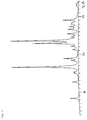
- the X-ray diffraction diagram of modification 2 recorded with Cu-K ⁇ 1 radiation is shown in FIG. 1.
- the STADI P dual-circuit diffractometer from Stoe (Darmstadt, Germany) or the computer-supported single-crystal diffractometer R3 m / V from Siemens (radiation Mo K ⁇ ) were used to record the diagram.
- the infrared spectrum of modification 2 of the compound of formula I (1 mg in 300 mg KBr) recorded with an infrared spectrophotometer shows the following main bands (unit cm -1 ): 1321 1481 672 3201 1607 3355 763 701 1109 1264 908 948 1065 1384 754 511 1536 1361 592 733 1663 852 427 960 1241 1014 3111 1779 1410 3297 3065 1811 1160 877 3221 484 1691 940 974 3442 831 3274 3129 3434 1188 894 628
- the specified wave numbers are arranged in increasing intensity.
- the infrared spectrum of modification 2 of the compound of formula I according to Example 1 is also shown in FIG. 3, the transmission in% being given in the ordinate and the wave number in cm ⁇ 1 in the abscissa.
- the compound of formula I crystallizes in modification 2 in space group P2 1 / c with 8 molecules in the unit cell.
- the two molecules have a very different conformation.
- the angles of the five and six rings with the central carbonyl group are 5.4 ° and 2.1 ° or 23.4 ° and 23.1 °. The latter twist creates the steric conditions for hydrogen bonding between the two molecules to be possible.
- the compound of formula I crystallizes in modification 1 in space group P2 1 / c with 4 molecules in the unit cell.
- the molecule is essentially planar.
- the angle between the planar atomic groups is less than 2.4 °.
- the molecules are arranged in stacks in the crystal.
- the molecules lie next to each other in stacks and are arranged in an anti-parallel manner.
- Very weak hydrogen bonds link the dimers in the crystal structure (NH ... H: 3.1444 ⁇ ).
- the X-ray diffraction diagrams also allow the amount of the Modification 2 in a mixture containing both modifications.
- For quantitative Determination is suitable for the line at 8.35 ° 2 theta of modification 1 and the line at 16.1 ° 2 theta of modification 2.
- the detection limit of this method is about 0.3% modification 2 in crystals with modification 1.
- Modification 2 is more water-soluble than modification 1. At 37 ° C, 38 mg / l of modification 2 can be dissolved, while modification 1 25 mg / l go into solution. Furthermore, the modification 2 is in the temperature range from -15 ° C to +40 ° C, preferably from 20 ° C to 40 ° C, stable and is not in Modification 1 converted.
- the modification 2 according to the invention of the compound of the formula I is obtained, for example, by heating a suspension of the crystals of the modification 1 or mixtures of the modifications 1 and 2 of the compound of the formula I in a solvent to a temperature of about 10 ° C. to 40 ° C., preferably 15 ° C to 30 ° C, especially from 20 ° C to 25 ° C.
- the production speed is essentially dependent on the temperature. Solvents in which the compound of the formula I dissolves poorly are advantageous.
- water can be used or aqueous solutions with (C 1 -C 4 ) alcohols, for example methanol, ethanol, propanol, isopropanol, butanol or isobutanol and / or with ketones such as acetone or methyl ethyl ketone.
- alcohols for example methanol, ethanol, propanol, isopropanol, butanol or isobutanol and / or with ketones such as acetone or methyl ethyl ketone.
- ketones such as acetone or methyl ethyl ketone
- the complete conversion of modification 1 into modification 2 is from Temperature dependent and usually lasts at a temperature of 20 ° C 36 hours to 65 hours, preferably from 48 hours to 60 hours.
- the reaction is checked by X-ray or IR spectroscopy using samples taken during treatment.
- modification 2 of the compound of formula I is to dissolve modification 1 or mixtures of modifications 1 and 2 in a solvent and then to flash-cool them to temperatures of about -5 ° C. to -25 ° C.
- Suitable solvents are, for example, water-miscible solvents such as (C 1 -C 4 ) alcohols, but also ketones such as acetone or methyl ethyl ketone or other solvents such as ethyl acetate, toluene or dichloromethane.
- the dissolving process takes place at room temperature from 20 ° C. to 25 ° C. or else elevated temperatures up to the boiling point of the solvent under normal pressure or under increased or reduced pressure.
- the solution obtained is optionally filtered in order to separate undissolved constituents or crystals of leflunomide.
- the filtered solution is then cooled so quickly that only crystals of modification 2 are formed.
- a sufficient cooling procedure is, for example, that the filtered solution is placed in a vessel which is cooled to -15 ° C, or by spraying the filtered solution in a room cooled to -10 ° C, or cooling the solution under vacuum condensation conditions.
- a preferred method is to introduce the compound of the formula I into methanol and to carry out the dissolution process at the boiling point of methanol under normal pressure or reduced pressure; then filter the hot solution and transfer the filtered solution so slowly into a vessel which has cooled to -15 ° C that the temperature of the crystal suspension obtained does not rise to more than -10 ° C.
- Crystallization can take place without seeding with crystals of modification 2 or preferably by seeding with crystals of modification 2.
- the seeding takes place in the cooled vessel.
- the amount of inoculation material depends on the amount of solution and can be easily determined by a person skilled in the art.
- the abovementioned processes are also suitable for converting mixtures containing modification 1 and 2 into an essentially pure modification 2 of the compound of the formula I.
- the invention also relates to new processes for the preparation of the compound of the formula I in modification 1.
- the novel processes can also be used to convert mixtures containing modification 1 and 2 into modification 1 in a targeted manner.
- crystals of modification 2 or mixtures of modification 1 and 2 are dissolved in a solvent.
- Suitable solvents are, for example, water-miscible solvents such as (C 1 -C 4 ) alcohols, for example methanol, ethanol, propanol, isopropanol, butanol or isobutanol, but also ketones such as acetone or methyl ethyl ketone.
- the dissolving process is preferably carried out at an elevated temperature up to the boiling point of the particular solvent.
- the hot solution is kept at boiling temperature for some time to ensure complete dissolution of the compound of formula I.
- the filtered solution is then cooled slowly enough that only crystals of modification 1 form. It is preferably cooled to end temperatures of 20 ° C. to -10 ° C., in particular to temperatures of 10 ° C. to -5 ° C., very particularly preferably to temperatures of 10 ° C. to 5 ° C.
- the crystals are separated and washed with isopropanol and then with water.
- the substance is dried at elevated temperature, preferably at 60 ° C. under reduced pressure or at normal pressure.
- a preferred method consists in the compound of formula I in 80% Isopropanol at the boiling point of isopropanol under normal pressure or to release reduced pressure and then slowly release the hot solution cool so that the crystallization at temperatures of more than 40 ° C, preferably from 40 ° C to 85 ° C, particularly preferably from 45 ° C to 80 ° C, in particular from 50 ° C to 70 ° C, takes place.
- the precipitated crystals are then washed several times with isopropanol and dried under reduced pressure. Crystallization can take place without seeding with crystals of modification 1 or preferably in the presence of crystals of modification 1, which by Inoculating into the solution containing the compound of formula I introduced become. Inoculation can also take place several times at different temperatures respectively.
- the amount of inoculation material depends on the amount of solution and can easily be determined by a specialist.
- the solution obtained is preferably filtered after process step b).
- Modifications 1 and 2 can also be specifically converted into Modification 1 using the particularly preferred process.
- crystals of modification 2 or mixtures of modification 1 and 2 are dissolved in a mixture containing organic solvents and water.
- Suitable solvents are, for example, water-miscible solvents such as (C 1 -C 4 ) alcohols, for example methanol, ethanol, propanol, isopropenol, butanol or isobutanol, but also ketones such as acetone or methyl ethyl ketone.
- Advantageous mixtures contain organic solvent and water in the Ratio from 1: 1 to 8: 1, preferably from 2: 1 to 6: 1, in particular from 3: 1 to 5: 1.
- the solution is preferably prepared at elevated temperature, especially at temperatures from 41 ° C to the boiling point of each Solvent.
- the heated solution will be on for some time Boiling temperature is kept around a complete solution of the compound of formula I. ensure.
- the release process can also be carried out at elevated pressure become.
- the solution is then filtered.
- the filter used has one Pore diameter of about 0.1 ⁇ m to 200 ⁇ m.
- the filtered solution will then added water, which advantageously the same temperature as that filtered solution, or the organic solvent is distilled off.
- the Solutions obtained advantageously contain the organic solvent and Water in a ratio of 4: 1 to 0.3: 1, preferably 2: 1 to 0.6: 1, in particular preferably from 1.6: 1 to 0.8: 1.
- a particularly preferred method is the compound of formula I. in a mixture of isopropanol and water in a ratio of 4: 1 to 5: 1 and at Boiling temperature of isopropanol under normal pressure or reduced pressure loosen and filter. Then hot solution with so much equally warm Water is added so that a ratio of isopropanol to water of 2: 1 to 0.8: 1 is present. The crystallization then takes place at temperatures of more than 40 ° C. preferably from 40 ° C to 85 ° C, particularly preferably from 45 ° C to 80 ° C, especially from 50 ° C to 70 ° C. The precipitated crystals are then washed several times with isopropanol and dried under reduced pressure.
- modification 1 is produced from modification 2 or a mixture containing the modification 1 and 2 .
- the Crystals are heated to a temperature of above 40 ° C to 130 ° C, preferred from 50 ° C to 110 ° C, especially from 70 ° C to 105 ° C, very particularly preferably 100 ° C.
- the transfer of modification 2 to 1 is from temperature dependent and lasts for example at 100 ° C. from 2 to 5 hours, preferably from 2 to 3 hours.
- Modification 1 of the compound of the formula I is obtained by heating the suspension of the crystals in a solvent to a temperature of more than 40 ° C., preferably 41 ° C. to 100 ° C., in particular 50 ° C. to 70 ° C.
- the production essentially depends on the temperature.
- Solvents in which the compound of the formula I dissolves poorly are advantageous. For example, water can be used or aqueous solutions with (C 1 -C 4 ) alcohols and / or with ketones such as methyl ethyl ketone or acetone.
- the heating takes place in aqueous suspension, expediently with stirring or shaking.
- the temperature treatment is carried out until modification 2 has been completely converted into modification 1.
- the complete transfer of modification 2 into modification 1 is from Temperature dependent and usually lasts at a temperature of 50 ° C 20 hours to 28 hours, preferably 24 hours.
- the control of the reaction is done by X-ray or IR spectroscopy using during the treatment taken samples.
- the invention also relates to medicinal products characterized by an effective one Content of modification 2 of the compound of formula I, together with a pharmaceutically suitable and physiologically compatible carrier, additive and / or active substances and auxiliary substances.
- the pharmaceuticals according to the invention characterized by an effective Content of modification 2 of the compound of formula I show the same Efficacy compared to people with rheumatoid arthritis treatment with a drug, characterized by an effective Content of modification 1 of the compound of formula I.
- the invention further relates to a method for producing the medicament, the characterized in that modification 2 of the compound of Formula I and a pharmaceutical carrier to a pharmaceutical Dosage form processed.
- the medicament according to the invention can be used as a dosage unit in the form of Dosage forms such as capsules (including microcapsules), tablets (including Dragees and pills) or suppositories are present, with the use of capsules the capsule material performs the function of the carrier and the content e.g. as Powder, gel, emulsion, dispersion or suspension can be present.
- the capsule material performs the function of the carrier and the content e.g. as Powder, gel, emulsion, dispersion or suspension can be present.
- oral (peroral) formulations with the To produce modification 2 of the compound of formula I, the calculated Contain the amount of active ingredient together with a pharmaceutical carrier.
- a suitable formulation (suppository) for rectal therapy can also be applied.
- transdermal application in the form of ointments, Creams or oral application of tablets or suspensions that the contain preparation according to the invention possible.
- ointments, pastes, creams and powders can be the usual ones Contain carriers, e.g. animal and vegetable fats, waxes, paraffins, Starch, tragacanth, cellulose derivatives, polyethylene glycols, silicones, bentonites, Talc, zinc oxide, milk sugar, silica, aluminum hydroxide, calcium silicate and Polyamide powder or mixtures of these substances.
- Contain carriers e.g. animal and vegetable fats, waxes, paraffins, Starch, tragacanth, cellulose derivatives, polyethylene glycols, silicones, bentonites, Talc, zinc oxide, milk sugar, silica, aluminum hydroxide, calcium silicate and Polyamide powder or mixtures of these substances.
- the tablets, pills or granules can be prepared using conventional methods such as Pressing, dipping or fluidized bed processes or boiler coating are produced and contain carriers and other common additives such as gelatin, agarose, Starch (e.g. potato, corn or wheat starch), cellulose such as ethyl cellulose, Silicon dioxide, various sugars such as milk sugar, magnesium carbonate and / or Calcium phosphates.
- the coating solution usually consists of sugar and / or Corn syrup and mostly still contains gelatin, gum arabic, Polyvinyl pyrrolidone, synthetic cellulose esters, surface-active substances, Plasticizers, pigments and similar additives according to the state of the Technology. Any customary flow regulating, Lubricants or lubricants such as magnesium stearate and release agents can be used.
- the dosage to be used is of course dependent on different ones Factors such as the living being to be treated (i.e. human or animal), age, Weight, general health, the severity of symptoms, the treating disease, the type of concomitant treatment with others Medicines, or the frequency of treatment.
- the dosages are in generally several times a day and preferably once to three times a day administered.
- the appropriate therapy is e.g. in the administration of one, two or 3 individual doses of a preparation consisting of N- (4-trifluoromethylphenyl) -5-methyl-isoxazole-4-carboxamide in modification 2 in a lot from 2 to 150 mg, preferably 10 to 100 mg, in particular 10 to 50 mg.
- the amount of active components naturally depends on the number of Individual doses and also depending on the illness to be treated.
- the Single dose can also consist of several, administered simultaneously Dosing units exist.
- Fig. 1 shows the X-ray diffraction pattern obtained and is typical of the Modification 2 of the compound of formula I.
- Modification 2 samples were prepared as in Example 1 and stored at different temperatures and humidity. Samples were taken after the above times and an X-ray diffraction chart was prepared as in Example 1. Table 1 shows the results. Time (months) Storage conditions Crystal modification 1 -15 ° C 2nd 3rd -15 ° C 2nd 6 -15 ° C 2nd 1 + 25 ° C 2nd 3rd + 25 ° C 2nd 6 + 25 ° C 2nd 1 + 40 ° C 2nd 3rd + 40 ° C 2nd 6 + 40 ° C 2nd 1 + 40 ° C / 75% relative humidity 2nd 3rd + 40 ° C / 75% relative humidity 2nd 6 + 40 ° C / 75% relative humidity 2nd 1 + 60 ° C about 76% 1 3rd + 60 ° C 1
- Water-moist leflunomide is first dissolved in raw isopropanol / water (corresponding to 16 kg leflunomide, raw, dry, in 28 l isopropanol plus the amount Water, which together with the water content of the moist product Total water volume of 9 l results).
- the mixture is then heated to 78 ° C to 82 ° C, 25 minutes (min) at this Temperature stirred and then already in a pressure funnel into one same temperature heated kettle filtered.
- the print hopper will match the quantity Rinsed isopropanol, which together with inserted isopropanol (iPrOH) IPrOH / water ratio of 4: 1 (here 4 l).
- iPrOH isopropanol
- Table 1 shows the results of 4 approaches. approach Initial concentration IPrOH / H 2 O ratio Final concentration proportion of Crystals modification 2 yield [g / l] [g / l] [%] [%] 1 600 4: 1 600 nb 73.2 2nd 600 3: 1 563 ⁇ 0.4 71.4 3rd 400 2: 1 333 ⁇ 0.4 70.5 4th 400 0.8: 1 222 ⁇ 0.4 85.6
Landscapes
- Health & Medical Sciences (AREA)
- Chemical & Material Sciences (AREA)
- Organic Chemistry (AREA)
- Nuclear Medicine, Radiotherapy & Molecular Imaging (AREA)
- Pharmacology & Pharmacy (AREA)
- Chemical Kinetics & Catalysis (AREA)
- General Chemical & Material Sciences (AREA)
- Medicinal Chemistry (AREA)
- Veterinary Medicine (AREA)
- Public Health (AREA)
- General Health & Medical Sciences (AREA)
- Life Sciences & Earth Sciences (AREA)
- Animal Behavior & Ethology (AREA)
- Bioinformatics & Cheminformatics (AREA)
- Engineering & Computer Science (AREA)
- Diabetes (AREA)
- Immunology (AREA)
- Pulmonology (AREA)
- Endocrinology (AREA)
- Emergency Medicine (AREA)
- Rheumatology (AREA)
- Obesity (AREA)
- Physical Education & Sports Medicine (AREA)
- Ophthalmology & Optometry (AREA)
- Hematology (AREA)
- Biomedical Technology (AREA)
- Neurosurgery (AREA)
- Pain & Pain Management (AREA)
- Neurology (AREA)
- Oncology (AREA)
- Dermatology (AREA)
- Reproductive Health (AREA)
- Orthopedic Medicine & Surgery (AREA)
- Communicable Diseases (AREA)
- Urology & Nephrology (AREA)
- Pharmaceuticals Containing Other Organic And Inorganic Compounds (AREA)
- Heterocyclic Carbon Compounds Containing A Hetero Ring Having Nitrogen And Oxygen As The Only Ring Hetero Atoms (AREA)
- Organic Low-Molecular-Weight Compounds And Preparation Thereof (AREA)
Abstract
Die Erfindung betrifft die Kristallmodifikation 2 der Verbindung der Formel I,

Verfahren zur Herstellung der Kristallmodifikationen 1 und 2 und deren Verwendung.Process for the preparation of crystal modifications 1 and 2 and their Use.
Description
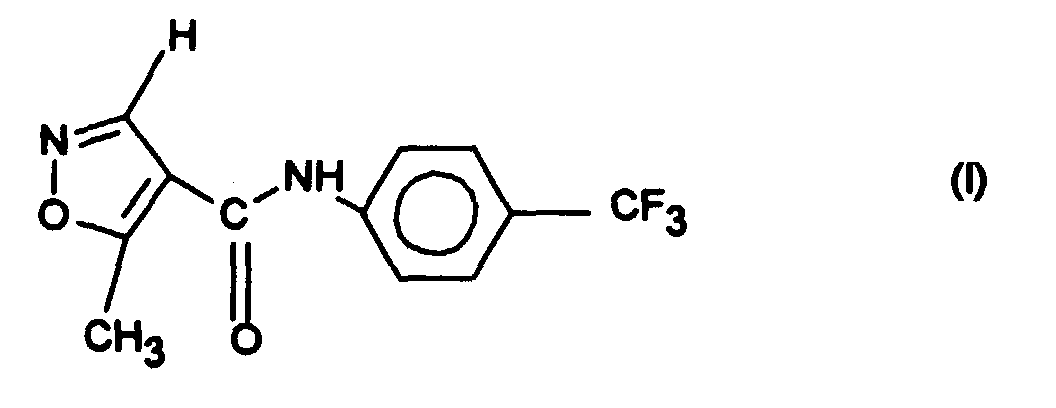
Die Erfindung betrifft eine neue gut lösliche Kristallmodifikation (Modifikation 2) der
Verbindung der Formel I

- Linien starker Intensität:
- 10,65; 14,20; 14,80; 16,10; 21,70; 23,15; 24,40; 24,85; 25,50; 25,85; 26,90; 29,85
- Linien mittlerer Intensität:
- 7,40; 9,80; 13,10; 15,45; 16,80; 20,70; 21,45; 22,80; 23,85; 27,25; 28,95
- Lines of intense intensity:
- 10.65; 14.20; 14.80; 16.10; 21.70; 23.15; 24.40; 24.85; 25.50; 25.85; 26.90; 29.85
- Medium intensity lines:
- 7.40; 9.80; 13.10; 15.45; 16.80; 20.70; 21.45; 22.80; 23.85; 27.25; 28.95
Das mit Cu-Kα1-Strahlung aufgenommene Röntgenbeugungsdiagramm der Modifikation 2 ist in Figur 1 dargestellt. Zur Aufnahme des Diagramms wurden das Zweikreisdiffraktometer STADI P der Firma Stoe (Darmstadt, Deutschland) oder das rechnergestützte Einkristalldiffraktometer R3 m/V der Firma Siemens (eingesetzte Strahlung Mo Kα) verwendet. The X-ray diffraction diagram of modification 2 recorded with Cu-K α1 radiation is shown in FIG. 1. The STADI P dual-circuit diffractometer from Stoe (Darmstadt, Germany) or the computer-supported single-crystal diffractometer R3 m / V from Siemens (radiation Mo K α ) were used to record the diagram.
Das Infrarot-Spektrum der Modifikation 2 der Verbindung der Formel I(1 mg in
300 mg KBr) aufgenommen mit einem Infrarot-Spektrophotometer zeigt die
folgenden Hauptbanden (Einheit cm-1):
Die angegebenen Wellenzahlen sind in ansteigender Intensität angeordnet. Das Infrarot-Spektrum der Modifikation 2 der Verbindung der Formel I gemäß Beispiel 1 ist ferner in Figur 3 dargestellt, wobei in der Ordinate die Transmission in % und auf der Abszisse die Wellenzahl in cm -1 angegeben wurde.The specified wave numbers are arranged in increasing intensity. The infrared spectrum of modification 2 of the compound of formula I according to Example 1 is also shown in FIG. 3, the transmission in% being given in the ordinate and the wave number in cm −1 in the abscissa.
Die Verbindung der Formel I kristallisiert in der Modifikation 2 in der Raumgruppe P21/c mit 8 Molekülen in der Elementarzelle. Die Moleküle der Verbindung der Formel I liegen als Dimere vor, die aus den Einzelmolekülen durch Bildung einer - C=O...HN-Wasserstoffbrückenbindung (2,938 Å) hervorgehen, wobei die zwei Molekülebenen praktisch senkrecht zueinander stehen (91,2°). Die beiden Moleküle haben eine stark unterschiedliche Konformation. Die Winkel der Fünf- und Sechsringe mit der zentralen Carbonylgruppe betragen 5,4° und 2,1 ° beziehungsweise 23,4° und 23,1°. Die letztere Verdrillung schafft die sterische Voraussetzungen dafür, daß die Wasserstoffbrückenbindung zwischen den beiden Molekülen möglich wird. The compound of formula I crystallizes in modification 2 in space group P2 1 / c with 8 molecules in the unit cell. The molecules of the compound of formula I are present as dimers which result from the individual molecules by forming a - C = O ... HN hydrogen bond (2.938 Å), the two molecular planes being practically perpendicular to one another (91.2 °). The two molecules have a very different conformation. The angles of the five and six rings with the central carbonyl group are 5.4 ° and 2.1 ° or 23.4 ° and 23.1 °. The latter twist creates the steric conditions for hydrogen bonding between the two molecules to be possible.
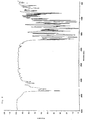
Die Verbindung der Formel I ist an sich bekannt und wird auch als Leflunomid (HWA 486) bezeichnet. Sie kann auf die in US 4,284,786 beschriebene Weise erhalten werden. Die durch Umkristallisation aus beispielsweise Toluol hergestellten Kristalle fallen jedoch in der Kristallmodifikation 1 an. Das Röntgenbeugungsdiagramm (Cu-Kα1Strahlung) der Modifikation 1 ist in Figur 2 wiedergegeben und weist charakteristische Linien bei folgenden Beugungswinkeln 2 Theta (°) auf:
- Linien starker Intensität:
- 16,70; 18,90; 23,00; 23,65; 29,05
- Linien mittlerer Intensität:
- 8,35; 12,65; 15,00; 15,30; 18,35; 21,25; 22,15; 24,10; 24,65; 25,45; 26,65; 27,40; 28,00; 28,30
- Lines of intense intensity:
- 16.70; 18.90; 23.00; 23.65; 29.05
- Medium intensity lines:
- 8.35; 12.65; 15.00; 15.30; 18.35; 21.25; 22.15; 24.10; 24.65; 25.45; 26.65; 27.40; 28.00; 28.30
Die Verbindung der Formel I kristallisiert in der Modifikation 1 in der Raumgruppe
P21/c mit 4 Molekülen in der Elementarzelle. Das Molekül ist im wesentlichen planar.
Der Winkel zwischen den planaren Atomgruppen ist kleiner als 2,4°. Die Moleküle
sind im Kristall in Stapeln angeordnet. Die Moleküle liegen in Stapeln
nebeneinander und sind in einer antiparallelen Art angeordnet. Sehr schwache
Wasserstoffbrückenbindungen verbinden die Dimere im Kristallverband (NH... H:
3,1444 Å). Die C=O-Gruppe ist an keiner Wasserstoffbrückenbindung beteiligt.The compound of formula I crystallizes in
Die Röntgenbeugungsdiagramme erlauben ferner die Bestimmung der Menge der
Modifikation 2 in einer Mischung, enthaltend beide Modifikationen. Zur quantitativen
Bestimmung eignet sich die Linie bei 8,35°2 Theta der Modifikation 1 und die Linie
bei 16,1°2 Theta der Modifikation 2. Bildet man das Verhältnis der Peakhöhen und
korreliert man es mit dem Gehalt an der Modifikation so erhält man eine Eichgerade.
Die Nachweisgrenze dieser Methode liegt bei etwa 0,3 % Modifikation 2 in Kristallen
mit Modifikation 1.The X-ray diffraction diagrams also allow the amount of the
Modification 2 in a mixture containing both modifications. For quantitative
Determination is suitable for the line at 8.35 ° 2 theta of
Die Modifikation 2 ist im Vergleich zur Modifikation 1 besser wasserlöslich. Bei
37° C lassen sich 38 mg/l der Modifikation 2 lösen, während von Modifikation 1
25 mg/l in Lösung gehen. Ferner ist die Modifikation 2 in dem Temperaturbereich
von -15 °C bis +40 °C, bevorzugt von 20 °C bis 40 °C, stabil und wird nicht in
Modifikation 1 umgewandelt.Modification 2 is more water-soluble than
Die erfindungsgemäße Modifikation 2 der Verbindung der Formel I erhält man
beispielsweise durch Erwärmen einer Suspension der Kristalle der Modifikation 1
oder Mischungen der Modifikationen 1 und 2 der Verbindung der Formel I in einem
Lösungsmittel auf eine Temperatur von etwa 10 °C bis 40 °C, bevorzugt 15 °C bis
30°C, insbesondere von 20°C bis 25°C. Die Herstellgeschwindigkeit ist im
wesentlichen von der Temperatur abhängig. Vorteilhaft sind Lösemittel, in denen
sich die Verbindung der Formel I schlecht löst. Beispielsweise kann Wasser
verwendet werden oder wäßrige Lösungen mit (C1-C4)-Alkoholen, z.B. Methanol,
Ethanol, Propanol, Isopropanol, Butanol oder Isobutanol und/oder mit Ketonen wie
Aceton oder Methylethylketon. In der Regel erfolgt das Erwärman in wäßriger
Suspension, zweckmäßigerweise unter Rühren oder Schütteln. Die
Temperaturbehandlung erfolgt so lange, bis die Modifikation 1 vollständig in die
Modifikation 2 überführt ist.The modification 2 according to the invention of the compound of the formula I is obtained, for example, by heating a suspension of the crystals of the
Die vollständige Überführung der Modifikation 1 in die Modifikation 2 ist von der
Temperatur abhängig und dauert in der Regel bei einer Temperatur von 20°C von
36 Stunden bis 65 Stunden, bevorzugt von 48 Stunden bis 60 Stunden. Die
Kontrolle der Reaktion erfolgt röntgenographisch oder IR-spektroskopisch mittels
während der Behandlung entnommener Proben.The complete conversion of
Ein weiteres Verfahren zur Herstellung der Modifikation 2 der Verbindung der
Formel I besteht darin, die Modifikation 1 oder Mischungen der Modifikationen 1 und
2 in einem Lösungsmittel zu lösen und dann schockartig auf Temperaturen von etwa
-5°C bis -25°C abzukühlen. Als Lösungsmittel geeignet sind beispielsweise mit
Wasser mischbare Lösungsmittel wie (C1-C4)-Alkohole, aber auch Ketone wie
Aceton oder Methylethylketon oder andere Lösungsmittel wie Ethylacetat, Toluol
oder Dichlormethan. Der Lösungsvorgang erfolgt bei Raumtemperatur von 20 °C bis
25 °C oder auch erhöhten Temperaturen bis zum Siedepunkt des Lösemittels unter
Normaldruck oder unter erhöhten oder verminderten Druck. Die erhaltene Lösung
wird gegebenenfalls filtriert um ungelöste Bestandteile oder Kristalle von Leflunomid
abzutrennen. Danach wird die filtrierte Lösung so schnell abgekühlt, daß sich nur
Kristalle der Modifikation 2 bilden. Ein ausreichendes Abkühlverfahren besteht
beispielsweise darin, daß die filtrierte Lösung in ein Gefäß, das auf -15°C gekühlt
ist, eingebracht wird, oder durch Versprühen der filtrierten Lösung in einen auf -10
°C gekühlten Raum, oder Abkühlung der Lösung unter Vakuumkondensationsbedingungen.
Ein bevorzugtes Verfahren besteht darin die Verbindung der Formel I
in Methanol einzubringen und den Lösungsvorgang bei Siedetemperatur von
Methanol unter Normaldruck oder verminderten Druck durchzufuhren; anschließend
die heiße Lösung zu filtrieren und die filtrierte Lösung so langsam in ein Gefäß, das
auf -15°C gekühlt ist, zu überführen, daß die Temperatur der erhaltenen
Kristallsuspension auf nicht mehr als -10°C steigt. Die ausgefallenen Kristalle
werden dann mehrfach mit Methanol gewaschen und unter verminderten Druck
getrocknet. Die Kristallisation kann ohne Animpfen mit Kristallen der Modifikation 2
erfolgen oder bevorzugt durch Animpfen mit Kristallen der Modifikation 2. Das
Animpfen erfolgt im abgekühlten Gefäß. Die Menge des Animpfmaterials hängt von
der Menge der Lösung ab und kann von einem Fachmann leicht ermittelt werden.
Die obengenannten Verfahren eignen sich auch zur Umwandlung von Mischungen,
enthaltend Modifikation 1 und 2, in eine im wesentlichen reine Modifikation 2 der
Verbindung der Formel I.Another method for producing modification 2 of the compound of formula I is to dissolve
Die Erfindung betrifft aber auch neue Verfahren zur Herstellung der Verbindung der
Formel I in der Modifikation 1. Durch die neuen Verfahren können auch
Mischungen, enthaltend die Modifikation 1 und 2, gezielt in die Modifikation 1
überführt werden. Dazu werden beispielsweise Kristalle der Modifikation 2 oder
Mischungen von Modifikation 1 und 2 in einem Lösungsmittel gelöst. Als
Lösungsmittel geeignet sind beispielsweise mit Wasser mischbare Lösungsmittel
wie (C1-C4)-Alkohole, z.B. Methanol, Ethanol, Propanol, Isopropanol, Butanol oder
Isobutanol, aber auch Ketone wie Aceton oder Methylethylketon. Bewährt haben
sich auch Mischungen von organischen Lösungsmitteln mit Wasser, beispielsweise
von etwa 40 % bis 90 % Isopropanol. Der Lösevorgang wird vorzugsweise bei
erhöhter Temperatur bis zum Siedepunkt des jeweiligen Lösungsmittels
durchgeführt. Die heiße Lösung wird für einige Zeit auf Siedetemperatur gehalten
um eine vollständige Lösung der Verbindung der Formel I sicherzustellen. Danach
wird die filtrierte Lösung so langsam abgekühlt, daß sich nur Kristalle der
Modifikation 1 bilden. Bevorzugt wird auf Endtemperaturen von 20 °C bis -10 °C
abgekühlt, insbesondere auf Temperaturen von 10 °C bis -5 °C, ganz besonders
bevorzugt auf Temperaturen von 10 °C bis 5 °C. Die Kristalle werden abgetrennt
und mit Isopropanol und anschließend mit Wasser gewaschen. Das Trocknen der
Substanz erfolgt bei erhöhter Temperatur bevorzugt bei 60 °C unter verminderten
Druck oder bei Normaldruck.However, the invention also relates to new processes for the preparation of the compound of the formula I in
Ein bevorzugtes Verfahren besteht darin die Verbindung der Formel I in 80 %igem
Isopropanol bei der Siedetemperatur von Isopropanol unter Normaldruck oder
verminderten Druck zu lösen und anschließend die heiße Lösung langsam
abzukühlen, so daß die Kristallisation bei Temperaturen von mehr als 40 °C,
bevorzugt von 40 °C bis 85 °C, besonders bevorzugt von 45 °C bis 80 °C,
insbesondere von 50 °C bis 70 °C, erfolgt. Die ausgefallenen Kristalle werden dann
mehrmals mit Isopropanol gewaschen und unter verminderten Druck getrocknet.
Die Kristallisation kann ohne Animpfen mit Kristallen der Modifikation 1 erfolgen
oder bevorzugt in Anwesenheit von Kristallen der Modifikation 1, die durch
Animpfen in die Lösung, enthaltend die Verbindung der Formel I, eingebracht
werden. Das Animpfen kann auch mehrfach bei unterschiedlichen Temperaturen
erfolgen. Die Menge des Animpfmaterials hängt von der Menge der Lösung ab und
kann von einem Fachmann leicht ermittelt werden.A preferred method consists in the compound of formula I in 80%
Isopropanol at the boiling point of isopropanol under normal pressure or
to release reduced pressure and then slowly release the hot solution
cool so that the crystallization at temperatures of more than 40 ° C,
preferably from 40 ° C to 85 ° C, particularly preferably from 45 ° C to 80 ° C,
in particular from 50 ° C to 70 ° C, takes place. The precipitated crystals are then
washed several times with isopropanol and dried under reduced pressure.
Crystallization can take place without seeding with crystals of
Ein besonders bevorzugtes Verfahren zur Herstellung der Verbindung der Formel I
in der Modifikation 1 besteht darin, daß man
Bevorzugt wird die erhaltene Lösung nach Verfahrensschritt b) filtriert.The solution obtained is preferably filtered after process step b).
Durch das besonders bevorzugte Verfahren können auch Mischungen, enthaltend
die Modifikation 1 und 2, gezielt in die Modifikation 1 überführt werden. Dazu
werden Kristalle der Modifikation 2 oder Mischungen von Modifikation 1 und 2 in
einer Mischung, enthaltend organische Lösungsmittel und Wasser gelöst. Als
Lösungsmittel geeignet sind beispielsweise mit Wasser mischbare Lösungsmittel
wie (C1-C4)-Alkohole, z.B. Methanol, Ethanol, Propanol, Isopropenol, Butanol oder
Isobutanol, aber auch Ketone wie Aceton oder Methylethylketon.
Vorteilhafte Mischungen enthalten organisches Lösungsmittel und Wasser im Verhältnis von 1:1 bis 8:1, bevorzugt von 2:1 bis 6:1, insbesondere von 3:1 bis 5:1.Advantageous mixtures contain organic solvent and water in the Ratio from 1: 1 to 8: 1, preferably from 2: 1 to 6: 1, in particular from 3: 1 to 5: 1.
Die Herstellung der Lösung erfolgt vorzugsweise bei erhöhter Temperatur, insbesondere bei Temperaturen von 41°C bis zum Siedepunkt des jeweiligen Lösungsmittels. Die erwärmte Lösung wird beispielsweise für einige Zeit auf Siedetemperatur gehalten um eine vollständige Lösung der Verbindung der Formel I sicherzustellen. Der Lösevorgang kann auch bei erhöhtem Druck durchgeführt werden. Danach wird die Lösung filtriert. Der eingesetzte Filter hat einen Porendurchmesser von etwa 0,1 µm bis 200 µm. Der filtrierten Lösung wird anschließend Wasser zugegeben, das vorteilhaft die gleiche Temperatur wie die filtrierte Lösung hat, oder das organische Lösungsmittel wird abdestilliert. Die erhaltenen Lösungen enthalten vorteilhaft das organische Lösungsmittel und Wasser im Verhältnis von 4:1 bis 0,3 :1, bevorzugt von 2:1 bis 0,6:1, insbesondere bevorzugt von 1,6:1 bis 0,8:1. Danach wird langsam abgekühlt bis zu einer minimalen Temperatur von 40°C. Die Kristalle werden abgetrennt und mit Isopropanol und anschließend mit Wasser gewaschen. Das Trocknen der Substanz erfolgt vorteilhaft bei erhöhter Temperatur bevorzugt bei 60 °C unter verminderten Druck oder bei Normaldruck.The solution is preferably prepared at elevated temperature, especially at temperatures from 41 ° C to the boiling point of each Solvent. For example, the heated solution will be on for some time Boiling temperature is kept around a complete solution of the compound of formula I. ensure. The release process can also be carried out at elevated pressure become. The solution is then filtered. The filter used has one Pore diameter of about 0.1 µm to 200 µm. The filtered solution will then added water, which advantageously the same temperature as that filtered solution, or the organic solvent is distilled off. The Solutions obtained advantageously contain the organic solvent and Water in a ratio of 4: 1 to 0.3: 1, preferably 2: 1 to 0.6: 1, in particular preferably from 1.6: 1 to 0.8: 1. Then it is slowly cooled down to one minimum temperature of 40 ° C. The crystals are separated and with Isopropanol and then washed with water. Drying the substance is advantageously carried out at elevated temperature, preferably at 60 ° C. under reduced Pressure or at normal pressure.
Ein insbesondere bevorzugtes Verfahren besteht darin die Verbindung der Formel I in einer Mischung von Isopropanol und Wasser im Verhältnis von 4:1 bis 5:1 und bei Siedetemperatur von Isopropanol unter Normaldruck oder verminderten Druck zu lösen und zu filtrieren. Anschließend wird heiße Lösung mit soviel gleichwarmem Wasser versetzt, daß ein Verhältnis von Isopropanol zu Wasser von 2:1 bis 0,8:1 vorliegt. Danach erfolgt die Kristallisation bei Temperaturen von mehr als 40 °C, bevorzugt von 40 °C bis 85 °C, besonders bevorzugt von 45 °C bis 80 °C, insbesondere von 50 °C bis 70 °C. Die ausgefallenen Kristalle werden dann mehrmals mit Isopropanol gewaschen und unter verminderten Druck getrocknet.A particularly preferred method is the compound of formula I. in a mixture of isopropanol and water in a ratio of 4: 1 to 5: 1 and at Boiling temperature of isopropanol under normal pressure or reduced pressure loosen and filter. Then hot solution with so much equally warm Water is added so that a ratio of isopropanol to water of 2: 1 to 0.8: 1 is present. The crystallization then takes place at temperatures of more than 40 ° C. preferably from 40 ° C to 85 ° C, particularly preferably from 45 ° C to 80 ° C, especially from 50 ° C to 70 ° C. The precipitated crystals are then washed several times with isopropanol and dried under reduced pressure.
Ein weiteres Verfahren zur Herstellung der Modifikation 1 aus der Modifikation 2
oder einer Mischung, enthaltend die Modifikation 1 und 2, besteht darin, daß die
Kristalle erhitzt werden auf eine Temperatur von über 40 °C bis 130 °C, bevorzugt
von 50 °C bis 110 °C, insbesondere von 70 °C bis 105 °C, ganz besonders
bevorzugt 100 °C. Die Überführung der Modifikation 2 in 1 ist von der Temperatur
abhängig und dauert beispielsweise bei 100 °C von 2 bis 5 Stunden, bevorzugt von
2 bis 3 Stunden.Another method for producing
Ein weiteres Verfahren zur Herstellung der Modifikation 1 besteht in der Herstellung
einer Suspension, enthaltend Kristalle der Modifikation 2 oder eine Mischung von
Kristallen enthaltend die Modifikation 1 und 2, und einem Lösungsmittel.
Die Modifikation 1 der Verbindung der Formel I erhält man durch Erwärmen der
Suspension der Kristalle in einem Lösungsmittel auf eine Temperatur von mehr als
40 °C, bevorzugt 41 °C bis 100 °C, insbesondere von 50 °C bis 70 °C. Die
Herstellung ist im wesentlichen von der Temperatur abhängig. Vorteilhaft sind
Lösemittel, in denen sich die Verbindung der Formel I schlecht löst. Beispielsweise
kann Wasser verwendet werden oder wäßrige Lösungen mit (C1-C4)-Alkoholen
und/oder mit Ketonen wie Methylethylketon oder Aceton. In der Regel erfolgt das
Erwärmen in wäßriger Suspension, zweckmäßigerweise unter Rühren oder
Schütteln. Die Temperaturbehandlung erfolgt so lange, bis die Modifikation 2
vollständig in die Modifikation 1 überführt ist.Another method for producing
Die vollständige Überführung der Modifikation 2 in die Modifikation 1 ist von der
Temperatur abhängig und dauert in der Regel bei einer Temperatur von 50°C von
20 Stunden bis 28 Stunden, bevorzugt 24 Stunden. Die Kontrolle der Reaktion
erfolgt röntgenographisch oder IR-spektroskopisch mittels während der Behandlung
entnommener Proben.The complete transfer of modification 2 into
Die erfindungsgemäße Modifikation 2 der Verbindung der Formel I eignet sich beispielsweise zur Behandlung von
- akuten immunologischen Ereignissen wie Sepsis, Allergie, Graft-versus-Hostund Host-versus-Graft-Reaktionen
- Autoimmunerankungen, insbesondere rheumatoide Arthritis, systemischem Lupus erythematodes, multipler Sklerose
- Psoriasis, atopischer Dermatitis, Asthma, Urtikaria, Rhinitis, Uveitis
- Typ II-Diabetes
- Leberfibrose, zystischer Fibrose, Kolitis
- Krebserkrankungen wie Lungenkrebs, Leukämie, Eierstockkrebs, Sarkome, Kaposi's Sarkom, Meningiom, Darmkrebs, Lymphknotenkrebs, Hirntumore, Brustkrebs, Pankreaskrebs, Prostatakrebs oder Hautkrebs.
- acute immunological events such as sepsis, allergy, graft-versus-host and host-versus-graft reactions
- Autoimmune disorders, especially rheumatoid arthritis, systemic lupus erythematosus, multiple sclerosis
- Psoriasis, atopic dermatitis, asthma, urticaria, rhinitis, uveitis
- Type II diabetes
- Liver fibrosis, cystic fibrosis, colitis
- Cancers such as lung cancer, leukemia, ovarian cancer, sarcomas, Kaposi's sarcoma, meningioma, colon cancer, lymph node cancer, brain tumors, breast cancer, pancreatic cancer, prostate cancer or skin cancer.
Die Erfindung betrifft auch Arzneimittel, gekennzeichnet durch einen wirksamen Gehalt an der Modifikation 2 der Verbindung der Formel I, zusammen mit einem pharmazeutisch geeigneten und physiologisch verträglichen Trägerstoff, Zusatzstoff und/oder Wirk- und Hilfsstoffen.The invention also relates to medicinal products characterized by an effective one Content of modification 2 of the compound of formula I, together with a pharmaceutically suitable and physiologically compatible carrier, additive and / or active substances and auxiliary substances.
Die erfindungsgemäßen Arzneimittel, gekennzeichnet durch einen wirksamen
Gehalt an der Modifikation 2 der Verbindung der Formel I, zeigen die gleiche
Wirksamkeit an Menschen, die an rheumatischer Arthritis leiden, im Vergleich mit
der Behandlung mit einem Arzneimittel, gekennzeichnet durch einen wirksamen
Gehalt an der Modifikation 1 der Verbindung der Formel I. The pharmaceuticals according to the invention, characterized by an effective
Content of modification 2 of the compound of formula I show the same
Efficacy compared to people with rheumatoid arthritis
treatment with a drug, characterized by an effective
Content of
Die Erfindung betrifft ferner ein Verfahren zur Herstellung des Arzneimittels, das dadurch gekennzeichnet ist, daß man die Modifikation 2 der Verbindung der Formel I und einen pharmazeutischen Träger zu einer pharmazeutischen Darreichungsform verarbeitet.The invention further relates to a method for producing the medicament, the characterized in that modification 2 of the compound of Formula I and a pharmaceutical carrier to a pharmaceutical Dosage form processed.
Das erfindungsgemäße Arzneimittel kann als Dosiereinheit in Form von Arzneiformen wie Kapseln (einschließlich Mikrokapseln), Tabletten (einschließlich Dragees und Pillen) oder Zäpfchen vorliegen, wobei bei Verwendung von Kapseln das Kapselmaterial die Funktion des Trägers wahrnehmen und der Inhalt z.B. als Pulver, Gel, Emulsion, Dispersion oder Suspension vorliegen kann. Besonders vorteilhaft und einfach ist es jedoch, orale (perorale) Formulierungen mit der Modifikation 2 der Verbindung der Formel I herzustellen, die die berechneten Menge des Wirkstoffs zusammen mit einem pharmazeutischen Träger enthalten. Auch eine entsprechende Formulierung (Zäpfchen) für die rektale Therapie kann angewandt werden. Ebenso ist die transdermale Applikation in Form von Salben, Cremes oder orale Applikation von Tabletten oder Suspensionen, die die erfindungsgemäße Zubereitung enthalten, möglich.The medicament according to the invention can be used as a dosage unit in the form of Dosage forms such as capsules (including microcapsules), tablets (including Dragees and pills) or suppositories are present, with the use of capsules the capsule material performs the function of the carrier and the content e.g. as Powder, gel, emulsion, dispersion or suspension can be present. Especially However, it is advantageous and simple to use oral (peroral) formulations with the To produce modification 2 of the compound of formula I, the calculated Contain the amount of active ingredient together with a pharmaceutical carrier. A suitable formulation (suppository) for rectal therapy can also be applied. Likewise, transdermal application in the form of ointments, Creams or oral application of tablets or suspensions that the contain preparation according to the invention, possible.
Salben, Pasten, Cremes und Puder können neben den Wirkstoffen die üblichen Trägerstoffe enthalten, z.B. tierische und pflanzliche Fette, Wachse, Paraffine, Stärke, Traganth, Zellulosederivate, Polyethylenglykole, Silicone, Bentonite, Talkum, Zinkoxid, Milchzucker, Kieselsäure, Aluminiumhydroxid, Kalziumsilikat und Polyamidpulver oder Gemische dieser Stoffe.In addition to the active ingredients, ointments, pastes, creams and powders can be the usual ones Contain carriers, e.g. animal and vegetable fats, waxes, paraffins, Starch, tragacanth, cellulose derivatives, polyethylene glycols, silicones, bentonites, Talc, zinc oxide, milk sugar, silica, aluminum hydroxide, calcium silicate and Polyamide powder or mixtures of these substances.
Die Tabletten, Pillen oder Granulatkörper können nach üblichen Verfahren wie Preß-, Tauch- oder Wirbelbettverfahren oder Kesseldragierung hergestellt werden und enthalten Trägermittel und andere übliche Hilfsstoffe wie Gelatine, Agarose, Stärke (z.B. Kartoffel-, Mais- oder Weizenstärke), Cellulose wie Ethylcellulose, Siliziumdioxid, verschiedene Zucker wie Milchzucker, Magnesiumcarbonat und/oder Kalziumphosphate. Die Dragierlösung besteht gewöhnlich aus Zucker und/oder Stärkesirup und enthält meistens noch Gelatine, Gummi arabicum, Polyvinylpyrrolidon, synthetische Celluloseester, oberflächenaktive Substanzen, Weichmacher, Pigmente und ähnliche Zusätze entsprechend dem Stand der Technik. Zur Herstellung der Zubereitungen kann jedes übliche Fließregulietungs-, Schmier- oder Gleitmittel wie Magnesiumstearat und Trennmittel verwendet werden.The tablets, pills or granules can be prepared using conventional methods such as Pressing, dipping or fluidized bed processes or boiler coating are produced and contain carriers and other common additives such as gelatin, agarose, Starch (e.g. potato, corn or wheat starch), cellulose such as ethyl cellulose, Silicon dioxide, various sugars such as milk sugar, magnesium carbonate and / or Calcium phosphates. The coating solution usually consists of sugar and / or Corn syrup and mostly still contains gelatin, gum arabic, Polyvinyl pyrrolidone, synthetic cellulose esters, surface-active substances, Plasticizers, pigments and similar additives according to the state of the Technology. Any customary flow regulating, Lubricants or lubricants such as magnesium stearate and release agents can be used.
Die anzuwendende Dosierung ist selbstverständlich abhängig von verschiedenen Faktoren wie dem zu behandelnden Lebewesen (d.h. Mensch oder Tier), Alter, Gewicht, allgemeiner Gesundheitszustand, dem Schweregrad der Symptome, der zu behandelnden Erkrankung, der Art der begleitenden Behandlung mit anderen Arzneimitteln, oder der Häufigkeit der Behandlung. Die Dosierungen werden im allgemeinen mehrfach pro Tag und vorzugsweise einmal bis dreimal pro Tag verabreicht.The dosage to be used is of course dependent on different ones Factors such as the living being to be treated (i.e. human or animal), age, Weight, general health, the severity of symptoms, the treating disease, the type of concomitant treatment with others Medicines, or the frequency of treatment. The dosages are in generally several times a day and preferably once to three times a day administered.
Die geeignete Therapie besteht somit z.B. in der Verabreichung von einer, zwei oder 3 Einzeldosierungen einer Zubereitung bestehend aus N-(4-Trifluor-methylphenyl)-5-methyl-isoxazol-4-carboxamid in der Modifikation 2 in einer Menge von 2 bis 150 mg, bevorzugt 10 bis 100 mg, insbesondere 10 bis 50 mg.The appropriate therapy is e.g. in the administration of one, two or 3 individual doses of a preparation consisting of N- (4-trifluoromethylphenyl) -5-methyl-isoxazole-4-carboxamide in modification 2 in a lot from 2 to 150 mg, preferably 10 to 100 mg, in particular 10 to 50 mg.
Die Menge der Wirkkomponenten hängt naturgemäß von der Zahl der Einzeldosierungen und auch von der zu behandelnden Krankheit ab. Die Einzeldosierung kann auch aus mehreren, gleichzeitig verabreichten Dosiereinheiten bestehen.The amount of active components naturally depends on the number of Individual doses and also depending on the illness to be treated. The Single dose can also consist of several, administered simultaneously Dosing units exist.
Etwa 40 mg der Verbindung der Formel I hergestellt gemäß US 4,284,786 wurden mit 40 ml Wasser in Flaschen (Volumen 45 ml) geschüttelt. Das Schütteln der verschlossenen Flaschen erfolgte bei 15 - 25 °C im Wasserbad. Nach 48 Stunden wurde eine Probe entnommen, gefiltert, getrocknet und ein Pulver-Röntgen-Beugungsdiagramm angefertigt. Die Messung erfolgte mit dem Zweikreisdiffraktometer STADI P der Firma Stoe (Darmstadt, Deutschland) mit Cu-Kα1-Strahlung im Debye-Scherrer Strahlengang und Transmission. About 40 mg of the compound of the formula I prepared in accordance with US 4,284,786 were shaken with 40 ml of water in bottles (volume 45 ml). The sealed bottles were shaken at 15-25 ° C in a water bath. After 48 hours, a sample was taken, filtered, dried and a powder X-ray diffraction pattern was made. The measurement was carried out using the STADI P dual-circuit diffractometer from Stoe (Darmstadt, Germany) with Cu-K α1 radiation in the Debye-Scherrer beam path and transmission.
Fig. 1 zeigt das erhaltene Röntgenbeugungsdiagramm und ist typische für die Modifikation 2 der Verbindung der Formel I.Fig. 1 shows the X-ray diffraction pattern obtained and is typical of the Modification 2 of the compound of formula I.
Proben der Modifikation 2 wurden wie in Beispiel 1 hergestellt und bei
verschiedenen Temperaturen und Luftfeuchtigkeit gelagert. Nach den genannten
Zeiten wurden Proben entnommen und ein Röntgenbeugungsdiagramm wurde wie
in Beispiel 1 angefertigt. Tabelle 1 zeigt die Ergebnisse.
Wasserfeuchtes Leflunomid, wird roh zunächst in Isopropanol/Wasser gelöst (entsprechend 16 kg Leflunomid, roh, trocken, in 28 l Isopropanol plus die Menge Wasser, die zusammen mit dem Wassergehalt des feuchten Produktes eine Gesamt-Wassermenge von 9 l ergibt).Water-moist leflunomide is first dissolved in raw isopropanol / water (corresponding to 16 kg leflunomide, raw, dry, in 28 l isopropanol plus the amount Water, which together with the water content of the moist product Total water volume of 9 l results).
Anschließend wird auf 78°C bis 82°C erwärmt, 25 Minuten (min) bei dieser Temperatur gerührt und dann über einen Drucktrichter in einen ebenfalls schon auf gleiche Temperatur geheizten Kessel filtriert. Der Drucktrichter wird mit der Menge Isopropanol nachgespült, die zusammen mit eingesetztem Isopropanol (iPrOH) ein Verhältnis von iPrOH/Wasser von 4:1 ergeben (hier 4 l). Danach wird ebenfalls auf 78°C bis 82°C vorgeheiztes Wasser zugesetzt (32 l, ergibt iPrOH/Wassar = 0,8:1). Dabei trübt sich die Lösung bereits, die dann in 20 min auf etwa 65°C gekühlt, etwa 40 min bei dieser Temperatur gehalten, danach in 70 min auf etwa 40°C gekühlt und noch 20 min nachgerührt wird. Das Produkt wird durch Zentrifugation isoliert.The mixture is then heated to 78 ° C to 82 ° C, 25 minutes (min) at this Temperature stirred and then already in a pressure funnel into one same temperature heated kettle filtered. The print hopper will match the quantity Rinsed isopropanol, which together with inserted isopropanol (iPrOH) IPrOH / water ratio of 4: 1 (here 4 l). After that, too Preheated water added at 78 ° C to 82 ° C (32 l, gives iPrOH / Wassar = 0.8: 1). The solution becomes cloudy, which then cools to about 65 ° C in about 20 minutes Maintained at this temperature for 40 min, then cooled to about 40 ° C. in 70 min and is stirred for a further 20 min. The product is isolated by centrifugation.
Tabelle 1 zeigt die Ergebnisse von 4 Ansätzen.
Claims (22)

- Linien starker Intensität:
- 10,65; 14,20; 14,80; 16,10; 21,70; 23,15; 24,40; 24,85; 25,50; 25,85; 26,90; 29,85
- Linien mittlerer Intensität:
- 7,40; 9,80; 13,10; 15,45; 16,80; 20,70; 21,45; 22,80; 23,85; 27,25; 28,95.
- Lines of intense intensity:
- 10.65; 14.20; 14.80; 16.10; 21.70; 23.15; 24.40; 24.85; 25.50; 25.85; 26.90; 29.85
- Medium intensity lines:
- 7.40; 9.80; 13.10; 15.45; 16.80; 20.70; 21.45; 22.80; 23.85; 27.25; 28.95.
- Linien starker Intensität:
- 16,70; 18,90; 23,00; 23,65; 29,05
- Linien mittlerer Intensität:
- 8,35; 12,65; 15,00; 15,30; 18,35; 21,25; 22,15; 24,10; 24,65; 25,45; 26,65; 27,40; 28,00; 28,30;
- Lines of intense intensity:
- 16.70; 18.90; 23.00; 23.65; 29.05
- Medium intensity lines:
- 8.35; 12.65; 15.00; 15.30; 18.35; 21.25; 22.15; 24.10; 24.65; 25.45; 26.65; 27.40; 28.00; 28.30;
Priority Applications (1)
| Application Number | Priority Date | Filing Date | Title |
|---|---|---|---|
| EP99117098A EP0987256B1 (en) | 1997-08-08 | 1998-07-31 | Crystal form of N-(4-trifluoromethylphenyl)-5-methylisoxazole-4-carboxamid |
Applications Claiming Priority (4)
| Application Number | Priority Date | Filing Date | Title |
|---|---|---|---|
| DE19734438A DE19734438A1 (en) | 1997-08-08 | 1997-08-08 | New crystal modification 2 of leflunomid has better water solubility than modification 1 and is stable over wide temperature range |
| DE19734438 | 1997-08-08 | ||
| DE1997156093 DE19756093A1 (en) | 1997-12-17 | 1997-12-17 | New crystal modification 2 of leflunomid |
| DE19756093 | 1997-12-17 |
Related Child Applications (1)
| Application Number | Title | Priority Date | Filing Date |
|---|---|---|---|
| EP99117098A Division EP0987256B1 (en) | 1997-08-08 | 1998-07-31 | Crystal form of N-(4-trifluoromethylphenyl)-5-methylisoxazole-4-carboxamid |
Publications (2)
| Publication Number | Publication Date |
|---|---|
| EP0903345A1 true EP0903345A1 (en) | 1999-03-24 |
| EP0903345B1 EP0903345B1 (en) | 2000-10-04 |
Family
ID=26038983
Family Applications (2)
| Application Number | Title | Priority Date | Filing Date |
|---|---|---|---|
| EP98114373A Expired - Lifetime EP0903345B1 (en) | 1997-08-08 | 1998-07-31 | Crystal form of N-(4-trifluoromethylphenyl)-5-methylisoxazole-4-carboxamid |
| EP99117098A Expired - Lifetime EP0987256B1 (en) | 1997-08-08 | 1998-07-31 | Crystal form of N-(4-trifluoromethylphenyl)-5-methylisoxazole-4-carboxamid |
Family Applications After (1)
| Application Number | Title | Priority Date | Filing Date |
|---|---|---|---|
| EP99117098A Expired - Lifetime EP0987256B1 (en) | 1997-08-08 | 1998-07-31 | Crystal form of N-(4-trifluoromethylphenyl)-5-methylisoxazole-4-carboxamid |
Country Status (28)
| Country | Link |
|---|---|
| US (5) | US6060494A (en) |
| EP (2) | EP0903345B1 (en) |
| JP (2) | JPH11124372A (en) |
| KR (2) | KR100544041B1 (en) |
| CN (2) | CN1181064C (en) |
| AR (1) | AR015418A1 (en) |
| AT (2) | ATE207065T1 (en) |
| AU (1) | AU752764B2 (en) |
| BR (1) | BR9806568A (en) |
| CA (1) | CA2245267C (en) |
| CZ (3) | CZ292943B6 (en) |
| DE (2) | DE59800287D1 (en) |
| DK (2) | DK0987256T3 (en) |
| ES (2) | ES2166205T3 (en) |
| GR (1) | GR3034814T3 (en) |
| HK (1) | HK1049481B (en) |
| HU (2) | HU229232B1 (en) |
| ID (1) | ID20667A (en) |
| IL (1) | IL125671A (en) |
| NO (1) | NO310871B1 (en) |
| NZ (1) | NZ331270A (en) |
| PL (1) | PL192126B1 (en) |
| PT (2) | PT903345E (en) |
| RU (1) | RU2224753C2 (en) |
| SK (2) | SK285216B6 (en) |
| TR (2) | TR199801513A2 (en) |
| TW (1) | TW593288B (en) |
| UA (1) | UA54411C2 (en) |
Cited By (4)
| Publication number | Priority date | Publication date | Assignee | Title |
|---|---|---|---|---|
| WO2001043742A1 (en) * | 1999-12-16 | 2001-06-21 | Teva Pharmaceuticals Industries Ltd. | Novel processes for making- and a new crystalline form of- leflunomide |
| WO2002040458A1 (en) * | 2000-11-17 | 2002-05-23 | Takeda Chemical Industries, Ltd. | Isoxazole derivatives |
| US7429593B2 (en) | 2001-09-14 | 2008-09-30 | Shionogi & Co., Ltd. | Utilities of amide compounds |
| CN103977594A (en) * | 2014-06-03 | 2014-08-13 | 江苏九九久科技股份有限公司 | Crystallization method |
Families Citing this family (17)
| Publication number | Priority date | Publication date | Assignee | Title |
|---|---|---|---|---|
| ATE207065T1 (en) * | 1997-08-08 | 2001-11-15 | Aventis Pharma Gmbh | CRYSTAL FORM OF N-(4-TRIFLUORMETHYLPHENYL)-5-METHYLISOXAZOLE-4-CARBONIC ACID AMIDE |
| DE19908527C2 (en) | 1999-02-26 | 2001-08-30 | Aventis Pharma Gmbh | Process for the crystallization of N- (4-trifluoromethylphenyl) -5-methyl-isoxazole-4-carboxamide |
| KR20020072312A (en) * | 2000-02-15 | 2002-09-14 | 테바 파마슈티컬 인더스트리즈 리미티드 | A method for synthesizing leflunomide |
| GB0123571D0 (en) | 2001-04-05 | 2001-11-21 | Aventis Pharm Prod Inc | Use of (Z)-2-cyano-3-hydroxy-but-2-enoic acid-(4'-trifluoromethylphenyl)-amide for treating multiple sclerosis |
| AU2003207055A1 (en) * | 2002-02-12 | 2003-09-04 | Sumitomo Pharmaceuticals Co., Ltd. | Novel drugs for external use |
| US20050158371A1 (en) * | 2002-02-12 | 2005-07-21 | Sumitomo Pharmaceuticals Co., Ltd. | Novel external agent |
| WO2004080461A2 (en) * | 2003-03-12 | 2004-09-23 | TEVA Gyógyszergyár Részvénytársaság | Stable pharmaceutical compositions of desloratadine |
| US20060135547A1 (en) * | 2003-03-12 | 2006-06-22 | Toth Zoltan G | Stable pharmaceutical compositions of desloratadine and processes for preparation of polymorphic forms of desloratadine |
| JP4223428B2 (en) * | 2004-03-31 | 2009-02-12 | 富士通メディアデバイス株式会社 | Filter and manufacturing method thereof |
| WO2007067710A1 (en) * | 2005-12-08 | 2007-06-14 | Amphora Discovery Corporation | Certain chemical entities, compositions, and methods for modulating trpv1 |
| CN101143834B (en) * | 2006-09-15 | 2010-09-08 | 欣凯医药化工中间体(上海)有限公司 | Polymorphism for N-(4-trifluoromethylphenyl)-2-cyano-3-hydroxycrotonamide sodium salt and preparation method thereof |
| UA103189C2 (en) * | 2008-03-10 | 2013-09-25 | Такеда Фармасьютикал Компани Лимитед | Crystal of benzimidazole compound |
| MX336663B (en) | 2009-09-18 | 2016-01-27 | Sanofi Sa | (z)-2-cyano-3-hydroxy-but-2-enoic acid-(4'-trifluormethylphenyl)- amide tablet formulations with improved stability. |
| US9895370B2 (en) * | 2015-11-19 | 2018-02-20 | Pharmedix.Co., Ltd | Pharmaceutical composition for preventing or treating of cirrhosis of liver comprising G protein coupled receptor 119 ligand as an active ingredient |
| CN109180599A (en) * | 2018-09-03 | 2019-01-11 | 深圳市新阳唯康科技有限公司 | A kind of leflunomide crystal compound and preparation method thereof |
| CN112898215B (en) * | 2021-02-04 | 2022-11-08 | 美罗药业股份有限公司 | Preparation method of leflunomide crystal form I |
| CN114716388B (en) * | 2021-11-04 | 2024-02-13 | 江苏冠军科技集团股份有限公司 | A kind of sulfonamide-silver compound and preparation method thereof |
Citations (5)
| Publication number | Priority date | Publication date | Assignee | Title |
|---|---|---|---|---|
| DE2525959A1 (en) * | 1975-06-11 | 1977-02-10 | Focke Pfuhl Verpack Automat | PACKAGING FOR CIGARETTES, CIGARILLOS ETC. |
| EP0013376A2 (en) * | 1978-12-16 | 1980-07-23 | Hoechst Aktiengesellschaft | Isoxazole derivative, process for its preparation and composition containing it |
| WO1991017748A1 (en) * | 1990-05-18 | 1991-11-28 | Hoechst Aktiengesellschaft | Isoxazole-4-carboxamides and hydroxyalkylidene-cyanoacetamides, drugs containing these compounds and use of such drugs |
| DE4127737A1 (en) * | 1991-08-22 | 1993-02-25 | Hoechst Ag | MEDICINAL PRODUCTS FOR TREATMENT OF REPELLATION REACTIONS IN ORGAN PLANTING |
| EP0617959A1 (en) * | 1993-03-31 | 1994-10-05 | Hoechst Aktiengesellschaft | Pharmaceutical for the treatment of skin disorders |
Family Cites Families (24)
| Publication number | Priority date | Publication date | Assignee | Title |
|---|---|---|---|---|
| DE2524959C2 (en) * | 1975-06-05 | 1983-02-10 | Hoechst Ag, 6000 Frankfurt | 5-methyl-isoxazole-4-carboxylic acid anilides, process for their preparation, agents containing these compounds |
| NL178596C (en) * | 1975-06-05 | 1986-04-16 | Hoechst Ag | METHOD FOR PREPARING A MEDICINAL PRODUCT WITH ANTIFLOGISTIC AND / OR ANALGETIC ACTION, AND A METHOD FOR PREPARING THEIR PRODUCT TO BE USED AS MEDICINAL COMPOUNDS 5-METHYLISOXAZOLE-4-CARBONIC ACID. |
| NL186239B (en) * | 1975-06-05 | Hoechst Ag | PROCESS FOR THE PREPARATION OF A MEDICINAL PRODUCT WITH ANTIFLOGISTICAL AND / OR ANALGETICAL ACTION AND PROCEDURE FOR THE PREPARATION OF A 2-HYDROXYETHYLIDE ENCYANAACETIC ANILIDE SUITABLE FOR USE IN THIS PROCESS. | |
| IL63968A (en) * | 1980-10-01 | 1985-10-31 | Glaxo Group Ltd | Form 2 ranitidine hydrochloride,its preparation and pharmaceutical compositions containing it |
| US4935434A (en) * | 1988-01-26 | 1990-06-19 | Bristol-Myers Company | Antiarthritic isoxazole-4-carboxamides |
| US5583150A (en) * | 1989-08-18 | 1996-12-10 | Alcon Laboratories, Inc. | 5-methyl-isoxazole-4-carboxylic acid anilides and 2-hydroxyethylidene-cyano acetic anilides for the treatment of ocular diseases |
| GB9115377D0 (en) * | 1991-07-17 | 1991-09-04 | Rhone Poulenc Agriculture | New compositions of matter |
| GB9209330D0 (en) * | 1992-04-30 | 1992-06-17 | Roussel Lab Ltd | Chemical compounds |
| ATE174219T1 (en) * | 1993-01-08 | 1998-12-15 | Hoechst Ag | USE OF LEFLUNOMIDE TO INHIBIT TUMOR NECROSIS FACTOR ALPHA |
| ES2125356T3 (en) * | 1993-01-08 | 1999-03-01 | Hoechst Ag | USE OF LEFLUNOMIDE FOR INTERLEUKIN INHIBITION 8. |
| ATE174218T1 (en) * | 1993-01-08 | 1998-12-15 | Hoechst Ag | USE OF LEFLUNOMIDE TO INHIBIT INTERLEUKIN 1 BETA |
| GB9320299D0 (en) * | 1993-10-01 | 1993-11-17 | Roussel Lab Ltd | Isoxazole derivatives |
| US5610173A (en) * | 1994-01-07 | 1997-03-11 | Sugen, Inc. | Formulations for lipophilic compounds |
| HU222888B1 (en) * | 1994-10-17 | 2003-12-29 | Hoechst Pharmaceuticals & Chemicals K.K. | Use of anilide compounds for the manufacture of a medicament for the prevention and treatment of Type I allergic diseases |
| SK283608B6 (en) * | 1995-02-06 | 2003-10-07 | Smithkline Beecham Plc | Anhydrous paroxetine hydrochloride, process for its preparation and use |
| DE19539638A1 (en) * | 1995-10-25 | 1997-04-30 | Hoechst Ag | The use of isoxazole and crotonic acid amide derivatives for the treatment of cancer |
| US6316479B1 (en) * | 1997-05-19 | 2001-11-13 | Sugen, Inc. | Isoxazole-4-carboxamide compounds active against protein tryosine kinase related disorders |
| HRP980291A2 (en) * | 1997-06-16 | 1999-04-30 | Lin-Hua Zhang | Crystalline roxifiban |
| ATE207065T1 (en) * | 1997-08-08 | 2001-11-15 | Aventis Pharma Gmbh | CRYSTAL FORM OF N-(4-TRIFLUORMETHYLPHENYL)-5-METHYLISOXAZOLE-4-CARBONIC ACID AMIDE |
| US6096770A (en) * | 1998-08-03 | 2000-08-01 | American Home Products Corporation | Anthranilic acid analogs |
| DE19908527C2 (en) * | 1999-02-26 | 2001-08-30 | Aventis Pharma Gmbh | Process for the crystallization of N- (4-trifluoromethylphenyl) -5-methyl-isoxazole-4-carboxamide |
| HRP20050176A2 (en) * | 1999-12-16 | 2005-08-31 | Teva Pharmaceutical Industries Ltd. | Novel processes for making - and a new crystalline form of-leflunomide |
| KR20020072312A (en) * | 2000-02-15 | 2002-09-14 | 테바 파마슈티컬 인더스트리즈 리미티드 | A method for synthesizing leflunomide |
| US6727272B1 (en) * | 2002-07-15 | 2004-04-27 | Unitech Pharmaceuticals, Inc. | Leflunomide analogs for treating rheumatoid arthritis |
-
1998
- 1998-07-31 AT AT99117098T patent/ATE207065T1/en active
- 1998-07-31 PT PT98114373T patent/PT903345E/en unknown
- 1998-07-31 DE DE59800287T patent/DE59800287D1/en not_active Expired - Lifetime
- 1998-07-31 DE DE59801792T patent/DE59801792D1/en not_active Expired - Lifetime
- 1998-07-31 EP EP98114373A patent/EP0903345B1/en not_active Expired - Lifetime
- 1998-07-31 ES ES99117098T patent/ES2166205T3/en not_active Expired - Lifetime
- 1998-07-31 DK DK99117098T patent/DK0987256T3/en active
- 1998-07-31 EP EP99117098A patent/EP0987256B1/en not_active Expired - Lifetime
- 1998-07-31 PT PT99117098T patent/PT987256E/en unknown
- 1998-07-31 ES ES98114373T patent/ES2150808T3/en not_active Expired - Lifetime
- 1998-07-31 AT AT98114373T patent/ATE196764T1/en active
- 1998-07-31 DK DK98114373T patent/DK0903345T3/en active
- 1998-08-05 CZ CZ19982468A patent/CZ292943B6/en not_active IP Right Cessation
- 1998-08-05 IL IL12567198A patent/IL125671A/en not_active IP Right Cessation
- 1998-08-05 CZ CZ20032982A patent/CZ301514B6/en not_active IP Right Cessation
- 1998-08-05 CZ CZ20032983A patent/CZ301426B6/en not_active IP Right Cessation
- 1998-08-06 ID IDP981098A patent/ID20667A/en unknown
- 1998-08-06 TR TR1998/01513A patent/TR199801513A2/en unknown
- 1998-08-06 SK SK1521-2001A patent/SK285216B6/en not_active IP Right Cessation
- 1998-08-06 UA UA98084307A patent/UA54411C2/en unknown
- 1998-08-06 NZ NZ331270A patent/NZ331270A/en not_active IP Right Cessation
- 1998-08-06 TW TW087112927A patent/TW593288B/en not_active IP Right Cessation
- 1998-08-06 TR TR2006/00582A patent/TR200600582A1/en unknown
- 1998-08-06 SK SK1058-98A patent/SK282641B6/en not_active IP Right Cessation
- 1998-08-06 US US09/129,783 patent/US6060494A/en not_active Expired - Lifetime
- 1998-08-06 AR ARP980103900A patent/AR015418A1/en active IP Right Grant
- 1998-08-07 KR KR1019980032110A patent/KR100544041B1/en not_active Expired - Lifetime
- 1998-08-07 CN CNB021045747A patent/CN1181064C/en not_active Expired - Lifetime
- 1998-08-07 HU HU0700190A patent/HU229232B1/en unknown
- 1998-08-07 JP JP10224015A patent/JPH11124372A/en active Pending
- 1998-08-07 RU RU98115390/04A patent/RU2224753C2/en active
- 1998-08-07 AU AU78870/98A patent/AU752764B2/en not_active Expired
- 1998-08-07 HU HU9801844A patent/HU225870B1/en unknown
- 1998-08-07 PL PL327901A patent/PL192126B1/en unknown
- 1998-08-07 BR BR9806568-8A patent/BR9806568A/en not_active Application Discontinuation
- 1998-08-07 CA CA002245267A patent/CA2245267C/en not_active Expired - Lifetime
- 1998-08-07 NO NO19983632A patent/NO310871B1/en not_active IP Right Cessation
- 1998-08-07 CN CN98116235A patent/CN1089759C/en not_active Expired - Lifetime
-
1999
- 1999-10-28 US US09/428,499 patent/US6221891B1/en not_active Expired - Lifetime
-
2000
- 2000-11-10 GR GR20000402501T patent/GR3034814T3/en unknown
-
2001
- 2001-01-19 US US09/764,258 patent/US6552202B2/en not_active Expired - Lifetime
-
2002
- 2002-11-25 US US10/302,872 patent/US6900334B2/en not_active Expired - Lifetime
-
2003
- 2003-02-19 HK HK03101247.6A patent/HK1049481B/en not_active IP Right Cessation
-
2004
- 2004-04-23 US US10/830,307 patent/US6995272B2/en not_active Expired - Lifetime
-
2005
- 2005-06-28 KR KR1020050056044A patent/KR100588254B1/en not_active Expired - Lifetime
-
2009
- 2009-07-28 JP JP2009175137A patent/JP2009280604A/en active Pending
Patent Citations (5)
| Publication number | Priority date | Publication date | Assignee | Title |
|---|---|---|---|---|
| DE2525959A1 (en) * | 1975-06-11 | 1977-02-10 | Focke Pfuhl Verpack Automat | PACKAGING FOR CIGARETTES, CIGARILLOS ETC. |
| EP0013376A2 (en) * | 1978-12-16 | 1980-07-23 | Hoechst Aktiengesellschaft | Isoxazole derivative, process for its preparation and composition containing it |
| WO1991017748A1 (en) * | 1990-05-18 | 1991-11-28 | Hoechst Aktiengesellschaft | Isoxazole-4-carboxamides and hydroxyalkylidene-cyanoacetamides, drugs containing these compounds and use of such drugs |
| DE4127737A1 (en) * | 1991-08-22 | 1993-02-25 | Hoechst Ag | MEDICINAL PRODUCTS FOR TREATMENT OF REPELLATION REACTIONS IN ORGAN PLANTING |
| EP0617959A1 (en) * | 1993-03-31 | 1994-10-05 | Hoechst Aktiengesellschaft | Pharmaceutical for the treatment of skin disorders |
Cited By (10)
| Publication number | Priority date | Publication date | Assignee | Title |
|---|---|---|---|---|
| WO2001043742A1 (en) * | 1999-12-16 | 2001-06-21 | Teva Pharmaceuticals Industries Ltd. | Novel processes for making- and a new crystalline form of- leflunomide |
| US6610718B2 (en) | 1999-12-16 | 2003-08-26 | Teva Pharmaceutical Industries Ltd. | Processes for making- and a new crystalline form of- leflunomide |
| US6806373B2 (en) | 1999-12-16 | 2004-10-19 | Teva Pharmaceutical Industries Ltd. | Process for preparing leflunomide form I |
| EP1242077A4 (en) * | 1999-12-16 | 2006-01-04 | Teva Pharma | Novel processes for making- and a new crystalline form of- leflunomide |
| WO2002040458A1 (en) * | 2000-11-17 | 2002-05-23 | Takeda Chemical Industries, Ltd. | Isoxazole derivatives |
| US7022725B2 (en) | 2000-11-17 | 2006-04-04 | Takeda Pharmaceutical Company Limited | Isoxazole derivatives |
| US7429593B2 (en) | 2001-09-14 | 2008-09-30 | Shionogi & Co., Ltd. | Utilities of amide compounds |
| US8106051B2 (en) | 2001-09-14 | 2012-01-31 | Shionogi & Co., Ltd. | Utilities of amide compounds |
| CN103977594A (en) * | 2014-06-03 | 2014-08-13 | 江苏九九久科技股份有限公司 | Crystallization method |
| CN103977594B (en) * | 2014-06-03 | 2016-02-17 | 江苏九九久科技股份有限公司 | A kind of method for crystallising |
Also Published As
Similar Documents
| Publication | Publication Date | Title |
|---|---|---|
| EP0903345B1 (en) | Crystal form of N-(4-trifluoromethylphenyl)-5-methylisoxazole-4-carboxamid | |
| DE69635106T2 (en) | guanine | |
| DE3888913T2 (en) | Crystalline beta-lactam hydrate. | |
| DE60316590T2 (en) | N- (2-CHLORO-4 - ((6,7-DIMETHOXY-4-CHINOLYL) OXYPHENYL-N '- (5-METHYL-3-ISOXAZOLYL) UREA SALT IN CRYSTALLINE FORM | |
| EP0212537A1 (en) | Process for the preparation of a stable modification of torasemide, and medicaments containing torasemide | |
| DE69814076T2 (en) | SHAPE 8-CHLORINE-6,11-DIHYDRO-11- (4-PIPERIDYLIDENE) -5H-BENZO [5,6] CYCLOHEPTA [1,2.B] PYRIDINE POLYMORPH | |
| DE69811500T2 (en) | CRYSTAL MODIFICATION OF 1- (2,6-DIFLUORBENZYL) -1H-1,2,3-TRIAZOL-4-CARBONIC ACID AMIDE AND ITS USE AS AN ANTI-PILEPTIC | |
| DE69104083T2 (en) | New antiulcus substance. | |
| DE69111607T2 (en) | PURE CRYSTALLINE SHAPED BY RIFAPENTIN. | |
| DE69905025T2 (en) | FORM VI, 5,6-DICHLOR-2- (ISOPROPYLAMINO) -1- (BETA-L-RIBOFURANOSYL) -1H-BENZIMIDAZOLE | |
| CH661732A5 (en) | CRYSTALLINE CEPHALEXIN HYDROCHLORIDE MONOHYDRATE, METHOD FOR THE PRODUCTION THEREOF AND PHARMACEUTICAL PREPARATION CONTAINING THIS. | |
| EP0849264A1 (en) | Novel polymorphic form of doxazosin mesylate (form I) | |
| EP0849266B1 (en) | Novel polymorphic form of doxazosin mesylate (form III) | |
| DE19734438A1 (en) | New crystal modification 2 of leflunomid has better water solubility than modification 1 and is stable over wide temperature range | |
| EP0849265A1 (en) | Novel polymorphic form of doxazosin mesylate (form II) | |
| DE2140464A1 (en) | Erythromycin urchins, processes for their preparation and medicines containing these compounds | |
| CA2531948C (en) | Crystal form of n-(4-trifluoromethylphenyl)-5-methylisoxazole-4-carboxamide | |
| DE2054124A1 (en) | Compounds inhibiting gastric hydrochloric acid secretion and methods for their preparation | |
| DE19756093A1 (en) | New crystal modification 2 of leflunomid | |
| HK1017681B (en) | Crystal from of n-(4-trifluoromethylphenyl)-5-methylisox |
Legal Events
| Date | Code | Title | Description |
|---|---|---|---|
| PUAI | Public reference made under article 153(3) epc to a published international application that has entered the european phase |
Free format text: ORIGINAL CODE: 0009012 |
|
| AK | Designated contracting states |
Kind code of ref document: A1 Designated state(s): AT BE CH DE DK ES FI FR GB GR IE IT LI LU NL PT SE |
|
| AX | Request for extension of the european patent |
Free format text: AL;LT;LV;MK;RO;SI |
|
| 17P | Request for examination filed |
Effective date: 19990127 |
|
| 17Q | First examination report despatched |
Effective date: 19990802 |
|
| GRAG | Despatch of communication of intention to grant |
Free format text: ORIGINAL CODE: EPIDOS AGRA |
|
| AKX | Designation fees paid |
Free format text: AT BE CH DE DK ES FI FR GB GR IE IT LI LU NL PT SE |
|
| AXX | Extension fees paid |
Free format text: LT PAYMENT 19990924;LV PAYMENT 19990924;RO PAYMENT 19990924;SI PAYMENT 19990924 |
|
| 17Q | First examination report despatched |
Effective date: 19990802 |
|
| GRAG | Despatch of communication of intention to grant |
Free format text: ORIGINAL CODE: EPIDOS AGRA |
|
| GRAH | Despatch of communication of intention to grant a patent |
Free format text: ORIGINAL CODE: EPIDOS IGRA |
|
| RAP1 | Party data changed (applicant data changed or rights of an application transferred) |
Owner name: AVENTIS PHARMA DEUTSCHLAND GMBH |
|
| GRAH | Despatch of communication of intention to grant a patent |
Free format text: ORIGINAL CODE: EPIDOS IGRA |
|
| GRAA | (expected) grant |
Free format text: ORIGINAL CODE: 0009210 |
|
| AK | Designated contracting states |
Kind code of ref document: B1 Designated state(s): AT BE CH DE DK ES FI FR GB GR IE IT LI LU NL PT SE |
|
| AX | Request for extension of the european patent |
Free format text: LT PAYMENT 19990924;LV PAYMENT 19990924;RO PAYMENT 19990924;SI PAYMENT 19990924 |
|
| LTIE | Lt: invalidation of european patent or patent extension | ||
| REF | Corresponds to: |
Ref document number: 196764 Country of ref document: AT Date of ref document: 20001015 Kind code of ref document: T |
|
| REG | Reference to a national code |
Ref country code: CH Ref legal event code: EP |
|
| REG | Reference to a national code |
Ref country code: DK Ref legal event code: T3 |
|
| REG | Reference to a national code |
Ref country code: IE Ref legal event code: FG4D Free format text: GERMAN |
|
| REF | Corresponds to: |
Ref document number: 59800287 Country of ref document: DE Date of ref document: 20001109 |
|
| ET | Fr: translation filed | ||
| REG | Reference to a national code |
Ref country code: ES Ref legal event code: FG2A Ref document number: 2150808 Country of ref document: ES Kind code of ref document: T3 |
|
| ITF | It: translation for a ep patent filed | ||
| GBT | Gb: translation of ep patent filed (gb section 77(6)(a)/1977) |
Effective date: 20001208 |
|
| REG | Reference to a national code |
Ref country code: PT Ref legal event code: SC4A Free format text: AVAILABILITY OF NATIONAL TRANSLATION Effective date: 20001018 |
|
| PLBE | No opposition filed within time limit |
Free format text: ORIGINAL CODE: 0009261 |
|
| STAA | Information on the status of an ep patent application or granted ep patent |
Free format text: STATUS: NO OPPOSITION FILED WITHIN TIME LIMIT |
|
| 26N | No opposition filed | ||
| REG | Reference to a national code |
Ref country code: GB Ref legal event code: IF02 |
|
| REG | Reference to a national code |
Ref country code: CH Ref legal event code: PFA Owner name: SANOFI-AVENTIS DEUTSCHLAND GMBH Free format text: AVENTIS PHARMA DEUTSCHLAND GMBH#BRUENINGSTRASSE 50#65929 FRANKFURT AM MAIN (DE) -TRANSFER TO- SANOFI-AVENTIS DEUTSCHLAND GMBH##65926 FRANKFURT AM MAIN (DE) |
|
| NLT1 | Nl: modifications of names registered in virtue of documents presented to the patent office pursuant to art. 16 a, paragraph 1 |
Owner name: SANOFI-AVENTIS DEUTSCHLAND GMBH |
|
| REG | Reference to a national code |
Ref country code: FR Ref legal event code: CD |
|
| REG | Reference to a national code |
Ref country code: FR Ref legal event code: PLFP Year of fee payment: 19 |
|
| REG | Reference to a national code |
Ref country code: FR Ref legal event code: PLFP Year of fee payment: 20 |
|
| PGFP | Annual fee paid to national office [announced via postgrant information from national office to epo] |
Ref country code: GR Payment date: 20170613 Year of fee payment: 20 Ref country code: FR Payment date: 20170613 Year of fee payment: 20 |
|
| PGFP | Annual fee paid to national office [announced via postgrant information from national office to epo] |
Ref country code: BE Payment date: 20170613 Year of fee payment: 20 Ref country code: LU Payment date: 20170710 Year of fee payment: 20 |
|
| PGFP | Annual fee paid to national office [announced via postgrant information from national office to epo] |
Ref country code: NL Payment date: 20170712 Year of fee payment: 20 |
|
| PGFP | Annual fee paid to national office [announced via postgrant information from national office to epo] |
Ref country code: CH Payment date: 20170712 Year of fee payment: 20 Ref country code: IT Payment date: 20170720 Year of fee payment: 20 Ref country code: ES Payment date: 20170801 Year of fee payment: 20 Ref country code: GB Payment date: 20170726 Year of fee payment: 20 Ref country code: FI Payment date: 20170710 Year of fee payment: 20 Ref country code: DE Payment date: 20170725 Year of fee payment: 20 |
|
| PGFP | Annual fee paid to national office [announced via postgrant information from national office to epo] |
Ref country code: IE Payment date: 20170710 Year of fee payment: 20 Ref country code: AT Payment date: 20170626 Year of fee payment: 20 Ref country code: PT Payment date: 20170717 Year of fee payment: 20 Ref country code: DK Payment date: 20170711 Year of fee payment: 20 Ref country code: SE Payment date: 20170711 Year of fee payment: 20 |
|
| REG | Reference to a national code |
Ref country code: DE Ref legal event code: R071 Ref document number: 59800287 Country of ref document: DE |
|
| REG | Reference to a national code |
Ref country code: NL Ref legal event code: MK Effective date: 20180730 |
|
| REG | Reference to a national code |
Ref country code: DK Ref legal event code: EUP Effective date: 20180731 |
|
| REG | Reference to a national code |
Ref country code: CH Ref legal event code: PL |
|
| REG | Reference to a national code |
Ref country code: GB Ref legal event code: PE20 Expiry date: 20180730 Ref country code: IE Ref legal event code: MK9A |
|
| REG | Reference to a national code |
Ref country code: AT Ref legal event code: MK07 Ref document number: 196764 Country of ref document: AT Kind code of ref document: T Effective date: 20180731 |
|
| REG | Reference to a national code |
Ref country code: SE Ref legal event code: EUG |
|
| REG | Reference to a national code |
Ref country code: BE Ref legal event code: MK Effective date: 20180731 |
|
| PG25 | Lapsed in a contracting state [announced via postgrant information from national office to epo] |
Ref country code: PT Free format text: LAPSE BECAUSE OF EXPIRATION OF PROTECTION Effective date: 20180808 Ref country code: IE Free format text: LAPSE BECAUSE OF EXPIRATION OF PROTECTION Effective date: 20180731 |
|
| PG25 | Lapsed in a contracting state [announced via postgrant information from national office to epo] |
Ref country code: GB Free format text: LAPSE BECAUSE OF EXPIRATION OF PROTECTION Effective date: 20180730 |
|
| REG | Reference to a national code |
Ref country code: ES Ref legal event code: FD2A Effective date: 20200804 |
|
| PG25 | Lapsed in a contracting state [announced via postgrant information from national office to epo] |
Ref country code: ES Free format text: LAPSE BECAUSE OF EXPIRATION OF PROTECTION Effective date: 20180801 |