EP0902811B1 - Non-flammable, thermoplastic moulded materials with improved anti-drip properties - Google Patents
Non-flammable, thermoplastic moulded materials with improved anti-drip properties Download PDFInfo
- Publication number
- EP0902811B1 EP0902811B1 EP97927075A EP97927075A EP0902811B1 EP 0902811 B1 EP0902811 B1 EP 0902811B1 EP 97927075 A EP97927075 A EP 97927075A EP 97927075 A EP97927075 A EP 97927075A EP 0902811 B1 EP0902811 B1 EP 0902811B1
- Authority
- EP
- European Patent Office
- Prior art keywords
- weight
- molding material
- component
- etwa
- thermoplastic
- Prior art date
- Legal status (The legal status is an assumption and is not a legal conclusion. Google has not performed a legal analysis and makes no representation as to the accuracy of the status listed.)
- Expired - Lifetime
Links
- 229920001169 thermoplastic Polymers 0.000 title abstract description 4
- 239000004416 thermosoftening plastic Substances 0.000 title abstract description 4
- 239000000463 material Substances 0.000 title abstract 4
- 229920000642 polymer Polymers 0.000 claims abstract description 28
- 229920001955 polyphenylene ether Polymers 0.000 claims abstract description 28
- OKTJSMMVPCPJKN-UHFFFAOYSA-N Carbon Chemical compound [C] OKTJSMMVPCPJKN-UHFFFAOYSA-N 0.000 claims abstract description 27
- 239000010439 graphite Substances 0.000 claims abstract description 24
- 229910002804 graphite Inorganic materials 0.000 claims abstract description 24
- 238000004519 manufacturing process Methods 0.000 claims abstract description 10
- 239000003795 chemical substances by application Substances 0.000 claims abstract description 9
- PPBRXRYQALVLMV-UHFFFAOYSA-N Styrene Chemical compound C=CC1=CC=CC=C1 PPBRXRYQALVLMV-UHFFFAOYSA-N 0.000 claims description 42
- 150000001875 compounds Chemical class 0.000 claims description 37
- 238000000465 moulding Methods 0.000 claims description 33
- 239000003063 flame retardant Substances 0.000 claims description 18
- RNFJDJUURJAICM-UHFFFAOYSA-N 2,2,4,4,6,6-hexaphenoxy-1,3,5-triaza-2$l^{5},4$l^{5},6$l^{5}-triphosphacyclohexa-1,3,5-triene Chemical compound N=1P(OC=2C=CC=CC=2)(OC=2C=CC=CC=2)=NP(OC=2C=CC=CC=2)(OC=2C=CC=CC=2)=NP=1(OC=1C=CC=CC=1)OC1=CC=CC=C1 RNFJDJUURJAICM-UHFFFAOYSA-N 0.000 claims description 15
- 238000009757 thermoplastic moulding Methods 0.000 claims description 13
- 239000004609 Impact Modifier Substances 0.000 claims description 9
- 239000000654 additive Substances 0.000 claims description 9
- 239000000835 fiber Substances 0.000 claims description 7
- OAICVXFJPJFONN-UHFFFAOYSA-N Phosphorus Chemical compound [P] OAICVXFJPJFONN-UHFFFAOYSA-N 0.000 claims description 4
- 230000002687 intercalation Effects 0.000 claims description 3
- 238000009830 intercalation Methods 0.000 claims description 3
- AWYVETCHVQGXMB-UHFFFAOYSA-N (3-hydroxyphenyl) diphenyl phosphate Chemical compound OC1=CC=CC(OP(=O)(OC=2C=CC=CC=2)OC=2C=CC=CC=2)=C1 AWYVETCHVQGXMB-UHFFFAOYSA-N 0.000 claims description 2
- 239000012778 molding material Substances 0.000 claims 12
- BALGEWAWGWFNKH-UHFFFAOYSA-N benzene-1,4-diol;diphenyl hydrogen phosphate Chemical compound OC1=CC=C(O)C=C1.C=1C=CC=CC=1OP(=O)(O)OC1=CC=CC=C1 BALGEWAWGWFNKH-UHFFFAOYSA-N 0.000 claims 1
- 229920002554 vinyl polymer Polymers 0.000 abstract description 20
- -1 alkyl radicals Chemical class 0.000 description 43
- 239000000203 mixture Substances 0.000 description 43
- KAKZBPTYRLMSJV-UHFFFAOYSA-N Butadiene Chemical compound C=CC=C KAKZBPTYRLMSJV-UHFFFAOYSA-N 0.000 description 16
- 229920001400 block copolymer Polymers 0.000 description 15
- 150000001993 dienes Chemical class 0.000 description 14
- YXFVVABEGXRONW-UHFFFAOYSA-N Toluene Chemical compound CC1=CC=CC=C1 YXFVVABEGXRONW-UHFFFAOYSA-N 0.000 description 12
- 229920001577 copolymer Polymers 0.000 description 12
- 229910019142 PO4 Inorganic materials 0.000 description 11
- 235000021317 phosphate Nutrition 0.000 description 11
- 125000000217 alkyl group Chemical group 0.000 description 10
- 125000003118 aryl group Chemical group 0.000 description 10
- 229920001971 elastomer Polymers 0.000 description 10
- 239000000178 monomer Substances 0.000 description 10
- 239000005060 rubber Substances 0.000 description 10
- 238000012360 testing method Methods 0.000 description 9
- WYURNTSHIVDZCO-UHFFFAOYSA-N Tetrahydrofuran Chemical compound C1CCOC1 WYURNTSHIVDZCO-UHFFFAOYSA-N 0.000 description 8
- 125000004432 carbon atom Chemical group C* 0.000 description 7
- 230000009477 glass transition Effects 0.000 description 7
- 238000000034 method Methods 0.000 description 7
- 239000002245 particle Substances 0.000 description 7
- RRHGJUQNOFWUDK-UHFFFAOYSA-N Isoprene Chemical compound CC(=C)C=C RRHGJUQNOFWUDK-UHFFFAOYSA-N 0.000 description 6
- 239000004793 Polystyrene Substances 0.000 description 6
- NBIIXXVUZAFLBC-UHFFFAOYSA-K phosphate Chemical compound [O-]P([O-])([O-])=O NBIIXXVUZAFLBC-UHFFFAOYSA-K 0.000 description 6
- 239000010452 phosphate Substances 0.000 description 6
- 229920002223 polystyrene Polymers 0.000 description 6
- 125000001424 substituent group Chemical group 0.000 description 6
- XZZNDPSIHUTMOC-UHFFFAOYSA-N triphenyl phosphate Chemical compound C=1C=CC=CC=1OP(OC=1C=CC=CC=1)(=O)OC1=CC=CC=C1 XZZNDPSIHUTMOC-UHFFFAOYSA-N 0.000 description 6
- 239000002879 Lewis base Substances 0.000 description 5
- 150000001639 boron compounds Chemical class 0.000 description 5
- 229910052794 bromium Inorganic materials 0.000 description 5
- 239000000460 chlorine Substances 0.000 description 5
- 229910052801 chlorine Inorganic materials 0.000 description 5
- 150000007527 lewis bases Chemical class 0.000 description 5
- 239000005062 Polybutadiene Substances 0.000 description 4
- 239000004721 Polyphenylene oxide Substances 0.000 description 4
- 125000001495 ethyl group Chemical group [H]C([H])([H])C([H])([H])* 0.000 description 4
- 125000005843 halogen group Chemical group 0.000 description 4
- 125000002496 methyl group Chemical group [H]C([H])([H])* 0.000 description 4
- 150000003013 phosphoric acid derivatives Chemical class 0.000 description 4
- 229920002857 polybutadiene Polymers 0.000 description 4
- 229920002959 polymer blend Polymers 0.000 description 4
- 238000006116 polymerization reaction Methods 0.000 description 4
- 230000008569 process Effects 0.000 description 4
- 239000000047 product Substances 0.000 description 4
- 239000000243 solution Substances 0.000 description 4
- 125000000547 substituted alkyl group Chemical group 0.000 description 4
- ILFYYSUCZQEGOL-UHFFFAOYSA-N 3-[bis(2-cyanoethyl)phosphoryl]propanenitrile Chemical compound N#CCCP(=O)(CCC#N)CCC#N ILFYYSUCZQEGOL-UHFFFAOYSA-N 0.000 description 3
- WKBOTKDWSSQWDR-UHFFFAOYSA-N Bromine atom Chemical compound [Br] WKBOTKDWSSQWDR-UHFFFAOYSA-N 0.000 description 3
- ZAMOUSCENKQFHK-UHFFFAOYSA-N Chlorine atom Chemical compound [Cl] ZAMOUSCENKQFHK-UHFFFAOYSA-N 0.000 description 3
- 125000002877 alkyl aryl group Chemical group 0.000 description 3
- 238000010539 anionic addition polymerization reaction Methods 0.000 description 3
- 150000005840 aryl radicals Chemical class 0.000 description 3
- KGBXLFKZBHKPEV-UHFFFAOYSA-N boric acid Chemical compound OB(O)O KGBXLFKZBHKPEV-UHFFFAOYSA-N 0.000 description 3
- 239000004327 boric acid Substances 0.000 description 3
- GDTBXPJZTBHREO-UHFFFAOYSA-N bromine Substances BrBr GDTBXPJZTBHREO-UHFFFAOYSA-N 0.000 description 3
- MTAZNLWOLGHBHU-UHFFFAOYSA-N butadiene-styrene rubber Chemical compound C=CC=C.C=CC1=CC=CC=C1 MTAZNLWOLGHBHU-UHFFFAOYSA-N 0.000 description 3
- 239000006229 carbon black Substances 0.000 description 3
- 235000019241 carbon black Nutrition 0.000 description 3
- 239000006184 cosolvent Substances 0.000 description 3
- 125000000753 cycloalkyl group Chemical group 0.000 description 3
- LEFPWWWXFFNJAA-UHFFFAOYSA-N dicyclohexylphosphorylcyclohexane Chemical compound C1CCCCC1P(C1CCCCC1)(=O)C1CCCCC1 LEFPWWWXFFNJAA-UHFFFAOYSA-N 0.000 description 3
- 229910052736 halogen Inorganic materials 0.000 description 3
- 150000002367 halogens Chemical class 0.000 description 3
- 229920005669 high impact polystyrene Polymers 0.000 description 3
- 239000004797 high-impact polystyrene Substances 0.000 description 3
- 239000003999 initiator Substances 0.000 description 3
- 239000011159 matrix material Substances 0.000 description 3
- 125000004108 n-butyl group Chemical group [H]C([H])([H])C([H])([H])C([H])([H])C([H])([H])* 0.000 description 3
- 125000001280 n-hexyl group Chemical group C(CCCCC)* 0.000 description 3
- 125000004123 n-propyl group Chemical group [H]C([H])([H])C([H])([H])C([H])([H])* 0.000 description 3
- 229920003052 natural elastomer Polymers 0.000 description 3
- 229920001194 natural rubber Polymers 0.000 description 3
- 229910052757 nitrogen Inorganic materials 0.000 description 3
- MPQXHAGKBWFSNV-UHFFFAOYSA-N oxidophosphanium Chemical class [PH3]=O MPQXHAGKBWFSNV-UHFFFAOYSA-N 0.000 description 3
- 125000001997 phenyl group Chemical group [H]C1=C([H])C([H])=C(*)C([H])=C1[H] 0.000 description 3
- 229920003023 plastic Polymers 0.000 description 3
- 239000004033 plastic Substances 0.000 description 3
- 238000002360 preparation method Methods 0.000 description 3
- 238000003860 storage Methods 0.000 description 3
- 150000003440 styrenes Chemical class 0.000 description 3
- ZMBHCYHQLYEYDV-UHFFFAOYSA-N trioctylphosphine oxide Chemical compound CCCCCCCCP(=O)(CCCCCCCC)CCCCCCCC ZMBHCYHQLYEYDV-UHFFFAOYSA-N 0.000 description 3
- FIQMHBFVRAXMOP-UHFFFAOYSA-N triphenylphosphane oxide Chemical compound C=1C=CC=CC=1P(C=1C=CC=CC=1)(=O)C1=CC=CC=C1 FIQMHBFVRAXMOP-UHFFFAOYSA-N 0.000 description 3
- 125000000391 vinyl group Chemical group [H]C([*])=C([H])[H] 0.000 description 3
- 125000006376 (C3-C10) cycloalkyl group Chemical group 0.000 description 2
- MYRTYDVEIRVNKP-UHFFFAOYSA-N 1,2-Divinylbenzene Chemical compound C=CC1=CC=CC=C1C=C MYRTYDVEIRVNKP-UHFFFAOYSA-N 0.000 description 2
- QQOMQLYQAXGHSU-UHFFFAOYSA-N 2,3,6-Trimethylphenol Chemical compound CC1=CC=C(C)C(O)=C1C QQOMQLYQAXGHSU-UHFFFAOYSA-N 0.000 description 2
- NXXYKOUNUYWIHA-UHFFFAOYSA-N 2,6-Dimethylphenol Chemical compound CC1=CC=CC(C)=C1O NXXYKOUNUYWIHA-UHFFFAOYSA-N 0.000 description 2
- 125000001731 2-cyanoethyl group Chemical group [H]C([H])(*)C([H])([H])C#N 0.000 description 2
- GVLZQVREHWQBJN-UHFFFAOYSA-N 3,5-dimethyl-7-oxabicyclo[2.2.1]hepta-1,3,5-triene Chemical compound CC1=C(O2)C(C)=CC2=C1 GVLZQVREHWQBJN-UHFFFAOYSA-N 0.000 description 2
- UQRONKZLYKUEMO-UHFFFAOYSA-N 4-methyl-1-(2,4,6-trimethylphenyl)pent-4-en-2-one Chemical group CC(=C)CC(=O)Cc1c(C)cc(C)cc1C UQRONKZLYKUEMO-UHFFFAOYSA-N 0.000 description 2
- 239000005995 Aluminium silicate Substances 0.000 description 2
- IJGRMHOSHXDMSA-UHFFFAOYSA-N Atomic nitrogen Chemical compound N#N IJGRMHOSHXDMSA-UHFFFAOYSA-N 0.000 description 2
- 0 CC(C)C1*CCC1 Chemical compound CC(C)C1*CCC1 0.000 description 2
- CURLTUGMZLYLDI-UHFFFAOYSA-N Carbon dioxide Chemical compound O=C=O CURLTUGMZLYLDI-UHFFFAOYSA-N 0.000 description 2
- HEDRZPFGACZZDS-UHFFFAOYSA-N Chloroform Chemical compound ClC(Cl)Cl HEDRZPFGACZZDS-UHFFFAOYSA-N 0.000 description 2
- VZCYOOQTPOCHFL-OWOJBTEDSA-N Fumaric acid Chemical compound OC(=O)\C=C\C(O)=O VZCYOOQTPOCHFL-OWOJBTEDSA-N 0.000 description 2
- 244000043261 Hevea brasiliensis Species 0.000 description 2
- QIGBRXMKCJKVMJ-UHFFFAOYSA-N Hydroquinone Chemical compound OC1=CC=C(O)C=C1 QIGBRXMKCJKVMJ-UHFFFAOYSA-N 0.000 description 2
- KFZMGEQAYNKOFK-UHFFFAOYSA-N Isopropanol Chemical compound CC(C)O KFZMGEQAYNKOFK-UHFFFAOYSA-N 0.000 description 2
- MZRVEZGGRBJDDB-UHFFFAOYSA-N N-Butyllithium Chemical compound [Li]CCCC MZRVEZGGRBJDDB-UHFFFAOYSA-N 0.000 description 2
- JUJWROOIHBZHMG-UHFFFAOYSA-N Pyridine Chemical compound C1=CC=NC=C1 JUJWROOIHBZHMG-UHFFFAOYSA-N 0.000 description 2
- YSMRWXYRXBRSND-UHFFFAOYSA-N TOTP Chemical compound CC1=CC=CC=C1OP(=O)(OC=1C(=CC=CC=1)C)OC1=CC=CC=C1C YSMRWXYRXBRSND-UHFFFAOYSA-N 0.000 description 2
- 229910010413 TiO 2 Inorganic materials 0.000 description 2
- 229910052784 alkaline earth metal Inorganic materials 0.000 description 2
- 125000003545 alkoxy group Chemical group 0.000 description 2
- 235000012211 aluminium silicate Nutrition 0.000 description 2
- VSCWAEJMTAWNJL-UHFFFAOYSA-K aluminium trichloride Chemical compound Cl[Al](Cl)Cl VSCWAEJMTAWNJL-UHFFFAOYSA-K 0.000 description 2
- 125000004104 aryloxy group Chemical group 0.000 description 2
- 230000008901 benefit Effects 0.000 description 2
- IISBACLAFKSPIT-UHFFFAOYSA-N bisphenol A Chemical compound C=1C=C(O)C=CC=1C(C)(C)C1=CC=C(O)C=C1 IISBACLAFKSPIT-UHFFFAOYSA-N 0.000 description 2
- 238000007796 conventional method Methods 0.000 description 2
- 239000007822 coupling agent Substances 0.000 description 2
- 125000000853 cresyl group Chemical group C1(=CC=C(C=C1)C)* 0.000 description 2
- 125000001995 cyclobutyl group Chemical group [H]C1([H])C([H])([H])C([H])(*)C1([H])[H] 0.000 description 2
- 125000000582 cycloheptyl group Chemical group [H]C1([H])C([H])([H])C([H])([H])C([H])([H])C([H])(*)C([H])([H])C1([H])[H] 0.000 description 2
- 125000000113 cyclohexyl group Chemical group [H]C1([H])C([H])([H])C([H])([H])C([H])(*)C([H])([H])C1([H])[H] 0.000 description 2
- 125000001511 cyclopentyl group Chemical group [H]C1([H])C([H])([H])C([H])([H])C([H])(*)C1([H])[H] 0.000 description 2
- 238000009826 distribution Methods 0.000 description 2
- 238000004870 electrical engineering Methods 0.000 description 2
- 150000002170 ethers Chemical class 0.000 description 2
- 238000001125 extrusion Methods 0.000 description 2
- 229910052731 fluorine Inorganic materials 0.000 description 2
- 238000005227 gel permeation chromatography Methods 0.000 description 2
- 229920001519 homopolymer Polymers 0.000 description 2
- 125000004435 hydrogen atom Chemical group [H]* 0.000 description 2
- 125000002887 hydroxy group Chemical group [H]O* 0.000 description 2
- 238000001746 injection moulding Methods 0.000 description 2
- NLYAJNPCOHFWQQ-UHFFFAOYSA-N kaolin Chemical compound O.O.O=[Al]O[Si](=O)O[Si](=O)O[Al]=O NLYAJNPCOHFWQQ-UHFFFAOYSA-N 0.000 description 2
- 239000000314 lubricant Substances 0.000 description 2
- FPYJFEHAWHCUMM-UHFFFAOYSA-N maleic anhydride Chemical compound O=C1OC(=O)C=C1 FPYJFEHAWHCUMM-UHFFFAOYSA-N 0.000 description 2
- UAEPNZWRGJTJPN-UHFFFAOYSA-N methylcyclohexane Chemical compound CC1CCCCC1 UAEPNZWRGJTJPN-UHFFFAOYSA-N 0.000 description 2
- 125000001624 naphthyl group Chemical group 0.000 description 2
- 125000001971 neopentyl group Chemical group [H]C([*])([H])C(C([H])([H])[H])(C([H])([H])[H])C([H])([H])[H] 0.000 description 2
- 239000012454 non-polar solvent Substances 0.000 description 2
- 150000002902 organometallic compounds Chemical class 0.000 description 2
- AUONHKJOIZSQGR-UHFFFAOYSA-N oxophosphane Chemical compound P=O AUONHKJOIZSQGR-UHFFFAOYSA-N 0.000 description 2
- 150000002989 phenols Chemical class 0.000 description 2
- 150000003018 phosphorus compounds Chemical class 0.000 description 2
- XHXFXVLFKHQFAL-UHFFFAOYSA-N phosphoryl trichloride Chemical compound ClP(Cl)(Cl)=O XHXFXVLFKHQFAL-UHFFFAOYSA-N 0.000 description 2
- 239000000049 pigment Substances 0.000 description 2
- 229920001195 polyisoprene Polymers 0.000 description 2
- HJWLCRVIBGQPNF-UHFFFAOYSA-N prop-2-enylbenzene Chemical compound C=CCC1=CC=CC=C1 HJWLCRVIBGQPNF-UHFFFAOYSA-N 0.000 description 2
- 150000003254 radicals Chemical class 0.000 description 2
- 229920005989 resin Polymers 0.000 description 2
- 239000011347 resin Substances 0.000 description 2
- 239000002904 solvent Substances 0.000 description 2
- 229920006301 statistical copolymer Polymers 0.000 description 2
- AKEJUJNQAAGONA-UHFFFAOYSA-N sulfur trioxide Chemical compound O=S(=O)=O AKEJUJNQAAGONA-UHFFFAOYSA-N 0.000 description 2
- 229920003051 synthetic elastomer Polymers 0.000 description 2
- 239000005061 synthetic rubber Substances 0.000 description 2
- 150000003512 tertiary amines Chemical class 0.000 description 2
- YLQBMQCUIZJEEH-UHFFFAOYSA-N tetrahydrofuran Natural products C=1C=COC=1 YLQBMQCUIZJEEH-UHFFFAOYSA-N 0.000 description 2
- 229920005992 thermoplastic resin Polymers 0.000 description 2
- 125000003944 tolyl group Chemical group 0.000 description 2
- VZCYOOQTPOCHFL-UHFFFAOYSA-N trans-butenedioic acid Natural products OC(=O)C=CC(O)=O VZCYOOQTPOCHFL-UHFFFAOYSA-N 0.000 description 2
- XLYOFNOQVPJJNP-UHFFFAOYSA-N water Substances O XLYOFNOQVPJJNP-UHFFFAOYSA-N 0.000 description 2
- 229910001868 water Inorganic materials 0.000 description 2
- 125000005023 xylyl group Chemical group 0.000 description 2
- NNIJZQYSYZQFDZ-UHFFFAOYSA-N (2,3-dibutylphenyl) dihydrogen phosphate Chemical compound CCCCC1=CC=CC(OP(O)(O)=O)=C1CCCC NNIJZQYSYZQFDZ-UHFFFAOYSA-N 0.000 description 1
- BGGGMYCMZTXZBY-UHFFFAOYSA-N (3-hydroxyphenyl) phosphono hydrogen phosphate Chemical compound OC1=CC=CC(OP(O)(=O)OP(O)(O)=O)=C1 BGGGMYCMZTXZBY-UHFFFAOYSA-N 0.000 description 1
- PMJHHCWVYXUKFD-SNAWJCMRSA-N (E)-1,3-pentadiene Chemical group C\C=C\C=C PMJHHCWVYXUKFD-SNAWJCMRSA-N 0.000 description 1
- MNZAKDODWSQONA-UHFFFAOYSA-N 1-dibutylphosphorylbutane Chemical compound CCCCP(=O)(CCCC)CCCC MNZAKDODWSQONA-UHFFFAOYSA-N 0.000 description 1
- PPDZLUVUQQGIOJ-UHFFFAOYSA-N 1-dihexylphosphorylhexane Chemical compound CCCCCCP(=O)(CCCCCC)CCCCCC PPDZLUVUQQGIOJ-UHFFFAOYSA-N 0.000 description 1
- NVZWEEGUWXZOKI-UHFFFAOYSA-N 1-ethenyl-2-methylbenzene Chemical compound CC1=CC=CC=C1C=C NVZWEEGUWXZOKI-UHFFFAOYSA-N 0.000 description 1
- QEDJMOONZLUIMC-UHFFFAOYSA-N 1-tert-butyl-4-ethenylbenzene Chemical compound CC(C)(C)C1=CC=C(C=C)C=C1 QEDJMOONZLUIMC-UHFFFAOYSA-N 0.000 description 1
- UHFOGRFLWQICFT-UHFFFAOYSA-N 2,2-bis(hydroxymethyl)-1,1-diphenylpropane-1,3-diol phosphono dihydrogen phosphate Chemical compound OP(O)(=O)OP(=O)(O)O.C1(=CC=CC=C1)C(O)(C(CO)(CO)CO)C1=CC=CC=C1 UHFOGRFLWQICFT-UHFFFAOYSA-N 0.000 description 1
- SRSOFSNWIZOUGJ-UHFFFAOYSA-N 2,5-dibromo-7-oxabicyclo[2.2.1]hepta-1(6),2,4-triene Chemical compound O1C2=CC(Br)=C1C=C2Br SRSOFSNWIZOUGJ-UHFFFAOYSA-N 0.000 description 1
- 150000003923 2,5-pyrrolediones Chemical class 0.000 description 1
- HIXDQWDOVZUNNA-UHFFFAOYSA-N 2-(3,4-dimethoxyphenyl)-5-hydroxy-7-methoxychromen-4-one Chemical compound C=1C(OC)=CC(O)=C(C(C=2)=O)C=1OC=2C1=CC=C(OC)C(OC)=C1 HIXDQWDOVZUNNA-UHFFFAOYSA-N 0.000 description 1
- SBYMUDUGTIKLCR-UHFFFAOYSA-N 2-chloroethenylbenzene Chemical compound ClC=CC1=CC=CC=C1 SBYMUDUGTIKLCR-UHFFFAOYSA-N 0.000 description 1
- ZZMQTTUJZFEWMD-UHFFFAOYSA-N 2-phenylethyl dihydrogen phosphate Chemical compound OP(O)(=O)OCCC1=CC=CC=C1 ZZMQTTUJZFEWMD-UHFFFAOYSA-N 0.000 description 1
- CPVSQXHMFHZDCI-UHFFFAOYSA-N 3,5,5-trimethylhexyl dihydrogen phosphate Chemical compound CC(C)(C)CC(C)CCOP(O)(O)=O CPVSQXHMFHZDCI-UHFFFAOYSA-N 0.000 description 1
- PDGYFLFFPVGHRS-UHFFFAOYSA-N 3,5-dibenzyl-7-oxabicyclo[2.2.1]hepta-1(6),2,4-triene Chemical compound C=1C=CC=CC=1CC(C=1O2)=CC2=CC=1CC1=CC=CC=C1 PDGYFLFFPVGHRS-UHFFFAOYSA-N 0.000 description 1
- GRXOKDOOUFYKLX-UHFFFAOYSA-N 3,5-dichloro-7-oxabicyclo[2.2.1]hepta-1(6),2,4-triene Chemical compound ClC1=C(O2)C(Cl)=CC2=C1 GRXOKDOOUFYKLX-UHFFFAOYSA-N 0.000 description 1
- XETJNNRAHDIJLJ-UHFFFAOYSA-N 3,5-didodecyl-7-oxabicyclo[2.2.1]hepta-1(6),2,4-triene Chemical compound CCCCCCCCCCCCC1=C(O2)C(CCCCCCCCCCCC)=CC2=C1 XETJNNRAHDIJLJ-UHFFFAOYSA-N 0.000 description 1
- UARZSZWNYUJZCJ-UHFFFAOYSA-N 3,5-diethoxy-7-oxabicyclo[2.2.1]hepta-1(6),2,4-triene Chemical compound CCOC1=C(O2)C(OCC)=CC2=C1 UARZSZWNYUJZCJ-UHFFFAOYSA-N 0.000 description 1
- IJAJGQIUSCYZPR-UHFFFAOYSA-N 3,5-diethyl-7-oxabicyclo[2.2.1]hepta-1(6),2,4-triene Chemical compound CCC1=C(O2)C(CC)=CC2=C1 IJAJGQIUSCYZPR-UHFFFAOYSA-N 0.000 description 1
- MJTCBJUSKONKGC-UHFFFAOYSA-N 3,5-dimethoxy-7-oxabicyclo[2.2.1]hepta-1(6),2,4-triene Chemical compound COC1=C(O2)C(OC)=CC2=C1 MJTCBJUSKONKGC-UHFFFAOYSA-N 0.000 description 1
- LBCHYKTUUMRFHG-UHFFFAOYSA-N 3,5-diphenyl-7-oxabicyclo[2.2.1]hepta-1(6),2,4-triene Chemical compound C=1C(C=2C=CC=CC=2)=C2OC=1C=C2C1=CC=CC=C1 LBCHYKTUUMRFHG-UHFFFAOYSA-N 0.000 description 1
- PTRQSJPGZBGYIW-UHFFFAOYSA-N 3,5-dipropyl-7-oxabicyclo[2.2.1]hepta-1(6),2,4-triene Chemical compound CCCC1=C(O2)C(CCC)=CC2=C1 PTRQSJPGZBGYIW-UHFFFAOYSA-N 0.000 description 1
- NAHKOLWGAFSCDM-UHFFFAOYSA-N 3-chloro-7-oxabicyclo[2.2.1]hepta-1,3,5-triene Chemical compound C1=C(O2)C(Cl)=CC2=C1 NAHKOLWGAFSCDM-UHFFFAOYSA-N 0.000 description 1
- LVKWETQHJRWAQQ-UHFFFAOYSA-N 3-ethoxy-5-methoxy-7-oxabicyclo[2.2.1]hepta-1(6),2,4-triene Chemical compound COC1=C(O2)C(OCC)=CC2=C1 LVKWETQHJRWAQQ-UHFFFAOYSA-N 0.000 description 1
- RPLCWNBMQZQYCF-UHFFFAOYSA-N 3-ethoxy-7-oxabicyclo[2.2.1]hepta-1,3,5-triene Chemical compound C1=C(O2)C(OCC)=CC2=C1 RPLCWNBMQZQYCF-UHFFFAOYSA-N 0.000 description 1
- KXRLIZRDCCQKDZ-UHFFFAOYSA-N 3-ethyl-5-methyl-7-oxabicyclo[2.2.1]hepta-1,3,5-triene Chemical compound CC1=C(O2)C(CC)=CC2=C1 KXRLIZRDCCQKDZ-UHFFFAOYSA-N 0.000 description 1
- VPWNQTHUCYMVMZ-UHFFFAOYSA-N 4,4'-sulfonyldiphenol Chemical class C1=CC(O)=CC=C1S(=O)(=O)C1=CC=C(O)C=C1 VPWNQTHUCYMVMZ-UHFFFAOYSA-N 0.000 description 1
- JLBJTVDPSNHSKJ-UHFFFAOYSA-N 4-Methylstyrene Chemical compound CC1=CC=C(C=C)C=C1 JLBJTVDPSNHSKJ-UHFFFAOYSA-N 0.000 description 1
- LSLCAJOUZZUEGS-UHFFFAOYSA-N 5-ethyl-3-octadecoxy-7-oxabicyclo[2.2.1]hepta-1(6),2,4-triene Chemical compound CCC1=C(O2)C(OCCCCCCCCCCCCCCCCCC)=CC2=C1 LSLCAJOUZZUEGS-UHFFFAOYSA-N 0.000 description 1
- BOLVXBAXRSJQMP-UHFFFAOYSA-N 5-ethyl-3-propyl-7-oxabicyclo[2.2.1]hepta-1(6),2,4-triene Chemical compound CCC1=C(O2)C(CCC)=CC2=C1 BOLVXBAXRSJQMP-UHFFFAOYSA-N 0.000 description 1
- NGNBLQAYJAKWKR-UHFFFAOYSA-N 5-methyl-3-phenyl-7-oxabicyclo[2.2.1]hepta-1,3,5-triene Chemical compound O1C=2C(C)=CC1=CC=2C1=CC=CC=C1 NGNBLQAYJAKWKR-UHFFFAOYSA-N 0.000 description 1
- QMZCVQNGASCJAX-UHFFFAOYSA-N 5-methyl-3-propyl-7-oxabicyclo[2.2.1]hepta-1,3,5-triene Chemical compound CC1=C(O2)C(CCC)=CC2=C1 QMZCVQNGASCJAX-UHFFFAOYSA-N 0.000 description 1
- HRPVXLWXLXDGHG-UHFFFAOYSA-N Acrylamide Chemical compound NC(=O)C=C HRPVXLWXLXDGHG-UHFFFAOYSA-N 0.000 description 1
- NLHHRLWOUZZQLW-UHFFFAOYSA-N Acrylonitrile Chemical compound C=CC#N NLHHRLWOUZZQLW-UHFFFAOYSA-N 0.000 description 1
- 229930185605 Bisphenol Natural products 0.000 description 1
- BTBUEUYNUDRHOZ-UHFFFAOYSA-N Borate Chemical compound [O-]B([O-])[O-] BTBUEUYNUDRHOZ-UHFFFAOYSA-N 0.000 description 1
- 229920000049 Carbon (fiber) Polymers 0.000 description 1
- 239000004215 Carbon black (E152) Substances 0.000 description 1
- 229920000742 Cotton Polymers 0.000 description 1
- XDTMQSROBMDMFD-UHFFFAOYSA-N Cyclohexane Chemical compound C1CCCCC1 XDTMQSROBMDMFD-UHFFFAOYSA-N 0.000 description 1
- SNRUBQQJIBEYMU-UHFFFAOYSA-N Dodecane Natural products CCCCCCCCCCCC SNRUBQQJIBEYMU-UHFFFAOYSA-N 0.000 description 1
- LFQSCWFLJHTTHZ-UHFFFAOYSA-N Ethanol Chemical compound CCO LFQSCWFLJHTTHZ-UHFFFAOYSA-N 0.000 description 1
- DGAQECJNVWCQMB-PUAWFVPOSA-M Ilexoside XXIX Chemical compound C[C@@H]1CC[C@@]2(CC[C@@]3(C(=CC[C@H]4[C@]3(CC[C@@H]5[C@@]4(CC[C@@H](C5(C)C)OS(=O)(=O)[O-])C)C)[C@@H]2[C@]1(C)O)C)C(=O)O[C@H]6[C@@H]([C@H]([C@@H]([C@H](O6)CO)O)O)O.[Na+] DGAQECJNVWCQMB-PUAWFVPOSA-M 0.000 description 1
- 229920002633 Kraton (polymer) Polymers 0.000 description 1
- WHXSMMKQMYFTQS-UHFFFAOYSA-N Lithium Chemical compound [Li] WHXSMMKQMYFTQS-UHFFFAOYSA-N 0.000 description 1
- FYYHWMGAXLPEAU-UHFFFAOYSA-N Magnesium Chemical compound [Mg] FYYHWMGAXLPEAU-UHFFFAOYSA-N 0.000 description 1
- CERQOIWHTDAKMF-UHFFFAOYSA-N Methacrylic acid Chemical compound CC(=C)C(O)=O CERQOIWHTDAKMF-UHFFFAOYSA-N 0.000 description 1
- 239000006057 Non-nutritive feed additive Substances 0.000 description 1
- CGSLYBDCEGBZCG-UHFFFAOYSA-N Octicizer Chemical compound C=1C=CC=CC=1OP(=O)(OCC(CC)CCCC)OC1=CC=CC=C1 CGSLYBDCEGBZCG-UHFFFAOYSA-N 0.000 description 1
- ZJLHDXWKGMKTLJ-UHFFFAOYSA-N P(=O)(OC1=CC=CC=C1)(OC1=CC=CC=C1)OC1=CC=CC=C1.C1(=CC=CC=C1)P(C1=CC=CC=C1)(C1=CC=CC=C1)=O Chemical compound P(=O)(OC1=CC=CC=C1)(OC1=CC=CC=C1)OC1=CC=CC=C1.C1(=CC=CC=C1)P(C1=CC=CC=C1)(C1=CC=CC=C1)=O ZJLHDXWKGMKTLJ-UHFFFAOYSA-N 0.000 description 1
- 239000004698 Polyethylene Substances 0.000 description 1
- OFOBLEOULBTSOW-UHFFFAOYSA-N Propanedioic acid Natural products OC(=O)CC(O)=O OFOBLEOULBTSOW-UHFFFAOYSA-N 0.000 description 1
- XBDQKXXYIPTUBI-UHFFFAOYSA-M Propionate Chemical compound CCC([O-])=O XBDQKXXYIPTUBI-UHFFFAOYSA-M 0.000 description 1
- 239000004809 Teflon Substances 0.000 description 1
- 229920006362 Teflon® Polymers 0.000 description 1
- GWEVSGVZZGPLCZ-UHFFFAOYSA-N Titan oxide Chemical compound O=[Ti]=O GWEVSGVZZGPLCZ-UHFFFAOYSA-N 0.000 description 1
- 238000006887 Ullmann reaction Methods 0.000 description 1
- XZKRXPZXQLARHH-XVNBXDOJSA-N [(1e)-buta-1,3-dienyl]benzene Chemical compound C=C\C=C\C1=CC=CC=C1 XZKRXPZXQLARHH-XVNBXDOJSA-N 0.000 description 1
- 238000010521 absorption reaction Methods 0.000 description 1
- 125000001931 aliphatic group Chemical group 0.000 description 1
- 150000001338 aliphatic hydrocarbons Chemical class 0.000 description 1
- 239000003513 alkali Substances 0.000 description 1
- 229910052783 alkali metal Inorganic materials 0.000 description 1
- 150000001340 alkali metals Chemical class 0.000 description 1
- 150000001342 alkaline earth metals Chemical class 0.000 description 1
- 125000002947 alkylene group Chemical group 0.000 description 1
- XYLMUPLGERFSHI-UHFFFAOYSA-N alpha-Methylstyrene Chemical compound CC(=C)C1=CC=CC=C1 XYLMUPLGERFSHI-UHFFFAOYSA-N 0.000 description 1
- HSFWRNGVRCDJHI-UHFFFAOYSA-N alpha-acetylene Natural products C#C HSFWRNGVRCDJHI-UHFFFAOYSA-N 0.000 description 1
- 125000000129 anionic group Chemical group 0.000 description 1
- 239000004760 aramid Substances 0.000 description 1
- 229920003235 aromatic polyamide Polymers 0.000 description 1
- 239000010425 asbestos Substances 0.000 description 1
- QVGXLLKOCUKJST-UHFFFAOYSA-N atomic oxygen Chemical compound [O] QVGXLLKOCUKJST-UHFFFAOYSA-N 0.000 description 1
- 238000005815 base catalysis Methods 0.000 description 1
- 150000001555 benzenes Chemical class 0.000 description 1
- WPYMKLBDIGXBTP-UHFFFAOYSA-N benzoic acid Chemical compound OC(=O)C1=CC=CC=C1 WPYMKLBDIGXBTP-UHFFFAOYSA-N 0.000 description 1
- MTZQAGJQAFMTAQ-UHFFFAOYSA-N benzoic acid ethyl ester Natural products CCOC(=O)C1=CC=CC=C1 MTZQAGJQAFMTAQ-UHFFFAOYSA-N 0.000 description 1
- 230000001588 bifunctional effect Effects 0.000 description 1
- XIMUORXKUCOUFY-UHFFFAOYSA-N bis(2-ethylhexyl) (4-methylphenyl) phosphate Chemical compound CCCCC(CC)COP(=O)(OCC(CC)CCCC)OC1=CC=C(C)C=C1 XIMUORXKUCOUFY-UHFFFAOYSA-N 0.000 description 1
- 238000007664 blowing Methods 0.000 description 1
- 229910021538 borax Inorganic materials 0.000 description 1
- 229910052810 boron oxide Inorganic materials 0.000 description 1
- 125000000484 butyl group Chemical group [H]C([*])([H])C([H])([H])C([H])([H])C([H])([H])[H] 0.000 description 1
- 235000012241 calcium silicate Nutrition 0.000 description 1
- 229910052799 carbon Inorganic materials 0.000 description 1
- 239000001569 carbon dioxide Substances 0.000 description 1
- 229910002092 carbon dioxide Inorganic materials 0.000 description 1
- 239000004917 carbon fiber Substances 0.000 description 1
- 230000015556 catabolic process Effects 0.000 description 1
- 238000006555 catalytic reaction Methods 0.000 description 1
- 150000001768 cations Chemical class 0.000 description 1
- 238000006243 chemical reaction Methods 0.000 description 1
- 239000007795 chemical reaction product Substances 0.000 description 1
- 239000003086 colorant Substances 0.000 description 1
- 239000004020 conductor Substances 0.000 description 1
- 238000007334 copolymerization reaction Methods 0.000 description 1
- 230000008878 coupling Effects 0.000 description 1
- 238000004132 cross linking Methods 0.000 description 1
- 238000006731 degradation reaction Methods 0.000 description 1
- 238000001514 detection method Methods 0.000 description 1
- JKWMSGQKBLHBQQ-UHFFFAOYSA-N diboron trioxide Chemical compound O=BOB=O JKWMSGQKBLHBQQ-UHFFFAOYSA-N 0.000 description 1
- CBKPYEHHMDSZBO-UHFFFAOYSA-N dicyclohexylphosphorylmethylbenzene Chemical compound C1CCCCC1P(C1CCCCC1)(=O)CC1=CC=CC=C1 CBKPYEHHMDSZBO-UHFFFAOYSA-N 0.000 description 1
- SBZXBUIDTXKZTM-UHFFFAOYSA-N diglyme Chemical compound COCCOCCOC SBZXBUIDTXKZTM-UHFFFAOYSA-N 0.000 description 1
- UXLMICCAWDDZBT-UHFFFAOYSA-N dihexylphosphorylbenzene Chemical compound CCCCCCP(=O)(CCCCCC)C1=CC=CC=C1 UXLMICCAWDDZBT-UHFFFAOYSA-N 0.000 description 1
- 238000006471 dimerization reaction Methods 0.000 description 1
- NXGAOFONOFYCNG-UHFFFAOYSA-N diphenylphosphorylmethylbenzene Chemical compound C=1C=CC=CC=1P(C=1C=CC=CC=1)(=O)CC1=CC=CC=C1 NXGAOFONOFYCNG-UHFFFAOYSA-N 0.000 description 1
- 125000003438 dodecyl group Chemical group [H]C([H])([H])C([H])([H])C([H])([H])C([H])([H])C([H])([H])C([H])([H])C([H])([H])C([H])([H])C([H])([H])C([H])([H])C([H])([H])C([H])([H])* 0.000 description 1
- 239000000975 dye Substances 0.000 description 1
- 239000013013 elastic material Substances 0.000 description 1
- 238000001493 electron microscopy Methods 0.000 description 1
- 239000003480 eluent Substances 0.000 description 1
- 238000005516 engineering process Methods 0.000 description 1
- 150000002148 esters Chemical class 0.000 description 1
- RTZKZFJDLAIYFH-UHFFFAOYSA-N ether Substances CCOCC RTZKZFJDLAIYFH-UHFFFAOYSA-N 0.000 description 1
- 125000005677 ethinylene group Chemical group [*:2]C#C[*:1] 0.000 description 1
- JSPBAVGTJNAVBJ-UHFFFAOYSA-N ethyl diphenyl phosphate Chemical compound C=1C=CC=CC=1OP(=O)(OCC)OC1=CC=CC=C1 JSPBAVGTJNAVBJ-UHFFFAOYSA-N 0.000 description 1
- BLHLJVCOVBYQQS-UHFFFAOYSA-N ethyllithium Chemical compound [Li]CC BLHLJVCOVBYQQS-UHFFFAOYSA-N 0.000 description 1
- 239000000945 filler Substances 0.000 description 1
- 239000011888 foil Substances 0.000 description 1
- WBJINCZRORDGAQ-UHFFFAOYSA-N formic acid ethyl ester Natural products CCOC=O WBJINCZRORDGAQ-UHFFFAOYSA-N 0.000 description 1
- 239000001530 fumaric acid Substances 0.000 description 1
- 239000007789 gas Substances 0.000 description 1
- 239000011521 glass Substances 0.000 description 1
- 239000003365 glass fiber Substances 0.000 description 1
- 125000005456 glyceride group Chemical group 0.000 description 1
- 239000008187 granular material Substances 0.000 description 1
- 239000010440 gypsum Substances 0.000 description 1
- 229910052602 gypsum Inorganic materials 0.000 description 1
- 239000012760 heat stabilizer Substances 0.000 description 1
- 125000004836 hexamethylene group Chemical group [H]C([H])([*:2])C([H])([H])C([H])([H])C([H])([H])C([H])([H])C([H])([H])[*:1] 0.000 description 1
- 229920006158 high molecular weight polymer Polymers 0.000 description 1
- 229930195733 hydrocarbon Natural products 0.000 description 1
- 150000002430 hydrocarbons Chemical class 0.000 description 1
- 229910052739 hydrogen Inorganic materials 0.000 description 1
- 239000001257 hydrogen Substances 0.000 description 1
- 230000006872 improvement Effects 0.000 description 1
- 238000010348 incorporation Methods 0.000 description 1
- 239000003112 inhibitor Substances 0.000 description 1
- 125000001449 isopropyl group Chemical group [H]C([H])([H])C([H])(*)C([H])([H])[H] 0.000 description 1
- 238000002356 laser light scattering Methods 0.000 description 1
- 239000004611 light stabiliser Substances 0.000 description 1
- 239000000944 linseed oil Substances 0.000 description 1
- 235000021388 linseed oil Nutrition 0.000 description 1
- 239000007788 liquid Substances 0.000 description 1
- 229910052744 lithium Inorganic materials 0.000 description 1
- UBJFKNSINUCEAL-UHFFFAOYSA-N lithium;2-methylpropane Chemical compound [Li+].C[C-](C)C UBJFKNSINUCEAL-UHFFFAOYSA-N 0.000 description 1
- WGOPGODQLGJZGL-UHFFFAOYSA-N lithium;butane Chemical compound [Li+].CC[CH-]C WGOPGODQLGJZGL-UHFFFAOYSA-N 0.000 description 1
- XBEREOHJDYAKDA-UHFFFAOYSA-N lithium;propane Chemical compound [Li+].CC[CH2-] XBEREOHJDYAKDA-UHFFFAOYSA-N 0.000 description 1
- 229910052749 magnesium Inorganic materials 0.000 description 1
- TWRXJAOTZQYOKJ-UHFFFAOYSA-L magnesium chloride Substances [Mg+2].[Cl-].[Cl-] TWRXJAOTZQYOKJ-UHFFFAOYSA-L 0.000 description 1
- VZCYOOQTPOCHFL-UPHRSURJSA-N maleic acid Chemical compound OC(=O)\C=C/C(O)=O VZCYOOQTPOCHFL-UPHRSURJSA-N 0.000 description 1
- 239000011976 maleic acid Substances 0.000 description 1
- 229910052751 metal Inorganic materials 0.000 description 1
- 239000002184 metal Substances 0.000 description 1
- 229910044991 metal oxide Inorganic materials 0.000 description 1
- 150000004706 metal oxides Chemical class 0.000 description 1
- FQPSGWSUVKBHSU-UHFFFAOYSA-N methacrylamide Chemical class CC(=C)C(N)=O FQPSGWSUVKBHSU-UHFFFAOYSA-N 0.000 description 1
- GYNNXHKOJHMOHS-UHFFFAOYSA-N methyl-cycloheptane Natural products CC1CCCCCC1 GYNNXHKOJHMOHS-UHFFFAOYSA-N 0.000 description 1
- DVSDBMFJEQPWNO-UHFFFAOYSA-N methyllithium Chemical compound C[Li] DVSDBMFJEQPWNO-UHFFFAOYSA-N 0.000 description 1
- 230000004048 modification Effects 0.000 description 1
- 238000012986 modification Methods 0.000 description 1
- 239000006082 mold release agent Substances 0.000 description 1
- 150000004712 monophosphates Chemical class 0.000 description 1
- 125000006606 n-butoxy group Chemical group 0.000 description 1
- 125000003136 n-heptyl group Chemical group [H]C([H])([H])C([H])([H])C([H])([H])C([H])([H])C([H])([H])C([H])([H])C([H])([H])* 0.000 description 1
- 125000000740 n-pentyl group Chemical group [H]C([H])([H])C([H])([H])C([H])([H])C([H])([H])C([H])([H])* 0.000 description 1
- 150000002903 organophosphorus compounds Chemical class 0.000 description 1
- 229910052762 osmium Inorganic materials 0.000 description 1
- SYQBFIAQOQZEGI-UHFFFAOYSA-N osmium atom Chemical compound [Os] SYQBFIAQOQZEGI-UHFFFAOYSA-N 0.000 description 1
- 230000003647 oxidation Effects 0.000 description 1
- 238000007254 oxidation reaction Methods 0.000 description 1
- 229910052760 oxygen Inorganic materials 0.000 description 1
- 239000001301 oxygen Substances 0.000 description 1
- 125000004430 oxygen atom Chemical group O* 0.000 description 1
- CMPQUABWPXYYSH-UHFFFAOYSA-N phenyl phosphate Chemical compound OP(O)(=O)OC1=CC=CC=C1 CMPQUABWPXYYSH-UHFFFAOYSA-N 0.000 description 1
- 150000003014 phosphoric acid esters Chemical class 0.000 description 1
- 229910052698 phosphorus Inorganic materials 0.000 description 1
- 239000011574 phosphorus Substances 0.000 description 1
- 230000000704 physical effect Effects 0.000 description 1
- PMJHHCWVYXUKFD-UHFFFAOYSA-N piperylene Natural products CC=CC=C PMJHHCWVYXUKFD-UHFFFAOYSA-N 0.000 description 1
- 229920000570 polyether Polymers 0.000 description 1
- 229920000573 polyethylene Polymers 0.000 description 1
- 239000002861 polymer material Substances 0.000 description 1
- 229920006380 polyphenylene oxide Polymers 0.000 description 1
- 239000002243 precursor Substances 0.000 description 1
- 238000012545 processing Methods 0.000 description 1
- 125000001436 propyl group Chemical group [H]C([*])([H])C([H])([H])C([H])([H])[H] 0.000 description 1
- UMJSCPRVCHMLSP-UHFFFAOYSA-N pyridine Natural products COC1=CC=CN=C1 UMJSCPRVCHMLSP-UHFFFAOYSA-N 0.000 description 1
- 239000011541 reaction mixture Substances 0.000 description 1
- 239000012744 reinforcing agent Substances 0.000 description 1
- 230000002441 reversible effect Effects 0.000 description 1
- 229910052895 riebeckite Inorganic materials 0.000 description 1
- 150000003839 salts Chemical class 0.000 description 1
- 239000011265 semifinished product Substances 0.000 description 1
- 238000000926 separation method Methods 0.000 description 1
- 239000011734 sodium Substances 0.000 description 1
- 229910052708 sodium Inorganic materials 0.000 description 1
- 235000010339 sodium tetraborate Nutrition 0.000 description 1
- 239000007787 solid Substances 0.000 description 1
- 238000010996 solid-state NMR spectroscopy Methods 0.000 description 1
- 239000003549 soybean oil Substances 0.000 description 1
- 235000012424 soybean oil Nutrition 0.000 description 1
- 230000003068 static effect Effects 0.000 description 1
- 229920006132 styrene block copolymer Polymers 0.000 description 1
- 229920001935 styrene-ethylene-butadiene-styrene Polymers 0.000 description 1
- 239000000126 substance Substances 0.000 description 1
- 239000000725 suspension Substances 0.000 description 1
- 238000010557 suspension polymerization reaction Methods 0.000 description 1
- 239000000454 talc Substances 0.000 description 1
- 229910052623 talc Inorganic materials 0.000 description 1
- KUCOHFSKRZZVRO-UHFFFAOYSA-N terephthalaldehyde Chemical compound O=CC1=CC=C(C=O)C=C1 KUCOHFSKRZZVRO-UHFFFAOYSA-N 0.000 description 1
- 125000000999 tert-butyl group Chemical group [H]C([H])([H])C(*)(C([H])([H])[H])C([H])([H])[H] 0.000 description 1
- 229920001187 thermosetting polymer Polymers 0.000 description 1
- 229910052718 tin Inorganic materials 0.000 description 1
- 238000005809 transesterification reaction Methods 0.000 description 1
- IJJNTMLAAKKCML-UHFFFAOYSA-N tribenzyl borate Chemical compound C=1C=CC=CC=1COB(OCC=1C=CC=CC=1)OCC1=CC=CC=C1 IJJNTMLAAKKCML-UHFFFAOYSA-N 0.000 description 1
- IMFACGCPASFAPR-UHFFFAOYSA-N tributylamine Chemical compound CCCCN(CCCC)CCCC IMFACGCPASFAPR-UHFFFAOYSA-N 0.000 description 1
- COIOYMYWGDAQPM-UHFFFAOYSA-N tris(2-methylphenyl)phosphane Chemical compound CC1=CC=CC=C1P(C=1C(=CC=CC=1)C)C1=CC=CC=C1C COIOYMYWGDAQPM-UHFFFAOYSA-N 0.000 description 1
- OOZBTDPWFHJVEK-UHFFFAOYSA-N tris(2-nonylphenyl) phosphate Chemical compound CCCCCCCCCC1=CC=CC=C1OP(=O)(OC=1C(=CC=CC=1)CCCCCCCCC)OC1=CC=CC=C1CCCCCCCCC OOZBTDPWFHJVEK-UHFFFAOYSA-N 0.000 description 1
- BSVBQGMMJUBVOD-UHFFFAOYSA-N trisodium borate Chemical compound [Na+].[Na+].[Na+].[O-]B([O-])[O-] BSVBQGMMJUBVOD-UHFFFAOYSA-N 0.000 description 1
- 238000010792 warming Methods 0.000 description 1
- 238000005303 weighing Methods 0.000 description 1
- 239000010456 wollastonite Substances 0.000 description 1
- 229910052882 wollastonite Inorganic materials 0.000 description 1
- DXZMANYCMVCPIM-UHFFFAOYSA-L zinc;diethylphosphinate Chemical compound [Zn+2].CCP([O-])(=O)CC.CCP([O-])(=O)CC DXZMANYCMVCPIM-UHFFFAOYSA-L 0.000 description 1
Classifications
-
- C—CHEMISTRY; METALLURGY
- C08—ORGANIC MACROMOLECULAR COMPOUNDS; THEIR PREPARATION OR CHEMICAL WORKING-UP; COMPOSITIONS BASED THEREON
- C08L—COMPOSITIONS OF MACROMOLECULAR COMPOUNDS
- C08L25/00—Compositions of, homopolymers or copolymers of compounds having one or more unsaturated aliphatic radicals, each having only one carbon-to-carbon double bond, and at least one being terminated by an aromatic carbocyclic ring; Compositions of derivatives of such polymers
- C08L25/02—Homopolymers or copolymers of hydrocarbons
- C08L25/04—Homopolymers or copolymers of styrene
- C08L25/06—Polystyrene
-
- C—CHEMISTRY; METALLURGY
- C08—ORGANIC MACROMOLECULAR COMPOUNDS; THEIR PREPARATION OR CHEMICAL WORKING-UP; COMPOSITIONS BASED THEREON
- C08K—Use of inorganic or non-macromolecular organic substances as compounding ingredients
- C08K5/00—Use of organic ingredients
- C08K5/49—Phosphorus-containing compounds
-
- C—CHEMISTRY; METALLURGY
- C08—ORGANIC MACROMOLECULAR COMPOUNDS; THEIR PREPARATION OR CHEMICAL WORKING-UP; COMPOSITIONS BASED THEREON
- C08L—COMPOSITIONS OF MACROMOLECULAR COMPOUNDS
- C08L71/00—Compositions of polyethers obtained by reactions forming an ether link in the main chain; Compositions of derivatives of such polymers
- C08L71/08—Polyethers derived from hydroxy compounds or from their metallic derivatives
- C08L71/10—Polyethers derived from hydroxy compounds or from their metallic derivatives from phenols
- C08L71/12—Polyphenylene oxides
Definitions
- the present invention relates to flame retardant thermoplastic Molding compositions with improved drip resistance, their use for Manufacture of fibers, foils and moldings and those made from them produced fibers, films and moldings.
- Polymer blends made from polyphenylene ether (PPE) and styrene polymers are e.g. from U.S. Patents 3,383,435; 4,128,602 and 4,128,603.
- PPE polyphenylene ether
- styrene polymers are e.g. from U.S. Patents 3,383,435; 4,128,602 and 4,128,603.
- Such molding compositions are suitable for production of molded parts, which are compared to impact modified Styrene polymers (HIPS, high impact polystyrene), the are not mixed with polyphenylene ethers, by a better one Characterize heat resistance.
- HIPS impact modified Styrene polymers
- a detailed description the properties of these polymer blends are also found in L. Bottenbruch, "Technical Polymer Blends", plastic manual 3/2, Hanser Verlag, Kunststoff, 1993.
- a major advantage of polymer blends made from polyphenylene ether and styrene polymers can be seen in the fact that by addition halogen-free flame retardants, especially those containing phosphorus Compounds to be mentioned, molding compounds are produced can, which are flame retardant and therefore for many applications in Field of electrical engineering.
- Flame retardancy according to UL 94 (in J. Troitzsch, "International Plastics Flammability Handbook ", p. 346 ff., Hanser Verlag, Kunststoff, 1990) is decisive.
- This test will be vertical Attached test specimen with multiple flames. This heats up the test specimen very strong, which in many cases leads to the fact that burning polymer material drips and the attached under the rod Cotton wool ignited. This undesirable behavior will especially observed when reaching short fire times large amounts of flame retardants must be used.
- EP 0 297 888 describes the use of expandable Graphite in combination with carbon black certain specification for adjustment the conductivity of thermoplastic or thermosetting Resins known.
- the resins obtained according to EP 0 297 888 are particularly suitable for the production of electrically conductive Materials, such as electrodes, and for shielding electromagnetic Waves. The problem of improving drip resistance is not addressed in it.
- JO 3181 532 From JO 3181 532 was also the use of expandable Graphite known for thermoplastic molding compositions. In it however, no flame-retardant molding compounds have been described. Purpose of Graphite addition according to JO 3181 532 was an improvement in the electrical Conductivity, as well as heat conduction and sliding properties.
- EP-A-0 794 229 which is a document under Article 54
- EPC represents molding compositions comprising polyphenylene oxide, vinyl aromatic Polymer, expanded graphite and flame retardants selected under red phosphorus, phosphorus-containing compounds and mixtures from that.
- JP-A-08 073 649 describes molding compositions consisting of a thermoplastic resin, red phosphorus and heat expandable Graphite.
- thermoplastic Molding compositions in particular molding compositions based on polyphenylene ether and styrene polymers to provide their drip resistance improved by adding a halogen-free anti-drip agent has been.
- the invention thus relates to flame-retardant, thermoplastic Molding compositions containing a thermoplastic resin based of one or more polyphenylene ethers and at least one vinyl aromatic polymer, a flame retardant and a die Drip resistance of the molding compound increasing amount of expandable Graphite.
- the expandable graphite is in one Amount from about 0.5 to about 10 wt .-%, preferably about 0.5 to about 9% by weight, in particular about 0.5 to about 7.5% by weight on the total weight of the molding compound.
- At least one known per se is used as component A) Polyphenylene ether used.
- these are connections based on substituted, especially disubstituted Polyphenylene ethers, the ether oxygen of the one Unit is bound to the benzene nucleus of the neighboring unit.
- substituents are halogen atoms, such as chlorine or bromine, and alkyl radicals with 1 to 4 carbon atoms, which are preferably not in the ⁇ position have tertiary hydrogen, e.g. Methyl, ethyl, propyl or butyl residues.
- the alkyl radicals can in turn by halogen atoms, such as chlorine or bromine, or by a hydroxyl group be substituted.
- substituents are alkoxy radicals, preferably with up to 4 carbon atoms, such as methoxy, ethoxy, n-propoxy and n-butoxy, or optionally substituted by halogen atoms and / or alkyl groups Phenyl residues.
- Copolymers of various types are also suitable Phenols such as Copolymers of 2,6-dimethylphenol and 2,3,6-trimethylphenol. Of course, mixtures of different Polyphenylene ethers are used.
- polyphenylene ethers are poly (2,6-dilauryl-1,4-phenylene ether), Poly (2,6-diphenyl-1,4-phenylene ether), poly (2,6-dimethoxy-1,4-phenylene ether), Poly (2,6-diethoxy-1,4-phenylene ether), Poly (2-methoxy-6-ethoxy-1,4-phenylene ether), poly (2-ethyl-6-stearyloxy-1,4-phenylene ether, Poly (2,6-dichloro-1,4-phenylene ether), Poly (2-methyl-6-phenyl-1,4-phenylene ether), poly (2,6-dibenzyl-1,4-phenylene ether), Poly (2-ethoxy-1,4-phenylene ether), poly (2-chloro-1,4-phenylene ether), Poly (2,5-dibromo-1,4-phenylene ether).
- Polyphenylene ethers are preferred in which the substituents Alkyl radicals with 1 to 4 carbon atoms are, such as Poly (2,6-dimethyl-1,4-phenylene ether), poly (2,6-diethyl-1,4-phenylene ether), Poly (2-methyl-6-ethyl-1,4-phenylene ether), poly (2-methyl-6-propyl-1,4-phenylene ether), Poly (2,6-dipropyl-1,4-phenylene ether) and poly (2-ethyl-6-propyl-1,4-phenylene ether).
- Alkyl radicals with 1 to 4 carbon atoms are, such as Poly (2,6-dimethyl-1,4-phenylene ether), poly (2,6-diethyl-1,4-phenylene ether), Poly (2-methyl-6-ethyl-1,4-phenylene ether), poly (2-methyl-6-propyl-1,4-phenylene ether), Poly (2,6-diprop
- Polyphenylene ethers within the meaning of the invention are also intended to include those be understood with monomers such as fumaric acid, maleic acid or maleic anhydride are modified.
- Such polyphenylene ethers include described in WO 87/00540.
- polyphenylene ethers are used in the compositions that a average molecular weight Mw (weight average) of about 8000 to about 70,000, preferably about 12,000 to about 60,000, and in particular about 25,000 to about 50,000.
- Mw weight average
- Intrinsic viscosity from about 0.18 to about 0.7, preferably from about 0.25 to about 0.62 and especially from about 0.39 to about 0.55 dl / g, measured in chloroform at 25 ° C.
- the molecular weight distribution is generally determined by means of gel permeation chromatography (Shodex separation column 0.8 x 50 cm of type A 803, A 804 and A 805 with THF as eluent at room temperature).
- the PPE samples are dissolved in THF under pressure at 110 ° C, 0.16 ml of a 0.25 wt .-% Solution to be injected.
- the detection is generally carried out with a UV detector.
- the columns were calibrated using PPE samples carried out whose absolute molecular weight distributions by a GPC laser light scattering combination was determined.
- Component B) is preferably an impact modified vinyl aromatic polymer, which is advantageously used with the Polyphenylene ether is compatible.
- Examples of preferred ones compatible with polyphenylene ethers vinyl aromatic polymers are the monograph of O.Olabisi, Polymer-Polymer Miscibility, 1979, pp. 224 to 230 and 245.
- the rubber content is about 5 to about 25% by weight, preferably about 8 to about 17% by weight, based on the weight of component B.
- Suitable impact-resistant modified polystyrenes are mostly in the Commercially available and have a viscosity number (VZ) of the hard matrix from about 50 to about 130 ml / g (0.5% in toluene at 23 ° C) to, preferably from about 60 to about 90 ml / g.
- VZ viscosity number
- Suitable monovinylaromatic compounds are in particular styrene and the styrene or nucleus-substituted styrenes.
- Preferred substituents are halogen atoms, such as especially chlorine and bromine; Hydroxyl; and C 1-4 alkyl such as methyl, ethyl, n-propyl, i-propyl, n-butyl and tert-butyl. Examples of these compounds are chlorostyrene, ⁇ -methylstyrene, styrene, p-methylstyrene, vinyltoluene and p-tert-butylstyrene. However, styrene is preferably used alone.
- the homopolymers are generally according to the known Process prepared in bulk, solution or suspension (cf. Ullmanns Encyclopedia of technical Chemie, volume 19, pages 265 to 272, Verlag Chemie, Weinheim 1980).
- the homopolymers can Weight average molecular weight Mw from about 3000 to about Have 300,000, which can be determined by conventional methods.
- Comonomers for the preparation of copolymers are, for example, (meth) acrylic acid, (meth) acrylic acid alkyl esters with 1 to 4 carbon atoms in the alkyl radical, acrylonitrile and maleic anhydride and maleimides, acrylamide and methacrylamides and their N, N or N-alkyl-substituted derivatives with 1 to 10 C atoms in the alkyl radical in question.
- C 1-10 alkyl radicals include C 1-4 alkyl radicals as defined above and n-pentyl, n-hexyl, n-heptyl, n-octyl, n-nonyl, n-decyl and their branched analogs.
- the comonomers are different depending on their chemical structure Amounts contained in the styrene polymers. Crucial for the content of comonomers in the copolymer the miscibility of the copolymer with the polyphenylene ether. Such mixing limits are known and for example in the US 4,360,618, 4,405,753 and in the publication of J.R. Fried, G.A. Hanna, Polymer Eng. Sci., Vol. 22 (1982) page 705 ff., described. The copolymers are produced after known methods, for example in Ullmann's encyclopedia the technical Chemistry, Volume 19, page 273 ff, Verlag Chemie, Weinheim (1980). The copolymers generally have Weight average molecular weight (Mw) from about 10,000 to about 300,000, which can be determined using conventional methods.
- Mw Weight average molecular weight
- Component B) is particularly preferably impact-resistant modified polystyrene.
- Suitable rubbers in accordance with the invention in addition to natural rubber, e.g. Polybutadiene, Polyisoprene and copolymers of butadiene and / or isoprene with styrene and other comonomers that determine a glass transition temperature according to K.H. Illers and H.Breuer, Kolloidzeitschrift 190 (1), 16 to 34 (1963), below -20 ° C.
- natural rubber e.g. Polybutadiene, Polyisoprene and copolymers of butadiene and / or isoprene with styrene and other comonomers that determine a glass transition temperature according to K.H. Illers and H.Breuer, Kolloidzeitschrift 190 (1), 16 to 34 (1963), below -20 ° C.
- Mixtures of different impact modified polymers can be used as defined above.
- the molding compositions of the invention can be used as component C) contain the following compounds C1, C2 and C3 individually or in a mixture:
- R a , R b and R c are the same or different and are selected from a hydrogen atom, straight-chain or branched, optionally substituted alkyl, aryl, alkylaryl or cycloalkyl groups having up to 40 carbon atoms.
- Preferred alkyl radicals are C 1 -C 20 alkyl, in particular C 1 -C 12 alkyl, such as methyl, ethyl, n-propyl, n-butyl, neopentyl, n-hexyl, n-octyl, n-nonyl, n -Dodecyl, 2-ethylhexyl, 3,5,5-trimethylhexyl and substituted alkyl radicals, such as cyanoethyl.
- Preferred aryl radicals are phenyl and naphthyl and simple or multi-substituted radicals such as tolyl, xylyl, mesityl and Cresyl.
- Preferred alkylaryl radicals are C 1 -C 20 -alkylaryl and in particular C 1 -C 12 -alkylaryl radicals, the alkyl part and aryl part being as defined above.
- Preferred cycloalkyl groups include C 3 -C 10 cycloalkyl groups such as cyclobutyl, cyclopentyl, cyclohexyl and cycloheptyl.
- Suitable substituents are cyano, hydroxy, C 1-4 alkyl and halogen, such as F, Cl, Br, J.
- phosphine oxides C1 are triphenylphosphine oxide, tritolylphosphine oxide, Trisnonylphenylphosphine oxide, tricyclohexylphosphine oxide, Tris (n-butyl) phosphine oxide, tris (n-hexyl) phosphine oxide, Tris (n-octyl) phosphine oxide, tris (cyanoethyl) phosphine oxide, Benzylbis (cyclohexyl) phosphine oxide, benzylbisphenylphosphine oxide, Phenylbis (n-hexyl) phosphine oxide. Particularly preferred triphenylphosphine oxide, tricyclohexylphosphine oxide are used, Tris (n-octyl) phosphine oxide and tris (cyanoethyl) phosphine oxide.
- Particularly suitable phosphates C2) are alkyl- and aryl-substituted phosphates.
- Examples are phenylbisdodecylphosphate, phenylbisneopentylphosphate, phenylethyl hydrogen phosphate, phenyl bis (3,5,5-trimethylhexyl phosphate), ethyl diphenyl phosphate, bis (2-ethylhexyl) p-tolyl phosphate, tritolyl phosphate, trixylylesylphosphate (2) ) phenyl phosphate, tris (nonylphenyl) phosphate, bis (dodecyl) p- (tolyl) phosphate, tricresyl phosphate, triphenyl phosphate, di-butylphenyl phosphate, p-tolyl-bis- (2,5,5-trimethylhexyl) - phosphate, 2-ethyl
- Phosphorus compounds in which each of the radicals R a , R b and R c is an aryl radical are particularly suitable.
- Triphenyl phosphate, trixylyl phosphate and trimesityl phosphate are very particularly suitable.
- Cyclic phosphates can also be used.
- Diphenylpentaerythritol diphosphate is particularly suitable.
- Particularly preferred mixtures of the following phosphine oxide C1) and Phosphate C2) combinations are: triphenylphosphine oxide-triphenylphosphate or trixylyl phosphate, tricyclohexylphosphine oxide and triphenyl phosphate, tris (cyanoethyl) phosphine oxide and triphenyl phosphate, Tris (n-octyl) phosphine oxide and triphenyl phosphate.
- Mixtures of several phosphine oxides and Phosphates are used, such as the mixture triphenylphosphine oxide, Triphenyl phosphate, trixylyl phosphate.
- the molecular weight is generally no more than about 1000, preferably about 150 to about 800.
- boron compounds C3) are both inorganic as well as organic boron compounds.
- inorganic boron compounds are boric acid, B 2 O 3 and salts of boric acid, preferably with alkali or alkaline earth metals. Boric acid, sodium borate and boron oxide are particularly preferred.
- Organic boron compounds C3) are, for example, tetraphenylborates, such as. Sodium tetraphenyl borate and tribenzyl borate.
- Suitable substituents in compounds of the formulas (IV), (V) and (VI) are cyano, hydroxy, C 1 -C 4 -alkyl and halogen, such as F, Cl, Br, J.
- Preferred alkyl radicals in the compound of the formula (IV), (V) and (VI) are C 1 -C 20 -alkyl, in particular C 1 -C 12 -alkyl, such as, for example, methyl, ethyl, n-propyl, n-butyl, neopentyl , n-hexyl, n-octyl, n-nonyl, n-dodecyl, 2-ethylhexyl, 3,5,5-trimethylhexyl and cyanoethyl.
- Preferred aryl radicals in connection with the formulas (IV), (V) and (VI) are phenyl and naphthyl as well as mono- or polysubstituted Residues such as tolyl, xylyl, mesityl and cresyl.
- Preferred alkylaryl radicals in connection with the formulas (IV), (V) and (VI) are C 1 -C 20 -alkylaryl and in particular C 1 -C 12 -alkylaryl radicals, the alkyl part and aryl part being as defined above.
- Preferred cycloalkyl groups in connection with formulas (IV), (V) and (VI) include C 3 -C 10 cycloalkyl groups, such as cyclobutyl, cyclopentyl, cyclohexyl and cycloheptyl.
- Preferred alkoxy radicals in connection with the formulas (IV), (V) and (VI) are C 1 -C 20 alkoxy radicals, the C 1 -C 20 alkyl part being as defined above.
- Preferred aryloxy radicals in connection with the formulas (IV), (V) and (VI) are those in which the aryl portion is as defined above.
- Preferred alkylene radicals in connection with the formulas (IV), (V) and (VI) are C 1 -C 6 alkylene radicals, such as methylene, ethylene, propylene and hexylene.
- phosphoric acid esters The preparation of phosphoric acid esters is generally described in Houben-Weyl, Methods of Organic Chemistry, Vol. XII / 2, Thieme Verlag, 1972. Those used according to the invention are preferred Compounds by transesterification with base catalysis or by reaction of phosphorus oxychloride with phenols under catalysis obtained from magnesium or aluminum chloride.
- Preferred Compounds of the formula (IV) are the commercially available products based on hydroquinone or resorcinol diphenyl phosphate.
- Preferred Compounds of formula (V) are obtained by reacting one Bisphenols (see e.g. Ullmann's Encyclopedia of Industrial Chemistry, 5th edition, vol. A19, p. 349), such as e.g. B. bisphenol A or
- Mixtures of the higher phosphates and monophosphates can also be used or monophosphine oxides in any mixing ratio be used.
- the molding compositions contain expandable graphite as component D).
- the intercalated component is regularly between the Layers of graphite embedded. When storing the component also finds an expansion of the graphite in the direction of the c-axis instead of. This storage is generally reversible, i.e. at higher temperatures is a release of the intercalated component possible.
- Particularly suitable storage connections contain at least about 10 wt .-% inert compounds, which at a temperature of at least about 240 ° C, preferably more than about 250 ° C, are released. Suitable inert compounds are for example water, carbon dioxide, sulfur trioxide and nitrogen.
- Impact modifiers are preferably used as component E) Rubbers used.
- component E in addition to a rubber-containing one Component B natural or synthetic rubbers used become.
- impact modifiers are e.g. Polybutadiene, polyisoprene or copolymers of butadiene and / or isoprene with styrene and other comonomers, the one Glass transition temperature, determined according to K.H. Illers and H. Breuer, Kolloidzeitschrift 190 (1), 16-34 (1963), from about -100 ° C to + 25 ° C, preferably below 0 ° C. You can also accordingly hydrogenated products are used.
- Preferred impact modifiers E are block polymers of vinyl aromatics and serve. Impact modifiers of this type are known.
- DE-AS 1 932 234, DE-AS 2 000 118 and DE-OS 2 255 930 are differently structured vinyl aromatic and diene blocks Comprehensive elastomeric block copolymers described.
- the Use of appropriate hydrogenated block copolymers, if appropriate in a mixture with the non-hydrogenated precursor as an impact modifier is described for example in DE-OS 2 750 515, DE-OS 2 434 848, DE-OS 3 038 551, EP-A-0 080 666 and WO 83/01254.
- Vinylaromatic-diene block copolymers are particularly useful according to the invention from blocks that have a hard phase (block type S) and as a soft phase a block B / S of diene and vinyl aromatic units included, which has a statistical structure.
- the structure can be homogeneous along the chain on statistical average or be inhomogeneous.
- Block copolymer in that the soft phase from one statistical copolymer of a vinyl aromatic with a diene is formed; statistical copolymers of vinyl aromatics and Diene is obtained by polymerization in the presence of a polar Cosolvent.
- a block copolymer that contains several blocks B / S and / or S with different Molecular weight per molecule is also preferred.
- Preferred vinyl aromatics are styrene, o-methylstyrene, vinyl toluene or mixtures of these compounds.
- Preferred dienes are butadiene, Isoprene, piperylene, 1-phenylbutadiene or mixtures thereof Links.
- a particularly preferred combination of monomers is Butadiene and styrene.
- the soft blocks of about 25 to are particularly preferred 75 wt .-% styrene and about 25 to 75 wt .-% butadiene built. Particularly preferred are soft blocks that have a butadiene content from about 34 to 69% by weight and a styrene content from about 31 to Contain 66 wt .-%.
- the proportion by weight of diene in the entire block copolymer is in In the case of the styrene / butadiene monomer combination at 15 to 65 wt .-%, corresponding to that of the vinyl aromatic component at 85 to 35% by weight.
- Butadiene-styrene block copolymers are particularly preferred with a monomer composition of 25 up to 60% by weight of diene and 75 to 40% by weight of vinyl aromatic compound.
- the block copolymers are in one by anionic polymerization
- Non-polar solvent available with the addition of a polar cosolvent.
- the cosolvent is opposite the metal cation acts as a Lewis base.
- a solvent are preferred aliphatic hydrocarbons such as cyclohexane or methylcyclohexane.
- the Lewis bases are polar aprotic compounds such as ethers and tertiary amines are preferred. Examples of particularly effective ethers are tetrahydrofuran and aliphatic polyethers such as diethylene glycol dimethyl ether.
- tertiary amines include tributylamine and pyridine.
- the polar Cosolvens will use the non-polar solvent in a small amount Amount, e.g. from 0.5 to 5% by volume. Particularly preferred is tetrahydrofuran in an amount of 0.1 to 0.3% by volume. According to experience comes with an amount of about 0.2 vol .-% in the most cases.
- the copolymerization parameters are determined by the dosage and structure of the Lewis base and the proportion of 1,2 or 1,4 links of the service units.
- the invention Polymers e.g. a share of 15 to 40% in 1,2 links and 85 to 60% of 1,4 linkages based on all diene units.
- the anionic polymerization is carried out using organometallic compounds initiated.
- Compounds of the alkali metals are preferred, especially lithium.
- initiators are methyl lithium, Ethyllithium, propyllithium, n-butyllithium, sec-butyllithium and tert-butyllithium.
- the organometallic compound is used as a solution in a chemically indifferent (inert) Added hydrocarbon. The dosage depends on the target molecular weight of the polymer, but is usually in the range of 0.002 to 5 mol% when viewed on the monomers relates.
- the polymerization temperature can be about 0 to 130 ° C. Prefers the temperature range is from 30 to 100 ° C.
- the volume fraction is the Soft phase in the solid is of crucial importance.
- the volume fraction is the volume fraction of those from diene and vinyl aromatic Sequences built soft phase at 60 to 95, preferred at 70 to 90 and particularly preferably at 80 to 90% by volume.
- the volume fraction of the two phases can be measured by means of contrasted Electron microscopy or solid-state NMR spectroscopy.
- the proportion of vinyl aromatic blocks can be broken down after osmium degradation determine the proportion of polydiene by felling and weighing.
- the future phase relationship of a polymer can also be determined from the Calculate the amount of monomers used if you complete each time polymerize out.
- the block copolymer is clearly defined in the sense of the invention by the quotient from the volume share in percent of from the B / S blocks formed soft phase and the proportion of diene units in the soft phase, which for the combination styrene / Butadiene is between 25 and 70 wt .-%.
- the glass transition temperature of the entire copolymer is preferably -50 ° C to + 25 ° C, preferably less than 0 ° C.
- the molecular weight of the block S is preferably 1000 to 200,000, in particular 3,000 and 80,000 [g / mol]. Within a Molecule S blocks can have different molecular weights.
- the molecular weight of the block B / S is usually from 2,000 to 250,000 [g / mol]; values from 5,000 to are preferred 150,000 [g / mol].
- Block B / S can differ within a molecule Take molecular weight values.
- the coupling center X is implemented by the living anionic chain ends with an at least bifunctional Coupling agent formed. Examples of such connections are in U.S. Patents 3,985,830, 3,280,084, 3,637,554 and 4,091,053 to find.
- epoxidized glycerides such as epoxidized Linseed oil or soybean oil used; divinylbenzene is also suitable.
- Preferred polymer structures are SB / SS, X - [- B / SS] 2 and Y - [- B / SS] 2 , the statistical block B / S itself again being in blocks B1 / S1-B2 / S2-B3 / S3- ... can be divided.
- the statistical block preferably consists of 2 to 15 statistical sub-blocks, particularly preferably 3 to 10 sub-blocks.
- the division of the statistical block B / S into as many sub-blocks Bn / Sn as possible offers the decisive advantage that even with a composition gradient within a sub-block Bn / Sn, as is difficult to avoid under practical conditions in anionic polymerization, the B / S block behaves like an almost perfect statistical polymer.
- the block copolymers can be worked up by protonating the carbanions with an alcohol such as isopropanol, acidifying the reaction mixture, for example using a mixture of CO 2 and water, and removing the solvent.
- the block copolymers can contain oxidation inhibitors and antiblocking agents.
- the molding compositions according to the invention can optionally be used as component F) Contain usual additives and processing aids.
- Heat and light stabilizers may be mentioned as additives, Lubricants and mold release agents, colorants such as dyes and Pigments in usual quantities.
- Other additives are reinforcing agents, such as glass fibers, asbestos fibers, carbon fibers, aromatic polyamide fibers and / or fillers, gypsum fibers, synthetic calcium silicates, kaolin, calcined kaolin, wollastonite, Talc and chalk.
- Suitable pigments are TiO 2 and carbon blacks.
- the average particle size is in the range from about 50 to 400 nm, in particular about 150 to 240 nm.
- Rutiles and anatase are used industrially, optionally with metal oxides, for example Al-oxide, Si-oxides, Zn-oxides or Siloxanes are coated.
- Carbon blacks comprise microcrystalline, finely divided carbon (cf. plastic dictionary, 7th edition 1980). Furnace blacks, acetylene blacks, gas blacks and the thermal blacks obtainable by thermal production are suitable.
- the particle sizes are preferably in the range from approximately 0.01 to 0.1 ⁇ m and the surfaces in the range from approximately 10 2 to 10 4 m 2 / g (BET / ASTM D 3037) with DBP absorption of approximately 10 2 to 10 3 ml / 100 g (BET / ASTM d 2414).
- the molding compositions according to the invention are expediently produced by mixing the components at temperatures in the Range from 230 to 320 ° C in conventional mixing devices, e.g. Kneaders, Banbury mixers and single screw extruders, preferably with a twin-screw extruder, but please note that processing must take place below the temperature at which releases the inert compound.
- conventional mixing devices e.g. Kneaders, Banbury mixers and single screw extruders, preferably with a twin-screw extruder, but please note that processing must take place below the temperature at which releases the inert compound.
- Kneaders e.g. Kneaders, Banbury mixers and single screw extruders, preferably with a twin-screw extruder, but please note that processing must take place below the temperature at which releases the inert compound.
- Obtaining a homogeneous molding compound is intensive mixing necessary.
- the order of mixing the components can be varied, two or optionally more Components can
- the molding compositions according to the invention are very suitable for production of all kinds of molded parts, e.g. by injection molding or Extrusion. You can continue to make films and Semi-finished products can be used in the deep-drawing or blowing process.
- the molding compositions 1 , 2 and 3 according to the invention and, for comparison purposes, the molding compositions V1 and V2 are produced and tested.
- the VZ of the hard matrix was 80 ml / g (0.5% in toluene at 23 ° C).
- Resorcinol diphosphate e.g. Fyroflex RDP (Akzo).
- Expandable graphite e.g. Sigraflex FR 90-60 / 80.
- Components A) and F) were on a twin-screw extruder (ZKS 30 from Werner & Pfleiderer) mixed at 240 ° C as Extruded, chilled and granulated.
- ZKS 30 from Werner & Pfleiderer
- the dried granules became round disks at 240 to 260 ° C, Flat bars for UL 94 testing and standard small bars processed.
- the damage work W s was determined according to DIN 53 443 at 23 ° C.
- the heat resistance of the samples was determined by means of the Vicat softening temperature, determined according to DIN 53 460, with a force of 49.05 N and a temperature increase of 50 K per hour on standard small bars.
- the flame retardancy and the dripping behavior was according to UL 94 Rods of 1/16 "thickness determine the stated fire times represent the sum of the fire times from both flames.
- thermoplastic molding compositions are summarized in Table 1.
- Molding compound no. V1 1 2 V2 3rd Component [% by weight] A 40 39.1 38.3 32 30.5 B 1 47 46.0 44.9 44.2 42.0 B 2 - - - 2.5 2.4 C. 10 10 12th 14 14 D - 2 2 - 4th E 3rd 2.9 2.8 4th 3.8 F - - - 3.3 3.3 W s [Nm] 34 28 29 24th 23 Vicat B [° C] 111 110 108 94 91 UL 94 Fire time [s] V-2 74 V-1 76 VO 42 V-2 154 V-1 89 Rods drained 5 0 0 5 0
Landscapes
- Chemical & Material Sciences (AREA)
- Health & Medical Sciences (AREA)
- Chemical Kinetics & Catalysis (AREA)
- Medicinal Chemistry (AREA)
- Polymers & Plastics (AREA)
- Organic Chemistry (AREA)
- Compositions Of Macromolecular Compounds (AREA)
- Manufacture Of Macromolecular Shaped Articles (AREA)
- Artificial Filaments (AREA)
- Reinforced Plastic Materials (AREA)
Abstract
Description
Die vorliegende Erfindung betrifft flammwidrige thermoplastische Formmassen mit verbesserter Tropffestigkeit, deren Verwendung zur Herstellung von Fasern, Folien und Formkörpern und die aus ihnen hergestellten Fasern, Folien und Formkörper.The present invention relates to flame retardant thermoplastic Molding compositions with improved drip resistance, their use for Manufacture of fibers, foils and moldings and those made from them produced fibers, films and moldings.
Polymermischungen aus Polyphenylenether (PPE) und Styrolpolymerisaten sind z.B. aus den US-Patentschriften 3,383,435; 4,128,602 sowie 4,128,603 bekannt. Solche Formmassen eignen sich zur Herstellung von Formteilen, die sich im Vergleich zu schlagzähmodifizierten Styrolpolymerisaten (HIPS, High Impact Polystyrol), die nicht mit Polyphenylenethern abgemischt sind, durch eine bessere Wärmeformbeständigkeit auszeichnen. Eine ausführliche Beschreibung der Eigenschaften dieser Polymermischungen findet sich auch in L. Bottenbruch, "Technische Polymer-Blends", Kunststoff Handbuch 3/2, Hanser Verlag, München, 1993.Polymer blends made from polyphenylene ether (PPE) and styrene polymers are e.g. from U.S. Patents 3,383,435; 4,128,602 and 4,128,603. Such molding compositions are suitable for production of molded parts, which are compared to impact modified Styrene polymers (HIPS, high impact polystyrene), the are not mixed with polyphenylene ethers, by a better one Characterize heat resistance. A detailed description the properties of these polymer blends are also found in L. Bottenbruch, "Technical Polymer Blends", plastic manual 3/2, Hanser Verlag, Munich, 1993.
Ein wesentlicher Vorteil der Polymerblends aus Polyphenylenether und Styrolpolymerisaten ist darin zu sehen, daß durch Zusatz halogenfreier Flammschutzmittel, wobei insbesondere phosphorhaltige Verbindungen zu erwähnen sind, Formmassen hergestellt werden können, die flammwidrig sind und daher für viele Anwendungen im Bereich der Elektrotechnik eingesetzt werden. Für den Einsatz auf dem Gebiet der Elektrotechnik ist insbesondere die Prüfung der Flammwidrigkeit nach UL 94 (in J. Troitzsch, "International Plastics Flammability Handbook", S. 346 ff., Hanser Verlag, München, 1990) ausschlaggebend. Bei dieser Prüfung werden vertikal befestigte Probekörper mehrfach beflammt. Dabei erhitzt sich der Probekörper sehr stark, was in vielen Fällen dazu führt, daß brennendes Polymermaterial abtropft und die unter dem Stab angebrachte Bodenwatte entzündet. Dieses unerwünschte Verhalten wird insbesondere dann beobachtet, wenn zum Erreichen kurzer Brandzeiten große Mengen an Flammschutzmittel eingesetzt werden müssen.A major advantage of polymer blends made from polyphenylene ether and styrene polymers can be seen in the fact that by addition halogen-free flame retardants, especially those containing phosphorus Compounds to be mentioned, molding compounds are produced can, which are flame retardant and therefore for many applications in Field of electrical engineering. For use on the field of electrical engineering is particularly the testing of Flame retardancy according to UL 94 (in J. Troitzsch, "International Plastics Flammability Handbook ", p. 346 ff., Hanser Verlag, Munich, 1990) is decisive. This test will be vertical Attached test specimen with multiple flames. This heats up the test specimen very strong, which in many cases leads to the fact that burning polymer material drips and the attached under the rod Cotton wool ignited. This undesirable behavior will especially observed when reaching short fire times large amounts of flame retardants must be used.
Das Problem des brennenden Abtropfens bei der UL 94-Prüfung ist seit langem bekannt und wird in der Technik meist durch Zusatz kleiner Mengen Teflon als Antitropfmittel gelöst (US-Patentschrift 4,107,232). Man ist jedoch in jüngster Zeit bestrebt, den Einsatz halogenhaltiger Verbindungen in thermoplastischen Formmassen vollständig zu vermeiden. Geeignete alternative Antitropfmittel konnten jedoch bisher nicht gefunden werden. The problem of burning dripping on the UL 94 test is has been known for a long time and is usually made in technology by addition small amounts of Teflon dissolved as an anti-drip agent (US patent 4,107,232). However, efforts have recently been made to: Use of halogen-containing compounds in thermoplastic molding compounds to avoid completely. Suitable alternative anti-drip agents could not be found so far.
Aus der EP 0 297 888 ist die Verwendung von expandierbarem Graphit in Kombination mit Ruß bestimmter Spezifikation zur Einstellung der Leitfähigkeit von thermoplastischen oder wärmehärtbaren Harzen bekannt. Die gemäß EP 0 297 888 erhaltenen Harze eignen sich besonders zur Herstellung von elektrisch leitenden Materialien, wie Elektroden, und zur Abschirmung elektromagnetischer Wellen. Das Problem der Verbesserung der Tropffestigkeit wird darin jedoch nicht angesprochen.EP 0 297 888 describes the use of expandable Graphite in combination with carbon black certain specification for adjustment the conductivity of thermoplastic or thermosetting Resins known. The resins obtained according to EP 0 297 888 are particularly suitable for the production of electrically conductive Materials, such as electrodes, and for shielding electromagnetic Waves. The problem of improving drip resistance is not addressed in it.
Aus der JO 3181 532 war ebenfalls die Verwendung von expandierbarem Graphit für thermoplastische Formmassen bekannt. Darin werden jedoch keine flammwidrigen Formmassen beschrieben. Zweck der Graphitzugabe gemäß JO 3181 532 war eine Verbesserung der elektrischen Leitfähigkeit, sowie der Wärmeleitung und Gleiteigenschaften.From JO 3181 532 was also the use of expandable Graphite known for thermoplastic molding compositions. In it however, no flame-retardant molding compounds have been described. Purpose of Graphite addition according to JO 3181 532 was an improvement in the electrical Conductivity, as well as heat conduction and sliding properties.
Die EP-A-0 794 229, welche ein Dokument nach Artikel 54(3) EPÜ darstellt, beschreibt Formmassen umfassend Polyphenylenoxid, vinylaromatisches Polymer, Blähgraphit und Flammschutzmittel ausgewählt unter rotem Phosphor, phosphorhaltigen Verbindungen und Gemischen davon.EP-A-0 794 229, which is a document under Article 54 (3) EPC represents molding compositions comprising polyphenylene oxide, vinyl aromatic Polymer, expanded graphite and flame retardants selected under red phosphorus, phosphorus-containing compounds and mixtures from that.
Die JP-A-08 073 649 beschreibt Formmassen bestehend aus einem thermoplastischen Harz, rotem Phosphor und wärmeexpandierbarem Graphit.JP-A-08 073 649 describes molding compositions consisting of a thermoplastic resin, red phosphorus and heat expandable Graphite.
Es stellt sich somit die Aufgabe, flammgeschützte thermoplastische Formmassen, insbesondere Formmassen auf Basis von Polyphenylenether und Styrolpolymeren, bereitzustellen, deren Tropffestigkeit durch Zusatz eines halogenfreien Antitropfmittels verbessert worden ist.It is therefore the task of flame retardant thermoplastic Molding compositions, in particular molding compositions based on polyphenylene ether and styrene polymers to provide their drip resistance improved by adding a halogen-free anti-drip agent has been.
Überraschenderweise wurde gefunden, daß der Zusatz einer die Tropffestigkeit erhöhenden Menge expandierbaren Graphits, insbesondere von etwa 0,5 bis etwa 10 Gew.-% expandierbarem Graphit, das Abtropfen von flammwidrig ausgerüsteten Formmassen verringern kann. Erfindungsgemäß sind insbesondere Formmassen auf Basis von PPE und HIPS erhältlich, deren Tropffestigkeit deutlich erhöht ist. Im Brandtest nach UL 94 können diese erfindungsgemäßen Formmassen die Klassifizierung V 0 erreichen.Surprisingly, it was found that the addition of a Drop-increasing amount of expandable graphite, in particular from about 0.5 to about 10% by weight of expandable graphite, Reduce the dripping of flame retardant molding compounds can. In particular, molding compositions based on PPE and HIPS available, whose drip resistance increases significantly is. In the fire test according to UL 94, these molding compositions according to the invention can achieve the classification V 0.
Dieser Befund ist umso überraschender, als weder die EP 0 297 888 noch die JO 31 81 532 einen Hinweis darauf liefert, daß allein durch expandierten Graphit das Brandverhalten und insbesondere das Abtropfverhalten thermoplastischer Formmassen, wie z.B. Formmassen aus Polyphenylenether und schlagfestem Polystyrol, verbessert werden kann.This finding is all the more surprising since neither EP 0 297 888 nor the JO 31 81 532 provides an indication that alone through expanded graphite the fire behavior and in particular the dripping behavior of thermoplastic molding compositions, e.g. Molding compounds made of polyphenylene ether and impact-resistant polystyrene, improved can be.
Gegenstand der Erfindung sind somit flammwidrige, thermoplastische Formmassen, enthaltend ein thermoplastisches Harz auf Basis von einem oder mehreren Polyphenylenethern und mindestens einem vinylaromatischen Polymer, ein Flammschutzmittel und eine die Tropffestigkeit der Formmasse erhöhende Menge an expandierbarem Graphit. Vorzugsweise ist der expandierbare Graphit in einem Anteil von etwa 0,5 bis etwa 10 Gew.-%, vorzugsweise etwa 0,5 bis etwa 9 Gew.-%, insbesondere etwa 0,5 bis etwa 7,5 Gew.-%, bezogen auf das Gesamtgewicht der Formmasse enthalten.The invention thus relates to flame-retardant, thermoplastic Molding compositions containing a thermoplastic resin based of one or more polyphenylene ethers and at least one vinyl aromatic polymer, a flame retardant and a die Drip resistance of the molding compound increasing amount of expandable Graphite. Preferably, the expandable graphite is in one Amount from about 0.5 to about 10 wt .-%, preferably about 0.5 to about 9% by weight, in particular about 0.5 to about 7.5% by weight on the total weight of the molding compound.
Gemäß einer vorteilhaften Ausführungsform der Erfindung wird eine
thermoplastische, flammwidrige Formmasse bereitgestellt, welche,
jeweils bezogen auf das Gesamtgewicht der Formmasse
Vorzugsweise wird eine Formmasse bereitgestellt, welche, jeweils
bezogen auf das Gesamtgewicht der Formmasse
Besonders bevorzugt ist eine Formmasse, die, bezogen auf das
Gesamtgewicht der Formmasse
Als Komponente A) wird erfindungsgemäß wenigstens ein an sich bekannter Polyphenylenether verwendet. Insbesondere sind dies Verbindungen auf Basis von substituierten, insbesondere disubstituierten Polyphenylenethern, wobei der Ethersauerstoff der einen Einheit an den Benzolkern der benachbarten Einheit gebunden ist. Vorzugsweise werden in 2- und/oder 6-Stellung zum Sauerstoffatom substituierte Polyphenylenether verwendet. Als Beispiele für Substituenten sind Halogenatome, wie Chlor oder Brom, und Alkylreste mit 1 bis 4 Kohlenstoffatomen, die vorzugsweise kein α-ständiges tertiäres Wasserstoffatom aufweisen, z.B. Methyl-, Ethyl-, Propyl- oder Butylreste, zu nennen. Die Alkylreste können wiederum durch Halogenatome, wie Chlor oder Brom, oder durch eine Hydroxylgruppe substituiert sein. Weitere Beispiele möglicher Substituenten sind Alkoxyreste, vorzugsweise mit bis zu 4 Kohlenstoffatomen, wie Methoxy, Ethoxy, n-Propoxy und n-Butoxy, oder gegebenenfalls durch Halogenatome und/oder Alkylgruppen substituierte Phenylreste. Ebenfalls geeignet sind Copolymere verschiedener Phenole wie z.B. Copolymere von 2,6-Dimethylphenol und 2,3,6-Trimethylphenol. Selbstverständlich können auch Gemische verschiedener Polyphenylenether eingesetzt werden.According to the invention, at least one known per se is used as component A) Polyphenylene ether used. In particular, these are connections based on substituted, especially disubstituted Polyphenylene ethers, the ether oxygen of the one Unit is bound to the benzene nucleus of the neighboring unit. Preferably in the 2- and / or 6-position to the oxygen atom substituted polyphenylene ether used. As examples of substituents are halogen atoms, such as chlorine or bromine, and alkyl radicals with 1 to 4 carbon atoms, which are preferably not in the α position have tertiary hydrogen, e.g. Methyl, ethyl, propyl or butyl residues. The alkyl radicals can in turn by halogen atoms, such as chlorine or bromine, or by a hydroxyl group be substituted. Further examples of possible substituents are alkoxy radicals, preferably with up to 4 carbon atoms, such as methoxy, ethoxy, n-propoxy and n-butoxy, or optionally substituted by halogen atoms and / or alkyl groups Phenyl residues. Copolymers of various types are also suitable Phenols such as Copolymers of 2,6-dimethylphenol and 2,3,6-trimethylphenol. Of course, mixtures of different Polyphenylene ethers are used.
Beispiele für Polyphenylenether sind Poly(2,6-dilauryl-1,4-phenylenether), Poly(2,6-diphenyl-1,4-phenylenether), Poly(2,6-dimethoxy-1,4-phenylenether), Poly(2,6-diethoxy-1,4-phenylenether), Poly(2-methoxy-6-ethoxy-1,4-phenylenether), Poly(2-ethyl-6-stearyloxy-1,4-phenylenether, Poly-(2,6-dichlor-1,4-phenylenether), Poly(2-methyl-6-phenyl-1,4-phenylenether), Poly(2,6-dibenzyl-1,4-phenylenether), Poly(2-ethoxy-1,4-phenylenether), Poly-(2-chlor-1,4-phenylenether), Poly(2,5-dibrom-1,4-phenylenether). Bevorzugt werden Polyphenylenether eingesetzt, bei denen die Substituenten Alkylreste mit 1 bis 4 Kohlenstoffatomen sind, wie Poly(2,6-dimethyl-1,4-phenylenether), Poly(2,6-diethyl-1,4-phenylenether), Poly(2-methyl-6-ethyl-1,4-phenylenether), Poly(2-methyl-6-propyl-1,4-phenylenether), Poly(2,6-dipropyl-1,4-phenylenether) und Poly (2-ethyl-6-propyl-1,4-phenylenether).Examples of polyphenylene ethers are poly (2,6-dilauryl-1,4-phenylene ether), Poly (2,6-diphenyl-1,4-phenylene ether), poly (2,6-dimethoxy-1,4-phenylene ether), Poly (2,6-diethoxy-1,4-phenylene ether), Poly (2-methoxy-6-ethoxy-1,4-phenylene ether), poly (2-ethyl-6-stearyloxy-1,4-phenylene ether, Poly (2,6-dichloro-1,4-phenylene ether), Poly (2-methyl-6-phenyl-1,4-phenylene ether), poly (2,6-dibenzyl-1,4-phenylene ether), Poly (2-ethoxy-1,4-phenylene ether), poly (2-chloro-1,4-phenylene ether), Poly (2,5-dibromo-1,4-phenylene ether). Polyphenylene ethers are preferred in which the substituents Alkyl radicals with 1 to 4 carbon atoms are, such as Poly (2,6-dimethyl-1,4-phenylene ether), poly (2,6-diethyl-1,4-phenylene ether), Poly (2-methyl-6-ethyl-1,4-phenylene ether), poly (2-methyl-6-propyl-1,4-phenylene ether), Poly (2,6-dipropyl-1,4-phenylene ether) and poly (2-ethyl-6-propyl-1,4-phenylene ether).
Unter Polyphenylenether im Sinne der Erfindung sollen auch solche verstanden werden, die mit Monomeren, wie Fumarsäure, Maleinsäure oder Maleinsäureanhydrid, modifiziert sind.Polyphenylene ethers within the meaning of the invention are also intended to include those be understood with monomers such as fumaric acid, maleic acid or maleic anhydride are modified.
Derartige Polyphenylenether sind u.a. in der WO 87/00540 beschrieben.Such polyphenylene ethers include described in WO 87/00540.
Hinsichtlich der physikalischen Eigenschaften der Polyphenylenether werden solche in den Zusammensetzungen eingesetzt, die ein mittleres Molekulargewicht Mw (Gewichtsmittel) von etwa 8000 bis etwa 70000, vorzugsweise etwa 12000 bis etwa 60000 und insbesondere etwa 25000 bis etwa 50000, aufweisen. Dies entspricht einer Grenzviskosität von etwa 0,18 bis etwa 0,7, vorzugsweise von etwa 0,25 bis etwa 0,62 und insbesondere von etwa 0,39 bis etwa 0,55 dl/g, gemessen in Chloroform bei 25°C.With regard to the physical properties of polyphenylene ethers are used in the compositions that a average molecular weight Mw (weight average) of about 8000 to about 70,000, preferably about 12,000 to about 60,000, and in particular about 25,000 to about 50,000. This corresponds to one Intrinsic viscosity from about 0.18 to about 0.7, preferably from about 0.25 to about 0.62 and especially from about 0.39 to about 0.55 dl / g, measured in chloroform at 25 ° C.
Die Bestimmung der Molekulargewichtsverteilung erfolgt im allgemeinen mittels Gelpermeationschromatographie (Shodex-Trennsäule 0,8 x 50 cm des Typs A 803, A 804 und A 805 mit THF als Elutionsmittel bei Raumtemperatur). Die Lösung der PPE-Proben in THF erfolgt unter Druck bei 110°C, wobei 0,16 ml einer 0,25 gew.-%igen Lösung injiziert werden. Die Detektion erfolgt im allgemeinen mit einem UV-Detektor. Die Eichung der Säulen wurde mit PPE-Proben durchgeführt, deren absolute Molekulargewichtsverteilungen durch eine GPC-Laser-Lichtstreuungskombination bestimmt wurde.The molecular weight distribution is generally determined by means of gel permeation chromatography (Shodex separation column 0.8 x 50 cm of type A 803, A 804 and A 805 with THF as eluent at room temperature). The PPE samples are dissolved in THF under pressure at 110 ° C, 0.16 ml of a 0.25 wt .-% Solution to be injected. The detection is generally carried out with a UV detector. The columns were calibrated using PPE samples carried out whose absolute molecular weight distributions by a GPC laser light scattering combination was determined.
Die Komponente B) ist vorzugsweise ein schlagzähmodifiziertes vinylaromatisches Polymer, das vorteilhafterweise mit dem eingesetzten Polyphenylenether verträglich ist.Component B) is preferably an impact modified vinyl aromatic polymer, which is advantageously used with the Polyphenylene ether is compatible.
Beispiele für bevorzugte, mit Polyphenylenethern verträgliche vinylaromatische Polymere sind der Monographie von O.Olabisi, Polymer-Polymer Miscibility, 1979, S. 224 bis 230 und 245 zu entnehmen.Examples of preferred ones compatible with polyphenylene ethers vinyl aromatic polymers are the monograph of O.Olabisi, Polymer-Polymer Miscibility, 1979, pp. 224 to 230 and 245.
Es kommen sowohl Homo- als auch Copolymerisate von vinylaromatischen Monomeren mit 8 bis 12 C-Atomen in Betracht, welche in Gegenwart eines Kautschuks hergestellt werden. Der Kautschukgehalt beträgt etwa 5 bis etwa 25 Gew.-%, vorzugsweise etwa 8 bis etwa 17 Gew.-%, bezogen auf das Gewicht der Komponente B.There are both homo- and copolymers of vinyl aromatic Monomers with 8 to 12 carbon atoms, which are present in the presence of a rubber. The rubber content is about 5 to about 25% by weight, preferably about 8 to about 17% by weight, based on the weight of component B.
Geeignete schlagfestmodifizierte Polystyrole sind größtenteils im Handel erhältlich und weisen eine Viskositätszahl (VZ) der Hartmatrix von etwa 50 bis etwa 130 ml/g (0,5 %ig in Toluol bei 23°C) auf, vorzugsweise von etwa 60 bis etwa 90 ml/g.Suitable impact-resistant modified polystyrenes are mostly in the Commercially available and have a viscosity number (VZ) of the hard matrix from about 50 to about 130 ml / g (0.5% in toluene at 23 ° C) to, preferably from about 60 to about 90 ml / g.
Als monovinylaromatische Verbindungen kommen dabei insbesondere Styrol und die kern- oder seitenkettensubstituierten Styrole in Betracht. Bevorzugte Substituenten sind dabei Halogenatome, wie insbesondere Chlor und Brom; Hydroxyl; und C1-4 Alkyl, wie Methyl, Ethyl, n-Propyl, i-Propyl, n-Butyl und tert.-Butyl. Als Beispiele für diese Verbindungen seien Chlorstyrol, α-Methylstyrol, Styrol, p-Methylstyrol, Vinyltoluol und p-tert.-Butylstyrol genannt. Vorzugsweise wird jedoch Styrol allein verwendet.Suitable monovinylaromatic compounds are in particular styrene and the styrene or nucleus-substituted styrenes. Preferred substituents are halogen atoms, such as especially chlorine and bromine; Hydroxyl; and C 1-4 alkyl such as methyl, ethyl, n-propyl, i-propyl, n-butyl and tert-butyl. Examples of these compounds are chlorostyrene, α-methylstyrene, styrene, p-methylstyrene, vinyltoluene and p-tert-butylstyrene. However, styrene is preferably used alone.
Die Homopolymerisate werden im allgemeinen nach den bekannten Verfahren in Masse, Lösung oder Suspension hergestellt (vgl. Ullmanns Enzyklopädie der techn. Chemie, Band 19, Seiten 265 bis 272, Verlag Chemie, Weinheim 1980). Die Homopolymerisate können Gewichtsmittel des Molekulargewichts Mw von etwa 3000 bis etwa 300000 aufweisen, die nach üblichen Methoden bestimmt werden können.The homopolymers are generally according to the known Process prepared in bulk, solution or suspension (cf. Ullmanns Encyclopedia of technical Chemie, volume 19, pages 265 to 272, Verlag Chemie, Weinheim 1980). The homopolymers can Weight average molecular weight Mw from about 3000 to about Have 300,000, which can be determined by conventional methods.
Als Comonomere zur Herstellung von Copolymerisaten kommen z.B. (Meth)acrylsäure, (Meth)acrylsäurealkylester mit 1 bis 4 C-Atomen im Alkylrest, Acrylnitril und Maleinsäureanhydrid sowie Maleinsäureimide, Acrylamid und Methacrylamide sowie deren N,N oder N-alkylsubstituierten Derivate mit 1 bis 10 C-Atomen im Alkylrest in Frage. Beispiele für C1-10 Alkylreste umfassen C1-4 Alkylreste obiger Definition sowie n-Pentyl, n-Hexyl, n-Heptyl, n-Octyl, n-Nonyl, n-Decyl und deren verzweigte Analoga.Comonomers for the preparation of copolymers are, for example, (meth) acrylic acid, (meth) acrylic acid alkyl esters with 1 to 4 carbon atoms in the alkyl radical, acrylonitrile and maleic anhydride and maleimides, acrylamide and methacrylamides and their N, N or N-alkyl-substituted derivatives with 1 to 10 C atoms in the alkyl radical in question. Examples of C 1-10 alkyl radicals include C 1-4 alkyl radicals as defined above and n-pentyl, n-hexyl, n-heptyl, n-octyl, n-nonyl, n-decyl and their branched analogs.
Die Comonomeren sind je nach ihrer chemischen Struktur in unterschiedlichen Mengen in den Styrolpolymerisaten enthalten. Entscheidend für den Gehalt an Comonomeren im Mischpolymerisat ist die Mischbarkeit des Copolymerisates mit dem Polyphenylenether. Solche Mischungsgrenzen sind bekannt und beispielsweise in der US 4,360,618, 4,405,753 und in der Veröffentlichung von J.R.Fried, G.A.Hanna, Polymer Eng.Sci., Band 22 (1982) Seite 705 ff., beschrieben. Die Herstellung der Copolymeren erfolgt nach bekannten Verfahren, die beispielsweise in Ullmanns Enzyklopädie der techn. Chemie, Band 19, Seite 273 ff, Verlag Chemie, Weinheim (1980), beschrieben sind. Die Copolymerisate haben im allgemeinen Gewichtsmittel des Molekulargewichts (Mw) von etwa 10000 bis etwa 300000, die nach üblichen Methoden bestimmt werden können.The comonomers are different depending on their chemical structure Amounts contained in the styrene polymers. Crucial for the content of comonomers in the copolymer the miscibility of the copolymer with the polyphenylene ether. Such mixing limits are known and for example in the US 4,360,618, 4,405,753 and in the publication of J.R. Fried, G.A. Hanna, Polymer Eng. Sci., Vol. 22 (1982) page 705 ff., described. The copolymers are produced after known methods, for example in Ullmann's encyclopedia the technical Chemistry, Volume 19, page 273 ff, Verlag Chemie, Weinheim (1980). The copolymers generally have Weight average molecular weight (Mw) from about 10,000 to about 300,000, which can be determined using conventional methods.
Bei der Komponente B) handelt es sich insbesondere bevorzugt um schlagfest modifiziertes Polystyrol.Component B) is particularly preferably impact-resistant modified polystyrene.
Die meist angewandten Verfahren zur Herstellung schlagzähmodifizierter Styrolpolymerisate sind die Polymerisation in Masse oder Lösung in Gegenwart eines Kautschuks, wie es beispielsweise in der US 2,694,692 beschrieben ist, und Verfahren zur Massesuspensionspolymerisation, wie sie beispielsweise in der US 2,862,906 beschrieben sind. Selbstverständlich sind auch andere Verfahren anwendbar, sofern die gewünschte Teilchengröße der Kautschukphase eingestellt wird.The most commonly used processes for the production of impact modified Styrene polymers are polymerization in bulk or Solution in the presence of a rubber, as for example in US 2,694,692, and process for bulk suspension polymerization, as for example in US 2,862,906 are described. Other procedures are of course also possible applicable, provided the desired particle size of the rubber phase is set.
Als Kautschuk werden die üblicherweise für die Schlagzähmodifizierung von Styrolpolymerisaten gebräuchlichen natürlichen oder synthetischen Kautschuke eingesetzt. Geeignete Kautschuke im Sinne der Erfindung sind neben Naturkautschuk z.B. Polybutadien, Polyisopren und Mischpolymerisate des Butadiens und/oder Isoprens mit Styrol und anderen Comonomeren, die eine Glastemperatur, bestimmt nach K.H.Illers und H.Breuer, Kolloidzeitschrift 190 (1), 16 bis 34 (1963), unter -20°C besitzen. Außerdem können erfindungsgemäß Gemische verschiedener schlagzähmodifizierter Polymere gemäß obiger Definition eingesetzt werden.As rubber they are usually used for impact modification of natural or common styrene polymers synthetic rubbers used. Suitable rubbers in According to the invention, in addition to natural rubber, e.g. Polybutadiene, Polyisoprene and copolymers of butadiene and / or isoprene with styrene and other comonomers that determine a glass transition temperature according to K.H. Illers and H.Breuer, Kolloidzeitschrift 190 (1), 16 to 34 (1963), below -20 ° C. In addition, according to the invention Mixtures of different impact modified polymers can be used as defined above.
Als Komponente C) können die erfindungsgemäßen Formmassen die folgenden Verbindungen C1, C2 und C3 einzeln oder im Gemisch enthalten:The molding compositions of the invention can be used as component C) contain the following compounds C1, C2 and C3 individually or in a mixture:
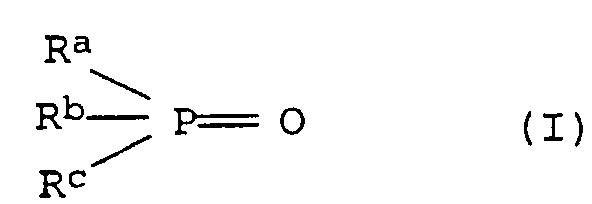
Bevorzugte Alkylreste sind hierbei C1-C20-Alkyl, insbesondere C1-C12-Alkyl, wie z.B. Methyl, Ethyl, n-Propyl, n-Butyl, Neopentyl, n-Hexyl, n-Octyl, n-Nonyl, n-Dodecyl, 2-Ethylhexyl, 3,5,5-Trimethylhexyl und substituierte Alkylreste, wie z.B. Cyanoethyl.Preferred alkyl radicals are C 1 -C 20 alkyl, in particular C 1 -C 12 alkyl, such as methyl, ethyl, n-propyl, n-butyl, neopentyl, n-hexyl, n-octyl, n-nonyl, n -Dodecyl, 2-ethylhexyl, 3,5,5-trimethylhexyl and substituted alkyl radicals, such as cyanoethyl.
Bevorzugte Arylreste sind Phenyl und Naphthyl sowie einfach oder mehrfach substituierte Reste, wie Tolyl, Xylyl, Mesityl und Cresyl.Preferred aryl radicals are phenyl and naphthyl and simple or multi-substituted radicals such as tolyl, xylyl, mesityl and Cresyl.
Bevorzugte Alkylarylreste sind C1-C20-Alkylaryl- und insbesondere C1-C12-Alkylarylreste, wobei Alkylteil und Arylteil wie oben definiert sind.Preferred alkylaryl radicals are C 1 -C 20 -alkylaryl and in particular C 1 -C 12 -alkylaryl radicals, the alkyl part and aryl part being as defined above.
Bevorzugte Cycloalkylgruppen umfassen C3-C10-Cycloalkylgruppen, wie Cyclobutyl, Cyclopentyl, Cyclohexyl und Cycloheptyl.Preferred cycloalkyl groups include C 3 -C 10 cycloalkyl groups such as cyclobutyl, cyclopentyl, cyclohexyl and cycloheptyl.
Geeignete Substituenten sind Cyano, Hydroxy, C1-4-Alkyl und Halogen, wie F, Cl, Br, J.Suitable substituents are cyano, hydroxy, C 1-4 alkyl and halogen, such as F, Cl, Br, J.

Beispiele für Phosphinoxide C1) sind Triphenylphosphinoxid, Tritolylphosphinoxid, Trisnonylphenylphosphinoxid, Tricyclohexylphosphinoxid, Tris-(n-butyl)-phosphinoxid, Tris-(n-hexyl)-phosphinoxid, Tris-(n-octyl)-phosphinoxid, Tris-(cyanoethyl)-phosphinoxid, Benzylbis-(cyclohexyl)-phosphinoxid, Benzylbisphenylphosphinoxid, Phenylbis-(n-hexyl)-phosphinoxid. Besonders bevorzugt eingesetzt werden Triphenylphosphinoxid, Tricyclohexylphosphinoxid, Tris-(n-octyl)-phosinoxid und Tris-(cyanoethyl)-phosphinoxid.Examples of phosphine oxides C1) are triphenylphosphine oxide, tritolylphosphine oxide, Trisnonylphenylphosphine oxide, tricyclohexylphosphine oxide, Tris (n-butyl) phosphine oxide, tris (n-hexyl) phosphine oxide, Tris (n-octyl) phosphine oxide, tris (cyanoethyl) phosphine oxide, Benzylbis (cyclohexyl) phosphine oxide, benzylbisphenylphosphine oxide, Phenylbis (n-hexyl) phosphine oxide. Particularly preferred triphenylphosphine oxide, tricyclohexylphosphine oxide are used, Tris (n-octyl) phosphine oxide and tris (cyanoethyl) phosphine oxide.
Als Phosphate C2) kommen vor allem alkyl- und arylsubstituierte Phosphate in Betracht. Beispiele sind Phenylbisdodecylphosphat, Phenylbisneopentylphosphat, Phenylethylhydrogenphosphat, Phenyl-bis-(3,5,5-trimethylhexylphosphat), Ethyldiphenylphosphat, Bis-(2-ethylhexyl)-p-tolyl-phosphat, Tritolylphosphat, Trixylylphosphat, Tirmesitylphosphat, Bis-(2-ethylhexyl)-phenylphosphat, Tris-(nonylphenyl)-phosphat, Bis-(dodecyl)-p-(tolyl)-phosphat, Tricresylphosphat, Triphenylphosphat, Di-butylphenylphosphat, p-Tolyl-bis-(2,5,5-trimethylhexyl)-phosphat, 2-Ethylhexyldiphenylphosphat. Besonders geeignet sind Phosphorverbindungen, bei denen jeder der Reste Ra, Rb und Rc ein Aryl-Rest ist. Ganz besonders geeignet ist dabei Triphenylphosphat, Trixylylphosphat sowie Trimesitylphosphat. Des weiteren können auch cyclische Phosphate eingesetzt werden. Besonders geeignet ist hierbei Diphenylpentaerythritol-diphosphat.Particularly suitable phosphates C2) are alkyl- and aryl-substituted phosphates. Examples are phenylbisdodecylphosphate, phenylbisneopentylphosphate, phenylethyl hydrogen phosphate, phenyl bis (3,5,5-trimethylhexyl phosphate), ethyl diphenyl phosphate, bis (2-ethylhexyl) p-tolyl phosphate, tritolyl phosphate, trixylylesylphosphate (2) ) phenyl phosphate, tris (nonylphenyl) phosphate, bis (dodecyl) p- (tolyl) phosphate, tricresyl phosphate, triphenyl phosphate, di-butylphenyl phosphate, p-tolyl-bis- (2,5,5-trimethylhexyl) - phosphate, 2-ethylhexyl diphenyl phosphate. Phosphorus compounds in which each of the radicals R a , R b and R c is an aryl radical are particularly suitable. Triphenyl phosphate, trixylyl phosphate and trimesityl phosphate are very particularly suitable. Cyclic phosphates can also be used. Diphenylpentaerythritol diphosphate is particularly suitable.
Besonders bevorzugte Mischungen aus folgenden Phosphinoxid C1)-und Phosphat C2)-Kombinationen sind: Triphenylphosphinoxid-Triphenylphosphat oder Trixylylphosphat, Tricyclohexylphosphinoxid und Triphenylphosphat, Tris(cyanoethyl)phosphinoxid und Triphenylphosphat, Tris-(n-octyl)-phosphinoxid und Triphenylphosphat. Es können auch Mischungen aus mehreren Phosphinoxiden und Phosphaten eingesetzt werden, wie etwa die Mischung Triphenylphosphinoxid, Triphenylphosphat, Trixylylphosphat.Particularly preferred mixtures of the following phosphine oxide C1) and Phosphate C2) combinations are: triphenylphosphine oxide-triphenylphosphate or trixylyl phosphate, tricyclohexylphosphine oxide and triphenyl phosphate, tris (cyanoethyl) phosphine oxide and triphenyl phosphate, Tris (n-octyl) phosphine oxide and triphenyl phosphate. Mixtures of several phosphine oxides and Phosphates are used, such as the mixture triphenylphosphine oxide, Triphenyl phosphate, trixylyl phosphate.
Das Molekulargewicht beträgt im allgemeinen nicht mehr als etwa 1000, bevorzugt etwa 150 bis etwa 800.The molecular weight is generally no more than about 1000, preferably about 150 to about 800.
Unter Borverbindungen C3) sollen erfindungsgemäß sowohl anorganische als auch organische Borverbindungen verstanden werden.According to the invention, boron compounds C3) are both inorganic as well as organic boron compounds.
Beispiele für anorganische Borverbindungen sind Borsäure, B2O3 und Salze der Borsäure, bevorzugt mit Alkali- oder Erdalkalimetallen. Besonders bevorzugt sind Borsäure, Natriumborat und Boroxid.Examples of inorganic boron compounds are boric acid, B 2 O 3 and salts of boric acid, preferably with alkali or alkaline earth metals. Boric acid, sodium borate and boron oxide are particularly preferred.
Organische Borverbindungen C3) sind beispielsweise Tetraphenylborate, wie z.B. Natriumtetraphenylborat und Tribenzylborat.Organic boron compounds C3) are, for example, tetraphenylborates, such as. Sodium tetraphenyl borate and tribenzyl borate.
Die Zusammensetzung der Komponente C) beträgt im Falle eines Gemischs
aus C1, C2 und C3 im allgemeinen (bezogen auf den Gehalt
der gesamten Komponente C).
Weiterhin geeignet als Komponente C) sind phosphororganische Verbindungen
der allgemeinen Formeln (IV), (V) und (VI)
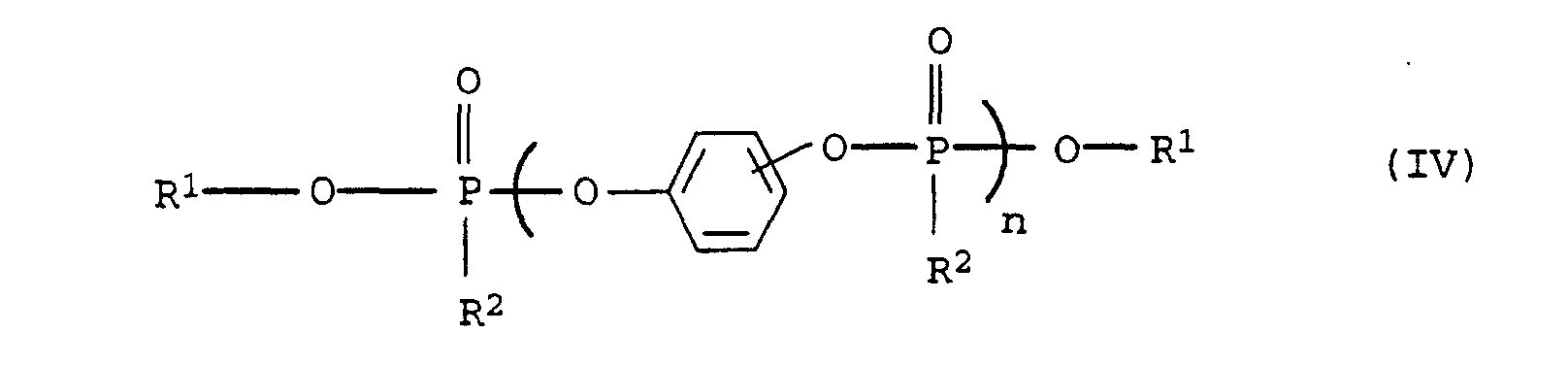

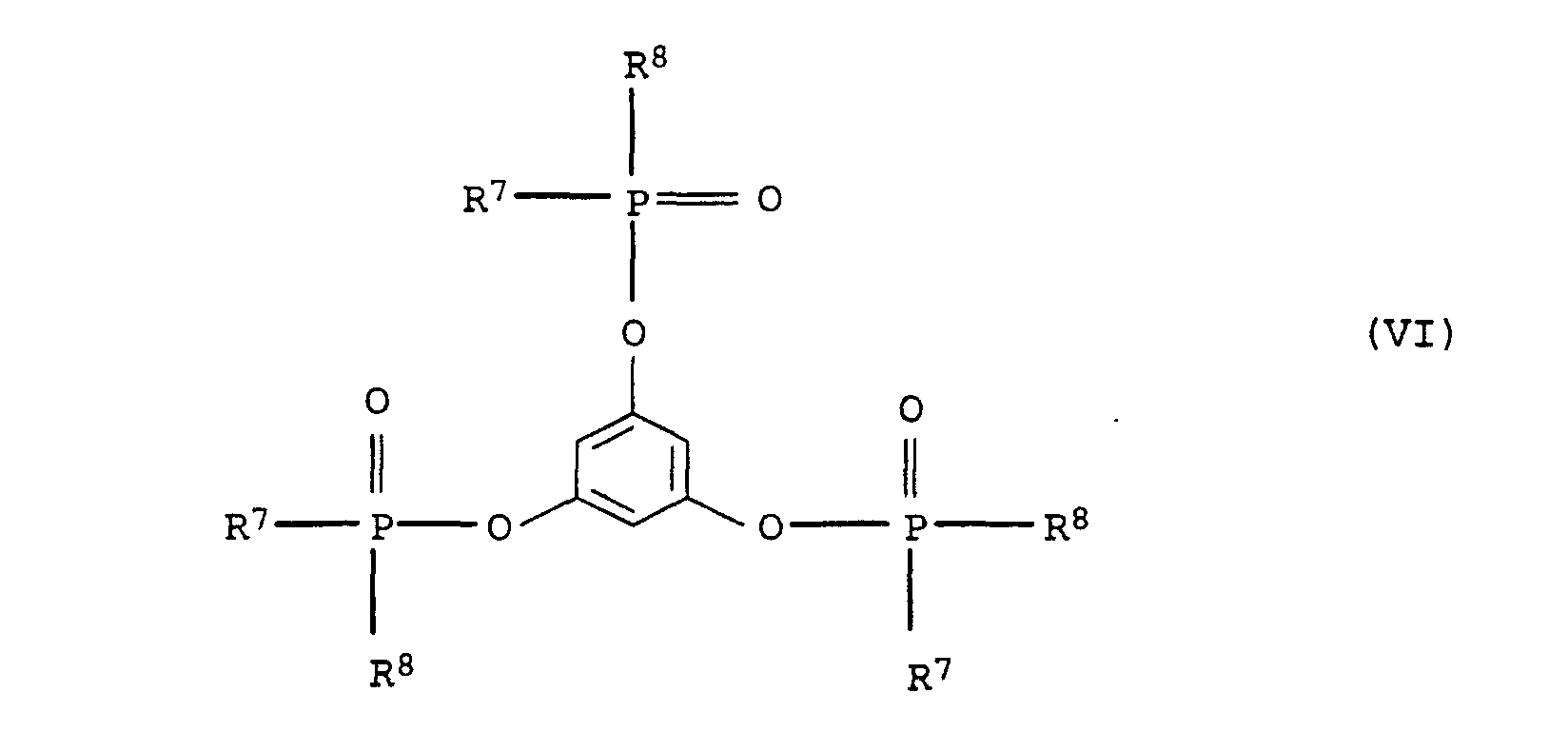
Geeignete Substituenten in Verbindungen der Formeln (IV), (V) und (VI) sind Cyano, Hydroxy, C1-C4-Alkyl und Halogen, wie F, Cl, Br, J.Suitable substituents in compounds of the formulas (IV), (V) and (VI) are cyano, hydroxy, C 1 -C 4 -alkyl and halogen, such as F, Cl, Br, J.
Bevorzugte Alkylreste in Verbindung der Formel (IV), (V) und (VI) sind C1-C20-Alkyl, insbesondere C1-C12-Alkyl, wie z.B. Methyl, Ethyl, n-Propyl, n-Butyl, Neopentyl, n-Hexyl, n-Octyl, n-Nonyl, n-Dodecyl, 2-Ethylhexyl, 3,5,5-Trimethylhexyl und Cyanoethyl.Preferred alkyl radicals in the compound of the formula (IV), (V) and (VI) are C 1 -C 20 -alkyl, in particular C 1 -C 12 -alkyl, such as, for example, methyl, ethyl, n-propyl, n-butyl, neopentyl , n-hexyl, n-octyl, n-nonyl, n-dodecyl, 2-ethylhexyl, 3,5,5-trimethylhexyl and cyanoethyl.
Bevorzugte Arylreste in Verbindung der Formeln (IV), (V) und (VI) sind Phenyl und Naphthyl sowie einfach oder mehrfach substituierte Reste, wie Tolyl, Xylyl, Mesityl und Cresyl.Preferred aryl radicals in connection with the formulas (IV), (V) and (VI) are phenyl and naphthyl as well as mono- or polysubstituted Residues such as tolyl, xylyl, mesityl and cresyl.
Bevorzugte Alkylarylreste in Verbindung der Formeln (IV), (V) und (VI) sind C1-C20-Alkylaryl- und insbesondere C1-C12-Alkylarylreste, wobei Alkylteil und Arylteil wie oben definiert sind.Preferred alkylaryl radicals in connection with the formulas (IV), (V) and (VI) are C 1 -C 20 -alkylaryl and in particular C 1 -C 12 -alkylaryl radicals, the alkyl part and aryl part being as defined above.
Bevorzugte Cycloalkylgruppen in Verbindung der Formeln (IV), (V) und (VI) umfassen C3-C10-Cycloalkylgruppen, wie Cyclobutyl, Cyclopentyl, Cyclohexyl und Cycloheptyl.Preferred cycloalkyl groups in connection with formulas (IV), (V) and (VI) include C 3 -C 10 cycloalkyl groups, such as cyclobutyl, cyclopentyl, cyclohexyl and cycloheptyl.
Bevorzugte Alkoxyreste in Verbindung der Formeln (IV), (V) und (VI) sind C1-C20-Alkoxyreste, wobei der C1-C20-Alkylteil wie oben definiert ist.Preferred alkoxy radicals in connection with the formulas (IV), (V) and (VI) are C 1 -C 20 alkoxy radicals, the C 1 -C 20 alkyl part being as defined above.
Bevorzugte Aryloxyreste in Verbindung der Formeln (IV), (V) und (VI) sind solche, worin der Arylanteil wie oben definiert ist.Preferred aryloxy radicals in connection with the formulas (IV), (V) and (VI) are those in which the aryl portion is as defined above.
Bevorzugte Alkylenreste in Verbindung der Formeln (IV), (V) und (VI) sind C1-C6-Alkylenreste, wie Methylen, Ethylen, Propylen und Hexylen.Preferred alkylene radicals in connection with the formulas (IV), (V) and (VI) are C 1 -C 6 alkylene radicals, such as methylene, ethylene, propylene and hexylene.
Die Herstellung von Phosphorsäureestern ist allgemein beschrieben in Houben-Weyl, Methoden der organischen Chemie, Bd. XII/2, Thieme Verlag, 1972. Bevorzugt werden die erfindungsgemäß verwendeten Verbindungen durch Umesterung unter Basenkatalyse bzw. durch Umsetzung von Phosphoroxichlorid mit Phenolen unter Katalyse von Magnesium- bzw. Aluminiumchlorid erhalten. Bevorzugte Verbindungen der Formel (IV) sind die handelsüblichen Produkte auf Basis von Hydrochinon- oder Resorcindiphenylphosphat. Bevorzugte Verbindungen der Formel (V) erhält man durch Reaktion eines Bisphenols (vgl. z. B. Ullmann's Encyclopedia of Industrial Chemistry, 5. Auflage, Bd. A19, S. 349), wie z. B. Bisphenol A oder The preparation of phosphoric acid esters is generally described in Houben-Weyl, Methods of Organic Chemistry, Vol. XII / 2, Thieme Verlag, 1972. Those used according to the invention are preferred Compounds by transesterification with base catalysis or by reaction of phosphorus oxychloride with phenols under catalysis obtained from magnesium or aluminum chloride. Preferred Compounds of the formula (IV) are the commercially available products based on hydroquinone or resorcinol diphenyl phosphate. Preferred Compounds of formula (V) are obtained by reacting one Bisphenols (see e.g. Ullmann's Encyclopedia of Industrial Chemistry, 5th edition, vol. A19, p. 349), such as e.g. B. bisphenol A or
Dabei ist zu beachten, daß die technisch verfügbaren Produkte jeweils Mischungen verschiedener Oligomere bzw. Isomere darstellen.It should be noted that the technically available products in each case Represent mixtures of different oligomers or isomers.
Des weiteren können Mischungen der höheren Phosphate und Monophosphate bzw. Monophosphinoxide in jedem Mischungsverhältnis eingesetzt werden.Mixtures of the higher phosphates and monophosphates can also be used or monophosphine oxides in any mixing ratio be used.
Als Komponente D) enthalten die Formmassen expandierbaren Graphit.The molding compositions contain expandable graphite as component D).
Wie dem Fachmann bekannt ist, kann Graphit aufgrund seiner
Schichtstruktur Einlagerungsverbindungen ausbilden (siehe auch:
Römpp, Chemie-Lexikon, 9. Aufl., Bd. 2, S. 1642 ff, Thieme-Verlag,
Stuttgart, 1990).As is known to the person skilled in the art, graphite can form intercalation compounds due to its layer structure (see also:
Römpp, Chemie-Lexikon, 9th edition, vol. 2, pp. 1642 ff, Thieme-Verlag, Stuttgart, 1990).
Die intercalierte Komponente wird dabei regelmäßig zwischen die Schichten des Graphits eingelagert. Beim Einlagern der Komponente findet auch eine Ausdehnung des Graphit in Richtung der c-Achse statt. Diese Einlagerung ist im allgemeinen reversibel, d.h. bei höheren Temperaturen ist eine Freisetzung der intercalierten Komponente möglich. Besonders geeignete Einlagerungsverbindungen enthalten mindestens etwa 10 Gew.-% inerte Verbindungen, die bei einer Temperatur von mindestens etwa 240°C, vorzugsweise mehr als etwa 250°C, freigesetzt werden. Geeignete inerte Verbindungen sind beispielsweise Wasser, Kohlendioxid, Schwefeltrioxid und Stickstoff.The intercalated component is regularly between the Layers of graphite embedded. When storing the component also finds an expansion of the graphite in the direction of the c-axis instead of. This storage is generally reversible, i.e. at higher temperatures is a release of the intercalated component possible. Particularly suitable storage connections contain at least about 10 wt .-% inert compounds, which at a temperature of at least about 240 ° C, preferably more than about 250 ° C, are released. Suitable inert compounds are for example water, carbon dioxide, sulfur trioxide and nitrogen.
Die Herstellung solcher Einlagerungsverbindungen ist dem Fachmann bekannt. Zur Herstellung von Einlagerungsverbindungen wird Graphit-Pulver mit der gasförmigen oder flüssigen Komponente unter Druck behandelt (siehe Ullmann's Encyclopedia of Industrial Chemistry, A5, 1986, S. 99 ff. und S. 122 ff.). Beim Erwärmen wird die eingelagerte Verbindung freigesetzt, wobei eine Volumenerhöhung um das 200-fache erfolgen kann (siehe Produktschrift "Expandable Graphite" der Firma Chuo Kasei Co., Ltd.).The preparation of such intercalation compounds is known to the person skilled in the art known. For the production of storage connections Graphite powder with the gaseous or liquid component treated under pressure (see Ullmann's Encyclopedia of Industrial Chemistry, A5, 1986, p. 99 ff. And p. 122 ff.). When warming up the stored connection is released, with an increase in volume can be done up to 200 times (see product brochure "Expandable Graphite" from Chuo Kasei Co., Ltd.).
Als Komponente E) werden vorzugsweise schlagzähmodifizierende Kautschuke eingesetzt.Impact modifiers are preferably used as component E) Rubbers used.
Als Komponente E können zusätzlich zu einer kautschukhaltigen Komponente B natürliche oder synthetische Kautschuke eingesetzt werden. Neben Naturkautschuk sind als Schlagzähmodifier z.B. Polybutadien, Polyisopren oder Mischpolymerisate des Butadiens und/oder Isoprens mit Styrol und anderen Comonomeren, die eine Glasübergangstemperatur, bestimmt nach K.H.Illers und H.Breuer, Kolloidzeitschrift 190 (1), 16-34 (1963), von etwa -100°C bis +25°C, vorzugsweise unter 0°C aufweisen. Außerdem können auch entsprechend hydrierte Produkte eingesetzt werden.As component E, in addition to a rubber-containing one Component B natural or synthetic rubbers used become. In addition to natural rubber, impact modifiers are e.g. Polybutadiene, polyisoprene or copolymers of butadiene and / or isoprene with styrene and other comonomers, the one Glass transition temperature, determined according to K.H. Illers and H. Breuer, Kolloidzeitschrift 190 (1), 16-34 (1963), from about -100 ° C to + 25 ° C, preferably below 0 ° C. You can also accordingly hydrogenated products are used.
Bevorzugte Schlagzähmodifier E sind Blockpolymere aus Vinylaromaten und Dienen. Schlagzähmodifier dieses Typs sind bekannt. In der DE-AS 1 932 234, der DE-AS 2 000 118 sowie der DE-OS 2 255 930 sind unterschiedlich aufgebaute vinylaromatische und Dienblöcke umfassende elastomere Blockcopolymerisate beschrieben. Die Verwendung entsprechender hydrierter Blockcopolymerisate gegebenenfalls im Gemisch mit der nicht hydrierten Vorstufe als Schlagzähmodifier ist beispielsweise beschrieben in der DE-OS 2 750 515, DE-OS 2 434 848, DE-OS 3 038 551, EP-A-0 080 666 und WO 83/01254. Auf die Offenbarung obiger Druckschriften wird hiermit ausdrücklich Bezug genommen.Preferred impact modifiers E are block polymers of vinyl aromatics and serve. Impact modifiers of this type are known. In DE-AS 1 932 234, DE-AS 2 000 118 and DE-OS 2 255 930 are differently structured vinyl aromatic and diene blocks Comprehensive elastomeric block copolymers described. The Use of appropriate hydrogenated block copolymers, if appropriate in a mixture with the non-hydrogenated precursor as an impact modifier is described for example in DE-OS 2 750 515, DE-OS 2 434 848, DE-OS 3 038 551, EP-A-0 080 666 and WO 83/01254. Reference is hereby made to the disclosure of the above publications expressly referred.
Insbesondere sind erfindungsgemäß brauchbar Vinylaromat-Dien-Blockcopolymerisate aus Blöcken, die eine Hartphase (Blocktyp S) und als Weichphase einen Block B/S aus Dien- und Vinylaromaten-Einheiten enthalten, der statistischen Aufbau besitzt. Der Aufbau kann dabei entlang der Kette im statistischen Mittel homogen oder inhomogen sein.Vinylaromatic-diene block copolymers are particularly useful according to the invention from blocks that have a hard phase (block type S) and as a soft phase a block B / S of diene and vinyl aromatic units included, which has a statistical structure. The structure can be homogeneous along the chain on statistical average or be inhomogeneous.
Man erhält ein solches erfindungsgemäß geeignetes kautschukelastisches Blockcopolymerisat dadurch, daß die Weichphase aus einen statistischen Copolymerisat eines Vinylaromaten mit einem Dien gebildet wird; statistische Copolymerisate von Vinylaromaten und Dienen erhält man durch Polymerisation in Gegenwart eines polaren Cosolvens.Such a rubber-elastic material which is suitable according to the invention is obtained Block copolymer in that the soft phase from one statistical copolymer of a vinyl aromatic with a diene is formed; statistical copolymers of vinyl aromatics and Diene is obtained by polymerization in the presence of a polar Cosolvent.
Ein erfindungsgemäß verwendbares Blockcopolymerisat kann z.B.
durch eine der folgenden allgemeinen Formeln (1) bis (11) dargestellt
werden:
- S
- für einen vinylaromatischen Block,
- B/S
- für die Weichphase aus einem statistisch aus Dien- und vinylaromatischen Einheiten aufgebauten Block steht,
- X
- den Rest eines n-funktionellen Initiators,
- Y
- den Rest eines m-funktionellen Kopplungsmittels und
- m,n
- natürliche Zahlen von 1 bis 10 bedeuten.
- S
- for a vinyl aromatic block,
- B / S
- stands for the soft phase from a block statistically composed of diene and vinyl aromatic units,
- X
- the rest of an n-functional initiator,
- Y
- the rest of an m-functional coupling agent and
- m, n
- natural numbers from 1 to 10 mean.
Bevorzugt ist ein Blockcopolymerisat einer der allgemeinen Formeln
S-B/S-S, X-[-B/S-S]2 und Y-[-B/S-S]2 (Bedeutung der Abkürzungen
wie vorstehend) und besonders bevorzugt ein Blockcopolymerisat,
dessen Weichphase unterteilt ist in Blöcke
Ein Blockcopolymerisat, das mehrere Blöcke B/S und/oder S mit unterschiedlicher Molmasse je Molekül aufweist, ist ebenfalls bevorzugt.A block copolymer that contains several blocks B / S and / or S with different Molecular weight per molecule is also preferred.
Ebenso kann an die Stelle eines ausschließlich aus vinylaromatischen
Einheiten aufgebauten Blocks S ein Block B treten, da es
insgesamt lediglich darauf ankommt, daß ein kautschukelastisches
Blockcopolymerisat gebildet wird. Solche Copolymerisate können
z.B. eine der Strukturen (15) bis (18) haben
Bevorzugte Vinylaromaten sind Styrol, o-Methylstyrol, Vinyltoluol oder Mischungen dieser Verbindungen. Bevorzugte Diene sind Butadien, Isopren, Piperylen, 1-Phenylbutadien oder Mischungen dieser Verbindungen. Eine besonders bevorzugte Monomerkombination ist Butadien und Styrol.Preferred vinyl aromatics are styrene, o-methylstyrene, vinyl toluene or mixtures of these compounds. Preferred dienes are butadiene, Isoprene, piperylene, 1-phenylbutadiene or mixtures thereof Links. A particularly preferred combination of monomers is Butadiene and styrene.
Besonders bevorzugt sind die Weichblöcke aus etwa 25 bis 75 Gew.-% Styrol und etwa 25 bis 75 Gew.-% Butadien aufgebaut. Insbesondere bevorzugt sind Weichblöcke, die einen Butadienanteil von etwa 34 bis 69 Gew.-% und einen Styrolanteil etwa von 31 bis 66 Gew.-% enthalten.The soft blocks of about 25 to are particularly preferred 75 wt .-% styrene and about 25 to 75 wt .-% butadiene built. Particularly preferred are soft blocks that have a butadiene content from about 34 to 69% by weight and a styrene content from about 31 to Contain 66 wt .-%.
Der Gewichtsanteil des Diens im gesamten Blockcopolymer liegt im Falle der Monomerkombination Styrol/Butadien bei 15 bis 65 Gew.-%, derjenige der vinylaromatischen Komponente entsprechend bei 85 bis 35 Gew.-%. Besonders bevorzugt sind Butadien-Styrol-Blockcopolymere mit einer Monomerzusammensetzung aus 25 bis 60 Gew.-% Dien und 75 bis 40 Gew.-% an vinylaromatischer Verbindung.The proportion by weight of diene in the entire block copolymer is in In the case of the styrene / butadiene monomer combination at 15 to 65 wt .-%, corresponding to that of the vinyl aromatic component at 85 to 35% by weight. Butadiene-styrene block copolymers are particularly preferred with a monomer composition of 25 up to 60% by weight of diene and 75 to 40% by weight of vinyl aromatic compound.
Die Blockcopolymere sind durch anionische Polymerisation in einem unpolaren Lösungsmittel unter Zusatz eines polaren Cosolvens erhältlich. Es besteht dabei die Vorstellung, daß das Cosolvens gegenüber dem Metallkation als Lewis-Base wirkt. Als Lösungsmittel werden bevorzugt aliphatische Kohlenwasserstoffe, wie Cyclohexan oder Methylcyclohexan, verwendet. Als Lewis-Basen werden polare aprotische Verbindungen, wie Ether und tertiäre Amine, bevorzugt. Beispiele für besonders effektive Ether sind Tetrahydrofuran und aliphatische Polyether wie Diethylenglycoldimethyl-ether. Als tertiäre Amine sind Tributylamin und Pyridin zu nennen. Das polare Cosolvens wird dem unpolaren Lösungsmittel in einer geringen Menge, z.B. von 0,5 bis 5 Vol.-%, zugesetzt. Besonders bevorzugt ist Tetrahydrofuran in einer Menge von 0,1 bis 0,3 Vol.-%. Erfahrungsgemäß kommt man mit einer Menge von etwa 0,2 Vol.-% in den meisten Fällen aus.The block copolymers are in one by anionic polymerization Non-polar solvent available with the addition of a polar cosolvent. There is a notion that the cosolvent is opposite the metal cation acts as a Lewis base. As a solvent are preferred aliphatic hydrocarbons such as cyclohexane or methylcyclohexane. The Lewis bases are polar aprotic compounds such as ethers and tertiary amines are preferred. Examples of particularly effective ethers are tetrahydrofuran and aliphatic polyethers such as diethylene glycol dimethyl ether. As tertiary amines include tributylamine and pyridine. The polar Cosolvens will use the non-polar solvent in a small amount Amount, e.g. from 0.5 to 5% by volume. Particularly preferred is tetrahydrofuran in an amount of 0.1 to 0.3% by volume. According to experience comes with an amount of about 0.2 vol .-% in the most cases.
Durch die Dosierung und Struktur der Lewis-Base werden die Copolymerisationsparameter und der Anteil an 1,2- bzw. 1,4-Verknüpfungen der Dieneinheiten bestimmt. Die erfindungsgemäßen Polymere haben z.B. einen Anteil von 15 bis 40% an 1,2-Verknüpfungen und 85 bis 60% an 1,4-Verknüpfungen bezogen auf alle Dieneinheiten.The copolymerization parameters are determined by the dosage and structure of the Lewis base and the proportion of 1,2 or 1,4 links of the service units. The invention Polymers e.g. a share of 15 to 40% in 1,2 links and 85 to 60% of 1,4 linkages based on all diene units.
Die anionische Polymerisation wird mittels metallorganischer Verbindungen initiiert. Bevorzugt sind Verbindungen der Alkalimetalle, besonders des Lithiums. Beispiele für Initiatoren sind Methyllithium, Ethyllithium, Propyllithium, n-Butyllithium, sek.-Butyllithium und tert.-Butyllithium. Die metallorganische Verbindung wird als Lösung in einem chemisch indifferenten (inerten) Kohlenwasserstoff zugesetzt. Die Dosierung richtet sich nach dem angestrebten Molekulargewicht des Polymers, liegt aber in der Regel im Bereich von 0,002 bis 5 Mol%, wenn man sie auf die Monomeren bezieht. The anionic polymerization is carried out using organometallic compounds initiated. Compounds of the alkali metals are preferred, especially lithium. Examples of initiators are methyl lithium, Ethyllithium, propyllithium, n-butyllithium, sec-butyllithium and tert-butyllithium. The organometallic compound is used as a solution in a chemically indifferent (inert) Added hydrocarbon. The dosage depends on the target molecular weight of the polymer, but is usually in the range of 0.002 to 5 mol% when viewed on the monomers relates.
Die Polymerisationstemperatur kann etwa 0 bis 130°C betragen. Bevorzugt wird der Temperaturbereich von 30 bis 100°C.The polymerization temperature can be about 0 to 130 ° C. Prefers the temperature range is from 30 to 100 ° C.
Für die mechanischen Eigenschaften ist der Volumenanteil der Weichphase im Festkörper von entscheidender Bedeutung. Erfindungsgemäß liegt der Volumenanteil der aus Dien- und vinylaromatischen Sequenzen aufgebauten Weichphase bei 60 bis 95, bevorzugt bei 70 bis 90 und besonders bevorzugt bei 80 bis 90 Vol.-%. Die aus den vinylaromatischen Monomeren entstandenen Blöcke A bilden die Hartphase, deren Volumenanteil entsprechend 1 bis 40, bevorzugt 10 bis 30 und besonder bevorzugt 10 bis 20 Vol.-% ausmacht.For the mechanical properties, the volume fraction is the Soft phase in the solid is of crucial importance. According to the invention is the volume fraction of those from diene and vinyl aromatic Sequences built soft phase at 60 to 95, preferred at 70 to 90 and particularly preferably at 80 to 90% by volume. The form blocks A formed from the vinyl aromatic monomers the hard phase, the volume fraction corresponding to 1 to 40, preferred 10 to 30 and particularly preferably 10 to 20 vol .-%.
Es ist darauf hinzuweisen, daß zwischen den oben erwähnten Mengenverhältnissen von vinylaromatischer Verbindung und Dien, den vorstehend angegebenen Grenzwerten der Phasenvolumina und der Zusammensetzung, die sich aus den erfindungsgemäßen Bereichen der Glastemperatur ergibt, keine strenge Übereinstimmung besteht, da es sich um jeweils auf volle Zehnerstellen gerundete Zahlenwerte handelt. Dies könnte vielmehr nur zufällig der Fall sein.It should be noted that between the proportions mentioned above of vinyl aromatic compound and diene limit values of phase volumes and composition given above, which arise from the areas of the invention Glass temperature results, there is no strict match because numerical values rounded to the nearest ten digits acts. Rather, this could only happen accidentally.
Meßbar ist der Volumenanteil der beiden Phasen mittels kontrastierter Elektronenmikroskopie oder Festkörper-NMR-Spektroskopie. Der Anteil der vinylaromatischen Blöcke läßt sich nach Osmiumabbau des Polydienanteils durch Fällen und Auswiegen bestimmen. Das künftige Phasenverhältnis eines Polymers läßt sich auch aus den eingesetzten Monomermengen berechnen, wenn man jedesmal vollständig auspolymerisieren läßt.The volume fraction of the two phases can be measured by means of contrasted Electron microscopy or solid-state NMR spectroscopy. The proportion of vinyl aromatic blocks can be broken down after osmium degradation determine the proportion of polydiene by felling and weighing. The future phase relationship of a polymer can also be determined from the Calculate the amount of monomers used if you complete each time polymerize out.
Im Sinne der Erfindung eindeutig definiert wird das Blockcopolymere durch den Quotienten aus dem Volumenanteil in Prozent der aus den B/S-Blöcken gebildeten Weichphase und dem Anteil an Dieneinheiten in der Weichphase, der für die Kombination Styrol/ Butadien zwischen 25 und 70 Gew.-% liegt.The block copolymer is clearly defined in the sense of the invention by the quotient from the volume share in percent of from the B / S blocks formed soft phase and the proportion of diene units in the soft phase, which for the combination styrene / Butadiene is between 25 and 70 wt .-%.
Durch den statischen Einbau der vinylaromatischen Verbindungen in den Weichblock des Blockcopolymeren und die Verwendung von Lewis-Basen während der Polymerisation wird die Glasübergangstemperatur (Tg) beeinflußt. Die Glasübergangstemperatur des gesamten Copolymers beträgt vorzugsweise -50°C bis +25°C, bevorzugt weniger als 0°C.The static incorporation of the vinyl aromatic compounds in the soft block of the block copolymer and the use of Lewis bases during the polymerization the glass transition temperature (Tg) affected. The glass transition temperature of the entire copolymer is preferably -50 ° C to + 25 ° C, preferably less than 0 ° C.
Das Molekulargewicht des Blocks S beträgt vorzugsweise 1000 bis 200.000, insbesondere 3.000 und 80.000 [g/mol]. Innerhalb eines Moleküls können S-Blöcke unterschiedliche Molmasse haben. The molecular weight of the block S is preferably 1000 to 200,000, in particular 3,000 and 80,000 [g / mol]. Within a Molecule S blocks can have different molecular weights.
Das Molekulargewicht des Blocks B/S beträgt üblicherweise von 2.000 bis 250.000 [g/mol]; bevorzugt sind Werte von 5.000 bis 150.000 [g/mol].The molecular weight of the block B / S is usually from 2,000 to 250,000 [g / mol]; values from 5,000 to are preferred 150,000 [g / mol].
Auch Block B/S kann wie Block S innerhalb eines Moleküls unterschiedliche Molekulargewichtswerte einnehmen.Block B / S, like block S, can differ within a molecule Take molecular weight values.
Das Kupplungszentrum X wird durch die Umsetzung der lebenden anionischen Kettenenden mit einem mindestens bifunktionellen Kupplungsagens gebildet. Beispiele für derartige Verbindungen sind in den US-PSen 3 985 830, 3 280 084, 3 637 554 und 4 091 053 zu finden. Bevorzugt werden z.B. epoxidierte Glyceride wie epoxidiertes Leinsamenöl oder Sojaöl eingesetzt; geeignet ist auch Divinylbenzol. Speziell für die Dimerisierung sind Dichlordialkylsilane, Dialdehyde, wie Terephthalaldehyd, und Ester, wie Ethylformiat oder -benzoat, geeignet.The coupling center X is implemented by the living anionic chain ends with an at least bifunctional Coupling agent formed. Examples of such connections are in U.S. Patents 3,985,830, 3,280,084, 3,637,554 and 4,091,053 to find. For example, epoxidized glycerides such as epoxidized Linseed oil or soybean oil used; divinylbenzene is also suitable. Dichlorodialkylsilanes, especially for dimerization, Dialdehydes such as terephthalaldehyde and esters such as ethyl formate or benzoate.
Bevorzugte Polymerstrukturen sind S-B/S-S, X-[-B/S-S]2 und Y-[-B/S-S]2, wobei der statistische Block B/S selbst wieder in Blöcke B1/S1-B2/S2-B3/S3-... unterteilt sein kann. Bevorzugt besteht der statistische Block aus 2 bis 15 statistischen Teilblöcken, besonders bevorzugt aus 3 bis 10 Teilblöcken. Die Aufteilung des statistischen Blocks B/S in möglichst viele Teilblöcke Bn/Sn bietet den entscheidenden Vorteil, daß auch bei einem Zusammensetzungsgradienten innerhalb eines Teilblocks Bn/Sn, wie er sich in der anionischen Polymerisation unter praktischen Bedingungen nur schwer vermeiden läßt, sich der B/S-Block insgesamt wie ein nahezu perfektes statistisches Polymer verhält. Es bietet sich deshalb an, weniger als die theoretische Menge an Lewis-Base zuzusetzen, was den Anteil 1,4-Dienverknüpfungen erhöht, die Glastemperatur Tg absenkt und die Vernetzungsanfälligkeit des Polymeren mindert. Ein größerer oder ein kleinerer Anteil der Teilblöcke kann mit einem hohen Dienanteil ausgestattet werden. Dies bewirkt, daß das Polymer auch unterhalb der Glastemperatur der überwiegenden B/S-Blöcke eine Restzähigkeit behält und nicht vollständig versprödet.Preferred polymer structures are SB / SS, X - [- B / SS] 2 and Y - [- B / SS] 2 , the statistical block B / S itself again being in blocks B1 / S1-B2 / S2-B3 / S3- ... can be divided. The statistical block preferably consists of 2 to 15 statistical sub-blocks, particularly preferably 3 to 10 sub-blocks. The division of the statistical block B / S into as many sub-blocks Bn / Sn as possible offers the decisive advantage that even with a composition gradient within a sub-block Bn / Sn, as is difficult to avoid under practical conditions in anionic polymerization, the B / S block behaves like an almost perfect statistical polymer. It therefore makes sense to add less than the theoretical amount of Lewis base, which increases the proportion of 1,4-diene linkages, lowers the glass transition temperature Tg and reduces the susceptibility to crosslinking of the polymer. A larger or a smaller proportion of the partial blocks can be equipped with a high proportion of diene. This means that the polymer retains its residual toughness even below the glass transition temperature of the predominant B / S blocks and does not become completely brittle.
Alle oben angegebenen Gewichts- und Volumenangaben beziehen sich auf die Monomerkombination Butadien/Styrol. Diese Angaben können jedoch ohne weiteres auf andere zu Styrol und Butadien technisch äquivalente Monomere umgerechnet werden.All weight and volume data given above refer to on the monomer combination butadiene / styrene. This information can however, readily to others technically on styrene and butadiene equivalent monomers can be converted.
Die Blockcopolymeren können dadurch aufgearbeitet werden, daß die Carbanionen mit einem Alkohol, wie Isopropanol, protoniert werden, die Reaktionsmischung angesäuert wird, z.B. mit einem Gemisch aus CO2 und Wasser und das Lösungsmittel entfernt wird. Die Blockcopolymeren können Oxidationsinhibitoren und Antiblockmittel enthalten.The block copolymers can be worked up by protonating the carbanions with an alcohol such as isopropanol, acidifying the reaction mixture, for example using a mixture of CO 2 and water, and removing the solvent. The block copolymers can contain oxidation inhibitors and antiblocking agents.
Auch Gemische obiger Kautschuke sind in den erfindungsgemäßen Formmassen einsetzbar.Mixtures of the above rubbers are also in the inventive Molding compounds can be used.
Als Komponente F) können die erfindungsgemäßen Formmassen gegebenenfalls übliche Zusatzstoffe und Verarbeitungshilfsmittel enthalten.The molding compositions according to the invention can optionally be used as component F) Contain usual additives and processing aids.
Als Zusatzstoffe seien genannt Hitze- und Lichtstabilisatoren, Gleit- und Entformungsmittel, Färbemittel, wie Farbstoffe und Pigmente in üblichen Mengen. Weitere Zusatzstoffe sind Verstärkungsmittel, wie Glasfasern, Asbestfasern, Kohlenstoff-Fasern, aromatische Polyamidfasern und/oder Füllstoffe, Gipsfasern, synthetische Calciumsilikate, Kaolin, calciniertes Kaolin, Wollastonit, Talkum und Kreide.Heat and light stabilizers may be mentioned as additives, Lubricants and mold release agents, colorants such as dyes and Pigments in usual quantities. Other additives are reinforcing agents, such as glass fibers, asbestos fibers, carbon fibers, aromatic polyamide fibers and / or fillers, gypsum fibers, synthetic calcium silicates, kaolin, calcined kaolin, wollastonite, Talc and chalk.
Auch niedermolekulare oder hochmolekulare Polymere kommen als Zusatzstoffe in Betracht, wobei Polyethylenwachs als Gleitmittel besonders bevorzugt ist.Low molecular or high molecular weight polymers also come as Additives into consideration, using polyethylene wax as a lubricant is particularly preferred.
Als Pigmente kommen z.B. in Frage TiO2 und Ruße.Examples of suitable pigments are TiO 2 and carbon blacks.
Bei Verwendung von TiO2 liegt die mittlere Teilchengröße im Bereich von etwa 50 bis 400 nm, insbesondere etwa 150 bis 240 nm. Technische Verwendung finden Rutile und Anatas, die gegebenenfalls mit Metalloxiden, z.B. Al-oxid, Si-Oxiden, Zn-Oxiden oder Siloxanen beschichtet sind.When using TiO 2 , the average particle size is in the range from about 50 to 400 nm, in particular about 150 to 240 nm. Rutiles and anatase are used industrially, optionally with metal oxides, for example Al-oxide, Si-oxides, Zn-oxides or Siloxanes are coated.
Ruße umfassen mikrokristallinen, feinteiligen Kohlenstoff (vgl. Kunststofflexikon, 7. Auflage 1980). Geeignet sind Ofenruße, Acetylenruße, Gasruße sowie die durch thermische Herstellung erhältlichen Thermalruße. Die Teilchengrößen liegen vorzugsweise im Bereich von etwa 0,01 bis 0,1 µm und die Oberflächen im Bereich von etwa 102 bis 104 m2/g (BET/ASTM D 3037) bei DBP-Absorption von etwa 102 bis 103 ml/100 g (BET/ASTM d 2414).Carbon blacks comprise microcrystalline, finely divided carbon (cf. plastic dictionary, 7th edition 1980). Furnace blacks, acetylene blacks, gas blacks and the thermal blacks obtainable by thermal production are suitable. The particle sizes are preferably in the range from approximately 0.01 to 0.1 μm and the surfaces in the range from approximately 10 2 to 10 4 m 2 / g (BET / ASTM D 3037) with DBP absorption of approximately 10 2 to 10 3 ml / 100 g (BET / ASTM d 2414).
Über Art und Menge dieser Zusatzstoffe lassen sich die gewünschten Eigenschaften der Endprodukte in weitem Maße steuern.The type and quantity of these additives can be used to achieve the desired Control properties of end products to a large extent.
Die Herstellung der erfindungsgemäßen Formmassen erfolgt zweckmäßigerweise durch Mischen der Komponenten bei Temperaturen im Bereich von 230 bis 320°C in üblichen Mischvorrichtungen, wie z.B. Knetern, Banburrymischern und Einschneckenextrudern, vorzugsweise mit einem Zweischneckenextruder, wobei jedoch zu beachten ist, daß die Verarbeitung unterhalb der Temperatur erfolgen muß, bei der eine Freisetzung der inerten Verbindung erfolgt. Um eine möglichst homogene Formmasse zu erhalten, ist eine intensive Durchmischung notwendig. Die Reihenfolge des Mischens der Komponenten kann variiert werden, es können zwei oder gegebenenfalls mehrere Komponenten vorgemischt sein oder es können auch alle Komponenten gemeinsam gemischt werden.The molding compositions according to the invention are expediently produced by mixing the components at temperatures in the Range from 230 to 320 ° C in conventional mixing devices, e.g. Kneaders, Banbury mixers and single screw extruders, preferably with a twin-screw extruder, but please note that processing must take place below the temperature at which releases the inert compound. To one if possible Obtaining a homogeneous molding compound is intensive mixing necessary. The order of mixing the components can be varied, two or optionally more Components can be premixed or all components can be mixed together.
Aus den erfindungsgemäßen Formmassen lassen sich z.B. durch Spritzguß oder Extrusion Formkörper herstellen, die flammwidrig sind und bei der Brandprüfung nach UL 94 nicht zum brennenden Abtropfen neigen.From the molding compositions according to the invention, e.g. by Injection molding or extrusion make molded articles that are flame retardant and are not burning during the fire test according to UL 94 They tend to drain.
Die erfindungsgemäßen Formmassen eignen sich sehr gut zur Herstellung von Formteilen aller Art, z.B. durch Spritzguß oder Extrusion. Sie können weiterhin zur Herstellung von Folien und Halbzeug im Tiefzieh- oder Blasverfahren verwendet werden.The molding compositions according to the invention are very suitable for production of all kinds of molded parts, e.g. by injection molding or Extrusion. You can continue to make films and Semi-finished products can be used in the deep-drawing or blowing process.
Unter Verwendung der unten aufgeführten Komponenten A) bis F) werden die erfindungsgemäßen Formmassen 1, 2 und 3 sowie zu Vergleichszwecken die Formmassen V1 und V2 hergestellt und getestet.Using the components A) to F) listed below, the molding compositions 1 , 2 and 3 according to the invention and, for comparison purposes, the molding compositions V1 and V2 are produced and tested.
Poly-2,6-dimethyl-1,4-phenylenether mit einem mittleren Molekulargewicht (Mw) von 40000 g/mol.Poly-2,6-dimethyl-1,4-phenylene ether with an average molecular weight (M w ) of 40,000 g / mol.
Schlagfestes Polystyrol mit 9 Gew.-% Polybutadien und Zellteilchenmorphologie, mittlere Teilchengröße der Weichkomponente von 1,9 µm. Die VZ der Hartmatrix betrug 80 ml/g (0,5 %-ig in Toluol bei 23°C).Impact-resistant polystyrene with 9% by weight polybutadiene and cell particle morphology, average particle size of the soft component of 1.9 µm. The VZ of the hard matrix was 80 ml / g (0.5% in toluene at 23 ° C).
Schlagfestes Polystyrol mit 11 Gew.-% Polybutadien und Zellteilchenmorphologie, mittlere Teilchengröße der Weichkomponente von 3,5 µm. Die VZ der Hartmatrix betrug 80 ml/g (0,5 %-ig in Toluol bei 23°C).Impact-resistant polystyrene with 11% by weight polybutadiene and cell particle morphology, average particle size of the soft component of 3.5 µm. The VZ of the hard matrix was 80 ml / g (0.5% in toluene at 23 ° C).
Resorcinoldiphosphat, z.B. Fyroflex RDP (Akzo).Resorcinol diphosphate, e.g. Fyroflex RDP (Akzo).
Expandierbarer Graphit, z.B. Sigraflex FR 90-60/80. Expandable graphite, e.g. Sigraflex FR 90-60 / 80.
SEBS Blockkautschuk Kraton G 1650 (Shell AG).SEBS block rubber Kraton G 1650 (Shell AG).
Ruß Black Pearls 880 (als 15 %-iger Batch in Polystyrol, VZ=80 ml/g 0,5 %-ig in Toluol bei 23°C).Soot Black Pearls 880 (as a 15% batch in polystyrene, VZ = 80 ml / g 0.5% in toluene at 23 ° C).
Die Komponenten A) und F) wurden auf einem Zweiwellenextruder (ZKS 30 der Fa. Werner & Pfleiderer) bei 240°C gemischt, als Strang ausgetragen, gekühlt und granuliert.Components A) and F) were on a twin-screw extruder (ZKS 30 from Werner & Pfleiderer) mixed at 240 ° C as Extruded, chilled and granulated.
Das getrocknete Granulat wurde bei 240 bis 260°C zu Rundscheiben, Flachstäben für die UL 94-Prüfung, und Normkleinstäben verarbeitet.The dried granules became round disks at 240 to 260 ° C, Flat bars for UL 94 testing and standard small bars processed.
Die Schädigungsarbeit Ws wurde nach DIN 53 443 bei 23°C bestimmt. Die Wärmeformbeständigkeit der Proben wurde mittels der Vicat-Erweichungstemperatur, bestimmt nach DIN 53 460, mit einer Kraft von 49,05 N und einer Temperatursteigerung von 50 K je Stunde, an Normkleinstäben ermittelt.The damage work W s was determined according to DIN 53 443 at 23 ° C. The heat resistance of the samples was determined by means of the Vicat softening temperature, determined according to DIN 53 460, with a force of 49.05 N and a temperature increase of 50 K per hour on standard small bars.
Die Flammwidrigkeit und das Abtropfverhalten wurde nach UL 94 an Stäben von 1/16"-Dicke bestimmt, die angeführten Brandzeiten stellen die Summe der Brandzeiten aus beiden Beflammungen dar.The flame retardancy and the dripping behavior was according to UL 94 Rods of 1/16 "thickness determine the stated fire times represent the sum of the fire times from both flames.
Die Zusammensetzungen und Eigenschaften der thermoplastischen
Formmassen sind in der Tabelle 1 zusammengestellt.
Brandzeit [s]
74
76
42
154
89
Fire time [s]
74
76
42
154
89
Die Versuche belegen die überraschend hohe Wirksamkeit der Komponente D) als Antitropfmittel.58/hzThe tests prove the surprisingly high effectiveness of the component D) as an anti-drip agent. 58 / hz
Claims (9)
- A flame-retardant, thermoplastic molding material containingwherein said molding material furthermore comprisesA) at least one polyphenylene ether,B) at least one vinylaromatic polymer andC) at least one flameproofing agent which is different from red phosphorus,
D) an amount of expandable graphite which increases the resistance of the molding material to dripping. - A molding material as claimed in claim 1, wherein the expandable graphite is present in an amount of from about 0.5 to about 10% by weight.
- A molding material as claimed in claim 2, containing, based in each case on the total weight of the molding material,A) from about 5 to about 97.5% by weight of polyphenylene ether,B) from about 1 to about 93.5% by weight of styrene polymer,C) from about 1 to about 20% by weight of flameproofing agent,D) from about 0.5 to about 10% by weight of expandable graphite,E) from about 0 to about 50% by weight of impact modifier andF) from about 0 to about 60% by weight of conventional additives.
- A thermoplastic molding material as claimed in any of claims 1 to 3, wherein component D) is an intercalation compound comprising graphite and an inert compound, the liberation of which takes place at above about 240°C at about atmospheric pressure.
- A thermoplastic molding material as claimed in claim 4, the amount of the inert compound being at least 10% by weight, based on component D).
- A thermoplastic molding material as claimed in claim 5, the inert compound being selected from H2O, CO2, SO3 and N2.
- A thermoplastic molding material as claimed in any of claims 1 to 6, wherein the flameproofing agent used is resorcinol diphenyl phosphate or hydroquinone diphenyl phosphate.
- The use of a molding material as claimed in any of claims 1 to 7 for the production of flame-retardant moldings, fibers and films.
- A flame-retardant molding, fiber or film produced using a molding material as claimed in any of claims 1 to 7.
Applications Claiming Priority (3)
| Application Number | Priority Date | Filing Date | Title |
|---|---|---|---|
| DE19621732 | 1996-05-30 | ||
| DE19621732A DE19621732A1 (en) | 1996-05-30 | 1996-05-30 | Flame-retardant thermoplastic molding compounds with improved drip resistance |
| PCT/EP1997/002792 WO1997045486A1 (en) | 1996-05-30 | 1997-05-28 | Non-flammable, thermoplastic moulded materials with improved anti-drip properties |
Publications (2)
| Publication Number | Publication Date |
|---|---|
| EP0902811A1 EP0902811A1 (en) | 1999-03-24 |
| EP0902811B1 true EP0902811B1 (en) | 2001-08-08 |
Family
ID=7795696
Family Applications (1)
| Application Number | Title | Priority Date | Filing Date |
|---|---|---|---|
| EP97927075A Expired - Lifetime EP0902811B1 (en) | 1996-05-30 | 1997-05-28 | Non-flammable, thermoplastic moulded materials with improved anti-drip properties |
Country Status (6)
| Country | Link |
|---|---|
| US (1) | US6197869B1 (en) |
| EP (1) | EP0902811B1 (en) |
| JP (1) | JP2000510899A (en) |
| DE (2) | DE19621732A1 (en) |
| ES (1) | ES2161467T3 (en) |
| WO (1) | WO1997045486A1 (en) |
Families Citing this family (8)
| Publication number | Priority date | Publication date | Assignee | Title |
|---|---|---|---|---|
| DE69736026T2 (en) * | 1996-03-08 | 2006-12-07 | Tosoh Corp., Shinnanyo | FLAME-REDUCING PLASTIC COMPOSITION |
| GB0229810D0 (en) * | 2002-12-20 | 2003-01-29 | Vantico Ag | Flame retardant polymer compositions |
| WO2006131572A1 (en) * | 2005-06-08 | 2006-12-14 | Grupo Industrial Catensa, S.A. | Fire-retardant felt material |
| US8057873B2 (en) * | 2008-04-28 | 2011-11-15 | Sabic Innovative Plastics Ip B.V. | Injection molded article and method for the manufacture thereof |
| CN102037798A (en) * | 2008-05-23 | 2011-04-27 | 日立化成工业株式会社 | Heat sink and cooling device |
| US8524137B2 (en) | 2011-05-26 | 2013-09-03 | Sabic Innovative Plastics Ip B.V. | Injection molded article and method for the manufacture thereof |
| US8722839B2 (en) | 2012-06-04 | 2014-05-13 | Sabic Innovative Plastics Ip B.V. | Poly(phenylene ether) fiber and method of making |
| DE202019001135U1 (en) | 2019-03-08 | 2019-04-11 | Emano Kunststofftechnik Gmbh | Polymer composite material for storage containers for gases and liquids made of plastic |
Family Cites Families (30)
| Publication number | Priority date | Publication date | Assignee | Title |
|---|---|---|---|---|
| BE520039A (en) | 1950-08-25 | |||
| US2862906A (en) | 1957-04-01 | 1958-12-02 | Monsanto Chemcial Company | Suspension process for the polymerization of vinylidene aromatic hydrocarbons |
| BE638995A (en) | 1962-07-16 | |||
| NL141540B (en) | 1965-01-06 | 1974-03-15 | Gen Electric | PROCESS FOR PREPARING A POLYSTYRENE CONTAINING POLYMER MIXTURE WHICH CAN BE PROCESSED INTO PRODUCTS WITH HIGH BENDING AND TENSILE STRENGTHS, AS WELL AS SUCH PRODUCTS. |
| NL133447C (en) | 1966-11-07 | |||
| US3639508A (en) | 1969-01-03 | 1972-02-01 | Gen Electric | Thermoplastic blends of polyarylene oxide and block polymer and method for making them |
| US3660531A (en) | 1969-06-04 | 1972-05-02 | Uniroyal Inc | Thermoplastic resin blend of polyphenylene oxide with butadiene-containing polymers |
| US4128602A (en) | 1970-04-24 | 1978-12-05 | General Electric Company | Polyphenylene ether compositions containing rubber modified polystyrene |
| CA1045269A (en) * | 1973-07-30 | 1978-12-26 | Tai M. Chang | Flame retardant and drip resistant thermoplastics |
| DE2434848C2 (en) | 1973-08-13 | 1986-09-04 | General Electric Co., Schenectady, N.Y. | Thermoplastic mass |
| US3994856A (en) | 1973-11-09 | 1976-11-30 | General Electric Company | Composition of a polyphenylene ether and a block copolymer of a vinyl aromatic compound and a conjugated diene |
| US3985830B1 (en) | 1974-07-15 | 1998-03-03 | Univ Akron | Star polymers and process for the preparation thereof |
| US4128603A (en) | 1974-07-18 | 1978-12-05 | General Electric Company | Compositions comprising polyphenylene ether and rubber modified polystyrene |
| AU8671075A (en) | 1974-12-06 | 1977-05-26 | Gen Electric | Flame retardant, non-dripping composition of polyphenylene ether and acrylonitrile - butadiene-styrene |
| US4091053A (en) | 1976-06-24 | 1978-05-23 | Phillips Petroleum Company | Coupled resinous diene copolymer with good integral hinge flex life and high hardness |
| DE2750515A1 (en) | 1976-12-22 | 1978-06-29 | Gen Electric | POLYPHENYLENE ETHER COMPOSITIONS WITH HIGH IMPACT RESISTANCE AND IMPROVED FORMABILITY |
| JPS5448852A (en) | 1977-09-27 | 1979-04-17 | Asahi Chem Ind Co Ltd | Thermoplastic polymer composition |
| NL8005597A (en) | 1979-10-15 | 1981-04-21 | Gen Electric | MIXTURES OF POLYPHENYLENE OXIDE AND SOFTENER. |
| US4544703A (en) | 1981-10-02 | 1985-10-01 | General Electric Company | High impact thermoplastic compositions containing diblock impact modifier |
| US4360618A (en) | 1981-11-19 | 1982-11-23 | Monsanto Company | Low acrylonitrile content styrene-acrylonitrile polymers blended with polyphenylene oxide |
| US4383082A (en) | 1981-12-01 | 1983-05-10 | General Electric Company | Polyphenylene ether resin compositions containing polyolefin in high amount |
| US4405753A (en) | 1982-02-03 | 1983-09-20 | Monsanto Company | Polyblends |
| US4504613A (en) * | 1983-08-19 | 1985-03-12 | General Electric Company | Polyphenylene ether resin compositions having improved ductile impact strength |
| GB8432153D0 (en) | 1984-12-20 | 1985-01-30 | Dunlop Ltd | Polyurethane foams |
| NL8502116A (en) | 1985-07-24 | 1987-02-16 | Gen Electric | PROCESS FOR PREPARING A POLYMER MIXTURE CONTAINING A POLYPHENYLENE ETHER AND A POLYAMIDE |
| JPH0813902B2 (en) | 1987-07-02 | 1996-02-14 | ライオン株式会社 | Conductive resin composition |
| DE3917518A1 (en) | 1989-05-30 | 1990-12-06 | Bayer Ag | FIRE PROTECTION ELEMENTS |
| JPH0873649A (en) * | 1994-09-07 | 1996-03-19 | Sekisui Chem Co Ltd | Flame retardant thermoplastic resin composition |
| US5760115A (en) * | 1995-03-03 | 1998-06-02 | Tosoh Corporation | Fire-retardant polymer composition |
| DE69736026T2 (en) * | 1996-03-08 | 2006-12-07 | Tosoh Corp., Shinnanyo | FLAME-REDUCING PLASTIC COMPOSITION |
-
1996
- 1996-05-30 DE DE19621732A patent/DE19621732A1/en not_active Withdrawn
-
1997
- 1997-05-28 JP JP09541618A patent/JP2000510899A/en active Pending
- 1997-05-28 US US09/194,122 patent/US6197869B1/en not_active Expired - Fee Related
- 1997-05-28 WO PCT/EP1997/002792 patent/WO1997045486A1/en not_active Ceased
- 1997-05-28 DE DE59704249T patent/DE59704249D1/en not_active Expired - Fee Related
- 1997-05-28 ES ES97927075T patent/ES2161467T3/en not_active Expired - Lifetime
- 1997-05-28 EP EP97927075A patent/EP0902811B1/en not_active Expired - Lifetime
Also Published As
| Publication number | Publication date |
|---|---|
| EP0902811A1 (en) | 1999-03-24 |
| JP2000510899A (en) | 2000-08-22 |
| DE59704249D1 (en) | 2001-09-13 |
| US6197869B1 (en) | 2001-03-06 |
| ES2161467T3 (en) | 2001-12-01 |
| DE19621732A1 (en) | 1997-12-04 |
| WO1997045486A1 (en) | 1997-12-04 |
Similar Documents
| Publication | Publication Date | Title |
|---|---|---|
| EP0897413B1 (en) | Flame-resistant thermoplastic moulding materials with improved processing behaviour | |
| EP0932650B1 (en) | Nonflammable mouldable material based on polyphenylene esters and vinyl aromatic polymers | |
| WO1997045486A1 (en) | Non-flammable, thermoplastic moulded materials with improved anti-drip properties | |
| EP0816435B1 (en) | Flame-retardant thermoplastic moulding matters having improved stability | |
| EP0962496B1 (en) | Halogen-free, flame-retardant thermoplasic compositions of Polyphenylene ethers and vinyl aromatic polymers | |
| EP0902812B1 (en) | Non-flammable, thermoplastic moulded materials based on polyphenylene ethers | |
| EP0836625B1 (en) | Antidrip agents for thermoplastic molding compounds | |
| EP0192154A2 (en) | Self-extinguishing thermoplastic composition not containing halogen | |
| EP1081190B1 (en) | Flameproof thermoplastic moulding masses | |
| EP0501162A2 (en) | Flame resistant thermoplastic moulding compositions | |
| EP0530572B1 (en) | Thermooxidation resistant thermoplastic moulding masses | |
| DE3234033A1 (en) | Self-extinguishing thermoplastic moulding compositions | |
| EP0501163B1 (en) | Low-fuming thermoplastic moulding compositions | |
| EP0496119A1 (en) | Flame retardant thermoplastic moulding compounds with higher fluidity | |
| EP0530558A2 (en) | Self-extinguishing thermoplastic moulding masses based on low molecular weight polyphenylenethers | |
| DE4139625A1 (en) | Flame-resistant thermoplastic moulding compsns. - comprise polyphenylene ether] vinyl]-aromatic polymer, and alkyl-substd.-phenyl phosphite | |
| EP0535486A1 (en) | Flame resistant low molecular weight moulding masses | |
| DE4129765A1 (en) | HALOGEN-FREE FLAME-RESISTANT THERMOPLASTIC MOLDING MATERIALS BASED ON POLYPHENYLENE ETHERS AND POLYSTYRENE | |
| DE9110420U1 (en) | Low-odor thermoplastic molding compounds |
Legal Events
| Date | Code | Title | Description |
|---|---|---|---|
| PUAI | Public reference made under article 153(3) epc to a published international application that has entered the european phase |
Free format text: ORIGINAL CODE: 0009012 |
|
| 17P | Request for examination filed |
Effective date: 19981117 |
|
| AK | Designated contracting states |
Kind code of ref document: A1 Designated state(s): BE DE DK ES FR GB IT NL SE |
|
| 17Q | First examination report despatched |
Effective date: 19990715 |
|
| GRAG | Despatch of communication of intention to grant |
Free format text: ORIGINAL CODE: EPIDOS AGRA |
|
| GRAG | Despatch of communication of intention to grant |
Free format text: ORIGINAL CODE: EPIDOS AGRA |
|
| GRAH | Despatch of communication of intention to grant a patent |
Free format text: ORIGINAL CODE: EPIDOS IGRA |
|
| GRAH | Despatch of communication of intention to grant a patent |
Free format text: ORIGINAL CODE: EPIDOS IGRA |
|
| GRAA | (expected) grant |
Free format text: ORIGINAL CODE: 0009210 |
|
| AK | Designated contracting states |
Kind code of ref document: B1 Designated state(s): BE DE DK ES FR GB IT NL SE |
|
| PG25 | Lapsed in a contracting state [announced via postgrant information from national office to epo] |
Ref country code: FR Free format text: LAPSE BECAUSE OF FAILURE TO SUBMIT A TRANSLATION OF THE DESCRIPTION OR TO PAY THE FEE WITHIN THE PRESCRIBED TIME-LIMIT Effective date: 20010808 |
|
| REF | Corresponds to: |
Ref document number: 59704249 Country of ref document: DE Date of ref document: 20010913 |
|
| GBT | Gb: translation of ep patent filed (gb section 77(6)(a)/1977) |
Effective date: 20010928 |
|
| PG25 | Lapsed in a contracting state [announced via postgrant information from national office to epo] |
Ref country code: SE Free format text: LAPSE BECAUSE OF FAILURE TO SUBMIT A TRANSLATION OF THE DESCRIPTION OR TO PAY THE FEE WITHIN THE PRESCRIBED TIME-LIMIT Effective date: 20011108 Ref country code: DK Free format text: LAPSE BECAUSE OF FAILURE TO SUBMIT A TRANSLATION OF THE DESCRIPTION OR TO PAY THE FEE WITHIN THE PRESCRIBED TIME-LIMIT Effective date: 20011108 |
|
| REG | Reference to a national code |
Ref country code: ES Ref legal event code: FG2A Ref document number: 2161467 Country of ref document: ES Kind code of ref document: T3 |
|
| REG | Reference to a national code |
Ref country code: GB Ref legal event code: IF02 |
|
| EN | Fr: translation not filed | ||
| PLBE | No opposition filed within time limit |
Free format text: ORIGINAL CODE: 0009261 |
|
| STAA | Information on the status of an ep patent application or granted ep patent |
Free format text: STATUS: NO OPPOSITION FILED WITHIN TIME LIMIT |
|
| 26N | No opposition filed | ||
| REG | Reference to a national code |
Ref country code: GB Ref legal event code: 732E |
|
| NLS | Nl: assignments of ep-patents |
Owner name: DEMI VERTRIEBS- UND BETEILIGUNGSGESELLSCHAFT MBH |
|
| PGFP | Annual fee paid to national office [announced via postgrant information from national office to epo] |
Ref country code: GB Payment date: 20040514 Year of fee payment: 8 |
|
| PGFP | Annual fee paid to national office [announced via postgrant information from national office to epo] |
Ref country code: NL Payment date: 20040518 Year of fee payment: 8 |
|
| PGFP | Annual fee paid to national office [announced via postgrant information from national office to epo] |
Ref country code: ES Payment date: 20040524 Year of fee payment: 8 |
|
| PGFP | Annual fee paid to national office [announced via postgrant information from national office to epo] |
Ref country code: BE Payment date: 20040525 Year of fee payment: 8 |
|
| PGFP | Annual fee paid to national office [announced via postgrant information from national office to epo] |
Ref country code: DE Payment date: 20040720 Year of fee payment: 8 |
|
| PG25 | Lapsed in a contracting state [announced via postgrant information from national office to epo] |
Ref country code: IT Free format text: LAPSE BECAUSE OF NON-PAYMENT OF DUE FEES Effective date: 20050528 Ref country code: GB Free format text: LAPSE BECAUSE OF NON-PAYMENT OF DUE FEES Effective date: 20050528 |
|
| PG25 | Lapsed in a contracting state [announced via postgrant information from national office to epo] |
Ref country code: ES Free format text: LAPSE BECAUSE OF NON-PAYMENT OF DUE FEES Effective date: 20050530 |
|
| PG25 | Lapsed in a contracting state [announced via postgrant information from national office to epo] |
Ref country code: BE Free format text: LAPSE BECAUSE OF NON-PAYMENT OF DUE FEES Effective date: 20050531 |
|
| BERE | Be: lapsed |
Owner name: *DEMI VERTRIEBS- UND BETEILIGUNGSG.- M.B.H Effective date: 20050531 |
|
| PG25 | Lapsed in a contracting state [announced via postgrant information from national office to epo] |
Ref country code: NL Free format text: LAPSE BECAUSE OF NON-PAYMENT OF DUE FEES Effective date: 20051201 Ref country code: DE Free format text: LAPSE BECAUSE OF NON-PAYMENT OF DUE FEES Effective date: 20051201 |
|
| GBPC | Gb: european patent ceased through non-payment of renewal fee |
Effective date: 20050528 |
|
| NLV4 | Nl: lapsed or anulled due to non-payment of the annual fee |
Effective date: 20051201 |
|
| REG | Reference to a national code |
Ref country code: ES Ref legal event code: FD2A Effective date: 20050530 |
|
| BERE | Be: lapsed |
Owner name: *DEMI VERTRIEBS- UND BETEILIGUNGSG.- M.B.H Effective date: 20050531 |