EP0893046B1 - Kopf und Kopfanordnung für Fadenschneider - Google Patents
Kopf und Kopfanordnung für Fadenschneider Download PDFInfo
- Publication number
- EP0893046B1 EP0893046B1 EP98401867A EP98401867A EP0893046B1 EP 0893046 B1 EP0893046 B1 EP 0893046B1 EP 98401867 A EP98401867 A EP 98401867A EP 98401867 A EP98401867 A EP 98401867A EP 0893046 B1 EP0893046 B1 EP 0893046B1
- Authority
- EP
- European Patent Office
- Prior art keywords
- head
- flails
- head assembly
- hub member
- recess
- Prior art date
- Legal status (The legal status is an assumption and is not a legal conclusion. Google has not performed a legal analysis and makes no representation as to the accuracy of the status listed.)
- Expired - Lifetime
Links
- 230000007246 mechanism Effects 0.000 claims description 20
- 230000000717 retained effect Effects 0.000 description 5
- 239000000853 adhesive Substances 0.000 description 3
- 230000001070 adhesive effect Effects 0.000 description 3
- 238000002788 crimping Methods 0.000 description 3
- 210000005069 ears Anatomy 0.000 description 3
- 238000000034 method Methods 0.000 description 3
- 0 C*1C=CCC1 Chemical compound C*1C=CCC1 0.000 description 2
- 239000004020 conductor Substances 0.000 description 2
- 238000006073 displacement reaction Methods 0.000 description 2
- 230000005484 gravity Effects 0.000 description 2
- 239000000463 material Substances 0.000 description 2
- 238000012986 modification Methods 0.000 description 2
- 230000004048 modification Effects 0.000 description 2
- 230000003313 weakening effect Effects 0.000 description 2
- 241000282887 Suidae Species 0.000 description 1
- 235000013405 beer Nutrition 0.000 description 1
- 238000001816 cooling Methods 0.000 description 1
- 230000003247 decreasing effect Effects 0.000 description 1
- 238000007689 inspection Methods 0.000 description 1
- 238000009434 installation Methods 0.000 description 1
- 230000014759 maintenance of location Effects 0.000 description 1
- 239000002184 metal Substances 0.000 description 1
- 229920000642 polymer Polymers 0.000 description 1
- 230000002028 premature Effects 0.000 description 1
- 238000003466 welding Methods 0.000 description 1
Images







Classifications
-
- A—HUMAN NECESSITIES
- A01—AGRICULTURE; FORESTRY; ANIMAL HUSBANDRY; HUNTING; TRAPPING; FISHING
- A01D—HARVESTING; MOWING
- A01D34/00—Mowers; Mowing apparatus of harvesters
- A01D34/01—Mowers; Mowing apparatus of harvesters characterised by features relating to the type of cutting apparatus
- A01D34/412—Mowers; Mowing apparatus of harvesters characterised by features relating to the type of cutting apparatus having rotating cutters
- A01D34/416—Flexible line cutters
Definitions
- the present invention relates generally to lawn and garden implements, and more particularly to a head for a string trimmer.
- String trimmers long have beer used to cut vegetation, particularly in areas inaccessible by a lawn mower or other cutting device.
- a string trimmer utilizes one or more flexible flails, such as a string fabricated of a plastic polymer, which is retained within a head assembly.
- the head assembly includes a spool for storing a large quantity of flail (string) therein together with a feeding mechanism for feeding the flail into a cutting path.
- These feeding mechanisms may be of the bump-feed type, the inertial-feed type, or a type that utilizes an actuator that is operable to feed string when a button or lever is pushed.
- Patents disclosing string trimmers that utilize one or more replaceable flails include Doolittle et al. U.S. Patent No. 4,089,114, Jacyno et al. U.S. Patent No. 4,118,865, Rouse U.S. Patent No. 4,756,146 and Tuggle U.S. Patent No. 5,303,476.
- the above-identified Doolittle et al. '114 patent further discloses the use of a disposable tip member, which snap-fits into a rotatable truncated cone member and a strand is secured within the disposable tip member.
- a head for a string trimmer permits easy replacement of flails and does not suffer from the disadvantages of flail feeding mechanisms.
- a head assembly for a string trimmer includes a hub member rotatable about an axis, a head and at least one flail captured between the head and the hub member.
- a mounting member fixes the head on the hub member and a release mechanism is provided allowing a component of force parallel to the axis to release the head from the hub member.
- a head for a string trimmer includes a main body having a base surface and at least one wall extending from the base surface and defining a recess adapted to removably receive a flail therein.
- a mounting arm is carried by either said base surface or the at least one wall for mounting the head on the hub member.
- a head assembly for a string trimmer includes a hub member rotatable about an axis.
- a head is also included having a base surface, a plurality of arms extending in a certain direction away from the base surface and engageable in apertures in the hub member to releasably retain the head on the hub member and walls extending in the certain direction and defining recess channels. Flails are disposed in the recess channels and a release mechanism is actuable to exert a component of force parallel to the axis to release the head from the hub member.
- a removable flail assembly for a string trimmer includes a carrier and a plurality of flails permanently connected to the carrier.
- a string trimmer cutting assembly includes a hub member, a flail carrier removably retained on the hub member and a plurality of flails secured to the carrier.
- the present invention eliminates the difficulties encountered with flail feeding mechanisms and further provides a simple, yet effective, arrangement of parts that facilitates replacement of worn elements.
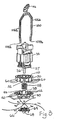
- a string trimmer 20 includes a motor housing 22 disposed at a first, lower end of a boom 24 and a handle assembly 26 located at a second, upper end of the boom 24.
- a shield 28 is secured to the housing 22 and a wire guard 30 is secured to one or both of the housing 22 and the shield 28.
- the wire guard 30 prevents an operator from moving a head assembly 32 closer than a certain distance to an object.
- the wire guard 30 may also be operable in a trimmer mode to serve as a guide.
- a motor 34 is disposed within the housing 22 and is connected to electrical conductors (not shown) extending from the handle assembly 26 through the boom 24 and into the housing 22.
- the electrical conductors may be connected to a source of power to energize the motor 34, as is conventional.
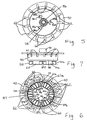
- a motor shaft 36 of the motor 34 is secured by any suitable means within a bore 38 of a lower hub member or element 40 so that the element 40 is fixed to and rotates with the shaft 36 (the element 40 is seen in greater detail in Figs. 4-7).
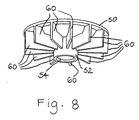
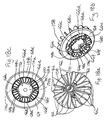
- An upper hub element 50 (shown in greater detail in Figs. 8-10) includes a central cylindrical portion 52 having a bore 54 (Figs. 8 and 9) within which is slidingly received a central hollow boss portion 56 of the lower hub element 40 such that the upper hub element 50 is captured between an end bell 57 of the motor 34 and the lower hub element 40.
- Axial movement of the upper hub element 50 can occur relative to the lower hub element 40, during which time the boss portion 56 slides within the bore 54.
- the upper hub element 50 includes a plurality of fan blades 60 which provide air movement for cooling of the motor 34.
- the fan blades 60 slidably engage slots 62 of the lower hub element 40 permitting axial travel of upper hub element 50 while causing the upper hub element 50 to rotate with the lower hub element 40 and the motor shaft 36.
- the lower hub element 40 includes a lower main surface 59 from which walls 61a-61f extend to define open chambers or recesses 63a-63f.
- a head 64 includes a base surface 66 which may be generally planar and a curved lower member 68.
- the member 68 is provided to space the head 64 above the ground during operation.
- the head 64 further includes a plurality of upraised wall portions or sections 70a-70f, each of which is roughly triangular in shape and which together define a plurality of recess channels 72a-72f extending outwardly from a recess center portion 74.
- First through third mounting arms 76a-76c are carried by and extend away from the base surface 66. If desired, each of the arms 76a-76c may instead be carried by a corresponding wall portion 70b, 70d, 70f, respectively.
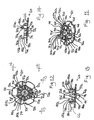
- each arm 76a-76c includes a deflectable main portion 78a-78c, respectively, and an inwardly directed finger portion 80a-80c, respectively.
- the finger portions 80a-80c extend into apertures 82a-82c (Figs. 4-6), such that hooked portions 86a-86c (best seen in Figs. 11, 13, and 14) engage outer margins 88a-88c of the apertures 82a-82c, respectively (the outer margins 88a-88c are best seen in Figs. 5 and 6).
- the wall portions 70a-70f fit within a recess center portion 87 of the lower hub element 40 and the recess channels 72a-72f are radially aligned with recess channels 89a-89f located between adjacent walls 61a-61f (see Figs. 4, 6 and 7).
- the recess center portion 87 is defined by the walls 61a-61f.
- each of the finger portions 80a-80c may extend into any of the apertures 82a-82c (i.e., the arms 76a-76c and the apertures 82a-82c are symmetric and hence may be aligned in any of three positions to fit the head 64 onto the lower hub element 40.)
- Fig. 15 illustrates a flail assembly 90 which may be inserted into the recess channels 72a-72f and the recess center portion 74 prior to assembly of the head 64 on the lower hub element 40.
- the flail assembly 90 includes a plurality of flails 90a-90f which are secured to a central connection member or carrier 92.
- the carrier 92 includes a plurality of flail receptacles 94a-94f in the form of ferrule members or portions which are crimped onto the flails 90a-90f, respectively, using any appropriate crimping tool.
- the carrier 92 may be fabricated of metal or any other suitable inexpensive material. If desired, the carrier 92 may have a different shape and/or accommodate a different number of flails.
- the carrier 92 is captured within one or both of the recess center portions 74, 87 and the flails extend radially outwardly through the aligned recess channels 72a-72f and 89a-89f.
- the carrier 92 may instead be secured to the head 64 inside the portion 74 by any suitable means, such as by heat staking, adhesive, etc.
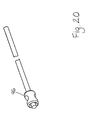
- the single carrier 92 can be replaced by a plurality of individual separate ferrules 96 (one of which is shown in Fig. 20), each of which is crimped to one of the flails 90a-90f, and which has a cross-sectional dimension larger than the cross-sectional dimension of the recess channels 72a-72f.
- Each ferrule 96 may comprise a simple hollow tube or may be split axially and thus have a C-shape in cross-section.
- a relatively uniform compressive load can be applied over the length of the ferrule 96 during the crimping process so that localized high stress on and weakening of the flail can be avoided.
- the individual ferrules 96 are placed in the recess center portion 74 with the flails extending outwardly through the aligned channels 72a-72f and 89a-89f.
- the ferrules 96 may be secured to the head by any suitable means (heat staking, adhesive, etc.), if desired.
- the ferrules prevent outward ejection of the flails 90a-90f owing to the difference in cross-sectional sizes of the ferrules and the channels 72a-72f.
- Crimping the flails to the carrier 92 or the individual ferrules 96 precludes the need to apply localized heat to the flails to secure the flails to the head 64, the carrier 92 or the ferrules 96, thereby avoiding heat induced local weakening and premature failure of the flails.
- an eject linkage 100 includes a button 102 which is accessible from a top surface 104 of the housing 22, and thus is remote from the head 64.
- First and second arms 106a, 106b slide in channels (not shown) or are otherwise guided by features in the housing 22 and include lower ends 108a, 108b which can be made to contact an upper flange surface 110 of the upper hub element 50.
- integral spring elements of the eject linkage 100 may bear against features (not shown) internal to the housing to bias the button 102 upwardly such that the lower ends 108a, 108b of the arms 106a, 106b are spaced from the upper hub element 50 when no pressure is applied to the button 102.
- an operator may press on the button 102, thereby displacing the linkage 100 downwardly to contact and then displace the upper hub element 50.
- the fan blades 60 are able to slide through the slots 62 of the lower hub element 40 to permit such movement.
- the center portion 52 of the upper hub element 50 ultimately bears against upper cam surfaces 120a-120c (Figs. 11-14) of the finger portions 80a-80c of head 64 and causes the arms 76a-76c to deflect inwardly, thereby disengaging the hooked portions 86a-86c from the outer margins 38a-88c of the apertures 82a-82c.
- the head 64 then either may be ejected by further movement of upper hub elements 50 and/or may drop downwardly under the force of gravity from the lower hub element 40 to permit access to the flail assembly 90. Once the worn flail assembly has been replaced with a new flail assembly, the head 64 can be reinstalled on the lower hub element 40 in the manner previously described.
- the head 64 and attached flail assembly 90 are replaced together as a unit.
- the head 64 and flail assembly 90 are fabricated of inexpensive materials so that cost is minimized.
- the head 64 is positively retained on the lower hub member 40, and this positive retention is enhanced during operation of the string trimmer 20 owing to an increase of the latching forces by centrifugal forces acting on the arms 76a-76c.
- the lengths of all of the flails need not be equal.
- the flails 90b, 90d and 90f may be of a first length and the remaining flails 90a, 90c and 90e may be of a second length longer than the first. It is thought that by making the flail lengths unequal, cutting efficiency can be maximized over the total life of the flails. Specifically, before wear has occurred, the majority of the cutting is accomplished at the tips of the longer flails, which are moving at a relatively high linear speed. As wear occurs, the flails shorten, thereby decreasing linear tip speed. Eventually, the longer flails wear to the length of the shorter flails, thereby presenting a greater number of flail tips for cutting, at least in part compensating for the shorter flail length and consequent lower tip speed.
- the long and short flail lengths form a pattern which is symmetric with respect to the rotational axis of the head so that an unbalanced situation is avoided.
- Figs. 17-19 illustrate an alternative embodiment of the present invention, which may utilize the head 64 and the flail assembly 90 of the previous Figs.
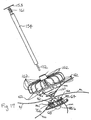
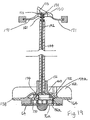
- a button 150 having a button recess 151 is actuable from the top surface of the housing 22 (Fig. 1) and is engageable with an eject linkage in the form of an ejection pin 152 having a spring plate 153 welded or otherwise secured thereto.
- the spring plate 153 resides within the button recess 151.
- the ejection pin 152 extends through a hollow motor shaft 154 and a hollow axle 156 of a hub member 158 into an ejector member 160.
- the hollow motor shaft 154 is rigidly fixed to the hollow axle 156 by any suitable means such that the hub member 158 rotates together with the shaft 154.
- the ejection pin 152 is spring loaded by a spring 161 disposed between the spring plate 153 and an end of the motor shaft 154 and the ejector member 160 is fixed to the end of the ejection pin 152 and is moveable therewith.
- the hub member 158 includes fan blades 162 and a lower main surface 164 from which walls 166a-166f extend defining chambers 168a-168f, respectively, similar or identical to the walls 61a-61f and chambers 63a-63f of Figs. 4 and 6.
- a central aperture 170 located between the walls 166 extends through the base surface 164 into a cavity 172 in which the ejector member 160 is disposed.
- the button 150 includes one or more integral spring elements 171 (Fig. 19) which engage structures or other features (such as grooves in ribs) in the housing 22 to bias the button 150 upwardly and thus normally space a base surface 173 of the button recess 151 from the spring plate 153 when no force is applied to the button 150.
- the head 64 is prepared for installation by placing a flail assembly 90 in the channels 72a-72f and recess chamber 74 (Fig. 12). The head 64 then is assembled onto the hub member 158 by passing the arms 76a-76c into the central aperture until the hooked portions 86a-86c engage undercut channels 174a-174c formed in a wall 176 defining the periphery of the aperture 170 (see Figs. 18a-18c). At this time, the ejector member 160 is positioned between the hub element 158 and the head 64, as seen in Fig. 19.
- the head 64 is keyed against rotation by fitting of the outer periphery of the head 64 with the outer portions of the walls 166a-166f and by seating of the hooked portions 86a-86c with the undercut channels 174a-174c (the channels 174a-174c have a limited angular extent, as seen in Figs. 18b and 18c). Ejection of the head 64 from the hub element 158 is accomplished by downwardly displacing the button 150 and the ejection pin 152 against the bias provided by the spring elements 171 and the spring 161, in turn, displacing the ejector member 160 into engagement with the finger portions 80a-80c.
- the flail assembly 90 can be configured to include arms like the arms 76 so that the assembly 90 itself may be removably retained on the hub member 40 or 158 without the need for the head 64.
- the flails 90a-90f may instead be permanently attached directly to the head 64 itself by any suitable means, such as heat staking, ultrasonic welding, adhesive, etc.
- the entine head 64 is replaced when the flails 90a-90f are worn.
- the number of individual flails used may vary, and, in fact, one or more flails may extend outwardly from opposite sides of the head 64, if desired. Regardless of the attachment of the flails, such attachment can be accomplished using highly automated, rapid operations.
- the button 102 or 150 may be located in a different position, allowing the actuating force for the release mechanism to be applied in a different direction.
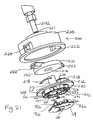
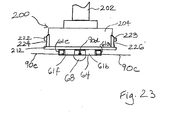
- Figs. 21-23 illustrate an alternative embodiment of the present invention, in which a conventional head 200 incorporating a bump feed mechanism and used, for example, on a string trimmer powered by a motive power source (such as a gas engine or an electric motor) disposed at an upper end of the string trimmer, is retrofitted to utilize one or more disposable components (such as the head 64) according to the present invention.
- the motive power source is connected through a drive cable or other drive mechanism 202 to the head 200.
- the head 200 includes a main hub element or member 204 mounted for rotation on the drive cable 202 and from which the usual bump feed components (such as a spool, spring and a ground engaging member) have been removed.
- the head may be that found on string trimmer Model No.
- An auxiliary hub element or member 212 includes a cylindrical central boss 213 which extends through a central cylindrical bore 214 of a release mechanism in the form of an ejector element or member 215.
- the central boss 213 is slightly smaller than the bore 214 so that the ejector element can move axially relative to the auxiliary hub member 212.
- One or more leaf springs 218 are captured between the auxiliary hub member 212 and the ejector member 215 and are retained in position by any suitable means.
- a flat head screw 219 extends through a central bore 220 of the auxiliary hub member 212 (the bore 220 is centered within and extends fully through the central boss 213) and the bore 214 of the ejector member 215 and is threaded into a threaded bore 222 in the drive shaft 202.
- the screw 219 includes an enlarged head which captures the members 212, 215 on the drive shaft 202 for rotation therewith.
- first and second ears 222, 223 extend through diametrically opposite apertures 224, 226, respectively, in the main hub member 204.
- the ears 222, 223, and thus the ejector member 215, are axially movable a short distance in the apertures 224, 226. During such movement, the ejector member 215 is guided on the auxiliary hub member 212 owing to the fit of the central boss 213 in the bore 214.
- auxiliary hub member 212 and the main hub member 204 may have interengaging features to cause the two members to rotate together during operation.
- the auxiliary hub member 212 includes a lower main surface 230, identical to the lower main surface 59, from which the walls 61a-61f extend to define the recesses 63a-63f.
- the apertures 82a-82c described previously also extend through the surface 230.
- the hooked portions 86a-86c of the arms 76a-76c engage the outer margins 88a-88c of the apertures 82a-82c in the auxiliary hub member 212.
- the ears 222, 223, and thus the ejector member 215 are downwardly axially displaced against the bias provided by the leaf springs 218, a lower surface 232 of the ejector member 215 contacts the arms 76a-76c, thereby moving such arms inwardly and releasing the hooked portions 86a-86c from the outer margins 88a-88c of the apertures 82a-82c and releasing the head 64 from the auxiliary hub member 212.
- a new flail assembly 90 may then be placed in the head 64 and the head 64 may be reassembled on the auxiliary hub member 212 as described above.
- the present invention is advantageous in that the flail assembly 90 or the head 64, when worn, can be easily removed and replaced with a new one.
- This replacement procedure is simple and does not require the user to necessarily invert the string trimmer to remove the head. Instead, the user need only press the button 102 or 150, allowing the head 64 to simply fall off of the hub member.
- the disposable elements i.e., the flail assembly and the head 64
- cutting efficiency over the entire life of the flails may be improved as compared with other designs which utilize either a single flail or a plurality of flails, all of the same length.
Landscapes
- Life Sciences & Earth Sciences (AREA)
- Environmental Sciences (AREA)
- Harvester Elements (AREA)
Claims (24)
- Kopfaufbau für einen Seiltrimmer, umfassend:dadurch gekennzeichnet, dass:ein Nabenelement (40;158;212), das um eine Achse rotierbar ist;einen Kopf (64); undein Montierelement (76a-76c), das den Kopf auf das Nabenelement befestigt;mindestens ein Seil (90a) zwischen dem Kopf (64) und dem Nabenelement (40; 158; 212) aufgenommen ist,und dass ein Lösemechanismus eine Kraftkomponente parallel zu der Achse ermöglichst, um den Kopf von dem Nabenelement zu lösen.
- Kopfaufbau nach Anspruch 1, worin das Montierelement einen Arm (76a) aufweist, der durch den Kopf getragen ist.
- Kopfaufbau nach Anspruch 1, worin der Lösemechanismus ein Auswurfelement (52; 160; 215) und ein Auswurfgestänge (100; 152, 222) aufweist.
- Kopfaufbau nach Anspruch 3, worin das Nabenelement (158) durch einen Motor angetrieben ist, der eine hohle Motorwelle (154) besitzt, und worin das Auswurfgestänge (152) sich durch die hohle Motorwelle (154) erstreckt.
- Kopfaufbau nach Anspruch 3, worin das Nabenelement (40) durch einen Motor (34) angetrieben ist, und worin das Auswurfgestänge (100) sich um den Motor (34) herum erstreckt.
- Kopfaufbau nach Anspruch 1, worin der Lösemechanismus durch einen Knopf (102; 150) betätigbar ist, der von dem Kopf (64) entfernt ist.
- Kopfaufbau nach Anspruch 6, worin das Nabenelement durch einen Motor (34) angetrieben ist, der in einem Gehäuse (22) gelegen ist, und worin der Knopf (102) auf einer oberen Fläche (104) des Seiltrimmers angeordnet ist.
- Kopfaufbau nach Anspruch 1, worin eine Mehrzahl von Seilen (90a-90f) zwischen dem Nabenelement (40; 158; 212) und dem Kopf (74) aufgenommen ist.
- Kopfaufbau nach Anspruch 8, worin die Mehrzahl von Seilen (90a-90f) in einem Tragelement (92) montiert ist.
- Kopfaufbau nach Anspruch 9, worin das Tragelement (92) in einer Vertiefung (74) in dem Kopf (64) angeordnet ist.
- Kopfaufbau nach Anspruch 8, worin eines (90d) der Seile eine Länge besitzt, die sich von einer Länge eines anderen Seils unterscheidet.
- Kopfaufbau nach Anspruch 8, worin jedes eines ersten Satzes von Seilen (90a, 90c, 90e) eine erste Länge besitzt und jedes eines zweiten Satzes von Seilen (90b, 90d, 90f) eine zweite Länge besitzt, die sich von der ersten Länge unterscheidet.
- Kopfaufbau nach Anspruch 1, worin sechs Seile (90a-90f) zwischen dem Kopf (64) und dem Nabenelement (40; 158; 212) aufgenommen sind.
- Kopfaufbau nach Anspruch 13, worin jedes eines ersten Satzes von Seilen eine erste Länge besitzt und jedes eines zweiten Satzes von Seilen eine zweite Länge besitzt, die sich von der ersten Länge unterscheidet.
- Kopfaufbau nach Anspruch 8, worin die Mehrzahl von Seilen (90a-90f) direkt und im wesentlichen dauerhaft an dem Kopf (64) befestigt ist.
- Kopfaufbau nach Anspruch 8, worin jedes Seil (90a-90f) an einer einzelnen Hülse (94a-94f) befestigt ist.
- Kopfaufbau nach Anspruch 1, worin das Montierelement eine Mehrzahl von Armen (76a-76c) aufweist, die sich in einer bestimmten Richtung weg von einer Basisfläche (66) des Kopfes (64) erstrecken, wobei die Mehrzahl von Armen (76a-76c) in Öffnungen (82a-82c) in dem Nabenelement (40) in Eingriff bringbar ist, wobei der Kopf (64) ferner Wände (70a-70f) einschließt, die sich in einer bestimmten Richtung erstrecken und Vertiefungskanäle (72a-72f) definieren, und worin eine Mehrzahl von Seilen (90a-90f) in den Vertiefungskanälen (72a-72f) angeordnet ist.
- Kopfaufbau nach Anspruch 17, worin der Lösemechanismus einen Lösebetätiger (102; 150) einschließt, der von dem Kopf (64) entfernt ist.
- Kopfaufbau nach Anspruch 17, worin die Vertiefungskanäle (72a-72f) sich nach außen erstrecken von einem Vertiefungsmittelabschnitt (74), und worin die Seile (90a-90f) durch einen Träger (92) miteinander verbunden sind, der in dem Vertiefungsmittelabschnitt (74) angeordnet ist.
- Kopf (64) für einen Seiltrimmer, umfassend:dadurch gekennzeichnet, dass ein Montierarm (76a) entweder durch die Basisfläche (66) oder die mindestens eine Wand (70b) zum Montieren des Kopfes (64) auf einem Nabenelement (40) getragen ist.einen Hauptkörper, der eine Basisfläche (66) besitzt; undmindestens eine Wand (70b), die sich von der Basisfläche (66) erstreckt und eine Vertiefung (72b, 74) definiert, die dazu ausgelegt ist, entnehmbar ein Seil (76b) darin aufzunehmen;
- Kopf nach Anspruch 20, ferner umfassend Montierarme (76b, 76c), worin die Montierarme voneinander beabstandet sind.
- Kopf nach Anspruch 20, ferner umfassend Wände (70a, 70c-70f), die sich von der Basisfläche (66) erstrecken, worin die mindestens eine Wand (70b) und die weiteren Wände eine Mehrzahl von Vertiefungskanälen (72a-72f) definieren, die sich von einem Vertiefungsmittelabschnitt (74) erstrecken.
- Kopf nach Anspruch 22, in Kombination mit einem Seilabschnitt (90a-90f), der sich durch jeden der Vertiefungskanäle (72a-72f) erstreckt.
- Kopf nach Anspruch 23, ferner umfassend ein Tragelement (92), an welchem die Seilabschnitte (90a-90f) montiert sind, worin das Tragelement (72) in dem Vertiefungsmittelabschnitt (74) angeordnet ist.
Applications Claiming Priority (2)
| Application Number | Priority Date | Filing Date | Title |
|---|---|---|---|
| US899471 | 1997-07-23 | ||
| US08/899,471 US5987756A (en) | 1997-07-23 | 1997-07-23 | Head and head assembly for a string trimmer |
Publications (2)
| Publication Number | Publication Date |
|---|---|
| EP0893046A1 EP0893046A1 (de) | 1999-01-27 |
| EP0893046B1 true EP0893046B1 (de) | 2003-03-19 |
Family
ID=25411047
Family Applications (1)
| Application Number | Title | Priority Date | Filing Date |
|---|---|---|---|
| EP98401867A Expired - Lifetime EP0893046B1 (de) | 1997-07-23 | 1998-07-22 | Kopf und Kopfanordnung für Fadenschneider |
Country Status (4)
| Country | Link |
|---|---|
| US (1) | US5987756A (de) |
| EP (1) | EP0893046B1 (de) |
| CA (1) | CA2243867C (de) |
| DE (1) | DE69812240T2 (de) |
Families Citing this family (34)
| Publication number | Priority date | Publication date | Assignee | Title |
|---|---|---|---|---|
| USD446699S1 (en) | 1999-08-12 | 2001-08-21 | Black & Decker, Inc. | String trimmer |
| US6401344B1 (en) | 1999-09-21 | 2002-06-11 | Mark R. Moore | Head for line trimming apparatus |
| US7111403B2 (en) | 1999-09-21 | 2006-09-26 | Moore Mark R | Head for line trimming apparatus |
| US20020029483A1 (en) * | 2000-08-11 | 2002-03-14 | Price Joseph E. | Multipurpose rotary cutting tool having interchangeable heads |
| AU147222S (en) | 2000-11-28 | 2002-03-21 | Black & Decker Inc | A trimmer |
| AU147221S (en) | 2000-11-28 | 2002-03-21 | Black & Decker Inc | A trimmer |
| JP2005501537A (ja) * | 2001-09-03 | 2005-01-20 | スピード、フランス | ブラシ・カッター用およびエッジ・トリマー用切断ワイヤ |
| FR2850235B1 (fr) * | 2003-01-23 | 2005-10-21 | Speed France | Tete de coupe pour debroussailleuse, coupe-bordures ou analogue |
| FR2850239B1 (fr) * | 2003-01-23 | 2005-10-21 | Speed France | Tete de coupe pour debroussailleuse, coupe-bordures ou analogue |
| FR2850237B1 (fr) * | 2003-01-23 | 2005-10-21 | Speed France | Tete de coupe pour debroussailleuse, coupe-bordures ou analogue |
| FR2850236B1 (fr) * | 2003-01-23 | 2005-10-21 | Speed France | Tete de coupe debroussailleuse, coupe-bordures ou analogue |
| FR2850238B1 (fr) * | 2003-01-23 | 2005-10-21 | Speed France | Tete de coupe pour debroussailleuse, coupe-bordures ou analogue |
| FR2854764B1 (fr) | 2003-05-14 | 2006-06-23 | Speed France | Nouveau fil de coupe pour appareils tels que taille-bordures ou debroussailleuses |
| DE602004020110D1 (de) * | 2004-01-09 | 2009-04-30 | Speed France | Schneidkopfeinrichtung für buschmäherfahrzeug, rasenkantenschneider oder analog , mit perfektionierten verriegelungsmitteln eines mähfadens |
| DE602004024927D1 (de) | 2004-01-19 | 2010-02-11 | Speed France S A S | Mähfäden und verfahren zu ihrer herstellung |
| USD510512S1 (en) | 2004-03-24 | 2005-10-11 | Black & Decker Inc. | String trimmer |
| FR2881022B1 (fr) * | 2005-01-24 | 2007-04-06 | Speed France Sa | Filament de coupe de composition amelioree pour coupe-bordures, debroussailleuses, etc. |
| USD552436S1 (en) * | 2005-08-19 | 2007-10-09 | Black & Decker Inc. | String trimmer |
| USD550525S1 (en) * | 2006-06-23 | 2007-09-11 | Robert Bosch Gmbh | Grass and weed cutter |
| US7536792B2 (en) | 2007-01-03 | 2009-05-26 | Moore Mark R | Head for a rotary line trimmer apparatus |
| US8060284B2 (en) * | 2007-10-31 | 2011-11-15 | Deere & Company | Work machine with torque limiting control for an infinitely variable transmission |
| US8176639B2 (en) * | 2009-05-14 | 2012-05-15 | Doane Ian J | Filament clamp for a vegetation trimmer |
| US20110203118A1 (en) * | 2010-02-19 | 2011-08-25 | Kyodo Co., Ltd. | Brush cutter |
| US20120159790A1 (en) | 2010-12-22 | 2012-06-28 | Hoelscher Gene | Grass trimming apparatus with spinning support guide |
| US9056381B1 (en) * | 2011-07-12 | 2015-06-16 | Frank L. Airosa | Line trimmer/grinder system |
| USD714108S1 (en) * | 2013-06-20 | 2014-09-30 | Black & Decker Inc. | String trimmer |
| US9472992B2 (en) * | 2013-07-11 | 2016-10-18 | The Toro Company | Electric motor support structure and power equipment unit incorporating same |
| AU2015101710A4 (en) | 2014-11-25 | 2015-12-24 | Nanjing Chervon Industry Co., Ltd. | Grass Trimmer |
| US10485165B2 (en) * | 2014-11-25 | 2019-11-26 | Chervon (Hk) Limited | Grass trimmer |
| WO2016126547A1 (en) | 2015-02-06 | 2016-08-11 | Mtd Products Inc | Handheld lawn maintenance tool |
| US10070582B2 (en) | 2016-04-20 | 2018-09-11 | Tti (Macao Commercial Offshore) Limited | String trimmer head |
| USD830798S1 (en) * | 2016-06-03 | 2018-10-16 | Andreas Stihl Ag & Co. Kg | Battery powered trimmer |
| WO2021170255A1 (en) * | 2020-02-27 | 2021-09-02 | Preff Sbp, Lda | Trimmer head |
| USD1075938S1 (en) * | 2023-05-11 | 2025-05-20 | Audioec Inc. | String trimmer bubble toy |
Family Cites Families (42)
| Publication number | Priority date | Publication date | Assignee | Title |
|---|---|---|---|---|
| US3895440A (en) * | 1974-10-15 | 1975-07-22 | Jr Charles B Pittinger | Disk for filament trimmer |
| US4043103A (en) * | 1976-03-15 | 1977-08-23 | Lakin George W | Lawn edger accessory |
| US4062114A (en) * | 1976-05-07 | 1977-12-13 | Woodrow Wilson Luick | Vegetation cutting apparatus |
| US4086700A (en) * | 1976-07-13 | 1978-05-02 | Elta Machine Industrial Co., Ltd. | Cutting head for a mower |
| CA1079075A (en) * | 1976-07-19 | 1980-06-10 | George C. Ballas | Rotary cutting assembly |
| US4656739A (en) * | 1976-08-10 | 1987-04-14 | Pittinger Jr Charles B | Bump-feed filament vegetation trimmer |
| US4089114A (en) * | 1976-08-31 | 1978-05-16 | Disston, Inc. | Cutting device |
| US4524515A (en) * | 1976-10-18 | 1985-06-25 | The Toro Company | Rotary cutting assembly with filament feed |
| US4118865A (en) * | 1977-01-14 | 1978-10-10 | Mcgraw-Edison Company | Assembly for removably attaching flexible cutting line element in grass trimmer |
| US4852258A (en) * | 1981-03-19 | 1989-08-01 | White Consolidated Industries, Inc. | Apparatus for cutting vegetation |
| DE2826280A1 (de) * | 1978-06-15 | 1979-12-20 | Peter Sick | Verfahren und vorrichtung zum maschinellen ernten von fruechten |
| DE2828425A1 (de) * | 1978-06-28 | 1980-01-10 | Stihl Maschf Andreas | Pflanzenschneidgeraet |
| US4203212A (en) * | 1978-07-13 | 1980-05-20 | Proulx Raymond E | Flail feedout mechanism for a rotary mower |
| US4189833A (en) * | 1978-08-15 | 1980-02-26 | Weed Eater, Inc. | Apparatus for cutting vegetation |
| US4268964A (en) * | 1979-07-02 | 1981-05-26 | Ambac Industries, Incorporated | Apparatus for cutting, trimming and edging vegetation and the like |
| US4271595A (en) * | 1979-07-26 | 1981-06-09 | Hawaiian Motor Company | Housing and cutting line assembly for vegetation cutting apparatus |
| US4250623A (en) * | 1979-08-01 | 1981-02-17 | Pittinger Charles B | Filament vegetation trimmer |
| US4259782A (en) * | 1979-09-14 | 1981-04-07 | Proulx Raymond E | Flail feedout mechanism for a rotary mower |
| US4476623A (en) * | 1979-10-22 | 1984-10-16 | International Business Machines Corporation | Method of fabricating a bipolar dynamic memory cell |
| US4295324A (en) * | 1980-06-30 | 1981-10-20 | Corinco, Inc. | Balanced mower head for carrying a plurality of monofilament lines |
| US4412382A (en) * | 1981-05-04 | 1983-11-01 | The Toro Company | Line feed mechanism for filament cutting |
| JPS6083508A (ja) * | 1983-10-15 | 1985-05-11 | タナカ工業株式会社 | ナイロンコ−ド型刈払機 |
| US4550498A (en) * | 1984-02-17 | 1985-11-05 | Oliver Ronald A | Replacement spool for rotating line vegetation cutter |
| US4571831A (en) * | 1984-07-31 | 1986-02-25 | The Toro Company | Cutting head for filament trimmer |
| US4685279A (en) * | 1986-01-17 | 1987-08-11 | Gullett Bradley T | Weed trimmer |
| US4738085A (en) * | 1986-04-22 | 1988-04-19 | Starting Industry Company Limited | Rotary cutter for mowers |
| US4823465A (en) * | 1986-12-17 | 1989-04-25 | White Consolidated Industries, Inc. | Line feed mechanism for line trimmers |
| US4790071A (en) * | 1987-01-02 | 1988-12-13 | Trimrite, Inc. | Line trimmer with replaceable cutting blade assembly |
| US4756146A (en) * | 1987-02-18 | 1988-07-12 | Snapper Power Equipment Division Of Fuqua Industries, Inc. | String trimmer head and method |
| US4779405A (en) * | 1987-05-01 | 1988-10-25 | Piston Powered Products, Inc. | Line-feeding head for a rotary line trimmer |
| JPH0455472Y2 (de) * | 1987-10-06 | 1992-12-25 | ||
| CA1319018C (en) * | 1987-11-04 | 1993-06-15 | Maria Rosa Calcinai | Appliance for scrub clearance, grass cutting or the like, with devices for lengthening the cutting line and coupling devices |
| US4794695A (en) * | 1988-01-04 | 1989-01-03 | Hurst Hubert L | Easy loading herbage trimmer |
| US4819416A (en) * | 1988-02-17 | 1989-04-11 | The Unblade Co. | Rotary cutting member for use with lawnmowers and the like |
| US5109607A (en) * | 1990-10-12 | 1992-05-05 | Inertia Dynamics Corporation | Automatic line trimmer head |
| US5197264A (en) * | 1991-05-21 | 1993-03-30 | Paul Lacey | Universal filament trimmer cutting head |
| US5303476A (en) * | 1992-10-29 | 1994-04-19 | Wci Outdoor Products, Inc. | Line head for a rotary line trimmer |
| US5398416A (en) * | 1994-01-03 | 1995-03-21 | Mackey; Robert T. | Universal string trimmer replacement head |
| US5433006A (en) * | 1994-01-28 | 1995-07-18 | Komatsu Zenoah Company | Mowing apparatus |
| JP3167859B2 (ja) * | 1994-04-07 | 2001-05-21 | タナカ工業株式会社 | ナイロンコード型刈払機 |
| US5493785A (en) * | 1994-12-12 | 1996-02-27 | Lawrence; Elbert | Rotary grass cutting head |
| US5651418A (en) * | 1995-04-17 | 1997-07-29 | Jerez; Orlando | Convertible, user-supported, garden cleaning implement for cutting/macerating weeds and like |
-
1997
- 1997-07-23 US US08/899,471 patent/US5987756A/en not_active Expired - Fee Related
-
1998
- 1998-07-22 CA CA002243867A patent/CA2243867C/en not_active Expired - Fee Related
- 1998-07-22 EP EP98401867A patent/EP0893046B1/de not_active Expired - Lifetime
- 1998-07-22 DE DE69812240T patent/DE69812240T2/de not_active Expired - Fee Related
Also Published As
| Publication number | Publication date |
|---|---|
| CA2243867A1 (en) | 1999-01-23 |
| US5987756A (en) | 1999-11-23 |
| DE69812240D1 (de) | 2003-04-24 |
| EP0893046A1 (de) | 1999-01-27 |
| CA2243867C (en) | 2006-09-19 |
| DE69812240T2 (de) | 2003-12-18 |
Similar Documents
| Publication | Publication Date | Title |
|---|---|---|
| US5987756A (en) | Head and head assembly for a string trimmer | |
| US6094823A (en) | Method and apparatus for anchoring flails on a string trimmer | |
| US6401344B1 (en) | Head for line trimming apparatus | |
| EP2319288B1 (de) | Fadenkopf für einen Trimmer | |
| US4524515A (en) | Rotary cutting assembly with filament feed | |
| US4476632A (en) | Multiple flail head for a rotary mower | |
| US7111403B2 (en) | Head for line trimming apparatus | |
| US4274201A (en) | Rotary cutting assembly with filament feed | |
| US9861033B2 (en) | Universally adaptable, easy to load trimmer head with free rotating bump knob | |
| EP0943228B1 (de) | Trimmerkopf mit fixiertem Schneidfaden | |
| US4685279A (en) | Weed trimmer | |
| US5615543A (en) | Rotary cutting head | |
| US4068376A (en) | Flexible cutting line and rotor therefor | |
| US5713191A (en) | Monofilament line based cutter assembly | |
| US6418627B1 (en) | Rotary cutter of mower | |
| US6735874B2 (en) | Cutting head for a rotary trimmer | |
| US20090100686A1 (en) | Fixed-line rotary head for string trimmer machine | |
| WO1999004611A1 (en) | Fixed line trimmer head | |
| WO2008137061A1 (en) | Top unloading fixed line trimmer head | |
| CA2498618A1 (en) | Cutting device, in particular a lawn mower | |
| US20070084061A1 (en) | Mechanism for attaching trimmer line strips to a head of a trimming apparatus | |
| US20130152359A1 (en) | Rotary trimmer apparatus and related rotary head assembly | |
| US4290257A (en) | Rotary assembly for cutting grass and other vegetation | |
| US12342753B2 (en) | Rotator, brush cutter, and bobbin | |
| CN219893861U (zh) | 一种便于拆卸刀片的割草机切割机构 |
Legal Events
| Date | Code | Title | Description |
|---|---|---|---|
| PUAI | Public reference made under article 153(3) epc to a published international application that has entered the european phase |
Free format text: ORIGINAL CODE: 0009012 |
|
| AK | Designated contracting states |
Kind code of ref document: A1 Designated state(s): DE FR GB IT |
|
| AX | Request for extension of the european patent |
Free format text: AL;LT;LV;MK;RO;SI |
|
| AKX | Designation fees paid | ||
| 17P | Request for examination filed |
Effective date: 19990920 |
|
| RBV | Designated contracting states (corrected) |
Designated state(s): AT BE CH CY LI |
|
| RBV | Designated contracting states (corrected) |
Designated state(s): DE FR GB IT |
|
| REG | Reference to a national code |
Ref country code: DE Ref legal event code: 8566 |
|
| 17Q | First examination report despatched |
Effective date: 20011205 |
|
| GRAH | Despatch of communication of intention to grant a patent |
Free format text: ORIGINAL CODE: EPIDOS IGRA |
|
| GRAH | Despatch of communication of intention to grant a patent |
Free format text: ORIGINAL CODE: EPIDOS IGRA |
|
| GRAA | (expected) grant |
Free format text: ORIGINAL CODE: 0009210 |
|
| RAP1 | Party data changed (applicant data changed or rights of an application transferred) |
Owner name: AB ELECTROLUX |
|
| RIN1 | Information on inventor provided before grant (corrected) |
Inventor name: REDDING, GLENN K. Inventor name: SMITH, ROGER W. Inventor name: KRAMER, GREGORY S. Inventor name: KRULL, MICHAEL Inventor name: SEARLE, JOHN F. Inventor name: LIND, JAMES Inventor name: TREES, GREGORY A Inventor name: YATES, JAN B. |
|
| AK | Designated contracting states |
Designated state(s): DE FR GB IT |
|
| REG | Reference to a national code |
Ref country code: GB Ref legal event code: FG4D |
|
| REF | Corresponds to: |
Ref document number: 69812240 Country of ref document: DE Date of ref document: 20030424 Kind code of ref document: P |
|
| ET | Fr: translation filed | ||
| PLBE | No opposition filed within time limit |
Free format text: ORIGINAL CODE: 0009261 |
|
| STAA | Information on the status of an ep patent application or granted ep patent |
Free format text: STATUS: NO OPPOSITION FILED WITHIN TIME LIMIT |
|
| 26N | No opposition filed |
Effective date: 20031222 |
|
| PGFP | Annual fee paid to national office [announced via postgrant information from national office to epo] |
Ref country code: FR Payment date: 20040708 Year of fee payment: 7 |
|
| PGFP | Annual fee paid to national office [announced via postgrant information from national office to epo] |
Ref country code: GB Payment date: 20040721 Year of fee payment: 7 |
|
| PGFP | Annual fee paid to national office [announced via postgrant information from national office to epo] |
Ref country code: DE Payment date: 20040729 Year of fee payment: 7 |
|
| PG25 | Lapsed in a contracting state [announced via postgrant information from national office to epo] |
Ref country code: IT Free format text: LAPSE BECAUSE OF NON-PAYMENT OF DUE FEES Effective date: 20050722 Ref country code: GB Free format text: LAPSE BECAUSE OF NON-PAYMENT OF DUE FEES Effective date: 20050722 |
|
| PG25 | Lapsed in a contracting state [announced via postgrant information from national office to epo] |
Ref country code: DE Free format text: LAPSE BECAUSE OF NON-PAYMENT OF DUE FEES Effective date: 20060201 |
|
| GBPC | Gb: european patent ceased through non-payment of renewal fee |
Effective date: 20050722 |
|
| PG25 | Lapsed in a contracting state [announced via postgrant information from national office to epo] |
Ref country code: FR Free format text: LAPSE BECAUSE OF NON-PAYMENT OF DUE FEES Effective date: 20060331 |
|
| REG | Reference to a national code |
Ref country code: FR Ref legal event code: ST Effective date: 20060331 |