EP0889645A2 - Rundfunkempfangsvorrichtung und Verfahren zur Verbreitung von Daten - Google Patents
Rundfunkempfangsvorrichtung und Verfahren zur Verbreitung von Daten Download PDFInfo
- Publication number
- EP0889645A2 EP0889645A2 EP98112464A EP98112464A EP0889645A2 EP 0889645 A2 EP0889645 A2 EP 0889645A2 EP 98112464 A EP98112464 A EP 98112464A EP 98112464 A EP98112464 A EP 98112464A EP 0889645 A2 EP0889645 A2 EP 0889645A2
- Authority
- EP
- European Patent Office
- Prior art keywords
- library
- program
- decoding
- channels
- decoding software
- Prior art date
- Legal status (The legal status is an assumption and is not a legal conclusion. Google has not performed a legal analysis and makes no representation as to the accuracy of the status listed.)
- Granted
Links
Images








Classifications
-
- H—ELECTRICITY
- H04—ELECTRIC COMMUNICATION TECHNIQUE
- H04N—PICTORIAL COMMUNICATION, e.g. TELEVISION
- H04N21/00—Selective content distribution, e.g. interactive television or video on demand [VOD]
- H04N21/40—Client devices specifically adapted for the reception of or interaction with content, e.g. set-top-box [STB]; Operations thereof
- H04N21/41—Structure of client; Structure of client peripherals
- H04N21/426—Internal components of the client ; Characteristics thereof
- H04N21/42607—Internal components of the client ; Characteristics thereof for processing the incoming bitstream
- H04N21/4263—Internal components of the client ; Characteristics thereof for processing the incoming bitstream involving specific tuning arrangements, e.g. two tuners
-
- H—ELECTRICITY
- H04—ELECTRIC COMMUNICATION TECHNIQUE
- H04N—PICTORIAL COMMUNICATION, e.g. TELEVISION
- H04N21/00—Selective content distribution, e.g. interactive television or video on demand [VOD]
- H04N21/40—Client devices specifically adapted for the reception of or interaction with content, e.g. set-top-box [STB]; Operations thereof
- H04N21/41—Structure of client; Structure of client peripherals
- H04N21/422—Input-only peripherals, i.e. input devices connected to specially adapted client devices, e.g. global positioning system [GPS]
- H04N21/42204—User interfaces specially adapted for controlling a client device through a remote control device; Remote control devices therefor
-
- H—ELECTRICITY
- H04—ELECTRIC COMMUNICATION TECHNIQUE
- H04N—PICTORIAL COMMUNICATION, e.g. TELEVISION
- H04N21/00—Selective content distribution, e.g. interactive television or video on demand [VOD]
- H04N21/40—Client devices specifically adapted for the reception of or interaction with content, e.g. set-top-box [STB]; Operations thereof
- H04N21/41—Structure of client; Structure of client peripherals
- H04N21/426—Internal components of the client ; Characteristics thereof
-
- H—ELECTRICITY
- H04—ELECTRIC COMMUNICATION TECHNIQUE
- H04N—PICTORIAL COMMUNICATION, e.g. TELEVISION
- H04N21/00—Selective content distribution, e.g. interactive television or video on demand [VOD]
- H04N21/40—Client devices specifically adapted for the reception of or interaction with content, e.g. set-top-box [STB]; Operations thereof
- H04N21/43—Processing of content or additional data, e.g. demultiplexing additional data from a digital video stream; Elementary client operations, e.g. monitoring of home network or synchronising decoder's clock; Client middleware
- H04N21/431—Generation of visual interfaces for content selection or interaction; Content or additional data rendering
- H04N21/4312—Generation of visual interfaces for content selection or interaction; Content or additional data rendering involving specific graphical features, e.g. screen layout, special fonts or colors, blinking icons, highlights or animations
- H04N21/4314—Generation of visual interfaces for content selection or interaction; Content or additional data rendering involving specific graphical features, e.g. screen layout, special fonts or colors, blinking icons, highlights or animations for fitting data in a restricted space on the screen, e.g. EPG data in a rectangular grid
-
- H—ELECTRICITY
- H04—ELECTRIC COMMUNICATION TECHNIQUE
- H04N—PICTORIAL COMMUNICATION, e.g. TELEVISION
- H04N21/00—Selective content distribution, e.g. interactive television or video on demand [VOD]
- H04N21/40—Client devices specifically adapted for the reception of or interaction with content, e.g. set-top-box [STB]; Operations thereof
- H04N21/43—Processing of content or additional data, e.g. demultiplexing additional data from a digital video stream; Elementary client operations, e.g. monitoring of home network or synchronising decoder's clock; Client middleware
- H04N21/431—Generation of visual interfaces for content selection or interaction; Content or additional data rendering
- H04N21/4312—Generation of visual interfaces for content selection or interaction; Content or additional data rendering involving specific graphical features, e.g. screen layout, special fonts or colors, blinking icons, highlights or animations
- H04N21/4316—Generation of visual interfaces for content selection or interaction; Content or additional data rendering involving specific graphical features, e.g. screen layout, special fonts or colors, blinking icons, highlights or animations for displaying supplemental content in a region of the screen, e.g. an advertisement in a separate window
-
- H—ELECTRICITY
- H04—ELECTRIC COMMUNICATION TECHNIQUE
- H04N—PICTORIAL COMMUNICATION, e.g. TELEVISION
- H04N21/00—Selective content distribution, e.g. interactive television or video on demand [VOD]
- H04N21/40—Client devices specifically adapted for the reception of or interaction with content, e.g. set-top-box [STB]; Operations thereof
- H04N21/43—Processing of content or additional data, e.g. demultiplexing additional data from a digital video stream; Elementary client operations, e.g. monitoring of home network or synchronising decoder's clock; Client middleware
- H04N21/435—Processing of additional data, e.g. decrypting of additional data, reconstructing software from modules extracted from the transport stream
-
- H—ELECTRICITY
- H04—ELECTRIC COMMUNICATION TECHNIQUE
- H04N—PICTORIAL COMMUNICATION, e.g. TELEVISION
- H04N21/00—Selective content distribution, e.g. interactive television or video on demand [VOD]
- H04N21/40—Client devices specifically adapted for the reception of or interaction with content, e.g. set-top-box [STB]; Operations thereof
- H04N21/43—Processing of content or additional data, e.g. demultiplexing additional data from a digital video stream; Elementary client operations, e.g. monitoring of home network or synchronising decoder's clock; Client middleware
- H04N21/438—Interfacing the downstream path of the transmission network originating from a server, e.g. retrieving encoded video stream packets from an IP network
- H04N21/4383—Accessing a communication channel
- H04N21/4384—Accessing a communication channel involving operations to reduce the access time, e.g. fast-tuning for reducing channel switching latency
-
- H—ELECTRICITY
- H04—ELECTRIC COMMUNICATION TECHNIQUE
- H04N—PICTORIAL COMMUNICATION, e.g. TELEVISION
- H04N21/00—Selective content distribution, e.g. interactive television or video on demand [VOD]
- H04N21/40—Client devices specifically adapted for the reception of or interaction with content, e.g. set-top-box [STB]; Operations thereof
- H04N21/43—Processing of content or additional data, e.g. demultiplexing additional data from a digital video stream; Elementary client operations, e.g. monitoring of home network or synchronising decoder's clock; Client middleware
- H04N21/442—Monitoring of processes or resources, e.g. detecting the failure of a recording device, monitoring the downstream bandwidth, the number of times a movie has been viewed, the storage space available from the internal hard disk
- H04N21/44213—Monitoring of end-user related data
- H04N21/44222—Analytics of user selections, e.g. selection of programmes or purchase activity
-
- H—ELECTRICITY
- H04—ELECTRIC COMMUNICATION TECHNIQUE
- H04N—PICTORIAL COMMUNICATION, e.g. TELEVISION
- H04N21/00—Selective content distribution, e.g. interactive television or video on demand [VOD]
- H04N21/40—Client devices specifically adapted for the reception of or interaction with content, e.g. set-top-box [STB]; Operations thereof
- H04N21/45—Management operations performed by the client for facilitating the reception of or the interaction with the content or administrating data related to the end-user or to the client device itself, e.g. learning user preferences for recommending movies, resolving scheduling conflicts
- H04N21/4508—Management of client data or end-user data
- H04N21/4532—Management of client data or end-user data involving end-user characteristics, e.g. viewer profile, preferences
-
- H—ELECTRICITY
- H04—ELECTRIC COMMUNICATION TECHNIQUE
- H04N—PICTORIAL COMMUNICATION, e.g. TELEVISION
- H04N21/00—Selective content distribution, e.g. interactive television or video on demand [VOD]
- H04N21/40—Client devices specifically adapted for the reception of or interaction with content, e.g. set-top-box [STB]; Operations thereof
- H04N21/47—End-user applications
-
- H—ELECTRICITY
- H04—ELECTRIC COMMUNICATION TECHNIQUE
- H04N—PICTORIAL COMMUNICATION, e.g. TELEVISION
- H04N21/00—Selective content distribution, e.g. interactive television or video on demand [VOD]
- H04N21/40—Client devices specifically adapted for the reception of or interaction with content, e.g. set-top-box [STB]; Operations thereof
- H04N21/47—End-user applications
- H04N21/482—End-user interface for programme selection
- H04N21/4821—End-user interface for programme selection using a grid, e.g. sorted out by channel and broadcast time
-
- H—ELECTRICITY
- H04—ELECTRIC COMMUNICATION TECHNIQUE
- H04N—PICTORIAL COMMUNICATION, e.g. TELEVISION
- H04N21/00—Selective content distribution, e.g. interactive television or video on demand [VOD]
- H04N21/80—Generation or processing of content or additional data by content creator independently of the distribution process; Content per se
- H04N21/81—Monomedia components thereof
- H04N21/8166—Monomedia components thereof involving executable data, e.g. software
- H04N21/8193—Monomedia components thereof involving executable data, e.g. software dedicated tools, e.g. video decoder software or IPMP tool
-
- H—ELECTRICITY
- H04—ELECTRIC COMMUNICATION TECHNIQUE
- H04N—PICTORIAL COMMUNICATION, e.g. TELEVISION
- H04N21/00—Selective content distribution, e.g. interactive television or video on demand [VOD]
- H04N21/80—Generation or processing of content or additional data by content creator independently of the distribution process; Content per se
- H04N21/83—Generation or processing of protective or descriptive data associated with content; Content structuring
- H04N21/84—Generation or processing of descriptive data, e.g. content descriptors
-
- H—ELECTRICITY
- H04—ELECTRIC COMMUNICATION TECHNIQUE
- H04N—PICTORIAL COMMUNICATION, e.g. TELEVISION
- H04N5/00—Details of television systems
- H04N5/44—Receiver circuitry for the reception of television signals according to analogue transmission standards
- H04N5/445—Receiver circuitry for the reception of television signals according to analogue transmission standards for displaying additional information
- H04N5/45—Picture in picture, e.g. displaying simultaneously another television channel in a region of the screen
-
- H—ELECTRICITY
- H04—ELECTRIC COMMUNICATION TECHNIQUE
- H04N—PICTORIAL COMMUNICATION, e.g. TELEVISION
- H04N5/00—Details of television systems
- H04N5/44—Receiver circuitry for the reception of television signals according to analogue transmission standards
- H04N5/46—Receiver circuitry for the reception of television signals according to analogue transmission standards for receiving on more than one standard at will
Definitions
- the present invention relates to a broadcasting reception apparatus receiving a broadcast signal transmitted with a data broadcasting method of broadcasting program signals of two or more kinds of broadcasting formats via a plurality of channels. Further, it relates to a data broadcasting method of broadcasting program signals of two or more kinds of broadcasting formats via a plurality of channels, and broadcasting a decoding software program for decoding the program signals using a channel different from the plurality of channels, and, more particularly, to a data broadcasting method with which a waiting time for downloading a decoding software program for decoding program signals can be reduced on the receiving side.
- Fig. 41 is a diagram showing a structure of a broadcasting system using a broadcasting satellite.
- reference numeral 201 denotes sub-broadcasters, such as television broadcasting stations, broadcasting one or more channels of broadcast signals.
- 202 is a broadcaster including a broadcasting satellite which receives broadcast signals from the plurality of sub-broadcasters 201, processes the broadcast signals, and transmits the result to a viewer's terminal, i.e., a broadcasting reception apparatus.
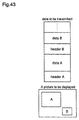
- all sub-broadcasters produce and transmit programs of a common broadcasting format, i.e., a video transmission format, a video coding format, and so on, such as MPEG, over all channels, while the viewer receives and reproduces broadcast signals by exclusive hardware corresponding to the common broadcasting format. That is, in the conventional broadcasting system, as shown in Fig. 42, the exclusive hardware receives data of the MPEG format transmitted by the sub-broadcasters 201 via the broadcaster 202, and displays the data on a full screen of a TV set or the like.
- a common broadcasting format i.e., a video transmission format, a video coding format, and so on, such as MPEG
- the exclusive hardware receives data of the MPEG format transmitted by the sub-broadcasters 201 via the broadcaster 202, and displays the data on a full screen of a TV set or the like.
- a decoding software program for decoding broadcast data is provided via broadcasting, even when a broadcasting reception apparatus does not have a decoding software program for decoding a certain broadcast data, this decoding software program can be downloaded via broadcasting so that the broadcast data can be decoded.
- this decoding software program can be downloaded via broadcasting so that the broadcast data can be decoded.
- a decoding software program for decoding broadcast data via broadcasting there may be, as shown in Fig. 44(a), a way in which a decoding program for decoding broadcast data is multiplexed into the broadcast data for each channel, or as shown in Fig. 44(b), a way in which a channel for broadcasting exclusively a decoding program for decoding broadcast data is set up apart from channels for the broadcast data, a decoding software program for decoding the broadcast data transmitted via the channel for the broadcast data is repeatedly broadcast.
- a broadcasting reception apparatus used in such a system providing a decoding software program for decoding broadcast data includes a program storage unit for holding the decoding software program (library), and decodes the broadcast data using the decoding software program stored in the program storage unit.
- the decoding software program for decoding broadcast data received is not held in the program storage unit, the decoding software program is downloaded to the broadcasting reception apparatus as described above.
- zapping by which the viewer checks the contents of programs broadcast simultaneously, by switching channels in a short time.
- program pictures can be instantly switched by the viewer's switching broadcasting channels.
- zapping when no software program for decoding its broadcast data is held in advance for a switched channel in zapping, a delay downloading the program makes it difficult to switch channels in a short time, which leads to unpleasant zapping.
- a decoding software program (library) for decoding a program signal on the channel 1 is a library A
- libraries for decoding a program signal on the channel 2 is a library B and a library D
- a decoding software program (library) is available in a library buffer of a broadcasting reception apparatus, or can check what channel, for which a decoding library is not held in the library buffer, can be nevertheless listened or watched in a short waiting time because it takes a short time to download the library.
- an EPG picture is displayed in which a plurality of cells are arranged in a matrix, each cell being indicated by a channel number, as shown in Fig. 19, and a channel to be received is chosen by moving a cursor shown on the EPG picture, indicating a cell ch8 in Fig. 19, up to down, side to side, and diagonally with a remote control having key buttons shown in Fig. 20.
- This channel selection system is convenient for a user because simple button operation lets the user shift the cursor to select channels, and the EPG picture can display only channels that the user desires by the user's setting, and so on.
- a broadcasting reception apparatus when not holding a decoding software program (library) for decoding received broadcast data, in its own program storage unit, a broadcasting reception apparatus must download the library via broadcasting.
- a decoding software program library
- an exclusive channel is set up apart from the channels for broadcast data to repeatedly transmit a plurality of libraries for decoding the broadcast data, unless the order of the plurality of libraries provided is planned cleverly, it is not possible to obtain a library necessary for the broadcasting reception apparatus, so it adversely takes long time to display a program.
- zapping operation is performed in the broadcasting reception apparatus to check the contents of programs in a way in which plural channels are switched at random in a short time, delays downloading libraries prevent smooth zapping.
- a decoding software program library
- a broadcasting reception apparatus receiving broadcast signals transmitted with a data broadcasting method of transmitting program signals of two or more kinds of broadcasting formats via a plurality of channels, said apparatus comprising:
- the user can recognize which channel can be decoded by decoding software programs (libraries) held in a library buffer, thereby making possible pleasant zapping.
- a broadcasting reception apparatus receiving broadcast signals transmitted with a data broadcasting method of transmitting program signals of two or more kinds of broadcasting formats, and decoding software programs for decoding the program signals, via a plurality of channels, said apparatus comprising:
- the user can recognize which channel can be decoded by decoding software programs held in a library buffer, and which channel will be listened or watched in a short waiting time because it takes a short time to download libraries although the channel is decoded with the libraries not held in the library buffer, thereby making possible pleasant zapping.
- the broadcasting reception apparatus of the second aspect wherein said checker predicts time which it takes to obtain a decoding software program by said program obtaining unit, based on the size of the decoding software program.
- the user can recognize which channel can be decoded by decoding software programs held in a library buffer, and which channel will be listened or watched in a short waiting time because it takes a short time to download libraries although the channel is decoded with the libraries not held in the library buffer, thereby making possible pleasant zapping.
- the broadcasting reception apparatus of the second aspect wherein said checker predicts time which it takes to obtain a decoding software program by said program obtaining unit, based on the size of the decoding software program and the incidence of the decoding software being provided by broadcasting.
- the broadcasting reception apparatus of any of the first and second aspects wherein said channel display unit presents the channel display on an EPG display screen used for selecting receiving channels.
- receiving channels are selected using a channel display.
- the broadcasting reception apparatus of any of the first and second aspects wherein said channel display unit presents the channel display on a portion of the display screen while said broadcasting reception apparatus displays a program on a display screen, or on a display unit set up apart from said broadcasting reception apparatus.
- a broadcasting reception apparatus receiving broadcast signals transmitted with a data broadcasting method of transmitting program signals of two or more kinds of broadcasting formats, and decoding software programs for decoding the program signals, via a plurality of channels, said apparatus comprising:
- the broadcasting reception apparatus of the seventh aspect wherein said download priority order determining unit counts up the number of programs decoded by each decoding software program from a present time to a predetermined time after, using a library EPG, and determines the order of download priority according to a result of the counting.
- the broadcasting reception apparatus of the eighth aspect further includes
- the broadcasting reception apparatus of the seventh aspect further includes
- the broadcasting reception apparatus of the tenth aspect wherein said download priority order determining unit uses the total audience time of channels listened or watched by the user, as the audience tendency.
- the broadcasting reception apparatus of the tenth aspect wherein said download priority order determining unit uses the number of times of audience of channels listened or watched at the same time in the past, as the audience tendency.
- the broadcasting reception apparatus of the seventh aspect further includes
- the broadcasting reception apparatus of the seventh aspect further includes
- a broadcasting reception apparatus receiving broadcast signals transmitted with a data broadcasting method of transmitting program signals of two or more kinds of broadcasting formats, and decoding software programs for decoding the program signals, via a plurality of channels,
- a broadcasting reception apparatus receiving broadcast signals transmitted with a data broadcasting method of transmitting program signals of two or more kinds of broadcasting formats, and decoding software programs for decoding the program signals, via a plurality of channels,
- a broadcasting reception apparatus receiving broadcast signals transmitted with a data broadcasting method of transmitting program signals of two or more kinds of broadcasting formats, and decoding software programs for decoding the program signals, via a plurality of channels,
- a broadcasting reception apparatus receiving broadcast signals transmitted with a data broadcasting method of transmitting program signals of two or more kinds of broadcasting formats, and decoding software programs for decoding the program signals, via a plurality of channels,
- a broadcasting reception apparatus receiving broadcast signals transmitted with a data broadcasting method of transmitting program signals of two or more kinds of broadcasting formats, and decoding software programs for decoding the program signals, via a plurality of channels,
- the higher rate a library is downloaded at the more incidence the library is provided at, so it is possible to reduce a waiting time of downloading a library on the receiving side, thereby making possible smooth zapping, especially when zapping is performed on the receiving side.
- the data broadcasting method of the twentieth aspect wherein the plurality of decoding software programs are distributedly provided, depending on the number of each decoding software program to be provided.
- the higher rate a library is downloaded at the more incidence the library is provided at, so it is possible to reduce a waiting time of downloading a library on the receiving side, thereby making possible smooth zapping, especially when zapping is performed on the receiving side.
- the data broadcasting method of the twenty-second aspect wherein the plurality of decoding software programs are distributedly provided, depending on the number of each decoding software program to be provided.
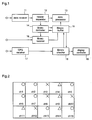
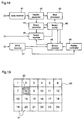
- Fig. 1 is a diagram showing a structure of a broadcasting reception apparatus in accordance with a first embodiment of this invention.
- reference numeral 11 denotes a data receiver receiving broadcast signals of a program (hereinafter referred to as program signals) provided by a broadcaster.
- the program signal comprises a data part and a header part.
- attribute data such as the name of a decoding software program for decoding the data
- 12 is a header separator separating a program signal received in the data receiver 11 into the data part and the header part, outputting the header part to a library controller 14 described hereinafter, and outputting the data part to the data processor 13 described hereinafter.
- 16 is a library receiver receiving a decoding software program (library) for decoding a program signal, via broadcasting.
- the library controller 14 detects the name of a library for decoding a program signal from the header part obtained from the header separator 12, and checks whether the library is held in a library buffer or not.
- 15 is the library buffer holding the library received in the library receiver 16.
- the data processor 13 decodes the data output by the header separator 12 using the library held in the library buffer 15.
- 17 is an EPG receiver receiving EPG data used in selecting channels in the broadcasting reception apparatus. In the EPG data, the names of libraries for decoding the program signals on the respective channels are described.
- 18 is a library checker comparing the name of libraries described in the EPG data with libraries in the library buffer 15.
- 19 is a display controller controlling the display of an EPG picture on a display screen.
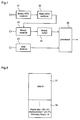
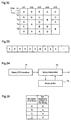
- Fig. 2 is a diagram illustrating an example of a channel display presented by the broadcasting reception apparatus in accordance with the first embodiment.
- the library checker 18 detects the name of a library used for decoding program data for each channel based on the EPG data received by the EPG receiver 17, and checks whether the library is held in the library buffer 15 or not.
- the display controller 19 displays the state of each channel, as shown in Fig. 2, based on a result of the check by the library checker 18. To be specific, for example, a ⁇ is displayed for a channel for which a library is held in the library buffer 15, while a X is displayed for a channel for which a library is not held in the library buffer 15. By seeing this display, a user verifies channels which can present a program immediately because the library is held in the library buffer 15, and can select such channels, thereby making possible pleasant zapping.
- the broadcasting reception apparatus receives broadcast signals transmitted according to a data broadcasting method sending program signals of two or more kinds of broadcasting formats via a plurality of channels, and comprises the library buffer 15 holding decoding software programs for decoding program signals, the library checker 18 checking, for each channel, whether a decoding software program necessary for decoding a program signal transmitted via the channel is held in the library buffer 15 or not, and the display controller 19 presenting a display having the plurality of channels, by which the viewer verifies, for each channel, whether a decoding software program necessary for decoding a program signal transmitted via the channel is held in the library buffer 15 or not.
- the viewer can check for what channel a decoding software program (library) is available in a library buffer of a broadcasting reception apparatus, thereby making possible pleasant zapping.
- the names of libraries for decoding program data for each channel are described in the EPG data, and the library checker 18 detects the name of a library to be used for decoding program data for each channel based on information about which cell is indicated by a cursor.
- the data receiver 11 receives program signals, switching a plurality of channels successively, and the header separator 12 extracts the header part of the program signal of each channel, and outputs it to the library controller 14, and the library controller 14 detects the name of a library for decoding the program signal for each channel by reading the header part of the program signal, and checks whether the library is held in the library buffer 15 or not, whereby the same effect is realized.
- the library checker 18 detects the name of a library for decoding program data of each channel based on EPG data received by the EPG receiver 17, and then, checks whether the library is held in the library buffer 15 or not. The library checker 18 further predicts a time necessary for the library receiver 16 downloading the libraries that are not held in the library buffer 15, based on information about the size of each library.
- the display controller 19 presents a channel display showing the state of each channel, as shown in Fig. 2, on the basis of results of the check and prediction by the library checker 18.
- channels for which libraries are held in the library buffer 15 are indicated by ⁇
- channels for which libraries are not held in the library buffer 15, but it takes within 3 seconds to download the library are indicated by ⁇
- channels for which libraries are not held in the library buffer 15, but it takes 3 seconds or more to download the library are indicated by X.
- a program exclusive channel As shown in Fig. 44(b), set up for broadcasting only decoding software programs for decoding broadcast data apart from channels for broadcasting broadcast data, and the decoding software programs are repeatedly transmitted via the program exclusive channel, if the library receiver receives the program exclusive channel to check the incidence of each library in advance, and predicts a time necessary to download each library by taking also the incidence into account, the predicted time becomes more precise.
- a way of displaying the state of each channel is not restricted to this.
- channels possible to listen to or watch may be displayed on the screen in listening to or watching a program.
- only channels, which would be indicated by ⁇ in the foregoing description, are displayed on the display screen of a program being listened or watched.
- a frame surrounding '2' indicates a position pointed by a cursor controlled by the arrow keys of a remote control and the like. That is, in this example, channels possible to immediately listen to or watch are displayed on the screen while a cursor is displayed and the viewer can choose a channel to be received by shifting the cursor using keys of a remote control.
- channels possible to immediately listen to or watch are displayed in Fig. 3. As shown in Fig. 4, however, all channels are displayed, and channels possible to immediately listen to or watch may be indicated by changing the size or color of the font of the channel number. Or channels possible to immediately listen to or watch may be highlighted, channels possible to listen to or watch after waiting in a short time may be blinked, and channels possible to listen to or watch a long time after may be black-and-white reversed.
- channels are displayed up to channel 10.
- the remote control can scroll channels to show channel 11 and the following. That is, if a button 'next' of the remote control is pushed, channel 11 to 20 are displayed. If the button 'next' is further pushed, channel 21 to 30 are displayed.
- channel selection by a remote control may be performed by choosing a channel number directly by the number keys of the remote control, or by shifting a cursor position by the arrow keys of the remote control.
- the channel selection is performed by shifting a cursor, and channels other than those possible to immediately listen to or watch are also displayed as shown in Fig. 4, the cursor does not shift its position in order in response to pushing on the arrow key of a remote control, but the cursor may take its position only on channels possible to immediately listen to or watch.
- the broadcasting reception apparatus may further include a means for displaying channels other than a cathode-ray tube.
- a library is a program which can not be divided.
- channels possible to be decoded by the combination of sub-library components held in a library buffer may be indicated by ⁇
- channels possible to be decoded by a sub-library component to be downloaded and sub-library components held in the library buffer may be indicated by ⁇
- channels, which two or more sub-library components to be downloaded are needed for constituting a library for decoding may be indicated by X. That is, channels are displayed depending on what sub-library is held.
- Fig. 6 is a conceptual diagram showing a sub-library.
- a sub-library is a unit of program constituting a library.
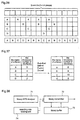
- sub-libraries a, b, and c constitute a library A; sub-libraries d, e, and f, a library B; sub-libraries a, b, and e, a library C; sub-libraries a, d, and g, a library D; and sub-libraries h, i, and j, a library E.
- the library buffer of a broadcasting reception apparatus stores the libraries A and B.
- channels using the libraries C, D, and E are indicated by X because it is decided that it takes a long time for the channel to become possible to listen to or watch.
- components constitute a library the components a, b, and e are to constitute the library C, and these components are already stored in the library buffer, so that the channel using the library C is indicated by ⁇ .
- the components a, d, and g are to constitute the library D, and only the component g should be downloaded, so the channel using the library D is indicated by ⁇ .
- the components h, i, and j are to constitute the library E, and all the components should be downloaded, so the channel using the library E is indicated by X. Note that channels may be displayed on EPG, or on the display screen of a program being listened or watched.
- Fig. 7 is a diagram showing a structure of a broadcasting reception apparatus in accordance with a second embodiment of this invention.
- reference numeral 21 designates a library EPG receiver receiving a library EPG provided by a broadcaster; 22, a library EPG analyzer analyzing the library EPG received by the library EPG receiver 21, and controlling a library receiver described below, based on a result of the analysis; 23, a library receiver receiving libraries provided by the broadcaster; 24, a library buffer holding the libraries received by the library receiver 23; 25, a data receiver receiving broadcast signals of a program; and 26, a processing unit decoding the program signals received by the data receiver 25, using the library held by the library buffer 24.
- Fig. 8 is a diagram showing an example of a structure of a broadcast signal of a program provided by a broadcaster.
- the broadcast signal comprises a data part 31 and a header part 32.
- the name of a decoding software program (library) for decoding data in the data part 31, and attribute data, such as the display position and display size of the data, are described. That is, data A is decoded using a library A, and displayed at a position (X1, Y1) on a screen, in a size (W1, H1).
- the software library A described in the header part is just a pointer indicating the library A, so the library A itself must be fetched.
- the library A itself may be supplied from a CD-ROM or hard disk, or via a network.
- a case will be discussed where the library A is downloaded using a channel (library EPG channel) of broadcasting.
- libraries themselves i.e., data of software programs, used for all channels, i.e., channel 1 to channel 100, are provided via the library EPG channel.
- the broadcasting reception apparatus downloads libraries according to a library EPG which is a list showing a program on which time zone, on which channel is decoded using which decoding software program, or library.
- the data of the library EPG is also provided via the library EPG channel.
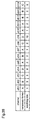
- a to D are the names of libraries which are used in time zones. For example, on the channel 1, the library A is used from time T1 to time T2, and the libraries A and B are used from time T2 to time T3.
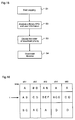
- Fig. 11 is a flowchart showing the operation of the broadcasting reception apparatus in accordance with the second embodiment in performing zapping operation. The operation of the broadcasting reception apparatus will be described with reference to Fig. 11.
- the library analyzer 22 analyzes the library EPG data received by the library EPG receiver 21 as a list shown in Fig. 10. Specifically, when the current time is t, the number of libraries at time (t+ ⁇ ) when libraries will be actually required for zapping are counted. In Fig. 10, the numbers of libraries are four As, two Bs, zero C, and one D at time (t+ ⁇ ).
- the library EPG analyzer 22 gives priority to the library having the larger number, decides to download the library first (S3), and outputs a control signal to the library receiver 23. According to the control signal, the library receiver 23 downloads the libraries in the order determined by the control signal (S4), and stores the libraries in the library buffer 24.
- the library buffer has stored the library A.
- the order of priority is A, B, D, and C, and the library A has been already stored in the library buffer, so that the libraries B, C, and D are download in order of B ⁇ D ⁇ C, within the size of the library buffer.
- the library buffer has as large an amount as stores two libraries, the library buffer stores the libraries A and B. Therefore, switching a channel to channel 3, 4, and 5 can be done smoothly with no download time.
- the download time is half compared with when both libraries B and D are downloaded. If the library buffer has an amount enough to store three libraries, because the libraries B, C, and D are downloaded at time t, a waiting time is zero when switching to any channel.
- the number of libraries used are counted between time t and time t+ ⁇ , which is at a constant time after time t, and the order of download is determined. Even when libraries used on each channel change in zapping, libraries to be needed later for zapping are efficiently fetched in advance. That is, some time after the above example, when time T2 comes between time t and time t+ ⁇ , and libraries used for each channel change, the library EPG analyzer 22 counts the number of libraries used at time t+ ⁇ , and decides the order of priority to download the libraries. Thus, when time t becomes time T2, necessary libraries have been already in the library buffer, zapping can be smoothly performed without any waiting time.
- channel 1 to channel 5 uses only the library A between time T1 and time T2 and then, the channel C uses both the library A and the library B after time T2, if the user zaps from channel 1 to channel 5 in order, and zaps channel 1 again after time T2, the library B for decoding broadcast signals on channel 1 has been already in the library buffer, so smooth zapping can be performed with no waiting time.
- the broadcasting reception apparatus receives broadcast signals transmitted according to a data broadcasting method sending program signals of two or more kinds of broadcasting formats via a plurality of channels, and includes the library EPG analyzer 22 deciding the order of priority to download decoding software programs for decoding broadcast signals transmitted via the plurality of channels, using the library EPG which is a list showing the decoding software programs in a matrix of channel and time.
- the broadcasting reception apparatus downloads the decoding software program according to the download priority determined by the library EPG analyzer 22, thereby reducing a waiting time for download in zapping, and realizing a broadcasting reception means capable of pleasant zapping.
- libraries and library EPG data are provided via an independent channel different from channels transmitting broadcast signals of programs
- the libraries and the library EPG data can be multiplexed into the empty region of each channel, or can be downloaded via package media, networks, or the like.
- libraries each may be a complete program or a dynamic link library.
- the library EPG analyzer 22 may detect the size of a library and the size of the empty region of a library buffer, and may decide the order of the download priority so as to exploit the library buffer effectively.
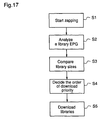
- Fig. 17 is a flowchart showing the operation in the case where the order of the download priority is decided by taking into account the size of a library and the size of the empty region of a library buffer.
- the library EPG analyzer 22 analyzes library EPG data received by the library EPG receiver 21, and produces a list of the library EPG data (S2). For example, if it is assumed that the library EPG is like Fig. 16, when the number of libraries used at time t is counted, there are two library As, three library Bs, three library Cs, two library Ds, two library Es, and one library Fs.
- priority for example, when listening to or watching channel 1, because the library A and the library B have been already stored in the library buffer, the library C has the first priority; the libraries D and E, the second priority; and the library F, the third priority.
- the size of a library, and the size of the empty region of the library buffer are detected and compared with each other (S3).
- the size of the library C is 100K byte
- the sizes of the libraries D, E, and F each are 20K byte
- the size of the empty region of the library buffer is 110K byte. If the library C is downloaded, only the library C occupies the region. If the libraries D, E, and F are downloaded, the three libraries can be stored in the library buffer. There are three channels requiring the library C, i.e., channel 2, channel 4, and channel 5. However, it is not possible to listen to or watch those channels if only the library C is downloaded.
- channel 3 is possible to listen to or watch. Consequently, when the library EPG analyzer 22 decides the order of download priority by taking into account the library size and the empty region size of a library buffer (S4), and then, libraries are downloaded, it is possible to reduce effectively a waiting time for download in zapping, and realize a broadcasting reception means capable of pleasant zapping.
- Fig. 12 is a diagram showing the broadcasting reception apparatus.
- the same reference numerals as in Fig. 7 denote identical or corresponding parts.
- Reference numeral 27 indicates a user information administrator recording a channel number along with date and time of listening to or watching the channel, for example, "listened or watched channel 3 from ⁇ o'clock to XX o'clock in ⁇ day of the week, X day ⁇ month".
- Fig. 15 is a flowchart showing the operation of the broadcasting reception apparatus in zapping.
- a program signal, a decoding software program, and library EPG data are provided.
- the library EPG analyzer 22 decides the order of priority of libraries downloaded based on the total audience time for each channel calculated based on information about user's audience accumulated in the user information administrator 27, and the library EPG data indicating a program on which time zone, on which channel is decoded using which decoding software program (library).
- the library EPG analyzer 22 analyzes the library EPG and the user information (S2), and decides the order of download priority (S3). That is, libraries needed for decoding the program signal of each channel at time (t+ ⁇ ) when libraries will be actually required for zapping, are detected in the library EPG. Further, the total audience time for each channel within a predetermined past period, for example, the last week, is calculated based on information about user's audience accumulated in the user information administrator 27. The libraries detected in the library EPG are downloaded in order of the total audience time the largest first. Specifically, Fig.
- FIG. 13 shows the total audience time for each channel within a predetermined past period, for example, the last week, calculated based on information about user's audience accumulated in the user information administrator 27.
- the order of priority is channel 5, channel 3, channel 2, and channel 4.
- What library is used in channel 5 is A. Since channel 1 is listened or watched at time t, the library A has been already stored in the buffer. What library is used in channel 3 are A and B. Accordingly, the library B has the first priority for library download.
- Channel 2 uses the libraries B and D, so the D has the second priority. Therefore, the order of priority is determined to be B ⁇ D, and the libraries B and D are fetched in advance, depending on the amount of the buffer.
- total audience times for channels within a given constant period are compared to each other, and the order of download priority is determined in such a way as that first for a channel having the largest total audience time a library for decoding broadcast signals on the channel is downloaded. Consequently, especially when the user repeatedly switches and listens or watches, i.e., zaps, his/her several favorite channels, a download waiting time can be reduced in zapping, thereby realizing a broadcasting reception means capable of pleasant zapping.
- the order of priority may be determined with the number of times of listening to or watching the channel at the same time in the past.
- the order of priority is determined with the number of times of listening to or watching the channel at the same time in the past, if the present time is t, the number of times of listening to or watching for each channel is counted at time t+ ⁇ yesterday, time t+ ⁇ 2 days before, and so on, i.e., time t+ ⁇ in the past.
- the order of channel priority is channel 3 ⁇ channel 2 ⁇ channel 1 ⁇ channel 5 ⁇ channel 4.
- Fig. 10 shows a library EPG in which the libraries used for channel 3 are A and B; channel 2, B and D; channel 1, A; channel 5, A; and channel 4, A.
- the order of download priority is B ⁇ D.
- the libraries B and D are fetched in advance, depending on the amount of the buffer.
- the download waiting time is reduced in zapping, thereby realizing a broadcasting reception means capable of pleasant zapping.
- the user's favorite genres are predetermined, or estimated from a past audience situation.
- a channel transmitting the favorite genres is found, and libraries used for the channel may be fetched in advance.
- the user information administrator 27 holds and administrates the genre-categorized program schedule table and the user's favorite genres.
- the total times of the user's audience genres in the past are calculated using the genre-categorized program schedule table, and the order of genres are determined by the total time in a way in which the largest is the most favorite.
- genres of programs broadcast at time t+ ⁇ are searched in the genre-categorized program schedule table, and the order of channel is determined in an manner that a channel transmitting a genre positioning high in the order of genre positions high in the order of channel.
- a library given priority to download first is determined using the library EPG.
- genres P, Q, R, and S are defined in the genre-categorized program schedule table
- the order of audience time in the past is S, R, Q, P, in which the largest is S.
- broadcast genres are searched at time t+ ⁇ using the genre-categorized program schedule table, if it is assumed that contents having a genre S are broadcast on channel 1 and channel 4; a genre R, channel 3; a genre Q, channel 2; and a genre P, channel 5, then the order of channel is channel 1, channel 4, channel 3, channel 2, channel 5.
- the order of library download priority is B, D, which are fetched in advance at time t, depending on the amount of a buffer.
- the download waiting time is reduced in zapping, thereby making possible a broadcasting reception means capable of pleasant zapping.
- the library EPG receiver 21 may receive the genre-categorized program schedule table, and the library EPG analyzer 22 may process the genre-categorized program schedule table.
- the above-described several ways of determining the order of download priority based on information about the user's switching channels in the past i.e., the determination of the order of priority based on the total audience time in a given constant period, the determination of the order of priority based on the number of times of audience for each channel at the same time in the past, and the determination of the order of priority based on favorite genres, are simulated, and a way the most suitable for the user may be automatically chosen. This method can fetch in advance the library used most probably.
- the user information administrator 27 may hold information about the preset, and the library EPG analyzer 22 may determine the order of download priority, according to which libraries used for the channels preset in the remote control are first fetched in advance. If the order of priority is determined based on channels preset in a remote control, especially when the user performs zapping with the remote control, it is possible to reduce the download waiting time, thereby realizing a broadcasting reception means capable of pleasant zapping.
- Fig. 18 is a diagram showing a structure of a broadcasting reception apparatus in accordance with a fourth embodiment of this invention.
- reference numeral 41 denotes a data receiver receiving broadcast signals of programs (hereinafter referred to as program signals) provided by broadcasters.
- the program signal comprises a data part and a header part.
- attribute data such as the name of a decoding software program for decoding the data
- 42 is a header separator separating a program signal received in the data receiver 41 into the data part and the header part, outputting the header part to a library controller 44 described hereinafter, and outputting the data part to the data processor 43 described hereinafter.
- the library 46 is a library receiver receiving a decoding software program (library) for decoding a program signal, via broadcasting.
- the library controller 44 detects the name of a library for decoding a program signal from the header part obtained from the header separator 42, and checks whether the library is held in a library buffer or not.
- 45 is the library buffer holding the library received in the library receiver 46.
- the data processor 43 decodes the data output by the header separator 42 using the library held in the library buffer 45.
- 47 is an EPG receiver receiving EPG data used in selecting channels in the broadcasting reception apparatus. In the EPG data, the names of libraries for decoding the program signals on the respective channels are described.
- 48 is a library checker comparing the name of libraries described in the EPG data with libraries in the library buffer 45.
- 49 is a display controller controlling the display of an EPG picture on a display screen.
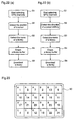
- Fig. 22(a) is a flowchart for explaining the operation of the broadcasting reception apparatus in accordance with the fourth embodiment. The operation will be described with reference to Fig. 22(a).
- channel selection for receiving signals is performed, for example, using an EPG picture 50 as shown in Fig. 19.
- the display controller 49 presents on a display screen, an EPG picture on which a plurality of cells 51 shown in Fig. 19, corresponding to a plurality of channels, arranged in a matrix based on the EPG data received by the EPG receiver 47.
- a cursor 52 is also displayed on the EPG picture 50 to indicate a cell. In Fig. 19, the cursor 52 is indicating channel 8.
- a channel number is presented in the cell 51
- information about a program being broadcast at the present time as well as the channel number may be displayed in the cell 51.
- the display controller 49 detects which cell is detected by the cursor (S2), and outputs this information to the library checker 48.
- the library checker 48 based on information about which cell is indicated by the cursor, detects the names of libraries for decoding program data on channels shown in a cell indicated by the cursor and its adjacent cells, i.e., in Fig. 19 a cell of channel 8 and its adjacent channels of eight channel 1, 2, 3, 7, 9, 13, 14, and 15 (S3). Thereafter, the library checker 48 checks whether those libraries are held in the library buffer 45 or not (S4). When the library is not held in the library buffer 45, the library checker 48 controls the library receiver 46 in a way to receive the library. In response to control of the library checker 48, the library receiver 46 downloads the library not held in the library buffer 45 (S5), and stores it in the library buffer 45.
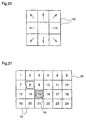
- receiving channels are selected by a cursor shifting cell by cell in a way that pushing one of a plurality of input keys 60 of a remote control, indicating directions of shifting a cursor, i.e., up, down, left, right, and slant directions, shifts a cursor from a cell to one of its adjacent cells positioning in the direction indicated by a pushed key.
- directions of shifting a cursor i.e., up, down, left, right, and slant directions
- the cursor 52 can move to eight cells 51 of channel 1, 2, 3, 7, 9, 13, 14, and 15 by pushing the input key one time.
- the broadcasting reception apparatus As described above, a cell indicated by a cursor is detected on an EPG picture. It is checked whether libraries used for channels indicated by the cell and its adjacent cells are held in a library buffer or not. When not held, the library is downloaded via broadcasting to be stored in the library buffer. Thus, the library that is used in a channel to be highly probably chosen, and that is not held in the library buffer is downloaded before selection of receiving channels. Therefore, the download waiting time is reduced in a broadcasting reception apparatus in which channel selection is performed using EPG.
- receiving channel selection is performed by choosing one of a plurality of cells on an EPG picture on which the plurality of cells corresponding to a plurality of channels are arranged in a matrix, using a cursor shifting from one cell to its adjacent cell by one operation of a remote control. It is decided whether a library buffer stores decoding software programs for decoding programs transmitted via channels shown in a cell indicated by the cursor and its adjacent cells. When not held, the decoding software program is download via broadcasting, and stored in the library buffer. Consequently, the download waiting time can be reduced in a broadcasting reception apparatus in which channel selection is performed using EPG.
- the name of a library for decoding program data on each channel is described in EPG data, and the library checker 48 detects from EPG data the names of libraries used for decoding program data on channels shown in a cell indicated by a cursor and its adjacent cells, based on information about which cell is indicated by the cursor.
- the data receiver 41 based on the information about which cell is indicated by a cursor, successively switches channels shown in a cell indicated by a cursor and its adjacent cells, and receives the channels, the header separator 42 extracts the header part of a program signal on each channel, and outputs it to the library controller 44, the library controller 44 reads the header part of a program signal on each channel to detect the name of a library for decoding the program signal data, and checks whether the library is held in the library buffer 45 or not, and when the library is not held in the library buffer 45, controls the library receiver 46 in a way to receive the library not held in the library buffer 45.
- the cells showing channels are arranged on the EPG picture in a 6 ⁇ 4 matrix.
- an EPG picture may be one in which the cells showing channels are arranged on the EPG picture in an m ⁇ n matrix (m and n are positive integers).
- a cursor position is detected on an EPG picture. For all channels shown in a cell indicated by the cursor and its adjacent cells, libraries used for those channels are held in a library buffer or not. When not held, the library is download via broadcasting.
- the motion of a cursor is detected on an EPG picture. For a cell to which the cursor shifted, its adjacent cell positioning in the shifting direction, and cells adjacent to the first and second cells, it is checked whether the libraries used for channels shown in those cells are held or not. When not held, the library is downloaded via broadcasting.
- FIG. 22(b) is a flowchart for explaining the operation of the broadcasting reception apparatus according to the fifth embodiment. The operation of the broadcasting reception apparatus according to the fifth embodiment will be described with reference to Fig. 22(b).
- the display controller 49 presents on a display screen, an EPG picture 50 on which a plurality of cells shown in Fig. 21, corresponding to a plurality of channels, arranged in a matrix.
- a cursor 52 is also displayed on the EPG picture 50 to indicate a cell.
- the user shifts the cursor 52 displayed on the EPG picture 50 using a remote control including, for example, input keys 60 shown in Fig. 20. It is assumed that the cursor, which has been positioned at a cell showing channel 8 in an initial state in selecting receiving channels, shifts to a cell showing channel 15 by operation of the remote control, as shown in Fig. 21.
- the display controller 49 detects a cell to which the cursor shifts and the direction of the cursor shifting (here right bottom) (S2), and outputs this information to the library checker 48.
- the library checker 48 based on the information from the display controller 49, detects from EPG data the names of libraries used for decoding program data on channels shown the cell to which the cursor shifts (cell showing channel 15), its adjacent cell positioning in the shifting direction (cell showing channel 22), and cells adjacent to the first and second cells (cells showing channel 16 and 21). Thereafter, the library checker 48 checks whether the libraries used for channels shown in those cells are held or not (S4). When the library is not held in the library buffer, the library checker 48 controls the library receiver 46 in a way to receive the library via broadcasting. The library receiver 46 downloads the library not held in the library buffer 45 in response to the control of the library checker 48, and stores the library in the library buffer 45.
- receiving channels are selected by a cursor shifting cell by cell in a way that pushing one of a plurality of input keys 60 of a remote control, indicating the direction of shifting a cursor, i.e., up, down, left, right, and slant directions, shifts a cursor from a cell to one of its adjacent cells positioning in the direction indicated by a pushed key.
- a cursor shifting cell by cell in a way that pushing one of a plurality of input keys 60 of a remote control, indicating the direction of shifting a cursor, i.e., up, down, left, right, and slant directions, shifts a cursor from a cell to one of its adjacent cells positioning in the direction indicated by a pushed key.
- the cursor 52 when the cursor 52 shifts from a cell showing channel 8 to a cell showing channel 15 by the user controlling the remote control, the cursor 52 can move to eight cells of channel 8, 9, 10, 14, 16, 20, 21, and 22 by pushing an input key next one time. Taking it into account that the cursor has shifted from channel 8 to channel 15, it is seemingly little probable that the cursor shifts back to channel 8. It is also considered little probable that the cursor shifts to channel 9 or 14, because if the user wants to switch to channel 9 or 14, it is better to shift the cursor directly from channel 8 to channel 9 or 14. Further, if shifting to channel 10, the cursor would move from channel 8 to channel 9 to channel 10. If shifting to channel 20, the cursor would move from channel 8 to channel 14 to channel 20.
- the cursor shifts from channel 8 to channel 10 or 20.
- the motion of a cursor is detected on an EPG picture. For a cell to which the cursor shifted, its adjacent cell positioning in the shifting direction, and cells adjacent to the first and second cells, it is checked whether the libraries used for channels shown in those cells are held or not.
- the library When not held, the library is downloaded via broadcasting, and stored in a library buffer. Therefore, the download of libraries, which are used on channels being highly probable to be selected, and are not held in a library buffer, is started before selecting the channels. Thus, the download waiting time is reduced using EPG in a broadcasting reception apparatus in which channel selection is performed.
- receiving channel selection is performed by choosing one of a plurality of cells on an EPG picture on which the plurality of cells corresponding to a plurality of channels are arranged in a matrix, using a cursor shifting from one cell to its adjacent cell by one operation of a remote control. For a cell to which the cursor shifted, its adjacent cell positioning in the shifting direction, and cells adjacent to the first and second cells, it is checked whether decoding software programs used for decoding programs broadcast via channels shown in those cells are held or not. When not held, the library is downloaded via broadcasting, and stored in a library buffer. Thus, the download waiting time is reduced using EPG in a broadcasting reception apparatus in which channel selection is performed.
- the name of a library for decoding program data on each channel is described in EPG data, and the library checker 48 detects from EPG data the names of libraries used for decoding program data on channels shown in a cell indicated by a cursor and its adjacent cells, based on information about which cell is indicated by the cursor.
- the data receiver 41 based on the information about which cell is indicated by a cursor, successively switches channels shown in a cell to which the cursor shifted, its adjacent cell positioning in the shifting direction, and cells adjacent to the first and second cells, and receives the channels, the header separator 42 extracts the header part of a program signal on each channel, and outputs it to the library controller 44, the library controller 44 reads the header part of a program signal on each channel to detect the name of a library for decoding the program signal data, and checks whether the library is held in the library buffer 45 or not, and when the library is not held in the library buffer 45, controls the library receiver 46 in a way to receive the library not held in the library buffer 45.
- the cells showing channels are arranged on the EPG picture in a 6 ⁇ 4 matrix.
- an EPG picture may be one in which the cells showing channels are arranged on the EPG picture in an m ⁇ n matrix (m and n are positive integers).
- Fig. 23 is a diagram showing an example of an EPG picture presented on a display screen by a broadcasting reception apparatus in accordance with a sixth embodiment of this invention.
- the broadcasting reception apparatus presents channels in such a manner as that channels using the same library cluster on the EPG picture.
- a structure of the broadcasting reception apparatus according to the sixth embodiment is similar to that of the broadcasting reception apparatus according to the fourth embodiment.
- the display controller 49 detects a library used for each channel from the EPG data, and displays channels in a manner in which channels using the same library cluster on the EPG picture, just as in Fig. 23.
- the data receiver 41 successively switches and receives all the channels
- the header separator 42 extracts the header part of a program signal on each channel, and outputs it to the library controller 44
- the library controller 44 reads the header part of a program signal on each channel to detect the name of a library for decoding the program signal data.
- the display controller 49 based on a result of the detection, performs display control in a way that channels using the same library cluster on the EPG picture, and displays the EPG picture as shown in Fig. 23 on the display screen.
- channels using the same library are clustered together on an EPG picture. Consequently, when channels are selected on the EPG picture, after a channel is chosen and the library for the channel is downloaded, the download waiting time is unnecessary when choosing channels neighboring the selected channel, using the same library, thereby realizing pleasant channel selection for the user.
- Fig. 24 is a diagram showing an example of an EPG picture presented on a display screen by a broadcasting reception apparatus in accordance with a seventh embodiment of this invention.
- the broadcasting reception apparatus presents channels in such a manner as that channels using the same library cluster on the EPG picture.
- a structure of the broadcasting reception apparatus according to the seventh embodiment is similar to that of the broadcasting reception apparatus according to the fourth embodiment shown in Fig. 18.
- the library checker 48 detects the library used for each channel from the EPG data, compares it to libraries held in the library buffer 45, and informs channels using the libraries held in the library buffer 45 to the display controller 49.
- the display controller 49 based on the information from the library checker 48, displays the channels using the libraries held in the library buffer 45 in a manner in which channels using the same library cluster on the EPG picture, just as in Fig. 24.
- Fig. 24 is an example when only libraries A and B among libraries A to D are held in the library buffer 45. As is apparent from the figure, channels using the libraries A and B are clustered together on the left side of the EPG picture.
- the data receiver 41 When the name of a library for decoding program data on each channel is not described in the EPG data, the data receiver 41 successively switches and receives all the channels, the header separator 42 extracts the header part of a program signal on each channel, and outputs it to the library controller 44, the library controller 44 reads the header part of a program signal on each channel to detect the name of a library for decoding the program signal data, and compares the detected library to libraries held in the library buffer 45, and informs channels using the libraries held in the library buffer 45 to the display controller 49.
- the display controller 49 based on the information from the library controller 44, performs display control in away that channels using the same library cluster on the EPG picture.
- channels using the same library i.e., channels not needing library download when selected
- the download waiting time is unnecessary, thereby realizing pleasant channel selection for the user.
- the download waiting time can be reduced or removed at all in selecting channels.
- a plurality of cells corresponding to a plurality of channels are arranged on an EPG picture in an m ⁇ n matrix (m and n are natural numbers), and cells are selected by a cursor which can shift from a cell to one of its adjacent cells, i.e., one by one, in response to one action of operation of a remote control.
- a plurality of cells corresponding to a plurality of channels are recursively arranged on an EPG picture in an m ⁇ n matrix (m and n are natural numbers), and a remote control has input keys arranged in an m ⁇ n matrix.
- Channels are selected in the following way. Cells including a desired channel are continually selected one time less than the number of recurring times of cell arrangement until only a minimum unit of m ⁇ n matrix is shown on the EPG picture. Then, an input key corresponding to the cell showing the desired channel is chosen.
- a structure of the broadcasting reception apparatus according to the eighth embodiment is similar to that of the broadcasting reception apparatus according to the fourth embodiment.
- Fig. 25 is a diagram illustrating a structure of input keys of the remote control used for channel selection in the broadcasting reception apparatus of the eighth embodiment.
- the remote control is used for operating EPG as shown in Fig. 26.
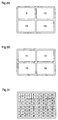
- the user pushes either of input keys arranged in the center portion of the remote control, i.e., 'top left', 'top right', 'bottom left' and 'bottom right'.
- Those input keys indicate the positions of divisions when the display screen is divided into four.
- pushing the 'top left' key leads to the selection of the top left portion of Fig. 26.
- the portion is made noticeable to represent that it is being selected, for example, by changing the color of the portion on the EPG picture.
- the display screen switches to that shown in Fig. 27.
- the EPG picture in Fig. 26 is presented, to push the 'top right' key selects the top right portion of Fig. 26, and to push the 'select' key switches the screen to that shown in Fig. 28; to push the 'bottom left' key selects the bottom left portion of Fig. 26, and to push the 'select' key switches the screen to that shown in Fig.
- the remote control further includes 'top', 'bottom', 'left' and 'right' input keys to change selection ranges. For example, in the situation that the EPG picture in Fig. 26 is presented, when the 'top left' key is pushed, the top left portion of the EPG picture in Fig. 26 becomes the selection range. In this situation, pushing the 'bottom' key makes the bottom left portion of the EPG picture the selection range. Then, pushing the 'right' key makes the bottom right portion the selection range. Then, pushing the 'top' key makes the top right portion the selection range.
- the remote control further include an 'up' key.
- the state is one stage up in the hierarchy. For example, in the situation that the EPG picture in Fig. 26 is presented, pushing the 'up' key leads to display of an EPG picture as shown in Fig. 31.
- the EPG picture shown in Fig. 26 is displayed.
- the 'top left' input key of the remote control corresponds to channel 1; the 'top right', channel 2; the 'bottom left', channel 5; and the 'bottom right', channel 6. Pushing either of the keys, a channel corresponding to it is selected.
- EPG pictures are selected by a remote control. At the time when either of the EPG pictures is presented, it is checked whether decoding software programs for decoding programs transmitted via the four channels shown in the EPG picture are held or not. When not held, the decoding software program is downloaded via broadcasting, and stored in the library buffer.
- the display controller 49 informs the library checker 48 about channels contained in the EPG picture, i.e., channel 1, channel 2, channel 5, and channel 6.
- the library checker 48 detects the library used for each channel from the EPG data.
- the library checker 48 controls the library receiver in a way to receive the library.
- the library receiver 46 downloads the library not held in the library buffer 45 via broadcasting, and stores the library in the library buffer 45.
- the display controller 49 informs the data receiver 41 about channels contained in the EPG picture, i.e., channel 1, channel 2, channel 5, and channel 6.
- the data receiver 41 successively switches and receives all the channels, the header separator 42 extracts the header part of a program signal on each channel, and outputs it to the library controller 44, the library controller 44 reads the header part of a program signal on each channel to detect the name of a library for decoding the program signal data, and checks whether the library is held in the library buffer 45 or not. When the library is not held, the library controller 44 controls the library receiver in a way to receive the library.
- the broadcasting reception apparatus in accordance with the eighth embodiment receives broadcast signals transmitted according to a data broadcasting method sending program signals of two or more kinds of broadcasting formats via a plurality of channels, in which a plurality of cells corresponding to a plurality of channels are recursively arranged on an EPG picture in a 2 ⁇ 2 matrix, and a remote control has input keys arranged in a 2 ⁇ 2 matrix.
- Channels are selected in the following way. Cells including a desired channel are continually selected one time less than the number of recurring times of cell arrangement until only a minimum unit of 2 ⁇ 2 matrix is shown on the EPG picture. Then, an input key corresponding to the cell showing the desired channel is chosen.
- a plurality of cells corresponding to a plurality of channels are recursively arranged on an EPG picture in a 2 ⁇ 2 matrix, and a remote control has input keys arranged in a 2 ⁇ 2 matrix.
- Channels are selected in the following way. Cells including a desired channel are continually selected one time less than the number of recurring times of cell arrangement until only a minimum unit of 2 ⁇ 2 matrix is shown on the EPG picture. Then, an input key corresponding to the cell showing the desired channel is chosen.
- the following modification is within the scope of this invention.
- a plurality of cells corresponding to a plurality of channels are recursively arranged on an EPG picture in an m ⁇ n matrix (m and n are natural numbers), and a remote control has input keys arranged in an m ⁇ n matrix.
- Channels are selected in the following way. Cells including a desired channel are continually selected one time less than the number of recurring times of cell arrangement until only a minimum unit of m ⁇ n matrix is shown on the EPG picture. Then, an input key corresponding to the cell showing the desired channel is chosen.
- Fig. 34 is a diagram showing a system structure of a broadcaster realizing a data broadcasting method in accordance with a ninth embodiment.
- reference numeral 71 designates a library EPG analyzer receiving a library EPG showing, for each channel, decoding software programs (libraries) necessary for decoding program signals transmitted by each sub-broadcasters, and analyzing the contents of the library EPG by handling it as a list.
- 73 is a library buffer holding a plurality of libraries.
- 72 is a library transmitter outputting the plurality of libraries held in the library buffer 73 in a predetermined order and incidence, based on a result of the analysis.
- a broadcaster comprising broadcasting satellites and so on receives broadcast signals from sub-broadcasters each having one or plural channels, and after processing the received broadcast signals, transmits the processed broadcast signals to household receiving terminals.
- each of the sub-broadcasters transmit a library EPG data as information showing decoding software programs (libraries), necessary for decoding program signals transmitted by their own, on a time axis for each channel.
- the library EPG analyzer 71 included in the broadcasting system of the broadcaster receives the library EPG data transmitted by each sub-broadcaster, totals up the data to make a list, for example, as shown in Fig. 32, and, based on the list, determines the order and incidence of libraries held in the library buffer 73 to be transmitted.
- necessary libraries for channel 1 to channel 5 at the time (t+ ⁇ ) regarded as when the user actually needs libraries are A, B, B, A, and A, respectively.
- the library EPG analyzer 71 counts the number of necessary libraries at the specific time (t+ ⁇ ), and controls the library transmitter 72 in a way to provide libraries so that the number of programs using the library matches the number of transmitting the library.
- the library transmitter 72 uses a library exclusive channel apart from channels for transmitting programs, and, for example, as shown in Fig. 33, provides each library in a way that the number of the provided library is proportional to the number of programs to be decoded with the library.
- the receiver highly probably selects the programs using the library, that is, it is highly probable that the receiver needs to download the library. Therefore, if the number of each library provided is made proportional to the number of programs using the library, actually transmitted, a library which the receiver highly probably needs is provided with a high incidence. Hence, the download waiting time on the receiving side is effectively reduced.
- libraries are provided in a way that the number of each library provided via a library exclusive channel is proportional to the number of programs to be decoded with the library, actually transmitted. Therefore, a library which is highly probably downloaded is provided with a high incidence. Hence, the download waiting time on the receiving side is reduced. Particularly, smooth zapping can be realized on the receiving side.
- the number of a library provided is proportional to the number of programs using the library.
- the order of libraries transmitted may be determined based on a predetermined rule, and provided. A description will be given of an example of when both the number of transmission and the transmission order are determined based on the library EPG data.
- the library EPG analyzer 71 determines the number of transmission and the transmission order for libraries according to a method as shown in Fig. 36. Initially, in Fig.
- the total number of libraries is 14, so fourteen frames are arranged in a row (uppermost row).
- the number of each library is 5 for A; 4 for B; 3 for C; and 2 for D.
- Four rows of frames are prepared in the center portion of Fig. 36, successively corresponding to A, B, C, and D in a way that the uppermost row is for A.
- the total number 14 is divided by the number of each library. Every the quotient number of frames, each library is put into a frame. In case of the library A, 14 divided by 5 is 2.8 with a remainder 2, and then, as shown in Fig. 36, A is arranged every two frames in the uppermost row of the center portion.
- components a, b, and c constitute a library A.
- Components b and d constitute a library B.
- Components a and c constitute a library C.
- Components c and d constitute a library D.
- the number of libraries is 5 for A; 4 for B; 3 for C; and 2 for D.
- the number of each component is 8 for a; 9 for b; 10 for c; and 6 for d.
- each component is provided with the ration of the number of transmission, i.e., 8:9:10:6.
- the components of the library to be highly probably downloaded are provided with a high incidence, so the library download waiting time can be reduced in zapping on the receiving side.
- information about what components constitute a library is necessary for the receiver to download components.
- the information may be transmitted via a library exclusive channel, or may be described in the header part of each data to be provided.
- Fig. 38 is a diagram illustrating a system structure of a broadcaster for realizing a data transmission method in accordance with a tenth embodiment.
- the same reference numerals as in Fig. 34 denote identical or corresponding parts.
- Reference numeral 74 indicates an audience rate totaling unit totaling up an audience rate for each program.
- a broadcaster comprising a broadcasting satellite and so on receives broadcast signals from sub-broadcasters each having one or plural channels, and after processing the received broadcast signals, transmits the processed broadcast signals to household receiving terminals.
- each of the sub-broadcasters transmits a library EPG data as information showing decoding software programs (libraries), necessary for decoding program signals transmitted by their own, arranged on a time axis for each channel.
- the audience rate totaling unit 74 included in the broadcasting system of the broadcaster obtains and totals up information about an audience rate for each program from each broadcast station or an audience rate search company or the like.
- the library EPG analyzer 71 receives library EPG data transmitted by each sub-broadcaster, and, for example, and totals up the data in a way to arrange a list. Based on the list and the audience rate for each program totaled by the audience rate totaling unit 74, the library EPG analyzer 71 further produces, for each library, the number of programs using the library, and the distribution of audience rates gathering the audience rate of each program, at the time when the user actually needs the library, and, based on those, determines the transmission order and transmission incidence of libraries held in the library buffer 73.
- a necessary library and an audience rate of each channel at a certain time are as shown in Fig. 39.
- An audience rate of each channel at the same time in the previous day may be used in place of that at the certain time.
- the average of audience rates at the same time in a given period may be used.
- libraries B to D the number of programs using the library and the total of audience rates are calculated.
- the number of programs using the library and the total of audience rates are multiplied by each other.
- the value of the multiplication is the transmission proportion of each library.
- libraries are distributed in the method shown in Fig. 36.
- a program using the library is highly probably selected on the receiving side, that is, it is highly probably necessary for the library to be downloaded on the receiving side.
- the program is highly probably selected at the time, that is, it is highly probably necessary for the library to be downloaded on the receiving side. That is, when the number of programs using a library and the audience rate of each channel at the same time are taken into consideration, a value resulting from multiplying the number of programs actually broadcast, using the library, by the audience rate is thought to indicate how often the library is required to be downloaded.
- the number of each library provided via a library exclusive channel is made proportional to a value resulting from multiplying the number of programs, actually broadcast, to be decoded using the library, by the audience rate. Therefore, a library, which is highly probably downloaded, is provided with a high incidence, so the download waiting time can be reduced on the receiving side.
Landscapes
- Engineering & Computer Science (AREA)
- Signal Processing (AREA)
- Multimedia (AREA)
- Databases & Information Systems (AREA)
- Social Psychology (AREA)
- Human Computer Interaction (AREA)
- Health & Medical Sciences (AREA)
- General Health & Medical Sciences (AREA)
- Software Systems (AREA)
- Computer Networks & Wireless Communication (AREA)
- General Engineering & Computer Science (AREA)
- Business, Economics & Management (AREA)
- Marketing (AREA)
- Two-Way Televisions, Distribution Of Moving Picture Or The Like (AREA)
- Circuits Of Receivers In General (AREA)
- Television Systems (AREA)
Applications Claiming Priority (8)
| Application Number | Priority Date | Filing Date | Title |
|---|---|---|---|
| JP179762/97 | 1997-07-04 | ||
| JP17976297A JP3592895B2 (ja) | 1997-07-04 | 1997-07-04 | 放送受信装置 |
| JP185549/97 | 1997-07-10 | ||
| JP18554997A JP3592896B2 (ja) | 1997-07-10 | 1997-07-10 | 放送受信装置 |
| JP18703597A JP3542887B2 (ja) | 1997-07-11 | 1997-07-11 | データ放送方法 |
| JP187035/97 | 1997-07-11 | ||
| JP18881297A JP3439326B2 (ja) | 1997-07-14 | 1997-07-14 | 放送受信装置 |
| JP188812/97 | 1997-07-14 |
Publications (3)
| Publication Number | Publication Date |
|---|---|
| EP0889645A2 true EP0889645A2 (de) | 1999-01-07 |
| EP0889645A3 EP0889645A3 (de) | 1999-01-20 |
| EP0889645B1 EP0889645B1 (de) | 2007-10-24 |
Family
ID=27474900
Family Applications (1)
| Application Number | Title | Priority Date | Filing Date |
|---|---|---|---|
| EP98112464A Expired - Lifetime EP0889645B1 (de) | 1997-07-04 | 1998-07-06 | Rundfunkempfangsvorrichtung und Verfahren zur Verbreitung von Daten |
Country Status (5)
| Country | Link |
|---|---|
| US (1) | US6337715B1 (de) |
| EP (1) | EP0889645B1 (de) |
| KR (1) | KR100303374B1 (de) |
| CN (4) | CN1271849C (de) |
| DE (1) | DE69838603T2 (de) |
Cited By (4)
| Publication number | Priority date | Publication date | Assignee | Title |
|---|---|---|---|---|
| DE10065005B4 (de) * | 1999-12-27 | 2005-05-12 | Lg Electronics Inc. | Digitaldaten-Übertragungsdienst und Datei-Herunterladeverfahren dafür |
| WO2006131808A3 (en) * | 2005-06-07 | 2007-03-01 | Nokia Corp | System and associated terminal, method and computer program product for directional channel browsing of broadcast content |
| EP1770919A4 (de) * | 2004-07-16 | 2008-08-06 | Brother Ind Ltd | Verbindungszustands-steuereinrichtung, verbindungszustands-steuerverfahren und verbindungszustands-steuerprogramm |
| EP1853058A3 (de) * | 2006-05-03 | 2008-10-01 | Samsung Electronics Co., Ltd. | Vorrichtung und Verfahren zur Codec-Aktualisierung |
Families Citing this family (71)
| Publication number | Priority date | Publication date | Assignee | Title |
|---|---|---|---|---|
| US6769128B1 (en) | 1995-06-07 | 2004-07-27 | United Video Properties, Inc. | Electronic television program guide schedule system and method with data feed access |
| WO1998010589A1 (en) * | 1996-09-03 | 1998-03-12 | Starsight Telecast, Inc. | Schedule system with enhanced recording capability |
| EP1036466B1 (de) | 1997-07-21 | 2003-03-26 | E Guide, Inc. | Verfahren zum navigieren in einem fernsehprogrammführer mit werbung |
| JP2000013708A (ja) * | 1998-06-26 | 2000-01-14 | Hitachi Ltd | 番組選択支援装置 |
| CN1867068A (zh) | 1998-07-14 | 2006-11-22 | 联合视频制品公司 | 交互式电视节目导视系统及其方法 |
| AR020608A1 (es) | 1998-07-17 | 2002-05-22 | United Video Properties Inc | Un metodo y una disposicion para suministrar a un usuario acceso remoto a una guia de programacion interactiva por un enlace de acceso remoto |
| KR100718034B1 (ko) * | 1998-07-17 | 2007-05-16 | 유나이티드 비디오 프로퍼티즈, 인크. | 세대 내에 복수개의 장치를 갖는 대화형 텔레비젼프로그램 가이드 시스템 |
| US6898762B2 (en) | 1998-08-21 | 2005-05-24 | United Video Properties, Inc. | Client-server electronic program guide |
| DE60037385T2 (de) * | 1999-06-01 | 2008-12-04 | Koninklijke Philips Electronics N.V. | Verfahren und vorrichtung zur bildschirmanzeige von fernsehprogrammnachrichten und kodemittel zur durchführung dieses verfahrens |
| US7380266B1 (en) * | 1999-09-09 | 2008-05-27 | Agere Systems Inc. | Transmission method and apparatus for optical fiber television network |
| US7020845B1 (en) * | 1999-11-15 | 2006-03-28 | Gottfurcht Elliot A | Navigating internet content on a television using a simplified interface and a remote control |
| US20060229930A9 (en) * | 1999-11-15 | 2006-10-12 | Gottfurcht Elliot A | Method to generate advertising revenue based on time and location |
| US6600497B1 (en) * | 1999-11-15 | 2003-07-29 | Elliot A. Gottfurcht | Apparatus and method to navigate interactive television using unique inputs with a remote control |
| EP1139590A3 (de) * | 2000-03-01 | 2008-10-01 | Matsushita Electric Industrial Co., Ltd. | Gerät für den Empfang und zur Speicherung von Wiedergabeprogrammen, mit einer hohen Wahrscheinlichkeit für die Wiedergabe von audiovisuellen Daten verwendet zu werden |
| US20040150677A1 (en) * | 2000-03-03 | 2004-08-05 | Gottfurcht Elliot A. | Method for navigating web content with a simplified interface using audible commands |
| US6611881B1 (en) | 2000-03-15 | 2003-08-26 | Personal Data Network Corporation | Method and system of providing credit card user with barcode purchase data and recommendation automatically on their personal computer |
| US7890978B2 (en) * | 2000-04-06 | 2011-02-15 | Opentv, Inc. | Generic data processing engine |
| JP3075102U (ja) * | 2000-07-24 | 2001-02-09 | 船井電機株式会社 | ディジタル放送用受信機 |
| US6907023B2 (en) | 2000-08-14 | 2005-06-14 | Vesuvius, Inc. | Communique system with dynamic bandwidth allocation in cellular communication networks |
| US6954641B2 (en) * | 2000-08-14 | 2005-10-11 | Vesivius, Inc. | Communique wireless subscriber device for a cellular communication network |
| US7024200B2 (en) * | 2000-08-14 | 2006-04-04 | Vesuvius, Inc. | Communique system with active feedback for cellular communication networks |
| KR100971696B1 (ko) | 2000-10-11 | 2010-07-22 | 유나이티드 비디오 프로퍼티즈, 인크. | 데이터의 기억 장치를 주문형 매체 배달 시스템의 서버에 제공하기 위한 시스템 및 방법 |
| US7434246B2 (en) * | 2001-06-08 | 2008-10-07 | Digeo, Inc. | Systems and methods for automatic personalizing of channel favorites in a set top box |
| KR100765740B1 (ko) * | 2001-06-26 | 2007-10-15 | 삼성전자주식회사 | A/v신호 저장 및 검색 방법과 그 장치 |
| JP4443833B2 (ja) * | 2002-02-27 | 2010-03-31 | パナソニック株式会社 | 情報再生方法、送信装置および受信装置 |
| US20040150676A1 (en) * | 2002-03-25 | 2004-08-05 | Gottfurcht Elliot A. | Apparatus and method for simple wide-area network navigation |
| JP4497804B2 (ja) * | 2002-10-08 | 2010-07-07 | キヤノン株式会社 | 受信装置及び受信装置の制御方法 |
| US7493646B2 (en) * | 2003-01-30 | 2009-02-17 | United Video Properties, Inc. | Interactive television systems with digital video recording and adjustable reminders |
| JP4047267B2 (ja) | 2003-11-21 | 2008-02-13 | キヤノン株式会社 | 番組選択方法及び番組選択制御装置 |
| US7487000B1 (en) * | 2005-01-04 | 2009-02-03 | Tcl Govideo Ltd. | Navigation screen system and method for remote control |
| WO2006075557A1 (ja) * | 2005-01-17 | 2006-07-20 | Matsushita Electric Industrial Co., Ltd. | プログラム実行装置 |
| US7567565B2 (en) | 2005-02-01 | 2009-07-28 | Time Warner Cable Inc. | Method and apparatus for network bandwidth conservation |
| US7614068B2 (en) * | 2005-03-18 | 2009-11-03 | Nokia Corporation | Prioritization of electronic service guide carousels |
| KR100762582B1 (ko) * | 2005-06-20 | 2007-10-01 | 엘지전자 주식회사 | 디지털 방송 수신기의 소프트웨어 다운로드 방법 |
| KR100749813B1 (ko) * | 2005-07-25 | 2007-08-16 | 삼성전자주식회사 | 방송 수신/전송 디바이스, 무선 a/v 시스템, 및 무선a/v 시스템의 제어방법 |
| US7916755B2 (en) * | 2006-02-27 | 2011-03-29 | Time Warner Cable Inc. | Methods and apparatus for selecting digital coding/decoding technology for programming and data delivery |
| US8458753B2 (en) | 2006-02-27 | 2013-06-04 | Time Warner Cable Enterprises Llc | Methods and apparatus for device capabilities discovery and utilization within a content-based network |
| US8170065B2 (en) * | 2006-02-27 | 2012-05-01 | Time Warner Cable Inc. | Methods and apparatus for selecting digital access technology for programming and data delivery |
| US8718100B2 (en) | 2006-02-27 | 2014-05-06 | Time Warner Cable Enterprises Llc | Methods and apparatus for selecting digital interface technology for programming and data delivery |
| KR100763206B1 (ko) * | 2006-04-03 | 2007-10-04 | 삼성전자주식회사 | 이용 가능한 코덱 정보를 제공하는 장치 및 그 방법 |
| KR100818924B1 (ko) * | 2006-05-03 | 2008-04-04 | 삼성전자주식회사 | 소프트웨어 모듈의 조합을 통해 dsp 코드를 생성하는장치 및 그 방법 |
| US7801888B2 (en) | 2007-03-09 | 2010-09-21 | Microsoft Corporation | Media content search results ranked by popularity |
| US20080235746A1 (en) | 2007-03-20 | 2008-09-25 | Michael James Peters | Methods and apparatus for content delivery and replacement in a network |
| US8418206B2 (en) | 2007-03-22 | 2013-04-09 | United Video Properties, Inc. | User defined rules for assigning destinations of content |
| US20090060468A1 (en) * | 2007-08-31 | 2009-03-05 | United Video Properties, Inc. | Systems and methods for recording popular media in an interactive media delivery system |
| US9071859B2 (en) | 2007-09-26 | 2015-06-30 | Time Warner Cable Enterprises Llc | Methods and apparatus for user-based targeted content delivery |
| US8561116B2 (en) | 2007-09-26 | 2013-10-15 | Charles A. Hasek | Methods and apparatus for content caching in a video network |
| JP4858389B2 (ja) * | 2007-09-28 | 2012-01-18 | 日本電気株式会社 | 動画像受信装置、動画像受信方法、及びプログラム |
| US8099757B2 (en) | 2007-10-15 | 2012-01-17 | Time Warner Cable Inc. | Methods and apparatus for revenue-optimized delivery of content in a network |
| US8813143B2 (en) | 2008-02-26 | 2014-08-19 | Time Warner Enterprises LLC | Methods and apparatus for business-based network resource allocation |
| US10063934B2 (en) | 2008-11-25 | 2018-08-28 | Rovi Technologies Corporation | Reducing unicast session duration with restart TV |
| US9866609B2 (en) | 2009-06-08 | 2018-01-09 | Time Warner Cable Enterprises Llc | Methods and apparatus for premises content distribution |
| US9258529B2 (en) * | 2009-10-15 | 2016-02-09 | Verizon Patent And Licensing Inc. | Data distribution |
| US9143737B2 (en) | 2009-10-15 | 2015-09-22 | Verizon Patent And Licensing Inc. | Data distribution |
| US20110296347A1 (en) * | 2010-05-26 | 2011-12-01 | Microsoft Corporation | Text entry techniques |
| KR20120043811A (ko) * | 2010-10-27 | 2012-05-07 | 삼성전자주식회사 | 네트워크를 통하여 방송신호를 수신하는 디스플레이장치 및 방송수신방법 |
| CN102244754A (zh) * | 2011-07-05 | 2011-11-16 | 青岛海信信芯科技有限公司 | 一种osd菜单的焦点移动方法、装置及一种电视机 |
| US8805418B2 (en) | 2011-12-23 | 2014-08-12 | United Video Properties, Inc. | Methods and systems for performing actions based on location-based rules |
| US9854280B2 (en) | 2012-07-10 | 2017-12-26 | Time Warner Cable Enterprises Llc | Apparatus and methods for selective enforcement of secondary content viewing |
| US8904444B2 (en) | 2012-11-15 | 2014-12-02 | Motorola Mobility Llc | Scalable data acquisition and accumulation in a resource constrained environment |
| US9131283B2 (en) | 2012-12-14 | 2015-09-08 | Time Warner Cable Enterprises Llc | Apparatus and methods for multimedia coordination |
| KR20150004156A (ko) * | 2013-07-02 | 2015-01-12 | 삼성전자주식회사 | 디스플레이 장치 및 그 방법 |
| US9510056B2 (en) * | 2013-11-27 | 2016-11-29 | Time Warner Cable Enterprises Llc | Methods and apparatus that support display and use of a program guide based on time spent by a user dwelling on a channel |
| US20160041993A1 (en) | 2014-08-05 | 2016-02-11 | Time Warner Cable Enterprises Llc | Apparatus and methods for lightweight transcoding |
| US10687115B2 (en) | 2016-06-01 | 2020-06-16 | Time Warner Cable Enterprises Llc | Cloud-based digital content recorder apparatus and methods |
| US10911794B2 (en) | 2016-11-09 | 2021-02-02 | Charter Communications Operating, Llc | Apparatus and methods for selective secondary content insertion in a digital network |
| US11109290B2 (en) | 2017-08-04 | 2021-08-31 | Charter Communications Operating, Llc | Switching connections over frequency bands of a wireless network |
| CN107959876B (zh) * | 2017-11-20 | 2021-03-16 | 中央电视台 | 一种节目编排的方法、装置及电子设备 |
| US10939142B2 (en) | 2018-02-27 | 2021-03-02 | Charter Communications Operating, Llc | Apparatus and methods for content storage, distribution and security within a content distribution network |
| CN109347968B (zh) * | 2018-11-07 | 2021-09-24 | 网宿科技股份有限公司 | 一种下载资源文件的数据块的方法、设备和系统 |
| US11102272B2 (en) * | 2019-12-19 | 2021-08-24 | Wangsu Science and Technology Co., Ltd. | Method and device for downloading resource file |
Family Cites Families (16)
| Publication number | Priority date | Publication date | Assignee | Title |
|---|---|---|---|---|
| JP3222456B2 (ja) * | 1990-07-30 | 2001-10-29 | 株式会社東芝 | 映像監視システム、送信装置、受信装置、および映像監視方法 |
| JP2960803B2 (ja) | 1991-08-28 | 1999-10-12 | 株式会社日立製作所 | デジタル放送信号受信装置およびデジタル放送信号受信テレビジョン受信機 |
| US5231494A (en) * | 1991-10-08 | 1993-07-27 | General Instrument Corporation | Selection of compressed television signals from single channel allocation based on viewer characteristics |
| US5990927A (en) * | 1992-12-09 | 1999-11-23 | Discovery Communications, Inc. | Advanced set top terminal for cable television delivery systems |
| JP3157065B2 (ja) | 1993-06-24 | 2001-04-16 | 株式会社ザナヴィ・インフォマティクス | 多チャンネル放送の送受信システム |
| DE69535646T2 (de) * | 1994-04-28 | 2008-11-06 | OpenTV, Inc., San Francisco | Vorrichtung und Verfahren zum Formulieren eines interaktiven Signales |
| GB9408574D0 (en) * | 1994-04-29 | 1994-06-22 | Newbridge Networks Corp | Atm switching system |
| US5477263A (en) | 1994-05-26 | 1995-12-19 | Bell Atlantic Network Services, Inc. | Method and apparatus for video on demand with fast forward, reverse and channel pause |
| US5635979A (en) * | 1994-05-27 | 1997-06-03 | Bell Atlantic | Dynamically programmable digital entertainment terminal using downloaded software to control broadband data operations |
| US5898695A (en) * | 1995-03-29 | 1999-04-27 | Hitachi, Ltd. | Decoder for compressed and multiplexed video and audio data |
| EP0762777A3 (de) * | 1995-09-04 | 1999-03-10 | Sharp Kabushiki Kaisha | Bildwiedergabevorrichtung |
| US5862140A (en) * | 1995-11-21 | 1999-01-19 | Imedia Corporation | Method and apparatus for multiplexing video programs for improved channel utilization |
| US5790753A (en) * | 1996-01-22 | 1998-08-04 | Digital Equipment Corporation | System for downloading computer software programs |
| US5951639A (en) * | 1996-02-14 | 1999-09-14 | Powertv, Inc. | Multicast downloading of software and data modules and their compatibility requirements |
| JP3601181B2 (ja) * | 1996-04-19 | 2004-12-15 | 株式会社日立製作所 | 受信装置 |
| US6028539A (en) * | 1997-02-07 | 2000-02-22 | Matsushita Electric Industrial Co., Ltd. | Buffer control method, and decoding apparatus performing buffer control |
-
1998
- 1998-07-02 US US09/109,182 patent/US6337715B1/en not_active Expired - Fee Related
- 1998-07-03 CN CNB2004100420061A patent/CN1271849C/zh not_active Expired - Fee Related
- 1998-07-03 CN CNB2004100420057A patent/CN100358346C/zh not_active Expired - Fee Related
- 1998-07-03 CN CNB981035841A patent/CN1220350C/zh not_active Expired - Fee Related
- 1998-07-03 CN CNB2004100420042A patent/CN1264340C/zh not_active Expired - Fee Related
- 1998-07-04 KR KR1019980027015A patent/KR100303374B1/ko not_active Expired - Fee Related
- 1998-07-06 DE DE69838603T patent/DE69838603T2/de not_active Expired - Fee Related
- 1998-07-06 EP EP98112464A patent/EP0889645B1/de not_active Expired - Lifetime
Cited By (8)
| Publication number | Priority date | Publication date | Assignee | Title |
|---|---|---|---|---|
| DE10065005B4 (de) * | 1999-12-27 | 2005-05-12 | Lg Electronics Inc. | Digitaldaten-Übertragungsdienst und Datei-Herunterladeverfahren dafür |
| EP1770919A4 (de) * | 2004-07-16 | 2008-08-06 | Brother Ind Ltd | Verbindungszustands-steuereinrichtung, verbindungszustands-steuerverfahren und verbindungszustands-steuerprogramm |
| CN100559777C (zh) * | 2004-07-16 | 2009-11-11 | 兄弟工业株式会社 | 连接状态控制设备、连接状态控制方法以及连接状态控制程序 |
| US7773615B2 (en) | 2004-07-16 | 2010-08-10 | Brother Kogyo Kabushiki Kaisha | Connection state control device, connection state control method, and connection state controlling program |
| WO2006131808A3 (en) * | 2005-06-07 | 2007-03-01 | Nokia Corp | System and associated terminal, method and computer program product for directional channel browsing of broadcast content |
| US7490341B2 (en) | 2005-06-07 | 2009-02-10 | Nokia Corporation | System and associated terminal, method and computer program product for directional channel browsing of broadcast content |
| EP1853058A3 (de) * | 2006-05-03 | 2008-10-01 | Samsung Electronics Co., Ltd. | Vorrichtung und Verfahren zur Codec-Aktualisierung |
| US8040917B2 (en) | 2006-05-03 | 2011-10-18 | Samsung Electronics Co., Ltd. | Apparatus and method for upgrading codec |
Also Published As
| Publication number | Publication date |
|---|---|
| CN1220350C (zh) | 2005-09-21 |
| EP0889645A3 (de) | 1999-01-20 |
| CN1264340C (zh) | 2006-07-12 |
| KR100303374B1 (ko) | 2001-09-24 |
| DE69838603T2 (de) | 2008-08-28 |
| US6337715B1 (en) | 2002-01-08 |
| KR19990013612A (ko) | 1999-02-25 |
| CN100358346C (zh) | 2007-12-26 |
| EP0889645B1 (de) | 2007-10-24 |
| CN1540975A (zh) | 2004-10-27 |
| CN1571489A (zh) | 2005-01-26 |
| DE69838603D1 (de) | 2007-12-06 |
| CN1271849C (zh) | 2006-08-23 |
| CN1210407A (zh) | 1999-03-10 |
| CN1571488A (zh) | 2005-01-26 |
Similar Documents
| Publication | Publication Date | Title |
|---|---|---|
| US6337715B1 (en) | Broadcasting reception apparatus and data broadcasting method | |
| US6965415B2 (en) | EPG-conditioned letterbox-to-anamorphic conversion | |
| EP1253782B1 (de) | Anzeigesteuerung für elektronische programmführer | |
| EP1244299A2 (de) | On-Screen-Programmübersichtanzeiger für Mehrkanalrundfunksysteme | |
| KR100308037B1 (ko) | 디지털티브이의eit분석방법 | |
| JP2014220832A (ja) | テレビ予約システム及びその操作方法 | |
| WO2001001699A1 (en) | Television program guide | |
| JP3542887B2 (ja) | データ放送方法 | |
| JP3439326B2 (ja) | 放送受信装置 | |
| US20030162493A1 (en) | Method and apparatus for providing broadcasting program guide information | |
| JP3592895B2 (ja) | 放送受信装置 | |
| EP1689174A2 (de) | Rundfunkempfangsgerät | |
| JP3592896B2 (ja) | 放送受信装置 | |
| KR100269131B1 (ko) | Epg정보를이용한채널선택장치및방법 | |
| EP0967745A2 (de) | Empfangsvorrichtung für den Empfang von mehreren digitalen Funkübertragungen mit Verwendung von mehreren Empfängern | |
| US20010052129A1 (en) | Digital data processing from mutiple streams of data | |
| KR100998436B1 (ko) | 방송프로그램안내정보의 osd 생성장치 및 그 방법 | |
| KR100753509B1 (ko) | 영상기기 및 그를 이용한 방송프로그램 시청 히스토리 관리방법 | |
| KR20050059354A (ko) | 디지털방송수신기의 방송프로그램 배너정보 표시방법 | |
| EP1219117A1 (de) | Fernsehprogrammführer | |
| CN101010946A (zh) | 根据频道档案构造电子节目指南的方法和装置 |
Legal Events
| Date | Code | Title | Description |
|---|---|---|---|
| PUAI | Public reference made under article 153(3) epc to a published international application that has entered the european phase |
Free format text: ORIGINAL CODE: 0009012 |
|
| PUAL | Search report despatched |
Free format text: ORIGINAL CODE: 0009013 |
|
| AK | Designated contracting states |
Kind code of ref document: A2 Designated state(s): DE FR GB |
|
| AX | Request for extension of the european patent |
Free format text: AL;LT;LV;MK;RO;SI |
|
| AK | Designated contracting states |
Kind code of ref document: A3 Designated state(s): AT BE CH CY DE DK ES FI FR GB GR IE IT LI LU MC NL PT SE |
|
| AX | Request for extension of the european patent |
Free format text: AL;LT;LV;MK;RO;SI |
|
| 17P | Request for examination filed |
Effective date: 19990224 |
|
| AKX | Designation fees paid |
Free format text: DE FR GB |
|
| 17Q | First examination report despatched |
Effective date: 20020917 |
|
| GRAP | Despatch of communication of intention to grant a patent |
Free format text: ORIGINAL CODE: EPIDOSNIGR1 |
|
| GRAS | Grant fee paid |
Free format text: ORIGINAL CODE: EPIDOSNIGR3 |
|
| GRAA | (expected) grant |
Free format text: ORIGINAL CODE: 0009210 |
|
| AK | Designated contracting states |
Kind code of ref document: B1 Designated state(s): DE FR GB |
|
| REG | Reference to a national code |
Ref country code: GB Ref legal event code: FG4D |
|
| REF | Corresponds to: |
Ref document number: 69838603 Country of ref document: DE Date of ref document: 20071206 Kind code of ref document: P |
|
| ET | Fr: translation filed | ||
| PLBE | No opposition filed within time limit |
Free format text: ORIGINAL CODE: 0009261 |
|
| STAA | Information on the status of an ep patent application or granted ep patent |
Free format text: STATUS: NO OPPOSITION FILED WITHIN TIME LIMIT |
|
| 26N | No opposition filed |
Effective date: 20080725 |
|
| PGFP | Annual fee paid to national office [announced via postgrant information from national office to epo] |
Ref country code: DE Payment date: 20080711 Year of fee payment: 11 |
|
| PG25 | Lapsed in a contracting state [announced via postgrant information from national office to epo] |
Ref country code: DE Free format text: LAPSE BECAUSE OF NON-PAYMENT OF DUE FEES Effective date: 20100202 |
|
| PGFP | Annual fee paid to national office [announced via postgrant information from national office to epo] |
Ref country code: GB Payment date: 20100630 Year of fee payment: 13 Ref country code: FR Payment date: 20100805 Year of fee payment: 13 |
|
| GBPC | Gb: european patent ceased through non-payment of renewal fee |
Effective date: 20110706 |
|
| REG | Reference to a national code |
Ref country code: FR Ref legal event code: ST Effective date: 20120330 |
|
| PG25 | Lapsed in a contracting state [announced via postgrant information from national office to epo] |
Ref country code: FR Free format text: LAPSE BECAUSE OF NON-PAYMENT OF DUE FEES Effective date: 20110801 |
|
| PG25 | Lapsed in a contracting state [announced via postgrant information from national office to epo] |
Ref country code: GB Free format text: LAPSE BECAUSE OF NON-PAYMENT OF DUE FEES Effective date: 20110706 |