EP0889010B1 - Sealing glass paste for cathode ray tubes - Google Patents
Sealing glass paste for cathode ray tubes Download PDFInfo
- Publication number
- EP0889010B1 EP0889010B1 EP98304653A EP98304653A EP0889010B1 EP 0889010 B1 EP0889010 B1 EP 0889010B1 EP 98304653 A EP98304653 A EP 98304653A EP 98304653 A EP98304653 A EP 98304653A EP 0889010 B1 EP0889010 B1 EP 0889010B1
- Authority
- EP
- European Patent Office
- Prior art keywords
- sealing glass
- glass paste
- oxidant
- weight
- glass
- Prior art date
- Legal status (The legal status is an assumption and is not a legal conclusion. Google has not performed a legal analysis and makes no representation as to the accuracy of the status listed.)
- Expired - Lifetime
Links
- 239000005394 sealing glass Substances 0.000 title claims description 62
- 239000007800 oxidant agent Substances 0.000 claims description 68
- 230000001590 oxidative effect Effects 0.000 claims description 55
- 239000011230 binding agent Substances 0.000 claims description 36
- 239000000463 material Substances 0.000 claims description 17
- XLYOFNOQVPJJNP-UHFFFAOYSA-N water Substances O XLYOFNOQVPJJNP-UHFFFAOYSA-N 0.000 claims description 14
- 239000000843 powder Substances 0.000 claims description 9
- 239000000203 mixture Substances 0.000 claims description 8
- 229910052799 carbon Inorganic materials 0.000 claims description 7
- 239000002270 dispersing agent Substances 0.000 claims description 7
- NLSCHDZTHVNDCP-UHFFFAOYSA-N caesium nitrate Chemical compound [Cs+].[O-][N+]([O-])=O NLSCHDZTHVNDCP-UHFFFAOYSA-N 0.000 claims description 6
- 238000000034 method Methods 0.000 claims description 6
- 239000006185 dispersion Substances 0.000 claims description 5
- 229920003171 Poly (ethylene oxide) Polymers 0.000 claims description 4
- PPBRXRYQALVLMV-UHFFFAOYSA-N Styrene Chemical compound C=CC1=CC=CC=C1 PPBRXRYQALVLMV-UHFFFAOYSA-N 0.000 claims description 4
- 239000000839 emulsion Substances 0.000 claims description 4
- 239000004372 Polyvinyl alcohol Substances 0.000 claims description 3
- ZLMJMSJWJFRBEC-UHFFFAOYSA-N Potassium Chemical compound [K] ZLMJMSJWJFRBEC-UHFFFAOYSA-N 0.000 claims description 3
- 239000007864 aqueous solution Substances 0.000 claims description 3
- 239000003795 chemical substances by application Substances 0.000 claims description 3
- 238000010438 heat treatment Methods 0.000 claims description 3
- 239000002245 particle Substances 0.000 claims description 3
- 229920002451 polyvinyl alcohol Polymers 0.000 claims description 3
- 229920000036 polyvinylpyrrolidone Polymers 0.000 claims description 3
- 239000001267 polyvinylpyrrolidone Substances 0.000 claims description 3
- 235000013855 polyvinylpyrrolidone Nutrition 0.000 claims description 3
- 229910052700 potassium Inorganic materials 0.000 claims description 3
- 239000011591 potassium Substances 0.000 claims description 3
- 239000004094 surface-active agent Substances 0.000 claims description 3
- 239000000080 wetting agent Substances 0.000 claims description 3
- 239000000230 xanthan gum Substances 0.000 claims description 3
- 235000010493 xanthan gum Nutrition 0.000 claims description 3
- 229920001285 xanthan gum Polymers 0.000 claims description 3
- 229940082509 xanthan gum Drugs 0.000 claims description 3
- QGZKDVFQNNGYKY-UHFFFAOYSA-O Ammonium Chemical compound [NH4+] QGZKDVFQNNGYKY-UHFFFAOYSA-O 0.000 claims description 2
- 229920002134 Carboxymethyl cellulose Polymers 0.000 claims description 2
- 239000001856 Ethyl cellulose Substances 0.000 claims description 2
- ZZSNKZQZMQGXPY-UHFFFAOYSA-N Ethyl cellulose Chemical compound CCOCC1OC(OC)C(OCC)C(OCC)C1OC1C(O)C(O)C(OC)C(CO)O1 ZZSNKZQZMQGXPY-UHFFFAOYSA-N 0.000 claims description 2
- 229920002907 Guar gum Polymers 0.000 claims description 2
- WHXSMMKQMYFTQS-UHFFFAOYSA-N Lithium Chemical compound [Li] WHXSMMKQMYFTQS-UHFFFAOYSA-N 0.000 claims description 2
- 239000002518 antifoaming agent Substances 0.000 claims description 2
- 239000008135 aqueous vehicle Substances 0.000 claims description 2
- 230000003115 biocidal effect Effects 0.000 claims description 2
- 239000003139 biocide Substances 0.000 claims description 2
- 239000001768 carboxy methyl cellulose Substances 0.000 claims description 2
- 235000010948 carboxy methyl cellulose Nutrition 0.000 claims description 2
- 239000008112 carboxymethyl-cellulose Substances 0.000 claims description 2
- 229920001249 ethyl cellulose Polymers 0.000 claims description 2
- 235000019325 ethyl cellulose Nutrition 0.000 claims description 2
- 239000000665 guar gum Substances 0.000 claims description 2
- 235000010417 guar gum Nutrition 0.000 claims description 2
- 229960002154 guar gum Drugs 0.000 claims description 2
- 229910052744 lithium Inorganic materials 0.000 claims description 2
- VLTRZXGMWDSKGL-UHFFFAOYSA-N perchloric acid Chemical compound OCl(=O)(=O)=O VLTRZXGMWDSKGL-UHFFFAOYSA-N 0.000 claims description 2
- 229920000058 polyacrylate Polymers 0.000 claims description 2
- 229940070721 polyacrylate Drugs 0.000 claims description 2
- 229920000193 polymethacrylate Polymers 0.000 claims description 2
- 229940068984 polyvinyl alcohol Drugs 0.000 claims description 2
- 235000019422 polyvinyl alcohol Nutrition 0.000 claims description 2
- 239000007787 solid Substances 0.000 claims description 2
- DGAQECJNVWCQMB-PUAWFVPOSA-M Ilexoside XXIX Chemical group C[C@@H]1CC[C@@]2(CC[C@@]3(C(=CC[C@H]4[C@]3(CC[C@@H]5[C@@]4(CC[C@@H](C5(C)C)OS(=O)(=O)[O-])C)C)[C@@H]2[C@]1(C)O)C)C(=O)O[C@H]6[C@@H]([C@H]([C@@H]([C@H](O6)CO)O)O)O.[Na+] DGAQECJNVWCQMB-PUAWFVPOSA-M 0.000 claims 1
- 229910002651 NO3 Inorganic materials 0.000 claims 1
- NHNBFGGVMKEFGY-UHFFFAOYSA-N Nitrate Chemical compound [O-][N+]([O-])=O NHNBFGGVMKEFGY-UHFFFAOYSA-N 0.000 claims 1
- SOCTUWSJJQCPFX-UHFFFAOYSA-N dichromate(2-) Chemical compound [O-][Cr](=O)(=O)O[Cr]([O-])(=O)=O SOCTUWSJJQCPFX-UHFFFAOYSA-N 0.000 claims 1
- VLTRZXGMWDSKGL-UHFFFAOYSA-M perchlorate Inorganic materials [O-]Cl(=O)(=O)=O VLTRZXGMWDSKGL-UHFFFAOYSA-M 0.000 claims 1
- 229910052708 sodium Inorganic materials 0.000 claims 1
- 239000011734 sodium Substances 0.000 claims 1
- 239000003981 vehicle Substances 0.000 description 21
- 239000011521 glass Substances 0.000 description 18
- 239000011324 bead Substances 0.000 description 11
- HTUMBQDCCIXGCV-UHFFFAOYSA-N lead oxide Chemical compound [O-2].[Pb+2] HTUMBQDCCIXGCV-UHFFFAOYSA-N 0.000 description 11
- -1 alkyl methacrylate Chemical compound 0.000 description 9
- 238000006722 reduction reaction Methods 0.000 description 9
- FGIUAXJPYTZDNR-UHFFFAOYSA-N potassium nitrate Chemical compound [K+].[O-][N+]([O-])=O FGIUAXJPYTZDNR-UHFFFAOYSA-N 0.000 description 8
- 230000015572 biosynthetic process Effects 0.000 description 7
- 238000010304 firing Methods 0.000 description 7
- 238000005755 formation reaction Methods 0.000 description 7
- 238000007789 sealing Methods 0.000 description 7
- 239000002904 solvent Substances 0.000 description 7
- OKTJSMMVPCPJKN-UHFFFAOYSA-N Carbon Chemical group [C] OKTJSMMVPCPJKN-UHFFFAOYSA-N 0.000 description 5
- 230000000052 comparative effect Effects 0.000 description 5
- 238000002156 mixing Methods 0.000 description 5
- 238000002360 preparation method Methods 0.000 description 5
- 230000009467 reduction Effects 0.000 description 5
- 239000000020 Nitrocellulose Substances 0.000 description 4
- FJWGYAHXMCUOOM-QHOUIDNNSA-N [(2s,3r,4s,5r,6r)-2-[(2r,3r,4s,5r,6s)-4,5-dinitrooxy-2-(nitrooxymethyl)-6-[(2r,3r,4s,5r,6s)-4,5,6-trinitrooxy-2-(nitrooxymethyl)oxan-3-yl]oxyoxan-3-yl]oxy-3,5-dinitrooxy-6-(nitrooxymethyl)oxan-4-yl] nitrate Chemical compound O([C@@H]1O[C@@H]([C@H]([C@H](O[N+]([O-])=O)[C@H]1O[N+]([O-])=O)O[C@H]1[C@@H]([C@@H](O[N+]([O-])=O)[C@H](O[N+]([O-])=O)[C@@H](CO[N+]([O-])=O)O1)O[N+]([O-])=O)CO[N+](=O)[O-])[C@@H]1[C@@H](CO[N+]([O-])=O)O[C@@H](O[N+]([O-])=O)[C@H](O[N+]([O-])=O)[C@H]1O[N+]([O-])=O FJWGYAHXMCUOOM-QHOUIDNNSA-N 0.000 description 4
- 239000003638 chemical reducing agent Substances 0.000 description 4
- IIPYXGDZVMZOAP-UHFFFAOYSA-N lithium nitrate Chemical compound [Li+].[O-][N+]([O-])=O IIPYXGDZVMZOAP-UHFFFAOYSA-N 0.000 description 4
- MFUVDXOKPBAHMC-UHFFFAOYSA-N magnesium;dinitrate;hexahydrate Chemical compound O.O.O.O.O.O.[Mg+2].[O-][N+]([O-])=O.[O-][N+]([O-])=O MFUVDXOKPBAHMC-UHFFFAOYSA-N 0.000 description 4
- 229920001220 nitrocellulos Polymers 0.000 description 4
- 229940079938 nitrocellulose Drugs 0.000 description 4
- KMUONIBRACKNSN-UHFFFAOYSA-N potassium dichromate Chemical compound [K+].[K+].[O-][Cr](=O)(=O)O[Cr]([O-])(=O)=O KMUONIBRACKNSN-UHFFFAOYSA-N 0.000 description 4
- 235000010333 potassium nitrate Nutrition 0.000 description 4
- 239000004323 potassium nitrate Substances 0.000 description 4
- VWDWKYIASSYTQR-UHFFFAOYSA-N sodium nitrate Chemical compound [Na+].[O-][N+]([O-])=O VWDWKYIASSYTQR-UHFFFAOYSA-N 0.000 description 4
- QVGXLLKOCUKJST-UHFFFAOYSA-N atomic oxygen Chemical compound [O] QVGXLLKOCUKJST-UHFFFAOYSA-N 0.000 description 3
- 230000015556 catabolic process Effects 0.000 description 3
- XMFOQHDPRMAJNU-UHFFFAOYSA-N lead(II,IV) oxide Inorganic materials O1[Pb]O[Pb]11O[Pb]O1 XMFOQHDPRMAJNU-UHFFFAOYSA-N 0.000 description 3
- 239000003960 organic solvent Substances 0.000 description 3
- 229910052760 oxygen Inorganic materials 0.000 description 3
- 239000001301 oxygen Substances 0.000 description 3
- 229910000679 solder Inorganic materials 0.000 description 3
- XLOMVQKBTHCTTD-UHFFFAOYSA-N zinc oxide Inorganic materials [Zn]=O XLOMVQKBTHCTTD-UHFFFAOYSA-N 0.000 description 3
- XIOUDVJTOYVRTB-UHFFFAOYSA-N 1-(1-adamantyl)-3-aminothiourea Chemical compound C1C(C2)CC3CC2CC1(NC(=S)NN)C3 XIOUDVJTOYVRTB-UHFFFAOYSA-N 0.000 description 2
- PAWQVTBBRAZDMG-UHFFFAOYSA-N 2-(3-bromo-2-fluorophenyl)acetic acid Chemical compound OC(=O)CC1=CC=CC(Br)=C1F PAWQVTBBRAZDMG-UHFFFAOYSA-N 0.000 description 2
- ZHJGWYRLJUCMRT-UHFFFAOYSA-N 5-[6-[(4-methylpiperazin-1-yl)methyl]benzimidazol-1-yl]-3-[1-[2-(trifluoromethyl)phenyl]ethoxy]thiophene-2-carboxamide Chemical compound C=1C=CC=C(C(F)(F)F)C=1C(C)OC(=C(S1)C(N)=O)C=C1N(C1=C2)C=NC1=CC=C2CN1CCN(C)CC1 ZHJGWYRLJUCMRT-UHFFFAOYSA-N 0.000 description 2
- IJGRMHOSHXDMSA-UHFFFAOYSA-N Atomic nitrogen Chemical compound N#N IJGRMHOSHXDMSA-UHFFFAOYSA-N 0.000 description 2
- 229920003106 Methocel™ A4C Polymers 0.000 description 2
- VYPSYNLAJGMNEJ-UHFFFAOYSA-N Silicium dioxide Chemical compound O=[Si]=O VYPSYNLAJGMNEJ-UHFFFAOYSA-N 0.000 description 2
- 239000000654 additive Substances 0.000 description 2
- QVQLCTNNEUAWMS-UHFFFAOYSA-N barium oxide Chemical compound [Ba]=O QVQLCTNNEUAWMS-UHFFFAOYSA-N 0.000 description 2
- 239000000919 ceramic Substances 0.000 description 2
- 239000011248 coating agent Substances 0.000 description 2
- 238000000576 coating method Methods 0.000 description 2
- 239000008367 deionised water Substances 0.000 description 2
- IZDJJEMZQZQQQQ-UHFFFAOYSA-N dicopper;tetranitrate;pentahydrate Chemical compound O.O.O.O.O.[Cu+2].[Cu+2].[O-][N+]([O-])=O.[O-][N+]([O-])=O.[O-][N+]([O-])=O.[O-][N+]([O-])=O IZDJJEMZQZQQQQ-UHFFFAOYSA-N 0.000 description 2
- AXZAYXJCENRGIM-UHFFFAOYSA-J dipotassium;tetrabromoplatinum(2-) Chemical compound [K+].[K+].[Br-].[Br-].[Br-].[Br-].[Pt+2] AXZAYXJCENRGIM-UHFFFAOYSA-J 0.000 description 2
- 150000002148 esters Chemical class 0.000 description 2
- HVMFKXBHFRRAAD-UHFFFAOYSA-N lanthanum(3+);trinitrate;hydrate Chemical compound O.[La+3].[O-][N+]([O-])=O.[O-][N+]([O-])=O.[O-][N+]([O-])=O HVMFKXBHFRRAAD-UHFFFAOYSA-N 0.000 description 2
- 229910000464 lead oxide Inorganic materials 0.000 description 2
- 229910052751 metal Inorganic materials 0.000 description 2
- 239000002184 metal Substances 0.000 description 2
- 229920000642 polymer Polymers 0.000 description 2
- 229920001296 polysiloxane Polymers 0.000 description 2
- 229910001487 potassium perchlorate Inorganic materials 0.000 description 2
- 235000010344 sodium nitrate Nutrition 0.000 description 2
- 239000004317 sodium nitrate Substances 0.000 description 2
- 239000011787 zinc oxide Substances 0.000 description 2
- BZSXEZOLBIJVQK-UHFFFAOYSA-N 2-methylsulfonylbenzoic acid Chemical compound CS(=O)(=O)C1=CC=CC=C1C(O)=O BZSXEZOLBIJVQK-UHFFFAOYSA-N 0.000 description 1
- NIXOWILDQLNWCW-UHFFFAOYSA-N Acrylic acid Chemical compound OC(=O)C=C NIXOWILDQLNWCW-UHFFFAOYSA-N 0.000 description 1
- BVKZGUZCCUSVTD-UHFFFAOYSA-L Carbonate Chemical compound [O-]C([O-])=O BVKZGUZCCUSVTD-UHFFFAOYSA-L 0.000 description 1
- XTEGARKTQYYJKE-UHFFFAOYSA-M Chlorate Chemical class [O-]Cl(=O)=O XTEGARKTQYYJKE-UHFFFAOYSA-M 0.000 description 1
- SXRSQZLOMIGNAQ-UHFFFAOYSA-N Glutaraldehyde Chemical compound O=CCCCC=O SXRSQZLOMIGNAQ-UHFFFAOYSA-N 0.000 description 1
- PWHULOQIROXLJO-UHFFFAOYSA-N Manganese Chemical compound [Mn] PWHULOQIROXLJO-UHFFFAOYSA-N 0.000 description 1
- 229920003091 Methocel™ Polymers 0.000 description 1
- 229920003102 Methocel™ E4M Polymers 0.000 description 1
- 229910019142 PO4 Inorganic materials 0.000 description 1
- 229920000388 Polyphosphate Polymers 0.000 description 1
- 229920002125 Sokalan® Polymers 0.000 description 1
- QCWXUUIWCKQGHC-UHFFFAOYSA-N Zirconium Chemical compound [Zr] QCWXUUIWCKQGHC-UHFFFAOYSA-N 0.000 description 1
- 150000005215 alkyl ethers Chemical class 0.000 description 1
- 229940072049 amyl acetate Drugs 0.000 description 1
- PGMYKACGEOXYJE-UHFFFAOYSA-N anhydrous amyl acetate Natural products CCCCCOC(C)=O PGMYKACGEOXYJE-UHFFFAOYSA-N 0.000 description 1
- 229910052810 boron oxide Inorganic materials 0.000 description 1
- SXDBWCPKPHAZSM-UHFFFAOYSA-M bromate Chemical class [O-]Br(=O)=O SXDBWCPKPHAZSM-UHFFFAOYSA-M 0.000 description 1
- 229910052792 caesium Inorganic materials 0.000 description 1
- 229920002678 cellulose Polymers 0.000 description 1
- 239000001913 cellulose Substances 0.000 description 1
- ZCDOYSPFYFSLEW-UHFFFAOYSA-N chromate(2-) Chemical class [O-][Cr]([O-])(=O)=O ZCDOYSPFYFSLEW-UHFFFAOYSA-N 0.000 description 1
- 238000004581 coalescence Methods 0.000 description 1
- 239000000084 colloidal system Substances 0.000 description 1
- 150000001875 compounds Chemical class 0.000 description 1
- 238000011109 contamination Methods 0.000 description 1
- JKWMSGQKBLHBQQ-UHFFFAOYSA-N diboron trioxide Chemical compound O=BOB=O JKWMSGQKBLHBQQ-UHFFFAOYSA-N 0.000 description 1
- NJDNXYGOVLYJHP-UHFFFAOYSA-L disodium;2-(3-oxido-6-oxoxanthen-9-yl)benzoate Chemical compound [Na+].[Na+].[O-]C(=O)C1=CC=CC=C1C1=C2C=CC(=O)C=C2OC2=CC([O-])=CC=C21 NJDNXYGOVLYJHP-UHFFFAOYSA-L 0.000 description 1
- 238000001035 drying Methods 0.000 description 1
- 238000005516 engineering process Methods 0.000 description 1
- 238000002474 experimental method Methods 0.000 description 1
- 238000005187 foaming Methods 0.000 description 1
- 238000009472 formulation Methods 0.000 description 1
- 238000007496 glass forming Methods 0.000 description 1
- 230000005484 gravity Effects 0.000 description 1
- MNWFXJYAOYHMED-UHFFFAOYSA-M heptanoate Chemical compound CCCCCCC([O-])=O MNWFXJYAOYHMED-UHFFFAOYSA-M 0.000 description 1
- 229920003088 hydroxypropyl methyl cellulose Polymers 0.000 description 1
- 235000010979 hydroxypropyl methyl cellulose Nutrition 0.000 description 1
- 238000010348 incorporation Methods 0.000 description 1
- ICIWUVCWSCSTAQ-UHFFFAOYSA-N iodic acid Chemical class OI(=O)=O ICIWUVCWSCSTAQ-UHFFFAOYSA-N 0.000 description 1
- RLJMLMKIBZAXJO-UHFFFAOYSA-N lead nitrate Chemical compound [O-][N+](=O)O[Pb]O[N+]([O-])=O RLJMLMKIBZAXJO-UHFFFAOYSA-N 0.000 description 1
- WABPQHHGFIMREM-UHFFFAOYSA-N lead(0) Chemical compound [Pb] WABPQHHGFIMREM-UHFFFAOYSA-N 0.000 description 1
- 239000007788 liquid Substances 0.000 description 1
- 229910052748 manganese Inorganic materials 0.000 description 1
- 239000011572 manganese Substances 0.000 description 1
- 229910052914 metal silicate Inorganic materials 0.000 description 1
- 239000000178 monomer Substances 0.000 description 1
- 150000002823 nitrates Chemical class 0.000 description 1
- 229910052757 nitrogen Inorganic materials 0.000 description 1
- 230000003647 oxidation Effects 0.000 description 1
- 238000007254 oxidation reaction Methods 0.000 description 1
- LLYCMZGLHLKPPU-UHFFFAOYSA-N perbromic acid Chemical class OBr(=O)(=O)=O LLYCMZGLHLKPPU-UHFFFAOYSA-N 0.000 description 1
- JRKICGRDRMAZLK-UHFFFAOYSA-L persulfate group Chemical group S(=O)(=O)([O-])OOS(=O)(=O)[O-] JRKICGRDRMAZLK-UHFFFAOYSA-L 0.000 description 1
- 239000010452 phosphate Substances 0.000 description 1
- 239000004584 polyacrylic acid Substances 0.000 description 1
- 229920001223 polyethylene glycol Polymers 0.000 description 1
- 239000001205 polyphosphate Substances 0.000 description 1
- 235000011176 polyphosphates Nutrition 0.000 description 1
- BITYAPCSNKJESK-UHFFFAOYSA-N potassiosodium Chemical compound [Na].[K] BITYAPCSNKJESK-UHFFFAOYSA-N 0.000 description 1
- 230000008569 process Effects 0.000 description 1
- 239000000377 silicon dioxide Substances 0.000 description 1
- 235000012239 silicon dioxide Nutrition 0.000 description 1
- 229910000108 silver(I,III) oxide Inorganic materials 0.000 description 1
- BAZAXWOYCMUHIX-UHFFFAOYSA-M sodium perchlorate Chemical compound [Na+].[O-]Cl(=O)(=O)=O BAZAXWOYCMUHIX-UHFFFAOYSA-M 0.000 description 1
- 229910001488 sodium perchlorate Inorganic materials 0.000 description 1
- 239000000243 solution Substances 0.000 description 1
- 230000006641 stabilisation Effects 0.000 description 1
- 238000002411 thermogravimetry Methods 0.000 description 1
- 239000002562 thickening agent Substances 0.000 description 1
- 229910052723 transition metal Inorganic materials 0.000 description 1
- 150000003624 transition metals Chemical class 0.000 description 1
- UJMBCXLDXJUMFB-UHFFFAOYSA-K trisodium;5-oxo-1-(4-sulfonatophenyl)-4-[(4-sulfonatophenyl)diazenyl]-4h-pyrazole-3-carboxylate Chemical compound [Na+].[Na+].[Na+].[O-]C(=O)C1=NN(C=2C=CC(=CC=2)S([O-])(=O)=O)C(=O)C1N=NC1=CC=C(S([O-])(=O)=O)C=C1 UJMBCXLDXJUMFB-UHFFFAOYSA-K 0.000 description 1
- LSGOVYNHVSXFFJ-UHFFFAOYSA-N vanadate(3-) Chemical class [O-][V]([O-])([O-])=O LSGOVYNHVSXFFJ-UHFFFAOYSA-N 0.000 description 1
- 229920003169 water-soluble polymer Polymers 0.000 description 1
- 238000009736 wetting Methods 0.000 description 1
- 229910052726 zirconium Inorganic materials 0.000 description 1
Classifications
-
- H—ELECTRICITY
- H01—ELECTRIC ELEMENTS
- H01J—ELECTRIC DISCHARGE TUBES OR DISCHARGE LAMPS
- H01J9/00—Apparatus or processes specially adapted for the manufacture, installation, removal, maintenance of electric discharge tubes, discharge lamps, or parts thereof; Recovery of material from discharge tubes or lamps
- H01J9/24—Manufacture or joining of vessels, leading-in conductors or bases
- H01J9/34—Joining base to vessel
-
- C—CHEMISTRY; METALLURGY
- C03—GLASS; MINERAL OR SLAG WOOL
- C03C—CHEMICAL COMPOSITION OF GLASSES, GLAZES OR VITREOUS ENAMELS; SURFACE TREATMENT OF GLASS; SURFACE TREATMENT OF FIBRES OR FILAMENTS MADE FROM GLASS, MINERALS OR SLAGS; JOINING GLASS TO GLASS OR OTHER MATERIALS
- C03C8/00—Enamels; Glazes; Fusion seal compositions being frit compositions having non-frit additions
- C03C8/14—Glass frit mixtures having non-frit additions, e.g. opacifiers, colorants, mill-additions
- C03C8/16—Glass frit mixtures having non-frit additions, e.g. opacifiers, colorants, mill-additions with vehicle or suspending agents, e.g. slip
-
- C—CHEMISTRY; METALLURGY
- C03—GLASS; MINERAL OR SLAG WOOL
- C03C—CHEMICAL COMPOSITION OF GLASSES, GLAZES OR VITREOUS ENAMELS; SURFACE TREATMENT OF GLASS; SURFACE TREATMENT OF FIBRES OR FILAMENTS MADE FROM GLASS, MINERALS OR SLAGS; JOINING GLASS TO GLASS OR OTHER MATERIALS
- C03C27/00—Joining pieces of glass to pieces of other inorganic material; Joining glass to glass other than by fusing
- C03C27/06—Joining glass to glass by processes other than fusing
-
- C—CHEMISTRY; METALLURGY
- C03—GLASS; MINERAL OR SLAG WOOL
- C03C—CHEMICAL COMPOSITION OF GLASSES, GLAZES OR VITREOUS ENAMELS; SURFACE TREATMENT OF GLASS; SURFACE TREATMENT OF FIBRES OR FILAMENTS MADE FROM GLASS, MINERALS OR SLAGS; JOINING GLASS TO GLASS OR OTHER MATERIALS
- C03C8/00—Enamels; Glazes; Fusion seal compositions being frit compositions having non-frit additions
- C03C8/14—Glass frit mixtures having non-frit additions, e.g. opacifiers, colorants, mill-additions
-
- C—CHEMISTRY; METALLURGY
- C03—GLASS; MINERAL OR SLAG WOOL
- C03C—CHEMICAL COMPOSITION OF GLASSES, GLAZES OR VITREOUS ENAMELS; SURFACE TREATMENT OF GLASS; SURFACE TREATMENT OF FIBRES OR FILAMENTS MADE FROM GLASS, MINERALS OR SLAGS; JOINING GLASS TO GLASS OR OTHER MATERIALS
- C03C8/00—Enamels; Glazes; Fusion seal compositions being frit compositions having non-frit additions
- C03C8/24—Fusion seal compositions being frit compositions having non-frit additions, i.e. for use as seals between dissimilar materials, e.g. glass and metal; Glass solders
-
- H—ELECTRICITY
- H01—ELECTRIC ELEMENTS
- H01J—ELECTRIC DISCHARGE TUBES OR DISCHARGE LAMPS
- H01J9/00—Apparatus or processes specially adapted for the manufacture, installation, removal, maintenance of electric discharge tubes, discharge lamps, or parts thereof; Recovery of material from discharge tubes or lamps
- H01J9/24—Manufacture or joining of vessels, leading-in conductors or bases
- H01J9/26—Sealing together parts of vessels
- H01J9/263—Sealing together parts of vessels specially adapted for cathode-ray tubes
Definitions
- the present invention relates to sealing glass pastes, and, in particular, to sealing glass pastes for cathode ray tubes (CRT).
- Cathode ray tubes are fabricated by sealing together a glass faceplate or panel supporting the phosphorescent display screen of the tube and a glass funnel having an electrically conductive interior coating which forms part of the electronic circuitry of the tube.
- a sealing glass paste is applied to the edges of one part (either the face panel or the funnel) in the form of a ribbon, which is then dried. The remaining part is then placed in contact with the dried paste and the assembly is heated to evaporate the solvent, burn out the binder and fuse the sealing glass.
- the binder/solvent system which has been used commercially comprises nitro-cellulose/amyl acetate or similar esters. Nitrocellulose has many disadvantages for use in such systems, but it has been tolerated because it does not cause the dielectric breakdown of the sealing glasses caused by reduction of PbO to Pb.
- US-A-3973975 discloses that the incorporation of Pb 3 O 4 in the sealing glasses containing PbO and the pastes made therewith, prevents the reduction of PbO to Pb.
- the Pb 3 O 4 is reduced to PbO, but the additional amount of PbO so formed does not affect the properties of the seal.
- the Pb 3 O 4 also acts to suppress the chemical reduction of the sealing glass by organic vapours during the sealing step.
- US-A-4154494 disclosed a method of preventing the chemical reduction of the devitrifiable solder glass by providing an oxygen-evolving agent with the bulb during the sealing step.
- the oxygen-containing compound is coated onto the funnel in an amount sufficient to suppress chemical reduction of the devitrifiable solder glass during sealing.
- the seal resists dielectric breakdown when very high voltages are subsequently applied.
- sealing glass paste which overcomes the problems of the prior art and which comprises an aqueous binder system containing an oxidant, thus overcoming the problems which are encountered with volatile organic solvent system and with lead-containing sealing glasses.
- WO 96/22255 discloses a sealing glass paste which comprises at least one sealing glass frit powder and an aqueous binder which does not contain nitrogen, the aqueous binder burning out at a temperature of below 475°C to leave less than 2% by weight of residues based on the binder.
- WO 97/31869 discloses a sealing glass material comprising a sealing glass frit and a vehicle, the vehicle being an aqueous solution of a cellulosic polymer.
- the present invention provides a sealing glass paste which comprises at least one sealing glass frit powder and an aqueous binder which comprises an aqueous solution, dispersion or emulsion of a polymeric material and a water soluble oxidant which decomposes at a temperature of below 475°C, the polymeric material burning out or decomposing at a temperature of below 475°C, in the presence of the oxidant, to leave less than 2% of residues based on the total weight of the solids content of the binder and the polymeric material being ethyl cellulose, carboxymethyl cellulose or mixtures thereof, guar gum, xanthan gum, polyvinyl alcohol, polyacrylate, polymethacrylate, polyvinyl pyrrolidone, polyethylene oxide or poly(alpha-methyl)styrene and a method for joining two surfaces together as defined in claim 14.
- the water soluble oxidant which is incorporated into the aqueous binder acts to minimise the chemical reduction of the sealing glass, i.e. if the sealing glass contains PbO, the reduction of the PbO to Pb will be minimised or prevented.
- the water soluble oxidant also assists in the burn-out of the binder during the sealing step and thus assists in preventing the formation of carbonaceous residues.
- the water soluble oxidants which are used in the present invention decompose thermally at a temperature below 475°C, preferably at a temperature of below 450°C, thereby donating oxygen under the sealing conditions normally used to seal the components of a cathode ray tube.
- Preferred oxidants for use in the present invention are the water soluble nitrates, perchlorates, permanganates and dichromates.
- Other oxidants which may also be used include the water soluble chromates, persulphates, halogenates (such as bromates, iodates, perbromates, hypochlorates, chlbrites and chlorates), peroxide salts, bismuthates, and transition metal high oxidation state oxides (such as Ag 2 O, AgCO 3 , molybdates and vanadates).
- Sodium potassium, lithium, ammonium or caesium nitrates are the most preferred oxidants for use in the invention.
- the water soluble oxidant is generally contained in the aqueous binder in an amount of from 0.05% to 5% by weight, preferably 0.1% to 2% by weight, based on the aqueous binder.
- a polymeric material is selected which leaves a low level of carbonaceous residue in order to keep the level of oxidant required in the aqueous binder to a minimum.
- the polymeric material may be water soluble and examples of water soluble polymers are the cellulose derivatives.
- the polymeric material may be in the form of a dispersion or emulsion and in this case it is generally necessary for the dispersion or emulsion to film form on drying.
- the present invention may be used with polymeric materials which, in the absence of the oxidant, would give levels of residues of above 2% by weight.
- the present invention also envisages that polymeric materials which give lower levels of residues can be used in the invention, with the oxidant further reducing the level of residues and also reducing the problems of the reduction of lead oxide to lead in sealing glass pastes which are based on lead-containing sealing glasses.
- Wetting agents may also be incorporated into the aqueous binder in an amount of up to about 5% by weight in order to improve the wetting of the frit glass powder after mixing.
- Suitable wetting agents include poly(ethylene glycol) alkyl ethers and silicone additives.
- Dispersants may also be added to the aqueous binder formulation in order to improve the shelf life of the resultant glass frit paste.
- a surfactant such as a polyphosphate, phosphate ester, metal silicate or metal carbonate which may be included in an amount of up to about 2% by weight.
- the surfactant adsorbs onto adjacent ceramic particles and inhibits coalescence via electronic stabilisation.
- Another class of dispersant is a water soluble polymeric dispersant which may also act as a binder, such as polyoxyethylene, polyvinyl alcohol, polyacrylic acid or polyvinylpyrrolidone which may be included in an amount of up to about 5% by weight. It will be understood that the polymeric dispersants may be included in the sealing glass pastes in addition to a polymeric material which does not have dispersant properties.
- the aqueous binder may also contain antifoam agents in an amount of up to about 1% by weight in order to minimise foaming during mixing and/or dispensing, which could potentially lead to bubble formation.
- antifoam agents in an amount of up to about 1% by weight in order to minimise foaming during mixing and/or dispensing, which could potentially lead to bubble formation.
- Defoamers based on polyoxyethylene or silicones are appropriate additives.
- the aqueous binder may additionally contain a biocide in an amount of up to 1% by weight, for example glutaraldehyde, or a thickening agent, for example Viscalex HV30 (Allied Colloids).
- a biocide in an amount of up to 1% by weight, for example glutaraldehyde, or a thickening agent, for example Viscalex HV30 (Allied Colloids).
- the sealing glass paste generally comprises from 65 to 95 percent by weight of the sealing glass frit powder and from 5 to 35 percent by weight of the aqueous binder, more preferably from 80 to 95 percent by weight of the sealing glass and from 20 to 5 percent by weight of the aqueous binder.
- the sealing glass frit powder preferably has a particle size in the range of from 1 to 150 ⁇ m more preferably 10 to 50 ⁇ m.
- the aqueous vehicle of the present invention may be used to formulate sealing glass pastes with any suitable sealing glass, including those which contain Pb0.
- Preferred sealing glasses for use in the present invention typically contain lead oxide, silicon dioxide, boron oxide, zinc oxide and barium oxide. Additional glass forming oxides include those of zirconium or manganese.
- the aqueous binder which is used in the sealing glass pastes of the present invention generally comprises from 0.1 to 15% by weight, preferably from 0.5 to 2% by weight, more preferably from 1.0 to 1.5% by weight, of the polymeric material.
- the aqueous binder burns out at a temperature of below 475°C, in the presence of the oxidant, to leave less than 2% by weight of residues, preferably less than 1.5% by weight of organic residues, more preferably less than 1% by weight of residues as measured by thermogravimetric analysis.
- the sealing glass paste of the present invention is prepared by admixing the aqueous binder with the sealing glass frit powder for a sufficient period of time to ensure that a uniform frit paste is obtained.
- the sealing glass paste of the present invention may be applied to the surfaces to be joined by any suitable means, for example by dispersion via a gravity feed or pressure feed device. Thus beads or a ribbon of the paste may be applied to one or both of the surfaces to be joined.
- the surfaces which are to be joined are then formed into an assemblage which is heated to a temperature at which the sealing glass will soften and fuse and at which the organic binder will be burnt out. In the assembly of cathode ray tubes, the assemblage is subjected to the heating conditions of the Lehr cycle.
- the present invention also includes within its scope an assembly which comprises at least two portions which are joined by a sealing glass paste as detailed above, and, in particular where the assembly is a cathode ray tube.
- aqueous binder system which is used in the present invention possesses the following advantages:
- the Lehr cycle used in the following Examples was as follows: heat from room temperature to 450°C at 10°C/min, hold at 450°C for 45 minutes and then cool to room temperature.
- Methocel E4M HPMC
- Methocel A4C Methocel A4C
- Example 15 (no oxidant) on the other hand is grey and this is attributed to the fact that a trace amount of carbon and/or reduced lead is present in the fired frit.
- Examples 16 and 17 using the Corning-Asahi 7590 Frit Glass shows that Example 16 (no oxidant) produces a grey frit bead, and Example 17 (potassium nitrate as oxidant) produces an 'orangy yellow' frit bead, thus demonstrating the applicability of this technology to other lead based TV frit sealing glasses.
- Potassium nitrate (0.25g) was dissolved in 25 grams of each of the aforementioned vehicles 18 to 41. These formations were numbered 18'-41'. Where 18' represents 18 + oxidant, 19' represents 19+ oxidant etc.
- Each frit paste was smeared onto glass slides to produce 'fillets' of approximate dimensions 3cm long x 2cm wide x 0.2cm thick.
- the pastes were dried in air and then heated under the conditions of the Lehr cycle.
- Kelzan PD414 Xanthan gum
- Example 45 (no oxidant) on the other hand is grey and this is attributed to the fact that carbon and/or reduced lead is present in the fired frit.
- Kelzan PD414 was found to give 32% carbonaceous residues in the absence of any added oxidant as analysed by TGA using the Lehr cycle conditions as described herein, which confirms the role of the oxidants in the vehicles used in the sealing glass pastes of the present invention.
Landscapes
- Chemical & Material Sciences (AREA)
- Engineering & Computer Science (AREA)
- Life Sciences & Earth Sciences (AREA)
- Chemical Kinetics & Catalysis (AREA)
- General Chemical & Material Sciences (AREA)
- Geochemistry & Mineralogy (AREA)
- Materials Engineering (AREA)
- Organic Chemistry (AREA)
- Manufacturing & Machinery (AREA)
- Ceramic Engineering (AREA)
- Glass Compositions (AREA)
- Sealing Material Composition (AREA)
- Manufacture Of Electron Tubes, Discharge Lamp Vessels, Lead-In Wires, And The Like (AREA)
- Vessels, Lead-In Wires, Accessory Apparatuses For Cathode-Ray Tubes (AREA)
- Compositions Of Macromolecular Compounds (AREA)
- Joining Of Glass To Other Materials (AREA)
Description
- The present invention relates to sealing glass pastes, and, in particular, to sealing glass pastes for cathode ray tubes (CRT). Cathode ray tubes are fabricated by sealing together a glass faceplate or panel supporting the phosphorescent display screen of the tube and a glass funnel having an electrically conductive interior coating which forms part of the electronic circuitry of the tube. To seal the components together a sealing glass paste is applied to the edges of one part (either the face panel or the funnel) in the form of a ribbon, which is then dried. The remaining part is then placed in contact with the dried paste and the assembly is heated to evaporate the solvent, burn out the binder and fuse the sealing glass.
- Wet coating techniques for sealing glass or ceramic parts have been proposed and generally have involved pastes having a sealing glass distributed throughout a binder/solvent system in which the solvent is an organic solvent. When the assembly has been formed it is then heated to evaporate the solvent, burn out the binder and fuse the glass. For example, US-A-4014845 discloses a binder/solvent system which comprises a polymeric material which is a polymer containing oxygen and a monomer of an alkyl methacrylate and a solvent for the polymeric material. For sealing glasses which contain PbO and which melt and flow at low temperatures, preferably at below 475°C, such as PbO-B2O3-ZnO, the binder/solvent system which has been used commercially comprises nitro-cellulose/amyl acetate or similar esters. Nitrocellulose has many disadvantages for use in such systems, but it has been tolerated because it does not cause the dielectric breakdown of the sealing glasses caused by reduction of PbO to Pb.
- Other binders which have been tried in place of nitrocellulose do not prevent the reduction of PbO in the sealing glass to Pb metal during the sealing process. Thus, instead of a yellow seal being formed by the devitrified solder glass, a grey or grey-black seal is formed, which indicates the presence of metallic lead. Some of the discolouration may also be due to carbon residues formed on incomplete burn-out of the binder.
- US-A-3973975 discloses that the incorporation of Pb3O4 in the sealing glasses containing PbO and the pastes made therewith, prevents the reduction of PbO to Pb. The Pb3O4 is reduced to PbO, but the additional amount of PbO so formed does not affect the properties of the seal. The Pb3O4 also acts to suppress the chemical reduction of the sealing glass by organic vapours during the sealing step.
- US-A-4154494 disclosed a method of preventing the chemical reduction of the devitrifiable solder glass by providing an oxygen-evolving agent with the bulb during the sealing step. The oxygen-containing compound is coated onto the funnel in an amount sufficient to suppress chemical reduction of the devitrifiable solder glass during sealing. Thus, the seal resists dielectric breakdown when very high voltages are subsequently applied.
- We have now developed a sealing glass paste which overcomes the problems of the prior art and which comprises an aqueous binder system containing an oxidant, thus overcoming the problems which are encountered with volatile organic solvent system and with lead-containing sealing glasses.
- WO 96/22255 discloses a sealing glass paste which comprises at least one sealing glass frit powder and an aqueous binder which does not contain nitrogen, the aqueous binder burning out at a temperature of below 475°C to leave less than 2% by weight of residues based on the binder.
- WO 97/31869 discloses a sealing glass material comprising a sealing glass frit and a vehicle, the vehicle being an aqueous solution of a cellulosic polymer.
- Accordingly, the present invention provides a sealing glass paste which comprises at least one sealing glass frit powder and an aqueous binder which comprises an aqueous solution, dispersion or emulsion of a polymeric material and a water soluble oxidant which decomposes at a temperature of below 475°C, the polymeric material burning out or decomposing at a temperature of below 475°C, in the presence of the oxidant, to leave less than 2% of residues based on the total weight of the solids content of the binder and the polymeric material being ethyl cellulose, carboxymethyl cellulose or mixtures thereof, guar gum, xanthan gum, polyvinyl alcohol, polyacrylate, polymethacrylate, polyvinyl pyrrolidone, polyethylene oxide or poly(alpha-methyl)styrene and a method for joining two surfaces together as defined in claim 14.
- The water soluble oxidant which is incorporated into the aqueous binder acts to minimise the chemical reduction of the sealing glass, i.e. if the sealing glass contains PbO, the reduction of the PbO to Pb will be minimised or prevented. The water soluble oxidant also assists in the burn-out of the binder during the sealing step and thus assists in preventing the formation of carbonaceous residues.
- The water soluble oxidants which are used in the present invention decompose thermally at a temperature below 475°C, preferably at a temperature of below 450°C, thereby donating oxygen under the sealing conditions normally used to seal the components of a cathode ray tube.
- Preferred oxidants for use in the present invention are the water soluble nitrates, perchlorates, permanganates and dichromates. Other oxidants which may also be used include the water soluble chromates, persulphates, halogenates (such as bromates, iodates, perbromates, hypochlorates, chlbrites and chlorates), peroxide salts, bismuthates, and transition metal high oxidation state oxides (such as Ag2O, AgCO3, molybdates and vanadates). Sodium potassium, lithium, ammonium or caesium nitrates are the most preferred oxidants for use in the invention.
- The water soluble oxidant is generally contained in the aqueous binder in an amount of from 0.05% to 5% by weight, preferably 0.1% to 2% by weight, based on the aqueous binder.
- The polymeric materials which may be used in the present invention are detailed above.
- Preferably a polymeric material is selected which leaves a low level of carbonaceous residue in order to keep the level of oxidant required in the aqueous binder to a minimum. The polymeric material may be water soluble and examples of water soluble polymers are the cellulose derivatives. Alternatively, the polymeric material may be in the form of a dispersion or emulsion and in this case it is generally necessary for the dispersion or emulsion to film form on drying.
- It will be understood that the present invention may be used with polymeric materials which, in the absence of the oxidant, would give levels of residues of above 2% by weight. However, the present invention also envisages that polymeric materials which give lower levels of residues can be used in the invention, with the oxidant further reducing the level of residues and also reducing the problems of the reduction of lead oxide to lead in sealing glass pastes which are based on lead-containing sealing glasses.
- Wetting agents may also be incorporated into the aqueous binder in an amount of up to about 5% by weight in order to improve the wetting of the frit glass powder after mixing. Suitable wetting agents include poly(ethylene glycol) alkyl ethers and silicone additives.
- Dispersants may also be added to the aqueous binder formulation in order to improve the shelf life of the resultant glass frit paste. One type of dispersant is a surfactant, such as a polyphosphate, phosphate ester, metal silicate or metal carbonate which may be included in an amount of up to about 2% by weight. The surfactant adsorbs onto adjacent ceramic particles and inhibits coalescence via electronic stabilisation. Another class of dispersant is a water soluble polymeric dispersant which may also act as a binder, such as polyoxyethylene, polyvinyl alcohol, polyacrylic acid or polyvinylpyrrolidone which may be included in an amount of up to about 5% by weight. It will be understood that the polymeric dispersants may be included in the sealing glass pastes in addition to a polymeric material which does not have dispersant properties.
- The aqueous binder may also contain antifoam agents in an amount of up to about 1% by weight in order to minimise foaming during mixing and/or dispensing, which could potentially lead to bubble formation. Defoamers based on polyoxyethylene or silicones are appropriate additives.
- The aqueous binder may additionally contain a biocide in an amount of up to 1% by weight, for example glutaraldehyde, or a thickening agent, for example Viscalex HV30 (Allied Colloids).
- The sealing glass paste generally comprises from 65 to 95 percent by weight of the sealing glass frit powder and from 5 to 35 percent by weight of the aqueous binder, more preferably from 80 to 95 percent by weight of the sealing glass and from 20 to 5 percent by weight of the aqueous binder.
- The sealing glass frit powder preferably has a particle size in the range of from 1 to 150µm more preferably 10 to 50µm. The aqueous vehicle of the present invention may be used to formulate sealing glass pastes with any suitable sealing glass, including those which contain Pb0. Preferred sealing glasses for use in the present invention typically contain lead oxide, silicon dioxide, boron oxide, zinc oxide and barium oxide. Additional glass forming oxides include those of zirconium or manganese.
- The aqueous binder which is used in the sealing glass pastes of the present invention generally comprises from 0.1 to 15% by weight, preferably from 0.5 to 2% by weight, more preferably from 1.0 to 1.5% by weight, of the polymeric material.
- The aqueous binder burns out at a temperature of below 475°C, in the presence of the oxidant, to leave less than 2% by weight of residues, preferably less than 1.5% by weight of organic residues, more preferably less than 1% by weight of residues as measured by thermogravimetric analysis.
- The sealing glass paste of the present invention is prepared by admixing the aqueous binder with the sealing glass frit powder for a sufficient period of time to ensure that a uniform frit paste is obtained.
- The sealing glass paste of the present invention may be applied to the surfaces to be joined by any suitable means, for example by dispersion via a gravity feed or pressure feed device. Thus beads or a ribbon of the paste may be applied to one or both of the surfaces to be joined. The surfaces which are to be joined are then formed into an assemblage which is heated to a temperature at which the sealing glass will soften and fuse and at which the organic binder will be burnt out. In the assembly of cathode ray tubes, the assemblage is subjected to the heating conditions of the Lehr cycle.
- The present invention also includes within its scope an assembly which comprises at least two portions which are joined by a sealing glass paste as detailed above, and, in particular where the assembly is a cathode ray tube.
- The aqueous binder system which is used in the present invention possesses the following advantages:
- i) the carbonaceous residue levels are very low, less than 2% by weight, after the frit is subjected to the appropriate heating cycle;
- ii) contamination from water which is known to give rise to rheological instability in the case of conventional nitrocellulose/ester systems is not an issue with the present invention;
- iii) the sealing glass pastes do not contain volatile organic solvents and thus there are no problems with VOC emissions;
- iv) the sealing glass pastes of the present invention produce seals which are resistant to high voltage breakdown and hermetic failure.
-
- The present invention will be further described with reference to the following non-limiting Examples.
- In the Examples the following definition is used:
- The Lehr cycle used in the following Examples was as follows: heat from room temperature to 450°C at 10°C/min, hold at 450°C for 45 minutes and then cool to room temperature.
- 13.0 grams of Methocel E4M (HPMC), and 13.0 grams of Methocel A4C (MC) were dissolved in 1974 grams of deionised water to produce 2000g of 1.3wt/wt% aqueous frit vehicle as a colourless liquid.(Methocel is a Registered Trade Mark.)
- A range of water soluble oxidants (0.50 grams of each) were dissolved in 50 gram portions of the above mentioned vehicle. The oxidants tested were as follows:
Vehicle Sample No. Oxidant Incorporated Resulting Vehicle Colour 1 caesium nitrate colourless 2 magnesium nitrate hexahydrate colourless 3 potassium dichromate orange 4 lithium nitrate colourless 5 sodium nitrate colourless 6 potassium permanaganate purple 7 calcium nitrate tetrahydrate colourless 8 potassium nitrate colourless 9 zinc nitrate hexahydrate colourless 10 copper nitrate hemipentahydrate blue 11 potassium perchlorate colourless 12 lanthanum nitrate hydrate colourless 13 ammonium nitrate colourless 14 lead nitrate colourless 15 (comparative) no oxidant colourless - 3 grams of each of the above vehicles 1 to 15 were mixed with 27 grams of frit glass (Techneglas CV-685-TG Glass) to produce frit pastes. (Techneglas CV-685 is a Registered Trade Mark). The pastes so produced were smeared onto glass slides to form oval shaped beads of approximate dimensions: 3 cm length by 1 cm wide by 0.2 cm thick. The beads were dried in air, then fired under the Lehr cycle conditions. This experiment was repeated using vehicles 8 and 15 in conjunction with Corning-Asahi 7590 frit glass (CA Glass). (Corning-Asahi 7590 is a Registered Trade Mark).
Appearance (Colour) Example No. Paste Before firing After firing (viewed from underneath) Vehicle/Glass 1 1/TG Glass white yellow/orange 2 2/TG Glass white yellow 3 3/TG Glass yellow orange 4 4/TG Glass white yellow 5 5/TG Glass white yellow/orange 6 6/TG Glass brown brown 7 7/TG Glass white yellow 8 8/TG Glass white yellow 9 9/TG Glass white orange/yellow 10 10/TG Glass pale blue pale green 11 11/TG Glass white orange 12 12/TG Glass white orangy yellow 13 13/TG Glass white yellow 14 14/TG Glass white orange 15
(Comparative)15/TG Glass white grey 16
(Comparative)15/CA Glass white grey 17 8/CA Glass white orangy yellow - The above results demonstrate that the oxidants used in Examples 1 to 14 prevent the formation of grey frit beads. This therefore indicates that the oxidants are helping to eliminate carbon and/or lead formation in the frit beads. Example 15 (no oxidant) on the other hand is grey and this is attributed to the fact that a trace amount of carbon and/or reduced lead is present in the fired frit. Examples 16 and 17 using the Corning-Asahi 7590 Frit Glass shows that Example 16 (no oxidant) produces a grey frit bead, and Example 17 (potassium nitrate as oxidant) produces an 'orangy yellow' frit bead, thus demonstrating the applicability of this technology to other lead based TV frit sealing glasses.

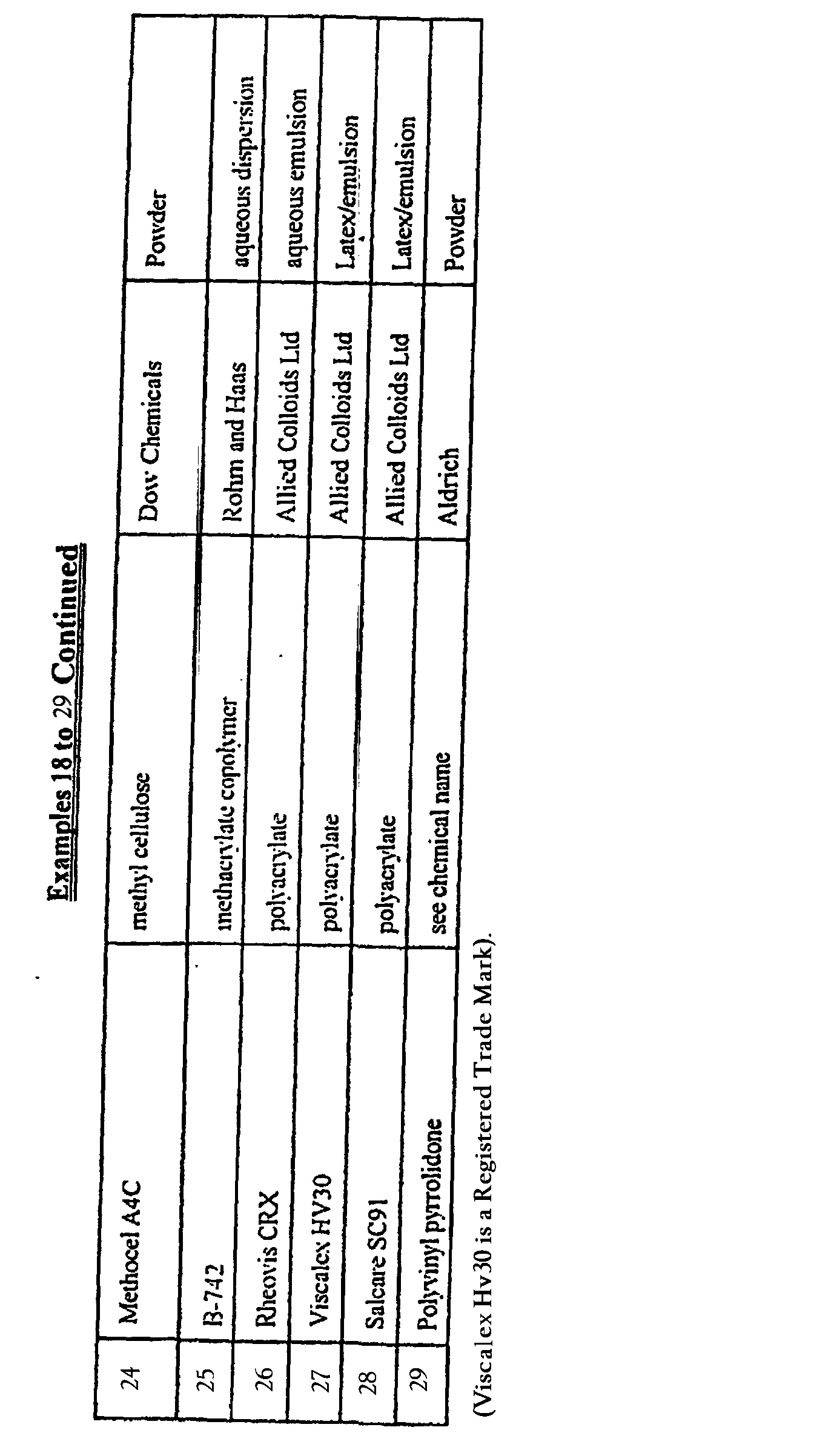
- Potassium nitrate (0.25g) was dissolved in 25 grams of each of the aforementioned vehicles 18 to 41. These formations were numbered 18'-41'. Where 18' represents 18 + oxidant, 19' represents 19+ oxidant etc.
- 3 grams of each of the above frit vehicles (18 to 29 and 18' to 29') were mixed with 27 grams of frit glass (Techneglas CV-685 frit glass) to produce frit pastes. Examples 18-29 are comparative examples. Examples 18'-29' are examples belonging to the invention.
- Each frit paste was smeared onto glass slides to produce 'fillets' of approximate dimensions 3cm long x 2cm wide x 0.2cm thick. The pastes were dried in air and then heated under the conditions of the Lehr cycle.


- 26 grams of Kelzan PD414 (Xanthan gum) was dissolved in 1974 grams of de-ionised water to produce 2000g of 1.3wt/wt% aqueous frit vehicle as a colourless gel.
- A range of water soluble oxidants were each dissolved in 50g portions of the above mentioned vehicle to give oxidant containing solutions. The oxidants tested were as follows:
Example No. Oxidant Incorporated Oxidant Concentration prepared % Resulting Vehicle Colour 30 Sodium chlorate 1,2 colourless 31 calcium nitrate tetrahydrate 1,2 colourless 32 Copper II nitrate hemipentahydrate 1 blue 33 Sodium nitrate 1 colourless 34 Potassium permanaganate 1 purple 35 Ammonium nitrate 1,2 colourless 36 Magnesium nitrate hexahydrate 1,2 colourless 37 Zinc nitrate hexahydrate 1,2 colourless 38 Sodium perchlorate 1,2 colourless 39 Potassium nitrate 1 colourless 40 Lithium nitrate 1 colourless 41 Lanthanum nitrate hydrate 1,2 colourless 42 Potassium perchlorate 1 colourless 43 Caesium nitrate 1 colourless 44 Potassium dichromate 1,2 orange 45 no oxidant added 0 colourless - 3g of each of the above vehicles 30 to 45 were mixed with 27 grams of frit glass (Techneglas CV-685 frit glass) to produce frit pastes. The pastes so produced were smeared onto glass slides to form oval shaped beads of approximate dimensions: 3cm length by 1cm wide by 0.2cm thick. The beads were dried in air, then fired under Lehr cycle conditions.
Appearance Example No. Before firing After-firing (viewed from underneath) 30 white brown/orange (1wt% oxidant) brownish orange (2wt% oxidant) 31 white mottled yellow/grey (1wt% oxidant) yellow (2wt% oxidant) 32 pale blue pale green (1wt% oxidant) 33 white yellow (1wt% oxidant) 34 brown brown (1wt% oxidant) 35 white mottled yellow/ grey (2wt% oxidant) 36 white mottled yellow/grey (1wt% oxidant) yellow (2wt% oxidant) 37 white mottled yellow/grey (1wt% oxidant) yellow (2wt% oxidant) 38 white dark orange (1wt% oxidant) orange (2wt% oxidant) 39 white yellow (1wt% oxidant) 40 white yellow (1wt% oxidant) 41 white mottled yellow/grey (1wt% oxidant) yellow (2wt% oxidant) 42 white dark orange (1wt% oxidant) 43 white yellow (1wt% oxidant) 44 yellow orange (1wt% oxidant) orange (2wt% oxidant) 45 white dark grey (no oxidant added) - The above results demonstrate that the oxidants used in Examples 30-44 above prevent the formation of grey frit beads. This therefore indicates that the oxidants are helping to eliminate carbon and/or lead formation in the frit beads. Example 45 (no oxidant) on the other hand is grey and this is attributed to the fact that carbon and/or reduced lead is present in the fired frit. Kelzan PD414 was found to give 32% carbonaceous residues in the absence of any added oxidant as analysed by TGA using the Lehr cycle conditions as described herein, which confirms the role of the oxidants in the vehicles used in the sealing glass pastes of the present invention.
Claims (15)
- A sealing glass paste which comprises at least one sealing glass frit powder and an aqueous binder which comprises an aqueous solution, dispersion or emulsion of a polymeric material and a water soluble oxidant which decomposes at a temperature of below 475°C, the polymeric material burning out or decomposing at a temperature of below 475°C, in the presence of the oxidant, to leave less than 2% of residues based on the total weight of the solids content of the binder and the polymeric material being ethyl cellulose, carboxymethyl cellulose or mixtures thereof, guar gum, xanthan gum, polyvinyl alcohol, polyacrylate, polymethacrylate, polyvinyl pyrrolidone, polyethylene oxide or poly(alpha-methyl)styrene.
- A sealing glass paste as claimed in claim 1 wherein the oxidant is a water soluble nitrate, perchlorate, permanganate or dichromate.
- A sealing glass paste as claimed in claim 1 wherein the oxidant is sodium, potassium, lithium, ammonium or caesium nitrate.
- A sealing glass paste as claimed in any one of claims 1 to 3 wherein the oxidant is included in the aqueous binder in an amount of from 0.05% to 5% by weight based on the aqueous binder.
- A sealing glass paste as claimed in claim 4 wherein the oxidant is included in the aqueous binder in an amount of from 0.1% to 2% by weight based on the aqueous binder.
- A sealing glass paste as claimed in any one of the preceding claims which comprises 65 to 95 percent by weight of the sealing glass frit powder and 5 to 35 percent by weight of the aqueous vehicle.
- A sealing glass paste as claimed in any one of the preceding claims which comprises up to 5% by weight based on the total weight of the composition of a wetting agent.
- A sealing glass paste as claimed in any one of the preceding claims which comprises up to 1% by weight based on the total weight of the composition of an antifoam agent.
- A sealing glass paste as claimed in any one of the preceding claims which comprises up to 2% by weight based on the total weight of the composition of a surfactant.
- A sealing glass paste as claimed in any one of the preceding claims which comprises up to 2% by weight based on the total weight of the composition of a polymeric dispersant.
- A sealing glass paste as claimed in any one of the preceding claims which comprises up to 1% by weight based on the total weight of the composition of a biocide.
- A sealing glass paste as claimed in any one of the preceding claims wherein the sealing glass frit powder has a particle size in the range of from 10 to 50µm.
- A sealing glass paste as claimed in any one of the preceding claims wherein the sealing glass contains PbO.
- A method for joining two surfaces together which comprises applying to at least one surface a sealing glass paste as claimed in any one of claims 1 to 13, forming an assembly of the surfaces to be joined and subjecting the assembly so formed to heating in order to soften and fuse the sealing glass frit in the sealing glass paste.
- A method as claimed in claim 14 wherein the assembly is heated to a temperature of below about 475°C.
Applications Claiming Priority (2)
| Application Number | Priority Date | Filing Date | Title |
|---|---|---|---|
| GBGB9713831.7A GB9713831D0 (en) | 1997-06-30 | 1997-06-30 | Sealing glass paste for cathode ray tubes |
| GB9713831 | 1997-06-30 |
Publications (2)
| Publication Number | Publication Date |
|---|---|
| EP0889010A1 EP0889010A1 (en) | 1999-01-07 |
| EP0889010B1 true EP0889010B1 (en) | 2003-09-24 |
Family
ID=10815173
Family Applications (1)
| Application Number | Title | Priority Date | Filing Date |
|---|---|---|---|
| EP98304653A Expired - Lifetime EP0889010B1 (en) | 1997-06-30 | 1998-06-12 | Sealing glass paste for cathode ray tubes |
Country Status (7)
| Country | Link |
|---|---|
| US (1) | US6183871B1 (en) |
| EP (1) | EP0889010B1 (en) |
| JP (2) | JPH1196913A (en) |
| KR (1) | KR100431531B1 (en) |
| DE (1) | DE69818358T2 (en) |
| GB (1) | GB9713831D0 (en) |
| TW (1) | TW372944B (en) |
Cited By (1)
| Publication number | Priority date | Publication date | Assignee | Title |
|---|---|---|---|---|
| US9593527B2 (en) | 2014-02-04 | 2017-03-14 | Guardian Industries Corp. | Vacuum insulating glass (VIG) unit with lead-free dual-frit edge seals and/or methods of making the same |
Families Citing this family (21)
| Publication number | Priority date | Publication date | Assignee | Title |
|---|---|---|---|---|
| KR100352160B1 (en) * | 1999-11-16 | 2002-09-12 | 권상직 | Method of manufacturing a sealing paste for manufacturing a flat display panel in a vacuum and a method for sealing a flat display panel by using the sealing paste |
| TW577101B (en) * | 2001-05-28 | 2004-02-21 | Matsushita Electric Industrial Co Ltd | Glass paste, transfer sheet, and plasma display panel |
| AU2003236995A1 (en) * | 2002-06-20 | 2004-01-06 | Koninklijke Philips Electronics N.V. | Glass frit and method for sealing glass surfaces together |
| DE10350460B4 (en) * | 2003-10-29 | 2006-07-13 | X-Fab Semiconductor Foundries Ag | Method for producing semiconductor devices having micromechanical and / or microelectronic structures, which result from the fixed connection of at least two semiconductor wafers, and corresponding arrangement |
| JP4880606B2 (en) * | 2004-09-24 | 2012-02-22 | イー・アイ・デュポン・ドウ・ヌムール・アンド・カンパニー | Sealing composition |
| GB0515088D0 (en) * | 2005-07-22 | 2005-08-31 | Imerys Minerals Ltd | Particulate glass compositions and methods of production |
| DE102005044523A1 (en) * | 2005-09-16 | 2007-03-29 | Schott Ag | Connecting elements using a glass solder used in the manufacture of electronic components comprises soldering the elements together by fusing a glass solder and releasing the oxidant locally during soldering |
| KR100651008B1 (en) * | 2005-12-28 | 2006-11-30 | 제일모직주식회사 | Paste Composition for Transparent Dielectric Formation in Plasma Display Panel |
| US8668798B2 (en) | 2009-06-30 | 2014-03-11 | Guardian Industries Corp. | Non-toxic water-based frit slurry paste, and assembly incorporating the same |
| US8816012B2 (en) | 2010-08-18 | 2014-08-26 | Ferro Corporation | Curable acrylate based printing medium |
| US9359247B2 (en) | 2011-02-22 | 2016-06-07 | Guardian Industries Corp. | Coefficient of thermal expansion filler for vanadium-based frit materials and/or methods of making and/or using the same |
| US8802203B2 (en) | 2011-02-22 | 2014-08-12 | Guardian Industries Corp. | Vanadium-based frit materials, and/or methods of making the same |
| US8733128B2 (en) | 2011-02-22 | 2014-05-27 | Guardian Industries Corp. | Materials and/or method of making vacuum insulating glass units including the same |
| US9458052B2 (en) | 2011-02-22 | 2016-10-04 | Guardian Industries Corp. | Coefficient of thermal expansion filler for vanadium-based frit materials and/or methods of making and/or using the same |
| US9290408B2 (en) | 2011-02-22 | 2016-03-22 | Guardian Industries Corp. | Vanadium-based frit materials, and/or methods of making the same |
| US9822580B2 (en) | 2011-02-22 | 2017-11-21 | Guardian Glass, LLC | Localized heating techniques incorporating tunable infrared element(s) for vacuum insulating glass units, and/or apparatuses for same |
| US9309146B2 (en) | 2011-02-22 | 2016-04-12 | Guardian Industries Corp. | Vanadium-based frit materials, binders, and/or solvents and methods of making the same |
| US9988302B2 (en) | 2014-02-04 | 2018-06-05 | Guardian Glass, LLC | Frits for use in vacuum insulating glass (VIG) units, and/or associated methods |
| EP3186207B1 (en) | 2014-07-23 | 2021-06-02 | Flexitallic Investments, Inc. | A glass coating composition for fuel cell gasket |
| US11318669B2 (en) * | 2016-01-29 | 2022-05-03 | Hewlett-Packard Development Company, L.P. | Three-dimensional (3D) printing |
| US11634358B2 (en) | 2018-01-03 | 2023-04-25 | Ferro Corporation | Polycarbonate diol coating composition for caustic and UV resistance |
Family Cites Families (15)
| Publication number | Priority date | Publication date | Assignee | Title |
|---|---|---|---|---|
| US3833392A (en) * | 1971-08-09 | 1974-09-03 | Westinghouse Electric Corp | Coating composition and method for preparing water-soluble cellulosic polymer coating compositions for coating fluorescent tubes |
| US4014845A (en) * | 1971-08-23 | 1977-03-29 | Owens-Illinois, Inc. | Fugitive vehicle system |
| US3973975A (en) * | 1972-04-21 | 1976-08-10 | Owens-Illinois, Inc. | PbO-containing sealing glass with higher oxide of a cation to avoid PbO reduction |
| CA1075723A (en) * | 1974-10-22 | 1980-04-15 | Owens-Illinois | Sealing glass composition and method of making same |
| US4006028A (en) * | 1975-07-03 | 1977-02-01 | Owens-Illinois, Inc. | Sealing glass compositions and pastes and use thereof |
| US4058387A (en) * | 1975-07-03 | 1977-11-15 | Owens-Illinois, Inc. | Simultaneously baking and sealing a faceplate assembly |
| US4154494A (en) * | 1977-05-23 | 1979-05-15 | Corning Glass Works | Process for manufacturing cathode ray tube bulbs |
| US4293439A (en) * | 1978-08-17 | 1981-10-06 | Corning Glass Works | Gelled solder glass suspensions for sealing glass or ceramic parts |
| JPS6077146A (en) * | 1983-09-30 | 1985-05-01 | Showa Highpolymer Co Ltd | Glaze composition |
| US4537958A (en) * | 1984-06-29 | 1985-08-27 | The Dow Chemical Company | Process for preparing cellulose ethers |
| GB2201412B (en) * | 1987-02-19 | 1990-08-08 | Ti | Aqueous vitreous enamel slips |
| US5238881A (en) * | 1988-11-09 | 1993-08-24 | Engelhard Corporation | Stable color dispersions, their preparation and use in ceramic glazes |
| GB9415075D0 (en) * | 1994-07-27 | 1994-09-14 | Cookson Group Plc | Paste or printable ink compositions |
| GB9500798D0 (en) * | 1995-01-16 | 1995-03-08 | Cookson Group Plc | Sealing glass paste |
| WO1997031869A1 (en) * | 1996-02-27 | 1997-09-04 | Corning Incorporated | Sealing glass suspension |
-
1997
- 1997-06-30 GB GBGB9713831.7A patent/GB9713831D0/en active Pending
-
1998
- 1998-06-12 EP EP98304653A patent/EP0889010B1/en not_active Expired - Lifetime
- 1998-06-12 DE DE69818358T patent/DE69818358T2/en not_active Expired - Fee Related
- 1998-06-24 KR KR10-1998-0023962A patent/KR100431531B1/en not_active Expired - Fee Related
- 1998-06-26 JP JP10180638A patent/JPH1196913A/en not_active Withdrawn
- 1998-06-29 US US09/106,694 patent/US6183871B1/en not_active Expired - Fee Related
- 1998-07-04 TW TW087110852A patent/TW372944B/en not_active IP Right Cessation
-
2006
- 2006-06-07 JP JP2006158665A patent/JP2006322005A/en active Pending
Cited By (1)
| Publication number | Priority date | Publication date | Assignee | Title |
|---|---|---|---|---|
| US9593527B2 (en) | 2014-02-04 | 2017-03-14 | Guardian Industries Corp. | Vacuum insulating glass (VIG) unit with lead-free dual-frit edge seals and/or methods of making the same |
Also Published As
| Publication number | Publication date |
|---|---|
| GB9713831D0 (en) | 1997-09-03 |
| JP2006322005A (en) | 2006-11-30 |
| DE69818358T2 (en) | 2004-06-24 |
| EP0889010A1 (en) | 1999-01-07 |
| KR100431531B1 (en) | 2004-09-08 |
| JPH1196913A (en) | 1999-04-09 |
| KR19990007300A (en) | 1999-01-25 |
| TW372944B (en) | 1999-11-01 |
| US6183871B1 (en) | 2001-02-06 |
| DE69818358D1 (en) | 2003-10-30 |
Similar Documents
| Publication | Publication Date | Title |
|---|---|---|
| US6183871B1 (en) | Sealing glass paste for cathode ray tubes | |
| CN102365247B (en) | Glass composition and covering and sealing members using same | |
| JP3278166B2 (en) | Glass paste for sealing | |
| EP1319700A2 (en) | Phosphor paste compositions | |
| CN1258489C (en) | Low temp. sealing lead-containingless tin phosphate series glass and composite material using the same | |
| US4340512A (en) | Method of providing a universal coating for fluorescent lamps | |
| JPWO2004087833A1 (en) | Phosphor and method for producing the same | |
| JP2004307329A (en) | Insulating material for display tube | |
| JP2003054987A (en) | Lead-free glass and lead-free glass powder | |
| TW200404752A (en) | Glass frit and method for sealing glass surfaces together | |
| JP2760202B2 (en) | Phosphor coating solution and fluorescent lamp | |
| US6784130B2 (en) | PDP material controlled in moisture content | |
| WO1997036836A1 (en) | Sealing glass modifier for use with voc-free or low-voc vehicle | |
| JP2002020139A (en) | Lead-free frit glass paste composition and firing method thereof | |
| KR20050016578A (en) | Glass frit and method for sealing glass surfaces together | |
| US2951767A (en) | Phosphor and method | |
| KR100920908B1 (en) | Glass sealing material for vanadium oxide-barium oxide-antimony oxide-based display | |
| JP2525278B2 (en) | Direct current type discharge display tube and method of manufacturing oxide cathode for discharge display tube | |
| JP2002015663A (en) | Method for manufacturing plasma display panel | |
| JP2012256461A (en) | Method for manufacturing plasma display panel and phosphor paste | |
| JPH10125226A (en) | Manufacturing method of phosphor screen | |
| JP2002293573A (en) | Sealing material | |
| JPH04342927A (en) | Gas discharge type display panel and electroconductive paste |
Legal Events
| Date | Code | Title | Description |
|---|---|---|---|
| PUAI | Public reference made under article 153(3) epc to a published international application that has entered the european phase |
Free format text: ORIGINAL CODE: 0009012 |
|
| AK | Designated contracting states |
Kind code of ref document: A1 Designated state(s): DE FR GB IE IT NL |
|
| AX | Request for extension of the european patent |
Free format text: AL;LT;LV;MK;RO;SI |
|
| 17P | Request for examination filed |
Effective date: 19990114 |
|
| AKX | Designation fees paid |
Free format text: DE FR GB IE IT NL |
|
| 17Q | First examination report despatched |
Effective date: 20000307 |
|
| GRAH | Despatch of communication of intention to grant a patent |
Free format text: ORIGINAL CODE: EPIDOS IGRA |
|
| GRAS | Grant fee paid |
Free format text: ORIGINAL CODE: EPIDOSNIGR3 |
|
| GRAA | (expected) grant |
Free format text: ORIGINAL CODE: 0009210 |
|
| AK | Designated contracting states |
Kind code of ref document: B1 Designated state(s): DE FR GB IE IT NL |
|
| PG25 | Lapsed in a contracting state [announced via postgrant information from national office to epo] |
Ref country code: IT Free format text: LAPSE BECAUSE OF FAILURE TO SUBMIT A TRANSLATION OF THE DESCRIPTION OR TO PAY THE FEE WITHIN THE PRE;WARNING: LAPSES OF ITALIAN PATENTS WITH EFFECTIVE DATE BEFORE 2007 MAY HAVE OCCURRED AT ANY TIME BEFORE 2007. THE CORRECT EFFECTIVE DATE MAY BE DIFFERENT FROM THE ONE RECORDED.SCRIBED TIME-LIMIT Effective date: 20030924 Ref country code: FR Free format text: LAPSE BECAUSE OF FAILURE TO SUBMIT A TRANSLATION OF THE DESCRIPTION OR TO PAY THE FEE WITHIN THE PRESCRIBED TIME-LIMIT Effective date: 20030924 |
|
| REG | Reference to a national code |
Ref country code: GB Ref legal event code: FG4D |
|
| REG | Reference to a national code |
Ref country code: IE Ref legal event code: FG4D |
|
| REF | Corresponds to: |
Ref document number: 69818358 Country of ref document: DE Date of ref document: 20031030 Kind code of ref document: P |
|
| PG25 | Lapsed in a contracting state [announced via postgrant information from national office to epo] |
Ref country code: IE Free format text: LAPSE BECAUSE OF NON-PAYMENT OF DUE FEES Effective date: 20040614 |
|
| PLBE | No opposition filed within time limit |
Free format text: ORIGINAL CODE: 0009261 |
|
| STAA | Information on the status of an ep patent application or granted ep patent |
Free format text: STATUS: NO OPPOSITION FILED WITHIN TIME LIMIT |
|
| 26N | No opposition filed |
Effective date: 20040625 |
|
| EN | Fr: translation not filed | ||
| REG | Reference to a national code |
Ref country code: IE Ref legal event code: MM4A |
|
| PGFP | Annual fee paid to national office [announced via postgrant information from national office to epo] |
Ref country code: NL Payment date: 20080618 Year of fee payment: 11 Ref country code: DE Payment date: 20080530 Year of fee payment: 11 |
|
| PGFP | Annual fee paid to national office [announced via postgrant information from national office to epo] |
Ref country code: GB Payment date: 20080624 Year of fee payment: 11 |
|
| GBPC | Gb: european patent ceased through non-payment of renewal fee |
Effective date: 20090612 |
|
| NLV4 | Nl: lapsed or anulled due to non-payment of the annual fee |
Effective date: 20100101 |
|
| PG25 | Lapsed in a contracting state [announced via postgrant information from national office to epo] |
Ref country code: GB Free format text: LAPSE BECAUSE OF NON-PAYMENT OF DUE FEES Effective date: 20090612 |
|
| PG25 | Lapsed in a contracting state [announced via postgrant information from national office to epo] |
Ref country code: DE Free format text: LAPSE BECAUSE OF NON-PAYMENT OF DUE FEES Effective date: 20100101 |
|
| PG25 | Lapsed in a contracting state [announced via postgrant information from national office to epo] |
Ref country code: NL Free format text: LAPSE BECAUSE OF NON-PAYMENT OF DUE FEES Effective date: 20100101 |