EP0887377B1 - Kautschukmischung - Google Patents
Kautschukmischung Download PDFInfo
- Publication number
- EP0887377B1 EP0887377B1 EP98109143A EP98109143A EP0887377B1 EP 0887377 B1 EP0887377 B1 EP 0887377B1 EP 98109143 A EP98109143 A EP 98109143A EP 98109143 A EP98109143 A EP 98109143A EP 0887377 B1 EP0887377 B1 EP 0887377B1
- Authority
- EP
- European Patent Office
- Prior art keywords
- rubber
- filler
- rubber mixture
- mixture according
- modified
- Prior art date
- Legal status (The legal status is an assumption and is not a legal conclusion. Google has not performed a legal analysis and makes no representation as to the accuracy of the status listed.)
- Expired - Lifetime
Links
- 229920001971 elastomer Polymers 0.000 title claims abstract description 134
- 239000005060 rubber Substances 0.000 title claims abstract description 124
- 239000000203 mixture Substances 0.000 title claims description 52
- 239000000945 filler Substances 0.000 claims abstract description 94
- 239000000126 substance Substances 0.000 claims abstract description 33
- 239000000654 additive Substances 0.000 claims abstract description 13
- 238000000034 method Methods 0.000 claims abstract description 8
- 239000011159 matrix material Substances 0.000 claims description 28
- VYPSYNLAJGMNEJ-UHFFFAOYSA-N Silicium dioxide Chemical compound O=[Si]=O VYPSYNLAJGMNEJ-UHFFFAOYSA-N 0.000 claims description 15
- 239000005062 Polybutadiene Substances 0.000 claims description 14
- 230000008859 change Effects 0.000 claims description 14
- 229920002857 polybutadiene Polymers 0.000 claims description 13
- 229920001577 copolymer Polymers 0.000 claims description 12
- 238000004519 manufacturing process Methods 0.000 claims description 12
- 239000006229 carbon black Substances 0.000 claims description 10
- 125000003178 carboxy group Chemical group [H]OC(*)=O 0.000 claims description 8
- 229920001195 polyisoprene Polymers 0.000 claims description 8
- 239000000377 silicon dioxide Substances 0.000 claims description 8
- 229920003048 styrene butadiene rubber Polymers 0.000 claims description 7
- 244000043261 Hevea brasiliensis Species 0.000 claims description 6
- 229920003052 natural elastomer Polymers 0.000 claims description 6
- 229920001194 natural rubber Polymers 0.000 claims description 6
- 229920002943 EPDM rubber Polymers 0.000 claims description 4
- 229920003051 synthetic elastomer Polymers 0.000 claims description 4
- 150000001721 carbon Chemical class 0.000 claims description 2
- 230000003993 interaction Effects 0.000 description 11
- 239000000806 elastomer Substances 0.000 description 10
- 229920000642 polymer Polymers 0.000 description 10
- 150000001875 compounds Chemical class 0.000 description 8
- 230000000694 effects Effects 0.000 description 8
- 235000019241 carbon black Nutrition 0.000 description 6
- 239000002245 particle Substances 0.000 description 6
- 230000008569 process Effects 0.000 description 5
- 238000004073 vulcanization Methods 0.000 description 5
- 125000003118 aryl group Chemical group 0.000 description 4
- 238000004132 cross linking Methods 0.000 description 4
- 230000005684 electric field Effects 0.000 description 4
- 239000000499 gel Substances 0.000 description 4
- 125000001424 substituent group Chemical group 0.000 description 4
- NINIDFKCEFEMDL-UHFFFAOYSA-N Sulfur Chemical compound [S] NINIDFKCEFEMDL-UHFFFAOYSA-N 0.000 description 3
- 230000003712 anti-aging effect Effects 0.000 description 3
- 239000003795 chemical substances by application Substances 0.000 description 3
- 239000003431 cross linking reagent Substances 0.000 description 3
- 239000004014 plasticizer Substances 0.000 description 3
- 230000002441 reversible effect Effects 0.000 description 3
- 238000005204 segregation Methods 0.000 description 3
- 229910052717 sulfur Inorganic materials 0.000 description 3
- 239000011593 sulfur Substances 0.000 description 3
- OKTJSMMVPCPJKN-UHFFFAOYSA-N Carbon Chemical group [C] OKTJSMMVPCPJKN-UHFFFAOYSA-N 0.000 description 2
- LZZYPRNAOMGNLH-UHFFFAOYSA-M Cetrimonium bromide Chemical compound [Br-].CCCCCCCCCCCCCCCC[N+](C)(C)C LZZYPRNAOMGNLH-UHFFFAOYSA-M 0.000 description 2
- 125000003342 alkenyl group Chemical group 0.000 description 2
- 125000000217 alkyl group Chemical group 0.000 description 2
- 125000004432 carbon atom Chemical group C* 0.000 description 2
- 238000010168 coupling process Methods 0.000 description 2
- 125000004122 cyclic group Chemical group 0.000 description 2
- 230000007613 environmental effect Effects 0.000 description 2
- 230000003014 reinforcing effect Effects 0.000 description 2
- 239000012763 reinforcing filler Substances 0.000 description 2
- 239000004071 soot Substances 0.000 description 2
- 229920002554 vinyl polymer Polymers 0.000 description 2
- 206010022528 Interactions Diseases 0.000 description 1
- 241000283139 Pusa sibirica Species 0.000 description 1
- BLRPTPMANUNPDV-UHFFFAOYSA-N Silane Chemical compound [SiH4] BLRPTPMANUNPDV-UHFFFAOYSA-N 0.000 description 1
- 239000002174 Styrene-butadiene Substances 0.000 description 1
- 230000008901 benefit Effects 0.000 description 1
- 230000008878 coupling Effects 0.000 description 1
- 238000005859 coupling reaction Methods 0.000 description 1
- 230000009977 dual effect Effects 0.000 description 1
- 239000011521 glass Substances 0.000 description 1
- 230000000977 initiatory effect Effects 0.000 description 1
- 230000002427 irreversible effect Effects 0.000 description 1
- 239000000463 material Substances 0.000 description 1
- 238000004806 packaging method and process Methods 0.000 description 1
- 238000005191 phase separation Methods 0.000 description 1
- 229920001084 poly(chloroprene) Polymers 0.000 description 1
- 229920000193 polymethacrylate Polymers 0.000 description 1
- 239000011148 porous material Substances 0.000 description 1
- 150000003233 pyrroles Chemical class 0.000 description 1
- 230000009467 reduction Effects 0.000 description 1
- 239000012744 reinforcing agent Substances 0.000 description 1
- 238000005096 rolling process Methods 0.000 description 1
- 229910000077 silane Inorganic materials 0.000 description 1
- 238000001228 spectrum Methods 0.000 description 1
- 238000003860 storage Methods 0.000 description 1
- 229930192474 thiophene Natural products 0.000 description 1
- 150000003577 thiophenes Chemical class 0.000 description 1
- 239000004636 vulcanized rubber Substances 0.000 description 1
Images
Classifications
-
- C—CHEMISTRY; METALLURGY
- C08—ORGANIC MACROMOLECULAR COMPOUNDS; THEIR PREPARATION OR CHEMICAL WORKING-UP; COMPOSITIONS BASED THEREON
- C08K—Use of inorganic or non-macromolecular organic substances as compounding ingredients
- C08K9/00—Use of pretreated ingredients
- C08K9/08—Ingredients agglomerated by treatment with a binding agent
Definitions
- the invention relates to a rubber mixture comprising at least one rubber component, Contains conventional additives and at least one filler.
- the fillers are essential in a rubber mixture. Wear like this it not only helps to make rubber compounds cheaper, but becomes their specific one Effect on the rubber exploited. A distinction is made in the rubber industry Fillers according to the level of their effect (activity). The activity of a filler is depending on its particle size, its specific surface, its geometric Shape and its chemical composition. This is how fillers are called active (reinforcing fillers), in which a property optimum depending on their Concentration is recorded, so that this rubber property is "actively” influenced. For these fillers z. B. counted soot or silica. In contrast to the reinforcing fillers is inactive (only reinforcing by volume) Fillers an almost consistently constant change in the property profile with the degree watching the stuffing. As an inactive filler in rubber mixtures such. B. chalk used.
- the activity of a filler depends on the particle size specific surface, the geometric shape of the particle and its chemical Structure.
- the reinforcing effect is based essentially on physical and / or chemical interactions at the interface between filler and rubber matrix.
- the surface properties of the fillers play an important role. It is Z. B. known for silica, to modify its surface with a silane to establish a good connection to the rubber matrix and thus the properties of the To influence vulcanizates positively. Such measures are known for. B. for the Manufacture of treads for pneumatic vehicle tires that unite the pneumatic vehicle tire gives low rolling resistance and good wet slip behavior.
- the object of the present invention is at least an optimal connection between filler and rubber matrix so that it becomes possible to Adapt the properties of the vulcanizate to changing environmental conditions.
- the rubber mixture according to the invention can be produced in such a way that the Filler surface is modified by grafting with the stimulus-sensitive substance and then these modified fillers with other conventional additives and Rubber components are mixed. It is possible to use the modified filler alone or in combination with other usual additives (except the Crosslinking chemicals) to the rubber components and under one conventional temperature control in a mixing unit (e.g. internal mixer) Mix. After the completion of such a basic mix and any Storage of these can contain the remaining additives, the crosslinking components (e.g. Vulcanization accelerator, sulfur), are added. So it’s not necessary the conventional mixing process for the production of a rubber mixture essential change.
- a mixing unit e.g. internal mixer
- fillers come the substances known in the rubber industry, such as. B. carbon black and / or silica and / or / or polymeric microgels are used.
- the carbon blacks should have the following characteristics: DBP number (ASTM D 2414) 90-200 cm 3 / 100g and a CTAB number (ASTM D 3765) 80-170 m 2 / g.
- the silicas found are compounds with a BET surface area of 145-270 m 2 / g (ASTM D 5604), a CTAB number of 120-285 m 2 / g (ASTM D 3765) and a pore volume of 0.7-1. 7 ml / g (DIN 66133) use.
- soot modified with silica such as z. B. in M.-J. Wang, WJ Patterson, TA Bronen: Carbon-Silica Dual Phase Filler, A New Generation Reinforcing Agent For Rubber ", Paper No. 25, Rubber Division American Chemical Society, Anaheim, California, May 6-9, 1997 are used
- the polymeric microgels can be, for example, polybutadiene gel, which is described, for example, in EP 0 575 851 B1, and, for example, are polychloroprene gels (for example EP 0 405 216 B1).
- Styrene-butadiene copolymer gels or also polymethacrylate gels are known These fillers are among the active fillers which, as already mentioned at the beginning, optimally influence the properties of the rubber mixture depending on its degree of filling in a certain range of active fillers by a stimulus-sensitive substance, it is possible to change the interactions between filler and polymer (also between filler-filler) abruptly if and only if the parameter is created or exceeds a certain limit.
- B. dynamically highly stressed rubber items such. B. tire treads are provided.
- B. statically loaded rubber articles with modified inactive fillers A combination of modified active and modified inactive fillers and the possibility that only one type of filler is modified are also conceivable for certain rubber compounds.
- Additives such as plasticizers, vulcanization accelerators, crosslinking agents or Anti-aging agents are used. It doesn't matter which one Cross-linking chemicals (e.g. sulfur or peoxides) can be used.
- Rubber components can be elastomers based on natural rubber, styrene-butadiene copolymer, Acrylonitrile-butadiene copolymer, isoprene-butadiene copolymer, Polybutadiene, synthetic polyisoprene, isoprene-isobutylene copolymer, ethylene-propylene-diene terpolymer and mixtures thereof are used.
- alkyl radical and alkenyl radical should be understood to mean carbon chains (branched or unbranched) having 1 to 12, preferably 1 to 6, carbon atoms, the alkenyl radical having to have at least one double bond.
- the alkyl and alkenyl radical can have a cyclic structure, whereby the term "alkenyl” also includes aromatic systems. These aromatic systems can be conventional substituents such as. B. -NH 2 , -NO 2 , -OCH 3 , -SH, -OH, -COOH, -COH, -alkyl (as already defined) or unsaturated substituents (eg -Vinyl).
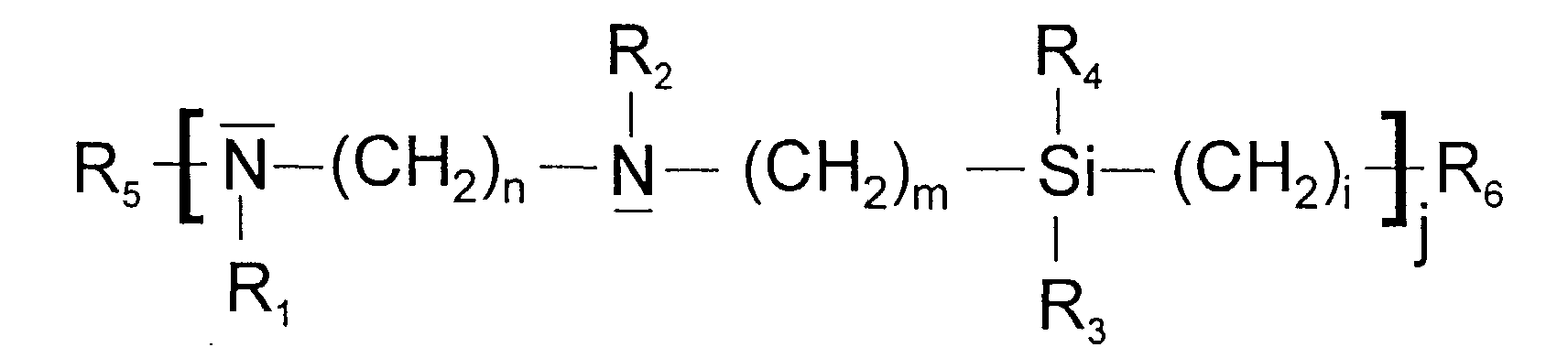
- n, m, i have a value between 0 and 5, preferably between 2 and 4.
- polymer is determined by the size of j, according to the application, j should be at least 2 and be able to assume a maximum value which is customary for the person skilled in the art. Values for j to 10 10 and even larger are known.
- alkyl radical and alkenyl radical should be understood to mean carbon chains (branched or unbranched) having 1 to 12, preferably 1 to 6, carbon atoms, the alkenyl radical having to have at least one double bond.
- the alkyl and alkenyl radical can have a cyclic structure, whereby the term alkenyl also includes aromatic systems.
- aromatic systems can include substituents customary for the person skilled in the art, such as, for example, -NH 2 , -NO 2 , -OCH 3 , -SH , -OH, -COOH, -COH, -alkyl (as already defined) or unsaturated substituents (for example -Vinyl)
- substituents customary for the person skilled in the art such as, for example, -NH 2 , -NO 2 , -OCH 3 , -SH , -OH, -COOH, -COH, -alkyl (as already defined) or unsaturated substituents (for example -Vinyl)
- the size of k, l, p, q is between 0 and 5, preferably between 2 and 4.
- the filler surface with a stimulus-sensitive substance provided, but the surface of the filler can also be modified in such a way that they were at least vulcanized with the rubber matrix immediately surrounding them Condition forms a stimuli-sensitive rubber compound. It is possible that Modify filler surface with substances that due to their properties in the Are able to suddenly change the interaction between a changing parameter Influencing filler and rubber matrix.
- One way to modify the surface of the filler so that it matches yours surrounding rubber matrix has stimuli-sensitive characteristics is that at at least two rubbers have been used in the production of the rubber mixture, wherein the surface of the filler is modified with a first rubber so that between this first rubber located on the filler surface and the adjacent second rubber of the rubber matrix at least in the vulcanized state forms a stimulus-sensitive rubber mixture.
- This embodiment has the advantage that a selection of stimuli-sensitive substances can be dispensed with, since the Rubber components available for the manufacture of the rubber product anyway stand. It is possible that the rubber matrix from a mixture of different Rubber components has been made, at least one of which with the on the Vulcanized rubber component filler has a stimulus-sensitive relationship comes in.
- Such a modified filler particle can be produced in such a way that the filler surface is grafted with a rubber and then this modified filler with further rubber components and other usual Additives are mixed.
- the addition of the individual substances can, as already mentioned done in different order, so that this mixing process to conventional Way is done. After assembling the corresponding blank, it will be vulcanized.
- both active fillers with the properties already mentioned such as B. carbon black and / or silica and / or silica-modified carbon blacks and / or polymeric microgels as well as inactive fillers to be modified so that they with the immediately surrounding rubber matrix forms a stimulus-sensitive rubber mixture.
- Additives such as plasticizers, vulcanization accelerators, crosslinking agents or Anti-aging agents are used. It doesn't matter which one Cross-linking chemicals (e.g. sulfur or peoxides) can be used.
- Rubber components can be elastomers based on natural rubber, styrene-butadiene copolymer, Acrylonitrile-butadiene copolymer, isoprene-butadiene copolymer, Polybutadiene, synthetic polyisoprene, isoprene-isobutylene copolymer, ethylene-propylene-diene terpolymer and mixtures thereof are used.
- the rubber matrix contains at least polyisoprene and if the filler surface has been modified with polybutadiene.
- the interactions between the polybutadiene grafted onto the filler and that in the rubber matrix located polyisoprene are influenced by an increase in temperature in such a way that segregation occurs at the interface between the polybutadiene and the polyisoprene.
- This sudden phase separation has a direct effect on the properties of e.g. B. on the Elasticity of the rubber material, because an adequate connection of the filler to the Rubber matrix is no longer given.
- the Filler surface is loaded with polyisoprene and the surrounding rubber matrix contains at least polybutadiene.
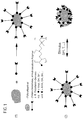
- the filler particle surface (e.g. carbon black) is treated with a polysilamine derivative specified form grafted in such a way that as much of the surface as possible is modified ( Figure 1 (1)).
- the filler particles can e.g. B. in a stirred vessel with the Polysilamine derivative are brought into contact.
- a filler modified in this way is converted into a Rubber mixture, not shown, mixed in in a conventional manner and subjected to the usual mixing process. After forming the corresponding blank like e.g. B. tread blank, this can be used for the production of a pneumatic vehicle tire Packaging can be used.
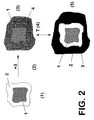
- FIG. 2 shows that the surface of the filler 1 (e.g. carbon black) has a Polyisoprene rubber (IR) 2 is grafted ( Figure 2 (1)).
- the interference of this modified Filler is in turn done in a conventional manner.
- the rubber compound contains at least polybutadiene (BR) 3 as component (FIG. 2 (2)), but this has advantageously also natural rubber (NR) and / or styrene-butadiene copolymer (SBR) because such blends e.g. for the production of treads from Vehicle tires have proven to be cheap.
- the mixing process takes place in one usual process flow and the rubber article blank, e.g. B. tread blank, becomes Assembly of pneumatic vehicle tires applied.
- a pneumatic vehicle tire which has a tread which has its properties various conditions (such as temperature) due to the environment or can also vary, adapt to the load condition. That happens in the way and Way that the polyisoprene 2, which covers the filler surface, with the polybutadiene 3, which is in the rubber matrix, forms a homogeneous phase 4 (FIG. 2 (3)) at a temperature increase, however, segregation ( Figure 2 (5)) in a polyisoprene phase 2 and occurs in a polybutadiene phase 3, whereby the interactions between Filler and rubber matrix are abruptly reduced. This influencing the Interactions cause a reduction in the elasticity of the rubber in the rubber product.
- various conditions such as temperature
Landscapes
- Chemical & Material Sciences (AREA)
- Health & Medical Sciences (AREA)
- Chemical Kinetics & Catalysis (AREA)
- Medicinal Chemistry (AREA)
- Polymers & Plastics (AREA)
- Organic Chemistry (AREA)
- Compositions Of Macromolecular Compounds (AREA)
Description

-H, -Alkyl (verzweigt oder unverzweigt), -Alkenyl (verzweigt oder unverzweigt) -Acyl, -Silyl, -NH2, -SH, -OH, -COOH, -COH, -NOH, -CN, -NC und
z. B. für die Herstellung von Fahrzeugreifen (z. B. Reifenlaufflächen) verwendet werden können. Gerade in diesem Bereich, wo die Temperaturabhängigkeit, bzw. die dynamische Belastbarkeit des Artikels ausschlaggebend für die Haltbarkeit des Artikels ist, kommt die Erfindung besonders zum Tragen. Prinzipiell können aber auch andere technische Gummiprodukte wie z. B. Dichtungen, Luftfedern oder aber auch Schläuche erfindungsgemäß modifiziert werden.
- Fig. 1:
- ein schematisches Prinzip der Ankopplung eines heterotelecheles stimuli-sensitives Polymer an die Füllstoffoberfläche
- Fig. 2:
- ein schematisches Prinzip zur Herstellung der Anbindung eines Füllstoffs an eine Gummimatrix, so dass der Füllstoff mit der ihm unmittelbar umgebenden Gummimatrix eine stimuli-sensitive Gummimischung bildet.
Claims (21)
- Kautschukmischung, die zumindest eine Kautschukkomponente, übliche Zusatzstoffe und zumindest einen Füllstoff enthält,
dadurch gekennzeichnet,
daß die Füllstoffoberfläche mit einer Substanz modifiziert ist, die sich an einen umgebenden veränderlichen Parameter (stimuli) durch eine sprunghafte Änderung einer oder mehrerer Eigenschaften anpaßt (sensitiv). - Kautschukmischung nach Anspruch 1, dadurch gekennzeichnet, daß die Substanz heterotelechele Eigenschaften aufweist.
- Kautschukmischung nach Anspruch 2, dadurch gekennzeichnet, daß die Substanz ein Polysilamin ist.
- Kautschukmischung nach Anspruch 3, dadurch gekennzeichnet, daß das Polysilamin folgende Struktur aufweist:wobei:
 1) R1, R2, R3, R4, R5, R6 ausgewählt ist aus:
-H, -Alkyl (verzweigt oder unverzweigt), -Alkenyl (verzweigt oder unverzweigt), -Acyl, -Silyl, -NH2, -SH, -OH, -COOH, -COH, -NOH, -CN, -NC und R5 ≠ R6 ist und2) n, m, i zwischen 0 und 5 und3) j > 2 liegt. - Kautschukmischung nach Anspruch 4, dadurch gekennzeichnet, daßwobei
 1) R7, R8, R9, R10 ausgewählt ist aus:
-H, -Alkyl (verzweigt oder unverzweigt), -Alkenyl (verzweigt oder unverzweigt) -Acyl, -Silyl, -NH2, -SH, -OH, -COOH, -COH, -NOH, -CN, -NC und2) k, l, p, q zwischen 0 und 5 liegt. - Kautschukmischung nach zumindest einem der vorhergehenden Ansprüche, dadurch gekennzeichnet, daß mit der Substanz die Oberfläche aktiver Füllstoffe modifiziert ist.
- Kautschukmischung nach Anspruch 6, dadurch gekennzeichnet, daß der Füllstoff Ruß und/oder Kieselsäure und/oder kieselsäuremodifizierter Ruß und/oder polymere Mikrogele ist.
- Kautschukmischung nach zumindest einem der vorhergehenden Ansprüche, dadurch gekennzeichnet, daß mit der Substanz die Oberfläche inaktiver Füllstoffe modifiziert ist.
- Kautschukmischung nach zumindest einem der vorhergehenden Ansprüche, dadurch gekennzeichnet, daß der Kautschuk ausgewählt ist aus Naturkautschuk, Styrol-Butadien-Copolymer, Acrylnitril-Butadien-Copolymer, Isopren-Butadien-Copolymer, Polybutadien, synthetisches Polyisopren, Isopren-lsobutylen-Copolymer, Ethylen-Propylen-Dien-Terpolymer und Mischungen hieraus.
- Füllstoff für Kautschukmischungen, dadurch gekennzeichnet, daß dessen Oberfläche mit einer Substanz modifiziert ist, die sich an einen umgebenden veränderlichen Parameter (stimuli) durch eine sprunghafte Änderung einer oder mehrerer Eigenschaften anpaßt (sensitiv).
- Verfahren zur Herstellung einer Kautschukmischung nach zumindest einem der vorhergehenden Ansprüche, folgende Schritte enthaltend:a) Pfropfen der Füllstoffoberfläche mit einer Substanz, die sich an einen umgebenden veränderlichen Parameter (stimuli) durch eine sprunghafte Änderung einer oder mehrerer Eigenschaften anpaßt (sensitiv), und anschließendb) Mischen des unter a) modifizierten Füllstoffs mit Kautschukkomponenten und weiteren üblichen Zusatzstoffen.
- Verwendung der Kautschukmischung nach zumindest einem der vorhergehenden Ansprüche zur Herstellung von Gummiprodukten.
- Gummimischung, bei deren Herstellung mindestens eine Kautschukkomponente, übliche Zusatzstoffe und zumindest einen Füllstoff verwendet worden ist, dadurch gekennzeichnet, daß die Oberfläche des Füllstoffs in der Art modifiziert ist, daß sie zumindest im vulkanisierten Zustand mit der ihr unmittelbar umgebenden Gummimatrix eine Gummimischung bildet, die in der Lage ist, sich an einen umgebenden veränderlichen Parameter (stimuli) durch eine sprunghafte Änderung einer oder mehrerer Eigenschaften anzupassen (sensitiv).
- Gummimischung nach Anspruch 13, dadurch gekennzeichnet, daß bei deren Herstellung zumindest zwei Kautschuke verwendet worden sind, wobei die Oberfläche des Füllstoffs mit dem ersten Kautschuk modifiziert ist, so daß sich zwischen diesem auf der Füllstoffoberfläche befindlichen ersten und dem angrenzenden zweiten Kautschuk der Gummimatrix zumindest im vulkanisierten Zustand eine Gummimischung bildet, die in der Lage ist, sich an einen umgebenden veränderlichen Parameter (stimuli) durch eine sprunghafte Änderung einer oder mehrerer Eigenschaften anzupassen (sensitiv).
- Gummimischung nach Anspruch 13 und/oder 14, dadurch gekennzeichnet, daß der Kautschuk ausgewählt ist aus Naturkautschuk, Styrol-Butadien-Copolymer, Acrylnitril-Butadien-Copolymer, Isopren-Butadien-Copolymer, Polybutadien, synthetisches Polyisopren, Isopren-lsobutylen-Copolymer, Ethylen-Propylen-Dien-Terpolymer und Mischungen hieraus.
- Gummimischung nach Anspruch 15, dadurch gekennzeichnet, daß die Kautschukmischung zumindest Polyisopren und Polybutadien enthält.
- Gummimischung nach zumindest einem der vorhergehenden Ansprüche 13 - 16, dadurch gekennzeichnet, daß der Füllstoff ein aktiver Füllstoff ist.
- Gummimischung nach Anspruch 17, dadurch gekennzeichnet, daß der Füllstoff Ruß und/oder Kieselsäure und/oder Kieselsäure gepfropfter Ruß und/oder polymere Mikrogele ist.
- Gummimischung nach zumindest einem der Ansprüche 13 - 16, dadurch gekennzeichnet, daß der Füllstoff ein inaktiver Füllstoff ist.
- Verfahren zur Herstellung einer Gummimischung nach zumindest einem der Ansprüche 13 - 19, folgende Schritte enthaltend:a) Pfropfen der Füllstoffoberfläche mit einem Kautschuk und anschließendb) Mischung des unter a) modifizierten Füllstoffs mit zumindest einer Kautschukkomponente und weiteren üblichen Zusatzstoffen undc) Vulkanisieren der Kautschukmischung.
- Verwendung der Gummimischung nach zumindest einem der Ansprüche 13 - 19 zur Herstellung von Gummiprodukten.
Applications Claiming Priority (2)
| Application Number | Priority Date | Filing Date | Title |
|---|---|---|---|
| DE19726729A DE19726729A1 (de) | 1997-06-24 | 1997-06-24 | Kautschukmischung |
| DE19726729 | 1997-06-24 |
Publications (2)
| Publication Number | Publication Date |
|---|---|
| EP0887377A1 EP0887377A1 (de) | 1998-12-30 |
| EP0887377B1 true EP0887377B1 (de) | 2001-04-11 |
Family
ID=7833457
Family Applications (1)
| Application Number | Title | Priority Date | Filing Date |
|---|---|---|---|
| EP98109143A Expired - Lifetime EP0887377B1 (de) | 1997-06-24 | 1998-05-20 | Kautschukmischung |
Country Status (4)
| Country | Link |
|---|---|
| US (1) | US6221950B1 (de) |
| EP (1) | EP0887377B1 (de) |
| AT (1) | ATE200504T1 (de) |
| DE (2) | DE19726729A1 (de) |
Families Citing this family (3)
| Publication number | Priority date | Publication date | Assignee | Title |
|---|---|---|---|---|
| DE10038488A1 (de) | 2000-08-08 | 2002-02-21 | Bayer Ag | Isocyanatosilan- und mikrogelhaltige Kautschukmischungen |
| US8094127B2 (en) | 2003-07-31 | 2012-01-10 | Volkswagen Ag | Display device |
| ATE538948T1 (de) | 2009-04-03 | 2012-01-15 | Continental Reifen Deutschland | Verfahren zur herstellung einer kautschukmischung |
Family Cites Families (6)
| Publication number | Priority date | Publication date | Assignee | Title |
|---|---|---|---|---|
| US3994742A (en) * | 1973-10-11 | 1976-11-30 | Ppg Industries, Inc. | Rubber additive of silica and organic coupling agent |
| DE3920745A1 (de) | 1989-06-24 | 1991-01-03 | Bayer Ag | Kautschukmischungen enthaltend schwefel-modifizierte polychloroprengel |
| DE69119125T3 (de) * | 1990-03-02 | 2001-01-11 | Bridgestone Corp., Tokio/Tokyo | Luftreifen |
| DE4220563A1 (de) | 1992-06-24 | 1994-01-13 | Bayer Ag | Kautschukmischungen enthaltend Polybutadien-Gel |
| JP3353926B2 (ja) * | 1992-12-25 | 2002-12-09 | 株式会社豊田中央研究所 | 防振装置 |
| JPH07291981A (ja) * | 1994-04-28 | 1995-11-07 | Asahi Chem Ind Co Ltd | ポリシルアミンオリゴマーおよび刺激応答性材料 |
-
1997
- 1997-06-24 DE DE19726729A patent/DE19726729A1/de not_active Withdrawn
-
1998
- 1998-05-20 EP EP98109143A patent/EP0887377B1/de not_active Expired - Lifetime
- 1998-05-20 DE DE59800604T patent/DE59800604D1/de not_active Expired - Fee Related
- 1998-05-20 AT AT98109143T patent/ATE200504T1/de not_active IP Right Cessation
- 1998-06-23 US US09/102,754 patent/US6221950B1/en not_active Expired - Fee Related
Also Published As
| Publication number | Publication date |
|---|---|
| DE59800604D1 (de) | 2001-05-17 |
| US6221950B1 (en) | 2001-04-24 |
| DE19726729A1 (de) | 1999-01-07 |
| EP0887377A1 (de) | 1998-12-30 |
| ATE200504T1 (de) | 2001-04-15 |
Similar Documents
| Publication | Publication Date | Title |
|---|---|---|
| DE60212052T2 (de) | Herstellung eines verstärkten Elastomer, elastomere Zusammensetzung und Reifen enthaltend diese Zusammensetzung | |
| EP2404964B1 (de) | Kautschukmischung | |
| DE69426215T2 (de) | Luftreifen und mit Kieselsäure verstärkte Laufflächenmischung | |
| DE69914033T2 (de) | Reifen mit durch Kieselsäure verstärkter Lauffläche oder Seitenwandkomponente | |
| EP2257423B1 (de) | Kautschukmischung mit niedrigem wärmeaufbau | |
| DE69419595T2 (de) | Schaumkautschuk enthaltend russ mit niedrigem aschegehalt | |
| EP2233317B1 (de) | Kautschukmischung mit verbessertem Steifigkeitsverhalten und Verfahren zu deren Herstellung | |
| EP2088169B1 (de) | Kautschukmischung und daraus hergestellte reifen | |
| DE68913594T2 (de) | Steife Seitenwände für Luftreifen. | |
| WO2012004140A1 (de) | Kautschukmischung | |
| EP0795582A1 (de) | Kautschukmischung für Reifen | |
| DE69209732T2 (de) | Kautschuk für Reifenlauffläche | |
| DE69809314T2 (de) | Abriebfestes elastomerisches Bestandteil für eine Reifenaufbautrommel | |
| EP0857751B1 (de) | Kautschukmischung für Reifenlaufstreifen | |
| DE69823479T2 (de) | Vulkanisierbare Kautschukzusammensetzung für Reifenlaufflächen mit einem geringeren Rollwiderstand | |
| DE19726729A1 (de) | Kautschukmischung | |
| EP0812879B1 (de) | Kautschukmischung für Reifenlaufstreifen | |
| DE60218377T2 (de) | Reifen mit Lauffläche aus einer Elastomerzusammensetzung, die Russ enthält, welcher an der Oberfläche Siliziumbereiche aufweist | |
| DE602004012459T2 (de) | Reifen mit stollen | |
| DE2328043A1 (de) | Koerper aus kautschuk | |
| DE602005003625T2 (de) | Kautschukzusammensetzung für Reifen und Luftreifen, der diese enthält | |
| EP3385090B1 (de) | Verfahren zur herstellung einer suspension, suspension und deren verwendung | |
| EP2163575B1 (de) | Gummiartikel, enthaltend kolloidale Kieselsäure | |
| DE102022206165A1 (de) | Dispersion und deren Verwendung | |
| DE69704308T2 (de) | Kautschukmischung für Lauffläche und Luftreifen mit dieser Mischung |
Legal Events
| Date | Code | Title | Description |
|---|---|---|---|
| PUAI | Public reference made under article 153(3) epc to a published international application that has entered the european phase |
Free format text: ORIGINAL CODE: 0009012 |
|
| AK | Designated contracting states |
Kind code of ref document: A1 Designated state(s): AT BE CH DE DK ES FI FR GB GR IE IT LI LU NL PT SE |
|
| AX | Request for extension of the european patent |
Free format text: AL;LT;LV;MK;RO;SI |
|
| 17P | Request for examination filed |
Effective date: 19990630 |
|
| AKX | Designation fees paid |
Free format text: AT BE CH DE DK ES FI FR GB GR IE IT LI LU NL PT SE |
|
| 17Q | First examination report despatched |
Effective date: 19991207 |
|
| GRAG | Despatch of communication of intention to grant |
Free format text: ORIGINAL CODE: EPIDOS AGRA |
|
| GRAG | Despatch of communication of intention to grant |
Free format text: ORIGINAL CODE: EPIDOS AGRA |
|
| GRAH | Despatch of communication of intention to grant a patent |
Free format text: ORIGINAL CODE: EPIDOS IGRA |
|
| GRAH | Despatch of communication of intention to grant a patent |
Free format text: ORIGINAL CODE: EPIDOS IGRA |
|
| GRAA | (expected) grant |
Free format text: ORIGINAL CODE: 0009210 |
|
| AK | Designated contracting states |
Kind code of ref document: B1 Designated state(s): AT BE CH DE DK ES FI FR GB GR IE IT LI LU NL PT SE |
|
| PG25 | Lapsed in a contracting state [announced via postgrant information from national office to epo] |
Ref country code: NL Free format text: LAPSE BECAUSE OF FAILURE TO SUBMIT A TRANSLATION OF THE DESCRIPTION OR TO PAY THE FEE WITHIN THE PRESCRIBED TIME-LIMIT Effective date: 20010411 Ref country code: IT Free format text: LAPSE BECAUSE OF FAILURE TO SUBMIT A TRANSLATION OF THE DESCRIPTION OR TO PAY THE FEE WITHIN THE PRE;WARNING: LAPSES OF ITALIAN PATENTS WITH EFFECTIVE DATE BEFORE 2007 MAY HAVE OCCURRED AT ANY TIME BEFORE 2007. THE CORRECT EFFECTIVE DATE MAY BE DIFFERENT FROM THE ONE RECORDED.SCRIBED TIME-LIMIT Effective date: 20010411 Ref country code: IE Free format text: LAPSE BECAUSE OF FAILURE TO SUBMIT A TRANSLATION OF THE DESCRIPTION OR TO PAY THE FEE WITHIN THE PRESCRIBED TIME-LIMIT Effective date: 20010411 Ref country code: GB Free format text: LAPSE BECAUSE OF FAILURE TO SUBMIT A TRANSLATION OF THE DESCRIPTION OR TO PAY THE FEE WITHIN THE PRESCRIBED TIME-LIMIT Effective date: 20010411 Ref country code: FR Free format text: LAPSE BECAUSE OF FAILURE TO SUBMIT A TRANSLATION OF THE DESCRIPTION OR TO PAY THE FEE WITHIN THE PRESCRIBED TIME-LIMIT Effective date: 20010411 Ref country code: FI Free format text: LAPSE BECAUSE OF FAILURE TO SUBMIT A TRANSLATION OF THE DESCRIPTION OR TO PAY THE FEE WITHIN THE PRESCRIBED TIME-LIMIT Effective date: 20010411 |
|
| REF | Corresponds to: |
Ref document number: 200504 Country of ref document: AT Date of ref document: 20010415 Kind code of ref document: T |
|
| REG | Reference to a national code |
Ref country code: CH Ref legal event code: EP |
|
| REG | Reference to a national code |
Ref country code: IE Ref legal event code: FG4D Free format text: GERMAN |
|
| REF | Corresponds to: |
Ref document number: 59800604 Country of ref document: DE Date of ref document: 20010517 |
|
| PG25 | Lapsed in a contracting state [announced via postgrant information from national office to epo] |
Ref country code: LU Free format text: LAPSE BECAUSE OF NON-PAYMENT OF DUE FEES Effective date: 20010520 |
|
| PG25 | Lapsed in a contracting state [announced via postgrant information from national office to epo] |
Ref country code: BE Free format text: LAPSE BECAUSE OF NON-PAYMENT OF DUE FEES Effective date: 20010531 |
|
| REG | Reference to a national code |
Ref country code: CH Ref legal event code: NV Representative=s name: BOVARD AG PATENTANWAELTE |
|
| PG25 | Lapsed in a contracting state [announced via postgrant information from national office to epo] |
Ref country code: SE Free format text: LAPSE BECAUSE OF FAILURE TO SUBMIT A TRANSLATION OF THE DESCRIPTION OR TO PAY THE FEE WITHIN THE PRESCRIBED TIME-LIMIT Effective date: 20010711 Ref country code: PT Free format text: LAPSE BECAUSE OF FAILURE TO SUBMIT A TRANSLATION OF THE DESCRIPTION OR TO PAY THE FEE WITHIN THE PRESCRIBED TIME-LIMIT Effective date: 20010711 Ref country code: DK Free format text: LAPSE BECAUSE OF FAILURE TO SUBMIT A TRANSLATION OF THE DESCRIPTION OR TO PAY THE FEE WITHIN THE PRESCRIBED TIME-LIMIT Effective date: 20010711 |
|
| PG25 | Lapsed in a contracting state [announced via postgrant information from national office to epo] |
Ref country code: GR Free format text: LAPSE BECAUSE OF FAILURE TO SUBMIT A TRANSLATION OF THE DESCRIPTION OR TO PAY THE FEE WITHIN THE PRESCRIBED TIME-LIMIT Effective date: 20010713 |
|
| NLV1 | Nl: lapsed or annulled due to failure to fulfill the requirements of art. 29p and 29m of the patents act | ||
| EN | Fr: translation not filed | ||
| GBV | Gb: ep patent (uk) treated as always having been void in accordance with gb section 77(7)/1977 [no translation filed] |
Effective date: 20010411 |
|
| PG25 | Lapsed in a contracting state [announced via postgrant information from national office to epo] |
Ref country code: ES Free format text: LAPSE BECAUSE OF FAILURE TO SUBMIT A TRANSLATION OF THE DESCRIPTION OR TO PAY THE FEE WITHIN THE PRESCRIBED TIME-LIMIT Effective date: 20011030 |
|
| BERE | Be: lapsed |
Owner name: CONTINENTAL A.G. Effective date: 20010531 |
|
| PLBE | No opposition filed within time limit |
Free format text: ORIGINAL CODE: 0009261 |
|
| STAA | Information on the status of an ep patent application or granted ep patent |
Free format text: STATUS: NO OPPOSITION FILED WITHIN TIME LIMIT |
|
| REG | Reference to a national code |
Ref country code: IE Ref legal event code: FD4D |
|
| 26N | No opposition filed | ||
| PGFP | Annual fee paid to national office [announced via postgrant information from national office to epo] |
Ref country code: CH Payment date: 20030422 Year of fee payment: 6 |
|
| PGFP | Annual fee paid to national office [announced via postgrant information from national office to epo] |
Ref country code: AT Payment date: 20030506 Year of fee payment: 6 |
|
| PG25 | Lapsed in a contracting state [announced via postgrant information from national office to epo] |
Ref country code: AT Free format text: LAPSE BECAUSE OF NON-PAYMENT OF DUE FEES Effective date: 20040520 |
|
| PG25 | Lapsed in a contracting state [announced via postgrant information from national office to epo] |
Ref country code: LI Free format text: LAPSE BECAUSE OF NON-PAYMENT OF DUE FEES Effective date: 20040531 Ref country code: CH Free format text: LAPSE BECAUSE OF NON-PAYMENT OF DUE FEES Effective date: 20040531 |
|
| REG | Reference to a national code |
Ref country code: CH Ref legal event code: PL |
|
| PGFP | Annual fee paid to national office [announced via postgrant information from national office to epo] |
Ref country code: DE Payment date: 20090429 Year of fee payment: 12 |
|
| PG25 | Lapsed in a contracting state [announced via postgrant information from national office to epo] |
Ref country code: DE Free format text: LAPSE BECAUSE OF NON-PAYMENT OF DUE FEES Effective date: 20101201 |