EP0885913A1 - Copolyether and solid polymer electrolyte - Google Patents
Copolyether and solid polymer electrolyte Download PDFInfo
- Publication number
- EP0885913A1 EP0885913A1 EP97946152A EP97946152A EP0885913A1 EP 0885913 A1 EP0885913 A1 EP 0885913A1 EP 97946152 A EP97946152 A EP 97946152A EP 97946152 A EP97946152 A EP 97946152A EP 0885913 A1 EP0885913 A1 EP 0885913A1
- Authority
- EP
- European Patent Office
- Prior art keywords
- group
- ether
- solid polymer
- polymer electrolyte
- polyether copolymer
- Prior art date
- Legal status (The legal status is an assumption and is not a legal conclusion. Google has not performed a legal analysis and makes no representation as to the accuracy of the status listed.)
- Granted
Links
- 0 CCC=*N(C)OC Chemical compound CCC=*N(C)OC 0.000 description 2
Classifications
-
- H—ELECTRICITY
- H01—ELECTRIC ELEMENTS
- H01G—CAPACITORS; CAPACITORS, RECTIFIERS, DETECTORS, SWITCHING DEVICES, LIGHT-SENSITIVE OR TEMPERATURE-SENSITIVE DEVICES OF THE ELECTROLYTIC TYPE
- H01G9/00—Electrolytic capacitors, rectifiers, detectors, switching devices, light-sensitive or temperature-sensitive devices; Processes of their manufacture
- H01G9/004—Details
- H01G9/022—Electrolytes; Absorbents
- H01G9/025—Solid electrolytes
-
- C—CHEMISTRY; METALLURGY
- C08—ORGANIC MACROMOLECULAR COMPOUNDS; THEIR PREPARATION OR CHEMICAL WORKING-UP; COMPOSITIONS BASED THEREON
- C08G—MACROMOLECULAR COMPOUNDS OBTAINED OTHERWISE THAN BY REACTIONS ONLY INVOLVING UNSATURATED CARBON-TO-CARBON BONDS
- C08G59/00—Polycondensates containing more than one epoxy group per molecule; Macromolecules obtained by polymerising compounds containing more than one epoxy group per molecule using curing agents or catalysts which react with the epoxy groups
- C08G59/14—Polycondensates modified by chemical after-treatment
- C08G59/1433—Polycondensates modified by chemical after-treatment with organic low-molecular-weight compounds
- C08G59/1438—Polycondensates modified by chemical after-treatment with organic low-molecular-weight compounds containing oxygen
- C08G59/145—Compounds containing one epoxy group
-
- C—CHEMISTRY; METALLURGY
- C08—ORGANIC MACROMOLECULAR COMPOUNDS; THEIR PREPARATION OR CHEMICAL WORKING-UP; COMPOSITIONS BASED THEREON
- C08G—MACROMOLECULAR COMPOUNDS OBTAINED OTHERWISE THAN BY REACTIONS ONLY INVOLVING UNSATURATED CARBON-TO-CARBON BONDS
- C08G59/00—Polycondensates containing more than one epoxy group per molecule; Macromolecules obtained by polymerising compounds containing more than one epoxy group per molecule using curing agents or catalysts which react with the epoxy groups
- C08G59/18—Macromolecules obtained by polymerising compounds containing more than one epoxy group per molecule using curing agents or catalysts which react with the epoxy groups ; e.g. general methods of curing
- C08G59/20—Macromolecules obtained by polymerising compounds containing more than one epoxy group per molecule using curing agents or catalysts which react with the epoxy groups ; e.g. general methods of curing characterised by the epoxy compounds used
- C08G59/22—Di-epoxy compounds
-
- C—CHEMISTRY; METALLURGY
- C08—ORGANIC MACROMOLECULAR COMPOUNDS; THEIR PREPARATION OR CHEMICAL WORKING-UP; COMPOSITIONS BASED THEREON
- C08G—MACROMOLECULAR COMPOUNDS OBTAINED OTHERWISE THAN BY REACTIONS ONLY INVOLVING UNSATURATED CARBON-TO-CARBON BONDS
- C08G65/00—Macromolecular compounds obtained by reactions forming an ether link in the main chain of the macromolecule
- C08G65/02—Macromolecular compounds obtained by reactions forming an ether link in the main chain of the macromolecule from cyclic ethers by opening of the heterocyclic ring
- C08G65/04—Macromolecular compounds obtained by reactions forming an ether link in the main chain of the macromolecule from cyclic ethers by opening of the heterocyclic ring from cyclic ethers only
- C08G65/06—Cyclic ethers having no atoms other than carbon and hydrogen outside the ring
- C08G65/14—Unsaturated oxiranes
-
- C—CHEMISTRY; METALLURGY
- C08—ORGANIC MACROMOLECULAR COMPOUNDS; THEIR PREPARATION OR CHEMICAL WORKING-UP; COMPOSITIONS BASED THEREON
- C08G—MACROMOLECULAR COMPOUNDS OBTAINED OTHERWISE THAN BY REACTIONS ONLY INVOLVING UNSATURATED CARBON-TO-CARBON BONDS
- C08G65/00—Macromolecular compounds obtained by reactions forming an ether link in the main chain of the macromolecule
- C08G65/02—Macromolecular compounds obtained by reactions forming an ether link in the main chain of the macromolecule from cyclic ethers by opening of the heterocyclic ring
- C08G65/04—Macromolecular compounds obtained by reactions forming an ether link in the main chain of the macromolecule from cyclic ethers by opening of the heterocyclic ring from cyclic ethers only
- C08G65/22—Cyclic ethers having at least one atom other than carbon and hydrogen outside the ring
-
- C—CHEMISTRY; METALLURGY
- C08—ORGANIC MACROMOLECULAR COMPOUNDS; THEIR PREPARATION OR CHEMICAL WORKING-UP; COMPOSITIONS BASED THEREON
- C08G—MACROMOLECULAR COMPOUNDS OBTAINED OTHERWISE THAN BY REACTIONS ONLY INVOLVING UNSATURATED CARBON-TO-CARBON BONDS
- C08G65/00—Macromolecular compounds obtained by reactions forming an ether link in the main chain of the macromolecule
- C08G65/02—Macromolecular compounds obtained by reactions forming an ether link in the main chain of the macromolecule from cyclic ethers by opening of the heterocyclic ring
- C08G65/04—Macromolecular compounds obtained by reactions forming an ether link in the main chain of the macromolecule from cyclic ethers by opening of the heterocyclic ring from cyclic ethers only
- C08G65/22—Cyclic ethers having at least one atom other than carbon and hydrogen outside the ring
- C08G65/223—Cyclic ethers having at least one atom other than carbon and hydrogen outside the ring containing halogens
-
- C—CHEMISTRY; METALLURGY
- C08—ORGANIC MACROMOLECULAR COMPOUNDS; THEIR PREPARATION OR CHEMICAL WORKING-UP; COMPOSITIONS BASED THEREON
- C08G—MACROMOLECULAR COMPOUNDS OBTAINED OTHERWISE THAN BY REACTIONS ONLY INVOLVING UNSATURATED CARBON-TO-CARBON BONDS
- C08G65/00—Macromolecular compounds obtained by reactions forming an ether link in the main chain of the macromolecule
- C08G65/02—Macromolecular compounds obtained by reactions forming an ether link in the main chain of the macromolecule from cyclic ethers by opening of the heterocyclic ring
- C08G65/04—Macromolecular compounds obtained by reactions forming an ether link in the main chain of the macromolecule from cyclic ethers by opening of the heterocyclic ring from cyclic ethers only
- C08G65/22—Cyclic ethers having at least one atom other than carbon and hydrogen outside the ring
- C08G65/24—Epihalohydrins
-
- C—CHEMISTRY; METALLURGY
- C08—ORGANIC MACROMOLECULAR COMPOUNDS; THEIR PREPARATION OR CHEMICAL WORKING-UP; COMPOSITIONS BASED THEREON
- C08K—Use of inorganic or non-macromolecular organic substances as compounding ingredients
- C08K5/00—Use of organic ingredients
- C08K5/0008—Organic ingredients according to more than one of the "one dot" groups of C08K5/01 - C08K5/59
-
- C—CHEMISTRY; METALLURGY
- C08—ORGANIC MACROMOLECULAR COMPOUNDS; THEIR PREPARATION OR CHEMICAL WORKING-UP; COMPOSITIONS BASED THEREON
- C08L—COMPOSITIONS OF MACROMOLECULAR COMPOUNDS
- C08L71/00—Compositions of polyethers obtained by reactions forming an ether link in the main chain; Compositions of derivatives of such polymers
- C08L71/02—Polyalkylene oxides
-
- H—ELECTRICITY
- H01—ELECTRIC ELEMENTS
- H01M—PROCESSES OR MEANS, e.g. BATTERIES, FOR THE DIRECT CONVERSION OF CHEMICAL ENERGY INTO ELECTRICAL ENERGY
- H01M10/00—Secondary cells; Manufacture thereof
- H01M10/05—Accumulators with non-aqueous electrolyte
- H01M10/052—Li-accumulators
-
- H—ELECTRICITY
- H01—ELECTRIC ELEMENTS
- H01M—PROCESSES OR MEANS, e.g. BATTERIES, FOR THE DIRECT CONVERSION OF CHEMICAL ENERGY INTO ELECTRICAL ENERGY
- H01M10/00—Secondary cells; Manufacture thereof
- H01M10/05—Accumulators with non-aqueous electrolyte
- H01M10/056—Accumulators with non-aqueous electrolyte characterised by the materials used as electrolytes, e.g. mixed inorganic/organic electrolytes
- H01M10/0564—Accumulators with non-aqueous electrolyte characterised by the materials used as electrolytes, e.g. mixed inorganic/organic electrolytes the electrolyte being constituted of organic materials only
- H01M10/0565—Polymeric materials, e.g. gel-type or solid-type
-
- H—ELECTRICITY
- H01—ELECTRIC ELEMENTS
- H01M—PROCESSES OR MEANS, e.g. BATTERIES, FOR THE DIRECT CONVERSION OF CHEMICAL ENERGY INTO ELECTRICAL ENERGY
- H01M6/00—Primary cells; Manufacture thereof
- H01M6/14—Cells with non-aqueous electrolyte
- H01M6/18—Cells with non-aqueous electrolyte with solid electrolyte
- H01M6/181—Cells with non-aqueous electrolyte with solid electrolyte with polymeric electrolytes
-
- Y—GENERAL TAGGING OF NEW TECHNOLOGICAL DEVELOPMENTS; GENERAL TAGGING OF CROSS-SECTIONAL TECHNOLOGIES SPANNING OVER SEVERAL SECTIONS OF THE IPC; TECHNICAL SUBJECTS COVERED BY FORMER USPC CROSS-REFERENCE ART COLLECTIONS [XRACs] AND DIGESTS
- Y02—TECHNOLOGIES OR APPLICATIONS FOR MITIGATION OR ADAPTATION AGAINST CLIMATE CHANGE
- Y02E—REDUCTION OF GREENHOUSE GAS [GHG] EMISSIONS, RELATED TO ENERGY GENERATION, TRANSMISSION OR DISTRIBUTION
- Y02E60/00—Enabling technologies; Technologies with a potential or indirect contribution to GHG emissions mitigation
- Y02E60/10—Energy storage using batteries
Definitions
- the present invention relates to a polyether copolymer and a solid polymer electrolyte. More particularly, it relates to a solid polymer electrolyte which is suitable as a material for an electrochemical device such as a battery, a capacitor and a sensor.
- the organic polymer substance is generally superior in processability and moldability and the resulting solid electrolyte has good flexibility and bending processability and, furthermore, the design freedom of the device to be applied is high and, therefore, the development is expected.
- the organic polymer substance is inferior in ionic conductivity to other materials at present.
- a trial of containing a specific alkaline metal salt in a mixture of an epichlorohydrin rubber and a low-molecular weight polyethylene glycol derivative and applying the resultant to a solid polymer electrolyte is suggested in Japanese Patent Kokai Publication No. 235957/1990 including the present applicant, but a practically sufficient conductivity value is not still obtained.
- An object of the present invention provides a solid electrolyte which is superior mechanical properties and ionic conductivity.
- the present invention provides a solid polymer electrolyte comprising:
- the present invention also provides a battery comprising the above solid polymer electrolyte.
- the solid polymer electrolyte of the present invention may be in the form of a gel.
- gel used herein means a polymer swollen with a solvent.
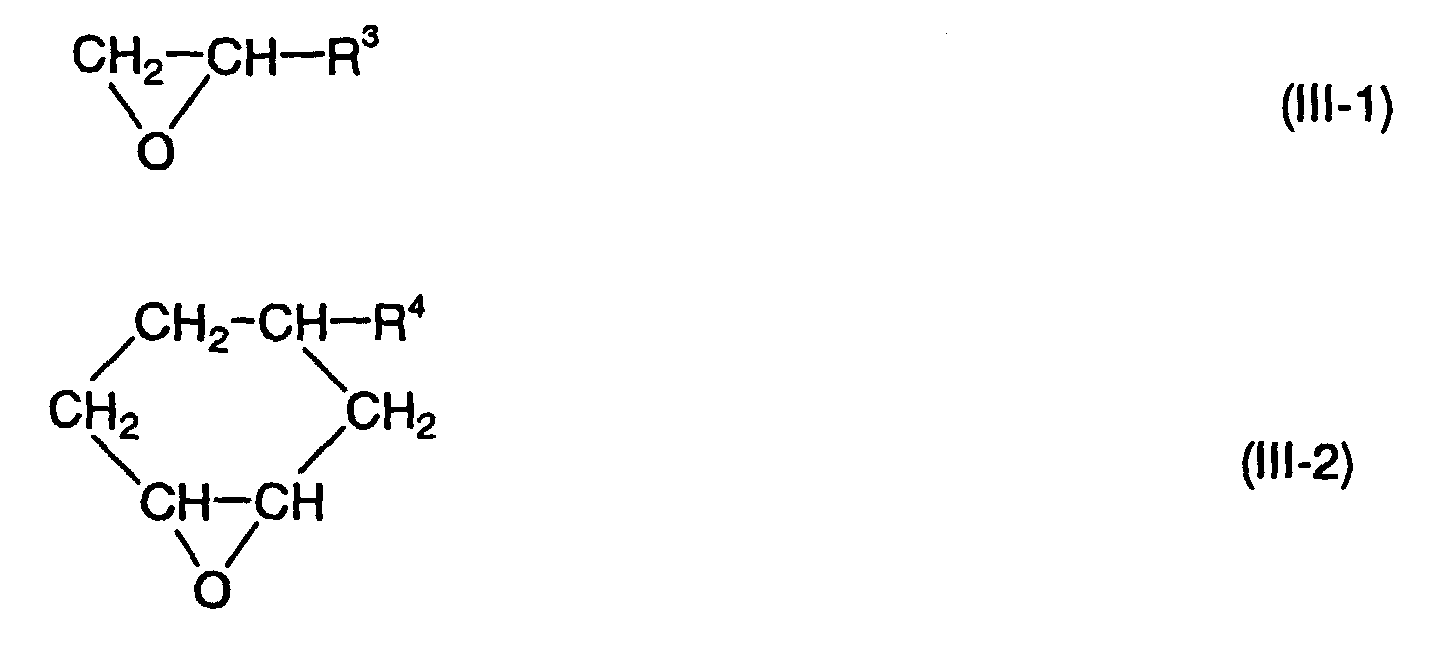
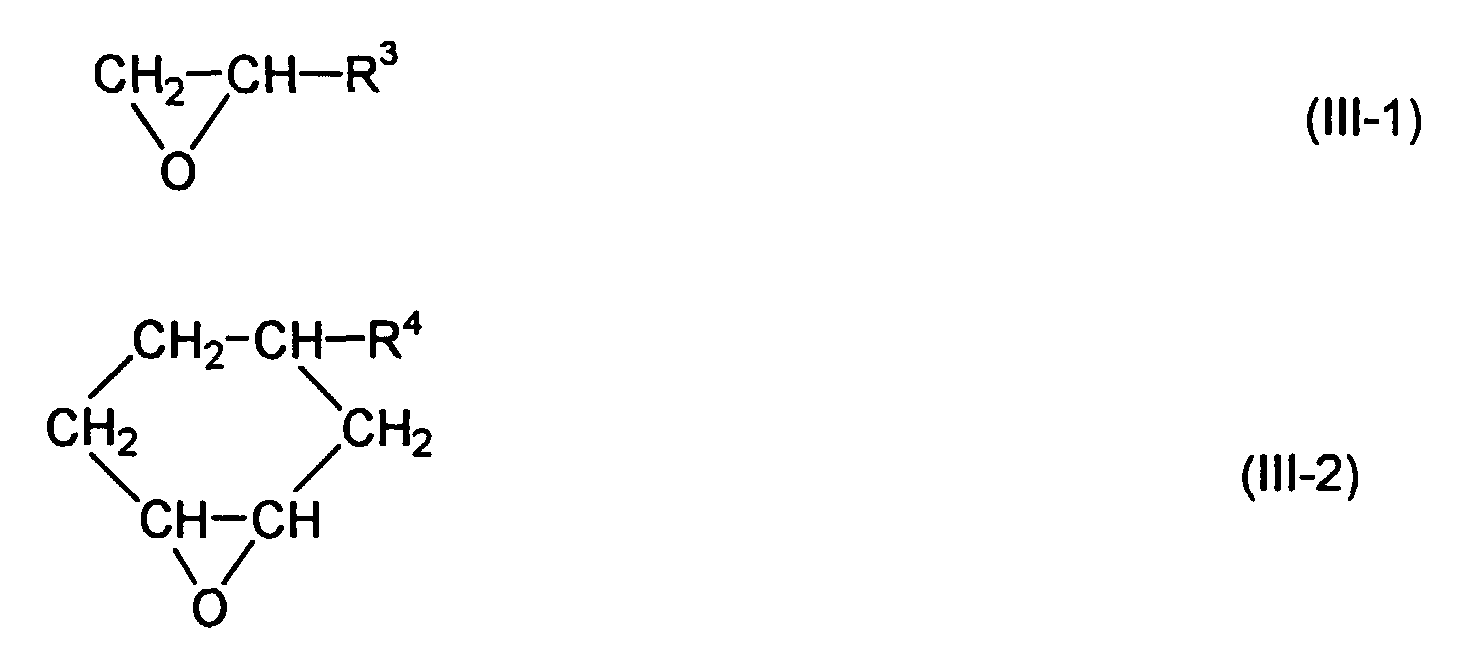
- the repeating unit (C) may be derived from a monomer of the formula (III-1) or (III-2): wherein R 3 and R 4 represent a reactive functional group-containing group.
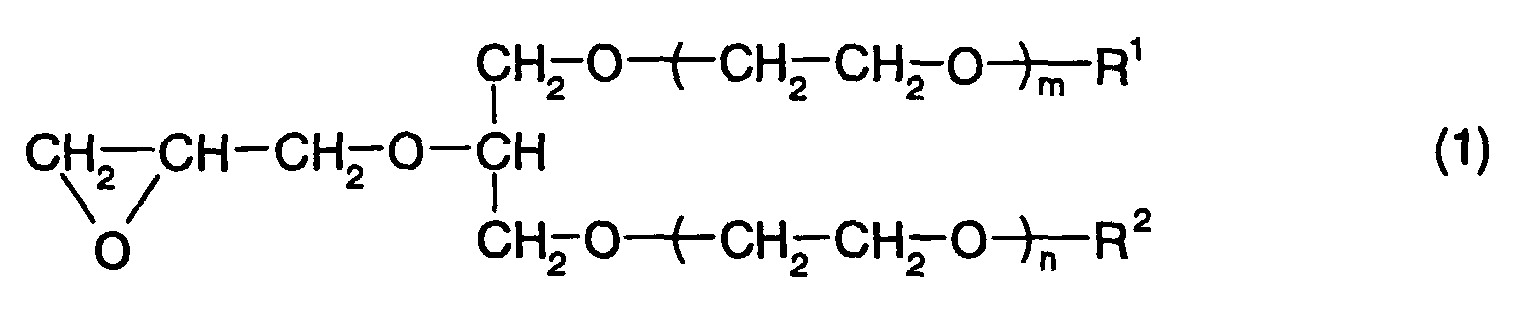
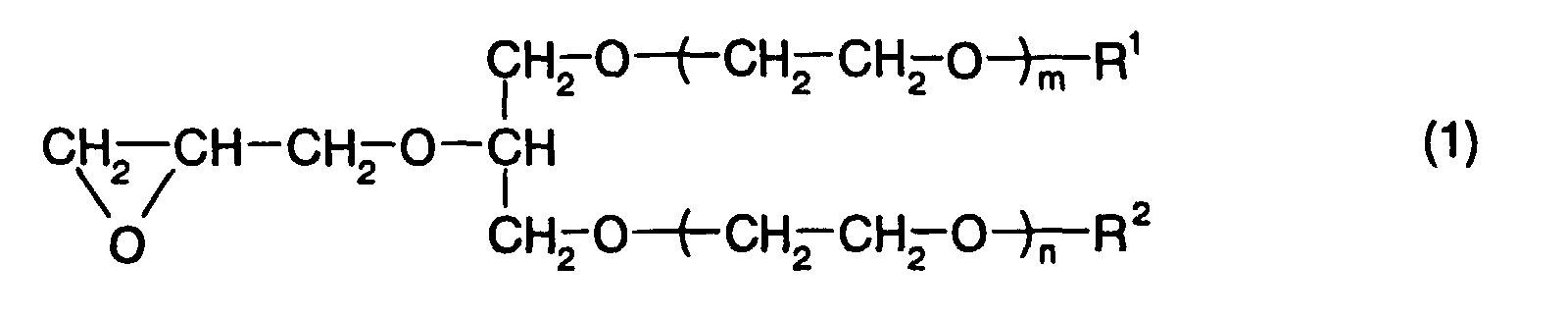
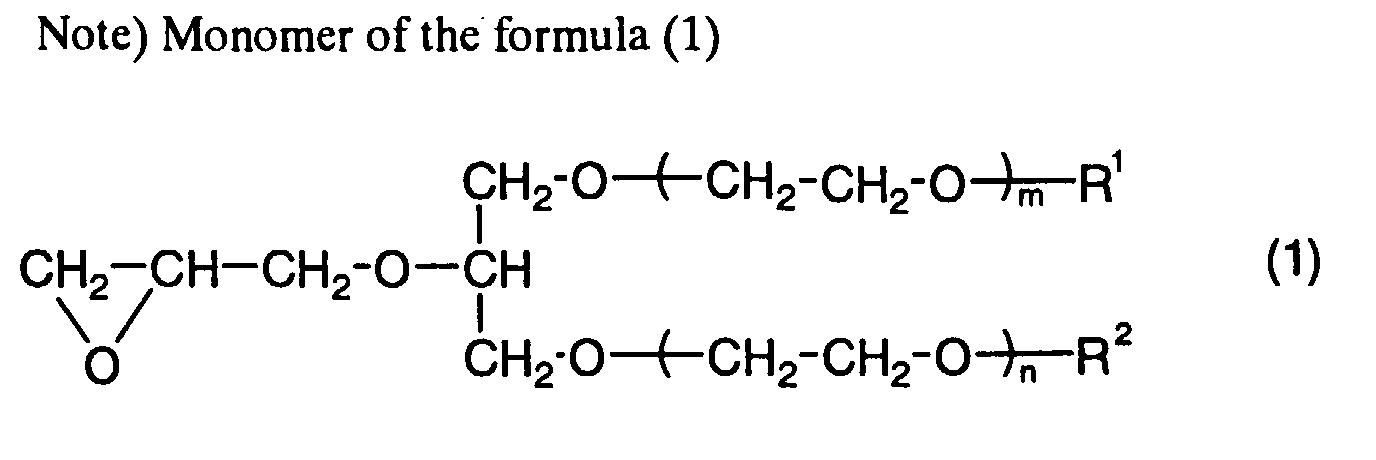
- the polyether polymer of the present invention comprises (A) a repeating unit derived from a monomer (I): wherein each of R 1 and R 2 is a group selected from a alkyl group having 1 to 12 carbon atoms, an alkenyl group having 2 to 8 carbon atoms, a cycloalkyl group having 3 to 8 carbon atoms, an aryl group having 6 to 14 carbon atoms, an aralkyl group having 7 to 12 carbon atoms and a tetrahydropyranyl group; and each of m and n is a numeral of 1 to 12, and (B) a repeating unit derived from a monomer (II): (CH 2 -CH 2 -O)
- the polyether copolymer optionally comprises (C) a repeating unit derived from a monomer having one epoxy group and at least one reactive functional group.
- a crosslinked material can be derived from the polyether copolymer having the repeating unit (C) by utilizing the reactivity of the reactive functional group.
- the copolymer used in the present invention may be crosslinked or not crosslinked.
- a crosslinking agent for crosslinking a binary copolymer having the repeating unit (I') and the repeating unit (II') specifically include isocyanate compounds such as 2,4-tolylene diisocyanate, 2,6-tolylene diisocyanate, 4,4-diphenylmethane diisocyanate and hexamethylene diisocyanate.
- the reactive functional group in the repeating unit (C) is preferably (a) a reactive silicon group, (b) an epoxy group, (c) an ethylenically unsaturated group, or (d) a halogen atom.
- the polymerization method of the polyether copolymer, which may have a crosslinkable side chain, of the present invention is the polymerization method wherein a copolymer is obtained by a ring opening reaction of ethylene oxide portion and can be conducted in the same manner as that described in Japanese Patent Kokai Publication Nos. 154736/1988 and 169823/1987 filed by the present applicant.
- the polymerization reaction can be conducted as follows. That is, the polyether copolymer can be obtained by reacting the respective monomers at the reaction temperature of 10 to 80°C under stirring, using a catalyst mainly containing an organoaluminum, a catalyst mainly containing an organozinc, an organotin-phosphate ester condensate catalyst and the like as a ring opening polymerization catalyst in the presence or absence of a solvent. Among of them, the organotin-phosphate ester condensate catalyst is particularly preferable in view of the polymerization degree, or properties of the resulting copolymer and the like.
- the reactive functional group does not react so that a copolymer having the reaction functional group is obtained.
- an oxirane compound having an epoxy group at only the both ends is used, an only epoxy group containing no substituent such as no methyl group is used for polymerization and an epoxy group containing a methyl group remains in the polymer without any reaction.
- the content of the repeating unit (A) is from 0.5 to 99% by mol, e.g. from 3 to 99% by mol, particularly from 10 to 95% by mol, and especially from 10 to 80% by mol;
- the content of the repeating unit (B) is from 99.5 to 1% by mol, e.g. from 95 to 1% by mol, particularly from 90 to 5% by mol, and specifically from 80 to 5% by mol;
- the content of the repeating unit (C) is from 0 to 15% by mol, e.g. 0 to 10% by mol, preferably from 0 to 5% by mol, and particularly 0.001 to 5% by mol.
- a glass transition temperature and a fusion heat of the polyether copolymer are measured by a differential scanning calorimeter (DSC).
- the glass transition temperature of the polyether copolymer is preferably not more than -60°C, more preferably not more than -63°C, e.g. not more than -65°C.
- the fusion heat of the polyether copolymer is preferably not more than 90 J/g, e.g. not more than 70 J/g, specifically not more than 60 J/g, particularly not more than 50 J/g.
- the polyether copolymer of the present invention may be any copolymer type such as a block copolymer and a random copolymer, but the random copolymer is preferable because the effect for reduction of the crystallizability of polyethylene oxide is large.
- the polyether copolymer of the present invention is a polyether copolymer having a side chain with two oligooxyethylene groups and, if necessary, a side chain containing a crosslinkable reactive functional group.
- the polyether copolymer of the present invention is a copolymer formed from at least two monomers.
- the polymerization degrees m and n of the oxyethylene unit of the side chain portion in the monomer (I), which constitutes the repeating unit (A), are from 1 to 12, e.g. from 1 to 6, respectively.
- the polymerization degree n exceeds 12
- the ionic conductivity of the resulting solid polymer electrolyte is unfavorably deteriorated.
- R 1 or R 2 represents an alkyl group
- the preferable carbon number of the alkyl group is from 1 to 6, particularly from 1 to 3.
- R 1 or R 2 represents an alkenyl group
- the preferable carbon number of the alkenyl group is from 2 to 6, particularly from 2 to 4.
- R 1 and R 2 may be a methyl group, an ethyl group, a propyl group, a butyl group, a pentyl group, a hexyl group, an allyl group or a cyclohexyl group.
- the monomer having a reactive silicon group, which constitutes the repeating unit (C), is preferably represented by the formula (III-a-1): wherein R 3 is a reactive silicon-containing group, or the formula (III-a-2): wherein R 4 is a reactive silicon-containing group.
- the reactive silicon group-containing monomer represented by the formula (III-a-1) is preferably a compound represented by the formula (III-a-1-1) or (III-a-1-2).
- the reactive silicon group-containing monomer represented by the formula (III-a-2) is preferably a compound represented by the formula (III-a-2-1).
- R 5 , R 6 and R 7 may be the same or different, but at least one of them represents an alkoxy group and the remainder represent an alkyl group; and k represents 1 to 6.
- Examples of the monomer represented by the formula (III-a-1-1) include 1-glycidoxymethyltrimethoxysilane, 1-glycidoxymethylmethyldimethoxysilane, 2-glycidoxyethyltrimethoxysilane, 2-glycidoxyethylmethyldimethoxysilane, 3-glycidoxypropylmethyldimethoxysilane, 3-glycidoxypropyltrimethoxysilane, 4-glycidoxybutylmethyldimethoxysilane, 4-glycidoxybutylmethyltrimethoxysilane, 6-glycidoxyhexylmethyldimethoxysilane and 6-glycidoxyhexylmethyltrimethoxysilane.
- Examples of the monomer represented by the formula (III-a-1-2) include 3-(1, 2-epoxy) propyltrimethoxysilane, 3- (1, 2-epoxy) propylmethyldimethoxysilane, 3-(1, 2-epoxy) propyldimethylmethoxysilane, 4-(1, 2-epoxy) butyltrimethoxysilane, 4-(1, 2-epoxy) butylmethyldimethoxysilane, 5-(1, 2-epoxy) pentyltrimethoxysilane, 5-(1, 2-epoxy) pentylmethyldimethoxysilane, 6-(1, 2-epoxy) hexyltrimethoxysilane and 6-(1, 2-epoxy) hexylmethyldimethoxysilane.
- Examples of the monomer represented by the formula (III-a-2-1) include 1-(3, 4-epoxycyclohexyl) methyltrimethoxysilane, 1-(3, 4-epoxycyclohexyl) methylmethyldimethoxysilane, 2-(3, 4-epoxycyclohexyl) ethyltrimethoxysilane, 2-(3, 4-epoxycyclohexyl) ethylmethyldimethoxysilane, 3-(3, 4-epoxycyclohexyl) propyltrimethoxysilane, 3-(3, 4-epoxycyclohexyl)propylmethyldimethoxysilane, 4-(3, 4-epoxycyclohexyl) butyltrimethoxysilane and 4-(3, 4-epoxycyclohexyl) butylmethyldimethoxysilane.
- 3-glycidoxypropyltrimethoxysilane 3-glycidoxypropylmethyldimethoxysilane, 4-(1, 2-epoxy) butyltrimethoxysilane, 5-(1, 2-epoxy)pentyltrimethoxysilane and 2-(3, 4-epoxycyclohexyl)ethyltrimethoxysilane are particularly preferable.
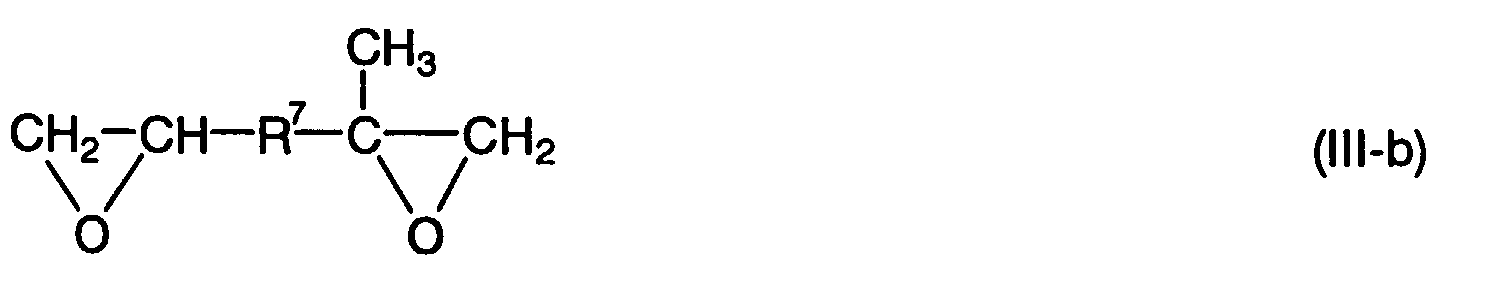
- the monomer having two epoxy groups, which constitutes the repeating unit (C), is preferably represented by the formula (III-b): wherein R 7 is a divalent organic group.
- the monomer having two epoxy groups preferably has an epoxy groups at the both ends.
- R 7 is preferably an organic group comprising elements selected from hydrogen, carbon and oxygen.
- the monomer having two epoxy groups is preferably a compound represented by the following formula (III-b-1), (III-b-2) or (III-b-3):
- a 1 and A 2 represent hydrogen or a methyl group; and m represents a numeral of 0 to 12.
- Examples of the monomer represented by the formula (III-b-1) include 2, 3-epoxypropyl-2', 3'-epoxy-2'-methyl propyl ether, ethylene glycol-2, 3-epoxypropyl-2', 3'-epoxy-2'-methyl propyl ether, and diethylene glycol-2, 3-epoxypropyl-2', 3'-epoxy-2'-methyl propyl ether.
- Examples of the monomer represented by the formula (III-b-2) include 2-methyl-1, 2, 3, 4-diepoxybutane, 2-methyl-1, 2, 4, 5-diepoxypenatane, and 2-methyl-1, 2, 5, 6-diepoxyhexane.
- Examples of the monomer represented by the formula (III-b-3) include hydroquinone-2, 3-epoxypropyl-2', 3'-epoxy-2'-methyl propyl ether, and catechol-2, 3-epoxypropyl-2', 3'-epoxy-2'-methyl propyl ether.
- the monomer having the ethylenically unsaturated group, which constitutes the repeating unit (C), is preferably represented by the formula (III-c): wherein R 8 is a group having an ethylenically unsaturated group.
- allyl glycidyl ether 4-vinylcyclohexyl glycidyl ether, ⁇ -terpinyl glycidyl ether, cyclohexenylmethyl glycidyl ether, p-vinylbenzyl glycidyl ether, allylphenyl glycidyl ether, vinyl glycidyl ether, 3, 4-epoxy-1-butene, 3, 4-epoxy-1-pentene, 4, 5-epoxy-2-pentene, 1, 2-epoxy-5, 9-cyclododecadiene, 3, 4-epoxy-1-vinylcyclohexene, 1, 2-epoxy-5-cyclooctene, glycidyl acrylate, glycidyl methacrylate, glycidyl sorbate, glycidyl cinnamate,
- Preferable examples thereof include allyl glycidyl ether, glycidyl acrylate and glycidyl methacrylate.
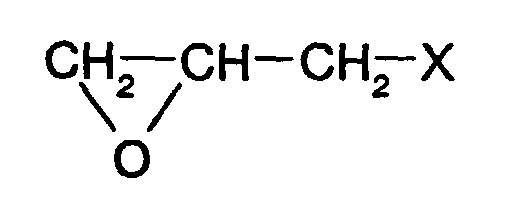
- the monomer (C) having a halogen atom is preferably represented by the formula (III-d): wherein R 9 is a group having at least one halogen atom.
- R 9 may be, e.g. an alkyl group substituted with a halogen atom.
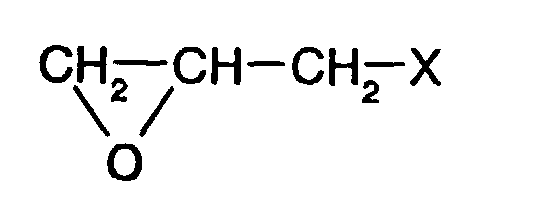
- Examples of the monomer having a halogen atom include: wherein X is a halogen atom, particularly a bromine atom (Br) or an iodine atom (I). Examples of the monomer having a halogen atom include epibromohydrin and epiiodohydrin.
- the crosslinking method of the copolymer wherein the reactive functional group is a reactive silicon group can be conducted by the reaction between the reactive silicon group and water.
- organometal compounds for example, tin compounds such as dibutyltin dilaurate, dibutyltin maleate, dibutyltin diacetate, tin octylate and dibutyltin acetylacetonate; titanium compounds such as tetrabutyl titanate and tetrapropyl titanate; aluminum compounds such as aluminum trisacetyl acetonate, aluminum trisethyl acetoacetate and diisopropoxyaluminum ethylacetoacetate; or amine compounds such as butylamine, octylamine, laurylamine, dibutylamine, monoethanolamine, diethanolamine, triethanolamine, diethylenetriamine, triety
- crosslinking method of the copolymer wherein the reactive functional group is an epoxy group
- polyamines, acid anhydrides and the like can be used.
- polyamines examples include aliphatic polyamines such as diethylenetriamine, dipropylenetriamine, triethylenetetramine, tetraethylenepentamine, dimethylaminopropylamine, diethylaminopropylamine, dibutylaminopropylamine, hexamethylenediamine, N-aminoethylpiperazine, bis-aminopropylpiperazine, trimethylhexamethylenediamine and dihydrazide isophthalate; and aromatic polyamines such as 4, 4'-diaminodiphenyl ether, diaminodiphenyl sulfone, m-phenylenediamine, 2, 4-toluylenediamine, m-toluylenediamine, o-toluylenediamine and xylylenediamine.
- aromatic polyamines such as 4, 4'-diaminodiphenyl ether, diaminodiphenyl sul
- the amount of the polyamine varies depending on the type of the polyamine, but is normally within the range from 0.1 to 10% by weight based on the whole composition excluding a plasticizer (that is, a composition excluding a plasticizer from a solid electrolyte).
- Examples of the acid anhydrides includes maleic anhydride, dodecenylsuccinic anhydride, chlorendic anhydride, phthalic anhydride, pyromellitic anhydride, hexahydrophthalic anhydride, methylhexahydrophthalic anhydride, tetramethylenemaleic anhydride, tetrahydrophthalic anhydride, methyltetrahydrophthalic anhydride and trimellitic anhydride.
- the amount of the acid anhydrides varies depending on the type of the acid anhydride, but is normally within the range from 0.1 to 10% by weight based on the whole composition excluding a plasticizer. In the crosslinking, an accelerator can be used.
- the accelerator include phenol, cresol, resorcin, pyrogallol, nonyl phenol and 2, 4, 6-tris(dimethylaminomethyl)phenol.
- the accelerator include benzyldimethylamine, 2, 4, 6-tris(dimethylaminomethyl)phenol, 2-(dimethylaminoethyl)phenol, dimethylaniline and 2-ethyl-4-methylimidazole.
- the amount of the accelerator varies depending on the type of the accelerator, but is normally within the range from 0.1 to 10% by weight based on the crosslinking agent.
- a radical initiator selected from an organic peroxide and an azo compound, or active energy ray such as ultraviolet ray and electron ray can be used. It is also possible to use a crosslinking agent having a silicon hydride.
- organic peroxide there can be used those which are normally used in the crosslinking, such as a ketone peroxide, a peroxy ketal, a hydroperoxide, a dialkyl peroxide, a diacyl peroxide and a peroxy ester.
- organic peroxide examples include methyl ethyl ketone peroxide, cyclohexanone peroxide, 1,1-bis(t-butylperoxy)-3, 3, 5-trimethylcyclohexane, 2, 2-bis(t-butylperoxy)octane, n-butyl-4,4-bis(t-butylperoxy)valerate, t-butyl hydroperoxide, cumene hydroperoxide, 2, 5-dimethylhexane-2, 5-dihydroperoxide, di-t-butyl peroxide, t-butylcumyl peroxide, dicumyl peroxide, ⁇ , ⁇ '-bis(t-butylperoxy-m-isopropyl)benzene, 2, 5-dimethyl-2, 5-di(t-butylperoxy)hexane, 2, 5-dimethyl-2, 5-di(t-butylperoxy)hexene, benzoylper
- the azo compound there can be used those which are normally used in the crosslinking, such as an azonitrile compound, an azoamide compound and an azoamidine compound.
- Specific examples of the azo compound include 2, 2'-azobisisobutyronitrile, 2,2'-azobis (2-methylbutyronitrile), 2, 2'-azobis (4-methoxy-2, 4-dimethylvaleronitrile), 2, 2'-azobis(2, 4-dimethylvaleronitrile), 1, 1'-azobis (cyclohexane-1-carbonitrile), 2-(carbamoylazo) isobutyronitrile, 2-phenylazo-4-methoxy-2, 4-dimethyl-valeronitrile, 2, 2-azobis (2-methyl-N-phenylpropionamidine) dihydrochloride, 2, 2'-azobis [N-(4-chlorophenyl)-2-methylpropionamidine] dihydrochloride, 2, 2'-azobis [N-(hydroxyphenyl)
- glycidyl acrylate ester In the crosslinking due to radiation of activated energy ray such as ultraviolet ray, glycidyl acrylate ester, glycidyl methacrylate ester and glycidyl cinnamate ester are particularly preferable among the monomer component represented by the formula (III-c).
- acetophenones such as diethoxyacetophenone, 2-hydroxy-2-methyl-1-phenylpropan-1-one, benzyldimethylketal, 1-(4-isopropylphenyl)-2-hydroxy-2-methylpropan-1-one, 4-(2-hydroxyethoxy) phenyl-(2-hydroxy-2-propyl) ketone, 2,2-dimethoxy-1,2-diphenylethan-1-one, 1-hydroxycyclohexyl-phenylketone and 2-methyl-2-morpholino (4-thiomethylphenyl) propan-1-one; benzoin ethers such as benzoin, benzoin methyl ether, benzoin ethyl ether, benzoin isopropyl ether and benzoin isobutyl ether; benzophenones such as benzophenone, methyl o-benzoyl benzoate, 4-phenylbenzophenone, hydroxybenzophenone, hydroxybenzophenone, hydroxybenzophen
- ethylene glycol diacrylate ethylene glycol dimethacrylate, oligoethylene glycol diacrylate, oligoethylene glycol dimethacrylate, propylene glycol diacrylate, propylene glycol dimethacrylate, oligopropylene glycol diacrylate, oligopropylene glycol dimethacrylate, 1, 3-butylene glycol diacrylate, 1, 4-butylene glycol diacrylate, 1, 3-glycerol dimethacrylate, 1, 1, 1-trimethylolpropane dimethacrylate, 1, 1, 1-trimethylolethane diacrylate, pentaerythritol trimethacrylate, 1, 2, 6-hexanetriacrylate, sorbitol pentamethacrylate, methylenebisacrylamide, methylenebismethacrylamide divinyl benzene, vinyl methacrylate, vinyl crotonate, vinyl acrylate, vinyl acetylene, trivinyl
- the compound having a silicon hydride group which is used for crosslinking the ethylenically unsaturated group
- a compound having at least two silicon hydride groups can be used.
- a polysiloxane compound or a polysilane compound is preferable.
- R 11 , R 12 , R 13 , R 14 , R 15 , R 16 , R 17 , R 18 and R 19 respectively represent a hydrogen atom or an alkyl or alkoxy group having 1 to 12 carbon atoms; and n ⁇ 2, m ⁇ 0, 2 ⁇ m + n ⁇ 300 .
- the alkyl group a lower alkyl group such as a methyl group and an ethyl group is preferable.
- the alkoxy group a lower alkoxy group such as a methoxy group and an ethoxy group is preferable.
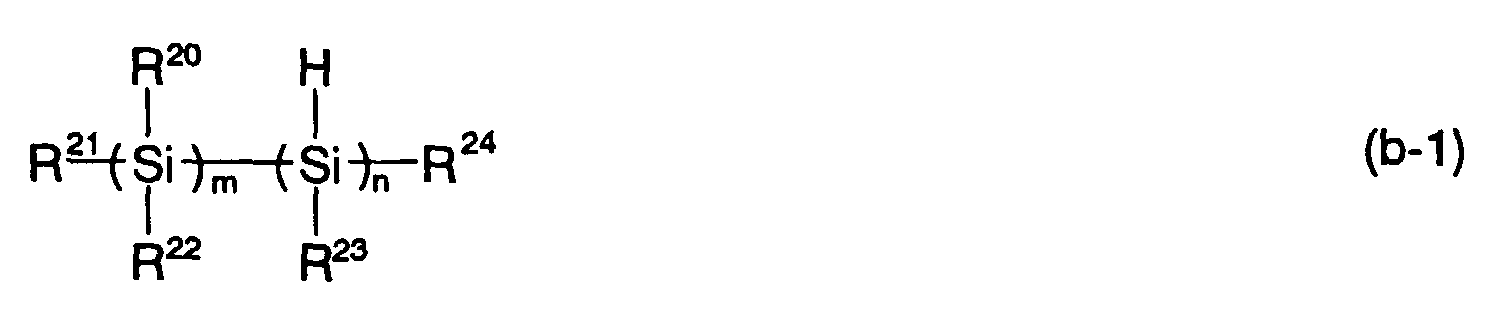
- polysilane compound a linear polysilane compound represented by the formula (b-1) can be used.
- R 20 , R 21 , R 22 , R 23 and R 24 respectively represent a hydrogen atom or an alkyl or alkoxy group having 1 to 12 carbon atoms; and n ⁇ 2, m ⁇ 0, 2 ⁇ m + n ⁇ 100 .
- Examples of the catalyst of the hydrosilylation reaction include transition metals such as palladium and platinum or a compound or complex thereof. Furthermore, peroxide, amine and phosphine can also be used. The most popular catalyst includes dichlorobis(acetonitrile)palladium(II), chlorotris(triphenylphosphine)rhodium(I) and chloroplatinic acid.
- a crosslinking agent such as polyamines, mercaptoimidazolines, mercaptopyrimidines, thioureas and polymercaptanes can be used.
- polyamines examples include hexamethylenediamine carbamate, triethylenetetramine, tetraethylenepentamine, ethylenediamine carbamate, diethylenetriamine, dipropylenetriamine, dimethylaminopropylamine, diethylaminopropylamine, dibutylaminopropylamine, hexamethylenediamine, trimethylhexamethylenediamine, diaminophenyl sulfone, m-phenylenediamine, 2, 4-toluylenediamine, m-toluylenediamine, o-toluylenediamine and xylylenediamine.
- Examples of the mercaptoimidazolines include 2-mercaptoimidazoline, 4-methyl-2-mercaptoimidazoline and 5-ethyl-4-butyl-2-mercaptoimidazoline.
- Examples of the mercaptopyrimidines include 2-mercaptopyrimidine, 4, 6-dimethyl-2-mercaptopyrimidine, and 5-butyl-2-mercaptopyrimidine.
- Examples of the thioureas include thiourea, ethylene thiourea, dibutyl thiourea, trimethyl thiourea, triethyl thiourea and tributyl thiourea.
- polymercaptanes examples include 2-dibutylamino-4, 6-dimethylcapto-s-triazine, 2-phenylamino-4, 6-dimercaptotriazine, 2, 5-dimercapto-1, 3, 4-thiazole, 1, 10-decanedithiol, 2, 3-dimercaptopyrazine, 2, 3-dimercaptoquinoxaline and 6-methylquinoxaline-2, 3-dithiocarbonate.
- the amount of the crosslinking agent varies depending on the type of the crosslinking agent, but is normally within the range from 0.1 to 30% by weight based on the whole composition excluding a plasticizer.
- a metal compound as an acid acceptor is effective to add to the solid polymer electrolyte in view of the thermal stability of the halogen-containing polymer.
- the metal oxide as the acid acceptor include oxide, hydroxide, carbonate salt, carboxylate salt, silicate salt, borate salt and phosphite salt of Group II metal of the periodic table; and oxide, basic carbonate salt, basic carboxylate salt, basic phosphite salt, basic sulfite salt and tribasic sulfate salt of Group VIa metal of the periodic table.
- magnesia magnesium hydroxide, barium hydroxide, magnesium carbonate, barium carbonate, quick lime, slaked lime, calcium carbonate, calcium silicate, calcium stearate, zinc stearate, calcium phthalate, magnesium phosphite, calcium phosphite, zinc white, tin oxide, litharge, read lead, white lead, dibasic lead phthalate, dibasic lead carbonate, tin stearate, basic lead phosphite, basic tin phosphite, basic lead sulfite and tribasic lead sulfate.
- the amount of the metal compound as the above acid acceptor varies depending on the type thereof, but is normally within the range from 0.1 to 30% by weight based on the whole composition excluding a plasticizer.
- the electrolyte salt compound used in the present invention is preferably soluble in a mixture comprising a polyether copolymer or a crosslinked material of the copolymer and a plasticizer.
- the following salt compounds are preferably used.
- examples thereof include a compound composed of a cation selected from a metal cation, ammonium ion, amidinium ion and guanidium ion, and an anion selected from chloride ion, bromide ion, iodide ion, perchlorate ion, thiocyanate ion, tetrafluoroborate ion, nitrate ion, AsF 6 - , PF 6 - , stearylsulfonate ion, octylsulfonate ion, dodecylbenzenesulfonate ion, naphthalenesufonate ion, dodecylnaphthalenesulfonate ion, 7, 7, 8, 8-tetracyano-p-quinodimethane ion, X 1 SO 3 - , [(X 1 SO 2 )(X 2 SO 2 )N] -
- X 1 , X 2 and X 3 independently represent a perfluoroalkyl having 1 to 6 carbon atoms or a perfluoroaryl group and Y represents a nitro group, a nitroso group, a carbonyl group, a carboxyl group or a cyano group.
- X 1 , X 2 and X 3 may be the same or different.
- the metal cation a cation of a transition metal can be used.
- a cation of a metal selected from Mn, Fe, Co, Ni, Cu, Zn and Ag metals is used.
- a cation of a metal selected from Li, Na, K, Rb, Cs, Mg, Ca and Ba metals good results are also obtained.
- Two or more compounds described above may be used as the electrolyte salt compound.
- the amount of the electrolyte salt compound is so that a numeral value of a molar ratio of the number of moles of the electrolyte salt compound to the total number of moles of oxyethylene units (the total number of moles of oxyethylene units included in a main chain and side chain of the polyether copolymer) is preferably within the range from 0.0001 to 5, more preferably from 0.001 to 0.5. When this value exceeds 5, the processability and moldability, the mechanical strength and flexibility of the resulting solid electrolyte are deteriorated.
- the plasticizer is an aprotic organic solvent, or a derivative or a metal salt of a linear or branched polyalkylene glycol having a number-average molecular weight of 200 to 5,000, or a metal salt of the derivative.
- aprotic organic solvent aprotic ethers and esters are preferable.
- Specific examples include propylene carbonate, ⁇ -butyrolactone, butylene carbonate, ethylene carbonate, dimethyl carbonate, ethylmethyl carbonate, diethyl carbonate, 1, 2-dimethoxyethane, 1, 2-dimethoxypropane, 3-methyl-2-oxyazolidone, tetrahydrofuran, 2-methyltetrahydrofuran, 1, 3-dioxolane, 4, 4-methyl-1, 3-dioxolane, tert-butyl ether, iso-butylether, 1, 2-ethoxymethoxyethane, ethylene glycol dimethyl ether, ethylene glycol diethyl ether, triethylene glycol dimethyl ether, triethylene glycol diethyl ether, tetraethylene glycol dimethyl ether, tetraethylene glycol diethyl ether, ethylene glyme, ethylene diglyme, methyl
- Triethylene glycol dimethyl ether, triethylene glycol diethyl ether, tetraethylene glycol dimethyl ether and tetraethylene glycol diethyl ether are also particularly preferable organic solvents.
- the derivative or metal salt of the linear or branched polyalkylene glycol or the metal salt of the derivative can be obtained from a polyalkylene glycol having a number-average molecular weight of 200 to 5,000.
- the polyalkylene glycol include polyethylene glycol or polypropylene glycol, and examples of the derivative thereof include ester derivative or ether derivative having an alkyl group having 1 to 8 carbon atoms and an alkenyl group having 3 to 8 carbon atoms.
- examples of the ether derivative include diethers such as dimethyl ether, diethyl ether, dipropyl ether and diallyl ether
- examples of the ester derivative include diesters such as polyalkylene glycol dimethacrylate ester (e.g. polyethylene glycol dimethacrylate ester), polyalkylene glycol diacetate ester (e.g. polyethylene glycol diacetate ester), and polyalkylene glycol diacrylate ester (e.g. polyethylene glycol diacrylate ester).
- metal salt of the derivative examples include sodium, lithium and dialkylaluminum salts (e.g. dioctylaluminum salt) of monoethers such as monomethyl ether, monoethyl ether, monopropyl ether, monobutyl ether, monohexyl ether, mono-2-ethyl-hexyl ether and monoallyl ether; and monoesters such as monoacetate ester, monoacrylate ester and monomethacrylate ester.
- monoethers such as monomethyl ether, monoethyl ether, monopropyl ether, monobutyl ether, monohexyl ether, mono-2-ethyl-hexyl ether and monoallyl ether
- monoesters such as monoacetate ester, monoacrylate ester and monomethacrylate ester.
- metal salt of polyalkylene glycol derivative examples include dioctylaluminum salt of polyethylene glycol monomethyl ether, dioctylaluminum salt of polyethylene glycol monoethyl ether and dioctylaluminum salt of polyethylene glycol monoallyl ether.
- the number-average molecular weight of the polyalkylene glycol used is more preferably within the range from 200 to 2,000.
- the formulating proportion of the plasticizer is optionally selected, but is from 0 to 2,000 parts by weight, preferably 1 to 2,000 parts by weight, e.g. 10 to 1,000 parts by weight, particularly from 10 to 500 parts by weight, based on 100 parts by weight of the polyether copolymer.
- a flame retardant can be used. That is, an effective amount of those selected from a halide (such as a brominated epoxy compound, tetrabromobisphenol A and chlorinated paraffin), antimony trioxide, antimony pentaoxide, aluminum hydroxide, magnesium hydroxide, phosphate ester, polyphosphate salt and zinc borate as a flame retardant can be added.
- a halide such as a brominated epoxy compound, tetrabromobisphenol A and chlorinated paraffin
- antimony trioxide antimony pentaoxide
- aluminum hydroxide magnesium hydroxide
- phosphate ester phosphate ester
- polyphosphate salt and zinc borate zinc borate
- the method for production of the solid polymer electrolyte of the present invention is not specifically limited, but the respective components may be mechanically mixed, normally. In case of the multicomponent-copolymer requiring the crosslinking, it is produced by a method such as mechanically mixing the respective components, followed by crosslinking. Alternatively, after crosslinking, the crosslinked copolymer may be impregnated by immersing in a plasticiser for a long time. As means for mechanically mixing, various kneaders, open rolls, extruders and the like can be optionally used.
- the amount of water used in the crosslinking reaction is not specifically limited because the crosslinking reaction easily occurs even in the presence of moisture in the atmosphere.
- the crosslinking can also be conducted by passing through a cold water or hot water bath for a short time, or exposing to a steam atmosphere.
- the crosslinking reaction is completed at the temperature of 10 to 200°C within 10 minutes to 20 hours.
- the crosslinking reaction when using a radical initiator, the crosslinking reaction is completed at the temperature of 10 to 200°C within 1 minutes to 20 hours. Furthermore, when using energy ray such as ultraviolet ray, a sensitizer is normally used. The crosslinking reaction is normally completed at the temperature of 10 to 150°C within 0.1 seconds to 1 hour. In case of the crosslinking agent having a silicon hydride, the crosslinking reaction is completed at the temperature of 10 to 180°C within 10 minutes to 10 hours.
- the method of mixing the electrolyte salt compound and plasticizer with the polyether copolymer is not specifically limited, but examples thereof include a method of impregnating by immersing the polyether copolymer in an organic solvent containing the electrolyte salt compound and plasticizer for a long time, a method of mechanically mixing the electrolyte salt compound and plasticizer with the polyether copolymer, a method of dissolving the polyether copolymer and the electrolyte salt compound in the plasticizer, followed by mixing or a method of dissolving the polyether copolymer once in the other organic solvent, followed by mixing the plasticizer.
- various polar solvents such as tetrahydrofuran, acetone acetonitrile, dimethylformamide, dimethyl sulfoxide, dioxane, methyl ethyl ketone and methyl isobutyl ketone, may be used alone or in combination thereof.
- the solid polymer electrolyte shown in the present invention is superior in mechanical strength and flexibility, and a large area thin-film shaped solid electrolyte can be easily obtained by utilizing the properties.
- the positive electrode material include lithium-manganese double oxide, lithium cobaltate, vanadium pentaoxide, polyacene, polypyrene, polyaniline, polyphenylene, polyphenylene sulfide, polyphenylene oxide, polypyrrole, and polyfuran, polyazulene.
- the negative electrode material examples include an interlaminar compound prepared by occlusion of lithium between graphite or carbon layers, a lithium metal and a lithium-lead alloy.
- the crosslinked solid polymer electrolyte can also be used as a diaphragm of an ion electrode of the cation such as alkaline metal ion, Cu ion, Ca ion and Mg ion.
- the solid polymer electrolyte of the present invention is especially suitable as a material for electrochemical device (e.g. a battery, a capacitor and a sensor).
- the monomer used in the Example was synthesized in two steps.
- the boiling point of the resulting monomer was 115°C at 0.3 mmHg. This monomer was used in Examples 1 and 5.
- a monomer (1) was synthesized by conducting the same operation as that of step 1 in Synthesis Example 1 of monomer and reacting epichlorohydrin in the same manner as that of step 2 in Synthesis Example 1 of monomer.
- Tributyltin chloride (10 g) and tributyl phosphate (35 g) were charged in a three-necked flask equipped with a stirrer, a thermometer and a distillation device, and the mixture with stirring under nitrogen stream was heated at 250°C for 20 minutes and the distillate was distilled off to obtain a solid condensate as a residue product.
- this organotin/phosphate ester condensate was used as a polymerization catalyst.
- composition analysis in terms of monomer
- 1 H NMR spectrum The composition analysis (in terms of monomer) of the polyether copolymer by element analysis and 1 H NMR spectrum was conducted.
- the gel permeation chromatography measurement was conducted and the molecular weight was calculated in terms of standard polystyrene.
- the gel permeation chromatography measurement was conducted at 60°C by a measuring device RID-6A manufactured by Shimadzu Corp., using a column manufactured by Showa Denko Co., Ltd. such as Showdex KD-807, KD-806, KD-806 and KD-803, and a solvent DMF.
- the glass transition temperature and fusion heat were measured in a nitrogen atmosphere within the temperature range from -100 to 80°C at a heating rate of 10°C/min. by a differential scanning calorimeter DSC8230B manufactured by Rigaku Denki Co., Ltd.
- the measurement of the conductivity ⁇ was conducted as follows. That is, a film vacuum-dried at 20°C under 1 mmHg for 72 hours (or gel-like film) was sandwiched between platinum electrodes and the conductivity was calculated according to the complex impedance method, using an A.C. method (voltage: 0.5 V, frequency: 5 Hz to 1 MHz).
- the flexibility of the solid electrolyte film was evaluated by the presence or absence of breakage in case of folding the film at an angle of 180 degrees at 25°C.
- the polymer was isolated by decantation, dried at 40°C under normal pressure for 24 hours, and then dried at 45°C under reduced pressure for 10 hours to obtain 350 g of a polymer.
- the glass transition temperature of this copolymer was -73°C, the weight-average molecular weight was 250,000 and the fusion heat was 8 J/g.
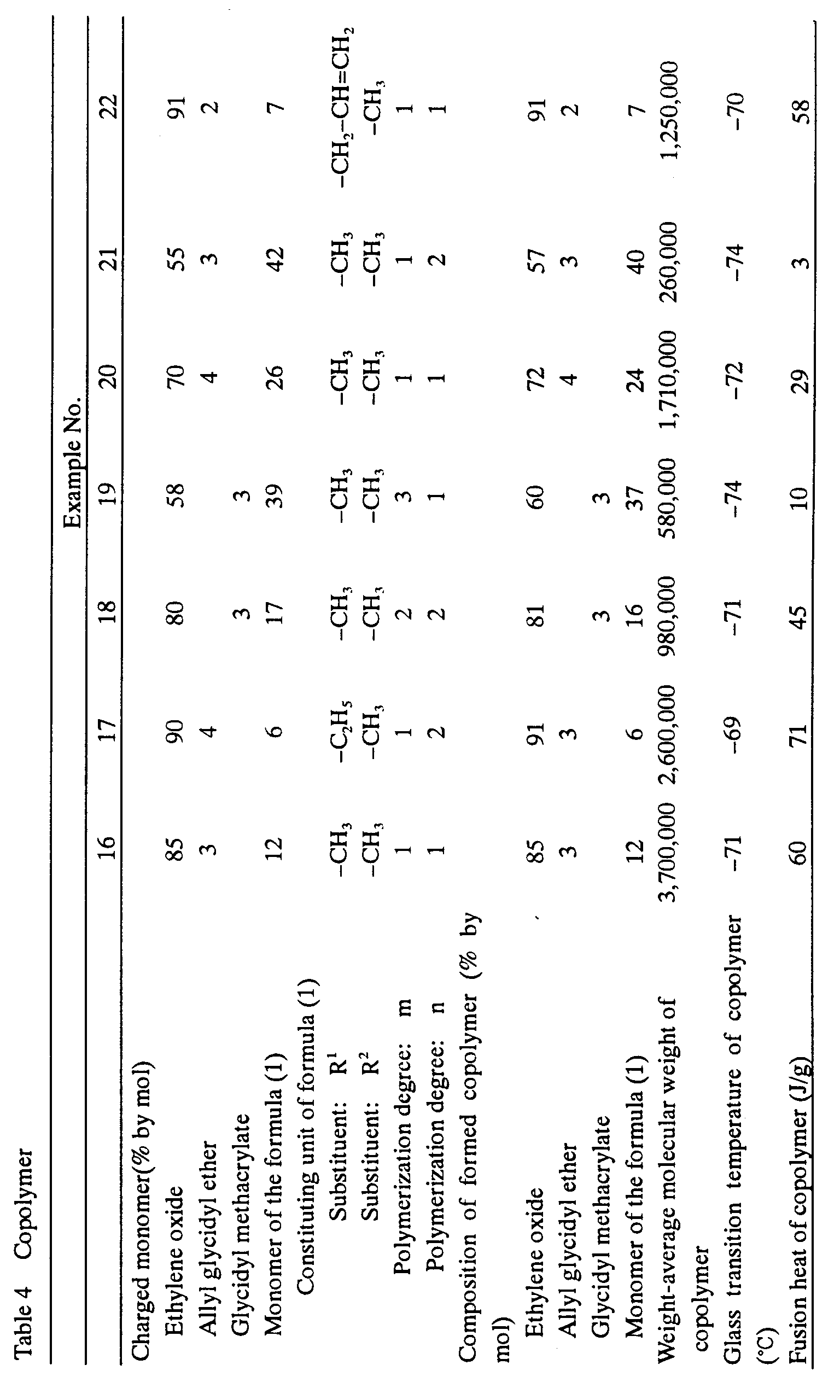
- the results of the composition analysis (in terms of monomer) of this polymer by 1 H NMR spectrum are shown in Table 1.
- the copolymer (1 g) obtained in Example 5 was dissolved in acetonitrile (20 ml), and the resulting solution was mixed with an acetonitrile solution of lithium bistrifluoromethanesulfonylimide (hereinafter referred to as LiTFSI) so that a molar ratio of (the number of moles of the LiTFSI) to (the total number of moles of ether oxygen atoms of polyether copolymer) was 0.05.
- LiTFSI lithium bistrifluoromethanesulfonylimide
- This mixed solution was casted on a mold made of polytetrafluoroethylene, followed by sufficient drying to obtain a film.
- the characteristics of the film were measured in the same manner as in Examples 8 to 11.
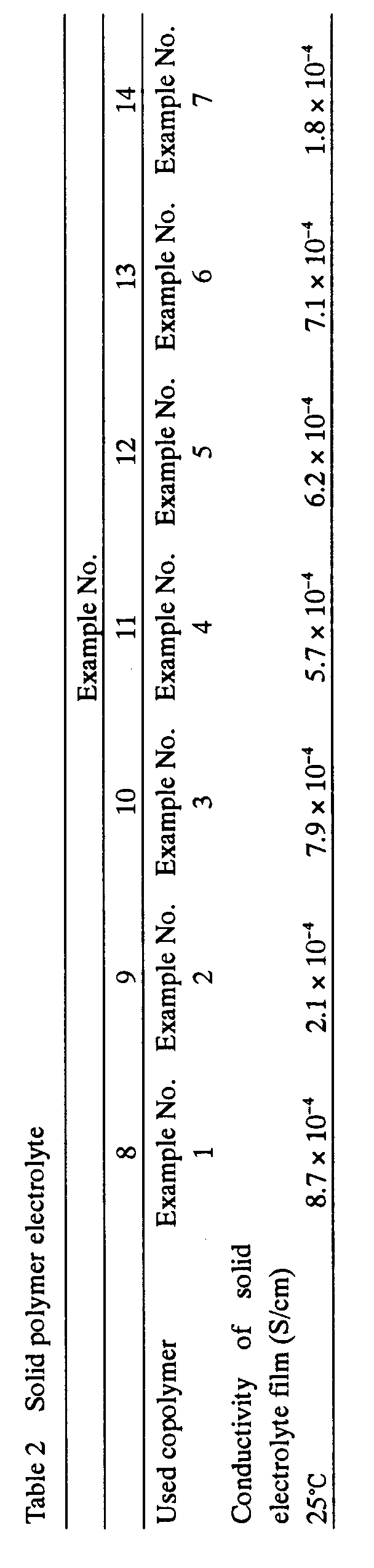
- the electrical conductivity of the solid electrolyte was 6.2 X 10 -4 S/cm at 25°C. The results are shown in Table 2.
- the copolymer (1 g) obtained in Example 6 was dissolved in acetonitrile (20 ml), and the resulting solution was mixed with an acetonitrile solution of LiTFSI so that a molar ratio of (the number of moles of the LiTFSI) to (the total number of moles of ether oxygen atoms) was 0.03.
- This mixed solution was casted on a mold made of polytetrafluoroethylene, followed by sufficient drying to obtain a film.
- the characteristics of the resulting film were measured in the same manner as in Examples 8 to 11. The results are shown in Table 2.
- a film was obtained in the same manner as in Example 13, except that a molar ratio of (the number of moles of the LiTFSI) to (the total number of moles of ether oxygen atoms) was 0.05. Properties of the film were measured in the same manner as in Examples 8 to 11. The results are shown in Table 2.
- a lithium metal foil as a negative electrode and lithium cobaltate (LiCoO 2 ) as a positive electrode a secondary battery was constructed.
- the size of the solid polymer electrolyte was 10 mm x 10 mm x 0.2 mm.
- the size of the lithium foil was 10 mm x 10 mm x 0.1 mm.
- Lithium cobaltate was prepared by mixing predetermined amount of lithium carbonate and cobalt carbonate powder and calcining the mixture at 900°C for 5 hours.
- the calcined mixture was ground, and then 12 parts by weight of acetylene black and 3 parts by weight of the solid polymer electrolyte obtained in Example 10 were added to 85 parts by weight of the resulting lithium cobaltate, followed by mixing by a roll and further press-molding under the pressure of 300 KgW/cm 2 to form a positive electrode having the size of 10 mm ⁇ 10 mm ⁇ 2 mm.
- Example 10 The solid polymer electrolyte obtained in Example 10 was sandwiched between the lithium metal foil and the lithium cobaltate plate, and the charge/discharge characteristics of the resulting battery were examined at 25°C with applying the pressure of 10 KgW/cm 2 so that the interfaces were brought into contact with each other.
- the discharge current at the initial terminal voltage of 3.8 V was 0.1 mA/cm 2 and charging could be conducted at 0.1 mA/cm 2 . It is possible to easily reduce the thickness of the battery in this Example and, therefore, a light-weight and large-capacity battery can be obtained.
- a monomer (1) was synthesized by conducting the same operation as that of step 1 in Synthesis Example 1 of monomer and reacting epichlorohydrin in the same manner as that of step 2 in Synthesis Example 1 of monomer.
- the polymer was isolated by decantation, dried at 40°C under normal pressure for 24 hours, and then dried at 45°C under reduced pressure for 10 hours to obtain 321 g of a polymer.
- the glass transition temperature of this copolymer was -71°C, the weight-average molecular weight was 3,700,000 and the fusion heat was 60 J/g.
- the results of the composition analysis (in terms of monomer) of this polymer by 1H NMR spectrum are as shown in Table 4.
- the polyether copolymer (1 g) obtained in Example 16 and a crosslinking agent dicumyl peroxide (0.015 g) were dissolved in tetrahydrofuran (20 ml), and the resulting solution was mixed with a tetrahydrofuran solution of lithium perchlorate so that a molar ratio of (the number of moles of the electrolyte salt compound) to (the total number of moles of ether oxygen atoms of the copolymer) was 0.05.
- This mixed solution was casted on a mold made of polytetrafluoroethylene, dried and then heated and pressured at 170°C and 60 KgW/cm 2 for 10 minutes to obtain a film.
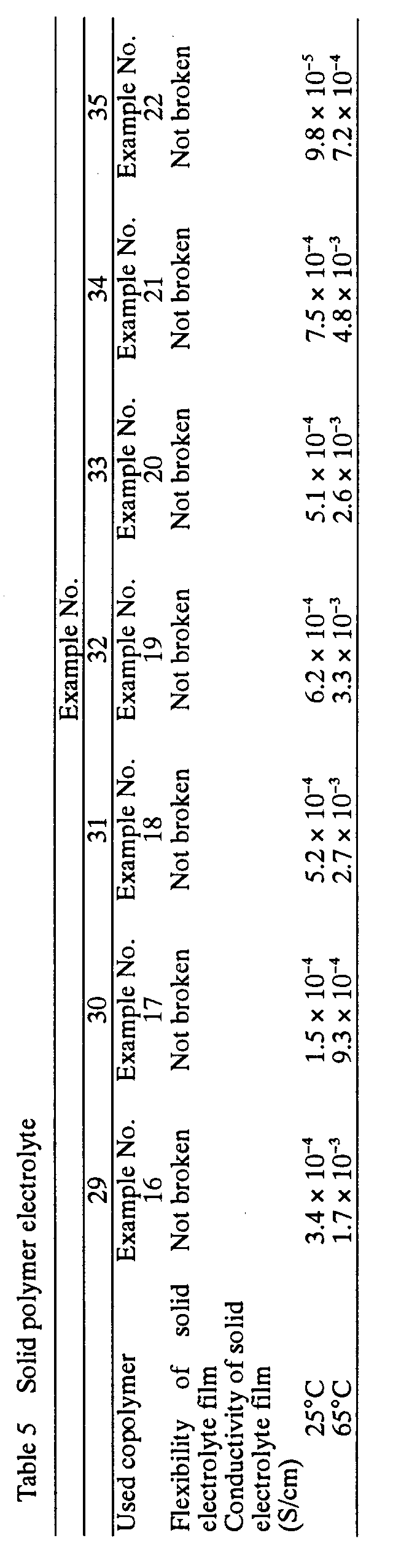
- the measurement results for the conductivity and flexibility of the film are shown in Table 5.
- the polyether copolymer (1 g) obtained in Example 17 and a crosslinking agent 1,1-bis (t-butylperoxy)-3, 3, 5-trimethylcyclohexane (0.02 g) were dissolved in tetrahydrofuran (20 ml), and the resulting solution was mixed with a tetrahydrofuran solution of lithium perchlorate so that a molar ratio of (the number of moles of the electrolyte salt compound) to (the total number of moles of ether oxygen atoms of the copolymer) was 0.05.
- This mixed solution was casted on a mold made of polytetrafluoroethylene, dried and then heated and pressured at 145°C and 100 KgW/cm 2 for 10 minutes to obtain a film.
- the measurement results for the conductivity and flexibility of the film are shown in Table 5.
- the polyether copolymer (1 g) obtained in Example 18 and a crosslinking agent benzoyl peroxide (0.015 g) were dissolved in acetonitrile (20 ml), and the resulting solution was mixed with an acetonitrile solution of lithium bistrifluoromethanesulfonylimide so that a molar ratio of (the number of moles of the electrolyte salt compound) to (the total number of moles of ether oxygen atoms of the copolymer) was 0.05, and then a film was obtained in the same manner as in Example 29.
- the measurement results for the electrical conductivity and flexibility of the film are shown in Table 5.
- the polyether copolymer (1 g) obtained in Example 19 and a crosslinking agent azobisisobutyronitrile (0.02 g) were dissolved in tetrahydrofuran (20 ml), and the resulting solution was mixed with a tetrahydrofuran solution of lithium perchlorate so that a molar ratio of (the number of moles of the electrolyte salt compound) to (the total number of moles of ether oxygen atoms of the copolymer) was 0.05.
- This mixed solution was casted on a mold made of polytetrafluoroethylene, dried and then allowed to stand at 100°C under an argon atmosphere for 2 hours to obtain a film.
- the measurement results for the electrical conductivity and flexibility of the film are shown in Table 5.
- the polyether copolymer (1 g) obtained in Example 20 and a sensitizer 2, 2-dimethoxy-1, 2-diphenylethan-1-one (0.02 g) were dissolved in tetrahydrofuran (20 ml), and the resulting solution was mixed with a tetrahydrofuran solution of lithium perchlorate so that a molar ratio of (the number of moles of the electrolyte salt compound) to (the total number of moles of ether oxygen atoms of the copolymer) was 0.05.
- This mixed solution was casted on a mold made of polytetrafluoroethylene and dried, followed by ultraviolet ray irradiation (30 mW/cm 2 , 360 nm) at 50°C under an argon atmosphere for 10 minutes to obtain a film.
- the measurement results for the electrical conductivity and flexibility of the film are shown in Table 5.
- the polyether copolymer (1 g) obtained in Example 21 and polysiloxane (0.2 g) represented by the formula (11) were dissolved in toluene (10 ml) and an isopropyl alcohol solution containing 1% by weight of chloroplatinic acid was added, and the resulting solution was mixed with a toluene solution of lithium bistrifluoromethanesulfonylimide so that a molar ratio of (the number of moles of the electrolyte salt compound) to (the total number of moles of ether oxygen atoms of the copolymer) was 0.05, and then a film was obtained in the same manner as in Example 29.
- the measurement results for the electrical conductivity and flexibility of the film are shown in Table 5.
- Mn represents a number-average molecular weight.
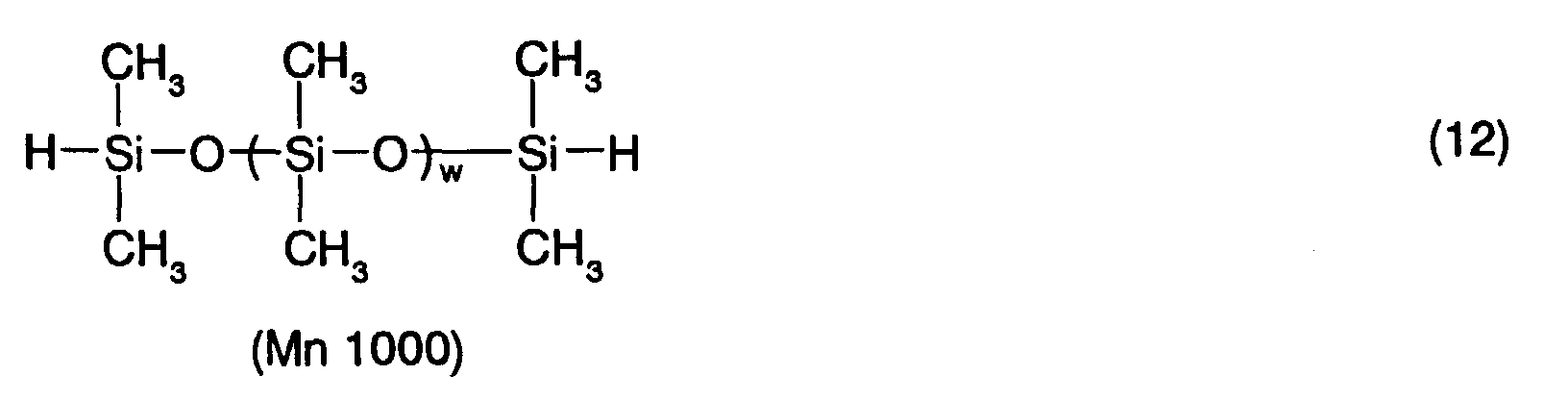
- the polyether copolymer (1 g) obtained in Example 22 and polysiloxane (0.2 g) represented by the formula (12) were dissolved in toluene (10 ml) and an isopropyl alcohol solution containing 1% by weight of chloroplatinic acid was added, and the resulting solution was mixed with a toluene solution of lithium bistrifluoromethanesulfonylimide so that a molar ratio of (the number of moles of the soluble electrolyte salt compound) to (the total number of moles of ether oxygen atoms of the copolymer) was 0.05, and then a film was obtained in the same manner as in Example 29.
- the measurement results for the electrical conductivity and flexibility of the film are shown in Table 5.
- Mn represents a number-average molecular weight.
- the polyether copolymer (1 g) obtained in Example 23 and a catalyst dibutyltin dilaurate (5 mg) were dissolved in tetrahydrofuran (20 ml), and the resulting solution was mixed with a tetrahydrofuran solution of lithium perchlorate so that a molar ratio of (the number of moles of the electrolyte salt compound) to (the total number of moles of ether oxygen atoms of the copolymer) was 0.05 and water was added to this mixed solution in the same amount as that of the reactive silicon group-containing component.
- the polyether copolymer (1 g) obtained in Example 24 was dissolved in tetrahydrofuran (20 ml), and the resulting solution was mixed with a tetrahydrofuran solution of lithium perchlorate so that a molar ratio of (the number of moles of the electrolyte salt compound) to (the total number of moles of ether oxygen atoms of the copolymer) was 0.05.
- a molar ratio of (the number of moles of the electrolyte salt compound) to (the total number of moles of ether oxygen atoms of the copolymer) was 0.05.
- water was added in the three times molar amount the reactive silicon group-containing component.
- This mixed solution was casted on a mold made of polytetrafluoroethylene, dried, heated and pressured at 160°C and 20 KgW/cm 2 for 10 minutes to obtain a film.
- the measurement results for the electrical conductivity and flexibility of the film are shown in Table 5.
- the polyether copolymer (1 g) obtained in Example 25 and a catalyst dibutyltin dilaurate (5 mg) were dissolved in tetrahydrofuran (20 ml) and water (10 ⁇ l) was added, followed by stirring for 15 minutes. After the solvent was removed under a normal pressure, the mixed solution was dried at 60°C for 10 hours to obtain a crosslinked material. The resulting crosslinked material was impregnated with a tetrahydrofuran solution (5 ml) containing lithium perchlorate (100 mg) for 20 hours, heated and pressured at 170°C and 80 KgW/cm 2 for 10 minutes to obtain a film. The measurement results for the electrical conductivity and flexibility of the film are shown in Table 5.
- the polyether copolymer (1 g) obtained in Example 26 and maleic anhydride (150 mg) were dissolved in tetrahydrofuran (20 ml), and the resulting solution was mixed with a tetrahydrofuran solution of lithium perchlorate so that a molar ratio of (the number of moles of the soluble electrolyte salt compound) to (the total number of moles of ether oxygen atoms of the copolymer) was 0.05.
- This mixed solution was casted on a mold made of polytetrafluoroethylene, dried and then heated and pressured at 160°C and 20 KgW/cm 2 for one hour to obtain a film.
- the measurement results for the electrical conductivity and flexibility of the film are shown in Table 5.
- the polyether copolymer (1 g) obtained in Example 27 and diethylenetriamine (50 mg) were dissolved in tetrahydrofuran (20 ml), and the resulting solution was mixed with a tetrahydrofuran solution of lithium perchlorate so that a molar ratio of (the number of moles of the soluble electrolyte salt compound) to (the total number of moles of ether oxygen atoms of the copolymer) was 0.05.
- This mixed solution was casted on a mold made of polytetrafluoroethylene, dried and then allowed to stand at 100°C under an argon atmosphere for 10 hours to obtain a film.
- the measurement results for the conductivity and flexibility of the film are shown in Table 5.
- the polyether copolymer (1 g) obtained in Example 28 and diethylene triamine (50 mg) were dissolved in tetrahydrofuran (20 ml) and the reaction was conducted at 40°C for 2 hours. After the solvent was removed under a normal pressure, the mixed solution was dried at 60°C for 6 hours to obtain a crosslinked material. The resulting crosslinked material was impregnated with a tetrahydrofuran solution (5 ml) containing lithium perchlorate (100 mg) for 20 hours, heated and pressured at 160°C and 100 KgW/cm 2 for 10 minutes to obtain a film. The measurement results for the conductivity and flexibility of the film are shown in Table 5.
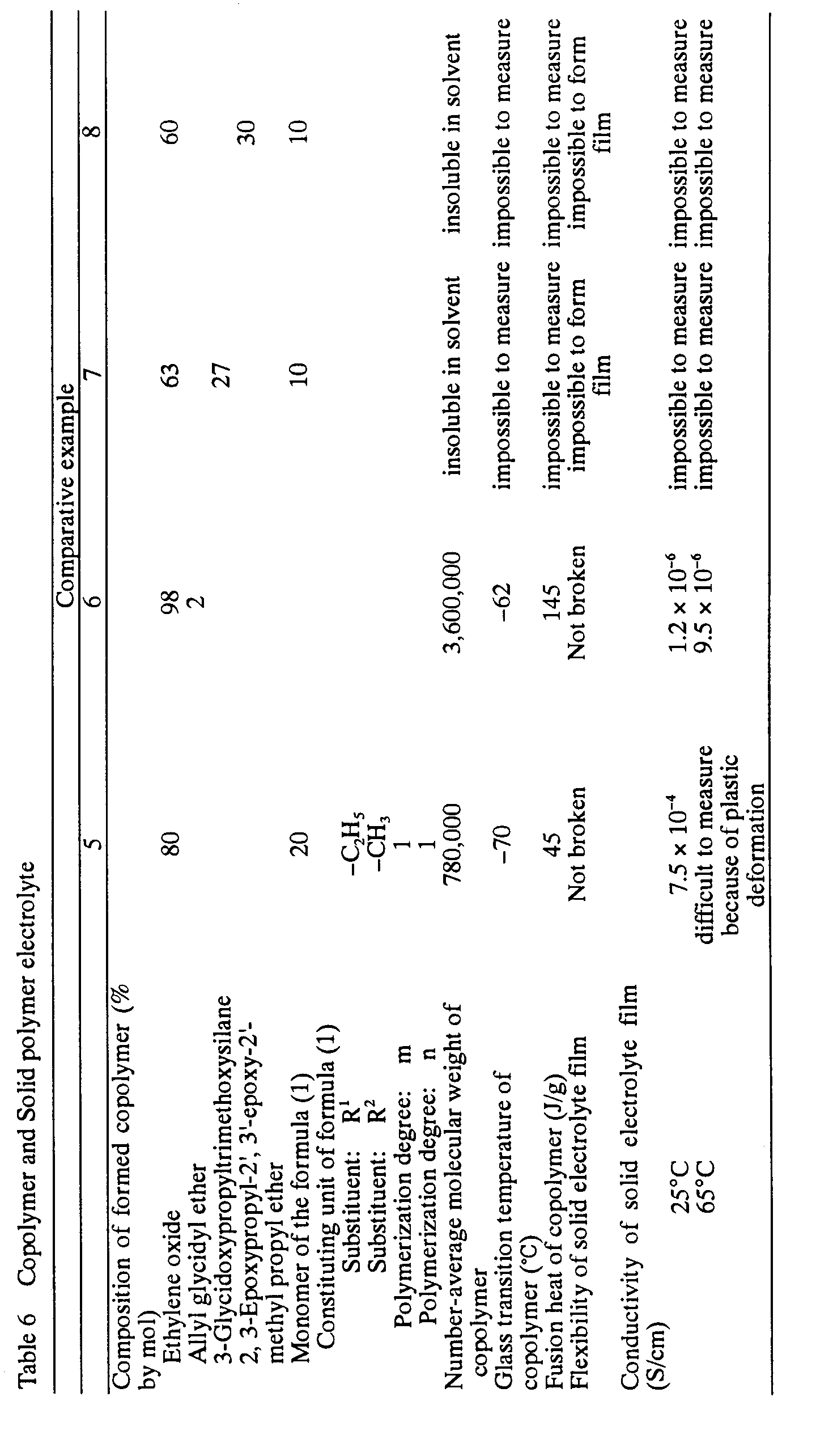
- Comparative 5 a film molding was conducted in the same manner as in Example 29, except for adding no crosslinking agent.
- Comparative Example 6 a film molding was conducted in the same manner as in Example 30.
- Comparative Example 7 a film molding was conducted in the same manner as in Example 36.
- Comparative Example 8 a film molding was conducted in the same manner as in Example 39. The results are shown in Table 6.
- a lithium metal foil as a negative electrode and lithium cobaltate (LiCoO 2 ) as a positive electrode a secondary battery was constructed.
- the size of the crosslinked solid polymer electrolyte was 10 mm ⁇ 10 mm ⁇ 0.2 mm.
- the size of the lithium foil was 10 mm ⁇ 10 mm ⁇ 0.1 mm.
- Lithium cobaltate was prepared by mixing predetermined amount of lithium carbonate and cobalt carbonate powder and calcining the mixture at 900°C for 5 hours.
- the calcined mixture was ground, and then 12 parts by weight of acetylene black and 3 parts by weight of the crosslinked solid polymer electrolyte obtained in Example 29 were added to 85 parts by weight of the resulting lithium cobaltate, followed by mixing by a mortar and press-molding under the pressure of 300 KgW/cm 2 to form a positive electrode having the size of 10 mm ⁇ 10 mm ⁇ 2 mm.
- Example 29 The crosslinked solid polymer electrolyte obtained in Example 29 was sandwiched between the lithium metal foil and the lithium cobaltate plate, and the charge/discharge characteristics of the resulting battery were examined with applying the pressure of 10 KgW/cm 2 so that the interfaces were brought into contact with each other.
- the discharge current at the initial terminal voltage of 3.8 V was 0.1 mA/cm 2 and the charging could be conducted at 0.1 mA/cm 2 . It is possible to easily reduce the thickness of the battery in this Example and, therefore, a light-weight and large-capacity battery can be obtained.
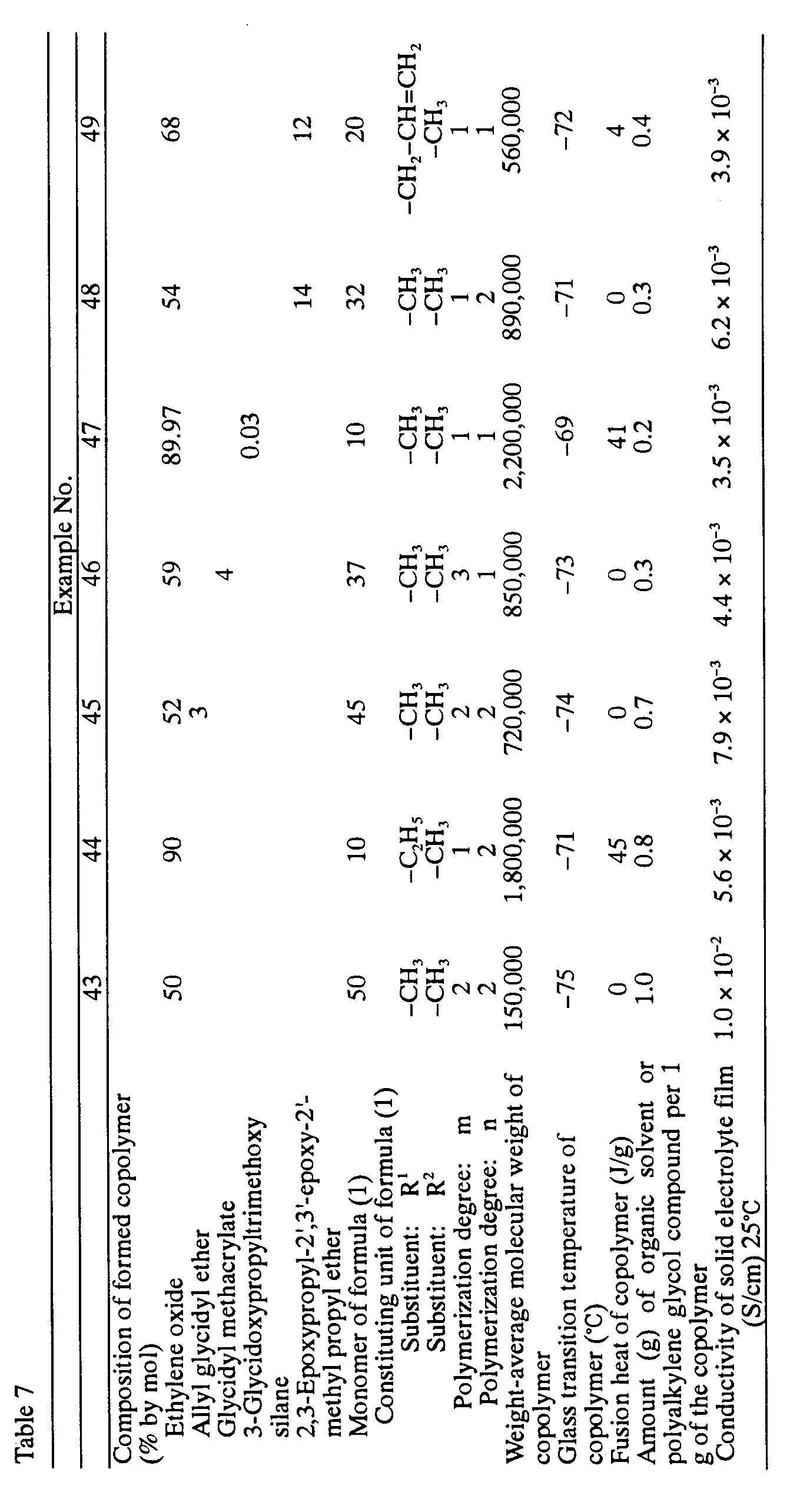
- the polymer was isolated by decantation, dried at 40°C under normal pressure for 24 hours, and then dried at 45°C under reduced pressure for 10 hours to obtain 195 g of a polymer.
- the glass transition temperature of this polymer was -75°C
- the weight-average molecular weight by gel permeation chromatography was 150,000
- the fusion heat was 0 J/g.
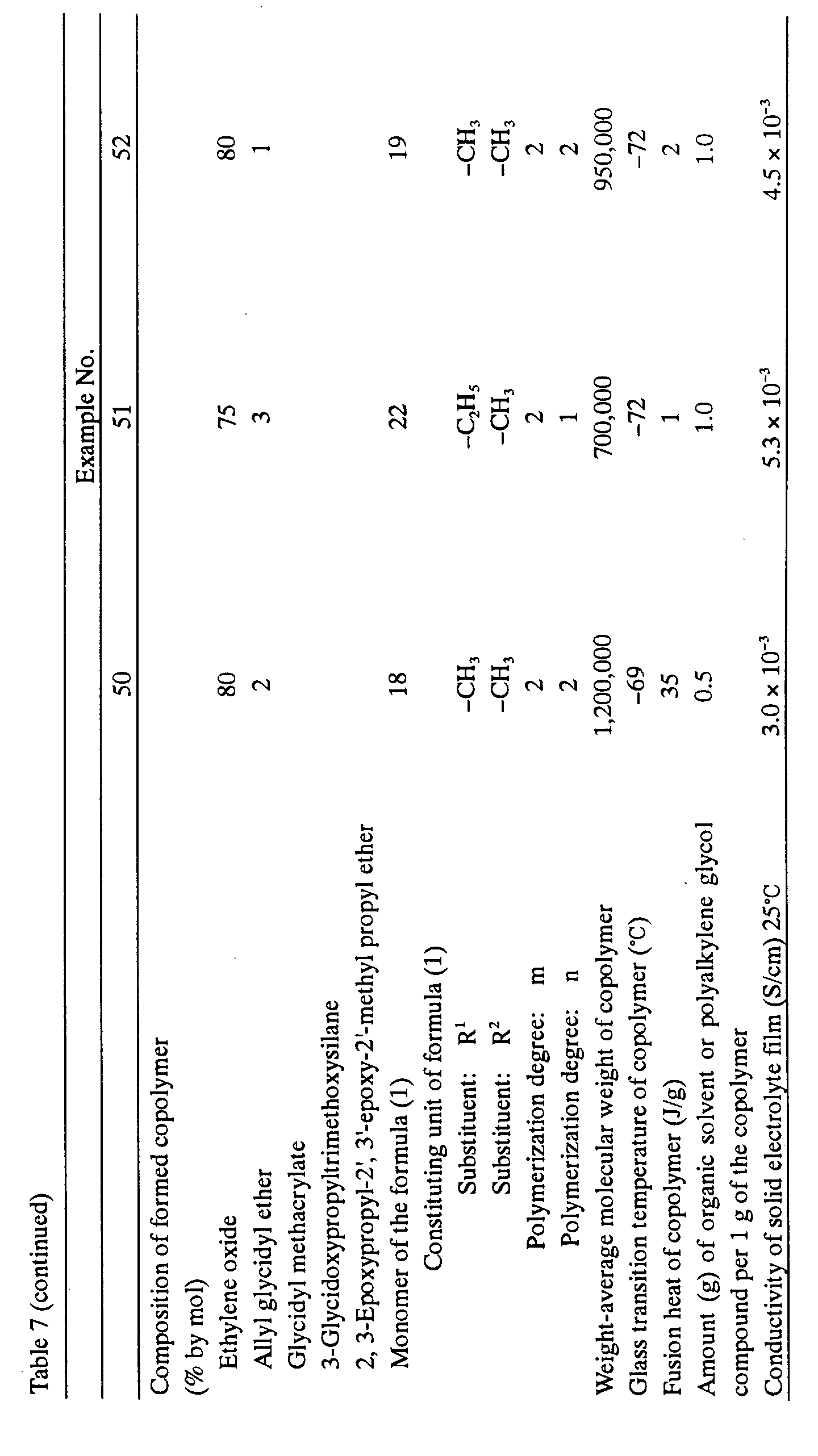
- the results of the composition analysis (in terms of monomer) of this polymer by 1 H NMR spectrum are as shown in Table 7.
- the resulting polyether copolymer (1 g) was mixed with a propylene carbonate solution (1 g) of lithium perchlorate so that a molar ratio of (the number of moles of the soluble electrolyte salt compound) to (the total number of moles of ether oxygen atoms of the copolymer) was 0.05.
- This mixed solution was casted on a mold made of polytetrafluoroethylene, heated and pressured at 100°C and 2 KgW/cm 2 for 10 minutes to obtain a film.
- the polyether copolymer (1 g) shown in Table 7 polymerized in the same manner as in Example 43 using the organotin-phosphate ester condensate catalyst, ethylene thiourea (a crosslinking agent) (0.015 g) and dibasic lead phthalate (0.05 g) were mixed with a propylene carbonate solution (0.8 g) of lithium perchlorate so that a molar ratio of (the number of moles of the electrolyte salt compound) to (the total number of moles of ether oxygen atoms of the copolymer) was 0.07.
- This mixed solution was casted on a mold made of polytetrafluoroethylene, dried, heated and pressured at 170°C and 60 KgW/cm 2 for 15 minutes to obtain a film.
- the polyether copolymer (1 g) shown in Table 7 polymerized in the same manner as in Example 43 using the organotin-phosphate ester condensate catalyst, and dicumyl peroxide (a crosslinking agent) (0.015 g) were mixed with a propylene carbonate solution (0.7 g) of lithium perchlorate so that a molar ratio of (the number of moles of the electrolyte salt compound) to (the total number of moles of ether oxygen atoms of the copolymer) was 0.05.
- This mixed solution was casted on a mold made of polytetrafluoroethylene, dried, heated and pressured at 160°C and 20 KgW/cm 2 for 10 minutes to obtain a gel-like film.
- the polyether copolymer (1 g) shown in Table 7 polymerized in the same manner as in Example 43 using the organotin-phosphate ester condensate catalyst, polyethylene glycol dimethyl ether (number-average molecular weight Mn: 1000) (0.3 g) and a crosslinking agent dicumyl peroxide (0.015 g) were dissolved in tetrahydrofuran (20 ml), and the resulting solution was mixed with a tetrahydrofuran solution (5 ml) of lithium perchlorate so that a molar ratio of (the number of moles of the electrolyte salt compound) to (the total number of ether oxygen atoms of the copolymer) was 0.05.
- This mixed solution was casted on a mold made of polytetrafluoroethylene, dried, heated and pressured at 160°C and 20 KgW/cm 2 for 10 minutes to obtain a film.
- the polyether copolymer (1 g) shown in Table 7 polymerized in the same manner as in Example 43 using the organotin-phosphate ester condensate catalyst, polyethylene glycol diethyl ether (Mn: 1000) (0.2 g) and dicumyl peroxide (a crosslinking agent) (0.015 g) were dissolved in tetrahydrofuran (20 ml), and the resulting solution was mixed with a tetrahydrofuran solution (5 ml) of lithium perchlorate so that a molar ratio of (the number of moles of the electrolyte salt compound) to (the total number of moles of ether oxygen atoms of the copolymer) was 0.05.
- This mixed solution was casted on a mold made of polytetrafluoroethylene, dried, heated and pressured at 160°C and 20 KgW/cm 2 for 10 minutes to obtain a film.
- This mixed solution was casted on a mold made of polytetrafluoroethylene, dried, heated and pressured at 160°C and 20 Kg
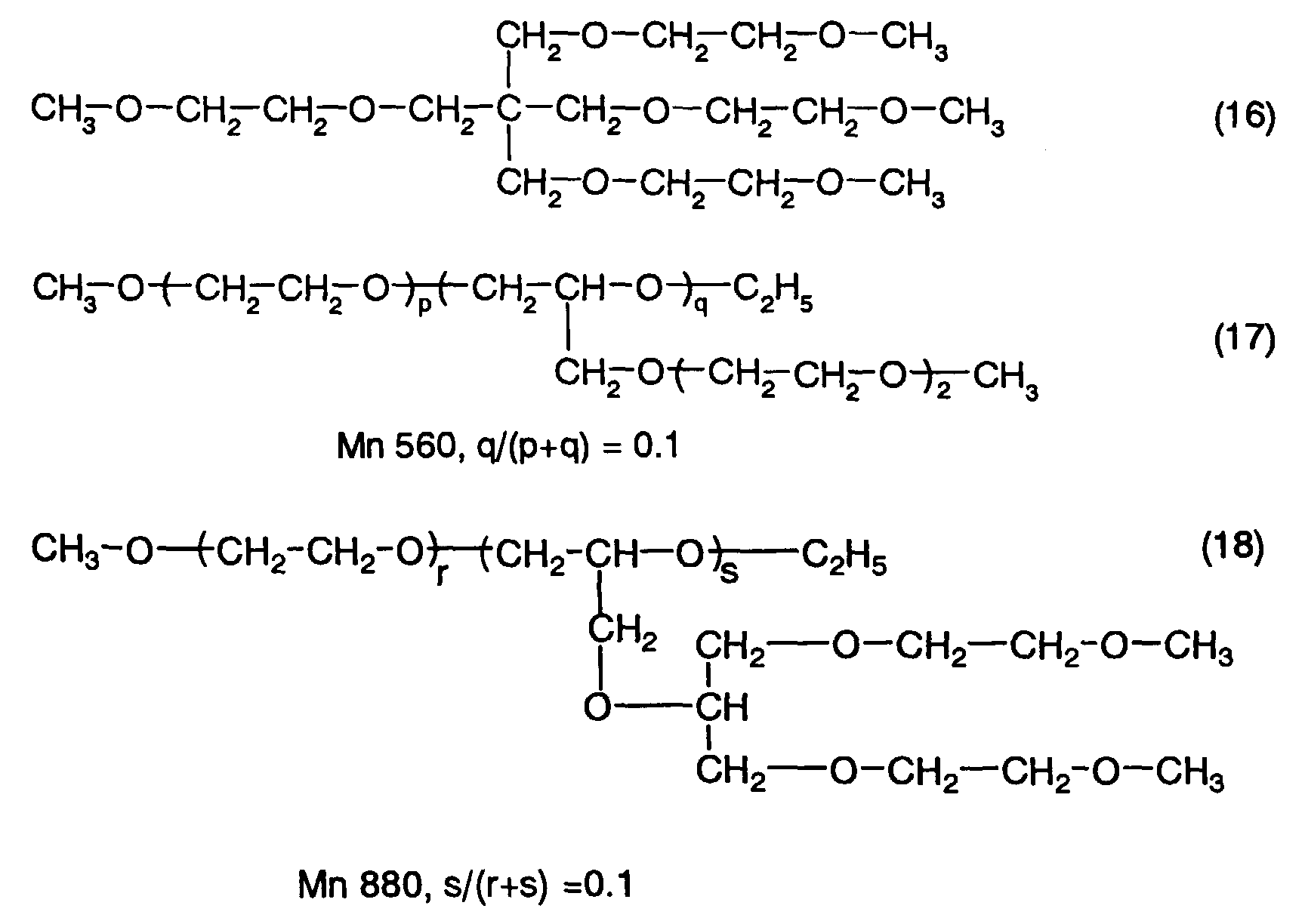
- a branched ethylene glycol derivative represented by the formula (16) in Example 50, by the formula (17) in Example 51, or by the formula (18) in Example 52 was mixed.
- This mixed solution was casted on a mold made of polytetrafluoroethylene, dried, heated and pressured at 160°C and 20 KgW/cm 2 for 10 minutes to obtain a film.
- Mn represents average molecular weight.
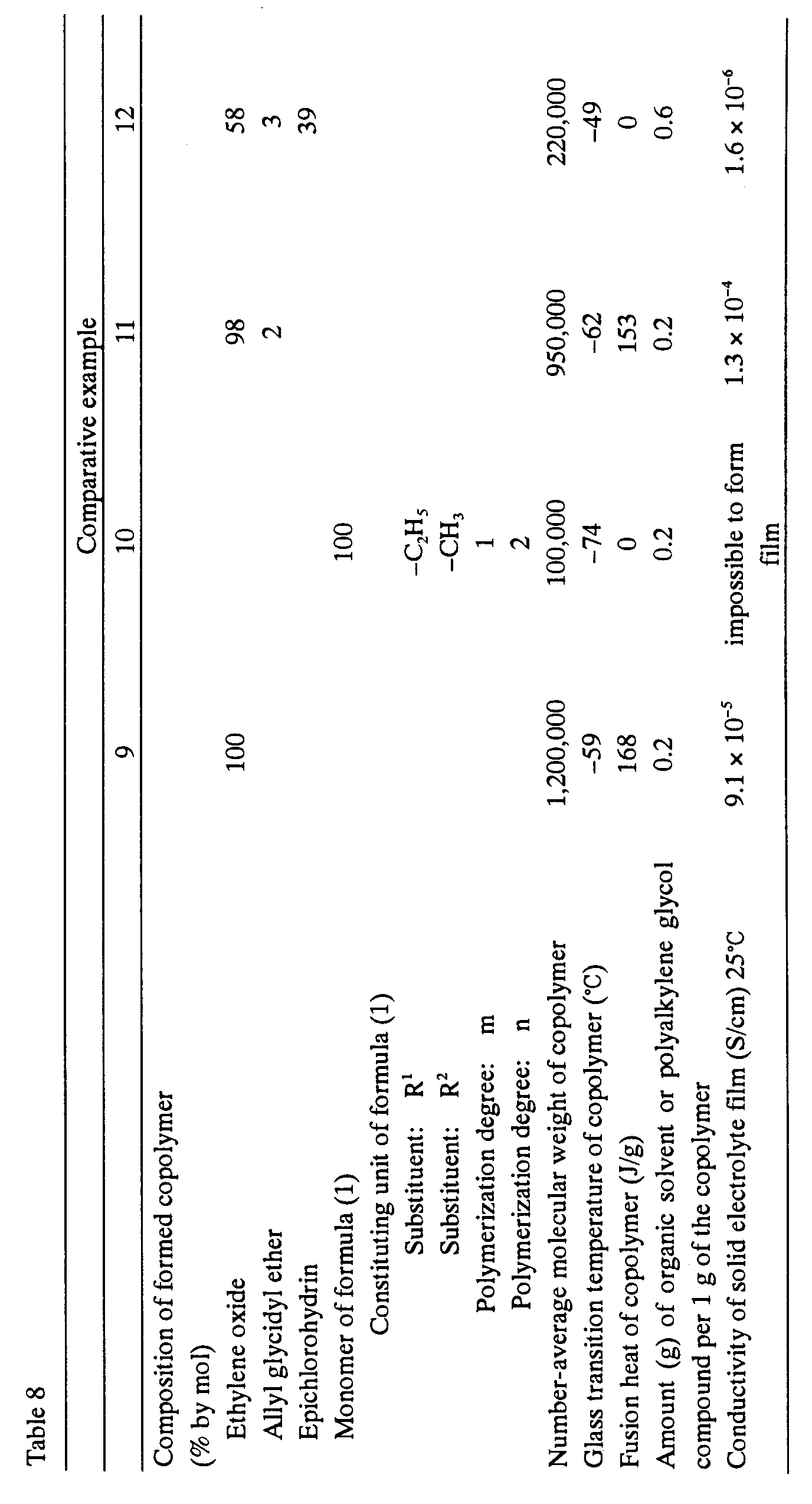
- the polyether copolymer (1 g) shown in Table 8 polymerized in the same manner as in Example 43 using the organotin-phosphate ester condensate catalyst and dicumyl peroxide (a crosslinking agent) (0.015 g) were dissolved in tetrahydrofuran (20 ml), and the resulting solution was mixed with a tetrahydrofuran solution of lithium perchlorate so that a molar ratio of (the number of moles of the electrolyte salt compound) to (the total number of moles of ether oxygen atoms of the copolymer) was 0.05.
- polyethylene glycol dimethyl ether (Mn: 1,000) (0.2 g) was dissolved in tetrahydrofuran (20 ml) and this solution was added. This mixed solution was casted on a mold made of polytetrafluoroethylene, dried so that tetrahydrofuran was thoroughly removed, heated and pressured at 160°C and 20 KgW/cm 2 for 10 minutes to obtain a film.
- a film was obtained in the same manner as in Example 45, except for using the polyether copolymer shown in Table 8 polymerized in the same manner as in Example 43 using the organotin-phosphate ester condensate catalyst.
- a lithium metal foil as a negative electrode and lithium cobaltate (LiCoO 2 ) as a positive electrode a secondary battery was constructed.
- the size of the solid polymer electrolyte was 10 mm ⁇ 10 mm ⁇ 0.2 mm.
- the size of the lithium foil was 10 mm ⁇ 10 mm ⁇ 0.1 mm.
- Lithium cobaltate was prepared by mixing predetermined amount of lithium carbonate and cobalt carbonate powder and calcining the mixture at 900°C for 5 hours.
- the calcined mixture was ground, and then 12 parts by weight of acetylene black and 3 parts by weight of the crosslinked solid polymer electrolyte obtained in Example 45 were added to 85 parts by weight of the resulting lithium cobaltate, followed by mixing by a roll and press-molding under the pressure of 300 KgW/cm 2 to form a positive electrode having the size of 10 mm ⁇ 10 mm ⁇ 2 mm.
- Example 45 The crosslinked solid polymer electrolyte obtained in Example 45 was sandwiched between the lithium metal foil and the lithium cobaltate plate, and the charge/discharge characteristics of the resulting battery were examined with applying the pressure of 10 KgW/cm 2 so that the interfaces were brought into contact with each other.
- the discharge current at the initial terminal voltage of 3.8 V was 0.1 mA/cm 2 and the charging could be conducted at 0.1 mA/cm 2 . It is possible to easily reduce the thickness of the battery in this Example and, therefore, a light-weight and large-capacity battery can be obtained.
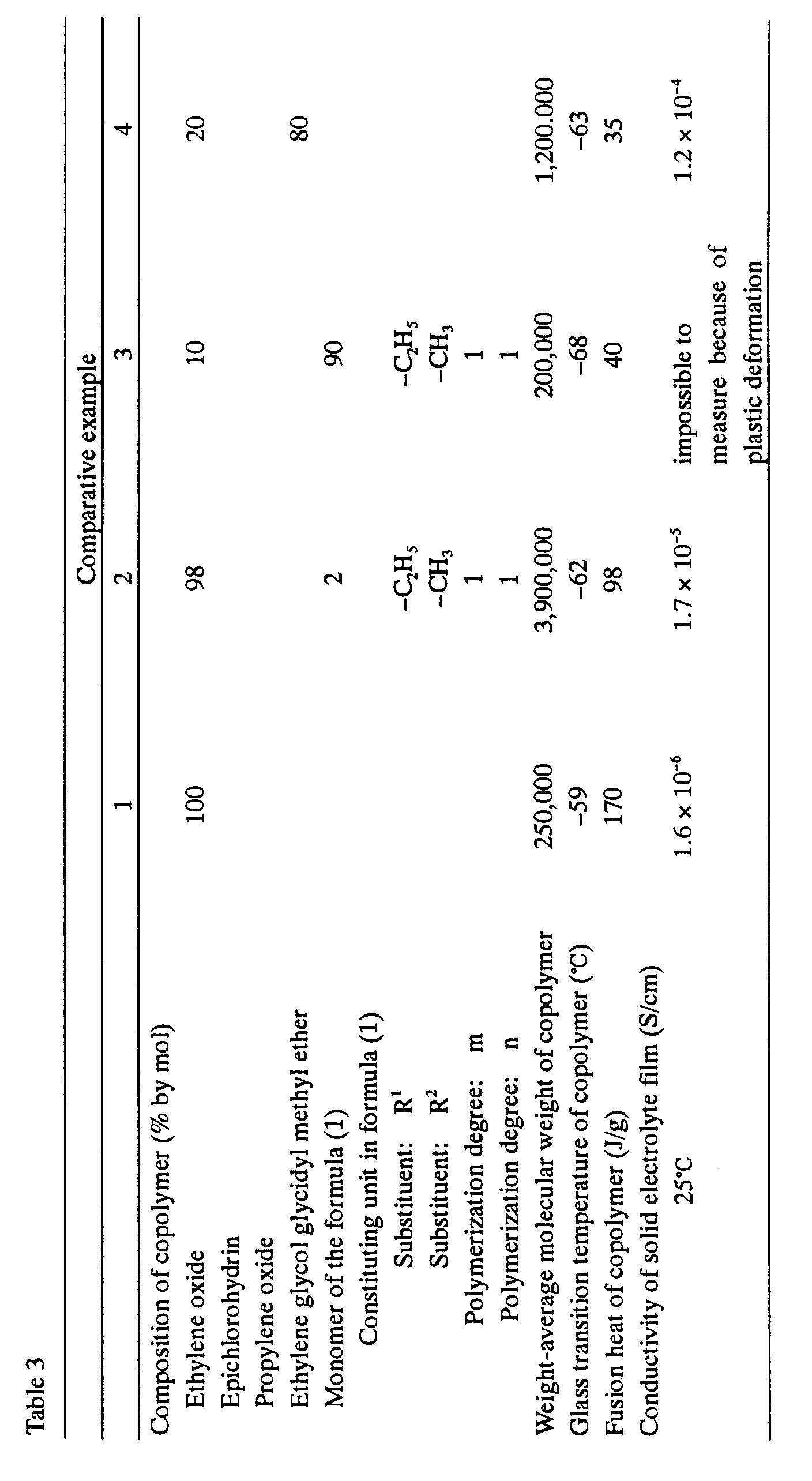
- a film was formed from the resulting copolymer in the same manner as that obtained in Example 13. At that time, a mol ratio of added LiTFSI was adjusted so that a molar ratio of (the number of moles of LiTFSI) to (the total number of moles of ether oxygen atoms of the copolymer) was 0.05.
- the conductivity of the solid electrolyte film was 1.1 ⁇ 10 -4 S/cm at 25°C.
- the solid polymer electrolyte of the present invention is superior in processability, moldability, mechanical strength, flexibility, heat resistance and the like, and the ionic conductivity is remarkably improved. Accordingly, an application to electronic apparatuses such as large-capacity condenser and display device (e.g. an electrochromic display) in addition to solid batteries (particularly secondary batteries), and an application to antistatic agent or antistatic material for rubber and plastic materials are expected.
- large-capacity condenser and display device e.g. an electrochromic display
- solid batteries particularly secondary batteries
- antistatic agent or antistatic material for rubber and plastic materials are expected.
Landscapes
- Chemical & Material Sciences (AREA)
- Chemical Kinetics & Catalysis (AREA)
- Health & Medical Sciences (AREA)
- Medicinal Chemistry (AREA)
- Polymers & Plastics (AREA)
- Organic Chemistry (AREA)
- Electrochemistry (AREA)
- Engineering & Computer Science (AREA)
- General Chemical & Material Sciences (AREA)
- Manufacturing & Machinery (AREA)
- Power Engineering (AREA)
- Inorganic Chemistry (AREA)
- Dispersion Chemistry (AREA)
- Condensed Matter Physics & Semiconductors (AREA)
- Physics & Mathematics (AREA)
- Emergency Medicine (AREA)
- Microelectronics & Electronic Packaging (AREA)
- General Physics & Mathematics (AREA)
- Secondary Cells (AREA)
- Compositions Of Macromolecular Compounds (AREA)
- Polyethers (AREA)
- Conductive Materials (AREA)
- Primary Cells (AREA)
- Epoxy Resins (AREA)
- Silicon Polymers (AREA)
Abstract
Description



(B) a repeating unit derived from a monomer (II):


or the formula (III-a-2):


wherein A1 and A2 represent hydrogen or a methyl group; Ph represents a phenylene group; and m represents a numeral of 0 to 12.



- δ : 2.2 to 2.3(2H, m, a), δ 2.9(1H, m, b), δ : 3.1(6H, s, c),
- δ :3.2 to 3.6(14H, m, d), δ : 3.7(1H, m, e)








Claims (35)
- A polyether copolymer having a weight-average molecular weight of 103 to 107, which is optionally crosslinked, comprising:(A) 0.5 to 99% by mol of a repeating unit derived from a monomer represented by the formula (I):wherein each of R1 and R2 represents a group selected from an alkyl group having 1 to 12 carbon atoms, an alkenyl group having 2 to 8 carbon atoms, a cycloalkyl group having 3 to 8 carbon atoms, an aryl group having 6 to 14 carbon atoms, an aralkyl group having 7 to 12 carbon atoms and a tetrahydropyranyl group; and each of m and n represents numeral of 1 to 12;
 (B) 99.5 to 1% by mol of a repeating unit derived from a monomer represented by the formula (II):; and
 (C) 0 to 15% by mol of a repeating unit derived from a monomer having one epoxy group and at least one reactive functional group.
 - The polyether copolymer according to claim 1, wherein the glass transition temperature measured by a differential scanning calorimeter (DSC) is not more than -60°C and the fusion heat is not more than 90 J/g.
- The polyether copolymer according to claim 1, wherein the reactive functional group in the repeating unit (C) is (a) a reactive silicon group, (b) an epoxy group, (c) an ethylenically unsaturated group or (d) a halogen atom.
- The polyether copolymer according to claim 1, wherein the repeating unit (C) is derived from a monomer of the formula (III-1) or (III-2):wherein R3 and R4 represent a group having a reactive functional group.
- The polyether copolymer according to claim 1, wherein the monomer having a reactive silicon group, which constitutes the repeating unit (C), is represented by the formula (III-a-1-1), (III-a-1-2) or (III-a-2-1):
 wherein R5, R6 and R7 may be the same or different, but at least one of them represents an alkoxy group and the remainder represent an alkyl group; and k represents 1 to 6.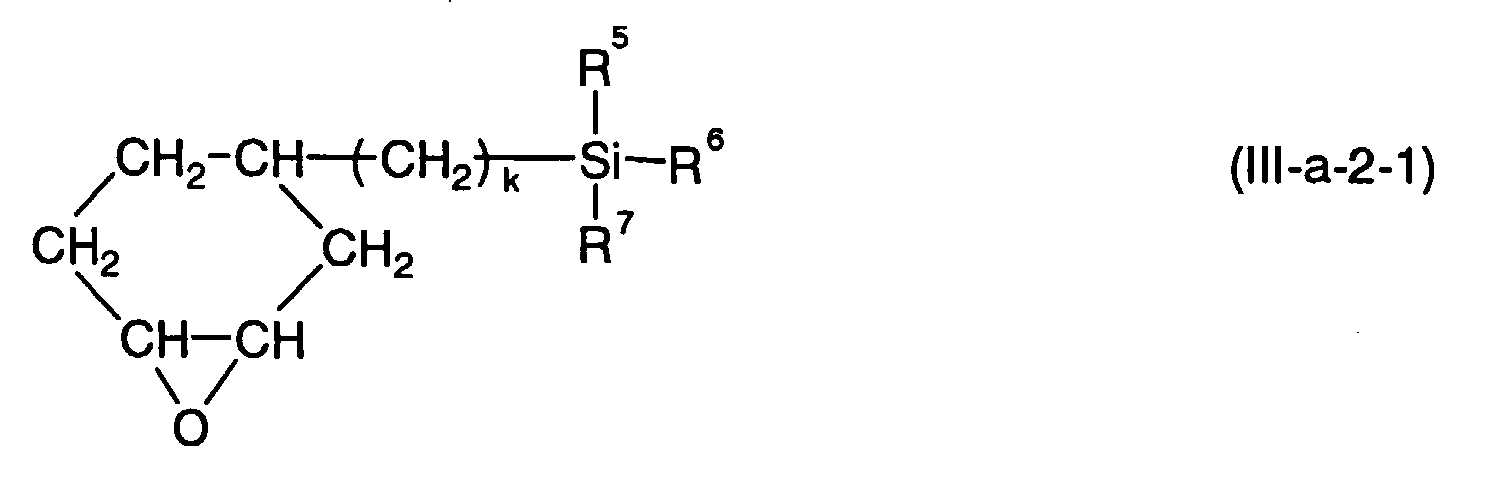
- The polyether copolymer according to claim 1, wherein the monomer having a reactive silicon group, which constitutes the repeating unit (C), is 3-glycidoxypropyltrimethoxysilane, 3-glycidoxypropylmethyldimethoxysilane, 4-(1, 2-epoxy)butyltrimethoxysilane, 5-(1, 2-epoxy)pentyltrimethoxysilane or 2-(3, 4-epoxycyclohexyl)ethyltrimethoxysilane.
- The polyether copolymer according to claim 1, wherein the monomer having two epoxy groups, which constitutes the repeating unit (C), is represented by the formula (III-b):wherein R7 is a divalent organic group.
- The polyether copolymer according to claim 7, wherein the group R7 in the formula (III-b) iswherein A1 and A2 represent hydrogen or a methyl group; Ph represents a phenylene group; and m represents a numeral of 0 to 12.-CH2-O-(CHA1-CHA2-O)m-CH2-,-(CH2)m-, or-CH2O-Ph-OCH2-
- The polyether copolymer according to claim 1, wherein the monomer having two epoxy groups, which constitutes the repeating unit (C), is 2, 3-epoxypropyl-2', 3'-epoxy-2'-methyl propyl ether or ethylene glycol-2, 3-epoxypropyl-2', 3'-epoxy-2'-methyl propyl ether.
- The polyether copolymer according to claim 1, wherein the monomer having an ethylenically unsaturated group, which constitutes the repeating unit (C), is represented by the formula (III-c):wherein R8 is a group having an ethylenically unsaturated group.

- The polyether copolymer according to claim 1, wherein the monomer having an ethylenically unsaturated group, which constitutes the repeating unit (C), is allyl glycidyl ether, 4-vinylcyclohexyl glycidyl ether, α-terpinyl glycidyl ether, cyclohexenylmethyl glycidyl ether, p-vinylbenzyl glycidyl ether, allylphenyl glycidyl ether, vinyl glycidyl ether, 3, 4-epoxy-1-butene, 3, 4-epoxy-1-pentene, 4,5-epoxy-2-pentene, 1, 2-epoxy-5, 9-cyclododecadiene, 3, 4-epoxy-1-vinylcyclohexene, 1, 2-epoxy-5-cyclooctene, glycidyl acrylate, glycidyl methacrylate, glycidyl sorbate, glycidyl cinnamate, glycidyl crotonate, glycidyl-4-hexenoate, oligoethylene glycol glycidyl ether acrylate having 1 to 12 oxyethylene chains, oligoethylene glycol glycidyl ether methacrylate having 1 to 12 oxyethylene chains, oligoethylene glycol allyl glycidyl ether having 1 to 12 oxyethylene chains or(n=1 to 12).

- The polyether copolymer according to claim 1, wherein the monomer having a halogen atom, which constitutes the repeating unit (C), is represented by the formula (III-d):wherein R9 is a group having at least one halogen atom.

- The polyether copolymer according to claim 1, wherein the monomer having a halogen atom iswherein X represents a bromine atom (Br) or an iodine atom (I).
- The polyether copolymer according to claim 1, wherein the polyether copolymer comprises 10 to 95% by mol of the repeating unit (A), 90 to 5% by mol of the repeating unit (B) and 0 to 10% by mol of the repeating unit (C).
- A solid polymer electrolyte comprising:(1) the polyether copolymer of claim 1;(2) an electrolyte salt compound; and(3) if necessary, a plasticizer selected from the group consisting of an aprotic organic solvent, and a derivative or a metal salt of a linear or branched polyalkylene glycol having a number-average molecular weight of 200 to 5,000 or a metal salt of the derivative.
- The solid polymer electrolyte according to claim 15, wherein the electrolyte salt compound (2) is a compound comprising a cation selected from a metal cation, an ammonium ion, an amidinium ion and a guanidium ion, and an anion selected from a chloride ion, a bromide ion, a iodide ion, a perchlorate ion, a thiocyanate ion, a tetrafluoroborate ion, a nitrate ion, AsF6 -, PF6 -, a stearylsulfonate ion, an octylsulfonate ion, a dodecylbenzenesulfonate ion, a naphthalenesufonate ion, a dodecylnaphthalenesulfonate ion, a 7, 7, 8, 8-tetracyano-p-quinodimethane ion, X1SO3 -, [(X1SO2)(X2SO2)N]-, [(X1SO2)(X2SO2)(X3SO2)C]- and [(X1SO2)(X2SO2)YC]- (wherein X1, X2, X3 and Y respectively represent an electron attractive group).
- The solid polymer electrolyte according to claim 16, wherein X1, X2 and X3 independently represent a perfluoroalkyl or perfluoroaryl group having 1 to 6 carbon atoms and Y represents a nitro group, a nitroso group, a carbonyl group, a carboxyl group or a cyano group.
- The solid polymer electrolyte according to claim 16, wherein the metal cation is a cation of a metal selected from Li, Na, K, Rb, Cs, Mg, Ca and Ba.
- The solid polymer electrolyte according to claim 16, wherein the metal cation is a cation of a transition metal.
- The solid polymer electrolyte according to claim 16, wherein the metal cation is a cation of a metal selected from Mn, Fe, Co, Ni, Cu, Zn and Ag.
- The solid polymer electrolyte according to claim 15, wherein the formulation ratio of the electrolyte salt compound to the polyether copolymer is so that a value of a molar ratio of the number of moles of the electrolyte salt compound to the total number of moles of oxyethylene units in the copolymer is from 0.0001 to 5.
- The solid polymer electrolyte according to claim 15, wherein the aprotic organic solvent is an aprotic organic solvent selected from ethers or esters.
- The solid polymer electrolyte according to claim 15, wherein the aprotic organic solvent is an organic solvent selected from propylene carbonate, γ-butyrolactone, butylene carbonate and 3-methyl-2-oxazolidone.
- The solid polymer electrolyte according to claim 15, wherein the aprotic organic solvent is an organic solvent selected from triethylene glycol dimethyl ether, triethylene glycol diethyl ether, tetraethylene glycol dimethyl ether and tetraethylene glycol diethyl ether.
- The solid polymer electrolyte according to claim 15, wherein the number-average molecular weight of the polyalkylene glycol is from 200 to 2,000.
- The solid polymer electrolyte according to claim 15, wherein the polyalkylene glycol is polyethylene glycol or polypropylene glycol.
- The solid polymer electrolyte according to claim 15, wherein the derivative of the polyalkylene glycol is an ether derivative or an ester derivative.
- The solid polymer electrolyte according to claim 27, wherein the ether derivative of the polyalkylene glycol is any one of polyethylene glycol dimethyl ether, polyethylene glycol diethyl ether and polyethylene glycol diallyl ether.
- The solid polymer electrolyte according to claim 27, wherein the ester derivative of the polyalkylene glycol is any one of polyethylene glycol dimethacrylate ester, polyethylene glycol diacrylate ester and polyethylene glycol diacetate ester.
- The solid polymer electrolyte according to claim 15, wherein the metal salt of the polyalkylene glycol is any one of a sodium salt, a lithium salt and a dialkylaluminum salt.
- The solid polymer electrolyte according to claim 15, wherein the metal salt of the polyalkylene glycol is any one of a lithium salt of polyethylene glycol and a dialkylaluminum salt of polyethylene glycol.
- The solid polymer electrolyte according to claim 15, wherein the metal salt of the polyalkylene glycol derivative is any one of a lithium salt of polyethylene glycol monomethyl ether, a lithium salt of polyethylene glycol monoethyl ether and a lithium salt of polyethylene glycol monoallyl ether.
- The solid polymer electrolyte according to claim 15, wherein the metal salt of the polyalkylene glycol derivative is any one of a dioctylaluminum salt of polyethylene glycol monomethyl ether, a dioctylaluminum salt of polyethylene glycol monoethyl ether and a dioctylaluminum salt of polyethylene glycol monoallyl ether.
- The solid polymer electrolyte according to claim 15, wherein the amount of the plasticizer is from 1 to 2,000 parts by weight based on 100 parts by weight of the polyether copolymer.
- A battery comprising the solid polymer electrolyte of claim 1, a positive electrode and a negative electrode.
Applications Claiming Priority (7)
| Application Number | Priority Date | Filing Date | Title |
|---|---|---|---|
| JP32842296 | 1996-12-09 | ||
| JP32842296 | 1996-12-09 | ||
| JP328422/96 | 1996-12-09 | ||
| JP345244/96 | 1996-12-25 | ||
| JP34524496 | 1996-12-25 | ||
| JP34524496 | 1996-12-25 | ||
| PCT/JP1997/004499 WO1998025990A1 (en) | 1996-12-09 | 1997-12-08 | Copolyether and solid polymer electrolyte |
Publications (3)
| Publication Number | Publication Date |
|---|---|
| EP0885913A1 true EP0885913A1 (en) | 1998-12-23 |
| EP0885913A4 EP0885913A4 (en) | 2000-03-22 |
| EP0885913B1 EP0885913B1 (en) | 2003-04-16 |
Family
ID=26572871
Family Applications (1)
| Application Number | Title | Priority Date | Filing Date |
|---|---|---|---|
| EP97946152A Expired - Lifetime EP0885913B1 (en) | 1996-12-09 | 1997-12-08 | Copolyether and solid polymer electrolyte |
Country Status (9)
| Country | Link |
|---|---|
| US (1) | US6180287B1 (en) |
| EP (1) | EP0885913B1 (en) |
| JP (1) | JP3223978B2 (en) |
| KR (1) | KR100538680B1 (en) |
| CN (1) | CN1094494C (en) |
| CA (1) | CA2244904C (en) |
| DE (1) | DE69720980T2 (en) |
| TW (1) | TW444044B (en) |
| WO (1) | WO1998025990A1 (en) |
Cited By (10)
| Publication number | Priority date | Publication date | Assignee | Title |
|---|---|---|---|---|
| EP1057846A4 (en) * | 1998-12-17 | 2001-12-12 | Nisshin Spinning | ION-CONDUCTING POLYMER ELECTROLYTE |
| EP1057869A4 (en) * | 1998-12-17 | 2001-12-19 | Nisshin Spinning | ION-CONDUCTING POLYMER ELECTROLYT |
| US6677084B1 (en) | 1999-04-19 | 2004-01-13 | Daiso Co., Ltd. | Solid crosslinked-polymer electrolyte and use thereof |
| EP1385176A1 (en) * | 2002-07-22 | 2004-01-28 | Sumitomo Rubber Industries, Ltd. | Conductive elastomer composition and method of producing same |
| EP1507268A4 (en) * | 2002-04-26 | 2005-11-23 | Zeon Corp | Molding material for high-molecular solid electrolytes, moldings of high-molecular solid electrolytes and process for production threof, and polyether polymer and process for production thereof |
| WO2008075906A1 (en) * | 2006-12-21 | 2008-06-26 | Postech Academy-Industry Foundation | Brush-type polyether-based polymer and chemical sensor comprising same |
| CN103165936A (en) * | 2011-12-17 | 2013-06-19 | 清华大学 | Fixed electrolyte and lithium-based battery using the same |
| CN103682427A (en) * | 2012-09-13 | 2014-03-26 | 微宏动力系统(湖州)有限公司 | Organosilicone polymer, solid electrolyte of organosilicone polymer and solid lithium ion battery |
| EP2840087A1 (en) | 2013-08-23 | 2015-02-25 | Evonik Degussa GmbH | Compounds containing semi-organic silicon groups with guanidine groups |
| CN108841353A (en) * | 2018-07-03 | 2018-11-20 | 烟台德邦科技有限公司 | A kind of large size chip encapsulation preparation method of underfill |
Families Citing this family (44)
| Publication number | Priority date | Publication date | Assignee | Title |
|---|---|---|---|---|
| US6849702B2 (en) | 1999-02-26 | 2005-02-01 | Robert W. Callahan | Polymer matrix material |
| US6605391B2 (en) * | 1999-02-26 | 2003-08-12 | Reveo, Inc. | Solid gel membrane |
| US20020012848A1 (en) * | 1999-02-26 | 2002-01-31 | Callahan Robert W. | Electrochemical cell incorporating polymer matrix material |
| US6358651B1 (en) * | 1999-02-26 | 2002-03-19 | Reveo, Inc. | Solid gel membrane separator in rechargeable electrochemical cells |
| JP2000285929A (en) * | 1999-03-31 | 2000-10-13 | Sony Corp | Solid electrolyte battery |
| US6447952B1 (en) * | 1999-06-07 | 2002-09-10 | Eltron Research, Inc. | Polymer electrolytes |
| JP2002025559A (en) | 2000-07-03 | 2002-01-25 | Sony Corp | Battery |
| JP3607862B2 (en) * | 2000-09-29 | 2005-01-05 | 株式会社日立製作所 | Fuel cell |
| JP3858594B2 (en) * | 2001-01-05 | 2006-12-13 | セイコーエプソン株式会社 | Liquid crystal panel contrast ranking system and method |
| JP4904553B2 (en) * | 2001-04-09 | 2012-03-28 | パイオトレック株式会社 | Lithium ion secondary battery using polymer electrolyte |
| US6727343B2 (en) * | 2001-04-17 | 2004-04-27 | Phoenix Innovation, Inc. | Heteroatomic polymer for more efficient solid polymer electrolytes for lithium batteries |
| US20040241551A1 (en) * | 2001-09-21 | 2004-12-02 | Seiji Nakamura | Element using polymer gel electrolyte |
| EP1446438A2 (en) * | 2001-11-07 | 2004-08-18 | Nektar Therapeutics Al, Corporation | Branched polymers and their conjugates |
| EP1571175B1 (en) * | 2002-11-29 | 2015-08-12 | Zeon Corporation | Process for producing polyether polymer composition, polyether polymer composition, and solid electrolyte film |
| CN100341197C (en) * | 2003-01-09 | 2007-10-03 | 三星Sdi株式会社 | Electrolyte for rechargeable lithium battery and rechargeable lithium battery comprising same |
| KR20060002984A (en) * | 2003-04-15 | 2006-01-09 | 다이소 가부시키가이샤 | Electrolyte Compositions and Cells |
| US8232324B2 (en) * | 2005-02-28 | 2012-07-31 | Shin-Etsu Chemical Co., Ltd. | Electrolyte membrane-forming curable resin composition, and preparation of electrolyte membrane and electrolyte membrane/electrode assembly |
| JP2007063175A (en) * | 2005-08-31 | 2007-03-15 | Nagoya City | Oligoethylene oxide derivative and method for producing oligoethylene oxide derivative |
| JP4512949B2 (en) * | 2005-08-31 | 2010-07-28 | 日立マクセル株式会社 | Non-aqueous electrolyte and non-aqueous electrolyte secondary battery |
| JP2010513594A (en) * | 2006-12-15 | 2010-04-30 | キンバリー クラーク ワールドワイド インコーポレイテッド | Biodegradable polyester used for fiber formation |
| WO2008073101A1 (en) * | 2006-12-15 | 2008-06-19 | Kimberly-Clark Worldwide, Inc. | Biodegradable polylactic acids for use in forming fibers |
| WO2008102699A1 (en) * | 2007-02-21 | 2008-08-28 | Nippon Shokubai Co., Ltd. | Ethylene oxide copolymer, polymer composition and lithium secondary battery |
| KR101422317B1 (en) * | 2007-08-22 | 2014-07-30 | 킴벌리-클라크 월드와이드, 인크. | Multicomponent biodegradable filaments and nonwoven webs formed therefrom |
| EP2220277A2 (en) * | 2007-12-13 | 2010-08-25 | Kimberly-Clark Worldwide, Inc. | Biodegradable fibers formed from a thermoplastic composition containing polylactic acid and a polyether copolymer |
| US20090214863A1 (en) * | 2008-02-22 | 2009-08-27 | Chevron Phillips Chemical Company Lp | Polyphenylene Sulfide Coatings |
| KR100934125B1 (en) * | 2008-02-27 | 2009-12-29 | 포항공과대학교 산학협력단 | Brush polymer compound, preparation method thereof and chemical sensor device using same |
| WO2009145778A1 (en) * | 2008-05-30 | 2009-12-03 | Kimberly-Clark Worldwide, Inc. | Polylactic acid fibers |
| WO2011099497A1 (en) * | 2010-02-10 | 2011-08-18 | 国立大学法人三重大学 | Solid electrolyte composition, solid electrolyte, lithium ion secondary battery, and method for producing lithium ion secondary battery |
| US8461262B2 (en) | 2010-12-07 | 2013-06-11 | Kimberly-Clark Worldwide, Inc. | Polylactic acid fibers |
| WO2012083253A1 (en) * | 2010-12-16 | 2012-06-21 | The Regents Of The University Of California | Polymer electrolytes based on poly(glycidyl ether)s |
| CN103159889B (en) * | 2011-12-17 | 2015-11-25 | 清华大学 | Interpenetrating net polymer and preparation method thereof |
| CA2863274A1 (en) * | 2012-01-10 | 2013-07-18 | Momentive Performance Materials, Inc. | Silicone epoxy ether compositions, methods for making same and uses therefor |
| US20140097388A1 (en) | 2012-10-04 | 2014-04-10 | Zeon Chemicals L.P. | Production method of rubber composition |
| US20160006075A1 (en) * | 2013-02-27 | 2016-01-07 | Daiso Co., Ltd. | Positive electrode and nonaqueous electrolyte secondary battery |
| CN103165938B (en) * | 2013-02-28 | 2015-07-08 | 上海交通大学 | Cross-linked polymer gel electrolyte membrane supported by hydrophilic polytetrafluoroethylene microporous membrane |
| WO2014157045A1 (en) | 2013-03-27 | 2014-10-02 | 日本ゼオン株式会社 | Crosslinkable rubber composition for conductive rolls, rubber crosslinked material for conductive rolls, and conductive roll |
| WO2015099027A1 (en) | 2013-12-26 | 2015-07-02 | 日本ゼオン株式会社 | Method for producing polyether rubber |
| US9437899B2 (en) | 2014-02-10 | 2016-09-06 | Battelle Memorial Institute | Solid-state rechargeable magnesium battery |
| WO2016159083A1 (en) * | 2015-03-31 | 2016-10-06 | 株式会社大阪ソーダ | Electrochemical capacitor |
| TWI570989B (en) | 2015-08-21 | 2017-02-11 | 財團法人工業技術研究院 | Electrolyte composition, and sodium secondary battery |
| WO2017094712A1 (en) * | 2015-11-30 | 2017-06-08 | 日本電気株式会社 | Lithium ion secondary battery |
| CN107069083B (en) * | 2017-03-13 | 2020-02-21 | 湖北大学 | A kind of solid polymer electrolyte membrane material with continuous ion transfer nanochannel and preparation method thereof |
| KR102320015B1 (en) | 2017-09-12 | 2021-11-02 | 주식회사 엘지에너지솔루션 | Polymer electrolyte for secondary battery and lithium secondary battery comprising the same |
| WO2019054677A2 (en) | 2017-09-12 | 2019-03-21 | 주식회사 엘지화학 | Polymer electrolyte for secondary battery and lithium secondary battery comprising same |
Family Cites Families (24)
| Publication number | Priority date | Publication date | Assignee | Title |
|---|---|---|---|---|
| US3297783A (en) | 1962-11-16 | 1967-01-10 | Union Carbide Corp | Vinyl halide resin plasticized with a linear copolymer of a diepoxide with a 1, 2-alkylene oxide |
| US4059474A (en) * | 1976-05-10 | 1977-11-22 | Molins Machine Company Inc. | Glue mechanism |
| FR2442512A1 (en) | 1978-11-22 | 1980-06-20 | Anvar | NEW ELASTOMERIC MATERIALS WITH ION CONDUCTION |
| US4578326A (en) | 1983-03-11 | 1986-03-25 | Societe Nationale Elf Aquitaine | Novel macromolecular material for use in realizing electrolytes and/or electrodes |
| US4758483A (en) | 1983-03-11 | 1988-07-19 | Societe Nationale Elf Aquitaine | Novel macromolecular material for use in realizing electrolytes and/or electrodes |
| FR2570224B1 (en) | 1984-09-11 | 1987-03-20 | Elf Aquitaine | SOLID POLYMER ELECTROLYTE CONSISTING OF A CROSSLINKED COPOLYMER |
| US4711950A (en) | 1985-11-05 | 1987-12-08 | Osaka Soda Co., Ltd. | Polyether polymer or copolymer, monomer therefor, and process for production thereof |
| JPH0826144B2 (en) | 1986-01-20 | 1996-03-13 | ダイソー株式会社 | Method for producing polyether copolymer having epoxy group in side chain |
| JPS62249361A (en) | 1986-04-21 | 1987-10-30 | Yuasa Battery Co Ltd | Organic solid electrolyte |
| EP0260847A1 (en) | 1986-09-19 | 1988-03-23 | Imperial Chemical Industries Plc | Solid electrolytes |
| FR2606218A1 (en) | 1986-10-30 | 1988-05-06 | Elf Aquitaine | NEW IONIC CONDUCTION MATERIAL |
| JPH0768336B2 (en) | 1986-12-18 | 1995-07-26 | ダイソー株式会社 | Process for producing polyether copolymer having oligooxyethylene side chain |
| GB8804860D0 (en) | 1988-03-01 | 1988-03-30 | Ici Plc | Solid electrolyte devices |
| JP2757004B2 (en) | 1989-03-08 | 1998-05-25 | ダイソー株式会社 | Ion conductive solid electrolyte |
| JP2762145B2 (en) | 1989-04-13 | 1998-06-04 | 第一工業製薬株式会社 | Ion conductive polymer electrolyte |
| US5116541A (en) | 1989-04-13 | 1992-05-26 | Dai-Ichi Kogyo Seiyaku Co., Ltd. | Ion-conductive polymer electrolyte |
| JPH02295004A (en) * | 1989-05-09 | 1990-12-05 | Hitachi Maxell Ltd | Lithium ion conductive polymer electrolyte |
| IT1236512B (en) | 1989-10-06 | 1993-03-11 | Eniricerche Spa | POLYEPOXIDE BASED SOLID POLYMER ELECTROLYTE. |
| JP2923542B2 (en) | 1990-07-06 | 1999-07-26 | 第一工業製薬株式会社 | Ion conductive polymer electrolyte |
| US5268243A (en) | 1992-01-27 | 1993-12-07 | Dai-Ichi Kogyo Seiyaku Co., Ltd. | Galvanic cell |
| JP3258366B2 (en) | 1992-04-28 | 2002-02-18 | 株式会社ユアサコーポレーション | Electric double layer capacitor |
| CA2175950C (en) | 1995-05-08 | 2008-12-02 | Shinzo Kohjiya | Polymer solid electrolyte |
| JP3047833B2 (en) * | 1996-10-11 | 2000-06-05 | 日本電気株式会社 | Hexavalent chromium treatment method |
| DE69722890T2 (en) * | 1996-10-28 | 2004-05-13 | Daiso Co., Ltd. | Polyether copolymer and solid polymer electrolyte |
-
1997
- 1997-12-08 TW TW086118417A patent/TW444044B/en not_active IP Right Cessation
- 1997-12-08 KR KR1019980706110A patent/KR100538680B1/en not_active Expired - Fee Related
- 1997-12-08 JP JP52648398A patent/JP3223978B2/en not_active Expired - Fee Related
- 1997-12-08 WO PCT/JP1997/004499 patent/WO1998025990A1/en not_active Ceased
- 1997-12-08 CA CA002244904A patent/CA2244904C/en not_active Expired - Fee Related
- 1997-12-08 US US09/101,971 patent/US6180287B1/en not_active Expired - Fee Related
- 1997-12-08 CN CN97192119A patent/CN1094494C/en not_active Expired - Fee Related
- 1997-12-08 DE DE69720980T patent/DE69720980T2/en not_active Expired - Fee Related
- 1997-12-08 EP EP97946152A patent/EP0885913B1/en not_active Expired - Lifetime
Cited By (21)
| Publication number | Priority date | Publication date | Assignee | Title |
|---|---|---|---|---|
| EP1057869A4 (en) * | 1998-12-17 | 2001-12-19 | Nisshin Spinning | ION-CONDUCTING POLYMER ELECTROLYT |
| US6469107B1 (en) | 1998-12-17 | 2002-10-22 | Nissihinbo Industries, Inc. | Ion-conductive polymer electrolyte composition of polyglycidol |
| US6472106B1 (en) | 1998-12-17 | 2002-10-29 | Nisshinbo Industries Inc. | Polymeric compound, polymer for polyelectrolyte, and composition for ionically conductive polyelectrolyte |
| EP1057846A4 (en) * | 1998-12-17 | 2001-12-12 | Nisshin Spinning | ION-CONDUCTING POLYMER ELECTROLYTE |
| US6677084B1 (en) | 1999-04-19 | 2004-01-13 | Daiso Co., Ltd. | Solid crosslinked-polymer electrolyte and use thereof |
| EP1507268A4 (en) * | 2002-04-26 | 2005-11-23 | Zeon Corp | Molding material for high-molecular solid electrolytes, moldings of high-molecular solid electrolytes and process for production threof, and polyether polymer and process for production thereof |
| EP1878759A1 (en) * | 2002-04-26 | 2008-01-16 | Zeon Corporation | Polyether polymer and process for producing same |
| US7915378B2 (en) | 2002-04-26 | 2011-03-29 | Hideyuki Nishio | Material for solid polymer electrolyte, and polyether polymer and process for producing same |
| CN1475865B (en) * | 2002-07-22 | 2012-11-28 | 住友橡胶工业株式会社 | Conductive elastomer composition and its mfg. method |
| EP1385176A1 (en) * | 2002-07-22 | 2004-01-28 | Sumitomo Rubber Industries, Ltd. | Conductive elastomer composition and method of producing same |
| CN1475865A (en) * | 2002-07-22 | 2004-02-18 | ס��� �ҵ��ʽ���� | Conductive elastomer composition and its mfg. method |
| US7141183B2 (en) | 2002-07-22 | 2006-11-28 | Sumitomo Rubber Industries, Ltd. | Conductive elastomer composition and method of producing same |
| WO2008075906A1 (en) * | 2006-12-21 | 2008-06-26 | Postech Academy-Industry Foundation | Brush-type polyether-based polymer and chemical sensor comprising same |
| CN103165936A (en) * | 2011-12-17 | 2013-06-19 | 清华大学 | Fixed electrolyte and lithium-based battery using the same |
| CN103165936B (en) * | 2011-12-17 | 2015-07-29 | 清华大学 | Solid electrolyte and use the lithium-base battery of this solid electrolyte |
| CN103682427A (en) * | 2012-09-13 | 2014-03-26 | 微宏动力系统(湖州)有限公司 | Organosilicone polymer, solid electrolyte of organosilicone polymer and solid lithium ion battery |
| CN103682427B (en) * | 2012-09-13 | 2016-01-20 | 微宏动力系统(湖州)有限公司 | Organosilicon polymer and solid electrolyte thereof and solid lithium ion battery |
| EP2840087A1 (en) | 2013-08-23 | 2015-02-25 | Evonik Degussa GmbH | Compounds containing semi-organic silicon groups with guanidine groups |
| DE102013216787A1 (en) | 2013-08-23 | 2015-02-26 | Evonik Degussa Gmbh | Guanidinruppen containing semi-organic silicon group-containing compounds |
| US9353225B2 (en) | 2013-08-23 | 2016-05-31 | Evonik Degussa Gmbh | Compounds having guanidine groups and containing semi-organic silicon groups |
| CN108841353A (en) * | 2018-07-03 | 2018-11-20 | 烟台德邦科技有限公司 | A kind of large size chip encapsulation preparation method of underfill |
Also Published As
| Publication number | Publication date |
|---|---|
| CA2244904C (en) | 2006-11-28 |
| CA2244904A1 (en) | 1998-06-18 |
| DE69720980D1 (en) | 2003-05-22 |
| EP0885913B1 (en) | 2003-04-16 |
| WO1998025990A1 (en) | 1998-06-18 |
| CN1210548A (en) | 1999-03-10 |
| EP0885913A4 (en) | 2000-03-22 |
| US6180287B1 (en) | 2001-01-30 |
| KR19990082380A (en) | 1999-11-25 |
| TW444044B (en) | 2001-07-01 |
| CN1094494C (en) | 2002-11-20 |
| JP3223978B2 (en) | 2001-10-29 |
| KR100538680B1 (en) | 2006-02-28 |
| DE69720980T2 (en) | 2004-02-12 |
Similar Documents
| Publication | Publication Date | Title |
|---|---|---|
| EP0885913B1 (en) | Copolyether and solid polymer electrolyte | |
| EP0856538B1 (en) | Solid polyelectrolyte | |
| EP0897941B1 (en) | Cross-linked solid polyelectrolyte and use thereof | |
| US5968681A (en) | Polyether copolymer and polymer solid electrolyte | |
| EP0945476B1 (en) | Crosslinked solid polyether copolymer electrolyte | |
| EP0994143B1 (en) | Solid polymer electrolyte and use thereof | |
| JPWO1998025990A1 (en) | Polyether copolymers and polymer solid electrolytes | |
| US6858351B2 (en) | Polyethylene oxide-based electrolyte containing silicon compound | |
| JPWO1997042251A1 (en) | Crosslinked polymer solid electrolyte and its uses | |
| JP4089221B2 (en) | Polymer solid electrolyte and battery | |
| JPWO1998007772A1 (en) | Polymer solid electrolyte | |
| US6201071B1 (en) | Polyether copolymer, solid polymer electrolyte and battery | |
| JPWO1998058983A1 (en) | Polyether copolymer, polymer solid electrolyte and battery | |
| JP3282565B2 (en) | Crosslinked polymer solid electrolyte and its use | |
| JP4640172B2 (en) | Electrolyte composition and battery | |
| JP4269648B2 (en) | Electrolyte composition and battery |
Legal Events
| Date | Code | Title | Description |
|---|---|---|---|
| PUAI | Public reference made under article 153(3) epc to a published international application that has entered the european phase |
Free format text: ORIGINAL CODE: 0009012 |
|
| 17P | Request for examination filed |
Effective date: 19980908 |
|
| AK | Designated contracting states |
Kind code of ref document: A1 Designated state(s): DE FR GB IT |
|
| A4 | Supplementary search report drawn up and despatched |
Effective date: 20000204 |
|
| AK | Designated contracting states |
Kind code of ref document: A4 Designated state(s): DE FR GB IT |
|
| RIC1 | Information provided on ipc code assigned before grant |
Free format text: 7C 08G 65/22 A, 7C 08G 65/08 B, 7C 08G 77/46 B, 7C 08G 59/22 B, 7C 08F 299/02 B, 7C 08L 71/02 B, 7C 08L 83/12 B, 7C 08L 63/00 B, 7C 08K 3/24 B, 7C 08K 5/42 B, 7H 01M 10/40 B, 7H 01M 6/18 B |
|
| GRAG | Despatch of communication of intention to grant |
Free format text: ORIGINAL CODE: EPIDOS AGRA |
|
| 17Q | First examination report despatched |
Effective date: 20020219 |
|
| GRAG | Despatch of communication of intention to grant |
Free format text: ORIGINAL CODE: EPIDOS AGRA |
|
| GRAH | Despatch of communication of intention to grant a patent |
Free format text: ORIGINAL CODE: EPIDOS IGRA |
|
| GRAH | Despatch of communication of intention to grant a patent |
Free format text: ORIGINAL CODE: EPIDOS IGRA |
|
| GRAA | (expected) grant |
Free format text: ORIGINAL CODE: 0009210 |
|
| AK | Designated contracting states |
Designated state(s): DE FR GB IT |
|
| PG25 | Lapsed in a contracting state [announced via postgrant information from national office to epo] |
Ref country code: IT Free format text: LAPSE BECAUSE OF FAILURE TO SUBMIT A TRANSLATION OF THE DESCRIPTION OR TO PAY THE FEE WITHIN THE PRESCRIBED TIME-LIMIT;WARNING: LAPSES OF ITALIAN PATENTS WITH EFFECTIVE DATE BEFORE 2007 MAY HAVE OCCURRED AT ANY TIME BEFORE 2007. THE CORRECT EFFECTIVE DATE MAY BE DIFFERENT FROM THE ONE RECORDED. Effective date: 20030416 |
|
| REG | Reference to a national code |
Ref country code: GB Ref legal event code: FG4D |
|
| REF | Corresponds to: |
Ref document number: 69720980 Country of ref document: DE Date of ref document: 20030522 Kind code of ref document: P |
|
| PG25 | Lapsed in a contracting state [announced via postgrant information from national office to epo] |
Ref country code: GB Free format text: LAPSE BECAUSE OF NON-PAYMENT OF DUE FEES Effective date: 20031208 |
|
| ET | Fr: translation filed | ||
| PLBE | No opposition filed within time limit |
Free format text: ORIGINAL CODE: 0009261 |
|
| STAA | Information on the status of an ep patent application or granted ep patent |
Free format text: STATUS: NO OPPOSITION FILED WITHIN TIME LIMIT |
|
| 26N | No opposition filed |
Effective date: 20040119 |
|
| GBPC | Gb: european patent ceased through non-payment of renewal fee |
Effective date: 20031208 |
|
| PGFP | Annual fee paid to national office [announced via postgrant information from national office to epo] |
Ref country code: DE Payment date: 20060131 Year of fee payment: 9 |
|
| PG25 | Lapsed in a contracting state [announced via postgrant information from national office to epo] |
Ref country code: DE Free format text: LAPSE BECAUSE OF NON-PAYMENT OF DUE FEES Effective date: 20070703 |
|
| PGFP | Annual fee paid to national office [announced via postgrant information from national office to epo] |
Ref country code: FR Payment date: 20071226 Year of fee payment: 11 |
|
| REG | Reference to a national code |
Ref country code: FR Ref legal event code: ST Effective date: 20090831 |
|
| PG25 | Lapsed in a contracting state [announced via postgrant information from national office to epo] |
Ref country code: FR Free format text: LAPSE BECAUSE OF NON-PAYMENT OF DUE FEES Effective date: 20081231 |