EP0885139B1 - Seat weight sensor having fluid filled bladder - Google Patents
Seat weight sensor having fluid filled bladder Download PDFInfo
- Publication number
- EP0885139B1 EP0885139B1 EP97954186A EP97954186A EP0885139B1 EP 0885139 B1 EP0885139 B1 EP 0885139B1 EP 97954186 A EP97954186 A EP 97954186A EP 97954186 A EP97954186 A EP 97954186A EP 0885139 B1 EP0885139 B1 EP 0885139B1
- Authority
- EP
- European Patent Office
- Prior art keywords
- bladder
- seat
- weight
- fluid
- measuring
- Prior art date
- Legal status (The legal status is an assumption and is not a legal conclusion. Google has not performed a legal analysis and makes no representation as to the accuracy of the status listed.)
- Expired - Lifetime
Links
- 239000012530 fluid Substances 0.000 title claims description 68
- 239000000463 material Substances 0.000 claims description 18
- 239000007788 liquid Substances 0.000 claims description 6
- 239000011248 coating agent Substances 0.000 claims description 4
- 238000000576 coating method Methods 0.000 claims description 4
- 238000004891 communication Methods 0.000 claims description 3
- 230000006378 damage Effects 0.000 description 16
- 239000007789 gas Substances 0.000 description 15
- 208000027418 Wounds and injury Diseases 0.000 description 14
- 208000014674 injury Diseases 0.000 description 14
- 238000009826 distribution Methods 0.000 description 11
- 230000008901 benefit Effects 0.000 description 8
- 230000035945 sensitivity Effects 0.000 description 6
- 230000004913 activation Effects 0.000 description 5
- 238000001994 activation Methods 0.000 description 5
- 238000013461 design Methods 0.000 description 5
- 230000000694 effects Effects 0.000 description 5
- 230000002706 hydrostatic effect Effects 0.000 description 5
- 238000000034 method Methods 0.000 description 5
- 230000003247 decreasing effect Effects 0.000 description 4
- 230000000116 mitigating effect Effects 0.000 description 4
- 239000004814 polyurethane Substances 0.000 description 4
- 229920002635 polyurethane Polymers 0.000 description 4
- 239000004677 Nylon Substances 0.000 description 3
- 230000007423 decrease Effects 0.000 description 3
- 230000007613 environmental effect Effects 0.000 description 3
- 239000004744 fabric Substances 0.000 description 3
- 238000005259 measurement Methods 0.000 description 3
- 229920001778 nylon Polymers 0.000 description 3
- 230000009471 action Effects 0.000 description 2
- 230000008859 change Effects 0.000 description 2
- 238000010276 construction Methods 0.000 description 2
- 230000001419 dependent effect Effects 0.000 description 2
- 239000006260 foam Substances 0.000 description 2
- 230000000670 limiting effect Effects 0.000 description 2
- 229920001296 polysiloxane Polymers 0.000 description 2
- 238000005381 potential energy Methods 0.000 description 2
- 230000008569 process Effects 0.000 description 2
- 230000002829 reductive effect Effects 0.000 description 2
- 238000005303 weighing Methods 0.000 description 2
- 238000003466 welding Methods 0.000 description 2
- 230000001133 acceleration Effects 0.000 description 1
- 230000004888 barrier function Effects 0.000 description 1
- 210000000988 bone and bone Anatomy 0.000 description 1
- 238000006243 chemical reaction Methods 0.000 description 1
- 230000008602 contraction Effects 0.000 description 1
- 230000001627 detrimental effect Effects 0.000 description 1
- 238000006073 displacement reaction Methods 0.000 description 1
- 238000010304 firing Methods 0.000 description 1
- 230000005484 gravity Effects 0.000 description 1
- 238000010348 incorporation Methods 0.000 description 1
- 239000003999 initiator Substances 0.000 description 1
- 230000000266 injurious effect Effects 0.000 description 1
- 238000009434 installation Methods 0.000 description 1
- 230000002452 interceptive effect Effects 0.000 description 1
- 210000003127 knee Anatomy 0.000 description 1
- 238000004519 manufacturing process Methods 0.000 description 1
- 230000007246 mechanism Effects 0.000 description 1
- 239000012528 membrane Substances 0.000 description 1
- 238000012986 modification Methods 0.000 description 1
- 230000004048 modification Effects 0.000 description 1
- 238000009828 non-uniform distribution Methods 0.000 description 1
- 239000011527 polyurethane coating Substances 0.000 description 1
- 230000001681 protective effect Effects 0.000 description 1
- 238000011160 research Methods 0.000 description 1
- 230000004044 response Effects 0.000 description 1
- 230000000452 restraining effect Effects 0.000 description 1
- 239000000725 suspension Substances 0.000 description 1
- 238000013022 venting Methods 0.000 description 1
Images


Classifications
-
- B—PERFORMING OPERATIONS; TRANSPORTING
- B60—VEHICLES IN GENERAL
- B60R—VEHICLES, VEHICLE FITTINGS, OR VEHICLE PARTS, NOT OTHERWISE PROVIDED FOR
- B60R21/00—Arrangements or fittings on vehicles for protecting or preventing injuries to occupants or pedestrians in case of accidents or other traffic risks
- B60R21/01—Electrical circuits for triggering passive safety arrangements, e.g. airbags, safety belt tighteners, in case of vehicle accidents or impending vehicle accidents
- B60R21/015—Electrical circuits for triggering passive safety arrangements, e.g. airbags, safety belt tighteners, in case of vehicle accidents or impending vehicle accidents including means for detecting the presence or position of passengers, passenger seats or child seats, and the related safety parameters therefor, e.g. speed or timing of airbag inflation in relation to occupant position or seat belt use
- B60R21/01512—Passenger detection systems
- B60R21/01516—Passenger detection systems using force or pressure sensing means
-
- B—PERFORMING OPERATIONS; TRANSPORTING
- B60—VEHICLES IN GENERAL
- B60N—SEATS SPECIALLY ADAPTED FOR VEHICLES; VEHICLE PASSENGER ACCOMMODATION NOT OTHERWISE PROVIDED FOR
- B60N2/00—Seats specially adapted for vehicles; Arrangement or mounting of seats in vehicles
- B60N2/002—Seats provided with an occupancy detection means mounted therein or thereon
- B60N2/0021—Seats provided with an occupancy detection means mounted therein or thereon characterised by the type of sensor or measurement
- B60N2/0024—Seats provided with an occupancy detection means mounted therein or thereon characterised by the type of sensor or measurement for identifying, categorising or investigation of the occupant or object on the seat
- B60N2/0025—Seats provided with an occupancy detection means mounted therein or thereon characterised by the type of sensor or measurement for identifying, categorising or investigation of the occupant or object on the seat by using weight measurement
-
- B—PERFORMING OPERATIONS; TRANSPORTING
- B60—VEHICLES IN GENERAL
- B60N—SEATS SPECIALLY ADAPTED FOR VEHICLES; VEHICLE PASSENGER ACCOMMODATION NOT OTHERWISE PROVIDED FOR
- B60N2/00—Seats specially adapted for vehicles; Arrangement or mounting of seats in vehicles
- B60N2/002—Seats provided with an occupancy detection means mounted therein or thereon
- B60N2/0021—Seats provided with an occupancy detection means mounted therein or thereon characterised by the type of sensor or measurement
- B60N2/003—Seats provided with an occupancy detection means mounted therein or thereon characterised by the type of sensor or measurement characterised by the sensor mounting location in or on the seat
- B60N2/0031—Seats provided with an occupancy detection means mounted therein or thereon characterised by the type of sensor or measurement characterised by the sensor mounting location in or on the seat mounted on the frame
-
- B—PERFORMING OPERATIONS; TRANSPORTING
- B60—VEHICLES IN GENERAL
- B60R—VEHICLES, VEHICLE FITTINGS, OR VEHICLE PARTS, NOT OTHERWISE PROVIDED FOR
- B60R21/00—Arrangements or fittings on vehicles for protecting or preventing injuries to occupants or pedestrians in case of accidents or other traffic risks
- B60R21/01—Electrical circuits for triggering passive safety arrangements, e.g. airbags, safety belt tighteners, in case of vehicle accidents or impending vehicle accidents
- B60R21/015—Electrical circuits for triggering passive safety arrangements, e.g. airbags, safety belt tighteners, in case of vehicle accidents or impending vehicle accidents including means for detecting the presence or position of passengers, passenger seats or child seats, and the related safety parameters therefor, e.g. speed or timing of airbag inflation in relation to occupant position or seat belt use
- B60R21/01512—Passenger detection systems
- B60R21/01516—Passenger detection systems using force or pressure sensing means
- B60R21/01522—Passenger detection systems using force or pressure sensing means using fluid means
-
- G—PHYSICS
- G01—MEASURING; TESTING
- G01G—WEIGHING
- G01G19/00—Weighing apparatus or methods adapted for special purposes not provided for in the preceding groups
- G01G19/40—Weighing apparatus or methods adapted for special purposes not provided for in the preceding groups with provisions for indicating, recording, or computing price or other quantities dependent on the weight
- G01G19/413—Weighing apparatus or methods adapted for special purposes not provided for in the preceding groups with provisions for indicating, recording, or computing price or other quantities dependent on the weight using electromechanical or electronic computing means
- G01G19/414—Weighing apparatus or methods adapted for special purposes not provided for in the preceding groups with provisions for indicating, recording, or computing price or other quantities dependent on the weight using electromechanical or electronic computing means using electronic computing means only
- G01G19/4142—Weighing apparatus or methods adapted for special purposes not provided for in the preceding groups with provisions for indicating, recording, or computing price or other quantities dependent on the weight using electromechanical or electronic computing means using electronic computing means only for controlling activation of safety devices, e.g. airbag systems
-
- B—PERFORMING OPERATIONS; TRANSPORTING
- B60—VEHICLES IN GENERAL
- B60N—SEATS SPECIALLY ADAPTED FOR VEHICLES; VEHICLE PASSENGER ACCOMMODATION NOT OTHERWISE PROVIDED FOR
- B60N2210/00—Sensor types, e.g. for passenger detection systems or for controlling seats
- B60N2210/40—Force or pressure sensors
- B60N2210/44—Force or pressure sensors using fluids
-
- Y—GENERAL TAGGING OF NEW TECHNOLOGICAL DEVELOPMENTS; GENERAL TAGGING OF CROSS-SECTIONAL TECHNOLOGIES SPANNING OVER SEVERAL SECTIONS OF THE IPC; TECHNICAL SUBJECTS COVERED BY FORMER USPC CROSS-REFERENCE ART COLLECTIONS [XRACs] AND DIGESTS
- Y10—TECHNICAL SUBJECTS COVERED BY FORMER USPC
- Y10S—TECHNICAL SUBJECTS COVERED BY FORMER USPC CROSS-REFERENCE ART COLLECTIONS [XRACs] AND DIGESTS
- Y10S297/00—Chairs and seats
- Y10S297/03—Pneumatic
Definitions
- the instant invention generally relates to sensor and systems for measuring weight and more particularly to a weight sensor for measuring the weight of occupants and other objects in a motor vehicle seat such as useful determining occupant seating conditions for controlling a vehicle safety restraint system.
- U.S. 5,176,424 describes a system containing a bladder constructed from a flexible material, for mounting beneath a cushion of a seat and to be supported by the base of the seat; a liquid fluid contained by the bladder; and a pressure sensor operatively coupled to the bladder for generating a signal responsive to the pressure of the fluid within the bladder.
- the pressure signal is used to control either a pump or a valve assembly.
- EP-A-0,900,705 which forms part of the state of the art under Article 54(3) EPC, discloses a system for measuring weight on a seat.
- a vehicle may contain automatic safety restraint actuators that are activated responsive to a vehicle crash for purposes of mitigating occupant injury.
- restraint actuators include air bags, seat belt pretensioners, and deployable knee bolsters.
- an automatic safety restraint system mitigates occupant injury, thereby not causing more injury with the automatic restraint system than would be caused by the crash had the automatic restraint system not been activated.
- an automatic safety restraint actuator Not withstanding the protective benefit of these automatic safety restraint actuators, there is generally both a risk and a cost associated with the deployment thereof.
- it is desirable to only activate automatic safety restraint actuators when needed to mitigate injury because of the expense of replacing the associated components of the safety restraint system, and because of the potential for such activations to harm occupants. This is particularly true of air bag restraint systems, wherein occupants too close to the air bag at the time of deployment - i.e.
- out-of-position occupants - are vulnerable to injury or death from the deploying air bag even when the associated vehicle crash is relatively mild.
- occupants who are of small stature or with weak constitution, such as children, small adults or people with frail bones are particularly vulnerable to injury induced by the air bag inflator.
- infants properly secured in a normally positioned rear facing infant seat (RFIS) in proximity to a front seat passenger-side air bag are also vulnerable to injury or death from the deploying air bag because of the close proximity of the infant seat's rear surface to the air bag inflator module.
- RFIS normally positioned rear facing infant seat
- Air bag inflators are designed with a given restraint capacity, as for example, the capacity to protect an unbelted normally seated fiftieth percentile occupant when subjected to a 48km/h (30 MPH) barrier equivalent crash, which results in associated energy and power levels which can be injurious to out-of-position occupants. While relatively infrequent, cases of injury or death caused by air bag inflators in crashes for which the occupants would have otherwise survived relatively unharmed have provided the impetus to reduce or eliminate the potential for air bag inflators to injure the occupants which they are intended to protect.
- One technique for mitigating injury to occupants by the air bag inflator is to reduce the power and energy levels of the associated air bag inflator, for example by reducing the amount of gas generant in the air bag inflator, or the inflation rate thereof. This reduces the risk of harm to occupants by the air bag inflator while simultaneously reducing the restraint capacity of the air bag inflator, which places occupants a greater risk for injury when exposed to higher severity crashes.
- Another technique for mitigating injury to occupants by the air bag inflator is to control the rate of inflation rate or the capacity of the inflator responsive to a measure of the severity of the crash.
- the risk of injury to such occupants would not be mitigated under the conditions of higher crash severity when the inflator is intentionally made aggressive in order to provide sufficient restraint for normally positioned occupants.
- Yet another technique for mitigating injury to occupants by the air bag inflator is to control the activation of the air bag inflator responsive to the presence, position, and size of the occupant, or to the severity of the crash.
- the air bag inflator can be disabled if the occupant weight is below a given threshold.
- the inflation capacity can be adjusted by controlling the number of inflation stages of a multi-stage inflator that are activated.
- the inflation power can be adjusted by controlling the time delay between the firings of respective stages of a multi-stage inflator.
- One measure of restraint capacity of an air bag inflator is the amount of occupant kinetic energy that can be absorbed by the associated air bag system, whereby when the occupant collides with the gas filled air bag, the kinetic energy of the occupant is converted to potential energy via the pressurization of the air bag, and this potential energy is dissipated by venting pressurized gases from the air bag.
- the velocity of an unrestrained occupant relative to the vehicle increases.
- the occupant restraint process is commenced early in the crash event so as to limit the amount of occupant kinetic energy that must be absorbed and thereby minimize the associated restraint forces and accelerations of and loads within the occupant.
- an occupant weight sensor is useful in an air bag system with variable restraint capacity to enable the restraint capacity to be preferentially adapted to the weight, or mass, of the occupant.
- US 5,573,269 upon which the precharacterising portion of the claims is based, describes an apparatus for sensing and restraining an occupant of a vehicle seat including a weight sensor and a seat incline sensor.
- the weight sensor senses a sensed weight of the occupant of the seat. The sensed weight differs from the actual weight of the occupant.
- the incline sensor senses a characteristic which affects the difference between the sensed weight and the actual weight of the occupant.
- Occupant presence can be detected by a seat weight sensor adapted to provide either a continuous measure of occupant weight or to provide a binary indication if the occupant weight is either above or below a specified weight threshold.
- Known seat weight sensors comprise one or more pads employing force sensitive resistive (FSR) films. These arrangements are typically used as weight threshold systems to disable a passenger air bag when the seat is empty. Load cells attached to the seat mounting posts have also been used in research applications. Mechanisms that use string based potentiometers to measure downward seat displacement have also been investigated.
- FSR force sensitive resistive
- variable resistance force sensors have limited sensitivity and in some situations are not sensitive enough to put directly under a seat pad while still achieving the desired response.
- the threshold weight system provides only very limited information. For example, such arrangements provide no indication as to the size of an occupant.
- the resistance values of known variable force resistor change with temperature, and are subject to drift over time with a constant load on the sensor.
- the prior art also teaches the use of seat weight sensors outside the automotive environment, for example as a means for disabling the activation of either a boat or an industrial machine if the operator is not properly seated, or for weighing a person seated on an exercise bike.
- These devices employ pneumatic bladders located in the seat, whereby the pressure within the bladder is used to either activate a threshold switch or to provide a continuous indication of occupant weight.
- the prior art also teaches the use of hydraulic load cells, wherein the weight to be measured acts upon a piston element of known area, whereby the measured weight is found by multiplying a measured pressure times the known area.
- hydraulic load cells in the automotive environment, particularly in a seat, is that the effects of load cell orientation on hydraulic head can introduce load measurement errors.
- a system for measuring a weight upon a seat characterised by:
- a system for measuring a weight upon a seat characterised by:
- the instant invention overcomes the above-noted problems by providing a seat weight sensor which incorporates a fluid filled bladder placed in series with the load path in the seat, whereby a load applied to and distributed across the bladder increases the pressure of the fluid therein.
- the pressure of the fluid can be measured by a pressure sensor and is substantially proportional to the magnitude of the applied load, and substantially inversely proportional to the supported area of the bladder.
- the instant invention may also incorporate a means for distributing the applied load across the area of the fluid filled bladder so as to prevent a concentrated load from compressing the top and bottom surfaces of the bladder against one another and thereby creating an alternate load path which does not cause an associated pressurization of the fluid.
- the output signal is substantially linear with respect to weight provided that 1) the weight is distributed over a sufficient area so that the bladder does not bottom out, 2) the height of the bladder is sufficiently small relative to the base dimensions so that the effect of loading on the support area is relatively small.
- the amount of fluid in the bladder should be less than the capacity of the bladder when the bladder is unloaded. Otherwise, the fluid in the bladder can be pressurized by increasing temperature or decreasing ambient pressure which results in associated load measurement errors.
- the bladder may incorporate either a liquid or a gas as the sensing fluid.
- a gaseous sensing fluid is prone to expansion and contraction resulting from changes in ambient temperature and pressure relative to the conditions under which the bladder was initially filled.
- a gaseous fluid is also more prone to leakage and to localized collapse of the top and bottom surfaces of the bladder under the influence of a concentrated load.
- the cushion can provide an effective distribution of the loads applied to the seat.
- a sheet of semi-rigid material can also be used to distribute load to the bladder, particularly the reaction forces from the seat springs if the bladder is located thereon.
- the bladder may incorporate internal seams which secure the top and bottom surfaces of the bladder to one another within the periphery of the bladder without disrupting the fluid communication within the bladder. These seams prevent the bladder from bulging in the center when the fluid expands due to temperature or pressure effects. Such bulging is detrimental to seating comfort.
- the seams also assist reducing the overall thickness of the bladder and in conserving the necessary amount of sensing fluid, which reduces cost when liquids such as silicone based fluids are used.
- the internal seams are also effective for modifying the sensitivity of the bladder. For example, a bladder may be more sensitive to central loads than to distal loads as might result when a portion of the applied load is carried by a portion of the seat cushion which is not in series with the load bladder load path. In this case, selective zones within the bladder, for example near the center, may be isolated from the sensing fluid by a closed path seam such that a load applied thereto is not sensed by the fluid within the bladder.
- the bladder may be constructed from several sheets of fabric, such as nylon, coated with a sealably weldable coating, such as polyurethane which can be RF (radio frequency) welded.
- a coating can be applied to the outside of the bladder to increase the membrane stiffness thereof and thereby facilitate the distribution of applied loads.
- the system may integrate pressure over the entire loading area of the seat, thereby producing a consistent output signal that is relatively insensitive to the associated load distribution.
- the system may be relatively flexible, and when installed under the seat cushion does not interfere with seating comfort. Furthermore, this installation is relatively easy, thereby minimizing the impact on the overall manufacturing process of the seat/vehicle.
- the pressure sensor may be a differential pressure sensor operably coupled to the fluid filled bladder for measuring the pressure therein relative to local atmospheric pressure.
- the volume of fluid in the fluid filled bladder is such that the volume of the bladder is an unloaded state is less than the maximum volume of the bladder over the range of environmental operating conditions.
- One advantage is that the fluid filled bladder is responsive to loads over a large area of the seat without regards to the distribution or amount of loading.
- Another advantage is that the output signal is inherently relatively linear which simplifies signal analysis.
- the seat weight sensor thereof can enable a rear facing infant seat for which the air bag system is preferably not deployed to be distinguished from an occupant for which the air bag system is preferably deployed.
- the seat weight sensor thereof is sufficiently robust, reliable and accurate to enable associated occupant weight dependent control of a controllable occupant restraint system.
- Yet another advantage is that the seat weight sensor thereof is relatively expensive to produce.
- the seat weight sensor is relatively insensitive to the effects of ambient temperature and pressure; which is simple in construction and relatively ambient temperature and pressure; which is simple in construction and relatively robust and reliable in operation; which can be readily incorporated into an automotive seat without interfering with occupant comfort; and which can be produced relatively inexpensively.
- FIG. 1 illustrates the incorporation of the instant invention in a vehicle seat.
- FIG. 2 illustrates the bladder of one embodiment of the instant invention in an unloaded condition together with several alternate pressure sensors connected to an associated signal processor which determines weight from measured pressure.
- FIG. 3 illustrates the instant invention responsive to one possible load distribution.
- FIG. 4 illustrates the instant invention responsive to a second possible load distribution.
- FIG. 5 illustrates one environment of the instant invention.
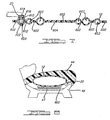
- FIG. 6 illustrates a second embodiment of the instant invention constructed from sealably interconnected sheets of flexible material.
- FIG. 7 illustrates a cross section of the Fig. 6 embodiment illustrating several fluid filled zones within the associated bladder, and also illustrating an associated dead-zone.
- FIG. 8 illustrates a means for distributing the support load from seat springs across the base of the fluid filled bladder of the instant invention.
- a seat 3 in a motor vehicle 1 incorporates a hydrostatic seat weight sensor 10 mounted in the seat base 40.
- the hydrostatic seat weight sensor 10 comprises bladder 12 and a differential pressure sensor 20 for measuring the difference in pressure between the bladder 12 and the atmosphere 25.
- the bladder 12 is sandwiched between the seat frame 46 below and the seat cushion foam 44 above.
- the bladder is filled with a fluid, either gaseous or liquid.
- an occupant 5 seated on the base 40 of seat 3 causes the pressure inside a bladder 12 to increase such that that product of the differential pressure, as sensed by differential pressure sensor 20, multiplied times the area of the base of the bladder 12 is substantially equal to the total weight distributed by the seat cushion foam 44 over the top of the bladder 12.
- the pressure signal output 22 from differential pressure sensor 20 is operably coupled to an electronic control module 50 which converts the pressure signal output 22 to a measure of occupant weight using known analog, digital, or microprocessor circuitry and software.
- a crash sensor 60 is also operably coupled to the electronic control module 50.
- the electronic control module 50 Responsive to a crash detected by the crash sensor 60, and further responsive to the sensed weight of the occupant as transformed from the pressure signal output 22, the electronic control module 50 generates a signal 80 which is operably coupled to one or more initiators 90 of one or more gas generators 100 mounted in an air bag inflator module 110, thereby controlling the activation of the air bag inflator module assembly 7 so as to inflate the air bag 120 as necessary to protect the occupant 5 from injury which might otherwise be caused by the crash.
- the electrical power necessary to carry out these operations is provided by a source of power 70, preferably the vehicle battery.
- the seat cushion 44 acts to distribute the load from the occupant 5 across the top load bearing surface of the bladder 12, thereby causing an increase in pressure of the fluid within the bladder 12 thereby supporting the top load bearing surface of the bladder 12 .
- the seat cushion acts to prevent concentrated loads applied to the seat from causing the top and bottom surfaces of the bladder 12 from collapsing against one another, thereby creating an alternate path for load which would not cause an associated increase in pressure of the fluid.
- the pressure of the unloaded bladder 12 is given by P o , which is substantially equal to the local atmospheric pressure.
- the pressure in the bladder 12 may be alternately sensed by an absolute pressure sensor 20 , or by one or more strain sensors 20 incorporated in or attached to the surface of the bladder 12 .
- the signal from the pressure sensor 20 is operably coupled to a signal processor 50 which measures the weight W of the applied load therefrom.
- the area A of the bladder which rests upon the supporting surface remains approximately equal regardless of the distribution of the weight which is applied to the bladder 12 .
- two different objects each with weight, W, but with different distributions of weight -- one concentrated and one whose weight is more spread out -- will each register the same increase in pressure, ⁇ P .
- the pressure increase ⁇ P resulting from an applied weight is independent of the shape of the applied weight, W, as long as the contact area between the bottom of the bladder 12 and the supporting surface remains constant.
- the bladder 12 is preferably only partially filled with fluid with an amount such that relatively high ambient temperatures or relatively low ambient pressures do not cause the fluid of the unloaded bladder 12 within the seat to become pressurized relative to local atmospheric pressure.
- the pressure of the fluid within the bladder 12 will generally be higher than the local atmospheric pressure by an amount corresponding to the weight of the top surface of the bladder 12 and to the hydrostatic pressure of the fluid within the bladder 12 relative to the location of the pressure sensor 20 .
- these incremental components of pressure are negligible relative to the range of loads to be measured.
- the bladder 12 is preferably designed so that the contact area at the bottom load bearing surface of the bladder 12 remains relatively constant over 1) the expected range of applied weights, W, and weight distributions which may result from various sizes and positions of objects, and 2) the expected range of ambient temperature and pressure conditions.
- the differential pressure of the fluid within the bladder 12 may not by itself accurately indicate the applied weight.
- a significant variation in the contact area will result in an ambiguity between the increase in fluid pressure relative to the increase in internal tension along the surface of the bladder.
- piezoresistive film can be added to the surface of the bladder in order to measure surface tension.
- the weight, W is supported by an increase in pressure, dP, as well as an increase in the surface tension of the bladder 12 .
- this information can be used to resolve the pressure/tension ambiguity and then accurately estimate the weight W of the applied load.
- the bladder 12 of a hydrostatic seat weight sensor 10 is constructed from two sheets of a flexible material which is coated with a material which can be sealably welded.
- the sheets of flexible material are first placed with sealably weldable coating sides adjacent one another, and are sealed to one another by a welded seam 602 along a periphery 601 so as to form an inflatable confinement.
- the sheets of material are also welded to one another at a plurality of seams 602 at locations 603 within the periphery 601 so as to form a plurality of zones in fluid communication with one another within the inflatable confinement.
- the bladder 12 is partially filled with a fluid which is distributed amongst the various zones.
- the amount of fluid and number of zones is such that the top and bottom surfaces of the b ladder 12 do not collapse against one another responsive to an applied load.
- the pressure within the bladder 12 is sensed by a p ressure sensor 20 attached to the outside surface of the bladder 12 , whereby a change the pressure of the bladder applies a force to a first electrode 612 of the pressure sensor 20 causing this electrode to deform or move relative to a second electrode 614, thereby changing the capacitance between the electrodes 612 and 614 .
- the second electrode is secured to the pressure sensor housing 616 which is attached to the surface of the bladder.
- a restraint 702 is located on the inside of the bladder 12 proximate the pressure sensor so as to prevent the top and bottom surfaces of the bladder 12 from collapsing against one another proximate the pressure sensor 20 .
- One problem which can occur with a hydrostatic seat weight sensor 10 is reduced sensitivity to loads which are distributed in the seat towards the periphery of the bladder. This problem can be mitigated by providing a non-uniform distribution of fluid filled zones 603 within the periphery of the bladder.
- one or more dead zones 604 may be formed within the bladder, each by a seam 602 which defines a closed path, whereby the portion of load applied to the seat cushion 44 in the region of the dead zone 604 is either supported by the adjacent fluid filled zones, or is transferred to the seat base 46 without increasing the pressure of the fluid within the bladder 12 .
- the top surface of the bladder 12 is constructed from 200 denier nylon fabric which is coated with polyurethane
- the bottom surface of the bladder 12 is constructed from 840 denier nylon fabric which is also coated with polyurethane.
- the seams are formed by welding the polyurethane coatings of the separate sheets together using an RF welding process.
- the outside of the bottom surface is also coated with polyurethane so as to distribute localized loads across the bottom surface of the bladder 12 .
- the bladder 12 is filled with a silicone fluid.
- a l oad distributor 802 constructed comprising sheet of semi-rigid material can be interposed between the bottom surface of the bladder 12 and the top of the seat suspension springs 47 so as to distribute the support loads from the seat base 46 across the bottom load bearing surface of the bladder 12 thereby preventing the top and bottom surfaces of the bladder 12 from collapsing against one another proximate the springs 47.
- a gaseous fluid may also be incorporated into the bladder 12.
- the gas-filled bladder is preferably only partially filled to allow for gaseous expansion due to variations in ambient temperature and pressure, such that over the possible range of environmental operating conditions the volume of the unloaded gas-filled bladder 12 generally does not exceed the design capacity thereof. Moreover, under these conditions, the associated absolute pressure in the bladder would not exceed ambient pressure by more than the negligibly small amount necessary to support the top surface of the bladder 12.
- the volume of the bladder 12 decreases until the pressure therein is sufficiently great to support the load.
- the base dimensions increase, thereby increasing the base area of the bladder 12 .
- the weight of the distributed load is then given by the product of the base area of the bladder times the difference in pressure inside and outside the bladder. Even if the loading on the top of the seat is relatively localized, the associated weight is given by the differential pressure acting on the base area of the bladder, assuming the base of the bladder is fully supported and that that top surface of the bladder is not locally compressed against the bottom surface.
- Vdpc The volume of the bladder, Vdpc, is then given in terms of the fill conditions, the local atmospheric condtions, and the measured pressure differential DP as,
- the above equations may be solved implicitly to determine the sensitivity of the weight measurement error to the geometry of the bladder, the fill conditions, and the ambient conditions.
- the sensitivity of the gas filled bladder to ambient temperature and pressure is decreased with decreasing amounts of gas in the bladder, and with decreasing bladder thickness (i.e. height) for the same base dimensions of the bladder.
- the bladder thickness i.e. height
- the bladder becomes more susceptible to bottoming-out under the influence of localized loads applied to the seat.
Landscapes
- Engineering & Computer Science (AREA)
- Mechanical Engineering (AREA)
- Physics & Mathematics (AREA)
- Mathematical Physics (AREA)
- Theoretical Computer Science (AREA)
- Aviation & Aerospace Engineering (AREA)
- Transportation (AREA)
- General Physics & Mathematics (AREA)
- Air Bags (AREA)
- Seats For Vehicles (AREA)
- Automotive Seat Belt Assembly (AREA)
- Force Measurement Appropriate To Specific Purposes (AREA)
Applications Claiming Priority (5)
| Application Number | Priority Date | Filing Date | Title |
|---|---|---|---|
| US993701 | 1992-12-21 | ||
| US3238096P | 1996-12-19 | 1996-12-19 | |
| US32380P | 1996-12-19 | ||
| US08/993,701 US5957491A (en) | 1996-12-19 | 1997-12-18 | Seat weight sensor having fluid filled bladder |
| PCT/US1997/023563 WO1998026961A1 (en) | 1996-12-19 | 1997-12-19 | Seat weight sensor having fluid filled bladder |
Publications (3)
| Publication Number | Publication Date |
|---|---|
| EP0885139A1 EP0885139A1 (en) | 1998-12-23 |
| EP0885139A4 EP0885139A4 (en) | 2000-04-05 |
| EP0885139B1 true EP0885139B1 (en) | 2004-09-29 |
Family
ID=26708343
Family Applications (1)
| Application Number | Title | Priority Date | Filing Date |
|---|---|---|---|
| EP97954186A Expired - Lifetime EP0885139B1 (en) | 1996-12-19 | 1997-12-19 | Seat weight sensor having fluid filled bladder |
Country Status (6)
| Country | Link |
|---|---|
| US (2) | US5957491A (enExample) |
| EP (1) | EP0885139B1 (enExample) |
| JP (1) | JP4198758B2 (enExample) |
| KR (1) | KR100508331B1 (enExample) |
| DE (1) | DE69730952T2 (enExample) |
| WO (1) | WO1998026961A1 (enExample) |
Families Citing this family (67)
| Publication number | Priority date | Publication date | Assignee | Title |
|---|---|---|---|---|
| US7243945B2 (en) * | 1992-05-05 | 2007-07-17 | Automotive Technologies International, Inc. | Weight measuring systems and methods for vehicles |
| US6958451B2 (en) * | 1995-06-07 | 2005-10-25 | Automotive Technologies International, Inc. | Apparatus and method for measuring weight of an occupying item of a seat |
| US7330784B2 (en) * | 1998-11-17 | 2008-02-12 | Automotive Technologies International, Inc. | Weight measuring systems and methods for vehicles |
| US20070135982A1 (en) | 1995-06-07 | 2007-06-14 | Automotive Technologies International, Inc. | Methods for Sensing Weight of an Occupying Item in a Vehicular Seat |
| US7779956B2 (en) * | 1995-06-07 | 2010-08-24 | Automotive Technologies International, Inc.. | Vehicular seats with weight sensing capability |
| US7762582B2 (en) * | 1995-06-07 | 2010-07-27 | Automotive Technologies International, Inc. | Vehicle component control based on occupant morphology |
| US7387183B2 (en) * | 1995-06-07 | 2008-06-17 | Automotive Technologies International, Inc. | Weight measuring systems and methods for vehicles |
| US20080189053A1 (en) * | 1995-06-07 | 2008-08-07 | Automotive Technologies International, Inc. | Apparatus and Method for Analyzing Weight of an Occupying Item of a Vehicular Seat |
| US7770920B2 (en) * | 1995-06-07 | 2010-08-10 | Automotive Technologies International, Inc. | Vehicular seats with fluid-containing weight sensing system |
| US7900736B2 (en) * | 1995-06-07 | 2011-03-08 | Automotive Technologies International, Inc. | Vehicular seats with fluid-containing weight sensing system |
| US7766383B2 (en) | 1998-11-17 | 2010-08-03 | Automotive Technologies International, Inc. | Vehicular component adjustment system and method |
| US7976060B2 (en) * | 1995-06-07 | 2011-07-12 | Automotive Technologies International, Inc. | Seat load or displacement measuring system for occupant restraint system control |
| US5957491A (en) * | 1996-12-19 | 1999-09-28 | Automotive Systems Laboratory, Inc. | Seat weight sensor having fluid filled bladder |
| US6674024B2 (en) | 1996-12-19 | 2004-01-06 | Automotive Systems Laboratory, Inc | Seat weight sensor |
| US5987370A (en) * | 1997-09-03 | 1999-11-16 | Delco Electronics Corp. | Vehicle occupant weight estimation apparatus having fluid-filled seat bladder |
| US6104100A (en) * | 1998-01-27 | 2000-08-15 | Sheldahl, Inc. | Charge transfer load sensor |
| US20050184496A1 (en) | 2003-10-03 | 2005-08-25 | Speckhart Frank H. | Sensor pad for controlling airbag deployment and associated support |
| US20040069071A1 (en) * | 2001-11-19 | 2004-04-15 | Speckhart Frank H. | Sensor pad for controlling airbag deployment and associated support |
| DE69935916T2 (de) * | 1998-09-03 | 2008-01-10 | Methode Electronics, Inc., Chicago | Sensorkissen zur steuerung des airbags mit zugehöriger haltevorrichtung |
| US6283504B1 (en) | 1998-12-30 | 2001-09-04 | Automotive Systems Laboratory, Inc. | Occupant sensor |
| US6825765B2 (en) | 1998-12-30 | 2004-11-30 | Automotive Systems Laboratory, Inc. | Occupant detection system |
| US6546817B1 (en) * | 1999-02-08 | 2003-04-15 | Takata Corporation | Diagnostic method for a seat load measuring apparatus |
| US6431591B1 (en) | 1999-02-26 | 2002-08-13 | Wacker Silicones Corporation | Airbag sensor deactivator suitable for use in smart airbag system |
| US6246936B1 (en) | 1999-10-05 | 2001-06-12 | Delphi Technologies, Inc. | Vehicle occupant characterization method based on sensed occupant weight |
| DE10014381C1 (de) * | 2000-03-23 | 2001-05-31 | Siemens Ag | Sensorsystem zur Bestimmung der Insassenposition in Fahrzeugen |
| US6476514B1 (en) | 2000-03-29 | 2002-11-05 | Ford Global Technologies, Inc. | Occupant detection sensor assembly for seats |
| US6494284B1 (en) * | 2000-11-03 | 2002-12-17 | Trw Inc. | Seat arrangement for a vehicle having an actuatable occupant protection device |
| JP2002144936A (ja) * | 2000-11-08 | 2002-05-22 | Nhk Spring Co Ltd | 自動車シートの着座感知装置 |
| JP3944082B2 (ja) * | 2001-03-26 | 2007-07-11 | メトラー−トレド アクチェンゲゼルシャフト | 被計量物を保護する計量皿 |
| KR20030017778A (ko) * | 2001-08-22 | 2003-03-04 | 현대자동차주식회사 | 튜브 타입의 센서를 이용한 자동차용 파워 시트 |
| EP1449115A4 (en) * | 2001-10-31 | 2005-01-26 | Automotive Systems Lab Inc A M | TRANSACTION VERIFICATION SYSTEMS AND METHOD |
| US6689974B2 (en) | 2002-02-21 | 2004-02-10 | Hickory Springs Manufacturing Co. | Pressure switch for motorized chairs |
| US6722736B2 (en) | 2002-02-21 | 2004-04-20 | Hickory Springs Manufacturing Company | Movable switch for a motorized recliner |
| US6438476B1 (en) * | 2002-02-27 | 2002-08-20 | Delphi Technologies, Inc. | Vehicle seat occupant characterization method including ultralight child seat detection |
| US7009502B2 (en) * | 2002-08-26 | 2006-03-07 | Automotive Technologies International, Inc. | Method for controlling output of a classification algorithm |
| DE10249871A1 (de) * | 2002-10-25 | 2004-05-06 | Delphi Technologies, Inc., Troy | Vorrichtung zur Erkennung einer Sitzbelegung |
| ATE338660T1 (de) * | 2003-04-23 | 2006-09-15 | Delphi Tech Inc | Insassenerkennungssystem für fahrzeuge |
| US6812417B1 (en) * | 2003-05-28 | 2004-11-02 | Walter Carl Lovell | Actuator, method of manufacture and application of use |
| US7043997B2 (en) * | 2003-07-09 | 2006-05-16 | Cherry Corporation | Seat for sensing a load |
| US6927678B2 (en) * | 2003-08-18 | 2005-08-09 | Delphi Technologies, Inc. | Fluid filled seat bladder with capacitive sensors for occupant classification and weight estimation |
| SE525958C2 (sv) * | 2003-10-10 | 2005-05-31 | Kongsberg Automotive Ab | Säteskonstruktion |
| EP1531093A1 (en) * | 2003-11-14 | 2005-05-18 | IEE INTERNATIONAL ELECTRONICS & ENGINEERING S.A. | Seat occupancy detector |
| US7000948B2 (en) * | 2003-11-20 | 2006-02-21 | Delphi Technologies, Inc. | Internally tethered seat bladder for occupant weight estimation |
| US6993954B1 (en) | 2004-07-27 | 2006-02-07 | Tekscan, Incorporated | Sensor equilibration and calibration system and method |
| US8326498B2 (en) | 2009-09-24 | 2012-12-04 | Ford Global Technologies, Llc | Vehicle anti-pinch control having variable threshold and method |
| TW201136784A (en) * | 2010-04-21 | 2011-11-01 | Hon Hai Prec Ind Co Ltd | Automobile seat system |
| US9009891B2 (en) * | 2011-09-23 | 2015-04-21 | Hill-Rom Services, Inc. | Automatic patient weight measurement for determining pressure relief set points |
| US9132052B2 (en) * | 2012-04-12 | 2015-09-15 | Sage Products, Llc | Apparatus and method for positioning a seated patient |
| US9091585B2 (en) * | 2013-02-08 | 2015-07-28 | Raf Technology, Inc. | Smart phone scale that uses the built-in barometric pressure sensor or orientation sensors to calculate weight |
| CA3152725A1 (en) | 2013-11-27 | 2015-05-27 | Sage Products, Llc | Apparatus and system for turning and positioning a patient |
| KR101705787B1 (ko) * | 2015-01-29 | 2017-02-13 | 주식회사 크레타 | 코어안정화운동 관리 시스템 |
| US10765576B2 (en) | 2015-08-18 | 2020-09-08 | Sage Products, Llc | Apparatus and system for boosting, transferring, turning and positioning a patient |
| US9849053B2 (en) | 2015-08-18 | 2017-12-26 | Sage Products, Llc | Apparatus and system for boosting, transferring, turning and positioning a patient |
| WO2018232012A1 (en) | 2017-06-13 | 2018-12-20 | Sage Products, Llc | Patient positioning and support system |
| US20180361897A1 (en) * | 2017-06-20 | 2018-12-20 | Ford Global Technologies, Llc | Vehicle seat padding assembly with molded-in bladders |
| US20190100122A1 (en) * | 2017-10-04 | 2019-04-04 | Ford Global Technologies, Llc | Waterproof skinned bench seat |
| TR201718597A2 (tr) * | 2017-11-23 | 2019-06-21 | Lakto Hayvancilik Teknolojileri Sanayi Ve Ticaret Ltd Sirketi | Hava veya sivi yastiğina bağli basinç sensörlü hayvan ağirliği ölçüm kantari |
| EP3840713A1 (en) | 2018-08-21 | 2021-06-30 | Sage Products, LLC | Systems and methods for lifting and positioning a patient |
| CN111361474A (zh) * | 2018-12-26 | 2020-07-03 | 北京奇虎科技有限公司 | 传感装置、其制作方法及儿童安全座椅 |
| CN111361473A (zh) * | 2018-12-26 | 2020-07-03 | 北京奇虎科技有限公司 | 安全提示系统及儿童安全座椅 |
| US11719557B2 (en) | 2019-12-24 | 2023-08-08 | Joyson Safety Systems Acquisition Llc | Apparatus and method of producing a sensing substrate |
| US11890240B2 (en) | 2021-04-30 | 2024-02-06 | Sage Products, Llc | Method and device for turning and positioning a patient using fillable chambers |
| US12472869B2 (en) | 2021-11-04 | 2025-11-18 | Joyson Safety Systems Acquisition Llc | Systems and methods for driver warnings upon child identification and bypass options based on gesture and posture detection |
| US20240198880A1 (en) * | 2022-12-20 | 2024-06-20 | Lear Corporation | Alternative width massage |
| US12508182B2 (en) | 2023-04-26 | 2025-12-30 | Sage Products, Llc | Sheet assembly for positioning a patient |
| DE102023124746A1 (de) * | 2023-09-13 | 2025-03-13 | Autoliv Development Ab | Sicherheitsvorrichtung |
| KR102902125B1 (ko) * | 2024-08-28 | 2025-12-19 | 주식회사 한창이지엠 | 자동차 시트에 결합되어 사용되는 블래더의 오일 충전 방법 및 오일 충전 장치 |
Citations (1)
| Publication number | Priority date | Publication date | Assignee | Title |
|---|---|---|---|---|
| EP0900705A2 (en) * | 1997-09-03 | 1999-03-10 | Delco Electronics Corporation | Vehicle occupant weight estimation apparatus |
Family Cites Families (47)
| Publication number | Priority date | Publication date | Assignee | Title |
|---|---|---|---|---|
| US1232983A (en) * | 1916-01-24 | 1917-07-10 | Eduard Schenk | Weighing apparatus. |
| US1969929A (en) | 1933-10-13 | 1934-08-14 | Scott E Heden | Fluid pressure controlled circuit maker |
| US3777175A (en) * | 1972-04-11 | 1973-12-04 | Lucas Industries Ltd | Safety arrangements for road vehicles |
| US3752245A (en) | 1972-04-17 | 1973-08-14 | B Johnson | Scale apparatus |
| JPS5073327A (enExample) * | 1973-11-06 | 1975-06-17 | ||
| US4022146A (en) * | 1974-02-27 | 1977-05-10 | Sadler Clinton P | Fluid pressure controlled circuit breaker as boat safety apparatus |
| US3889529A (en) * | 1974-04-17 | 1975-06-17 | Emery Co A H | Rectangular hydraulic load cell |
| US3992946A (en) * | 1975-12-11 | 1976-11-23 | The A. H. Emery Company | Hydraulic weighing apparatus |
| US4056156A (en) * | 1976-08-12 | 1977-11-01 | Dayton Arnold J | Weighing device |
| CA1101001A (en) | 1977-07-21 | 1981-05-12 | Alan W. Wakefield | Weighing apparatus |
| US4219090A (en) * | 1979-04-13 | 1980-08-26 | Dayton Arnold J | Weighing device |
| CA1126767A (en) * | 1980-02-15 | 1982-06-29 | Gerhard J. Dyck | Sealed load cell construction |
| US4383584A (en) * | 1980-02-15 | 1983-05-17 | International Road Dynamics Inc. | Sealed load cell construction |
| US4361198A (en) | 1980-11-21 | 1982-11-30 | Glenda J. Sjogren | Scale pad and valve structure |
| US4456084A (en) * | 1982-05-21 | 1984-06-26 | Atlas Electronics International, Inc. | Vehicle load monitoring system |
| US4644597A (en) * | 1983-05-09 | 1987-02-24 | Dynatech, Inc. | Air mattress with pressure relief valve |
| WO1985004472A1 (fr) | 1984-04-02 | 1985-10-10 | Emmanuel De Canecaude | Dispositif de pesage de personnes sur siege de w.c. |
| JPS6239338A (ja) * | 1985-08-15 | 1987-02-20 | Mazda Motor Corp | 自動車のシ−ト装置 |
| US5176424A (en) * | 1988-06-10 | 1993-01-05 | Mazda Motor Corporation | Automobile seat assembly |
| US4957286A (en) * | 1988-10-14 | 1990-09-18 | The Faulhaber Co. | Seat with weight measuring capabilities |
| US4987898A (en) * | 1989-01-17 | 1991-01-29 | Noninvasive Medical Incorporated | Method and device for the non-invasive measurement of pressure |
| US4908895A (en) * | 1989-03-20 | 1990-03-20 | Walker Robert A | Air mattress |
| JP2762297B2 (ja) | 1989-04-17 | 1998-06-04 | グラム株式会社 | 体重等測定方法 |
| US5117373A (en) * | 1990-05-18 | 1992-05-26 | Load Cell Systems, Inc. | Low profile weight measuring system for containers |
| US5232243A (en) * | 1991-04-09 | 1993-08-03 | Trw Vehicle Safety Systems Inc. | Occupant sensing apparatus |
| US5129472A (en) | 1991-04-26 | 1992-07-14 | Bao Hung Tung | Weighing apparatus |
| US5234065A (en) | 1992-11-23 | 1993-08-10 | Schmidt Karl B | Portable weight measuring device |
| SE500823C2 (sv) * | 1993-01-29 | 1994-09-12 | Whirlpool Europ | Mikrovågsugn med vägningsanordning |
| US5529377A (en) | 1993-06-25 | 1996-06-25 | Mccord Winn Texton | Air cell module for automotive seat |
| US5573269A (en) * | 1993-12-02 | 1996-11-12 | Trw Vehicle Safety Systems Inc. | Apparatus and method for sensing and restraining an occupant of a vehicle seat |
| US5427331A (en) | 1994-04-01 | 1995-06-27 | Lockheed Corporation | Rapid deflation system for pneumatic seat cushion |
| US5474327A (en) * | 1995-01-10 | 1995-12-12 | Delco Electronics Corporation | Vehicle occupant restraint with seat pressure sensor |
| US5634685A (en) | 1995-03-20 | 1997-06-03 | Herring; Charles | Inflatable/deflatable motorcycle seat cushion |
| WO1997046148A1 (en) * | 1996-06-07 | 1997-12-11 | Span-America Medical Systems, Inc. | Improved wheelchair cushion |
| US5986221A (en) * | 1996-12-19 | 1999-11-16 | Automotive Systems Laboratory, Inc. | Membrane seat weight sensor |
| US6109117A (en) * | 1996-12-19 | 2000-08-29 | Automotive Systems Laboratory, Inc. | Seat weight sensor |
| US6056079A (en) * | 1996-12-19 | 2000-05-02 | Automotive Systems Laboratory, Inc. | Automotive seat weight sensing system |
| US5957491A (en) * | 1996-12-19 | 1999-09-28 | Automotive Systems Laboratory, Inc. | Seat weight sensor having fluid filled bladder |
| US6045155A (en) * | 1997-01-16 | 2000-04-04 | Automotive Systems Laboratory, Inc. | Vehicle seat sensor having self-maintaining air bladder |
| US5918696A (en) * | 1997-09-05 | 1999-07-06 | Automotive Systems Laboratory, Inc. | Seat weight sensor with means for distributing loads |
| US5927427A (en) * | 1997-09-05 | 1999-07-27 | Automotive Systems Laboratory, Inc. | Seat weight having self-regulating fluid filled bladder |
| US5979585A (en) * | 1997-09-05 | 1999-11-09 | Automotive Systems Laboratory, Inc. | Seat weight sensor having self-regulating fluid filled bladder |
| US6076853A (en) * | 1997-11-13 | 2000-06-20 | Automotive Systems Laboratory, Inc. | Altitude/temperature compensation for a gas-filled weight sensor |
| US5984349A (en) * | 1997-11-17 | 1999-11-16 | Automotive Systems Laboratory, Inc. | Low profile hydraulic seat weight sensor |
| US6021863A (en) * | 1997-11-17 | 2000-02-08 | Automotive Systems Laboratory, Inc. | Seat weight sensor using fluid filled tubing |
| US5904219A (en) * | 1998-01-15 | 1999-05-18 | General Motors Corporation | Vehicle seat air bladder pressure sensor |
| US6047423A (en) * | 1998-07-27 | 2000-04-11 | Larson; Lynn D. | Air mattress with firmness adjusting air bladders |
-
1997
- 1997-12-18 US US08/993,701 patent/US5957491A/en not_active Expired - Lifetime
- 1997-12-19 KR KR10-1998-0705763A patent/KR100508331B1/ko not_active Expired - Fee Related
- 1997-12-19 DE DE69730952T patent/DE69730952T2/de not_active Expired - Lifetime
- 1997-12-19 EP EP97954186A patent/EP0885139B1/en not_active Expired - Lifetime
- 1997-12-19 WO PCT/US1997/023563 patent/WO1998026961A1/en not_active Ceased
- 1997-12-19 JP JP52800198A patent/JP4198758B2/ja not_active Expired - Lifetime
-
1999
- 1999-09-07 US US09/391,064 patent/US6286861B1/en not_active Expired - Lifetime
Patent Citations (1)
| Publication number | Priority date | Publication date | Assignee | Title |
|---|---|---|---|---|
| EP0900705A2 (en) * | 1997-09-03 | 1999-03-10 | Delco Electronics Corporation | Vehicle occupant weight estimation apparatus |
Also Published As
| Publication number | Publication date |
|---|---|
| EP0885139A4 (en) | 2000-04-05 |
| US5957491A (en) | 1999-09-28 |
| JP2002513348A (ja) | 2002-05-08 |
| WO1998026961A1 (en) | 1998-06-25 |
| DE69730952T2 (de) | 2005-10-06 |
| KR19990082043A (ko) | 1999-11-15 |
| DE69730952D1 (de) | 2004-11-04 |
| JP4198758B2 (ja) | 2008-12-17 |
| EP0885139A1 (en) | 1998-12-23 |
| KR100508331B1 (ko) | 2005-11-21 |
| US6286861B1 (en) | 2001-09-11 |
Similar Documents
| Publication | Publication Date | Title |
|---|---|---|
| US5957491A (en) | Seat weight sensor having fluid filled bladder | |
| US6674024B2 (en) | Seat weight sensor | |
| US6076853A (en) | Altitude/temperature compensation for a gas-filled weight sensor | |
| US5918696A (en) | Seat weight sensor with means for distributing loads | |
| US5927427A (en) | Seat weight having self-regulating fluid filled bladder | |
| US6021863A (en) | Seat weight sensor using fluid filled tubing | |
| US6056079A (en) | Automotive seat weight sensing system | |
| US5984349A (en) | Low profile hydraulic seat weight sensor | |
| US5986221A (en) | Membrane seat weight sensor | |
| US6045155A (en) | Vehicle seat sensor having self-maintaining air bladder | |
| US6109117A (en) | Seat weight sensor | |
| US5979585A (en) | Seat weight sensor having self-regulating fluid filled bladder | |
| US5975568A (en) | Sensor pad for controlling airbag deployment and associated support | |
| US20120166046A1 (en) | Sensor pad for controlling airbag deployment and associated support | |
| WO1998030411A1 (en) | Automotive seat weight sensing system | |
| EP0892728B1 (en) | Automotive seat weight sensing system | |
| WO1999011483A1 (en) | Seat weight sensor having self-regulating fluid filled bladder | |
| US20020027348A1 (en) | Sensor pad for controlling airbag deployment and associated support | |
| US20040069071A1 (en) | Sensor pad for controlling airbag deployment and associated support | |
| CA2245662A1 (en) | Seat weight sensor having fluid filled bladder | |
| EP1107886A1 (en) | Sensor pad for controlling airbag deployment and associated support |
Legal Events
| Date | Code | Title | Description |
|---|---|---|---|
| PUAI | Public reference made under article 153(3) epc to a published international application that has entered the european phase |
Free format text: ORIGINAL CODE: 0009012 |
|
| 17P | Request for examination filed |
Effective date: 19980730 |
|
| AK | Designated contracting states |
Kind code of ref document: A1 Designated state(s): DE FR GB |
|
| A4 | Supplementary search report drawn up and despatched |
Effective date: 20000223 |
|
| AK | Designated contracting states |
Kind code of ref document: A4 Designated state(s): DE FR GB |
|
| 17Q | First examination report despatched |
Effective date: 20010601 |
|
| GRAP | Despatch of communication of intention to grant a patent |
Free format text: ORIGINAL CODE: EPIDOSNIGR1 |
|
| GRAS | Grant fee paid |
Free format text: ORIGINAL CODE: EPIDOSNIGR3 |
|
| GRAA | (expected) grant |
Free format text: ORIGINAL CODE: 0009210 |
|
| AK | Designated contracting states |
Kind code of ref document: B1 Designated state(s): DE FR GB |
|
| REG | Reference to a national code |
Ref country code: GB Ref legal event code: FG4D |
|
| REF | Corresponds to: |
Ref document number: 69730952 Country of ref document: DE Date of ref document: 20041104 Kind code of ref document: P |
|
| PLBE | No opposition filed within time limit |
Free format text: ORIGINAL CODE: 0009261 |
|
| STAA | Information on the status of an ep patent application or granted ep patent |
Free format text: STATUS: NO OPPOSITION FILED WITHIN TIME LIMIT |
|
| ET | Fr: translation filed | ||
| 26N | No opposition filed |
Effective date: 20050630 |
|
| PGFP | Annual fee paid to national office [announced via postgrant information from national office to epo] |
Ref country code: GB Payment date: 20061221 Year of fee payment: 10 |
|
| PGFP | Annual fee paid to national office [announced via postgrant information from national office to epo] |
Ref country code: FR Payment date: 20061212 Year of fee payment: 10 |
|
| GBPC | Gb: european patent ceased through non-payment of renewal fee |
Effective date: 20071219 |
|
| REG | Reference to a national code |
Ref country code: FR Ref legal event code: ST Effective date: 20081020 |
|
| PG25 | Lapsed in a contracting state [announced via postgrant information from national office to epo] |
Ref country code: GB Free format text: LAPSE BECAUSE OF NON-PAYMENT OF DUE FEES Effective date: 20071219 |
|
| PG25 | Lapsed in a contracting state [announced via postgrant information from national office to epo] |
Ref country code: FR Free format text: LAPSE BECAUSE OF NON-PAYMENT OF DUE FEES Effective date: 20071231 |
|
| PGFP | Annual fee paid to national office [announced via postgrant information from national office to epo] |
Ref country code: DE Payment date: 20161213 Year of fee payment: 20 |
|
| REG | Reference to a national code |
Ref country code: DE Ref legal event code: R071 Ref document number: 69730952 Country of ref document: DE |