EP0878490A2 - Olefinpolymerisationsverfahren und daraus erhaltene Produkte. - Google Patents
Olefinpolymerisationsverfahren und daraus erhaltene Produkte. Download PDFInfo
- Publication number
- EP0878490A2 EP0878490A2 EP98108925A EP98108925A EP0878490A2 EP 0878490 A2 EP0878490 A2 EP 0878490A2 EP 98108925 A EP98108925 A EP 98108925A EP 98108925 A EP98108925 A EP 98108925A EP 0878490 A2 EP0878490 A2 EP 0878490A2
- Authority
- EP
- European Patent Office
- Prior art keywords
- range
- silica
- alumina
- reactor
- aluminum
- Prior art date
- Legal status (The legal status is an assumption and is not a legal conclusion. Google has not performed a legal analysis and makes no representation as to the accuracy of the status listed.)
- Withdrawn
Links
Images
Classifications
-
- C—CHEMISTRY; METALLURGY
- C08—ORGANIC MACROMOLECULAR COMPOUNDS; THEIR PREPARATION OR CHEMICAL WORKING-UP; COMPOSITIONS BASED THEREON
- C08F—MACROMOLECULAR COMPOUNDS OBTAINED BY REACTIONS ONLY INVOLVING CARBON-TO-CARBON UNSATURATED BONDS
- C08F110/00—Homopolymers of unsaturated aliphatic hydrocarbons having only one carbon-to-carbon double bond
- C08F110/02—Ethene
-
- C—CHEMISTRY; METALLURGY
- C08—ORGANIC MACROMOLECULAR COMPOUNDS; THEIR PREPARATION OR CHEMICAL WORKING-UP; COMPOSITIONS BASED THEREON
- C08F—MACROMOLECULAR COMPOUNDS OBTAINED BY REACTIONS ONLY INVOLVING CARBON-TO-CARBON UNSATURATED BONDS
- C08F10/00—Homopolymers and copolymers of unsaturated aliphatic hydrocarbons having only one carbon-to-carbon double bond
- C08F10/02—Ethene
-
- Y—GENERAL TAGGING OF NEW TECHNOLOGICAL DEVELOPMENTS; GENERAL TAGGING OF CROSS-SECTIONAL TECHNOLOGIES SPANNING OVER SEVERAL SECTIONS OF THE IPC; TECHNICAL SUBJECTS COVERED BY FORMER USPC CROSS-REFERENCE ART COLLECTIONS [XRACs] AND DIGESTS
- Y10—TECHNICAL SUBJECTS COVERED BY FORMER USPC
- Y10S—TECHNICAL SUBJECTS COVERED BY FORMER USPC CROSS-REFERENCE ART COLLECTIONS [XRACs] AND DIGESTS
- Y10S526/00—Synthetic resins or natural rubbers -- part of the class 520 series
- Y10S526/903—Monomer polymerized in presence of transition metal containing catalyst and hydrocarbon additive affecting polymer properties of catalyst activity
Definitions
- This invention relates to olefin polymerization processes and the resultant polymer products.
- Ultra high molecular weight olefin polymers such as polyethylene are useful in many demanding and extremely critical applications, such as human joint replacements, gears, bullet proof vests, skis, and other applications. Since ultra high molecular weight the polymer cannot be pelletized after leaving the reactor, the polymer must be sold as a fluff or a powder. Therefore, particle size and toughness of the resultant polymer is critical.
- olefin polymers such as polyethylene.
- One of the most economical routes to most commercial grades of olefin polymers is a loop/slurry process with a paraffin diluent wherein the polymerization process carried out at a temperature low enough that the resulting polymer is largely insoluble in the diluent. It is believed that commercially acceptable ultra high molecular weight polyethylenes traditionally are made using a stirred tank process, in a heavy hydrocarbon diluent.
- a process is provided to polymerize ethylene in a loop/slurry process using a Ziegler/Natta-type catalyst system to produce a very tough ultra high molecular weight polyethylene.
- a very tough, ultra high molecular weight polyethylene is provided.
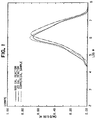
- FIG. 1 shows three (3) molecular weight distributions obtained from size exclusion chromatography (SEC) of three different polyethylene samples.
- UHMWPE designates ultra high molecular weight polyethylene.
- the x-axis, labeled “LOG M”, is the log of the polyethylene molecular weight.
- the y-axis, labeled “DW/D(LOG M)” is the differential mass fraction.
- Two curves, designated as “600 Gallon Reactor”and “23 Gallon Reactor” are curves of ethylene homopolymers prepared in accordance with the novel, inventive process.
- the third curve, designated as "Commercial Sample,” is a commercially available polyethylene, GUR 4150 made by Hoechst Celanese USA.
- the catalyst system used in the present invention must be a titanium-containing catalyst system, commonly referred to as "Ziegler-Natta" catalysts.
- Commercially available titanium catalyst systems typically comprise complexes of titanium halides with organometallic compounds, such as aluminum alkyls.
- Exemplary magnesium/titanium catalyst systems include, but are not limited to, those disclosed in U.S. Patent No.'s 4,394,291; 4,326,988; and 4,347,158, herein incorporated by reference.
- the catalyst system is a titanium-containing catalyst and is deposited on an inorganic oxide support.
- support refers to a carrier for another catalytic component. Any support useful to support catalyst systems can be used.
- Exemplary catalyst supports include, but are not limited to, inorganic oxides, either alone or in combination, phosphated inorganic oxides, and mixtures thereof.
- supports selected from the group consisting of silica, silica-alumina, alumina, fluorided alumina, silated alumina, thoria, aluminophosphate, aluminum phosphate, phosphated silica, phosphated alumina, silica-titania, coprecipitated silica/titania, fluorided/silated alumina, and mixtures thereof.
- the catalyst system support comprises silica, titania, alumina, either alone or in combination and either modified or unmodified.
- the presently most preferred catalyst system support is a silica-containing support.
- silica means a silica-containing material generally composed of 80 to 100 weight percent silica, the remainder, if any, being selected from alumina, boria, magnesia, thoria, zirconia, or mixtures thereof.
- the silica-containing material can consist essentially of silica and no more than 20 weight percent of alumina, titania or other metal oxide.
- Other ingredients which do not adversely affect the catalyst system, or which are present to produce some unrelated result also can be present.
- the particle size of the polymer fluff is critical.
- a correct selection of particle size of the catalyst system particles can control the particle size of the resultant polymer fluff.
- catalyst system particles are within a range of about 1 to about 40 microns, preferably within a range of about 2 to about 20 microns.
- catalyst particles are kept within a size range of about 4 to about 16 microns.
- Titanium usually is present in the catalyst system in an amount within a range of about 0.01 to about 5 weight percent, preferably within a range of about 0.1 to about 2.5 weight percent, based on the total mass of the catalyst system (support plus titanium compound). Most preferably, titanium is present in the catalyst system in an amount within a range of 0.2 to 1 weight percent based on the total mass of the catalyst system for best catalyst system activity and productivity, as well as best polymer product particle size.
- the titanium-containing catalyst is combined, preferably in the reactor, with an aluminum alkyl cocatalyst, expressed by the general formulae AlR 3 , AlR 2 X, and/or AlRX 2 , wherein R is an alkyl group having from about 1 to about 12 carbon atoms per molecule and X is a halogen atom.
- aluminum alkyl cocatalysts include, but are not limited to triethylaluminum (TEA), triisobutyl aluminum (TIBAL), diethylaluminum chloride (DEAC), ethylaluminum sesquichloride (EASC), and mixtures of two or more thereof.
- the cocatalyst is a trialkyl aluminum cocatalyst, such as TEA, TIBAL and mixtures thereof for best catalyst system activity and reactivity.
- a cocatalyst can be present in the reactor in an amount within a range of about 5 to about 500 mg/kg (ppm), based on the weight of diluent, such as isobutane in the reactor.
- a cocatalyst if used is present in the reactor in an amount within a range of about 50 to about 100 mg/kg in order to optimize catalyst activity and productivity.
- Precontacting catalyst and cocatalyst can occur, but is not required. While not wishing to be bound by theory, it is believed that precontacting catalyst system and cocatalyst can reduce the quantity of cocatalyst used in the reactor.
- the polymers produced in accordance with the process of this invention are predominately homopolymers of ethylene. Trace amounts of comonomers can be present, but comonomers preferably are not present in any significant amount since comonomers can reduce the molecular weight of the desired ultra high molecular weight polymer product.
- the ethylene concentration in the polymerization reactor is within a range of from about 2 weight percent to about 15 weight percent, based on the total liquid contents of the reactor. Most preferably, the ethylene concentration in the polymerization reactor is within a range of from about 4 to about 7 weight percent. While ethylene concentration does not significantly affect the molecular weight of the resultant polymer, higher or lower ethylene concentration can effect catalyst activity.
- loop/slurry also known as particle form, polymerization conditions wherein the temperature is kept below the temperature at which polymer swells.
- loop/slurry also known as particle form, polymerization conditions wherein the temperature is kept below the temperature at which polymer swells.
- Such polymerization techniques are well known in the art and are disclosed, for instance, in Norwood, U.S. Patent No. 3,248,179, the disclosure of which is herein incorporated by reference.
- a loop polymerization process is much more preferred than a stirred tank reactor because diluent can be flashed off, eliminating the necessity of separating polymer product from solvent, greater heat transfer surface of the loop reactor, much more versatility for plant operation, and often less polymer swelling during polymerization.
- the temperature of the polymerization reactor, or reaction zone, according to this invention is critical and must be kept within a range of about 150°F to about 180°F, preferably within a range of about 160° to about 170°F. Most preferably, the reaction zone temperature is within a range of 162° to 168°F. The temperature range is critical in order to produce an ultra high molecular weight polyethylene.
- Too high of a reactor temperature can produce a polymer with too low of a molecular weight; too low of a reactor temperature can make the polymerization process inoperable because a lower reactor temperature can be difficult to maintain due to the exothermic polymerization reaction, flashing off reactor diluent can be difficult, and a can produce a polymer with a commercially unacceptable molecular weight.
- the loop/slurry process used in this invention must be carried out in an inert diluent (medium), selected from the group consisting of hydrocarbons having three and four carbon atoms per molecule.
- diluents include, but are not limited to propane, n-butane, isobutane, and mixtures thereof. Diluents having greater or less than three or four carbon atoms per molecule can be difficult to separate from the polymer product during the polymer recovery process. Isobutane is the most preferred diluent due to low cost and ease of use.
- Pressures in the loop/slurry process can vary from about 110 to about 1000 psia (0.76-4.8 MPa) or higher, preferably 500 to 700 psia.
- the catalyst system is kept in suspension and is contacted with ethylene at a sufficient pressure to maintain the medium and at least a portion of the ethylene in a liquid phase.
- the reactor medium and temperature thus are selected such that the polymer is produced and recovered as solid particles.
- Catalyst system concentrations in the reactor can be such that the catalyst system content ranges from 0.0001 to about 0.1 weight percent based, on the weight of the reactor contents.
- Polymers produced in accordance with this invention are considered a homopolymer of ethylene, even though trace, insignificant amounts of comonomers can be present in the resultant polymer.
- Polymers produced according to this invention have an ultra high weight average (M w ) molecular weight, generally above one million (1,000,000).
- M w ultra high weight average
- polymers produced in accordance with this invention have a molecular weight within a range of greater than about two million (2,000,000) and most preferably, within a range of greater than or equal to about 2,500,000 up to about 10,000,000.
- the inherent viscosity (IV) of the polymers generally is greater than about 19, preferably within a range of about 20 to about 30. Most preferably, the polymers will have an IV within a range of 22 to 28.
- the density of these novel polymers usually is within a range of about 0.92 g/cc to about 0.94 g/cc, preferably from about 0.925 to about 0.936 g/cc. Most preferably, the polymer density is within a range of about 0.927 to about 0.933 g/cc.
- the fluff, or powder size.
- the particle size is less than about 400 microns (40 mesh), preferably within a range of about 400 microns to about 40 microns (300 mesh). Most preferably, the particle size is within a range of about 50 to about 400 microns. Particle sizes of larger that about 400 microns often can appear in the in the finished product as a flaw, or a white patch. While not wishing to be bound by theory, it is believed that this defect appears because the particles are not molded by typical methods in the art, but are merely fused together by compression. Fine, or small, particles can inhibit transport of the powder through conveyor blowers because the fine particles can cling to walls by static and can plug downstream filters due to blowover.
- Polymers produced according to this invention must be very tough, as evidenced by a sand wheel abrasion test, tensile strength, elongation, flexural modulus, hardness and Izod impact strength. The most important of these tests is the sand wheel abrasion test wherein a plaque of compression molded polymer is subjected to sanding and the amount of polymer lost is measured. Generally, the compression molded polymer sample loss is less than or equal to about 150 grams, preferably, less than about 140 grams. Most preferably, the compression molded polymer sample loses between zero (0) and 125 grams.
- Polymer tensile strength at yield is within a range of about 15 to about 30 MPa, preferably, within a range of about 19 to about 24 MPa. Most preferably, as an indicator of toughness, the tensile strength at yield is within a range of 20 to 24 MPa. Tensile strength at break usually is greater or equal to about 30 MPa, preferably greater than about 35 MPa. Most preferably, as an indicator of toughness, the tensile strength at break is greater than 38 and less than 75 MPa.
- Izod impact usually is greater or equal to about 45 kJ/m 2 , preferably greater than about 50 kJ/m 2 . Most preferably, as another indicator of toughness, the Izod impact is within a range of about 55 to about 200 kJ/m 2 . Izod impact is not only related to the polymer itself, but also is an indicator of how well the polymer particles fuse, or knit, together during the fusion process. Polymers having too high a molecular weight can have poor Izod impact strength because of poor fusion. Thus, Izod impact strength often can go through a maximum as molecular weight is increased.
- polymers produced in accordance with this invention have a bulk density of greater than about 0.25 g/cc, preferably, greater than about 0.3 g/cc. Most preferably, polymer bulk density is within a range of 0.35 to 1 g/cc.
- Ethylene homopolymers were prepared in a continuous particle form process by contacting the catalyst with ethylene, employing a liquid full loop reactor, having a volume of 23 gallons (87 liters), isobutane as the diluent; no hydrogen or comonomer were added to the reactor.
- the reactor was operated to have a residence time of 1.25 hrs.
- the reactor temperature was 164°F (73.3°C), unless stated differently, and the pressure was 4 MPa (580 psi).
- the isobutane feed rate was 46 l/hr
- the ethylene feed rate was about 30 lbs/hr
- a reactor ethylene concentration within a range of about 3.5 to about 5 weight percent.
- the catalyst systems used were commercially available catalyst systems purchased from W.R. Grace and Company, the Davison business unit, designated as Davison Sylopol® 5910, having an average particle size of 10 microns. Sales literature for Sylopol® 5910 provides a chemical analysis (weight percent) of 15.16% Cl, 4.44% Al, 2.95% Mg, 0.60% Ti and a Mg/Ti molar ratio of 9.69.
- the catalyst system is a silica-supported Ziegler-Natta catalyst, also described as a Ziegler-Natta catalyst deposited on silica.
- Triethyl aluminum (TEA) cocatalyst was present in the reactor at 50 mg/kg, based on the weight of the isobutane feed.
- the data in Table 1 show that the resultant polymer has desirable properties, such as a low bulk density, high tensile strength and a low sand wheel abrasion test result.
- Size exclusion chromatograph (SEC) results are shown in Figure 1.
- the curve designated as "23 Gallon Reactor” is exemplary for all products made in the above-described 23 gallon reactor.
- All 23 gallon reactor samples analyzed by SEC have a weight average molecular weight (M w ) of greater than or equal to about 3,000,000.
- the data is Table 4 show that the effect of ethylene concentration with a catalyst system having a particle size within a range of 4 to 16 microns and low titanium content.
- Ethylene homopolymers were prepared in a continuous particle form process by contacting the catalyst with ethylene, as described above, but a larger reactor was used.
- the liquid full loop reactor had a volume of 600 gallons (2271 liters), isobutane was the diluent; no hydrogen or comonomer were added to the reactor.
- the reactor was operated to have a residence time of about 1.25 hrs.
- the reactor temperature was 164°F (73.3°C), unless stated differently, and the pressure was 4.14 MPa (600 psi). Polymer was removed from the reactor at the rate of 800 to 1000 lbs/hr.
- the catalyst systems used were the same as those described above, Davison Sylopol® 5910. Triethyl aluminum (TEA) cocatalyst was present in the reactor at 75 mg/kg, based on the weight of the isobutane feed.
- TAA Triethyl aluminum
- Size exclusion chromatography (SEC) results are shown in Figure I.
- the curve designated as "600 Gallon Reactor” is exemplary for all products made in the above-described 600 gallon reactor. All 600 gallon reactor samples analyzed by SEC have a weight average molecular weight (M w ) of greater than or equal to about 2,500,000. Note that the curve designated as a "Commercial Sample” had a similar SEC curve as that of the 600 gallon reactor sample.
Landscapes
- Chemical & Material Sciences (AREA)
- Health & Medical Sciences (AREA)
- Chemical Kinetics & Catalysis (AREA)
- Medicinal Chemistry (AREA)
- Polymers & Plastics (AREA)
- Organic Chemistry (AREA)
- Transition And Organic Metals Composition Catalysts For Addition Polymerization (AREA)
- Addition Polymer Or Copolymer, Post-Treatments, Or Chemical Modifications (AREA)
- Polymerization Catalysts (AREA)
Applications Claiming Priority (2)
| Application Number | Priority Date | Filing Date | Title |
|---|---|---|---|
| US08/857,788 US6034186A (en) | 1997-05-16 | 1997-05-16 | Olefin polymerization processes and products thereof |
| US857788 | 1997-05-16 |
Publications (2)
| Publication Number | Publication Date |
|---|---|
| EP0878490A2 true EP0878490A2 (de) | 1998-11-18 |
| EP0878490A3 EP0878490A3 (de) | 1999-02-17 |
Family
ID=25326747
Family Applications (1)
| Application Number | Title | Priority Date | Filing Date |
|---|---|---|---|
| EP98108925A Withdrawn EP0878490A3 (de) | 1997-05-16 | 1998-05-15 | Olefinpolymerisationsverfahren und daraus erhaltene Produkte. |
Country Status (12)
| Country | Link |
|---|---|
| US (2) | US6034186A (de) |
| EP (1) | EP0878490A3 (de) |
| JP (1) | JPH10324716A (de) |
| KR (1) | KR19980086869A (de) |
| CN (1) | CN1199740A (de) |
| AU (1) | AU700622B2 (de) |
| CA (1) | CA2238241C (de) |
| HU (1) | HUP9801096A3 (de) |
| ID (1) | ID21384A (de) |
| MY (1) | MY132890A (de) |
| NO (1) | NO982241L (de) |
| SG (1) | SG60221A1 (de) |
Cited By (2)
| Publication number | Priority date | Publication date | Assignee | Title |
|---|---|---|---|---|
| WO2004007562A3 (en) * | 2002-07-15 | 2004-04-15 | Dow Global Technologies Inc | Spray-dried polymerization catalyst and polymerization processes employing same |
| EP3061800A1 (de) | 2015-02-26 | 2016-08-31 | Repsol, S.A. | Polyolefinstützmittel mit ultrahohem Molekulargewicht |
Families Citing this family (9)
| Publication number | Priority date | Publication date | Assignee | Title |
|---|---|---|---|---|
| US6329476B1 (en) * | 1997-10-14 | 2001-12-11 | Phillips Petroleum Company | Olefin polymerization processes and products thereof |
| US6265504B1 (en) * | 1999-09-22 | 2001-07-24 | Equistar Chemicals, Lp | Preparation of ultra-high-molecular-weight polyethylene |
| DE602005000009T2 (de) * | 2004-02-13 | 2006-11-23 | Total Petrochemicals Research Feluy, Seneffe | Katalysatorkorngrösse |
| US11208514B2 (en) | 2008-03-20 | 2021-12-28 | Chevron Phillips Chemical Company Lp | Silica-coated alumina activator-supports for metallocene catalyst compositions |
| US7884163B2 (en) | 2008-03-20 | 2011-02-08 | Chevron Phillips Chemical Company Lp | Silica-coated alumina activator-supports for metallocene catalyst compositions |
| US20110268962A1 (en) * | 2009-01-09 | 2011-11-03 | Teijin Aramid B.V. | Ultra-high molecular weight polyethylene comprising refractory particles |
| IN2012DN05905A (de) | 2010-02-05 | 2015-09-18 | Total Petrochemicals Res Feluy | |
| US8399580B2 (en) | 2010-08-11 | 2013-03-19 | Chevron Philips Chemical Company Lp | Additives to chromium catalyst mix tank |
| CN102952222B (zh) * | 2011-08-30 | 2015-02-25 | 中国石油化工股份有限公司 | 超高分子量聚乙烯树脂及其制备方法 |
Family Cites Families (16)
| Publication number | Priority date | Publication date | Assignee | Title |
|---|---|---|---|---|
| US3984387A (en) * | 1974-08-07 | 1976-10-05 | The Dow Chemical Company | Preparation of linear α-olefin polymers having ultra high molecular weight |
| GB2010870B (en) * | 1977-12-21 | 1982-05-26 | Bp Chem Int Ltd | Polymerisaton catalyst |
| US4284748A (en) * | 1979-09-07 | 1981-08-18 | Phillips Petroleum Company | Olefin polymerization |
| US4347158A (en) * | 1980-05-02 | 1982-08-31 | Dart Industries, Inc. | Supported high efficiency polyolefin catalyst component and methods of making and using the same |
| US4326988A (en) * | 1980-08-12 | 1982-04-27 | Phillips Petroleum Company | Catalyst, method of producing the catalyst, and polymerization process employing the catalyst |
| US4394291A (en) * | 1981-03-04 | 1983-07-19 | Phillips Petroleum Company | Polyolefin polymerization process and catalyst |
| US4526943A (en) * | 1982-07-29 | 1985-07-02 | The Dow Chemical Company | Process for polymerizing olefins in the presence of a catalyst prepared from organomagnesium compound, organic hydroxyl-containing compound, reducing halide source and transition metal compound |
| US4806513A (en) * | 1984-05-29 | 1989-02-21 | Phillips Petroleum Company | Silicon and fluorine-treated alumina containing a chromium catalyst and method of producing same |
| DE3612376A1 (de) * | 1986-04-12 | 1987-10-15 | Basf Ag | Verfahren zum herstellen kleinteiliger homo- und copolymerisate des ethens unter verwendung eines fluessigen alkans als reaktionsmedium |
| WO1989010942A1 (fr) * | 1988-05-13 | 1989-11-16 | Mitsui Petrochemical Industries, Ltd. | Composant catalyseur a base de titane, procede de production, catalyseur permettant de produire un polymere ethylenique contenant ledit composant catalyseur a base de titane, et procede de production de ce polymere ethylenique |
| KR940008983B1 (ko) * | 1988-06-23 | 1994-09-28 | 도오소오 가부시끼가이샤 | 폴리에틸렌의 제조방법 |
| US5200379A (en) * | 1990-06-07 | 1993-04-06 | Phillips Petroleum Company | Olefin polymerization using supported pentadienyl derivative-transition metal complexes |
| CA2043904C (en) * | 1990-10-09 | 1997-10-07 | Kent E. Mitchell | Olefin polymerization |
| US5231151A (en) * | 1991-01-18 | 1993-07-27 | The Dow Chemical Company | Silica supported transition metal catalyst |
| IT1271425B (it) * | 1993-01-13 | 1997-05-28 | Himont Inc | Componenti e catalizzatori per la polimerizzazione di etilene |
| FI96216C (fi) * | 1994-12-16 | 1996-05-27 | Borealis Polymers Oy | Prosessi polyeteenin valmistamiseksi |
-
1997
- 1997-05-16 US US08/857,788 patent/US6034186A/en not_active Expired - Lifetime
-
1998
- 1998-04-18 SG SG1998000892A patent/SG60221A1/en unknown
- 1998-04-20 AU AU61985/98A patent/AU700622B2/en not_active Ceased
- 1998-05-07 ID IDP980671A patent/ID21384A/id unknown
- 1998-05-07 MY MYPI98002052A patent/MY132890A/en unknown
- 1998-05-08 KR KR1019980016451A patent/KR19980086869A/ko not_active Withdrawn
- 1998-05-11 JP JP10127695A patent/JPH10324716A/ja active Pending
- 1998-05-14 CN CN98108478A patent/CN1199740A/zh active Pending
- 1998-05-15 CA CA002238241A patent/CA2238241C/en not_active Expired - Fee Related
- 1998-05-15 NO NO982241A patent/NO982241L/no not_active Application Discontinuation
- 1998-05-15 HU HU9801096A patent/HUP9801096A3/hu unknown
- 1998-05-15 EP EP98108925A patent/EP0878490A3/de not_active Withdrawn
- 1998-11-13 US US09/191,800 patent/US6037433A/en not_active Expired - Fee Related
Cited By (5)
| Publication number | Priority date | Publication date | Assignee | Title |
|---|---|---|---|---|
| WO2004007562A3 (en) * | 2002-07-15 | 2004-04-15 | Dow Global Technologies Inc | Spray-dried polymerization catalyst and polymerization processes employing same |
| AU2003251916B2 (en) * | 2002-07-15 | 2007-08-02 | Univation Technologies, Llc | Method for preparing a spray-dried composition for use as a polymerization catalyst |
| EP3061800A1 (de) | 2015-02-26 | 2016-08-31 | Repsol, S.A. | Polyolefinstützmittel mit ultrahohem Molekulargewicht |
| WO2016135253A1 (en) | 2015-02-26 | 2016-09-01 | Repsol, S.A. | Ultra-high-molecular-weight polyolefin proppants |
| US10870792B2 (en) | 2015-02-26 | 2020-12-22 | Repsol, S.A. | Ultra-high-molecular-weight polyolefin proppants |
Also Published As
| Publication number | Publication date |
|---|---|
| NO982241D0 (no) | 1998-05-15 |
| ID21384A (id) | 1999-06-03 |
| AU6198598A (en) | 1998-11-19 |
| HUP9801096A2 (hu) | 1999-03-29 |
| CA2238241A1 (en) | 1998-11-16 |
| US6034186A (en) | 2000-03-07 |
| CA2238241C (en) | 2003-02-18 |
| EP0878490A3 (de) | 1999-02-17 |
| AU700622B2 (en) | 1999-01-07 |
| KR19980086869A (ko) | 1998-12-05 |
| HUP9801096A3 (en) | 1999-05-28 |
| MY132890A (en) | 2007-10-31 |
| US6037433A (en) | 2000-03-14 |
| NO982241L (no) | 1998-11-17 |
| JPH10324716A (ja) | 1998-12-08 |
| CN1199740A (zh) | 1998-11-25 |
| SG60221A1 (en) | 1999-02-22 |
| HU9801096D0 (en) | 1998-07-28 |
Similar Documents
| Publication | Publication Date | Title |
|---|---|---|
| AU704975B1 (en) | Process for polymerizing ethylene | |
| US6627707B2 (en) | Olefin polymerization processes and products thereof | |
| KR100570556B1 (ko) | 중합체 조성물, 이의 제조 방법 및 이를 이용하여 제조된필름 | |
| EP0133383B1 (de) | Trägerkatalysator für die Polymerisation von Äthylen bei hoher Temperatur | |
| EP1090048B1 (de) | Verfahren zur herstellung eines homogenen polyethylenmaterials in gegenwart eines katalysators | |
| US11149136B2 (en) | Bimodal polyethylene | |
| CA2846637C (en) | Hyperbranched polymers and methods of making and using same | |
| NZ207669A (en) | Production of ethylene(co)polymers using supported vanadium catalyst | |
| US6037433A (en) | Olefin polymerization processes and products thereof | |
| JPH03290408A (ja) | オレフィン重合用のジルコニウムをベースとする触媒組成物 | |
| AU723865B2 (en) | Ziegler-natta catalyst for ethylene polymerization or copolymerization | |
| WO1984003889A1 (en) | Ethylene polymerization using supported vanadium catalyst | |
| EP0884331A2 (de) | Polymerisations-Katalysatoren und Verfahren | |
| US4387202A (en) | Polymerization using mixed aluminum compounds | |
| US7071276B2 (en) | Process to produce polymers | |
| CA1216398A (en) | Method of polymerizing ethylene | |
| EP2077284B1 (de) | Verwendung eines verbesserten Festkörper-Vanadium-haltigen Ziegler-Natta-Katalysatorensystems zur Herstellung von Ethylenpolymerzusammensetzungen in einem mehrstufigen Verfahren | |
| WO2000001735A1 (en) | A process for polymerizing monomers | |
| MXPA98004682A (en) | Process for ethylene polymerization and heteroge catalytic system |
Legal Events
| Date | Code | Title | Description |
|---|---|---|---|
| PUAI | Public reference made under article 153(3) epc to a published international application that has entered the european phase |
Free format text: ORIGINAL CODE: 0009012 |
|
| AK | Designated contracting states |
Kind code of ref document: A2 Designated state(s): BE DE ES FR GB IT |
|
| AX | Request for extension of the european patent |
Free format text: AL;LT;LV;MK;RO;SI |
|
| PUAL | Search report despatched |
Free format text: ORIGINAL CODE: 0009013 |
|
| AK | Designated contracting states |
Kind code of ref document: A3 Designated state(s): AT BE CH CY DE DK ES FI FR GB GR IE IT LI LU MC NL PT SE |
|
| AX | Request for extension of the european patent |
Free format text: AL;LT;LV;MK;RO;SI |
|
| 17P | Request for examination filed |
Effective date: 19990721 |
|
| AKX | Designation fees paid |
Free format text: BE DE ES FR GB IT |
|
| 17Q | First examination report despatched |
Effective date: 20020606 |
|
| GRAH | Despatch of communication of intention to grant a patent |
Free format text: ORIGINAL CODE: EPIDOS IGRA |
|
| RAP1 | Party data changed (applicant data changed or rights of an application transferred) |
Owner name: CONOCOPHILLIPS COMPANY |
|
| STAA | Information on the status of an ep patent application or granted ep patent |
Free format text: STATUS: THE APPLICATION IS DEEMED TO BE WITHDRAWN |
|
| 18D | Application deemed to be withdrawn |
Effective date: 20030324 |