EP0876384B1 - Entsalzung und reinigung von oligosacchariden und deren derivate - Google Patents
Entsalzung und reinigung von oligosacchariden und deren derivate Download PDFInfo
- Publication number
- EP0876384B1 EP0876384B1 EP96938864A EP96938864A EP0876384B1 EP 0876384 B1 EP0876384 B1 EP 0876384B1 EP 96938864 A EP96938864 A EP 96938864A EP 96938864 A EP96938864 A EP 96938864A EP 0876384 B1 EP0876384 B1 EP 0876384B1
- Authority
- EP
- European Patent Office
- Prior art keywords
- oligosaccharides
- water
- solution
- acetonitrile
- modifier
- Prior art date
- Legal status (The legal status is an assumption and is not a legal conclusion. Google has not performed a legal analysis and makes no representation as to the accuracy of the status listed.)
- Expired - Lifetime
Links
- 229920001542 oligosaccharide Polymers 0.000 title claims abstract description 92
- 150000002482 oligosaccharides Chemical class 0.000 title claims abstract description 92
- 238000011033 desalting Methods 0.000 title description 12
- 238000000746 purification Methods 0.000 title description 4
- OKTJSMMVPCPJKN-UHFFFAOYSA-N Carbon Chemical compound [C] OKTJSMMVPCPJKN-UHFFFAOYSA-N 0.000 claims abstract description 56
- 229910052799 carbon Inorganic materials 0.000 claims abstract description 48
- 150000003839 salts Chemical class 0.000 claims abstract description 34
- 238000000034 method Methods 0.000 claims abstract description 32
- 239000007787 solid Substances 0.000 claims abstract description 8
- 238000005406 washing Methods 0.000 claims abstract description 6
- WEVYAHXRMPXWCK-UHFFFAOYSA-N Acetonitrile Chemical group CC#N WEVYAHXRMPXWCK-UHFFFAOYSA-N 0.000 claims description 126
- XLYOFNOQVPJJNP-UHFFFAOYSA-N water Substances O XLYOFNOQVPJJNP-UHFFFAOYSA-N 0.000 claims description 65
- DTQVDTLACAAQTR-UHFFFAOYSA-N Trifluoroacetic acid Chemical compound OC(=O)C(F)(F)F DTQVDTLACAAQTR-UHFFFAOYSA-N 0.000 claims description 44
- OAKJQQAXSVQMHS-UHFFFAOYSA-N hydrazine group Chemical group NN OAKJQQAXSVQMHS-UHFFFAOYSA-N 0.000 claims description 34
- 239000003607 modifier Substances 0.000 claims description 28
- 239000000243 solution Substances 0.000 claims description 28
- 238000010828 elution Methods 0.000 claims description 25
- HEMHJVSKTPXQMS-UHFFFAOYSA-M Sodium hydroxide Chemical group [OH-].[Na+] HEMHJVSKTPXQMS-UHFFFAOYSA-M 0.000 claims description 24
- 230000002378 acidificating effect Effects 0.000 claims description 21
- 239000002253 acid Substances 0.000 claims description 16
- 238000004587 chromatography analysis Methods 0.000 claims description 13
- LFQSCWFLJHTTHZ-UHFFFAOYSA-N Ethanol Chemical compound CCO LFQSCWFLJHTTHZ-UHFFFAOYSA-N 0.000 claims description 11
- LRHPLDYGYMQRHN-UHFFFAOYSA-N N-Butanol Chemical compound CCCCO LRHPLDYGYMQRHN-UHFFFAOYSA-N 0.000 claims description 10
- OKKJLVBELUTLKV-UHFFFAOYSA-N Methanol Chemical group OC OKKJLVBELUTLKV-UHFFFAOYSA-N 0.000 claims description 9
- 239000003599 detergent Substances 0.000 claims description 9
- FAPWRFPIFSIZLT-UHFFFAOYSA-M Sodium chloride Chemical compound [Na+].[Cl-] FAPWRFPIFSIZLT-UHFFFAOYSA-M 0.000 claims description 7
- 239000000872 buffer Substances 0.000 claims description 6
- 239000003153 chemical reaction reagent Substances 0.000 claims description 6
- WCUXLLCKKVVCTQ-UHFFFAOYSA-M Potassium chloride Chemical compound [Cl-].[K+] WCUXLLCKKVVCTQ-UHFFFAOYSA-M 0.000 claims description 4
- 239000003513 alkali Substances 0.000 claims description 4
- BDERNNFJNOPAEC-UHFFFAOYSA-N propan-1-ol Chemical compound CCCO BDERNNFJNOPAEC-UHFFFAOYSA-N 0.000 claims description 4
- 239000011780 sodium chloride Substances 0.000 claims description 4
- 239000003518 caustics Substances 0.000 claims description 3
- 239000012279 sodium borohydride Substances 0.000 claims description 3
- 229910000033 sodium borohydride Inorganic materials 0.000 claims description 3
- JKMHFZQWWAIEOD-UHFFFAOYSA-N 2-[4-(2-hydroxyethyl)piperazin-1-yl]ethanesulfonic acid Chemical compound OCC[NH+]1CCN(CCS([O-])(=O)=O)CC1 JKMHFZQWWAIEOD-UHFFFAOYSA-N 0.000 claims description 2
- QTBSBXVTEAMEQO-UHFFFAOYSA-M Acetate Chemical compound CC([O-])=O QTBSBXVTEAMEQO-UHFFFAOYSA-M 0.000 claims description 2
- 239000007995 HEPES buffer Substances 0.000 claims description 2
- 239000007993 MOPS buffer Substances 0.000 claims description 2
- 229910019142 PO4 Inorganic materials 0.000 claims description 2
- 239000007983 Tris buffer Substances 0.000 claims description 2
- 125000000129 anionic group Chemical group 0.000 claims description 2
- 150000004982 aromatic amines Chemical class 0.000 claims description 2
- 230000015572 biosynthetic process Effects 0.000 claims description 2
- 125000002091 cationic group Chemical group 0.000 claims description 2
- NBIIXXVUZAFLBC-UHFFFAOYSA-K phosphate Chemical compound [O-]P([O-])([O-])=O NBIIXXVUZAFLBC-UHFFFAOYSA-K 0.000 claims description 2
- 239000010452 phosphate Substances 0.000 claims description 2
- 239000001103 potassium chloride Substances 0.000 claims description 2
- 235000011164 potassium chloride Nutrition 0.000 claims description 2
- 239000004094 surface-active agent Substances 0.000 claims description 2
- LENZDBCJOHFCAS-UHFFFAOYSA-N tris Chemical compound OCC(N)(CO)CO LENZDBCJOHFCAS-UHFFFAOYSA-N 0.000 claims description 2
- DVLFYONBTKHTER-UHFFFAOYSA-N 3-(N-morpholino)propanesulfonic acid Chemical compound OS(=O)(=O)CCCN1CCOCC1 DVLFYONBTKHTER-UHFFFAOYSA-N 0.000 claims 1
- DBMJMQXJHONAFJ-UHFFFAOYSA-M Sodium laurylsulphate Chemical compound [Na+].CCCCCCCCCCCCOS([O-])(=O)=O DBMJMQXJHONAFJ-UHFFFAOYSA-M 0.000 claims 1
- 108090000765 processed proteins & peptides Proteins 0.000 abstract description 12
- 102000004196 processed proteins & peptides Human genes 0.000 abstract description 10
- 229920001184 polypeptide Polymers 0.000 abstract description 9
- 239000003480 eluent Substances 0.000 description 17
- 235000000346 sugar Nutrition 0.000 description 17
- 238000000926 separation method Methods 0.000 description 16
- WQZGKKKJIJFFOK-GASJEMHNSA-N Glucose Natural products OC[C@H]1OC(O)[C@H](O)[C@@H](O)[C@@H]1O WQZGKKKJIJFFOK-GASJEMHNSA-N 0.000 description 14
- 239000008103 glucose Substances 0.000 description 14
- 238000004128 high performance liquid chromatography Methods 0.000 description 14
- -1 salts sodium chloride Chemical class 0.000 description 14
- 238000004458 analytical method Methods 0.000 description 13
- 108090000288 Glycoproteins Proteins 0.000 description 12
- 102000003886 Glycoproteins Human genes 0.000 description 12
- 239000000203 mixture Substances 0.000 description 12
- 230000007935 neutral effect Effects 0.000 description 12
- 150000008163 sugars Chemical class 0.000 description 11
- 108060002885 fetuin Proteins 0.000 description 10
- 102000013361 fetuin Human genes 0.000 description 10
- 235000018102 proteins Nutrition 0.000 description 10
- 102000004169 proteins and genes Human genes 0.000 description 10
- 108090000623 proteins and genes Proteins 0.000 description 10
- 239000003463 adsorbent Substances 0.000 description 9
- MUPFEKGTMRGPLJ-RMMQSMQOSA-N Raffinose Natural products O(C[C@H]1[C@@H](O)[C@H](O)[C@@H](O)[C@@H](O[C@@]2(CO)[C@H](O)[C@@H](O)[C@@H](CO)O2)O1)[C@@H]1[C@H](O)[C@@H](O)[C@@H](O)[C@@H](CO)O1 MUPFEKGTMRGPLJ-RMMQSMQOSA-N 0.000 description 8
- MUPFEKGTMRGPLJ-UHFFFAOYSA-N UNPD196149 Natural products OC1C(O)C(CO)OC1(CO)OC1C(O)C(O)C(O)C(COC2C(C(O)C(O)C(CO)O2)O)O1 MUPFEKGTMRGPLJ-UHFFFAOYSA-N 0.000 description 8
- MUPFEKGTMRGPLJ-ZQSKZDJDSA-N raffinose Chemical compound O[C@H]1[C@H](O)[C@@H](CO)O[C@@]1(CO)O[C@@H]1[C@H](O)[C@@H](O)[C@H](O)[C@@H](CO[C@@H]2[C@@H]([C@@H](O)[C@@H](O)[C@@H](CO)O2)O)O1 MUPFEKGTMRGPLJ-ZQSKZDJDSA-N 0.000 description 8
- 239000000126 substance Substances 0.000 description 8
- 239000006188 syrup Substances 0.000 description 8
- 235000020357 syrup Nutrition 0.000 description 8
- 240000008042 Zea mays Species 0.000 description 7
- 235000005824 Zea mays ssp. parviglumis Nutrition 0.000 description 7
- 235000002017 Zea mays subsp mays Nutrition 0.000 description 7
- 235000005822 corn Nutrition 0.000 description 7
- 150000004676 glycans Chemical class 0.000 description 7
- 238000011084 recovery Methods 0.000 description 7
- 241000283690 Bos taurus Species 0.000 description 6
- 108090000790 Enzymes Proteins 0.000 description 6
- 102000004190 Enzymes Human genes 0.000 description 6
- 108010058846 Ovalbumin Proteins 0.000 description 6
- 229940092253 ovalbumin Drugs 0.000 description 6
- 230000000717 retained effect Effects 0.000 description 5
- 210000002700 urine Anatomy 0.000 description 5
- QGZKDVFQNNGYKY-UHFFFAOYSA-N Ammonia Chemical group N QGZKDVFQNNGYKY-UHFFFAOYSA-N 0.000 description 4
- IJGRMHOSHXDMSA-UHFFFAOYSA-N Atomic nitrogen Chemical compound N#N IJGRMHOSHXDMSA-UHFFFAOYSA-N 0.000 description 4
- GUBGYTABKSRVRQ-QKKXKWKRSA-N Lactose Natural products OC[C@H]1O[C@@H](O[C@H]2[C@H](O)[C@@H](O)C(O)O[C@@H]2CO)[C@H](O)[C@@H](O)[C@H]1O GUBGYTABKSRVRQ-QKKXKWKRSA-N 0.000 description 4
- 102100038551 Peptide-N(4)-(N-acetyl-beta-glucosaminyl)asparagine amidase Human genes 0.000 description 4
- 102000000447 Peptide-N4-(N-acetyl-beta-glucosaminyl) Asparagine Amidase Human genes 0.000 description 4
- 108010055817 Peptide-N4-(N-acetyl-beta-glucosaminyl) Asparagine Amidase Proteins 0.000 description 4
- VMHLLURERBWHNL-UHFFFAOYSA-M Sodium acetate Chemical compound [Na+].CC([O-])=O VMHLLURERBWHNL-UHFFFAOYSA-M 0.000 description 4
- 230000001143 conditioned effect Effects 0.000 description 4
- OPQARKPSCNTWTJ-UHFFFAOYSA-L copper(ii) acetate Chemical compound [Cu+2].CC([O-])=O.CC([O-])=O OPQARKPSCNTWTJ-UHFFFAOYSA-L 0.000 description 4
- 238000000605 extraction Methods 0.000 description 4
- 238000005194 fractionation Methods 0.000 description 4
- 239000000413 hydrolysate Substances 0.000 description 4
- 239000008101 lactose Substances 0.000 description 4
- 238000001819 mass spectrum Methods 0.000 description 4
- 238000002414 normal-phase solid-phase extraction Methods 0.000 description 4
- 108040002068 peptide-N4-(N-acetyl-beta-glucosaminyl)asparagine amidase activity proteins Proteins 0.000 description 4
- 239000001632 sodium acetate Substances 0.000 description 4
- 235000017281 sodium acetate Nutrition 0.000 description 4
- OWEGMIWEEQEYGQ-UHFFFAOYSA-N 100676-05-9 Natural products OC1C(O)C(O)C(CO)OC1OCC1C(O)C(O)C(O)C(OC2C(OC(O)C(O)C2O)CO)O1 OWEGMIWEEQEYGQ-UHFFFAOYSA-N 0.000 description 3
- QTBSBXVTEAMEQO-UHFFFAOYSA-N Acetic acid Chemical compound CC(O)=O QTBSBXVTEAMEQO-UHFFFAOYSA-N 0.000 description 3
- VEXZGXHMUGYJMC-UHFFFAOYSA-N Hydrochloric acid Chemical compound Cl VEXZGXHMUGYJMC-UHFFFAOYSA-N 0.000 description 3
- GUBGYTABKSRVRQ-PICCSMPSSA-N Maltose Natural products O[C@@H]1[C@@H](O)[C@H](O)[C@@H](CO)O[C@@H]1O[C@@H]1[C@@H](CO)OC(O)[C@H](O)[C@H]1O GUBGYTABKSRVRQ-PICCSMPSSA-N 0.000 description 3
- VYPSYNLAJGMNEJ-UHFFFAOYSA-N Silicium dioxide Chemical compound O=[Si]=O VYPSYNLAJGMNEJ-UHFFFAOYSA-N 0.000 description 3
- YXFVVABEGXRONW-UHFFFAOYSA-N Toluene Chemical compound CC1=CC=CC=C1 YXFVVABEGXRONW-UHFFFAOYSA-N 0.000 description 3
- PBCJIPOGFJYBJE-UHFFFAOYSA-N acetonitrile;hydrate Chemical compound O.CC#N PBCJIPOGFJYBJE-UHFFFAOYSA-N 0.000 description 3
- 238000005571 anion exchange chromatography Methods 0.000 description 3
- 239000007864 aqueous solution Substances 0.000 description 3
- WQZGKKKJIJFFOK-VFUOTHLCSA-N beta-D-glucose Chemical compound OC[C@H]1O[C@@H](O)[C@H](O)[C@@H](O)[C@@H]1O WQZGKKKJIJFFOK-VFUOTHLCSA-N 0.000 description 3
- 238000007068 beta-elimination reaction Methods 0.000 description 3
- 238000006243 chemical reaction Methods 0.000 description 3
- 150000001875 compounds Chemical class 0.000 description 3
- 238000001704 evaporation Methods 0.000 description 3
- 230000008020 evaporation Effects 0.000 description 3
- 238000006698 hydrazinolysis reaction Methods 0.000 description 3
- 230000002209 hydrophobic effect Effects 0.000 description 3
- 238000002955 isolation Methods 0.000 description 3
- 150000002772 monosaccharides Chemical class 0.000 description 3
- 238000012856 packing Methods 0.000 description 3
- 229920001282 polysaccharide Polymers 0.000 description 3
- 239000005017 polysaccharide Substances 0.000 description 3
- 108091003079 Bovine Serum Albumin Proteins 0.000 description 2
- 229920002307 Dextran Polymers 0.000 description 2
- 208000002678 Mucopolysaccharidoses Diseases 0.000 description 2
- QAOWNCQODCNURD-UHFFFAOYSA-N Sulfuric acid Chemical compound OS(O)(=O)=O QAOWNCQODCNURD-UHFFFAOYSA-N 0.000 description 2
- 229920004890 Triton X-100 Polymers 0.000 description 2
- 150000001298 alcohols Chemical class 0.000 description 2
- 229910021529 ammonia Inorganic materials 0.000 description 2
- AYJRCSIUFZENHW-UHFFFAOYSA-L barium carbonate Chemical compound [Ba+2].[O-]C([O-])=O AYJRCSIUFZENHW-UHFFFAOYSA-L 0.000 description 2
- TZCXTZWJZNENPQ-UHFFFAOYSA-L barium sulfate Chemical compound [Ba+2].[O-]S([O-])(=O)=O TZCXTZWJZNENPQ-UHFFFAOYSA-L 0.000 description 2
- GUBGYTABKSRVRQ-QUYVBRFLSA-N beta-maltose Chemical compound OC[C@H]1O[C@H](O[C@H]2[C@H](O)[C@@H](O)[C@H](O)O[C@@H]2CO)[C@H](O)[C@@H](O)[C@@H]1O GUBGYTABKSRVRQ-QUYVBRFLSA-N 0.000 description 2
- 229940098773 bovine serum albumin Drugs 0.000 description 2
- 239000000337 buffer salt Substances 0.000 description 2
- 239000001913 cellulose Substances 0.000 description 2
- 229920002678 cellulose Polymers 0.000 description 2
- 230000036425 denaturation Effects 0.000 description 2
- 238000004925 denaturation Methods 0.000 description 2
- 238000010790 dilution Methods 0.000 description 2
- 239000012895 dilution Substances 0.000 description 2
- 208000037265 diseases, disorders, signs and symptoms Diseases 0.000 description 2
- 238000005227 gel permeation chromatography Methods 0.000 description 2
- 238000010438 heat treatment Methods 0.000 description 2
- 229940042795 hydrazides for tuberculosis treatment Drugs 0.000 description 2
- 230000007062 hydrolysis Effects 0.000 description 2
- 238000006460 hydrolysis reaction Methods 0.000 description 2
- 239000000463 material Substances 0.000 description 2
- 238000012544 monitoring process Methods 0.000 description 2
- 206010028093 mucopolysaccharidosis Diseases 0.000 description 2
- 229910052757 nitrogen Inorganic materials 0.000 description 2
- 239000008363 phosphate buffer Substances 0.000 description 2
- 229920006395 saturated elastomer Polymers 0.000 description 2
- 239000002904 solvent Substances 0.000 description 2
- DCXYFEDJOCDNAF-UHFFFAOYSA-N Asparagine Natural products OC(=O)C(N)CC(N)=O DCXYFEDJOCDNAF-UHFFFAOYSA-N 0.000 description 1
- 108700043183 Bos taurus BSM1 Proteins 0.000 description 1
- 108010031186 Glycoside Hydrolases Proteins 0.000 description 1
- 102000005744 Glycoside Hydrolases Human genes 0.000 description 1
- 239000005909 Kieselgur Substances 0.000 description 1
- DCXYFEDJOCDNAF-REOHCLBHSA-N L-asparagine Chemical compound OC(=O)[C@@H](N)CC(N)=O DCXYFEDJOCDNAF-REOHCLBHSA-N 0.000 description 1
- 102000007330 LDL Lipoproteins Human genes 0.000 description 1
- 108010007622 LDL Lipoproteins Proteins 0.000 description 1
- 108010090665 Mannosyl-Glycoprotein Endo-beta-N-Acetylglucosaminidase Proteins 0.000 description 1
- OVRNDRQMDRJTHS-FMDGEEDCSA-N N-acetyl-beta-D-glucosamine Chemical group CC(=O)N[C@H]1[C@H](O)O[C@H](CO)[C@@H](O)[C@@H]1O OVRNDRQMDRJTHS-FMDGEEDCSA-N 0.000 description 1
- 102000007056 Recombinant Fusion Proteins Human genes 0.000 description 1
- 108010008281 Recombinant Fusion Proteins Proteins 0.000 description 1
- 229920002472 Starch Polymers 0.000 description 1
- AYFVYJQAPQTCCC-UHFFFAOYSA-N Threonine Natural products CC(O)C(N)C(O)=O AYFVYJQAPQTCCC-UHFFFAOYSA-N 0.000 description 1
- 239000004473 Threonine Substances 0.000 description 1
- 238000010521 absorption reaction Methods 0.000 description 1
- 239000003929 acidic solution Substances 0.000 description 1
- 125000000217 alkyl group Chemical group 0.000 description 1
- 229940024606 amino acid Drugs 0.000 description 1
- 235000001014 amino acid Nutrition 0.000 description 1
- 150000001413 amino acids Chemical class 0.000 description 1
- 238000005349 anion exchange Methods 0.000 description 1
- 238000013459 approach Methods 0.000 description 1
- 239000003125 aqueous solvent Substances 0.000 description 1
- 229960001230 asparagine Drugs 0.000 description 1
- 235000009582 asparagine Nutrition 0.000 description 1
- 239000006177 biological buffer Substances 0.000 description 1
- 239000013060 biological fluid Substances 0.000 description 1
- 239000012620 biological material Substances 0.000 description 1
- 238000005251 capillar electrophoresis Methods 0.000 description 1
- 238000012511 carbohydrate analysis Methods 0.000 description 1
- 230000015556 catabolic process Effects 0.000 description 1
- 238000001311 chemical methods and process Methods 0.000 description 1
- 210000004978 chinese hamster ovary cell Anatomy 0.000 description 1
- 238000013375 chromatographic separation Methods 0.000 description 1
- 239000000356 contaminant Substances 0.000 description 1
- 239000012043 crude product Substances 0.000 description 1
- 238000006731 degradation reaction Methods 0.000 description 1
- 238000001212 derivatisation Methods 0.000 description 1
- 238000000502 dialysis Methods 0.000 description 1
- VHJLVAABSRFDPM-QWWZWVQMSA-N dithiothreitol Chemical compound SC[C@@H](O)[C@H](O)CS VHJLVAABSRFDPM-QWWZWVQMSA-N 0.000 description 1
- 230000000694 effects Effects 0.000 description 1
- 238000002330 electrospray ionisation mass spectrometry Methods 0.000 description 1
- 238000006911 enzymatic reaction Methods 0.000 description 1
- 238000011067 equilibration Methods 0.000 description 1
- 239000012634 fragment Substances 0.000 description 1
- 239000007789 gas Substances 0.000 description 1
- 102000035122 glycosylated proteins Human genes 0.000 description 1
- 108091005608 glycosylated proteins Proteins 0.000 description 1
- 239000003673 groundwater Substances 0.000 description 1
- 125000001183 hydrocarbyl group Chemical group 0.000 description 1
- 238000010348 incorporation Methods 0.000 description 1
- 238000011534 incubation Methods 0.000 description 1
- 239000003701 inert diluent Substances 0.000 description 1
- 229910010272 inorganic material Inorganic materials 0.000 description 1
- 239000011147 inorganic material Substances 0.000 description 1
- 229910052500 inorganic mineral Inorganic materials 0.000 description 1
- 230000010354 integration Effects 0.000 description 1
- 238000005342 ion exchange Methods 0.000 description 1
- 150000002500 ions Chemical class 0.000 description 1
- 150000002632 lipids Chemical class 0.000 description 1
- 239000007788 liquid Substances 0.000 description 1
- 230000014759 maintenance of location Effects 0.000 description 1
- 238000004949 mass spectrometry Methods 0.000 description 1
- 239000000693 micelle Substances 0.000 description 1
- 235000010755 mineral Nutrition 0.000 description 1
- 239000011707 mineral Substances 0.000 description 1
- 238000012986 modification Methods 0.000 description 1
- 230000004048 modification Effects 0.000 description 1
- 239000000178 monomer Substances 0.000 description 1
- 150000007524 organic acids Chemical class 0.000 description 1
- 230000020477 pH reduction Effects 0.000 description 1
- 238000004816 paper chromatography Methods 0.000 description 1
- RIPZIAOLXVVULW-UHFFFAOYSA-N pentane-2,4-dione Chemical compound CC(=O)CC(C)=O.CC(=O)CC(C)=O RIPZIAOLXVVULW-UHFFFAOYSA-N 0.000 description 1
- 239000000575 pesticide Substances 0.000 description 1
- 239000012071 phase Substances 0.000 description 1
- 238000005191 phase separation Methods 0.000 description 1
- 238000001556 precipitation Methods 0.000 description 1
- 238000002360 preparation method Methods 0.000 description 1
- 239000000047 product Substances 0.000 description 1
- 238000002731 protein assay Methods 0.000 description 1
- 150000003217 pyrazoles Chemical class 0.000 description 1
- 239000011541 reaction mixture Substances 0.000 description 1
- 238000004366 reverse phase liquid chromatography Methods 0.000 description 1
- 239000000377 silicon dioxide Substances 0.000 description 1
- 238000001179 sorption measurement Methods 0.000 description 1
- 238000012306 spectroscopic technique Methods 0.000 description 1
- 238000004611 spectroscopical analysis Methods 0.000 description 1
- 235000019698 starch Nutrition 0.000 description 1
- 239000008107 starch Substances 0.000 description 1
- 125000004079 stearyl group Chemical group [H]C([*])([H])C([H])([H])C([H])([H])C([H])([H])C([H])([H])C([H])([H])C([H])([H])C([H])([H])C([H])([H])C([H])([H])C([H])([H])C([H])([H])C([H])([H])C([H])([H])C([H])([H])C([H])([H])C([H])([H])C([H])([H])[H] 0.000 description 1
- 238000000825 ultraviolet detection Methods 0.000 description 1
Images







Classifications
-
- C—CHEMISTRY; METALLURGY
- C13—SUGAR INDUSTRY
- C13B—PRODUCTION OF SUCROSE; APPARATUS SPECIALLY ADAPTED THEREFOR
- C13B20/00—Purification of sugar juices
- C13B20/14—Purification of sugar juices using ion-exchange materials
- C13B20/148—Purification of sugar juices using ion-exchange materials for fractionating, adsorption or ion exclusion processes combined with elution or desorption of a sugar fraction
-
- B—PERFORMING OPERATIONS; TRANSPORTING
- B01—PHYSICAL OR CHEMICAL PROCESSES OR APPARATUS IN GENERAL
- B01D—SEPARATION
- B01D15/00—Separating processes involving the treatment of liquids with solid sorbents; Apparatus therefor
- B01D15/08—Selective adsorption, e.g. chromatography
-
- B—PERFORMING OPERATIONS; TRANSPORTING
- B01—PHYSICAL OR CHEMICAL PROCESSES OR APPARATUS IN GENERAL
- B01J—CHEMICAL OR PHYSICAL PROCESSES, e.g. CATALYSIS OR COLLOID CHEMISTRY; THEIR RELEVANT APPARATUS
- B01J20/00—Solid sorbent compositions or filter aid compositions; Sorbents for chromatography; Processes for preparing, regenerating or reactivating thereof
- B01J20/02—Solid sorbent compositions or filter aid compositions; Sorbents for chromatography; Processes for preparing, regenerating or reactivating thereof comprising inorganic material
- B01J20/20—Solid sorbent compositions or filter aid compositions; Sorbents for chromatography; Processes for preparing, regenerating or reactivating thereof comprising inorganic material comprising free carbon; comprising carbon obtained by carbonising processes
-
- C—CHEMISTRY; METALLURGY
- C07—ORGANIC CHEMISTRY
- C07H—SUGARS; DERIVATIVES THEREOF; NUCLEOSIDES; NUCLEOTIDES; NUCLEIC ACIDS
- C07H1/00—Processes for the preparation of sugar derivatives
- C07H1/06—Separation; Purification
-
- C—CHEMISTRY; METALLURGY
- C13—SUGAR INDUSTRY
- C13K—SACCHARIDES OBTAINED FROM NATURAL SOURCES OR BY HYDROLYSIS OF NATURALLY OCCURRING DISACCHARIDES, OLIGOSACCHARIDES OR POLYSACCHARIDES
- C13K1/00—Glucose; Glucose-containing syrups
- C13K1/06—Glucose; Glucose-containing syrups obtained by saccharification of starch or raw materials containing starch
- C13K1/08—Purifying
Definitions
- the present invention relates to methods for purifying sugars and in particular methods for desalting oligosaccharides and their derivatives.
- Solid-phase extraction cartridges are now commercially available for the extraction of hydrophobic substances from aqueous solution, such as pesticide and hydrocarbon residues in ground water. Most commonly, these contain silica which has been modified by the covalent incorporation of alkyl groups (most commonly octadecyl or ODS chains) to confer reversed-phase separation characteristics. Such reversed-phase adsorbents show excellent retention of hydrophobic substances, but have very little affinity for hydrophilic solutes, such as sugars. These cartridges are therefore useful for the removal of salts from hydrophobic substances, but not from sugars.
- Activated carbon is a long-established adsorbent for the purification of both gases and liquids. It has also been applied to the preparative chromatographic fractionation of mixtures of oligosaccharides which are obtained by partial hydrolysis of polysaccharides, such as starch (1). In that application, an inert diluent, typically diatomaceous earth, is mixed with the carbon to enable increased flow of the solvent through the column. A solution of the crude hydrolysate is applied to such a 'charcoal-Celite' column and the different oligosaccharides are obtained, in order of increasing size, by elution with water containing increasing proportions of ethanol as an organic modifier. The composition is typically changed on a batch basis, rather than by elution with a gradient of organic modifier.
- Activated carbon chromatographic adsorbents have not been used in high-performance liquid chromatography (HPLC) but, with the recent availability of graphitised carbon packings (2) an analogous separation mode has become available. Like the older 'activated carbon' and 'activated charcoal', graphitised carbon has extremely high chemical stability, as well as good mechanical properties.
- Porous graphitised carbon is presently manufactured by Shandon HPLC (Cheshire, England) who also markets Hypercarb HPLC columns. Carbograph solid-phase extraction cartridges containing the same packing are available from Alltech Associates Inc (Deerfield, IL, USA). HPLC separations of oligosaccharides have been reported using the Hypercarb column (3, 4, 5,6).
- a hitherto unrecognised aspect is the value of carbon columns for the desalting of oligosaccharide solutions. This fact is surprising, in view of the lack of effective methods for the desalting of oligosaccharides.
- the present inventors have developed a useful method to remove salts or polypeptides from solutions of oligosaccharides.
- the present invention consists in a method to separate oligosaccharides from salts comprising the steps of:-
- the present invention consists in a method to separate oligosaccharides from polypeptides comprising the steps of:-
- the solid support comprises porous graphitised carbon and the support is packed in a chromatography column or cartridge.
- the support can be used in either continuous or batch mode, for clean-up of samples before chromatography, for chromatographic separation or for clean-up after chromatography, especially when samples are to be submitted to spectroscopic analysis.
- the washing step is preferably with water and the elution step preferably includes an organic modifier.
- the organic modifier is acetonitrile.
- the concentration of organic modifier is preferably from about 1 to 90% v/v. It will be appreciated by one skilled in the art, however, that other organic modifiers are suitable, especially the lower alcohols methanol, ethanol, propanol and butanol.
- the bound oligosaccharides can be removed by varying the concentration of the organic modifier during the elution step. Furthermore, in order to separate different oligosaccharides bound to the support, different concentrations of organic modifier can be used in combination with acidic or basic modifiers.
- a suitable acidic modifier is a dilute acid, for example, trifluoroacetic acid (TFA), preferably at a concentration of about 0.01 to 1% v/v.
- a suitable basic modifier is ammonia. It will be appreciated, however, that other basic and acidic modifiers would be suitable for the methods of the present invention.
- the concentration of acidic or basic modifiers is preferably from about 0.01 to 5% v/v. Elution may include increasing the concentration of organic modifier in steps or by gradient. Such elution techniques are well known to one skilled in the art.
- the methods of the present invention are particularly useful in removing salts used in biological buffers and reagents, as well as removing polypeptides from sugar solutions.
- Examples include the salts sodium chloride and potassium chloride, caustic alkali like sodium hydroxide, cationic buffers like Tris, anionic buffers like phosphate and acetate, zwitterionic buffers like HEPES and MOPS, and surfactants like SDS.
- the salts listed above are only provided as examples and many other salts can be removed from oligosaccharides using the method of the present invention.
- salts may also be removed from sugars using the methods of the present invention.
- examples of such compounds are non-ionic detergents. Removal of these compounds from sugars is included within the scope of the present invention.
- Desalting of the sugar samples is crucial in many techniques of carbohydrate analysis such as mass spectroscopy, capillary electrophoresis, anion exchange chromatography, enzyme degradation and chemical derivatisation.
- the present inventors have evaluated graphitised carbon for the isolation of mixtures of oligosaccharides (or their derivatives) from solutions containing one or more of the following contaminants: salt (including caustic alkali), protein (including enzymes), reagents for the release of oligosaccharides from glycoconjugates (such as hydrazine and sodium borohydride) and reagents used for formation of oligosaccharide derivatives (including aromatic amines).
- salt including caustic alkali
- protein including enzymes
- reagents for the release of oligosaccharides from glycoconjugates such as hydrazine and sodium borohydride
- reagents used for formation of oligosaccharide derivatives including aromatic amines.
- acidic or basic modifiers in the eluents, it is possible to fractionate acidic, phosphorylated, sulphated and neutral oligosaccharides.
- the adsorbent can be used repeatedly and
- N-linked glycans are released from a glycoprotein by treatment with hydrazine.
- hydrazine For the analysis to proceed, it is necessary to separate the glycans from the excess of hydrazine and from the protein and derived peptide hydrazides. This separation is typically achieved by a combination of evaporation (to remove the majority of the hydrazine) and size-exclusion, cellulose or reversed phase chromatography to separate the glycans from the proteinaceous materials. Neither of these procedures is particularly effective.
- an aqueous solution of the crude product can be applied to a graphitised carbon solid-phase extraction cartridge, then washed with water to remove the remaining hydrazine and then with water (containing up to 25% acetonitrile as an organic modifier) to elute the mixture of neutral glycans, followed with the same eluent containing dilute acid (such as 0.05% trifluoroacetic acid) to elute the acidic glycans.
- dilute acid such as 0.05% trifluoroacetic acid
- the glycans may be removed from the glycoprotein by the use of enzymes, such as endoglycanases or glycopeptidases. In this event, it is usually necessary to remove the buffer salts and the enzyme prior to further analysis.
- the salts are removed by elution of the carbon solid-phase extraction cartridge with water. As before, the glycans remain on the column and are isolated by elution with water-acetonitrile mixtures (with and without the addition of an acid), and the protein is retained by the adsorbent.
- the next step in the analysis of the released glycoforms from glycoconjugates is commonly a separation of the glycans using high-performance anion-exchange chromatography at high pH, which involves using an eluent which contains sodium hydroxide and (usually) a gradient of sodium acetate.
- an eluent which contains sodium hydroxide and (usually) a gradient of sodium acetate.
- the eluent can be desalted using a carbon adsorbent.
- the organic modifier used with water in the elutions is usually acetonitrile. It should be understood, however, that other modifiers (especially the lower alcohols methanol, ethanol, propanol and butanol) can be used to advantage to obtain improved selectivity and exploit the greater chemical inertness of these solvents.
- a solution of raffinose (200 mg) in water (5 mL) was applied to a conditioned graphitised carbon cartridge, the cartridge rinsed with water (5 x 1 mL) and the retained raffinose eluted with acetonitrile:water (1:1, 5 mL).
- An aliquot (10 ⁇ L) of the eluate was evaporated in a nitrogen stream, reconstituted in water (1 mL) and analysed by HPAEC.
- the total raffinose recovered in the acetonitrile:water eluate from a column containing 150 mg graphitised carbon was 41 ⁇ 2 mg.
- Oligosaccharides can be synthesised by heating a concentrated solution of the monomer in acid. Glucose (1 g) was heated at 100°C for 4 h in 1 mL of 2M TFA and applied to the carbon column. The acid and glucose monosaccharide were washed from the column in 5 mL water and oligomers DP 2 or greater were eluted in 3 mL 25% acetonitrile in water.
- Acidic solutions of glycans can be applied to graphitised carbon, such as a hydrolysate of a polysaccharide which still contains the non-volatile acid.
- the acid and monosaccharides can then be removed by elution with water and the sugar fragments eluted as before with acetonitrile/water with or without added trifluoroacetic acid.
- Dextran 500 (10 mg) was dissolved in 0.1M hydrochloric acid (100 ⁇ L) and heated at 100°C for 2 hours. The hydrolysate was diluted in water (5 mL) and applied to a conditioned graphitised carbon cartridge.
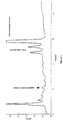
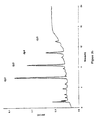
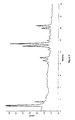
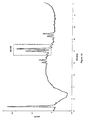
- a mixture of glycan hydrazones of corn syrup was prepared using hydrazine and was converted to a mixture of glycosylpyrazole derivatives (Fig. 5a) by treatment with an excess of pentan-2,4-dione (acetylacetone) in aqueous solution.
- the reaction mixture was applied directly to a column or cartridge containing a carbon adsorbent.
- the reagent was removed by elution with water, while the glycosylpyrazoles were recovered by elution with 10% acetonitrile in water (DP 1 to 3) (Fig. 5b) and 25% acetonitrile in water (DP 3 to 10) (Fig. 5c).
- the recovery of the pyrazoles was monitored using an aminopropyl HPLC column (Rainin) with UV detection.
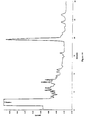
- oligosaccharide (DP6) from corn syrup was collected from a CarboPac PA1 HPLC column in approximately 0.5 mL of 0.2M sodium acetate in 0.25M sodium hydroxide. The fraction was applied directly to a column of graphitised carbon adsorbant, the column was washed with five bed volumes of water before the oligosaccharide was eluted with three bed volumes of 25% acetonitrile in water. The recovery of the desalted sugar was demonstrated by re-chromatography on the CarboPac PA1 HPLC column (Fig. 6).
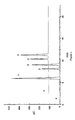
- the acidic N-acetylneuraminyllactose was also separated from its isomers (Fig. 2) and collected from the CarboPac PA1 HPLC column.
- the fraction was applied directly to a column of graphitised carbon adsorbant, the column was washed with five bed volumes of water before the oligosaccharide was eluted with three bed volumes of 25% acetonitrile containing 0.05% TFA.
- the recovery of the desalted sugar was demonstrated by re-chromatography on the CarboPac PA1 HPLC column (Fig. 7).
- Anhydrous hydrazine is used for the removal of N- and O-linked oligosaccharides from glycoproteins.
- the hydrazine needs to be removed before the reducing terminus is regenerated. To date this has involved exhaustive paper chromatography or more recently cellulose chromatography has been incorporated, with mixed success by many workers, into marketed kits (Oxford GlycoSystems).
- Hydrazine was shown to elute from the PGC cartridge with water.
- a model glycoprotein (1 mg bovine fetuin) was subjected to hydrazinolysis by heating in anhydrous hydrazine at 95°C for 4 h.
- the hydrazine was removed by evaporation (SpeedVac, Savant), washed once with toluene to remove excess hydrazine, and the mixture of products was dissolved in 1 mL water, and applied to a small PGC column (1 mL bed volume).
- the column was eluted with five bed volumes of water to remove residual hydrazine, then with three bed volumes of water containing 25% acetonitrile to elute neutral glycans, then with the same eluent containing 0.05% trifluoroacetic acid to elute acidic glycans.
- Amino acid analysis of the fractions showed that the peptides resulting from the hydrazinolysis were eluted predominantly by 50% acetonitrile in water and in 0.05% TFA.
- acetylated glycan hydrazones were prepared and converted to the reducing glycans by treatment with aqueous copper(II) acetate and the regenerated reducing sugars were separated on HPAEC (Fig. 8).
- the most commonly used method for releasing N-linked oligosaccharides from glycoproteins is the use of endoglycosidases such as PNGase F, Endo F and Endo H.
- the reaction is usually achieved with high yield by the denaturation of the glycoprotein by the action of detergents at high temperature to order to increase the accessibility of the enzyme to the glycosylated sites.
- Model glycoproteins 500 ⁇ g bovine fetuin consisting of 3 sites with acidic N-linked oligosaccharides; and ovalbumin ,comprising a single site of N-linked neutral oligosaccharide
- peptide N-glycosidase F 5 units, PNGase F
- the enzyme reaction was carried out after denaturation of the protein with either 1) 0.05% reduced Triton X100 (Fig. 9) or 2) 0.1% SDS (Fig. 10).
- the incubation mixture is applied to a graphitised carbon column (1 mL bed volume).
- the column was eluted with five bed volumes to remove the buffer salts and detergents, then with three bed volumes of water containing 25% acetonitrile to elute neutral glycans, then with the same eluent containing 0.05% trifluoroacetic acid to elute acidic glycans.
- the acidic glycan profile obtained is shown (Fig. 9 and 10) and is a typical profile of the oligosaccharides released from fetuin.
- bovine serum albumin a non-glycosylated protein
- a solution of bovine serum albumin (BSA, 0.5 mg/mL) in 100 mM phosphate buffer (1 mL) was applied to a PGC cartridge.
- BSA bovine serum albumin
- UV absorption at 280nm showed that no protein eluted using three bed volumes of 0, 25, 50, 100% acetonitrile or 0, 25, 50, 80% acetonitrile containing 0.1% TFA. Under these conditions all glycans can be eluted.
- the protein could not be desorbed from the column using 50% propanol, water-saturated butanol, butanol-saturated water, 1M ammonia, or 0.1M NaOH, as judged by the Bio-Rad DG protein assay.
- the PGC column can thus be used for deproteinising solutions of oligosaccharides.
- the oligosaccharides released enzymically from fetuin and ovalbumin were collected from the CarboPac PA1 HPLC column.
- the trisialylated oligosaccharide isomers of fetuin were collected in approximately 0.5 mL of 0.2M sodium acetate in 0.25M sodium hydroxide and applied directly to a porous graphitised carbon on-line HPLC cartridge (0.5 mL bed volume). The cartridge was washed with five bed volumes of water before the oligosaccharides were eluted directly into the electrospray-masspectrometer with 25% acetonitrile in 0.05% TFA.
- the mass of the fetuin trisialylated oligosaccharide isomers was obtained (2879 mass) and the mass spectrum showed evidence of a small amount of peeling occurring in the alkaline chromatography as evidenced by the loss of mass equal to one N-acetylglucosamine moiety (Fig. 11).
- the recovery of the desalted sugar was also evidenced by re-chromatography on the CarboPac PA1 HPLC column.
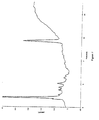
- the group of neutral oligosaccharides released enzymatically from ovalbumin (Fig. 12) were collected in approximately 1 mL of 0.1M sodium acetate in 0.25M sodium hydroxide and applied directly to a porous graphitised carbon on-line HPLC cartridge (0.5 mL bed volume). The cartridge was washed with five bed volumes of water before the oligosaccharides were eluted directly into the electrospray-masspectrometer with 25% acetonitrile in 0.05% TFA. The mass spectrum obtained shows the heterogeneity of the ovalbumin oligosaccharides (Fig. 13).
- O-linked oligosaccharides are typically released chemically from glycoproteins by beta elimination.
- a model glycoprotein (bovine submaxillary mucin) was subjected to beta elimination in the presence of sodium hydroxide and sodium borohydride. The reaction was terminated by acidification with dilute acid and the solution was applied to a graphitised carbon cartridge. The cartridge was eluted with five bed volumes to remove salts, then three bed volumes of water/acetonitrile (3:1) containing 0.05% trifluoroacetic acid to elute the glycans. Monosaccharide analysis before and after ⁇ -elimination showed 99% recovery of the oligosaccharides from the PGC column.
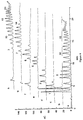
- Urine containing oligosaccharides which accumulate in the mucopolysaccharidosis disease (GM1), was desalted prior to analysis by HPAEC-PAD.
- a sample of 5 mL of urine was applied to the PGC column, the salts were washed off with water and the oligosaccharides were eluted with 25% acetonitrile.
- the eluted sugars were dried in a Speed-Vac, redissolved in water and applied directly to the chromatography column. The results are shown in Fig. 14 and demonstrate the application of this desalting method to biological fluids.
Landscapes
- Chemical & Material Sciences (AREA)
- Organic Chemistry (AREA)
- Life Sciences & Earth Sciences (AREA)
- Biochemistry (AREA)
- Analytical Chemistry (AREA)
- Health & Medical Sciences (AREA)
- General Health & Medical Sciences (AREA)
- Chemical Kinetics & Catalysis (AREA)
- Engineering & Computer Science (AREA)
- Inorganic Chemistry (AREA)
- Emergency Medicine (AREA)
- Biotechnology (AREA)
- Genetics & Genomics (AREA)
- Molecular Biology (AREA)
- Saccharide Compounds (AREA)
- Polysaccharides And Polysaccharide Derivatives (AREA)
- Medicines That Contain Protein Lipid Enzymes And Other Medicines (AREA)
- Treatment Of Liquids With Adsorbents In General (AREA)
- Peptides Or Proteins (AREA)
- Solid-Sorbent Or Filter-Aiding Compositions (AREA)
Claims (14)
- Verfahren zur Trennung von Oligosacchariden von Salzen, welches umfasst:(a) Kontaktierung einer ersten Lösung, die Oligosaccharide und Salze enthält, mit einem festen Träger, worin der Träger einen graphitisierten Kohlenstoff umfasst und in eine Chromatographiesäule oder -kartusche gepackt ist;(b) Waschen des Trägers mit Wasser; und(c) Elution aller gebundenen Oligosaccharide von dem Träger unter Verwendung einer zweiten Lösung, die einen organischen Modifikator enthält.
- Verfahren nach Anspruch 1, worin der organische Modifikator Acetonitril ist.
- Verfahren nach Anspruch 1, worin der organische Modifikator Methanol, Ethanol, Propanol oder Butanol ist.
- Verfahren nach einem der vorhergegangenen Ansprüche, worin die Konzentration des organischen Modifikators in der zweiten Lösung 1 bis 90 % v/v ist.
- Verfahren nach einem der vorhergegangenen Ansprüche, worin die Konzentration des organischen Modifikators in der zweiten Lösung während der Elution variiert wird.
- Verfahren nach Anspruch 5, worin ein azider oder basischer Modifikator in Kombination mit dem organischen Modifikator verwendet wird.
- Verfahren nach Anspruch 6, worin der azide oder basische Modifikator eine Dünnsäure ist.
- Verfahren nach Anspruch 7, worin die Dünnsäure Trifluoressigsäure ist.
- Verfahren nach Anspruch 8, worin die Konzentration der Trifluoressigsäure in der zweiten Lösung 0,01 bis 1% v/v ist.
- Verfahren nach Anspruch 6, worin die Konzentration des aziden oder basischen Modifikators in der zweiten Lösung 0,01 bis 5% v/v ist.
- Verfahren nach einem der vorhergegangenen Ansprüche, worin die erste Lösung ein Salz umfasst, ausgewählt aus Natriumchlorid, Kaliumchlorid, Ätzalkali, kationischen Puffern, anionischen Puffern, zwitterionischen Puffern und oberflächenaktiven Stoffen.
- Verfahren nach Anspruch 11, worin das Salz Natriumhydroxid, Tris, Phosphat, Acetat, HEPES, MOPS und Natriumdodecylsulphat (SDS) ist.
- Verfahren nach einem der vorhergegangenen Ansprüche, worin die erste Lösung ein Salz umfasst, ausgewählt aus nichtionischen Detergenzien, Reagenzien zur Freisetzung von Oligosacchariden aus Glycokonjugaten und Reagenzien, die bei der Bildung von Oligosaccharidderivaten verwendet werden.
- Verfahren nach Anspruch 13, worin das Salz Hydrazin, Natriumborhydrid oder ein aromatisches Amin ist.
Applications Claiming Priority (4)
| Application Number | Priority Date | Filing Date | Title |
|---|---|---|---|
| AUPN694895 | 1995-12-01 | ||
| AUPN6948A AUPN694895A0 (en) | 1995-12-01 | 1995-12-01 | Desalting and purification of oligosaccharides and their derivatives |
| AUPN6948/95 | 1995-12-01 | ||
| PCT/AU1996/000769 WO1997020853A1 (en) | 1995-12-01 | 1996-11-29 | Desalting and purification of oligosaccharides and their derivatives |
Publications (3)
| Publication Number | Publication Date |
|---|---|
| EP0876384A1 EP0876384A1 (de) | 1998-11-11 |
| EP0876384A4 EP0876384A4 (de) | 2002-09-11 |
| EP0876384B1 true EP0876384B1 (de) | 2005-03-16 |
Family
ID=3791270
Family Applications (1)
| Application Number | Title | Priority Date | Filing Date |
|---|---|---|---|
| EP96938864A Expired - Lifetime EP0876384B1 (de) | 1995-12-01 | 1996-11-29 | Entsalzung und reinigung von oligosacchariden und deren derivate |
Country Status (6)
| Country | Link |
|---|---|
| US (1) | US6376663B1 (de) |
| EP (1) | EP0876384B1 (de) |
| JP (1) | JP2000502062A (de) |
| AU (1) | AUPN694895A0 (de) |
| DE (1) | DE69634495T2 (de) |
| WO (1) | WO1997020853A1 (de) |
Families Citing this family (10)
| Publication number | Priority date | Publication date | Assignee | Title |
|---|---|---|---|---|
| US6284250B1 (en) | 1998-02-05 | 2001-09-04 | The Henry M. Jackson Foundation For The Advancement Of Military Medicine | Simplified method for removing free protein during preparation of protein-polysaccharide conjugates and vaccines using restricted-access media |
| AU2003292632A1 (en) | 2002-12-26 | 2004-07-22 | Shionogi Co., Ltd. | Method of purifying/concentrating sugar chain with sugar chain-trapping molecule and method of analyzing sugar chain structure |
| US20070161074A1 (en) * | 2005-12-27 | 2007-07-12 | Daiichi Pharmaceutical Co., Ltd. | Diagnostic method of mucopolysaccharidoses |
| US8163518B2 (en) * | 2006-05-02 | 2012-04-24 | Genetech, Inc. | Microwave assisted deglycosylation of proteins for molecular weight determination by mass spectrometry |
| WO2012037407A1 (en) * | 2010-09-17 | 2012-03-22 | Prozyme, Inc. | Isolation and deglycosylation of glycoproteins |
| US20130005954A1 (en) * | 2011-06-28 | 2013-01-03 | Apicore, Llc | Process for preparing heparinoids and intermediates useful in the synthesis thereof |
| WO2014135167A1 (en) * | 2013-03-08 | 2014-09-12 | Glycom A/S | Purification of oligosaccaharides by reversible derivatization |
| EP3199233B1 (de) * | 2014-09-25 | 2018-12-05 | Shenzhen Cantonnet Energy Services Co. , Ltd. | Herstellungsverfahren einer festphasenextraktionssäule enthaltend graphen oder mofizierter graphen |
| WO2021111413A1 (en) * | 2019-12-05 | 2021-06-10 | Waters Technologies Corporation | Chelator based eluents for solid phase extraction of phosphorylated compounds |
| CN113416759B (zh) * | 2021-05-24 | 2024-02-13 | 厦门大学 | 一种苹果果胶来源的中性低聚糖的制备方法 |
Family Cites Families (2)
| Publication number | Priority date | Publication date | Assignee | Title |
|---|---|---|---|---|
| US2549840A (en) * | 1949-07-29 | 1951-04-24 | Edna M Montgomery | Separation and fractionation of sugars |
| US5431821A (en) * | 1992-02-07 | 1995-07-11 | The Ohio State University | Glassy carbon in separation processes |
-
1995
- 1995-12-01 AU AUPN6948A patent/AUPN694895A0/en not_active Abandoned
-
1996
- 1996-11-29 US US09/077,539 patent/US6376663B1/en not_active Expired - Fee Related
- 1996-11-29 WO PCT/AU1996/000769 patent/WO1997020853A1/en not_active Ceased
- 1996-11-29 EP EP96938864A patent/EP0876384B1/de not_active Expired - Lifetime
- 1996-11-29 DE DE69634495T patent/DE69634495T2/de not_active Expired - Fee Related
- 1996-11-29 JP JP9520790A patent/JP2000502062A/ja not_active Ceased
Also Published As
| Publication number | Publication date |
|---|---|
| DE69634495D1 (de) | 2005-04-21 |
| EP0876384A4 (de) | 2002-09-11 |
| EP0876384A1 (de) | 1998-11-11 |
| WO1997020853A1 (en) | 1997-06-12 |
| JP2000502062A (ja) | 2000-02-22 |
| AUPN694895A0 (en) | 1996-01-04 |
| US6376663B1 (en) | 2002-04-23 |
| DE69634495T2 (de) | 2005-08-04 |
Similar Documents
| Publication | Publication Date | Title |
|---|---|---|
| Packer et al. | A general approach to desalting oligosaccharides released from glycoproteins | |
| Churms | Recent progress in carbohydrate separation by high-performance liquid chromatography based on hydrophilic interaction | |
| EP1341935B1 (de) | Gewinnung eines monosaccharids aus einer lösung unter verwendung eines schwach-sauren kationaustauscherharzes für die chromatographische abtrennung | |
| US6376663B1 (en) | Desalting and purification of oligosaccharides and their derivatives | |
| US6451123B1 (en) | Process for the separation of sugars | |
| El Rassi | Recent progress in reversed-phase and hydrophobic interaction chromatography of carbohydrate species | |
| EP1729867B1 (de) | Verfahren zur chromatographischen reinigung | |
| EP1490521B1 (de) | Trennung von zuckern, zuckeralkoholen, kohlenhydraten und mischungen davon | |
| US7722721B2 (en) | Separation method | |
| AU700241B2 (en) | Desalting and purification of oligosaccharides and their derivatives | |
| EP1639142B1 (de) | Verfahren zur rückgewinnung von galactose aus einer aus biomaterial auf pflanzenbasis gewonnenen lösung unter verwendung von chromatographischen fraktionierungsschritten und kristallisation | |
| WO2000042225A1 (en) | Process for the separation of sugars | |
| JPH0687903A (ja) | グリカンの単離 | |
| Ben-bassat et al. | Review high performance liquid chromatography of mono-and oligosaccharides | |
| CA1321583C (en) | Production process of high-purity lactulose syrup | |
| US20040039192A1 (en) | Recovery of oxygen linked oligosaccharides from mammal glycoproteins | |
| US4880919A (en) | Process for separating arabinose from a mixture of aldoses | |
| JP7521307B2 (ja) | 糖鎖を標識する方法及びキット | |
| WO1991014706A2 (en) | Lectin affinity membranes and methods for using them | |
| JP3885912B2 (ja) | オリゴ糖の単離精製方法 | |
| Hicks et al. | Preparative HPLC of carbohydrates | |
| JP7761955B2 (ja) | 糖脂質を単離及び/又は精製する方法 | |
| AU2001272217A1 (en) | The recovery of oxygen linked oligosaccharides from mammal glycoproteins | |
| Andrew et al. | Affinity chromatography of arabinogalactan-proteins | |
| VENTE et al. | Adsorptive separation of oligosaccharides: influence of crosslinking of cation exchange resins |
Legal Events
| Date | Code | Title | Description |
|---|---|---|---|
| PUAI | Public reference made under article 153(3) epc to a published international application that has entered the european phase |
Free format text: ORIGINAL CODE: 0009012 |
|
| 17P | Request for examination filed |
Effective date: 19980619 |
|
| AK | Designated contracting states |
Kind code of ref document: A1 Designated state(s): DE FR GB |
|
| A4 | Supplementary search report drawn up and despatched |
Effective date: 20020730 |
|
| AK | Designated contracting states |
Kind code of ref document: A4 Designated state(s): DE FR GB |
|
| RIC1 | Information provided on ipc code assigned before grant |
Free format text: 7C 07H 1/06 A, 7C 07H 1/08 B, 7C 13D 3/12 B, 7B 01D 15/08 B, 7B 01J 20/20 B, 7C 13K 1/08 B |
|
| 17Q | First examination report despatched |
Effective date: 20030605 |
|
| GRAP | Despatch of communication of intention to grant a patent |
Free format text: ORIGINAL CODE: EPIDOSNIGR1 |
|
| GRAS | Grant fee paid |
Free format text: ORIGINAL CODE: EPIDOSNIGR3 |
|
| GRAA | (expected) grant |
Free format text: ORIGINAL CODE: 0009210 |
|
| AK | Designated contracting states |
Kind code of ref document: B1 Designated state(s): DE FR GB |
|
| REG | Reference to a national code |
Ref country code: GB Ref legal event code: FG4D |
|
| REF | Corresponds to: |
Ref document number: 69634495 Country of ref document: DE Date of ref document: 20050421 Kind code of ref document: P |
|
| PLBE | No opposition filed within time limit |
Free format text: ORIGINAL CODE: 0009261 |
|
| STAA | Information on the status of an ep patent application or granted ep patent |
Free format text: STATUS: NO OPPOSITION FILED WITHIN TIME LIMIT |
|
| 26N | No opposition filed |
Effective date: 20051219 |
|
| EN | Fr: translation not filed | ||
| PGFP | Annual fee paid to national office [announced via postgrant information from national office to epo] |
Ref country code: DE Payment date: 20061123 Year of fee payment: 11 |
|
| PGFP | Annual fee paid to national office [announced via postgrant information from national office to epo] |
Ref country code: GB Payment date: 20061129 Year of fee payment: 11 |
|
| GBPC | Gb: european patent ceased through non-payment of renewal fee |
Effective date: 20071129 |
|
| PG25 | Lapsed in a contracting state [announced via postgrant information from national office to epo] |
Ref country code: FR Free format text: LAPSE BECAUSE OF NON-PAYMENT OF DUE FEES Effective date: 20051130 Ref country code: DE Free format text: LAPSE BECAUSE OF NON-PAYMENT OF DUE FEES Effective date: 20080603 |
|
| PG25 | Lapsed in a contracting state [announced via postgrant information from national office to epo] |
Ref country code: FR Free format text: LAPSE BECAUSE OF NON-PAYMENT OF DUE FEES Effective date: 20050316 |
|
| PG25 | Lapsed in a contracting state [announced via postgrant information from national office to epo] |
Ref country code: GB Free format text: LAPSE BECAUSE OF NON-PAYMENT OF DUE FEES Effective date: 20071129 |