EP0875847A2 - Méthode de simulation d'un procédé pour calculer la concentration d'oxydant de surface dans un procédé d'oxydation - Google Patents
Méthode de simulation d'un procédé pour calculer la concentration d'oxydant de surface dans un procédé d'oxydation Download PDFInfo
- Publication number
- EP0875847A2 EP0875847A2 EP98107520A EP98107520A EP0875847A2 EP 0875847 A2 EP0875847 A2 EP 0875847A2 EP 98107520 A EP98107520 A EP 98107520A EP 98107520 A EP98107520 A EP 98107520A EP 0875847 A2 EP0875847 A2 EP 0875847A2
- Authority
- EP
- European Patent Office
- Prior art keywords
- surf
- oxide film
- silicon oxide
- silicon
- thickness
- Prior art date
- Legal status (The legal status is an assumption and is not a legal conclusion. Google has not performed a legal analysis and makes no representation as to the accuracy of the status listed.)
- Withdrawn
Links
Images


Classifications
-
- G—PHYSICS
- G06—COMPUTING OR CALCULATING; COUNTING
- G06F—ELECTRIC DIGITAL DATA PROCESSING
- G06F30/00—Computer-aided design [CAD]
- G06F30/20—Design optimisation, verification or simulation
- G06F30/23—Design optimisation, verification or simulation using finite element methods [FEM] or finite difference methods [FDM]
-
- G—PHYSICS
- G06—COMPUTING OR CALCULATING; COUNTING
- G06F—ELECTRIC DIGITAL DATA PROCESSING
- G06F2111/00—Details relating to CAD techniques
- G06F2111/10—Numerical modelling
Definitions
- the present invention relates to a process simulation method, and more particularly to a process simulation method for calculating a surface oxidant concentration in an oxidation process for fabricating a semiconductor device.
- Process simulations are the techniques for prediction of internal physical quantities such as impurity concentration profile of a transistor or shapes thereof by conducting calculations of fabrication processes of the transistor.
- a process simulator is used for optimization of the transistor to enable the transistor to exhibit best performances.
- the use of the process simulator results in remarkable reductions in the cost and the time as compared to the experimental manufacturing of a large scale integrated circuit.
- the process simulator implements calculations of the fabrication processes of various semiconductor device by use of computer. Optimum simulation models are incorporated for every processes.
- the process simulation method for the oxidation process is disclosed in VLSI Design/Manufacturing Simulation, 1987, CMC, pp. 51-62, wherein variation in thickness of the silicon oxide film over time is simulated by solving the following equation (1) which has been obtained by differentiating Deal-Grove Equation.
- DT ox /dt B/(2T ox old + A)
- LOCOS oxide film local oxidation of silicon layer
- trench isolation for electrical isolations between individual devices which should be integrated.
- LOCOS oxide film silicon layer
- trench isolation for electrical isolations between individual devices which should be integrated.
- the two-dimensional process simulation for the LOCOS oxide film is disclosed in "Semiconductor Process Device Simulation Technique", published from Realize Co. pp. 78-89.
- FIG. 1 is a flow chart illustrative of the above conventional two-dimensional process simulation method for oxidation.
- FIG. 2 is a fragmentary cross sectional elevation view illustrative of silicon oxidation processes.
- the above conventional two-dimensional process simulation method will be described in detail with reference to FIGS. 1 and 2.
- a first step 301 the time for calculating the oxidation is set zero.
- a second step 302 an initial oxidation film T ox init is given so that an interface of silicon to be oxidized is not made into contact with oxygen atmosphere. This initial oxidation film is required for calculating a surface oxidant concentration in the following third step 303.
- the following oxidant diffusion equation (Laplace equation) in oxide film is solved to find a surface oxidant concentration on an interface between silicon and silicon oxide.
- D ox ⁇ 2 C ox 0
- D ox is the diffusion coefficient of oxidant in oxide film
- ⁇ 2 is the Laplacean
- C ox is the oxidant concentration.
- the oxidation calculating time t is put forwarded by an increment ⁇ t.
- the silicon surface oxidant concentration C surf is used to solve the following equation to find an oxidation rate dT ox /dt on the silicon surface.
- dT ox /dt K ⁇ C surf
- a thickness ⁇ T ox of oxidized film is found. Further, dT ox trans is calculated to form a fresh interface between the silicon oxide and silicon as shown in FIG. 2B.
- a deformation calculation is made to find the oxide film thickness as shown in FIG. 2C.
- the eighth step 308 it is verified whether the oxidation calculation time reaches a predetermined final time. If verified, then the simulation is finished. If not verified, then the simulation step enters into the next ninth step 309, wherein for the deformed oxide film, the oxidant diffusion equation is solved to calculate the oxidant surface concentration C surf on the silicon surface so that a sequential set of the above steps 304 to 308 is repeated until the oxidation calculation time reaches the predetermined final time.
- the oxidant diffusion equation in the oxide film in the form of Laplace equation is solved to calculate the surface oxidant concentration on the silicon surface or the interface between the silicon and silicon oxide, it is required that a silicon oxide film having a finite or not zero thickness exists in the initial state where the time is zero. Thus, it is required to provide or deposit an initial silicon oxide film previously. This means that it is necessary to input the data for the initial silicon oxide film by user. This previous depositions of the initial silicon oxide film requires various processings.
- the actual wafer has a surface irregularity or has convex and concave, for which reason if a uniform-thickness silicon oxide film is deposited as an initial silicon oxide film over the wafer, then at the concave portion deposited silicon oxide films overlapped each other. Such overlap of the deposited silicon oxide films as the initial films should be avoided.
- the various processings by the user side are required for avoiding the above problems. Otherwise, the process simulator receives the load of processings.
- the present invention provides a method of simulating a process for oxidation of silicon.
- the method comprises the following steps.
- a time "t" of oxidation calculation is set at zero.
- An effective surface oxidant concentration of a silicon surface exposed to an oxygen atmosphere is calculated assuming that a spontaneous silicon oxide film as an initial silicon oxide film extends over the silicon surface.
- the time "t" of oxidation calculation is forwarded by a predetermined time increment ⁇ t.
- An oxidation rate is calculated by use of one of the effective surface oxidant concentration and the surface oxidant concentration.
- a new silicon surface is formed based upon the calculated oxidation rate and the time increment ⁇ t. Variations in thickness of the silicon oxide film over time are found by a deformation calculation.
- the presence of the spontaneous silicon oxide film on a part of silicon exposed to an oxygen atmosphere is assumed as an initial silicon oxide film to calculate an effective surface oxidant concentration on the silicon surface to be oxidized. For this reason, it is unnecessary to set or deposit an initial oxide film which isolates an oxidation-intended part of silicon from the oxygen atmosphere, whereby the process simulation is remarkably improved in facilitation of operation of the process simulator and in convenience in use of the process simulator.
- FIG. 1 is a flow chart illustrative of the conventional process simulation method.
- FIG. 2 is a fragmentary cross sectional elevation view illustrative of oxidation process of a silicon surface to be simulated in the conventional process simulation method of FIG. 1.
- FIG. 3 is a flow chart illustrative of a novel process simulation method in a first embodiment in accordance with the present invention.
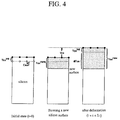
- FIG. 4 is a fragmentary cross sectional elevation view illustrative of oxidation process of a silicon surface to be simulated in a novel process simulation method of FIG. 3.
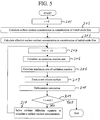
- FIG. 5 is a flow chart illustrative of a novel process simulation method in a second embodiment in accordance with the present invention.
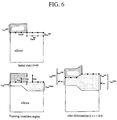
- FIG. 6 is a fragmentary cross sectional elevation view illustrative of oxidation process of a silicon surface to be simulated in a novel process simulation method of FIG. 3.
- the first present invention provides a method of simulating a process for oxidation of silicon.
- the method comprises the following steps.
- a time "t" of oxidation calculation is set at zero.
- An effective surface oxidant concentration of a silicon surface exposed to an oxygen atmosphere is calculated assuming that a spontaneous silicon oxide film as an initial silicon oxide film extends over the silicon surface.
- the time "t" of oxidation calculation is forwarded by a predetermined time increment ⁇ t.
- An oxidation rate is calculated by use of one of the effective surface oxidant concentration and the surface oxidant concentration.
- a new silicon surface is formed based upon the calculated oxidation rate and the time increment ⁇ t. Variations in thickness of the silicon oxide film over time are found by a deformation calculation.
- the presence of the spontaneous silicon oxide film on a part of silicon exposed to an oxygen atmosphere is assumed as an initial silicon oxide film to calculate an effective surface oxidant concentration on the silicon surface to be oxidized. For this reason, it is unnecessary to set or deposit an initial oxide film which isolates an oxidation-intended part of silicon from the oxygen atmosphere, whereby the process simulation is remarkably improved in facilitation of operation of the process simulator and in convenience in use of the process simulator.
- C surf eff C*/ ⁇ (k/h) + 1 + (kT ox init /D) ⁇
- C surf eff is the effective surface oxidant concentration
- T ox init is a thickness of the spontaneous silicon oxide film
- C* is an oxidant concentration of the oxygen atmosphere over the silicon surface
- k and h are predetermined reaction coefficients
- D is a diffusion coefficient of oxidant into a silicon oxide film.
- C surf eff C*/ ⁇ 1 + (kT ox init /D) ⁇
- C surf eff is the effective surface oxidant concentration
- T ox init is a thickness of the spontaneous silicon oxide film
- C* is an oxidant concentration of the oxygen atmosphere over the silicon surface
- D is a diffusion coefficient of oxidant into a silicon oxide film.
- time increment ⁇ t has previously been determined in consideration of both efficiency and accuracy of an intended simulation.
- time increment ⁇ t is constant.
- the time increment ⁇ t is varied.
- the time increment ⁇ t may be set small in an initial half time period whilst set large in a later half time period.
- T ox trans T ox init + ⁇ K ⁇ C surf eff ⁇ t
- T ox trans T ox init + ⁇ K ⁇ C surf eff ⁇ t
- ⁇ a ratio in thickness of silicon to silicon oxide
- T ox init a thickness of the spontaneous silicon oxide film
- K is a constant
- C surf eff the effective surface oxidant concentration.
- ⁇ may be set in the range of 0.44 ⁇ 10%.
- T ox trans T ox init + ⁇ K ⁇ C surf ⁇ t
- T ox trans T ox init + ⁇ K ⁇ C surf ⁇ t
- ⁇ a ratio in thickness of silicon to silicon oxide
- T ox init a thickness of the spontaneous silicon oxide film
- K is a constant
- C surf is a surface oxidant concentration.
- ⁇ may be set in the range of 0.44 ⁇ 10%.
- the second present invention provides a method of simulating a process for oxidation of silicon.
- the method comprises the following steps.
- a time "t" of oxidation calculation is set at zero.
- Both a surface oxidant concentration of a silicon surface for its part thereof unexposed to an oxygen atmosphere and an effective surface oxidant concentration of the silicon surface for its another part exposed to the oxygen atmosphere are calculated, assuming that a spontaneous silicon oxide film as an initial silicon oxide film extends over the silicon surface.
- the time "t" of oxidation calculation is forwarded by a predetermined time increment ⁇ t.
- An oxidation rate is calculated by use of the effective surface oxidant concentration.
- a new silicon surface is formed based upon the calculated oxidation rate and the time increment ⁇ t.
- Variations in thickness of the silicon oxide film over time are founded by a deformation calculation. There is verified whether or not the time “t" of oxidation calculation reaches a predetermined end time so that if the time “t” of oxidation calculation reaches the predetermined end time, then a current simulation is ended, whilst if the time "t” of oxidation calculation does not reach the predetermined end time, then an oxidant diffusion equation is solved for a deformed silicon oxide film to calculate the surface oxidant concentration of the silicon surface to be oxidized. A loop comprising the sequential third to seventh steps is repeated until the time "t" of oxidation calculation reaches the predetermined end time.
- the presence of the spontaneous silicon oxide film on a part of silicon exposed to an oxygen atmosphere is assumed as an initial silicon oxide film to calculate an effective surface oxidant concentration on the silicon surface to be oxidized. For this reason, it is unnecessary to set or deposit an initial oxide film which isolates an oxidation-intended part of silicon from the oxygen atmosphere, whereby the process simulation is remarkably improved in facilitation of operation of the process simulator and in convenience in use of the process simulator.
- the oxidant diffusion equation is approximated to be D ox ⁇ 2 C ox ⁇ 0 .
- C surf eff C*/ ⁇ (k/h) + 1 + (kT ox init /D) ⁇
- C surf eff is the effective surface oxidant concentration
- T ox init is a thickness of the spontaneous silicon oxide film
- C* is an oxidant concentration of the oxygen atmosphere over the silicon surface
- k and h are predetermined reaction coefficients
- D is a diffusion coefficient of oxidant into a silicon oxide film.
- C surf eff C*/ ⁇ 1 + (kT ox init /D) ⁇
- C surf eff is the effective surface oxidant concentration
- T ox init is a thickness of the spontaneous silicon oxide film
- C* is an oxidant concentration of the oxygen atmosphere over the silicon surface
- D is a diffusion coefficient of oxidant into a silicon oxide film.
- time increment ⁇ t has previously been determined in consideration of both efficiency and accuracy of an intended simulation.
- time increment ⁇ t is constant.
- the time increment ⁇ t is varied.
- the time increment ⁇ t may be set small in an initial half time period whilst set large in a later half time period.
- T ox trans T ox init + ⁇ K ⁇ C surf eff ⁇ t
- T ox trans T ox init + ⁇ K ⁇ C surf eff ⁇ t
- ⁇ a ratio in thickness of silicon to silicon oxide
- T ox init a thickness of the spontaneous silicon oxide film
- K is a constant
- C surf eff the effective surface oxidant concentration.
- ⁇ may be set in the range of 0.44 ⁇ 10%.
- T ox trans T ox init + ⁇ K ⁇ C surf ⁇ t
- T ox trans T ox init + ⁇ K ⁇ C surf ⁇ t
- ⁇ a ratio in thickness of silicon to silicon oxide
- T ox init a thickness of the spontaneous silicon oxide film
- K is a constant
- C surf is a surface oxidant concentration.
- ⁇ may be set in the range of 0.44 ⁇ 10%.
- the third present invention provides a computer-readable storage medium having stored a computer program for simulating a process for oxidation of silicon.
- the computer program includes the following steps. A time "t" of oxidation calculation is set at zero. An effective surface oxidant concentration of a silicon surface exposed to an oxygen atmosphere is calculated assuming that a spontaneous silicon oxide film as an initial silicon oxide film extends over the silicon surface. The time "t" of oxidation calculation is forwarded by a predetermined time increment ⁇ t. An oxidation rate is calculated by use of one of the effective surface oxidant concentration and the surface oxidant concentration. A new silicon surface is formed based upon the calculated oxidation rate and the time increment ⁇ t. Variations in thickness of the silicon oxide film over time are found by a deformation calculation.
- the presence of the spontaneous silicon oxide film on a part of silicon exposed to an oxygen atmosphere is assumed as an initial silicon oxide film to calculate an effective surface oxidant concentration on the silicon surface to be oxidized. For this reason, it is unnecessary to set or deposit an initial oxide film which isolates an oxidation-intended part of silicon from the oxygen atmosphere, whereby the process simulation is remarkably improved in facilitation of operation of the process simulator and in convenience in use of the process simulator.
- C surf eff C*/ ⁇ (k/h) + 1 + (kT ox init /D) ⁇
- C surf eff is the effective surface oxidant concentration
- T ox init is a thickness of the spontaneous silicon oxide film
- C* is an oxidant concentration of the oxygen atmosphere over the silicon surface
- k and h are predetermined reaction coefficients
- D is a diffusion coefficient of oxidant into a silicon oxide film.
- C surf eff C*/ ⁇ 1 + (kT ox init /D) ⁇
- C surf eff is the effective surface oxidant concentration
- T ox init is a thickness of the spontaneous silicon oxide film
- C* is an oxidant concentration of the oxygen atmosphere over the silicon surface
- D is a diffusion coefficient of oxidant into a silicon oxide film.
- time increment ⁇ t has previously been determined in consideration of both efficiency and accuracy of an intended simulation.
- time increment ⁇ t is constant.
- the time increment ⁇ t is varied.
- the time increment ⁇ t may be set small in an initial half time period whilst set large in a later half time period.
- T ox trans T ox init + ⁇ K ⁇ C surf eff ⁇ t
- T ox trans T ox init + ⁇ K ⁇ C surf eff ⁇ t
- ⁇ a ratio in thickness of silicon to silicon oxide
- T ox init a thickness of the spontaneous silicon oxide film
- K is a constant
- C surf eff the effective surface oxidant concentration.
- ⁇ may be set in the range of 0.44 ⁇ 10%.
- T ox trans T ox init + ⁇ K ⁇ C surf ⁇ t
- T ox trans T ox init + ⁇ K ⁇ C surf ⁇ t
- ⁇ a ratio in thickness of silicon to silicon oxide
- T ox init a thickness of the spontaneous silicon oxide film
- K is a constant
- C surf is a surface oxidant concentration.
- ⁇ may be set in the range of 0.44 ⁇ 10%.
- the fourth present invention provides a computer-readable storage medium having stored a computer program for simulating a process for oxidation of silicon.
- the computer program includes the following steps.
- a time "t" of oxidation calculation is set at zero. Both a surface oxidant concentration of a silicon surface for its part thereof unexposed to an oxygen atmosphere and an effective surface oxidant concentration of the silicon surface for its another part exposed to the oxygen atmosphere are calculated, assuming that a spontaneous silicon oxide film as an initial silicon oxide film extends over the silicon surface.
- the time "t" of oxidation calculation is forwarded by a predetermined time increment ⁇ t.
- An oxidation rate is calculated by use of the effective surface oxidant concentration.
- a new silicon surface is formed based upon the calculated oxidation rate and the time increment ⁇ t.
- Variations in thickness of the silicon oxide film over time are founded by a deformation calculation. There is verified whether or not the time “t" of oxidation calculation reaches a predetermined end time so that if the time “t” of oxidation calculation reaches the predetermined end time, then a current simulation is ended, whilst if the time "t” of oxidation calculation does not reach the predetermined end time, then an oxidant diffusion equation is solved for a deformed silicon oxide film to calculate the surface oxidant concentration of the silicon surface to be oxidized. A loop comprising the sequential third to seventh steps is repeated until the time "t" of oxidation calculation reaches the predetermined end time.
- the presence of the spontaneous silicon oxide film on a part of silicon exposed to an oxygen atmosphere is assumed as an initial silicon oxide film to calculate an effective surface oxidant concentration on the silicon surface to be oxidized. For this reason, it is unnecessary to set or deposit an initial oxide film which isolates an oxidation-intended part of silicon from the oxygen atmosphere, whereby the process simulation is remarkably improved in facilitation of operation of the process simulator and in convenience in use of the process simulator.
- the computer program further includes the step of conducting, after the fourth step, a calculation for a maximum rate of oxidation reaction at points where a plurality of definitions for rate of oxidation reaction are given on the same coordinates.
- the oxidant diffusion equation may be approximated to be D ox ⁇ 2 C ox ⁇ 0 .
- C surf eff C*/ ⁇ (k/h) + 1 + (kT ox init /D) ⁇
- C surf eff is the effective surface oxidant concentration
- T ox init is a thickness of the spontaneous silicon oxide film
- C* is an oxidant concentration of the oxygen atmosphere over the silicon surface
- k and h are predetermined reaction coefficients
- D is a diffusion coefficient of oxidant into a silicon oxide film.
- C surf eff C*/ ⁇ 1 + (kT ox init /D) ⁇
- C surf eff is the effective surface oxidant concentration
- T ox init is a thickness of the spontaneous silicon oxide film
- C* is an oxidant concentration of the oxygen atmosphere over the silicon surface
- D is a diffusion coefficient of oxidant into a silicon oxide film.
- time increment ⁇ t has previously been determined in consideration of both efficiency and accuracy of an intended simulation.
- time increment ⁇ t is constant.
- the time increment ⁇ t is varied.
- the time increment ⁇ t may be set small in an initial half time period whilst set large in a later half time period.
- T ox trans T ox init + ⁇ K ⁇ C surf eff ⁇ t
- T ox trans is a thickness of the transition region
- ⁇ is a ratio in thickness of silicon to silicon oxide
- T ox init is a thickness of the spontaneous silicon oxide film
- K is a constant
- C surf eff is the effective surface oxidant concentration.
- ⁇ may be set in the range of 0.44 ⁇ 10%.
- T ox trans T ox init + ⁇ K ⁇ C surf ⁇ t
- T ox trans is a thickness of the transition region
- ⁇ is a ratio in thickness of silicon to silicon oxide
- T ox init is a thickness of the spontaneous silicon oxide film
- K is a constant
- C surf is a surface oxidant concentration.
- ⁇ may be set in the range of 0.44 ⁇ 10%.
- the fifth present invention provides a process simulator for a simulation of a process for oxidation of silicon.
- the process simulator includes a processing unit and a storage unit which has stored a computer program for causing the processing unit to perform the simulation by the following steps.
- a time "t" of oxidation calculation is set at zero.
- An effective surface oxidant concentration of a silicon surface exposed to an oxygen atmosphere is calculated assuming that a spontaneous silicon oxide film as an initial silicon oxide film extends over the silicon surface.
- the time "t" of oxidation calculation is forwarded by a predetermined time increment ⁇ t.
- An oxidation rate is calculated by use of one of the effective surface oxidant concentration and the surface oxidant concentration.
- a new silicon surface is formed based upon the calculated oxidation rate and the time increment ⁇ t.
- Variations in thickness of the silicon oxide film over time are found by a deformation calculation. There is verified whether or not the time “t" of oxidation calculation reaches a predetermined end time so that if the time “t” of oxidation calculation reaches the predetermined end time, then a current simulation is ended, whilst if the time "t” of oxidation calculation does not reach the predetermined end time, then an oxidant diffusion equation is solved for a deformed silicon oxide film to calculate the surface oxidant concentration of the silicon surface to be oxidized. A loop comprising the sequential third to seventh steps is repeated until the time "t" of oxidation calculation reaches the predetermined end time.
- the presence of the spontaneous silicon oxide film on a part of silicon exposed to an oxygen atmosphere is assumed as an initial silicon oxide film to calculate an effective surface oxidant concentration on the silicon surface to be oxidized. For this reason, it is unnecessary to set or deposit an initial oxide film which isolates an oxidation-intended part of silicon from the oxygen atmosphere, whereby the process simulation is remarkably improved in facilitation of operation of the process simulator and in convenience in use of the process simulator.
- C surf eff C*/ ⁇ (k/h) + 1 + (kT ox init /D) ⁇
- C surf eff is the effective surface oxidant concentration
- T ox init is a thickness of the spontaneous silicon oxide film
- C* is an oxidant concentration of the oxygen atmosphere over the silicon surface
- k and h are predetermined reaction coefficients
- D is a diffusion coefficient of oxidant into a silicon oxide film.
- C surf eff C*/ ⁇ 1 + (kT ox init /D) ⁇
- C surf eff is the effective surface oxidant concentration
- T ox init is a thickness of the spontaneous silicon oxide film
- C* is an oxidant concentration of the oxygen atmosphere over the silicon surface
- D is a diffusion coefficient of oxidant into a silicon oxide film.
- time increment ⁇ t has previously been determined in consideration of both efficiency and accuracy of an intended simulation.
- time increment ⁇ t is constant.
- the time increment ⁇ t is varied.
- the time increment ⁇ t may be set small in an initial half time period whilst set large in a later half time period.
- T ox trans T ox init + ⁇ K ⁇ C surf eff ⁇ t
- T ox trans T ox init + ⁇ K ⁇ C surf eff ⁇ t
- ⁇ a ratio in thickness of silicon to silicon oxide
- T ox init a thickness of the spontaneous silicon oxide film
- K is a constant
- C surf eff the effective surface oxidant concentration.
- ⁇ may be set in the range of 0.44 ⁇ 10%.
- T ox trans T ox init + ⁇ K ⁇ C surf ⁇ t
- T ox trans T ox init + ⁇ K ⁇ C surf ⁇ t
- ⁇ a ratio in thickness of silicon to silicon oxide
- T ox init a thickness of the spontaneous silicon oxide film
- K is a constant
- C surf is a surface oxidant concentration.
- ⁇ may be set in the range of 0.44 ⁇ 10%.
- the sixth present invention provides a process simulator for a simulation of a process for oxidation of silicon.
- the process simulator includes a processing unit and a storage unit which has stored a computer program for causing the processing unit to perform the simulation by the following steps.
- a time "t" of oxidation calculation is set at zero. Both a surface oxidant concentration of a silicon surface for its part thereof unexposed to an oxygen atmosphere and an effective surface oxidant concentration of the silicon surface for its another part exposed to the oxygen atmosphere are calculated, assuming that a spontaneous silicon oxide film as an initial silicon oxide film extends over the silicon surface.
- the time "t" of oxidation calculation is forwarded by a predetermined time increment ⁇ t.
- An oxidation rate is calculated by use of the effective surface oxidant concentration.
- a new silicon surface is formed based upon the calculated oxidation rate and the time increment ⁇ t. Variations in thickness of the silicon oxide film over time are founded by a deformation calculation. There is verified whether or not the time “t" of oxidation calculation reaches a predetermined end time so that if the time “t” of oxidation calculation reaches the predetermined end time, then a current simulation is ended, whilst if the time "t" of oxidation calculation does not reach the predetermined end time, then an oxidant diffusion equation is solved for a deformed silicon oxide film to calculate the surface oxidant concentration of the silicon surface to be oxidized. A loop comprising the sequential third to seventh steps is repeated until the time "t" of oxidation calculation reaches the predetermined end time.
- the presence of the spontaneous silicon oxide film on a part of silicon exposed to an oxygen atmosphere is assumed as an initial silicon oxide film to calculate an effective surface oxidant concentration on the silicon surface to be oxidized. For this reason, it is unnecessary to set or deposit an initial oxide film which isolates an oxidation-intended part of silicon from the oxygen atmosphere, whereby the process simulation is remarkably improved in facilitation of operation of the process simulator and in convenience in use of the process simulator.
- the simulation further includes the step of conducting, after the fourth step, a calculation for a maximum rate of oxidation reaction at points where a plurality of definitions for rate of oxidation reaction are given on the same coordinates.
- the oxidant diffusion equation is approximated to be D ox ⁇ 2 C ox ⁇ 0 .
- C surf eff C*/ ⁇ (k/h) + 1 + (kT ox init /D) ⁇
- C surf eff is the effective surface oxidant concentration
- T ox init is a thickness of the spontaneous silicon oxide film
- C* is an oxidant concentration of the oxygen atmosphere over the silicon surface
- k and h are predetermined reaction coefficients
- D is a diffusion coefficient of oxidant into a silicon oxide film.
- C surf eff C*/ ⁇ 1 + (kT ox init /D) ⁇
- C surf eff is the effective surface oxidant concentration
- T ox init is a thickness of the spontaneous silicon oxide film
- C* is an oxidant concentration of the oxygen atmosphere over the silicon surface
- D is a diffusion coefficient of oxidant into a silicon oxide film.
- time increment ⁇ t has previously been determined in consideration of both efficiency and accuracy of an intended simulation.
- time increment ⁇ t is constant.
- the time increment ⁇ t is varied.
- the time increment ⁇ t may be set small in an initial half time period whilst set large in a later half time period.
- T ox trans T ox init + ⁇ K ⁇ C surf eff ⁇ t
- T ox trans T ox init + ⁇ K ⁇ C surf eff ⁇ t
- ⁇ a ratio in thickness of silicon to silicon oxide
- T ox init a thickness of the spontaneous silicon oxide film
- K is a constant
- C surf eff the effective surface oxidant concentration.
- ⁇ may be set in the range of 0.44 ⁇ 10%.
- T ox trans T ox init + ⁇ K ⁇ C surf ⁇ t
- T ox trans T ox init + ⁇ K ⁇ C surf ⁇ t
- ⁇ a ratio in thickness of silicon to silicon oxide
- T ox init a thickness of the spontaneous silicon oxide film
- K is a constant
- C surf is a surface oxidant concentration.
- ⁇ may be set in the range of 0.44 ⁇ 10%.
- FIG. 3 is a flow chart illustrative of a novel process simulation method in oxidation process for formation of a semiconductor device, provided that an entire surface of silicon is exposed to an oxygen atmosphere.
- the novel process simulation method comprises the following steps.
- a time "t" of oxidation calculation is set at zero.
- a silicon surface to be oxidized is exposed to an oxygen atmosphere, then an effective surface oxidant concentration is calculated in consideration of an initial silicon oxide film, wherein a presence of a spontaneous silicon oxide film having a thickness of T ox init over silicon is assumed so that a surface oxidant concentration C surf eff of silicon surface exposed to an oxygen atmosphere is found as the following equation by solving an equivalent equation to one-dimensional Deal-Grove equation.
- C surf eff C*/ ⁇ (k/h) + 1 + (kT ox init /D) ⁇
- C* is the oxidant concentration of an atmosphere over a silicon surface
- k and h are the reaction coefficients
- D is the diffusion coefficient of oxidant into a silicon oxide film
- T ox init is the thickness of the spontaneous silicon oxide film as the initial silicon oxide film. It may, for example, be possible that the thickness T ox init is assumed to be 20 angstroms.
- a third step 103 the time "t" of oxidation calculation is forwarded by a predetermined time increment ⁇ t, wherein ⁇ t has previously been determined in consideration of both efficiency and accuracy of an intended simulation.
- ⁇ t has previously been determined in consideration of both efficiency and accuracy of an intended simulation.
- the time increment ⁇ t may be determined to be 5 minutes.
- This time increment ⁇ t may be determined to be constant or may be varied. It is, for example, possible that the time increment ⁇ t is relatively small in the initial half time period whilst relatively large in the later half time period.
- a fourth step 104 the surface oxidant concentration C surf eff of silicon surface is used to solve the following equation in order to calculate an oxidation rate dT ox /dt (V ox ).
- dT ox /dt K ⁇ C surf eff
- a new silicon surface is formed based upon the calculated oxidation rate dT ox /dt (V ox ) and the time increment ⁇ t as shown in FIG. 4, whereby the spontaneous silicon oxide film is absorbed into a transition region.
- a thickness T ox trans of the transition region is given by the following equation.
- 0.44 is a typical value as a ratio in thickness of silicon to be oxidized to silicon oxide. This value 0.44 might be varied in the range of 0.44 ⁇ 10% under various conditions. The value in the range of 0.44 ⁇ 10% may be available as the coefficient in the above equation (7).
- 0.44 is a typical value as a ratio in thickness of silicon to be oxidized to silicon oxide. This value 0.44 might be varied in the range of 0.44 ⁇ 10% under various conditions. The value in the range of 0.44 ⁇ 10% may be available as the coefficient in the above equation (7').
- a calculation for deformation is implemented to find a variation in thickness of a silicon oxide film for every one hour as shown in FIG. 4.
- a seventh step 107 it is verified whether or not the time "t" of oxidation calculation reaches a predetermined end time. If the time “t” of oxidation calculation reaches the predetermined end time, then the above process simulation is ended. If, however, the time “t” of oxidation calculation does not reach the predetermined end time, then the process simulation enters into an eight step 108.
- the oxidant diffusion equation is solved for the deformed silicon oxide film to calculate the surface oxidant concentration C surf of the silicon surface to be oxidized before returning to the above third step 103.
- a loop comprising the sequential steps 103 through 108 is repeated until the time "t" of oxidation calculation reaches the predetermined end time.
- the presence of the spontaneous silicon oxide film on a part of silicon exposed to an oxygen atmosphere is assumed as an initial silicon oxide film to calculate an effective surface oxidant concentration on the silicon surface to be oxidized. For this reason, it is unnecessary to set or deposit an initial oxide film which isolates an oxidation-intended part of silicon from the oxygen atmosphere, whereby the process simulation is remarkably improved in facilitation of operation of the process simulator and in convenience in use of the process simulator.
- FIG. 5 is a flow chart illustrative of a novel process simulation method in oxidation process for formation of a semiconductor device, provided that a surface of silicon is partially exposed to an oxygen atmosphere.
- the novel process simulation method comprises the following steps.
- a time "t" of oxidation calculation is set at zero.
- a surface oxidant concentration C surf of a silicon surface is calculated by solving the following oxidant diffusion equation regarding a part of silicon which is not exposed to an oxygen atmosphere.
- D ox ⁇ 2 C ox dC ox /dt
- D ox is the diffusion coefficient of oxidant in oxide film
- ⁇ 2 is the Laplacean
- C ox is the oxidant concentration.
- a third step 203 for the remaining part of silicon surface exposed to the oxygen atmosphere, an effective surface oxidant concentration is calculated in consideration of an initial silicon oxide film, wherein a spontaneous silicon oxide film having a thickness of T ox init is assumed so that a surface oxidant concentration C surf eff of silicon surface exposed to the oxygen atmosphere is found as the following equation by solving an equivalent equation to one-dimensional Deal-Grove equation.
- C surf eff C*/ ⁇ (k/h) + 1 + (kT ox init /D) ⁇
- C* is the oxidant concentration of an atmosphere over a silicon surface
- k and h are the reaction coefficients
- D is the diffusion coefficient of oxidant into a silicon oxide film
- T ox init is the thickness of the spontaneous silicon oxide film as the initial silicon oxide film. It may, for example, be possible that the thickness T ox init is assumed to be 20 angstroms.
- a fourth step 204 the time "t" of oxidation calculation is forwarded by a predetermined time increment ⁇ t, wherein ⁇ t has previously been determined in consideration of both efficiency and accuracy of an intended simulation.
- ⁇ t has previously been determined in consideration of both efficiency and accuracy of an intended simulation.
- the time increment ⁇ t may be determined to be 5 minutes.
- This time increment ⁇ t may be determined to be constant or may be varied. It is, for example, possible that the time increment ⁇ t is relatively small in the initial half time period whilst relatively large in the later half time period.
- both the surface oxidant concentration C surf and the effective surface oxidant concentration C surf eff of silicon surface are used to solve the following equations in order to calculate an oxidation rate dT ox /dt (V ox ).
- dT ox /dt K ⁇ C surf
- dT ox /dt K ⁇ C surf eff
- a new silicon surface is formed based upon the calculated oxidation rate dT ox /dt (V ox ) and the time increment ⁇ t as shown in FIG. 6, whereby the spontaneous silicon oxide film is absorbed into a transition region.
- a thickness T ox trans of the transition region is given by the following equations.
- 0.44 is a typical value as a ratio in thickness of silicon to be oxidized to silicon oxide. This value 0.44 might be varied in the range of 0.44 ⁇ 10% under various conditions. The value in the range of 0.44 ⁇ 10% may be available as the coefficient in the above equations.
- a calculation for deformation is implemented to find a variation in thickness of a silicon oxide film for every one hour as shown in FIG. 6.
- a ninth step 209 it is verified whether or not the time "t" of oxidation calculation reaches a predetermined end time. If the time “t” of oxidation calculation reaches the predetermined end time, then the above process simulation is ended. If, however, the time “t” of oxidation calculation does not reach the predetermined end time, then the process simulation enters into a tenth step 210.
- the oxidant diffusion equation is solved for the deformed silicon oxide film to calculate the surface oxidant concentration C surf of the silicon surface to be oxidized before returning to the above fourth step 204.
- a loop comprising the sequential steps 204 through 210 is repeated until the time "t" of oxidation calculation reaches the predetermined end time.
- the presence of the spontaneous silicon oxide film on a part of silicon exposed to an oxygen atmosphere is assumed as an initial silicon oxide film to calculate an effective surface oxidant concentration on the silicon surface to be oxidized. For this reason, it is unnecessary to set or deposit an initial oxide film which isolates an oxidation-intended part of silicon from the oxygen atmosphere, whereby the process simulation is remarkably improved in facilitation of operation of the process simulator and in convenience in use of the process simulator.
Landscapes
- Engineering & Computer Science (AREA)
- Physics & Mathematics (AREA)
- Theoretical Computer Science (AREA)
- Computer Hardware Design (AREA)
- Evolutionary Computation (AREA)
- Geometry (AREA)
- General Engineering & Computer Science (AREA)
- General Physics & Mathematics (AREA)
- Formation Of Insulating Films (AREA)
- Local Oxidation Of Silicon (AREA)
- Management, Administration, Business Operations System, And Electronic Commerce (AREA)
Applications Claiming Priority (3)
| Application Number | Priority Date | Filing Date | Title |
|---|---|---|---|
| JP107030/97 | 1997-04-24 | ||
| JP10703097A JP3353644B2 (ja) | 1997-04-24 | 1997-04-24 | プロセスシミュレーション方法 |
| JP10703097 | 1997-04-24 |
Publications (2)
| Publication Number | Publication Date |
|---|---|
| EP0875847A2 true EP0875847A2 (fr) | 1998-11-04 |
| EP0875847A3 EP0875847A3 (fr) | 2000-03-01 |
Family
ID=14448745
Family Applications (1)
| Application Number | Title | Priority Date | Filing Date |
|---|---|---|---|
| EP98107520A Withdrawn EP0875847A3 (fr) | 1997-04-24 | 1998-04-24 | Méthode de simulation d'un procédé pour calculer la concentration d'oxydant de surface dans un procédé d'oxydation |
Country Status (3)
| Country | Link |
|---|---|
| US (1) | US6044213A (fr) |
| EP (1) | EP0875847A3 (fr) |
| JP (1) | JP3353644B2 (fr) |
Families Citing this family (5)
| Publication number | Priority date | Publication date | Assignee | Title |
|---|---|---|---|---|
| JP2009140956A (ja) * | 2007-12-03 | 2009-06-25 | Elpida Memory Inc | 形状予測シミュレータ、方法およびプログラム |
| JP5258824B2 (ja) | 2010-03-16 | 2013-08-07 | 株式会社東芝 | プロセスシミュレーションをコンピュータに実行させるプログラム |
| JP6986810B2 (ja) * | 2020-04-23 | 2021-12-22 | 信 伊藤 | 半導体材料の熱酸化プロセスにおける酸化時間の計算方法 |
| CN113514021B (zh) * | 2021-06-10 | 2023-08-11 | 中国空气动力研究与发展中心计算空气动力研究所 | 一种复合材料质量损失和氧化层厚度的评估方法 |
| CN114019054B (zh) * | 2021-11-08 | 2023-08-01 | 南京中医药大学 | 一种中药成分在纳滤膜界面层浓度的计算方法 |
Family Cites Families (9)
| Publication number | Priority date | Publication date | Assignee | Title |
|---|---|---|---|---|
| US4728619A (en) * | 1987-06-19 | 1988-03-01 | Motorola, Inc. | Field implant process for CMOS using germanium |
| GB2210728B (en) * | 1987-10-07 | 1991-11-13 | Stc Plc | Isolation trenches for semiconductors |
| US5328559A (en) * | 1992-09-08 | 1994-07-12 | Ic Sensors, Inc. | Groove width trimming |
| DE59409300D1 (de) * | 1993-06-23 | 2000-05-31 | Siemens Ag | Verfahren zur Herstellung von einem Isolationsgraben in einem Substrat für Smart-Power-Technologien |
| JPH0855145A (ja) * | 1994-08-08 | 1996-02-27 | Fujitsu Ltd | 半導体プロセスシミュレーション方法及びそのための装置 |
| JP2701795B2 (ja) * | 1995-06-28 | 1998-01-21 | 日本電気株式会社 | プロセスシミュレーション方法 |
| US5674762A (en) * | 1995-08-28 | 1997-10-07 | Motorola, Inc. | Method of fabricating an EPROM with high voltage transistors |
| JPH0981610A (ja) * | 1995-09-12 | 1997-03-28 | Toshiba Corp | シミュレーション方法及びその装置 |
| US5834379A (en) * | 1996-07-16 | 1998-11-10 | Cornell Research Foundation, Inc. | Process for synthesis of cubic GaN on GaAs using NH3 in an RF plasma process |
-
1997
- 1997-04-24 JP JP10703097A patent/JP3353644B2/ja not_active Expired - Fee Related
-
1998
- 1998-04-24 US US09/065,900 patent/US6044213A/en not_active Expired - Fee Related
- 1998-04-24 EP EP98107520A patent/EP0875847A3/fr not_active Withdrawn
Also Published As
| Publication number | Publication date |
|---|---|
| JPH10303192A (ja) | 1998-11-13 |
| US6044213A (en) | 2000-03-28 |
| EP0875847A3 (fr) | 2000-03-01 |
| JP3353644B2 (ja) | 2002-12-03 |
Similar Documents
| Publication | Publication Date | Title |
|---|---|---|
| Antoniadis et al. | Models for computer simulation of complete IC fabrication process | |
| US6044213A (en) | Process simulation method for calculating a surface oxidant concentration in oxidation process | |
| EP0862126A2 (fr) | Dispositif de simulation de procédé d'implantation d'ions réalisant une interpolation précise des profils d'implantation d'ions et méthode de simulation | |
| JP3016385B2 (ja) | プロセスシミュレーション方法 | |
| JP2998653B2 (ja) | プロセスシミュレーション方法 | |
| US7707523B2 (en) | Method of fabricating a semiconductor device and a method of generating a mask pattern | |
| JP3050290B2 (ja) | アモルファス化領域決定方法 | |
| US20010041971A1 (en) | Method of generating mesh and storage medium storing mesh generating program | |
| US20010045572A1 (en) | Semiconductor interated circuit and method of manufacturing the same | |
| JP3298524B2 (ja) | プロセスシミュレーション方法 | |
| JPH021917A (ja) | 半導体集積回路 | |
| JP3123533B2 (ja) | プロセスシミュレーション方法 | |
| JP3022401B2 (ja) | プロセスシミュレーション方法 | |
| Krusius et al. | Two-and three-dimensional analytical solutions for post-anneal implant profiles through arbitrary mask edges | |
| JP2980459B2 (ja) | 半導体素子製造方法およびその装置 | |
| US20020165704A1 (en) | Method for extrapolating model parameters of spice | |
| Tazawa et al. | A high-speed 2-D topography simulator based on a pixel model | |
| JP3099464B2 (ja) | 遅延計算装置 | |
| JPH09191039A (ja) | 半導体シミュレーション方法および半導体シミュレーション装置 | |
| US6513150B1 (en) | Method of generating mesh for process simulation | |
| JP3204300B2 (ja) | デバイスシミュレーション方法 | |
| Collard et al. | TWO‐DIMENSIONAL PROCESS SIMULATION USING A QUADRATIC FINITE ELEMENT DISCRETIZATION | |
| EP1071127A2 (fr) | Méthode de simulation rapide d'un procédé d'oxidation dans un dispositif semiconducteur | |
| JP2964808B2 (ja) | 不純物拡散プロセスのシミュレーション方法 | |
| Guillemot et al. | Recent developments of the two-dimensional technological process simulator OSIRIS |
Legal Events
| Date | Code | Title | Description |
|---|---|---|---|
| PUAI | Public reference made under article 153(3) epc to a published international application that has entered the european phase |
Free format text: ORIGINAL CODE: 0009012 |
|
| AK | Designated contracting states |
Kind code of ref document: A2 Designated state(s): CH DE GB LI |
|
| AX | Request for extension of the european patent |
Free format text: AL;LT;LV;MK;RO;SI |
|
| PUAL | Search report despatched |
Free format text: ORIGINAL CODE: 0009013 |
|
| AK | Designated contracting states |
Kind code of ref document: A3 Designated state(s): AT BE CH CY DE DK ES FI FR GB GR IE IT LI LU MC NL PT SE |
|
| AX | Request for extension of the european patent |
Free format text: AL;LT;LV;MK;RO;SI |
|
| 17P | Request for examination filed |
Effective date: 20000122 |
|
| AKX | Designation fees paid |
Free format text: CH DE GB LI |
|
| RAP1 | Party data changed (applicant data changed or rights of an application transferred) |
Owner name: NEC ELECTRONICS CORPORATION |
|
| STAA | Information on the status of an ep patent application or granted ep patent |
Free format text: STATUS: THE APPLICATION HAS BEEN WITHDRAWN |
|
| 18W | Application withdrawn |
Effective date: 20031120 |