EP0875822A2 - Verfahren zum Erzeugen von reinen Carr-Save-Ausgangswerten für einen Multplizierer - Google Patents
Verfahren zum Erzeugen von reinen Carr-Save-Ausgangswerten für einen Multplizierer Download PDFInfo
- Publication number
- EP0875822A2 EP0875822A2 EP98303034A EP98303034A EP0875822A2 EP 0875822 A2 EP0875822 A2 EP 0875822A2 EP 98303034 A EP98303034 A EP 98303034A EP 98303034 A EP98303034 A EP 98303034A EP 0875822 A2 EP0875822 A2 EP 0875822A2
- Authority
- EP
- European Patent Office
- Prior art keywords
- multiplier
- carry
- save
- partial
- bit
- Prior art date
- Legal status (The legal status is an assumption and is not a legal conclusion. Google has not performed a legal analysis and makes no representation as to the accuracy of the status listed.)
- Withdrawn
Links
Images


Classifications
-
- G—PHYSICS
- G06—COMPUTING OR CALCULATING; COUNTING
- G06F—ELECTRIC DIGITAL DATA PROCESSING
- G06F7/00—Methods or arrangements for processing data by operating upon the order or content of the data handled
- G06F7/38—Methods or arrangements for performing computations using exclusively denominational number representation, e.g. using binary, ternary, decimal representation
- G06F7/48—Methods or arrangements for performing computations using exclusively denominational number representation, e.g. using binary, ternary, decimal representation using non-contact-making devices, e.g. tube, solid state device; using unspecified devices
- G06F7/52—Multiplying; Dividing
- G06F7/523—Multiplying only
- G06F7/53—Multiplying only in parallel-parallel fashion, i.e. both operands being entered in parallel
- G06F7/5306—Multiplying only in parallel-parallel fashion, i.e. both operands being entered in parallel with row wise addition of partial products
- G06F7/5312—Multiplying only in parallel-parallel fashion, i.e. both operands being entered in parallel with row wise addition of partial products using carry save adders
-
- G—PHYSICS
- G06—COMPUTING OR CALCULATING; COUNTING
- G06F—ELECTRIC DIGITAL DATA PROCESSING
- G06F7/00—Methods or arrangements for processing data by operating upon the order or content of the data handled
- G06F7/38—Methods or arrangements for performing computations using exclusively denominational number representation, e.g. using binary, ternary, decimal representation
- G06F7/48—Methods or arrangements for performing computations using exclusively denominational number representation, e.g. using binary, ternary, decimal representation using non-contact-making devices, e.g. tube, solid state device; using unspecified devices
- G06F7/499—Denomination or exception handling, e.g. rounding or overflow
- G06F7/49994—Sign extension
-
- G—PHYSICS
- G06—COMPUTING OR CALCULATING; COUNTING
- G06F—ELECTRIC DIGITAL DATA PROCESSING
- G06F7/00—Methods or arrangements for processing data by operating upon the order or content of the data handled
- G06F7/38—Methods or arrangements for performing computations using exclusively denominational number representation, e.g. using binary, ternary, decimal representation
- G06F7/48—Methods or arrangements for performing computations using exclusively denominational number representation, e.g. using binary, ternary, decimal representation using non-contact-making devices, e.g. tube, solid state device; using unspecified devices
- G06F7/52—Multiplying; Dividing
- G06F7/523—Multiplying only
- G06F7/533—Reduction of the number of iteration steps or stages, e.g. using the Booth algorithm, log-sum, odd-even
- G06F7/5334—Reduction of the number of iteration steps or stages, e.g. using the Booth algorithm, log-sum, odd-even by using multiple bit scanning, i.e. by decoding groups of successive multiplier bits in order to select an appropriate precalculated multiple of the multiplicand as a partial product
- G06F7/5336—Reduction of the number of iteration steps or stages, e.g. using the Booth algorithm, log-sum, odd-even by using multiple bit scanning, i.e. by decoding groups of successive multiplier bits in order to select an appropriate precalculated multiple of the multiplicand as a partial product overlapped, i.e. with successive bitgroups sharing one or more bits being recoded into signed digit representation, e.g. using the Modified Booth Algorithm
- G06F7/5338—Reduction of the number of iteration steps or stages, e.g. using the Booth algorithm, log-sum, odd-even by using multiple bit scanning, i.e. by decoding groups of successive multiplier bits in order to select an appropriate precalculated multiple of the multiplicand as a partial product overlapped, i.e. with successive bitgroups sharing one or more bits being recoded into signed digit representation, e.g. using the Modified Booth Algorithm each bitgroup having two new bits, e.g. 2nd order MBA
Definitions
- This application is related to the art of automated processing of numerical data, and more particularly to an improved method for implementing carry-save multiplication in such processing.
- a method is provided for causing each partial product, and a sum of all partial products in a two's-complement carry-save multiplier to be in pure carry-save form. That method includes the addition of sign extension bits to each partial product of the multiplier to achieve such pure carry-save form.
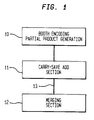
- Figure 1 illustrates in schematic form a typical prior-art Booth multiplier using carry-save architecture.
- Figure 2 shows the decoded partial products for a Booth-multiplier modified according to the method of the invention.
- Figure 3 shows the carry-save add section of an exemplary 12 x 10 Booth multiplier implemented according to the method of the invention.
- an algorithm may be seen as a self-contained sequence of steps leading to a desired result. These steps generally involve manipulations of physical quantities. Usually, though not necessarily, these quantities take the form of electrical or magnetic signals capable of being stored, transferred, combined, compared and otherwise manipulated. For convenience of reference, as well as to comport with common usage, these signals will be described from time to time in terms of bits, values, elements, symbols, characters, terms, numbers, or the like. However, it should be emphasized that these and similar terms are to be associated with the appropriate physical quantities - such terms being merely convenient labels applied to those quantities.
- a starting point for any consideration of machine processing of numerical data is a determination of the form in which the data will be presented.
- a numbering system must be chosen.
- machine processing of numbers has been related to numbers represented in base 2 (binary), 8 (octal), 10 (decimal) and 16 (hexadecimal). Because the binary numbering system has become the overwhelming choice for contemporary machine processing of numerical data, that system will be used herein to illustrate the methodology of the invention. It should, however, be apparent to those skilled in the art that the inventive method can readily be extended to other numbering systems.
- radix complements Two kinds of complements are in general use: radix complements and diminished radix complements, where radix refers to the base of the number system being used.
- the diminished radix complement is known as the one's-complement and is formed by complementing each bit in the binary number under consideration (i.e., changing all "1"s to "0"s and vice versa).
- the radix complement in binary is known as the two's-complement, and is formed by adding "1" to the one's-complement of the number.
- two's-complement representation will be used to illustrate the methodology of the invention and may be considered as being a part of the preferred embodiment of the invention. However, it should be apparent to those skilled in the art of the invention that the methodology disclosed herein may readily be extended to other complementary forms.
- the fundamental arithmetic operation carried out for machine processing of numerical data is that of addition, which is implemented in the machine process by a logical device known as an adder.
- Each adder processes one bit for up to three numerical values to be added.
- Such adders are usually staged in parallel (the number of such parallel adders being at least equal to the number of bits in numbers to be added) with the result that all bits in the numbers being added are processed simultaneously.
- Such parallel adders must of course deal with the carry from one bit position to another, and a variety of parallel adder configurations have been developed to address this requirement.
- the ripple adder the carry look-ahead adder
- carry-save adder All of these parallel adder configurations are well known in the art and, except for the carry-save adder which forms a part of the preferred embodiment of the invention, will not be discussed further here.
- the carry-save adder has been found to provide significant advantage in both processing time and hardware complexity over the ripple adder and the carry look-ahead adder. Accordingly it has become the parallel adder of choice for most machine processing applications. Essentially, the unique feature of the carry-save adder can be described as follows. While other parallel adders must propagate a carry produced by a summation at a bit position through all bits to the left of that bit position, the carry-save adder instead provides two output terms for each set of bits added, a sum term and a carry term. The carry terms for each bit position are sent downward (in parallel and shifted one bit position to the left) to another stage as another n -bit number (n being the number of bits in the numbers being added). The "subtotals" of the sum terms and the carry terms are then added to produce the total for the addition operation.
- the primary advantage of the carry-save adder is realized in the multiplication operation and will be discussed further in that context.
- each summation of a partial product and a preceding term will be expressed in carry-save format (i.e., each bit position will have both a sum term and a carry term).
- the carry and sum terms are added in parallel through all of the partial products and the product of the multiplication is determined as a "grand total" of the total of the sum terms through all partial products and the total of the carry terms through all partial products (shifted one bit to the left relative to the sum total). It has been found that application of the carry-save method for addition of the partial products in such multiplication operations results in considerable savings in processing time. Accordingly, this method is commonly used for the multiplication operation in machine processing.
- FIG. 1 A two's-complement Booth multiplier using carry-save addition of the partial products is illustrated schematically in Figure 1.
- a multiplier is functionally divided into three sections.
- the Booth encoding process is carried out and the partial products generated.
- the Booth encoding process is well known in the art and need not be further discussed other than to note that it typically results in a number of partial products which are approximately half the number of bits in the multiplier.
- the second section (Carry-Save Add) 11 the partial products are added using the carry-save methodology, and in the final section (Merging) 12 the sum and carry terms for all of the partial products are merged to form a single value, which is the product of the multiplication.
- the method of the invention produces a modification of the Carry-Save Add process for such a multiplier such that the totals of the carry and sum terms for such an adder are in pure carry-save format, and thus can be used for other processes requiring such an output.
- the invention makes use of a technique known as sign extension. Although that technique is well known to those skilled in the art, a brief review is provided hereafter.
- the sign for a number is typically represented by an extra bit in the most significant bit position for the number.
- the logic of the machine processor is such that this sign bit is not processed in the manner of the normal arithmetic operation being carried out for the number, but rather in such a way as to preserve the correct sign for the resultant of the arithmetic operation. Since these sign bits are not processed in the arithmetic operation, one or more such bits may be added to the left of the most significant bit position of a number with the same effect as adding zeros to the left of a number's most significant bit position.
- the method of the invention proceeds from the recognition by the inventor that the output of a carry-save add section of a multiplier (such as depicted in Figure 1) will be in pure carry-save form if each of the intermediate partial product sums are themselves in pure carry-save form. Realization of that objective -- i.e., each of the intermediate partial product sums for the multiplier being in pure carry-save form -- follows from two key ideas:
- FIG. 2 Application of the method of the invention is illustrated in Figure 2.
- the partial products produced by the Booth encoding step for an exemplary 12 x 10 two's-complement Booth multiplier are shown along with sign extension bits added according to the method of the invention.
- the 5 partial products produced by Booth encoding are designated a 0 , a 1 , ... a 12 ; b 0 , b 1 , ... b 12 ; f 0 , f 1 , ... f 12 ; d 0 , d 1 , ... d 12 ; and e 0 , e 1 , ... e 12 .
- Figure 3 shows 4 rows of bit adders (circles with numerals corresponding to bit position) which will be needed for the addition of the 5 partial products of Figure 2, and which are connected in a carry-save-add configuration.
- Each bit adder has 3 inputs, which as indicated in the figure are constituted as the partial product bits being added for a given adder stage (row), and two outputs, which represent the sum and carry terms for the bits added by that adder.
- a bus device symbolized by ⁇ and having two inputs and one output
- the output of those busses will be the complete sum and carry terms as shown at 25 and 26 of Figure 2, as well as at the output of those bus devices in Figure 3.
- this adder stage combines the "f" partial products (of Figure 2) with the sum and carry terms resulting from addition of the "a” and “b” partial products. Due, however, to the Booth-encoding shift, the "f" partial product bits are shifted two bit positions to the left of the resultant of adding the "a” and “b” partial products, and thus represents a number two bits greater in length than that resultant. This is shown in both the partial products of Figure 2 and by the upper two bit adders in the second adder stage 41 of Figure 3.
- Figure 3 also shows how the invention avoids the necessity of adding two sign-extension bits to that resultant in order to provide equivalent length numbers for the addition process. Because the value of the sum and carry terms associated with the addition of such additional sign-extension bits is known to be the same as that for the first sign-extension bit added (i.e., the sum of the a 0 and b 0 terms in the first adder stage 40 of Figure 3), the resultant values from addition of that first sign-extension bit can be bridged to the upper two bit adders in the second stage adder, as shown at 40 and 41 . This bridging process is repeated for adder stages 3 42 and 4 43 (or, more generally, all adder stages after the first stage) thus saving two bit adders per stage.
Landscapes
- Physics & Mathematics (AREA)
- General Physics & Mathematics (AREA)
- Computational Mathematics (AREA)
- Mathematical Analysis (AREA)
- Mathematical Optimization (AREA)
- Pure & Applied Mathematics (AREA)
- Engineering & Computer Science (AREA)
- Theoretical Computer Science (AREA)
- Computing Systems (AREA)
- General Engineering & Computer Science (AREA)
- Complex Calculations (AREA)
- Image Processing (AREA)
Applications Claiming Priority (2)
| Application Number | Priority Date | Filing Date | Title |
|---|---|---|---|
| US84174397A | 1997-04-30 | 1997-04-30 | |
| US841743 | 1997-04-30 |
Publications (2)
| Publication Number | Publication Date |
|---|---|
| EP0875822A2 true EP0875822A2 (de) | 1998-11-04 |
| EP0875822A3 EP0875822A3 (de) | 1999-11-17 |
Family
ID=25285593
Family Applications (1)
| Application Number | Title | Priority Date | Filing Date |
|---|---|---|---|
| EP98303034A Withdrawn EP0875822A3 (de) | 1997-04-30 | 1998-04-21 | Verfahren zum Erzeugen von reinen Carr-Save-Ausgangswerten für einen Multplizierer |
Country Status (4)
| Country | Link |
|---|---|
| EP (1) | EP0875822A3 (de) |
| JP (1) | JPH10326183A (de) |
| CN (1) | CN1201182A (de) |
| TW (1) | TW407245B (de) |
Families Citing this family (3)
| Publication number | Priority date | Publication date | Assignee | Title |
|---|---|---|---|---|
| CN100405288C (zh) * | 2004-05-27 | 2008-07-23 | 扬智科技股份有限公司 | 乘法器的符号延伸方法及结构 |
| US7797366B2 (en) * | 2006-02-15 | 2010-09-14 | Qualcomm Incorporated | Power-efficient sign extension for booth multiplication methods and systems |
| CN111488133B (zh) * | 2020-04-15 | 2023-03-28 | 电子科技大学 | 高基数近似布斯编码方法和混合基数布斯编码近似乘法器 |
-
1998
- 1998-03-24 TW TW87104414A patent/TW407245B/zh not_active IP Right Cessation
- 1998-04-16 JP JP10106379A patent/JPH10326183A/ja active Pending
- 1998-04-21 EP EP98303034A patent/EP0875822A3/de not_active Withdrawn
- 1998-04-29 CN CN 98107483 patent/CN1201182A/zh active Pending
Non-Patent Citations (2)
| Title |
|---|
| RAGHUNATH R K J ET AL: "A COMPACT CARRY-SAVE MULTIPLIER ARCHITECTURE AND ITS APPLICATIONS" PROCEEDINGS OF THE 40TH MIDWEST SYMPOSIUM ON CIRCUITS AND SYSTEMS MWSCAS '97, SACRAMENTO, CA, AUG. 3 - 6, 1997, vol. 2, 3 August 1997 (1997-08-03), pages 794-797, XP000789274 SODERSTRAND;M A; MICHAEL; S (EDS ) ISBN: 0-7803-3695-X * |
| SALOMON O ET AL: "GENERAL ALGORITHMS FOR A SIMPLIFIED ADDITION OF 2'S COMPLEMENT NUMBERS" IEEE JOURNAL OF SOLID-STATE CIRCUITS, vol. 30, no. 7, 1 July 1995 (1995-07-01), pages 839-844, XP000523439 ISSN: 0018-9200 * |
Also Published As
| Publication number | Publication date |
|---|---|
| EP0875822A3 (de) | 1999-11-17 |
| TW407245B (en) | 2000-10-01 |
| JPH10326183A (ja) | 1998-12-08 |
| CN1201182A (zh) | 1998-12-09 |
Similar Documents
| Publication | Publication Date | Title |
|---|---|---|
| KR102447636B1 (ko) | 부동 소수점 수를 누산하기 위한 산술 연산을 수행하는 장치 및 방법 | |
| US3993891A (en) | High speed parallel digital adder employing conditional and look-ahead approaches | |
| US8601047B2 (en) | Decimal floating-point adder with leading zero anticipation | |
| US4866656A (en) | High-speed binary and decimal arithmetic logic unit | |
| US5426598A (en) | Adder and multiplier circuit employing the same | |
| EP0890899A2 (de) | Multiplikationsverfahren und -vorrichtung | |
| US5132925A (en) | Radix-16 divider using overlapped quotient bit selection and concurrent quotient rounding and correction | |
| EP0356153B1 (de) | Verfahren und Gerät zur Radix-2**n-Division mit überlappender Quotientenbitauswahl und gleichzeitiger Rundung und Korrektur des Quotienten | |
| US7143126B2 (en) | Method and apparatus for implementing power of two floating point estimation | |
| CN1218240C (zh) | 数据处理设备及其数据处理方法 | |
| US6182100B1 (en) | Method and system for performing a logarithmic estimation within a data processing system | |
| US20010025293A1 (en) | Divider | |
| US7054898B1 (en) | Elimination of end-around-carry critical path in floating point add/subtract execution unit | |
| JP2006172035A (ja) | 除算・開平演算器 | |
| EP0875822A2 (de) | Verfahren zum Erzeugen von reinen Carr-Save-Ausgangswerten für einen Multplizierer | |
| US7401107B2 (en) | Data processing apparatus and method for converting a fixed point number to a floating point number | |
| US5289399A (en) | Multiplier for processing multi-valued data | |
| US7080112B2 (en) | Method and apparatus for computing an approximation to the reciprocal of a floating point number in IEEE format | |
| KR100317767B1 (ko) | 부동 소수점 2진 4 워드 포맷 승산 명령 유닛 | |
| US7552165B2 (en) | Method and system to implement an improved floating point adder with integrated adding and rounding | |
| US5570309A (en) | Iterative arithmetic processor | |
| KR100309520B1 (ko) | 라운드오프기능을갖는승산방법및승산회로 | |
| US6704761B1 (en) | Carry-save multiplier/accumulator system and method | |
| JP2777265B2 (ja) | 高基数開平演算装置 | |
| US5381380A (en) | Divide circuit having high-speed operating capability |
Legal Events
| Date | Code | Title | Description |
|---|---|---|---|
| PUAI | Public reference made under article 153(3) epc to a published international application that has entered the european phase |
Free format text: ORIGINAL CODE: 0009012 |
|
| AK | Designated contracting states |
Kind code of ref document: A2 Designated state(s): DE FR GB |
|
| AX | Request for extension of the european patent |
Free format text: AL;LT;LV;MK;RO;SI |
|
| PUAL | Search report despatched |
Free format text: ORIGINAL CODE: 0009013 |
|
| AK | Designated contracting states |
Kind code of ref document: A3 Designated state(s): AT BE CH CY DE DK ES FI FR GB GR IE IT LI LU MC NL PT SE |
|
| AX | Request for extension of the european patent |
Free format text: AL;LT;LV;MK;RO;SI |
|
| 17P | Request for examination filed |
Effective date: 20000505 |
|
| AKX | Designation fees paid |
Free format text: DE FR GB |
|
| STAA | Information on the status of an ep patent application or granted ep patent |
Free format text: STATUS: THE APPLICATION IS DEEMED TO BE WITHDRAWN |
|
| 18D | Application deemed to be withdrawn |
Effective date: 20021104 |