EP0875124B1 - Vorrichtung und verfahren zur herstellung von verbindungen - Google Patents
Vorrichtung und verfahren zur herstellung von verbindungen Download PDFInfo
- Publication number
- EP0875124B1 EP0875124B1 EP97915816A EP97915816A EP0875124B1 EP 0875124 B1 EP0875124 B1 EP 0875124B1 EP 97915816 A EP97915816 A EP 97915816A EP 97915816 A EP97915816 A EP 97915816A EP 0875124 B1 EP0875124 B1 EP 0875124B1
- Authority
- EP
- European Patent Office
- Prior art keywords
- channel
- local exchange
- protocol
- pstn
- subscriber unit
- Prior art date
- Legal status (The legal status is an assumption and is not a legal conclusion. Google has not performed a legal analysis and makes no representation as to the accuracy of the status listed.)
- Expired - Lifetime
Links
- 238000000034 method Methods 0.000 title claims abstract description 20
- 238000004891 communication Methods 0.000 title abstract description 27
- 230000006870 function Effects 0.000 claims abstract description 19
- 230000011664 signaling Effects 0.000 claims description 20
- 230000005540 biological transmission Effects 0.000 description 14
- 238000010586 diagram Methods 0.000 description 7
- 238000013507 mapping Methods 0.000 description 4
- 230000008901 benefit Effects 0.000 description 3
- 230000001419 dependent effect Effects 0.000 description 3
- 238000012546 transfer Methods 0.000 description 2
- 230000007246 mechanism Effects 0.000 description 1
- 239000000203 mixture Substances 0.000 description 1
- 238000012986 modification Methods 0.000 description 1
- 230000004048 modification Effects 0.000 description 1
Images

Classifications
-
- H—ELECTRICITY
- H04—ELECTRIC COMMUNICATION TECHNIQUE
- H04Q—SELECTING
- H04Q11/00—Selecting arrangements for multiplex systems
- H04Q11/04—Selecting arrangements for multiplex systems for time-division multiplexing
- H04Q11/0428—Integrated services digital network, i.e. systems for transmission of different types of digitised signals, e.g. speech, data, telecentral, television signals
-
- H—ELECTRICITY
- H04—ELECTRIC COMMUNICATION TECHNIQUE
- H04Q—SELECTING
- H04Q2213/00—Indexing scheme relating to selecting arrangements in general and for multiplex systems
- H04Q2213/1307—Call setup
-
- H—ELECTRICITY
- H04—ELECTRIC COMMUNICATION TECHNIQUE
- H04Q—SELECTING
- H04Q2213/00—Indexing scheme relating to selecting arrangements in general and for multiplex systems
- H04Q2213/13093—Personal computer, PC
-
- H—ELECTRICITY
- H04—ELECTRIC COMMUNICATION TECHNIQUE
- H04Q—SELECTING
- H04Q2213/00—Indexing scheme relating to selecting arrangements in general and for multiplex systems
- H04Q2213/13176—Common channel signaling, CCS7
-
- H—ELECTRICITY
- H04—ELECTRIC COMMUNICATION TECHNIQUE
- H04Q—SELECTING
- H04Q2213/00—Indexing scheme relating to selecting arrangements in general and for multiplex systems
- H04Q2213/13202—Network termination [NT]
-
- H—ELECTRICITY
- H04—ELECTRIC COMMUNICATION TECHNIQUE
- H04Q—SELECTING
- H04Q2213/00—Indexing scheme relating to selecting arrangements in general and for multiplex systems
- H04Q2213/13204—Protocols
-
- H—ELECTRICITY
- H04—ELECTRIC COMMUNICATION TECHNIQUE
- H04Q—SELECTING
- H04Q2213/00—Indexing scheme relating to selecting arrangements in general and for multiplex systems
- H04Q2213/13209—ISDN
-
- H—ELECTRICITY
- H04—ELECTRIC COMMUNICATION TECHNIQUE
- H04Q—SELECTING
- H04Q2213/00—Indexing scheme relating to selecting arrangements in general and for multiplex systems
- H04Q2213/13298—Local loop systems, access network
-
- H—ELECTRICITY
- H04—ELECTRIC COMMUNICATION TECHNIQUE
- H04Q—SELECTING
- H04Q2213/00—Indexing scheme relating to selecting arrangements in general and for multiplex systems
- H04Q2213/13389—LAN, internet
Definitions
- This invention relates to a device and method to establish communication through an interface between a subscriber unit and a Local Exchange on a telecommunication line intended for digital traffic, for instance an ISDN access.
- PSTN Public Switched Telephone Network
- LE local exchange
- modem which converts digital data to analogue signals
- the LE must have one modem per subscriber call, for connection to ISDN (Integrated Services Digital Network).
- ISDN Integrated Services Digital Network
- ISDN-BA Integrated Services Digital Network - Basic Access
- the transmission could then go directly from a subscriber station to an LE.
- the subscriber has been provided with a Network Termination (NT) terminating the transmission towards the LE.
- Terminal Equipment TE such as computers or other kinds of terminal equipment, are connected directly to the NT, while telephones are connected via an A/D- and D/A-converter equipment (TA) for speech transmission to and from the NT.
- TA A/D- and D/A-converter equipment
- An interface to an ISDN-line for analogue telephones and computers is described in US 5,305,312.
- a processor having a stored program controls access to the ISDN-line for the analogue and digital interface circuits.
- the telephones with their analogue interface and the computers with their digital interface are connected in parallel to an ISDN bus.
- the processor provides access to switch-controlled ISDN features for the analogue telephones, such as call waiting etc, i.e. the selfevident call control information features which always have to be there.
- US4,761,779 discloses call control information of a subscriber's line being compiled into a packet form, transferred via a network of a digital switch board to a signal control device, and digital data being transferred via the network to a handler.
- Another object of the invention is to provide a method and a device having the need for only one additional unit at the subscriber station.
- Still another object of the invention is to provide a method and a device in which the B-channels between the subscriber station and the network to which it is connected could be chosen arbitrary and not dependent upon if the transmission is a speech or a data transmission.
- the invention provides a method and an equipment to establish communication through an interface between a subscriber unit and a Local Exchange on a telecommunication line intended for digital traffic, for instance an ISDN-line.
- Packages are transmitted according to a protocol comprising PSTN speech communication together with at least service functions for telephone communication between the subscriber unit and the Local Exchange.
- An amended protocol could be used for this protocol of a kind ordinarily making PSTN speech communication through an interface between an Access Network and a Local Exchange.
- a part, e.g. an address field, of the protocol could allocate a B-channel for communication to a particular call arbitrary at a call set-up.
- the protocol could support communication between an access connected to a telephone set in the subscriber unit and a call control in the Local Exchange.
- Preference procedure operations for allocating available B-channels to subscriber calls could be written into the protocol.
- the protocol could support digital IP-packets to be sent down on all available B-channels on demand.
- the protocol could also disconnect an occupied B-channel for a new call if more than one B-channel is occupied by the same traffic service or if the new call has a higher priority than the call occupying the B-channel.
- ETSI European Telecommunications Standard Institute
- V V5.1 interface
- AN Access Network
- LE Local Exchange
- B-channel B-channel (bearer channel) allocation
- Supported access types in the V5 interface standard are ISDN-BA and PSTN services.
- ISDN-BA are provided for digital communication and PSTN for speech communication.
- the standard does not yet comprise a mixture of PSTN and ISDN-BA across the same access digital section, for instance ISDN-BA, and this is of interest for the present invention.
- a part of this standard interface i.e. ETS 300 324-1:1994, clause 13, with some amendments can be used as a protocol between a subscriber station and a LE.
- ETS 300 324-1:1994, clause 13 with some amendments can be used as a protocol between a subscriber station and a LE.
- the invention provides a method and a device in which the PSTN signalling priciples of the V5.1 interface standard (ETS 300 324-1, particularly clause 13) can be amended for use even for other kinds of communications than between an AN and a LE, and in particular to mix PSTN and ISDN-BA traffic on the same traffic line.
- PSTN is unique in every country in Europe, and also in other countries.
- the V5.1 standard has defined the protocol stated above to transfer analogue line signalling between a PSTN terminal and the LE traffic handling functions (call control).
- PSTN has always had a fixed allocated 64 kbit/s B-channel. If there are two B-channels in a mixed line for PSTN and ISDN-BA across the same access, both B-channels were owned by the ISDN-BA traffic.
- the invention provides a way to overcome this drawback by providing a particular protocol in a network termination unit, also called NTN, in the subscriber station and also in the LE regarding the particular subscriber station which protocol for the PSTN traffic transmits packages between these devices comprising PSTN speech communication together with wanted service functions across the ISDN-BA line.
- the protocol could also let the LE allocate a B-channel arbitrary among the B-channels in the traffic line between the two devices.
- the protocol comprises features to communicate across the D-channel from the LE to the subscriber equipment the B-channel which is choosen for an actual traffic PSTN communication.
- the programming for providing this is obvious for a person skilled in the art and is therefore not described here.
- this part of the standard protocol is used for a subscriber wanting to have a limited number of B-channels and thus more bandwidth for different services.
- This part of the protocol is then used for allocating an arbitrary B-channel for whichever service to be provided at the moment being and to communicate the kind of service and service functions and the B-channel in question across the D-channel.
- This part of the protocol could also be provided with priority and preferance features in order to allocate one or more B-channels to particular data services in dependence of the momentary level of traffic on the B-channels.
- An advantage of using an already existing protocol is that relevant parts of it could be reused for writing wanted specifications for the client.
- the protocol mentioned above in V5.1 is the preferred one, since it demands a reasonable computer utility, and thus represents the cheepest way for the inventive application.
- an AN could be coupled between the subscriber station and the LE. This AN will then be transparent for the signalling procedures between the LE and the subscriber station.
- the advantage with the invention is that both rapid digital communication and speech communication keeping the same services as before when upgrading from PSTN to ISDN-BA could be provided. Also, communication with common information networks, such as INTERNET, could be done at a high rate.
- the invention will provide a customer station with both an ISDN basic access User Network interface with access to the ISDN services and a PSTN interface with full access to the PSTN services.
- the V5 PSTN protocol in accordance with the standard ETS 300 324-1:1994, clause 13, comprises a protocol discriminator PD, an L3addr denoting addresses withing layer 3 messages for PSTN to interfaces to networks and users, the type of message MSG sent, and information elements IE in the message.
- the invention is related to the principle how PSTN service can address the B-channels in ISDN-BA at call set-up.
- the PSTN protocol from the V5.1 clause 13 shown in FIG 1 is practical to be used.
- the principles from the above mentioned V5.1 interface standard (or some other kind of interface protocols giving the possibility to provide extra information on a D-channel at call set-up) and the PSTN signalling are used for transmissions between an LE directly to a subscriber station.
- the protocol mentioned above is defined for PSTN with the purpose to be a tool box for transporting the analogue line signalling through the V5 interface to the traffic control functions in the LE. This means that the LE is service responsible and controls the tunes sent and received.
- the L3addr will be overdimensioned because it is dimensioned to store a large amount of addresses for the connections between an AN and a LE serving many subscriber stations.
- the L3addr could therefore be used for other purposes.
- the same address field is used to address the B-channels in the ISDN-BA interface.
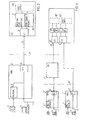
- the subscriber is provided with a Network Termination Unit 1, also called NTN, common for all its telecommunication service functions.
- the unit 1 provides an access type making it possible for the user/subscriber to keep the same services as before when the user upgrades from PSTN to ISDN-BA. This is possible by using the principle from the V5.1 interface standard (ETS 300 324-1, clause 13) and the PSTN signalling. For instance, the national PSTN mapping according to ETR 150 (disclosed in ETS 300 324-1:1994 Annex Q, bibliography) could be used.
- the protocol in FIG 1 in the V5.1 interface standard is a protocol defined for PSTN signalling with the purpose to be a tool box for transporting the analogue line signalling across the V-interface to the traffic control functions 10 in the LE. This means that the LE is service responsible and controls the tones sent and received.
- Telephones, computers, data terminal equipments can be directly connected to the unit 1 comprising a processor, memory and interfaces to the devices connected to it.
- the unit 1 comprises at least one analogue interface to a logic TA-PSTN 2 within the NTN, known per se and provided with a processor working according a protocol, to which an analogue telephone set 3 is connectable using its usual connector.
- the logic TA-PSTN 2 is a logic function read into the processor memory of the unit 1.
- the TA-PSTN 2 represents no mapping but instead a program function and can thus transmit all possible services for the telephone station.
- Digital equipments 4 (only one is illustrated) are also plugged in directly to the unit 1.
- the logic function TA-PSTN 2 is provided with the protocol shown in FIG 1, or some variation of it.
- L3addr is amended to provide the wanted PSTN services.
- the unit 1 is provided with a Network Termination type one 5, below called NT1, also in the form of a logic function. Both the TA-PSTN 2 and the direct connections from the digital equipments are logically coupled to the NT1 5 inside the unit 1.
- the protocol provided in the TA-PSTN unit is used to read when the telephone station goes off-hooked and a number is dialed and to have a dialogue with a call control 10 having a processor using a protocol in the LE, as will be explained further below.
- the protocol relates to operations essentially between the TA-PSTN 2 and the call control 10.
- the unit 1 will thus function as a part of the public network, and this will make it reasonable secure against unauthorised access.
- the unit 1 is connected to the LE through an interface 9 through which at least two B-channels (e.g. 64 kbit/s) for telecommunications can be provided.
- B-channels e.g. 64 kbit/s
- a bi-directional D-channel e.g. 16 kbit/s
- the connection is preferably a Digital Subscriber Line (DSL) 12, i.e. a physical cable, and could be of the standardized kind 2B+D(2B1Q/4B3T) according to the ETSI technical report ETR 080 which describes the characteristics and parameters at the Access digital section.
- DSL Digital Subscriber Line
- the invention is able to make an arbitrary choice of the B-channels. This is the case, firstly since the communication between the unit 1 and the LE is done on the DSL line 12, and secondly because the protocol used in both the unit 1 and the LE has an overdimentioned address field in which instructions for arbitrary choice could be written instead of addresses.
- a person skilled in the art could easily do the programming when knowing the features to be amended in the protocol and therefore the exact programming is not necessary to describe.
- the protocol for cooperation with the protocol in the TA-PSTN 2 in the call control 10 in the LE, in the address field L3addr, is thus provided with instructions regarding how to choose the B-channel for the transfer between the unit 1 and the LE, and to which network the signal is to be transfered, PSTN for speech signals shown in the block 7 and ISDN for data signals shown in the block 8.
- PSTN for speech signals shown in the block 7
- ISDN for data signals shown in the block 8.
- the arrangement according to the invention could also be used for a "high speed" ISDN access service, such as for INTERNET/On-Line services, video telephony and other ISDN based services.
- INTERNET it enables a customer computer 4 to send IP (Information Packet) packets used by all INTERNET applications, e.g. WWW, down on all available B-channels on demand. This demand is controlled by the L3addr field in the protocol. If only a few addressable B-channels have been provided for traffic between the unit 1 and the LE, then the allocation of B-channels for an INTERNET service could be made dependent on the level of data traffic.
- IP Information Packet
- preference procedure operations could be written into the L3addr field in the protocol. Automatic disconnection of one of two occupied B-channels could for instance be automatically provided if a telephone 3 is off-hooked. Any existing data connection with INTERNET would then continue on one B-channel. This could be made by using a Call Waiting signal via the ISDN D-channel.
- FIG 3 illustrates that the LE could be directly connected to a subscriber unit NTN 1' in the same way as in FIG 2 but also that it could be connected to an AN 11 in a way common in the art and that the subscriber unit 1" could be connected to the AN.
- the AN will be "transparent" for the signalling between the TA-PSTN 2" and the call control 10" using the same protocol as the TA-PSTN 2".
- FIGs 4 and 5 give the principle for the signalling according to the invention and indicate that the LE choose the B-channel available, i.e. not used by ISDN-BA, for the PSTN call.
- This message always begins with a statement of which protocol to be used, such as the PSTN-protocol.
- the D-channel has a separate signalling for both PSTN and ISDN.
- the LE communicates this message to the called party and receives a signal that the establish is acknowledged.
- the LE examines if there is an idle B-channel to be chosen, occupies an idle B-channel and acknowledge the establishment across the interface 9 between the unit 1 and the LE and establish the connection through the choosen B-channel.
- the L3addr is set to 0, i.e. not selected.
- the L3addr could also be structured in a way to allow selection of multirate B-channels.
- the sending of a PSTN message is a primitive having the name FE-establish_request, FE-establish_acknowledge, and when a message sent to the LE the primitive FE-establish_indication and FE-establish_acknowledge_indication, respectively, is generated.
- This primitive is sent between the PSTN protocol function and the PSTN call control in the LE.
Landscapes
- Engineering & Computer Science (AREA)
- Computer Networks & Wireless Communication (AREA)
- Data Exchanges In Wide-Area Networks (AREA)
- Communication Control (AREA)
- Telephonic Communication Services (AREA)
- Interface Circuits In Exchanges (AREA)
- Use Of Switch Circuits For Exchanges And Methods Of Control Of Multiplex Exchanges (AREA)
- Adornments (AREA)
- Radio Relay Systems (AREA)
Claims (12)
- Verfahren zum Einrichten einer Verbindung zwischen einer Teilnehmer-Einheit (1) und einer lokalen Vermittlungsstelle (LE) über eine digitale Integrated-Services-Netzwerkleitung (9, 12), welche einen für digitalen Verkehr beabsichtigten D-Kanal und zumindest zwei für digitalen Verkehr beabsichtigte B-Kanäle aufweist, wobei die Teilnehmer-Einheit zumindest eine analoge Schnittstelle und zumindest eine digitale Schnittstelle für Teilnehmergeräte (3, 4) aufweist, und wobei die Verbindung eine der zumindest einen analogen Schnittstelle verwendet, wobei das Verfahren durch die folgenden Verfahrensschritte gekennzeichnet ist:Auswählen in der Vermittlungsstelle von einem der zumindest zwei B-Kanäle für die Verbindung; undEinrichten der Verbindung über den ausgewählten B-Kanal, wobei der Verfahrensschritt des Einrichtens das Versenden einer Nachricht von der lokalen Vermittlungsstelle zu der Teilnehmer-Einheit auf dem D-Kanal unter der Verwendung eines auf einem V5 PSTN-Protokoll basierenden Protokolls aufweist, wobei die Nachricht eine Identifikation des ausgewählten B-Kanals enthält.
- Verfahren nach Anspruch 1, in welchem die Identifikation des ausgewählten B-Kanals in einem L3Addr-Feld des V5 PSTN-Protokolls angegeben ist.
- Verfahren nach Anspruch 1 oder 2, in welchem die Verbindung von der Teilnehmer-Einheit (1) initiiert wird, wobei das Verfahren ferner den Verfahrensschritt des Empfangens in der lokalen Vermittlungsstelle von einer Identifikation des ausgewählten B-Kanals auf dem D-Kanal aufweist, die anzeigt, dass kein B-Kanal ausgewählt worden ist; und wobei die Nachricht eine Einrichtungs-Bestätigungsnachricht ist.
- Verfahren nach Anspruch 1 oder 2, in welchem die Verbindung bei der Teilnehmer-Einheit (1) abgeschlossen wird; und wobei die Nachricht eine Einrichtungs-Nachricht ist.
- Verfahren nach Anspruch 3, in welchem das Verfahren ferner den Verfahrensschritt des Empfangens in der lokalen Vermittlungsstelle von einer Angabe hinsichtlich angeforderter Dienst-Funktionen von der Teilnehmer-Einheit (1) aufweist, wobei die Angabe hinsichtlich der angeforderten Dienst-Funktionen unter Verwendung des Protokolls auf dem D-Kanal übertragen wird.
- Teilnehmer-Einheit (1), die zumindest eine analoge Schnittstelle und zumindest eine digitale Schnittstelle für Teilnehmergeräte (3, 4) aufweist, wobei die Teilnehmer-Einheit mit einer lokalen Vermittlungsstelle (LE) über eine digitale Integrated-Services-Netzwerkleitung (9, 12) verbunden ist, welche einen für digitalen Verkehr beabsichtigten D-Kanal und zumindest zwei für digitalen Verkehr beabsichtigte B-Kanäle aufweist, wobei die Teilnehmer-Einheit gekennzeichnet ist durch:eine Einrichtung (2) zum Übertragen einer analogen Leitungs-Signalisierung auf dem D-Kanal zu der lokalen Vermittlungsstelle, und zwar unter Verwendung eines auf einem V5 PSTN-Protokoll basierenden Protokolls; undeine Einrichtung (2, 5) zum Empfangen einer Identifikation eines ausgewählten, für eine Verbindung zwischen der Teilnehmer-Einheit und der lokalen Vermittlungsstelle zu verwendenden B-Kanals von der Vermittlungsstelle auf dem D-Kanal, wobei die Identifikation unter Verwendung des Protokolls übertragen wird.
- Teilnehmer-Einheit (1) nach Anspruch 6, in welcher die Einrichtung (2) zum Übertragen der analogen Leitungs-Signalisierung ausgelegt ist, eine Angabe der angeforderten Dienste zu übertragen.
- Lokale Vermittlungsstelle (LE), die sowohl Funktionen des öffentlichen Telefonnetzes als auch Funktionen des Integrated-Services-Netzwerks unterstützt, wobei die Vermittlungsstelle (LE) eine Schnittstelle zu zumindest einer Integrated-Services-Netzwerkleitung (9, 12) aufweist, welche einen für digitalen Verkehr beabsichtigten D-Kanal und zumindest zwei für digitalen Verkehr beabsichtigte B-Kanäle aufweist, wobei die lokale Vermittlungsstelle eine Einrichtung zum Empfangen einer Anforderung für das Einrichten einer Verbindung über die Integrated-Services-Netzwerkleitung aufweist, und wobei die lokale Vermittlungsstelle gekennzeichnet ist durch:eine Einrichtung (10) zum Auswählen eines B-Kanals für die Verbindung; undeine Einrichtung (10) zum Übertragen einer Identifikation des ausgewählten B-Kanals auf dem D-Kanal, und zwar unter Verwendung eines auf einem V5 PSTN-Protokoll basierenden Protokolls.
- Lokale Vermittlungsstelle (LE) nach Anspruch 8, in welcher die Übertragungs-Einrichtung (10) ausgelegt ist, die Identifikation des ausgewählten B-Kanals in einem L3Addr-Feld des Protokolls zu übertragen.
- Lokale Vermittlungsstelle (LE) nach Anspruch 8 oder 9, welche ferner eine Einrichtung (10) zum Empfangen einer analogen Leitungs-Signalisierung auf dem D-Kanal aufweist.
- Lokale Vermittlungsstelle (LE) nach einem der Ansprüche 8 bis 10, welche ferner eine Einrichtung (10) aufweist, um einen belegten B-Kanal für einen neuen Anruf zu trennen, wenn mehr als ein B-Kanal von demselben Verkehrs-Dienst belegt wird.
- Lokale Vermittlungsstelle (LE) nach einem der Ansprüche 8 bis 11, welche ferner eine Einrichtung (11) aufweist, um zumindest zeitweilig einen belegten B-Kanal für einen neuen Anruf zu trennen, wenn der neue Anruf eine höhere Priorität als der Anruf hat, der den B-Kanal belegt.
Applications Claiming Priority (3)
| Application Number | Priority Date | Filing Date | Title |
|---|---|---|---|
| SE9601228A SE515417C2 (sv) | 1996-03-29 | 1996-03-29 | Anordning och förfarande för att etablera kommunikation |
| SE9601228 | 1996-03-29 | ||
| PCT/SE1997/000518 WO1997037510A1 (en) | 1996-03-29 | 1997-03-25 | Device and method to establish communication |
Publications (2)
| Publication Number | Publication Date |
|---|---|
| EP0875124A1 EP0875124A1 (de) | 1998-11-04 |
| EP0875124B1 true EP0875124B1 (de) | 2004-11-17 |
Family
ID=20402022
Family Applications (1)
| Application Number | Title | Priority Date | Filing Date |
|---|---|---|---|
| EP97915816A Expired - Lifetime EP0875124B1 (de) | 1996-03-29 | 1997-03-25 | Vorrichtung und verfahren zur herstellung von verbindungen |
Country Status (13)
| Country | Link |
|---|---|
| US (1) | US6343118B1 (de) |
| EP (1) | EP0875124B1 (de) |
| JP (1) | JP3933694B2 (de) |
| CN (1) | CN1157987C (de) |
| AT (1) | ATE282937T1 (de) |
| AU (1) | AU709462B2 (de) |
| BR (1) | BR9708448B1 (de) |
| CA (1) | CA2248857A1 (de) |
| DE (1) | DE69731613T2 (de) |
| ES (1) | ES2232863T3 (de) |
| MY (1) | MY119784A (de) |
| SE (1) | SE515417C2 (de) |
| WO (1) | WO1997037510A1 (de) |
Families Citing this family (5)
| Publication number | Priority date | Publication date | Assignee | Title |
|---|---|---|---|---|
| US6243377B1 (en) | 1997-11-25 | 2001-06-05 | Telefonaktiebolaget Lm Ericsson (Publ) | System for providing simultaneous voice and data transmission |
| DE19843601A1 (de) * | 1998-09-23 | 2000-03-30 | Alcatel Sa | Netzabschlußeinrichtung eines Telekommunikationsnetzes |
| CA2290069A1 (en) * | 1999-11-19 | 2001-05-19 | Nokia Mobile Phones Ltd. | Method for establishing a call in the presence of outband indication of pstn involvement at multimedia call setup |
| JP3440926B2 (ja) | 2000-05-31 | 2003-08-25 | 日本電気株式会社 | 同一加入者の複数v5インタフェース収容方式及びアクセス回路網、ホスト局 |
| AU2002365347A1 (en) | 2001-11-26 | 2003-06-10 | Ayman, L.L.C. | Universal point of contact identifier system calling device and method |
Family Cites Families (6)
| Publication number | Priority date | Publication date | Assignee | Title |
|---|---|---|---|---|
| JPH0666990B2 (ja) * | 1985-11-28 | 1994-08-24 | 富士通株式会社 | 加入者線交換制御方式 |
| US4922484A (en) * | 1987-07-22 | 1990-05-01 | Nec Corporation | ISDN remote switching unit for accommodating analog and digital lines |
| JPH0457434A (ja) * | 1990-06-27 | 1992-02-25 | Canon Inc | 通信端末装置 |
| US5305312A (en) * | 1992-02-07 | 1994-04-19 | At&T Bell Laboratories | Apparatus for interfacing analog telephones and digital data terminals to an ISDN line |
| US5708663A (en) * | 1996-04-22 | 1998-01-13 | Adtran, Inc. | ISDN terminal adapter for use with external modem and employing software-based serial communication framing for ISDN `D` channel signaling |
| US6047006A (en) * | 1997-05-12 | 2000-04-04 | Siemens Information And Communication Networks, Inc. | Method and apparatus for dynamically allocating bandwidth to independent data and audio devices |
-
1996
- 1996-03-29 SE SE9601228A patent/SE515417C2/sv not_active IP Right Cessation
-
1997
- 1997-03-21 MY MYPI97001204A patent/MY119784A/en unknown
- 1997-03-25 CA CA002248857A patent/CA2248857A1/en not_active Abandoned
- 1997-03-25 BR BRPI9708448-4A patent/BR9708448B1/pt not_active IP Right Cessation
- 1997-03-25 JP JP53519497A patent/JP3933694B2/ja not_active Expired - Lifetime
- 1997-03-25 CN CNB97193472XA patent/CN1157987C/zh not_active Expired - Lifetime
- 1997-03-25 AU AU23146/97A patent/AU709462B2/en not_active Expired
- 1997-03-25 WO PCT/SE1997/000518 patent/WO1997037510A1/en not_active Ceased
- 1997-03-25 EP EP97915816A patent/EP0875124B1/de not_active Expired - Lifetime
- 1997-03-25 DE DE69731613T patent/DE69731613T2/de not_active Expired - Lifetime
- 1997-03-25 AT AT97915816T patent/ATE282937T1/de active
- 1997-03-25 ES ES97915816T patent/ES2232863T3/es not_active Expired - Lifetime
-
1998
- 1998-09-28 US US09/161,615 patent/US6343118B1/en not_active Expired - Lifetime
Also Published As
| Publication number | Publication date |
|---|---|
| CN1214847A (zh) | 1999-04-21 |
| SE515417C2 (sv) | 2001-07-30 |
| WO1997037510A1 (en) | 1997-10-09 |
| MY119784A (en) | 2005-07-29 |
| BR9708448A (pt) | 1999-08-03 |
| ATE282937T1 (de) | 2004-12-15 |
| JP2000508846A (ja) | 2000-07-11 |
| AU709462B2 (en) | 1999-08-26 |
| BR9708448B1 (pt) | 2009-08-11 |
| SE9601228L (sv) | 1997-09-30 |
| CA2248857A1 (en) | 1997-10-09 |
| SE9601228D0 (sv) | 1996-03-29 |
| US6343118B1 (en) | 2002-01-29 |
| CN1157987C (zh) | 2004-07-14 |
| ES2232863T3 (es) | 2005-06-01 |
| EP0875124A1 (de) | 1998-11-04 |
| JP3933694B2 (ja) | 2007-06-20 |
| AU2314697A (en) | 1997-10-22 |
| DE69731613D1 (de) | 2004-12-23 |
| DE69731613T2 (de) | 2005-12-15 |
Similar Documents
| Publication | Publication Date | Title |
|---|---|---|
| EP0965204B1 (de) | Telekommunikationsnetzzugriff in einer mehrdiensteumgebung | |
| US5483530A (en) | System and method for communicating with digital and analog devices via a single digital interface | |
| KR0150651B1 (ko) | Isdn 비디오 전화기를 이용한 isdn 오디오 및 비디오 호출 방법 및 장치 | |
| EP0845186B1 (de) | Verbesserter zugriff auf kommunikationsnetze in einer mehrdienstumgebung | |
| US5991292A (en) | Network access in multi-service environment | |
| US6128293A (en) | Multiservice access management system | |
| EP0594244B1 (de) | Kommunikationssystem und Nebenstellenanlage dafür | |
| EP0542705A2 (de) | Anordnung zur Anpassung einer Schnittstelle zu einem digitalen Netz | |
| EP0875124B1 (de) | Vorrichtung und verfahren zur herstellung von verbindungen | |
| US6711175B1 (en) | Procedure for scanning or disconnecting a module line in a V5.2 access node | |
| US5787087A (en) | Method and apparatus for interconnecting a plurality of terminal equipments to the ISDN | |
| CN1247685A (zh) | 接入线网络的用户侧网络终端和用于运行网络终端的方法 | |
| KR20000064709A (ko) | 액세스망에연결된가입자국에서비스를제공하기위한시스템및방법 | |
| Becker | All about ISDN | |
| JP2761880B2 (ja) | 構内交換装置の伝送制御方式 | |
| US6480583B1 (en) | Method for providing information services in characters through ISDN | |
| KR100288711B1 (ko) | 외부출력장치가 연동되는 종합정보통신망 팩시밀리 시스템 | |
| KR20010038495A (ko) | 에이오디아이 서비스 제공 단말 장치 | |
| KR100219226B1 (ko) | Isdn 사용자-망 접속의 계층3에서 해제 확인 프리미티브 처리방법 | |
| KR100315688B1 (ko) | 교환시스템에서의 사용자 망 인터페이스의 채널정합방법 | |
| Davies et al. | ISPBXs and terminals | |
| Davies et al. | User-network interfaces | |
| KR20000065848A (ko) | 종합정보통신망에 연동되는 단말장치의 전원 다운 시, 데이터를백업하는 장치 | |
| AU5363600A (en) | System and method for providing services to subscriber stations connected to an access network |
Legal Events
| Date | Code | Title | Description |
|---|---|---|---|
| PUAI | Public reference made under article 153(3) epc to a published international application that has entered the european phase |
Free format text: ORIGINAL CODE: 0009012 |
|
| 17P | Request for examination filed |
Effective date: 19980828 |
|
| AK | Designated contracting states |
Kind code of ref document: A1 Designated state(s): AT CH DE DK ES FI FR GB IE IT LI NL SE |
|
| 17Q | First examination report despatched |
Effective date: 20020108 |
|
| RAP1 | Party data changed (applicant data changed or rights of an application transferred) |
Owner name: TELEFONAKTIEBOLAGET LM ERICSSON (PUBL) |
|
| GRAP | Despatch of communication of intention to grant a patent |
Free format text: ORIGINAL CODE: EPIDOSNIGR1 |
|
| GRAS | Grant fee paid |
Free format text: ORIGINAL CODE: EPIDOSNIGR3 |
|
| GRAA | (expected) grant |
Free format text: ORIGINAL CODE: 0009210 |
|
| AK | Designated contracting states |
Kind code of ref document: B1 Designated state(s): AT CH DE DK ES FI FR GB IE IT LI NL SE |
|
| PG25 | Lapsed in a contracting state [announced via postgrant information from national office to epo] |
Ref country code: NL Free format text: LAPSE BECAUSE OF FAILURE TO SUBMIT A TRANSLATION OF THE DESCRIPTION OR TO PAY THE FEE WITHIN THE PRESCRIBED TIME-LIMIT Effective date: 20041117 Ref country code: IT Free format text: LAPSE BECAUSE OF FAILURE TO SUBMIT A TRANSLATION OF THE DESCRIPTION OR TO PAY THE FEE WITHIN THE PRESCRIBED TIME-LIMIT;WARNING: LAPSES OF ITALIAN PATENTS WITH EFFECTIVE DATE BEFORE 2007 MAY HAVE OCCURRED AT ANY TIME BEFORE 2007. THE CORRECT EFFECTIVE DATE MAY BE DIFFERENT FROM THE ONE RECORDED. Effective date: 20041117 |
|
| REG | Reference to a national code |
Ref country code: GB Ref legal event code: FG4D |
|
| REG | Reference to a national code |
Ref country code: CH Ref legal event code: EP |
|
| REG | Reference to a national code |
Ref country code: IE Ref legal event code: FG4D |
|
| REF | Corresponds to: |
Ref document number: 69731613 Country of ref document: DE Date of ref document: 20041223 Kind code of ref document: P |
|
| REG | Reference to a national code |
Ref country code: CH Ref legal event code: NV Representative=s name: ISLER & PEDRAZZINI AG |
|
| PG25 | Lapsed in a contracting state [announced via postgrant information from national office to epo] |
Ref country code: SE Free format text: LAPSE BECAUSE OF FAILURE TO SUBMIT A TRANSLATION OF THE DESCRIPTION OR TO PAY THE FEE WITHIN THE PRESCRIBED TIME-LIMIT Effective date: 20050217 Ref country code: DK Free format text: LAPSE BECAUSE OF FAILURE TO SUBMIT A TRANSLATION OF THE DESCRIPTION OR TO PAY THE FEE WITHIN THE PRESCRIBED TIME-LIMIT Effective date: 20050217 |
|
| PG25 | Lapsed in a contracting state [announced via postgrant information from national office to epo] |
Ref country code: IE Free format text: LAPSE BECAUSE OF NON-PAYMENT OF DUE FEES Effective date: 20050325 |
|
| NLV1 | Nl: lapsed or annulled due to failure to fulfill the requirements of art. 29p and 29m of the patents act | ||
| REG | Reference to a national code |
Ref country code: ES Ref legal event code: FG2A Ref document number: 2232863 Country of ref document: ES Kind code of ref document: T3 |
|
| PLBE | No opposition filed within time limit |
Free format text: ORIGINAL CODE: 0009261 |
|
| STAA | Information on the status of an ep patent application or granted ep patent |
Free format text: STATUS: NO OPPOSITION FILED WITHIN TIME LIMIT |
|
| 26N | No opposition filed |
Effective date: 20050818 |
|
| ET | Fr: translation filed | ||
| REG | Reference to a national code |
Ref country code: IE Ref legal event code: MM4A |
|
| REG | Reference to a national code |
Ref country code: CH Ref legal event code: PCAR Free format text: ISLER & PEDRAZZINI AG;POSTFACH 1772;8027 ZUERICH (CH) |
|
| REG | Reference to a national code |
Ref country code: FR Ref legal event code: PLFP Year of fee payment: 20 |
|
| PGFP | Annual fee paid to national office [announced via postgrant information from national office to epo] |
Ref country code: CH Payment date: 20160328 Year of fee payment: 20 Ref country code: ES Payment date: 20160328 Year of fee payment: 20 |
|
| PGFP | Annual fee paid to national office [announced via postgrant information from national office to epo] |
Ref country code: GB Payment date: 20160329 Year of fee payment: 20 Ref country code: AT Payment date: 20160302 Year of fee payment: 20 Ref country code: FI Payment date: 20160325 Year of fee payment: 20 Ref country code: FR Payment date: 20160328 Year of fee payment: 20 |
|
| PGFP | Annual fee paid to national office [announced via postgrant information from national office to epo] |
Ref country code: DE Payment date: 20160331 Year of fee payment: 20 |
|
| REG | Reference to a national code |
Ref country code: DE Ref legal event code: R071 Ref document number: 69731613 Country of ref document: DE |
|
| REG | Reference to a national code |
Ref country code: CH Ref legal event code: PL |
|
| REG | Reference to a national code |
Ref country code: GB Ref legal event code: PE20 Expiry date: 20170324 |
|
| REG | Reference to a national code |
Ref country code: AT Ref legal event code: MK07 Ref document number: 282937 Country of ref document: AT Kind code of ref document: T Effective date: 20170325 |
|
| PG25 | Lapsed in a contracting state [announced via postgrant information from national office to epo] |
Ref country code: GB Free format text: LAPSE BECAUSE OF EXPIRATION OF PROTECTION Effective date: 20170324 |
|
| REG | Reference to a national code |
Ref country code: ES Ref legal event code: FD2A Effective date: 20170630 |
|
| PG25 | Lapsed in a contracting state [announced via postgrant information from national office to epo] |
Ref country code: ES Free format text: LAPSE BECAUSE OF EXPIRATION OF PROTECTION Effective date: 20170326 |