EP0874413A2 - Solid polymer type fuel cell and method for manufacturing the same - Google Patents
Solid polymer type fuel cell and method for manufacturing the same Download PDFInfo
- Publication number
- EP0874413A2 EP0874413A2 EP98107352A EP98107352A EP0874413A2 EP 0874413 A2 EP0874413 A2 EP 0874413A2 EP 98107352 A EP98107352 A EP 98107352A EP 98107352 A EP98107352 A EP 98107352A EP 0874413 A2 EP0874413 A2 EP 0874413A2
- Authority
- EP
- European Patent Office
- Prior art keywords
- solid polymer
- polymer electrolyte
- colloid
- carbon powder
- particle size
- Prior art date
- Legal status (The legal status is an assumption and is not a legal conclusion. Google has not performed a legal analysis and makes no representation as to the accuracy of the status listed.)
- Withdrawn
Links
Images


Classifications
-
- H—ELECTRICITY
- H01—ELECTRIC ELEMENTS
- H01M—PROCESSES OR MEANS, e.g. BATTERIES, FOR THE DIRECT CONVERSION OF CHEMICAL ENERGY INTO ELECTRICAL ENERGY
- H01M4/00—Electrodes
- H01M4/86—Inert electrodes with catalytic activity, e.g. for fuel cells
- H01M4/90—Selection of catalytic material
- H01M4/92—Metals of platinum group
- H01M4/925—Metals of platinum group supported on carriers, e.g. powder carriers
- H01M4/926—Metals of platinum group supported on carriers, e.g. powder carriers on carbon or graphite
-
- H—ELECTRICITY
- H01—ELECTRIC ELEMENTS
- H01M—PROCESSES OR MEANS, e.g. BATTERIES, FOR THE DIRECT CONVERSION OF CHEMICAL ENERGY INTO ELECTRICAL ENERGY
- H01M8/00—Fuel cells; Manufacture thereof
- H01M8/10—Fuel cells with solid electrolytes
- H01M8/1004—Fuel cells with solid electrolytes characterised by membrane-electrode assemblies [MEA]
-
- H—ELECTRICITY
- H01—ELECTRIC ELEMENTS
- H01M—PROCESSES OR MEANS, e.g. BATTERIES, FOR THE DIRECT CONVERSION OF CHEMICAL ENERGY INTO ELECTRICAL ENERGY
- H01M2300/00—Electrolytes
- H01M2300/0017—Non-aqueous electrolytes
- H01M2300/0065—Solid electrolytes
- H01M2300/0082—Organic polymers
-
- Y—GENERAL TAGGING OF NEW TECHNOLOGICAL DEVELOPMENTS; GENERAL TAGGING OF CROSS-SECTIONAL TECHNOLOGIES SPANNING OVER SEVERAL SECTIONS OF THE IPC; TECHNICAL SUBJECTS COVERED BY FORMER USPC CROSS-REFERENCE ART COLLECTIONS [XRACs] AND DIGESTS
- Y02—TECHNOLOGIES OR APPLICATIONS FOR MITIGATION OR ADAPTATION AGAINST CLIMATE CHANGE
- Y02E—REDUCTION OF GREENHOUSE GAS [GHG] EMISSIONS, RELATED TO ENERGY GENERATION, TRANSMISSION OR DISTRIBUTION
- Y02E60/00—Enabling technologies; Technologies with a potential or indirect contribution to GHG emissions mitigation
- Y02E60/30—Hydrogen technology
- Y02E60/50—Fuel cells
-
- Y—GENERAL TAGGING OF NEW TECHNOLOGICAL DEVELOPMENTS; GENERAL TAGGING OF CROSS-SECTIONAL TECHNOLOGIES SPANNING OVER SEVERAL SECTIONS OF THE IPC; TECHNICAL SUBJECTS COVERED BY FORMER USPC CROSS-REFERENCE ART COLLECTIONS [XRACs] AND DIGESTS
- Y02—TECHNOLOGIES OR APPLICATIONS FOR MITIGATION OR ADAPTATION AGAINST CLIMATE CHANGE
- Y02P—CLIMATE CHANGE MITIGATION TECHNOLOGIES IN THE PRODUCTION OR PROCESSING OF GOODS
- Y02P70/00—Climate change mitigation technologies in the production process for final industrial or consumer products
- Y02P70/50—Manufacturing or production processes characterised by the final manufactured product
-
- Y—GENERAL TAGGING OF NEW TECHNOLOGICAL DEVELOPMENTS; GENERAL TAGGING OF CROSS-SECTIONAL TECHNOLOGIES SPANNING OVER SEVERAL SECTIONS OF THE IPC; TECHNICAL SUBJECTS COVERED BY FORMER USPC CROSS-REFERENCE ART COLLECTIONS [XRACs] AND DIGESTS
- Y10—TECHNICAL SUBJECTS COVERED BY FORMER USPC
- Y10T—TECHNICAL SUBJECTS COVERED BY FORMER US CLASSIFICATION
- Y10T29/00—Metal working
- Y10T29/49—Method of mechanical manufacture
- Y10T29/49002—Electrical device making
- Y10T29/49108—Electric battery cell making
- Y10T29/49115—Electric battery cell making including coating or impregnating
Definitions
- the present invention relates to a method for manufacturing an assembly of a solid polymer electrolyte membrane and electrodes and to an assembly manufactured by the method, and more particularly to a fuel cell which is made using the assembly and uses as a fuel a reducing agent such as pure hydrogen, modified hydrogen obtained from methanol or fossil fuels or methanol and as an oxidizing agent air or oxygen, especially a fuel cell which uses a solid polymer as an electrolyte.
- a reducing agent such as pure hydrogen, modified hydrogen obtained from methanol or fossil fuels or methanol and as an oxidizing agent air or oxygen
- JP-B-62-61118 and JP-B-62-61119 disclose a method which comprises coating a mixture of a solution of solid polymer electrolyte with a catalyst compound on a solid polymer membrane, hot pressing the coated membrane on an electrode material and then reducing the catalyst compound or carrying out the coating after the reduction and then carrying out the hot pressing.
- JP-A-3-184266 uses a powder prepared by coating a solid polymer electrolyte on the surface of a polymer resin
- JP-A-3-295172 employs a method which comprises incorporating a powder of a solid polymer electrolyte into an electrode
- JP-A-5-36418 discloses a method which comprises mixing a solid polymer electrolyte, a catalyst, a carbon powder and a fluoropolymer and forming the mixture into a film to form an electrode.
- the dispersion with an alcoholic solvent is coated on a porous substrate or when the inky dispersion is coated on a porous substrate, the dispersion cannot be directly molded on the surface of the substrate as the dispersion penetrates or permeates into the inside of the substrate and thus, complicated processing techniques such as transferring are needed.
- the inventors have disclosed a method for manufacturing electrodes using colloid of solid polymer electrolyte in JP-A-7-183035 and JP-A-8-264190.
- the object of the present invention is to improve these inventions and to provide an assembly of a solid polymer electrolyte membrane and electrodes having further higher performances by severely specifying colloid particle size of the solid polymer electrolyte and controlling the thickness of coat, and a solid polymer type fuel cell made using said assembly.
- the present invention relates to a method for manufacturing an assembly comprising a solid polymer electrolyte membrane and electrodes provided on both sides of the membrane, wherein at least one of the electrodes is formed by a step of preparing a mixed liquid containing an organic solvent, a noble metal catalyst-supporting carbon powder and a colloid of a solid polymer electrolyte having a particle size of 1 nm or more and less than 400 nm, said colloid being adsorbed to the carbon powder and a step of forming an electrode by coating said mixed liquid on one side of a gas-diffusible layer.
- the present invention further relates to an assembly manufactured by the above method and a solid polymer type fuel cell which uses the assembly.
- the solid polymer electrolyte is surely adsorbed to the catalyst surface, whereby a wide reaction surface area can be secured. Moreover, thickness of the polymer electrolyte layer can be controlled to such a degree that hydrogen and oxygen can easily diffuse therethrough, and thus a solid polymer type fuel cell of small concentration polarization and high performance can be obtained.
- FIG. 1 is a block diagram which shows the steps of manufacture of the assembly of the present invention.
- FIG. 2 is a schematic sectional view of the electrode in the example of the present invention.
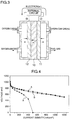
- FIG. 3 is a schematic sectional view of a unit cell of the solid polymer type fuel cell of the present invention.
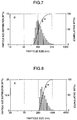
- FIG. 4 is a graph which shows voltage-current characteristics of a fuel cell.
- FIG. 5 is a graph which shows voltage-current characteristics of a fuel cell.
- FIG. 6 is a graph which shows a particle size distribution of the solid polymer electrolyte of Example 1 of the present invention.
- FIG. 7 is a graph which shows a particle size distribution of the solid polymer electrolyte of Example 2 of the present invention.
- FIG. 8 is a graph which shows a particle size distribution of the solid polymer electrolyte of comparative example.
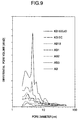
- FIG. 9 is a graph which shows a pore distribution of carbon black.
- the present invention relates to a method for manufacturing an assembly comprising a solid polymer electrolyte membrane and electrodes provided on both sides of the membrane, wherein at least one of the electrodes is formed by a step of preparing a mixed liquid containing an organic solvent, a noble metal catalyst-supporting carbon powder and a colloid of a solid polymer electrolyte having a particle size of 1 nm or more and less than 400 nm, said colloid being adsorbed to the carbon powder and a step of forming an electrode by coating said mixed liquid on one side of a gas-diffusible layer.
- a step of preparing a mixed liquid containing an organic solvent, a noble metal catalyst-supporting carbon powder and a colloid of a solid polymer electrolyte having a particle size of 1 nm or more and less than 400 nm said colloid being adsorbed to the carbon powder
- a step of forming an electrode by coating said mixed liquid on one side of a gas-diffusible layer.
- the steps of manufacture of the assembly may include a first step of preparing a dispersion by dispersing a noble metal catalyst-supporting carbon power in an organic solvent, a second step of obtaining a mixed liquid by mixing this dispersion with an alcoholic solution of a solid polymer electrolyte to produce a colloid of the solid electrolyte having a particle size of 1 nm or more and less than 400 nm and simultaneously adsorb the colloid to the carbon powder, a third step of making an electrode by coating the mixed liquid on one side of a gas-diffusible layer, and a fourth step of pressing the electrode to at least one side of a solid polymer electrolyte membrane to integrally join them.
- the steps of manufacture of the assembly may include a first step of preparing a colloidal dispersion by mixing an organic solvent and an alcoholic solution of a solid polymer electrolyte to produce a colloid having a particle size of 1 nm or more and less than 400 nm, a second step of mixing said colloidal dispersion with a noble metal catalyst-supporting carbon powder to prepare a mixed liquid in which the colloid is adsorbed to the carbon powder, and the above third and fourth steps.
- the colloid of solid polymer electrolyte having a severely adjusted particle size can be uniformly adsorbed to carbon powder, and therefore it becomes possible to disperse catalyst fine particles 3, carbon fine powders 4 and solid polymer electrolyte 5 in such a state that they uniformly adhere to each other inside the catalyst layer 2 of electrode 1 as shown in the schematic sectional view of electrode of FIG. 2.
- the thickness of the coat of the solid polymer electrolyte can be controlled by adjusting the particle size of colloid of the solid polymer electrolyte.
- the three channels of gas channel 7 formed by the void between the carbon powders 4 which is a passage for feeding a fuel gas such as hydrogen or an oxidizing agent gas such as oxygen, proton channel 8 formed by the hydrated solid polymer electrolyte 5, and electron channel 6 formed by mutual connection of the carbon fine powders can be efficiently formed in close to each other inside the same catalyst layer.
- a fuel gas such as hydrogen or an oxidizing agent gas such as oxygen
- proton channel 8 formed by the hydrated solid polymer electrolyte 5 can be efficiently formed in close to each other inside the same catalyst layer.
- 9 indicates a gas-diffusible layer
- 10 indicates a solid polymer electrolyte.
- feed of hydrogen and oxygen gas and transfer of proton and electron can be carried out simultaneously and smoothly in a wide range by the following reaction at the hydrogen electrode: H 2 ⁇ 2H + + 2e - and the following reaction at the oxygen electrode: 1/2O 2 + 2H + + 2e - ⁇ H 2 O Therefore, the reaction rate and the reaction area are increased.
- colloid particle size of the polymer electrolyte is less than 400 nm, the colloidal polymer electrolyte layer is adsorbed widely and uniformly to the catalyst surface, and thus a polymer electrolyte layer superior in diffusion of hydrogen and oxygen gas can be formed.
- the critical particle size for the formation of colloid is 1 nm or more. Therefore, the colloid particle size of the polymer electrolyte is 1 nm or more and less than 400 nm.
- the carbon powders used as a carrier for catalyst include those which are great in pore volume of small pores of less than 10 nm, such as carbon black, and in order to form a three-dimensional electrolyte network in the electrode, the colloid particle size is preferably 10 nm or more. Accordingly, the colloid particle size is more preferably 10 nm or more and less than 400 nm.
- the colloid particles may be either monodisperse or polydisperse.
- Average particle size of primary particles of colloid is preferably 10 nm or more and less than 130 nm, more preferably 10 nm or more and less than 70 nm.
- the thickness of the electrolyte layer usually depends on the size of primary particles of colloid.
- the colloid particles may be adsorbed in the form of multilayer, and hence the thickness is about 1-3 times the average particle size of primary particles of colloid.
- the thickness of the electrolyte layer is 10 nm or more and less than 400 nm, preferably 10 nm or more and less than 200 nm, more preferably 10 nm or more and less than 50 nm.
- Size of colloid can be adjusted by changing molecular weight and molecular structure of the polymer electrolyte, and kind and composition of organic solvents at the step of preparation of colloid.
- organic solvents there may be suitably used those having a polar group other than hydroxyl group in the molecule and having a carbon chain of 1-8 carbon atoms which bond to the polar group or having a dielectric constant of 3-10 as disclosed in U.S. Pat. No.5,474,875.
- U.S. Pat. No.5,474,875 is incorporated herein by reference.
- Mixing ratio in weight of organic solvent and polymer electrolyte is preferably 10 : 1 - 100 : 1, more preferably 20 : 1 - 70 : 1, and mixing temperature is preferably 30°C or lower, more preferably room temperature.
- carbon powders subjected to water repelling treatment for example, carbon powders to which 25-70% in weight ratio of a fluoropolymer is added, may be added to the carbon powders of the present invention.
- Amount of the water repelled carbon powders is 10-50% by weight of the carbon powders supporting the noble metal catalyst.
- a 9% ethanolic solution of "Flemion" manufactured by Asahi Glass Co., Ltd. as a solid polymer electrolyte in an amount of 1 g for 60 g of n-butyl acetate was mixed with the above dispersion to produce a white colloid.
- the colloidal solid polymer electrolyte was immediately adsorbed to the surface of the carbon fine powders supporting the catalyst. After a while from completion of addition of all polymer electrolyte solution, stirring was stopped and the supernatant liquid became transparent.
- the resulting paste was coated on a carbon paper substrate to which 20-60% by weight of a fluoropolymer was previously added (manufactured by Toray Industries, Inc.).
- a fluoropolymer manufactured by Toray Industries, Inc.
- the bridging agglomeration which occurred in the second step prevented the catalyst fine particles from penetrating into the carbon paper and only the solvent was removed and filtered, whereby it became possible to mold the catalyst layer on the surface of the substrate.
- the above electrodes were hot pressed on both sides of Nafion membrane manufactured by DuPont de Nemours, E.,I. Co., by application of a pressure of 5-100 kg/cm 2 at 120-200°C to make a cell A.
- Cell B was produced in the same manner as in Example 1, except that "5% Nafion solution” manufactured by Aldrich Chemical Co., Ltd. was used as the solid polymer electrolyte in the second step.
- Cell X was produced in the same manner as in Example 1, except that "5% Nafion solution” manufactured by Aldrich Chemical Co., Ltd. was used as the solid polymer electrolyte and the mixing was carried out under heating at 50°C in the second step.
- FIG. 3 shows a schematic sectional view of a unit cell of the manufactured solid polymer type fuel cell.
- 10 indicates a solid polymer electrolyte membrane.
- "Nafion 112 membrane” manufactured by DuPont de Nemours,E.I., Co. was used as the solid polymer electrolyte membrane 10.
- 11 and 12 indicate a porous negative electrode and a porous positive electrode, respectively.
- the amount of the solid polymer electrolyte added was 1.0 mg/cm 2 per apparent electrode area for both the electrodes, but the same characteristics were obtained with addition of the electrolyte in the range of 0.1-3.0 mg/cm 2 .
- Discharge test was conducted by feeding hydrogen gas moisturized at 90°C to the negative electrode side and oxygen gas moisturized at 80°C to the positive electrode side from the inlet of the cell toward the outlet of the cell, respectively.
- FIG. 4 shows voltage-current characteristics of the cells made in Examples 1 and 2 and Comparative Example.
- Current densities of cells A and B of the present invention and cell X of Comparative Example at 500 mV were 1200, 1150, and 360 mA/cm 2 , respectively.
- the cells of the present invention showed characteristics of more than 3 times that of Comparative Example.
- FIG. 5 shows characteristics obtained by Tafel plotting the respective characteristics of FIG. 4.
- Current densities of cells A and B of the present invention and cell X of Comparative Example at 850 mV were 60, 26, and 10 mA/cm 2 , respectively.
- the straight line portion of the Tafel plotted characteristics shows activation polarization, namely, characteristics of the region where polarization caused by charge transport determines the rate of reaction, and current density of this region at a given voltage can approximate to the reaction area of the electrode. Therefore, it was found that cell A of Example 1 of the present invention had a reaction area of 6 times that of cell X of Comparative Example, and cell B had a reaction area of 2.6 times that of cell X.
- FIGS. 6-8 show particle size distributions of colloids A', B', and X' prepared by mixing the solid polymer electrolyte used in Examples 1 and 2 and Comparative Example with n-butyl acetate solvent, which were measured by cumulant analysis using a dynamic light scattering photometer DLS-7000 manufactured by Ohtsuka Denshi Co., Ltd.
- Table 1 shows average particle size, primary particle size, range of particle size distribution and polydisperse index of the colloid particles.
- a polydisperse index of 0.1 or less means monodisperse, and that of more than 0.1 means polydisperse.
- colloid A' of Example 1 had a distribution range of 13-340 nm and an average particle size of 102 nm, and was in polydisperse state, but most of the colloid was occupied by particles of about 16 nm.
- colloid B' of Example 2 had a distribution range of 73-351 nm and an average particle size of 154 nm, was in slightly polydisperse state, and had an average particle size of primary particles of about 122 nm.
- colloid X' of Comparative Example comprised particles of monodisperse state having a distribution range of 282-1200 nm and having a primary particle size of about 424 nm.
- the thickness of the layer depends on the primary particles of the colloid, and besides, the primary particles are sometimes adsorbed in the form of multilayer, and therefore, the thickness was 1-3 times the particle size.
- the thickness of the electrolyte layer was 122-366 nm in the case of B' and 16-48 nm in the case of A'. On the other hand, it was 424 nm or more in the case of X'.
- colloids having various particle size can be prepared by changing kind of solid polymer materials, mixing conditions and the like by the method of the present invention. It can be seen from the results of FIGS. 4 and 5 that state of colloid greatly affects the cell characteristics.
- Cells A and B of Examples 1 and 2 in which the particle size of colloid was distributed in the range of 10 nm or more and less than 400 nm showed high characteristics and the comparative cell X in which the colloid particles had an average particle size of 400 nm or more showed low characteristics.
- FIG. 9 shows results of pore distribution of typical carbon blacks used as a carrier for catalyst which were obtained by nitrogen gas adsorption method.
- Ketjen Black 600D (KB600JD) and Ketjen Black EC (KBEC) manufactured by Lion Co., Ltd. and acetylene blacks (AB, AB1, AB2, AB3, and AB18) manufactured by Denki Kagaku Kogyo Co., Ltd. were used as the carbon blacks.
- these carbon blacks have a large volume for the pores of 10 nm or less. Since primary particle size of carbon black is 10 nm or more, these pores can be considered to be those formed on the surface of carbon black particles. Therefore, it is preferred for forming a three-dimensional electrolyte network in the electrode that thickness of the solid polymer electrolyte layer formed on these carbon blacks is 10 nm or more.
- the kind and amount of the above-mentioned organic solvents can be experimentally optionally selected so that particle size of the colloid is in the range of 1 nm or more and less than 400 nm.
- the Examples of the present invention describe the representative values and do not restrict the present invention.
- solutions of Flemion and Nafion were used as representative examples of polymers comprising a copolymer of tetrafluoroethylene and perfluorovinyl ether as the solid polymer electrolyte, but the polymers are not limited to these examples as far as they are polymer electrolyte having proton exchange group, and the similar effects were obtained by using polymers of different molecular structures.
- perfluorovinyl ethers polymers of different side chain molecular length, polymers comprising a copolymer of styrene and vinyl benzene, and other hydrocarbon polymer electrolytes.
- a hydrogen-oxygen fuel cell was taken up, but the present invention can also be applied to fuel cells which use modified hydrogen obtained from methanol, natural gases, naphtha, etc., fuel cells which use air as oxidizing agent, and liquid fuel cells which directly use methanol as a fuel.
- fuel cells were constructed using an assembly of a solid polymer electrolyte and an electrode, but the assembly can be effectively applied to generators or purifiers of oxygen, ozone, hydrogen, etc. and various gas sensors such as oxygen sensor and alcohol sensor.
- the present invention contact between the solid polymer electrolyte and the catalyst in the electrode and dispersing state of them in the electrode can be improved, and the three channels of the gas channel formed by the voids between fine carbon powders which is a channel for feeding fuel gases such as hydrogen and oxidizing agent gases such as oxygen, the proton channel formed by the hydrous solid polymer electrolyte and the electron channel formed by mutual connection of carbon fine powders are formed very close to each other in the same catalyst layer, and the reaction area is increased.
- the present invention can provide solid polymer type fuel cells which exhibit higher discharge performance.
Landscapes
- Chemical & Material Sciences (AREA)
- Engineering & Computer Science (AREA)
- Chemical Kinetics & Catalysis (AREA)
- Electrochemistry (AREA)
- General Chemical & Material Sciences (AREA)
- Materials Engineering (AREA)
- Life Sciences & Earth Sciences (AREA)
- Manufacturing & Machinery (AREA)
- Sustainable Development (AREA)
- Sustainable Energy (AREA)
- Inert Electrodes (AREA)
- Fuel Cell (AREA)
Abstract
Description
| A' | B' | X' | |
| Average particle size of colloid (nm) | 102 | 154 | 514 |
| Average particle size of primary particles (nm) | 16 | 122 | 424 |
| Range of particle size distribution (nm) | 13∼340 | 73∼351 | 282∼1200 |
| Polydisperse index | 0.207 | 0.123 | 0.073 |
Claims (8)
- A method for producing an assembly comprising a solid polymer electrolyte membrane and electrodes provided on both sides of the membrane, wherein at least one of the electrodes is formed by a step of preparing a mixed liquid containing an organic solvent, a noble metal catalyst-supporting carbon powder and a colloid of a solid polymer electrolyte having a particle size of 1 nm more and less than 400 nm, said colloid being adsorbed to the carbon powder and a step of forming an electrode by coating said mixed liquid on one side of a gas-diffusible layer.
- A method according to claim 1, wherein the step of preparing mixed liquid includes a step of preparing a dispersion by dispersing a noble metal catalyst-supporting carbon powder in an organic solvent and a step of preparing a mixed liquid by mixing said dispersion and an alcoholic solution of a solid polymer electrolyte to produce colloid of the solid polymer electrolyte and simultaneously adsorb the colloid to the carbon powder.
- A method according to claim 1, wherein the step of preparing mixed liquid includes a step of preparing a mixed liquid includes a step of preparing a colloid dispersion by mixing an organic solvent and an alcoholic solution of a solid polymer electrolyte to produce colloid and a step of preparing a mixed liquid by mixing the colloid dispersion and a noble metal catalyst-supporting carbon powder to adsorb the colloid to the carbon powder.
- A method according to any preceding claim, wherein particle size of the colloid is 10 nm or more and less than 400 nm.
- A method according to any preceding claim, wherein average particle size of primary particles of the colloid is 10 nm or more and less than 130 nm.
- A method according to any preceding claim, wherein the carbon powder contains water repelled carbon powder.
- An assembly comprising a solid polymer electrolyte membrane and electrodes provided on both sides of the membrane, wherein at least one of the electrodes is the assembly of a solid polymer electrolyte membrane and electrodes produced by the method according to any preceding claim and thickness of the solid polymer electrolyte membrane formed on the surface of the noble metal catalyst is 10 nm more and less than 400 nm.
- A solid polymer type fuel cell made using the assembly according to claim 7.
Applications Claiming Priority (3)
| Application Number | Priority Date | Filing Date | Title |
|---|---|---|---|
| JP104470/97 | 1997-04-22 | ||
| JP10447097 | 1997-04-22 | ||
| JP9104470A JPH10302805A (en) | 1997-04-22 | 1997-04-22 | Assembly of solid polymer electrolyte membrane and electrode, method for producing the same, and fuel cell using the same |
Publications (2)
| Publication Number | Publication Date |
|---|---|
| EP0874413A2 true EP0874413A2 (en) | 1998-10-28 |
| EP0874413A3 EP0874413A3 (en) | 2000-04-12 |
Family
ID=14381480
Family Applications (1)
| Application Number | Title | Priority Date | Filing Date |
|---|---|---|---|
| EP98107352A Withdrawn EP0874413A3 (en) | 1997-04-22 | 1998-04-22 | Solid polymer type fuel cell and method for manufacturing the same |
Country Status (4)
| Country | Link |
|---|---|
| US (1) | US6060187A (en) |
| EP (1) | EP0874413A3 (en) |
| JP (1) | JPH10302805A (en) |
| CA (1) | CA2235431C (en) |
Cited By (7)
| Publication number | Priority date | Publication date | Assignee | Title |
|---|---|---|---|---|
| US6403245B1 (en) | 1999-05-21 | 2002-06-11 | Microcoating Technologies, Inc. | Materials and processes for providing fuel cells and active membranes |
| WO2003092093A3 (en) * | 2002-04-26 | 2004-02-26 | Ube Industries | Fuel cell electrode employing porous graphite film, membrane-electrode assembly and fuel cell |
| EP1443577A1 (en) * | 2002-11-05 | 2004-08-04 | Matsushita Electric Industrial Co., Ltd. | Fuell cell |
| EP1515381A1 (en) * | 2003-09-12 | 2005-03-16 | Matsushita Electric Industrial Co., Ltd. | Ink for forming a catalyst layer, electrode and membrane-electrode assembly using the same |
| EP1294034A4 (en) * | 2000-06-22 | 2007-12-05 | Matsushita Electric Industrial Co Ltd | POLYMER ELECTROLYTE FUEL CELL, METHOD OF MANUFACTURING THE SAME ELECTRODE AND MANUFACTURING DEVICE |
| WO2008047191A3 (en) * | 2006-09-14 | 2008-08-21 | Toyota Motor Co Ltd | Catalyst structure body for fuel cell, manufacture method therefor, membrane-electrode assembly, and fuel cell |
| EP2128917A4 (en) * | 2006-12-05 | 2011-08-31 | Toyota Motor Co Ltd | FUEL CELL ELECTRODE MANUFACTURING METHOD |
Families Citing this family (19)
| Publication number | Priority date | Publication date | Assignee | Title |
|---|---|---|---|---|
| JP2001015122A (en) * | 1999-06-30 | 2001-01-19 | Tanaka Kikinzoku Kogyo Kk | Catalyst for polymer electrolyte fuel cell and polymer electrolyte fuel cell |
| JP4433518B2 (en) * | 1999-07-30 | 2010-03-17 | アイシン精機株式会社 | Solid polymer electrolyte fuel cell |
| JP4734688B2 (en) * | 2000-02-01 | 2011-07-27 | 東レ株式会社 | ELECTRODE AND MANUFACTURING METHOD THEREOF, MEMBRANE-ELECTRODE COMPOSITION AND MANUFACTURING METHOD THEREOF, AND ELECTROCHEMICAL DEVICE, WATER ELECTROLYTIC DEVICE, FUEL CELL, MOBILE BODY USING THE SAME, AND AUTOMOBILE |
| US7201993B2 (en) * | 2000-08-04 | 2007-04-10 | Matsushita Electric Industrial Co., Ltd. | Polymer electrolyte fuel cell |
| US20040053111A1 (en) | 2000-10-31 | 2004-03-18 | Koichi Matsumoto | Electrode for solid polymer type fuel cell |
| EP1244165A3 (en) * | 2001-03-19 | 2006-03-29 | Ube Industries, Ltd. | Electrode base material for fuel cell |
| US20030206710A1 (en) * | 2001-09-14 | 2003-11-06 | Ferman Ahmet Mufit | Audiovisual management system |
| KR100480782B1 (en) * | 2002-10-26 | 2005-04-07 | 삼성에스디아이 주식회사 | Membrane and electrode assembly of full cell, production method of the same and fuel cell employing the same |
| US20040107869A1 (en) * | 2002-12-10 | 2004-06-10 | 3M Innovative Properties Company | Catalyst ink |
| JP4817622B2 (en) * | 2004-07-12 | 2011-11-16 | 株式会社巴川製紙所 | Method for producing gas diffusion electrode for polymer electrolyte fuel cell |
| JP2006310216A (en) * | 2005-05-02 | 2006-11-09 | Toyota Motor Corp | Method for producing coating solution for forming catalyst electrode layer |
| WO2008004645A1 (en) * | 2006-07-04 | 2008-01-10 | Sumitomo Chemical Company, Limited | Polymer electrolyte emulsion and use thereof |
| WO2008004644A1 (en) | 2006-07-04 | 2008-01-10 | Sumitomo Chemical Company, Limited | Polymer electrolyte emulsion and use thereof |
| JP2009245932A (en) * | 2008-03-13 | 2009-10-22 | Toppan Printing Co Ltd | Electrode catalyst ink for fuel cell, electrode catalyst layer, membrane-electrode assembly, and polymer electrolyte fuel cell |
| JP5465840B2 (en) * | 2008-05-13 | 2014-04-09 | 旭化成イーマテリアルズ株式会社 | Method for producing polymer electrolyte fuel cell |
| JP2011008940A (en) * | 2009-06-23 | 2011-01-13 | Toyota Motor Corp | Membrane-electrode assembly, and fuel battery |
| KR101093703B1 (en) * | 2009-06-25 | 2011-12-15 | 삼성에스디아이 주식회사 | Polymer electrolyte membrane for fuel cell and manufacturing method thereof |
| US20130004884A1 (en) * | 2010-03-15 | 2013-01-03 | Katsuyuki Kishi | Slurry for fuel cell electrode catalyst layer, electrode catalyst layer, membrane electrode assembly, and fuel cell |
| JP2025069643A (en) * | 2023-10-18 | 2025-05-01 | 株式会社Screenホールディングス | Electrode structure, gas diffusion layer, and water electrolysis device |
Family Cites Families (10)
| Publication number | Priority date | Publication date | Assignee | Title |
|---|---|---|---|---|
| CA1088149A (en) * | 1976-06-15 | 1980-10-21 | Gerda M. Kohlmayr | Method of fabricating a fuel cell electrode |
| US4959162A (en) * | 1989-02-03 | 1990-09-25 | The United States Of America As Represented By The United States Department Of Energy | Colloidal polypyrrole |
| JPH03184266A (en) * | 1989-12-13 | 1991-08-12 | Toshiba Corp | Fuel cell with solid electrolyte |
| JPH03295172A (en) * | 1990-04-13 | 1991-12-26 | Mitsubishi Heavy Ind Ltd | Junction body of solid polymer electrolyte film and electrode |
| US5211984A (en) * | 1991-02-19 | 1993-05-18 | The Regents Of The University Of California | Membrane catalyst layer for fuel cells |
| JPH0536418A (en) * | 1991-03-13 | 1993-02-12 | Fuji Electric Co Ltd | Solid polymer electrolyte fuel cell and method of manufacturing the same |
| JPH06261119A (en) * | 1993-03-04 | 1994-09-16 | Toshiba Corp | Private branch exchange |
| JP3112214B2 (en) * | 1993-03-08 | 2000-11-27 | 日本電信電話株式会社 | Noise audible immunity evaluation tester |
| JP3422377B2 (en) * | 1993-08-06 | 2003-06-30 | 松下電器産業株式会社 | Method for manufacturing polymer electrolyte fuel cell and polymer electrolyte fuel cell obtained by the method |
| JP3712768B2 (en) * | 1995-01-26 | 2005-11-02 | 松下電器産業株式会社 | Production method of polymer electrolyte fuel cell |
-
1997
- 1997-04-22 JP JP9104470A patent/JPH10302805A/en active Pending
-
1998
- 1998-04-08 US US09/056,686 patent/US6060187A/en not_active Expired - Fee Related
- 1998-04-21 CA CA002235431A patent/CA2235431C/en not_active Expired - Fee Related
- 1998-04-22 EP EP98107352A patent/EP0874413A3/en not_active Withdrawn
Cited By (11)
| Publication number | Priority date | Publication date | Assignee | Title |
|---|---|---|---|---|
| US6403245B1 (en) | 1999-05-21 | 2002-06-11 | Microcoating Technologies, Inc. | Materials and processes for providing fuel cells and active membranes |
| EP1294034A4 (en) * | 2000-06-22 | 2007-12-05 | Matsushita Electric Industrial Co Ltd | POLYMER ELECTROLYTE FUEL CELL, METHOD OF MANUFACTURING THE SAME ELECTRODE AND MANUFACTURING DEVICE |
| US7544630B2 (en) | 2000-06-22 | 2009-06-09 | Panasonic Corporation | Methods of manufacturing electrodes for polymer electrolyte fuel cells |
| WO2003092093A3 (en) * | 2002-04-26 | 2004-02-26 | Ube Industries | Fuel cell electrode employing porous graphite film, membrane-electrode assembly and fuel cell |
| EP1443577A1 (en) * | 2002-11-05 | 2004-08-04 | Matsushita Electric Industrial Co., Ltd. | Fuell cell |
| US7569302B2 (en) | 2002-11-05 | 2009-08-04 | Panasonic Corporation | Fuel cell for generating electric power |
| EP1515381A1 (en) * | 2003-09-12 | 2005-03-16 | Matsushita Electric Industrial Co., Ltd. | Ink for forming a catalyst layer, electrode and membrane-electrode assembly using the same |
| US7364813B2 (en) | 2003-09-12 | 2008-04-29 | Matsushita Electric Industrial Co., Ltd. | Ink for forming catalyst layer, and electrode and membrane-electrode assembly using the same |
| WO2008047191A3 (en) * | 2006-09-14 | 2008-08-21 | Toyota Motor Co Ltd | Catalyst structure body for fuel cell, manufacture method therefor, membrane-electrode assembly, and fuel cell |
| US8293404B2 (en) | 2006-09-14 | 2012-10-23 | Toyota Jidosha Kabushiki Kaisha | Catalyst structure body for fuel cell, manufacture method therefor, membrane-electrode assembly, and fuel cell |
| EP2128917A4 (en) * | 2006-12-05 | 2011-08-31 | Toyota Motor Co Ltd | FUEL CELL ELECTRODE MANUFACTURING METHOD |
Also Published As
| Publication number | Publication date |
|---|---|
| US6060187A (en) | 2000-05-09 |
| JPH10302805A (en) | 1998-11-13 |
| CA2235431A1 (en) | 1998-10-22 |
| EP0874413A3 (en) | 2000-04-12 |
| CA2235431C (en) | 2003-04-15 |
Similar Documents
| Publication | Publication Date | Title |
|---|---|---|
| US6060187A (en) | Solid polymer type fuel cell and method for manufacturing the same | |
| EP0637851B1 (en) | Solid polymer type fuel cell and method for manufacturing the same | |
| US7455703B2 (en) | Method for manufacturing polymer electrolyte fuel cell | |
| CA2167873C (en) | Method for manufacturing solid polymer electrolyte fuel cell | |
| US6576363B1 (en) | Solid polymer electrolyte-catalyst composite electrode, electrode for fuel cell, and process for producing these electrodes | |
| EP1045467B1 (en) | Layered carbon electrode for electrochemical cells | |
| EP1169743B1 (en) | Gas difffusion substrates | |
| EP1304753A1 (en) | Polyelectrolyte fuel cell | |
| US9346673B2 (en) | Electrode for fuel cell, membrane-electrode assembly for fuel cell comprising the same, fuel cell system comprising the same, and method for preparing the electrode | |
| EP1357617A1 (en) | Gas diffusion electrode and fuel cell using this | |
| JP3275652B2 (en) | Electrode for polymer electrolyte fuel cell and fuel cell using the same | |
| JPH0888007A (en) | Polymer electrolyte fuel cell and its electrode | |
| US7056615B2 (en) | Electrode for polymer electrolyte fuel cells and manufacturing method therefor | |
| CN100502109C (en) | Electrode for fuel cell, its preparation method, membrane-electrode assembly for fuel cell comprising the same, fuel cell system | |
| CN1747785A (en) | Improved pemfc electrocatalyst based on mixed carbon supports | |
| JP2000012041A (en) | Fuel cell electrode and method of manufacturing the same | |
| JP3055283B2 (en) | Method for producing electrode for ion exchange membrane fuel cell and ion exchange membrane fuel cell | |
| JP2002050367A (en) | Polymer electrolyte fuel cell and method for producing the same | |
| JPH08185866A (en) | Polymer electrolyte fuel cell and method for manufacturing the electrode thereof | |
| JP4969161B2 (en) | ELECTRODE FOR DIRECT FUEL CELL AND MANUFACTURING METHOD THEREOF, AND MEMBRANE ELECTRODE ASSEMBLY, FUEL DIRECT FUEL CELL, ELECTRONIC DEVICE | |
| JP2008004298A5 (en) | ||
| JP2001283868A (en) | Manufacturing method of solid polymer electrolytic electrode |
Legal Events
| Date | Code | Title | Description |
|---|---|---|---|
| PUAI | Public reference made under article 153(3) epc to a published international application that has entered the european phase |
Free format text: ORIGINAL CODE: 0009012 |
|
| 17P | Request for examination filed |
Effective date: 19980422 |
|
| AK | Designated contracting states |
Kind code of ref document: A2 Designated state(s): DE FR GB |
|
| AX | Request for extension of the european patent |
Free format text: AL;LT;LV;MK;RO;SI |
|
| PUAL | Search report despatched |
Free format text: ORIGINAL CODE: 0009013 |
|
| AK | Designated contracting states |
Kind code of ref document: A3 Designated state(s): AT BE CH CY DE DK ES FI FR GB GR IE IT LI LU MC NL PT SE |
|
| AX | Request for extension of the european patent |
Free format text: AL;LT;LV;MK;RO;SI |
|
| AKX | Designation fees paid |
Free format text: DE FR GB |
|
| STAA | Information on the status of an ep patent application or granted ep patent |
Free format text: STATUS: THE APPLICATION HAS BEEN WITHDRAWN |
|
| 18W | Application withdrawn |
Effective date: 20040802 |