EP0869938B1 - Neue vinylsulfid-verbindungen und ein verfahren zu ihrer herstellung - Google Patents
Neue vinylsulfid-verbindungen und ein verfahren zu ihrer herstellung Download PDFInfo
- Publication number
- EP0869938B1 EP0869938B1 EP96923225A EP96923225A EP0869938B1 EP 0869938 B1 EP0869938 B1 EP 0869938B1 EP 96923225 A EP96923225 A EP 96923225A EP 96923225 A EP96923225 A EP 96923225A EP 0869938 B1 EP0869938 B1 EP 0869938B1
- Authority
- EP
- European Patent Office
- Prior art keywords
- group
- substituted
- compound
- dioxetane
- groups
- Prior art date
- Legal status (The legal status is an assumption and is not a legal conclusion. Google has not performed a legal analysis and makes no representation as to the accuracy of the status listed.)
- Expired - Lifetime
Links
- 238000000034 method Methods 0.000 title claims abstract description 61
- 230000008569 process Effects 0.000 title claims abstract description 48
- 238000002360 preparation method Methods 0.000 title abstract description 21
- 150000008127 vinyl sulfides Chemical class 0.000 title abstract description 15
- -1 ketone compound Chemical class 0.000 claims abstract description 71
- UIYCHXAGWOYNNA-UHFFFAOYSA-N vinyl sulfide Chemical compound C=CSC=C UIYCHXAGWOYNNA-UHFFFAOYSA-N 0.000 claims abstract description 57
- 125000003545 alkoxy group Chemical group 0.000 claims abstract description 21
- 239000003795 chemical substances by application Substances 0.000 claims abstract description 18
- 230000003213 activating effect Effects 0.000 claims abstract description 16
- 125000001424 substituent group Chemical group 0.000 claims abstract description 15
- 150000001875 compounds Chemical class 0.000 claims description 37
- 125000003118 aryl group Chemical group 0.000 claims description 21
- 125000000217 alkyl group Chemical group 0.000 claims description 18
- 125000003367 polycyclic group Chemical group 0.000 claims description 16
- 125000004432 carbon atom Chemical group C* 0.000 claims description 13
- XJDNKRIXUMDJCW-UHFFFAOYSA-J titanium tetrachloride Chemical compound Cl[Ti](Cl)(Cl)Cl XJDNKRIXUMDJCW-UHFFFAOYSA-J 0.000 claims description 13
- 125000000962 organic group Chemical group 0.000 claims description 12
- 125000001072 heteroaryl group Chemical group 0.000 claims description 10
- 125000004423 acyloxy group Chemical group 0.000 claims description 9
- 125000002887 hydroxy group Chemical group [H]O* 0.000 claims description 8
- 125000006239 protecting group Chemical group 0.000 claims description 8
- 125000005415 substituted alkoxy group Chemical group 0.000 claims description 8
- 125000004122 cyclic group Chemical group 0.000 claims description 7
- 125000005073 adamantyl group Chemical group C12(CC3CC(CC(C1)C3)C2)* 0.000 claims description 6
- 125000004435 hydrogen atom Chemical group [H]* 0.000 claims description 6
- 150000001412 amines Chemical class 0.000 claims description 5
- 125000005842 heteroatom Chemical group 0.000 claims description 5
- 239000012280 lithium aluminium hydride Substances 0.000 claims description 5
- 125000005389 trialkylsiloxy group Chemical group 0.000 claims description 4
- 239000003638 chemical reducing agent Substances 0.000 claims description 3
- 125000000753 cycloalkyl group Chemical group 0.000 claims description 3
- 150000003608 titanium Chemical class 0.000 claims description 3
- YONPGGFAJWQGJC-UHFFFAOYSA-K titanium(iii) chloride Chemical compound Cl[Ti](Cl)Cl YONPGGFAJWQGJC-UHFFFAOYSA-K 0.000 claims description 3
- 125000003003 spiro group Chemical group 0.000 claims description 2
- 125000005841 biaryl group Chemical group 0.000 claims 2
- 125000005843 halogen group Chemical group 0.000 claims 2
- 125000004206 2,2,2-trifluoroethyl group Chemical group [H]C([H])(*)C(F)(F)F 0.000 claims 1
- 125000001255 4-fluorophenyl group Chemical group [H]C1=C([H])C(*)=C([H])C([H])=C1F 0.000 claims 1
- QUPDWYMUPZLYJZ-UHFFFAOYSA-N ethyl Chemical compound C[CH2] QUPDWYMUPZLYJZ-UHFFFAOYSA-N 0.000 claims 1
- 239000003960 organic solvent Substances 0.000 claims 1
- BVTJGGGYKAMDBN-UHFFFAOYSA-N Dioxetane Chemical class C1COO1 BVTJGGGYKAMDBN-UHFFFAOYSA-N 0.000 abstract description 115
- 238000006243 chemical reaction Methods 0.000 abstract description 43
- 229910052760 oxygen Inorganic materials 0.000 abstract description 16
- QVGXLLKOCUKJST-UHFFFAOYSA-N atomic oxygen Chemical compound [O] QVGXLLKOCUKJST-UHFFFAOYSA-N 0.000 abstract description 15
- 239000001301 oxygen Substances 0.000 abstract description 15
- 239000000543 intermediate Substances 0.000 abstract description 12
- 125000004104 aryloxy group Chemical group 0.000 abstract description 11
- 125000003302 alkenyloxy group Chemical group 0.000 abstract description 9
- 125000002102 aryl alkyloxo group Chemical group 0.000 abstract description 9
- 239000010936 titanium Substances 0.000 abstract description 5
- RTAQQCXQSZGOHL-UHFFFAOYSA-N Titanium Chemical compound [Ti] RTAQQCXQSZGOHL-UHFFFAOYSA-N 0.000 abstract description 4
- 238000003556 assay Methods 0.000 abstract description 4
- 239000003153 chemical reaction reagent Substances 0.000 abstract description 4
- 230000008878 coupling Effects 0.000 abstract description 4
- 238000010168 coupling process Methods 0.000 abstract description 4
- 238000005859 coupling reaction Methods 0.000 abstract description 4
- 229910052719 titanium Inorganic materials 0.000 abstract description 4
- 239000011203 carbon fibre reinforced carbon Substances 0.000 abstract description 3
- 238000003018 immunoassay Methods 0.000 abstract description 3
- 238000007899 nucleic acid hybridization Methods 0.000 abstract 1
- 150000003568 thioethers Chemical group 0.000 abstract 1
- XEKOWRVHYACXOJ-UHFFFAOYSA-N Ethyl acetate Chemical compound CCOC(C)=O XEKOWRVHYACXOJ-UHFFFAOYSA-N 0.000 description 60
- 239000000243 solution Substances 0.000 description 47
- VLKZOEOYAKHREP-UHFFFAOYSA-N n-Hexane Chemical compound CCCCCC VLKZOEOYAKHREP-UHFFFAOYSA-N 0.000 description 42
- HEDRZPFGACZZDS-MICDWDOJSA-N Trichloro(2H)methane Chemical compound [2H]C(Cl)(Cl)Cl HEDRZPFGACZZDS-MICDWDOJSA-N 0.000 description 32
- 230000015572 biosynthetic process Effects 0.000 description 31
- YMWUJEATGCHHMB-UHFFFAOYSA-N Dichloromethane Chemical compound ClCCl YMWUJEATGCHHMB-UHFFFAOYSA-N 0.000 description 30
- WYURNTSHIVDZCO-UHFFFAOYSA-N Tetrahydrofuran Chemical compound C1CCOC1 WYURNTSHIVDZCO-UHFFFAOYSA-N 0.000 description 28
- ZMANZCXQSJIPKH-UHFFFAOYSA-N Triethylamine Chemical compound CCN(CC)CC ZMANZCXQSJIPKH-UHFFFAOYSA-N 0.000 description 27
- IAZDPXIOMUYVGZ-UHFFFAOYSA-N Dimethylsulphoxide Chemical compound CS(C)=O IAZDPXIOMUYVGZ-UHFFFAOYSA-N 0.000 description 23
- 238000003786 synthesis reaction Methods 0.000 description 23
- CSNNHWWHGAXBCP-UHFFFAOYSA-L Magnesium sulfate Chemical compound [Mg+2].[O-][S+2]([O-])([O-])[O-] CSNNHWWHGAXBCP-UHFFFAOYSA-L 0.000 description 20
- OKKJLVBELUTLKV-UHFFFAOYSA-N Methanol Chemical compound OC OKKJLVBELUTLKV-UHFFFAOYSA-N 0.000 description 15
- 238000005160 1H NMR spectroscopy Methods 0.000 description 14
- XKRFYHLGVUSROY-UHFFFAOYSA-N Argon Chemical compound [Ar] XKRFYHLGVUSROY-UHFFFAOYSA-N 0.000 description 14
- FPGGTKZVZWFYPV-UHFFFAOYSA-M tetrabutylammonium fluoride Chemical compound [F-].CCCC[N+](CCCC)(CCCC)CCCC FPGGTKZVZWFYPV-UHFFFAOYSA-M 0.000 description 14
- YLQBMQCUIZJEEH-UHFFFAOYSA-N tetrahydrofuran Natural products C=1C=COC=1 YLQBMQCUIZJEEH-UHFFFAOYSA-N 0.000 description 14
- 229910003074 TiCl4 Inorganic materials 0.000 description 13
- 239000003921 oil Substances 0.000 description 13
- 230000001960 triggered effect Effects 0.000 description 13
- 238000004809 thin layer chromatography Methods 0.000 description 12
- VYPSYNLAJGMNEJ-UHFFFAOYSA-N Silicium dioxide Chemical compound O=[Si]=O VYPSYNLAJGMNEJ-UHFFFAOYSA-N 0.000 description 11
- NINIDFKCEFEMDL-UHFFFAOYSA-N Sulfur Chemical compound [S] NINIDFKCEFEMDL-UHFFFAOYSA-N 0.000 description 11
- 150000002576 ketones Chemical class 0.000 description 11
- 239000000203 mixture Substances 0.000 description 11
- 239000007787 solid Substances 0.000 description 11
- 239000002904 solvent Substances 0.000 description 11
- 125000002915 carbonyl group Chemical group [*:2]C([*:1])=O 0.000 description 10
- 229910052943 magnesium sulfate Inorganic materials 0.000 description 10
- 125000001997 phenyl group Chemical group [H]C1=C([H])C([H])=C(*)C([H])=C1[H] 0.000 description 10
- MYMOFIZGZYHOMD-UHFFFAOYSA-N Dioxygen Chemical compound O=O MYMOFIZGZYHOMD-UHFFFAOYSA-N 0.000 description 9
- 238000007124 photooxygenation reaction Methods 0.000 description 9
- 238000003756 stirring Methods 0.000 description 9
- 125000005133 alkynyloxy group Chemical group 0.000 description 8
- 150000002367 halogens Chemical group 0.000 description 8
- 239000011541 reaction mixture Substances 0.000 description 8
- XLYOFNOQVPJJNP-UHFFFAOYSA-N water Substances O XLYOFNOQVPJJNP-UHFFFAOYSA-N 0.000 description 8
- ZMXDDKWLCZADIW-UHFFFAOYSA-N N,N-Dimethylformamide Chemical compound CN(C)C=O ZMXDDKWLCZADIW-UHFFFAOYSA-N 0.000 description 7
- QYKIQEUNHZKYBP-UHFFFAOYSA-N Vinyl ether Chemical compound C=COC=C QYKIQEUNHZKYBP-UHFFFAOYSA-N 0.000 description 7
- ORILYTVJVMAKLC-UHFFFAOYSA-N adamantane Chemical compound C1C(C2)CC3CC1CC2C3 ORILYTVJVMAKLC-UHFFFAOYSA-N 0.000 description 7
- 229910052786 argon Inorganic materials 0.000 description 7
- 229910052736 halogen Inorganic materials 0.000 description 7
- 239000002243 precursor Substances 0.000 description 7
- 150000003839 salts Chemical class 0.000 description 7
- 229910052717 sulfur Inorganic materials 0.000 description 7
- DGAQECJNVWCQMB-PUAWFVPOSA-M Ilexoside XXIX Chemical compound C[C@@H]1CC[C@@]2(CC[C@@]3(C(=CC[C@H]4[C@]3(CC[C@@H]5[C@@]4(CC[C@@H](C5(C)C)OS(=O)(=O)[O-])C)C)[C@@H]2[C@]1(C)O)C)C(=O)O[C@H]6[C@@H]([C@H]([C@@H]([C@H](O6)CO)O)O)O.[Na+] DGAQECJNVWCQMB-PUAWFVPOSA-M 0.000 description 6
- 150000001336 alkenes Chemical class 0.000 description 6
- 230000005587 bubbling Effects 0.000 description 6
- DNJIEGIFACGWOD-UHFFFAOYSA-N ethanethiol Chemical compound CCS DNJIEGIFACGWOD-UHFFFAOYSA-N 0.000 description 6
- 230000002452 interceptive effect Effects 0.000 description 6
- CXKWCBBOMKCUKX-UHFFFAOYSA-M methylene blue Chemical compound [Cl-].C1=CC(N(C)C)=CC2=[S+]C3=CC(N(C)C)=CC=C3N=C21 CXKWCBBOMKCUKX-UHFFFAOYSA-M 0.000 description 6
- 229960000907 methylthioninium chloride Drugs 0.000 description 6
- 239000003504 photosensitizing agent Substances 0.000 description 6
- 239000011734 sodium Substances 0.000 description 6
- 229910052708 sodium Inorganic materials 0.000 description 6
- 239000011593 sulfur Substances 0.000 description 6
- RMVRSNDYEFQCLF-UHFFFAOYSA-N thiophenol Chemical compound SC1=CC=CC=C1 RMVRSNDYEFQCLF-UHFFFAOYSA-N 0.000 description 6
- 125000003282 alkyl amino group Chemical group 0.000 description 5
- 125000003178 carboxy group Chemical group [H]OC(*)=O 0.000 description 5
- 239000003480 eluent Substances 0.000 description 5
- 239000003623 enhancer Substances 0.000 description 5
- 235000019341 magnesium sulphate Nutrition 0.000 description 5
- 239000000463 material Substances 0.000 description 5
- 239000002244 precipitate Substances 0.000 description 5
- 125000002924 primary amino group Chemical group [H]N([H])* 0.000 description 5
- 239000000047 product Substances 0.000 description 5
- 239000000741 silica gel Substances 0.000 description 5
- 229910002027 silica gel Inorganic materials 0.000 description 5
- 150000007970 thio esters Chemical class 0.000 description 5
- 125000003837 (C1-C20) alkyl group Chemical group 0.000 description 4
- 238000001644 13C nuclear magnetic resonance spectroscopy Methods 0.000 description 4
- LFQSCWFLJHTTHZ-UHFFFAOYSA-N Ethanol Chemical compound CCO LFQSCWFLJHTTHZ-UHFFFAOYSA-N 0.000 description 4
- JRNVZBWKYDBUCA-UHFFFAOYSA-N N-chlorosuccinimide Chemical compound ClN1C(=O)CCC1=O JRNVZBWKYDBUCA-UHFFFAOYSA-N 0.000 description 4
- 150000001450 anions Chemical class 0.000 description 4
- 125000003710 aryl alkyl group Chemical group 0.000 description 4
- ISWSIDIOOBJBQZ-UHFFFAOYSA-N phenol group Chemical group C1(=CC=CC=C1)O ISWSIDIOOBJBQZ-UHFFFAOYSA-N 0.000 description 4
- 229920000642 polymer Polymers 0.000 description 4
- 239000000126 substance Substances 0.000 description 4
- 125000000547 substituted alkyl group Chemical group 0.000 description 4
- 239000004094 surface-active agent Substances 0.000 description 4
- 0 *C(N)=C(*)N*O Chemical compound *C(N)=C(*)N*O 0.000 description 3
- 125000004208 3-hydroxyphenyl group Chemical group [H]OC1=C([H])C([H])=C([H])C(*)=C1[H] 0.000 description 3
- WEVYAHXRMPXWCK-UHFFFAOYSA-N Acetonitrile Chemical compound CC#N WEVYAHXRMPXWCK-UHFFFAOYSA-N 0.000 description 3
- 108090000790 Enzymes Proteins 0.000 description 3
- 102000004190 Enzymes Human genes 0.000 description 3
- MHAJPDPJQMAIIY-UHFFFAOYSA-N Hydrogen peroxide Chemical compound OO MHAJPDPJQMAIIY-UHFFFAOYSA-N 0.000 description 3
- 150000005347 biaryls Chemical group 0.000 description 3
- 239000000872 buffer Substances 0.000 description 3
- 239000000839 emulsion Substances 0.000 description 3
- 239000000706 filtrate Substances 0.000 description 3
- 229910052751 metal Inorganic materials 0.000 description 3
- 239000002184 metal Substances 0.000 description 3
- 125000000325 methylidene group Chemical group [H]C([H])=* 0.000 description 3
- 238000002156 mixing Methods 0.000 description 3
- 230000003647 oxidation Effects 0.000 description 3
- 238000007254 oxidation reaction Methods 0.000 description 3
- 239000000377 silicon dioxide Substances 0.000 description 3
- 150000003573 thiols Chemical group 0.000 description 3
- KXMSZNBXVSTMKI-UHFFFAOYSA-N 3-(3'-ethylsulfanylspiro[adamantane-2,4'-dioxetane]-3'-yl)phenol Chemical compound O1OC2(C3CC4CC(C3)CC2C4)C1(SCC)C1=CC=CC(O)=C1 KXMSZNBXVSTMKI-UHFFFAOYSA-N 0.000 description 2
- PAEXIPXYXODHNJ-UHFFFAOYSA-N 3-[3'-(2,2,2-trifluoroethylsulfanyl)spiro[adamantane-2,4'-dioxetane]-3'-yl]phenol Chemical compound OC1=CC=CC(C2(C3(C4CC5CC(C4)CC3C5)OO2)SCC(F)(F)F)=C1 PAEXIPXYXODHNJ-UHFFFAOYSA-N 0.000 description 2
- OKIHXNKYYGUVTE-UHFFFAOYSA-N 4-Fluorothiophenol Chemical compound FC1=CC=C(S)C=C1 OKIHXNKYYGUVTE-UHFFFAOYSA-N 0.000 description 2
- KRHYYFGTRYWZRS-UHFFFAOYSA-M Fluoride anion Chemical compound [F-] KRHYYFGTRYWZRS-UHFFFAOYSA-M 0.000 description 2
- VEXZGXHMUGYJMC-UHFFFAOYSA-N Hydrochloric acid Chemical compound Cl VEXZGXHMUGYJMC-UHFFFAOYSA-N 0.000 description 2
- JUJWROOIHBZHMG-UHFFFAOYSA-N Pyridine Chemical compound C1=CC=NC=C1 JUJWROOIHBZHMG-UHFFFAOYSA-N 0.000 description 2
- XNWIFTQSAMPUTE-UHFFFAOYSA-N [3-(3'-ethylsulfanylspiro[adamantane-2,4'-dioxetane]-3'-yl)phenyl] 2,2-dimethylpropanoate Chemical compound O1OC2(C3CC4CC(C3)CC2C4)C1(SCC)C1=CC=CC(OC(=O)C(C)(C)C)=C1 XNWIFTQSAMPUTE-UHFFFAOYSA-N 0.000 description 2
- YLUSFCVMEZMMBK-UHFFFAOYSA-N [3-[3'-(4-fluorophenyl)sulfanylspiro[adamantane-2,4'-dioxetane]-3'-yl]phenyl] 2,2-dimethylpropanoate Chemical compound CC(C)(C)C(=O)OC1=CC=CC(C2(C3(C4CC5CC(C4)CC3C5)OO2)SC=2C=CC(F)=CC=2)=C1 YLUSFCVMEZMMBK-UHFFFAOYSA-N 0.000 description 2
- 239000000010 aprotic solvent Substances 0.000 description 2
- 239000007864 aqueous solution Substances 0.000 description 2
- BVKZGUZCCUSVTD-UHFFFAOYSA-N carbonic acid Chemical compound OC(O)=O BVKZGUZCCUSVTD-UHFFFAOYSA-N 0.000 description 2
- 150000001732 carboxylic acid derivatives Chemical group 0.000 description 2
- 238000004587 chromatography analysis Methods 0.000 description 2
- 239000012230 colorless oil Substances 0.000 description 2
- 238000001816 cooling Methods 0.000 description 2
- 238000000354 decomposition reaction Methods 0.000 description 2
- 230000008034 disappearance Effects 0.000 description 2
- 239000000975 dye Substances 0.000 description 2
- 230000000694 effects Effects 0.000 description 2
- 238000001704 evaporation Methods 0.000 description 2
- 230000008020 evaporation Effects 0.000 description 2
- PCHJSUWPFVWCPO-UHFFFAOYSA-N gold Chemical compound [Au] PCHJSUWPFVWCPO-UHFFFAOYSA-N 0.000 description 2
- 229910052737 gold Inorganic materials 0.000 description 2
- 239000010931 gold Substances 0.000 description 2
- 238000010438 heat treatment Methods 0.000 description 2
- 230000001404 mediated effect Effects 0.000 description 2
- QSHDDOUJBYECFT-UHFFFAOYSA-N mercury Chemical compound [Hg] QSHDDOUJBYECFT-UHFFFAOYSA-N 0.000 description 2
- 229910052753 mercury Inorganic materials 0.000 description 2
- BRMYZIKAHFEUFJ-UHFFFAOYSA-L mercury diacetate Chemical group CC(=O)O[Hg]OC(C)=O BRMYZIKAHFEUFJ-UHFFFAOYSA-L 0.000 description 2
- 125000001624 naphthyl group Chemical group 0.000 description 2
- 150000007523 nucleic acids Chemical class 0.000 description 2
- 108020004707 nucleic acids Proteins 0.000 description 2
- 102000039446 nucleic acids Human genes 0.000 description 2
- JYXWOVSEENFLTR-UHFFFAOYSA-N o-ethyl 3-methoxybenzenecarbothioate Chemical compound CCOC(=S)C1=CC=CC(OC)=C1 JYXWOVSEENFLTR-UHFFFAOYSA-N 0.000 description 2
- 150000002989 phenols Chemical class 0.000 description 2
- 150000004032 porphyrins Chemical class 0.000 description 2
- 238000012746 preparative thin layer chromatography Methods 0.000 description 2
- RYVMUASDIZQXAA-UHFFFAOYSA-N pyranoside Natural products O1C2(OCC(C)C(OC3C(C(O)C(O)C(CO)O3)O)C2)C(C)C(C2(CCC3C4(C)CC5O)C)C1CC2C3CC=C4CC5OC(C(C1O)O)OC(CO)C1OC(C1OC2C(C(OC3C(C(O)C(O)C(CO)O3)O)C(O)C(CO)O2)O)OC(CO)C(O)C1OC1OCC(O)C(O)C1O RYVMUASDIZQXAA-UHFFFAOYSA-N 0.000 description 2
- 238000010791 quenching Methods 0.000 description 2
- 230000000171 quenching effect Effects 0.000 description 2
- 229910052709 silver Inorganic materials 0.000 description 2
- 239000004332 silver Substances 0.000 description 2
- 239000007858 starting material Substances 0.000 description 2
- 238000006467 substitution reaction Methods 0.000 description 2
- 125000004001 thioalkyl group Chemical group 0.000 description 2
- 125000005000 thioaryl group Chemical group 0.000 description 2
- 125000006649 (C2-C20) alkynyl group Chemical group 0.000 description 1
- SYYSBZOSEAUMEY-UHFFFAOYSA-N 1,1,1-trifluoro-2-$l^{1}-sulfanylethane Chemical group FC(F)(F)C[S] SYYSBZOSEAUMEY-UHFFFAOYSA-N 0.000 description 1
- RYRLLAOLJVDVNN-UHFFFAOYSA-N 2,2,2-trifluoroethanethiol Chemical compound FC(F)(F)CS RYRLLAOLJVDVNN-UHFFFAOYSA-N 0.000 description 1
- JVSFQJZRHXAUGT-UHFFFAOYSA-N 2,2-dimethylpropanoyl chloride Chemical compound CC(C)(C)C(Cl)=O JVSFQJZRHXAUGT-UHFFFAOYSA-N 0.000 description 1
- ORYWZWQTOIFLON-UHFFFAOYSA-N 2-adamantyl-(3-hydroxyphenyl)methanone Chemical compound OC1=CC=CC(C(=O)C2C3CC4CC(C3)CC2C4)=C1 ORYWZWQTOIFLON-UHFFFAOYSA-N 0.000 description 1
- JRTKGYHIGWZFEV-UHFFFAOYSA-N 3-(2-adamantylidenemethoxymethyl)phenol Chemical compound OC1=CC=CC(COC=C2C3CC4CC(C3)CC2C4)=C1 JRTKGYHIGWZFEV-UHFFFAOYSA-N 0.000 description 1
- RVRTXMFVLYHVQX-UHFFFAOYSA-N 3-(3'-methoxyspiro[adamantane-2,4'-dioxetane]-3'-yl)phenol Chemical compound O1OC2(C3CC4CC(C3)CC2C4)C1(OC)C1=CC=CC(O)=C1 RVRTXMFVLYHVQX-UHFFFAOYSA-N 0.000 description 1
- OSUCTIOITZBMGT-UHFFFAOYSA-N 3-[3'-(4-fluorophenyl)sulfanylspiro[adamantane-2,4'-dioxetane]-3'-yl]phenol Chemical compound OC1=CC=CC(C2(C3(C4CC5CC(C4)CC3C5)OO2)SC=2C=CC(F)=CC=2)=C1 OSUCTIOITZBMGT-UHFFFAOYSA-N 0.000 description 1
- RUQIUASLAXJZIE-UHFFFAOYSA-N 3-methoxybenzoyl chloride Chemical compound COC1=CC=CC(C(Cl)=O)=C1 RUQIUASLAXJZIE-UHFFFAOYSA-N 0.000 description 1
- 125000004207 3-methoxyphenyl group Chemical group [H]C1=C([H])C(*)=C([H])C(OC([H])([H])[H])=C1[H] 0.000 description 1
- BVCCTQHXJQXLKM-UHFFFAOYSA-N 4,4,4-triphenoxy-1,2,3,4$l^{5}-trioxaphosphetane Chemical compound O1OOP1(OC=1C=CC=CC=1)(OC=1C=CC=CC=1)OC1=CC=CC=C1 BVCCTQHXJQXLKM-UHFFFAOYSA-N 0.000 description 1
- WDBQJSCPCGTAFG-QHCPKHFHSA-N 4,4-difluoro-N-[(1S)-3-[4-(3-methyl-5-propan-2-yl-1,2,4-triazol-4-yl)piperidin-1-yl]-1-pyridin-3-ylpropyl]cyclohexane-1-carboxamide Chemical compound FC1(CCC(CC1)C(=O)N[C@@H](CCN1CCC(CC1)N1C(=NN=C1C)C(C)C)C=1C=NC=CC=1)F WDBQJSCPCGTAFG-QHCPKHFHSA-N 0.000 description 1
- BWGRDBSNKQABCB-UHFFFAOYSA-N 4,4-difluoro-N-[3-[3-(3-methyl-5-propan-2-yl-1,2,4-triazol-4-yl)-8-azabicyclo[3.2.1]octan-8-yl]-1-thiophen-2-ylpropyl]cyclohexane-1-carboxamide Chemical compound CC(C)C1=NN=C(C)N1C1CC2CCC(C1)N2CCC(NC(=O)C1CCC(F)(F)CC1)C1=CC=CS1 BWGRDBSNKQABCB-UHFFFAOYSA-N 0.000 description 1
- ZCYVEMRRCGMTRW-UHFFFAOYSA-N 7553-56-2 Chemical compound [I] ZCYVEMRRCGMTRW-UHFFFAOYSA-N 0.000 description 1
- PNEYBMLMFCGWSK-UHFFFAOYSA-N Alumina Chemical compound [O-2].[O-2].[O-2].[Al+3].[Al+3] PNEYBMLMFCGWSK-UHFFFAOYSA-N 0.000 description 1
- CEHZDLUKKOKOKV-UHFFFAOYSA-N C1OOC1C1=CC2=CC=CC=C2O1 Chemical group C1OOC1C1=CC2=CC=CC=C2O1 CEHZDLUKKOKOKV-UHFFFAOYSA-N 0.000 description 1
- XMWRBQBLMFGWIX-UHFFFAOYSA-N C60 fullerene Chemical class C12=C3C(C4=C56)=C7C8=C5C5=C9C%10=C6C6=C4C1=C1C4=C6C6=C%10C%10=C9C9=C%11C5=C8C5=C8C7=C3C3=C7C2=C1C1=C2C4=C6C4=C%10C6=C9C9=C%11C5=C5C8=C3C3=C7C1=C1C2=C4C6=C2C9=C5C3=C12 XMWRBQBLMFGWIX-UHFFFAOYSA-N 0.000 description 1
- LZZYPRNAOMGNLH-UHFFFAOYSA-M Cetrimonium bromide Chemical compound [Br-].CCCCCCCCCCCCCCCC[N+](C)(C)C LZZYPRNAOMGNLH-UHFFFAOYSA-M 0.000 description 1
- 229910000881 Cu alloy Inorganic materials 0.000 description 1
- 238000001712 DNA sequencing Methods 0.000 description 1
- LCGLNKUTAGEVQW-UHFFFAOYSA-N Dimethyl ether Chemical compound COC LCGLNKUTAGEVQW-UHFFFAOYSA-N 0.000 description 1
- 239000002841 Lewis acid Substances 0.000 description 1
- WHXSMMKQMYFTQS-UHFFFAOYSA-N Lithium Chemical compound [Li] WHXSMMKQMYFTQS-UHFFFAOYSA-N 0.000 description 1
- LSDPWZHWYPCBBB-UHFFFAOYSA-N Methanethiol Chemical compound SC LSDPWZHWYPCBBB-UHFFFAOYSA-N 0.000 description 1
- LFZAGIJXANFPFN-UHFFFAOYSA-N N-[3-[4-(3-methyl-5-propan-2-yl-1,2,4-triazol-4-yl)piperidin-1-yl]-1-thiophen-2-ylpropyl]acetamide Chemical compound C(C)(C)C1=NN=C(N1C1CCN(CC1)CCC(C=1SC=CC=1)NC(C)=O)C LFZAGIJXANFPFN-UHFFFAOYSA-N 0.000 description 1
- PCLIMKBDDGJMGD-UHFFFAOYSA-N N-bromosuccinimide Chemical compound BrN1C(=O)CCC1=O PCLIMKBDDGJMGD-UHFFFAOYSA-N 0.000 description 1
- LQZMLBORDGWNPD-UHFFFAOYSA-N N-iodosuccinimide Chemical compound IN1C(=O)CCC1=O LQZMLBORDGWNPD-UHFFFAOYSA-N 0.000 description 1
- CBENFWSGALASAD-UHFFFAOYSA-N Ozone Chemical compound [O-][O+]=O CBENFWSGALASAD-UHFFFAOYSA-N 0.000 description 1
- ZLMJMSJWJFRBEC-UHFFFAOYSA-N Potassium Chemical compound [K] ZLMJMSJWJFRBEC-UHFFFAOYSA-N 0.000 description 1
- BQCADISMDOOEFD-UHFFFAOYSA-N Silver Chemical compound [Ag] BQCADISMDOOEFD-UHFFFAOYSA-N 0.000 description 1
- KEAYESYHFKHZAL-UHFFFAOYSA-N Sodium Chemical compound [Na] KEAYESYHFKHZAL-UHFFFAOYSA-N 0.000 description 1
- UIIMBOGNXHQVGW-UHFFFAOYSA-M Sodium bicarbonate Chemical class [Na+].OC([O-])=O UIIMBOGNXHQVGW-UHFFFAOYSA-M 0.000 description 1
- 238000002105 Southern blotting Methods 0.000 description 1
- 229910010062 TiCl3 Inorganic materials 0.000 description 1
- RHQDFWAXVIIEBN-UHFFFAOYSA-N Trifluoroethanol Chemical compound OCC(F)(F)F RHQDFWAXVIIEBN-UHFFFAOYSA-N 0.000 description 1
- HCHKCACWOHOZIP-UHFFFAOYSA-N Zinc Chemical compound [Zn] HCHKCACWOHOZIP-UHFFFAOYSA-N 0.000 description 1
- JXBZRUOOVPQYJY-UHFFFAOYSA-N [3-[2-[1-[3-(2,2-dimethylpropanoyloxy)phenyl]adamantane-2-carbonyl]-1-adamantyl]phenyl] 2,2-dimethylpropanoate Chemical compound CC(C)(C)C(=O)OC1=CC=CC(C23C(C4CC(CC(C4)C2)C3)C(=O)C2C3(CC4CC(C3)CC2C4)C=2C=C(OC(=O)C(C)(C)C)C=CC=2)=C1 JXBZRUOOVPQYJY-UHFFFAOYSA-N 0.000 description 1
- 239000002253 acid Substances 0.000 description 1
- 230000009471 action Effects 0.000 description 1
- 125000002252 acyl group Chemical group 0.000 description 1
- 230000010933 acylation Effects 0.000 description 1
- 238000005917 acylation reaction Methods 0.000 description 1
- IYKFYARMMIESOX-SPJNRGJMSA-N adamantanone Chemical compound C([C@H](C1)C2)[C@H]3C[C@@H]1C(=O)[C@@H]2C3 IYKFYARMMIESOX-SPJNRGJMSA-N 0.000 description 1
- 238000007605 air drying Methods 0.000 description 1
- 150000001298 alcohols Chemical class 0.000 description 1
- 150000001299 aldehydes Chemical group 0.000 description 1
- 125000003342 alkenyl group Chemical group 0.000 description 1
- 150000001350 alkyl halides Chemical class 0.000 description 1
- 150000008051 alkyl sulfates Chemical class 0.000 description 1
- 125000004414 alkyl thio group Chemical group 0.000 description 1
- 239000002168 alkylating agent Substances 0.000 description 1
- 229940100198 alkylating agent Drugs 0.000 description 1
- AZDRQVAHHNSJOQ-UHFFFAOYSA-N alumane Chemical compound [AlH3] AZDRQVAHHNSJOQ-UHFFFAOYSA-N 0.000 description 1
- 239000012491 analyte Substances 0.000 description 1
- 239000000427 antigen Substances 0.000 description 1
- 108091007433 antigens Proteins 0.000 description 1
- 102000036639 antigens Human genes 0.000 description 1
- 239000012062 aqueous buffer Substances 0.000 description 1
- 239000012298 atmosphere Substances 0.000 description 1
- 125000004429 atom Chemical group 0.000 description 1
- 239000011324 bead Substances 0.000 description 1
- 230000008901 benefit Effects 0.000 description 1
- HIVYJCRZTVRVTB-UHFFFAOYSA-N bis[1-(3-hydroxyphenyl)-2-adamantyl]methanone Chemical compound OC1=CC=CC(C23C(C4CC(CC(C4)C2)C3)C(=O)C2C3(CC4CC(C3)CC2C4)C=2C=C(O)C=CC=2)=C1 HIVYJCRZTVRVTB-UHFFFAOYSA-N 0.000 description 1
- 238000004061 bleaching Methods 0.000 description 1
- GGNALUCSASGNCK-UHFFFAOYSA-N carbon dioxide;propan-2-ol Chemical compound O=C=O.CC(C)O GGNALUCSASGNCK-UHFFFAOYSA-N 0.000 description 1
- 150000003857 carboxamides Chemical group 0.000 description 1
- 150000001733 carboxylic acid esters Chemical group 0.000 description 1
- 150000001735 carboxylic acids Chemical class 0.000 description 1
- 239000007810 chemical reaction solvent Substances 0.000 description 1
- JOPOVCBBYLSVDA-UHFFFAOYSA-N chromium(6+) Chemical compound [Cr+6] JOPOVCBBYLSVDA-UHFFFAOYSA-N 0.000 description 1
- 238000003776 cleavage reaction Methods 0.000 description 1
- 238000004440 column chromatography Methods 0.000 description 1
- 238000009833 condensation Methods 0.000 description 1
- 229920001577 copolymer Polymers 0.000 description 1
- TVZPLCNGKSPOJA-UHFFFAOYSA-N copper zinc Chemical compound [Cu].[Zn] TVZPLCNGKSPOJA-UHFFFAOYSA-N 0.000 description 1
- 239000013078 crystal Substances 0.000 description 1
- 230000002950 deficient Effects 0.000 description 1
- 238000001514 detection method Methods 0.000 description 1
- 238000011161 development Methods 0.000 description 1
- AFOSIXZFDONLBT-UHFFFAOYSA-N divinyl sulfone Chemical class C=CS(=O)(=O)C=C AFOSIXZFDONLBT-UHFFFAOYSA-N 0.000 description 1
- 239000012039 electrophile Substances 0.000 description 1
- 230000008030 elimination Effects 0.000 description 1
- 238000003379 elimination reaction Methods 0.000 description 1
- 230000002255 enzymatic effect Effects 0.000 description 1
- YQGOJNYOYNNSMM-UHFFFAOYSA-N eosin Chemical compound [Na+].OC(=O)C1=CC=CC=C1C1=C2C=C(Br)C(=O)C(Br)=C2OC2=C(Br)C(O)=C(Br)C=C21 YQGOJNYOYNNSMM-UHFFFAOYSA-N 0.000 description 1
- IINNWAYUJNWZRM-UHFFFAOYSA-L erythrosin B Chemical compound [Na+].[Na+].[O-]C(=O)C1=CC=CC=C1C1=C2C=C(I)C(=O)C(I)=C2OC2=C(I)C([O-])=C(I)C=C21 IINNWAYUJNWZRM-UHFFFAOYSA-L 0.000 description 1
- 125000004705 ethylthio group Chemical group C(C)S* 0.000 description 1
- 239000007850 fluorescent dye Substances 0.000 description 1
- 229910003472 fullerene Inorganic materials 0.000 description 1
- 230000014509 gene expression Effects 0.000 description 1
- 238000007429 general method Methods 0.000 description 1
- 230000005283 ground state Effects 0.000 description 1
- 230000002209 hydrophobic effect Effects 0.000 description 1
- 125000004464 hydroxyphenyl group Chemical group 0.000 description 1
- 150000002466 imines Chemical group 0.000 description 1
- 239000012678 infectious agent Substances 0.000 description 1
- 229910052740 iodine Inorganic materials 0.000 description 1
- 239000011630 iodine Substances 0.000 description 1
- 238000002955 isolation Methods 0.000 description 1
- 150000007517 lewis acids Chemical class 0.000 description 1
- 229910052744 lithium Inorganic materials 0.000 description 1
- 238000004519 manufacturing process Methods 0.000 description 1
- 239000003550 marker Substances 0.000 description 1
- 239000012528 membrane Substances 0.000 description 1
- 229910052987 metal hydride Inorganic materials 0.000 description 1
- 150000004681 metal hydrides Chemical class 0.000 description 1
- 238000000655 nuclear magnetic resonance spectrum Methods 0.000 description 1
- AICOOMRHRUFYCM-ZRRPKQBOSA-N oxazine, 1 Chemical compound C([C@@H]1[C@H](C(C[C@]2(C)[C@@H]([C@H](C)N(C)C)[C@H](O)C[C@]21C)=O)CC1=CC2)C[C@H]1[C@@]1(C)[C@H]2N=C(C(C)C)OC1 AICOOMRHRUFYCM-ZRRPKQBOSA-N 0.000 description 1
- 229910052698 phosphorus Inorganic materials 0.000 description 1
- 230000002165 photosensitisation Effects 0.000 description 1
- 229920001721 polyimide Polymers 0.000 description 1
- 229910052700 potassium Inorganic materials 0.000 description 1
- 239000011591 potassium Substances 0.000 description 1
- NTTOTNSKUYCDAV-UHFFFAOYSA-N potassium hydride Chemical compound [KH] NTTOTNSKUYCDAV-UHFFFAOYSA-N 0.000 description 1
- 229910000105 potassium hydride Inorganic materials 0.000 description 1
- 125000002577 pseudohalo group Chemical group 0.000 description 1
- UMJSCPRVCHMLSP-UHFFFAOYSA-N pyridine Natural products COC1=CC=CN=C1 UMJSCPRVCHMLSP-UHFFFAOYSA-N 0.000 description 1
- 230000009467 reduction Effects 0.000 description 1
- 238000010992 reflux Methods 0.000 description 1
- 230000027756 respiratory electron transport chain Effects 0.000 description 1
- 230000007017 scission Effects 0.000 description 1
- 229910000104 sodium hydride Inorganic materials 0.000 description 1
- 239000012312 sodium hydride Substances 0.000 description 1
- QJDUDPQVDAASMV-UHFFFAOYSA-M sodium;ethanethiolate Chemical compound [Na+].CC[S-] QJDUDPQVDAASMV-UHFFFAOYSA-M 0.000 description 1
- 239000000758 substrate Substances 0.000 description 1
- 238000000967 suction filtration Methods 0.000 description 1
- 150000003871 sulfonates Chemical class 0.000 description 1
- 238000005979 thermal decomposition reaction Methods 0.000 description 1
- 238000001149 thermolysis Methods 0.000 description 1
- 238000012546 transfer Methods 0.000 description 1
- 229910052723 transition metal Inorganic materials 0.000 description 1
- 125000004665 trialkylsilyl group Chemical group 0.000 description 1
- NTBHQWQOMYCCJI-UHFFFAOYSA-N triethyl(trioxidanyl)silane Chemical compound CC[Si](CC)(CC)OOO NTBHQWQOMYCCJI-UHFFFAOYSA-N 0.000 description 1
- 238000012800 visualization Methods 0.000 description 1
- 238000001262 western blot Methods 0.000 description 1
- 239000011701 zinc Substances 0.000 description 1
- 229910052725 zinc Inorganic materials 0.000 description 1
Classifications
-
- C—CHEMISTRY; METALLURGY
- C07—ORGANIC CHEMISTRY
- C07C—ACYCLIC OR CARBOCYCLIC COMPOUNDS
- C07C323/00—Thiols, sulfides, hydropolysulfides or polysulfides substituted by halogen, oxygen or nitrogen atoms, or by sulfur atoms not being part of thio groups
- C07C323/10—Thiols, sulfides, hydropolysulfides or polysulfides substituted by halogen, oxygen or nitrogen atoms, or by sulfur atoms not being part of thio groups containing thio groups and singly-bound oxygen atoms bound to the same carbon skeleton
- C07C323/11—Thiols, sulfides, hydropolysulfides or polysulfides substituted by halogen, oxygen or nitrogen atoms, or by sulfur atoms not being part of thio groups containing thio groups and singly-bound oxygen atoms bound to the same carbon skeleton having the sulfur atoms of the thio groups bound to acyclic carbon atoms of the carbon skeleton
- C07C323/16—Thiols, sulfides, hydropolysulfides or polysulfides substituted by halogen, oxygen or nitrogen atoms, or by sulfur atoms not being part of thio groups containing thio groups and singly-bound oxygen atoms bound to the same carbon skeleton having the sulfur atoms of the thio groups bound to acyclic carbon atoms of the carbon skeleton the carbon skeleton containing six-membered aromatic rings
-
- C—CHEMISTRY; METALLURGY
- C07—ORGANIC CHEMISTRY
- C07C—ACYCLIC OR CARBOCYCLIC COMPOUNDS
- C07C2603/00—Systems containing at least three condensed rings
- C07C2603/56—Ring systems containing bridged rings
- C07C2603/58—Ring systems containing bridged rings containing three rings
- C07C2603/70—Ring systems containing bridged rings containing three rings containing only six-membered rings
- C07C2603/74—Adamantanes
Definitions
- the present invention relates to a novel process for the preparation of stable chemiluminescent 1,2-dioxetane compounds which can be triggered to generate light.
- Stable, triggerable dioxetanes prepared by the present process are preferably of the formula:
- the present invention also relates to novel sulfur-substituted alkenes (vinyl sulfides) preferably of the formula: and stable triggerable sulfur-substituted 1,2-dioxetanes preferably of the formula: a process for their preparation and a process for their use as intermediates for producing stable triggerable 1,2-dioxetanes substituted on the dioxetane ring with alkoxy, alkenyloxy, alkynyloxy, aryloxy, aralkyloxy or acyloxy groups.
- Dioxetanes The preparation of dioxetanes with alkoxy substituents by addition of singlet oxygen to a vinyl ether is well known in the art. Singlet oxygen is typically produced by irradiation of a photosensitizing dye in the presence of oxygen but can also be generated by thermolysis of triphenylphosphite ozonide. Other methods of preparing dioxetanes with alkoxy substituents from vinyl ethers include electron-transfer oxidation with oxygen and triarylaminium cation radical salts (R. Curci, L. Lopez, L. Troisi, S.M.K. Rashid and A.P. Schaap, Tetrahedron Lett.
- a dioxetane was produced in low yield by reaction of a dioxene compound with oxygen which had been passed through an electric discharge, apparently producing a small amount of singlet oxygen in addition to ozone (T.-S. Fang and W.-P. Mei, Tetrahedron Lett. 28, 329-21 (1987)).
- 1,2-Dioxetanes with one or more sulfur-containing substituents on the dioxetane ring are known. All known examples are unstable, with most decomposing rapidly at room temperature.
- Vinyl sulfides containing a carbon-carbon double bond and a sulfur substituent directly attached to one of the double bond carbon atoms can be prepared by various methods known to the skilled synthetic chemist.
- One of the classical methods for preparation of vinyl sulfides involves the reaction of a ketone and mercaptan with TiCl 4 and an amine base (T. Mukaiyama, K. Saigo, Chem. Lett., 479-82, 1973)).
- Vinyl sulfides have been formed by other methods which utilize titanium reagents.
- Vinyl sulfones are reduced at the sulfur to vinyl sulfides with LiAlH 4 -TiCl 4 (E. Akgun, K.
- dioxetanes bear a protected aryloxide substituent which is triggered to decompose with emission of light by the action of an enzyme in an alkaline aqueous buffer to give an aryloxide intermediate dioxetane which decomposes with emission of light at a greatly increased rate. Chemiluminescence is thereby emitted at a much greater intensity than that resulting from slow thermal decomposition of the protected form of the dioxetane. Further examples of enzymatically triggered dioxetanes are disclosed in U.S. Patent No. 5,068,339 to Schaap, U.S. Patent Nos.
- New processes for the preparation of existing and new triggerable dioxetanes are desirable to advance the state of the art. Processes which permit the preparation of dioxetane compounds which are difficult or impossible to prepare by known methods would be particularly desirable. The process of the present invention provides such means.
- Said vinyl sulfides may be used in preparing sulfur-substituted dioxetanes.
- Novel aryl group-substituted 1,2-dioxetanes further substituted on the dioxetane ring with a thioalkyl or thioaryl group SR 4 .
- 1,2-dioxetanes may be produced by replacement of the sulfur-containing group SR 4 of a sulfur-substituted dioxetane with an alkoxy, alkenyloxy, alkynyloxy, aryloxy, aralkyloxy or acyloxy group OR 5 .
- Such dioxetanes further substituted on the dioxetane ring with aryl group substituted with an OX substituent can be triggered by activating agents to remove a protecting group X and consequently generate chemiluminescence.
- a number of different stable 1,2-dioxetanes each substituted on the dioxetane ring with different alkoxy, alkenyloxy, alkynyloxy, aryloxy, aralkyloxy or acyloxy groups OR 5 may be produced by replacement of the sulfur-containing group SR 4 of a sulfur-substituted dioxetane.
- Dioxetane compounds prepared by the process commencing with the vinyl sulphide of the present invention can be used in assay methods to signal the presence or amount of an analyte, in emergency and novelty lighting applications and as light standards for luminometer calibration.
- Dioxetane compounds which are triggered by an activating agent to produce light are useful in immunoassays and the detection of nucleic acids, antibodies, haptens and antigens by generally known methods.
- Stable aryl group-substituted 1,2-dioxetanes (III) further substituted on the dioxetane ring with an alkoxy, aryloxy or acyloxy group can be triggered to generate chemiluminescence.
- Preparation involves the substitution of an alkoxy, alkenyloxy, alkynyloxy, aryloxy, aralkyloxy or acyloxy group OR 5 for a thioalkyl or thioaryl group SR 4 on the dioxetane ring of a sulfur-substituted dioxetane (II) mediated by an electrophilic compound E-Y.
- Sulfur-substituted dioxetanes are prepared by addition of oxygen to a vinyl sulfide (I) of the present invention.
- the sequence of reactions is shown in the Scheme below. While not wishing to be bound by any particular theory, a plausible explanation for the reaction is illustrated in the Scheme shown below. No reaction involving the direct substitution of groups on a dioxetane ring has ever been reported. This represents the first demonstration of the synthesis of a dioxetane by replacing one of the dioxetane ring substituents of a different precursor dioxetane. The ability to selectively replace one of the ring substituents readily allows the synthesis of a variety of new dioxetane compounds from a common intermediate.
- Sulfur-substituted dioxetanes useful in practicing this process are of the formula: wherein R 1 and R 3 are organic groups providing sufficient stability to the dioxetane to permit conversion to an alkoxy, alkenyloxy, alkynyloxy, aryloxy, aralkyloxy or acyloxy-substituted dioxetane.
- the groups R 1 and R 2 are chosen from branched chain or cyclic alkyl, groups.
- R 1 and R 2 can optionally be joined together to form a cyclic or polycyclic group which is spiro-fused to the dioxetane ring.
- the group R 4 is selected from (C 1 -C 20 ) alkyl, (C 7 -C 30 ) aralkyl and (C 6 -C 30 ) aryl groups which can optionally contain non-interfering substituents and optionally contain N, O, S, P or halogen heteroatoms within the alkyl, aralkyl or aryl group.
- the group R 3 is selected from aryl, biaryl, heteroaryl, fused ring polycyclic aryl or heteroaryl groups in which one or more of the ring hydrogens can be replaced by an atom or group selected from halogens, alkyl, alkoxy, substituted alkoxy, carbonyl, carboxyl, amino and alkylamino groups.
- the X group can be any protecting group which serves to block formation of the aryloxide anion and which can be removed by an activating agent to form the aryloxide anion, or is a hydrogen atom or a labile group which can be replaced with another such protecting group
- Representative OX groups include form the aryloxide anion.
- Representative OX groups include hydroxyl, alkoxy, substituted alkoxy (e.g.
- acyloxy having the formula OOCR 10 wherein R 10 is selected from alkyl and aryl groups containing 2 to 20 carbon atoms, trialkylsilyloxy, triarylsilyloxy, aryldialkylsilyloxy, OPO(OR 8 ) 2 wherein R 8 is an organic group, oxygen pyranoside including, without limitation, ⁇ -D-galactosyloxy and ⁇ -D-glucuronidyloxy groups.
- the process is used to form a sulfur-substituted dioxetane (V) wherein the R 1 and R 2 groups are joined together as a polycyclic alkyl group spiro-fused to the dioxetane ring as represented by the formula: wherein is the polycyclic alkyl group.
- a sulfur-substituted dioxetane wherein the group is an adamantyl group with optional non-hydrogen substituents.
- Electrophilic agents useful in practicing the present invention include but are not limited to halogens including Cl 2 , Br 2 , I 2 , ICl and IBr, hydrogen peroxide, singlet oxygen, pseudo-halogens such as N-chlorosuccinimide (NCS), N-bromosuccinimide (NBS) and N-iodosuccinimide (NIS), alkylating agents including alkyl halides and alkyl sulfates and sulfonates, transition metal salts, especially salts of mercury, silver and gold, and Lewis acids such as titanium tetrachloride.
- the compound of structure E-Y may serve as both the electrophilic agent and the hydroxylic compound R 5 O - M + .
- Photosensitizers useful in practicing the process of the invention include compounds known in the art to produce singlet oxygen upon irradiation with visible light in the presence of ground state oxygen.
- Exemplary photosensitizers include methylene blue, Rose Bengal, eosin, erythrosin, rhodamines, porphyrins, metal porphyrins and fullerenes.
- Photosensitizers may be employed as the soluble dye or linked to an insoluble support such as silica or a polymer bead.
- Preferred photosensitizers are methylene blue or polymer-bound Rose Bengal.
- a vinyl sulfide containing a sulfur substituent SR 4 wherein R 4 is an organic group containing 1 to 20 carbon atoms and optionally heteroatoms is converted by low temperature photooxygenation to the corresponding sulfur-substituted 1,2-dioxetane by addition of singlet oxygen to the double bond.
- R 4 is an organic group containing 1 to 20 carbon atoms and optionally heteroatoms
- Sulfur-substituted dioxetane compounds of relatively lower thermal stability are preferably not isolated at this point but instead directly reacted at a low temperature with a compound containing a hydroxyl group or a salt thereof.
- Sulfur-substituted dioxetane compounds of relatively higher thermal stability can be first isolated before reaction with a compound containing a hydroxyl group or a salt thereof.
- An electrophilic compound is added at low temperature to the sulfur-substituted dioxetane in an amount ranging from about 0.5 mol to about 1.5 mol of electrophilic compound per mol of dioxetane based on complete conversion of the vinyl sulfide. It is especially preferred that the photooxygenation and addition of electrophilic compound be performed at or below about -40 °C; use of a Dry Ice-isopropyl alcohol mixture, ca. -78 °C, for cooling is particularly suited for this purpose.
- the hydroxylic compound is permitted to react with the dioxetane to effect replacement of the SR 4 group with the OR 5 group.
- Vinyl sulfide compounds (I) useful in practicing the present invention are preferably of the formula: wherein R 1 and R 2 are organic groups which can optionally be joined together to form cyclic or polycyclic groups, wherein R 4 is selected from (C 1 -C 20 ) alkyl, (C 7 -C 30 ) aralkyl and (C 6 -C 30 ) aryl groups and optionally containing heteroatoms, wherein R 3 is selected from aryl, biaryl, heteroaryl, fused ring polycyclic aryl or heteroaryl groups which can optionally contain non-interfering substituents and wherein X is a protecting group.
- R 1 and R 2 groups are selected from branched chain alkyl and cycloalkyl groups containing 3 to 20 carbon atoms and optionally heteroatoms.
- a vinyl sulfide having the formula: wherein is selected from cyclic and polycyclic organic groups which can optionally be substituted. It is preferred that R 3 is an optionally substituted phenyl, naphthyl or other fused-ring aryl group. It is especially preferred that R 3 is a phenyl group in which an OX group is oriented meta to the dioxetane ring group as shown below.
- the phenyl ring can optionally contain additional ring substituents independently selected from halogens, alkyl, substituted alkyl, alkoxy, substituted alkoxy, carbonyl, carboxyl, amino and alkylamino groups.
- the group is more preferably a polycyclic group, preferably an adamantyl group optionally having one or more non-interfering substituent groups for instance halogens, alkyl, substituted alkyl, alkoxy, substituted alkoxy, carbonyl, carboxyl, phenyl, substituted phenyl, amino and alkylamino groups covalently bonded thereto.
- Vinyl sulfides useful in practicing the process of the present invention can be prepared by art-known methods for the preparation of vinyl sulfides. An exemplary process for the preparation of vinyl sulfides is disclosed in T. Mukaiyama, K, Saigo, Chem. Lett., 479-82 (1973).
- vinyl sulfide (IV) is formed by coupling a ketone compound and a thioester compound with a low valent titanium reagent exemplified by the following reaction: This reaction process achieves the direct formation of both carbon-carbon bonds of the vinyl sulfide product.
- the low valent titanium reagent which is used in excess, is prepared by reacting a titanium salt, preferably TiCl 3 or TiCl 4 with a metallic reducing agent selected from lithium, sodium, potassium, zinc and zinc-copper alloys or a metal hydride including, without limitation, sodium hydride, potassium hydride, aluminum hydride, lithium aluminum hydride or potassium triethylborohydride in the presence or absence of an amine base in an aprotic solvent, preferably tetrahydrofuran.
- the ratio of ketone to thioester is preferably from about 1:3 to about 3:1.
- the reaction between the ketone and thioester is conducted between about 0 °C and the reflux temperature of the solvent, preferably between about 20 °C and about 70 °C.
- Thioalkyl- and thioaryl-substituted dioxetanes are surprisingly stable and can be manipulated at temperatures of -10 to 25 °C. Reaction of the thioalkyl- and thioaryl-substituted dioxetanes with an activating agent to cleave the O-X bond and remove the X group yields an unstable oxide intermediate dioxetane compound which decomposes and releases electronic energy to form light and two carbonyl-containing compounds of the formula:
- all dioxetanes bearing sulfur substituents known in the prior art including those with an adamantyl substituent, spontaneously decompose at or, in most cases, well below room temperature. It was particularly unexpected that a sulfur-substituted dioxetane would exhibit decay rates in alkaline amine buffers containing metal salts comparable to analogous alkoxy-substituted dioxetanes.
- Stable alkoxy, alkenyloxy, alkynyloxy, aryloxy, aralkyloxy or acyloxy-substituted dioxetanes which can be prepared by this process are of the formula: wherein R 1 and R 2 are organic groups which provide stability and which can optionally be joined together to form a cyclic or polycyclic group which is spiro-fused to the dioxetane ring, wherein R 5 is selected independently from the group consisting of (C 1 -C 20 ) alkyl groups, (C 2 -C 20 ) alkenyl groups, (C 2 -C 20 ) alkynyl groups, (C 6 -C 30 ) aryl groups, (C 7 -C 30 ) aralkyl groups and (C 1 -C 20 ) acyl groups.
- R 5 can optionally be substituted with one or more substituents including, without limitation, hydroxy, alkoxy, halogen, cyano, nitro, amino, imine, ketone, aldehyde, carboxylic acid, carboxylic ester, carboxamide, thiol, thioester, trialkylsilyloxy, triarylsilyloxy and alkyldiarylsilyloxy substituents.
- the group R 3 is selected from aryl, biaryl, heteroaryl, fused ring polycyclic aryl and fused ring polycyclic heteroaryl groups which can optionally be substituted with non-interfering groups.
- X is a group which can be removed by an activating agent as is generally known in the art to form an unstable oxide intermediate dioxetane compound.
- X can be a group such as a hydrogen atom or a labile group which can be replaced with another removable group without triggering the decomposition of the dioxetane.
- Representative OX groups include hydroxyl, alkoxy, substituted alkoxy (e.g.
- acyloxy having the formula OOCR 10 wherein R 10 is selected from alkyl and aryl groups containing 2 to 20 carbon atoms, trialkylsilyloxy, triarylsilyloxy, aryldialkylsilyloxy, OPO(OR 8 ) 2 wherein R 8 is an organic group, OPO 3 2- salts and oxygen pyranoside including, without limitation, ⁇ -D-galactosyloxy and ⁇ -D-glucuronidyloxy groups.
- a preferred dioxetane compound which can be made by the process of the present invention is a stable dioxetane of the formula: wherein is selected from cyclic and polycyclic organic groups, which can optionally be substituted with non-interfering groups and which is spiro-fused to the dioxetane ring and which provides thermal stability, wherein R 3 , R 5 and X are as defined above so that when the dioxetane is triggered to remove the X group by an activating agent an unstable oxide intermediate dioxetane compound is formed which decomposes and releases electronic energy to form light and two carbonyl-containing compounds of the formula:
- the group is a polycyclic organic group spiro-fused to the dioxetane ring, containing 6 to 30 carbon atoms and which can optionally be substituted with non-interfering groups and which provides thermal stability.
- the group is more preferably an adamantyl group optionally having at least one substituent group selected from halogens, alkyl, substituted alkyl, alkoxy, substituted alkoxy, carbonyl, carboxyl, phenyl, substituted phenyl, amino and alkylamino groups covalently bonded thereto.
- the group R 3 is a phenyl or naphthyl group. It is especially preferred that R 3 is a phenyl group in which the OX group as defined above is oriented meta to the dioxetane ring group as shown below.
- the phenyl ring can optionally contain additional ring substituents independently selected from halogens, alkyl, substituted alkyl, alkoxy, substituted alkoxy, carbonyl, carboxyl, amino and alkylamino groups.
- the stable 1,2-dioxetane compounds have long half-lives at room temperature, typically ⁇ 1 year, but can be triggered by an activating agent to decompose rapidly with half-lives ranging from seconds to a few minutes depending on the microenvironment where the dioxetane is located.
- Aryloxy-substituted dioxetanes of the formula: have been prepared, it is believed for the first time, by this process by using a phenol as the hydroxylic compound R 5 OH.
- Dioxetanes wherein Ar is an optionally substituted (C 6 -C 30 ) aryl group and wherein X is a removable group are highly stable compounds which produce visible light when triggered to remove X.
- the hydroxylic compound R 5 OH may itself be another dioxetane molecule with a phenolic group.
- chains of directly linked, oligomeric or polymeric dioxetanes are formed.
- such oligomeric or polymeric dioxetanes can serve as the hydroxylic compound in order to build chain structures of greater length.
- a requirement for this process is that the OX group of the monomeric, oligomeric or polymeric dioxetane serving as the R' 5 OH component be present as OH.
- An example showing formation of a dimeric bis-dioxetane (VII) is illustrated below to aid in understanding the process.
- the intermediate carbonium ion can serve as its own R 5 OH component; i.e. when X is H a self-condensation can occur to produce an oligomeric or polymeric dioxetane chain compound.
- a substoichiometric amount of a competing R' 5 OH compound is required to effect chain termination.
- a possible dioxetane compound (VIII) prepared by this process is illustrated to aid in understanding the process.
- acyloxy-substituted dioxetane of the formula has been prepared for the first time by this process.
- the hydroxylic compound can be a carboxylic acid R 9 COOH, a salt thereof or it can be as the electrophilic compound in the manner described above.
- Dioxetanes wherein R 9 is an optionally substituted (C 1 -C 20 ) alkyl or aryl group and wherein X is a removable group are also stable compounds which emit light when triggered to remove X.
- a significant advantage of this process for preparing alkoxy, alkenyloxy, alkynyloxy, aryloxy, aralkyloxy or acyloxy-substituted dioxetanes is that a single vinyl sulfide precursor compound can be converted into any of a large number of other dioxetane compounds limited only by the availability of the hydroxylic compound R 5 -OH or salt R 5 O - M + . Since the OR 5 group is not introduced until after formation of the dioxetane ring, it is possible to prepare dioxetane compounds which would be problematic to prepare by the prior art process of photooxygenating a vinyl ether precursor.
- the present process is amenable to the preparation of dioxetanes with groups which could interfere with the photooxygenation either by quenching of singlet oxygen, or by quenching or bleaching the photosensitizer.
- This process is also amenable to the preparation of dioxetanes with groups which make the vinyl ether more electron-deficient and therefore less reactive or unreactive to singlet oxygen.
- This process further permits the preparation of dioxetanes with groups such as C-C double bonds which are themselves reactive toward singlet oxygen.
- Dioxetanes prepared by this process can be used in a process for generating light which comprises reacting an activating agent with a stable 1,2-dioxetane of the formula (III): wherein the X group is removed by the activating agent to form an unstable oxide intermediate dioxetane compound which decomposes and releases electronic energy to form light and two carbonyl-containing compounds of the formula:
- the activating agent can be a chemical, including an enzyme, which reacts catalytically or stoichiometrically to trigger the dioxetane.
- exemplary activating agents are disclosed, for example, in U.S. Patent 4,857,652 the relevant portion of the disclosure of which is incorporated herein by reference.
- Activating agents which react catalytically or stoichiometrically to trigger the dioxetane by removal of the X group are well known in the art. Reactions can be conducted in aqueous solution, in which case it is often desirable to use one or more art-known chemiluminescence enhancers to increase or prolong light emission. Reactions can also be conducted in polar, aprotic solvents such as dimethyl sulfoxide, N,N-dimethylformamide or acetonitrile.
- the process for generating light can be performed in solution or on the surface of a solid support such as a membrane.
- Dioxetanes prepared by the process of the present invention can further be incorporated into a chemiluminescent composition which comprises a dioxetane, one or more enhancer substances and optional fluorescers.
- Enhancers are substances which increase the amount of light produced on triggering the dioxetane. Enhancer substances well known in the art increase chemiluminescence either by providing a hydrophobic environment in which the light emitting reaction can occur or through energy transfer to a fluorescent compound held in proximity to the dioxetane.
- Example 6 Synthesis of Compound 6. 4-(3-Hydroxyphenyl)-4-methoxyspiro[1,2-dioxetane-3,2'-tricyclo[3.3.1.1 3,7 ] decane].
- the vinyl sulfide of Example 1(b) (0.113 g) was irradiated for 15 min in 20 mL of methanol containing a few crystals ( ⁇ 1 mg) of methylene blue with continuous oxygen bubbling at -78 °C using a 1000 W Na lamp. Iodine (0.096 g) and 1 mL of 30% H 2 O 2 were added and the mixture warmed to room temperature.
- Example 7 Alternate Synthesis of Vinyl Sulfide from Example 1(b) by Ti-Mediated Coupling (a) synthesis of ethyl 3-methoxythiobenzoate.
- a) synthesis of ethyl 3-methoxythiobenzoate To an ice cooled solution of m-anisoyl chloride (8.53 g) in 10 ml of CH 2 Cl 2 was added 4.85 mL of pyridine. After 10 min, ethanethiol (3.73 g) was added dropwise and the resulting solution stirred over night. The solution was diluted with 100 mL of methylene chloride, washed with saturated sodium bicarbonate then washed several times with water and dried.
- the crude reaction mixture was cooled to room temperature after 120 min, diluted with hexane and decanted. The residue was washed several times using a total of ca. 500 mL of hexane. The combined hexane solutions were filtered and evaporated leaving an oil. The alkene was purified by subjecting the oil to prep.
- Example 8 Comparison of Rates of Base-Induced Decay of a Hydroxyphenyl Alkylthio Dioxetane.
- Surfactant A is CTAB
- B is poly(vinylbenzyltributylphosphonium chloride)
- C is poly(vinylbenzyltributylphosphonium chloride)-co-poly(vinylbenzyltrioctylphosphonium chloride)
- D is 1-trioctylphosphoniummethyl-4-tributylphosphoniummethylbenzene dichloride.
- Example 9 Fluoride Induced Chemiluminescence from Sulfur Substituted Dioxetanes. A portion of each of the dioxetanes 1-5 was separately mixed with a solution of 0.1 M TBAF in DMSO causing a brief flash of yellow to reddish light which could be seen in a darkened room by eye. Chemiluminescence persisted for several seconds.
Landscapes
- Chemical & Material Sciences (AREA)
- Organic Chemistry (AREA)
- Organic Low-Molecular-Weight Compounds And Preparation Thereof (AREA)
- Heterocyclic Carbon Compounds Containing A Hetero Ring Having Oxygen Or Sulfur (AREA)
- Measuring Or Testing Involving Enzymes Or Micro-Organisms (AREA)
- Low-Molecular Organic Synthesis Reactions Using Catalysts (AREA)
- Heterocyclic Compounds That Contain Two Or More Ring Oxygen Atoms (AREA)
- Saccharide Compounds (AREA)
Claims (15)
- Vinylsulfidverbindung der Formelworin
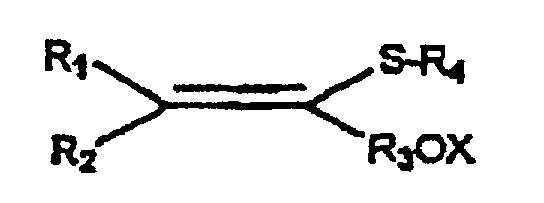
R4 eine organische Gruppe ist, die 1 bis 20 Kohlenstoffatome und gegebenenfalls Heteroatome enthält, R1 und R2 aus einer verzweigten Alkyl- und einer Cycloalkylgruppe ausgewählt sind, die gegebenenfalls miteinander zu einer cyclischen oder polycyclischen Gruppe verbunden sein können, R3 aus einer Arylgruppe, Biarylgruppe, Heteroarylgruppe, einer kondensierten polycyclischen Arylgruppe und einer kondensierten polycyclischen Heteroarylgruppe ausgewählt ist, die weitere Substituenten aufweisen können, und X eine Schutzgruppe, die durch ein Aktivierungsmittel entfernt werden kann, oder ein Wasserstoffatom oder eine zersetzliche Gruppe ist, die durch eine andere derartige Schutzgruppe ersetzt können. - Vinylsulfidverbindung nach Anspruch 1 mit der Formel worineine polycyclische Alkylgruppe ist, die gegebenenfalls substituiert sein kann.

- Verbindung nach Anspruch 2, wobeiaus der Gruppe ausgewählt ist, die aus substituierten und unsubstituierten Adamantylgruppen besteht.

- Verbindung nach Anspruch 2 oder Anspruch 3 mit der Formel

- Verbindung nach Anspruch 2, wobei R4 aus der Gruppe ausgewählt ist, die aus einer Arylgruppe mit 1 bis 12 Kohlenstoffatomen, die mit mindestens einem Halogenatom substituiert sein kann, und einer Arylgruppe mit 6 bis 20 Kohlenstoffatomen, die mit mindestens einem Halogenatom substituiert sein kann, besteht, wobei R4 vorzugsweise aus C2H5, CH2CF3 und p-Fluorphenyl ausgewählt ist.
- Verbindung nach Anspruch 2, wobei R3 eine m-Phenylgruppe ist und wobei OX aus der Gruppe ausgewählt ist, die aus einer Hydroxyl-, Alkoxy-, substituierten Alkoxy-, Acyloxy- mit der Formel OOCR10, worin R10 aus einer Alkyl- und Arylgruppe mit 2 bis 20 Kohlenstoffatomen ausgewählt ist, Trialkylsilyloxy-, Triarylsilyloxy-, Aryldialkylsilyloxy-, OPO(OR8)2, worin R8 ein organischer Rest ist, β-D-Galactosyloxy- und β-D-Glucuronidyloxygruppe besteht, wobei OX vorzugsweise eine Hydroxyl- oder Pivaloyloxygruppe ist.
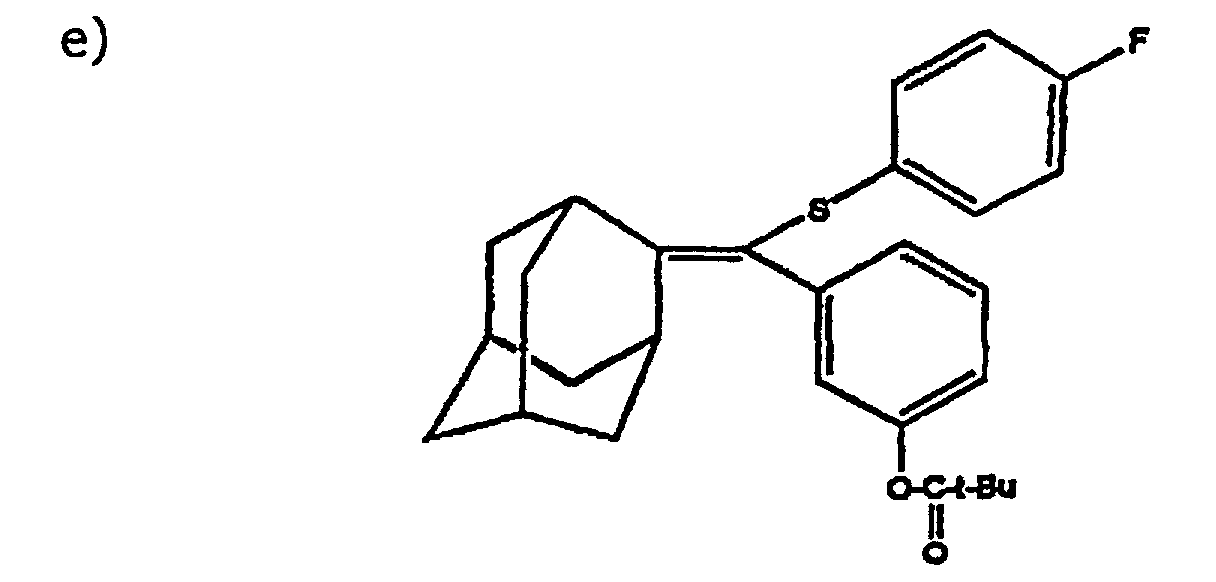
- Verbindung nach einem der vorstehenden Ansprüche, die aus den folgenden ausgewählt ist:


 und
und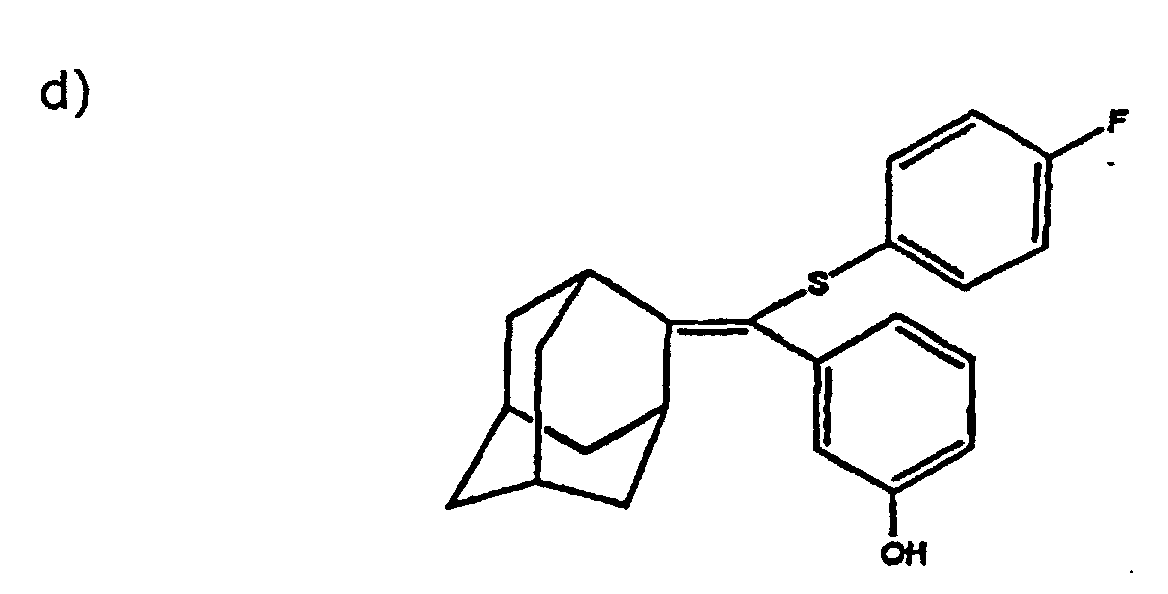
- Verfahren zum Herstellen einer Vinylsulfidverbindung der Formelwie in Anspruch 1, das folgendes aufweist:
 worin R1 und R2 aus einer verzweigten Alkyl- und einer Cycloalkylgruppe ausgewählt sind, die gegebenenfalls miteinander zu einer cyclischen oder polycyclischen Gruppe verbunden sein können,Umsetzen einer Ketonverbindung der Formel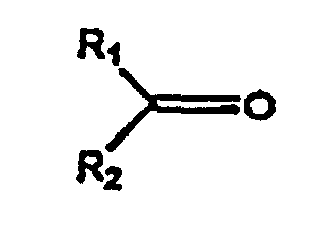
mit einer Thioesterverbindung der Formelworin R3 aus einer Aryl-, Biaryl-, Heteroarylgruppe, einer kondensierten polycyclischen Arylgruppe und einer kondensierten polycyclischen Heteroarylgruppe ausgewählt ist, die gegebenenfalls substituiert sein können, und X eine Schutzgruppe, die durch ein Aktivierungsmittel entfernt werden kann, oder ein Wasserstoffatom oder eine zersetzliche Gruppe ist, die durch eine andere derartige Schutzgruppe ersetzt können,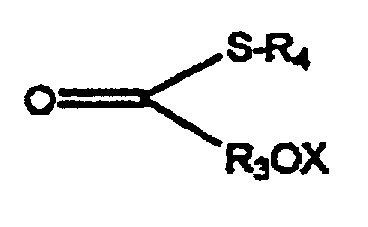
in einem aprotischen Lösungsmittel in Gegenwart eines metallischen Reduktionsmittels, eines Titansalzes und gegebenenfalls einer Amin-Base, wodurch das Vinylsulfid erzeugt wird. - Verfahren nach Anspruch 8, wobei die Vinylsulfidverbindung die Formelhat, und wobei die Ketonverbindung die Formel
 hat, worin
 eine polycyclische Alkylgruppe ist, die gegebenenfalls substituiert sein kann.
- Verfahren nach Anspruch 9, wobeiaus der Gruppe ausgewählt ist, die aus substituierten und unsubstituierten Adamantylgruppen besteht.
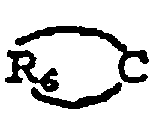
- Verfahren nach Anspruch 9 oder Anspruch 10, wobeieine spiro-kondensierte Adamantylgruppe ist.

- Verfahren nach einem der Ansprüche 9 bis 11, wobei R3 eine m-Phenylgruppe ist und wobei OX eine Alkoxygruppe ist.
- Verfahren nach einem der Ansprüche 9 bis 12, wobei R4 eine Alkylgruppe mit 1 bis 12 Kohlenstoffatomen ist.
- Verfahren nach Anspruch 8, wobei das Titansalz aus der Gruppe ausgewählt ist, die aus Titantrichlorid und Titantetrachlorid besteht.
- Verfahren nach Anspruch 8, wobei das metallische Reduktionsmittel Lithiumaluminiumhydrid ist und eine Amin-Base verwendet wird.
Applications Claiming Priority (3)
| Application Number | Priority Date | Filing Date | Title |
|---|---|---|---|
| US49271595A | 1995-06-20 | 1995-06-20 | |
| US492715 | 1995-06-20 | ||
| PCT/US1996/009249 WO1997000849A1 (en) | 1995-06-20 | 1996-06-19 | Novel vinyl sulfide compounds and a process for their preparation |
Publications (3)
| Publication Number | Publication Date |
|---|---|
| EP0869938A1 EP0869938A1 (de) | 1998-10-14 |
| EP0869938A4 EP0869938A4 (de) | 1998-10-14 |
| EP0869938B1 true EP0869938B1 (de) | 2002-10-16 |
Family
ID=23957357
Family Applications (1)
| Application Number | Title | Priority Date | Filing Date |
|---|---|---|---|
| EP96923225A Expired - Lifetime EP0869938B1 (de) | 1995-06-20 | 1996-06-19 | Neue vinylsulfid-verbindungen und ein verfahren zu ihrer herstellung |
Country Status (6)
| Country | Link |
|---|---|
| US (1) | US5883287A (de) |
| EP (1) | EP0869938B1 (de) |
| JP (1) | JP3023993B2 (de) |
| AT (1) | ATE226188T1 (de) |
| DE (1) | DE69624374T2 (de) |
| WO (1) | WO1997000849A1 (de) |
Families Citing this family (6)
| Publication number | Priority date | Publication date | Assignee | Title |
|---|---|---|---|---|
| US6348324B1 (en) | 1999-01-21 | 2002-02-19 | Hypoguard America Limited | Composition and device for detecting leukocytes in urine |
| US6528652B1 (en) | 1999-01-21 | 2003-03-04 | Chronimed | Composition and device for detecting leukocytes in urine |
| US7779591B2 (en) * | 2007-03-29 | 2010-08-24 | Stronggo Llc | Tiles with bottom-side extensions and method for installation |
| US7735278B2 (en) * | 2007-03-29 | 2010-06-15 | Stronggo Llc | Edge-adapted detectable warning tiles with bottom-side extensions |
| CN102030779A (zh) * | 2010-11-17 | 2011-04-27 | 云南瑞亘生物科技有限公司 | 一种免疫分析用化学发光物amppd的制备方法 |
| CN115710179A (zh) * | 2022-12-02 | 2023-02-24 | 浙江工业大学台州研究院 | 一种光催化合成α-酰氧基酮的方法 |
Family Cites Families (3)
| Publication number | Priority date | Publication date | Assignee | Title |
|---|---|---|---|---|
| US5068339A (en) * | 1986-07-17 | 1991-11-26 | Board Of Governors Of Wayne State University | Enhanced chemiluminescence from 1,2-dioxetanes through energy transfer to tethered fluorescers |
| US5220005A (en) * | 1986-07-24 | 1993-06-15 | Tropix, Inc. | Substituted adamantyl dioxetanes |
| EP0473984A1 (de) * | 1990-09-07 | 1992-03-11 | The Board Of Governors Of Wayne State University | 1,2-Dioxetan-Verbindungen als chemilumineszierende Markierungen für organische und biologische Moleküle |
-
1996
- 1996-06-19 JP JP9503860A patent/JP3023993B2/ja not_active Expired - Fee Related
- 1996-06-19 US US08/981,448 patent/US5883287A/en not_active Expired - Lifetime
- 1996-06-19 AT AT96923225T patent/ATE226188T1/de not_active IP Right Cessation
- 1996-06-19 EP EP96923225A patent/EP0869938B1/de not_active Expired - Lifetime
- 1996-06-19 DE DE69624374T patent/DE69624374T2/de not_active Expired - Fee Related
- 1996-06-19 WO PCT/US1996/009249 patent/WO1997000849A1/en not_active Ceased
Non-Patent Citations (1)
| Title |
|---|
| FRANCIS A. CAREY: "Organic Chemistry", 1992, MCGRAW-HILL, NEW YORK * |
Also Published As
| Publication number | Publication date |
|---|---|
| JPH10511101A (ja) | 1998-10-27 |
| US5883287A (en) | 1999-03-16 |
| AU6379396A (en) | 1997-01-22 |
| EP0869938A1 (de) | 1998-10-14 |
| AU709184B2 (en) | 1999-08-26 |
| DE69624374T2 (de) | 2003-07-10 |
| WO1997000849A1 (en) | 1997-01-09 |
| EP0869938A4 (de) | 1998-10-14 |
| DE69624374D1 (de) | 2002-11-21 |
| ATE226188T1 (de) | 2002-11-15 |
| JP3023993B2 (ja) | 2000-03-21 |
Similar Documents
| Publication | Publication Date | Title |
|---|---|---|
| DE68925963T2 (de) | Chemilimineszente 1,2-Dioxetan-Verbindungen | |
| EP1594855B1 (de) | Signalverbindungen zur verwendung in verfahren zum nachweis von wasserstoffperoxid | |
| EP0352713B2 (de) | Verfahren und Kompositionen zur Erzeugung verstärkter Chemilumineszenz von 1,2-Dioxetanen | |
| US5578253A (en) | Chemiluminescent dialkyl-substituted 1,2-dioxetane compounds, methods of synthesis and use | |
| EP0254051A2 (de) | Chemolumineszierende 1,2-Dioxetan-Verbindungen | |
| EP0582317B1 (de) | Synthese von 1,2-Dioxetanen und Zwischenprodukte dafür | |
| EP0842168B1 (de) | Verfahren zur herstellung von 1,2-dioxetanverbindungen und mit schwefel substituierte 1,2-dioxetane als zwischenverbindungen | |
| CN115215833B (zh) | 化学发光探针及其应用 | |
| EP0869938B1 (de) | Neue vinylsulfid-verbindungen und ein verfahren zu ihrer herstellung | |
| US6461876B1 (en) | Chemiluminescent 1,2-dioxetanes | |
| Edwards et al. | Naphthyl dioxetane phosphates: Synthesis of novel substrates for enzymic chemiluminescent assays | |
| AU703632B2 (en) | DI-substituted 1,2-dioxetane compounds having increased water solubility and assay compositions | |
| AU747422B2 (en) | Process for the preparation of 1,2-dioxetane compounds and novel sulfur-substituted 1,2-dioxetane compounds as intermediates | |
| CA2222788C (en) | Novel vinyl sulfide compounds and a process for their preparation | |
| AU709184C (en) | Novel vinyl sulfide compounds and a process for their preparation | |
| US6140495A (en) | Chemiluminescent 1,2-dioxetanes | |
| EP2048140A1 (de) | Deuterierte chemilumineszente 1,2-Dioxetane | |
| CN115536683B (zh) | 一种用于生命体中二氧化硫和双氧水成像的荧光探针及其制备方法和应用 | |
| AU700925B2 (en) | Chemiluminescent dialkyl-substituted 1,2-dioxetane compounds, methods of synthesis and use | |
| CN115536652A (zh) | 一种频率上转换氧杂蒽荧光探针及其制备方法和在检测硫醇中的应用 |
Legal Events
| Date | Code | Title | Description |
|---|---|---|---|
| PUAI | Public reference made under article 153(3) epc to a published international application that has entered the european phase |
Free format text: ORIGINAL CODE: 0009012 |
|
| 17P | Request for examination filed |
Effective date: 19980120 |
|
| A4 | Supplementary search report drawn up and despatched |
Effective date: 19980817 |
|
| AK | Designated contracting states |
Kind code of ref document: A4 Designated state(s): AT BE CH DE DK ES FI FR GB GR IE IT LI LU MC NL PT SE Kind code of ref document: A1 Designated state(s): AT BE CH DE DK ES FI FR GB GR IE IT LI LU MC NL PT SE |
|
| 17Q | First examination report despatched |
Effective date: 20000221 |
|
| RAP1 | Party data changed (applicant data changed or rights of an application transferred) |
Owner name: LUMIGEN, INC. |
|
| GRAG | Despatch of communication of intention to grant |
Free format text: ORIGINAL CODE: EPIDOS AGRA |
|
| RIN1 | Information on inventor provided before grant (corrected) |
Inventor name: EICKHOLT, ROBERT, A. Inventor name: ARGHAVANI, ZAHRA Inventor name: AKHAVAN-TAFTI, HASHEM |
|
| GRAG | Despatch of communication of intention to grant |
Free format text: ORIGINAL CODE: EPIDOS AGRA |
|
| GRAH | Despatch of communication of intention to grant a patent |
Free format text: ORIGINAL CODE: EPIDOS IGRA |
|
| RIN1 | Information on inventor provided before grant (corrected) |
Inventor name: EICKHOLT, ROBERT, A. Inventor name: ARGHAVANI, ZAHRA Inventor name: AKHAVAN-TAFTI, HASHEM |
|
| GRAH | Despatch of communication of intention to grant a patent |
Free format text: ORIGINAL CODE: EPIDOS IGRA |
|
| GRAA | (expected) grant |
Free format text: ORIGINAL CODE: 0009210 |
|
| AK | Designated contracting states |
Kind code of ref document: B1 Designated state(s): AT BE CH DE DK ES FI FR GB GR IE IT LI LU MC NL PT SE |
|
| PG25 | Lapsed in a contracting state [announced via postgrant information from national office to epo] |
Ref country code: NL Free format text: LAPSE BECAUSE OF FAILURE TO SUBMIT A TRANSLATION OF THE DESCRIPTION OR TO PAY THE FEE WITHIN THE PRESCRIBED TIME-LIMIT Effective date: 20021016 Ref country code: LI Free format text: LAPSE BECAUSE OF FAILURE TO SUBMIT A TRANSLATION OF THE DESCRIPTION OR TO PAY THE FEE WITHIN THE PRESCRIBED TIME-LIMIT Effective date: 20021016 Ref country code: IT Free format text: LAPSE BECAUSE OF FAILURE TO SUBMIT A TRANSLATION OF THE DESCRIPTION OR TO PAY THE FEE WITHIN THE PRE;WARNING: LAPSES OF ITALIAN PATENTS WITH EFFECTIVE DATE BEFORE 2007 MAY HAVE OCCURRED AT ANY TIME BEFORE 2007. THE CORRECT EFFECTIVE DATE MAY BE DIFFERENT FROM THE ONE RECORDED.SCRIBED TIME-LIMIT Effective date: 20021016 Ref country code: GR Free format text: LAPSE BECAUSE OF FAILURE TO SUBMIT A TRANSLATION OF THE DESCRIPTION OR TO PAY THE FEE WITHIN THE PRESCRIBED TIME-LIMIT Effective date: 20021016 Ref country code: FI Free format text: LAPSE BECAUSE OF FAILURE TO SUBMIT A TRANSLATION OF THE DESCRIPTION OR TO PAY THE FEE WITHIN THE PRESCRIBED TIME-LIMIT Effective date: 20021016 Ref country code: CH Free format text: LAPSE BECAUSE OF FAILURE TO SUBMIT A TRANSLATION OF THE DESCRIPTION OR TO PAY THE FEE WITHIN THE PRESCRIBED TIME-LIMIT Effective date: 20021016 Ref country code: BE Free format text: LAPSE BECAUSE OF FAILURE TO SUBMIT A TRANSLATION OF THE DESCRIPTION OR TO PAY THE FEE WITHIN THE PRESCRIBED TIME-LIMIT Effective date: 20021016 Ref country code: AT Free format text: LAPSE BECAUSE OF FAILURE TO SUBMIT A TRANSLATION OF THE DESCRIPTION OR TO PAY THE FEE WITHIN THE PRESCRIBED TIME-LIMIT Effective date: 20021016 |
|
| REF | Corresponds to: |
Ref document number: 226188 Country of ref document: AT Date of ref document: 20021115 Kind code of ref document: T |
|
| REG | Reference to a national code |
Ref country code: GB Ref legal event code: FG4D |
|
| REG | Reference to a national code |
Ref country code: CH Ref legal event code: EP |
|
| REG | Reference to a national code |
Ref country code: IE Ref legal event code: FG4D |
|
| REF | Corresponds to: |
Ref document number: 69624374 Country of ref document: DE Date of ref document: 20021121 |
|
| PG25 | Lapsed in a contracting state [announced via postgrant information from national office to epo] |
Ref country code: SE Free format text: LAPSE BECAUSE OF FAILURE TO SUBMIT A TRANSLATION OF THE DESCRIPTION OR TO PAY THE FEE WITHIN THE PRESCRIBED TIME-LIMIT Effective date: 20030116 Ref country code: PT Free format text: LAPSE BECAUSE OF FAILURE TO SUBMIT A TRANSLATION OF THE DESCRIPTION OR TO PAY THE FEE WITHIN THE PRESCRIBED TIME-LIMIT Effective date: 20030116 Ref country code: DK Free format text: LAPSE BECAUSE OF FAILURE TO SUBMIT A TRANSLATION OF THE DESCRIPTION OR TO PAY THE FEE WITHIN THE PRESCRIBED TIME-LIMIT Effective date: 20030116 |
|
| NLV1 | Nl: lapsed or annulled due to failure to fulfill the requirements of art. 29p and 29m of the patents act | ||
| ET | Fr: translation filed | ||
| PG25 | Lapsed in a contracting state [announced via postgrant information from national office to epo] |
Ref country code: ES Free format text: LAPSE BECAUSE OF FAILURE TO SUBMIT A TRANSLATION OF THE DESCRIPTION OR TO PAY THE FEE WITHIN THE PRESCRIBED TIME-LIMIT Effective date: 20030429 |
|
| REG | Reference to a national code |
Ref country code: CH Ref legal event code: PL |
|
| PG25 | Lapsed in a contracting state [announced via postgrant information from national office to epo] |
Ref country code: LU Free format text: LAPSE BECAUSE OF NON-PAYMENT OF DUE FEES Effective date: 20030619 |
|
| PG25 | Lapsed in a contracting state [announced via postgrant information from national office to epo] |
Ref country code: MC Free format text: LAPSE BECAUSE OF NON-PAYMENT OF DUE FEES Effective date: 20030630 |
|
| PLBE | No opposition filed within time limit |
Free format text: ORIGINAL CODE: 0009261 |
|
| STAA | Information on the status of an ep patent application or granted ep patent |
Free format text: STATUS: NO OPPOSITION FILED WITHIN TIME LIMIT |
|
| 26N | No opposition filed |
Effective date: 20030717 |
|
| PGFP | Annual fee paid to national office [announced via postgrant information from national office to epo] |
Ref country code: IE Payment date: 20080627 Year of fee payment: 13 |
|
| PGFP | Annual fee paid to national office [announced via postgrant information from national office to epo] |
Ref country code: FR Payment date: 20090617 Year of fee payment: 14 |
|
| PGFP | Annual fee paid to national office [announced via postgrant information from national office to epo] |
Ref country code: GB Payment date: 20090625 Year of fee payment: 14 Ref country code: DE Payment date: 20090629 Year of fee payment: 14 |
|
| REG | Reference to a national code |
Ref country code: IE Ref legal event code: MM4A |
|
| PG25 | Lapsed in a contracting state [announced via postgrant information from national office to epo] |
Ref country code: IE Free format text: LAPSE BECAUSE OF NON-PAYMENT OF DUE FEES Effective date: 20090619 |
|
| GBPC | Gb: european patent ceased through non-payment of renewal fee |
Effective date: 20100619 |
|
| REG | Reference to a national code |
Ref country code: FR Ref legal event code: ST Effective date: 20110228 |
|
| PG25 | Lapsed in a contracting state [announced via postgrant information from national office to epo] |
Ref country code: DE Free format text: LAPSE BECAUSE OF NON-PAYMENT OF DUE FEES Effective date: 20110101 |
|
| PG25 | Lapsed in a contracting state [announced via postgrant information from national office to epo] |
Ref country code: FR Free format text: LAPSE BECAUSE OF NON-PAYMENT OF DUE FEES Effective date: 20100630 |
|
| PG25 | Lapsed in a contracting state [announced via postgrant information from national office to epo] |
Ref country code: GB Free format text: LAPSE BECAUSE OF NON-PAYMENT OF DUE FEES Effective date: 20100619 |