EP0869737B1 - Procede de controle automatique de l'acuite auditive, notamment de nouveau-nes et de nourrissons - Google Patents
Procede de controle automatique de l'acuite auditive, notamment de nouveau-nes et de nourrissons Download PDFInfo
- Publication number
- EP0869737B1 EP0869737B1 EP96946211A EP96946211A EP0869737B1 EP 0869737 B1 EP0869737 B1 EP 0869737B1 EP 96946211 A EP96946211 A EP 96946211A EP 96946211 A EP96946211 A EP 96946211A EP 0869737 B1 EP0869737 B1 EP 0869737B1
- Authority
- EP
- European Patent Office
- Prior art keywords
- test
- sample
- subaverages
- spectral
- sweeps
- Prior art date
- Legal status (The legal status is an assumption and is not a legal conclusion. Google has not performed a legal analysis and makes no representation as to the accuracy of the status listed.)
- Expired - Lifetime
Links
- 238000012360 testing method Methods 0.000 title claims abstract description 111
- 238000000034 method Methods 0.000 title claims abstract description 48
- 230000003595 spectral effect Effects 0.000 claims abstract description 46
- 238000001228 spectrum Methods 0.000 claims abstract description 29
- 230000001965 increasing effect Effects 0.000 claims abstract description 23
- 230000008569 process Effects 0.000 claims abstract description 23
- 238000012935 Averaging Methods 0.000 claims abstract description 14
- 230000000638 stimulation Effects 0.000 claims abstract description 14
- 230000004044 response Effects 0.000 claims abstract description 9
- 210000000133 brain stem Anatomy 0.000 claims abstract 3
- 238000001514 detection method Methods 0.000 claims description 19
- 230000035945 sensitivity Effects 0.000 claims description 17
- 238000004422 calculation algorithm Methods 0.000 claims description 7
- 230000000763 evoking effect Effects 0.000 claims description 7
- 230000006870 function Effects 0.000 claims description 7
- 238000012071 hearing screening Methods 0.000 claims description 7
- 238000000528 statistical test Methods 0.000 claims description 6
- 230000003247 decreasing effect Effects 0.000 claims description 5
- 238000012986 modification Methods 0.000 claims description 3
- 230000004048 modification Effects 0.000 claims description 3
- 230000009466 transformation Effects 0.000 claims description 3
- 230000001419 dependent effect Effects 0.000 claims description 2
- 238000004088 simulation Methods 0.000 claims description 2
- 238000011835 investigation Methods 0.000 description 9
- 238000012216 screening Methods 0.000 description 7
- 208000032041 Hearing impaired Diseases 0.000 description 5
- 230000009467 reduction Effects 0.000 description 5
- 230000002269 spontaneous effect Effects 0.000 description 5
- 238000007619 statistical method Methods 0.000 description 5
- 238000009795 derivation Methods 0.000 description 4
- 238000011156 evaluation Methods 0.000 description 4
- 238000012076 audiometry Methods 0.000 description 3
- 210000003027 ear inner Anatomy 0.000 description 3
- 210000002768 hair cell Anatomy 0.000 description 3
- 238000001135 Friedman test Methods 0.000 description 2
- 230000008901 benefit Effects 0.000 description 2
- 238000011161 development Methods 0.000 description 2
- 230000018109 developmental process Effects 0.000 description 2
- 210000000883 ear external Anatomy 0.000 description 2
- 208000016354 hearing loss disease Diseases 0.000 description 2
- 238000012074 hearing test Methods 0.000 description 2
- 238000012545 processing Methods 0.000 description 2
- 210000004761 scalp Anatomy 0.000 description 2
- 206010011878 Deafness Diseases 0.000 description 1
- 208000016621 Hearing disease Diseases 0.000 description 1
- 238000001604 Rao's score test Methods 0.000 description 1
- 206010039897 Sedation Diseases 0.000 description 1
- 239000000853 adhesive Substances 0.000 description 1
- 230000001070 adhesive effect Effects 0.000 description 1
- 210000000721 basilar membrane Anatomy 0.000 description 1
- 238000004364 calculation method Methods 0.000 description 1
- 230000008859 change Effects 0.000 description 1
- 230000008602 contraction Effects 0.000 description 1
- 230000001054 cortical effect Effects 0.000 description 1
- 238000013480 data collection Methods 0.000 description 1
- 238000003745 diagnosis Methods 0.000 description 1
- 230000000694 effects Effects 0.000 description 1
- 230000002349 favourable effect Effects 0.000 description 1
- 210000001061 forehead Anatomy 0.000 description 1
- 230000010370 hearing loss Effects 0.000 description 1
- 231100000888 hearing loss Toxicity 0.000 description 1
- 230000006872 improvement Effects 0.000 description 1
- 230000003447 ipsilateral effect Effects 0.000 description 1
- 230000007794 irritation Effects 0.000 description 1
- 210000001595 mastoid Anatomy 0.000 description 1
- 238000005259 measurement Methods 0.000 description 1
- 230000010355 oscillation Effects 0.000 description 1
- 230000003534 oscillatory effect Effects 0.000 description 1
- 230000000750 progressive effect Effects 0.000 description 1
- 238000005070 sampling Methods 0.000 description 1
- 230000036280 sedation Effects 0.000 description 1
- 238000004904 shortening Methods 0.000 description 1
- 238000012109 statistical procedure Methods 0.000 description 1
- 230000004936 stimulating effect Effects 0.000 description 1
- 230000002123 temporal effect Effects 0.000 description 1
- 230000001131 transforming effect Effects 0.000 description 1
- 239000002699 waste material Substances 0.000 description 1
Classifications
-
- A—HUMAN NECESSITIES
- A61—MEDICAL OR VETERINARY SCIENCE; HYGIENE
- A61B—DIAGNOSIS; SURGERY; IDENTIFICATION
- A61B5/00—Measuring for diagnostic purposes; Identification of persons
- A61B5/12—Audiometering
-
- A—HUMAN NECESSITIES
- A61—MEDICAL OR VETERINARY SCIENCE; HYGIENE
- A61B—DIAGNOSIS; SURGERY; IDENTIFICATION
- A61B5/00—Measuring for diagnostic purposes; Identification of persons
- A61B5/24—Detecting, measuring or recording bioelectric or biomagnetic signals of the body or parts thereof
- A61B5/316—Modalities, i.e. specific diagnostic methods
- A61B5/369—Electroencephalography [EEG]
- A61B5/377—Electroencephalography [EEG] using evoked responses
- A61B5/38—Acoustic or auditory stimuli
Definitions
- the invention relates to the field of objective, i.e. of the patient's involvement independent determination of the Hearing ability using acoustically evoked potentials (AEP) or otoacoustic emissions (OAE).
- AEP acoustically evoked potentials
- OAE otoacoustic emissions
- the averaging must be carried out until a good evaluable AEP is available. Deciding whether an answer potential is present or not, is determined by the examiner like. The alleged objective audiometry is therefore only objective with regard to data collection, the Evaluation is subjective.
- Effective decision support can only be expected from suitable statistical procedures that are not applied to the averaging result, but to the total amount of individual sweeps.
- the statistics can be applied either to the time functions of the sweeps or to binomial features derived from the time functions or, after a spectral transformation, to the spectra of the sweeps.
- the method described in this patent still refers to medium-latent AEP (MAEP), but the ALGO-1 Plus sensibly works with the FAEP, which is cheaper for hearing tests in infants, but the procedure is basically the same:
- MAEP medium-latent AEP
- the template results here as the mean value of the FAEP of 35 normally hearing babies with a stimulus strength of 35 dB HL.
- 9 data points were determined, which are particularly stable. Only the values of the sweeps at these times are then evaluated with different weighting using binominal statistics.
- the template is positive or negative at the selected times after the stimulus application. The individual sweeps are now checked to see whether the amplitude is also positive or negative at these times. The number of matches is counted and a statistical check is carried out to determine whether it is greater than in the case of a pure random signal.
- the statistical used Test is a so-called one-sample test, i.e. it will only the conditions at a given time checked (in this case to the ones marked on the template Times). As a result of the 9 times checked then 9 test results.
- the single ones statistical test results can contradict each other and need to make a statement through an additional procedure be linked.
- the device Based on the concept of a screening device tailored to the procedure, with which the hearing threshold should not be determined but rather hearing-impaired children should be "screened", the device only works with a fixed, relatively far above-threshold stimulus intensity of 35 dB HL. The result is only a yes / no answer (hearing impaired / not hearing impaired). The concept is not objectionable, but what is critical is the chosen relatively high stimulus level, which evokes a demonstrable response even in the case of significant hearing disorders.
- Otoacoustic emissions are sound emissions from the inner ear that can be registered with a sensitive microphone in the outer ear canal. OAE are generated by the outer hair cells.
- the outer hair cells are capable of active oscillatory contractions, which bring about a very sharp frequency tuning of the basilar membrane in the inner ear. The oscillations of the outer hair cells release vibrational energy, which can be measured as a retrograde sound emission in the outer ear canal. 1)
- the OAE are relatively simple and take up little time measurable (with commercial equipment), so they are good as the basis for a screening hearing test in infants and small children.
- the problem is here too (like in the AEP) that the presence / absence of OAE must be assessed subjectively by the examiner.
- the averaging process is used Improvement of the signal-to-noise ratio used. It must have a fixed number of averaging steps to be worked, even with very small OAE still leads to an evaluable result. At OAE with larger amplitude will inevitably waste time since they are also with a smaller number of averages would be detectable. For use as a screening process but is the shortest possible duration of the investigation required.
- tests are carried out either only in the spectral range (according to claim 1 with the associated subclaims) or in the spectral range and in the time range (cf. claims 11 and 12). Since the signal-to-noise ratio in the individual sweep near the threshold is extremely unfavorable in the case of the FAEP, the statistical testing is not carried out on the basis of the individual sweeps, but rather a sufficient number of sweeps (preferably 100) to partial mean potentials (TMP) is pre-determined.
- the basis for the statistical test method according to the invention is the little-known "q-sample uniform scores test" according to Mardia, KV Statistics of directional data, which has not yet been mentioned in connection with automatic AEP detection. Academic Press, New York, 1972. In this test, as the name suggests, q spectral terms are also included in the test. As a result, there are not q statements, but only a statement (potential available / not available).
- Another q-sample test not previously used for automatic AEP detection is the q-sample Watson U 2 test (Maag, UR: Ak-sample analogue of Watson's U 2 statistic. Biometrika 1966: 53; 579-583). The sensitivity of this test is slightly lower than that of the q-sample uniform scores test.
- n of the spectral terms tested is always a certain one (also gradually increasing) number of spectral terms is added, which is generated by simulation and only randomly distributed phases and amplitudes contain.
- Contain those from the real investigation Terms a signal portion from an AEP, it is called Result of the larger differences in the sample between the included terms the test is more sensitive react to the signal component. Contain those from the real investigation terms, however, no signal component from an AEP, the added terms are without Concern.
- the application of the conventional and the invention modified q-sample uniform scores tests the spectra of the partial mean potentials follow a special test strategy, through which another Increase in detection sensitivity is achieved.
- the FAEP spectrum evaluated here consists of n spectral terms, which for the FAEP display essential frequency range from 30 to include about 600 Hz.
- FAEP close to the threshold expose themselves mainly low-frequency spectral components together, with increasing exuberance of the FAEP are increasing also higher-frequency terms on the composition of the FAEP time course involved. In addition, the frequency varies The composition of the FAEP is highly interindividual.
- the unmodified (conventional) q-sample uniform scores test checks the phases of the spectral terms involved for equality.
- the modified q-sample uniform scores also relates to the spectral amplitudes with a.
- a test situation is not foreseeable, in which Number of spectral terms there are maximum differences between result in the spectral terms and thus an optimal one Detection sensitivity is achieved, the following was Test strategy developed that delivers a result that is very close to the optimal sensitivity.
- the q-sample uniform scores test is then applied several times to this sample, consisting of the 5 spectra of the TMP: Starting, for example, with the term corresponding to the lowest frequency of the spectrum (fundamental frequency) (but preferably with the first term above 50 Hz, in order to rule out any interference from the mains frequency), a test run is carried out using the modified q-sample uniform scores test including a small number q 1 of terms. Then the number is increased to q 2 and a new test run is carried out. This is repeated unless the presence of a FAEP is indicated during a test run until all n spectral terms are included.
- the signal processor could be fast enough the increment for increasing the number of spectral terms included can also be 1. That would be it The best way to achieve the optimum sensitivity.
- the stimulus level can be fixed; but he can also be gradually increased or decreased.
- the principle is that the test scope of the stimulus level is always halved during the next test. For example, it starts with a stimulus level of 20 dB HL (the majority of the children examined will have normal hearing, which is why it makes sense, due to time constraints, not to start testing very far above the normal hearing threshold and rather a slightly longer one for the less frequent hearing impaired children Accept trial period). If the test shows the presence of an AEP at 20 dB, the stimulus level is terminated. The stimulus level is halved, ie the next test takes place at 10 dB HL. If the test also shows an AEP, the stimulus level is halved again to 5 dB HL and tested again.
- the stimulus repetition rate is 59 / s for FAEP leads chosen unusually high, i.e. there will be 59 sweeps per Second won (37 sweeps per second in the standing the comparison method called technology). Any other Repetition rate is between about 10 / s and about 100 / s in principle conceivable.
- the amplitude of the wave V of FAEP decreased when the stimulus repetition rate was increased. Up to a stimulus repetition rate of about 100 / s is the reduction the amplitude is only relatively small. Any reduction the amplitude does reduce the signal-to-noise ratio and thus the possibility of detection with the increased stimulus rate however, more sweeps per unit of time are averaged. The resulting increase in the signal-to-noise ratio exceeds the effect of the increased Stimulus repetition rate-related amplitude reduction. In the The sum therefore results in a high stimulus rate better AEP traceability.
- the application of the invention has the following advantages. Due to the higher potential detection sensitivity of the chosen and modified statistical method, when using AEP, a detection of potential near the threshold and thus a real hearing threshold determination is possible. As a result, much more diagnostic information is obtained than in the simple yes / no decision of the screening device mentioned in the prior art.
- medium latent overlay not only not critical, but even desirable as it has sensitivity to detection elevated. There is therefore no age-related application restriction.
- the high stimulus repetition rate of 59 / s allows a short examination time.
- the statistical method according to the invention is a q-sample Test, it delivers, regardless of how much spectral terms only one should be included in the test only statistical statement.
- the method according to the invention is also applicable to all others known AEP types and OAE emissions applicable. It can immediately (TEOAE) or after slight modification (DPOAE) for the objective detection of otoacoustic emissions be used.
- OAE otoacoustic emissions
- the click hearing threshold should be determined objectively.
- the early acoustically evoked potentials (FAEP) with click stimulation are to be derived and verified by a statistical method.
- the examination takes place during natural sleep of the child or if necessary with slight sedation.
- the stimulus application takes place via headphones or via Insert phones.
- the starting stimulus level for the objective Determining the hearing threshold according to the one proposed here Method is 20 dB HL.
- 3 Adhesive electrodes fixed on the child's scalp (Vertex, ipsilateral mastoid. Forehead).
- the click stimulation takes place with a stimulus repetition rate of 59 / s.
- the EEG is appropriately strengthened and then over an analog to digital converter (ADC) into a digital form transferred.
- ADC analog to digital converter
- the sampling rate of the ADC is 10 kHz. from Counting the onset of stimulus, EEG sections (sweeps) with a length of 16 ms. Every sweep is there from 160 samples. Of 100 in a row Sweeps the mean is calculated. The resulting Partial mean potential is saved.
- test is made up of the sample Spectral terms 6 to 10 of the first 5 partial mean potentials applied.
- the number n of spectral terms included is gradually increased until a significant result is obtained or until the 65th term has also been included in the step-by-step increase in number n of spectral terms. In the latter case, statistical testing continues at the start stimulus level of 20 dB as soon as the spectra of the next 5 TMP are available.
- the now expanded sample consists of the spectra of the first 10 TMP.
- the objective hearing threshold determination is thus ended.
- the result is that the infant's click hearing threshold is 10 dB HL, so the infant has normal hearing and not, as suspected, hearing impaired.
- the time required for the threshold to be found automatically would be a little less than 3 minutes in the above case (the time required for obtaining a TMP is 1.69 seconds; 1.69 • (20 + 70) TMP ⁇ 2.5 minutes).
Landscapes
- Health & Medical Sciences (AREA)
- Life Sciences & Earth Sciences (AREA)
- Physics & Mathematics (AREA)
- Engineering & Computer Science (AREA)
- General Health & Medical Sciences (AREA)
- Surgery (AREA)
- Veterinary Medicine (AREA)
- Biophysics (AREA)
- Pathology (AREA)
- Biomedical Technology (AREA)
- Heart & Thoracic Surgery (AREA)
- Medical Informatics (AREA)
- Molecular Biology (AREA)
- Public Health (AREA)
- Animal Behavior & Ethology (AREA)
- Acoustics & Sound (AREA)
- Multimedia (AREA)
- Audiology, Speech & Language Pathology (AREA)
- Psychiatry (AREA)
- Psychology (AREA)
- Measurement Of The Respiration, Hearing Ability, Form, And Blood Characteristics Of Living Organisms (AREA)
Claims (12)
- Procédé de contrôle automatique de l'acuité auditive, notamment de nouveau-nés et de nourrissons qui se base sur la détermination du potentiel prématuré évoqué acoustiquement ou sur des émissions oto-acoustiques, et qui prévoit des contrôles dans le domaine spectral en étapes comme suit :a) préalablement, on établit les moyennes d'un nombre suffisant de sweeps qui donneront le potentiel en moyennes partielles (p.m.p.), les sweeps y sont définis comme sections après-stimulation de l'électro-encéphalogramme spontané,b) avec les valeurs du potentiel en moyennes partielles, on calcule les spectres,c) sur ces spectres du potentiel en moyennes partielles, on applique le test q-sample uniform scores de la manière traditionnelle ou le test q-sample Watson U2, c'est-à-dire, on vérifie la similitude des phases des valeurs intégrées du spectre, ou on applique un test q-sample uniform scores modifié, qui comprend encore les amplitudes spectrales,d) afin de décider combien de valeurs du spectre n et lesquelles doivent être intégrées dans ce test, les étapes suivantes du procédé sont nécessaires :d 1) à partir d'un premier nombre de sweeps, on détermine en continu le potentiel en moyennes partielles ; sur cette épreuve au hasard, après la transformation dans le domaine spectral qui est composé de m spectres du potentiel en moyennes partielles, on applique plusieurs fois le test q-sample uniform de la manière traditionnelle ou modifiée, ou bien on y applique plusieurs fois le test q-sample Watson U2;d 2) commençant de préférence par la première valeur supérieure à 50 Hz, on fait un premier programme de contrôle avec le test q-sample uniform, dans lequel on n'emploie qu'un nombre réduit q1 de valeurs ;d 3) en augmentant pas à pas le nombre de valeurs intégrées dans le test, on effectue à chaque fois un nouveau programme de contrôle, jusqu'à ce que toutes les valeurs du spectre soient tenues en compte, à condition que le dispositif n'indique pas plus tôt l'existence d'un potentiel prématuré évoqué acoustiquement ;d 4) si l'épreuve au hasard avec m valeurs du potentiel en moyennes partielles n'a donné aucune signification même en y ayant considéré toutes les n valeurs du spectre, on applique le procédé expliqué ci-dessus sur un contrôle au hasard élargi avec m + 5 dès qu'il y a au moins cinq valeurs suivantes du potentiel en moyennes partielles ; il est également possible d'élargir la gamme des épreuves au hasard en plus petits ou plus grands pas en continuant les contrôles en même temps ;d 5) après l'obtention d'un nombre d'épreuves au hasard prédéfini qui devrait être compris entre m = 50 et m = 200 environ, la collection de données n'est plus continuée à ce niveau de stimulation, si le test n'indique aucune signification, ou bien on augmente le niveau de stimulation ;d 6) si, au cours de l'un de ces contrôles, le résultat « potentiel prématuré évoqué acoustiquement existe » est indiqué, le test est arrêté à ce niveau de stimulation acoustique, ou ce dernier est baissé progressivement dans des pas d'au moins 5 dB, et on recommence les programmes de contrôle expliqués ci-dessus en commençant par un nombre d'épreuves au hasard de m.
- Procédé selon la revendication n°. 1,
caractérisé par le fait que le nombre de sweeps dont on établit préalablement la moyenne afin d'obtenir le potentiel en moyennes partielles (p.m.p.) est compris entre 50 et 1000, le nombre de sweeps par p.m.p. peut varier en fonction de la variance du p.m.p. (rapport signal-bruit) qui est calculée en même temps. - Procédé selon la revendication n°. 2,
caractérisé par le fait qu' on utilise de préférence 100 sweeps par potentiel en moyennes partielles pour en former la moyenne. - Procédé selon l'une des revendications 1 à 3,
caractérisé par le fait que le procédé est entamé quand le nombre m des valeurs du potentiel en moyennes partielles est égal ou supérieur à 3, de préférence il est m = 5 ou m = 10. - Procédé selon la revendication n°. 1,
caractérisé par le fait que le contrôle multiple après la phase d) du procédé commence avec q1≥2 valeurs du spectre. - Procédé selon l'une des revendications 1 à 5,
caractérisé par le fait que, lors d'une augmentation pas à pas du nombre n des valeurs du spectre, on y ajoute, après les avoir testées, un nombre de valeurs du spectre qui découlent d'une simulation et qui ne disposent que phases et d'amplitudes disposées aléatoirement et dont le nombre peut, lui aussi, être augmenté pas à pas. - Procédé selon l'une des revendications 1 à 6,
caractérisé par le fait que le taux de répétition de la stimulation est supérieur à 10/s, et de préférence il est de 59/s. - Procédé selon l'une des revendications 1 à 7,
caractérisé par le fait que pour réduire ou augmenter le niveau de la stimulation, les pas suivent un algorithme dont le principe réside dans le fait qu'une marge de contrôle prédéterminée pour le niveau de la stimulation est divisée par moitié dans le test suivant ; si la marge de contrôle est encore ouverte vers le haut quand une augmentation du niveau de la stimulation est nécessaire, il faut doubler le niveau de la stimulation lors du contrôle suivant. - Procédé selon l'une des revendications 1 à 8,
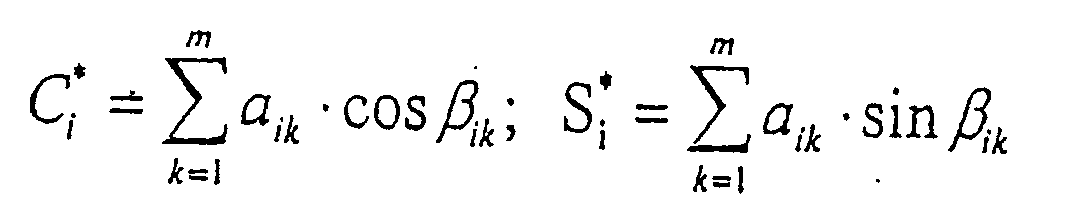
caractérisé par le fait que pour le test q-sample uniform scores s'applique : avecn = nombre des valeurs du spectre intégrées,m = nombre des potentiels en moyennes partielles (p.m.p.)il existe h = m - n angles de phase,tous les h angles de phase sont classés par rang, avec rupture randomisée des liaisons, rik représentent les rangs des phases dans la i-e valeur du spectre (i = 1, ..., n) du k-e p.m.p. (k = 1,... m)toutes les phases sont remplacées partoutes les amplitudes spectrales Aik sont classées par rang séparément pour chaque p.m.p., ou la totalité des h = m - n amplitudes spectrales sont classées par rang, aik y représente les rangs des amplitudes des Aik dans la i-e valeur du spectre du k-e p.m.p.; statistique du test :mit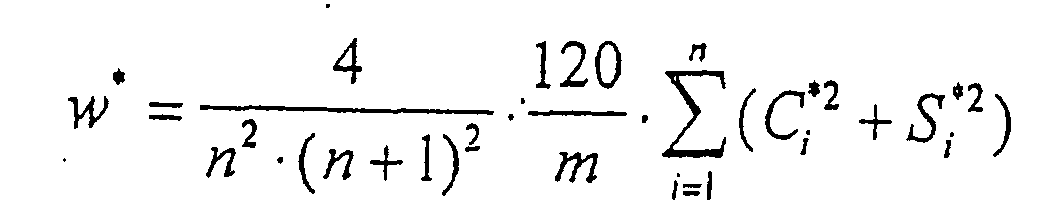
- Procédé selon l'une des revendications 1 à 9,
caractérisé par le fait qu'il est appliqué avec des émissions oto-acoustiques évoquées transitoirement ou à l'aide de produits de distorsion des émissions oto-acoustiques afin de mettre en évidence objective les émissions oto-acoustiques. - Procédé selon l'une des revendications 1 à 10,
caractérisé par le fait que, pour contrôler l'acuité auditive avec visualisation sur l'écran, on fait un test dans le domaine spectrale, et en même temps, on en fait un autre, qui est statistique et se fait dans le domaine temporaire ; celui qui se fait dans le domaine spectrale analyse notamment la gamme des phases, et celui qui se fait dans le domaine temporaire analyse les amplitudes de la fonction de temps ; les résultats des tests dans les domaines et de temps et de spectre sont mis en relation et analysés ; ainsi, un faux résultat positif qui résulte du test dans le domaine spectrale n'est pas confirmé par un résultat identique obtenu par le test dans le domaine temporaire - et inversement. - Procédé selon la revendication n°. 11,
caractérisé par le fait que, dans le but d'une augmentation de la sensibilité du contrôle du potentiel évoqué acoustiquement lors de la détermination des seuils de acuité auditive, on peut choisir une composition OU à la place d'une composition ET pour mettre en relation les résultats obtenus dans les tests dans le domaine de temps et de spectre, qui font partie du contrôle de l'acuité auditive avec visualisation sur l'écran.
Applications Claiming Priority (3)
| Application Number | Priority Date | Filing Date | Title |
|---|---|---|---|
| DE19548982A DE19548982A1 (de) | 1995-12-28 | 1995-12-28 | Verfahren zur automatischen Hörschwellenbestimmung, insbesondere bei Neugeborenen und Kleinkindern |
| DE19548982 | 1995-12-28 | ||
| PCT/DE1996/002453 WO1997024056A2 (fr) | 1995-12-28 | 1996-12-19 | Procede de controle automatique de l'acuite auditive, notamment de nouveau-nes et de nourrissons |
Publications (2)
| Publication Number | Publication Date |
|---|---|
| EP0869737A2 EP0869737A2 (fr) | 1998-10-14 |
| EP0869737B1 true EP0869737B1 (fr) | 2002-03-06 |
Family
ID=7781560
Family Applications (1)
| Application Number | Title | Priority Date | Filing Date |
|---|---|---|---|
| EP96946211A Expired - Lifetime EP0869737B1 (fr) | 1995-12-28 | 1996-12-19 | Procede de controle automatique de l'acuite auditive, notamment de nouveau-nes et de nourrissons |
Country Status (6)
| Country | Link |
|---|---|
| US (1) | US6071246A (fr) |
| EP (1) | EP0869737B1 (fr) |
| AT (1) | ATE213926T1 (fr) |
| AU (1) | AU1921397A (fr) |
| DE (2) | DE19548982A1 (fr) |
| WO (1) | WO1997024056A2 (fr) |
Families Citing this family (37)
| Publication number | Priority date | Publication date | Assignee | Title |
|---|---|---|---|---|
| DE19736480B4 (de) * | 1997-08-21 | 2006-03-16 | Siemens Ag | System zum Überwachen eines Patienten |
| US6200273B1 (en) * | 1999-04-26 | 2001-03-13 | House Ear Institute | Power-optimized cumulative, sequential statistical method for detection of auditory evoked potentials |
| DE19954666B4 (de) * | 1999-11-13 | 2004-05-06 | Pilot Blankenfelde Medizinisch-Elektronische Geräte GmbH | Verfahren zur objektiven frequenzspezifischen Hörschwellenbestimmung mittels der Amplitude Modulation Following Response (AMFR) |
| US6343230B1 (en) * | 2000-01-07 | 2002-01-29 | Natus Medical, Inc. | Hearing evaluation device with predictive capabilities |
| US7133715B1 (en) | 2000-01-07 | 2006-11-07 | Natus Medical Inc. | Hearing evaluation device with noise detection and evaluation capability |
| US6503207B2 (en) * | 2000-02-14 | 2003-01-07 | Natus Medical, Inc. | Multi-mode audiometric device and associated screening method |
| US20010036277A1 (en) * | 2000-02-14 | 2001-11-01 | Stone Robert T. | Audiometric apparatus and associated screening method |
| US7399282B2 (en) * | 2000-05-19 | 2008-07-15 | Baycrest Center For Geriatric Care | System and method for objective evaluation of hearing using auditory steady-state responses |
| US6602202B2 (en) | 2000-05-19 | 2003-08-05 | Baycrest Centre For Geriatric Care | System and methods for objective evaluation of hearing using auditory steady-state responses |
| US6718199B2 (en) | 2000-10-27 | 2004-04-06 | Massachusetts Eye & Ear Infirmary | Measurement of electrophysiologic response |
| WO2002062221A1 (fr) * | 2001-02-07 | 2002-08-15 | East Carolina University | Evaluation audiologique via un reseau informatique |
| EP1401331A2 (fr) | 2001-06-07 | 2004-03-31 | Stürzebecher, Ekkehard | Methode de depistage auditif du nouveau-ne a l'aide de potentiels evoques en regime permanent a taux de declics eleve |
| US20040171965A1 (en) * | 2001-10-02 | 2004-09-02 | Fischer-Zoth Gmbh | Portable handheld hearing screening device and method with internet access and link to hearing screening database |
| EP1444950A1 (fr) * | 2003-02-07 | 2004-08-11 | Stürzebecher Ekkehard | Procédé de détection objective d'Auditory-State-Responses (ASSR) dans le domaine temporel |
| EP1444951A1 (fr) * | 2003-02-07 | 2004-08-11 | Stürzebecher Ekkehard | Appareil pour détection objective de "Auditory Steady-State Responses" (ASSR) dans le domaine de fréquentiel |
| US7035745B2 (en) * | 2003-02-07 | 2006-04-25 | Oticon A/S | Statistical test method for objective verification of auditory steady-state responses (ASSR) in the frequency domain |
| ATE531314T1 (de) * | 2003-06-19 | 2011-11-15 | Neuronetrix Solutions Llc | Vorrichtung und verfahren für ein automatisches eeg-system für auditorisch evozierte antworten |
| US7704216B2 (en) * | 2005-08-24 | 2010-04-27 | Audiology Incorporated | Method for assessing the accuracy of test results |
| EP1813190A1 (fr) * | 2006-01-30 | 2007-08-01 | Siemens Audiologische Technik GmbH | Appareil pour un test auditif |
| DE102006017988A1 (de) * | 2006-04-07 | 2007-10-11 | Dalhoff, Ernst, Dr. | Verfahren und Vorrichtung zur Ermittlung von Daten über den Zustand eines Hörorgans |
| US10368785B2 (en) | 2008-10-24 | 2019-08-06 | East Carolina University | In-ear hearing test probe devices and methods and systems using same |
| US20100249635A1 (en) * | 2009-03-26 | 2010-09-30 | Cordial Medical Europe B.V. | Hearing screening system for a subject or a patient, and a method for hearing screening |
| WO2010141764A2 (fr) * | 2009-06-03 | 2010-12-09 | University Of Pittsburgh - Of The Commonwealth System Of Higher Education | Mesure stable et approche d'analyse pour le profilage de potentiels évoqués auditifs depuis une courte latence jusqu'à une longue latence |
| WO2011116002A1 (fr) * | 2010-03-15 | 2011-09-22 | Board Of Regents, The University Of Texas System | Procédé et appareil destinés à réduire de manière automatique un niveau de volume d'un signal audio fourni à un utilisateur |
| US10548516B2 (en) * | 2014-06-19 | 2020-02-04 | Eers Global Technologies Inc. | Method and device for continuous in-ear hearing health monitoring on a human being |
| DE102017005867A1 (de) * | 2017-06-22 | 2018-12-27 | Hochschule RheinMain | Automatisierte Analyse von evozierten Potenzial-Signalen oder ereigniskorrelierten Potenzial-Signalen einer neuronalen Aktivität |
| WO2019060298A1 (fr) | 2017-09-19 | 2019-03-28 | Neuroenhancement Lab, LLC | Procédé et appareil de neuro-activation |
| US11717686B2 (en) | 2017-12-04 | 2023-08-08 | Neuroenhancement Lab, LLC | Method and apparatus for neuroenhancement to facilitate learning and performance |
| US11318277B2 (en) | 2017-12-31 | 2022-05-03 | Neuroenhancement Lab, LLC | Method and apparatus for neuroenhancement to enhance emotional response |
| US12280219B2 (en) | 2017-12-31 | 2025-04-22 | NeuroLight, Inc. | Method and apparatus for neuroenhancement to enhance emotional response |
| US11364361B2 (en) | 2018-04-20 | 2022-06-21 | Neuroenhancement Lab, LLC | System and method for inducing sleep by transplanting mental states |
| CN108703761B (zh) * | 2018-06-11 | 2021-01-22 | 佛山博智医疗科技有限公司 | 听觉识别敏感度的测试方法 |
| CN113382683A (zh) | 2018-09-14 | 2021-09-10 | 纽罗因恒思蒙特实验有限责任公司 | 改善睡眠的系统和方法 |
| CN109998539B (zh) * | 2019-04-30 | 2020-05-12 | 上海交通大学医学院附属第九人民医院 | 一种听性脑干反应自动测试装置 |
| US11786694B2 (en) | 2019-05-24 | 2023-10-17 | NeuroLight, Inc. | Device, method, and app for facilitating sleep |
| CN111493884B (zh) * | 2020-04-21 | 2023-03-24 | 济南市章丘区人民医院 | 一种儿科护理用辅助听筛检测装置及其工作方法 |
| CN120436626A (zh) * | 2025-06-24 | 2025-08-08 | 中山大学附属第三医院 | 基于固定刺激强度的听觉评估方法、装置、终端及介质 |
Family Cites Families (8)
| Publication number | Priority date | Publication date | Assignee | Title |
|---|---|---|---|---|
| US4462411A (en) * | 1981-01-07 | 1984-07-31 | The University Of Melbourne | Evoked response audiometer |
| DE3300985C1 (de) * | 1983-01-14 | 1984-07-19 | Wilh. Lambrecht GmbH, 3400 Göttingen | Klick-Generator für Hirnstamm-Audiometer |
| DE3304009C2 (de) * | 1983-02-07 | 1985-05-23 | Günter Dr. 4406 Drensteinfurt Kauffmann | Einrichtung zur Überprüfung des Hörvermögens von Säuglingen |
| US4462441A (en) * | 1983-02-08 | 1984-07-31 | Alltrade Inc. | Quartering wedge |
| US5099856A (en) * | 1989-11-08 | 1992-03-31 | Etymotic Research, Inc. | Electrode isolation amplifier |
| US5230344A (en) * | 1992-07-31 | 1993-07-27 | Intelligent Hearing Systems Corp. | Evoked potential processing system with spectral averaging, adaptive averaging, two dimensional filters, electrode configuration and method therefor |
| US5697379A (en) * | 1995-06-21 | 1997-12-16 | Neely; Stephen T. | Method and apparatus for objective and automated analysis of auditory brainstem response to determine hearing capacity |
| US5601091A (en) * | 1995-08-01 | 1997-02-11 | Sonamed Corporation | Audiometric apparatus and association screening method |
-
1995
- 1995-12-28 DE DE19548982A patent/DE19548982A1/de not_active Withdrawn
-
1996
- 1996-12-19 WO PCT/DE1996/002453 patent/WO1997024056A2/fr not_active Ceased
- 1996-12-19 AT AT96946211T patent/ATE213926T1/de not_active IP Right Cessation
- 1996-12-19 US US09/101,141 patent/US6071246A/en not_active Expired - Fee Related
- 1996-12-19 AU AU19213/97A patent/AU1921397A/en not_active Abandoned
- 1996-12-19 EP EP96946211A patent/EP0869737B1/fr not_active Expired - Lifetime
- 1996-12-19 DE DE59608858T patent/DE59608858D1/de not_active Expired - Fee Related
Also Published As
| Publication number | Publication date |
|---|---|
| DE59608858D1 (de) | 2002-04-11 |
| DE19548982A1 (de) | 1997-07-03 |
| AU1921397A (en) | 1997-07-28 |
| US6071246A (en) | 2000-06-06 |
| WO1997024056A2 (fr) | 1997-07-10 |
| WO1997024056A3 (fr) | 1997-10-23 |
| ATE213926T1 (de) | 2002-03-15 |
| EP0869737A2 (fr) | 1998-10-14 |
Similar Documents
| Publication | Publication Date | Title |
|---|---|---|
| EP0869737A2 (fr) | Procede de controle automatique de l'acuite auditive, notamment de nouveau-nes et de nourrissons | |
| Lukas | The role of efferent inhibition in human auditory attention: an examination of the auditory brainstem potentials | |
| Rance et al. | The automated prediction of hearing thresholds in sleeping subjects using auditory steady-state evoked potentials | |
| EP3010572B1 (fr) | Dispositif d'étalonnage d'une neurostimulation acoustique désynchronisante | |
| Lukas | Human auditory attention: the olivocochlear bundle may function as a peripheral filter | |
| Golding et al. | The relationship between obligatory cortical auditory evoked potentials (CAEPs) and functional measures in young infants | |
| Hyde | The N1 response and its applications | |
| EP2887861B1 (fr) | Appareil pour étudier une distribution de phases pour identifier une interaction pathologique entre différentes régions du cerveau | |
| Backus et al. | Measurement of the distribution of medial olivocochlear acoustic reflex strengths across normal-hearing individuals via otoacoustic emissions | |
| Abdala et al. | Distortion product otoacoustic emission suppression tuning curves in human adults and neonates | |
| DE60011971T2 (de) | System zur detektion des auditiven evozierten potentials mittels punkt-optimierten varianz-quotienten | |
| DE112019007067T5 (de) | Vorrichtung und verfahren zum automatischen testen einer auditorischen hirnstammreaktion | |
| DE102014108663A1 (de) | Verfahren und Vorrichtung zur Untersuchung des Hörvermögens | |
| DE102016009874A1 (de) | Vorrichtung und Verfahren zur Hörschwellen-adaptierten akustischen Stimulation | |
| EP1027863B1 (fr) | Détermination objective de la distorsion du son auprès et au-dessus du seuil auditif | |
| Leong et al. | Sensorineural hearing loss diminishes use of temporal envelope cues: evidence from roving-level tone-in-noise detection | |
| Kaf et al. | Reliability of electric response audiometry using 80 Hz auditory steady-state responses: Confiabilidad de la audiometría de respuestas eléctricas utilizando respuestas de estado estable de 80 Hz | |
| EP1444950A1 (fr) | Procédé de détection objective d'Auditory-State-Responses (ASSR) dans le domaine temporel | |
| DE19954666B4 (de) | Verfahren zur objektiven frequenzspezifischen Hörschwellenbestimmung mittels der Amplitude Modulation Following Response (AMFR) | |
| Puel et al. | Effect of visual selective attention on otoacoustic emissions | |
| DE102024208367A1 (de) | Vorrichtung zur Schlafbeeinflussung | |
| Formby et al. | Pure-tone masking of tinnitus | |
| Walsh et al. | Properties of a nonlinear version of the stimulus-frequency otoacoustic emission | |
| Alhussaini et al. | Objective analysis of early auditory responses elicited by gaps in noise | |
| De Koker | The clinical value of auditory steady state responses in the audiological assessment of pseudohypacusic workers with noise-induced hearing loss in the South African mining industry |
Legal Events
| Date | Code | Title | Description |
|---|---|---|---|
| PUAI | Public reference made under article 153(3) epc to a published international application that has entered the european phase |
Free format text: ORIGINAL CODE: 0009012 |
|
| 17P | Request for examination filed |
Effective date: 19980507 |
|
| AK | Designated contracting states |
Kind code of ref document: A2 Designated state(s): AT CH DE DK FR GB GR IT LI NL SE |
|
| RIN1 | Information on inventor provided before grant (corrected) |
Inventor name: THIE, RAINER Inventor name: BAAG, MATTHIAS Inventor name: CEBULLA, MARIO Inventor name: STUERZEBECHER, EKKEHARD |
|
| GRAG | Despatch of communication of intention to grant |
Free format text: ORIGINAL CODE: EPIDOS AGRA |
|
| GRAG | Despatch of communication of intention to grant |
Free format text: ORIGINAL CODE: EPIDOS AGRA |
|
| GRAH | Despatch of communication of intention to grant a patent |
Free format text: ORIGINAL CODE: EPIDOS IGRA |
|
| 17Q | First examination report despatched |
Effective date: 20010716 |
|
| GRAH | Despatch of communication of intention to grant a patent |
Free format text: ORIGINAL CODE: EPIDOS IGRA |
|
| REG | Reference to a national code |
Ref country code: GB Ref legal event code: IF02 |
|
| GRAA | (expected) grant |
Free format text: ORIGINAL CODE: 0009210 |
|
| AK | Designated contracting states |
Kind code of ref document: B1 Designated state(s): AT CH DE DK FR GB GR IT LI NL SE |
|
| PG25 | Lapsed in a contracting state [announced via postgrant information from national office to epo] |
Ref country code: NL Free format text: LAPSE BECAUSE OF FAILURE TO SUBMIT A TRANSLATION OF THE DESCRIPTION OR TO PAY THE FEE WITHIN THE PRESCRIBED TIME-LIMIT Effective date: 20020306 Ref country code: IT Free format text: LAPSE BECAUSE OF FAILURE TO SUBMIT A TRANSLATION OF THE DESCRIPTION OR TO PAY THE FEE WITHIN THE PRE;WARNING: LAPSES OF ITALIAN PATENTS WITH EFFECTIVE DATE BEFORE 2007 MAY HAVE OCCURRED AT ANY TIME BEFORE 2007. THE CORRECT EFFECTIVE DATE MAY BE DIFFERENT FROM THE ONE RECORDED.SCRIBED TIME-LIMIT Effective date: 20020306 Ref country code: GR Free format text: LAPSE BECAUSE OF FAILURE TO SUBMIT A TRANSLATION OF THE DESCRIPTION OR TO PAY THE FEE WITHIN THE PRESCRIBED TIME-LIMIT Effective date: 20020306 Ref country code: GB Free format text: LAPSE BECAUSE OF FAILURE TO SUBMIT A TRANSLATION OF THE DESCRIPTION OR TO PAY THE FEE WITHIN THE PRESCRIBED TIME-LIMIT Effective date: 20020306 Ref country code: FR Free format text: LAPSE BECAUSE OF FAILURE TO SUBMIT A TRANSLATION OF THE DESCRIPTION OR TO PAY THE FEE WITHIN THE PRESCRIBED TIME-LIMIT Effective date: 20020306 |
|
| REF | Corresponds to: |
Ref document number: 213926 Country of ref document: AT Date of ref document: 20020315 Kind code of ref document: T |
|
| REG | Reference to a national code |
Ref country code: CH Ref legal event code: EP |
|
| REF | Corresponds to: |
Ref document number: 59608858 Country of ref document: DE Date of ref document: 20020411 |
|
| PG25 | Lapsed in a contracting state [announced via postgrant information from national office to epo] |
Ref country code: SE Free format text: LAPSE BECAUSE OF FAILURE TO SUBMIT A TRANSLATION OF THE DESCRIPTION OR TO PAY THE FEE WITHIN THE PRESCRIBED TIME-LIMIT Effective date: 20020606 Ref country code: DK Free format text: LAPSE BECAUSE OF FAILURE TO SUBMIT A TRANSLATION OF THE DESCRIPTION OR TO PAY THE FEE WITHIN THE PRESCRIBED TIME-LIMIT Effective date: 20020606 |
|
| NLV1 | Nl: lapsed or annulled due to failure to fulfill the requirements of art. 29p and 29m of the patents act | ||
| GBV | Gb: ep patent (uk) treated as always having been void in accordance with gb section 77(7)/1977 [no translation filed] |
Effective date: 20020306 |
|
| PG25 | Lapsed in a contracting state [announced via postgrant information from national office to epo] |
Ref country code: AT Free format text: LAPSE BECAUSE OF NON-PAYMENT OF DUE FEES Effective date: 20021219 |
|
| EN | Fr: translation not filed | ||
| PG25 | Lapsed in a contracting state [announced via postgrant information from national office to epo] |
Ref country code: LI Free format text: LAPSE BECAUSE OF NON-PAYMENT OF DUE FEES Effective date: 20021231 Ref country code: CH Free format text: LAPSE BECAUSE OF NON-PAYMENT OF DUE FEES Effective date: 20021231 |
|
| PLBE | No opposition filed within time limit |
Free format text: ORIGINAL CODE: 0009261 |
|
| STAA | Information on the status of an ep patent application or granted ep patent |
Free format text: STATUS: NO OPPOSITION FILED WITHIN TIME LIMIT |
|
| 26N | No opposition filed |
Effective date: 20021209 |
|
| REG | Reference to a national code |
Ref country code: CH Ref legal event code: PL |
|
| PGFP | Annual fee paid to national office [announced via postgrant information from national office to epo] |
Ref country code: DE Payment date: 20071214 Year of fee payment: 12 |
|
| PG25 | Lapsed in a contracting state [announced via postgrant information from national office to epo] |
Ref country code: DE Free format text: LAPSE BECAUSE OF NON-PAYMENT OF DUE FEES Effective date: 20090701 |