EP0865030A2 - Vorrichtung zur Berechnung einer a posteriori Wahrscheinlichkeit eines Phonemsymbols und Spracherkennungsvorrichtung - Google Patents
Vorrichtung zur Berechnung einer a posteriori Wahrscheinlichkeit eines Phonemsymbols und Spracherkennungsvorrichtung Download PDFInfo
- Publication number
- EP0865030A2 EP0865030A2 EP98104222A EP98104222A EP0865030A2 EP 0865030 A2 EP0865030 A2 EP 0865030A2 EP 98104222 A EP98104222 A EP 98104222A EP 98104222 A EP98104222 A EP 98104222A EP 0865030 A2 EP0865030 A2 EP 0865030A2
- Authority
- EP
- European Patent Office
- Prior art keywords
- neuron group
- units
- input
- parameters
- phoneme
- Prior art date
- Legal status (The legal status is an assumption and is not a legal conclusion. Google has not performed a legal analysis and makes no representation as to the accuracy of the status listed.)
- Withdrawn
Links
- 210000002364 input neuron Anatomy 0.000 claims abstract description 107
- 238000013528 artificial neural network Methods 0.000 claims abstract description 87
- 230000000306 recurrent effect Effects 0.000 claims abstract description 22
- 230000002457 bidirectional effect Effects 0.000 claims abstract description 16
- 210000002569 neuron Anatomy 0.000 claims description 173
- 230000003111 delayed effect Effects 0.000 claims description 20
- 239000000284 extract Substances 0.000 abstract 1
- 238000012549 training Methods 0.000 description 39
- 239000013598 vector Substances 0.000 description 22
- 238000000034 method Methods 0.000 description 15
- 238000004364 calculation method Methods 0.000 description 11
- 210000004205 output neuron Anatomy 0.000 description 10
- 239000011159 matrix material Substances 0.000 description 9
- 238000010586 diagram Methods 0.000 description 7
- 238000012545 processing Methods 0.000 description 7
- 230000015654 memory Effects 0.000 description 6
- 238000004422 calculation algorithm Methods 0.000 description 3
- 238000010276 construction Methods 0.000 description 3
- 230000006870 function Effects 0.000 description 3
- 238000004458 analytical method Methods 0.000 description 2
- 230000010354 integration Effects 0.000 description 2
- 238000012986 modification Methods 0.000 description 2
- 230000004048 modification Effects 0.000 description 2
- 230000001419 dependent effect Effects 0.000 description 1
- 238000009795 derivation Methods 0.000 description 1
- 230000004044 response Effects 0.000 description 1
- 238000004088 simulation Methods 0.000 description 1
- 238000007619 statistical method Methods 0.000 description 1
- 238000012360 testing method Methods 0.000 description 1
Images



Classifications
-
- G—PHYSICS
- G10—MUSICAL INSTRUMENTS; ACOUSTICS
- G10L—SPEECH ANALYSIS TECHNIQUES OR SPEECH SYNTHESIS; SPEECH RECOGNITION; SPEECH OR VOICE PROCESSING TECHNIQUES; SPEECH OR AUDIO CODING OR DECODING
- G10L15/00—Speech recognition
- G10L15/08—Speech classification or search
- G10L15/16—Speech classification or search using artificial neural networks
Definitions
- the present invention relates to a phoneme-symbol a posteriori probability calculating apparatus and a speech recognition apparatus, and in particular, to a phoneme-symbol a posteriori probability calculating apparatus for calculating a posteriori probabilities of phoneme symbols by using a phoneme-symbol a posteriori probability calculating model based on a speech signal of inputted utterance speech, and a speech recognition apparatus for performing speech recognition by using the phoneme-symbol a posteriori probability calculating model.
- a reference character C denotes a set of all the phoneme symbols
- a function "argmax" is a phoneme symbol series which results in a maximum value of the argument over all the phoneme symbols included in the set C of all the phoneme symbols
- X is a matrix of speech feature parameters of one frame which comprises a vector series x 1 , x 2 , ..., x L of speech feature parameters of one frame.
- the first term Pr 1 of the argument of the function argmax in the final expression of the Equation (2) is modeled by MLP and the second term Pr 2 is modeled by HMM, so that a phoneme symbol series which results in a maximum a posteriori probability Pr of phoneme symbol series can be determined by using the MLP model and the HMM model.
- the first term Pr 1 of the argument of the function argmax in the final expression of the Equation (2) is modeled by RNN and the second term Pr 2 is modeled by HMM, so that a phoneme symbol series which results in a maximum a posteriori probability Pr of phoneme symbol series can be determined by using the MLP model and the HMM model.
- the first and second prior art because of their using HMMs for modeling, there are such problems that the apparatuses thereof are so complex in constitution and it is extremely difficult to implement an apparatus for calculating the same a posteriori probability into an integrated circuit (hereinafter, referred to as an IC).
- an IC integrated circuit
- An essential object of the present invention is to provide an apparatus for calculating a posteriori probabilities of phoneme symbols, which is simple in circuitry and is easy to be integrated into an IC, as compared with the prior art, and moreover which is capable of calculating the a posteriori probability of a phoneme symbol by using a a posteriori probability calculating model for phoneme symbols without any approximation.
- Another object of the present invention is to provide a speech recognition apparatus capable of performing speech recognition by using the above-created a posteriori probability calculating model for phoneme symbols.
- an apparatus for calculating a posteriori probabilities of phoneme symbols comprising:
- said forward module comprises:
- an apparatus for calculating a posteriori probabilities of phoneme symbols comprising:
- said forward module comprises:
- the above-mentioned apparatus preferably further comprises:
- a speech recognition apparatus comprising:
- Equation (4) shows the a posteriori probability of a phoneme symbol derived by a forward a posteriori probability estimation (hereinafter, referred to as MAP forward a posteriori probability estimation) using the maximum a posteriori probability estimation (hereinafter, referred to as a MAP estimation).
- c 1 c 2 ...c t-1 , x 1 x 2 ...x L ) in the final expression of the Equation (4) represents the a posteriori probability at which the timing t-th phoneme symbol c t occurs when the vector series x 1 , x 2 , ..., x L of speech feature parameters of one frame is inputted and when the timing first phoneme symbol c 1 to the timing (t-1)-th phoneme symbol c t-1 are inputted.
- c 1 c 2 ...c t-1 , x 1 x 2 ...x L ) is calculated by using the phoneme-symbol a posteriori probability calculating neural network 11 of Figs. 1 and 2.
- This phoneme-symbol a posteriori probability calculating neural network 11 is trained to be created in advance by a neural network training section 10, based on 26-dimensional speech feature parameters stored in a parameter file 31 of speech data for training, and phoneme signals for training stored in a phoneme symbol series file 32 of speech data for training.
- the phoneme signal herein refers to a phoneme symbol series signal.
- the 26-dimensional speech feature parameters preferably include 12-dimensional mel frequency cepstrum coefficients or melcepstrum coefficients (hereinafter, referred to as MFCCs), a log power, and respective primary recurrent coefficients of the MFCCs and the log power.
- MFCCs 12-dimensional mel frequency cepstrum coefficients or melcepstrum coefficients
- MFCCs 12-dimensional mel frequency cepstrum coefficients or melcepstrum coefficients
- log power a log power
- respective primary recurrent coefficients of the MFCCs and the log power respective primary recurrent coefficients
- the present invention is not limited to this, and the present invention may use phoneme symbols in the other languages. For example, twenty-six phoneme symbols are involved in the utterance language of Japanese.
- a phoneme checking section 4 determines the phoneme symbol of the maximum a posteriori probability argmax P(C
- the output from the phoneme checking section 4 will be /o/o/o/o/h/h/a/a/a/y/y/y/o/o/o/o.
- the Equation (5) shows the a posteriori probability of a phoneme symbol derived by the backward a posteriori probability estimation (hereinafter, referred to as MAP backward a posteriori probability estimation) using the MAP estimation.
- c t+1 c t+2 ...c L , x 1 x 2 ...x L ) in the final expression of the Equation (5) represents the a posteriori probability at which the timing t-th phoneme symbol c t occurs when the vector series x 1 , x 2 , ..., x L of speech feature parameters of one frame is inputted and when the timing (t + 1)-th phoneme symbol c t+1 to the timing L-th phoneme symbol c L are inputted.
- c t+1 c t+2 ...c L , x 1 x 2 ...x L ) is calculated by using the phoneme-symbol a posteriori probability calculating neural network 11a shown in Fig. 5.
- This phoneme-symbol a posteriori probability calculating neural network 11a is trained to be created in advance by the neural network training section 10 based on 26-dimensional speech feature parameters stored in the parameter file 31 of speech data for training, and on phoneme signals for training stored in the phoneme symbol series file 32 of speech data for training.
- the phoneme checking section 4 determines the phoneme symbol of the maximum probability argmax P(C
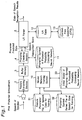
- Fig. 1 is a block diagram of a speech recognition apparatus using the phoneme-symbol a posteriori probability calculating neural network 11 which is the first preferred embodiment according to the present invention.
- the present preferred embodiment is characterized in comprising:
- the neural network training section 10 constitutes an apparatus for creating a phoneme-symbol a posteriori probability calculating neural network.
- the phoneme checking section 4 constitutes a phoneme-symbol a posteriori probability calculating apparatus for calculating a posteriori probabilities of phoneme symbols by using the phoneme-symbol a posteriori probability calculating neural network 11 based on inputted speech feature parameters.
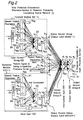
- the present preferred embodiment employs a phoneme-symbol a posteriori probability calculating neural network 11 implemented by a bidirectional recurrent neural network (hereinafter, referred to as a BRNN) as shown in Fig. 2 in order to calculate a posteriori probabilities of phoneme symbols.
- a BRNN bidirectional recurrent neural network
- the common recurrent neural network reflexively utilizes information of the past in terms of time or timing
- the BRNN features in its capability of utilizing input information of the past and future.
- a 6-bit encoded phoneme signal Aam for training which results from encoding by encoders 56, 66 and 71 a 61-bit phoneme signal for training representing which phoneme symbol out of the 61 phoneme symbols the pertinent frame input corresponds to.
- a 6-bit hypothetical encoded phoneme signal Aam which results from encoding a hypothetical phoneme signal by the encoders 56, 66 and 71, instead of the phoneme signal Aam for training.
- the speech feature parameters Abm are normalized to an interval [-1, +1] before being inputted, while the encoded phoneme signal Aam is changed in variables from [0., 1] to the interval [-1, +1] before being inputted.
- probability information representing which phoneme symbol the current frame input corresponds to (for example, "1" when the frame corresponds to the current phoneme symbol; otherwise, "0") is given as a training signal for the training process. Then, upon the calculation of the a posteriori probability of a phoneme symbol, a calculated a posteriori probability of a phoneme symbol is outputted from the neural network 11.
- the outputted a posteriori probabilities P i of the 61 phoneme symbols are inputted to the phoneme checking section 4, which then, for example, detects the phoneme symbol having the greatest a posteriori probability among them as a phoneme symbol candidate for the current frame. That is, the number of units of a neuron group A(t) is 32 in total, consisting of the number of dimensions of 26 of speech feature parameters and the number of encoded phoneme signals of 6, which is either 6-bit encoded phoneme signals (upon training) or hypothetical encoded phoneme signals (upon calculation of the a posteriori probability of a phoneme symbol). On the other hand, the number of units for outputting is the number of phoneme symbols of 61.
- the speech feature parameters include 12-dimensional MFCCs, a log power, and the primary recurrent coefficients of the MFCCs and the log power.
- the total number of frames of one file is assumed as a plurality L in each case.
- the number of bits is reduced by encoding phoneme signals.
- the present invention is not limited to this, and the phoneme signals may be inputted to the neural network 11 as they are without being encoded.
- a forward module B(t-1) is a module which has a forward-in-time feedback connection by a delay element 54, and which generates and outputs to a hidden neuron group D, 64 parameters of timing "t-1" delayed by a predetermined unit timing or time from 32 parameters which are outputted from the input neuron group A(t), based on the 26 speech feature parameters and 6 encoded phoneme signals.
- the forward module B(t-1) comprises:
- a feedback loop is formed from the intermediate neuron group 52 via the intermediate neuron group 53 and the delay element 54 to the intermediate neuron group 52.
- weighting coefficients matrices W FA and W FB in the Equation (1) are a 64 ⁇ 32 matrix and a 64 ⁇ 64 matrix, respectively, and can be expressed by the following equations:
- a backward module C(t+1) is a module which has a backward-in-time feedback connection by an inverse delay element 64, and which generates and outputs to the hidden neuron group D, 32 parameters of timing "t+1" inversely delayed by a predetermined unit timing or time from 32 parameters which are outputted from the input neuron group A(t), based on the 26 speech feature parameters and 6 encoded phoneme signals.
- the backward module C(t+1) comprises:
- the backward module C(t+1) is characterized in that the units a 1 through a 6 of the input neuron group 61 are not connected to the units c 1 through c 32 of the intermediate neuron group 63.
- a feedback loop is formed from the intermediate neuron group 62 via the intermediate neuron group 63 and the inverse delay element 64 to the intermediate neuron group 62.
- input parameter vectors A m for the input neuron group 61 are the same as those in the Equation (3).
- weighting coefficient matrices W BA and W BC in the Equation (6) are a 32 ⁇ 32 matrix and a 32 ⁇ 32 matrix, respectively, and can be expressed by the following equations:
- the units b 1 to b 64 of the status neuron group B(t-1) are respectively connected to the units d 1 to d 64 of the hidden neuron group D so that output parameters from the units b 1 to b 64 of the status neuron group B(t-1) are multiplied by respective weighting coefficients and respective multiplied result values are respectively inputted to the units d 1 to d 64 of the hidden neuron group D.
- the units c 1 to c 32 of the status neuron group C(t+1) are respectively connected to the units d 1 to d 64 of the hidden neuron group D so that output parameters from the units c 1 to c 32 of the status neuron group C(t+1) are multiplied by respective weighting coefficients and the respective multiplied values are respectively inputted to the units d 1 to d 64 of the hidden neuron group D.
- the 32 units a 1 to a 32 of the input neuron group A(t) are respectively connected to the units d 1 to d 64 of the hidden neuron group D so that output parameters from the 32 units a 1 to a 32 of the input neuron group A(t) are multiplied by respective weighting coefficients and the respective multiplied values are respectively inputted to the units d 1 to d 64 of the hidden neuron group D.
- the output neuron group E is connected to the hidden neuron group D so that the output parameters from the units d 1 to d 64 of the hidden neuron group D are multiplied by respective weighting coefficients and the respective multiplied values are respectively inputted to the output units e 1 to e 61 of the output neuron group E.
- the training or calculating process is executed after the completion of the processing operation of the forward module B(t-1) and the backward module C(t+1).
- an input layer 100 comprises the input neuron group A(t), the forward module B(t-1) for calculating output parameters at timing "t-1" delayed by a unit timing or time from the output timing "t” of the input neuron group A(t), and the backward module C(t+1) for calculating output parameters at timing "t+1" inversely delayed by a unit timing or time from the timing "t".
- An intermediate layer 200 comprises the hidden neuron group D
- an output layer 300 comprises the output neuron group E.
- the phoneme-symbol a posteriori probability calculating neural network 11 constructed as described above is equivalently as shown in Fig. 3, and is a BRNN, in which the forward module comprising the units of the forward status neutron group B and the backward module comprising the units of the backward status neutron group C are connected in the direction of time respectively, and the input layer 100 comprises the input neuron group A(t), the forward module B(t-1) and the backward module C(t+1).
- an A/D converter 1, a feature extracting section 2, the phoneme checking section 4, an LR parser 5 and the neural network training section 10 are constituted by, for example, an arithmetic and control unit or a controller such as a digital computer.
- a buffer memory 3 is constituted by, for example, a hard disk memory.
- the feature parameter file 31 of speech data for training, the phoneme symbol series file 32 of speech data for training, the initial model 33 of the phoneme-symbol a posteriori probability calculating neural network, the phoneme-symbol a posteriori probability calculating neural network 11, an LR table 12 and a context-free grammar database 13 are stored in, for example, hard disk memories, respectively.
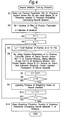
- Fig. 4 is a flow chart showing a neural network training process executed by the neural network training section 10 shown in Fig. 1.
- step S1 the feature parameter file 31, the phoneme symbol series file 32 corresponding to the feature parameter file and the initial model 33 of the phoneme-symbol a posteriori probability calculating neural network are read in the neural network training section 10.
- step S2 the number of files for the feature parameter file 31 corresponding to the total number of utterances of the phoneme symbol series file 32 is set to a parameter N, and the number of iterations for training is set to a parameter I.
- the parameter i is initialized to one at step S3
- the parameter n is initialized to one at step S4.
- step S5 the total number of frames at the n-th file is set to a parameter Ln.
- step S6 by using feature parameters of Ln frames, the output values of the status neuron group B(t-1) of the forward module, the status neuron group C(t+1) of the backward module and the output neuron group E (Ln groups for each) are calculated, and the weighting-coefficient updated parameters of the neural network are calculated.
- step S8 it is decided at step S8 whether or not n > N. If n ⁇ N then the program returns to step S5, where the foregoing processes from step S5 to step S7 are iterated. If n > N at step S8, then the weighting coefficient updating process of the neural network is executed at step S9, the parameter i is incremented by one at step S10, and thereafter, it is decided at step S11 whether or not i > N. If i ⁇ I here, then it is judged that a predetermined number of iterations has been reached, followed by step S12, where the resulting phoneme-symbol a posteriori probability calculating neural network 11 is stored in the memory. Thus, the neural network training process is completed. The phoneme-symbol a posteriori probability calculating neural network 11 after the training is connected to the phoneme checking section 4.
- an uttered speech of a speaker is inputted to a microphone 1, and then is converted into a speech signal.
- the speech signal is inputted to the feature extracting section 2.
- the feature extracting section 2 converts the input speech signal from analog to digital form, i.e, digital speech signal data, and then executes, for example, LPC analysis to extract 26-dimensional feature parameters including 12-dimensional MFCCs, a log power, and the respective primary recurrent coefficients of the MFCCs and the log power. Then a time series of the extracted feature parameters is inputted to the phoneme checking section 4 via the buffer memory 3.
- the phoneme checking section 4 executes a phoneme checking process in response to a phoneme checking request from the phoneme-context dependent LR parser 5. Then, by using the trained phoneme-symbol a posteriori probability calculating neural network 11, the a posteriori probabilities of phoneme symbols for the speech signal data within the phoneme checking interval are calculated and besides the most likely phoneme symbol candidate is detected, where the value of the a posteriori probability of the most likely phoneme symbol at this timing is returned to the LR parser 5 as a phoneme checking score. In this process, a forward path algoritnm is used.
- a predetermined context-free grammar (CFG) within the context-free grammar database 13 is automatically transformed in a manner known to those skilled in the art so that the LR table 12 is generated and stored in the memory therefor.
- the LR parser 5 uses a publicly already known LR algorithm (algorithm using left-to-right processing and rightmost derivation processing), and looking up to the LR table 12, processes input phoneme predicted data from left to right without turning back. When there is an ambiguity syntactically therein, analyses for all the candidates are processed in parallel with the stack divided. The LR parser 5 predicts the next-coming phoneme from the LR table 12, outputting phoneme predicted data to the phoneme checking section 4.
- CFG context-free grammar
- the phoneme checking section 4 checks the phoneme-symbol corresponding to the phoneme candidate by looking up to the phoneme-symbol a posteriori probability calculating neural network 11, and returns its likelihood to the LR parser 5 as a speech recognition score, in which way phonemes are strung one after another, so that continuous speech is recognized.
- a posteriori probability calculating neural network 11 a posteriori probability calculating neural network 11
- the phoneme checking section 4 checks the phoneme-symbol corresponding to the phoneme candidate by looking up to the phoneme-symbol a posteriori probability calculating neural network 11, and returns its likelihood to the LR parser 5 as a speech recognition score, in which way phonemes are strung one after another, so that continuous speech is recognized.
- the phoneme checking section 4 checks the phoneme-symbol corresponding to the phoneme candidate by looking up to the phoneme-symbol a posteriori probability calculating neural network 11, and returns its likelihood to the LR parser 5 as a speech recognition score, in
- the circuit construction is simple and the IC integration is easy to accomplish, as compared with the prior art, so that a posteriori probabilities of phoneme symbols can be determined without any approximation, and that the a posteriori probabilities of phoneme symbols can be calculated with a higher precision and a higher speed than those of the prior art. Also, since speech recognition is done by using the phoneme-symbol a posteriori probability calculating neural network 11, the speech recognition can be accomplished with a higher ratio of speech recognition than that of the prior art.
- the phoneme signals for training or hypothetical phoneme signals are encoded by using the encoders 56, 66 and 71 so as to be inputted to the input neuron groups 51 and 61, A(t), respectively, with lowered numbers of bits, the construction of the neural network 11 can be further extremely simplified.
- Fig. 5 is a block diagram showing a constitution of a a posteriori-probability calculating neural network 11a, which is a second preferred embodiment according to the present invention.
- the phoneme-symbol a posteriori probability calculating neural network 11a of the second preferred embodiment differs from the phoneme-symbol a posteriori probability calculating neural network 11 of the first preferred embodiment in the constitutions of the forward module B(t-1) and the backward module C(t+1). The differences are explained in detail below.
- a forward module B(t-1) is a module which has a forward-in-time feedback connection of a delay element 54, and which generates and outputs to a hidden neuron group D, 64 parameters of timing "t-1" delayed by a predetermined unit timing or time from 32 parameters which are outputted from the input neuron group A(t), based on the 26 speech feature parameters and 6 encoded phoneme signals.
- the forward module B(t-1) comprises:
- the forward module B(t-1) is characterized in that the units a 1 through a 6 of the input neuron group 51 are not connected to the units c 1 through c 32 of the intermediate neuron group 53.
- a feedback loop is formed from the intermediate neuron group 52 via the intermediate neuron group 53 and the delay element 54 to the intermediate neuron group 52.
- input parameter vectors A m for the input neuron group 51 are the same as those in the Equation (3) of the first preferred embodiment.
- weighting coefficient matrices W FA and W FB in the Equation (11) are a 32 ⁇ 32 matrix and a 32 ⁇ 32 matrix, respectively, and can be expressed by the following equations:
- a backward module C(t+1) is a module which has a backward-in-time feedback connection of an inverse delay element 64, and which generates and outputs to the hidden neuron group D, 64 parameters of timing "t+1" inversely delayed by a predetermined unit timing or time from 64 parameters which are outputted from the input neuron group A(t), based on the 26 speech feature parameters and 6 encoded phoneme signals.
- the backward module C(t+1) comprises:
- a feedback loop is formed from the intermediate neuron group 62 via the intermediate neuron group 63 and the inverse delay element 64 to the intermediate neuron group 62.
- input parameter vectors A m for the input neuron group 61 are the same as those in the Equation (3).
- weighting coefficient matrices W BA and W BC in the Equation (6) are a 64 ⁇ 32 matrix and a 64 ⁇ 64 matrix, respectively, and can be expressed by the following equations:
- the training or calculating process is executed after the completion of the processing operation of the forward module B(t-1) and the backward module C(t+1).
- an input layer 100 comprises the input neuron group A(t), the forward module B(t-1) for calculating output parameters at timing "t-1" delayed by a unit timing from the output timing "t" of the input neuron group A(t), and the backward module C(t+1) for calculating output parameters at timing "t+1" inversely delayed by a unit timing or time from the timing "t".
- An intermediate layer 200 comprises the hidden neuron group D
- an output layer 300 comprises the output neuron group E.
- the phoneme-symbol a posteriori probability calculating neural network 11a constructed as described above is equivalently shown in Fig. 6, and is a BRNN, in which the forward module of the units of the forward status neutron group B and the backward module of the units of the backward status neutron group C are connected in the direction of time or timing, respectively, and the input layer 100 comprises the input neuron group A(t), the forward module B(t-1) and the backward module C(t+1).
- the phoneme-symbol a posteriori probability calculating neural network constructed as described above is trained to be created by the neural network training section 10 shown in Fig. 1, in a manner similar to that of the first preferred embodiment.
- the created phoneme-symbol a posteriori probability calculating neural network 11 is used by the speech recognition apparatus shown in Fig. 1.
- the circuit construction is simple and the IC integration is easy to accomplish, as compared with the prior art, so that a posteriori probabilities of phoneme symbol series can be determined without any approximation, and that the a posteriori probabilities of phoneme symbol series can be calculated with a higher precision and a higher speed than those of the prior art. Also, since speech recognition is done by using the phoneme-symbol a posteriori probability calculating neural network 11a, the speech recognition can be accomplished with a higher ratio of speech recognition than that of the prior art.
- the hidden neuron group D of the intermediate layer 200 preferably has a number of units larger than the number of units of the output neuron group E of the output layer 300.
- the units a 1 to a 6 of the input neuron group 61, which are not connected to the intermediate neuron group 63, may be omitted.
- the units a 1 to a 6 of the input neuron group 51, which are not connected to the intermediate neuron group 53, may be omitted.
- the present inventor conducted a classification test of phonemes with speech feature parameters and their hypothetical phonemes taken as input signals, by using a phoneme database possessed by the present patent applicant. As a result, phonemes were able to be detected with a ratio of correct answers of 77.5 % with respect to a data set containing all the 61 kinds of phoneme symbols. Thus, it could be considered that when the phoneme-symbol a posteriori probability calculating neural network 11 of the preferred embodiment is applied, the speech recognition can be accomplished with a higher ratio of speech recognition than that in the prior art.
Landscapes
- Engineering & Computer Science (AREA)
- Artificial Intelligence (AREA)
- Evolutionary Computation (AREA)
- Computational Linguistics (AREA)
- Health & Medical Sciences (AREA)
- Audiology, Speech & Language Pathology (AREA)
- Human Computer Interaction (AREA)
- Physics & Mathematics (AREA)
- Acoustics & Sound (AREA)
- Multimedia (AREA)
- Machine Translation (AREA)
- Image Analysis (AREA)
Applications Claiming Priority (2)
| Application Number | Priority Date | Filing Date | Title |
|---|---|---|---|
| JP56138/97 | 1997-03-11 | ||
| JP9056138A JP2996926B2 (ja) | 1997-03-11 | 1997-03-11 | 音素シンボルの事後確率演算装置及び音声認識装置 |
Publications (2)
| Publication Number | Publication Date |
|---|---|
| EP0865030A2 true EP0865030A2 (de) | 1998-09-16 |
| EP0865030A3 EP0865030A3 (de) | 1999-03-17 |
Family
ID=13018725
Family Applications (1)
| Application Number | Title | Priority Date | Filing Date |
|---|---|---|---|
| EP98104222A Withdrawn EP0865030A3 (de) | 1997-03-11 | 1998-03-10 | Vorrichtung zur Berechnung einer a posteriori Wahrscheinlichkeit eines Phonemsymbols und Spracherkennungsvorrichtung |
Country Status (3)
| Country | Link |
|---|---|
| US (1) | US6041299A (de) |
| EP (1) | EP0865030A3 (de) |
| JP (1) | JP2996926B2 (de) |
Cited By (5)
| Publication number | Priority date | Publication date | Assignee | Title |
|---|---|---|---|---|
| US7343288B2 (en) | 2002-05-08 | 2008-03-11 | Sap Ag | Method and system for the processing and storing of voice information and corresponding timeline information |
| US7406413B2 (en) | 2002-05-08 | 2008-07-29 | Sap Aktiengesellschaft | Method and system for the processing of voice data and for the recognition of a language |
| WO2017091751A1 (en) * | 2015-11-25 | 2017-06-01 | Baidu Usa Llc | Deployed end-to-end speech recognition |
| WO2018085730A1 (en) * | 2016-11-03 | 2018-05-11 | Salesforce.Com, Inc. | Training a joint many-task neural network model using successive regularization |
| US10540957B2 (en) | 2014-12-15 | 2020-01-21 | Baidu Usa Llc | Systems and methods for speech transcription |
Families Citing this family (59)
| Publication number | Priority date | Publication date | Assignee | Title |
|---|---|---|---|---|
| EP0897224A3 (de) * | 1997-08-14 | 2002-12-11 | Her Majesty The Queen In Right Of Canada as represented by the Minister of Industry | Verfahren für verbesserte max-log-a-posteriori Wahrscheinlichkeitsverarbeitung |
| US6947890B1 (en) * | 1999-05-28 | 2005-09-20 | Tetsuro Kitazoe | Acoustic speech recognition method and system using stereo vision neural networks with competition and cooperation |
| US6832194B1 (en) | 2000-10-26 | 2004-12-14 | Sensory, Incorporated | Audio recognition peripheral system |
| US7173551B2 (en) | 2000-12-21 | 2007-02-06 | Quellan, Inc. | Increasing data throughput in optical fiber transmission systems |
| JP2002236904A (ja) * | 2001-02-08 | 2002-08-23 | Sony Corp | データ処理装置および方法、記録媒体、並びにプログラム |
| US7307569B2 (en) * | 2001-03-29 | 2007-12-11 | Quellan, Inc. | Increasing data throughput in optical fiber transmission systems |
| US7149256B2 (en) | 2001-03-29 | 2006-12-12 | Quellan, Inc. | Multilevel pulse position modulation for efficient fiber optic communication |
| CA2442922A1 (en) * | 2001-04-04 | 2002-10-17 | Quellan, Inc. | Method and system for decoding multilevel signals |
| US6625600B2 (en) * | 2001-04-12 | 2003-09-23 | Telelogue, Inc. | Method and apparatus for automatically processing a user's communication |
| US20030030873A1 (en) * | 2001-05-09 | 2003-02-13 | Quellan, Inc. | High-speed adjustable multilevel light modulation |
| US7212580B2 (en) * | 2002-02-15 | 2007-05-01 | Quellan, Inc. | Multi-level signal clock recovery technique |
| AU2003217947A1 (en) * | 2002-03-08 | 2003-09-22 | Quellan, Inc. | High speed analog-to-digital converter using a unique gray code having minimal bit transitions |
| US20030198478A1 (en) * | 2002-04-23 | 2003-10-23 | Quellan, Inc. | Method and system for generating and decoding a bandwidth efficient multi-level signal |
| JP2004013681A (ja) * | 2002-06-10 | 2004-01-15 | Bosu & K Consulting Kk | 名刺情報管理システム |
| WO2004008782A2 (en) | 2002-07-15 | 2004-01-22 | Quellan, Inc. | Adaptive noise filtering and equalization |
| US7934144B2 (en) | 2002-11-12 | 2011-04-26 | Quellan, Inc. | High-speed analog-to-digital conversion with improved robustness to timing uncertainty |
| WO2005018134A2 (en) * | 2003-08-07 | 2005-02-24 | Quellan, Inc. | Method and system for crosstalk cancellation |
| US7804760B2 (en) | 2003-08-07 | 2010-09-28 | Quellan, Inc. | Method and system for signal emulation |
| EP1687929B1 (de) * | 2003-11-17 | 2010-11-10 | Quellan, Inc. | Verfahren und system zur löschung von antennenstörungen |
| US7616700B2 (en) * | 2003-12-22 | 2009-11-10 | Quellan, Inc. | Method and system for slicing a communication signal |
| US7720012B1 (en) * | 2004-07-09 | 2010-05-18 | Arrowhead Center, Inc. | Speaker identification in the presence of packet losses |
| US7522883B2 (en) | 2004-12-14 | 2009-04-21 | Quellan, Inc. | Method and system for reducing signal interference |
| US7725079B2 (en) * | 2004-12-14 | 2010-05-25 | Quellan, Inc. | Method and system for automatic control in an interference cancellation device |
| US20060245654A1 (en) * | 2005-04-29 | 2006-11-02 | Microsoft Corporation | Utilizing grammatical parsing for structured layout analysis |
| US8249344B2 (en) * | 2005-07-01 | 2012-08-21 | Microsoft Corporation | Grammatical parsing of document visual structures |
| US8509563B2 (en) * | 2006-02-02 | 2013-08-13 | Microsoft Corporation | Generation of documents from images |
| KR101372361B1 (ko) * | 2006-04-26 | 2014-03-12 | 인터실 아메리카스 엘엘씨 | 통신 채널로부터 복사성 방출을 감소시키기 위한 방법 및 시스템 |
| US20100057452A1 (en) * | 2008-08-28 | 2010-03-04 | Microsoft Corporation | Speech interfaces |
| US20100228538A1 (en) * | 2009-03-03 | 2010-09-09 | Yamada John A | Computational linguistic systems and methods |
| JP2010282199A (ja) * | 2009-06-02 | 2010-12-16 | Honda Motor Co Ltd | 語彙獲得装置、マルチ対話行動システム及び語彙獲得プログラム |
| US8775341B1 (en) | 2010-10-26 | 2014-07-08 | Michael Lamport Commons | Intelligent control with hierarchical stacked neural networks |
| US9015093B1 (en) | 2010-10-26 | 2015-04-21 | Michael Lamport Commons | Intelligent control with hierarchical stacked neural networks |
| US9202464B1 (en) * | 2012-10-18 | 2015-12-01 | Google Inc. | Curriculum learning for speech recognition |
| US9672811B2 (en) * | 2012-11-29 | 2017-06-06 | Sony Interactive Entertainment Inc. | Combining auditory attention cues with phoneme posterior scores for phone/vowel/syllable boundary detection |
| US9153231B1 (en) * | 2013-03-15 | 2015-10-06 | Amazon Technologies, Inc. | Adaptive neural network speech recognition models |
| US9715660B2 (en) * | 2013-11-04 | 2017-07-25 | Google Inc. | Transfer learning for deep neural network based hotword detection |
| US9620108B2 (en) * | 2013-12-10 | 2017-04-11 | Google Inc. | Processing acoustic sequences using long short-term memory (LSTM) neural networks that include recurrent projection layers |
| KR102380833B1 (ko) | 2014-12-02 | 2022-03-31 | 삼성전자주식회사 | 음성 인식 방법 및 음성 인식 장치 |
| JP6389776B2 (ja) * | 2015-02-23 | 2018-09-12 | 日本電信電話株式会社 | 言語識別モデル学習装置、言語識別装置、言語識別方法、およびプログラム |
| US10762894B2 (en) * | 2015-03-27 | 2020-09-01 | Google Llc | Convolutional neural networks |
| JP6614639B2 (ja) * | 2015-05-22 | 2019-12-04 | 国立研究開発法人情報通信研究機構 | 音声認識装置及びコンピュータプログラム |
| KR102413692B1 (ko) | 2015-07-24 | 2022-06-27 | 삼성전자주식회사 | 음성 인식을 위한 음향 점수 계산 장치 및 방법, 음성 인식 장치 및 방법, 전자 장치 |
| KR102423302B1 (ko) | 2015-10-06 | 2022-07-19 | 삼성전자주식회사 | 음성 인식에서의 음향 점수 계산 장치 및 방법과, 음향 모델 학습 장치 및 방법 |
| KR102192678B1 (ko) | 2015-10-16 | 2020-12-17 | 삼성전자주식회사 | 음향 모델 입력 데이터의 정규화 장치 및 방법과, 음성 인식 장치 |
| US10043512B2 (en) * | 2015-11-12 | 2018-08-07 | Google Llc | Generating target sequences from input sequences using partial conditioning |
| US9842106B2 (en) * | 2015-12-04 | 2017-12-12 | Mitsubishi Electric Research Laboratories, Inc | Method and system for role dependent context sensitive spoken and textual language understanding with neural networks |
| KR102151682B1 (ko) | 2016-03-23 | 2020-09-04 | 구글 엘엘씨 | 다중채널 음성 인식을 위한 적응성 오디오 강화 |
| KR102876305B1 (ko) | 2016-12-14 | 2025-10-24 | 삼성전자주식회사 | 순환 모델에 기초한 인식 및 순환 모델을 트레이닝하는 방법과 장치 |
| US11087213B2 (en) * | 2017-02-10 | 2021-08-10 | Synaptics Incorporated | Binary and multi-class classification systems and methods using one spike connectionist temporal classification |
| US11100932B2 (en) * | 2017-02-10 | 2021-08-24 | Synaptics Incorporated | Robust start-end point detection algorithm using neural network |
| US11080600B2 (en) * | 2017-02-10 | 2021-08-03 | Synaptics Incorporated | Recurrent neural network based acoustic event classification using complement rule |
| US10762891B2 (en) * | 2017-02-10 | 2020-09-01 | Synaptics Incorporated | Binary and multi-class classification systems and methods using connectionist temporal classification |
| US11853884B2 (en) * | 2017-02-10 | 2023-12-26 | Synaptics Incorporated | Many or one detection classification systems and methods |
| US10762417B2 (en) * | 2017-02-10 | 2020-09-01 | Synaptics Incorporated | Efficient connectionist temporal classification for binary classification |
| US10762427B2 (en) * | 2017-03-01 | 2020-09-01 | Synaptics Incorporated | Connectionist temporal classification using segmented labeled sequence data |
| JP7112075B2 (ja) * | 2017-08-07 | 2022-08-03 | 国立研究開発法人情報通信研究機構 | 音声合成のためのフロントエンドの学習方法、コンピュータプログラム、音声合成システム、及び音声合成のためのフロントエンド処理方法 |
| JP6772115B2 (ja) * | 2017-08-07 | 2020-10-21 | 日本電信電話株式会社 | 音響モデル学習装置、音声認識装置、音響モデル学習方法、音声認識方法、及びプログラム |
| CN111341299B (zh) | 2018-11-30 | 2021-10-15 | 阿里巴巴集团控股有限公司 | 一种语音处理方法及装置 |
| CN112530400A (zh) * | 2020-11-30 | 2021-03-19 | 清华珠三角研究院 | 基于深度学习的文本生成语音的方法、系统、装置及介质 |
Family Cites Families (3)
| Publication number | Priority date | Publication date | Assignee | Title |
|---|---|---|---|---|
| US5408424A (en) * | 1993-05-28 | 1995-04-18 | Lo; James T. | Optimal filtering by recurrent neural networks |
| DE19530646C1 (de) * | 1995-08-21 | 1996-10-17 | Siemens Ag | Lernverfahren für ein rekurrentes neuronales Netz |
| JPH0973440A (ja) * | 1995-09-06 | 1997-03-18 | Fujitsu Ltd | コラム構造の再帰型ニューラルネットワークによる時系列トレンド推定システムおよび方法 |
-
1997
- 1997-03-11 JP JP9056138A patent/JP2996926B2/ja not_active Expired - Lifetime
-
1998
- 1998-03-10 EP EP98104222A patent/EP0865030A3/de not_active Withdrawn
- 1998-03-11 US US09/038,128 patent/US6041299A/en not_active Expired - Fee Related
Non-Patent Citations (5)
| Title |
|---|
| ALLEN R B ET AL: "RECURRENT NEURAL NETWORK FOR WORD IDENTIFICATION FROM PHONEME SEQUENCES" PROCEEDINGS OF THE INTERNATIONAL CONFERENCE ON SPOKEN LANGUAGE PROCESSING (ICSLP), KOBE, NOV. 18 -22, 1990, vol. 2, 18 November 1990, pages 1037-1040, XP000506940 ACOUSTICAL SOCIETY OF JAPAN * |
| BRIDLE J S: "ALPHA-NETS: A RECURRENT 'NEURAL' NETWORK ARCHITECTURE WITH A HIDDEN MARKOV MODEL INTERPRETATION" SPEECH COMMUNICATION, vol. 9, no. 1, 1 February 1990, pages 83-92, XP000149378 * |
| ROBINSON A J: "AN APPLICATION OF RECURRENT NETS TO PHONE PROBABILITY ESTIMATION" IEEE TRANSACTIONS ON NEURAL NETWORKS, vol. 5, no. 2, 1 March 1994, pages 298-305, XP000441811 * |
| SCHUSTER M ET AL: "BIDIRECTIONAL RECURRENT NEURAL NETWORKS" IEEE TRANSACTIONS ON SIGNAL PROCESSING, vol. 45, no. 11, November 1997, pages 2673-2681, XP000754251 * |
| SCHUSTER M: "Learning out of time series with an extended recurrent neural network" NEURAL NETWORKS FOR SIGNAL PROCESSING VI. PROCEEDINGS OF THE 1996 IEEE SIGNAL PROCESSING SOCIETY WORKSHOP (CAT. NO.96TH8205), NEURAL NETWORKS FOR SIGNAL PROCESSING VI. PROCEEDINGS OF THE 1996 IEEE SIGNAL PROCESSING SOCIETY WORKSHOP, KYOTO, JAPAN, 4-6, pages 170-179, XP002090473 ISBN 0-7803-3550-3, 1996, New York, NY, USA, IEEE, USA * |
Cited By (15)
| Publication number | Priority date | Publication date | Assignee | Title |
|---|---|---|---|---|
| US7406413B2 (en) | 2002-05-08 | 2008-07-29 | Sap Aktiengesellschaft | Method and system for the processing of voice data and for the recognition of a language |
| US7343288B2 (en) | 2002-05-08 | 2008-03-11 | Sap Ag | Method and system for the processing and storing of voice information and corresponding timeline information |
| US11562733B2 (en) | 2014-12-15 | 2023-01-24 | Baidu Usa Llc | Deep learning models for speech recognition |
| US10540957B2 (en) | 2014-12-15 | 2020-01-21 | Baidu Usa Llc | Systems and methods for speech transcription |
| US10332509B2 (en) | 2015-11-25 | 2019-06-25 | Baidu USA, LLC | End-to-end speech recognition |
| WO2017091751A1 (en) * | 2015-11-25 | 2017-06-01 | Baidu Usa Llc | Deployed end-to-end speech recognition |
| US10319374B2 (en) | 2015-11-25 | 2019-06-11 | Baidu USA, LLC | Deployed end-to-end speech recognition |
| WO2018085730A1 (en) * | 2016-11-03 | 2018-05-11 | Salesforce.Com, Inc. | Training a joint many-task neural network model using successive regularization |
| WO2018085728A1 (en) * | 2016-11-03 | 2018-05-11 | Salesforce.Com, Inc. | Joint many-task neural network model for multiple natural language processing (nlp) tasks |
| US10839284B2 (en) | 2016-11-03 | 2020-11-17 | Salesforce.Com, Inc. | Joint many-task neural network model for multiple natural language processing (NLP) tasks |
| US11042796B2 (en) | 2016-11-03 | 2021-06-22 | Salesforce.Com, Inc. | Training a joint many-task neural network model using successive regularization |
| US11222253B2 (en) | 2016-11-03 | 2022-01-11 | Salesforce.Com, Inc. | Deep neural network model for processing data through multiple linguistic task hierarchies |
| WO2018085729A1 (en) * | 2016-11-03 | 2018-05-11 | Salesforce.Com, Inc. | Deep neural network model for processing data through multiple linguistic task hierarchies |
| US11783164B2 (en) | 2016-11-03 | 2023-10-10 | Salesforce.Com, Inc. | Joint many-task neural network model for multiple natural language processing (NLP) tasks |
| US11797825B2 (en) | 2016-11-03 | 2023-10-24 | Salesforce, Inc. | Training a joint many-task neural network model using successive regularization |
Also Published As
| Publication number | Publication date |
|---|---|
| EP0865030A3 (de) | 1999-03-17 |
| US6041299A (en) | 2000-03-21 |
| JPH10254483A (ja) | 1998-09-25 |
| JP2996926B2 (ja) | 2000-01-11 |
Similar Documents
| Publication | Publication Date | Title |
|---|---|---|
| US6041299A (en) | Apparatus for calculating a posterior probability of phoneme symbol, and speech recognition apparatus | |
| EP0387602B1 (de) | Verfahren und Einrichtung zur automatischen Bestimmung von phonologischen Regeln für ein System zur Erkennung kontinuierlicher Sprache | |
| Robinson et al. | A recurrent error propagation network speech recognition system | |
| EP0706171B1 (de) | Einrichtung und Verfahren zur Spracherkennung | |
| EP0771461B1 (de) | Verfahren und vorrichtung zur spracherkennung mittels optimierter partieller buendelung von wahrscheinlichkeitsmischungen | |
| US4827521A (en) | Training of markov models used in a speech recognition system | |
| JP2871561B2 (ja) | 不特定話者モデル生成装置及び音声認識装置 | |
| EP0750293A2 (de) | Konstruktionsverfahren für ein Zustandsübertragungsmodell und Spracherkennungsverfahren und Gerät dafür | |
| EP0617827B1 (de) | Mehrteiliger expertsystem | |
| EP0903728A2 (de) | Blockalgorithmus für die Mustererkennung | |
| EP0762383B1 (de) | Vorrichtung zur Musteranpassung für Sprach- oder Mustererkennung | |
| US6236962B1 (en) | Speech processing apparatus and method and computer readable medium encoded with a program for recognizing input speech by performing searches based on a normalized current feature parameter | |
| EP0688012B1 (de) | Vorrichtung zur Spracherkennung | |
| JP3589044B2 (ja) | 話者適応化装置 | |
| JP2531227B2 (ja) | 音声認識装置 | |
| JP2982689B2 (ja) | 情報量基準を用いた標準パターン作成方式 | |
| JP3039399B2 (ja) | 非母国語音声認識装置 | |
| Paul | The Lincoln large-vocabulary stack-decoder based HMM CSR | |
| EP0731447B1 (de) | Trainingssystem für Referenzmuster und dieses Trainingssystem benutzendes Spracherkennungssystem | |
| Gemello et al. | Hybrid HMM/Neural Network basedSpeech Recognition in Loquendo ASR | |
| Digalakis et al. | Continuous Speech Dictation on ARPA's North American Business News Domain | |
| Campbell et al. | Using polynomial networks for speech recognition | |
| Kwon et al. | Performance of HMM-based speech recognizers with discriminative state-weights | |
| JPH10254477A (ja) | 音素境界検出装置及び音声認識装置 | |
| Bilcu et al. | A study on different neural network architectures applied to text-to-phoneme mapping |
Legal Events
| Date | Code | Title | Description |
|---|---|---|---|
| PUAI | Public reference made under article 153(3) epc to a published international application that has entered the european phase |
Free format text: ORIGINAL CODE: 0009012 |
|
| 17P | Request for examination filed |
Effective date: 19980310 |
|
| AK | Designated contracting states |
Kind code of ref document: A2 Designated state(s): DE FR GB |
|
| AX | Request for extension of the european patent |
Free format text: AL;LT;LV;MK;RO;SI |
|
| PUAL | Search report despatched |
Free format text: ORIGINAL CODE: 0009013 |
|
| AK | Designated contracting states |
Kind code of ref document: A3 Designated state(s): AT BE CH DE DK ES FI FR GB GR IE IT LI LU MC NL PT SE |
|
| AX | Request for extension of the european patent |
Free format text: AL;LT;LV;MK;RO;SI |
|
| AKX | Designation fees paid |
Free format text: DE FR GB |
|
| 17Q | First examination report despatched |
Effective date: 20021106 |
|
| STAA | Information on the status of an ep patent application or granted ep patent |
Free format text: STATUS: THE APPLICATION IS DEEMED TO BE WITHDRAWN |
|
| 18D | Application deemed to be withdrawn |
Effective date: 20030318 |