EP0864591B1 - Verfahren zu herstellung von hochkristallinen Propylenhomopolymerisaten - Google Patents
Verfahren zu herstellung von hochkristallinen Propylenhomopolymerisaten Download PDFInfo
- Publication number
- EP0864591B1 EP0864591B1 EP98103998A EP98103998A EP0864591B1 EP 0864591 B1 EP0864591 B1 EP 0864591B1 EP 98103998 A EP98103998 A EP 98103998A EP 98103998 A EP98103998 A EP 98103998A EP 0864591 B1 EP0864591 B1 EP 0864591B1
- Authority
- EP
- European Patent Office
- Prior art keywords
- titanium
- preparation
- compound
- propylene homopolymers
- solid component
- Prior art date
- Legal status (The legal status is an assumption and is not a legal conclusion. Google has not performed a legal analysis and makes no representation as to the accuracy of the status listed.)
- Expired - Lifetime
Links
- 238000000034 method Methods 0.000 title claims abstract description 35
- 229920001384 propylene homopolymer Polymers 0.000 title claims description 55
- QQONPFPTGQHPMA-UHFFFAOYSA-N propylene Natural products CC=C QQONPFPTGQHPMA-UHFFFAOYSA-N 0.000 claims abstract description 19
- 125000004805 propylene group Chemical group [H]C([H])([H])C([H])([*:1])C([H])([H])[*:2] 0.000 claims abstract description 12
- 239000010936 titanium Substances 0.000 claims description 73
- 229910052719 titanium Inorganic materials 0.000 claims description 57
- 150000001875 compounds Chemical class 0.000 claims description 45
- RTAQQCXQSZGOHL-UHFFFAOYSA-N Titanium Chemical compound [Ti] RTAQQCXQSZGOHL-UHFFFAOYSA-N 0.000 claims description 43
- 239000007787 solid Substances 0.000 claims description 43
- 239000011777 magnesium Substances 0.000 claims description 27
- -1 titanium halide Chemical class 0.000 claims description 27
- 229910052749 magnesium Inorganic materials 0.000 claims description 25
- 229910052809 inorganic oxide Inorganic materials 0.000 claims description 24
- FYYHWMGAXLPEAU-UHFFFAOYSA-N Magnesium Chemical compound [Mg] FYYHWMGAXLPEAU-UHFFFAOYSA-N 0.000 claims description 19
- 239000002245 particle Substances 0.000 claims description 19
- 238000002360 preparation method Methods 0.000 claims description 18
- 229910052782 aluminium Inorganic materials 0.000 claims description 17
- VYPSYNLAJGMNEJ-UHFFFAOYSA-N Silicium dioxide Chemical compound O=[Si]=O VYPSYNLAJGMNEJ-UHFFFAOYSA-N 0.000 claims description 14
- 239000000203 mixture Substances 0.000 claims description 14
- XJDNKRIXUMDJCW-UHFFFAOYSA-J titanium tetrachloride Chemical compound Cl[Ti](Cl)(Cl)Cl XJDNKRIXUMDJCW-UHFFFAOYSA-J 0.000 claims description 13
- LFQSCWFLJHTTHZ-UHFFFAOYSA-N Ethanol Chemical compound CCO LFQSCWFLJHTTHZ-UHFFFAOYSA-N 0.000 claims description 11
- 239000000741 silica gel Substances 0.000 claims description 10
- 229910002027 silica gel Inorganic materials 0.000 claims description 10
- 238000006116 polymerization reaction Methods 0.000 claims description 9
- 125000000217 alkyl group Chemical group 0.000 claims description 8
- 239000012442 inert solvent Substances 0.000 claims description 6
- 238000002156 mixing Methods 0.000 claims description 5
- 125000003837 (C1-C20) alkyl group Chemical group 0.000 claims description 4
- 239000011954 Ziegler–Natta catalyst Substances 0.000 claims description 4
- 239000007788 liquid Substances 0.000 claims description 4
- 150000003961 organosilicon compounds Chemical class 0.000 claims description 4
- 150000001335 aliphatic alkanes Chemical class 0.000 claims description 3
- 125000000753 cycloalkyl group Chemical group 0.000 claims description 3
- 239000000126 substance Substances 0.000 claims description 3
- 125000000008 (C1-C10) alkyl group Chemical group 0.000 claims description 2
- 125000004432 carbon atom Chemical group C* 0.000 claims description 2
- 230000000379 polymerizing effect Effects 0.000 claims 1
- 229920000642 polymer Polymers 0.000 abstract description 35
- CTQNGGLPUBDAKN-UHFFFAOYSA-N O-Xylene Chemical compound CC1=CC=CC=C1C CTQNGGLPUBDAKN-UHFFFAOYSA-N 0.000 abstract description 13
- 238000004519 manufacturing process Methods 0.000 abstract description 10
- 239000008096 xylene Substances 0.000 abstract description 10
- 238000009835 boiling Methods 0.000 abstract description 6
- 238000001816 cooling Methods 0.000 abstract description 6
- 238000010438 heat treatment Methods 0.000 abstract description 4
- 229920001519 homopolymer Polymers 0.000 abstract 2
- 239000000243 solution Substances 0.000 description 26
- 239000000460 chlorine Substances 0.000 description 24
- 229910052801 chlorine Inorganic materials 0.000 description 15
- IMNFDUFMRHMDMM-UHFFFAOYSA-N N-Heptane Chemical compound CCCCCCC IMNFDUFMRHMDMM-UHFFFAOYSA-N 0.000 description 14
- YNQLUTRBYVCPMQ-UHFFFAOYSA-N Ethylbenzene Chemical compound CCC1=CC=CC=C1 YNQLUTRBYVCPMQ-UHFFFAOYSA-N 0.000 description 12
- CSCPPACGZOOCGX-UHFFFAOYSA-N Acetone Chemical compound CC(C)=O CSCPPACGZOOCGX-UHFFFAOYSA-N 0.000 description 10
- 239000003054 catalyst Substances 0.000 description 10
- ZAMOUSCENKQFHK-UHFFFAOYSA-N Chlorine atom Chemical compound [Cl] ZAMOUSCENKQFHK-UHFFFAOYSA-N 0.000 description 9
- XLYOFNOQVPJJNP-UHFFFAOYSA-N water Substances O XLYOFNOQVPJJNP-UHFFFAOYSA-N 0.000 description 9
- 238000010828 elution Methods 0.000 description 8
- 239000011164 primary particle Substances 0.000 description 8
- 230000000052 comparative effect Effects 0.000 description 7
- 238000000605 extraction Methods 0.000 description 7
- 238000012685 gas phase polymerization Methods 0.000 description 7
- 239000000155 melt Substances 0.000 description 7
- IJGRMHOSHXDMSA-UHFFFAOYSA-N Atomic nitrogen Chemical compound N#N IJGRMHOSHXDMSA-UHFFFAOYSA-N 0.000 description 6
- YXFVVABEGXRONW-UHFFFAOYSA-N Toluene Chemical compound CC1=CC=CC=C1 YXFVVABEGXRONW-UHFFFAOYSA-N 0.000 description 6
- 238000004458 analytical method Methods 0.000 description 6
- 239000013078 crystal Substances 0.000 description 6
- DOIRQSBPFJWKBE-UHFFFAOYSA-N dibutyl phthalate Chemical compound CCCCOC(=O)C1=CC=CC=C1C(=O)OCCCC DOIRQSBPFJWKBE-UHFFFAOYSA-N 0.000 description 6
- 238000003756 stirring Methods 0.000 description 6
- XAGFODPZIPBFFR-UHFFFAOYSA-N aluminium Chemical compound [Al] XAGFODPZIPBFFR-UHFFFAOYSA-N 0.000 description 5
- 238000005194 fractionation Methods 0.000 description 5
- 238000002844 melting Methods 0.000 description 5
- 230000008018 melting Effects 0.000 description 5
- 229920001155 polypropylene Polymers 0.000 description 5
- RGPSRYWDFHAWOT-UHFFFAOYSA-N CCCCCCCC[Mg]CCCC Chemical compound CCCCCCCC[Mg]CCCC RGPSRYWDFHAWOT-UHFFFAOYSA-N 0.000 description 4
- 239000004743 Polypropylene Substances 0.000 description 4
- 239000000654 additive Substances 0.000 description 4
- AZDRQVAHHNSJOQ-UHFFFAOYSA-N alumane Chemical class [AlH3] AZDRQVAHHNSJOQ-UHFFFAOYSA-N 0.000 description 4
- 150000001733 carboxylic acid esters Chemical class 0.000 description 4
- JWCYDYZLEAQGJJ-UHFFFAOYSA-N dicyclopentyl(dimethoxy)silane Chemical compound C1CCCC1[Si](OC)(OC)C1CCCC1 JWCYDYZLEAQGJJ-UHFFFAOYSA-N 0.000 description 4
- 239000007789 gas Substances 0.000 description 4
- 229920001580 isotactic polymer Polymers 0.000 description 4
- 238000004626 scanning electron microscopy Methods 0.000 description 4
- 239000012265 solid product Substances 0.000 description 4
- 239000003381 stabilizer Substances 0.000 description 4
- AZUYLZMQTIKGSC-UHFFFAOYSA-N 1-[6-[4-(5-chloro-6-methyl-1H-indazol-4-yl)-5-methyl-3-(1-methylindazol-5-yl)pyrazol-1-yl]-2-azaspiro[3.3]heptan-2-yl]prop-2-en-1-one Chemical compound ClC=1C(=C2C=NNC2=CC=1C)C=1C(=NN(C=1C)C1CC2(CN(C2)C(C=C)=O)C1)C=1C=C2C=NN(C2=CC=1)C AZUYLZMQTIKGSC-UHFFFAOYSA-N 0.000 description 3
- OKKJLVBELUTLKV-UHFFFAOYSA-N Methanol Chemical compound OC OKKJLVBELUTLKV-UHFFFAOYSA-N 0.000 description 3
- 229910004298 SiO 2 Inorganic materials 0.000 description 3
- 235000014113 dietary fatty acids Nutrition 0.000 description 3
- 238000004453 electron probe microanalysis Methods 0.000 description 3
- 150000002170 ethers Chemical class 0.000 description 3
- 239000000194 fatty acid Substances 0.000 description 3
- 229930195729 fatty acid Natural products 0.000 description 3
- 150000004665 fatty acids Chemical class 0.000 description 3
- 238000001914 filtration Methods 0.000 description 3
- 238000005227 gel permeation chromatography Methods 0.000 description 3
- 229910052736 halogen Inorganic materials 0.000 description 3
- 150000002367 halogens Chemical class 0.000 description 3
- 125000002887 hydroxy group Chemical group [H]O* 0.000 description 3
- 150000002576 ketones Chemical class 0.000 description 3
- 150000002596 lactones Chemical class 0.000 description 3
- VLKZOEOYAKHREP-UHFFFAOYSA-N n-Hexane Chemical compound CCCCCC VLKZOEOYAKHREP-UHFFFAOYSA-N 0.000 description 3
- 229910052757 nitrogen Inorganic materials 0.000 description 3
- 239000011148 porous material Substances 0.000 description 3
- 230000000630 rising effect Effects 0.000 description 3
- 238000001179 sorption measurement Methods 0.000 description 3
- VOITXYVAKOUIBA-UHFFFAOYSA-N triethylaluminium Chemical compound CC[Al](CC)CC VOITXYVAKOUIBA-UHFFFAOYSA-N 0.000 description 3
- YIWUKEYIRIRTPP-UHFFFAOYSA-N 2-ethylhexan-1-ol Chemical compound CCCCC(CC)CO YIWUKEYIRIRTPP-UHFFFAOYSA-N 0.000 description 2
- XKRFYHLGVUSROY-UHFFFAOYSA-N Argon Chemical compound [Ar] XKRFYHLGVUSROY-UHFFFAOYSA-N 0.000 description 2
- WKBOTKDWSSQWDR-UHFFFAOYSA-N Bromine atom Chemical group [Br] WKBOTKDWSSQWDR-UHFFFAOYSA-N 0.000 description 2
- OYPRJOBELJOOCE-UHFFFAOYSA-N Calcium Chemical compound [Ca] OYPRJOBELJOOCE-UHFFFAOYSA-N 0.000 description 2
- KCXZNSGUUQJJTR-UHFFFAOYSA-N Di-n-hexyl phthalate Chemical compound CCCCCCOC(=O)C1=CC=CC=C1C(=O)OCCCCCC KCXZNSGUUQJJTR-UHFFFAOYSA-N 0.000 description 2
- MQIUGAXCHLFZKX-UHFFFAOYSA-N Di-n-octyl phthalate Chemical compound CCCCCCCCOC(=O)C1=CC=CC=C1C(=O)OCCCCCCCC MQIUGAXCHLFZKX-UHFFFAOYSA-N 0.000 description 2
- UFHFLCQGNIYNRP-UHFFFAOYSA-N Hydrogen Chemical compound [H][H] UFHFLCQGNIYNRP-UHFFFAOYSA-N 0.000 description 2
- KFZMGEQAYNKOFK-UHFFFAOYSA-N Isopropanol Chemical compound CC(C)O KFZMGEQAYNKOFK-UHFFFAOYSA-N 0.000 description 2
- LRHPLDYGYMQRHN-UHFFFAOYSA-N N-Butanol Chemical compound CCCCO LRHPLDYGYMQRHN-UHFFFAOYSA-N 0.000 description 2
- NBIIXXVUZAFLBC-UHFFFAOYSA-N Phosphoric acid Chemical compound OP(O)(O)=O NBIIXXVUZAFLBC-UHFFFAOYSA-N 0.000 description 2
- DKGAVHZHDRPRBM-UHFFFAOYSA-N Tert-Butanol Chemical compound CC(C)(C)O DKGAVHZHDRPRBM-UHFFFAOYSA-N 0.000 description 2
- 239000002253 acid Substances 0.000 description 2
- 150000001298 alcohols Chemical class 0.000 description 2
- 150000004996 alkyl benzenes Chemical class 0.000 description 2
- BTANRVKWQNVYAZ-UHFFFAOYSA-N butan-2-ol Chemical compound CCC(C)O BTANRVKWQNVYAZ-UHFFFAOYSA-N 0.000 description 2
- 239000011575 calcium Substances 0.000 description 2
- 229910052791 calcium Inorganic materials 0.000 description 2
- KBPLFHHGFOOTCA-UHFFFAOYSA-N caprylic alcohol Natural products CCCCCCCCO KBPLFHHGFOOTCA-UHFFFAOYSA-N 0.000 description 2
- 150000001244 carboxylic acid anhydrides Chemical class 0.000 description 2
- 150000001735 carboxylic acids Chemical class 0.000 description 2
- 238000006243 chemical reaction Methods 0.000 description 2
- 238000002425 crystallisation Methods 0.000 description 2
- 230000008025 crystallization Effects 0.000 description 2
- 150000005690 diesters Chemical class 0.000 description 2
- FLKPEMZONWLCSK-UHFFFAOYSA-N diethyl phthalate Chemical compound CCOC(=O)C1=CC=CC=C1C(=O)OCC FLKPEMZONWLCSK-UHFFFAOYSA-N 0.000 description 2
- XFAOZKNGVLIXLC-UHFFFAOYSA-N dimethoxy-(2-methylpropyl)-propan-2-ylsilane Chemical compound CO[Si](C(C)C)(OC)CC(C)C XFAOZKNGVLIXLC-UHFFFAOYSA-N 0.000 description 2
- IPKKHRVROFYTEK-UHFFFAOYSA-N dipentyl phthalate Chemical compound CCCCCOC(=O)C1=CC=CC=C1C(=O)OCCCCC IPKKHRVROFYTEK-UHFFFAOYSA-N 0.000 description 2
- 238000009826 distribution Methods 0.000 description 2
- 238000010894 electron beam technology Methods 0.000 description 2
- 238000000635 electron micrograph Methods 0.000 description 2
- 150000002148 esters Chemical class 0.000 description 2
- 239000000945 filler Substances 0.000 description 2
- ZSIAUFGUXNUGDI-UHFFFAOYSA-N hexan-1-ol Chemical compound CCCCCCO ZSIAUFGUXNUGDI-UHFFFAOYSA-N 0.000 description 2
- 239000000017 hydrogel Substances 0.000 description 2
- 239000001257 hydrogen Substances 0.000 description 2
- 229910052739 hydrogen Inorganic materials 0.000 description 2
- 238000010191 image analysis Methods 0.000 description 2
- 239000013067 intermediate product Substances 0.000 description 2
- ZXEKIIBDNHEJCQ-UHFFFAOYSA-N isobutanol Chemical compound CC(C)CO ZXEKIIBDNHEJCQ-UHFFFAOYSA-N 0.000 description 2
- 239000000314 lubricant Substances 0.000 description 2
- 150000002681 magnesium compounds Chemical class 0.000 description 2
- YHNWUQFTJNJVNU-UHFFFAOYSA-N magnesium;butane;ethane Chemical compound [Mg+2].[CH2-]C.CCC[CH2-] YHNWUQFTJNJVNU-UHFFFAOYSA-N 0.000 description 2
- 239000000463 material Substances 0.000 description 2
- QSHDDOUJBYECFT-UHFFFAOYSA-N mercury Chemical compound [Hg] QSHDDOUJBYECFT-UHFFFAOYSA-N 0.000 description 2
- 229910052753 mercury Inorganic materials 0.000 description 2
- 239000006082 mold release agent Substances 0.000 description 2
- 239000002667 nucleating agent Substances 0.000 description 2
- 150000002901 organomagnesium compounds Chemical class 0.000 description 2
- 150000003021 phthalic acid derivatives Chemical class 0.000 description 2
- 238000002459 porosimetry Methods 0.000 description 2
- 239000000047 product Substances 0.000 description 2
- BDERNNFJNOPAEC-UHFFFAOYSA-N propan-1-ol Chemical compound CCCO BDERNNFJNOPAEC-UHFFFAOYSA-N 0.000 description 2
- 238000000746 purification Methods 0.000 description 2
- 150000003839 salts Chemical class 0.000 description 2
- 239000000725 suspension Substances 0.000 description 2
- 239000000454 talc Substances 0.000 description 2
- 229910052623 talc Inorganic materials 0.000 description 2
- 150000003609 titanium compounds Chemical class 0.000 description 2
- 230000004580 weight loss Effects 0.000 description 2
- YWEWWNPYDDHZDI-JJKKTNRVSA-N (1r)-1-[(4r,4ar,8as)-2,6-bis(3,4-dimethylphenyl)-4,4a,8,8a-tetrahydro-[1,3]dioxino[5,4-d][1,3]dioxin-4-yl]ethane-1,2-diol Chemical compound C1=C(C)C(C)=CC=C1C1O[C@H]2[C@@H]([C@H](O)CO)OC(C=3C=C(C)C(C)=CC=3)O[C@H]2CO1 YWEWWNPYDDHZDI-JJKKTNRVSA-N 0.000 description 1
- FMZUHGYZWYNSOA-VVBFYGJXSA-N (1r)-1-[(4r,4ar,8as)-2,6-diphenyl-4,4a,8,8a-tetrahydro-[1,3]dioxino[5,4-d][1,3]dioxin-4-yl]ethane-1,2-diol Chemical compound C([C@@H]1OC(O[C@@H]([C@@H]1O1)[C@H](O)CO)C=2C=CC=CC=2)OC1C1=CC=CC=C1 FMZUHGYZWYNSOA-VVBFYGJXSA-N 0.000 description 1
- 125000004178 (C1-C4) alkyl group Chemical group 0.000 description 1
- 125000004209 (C1-C8) alkyl group Chemical group 0.000 description 1
- DNIAPMSPPWPWGF-GSVOUGTGSA-N (R)-(-)-Propylene glycol Chemical compound C[C@@H](O)CO DNIAPMSPPWPWGF-GSVOUGTGSA-N 0.000 description 1
- RELMFMZEBKVZJC-UHFFFAOYSA-N 1,2,3-trichlorobenzene Chemical compound ClC1=CC=CC(Cl)=C1Cl RELMFMZEBKVZJC-UHFFFAOYSA-N 0.000 description 1
- BBMCTIGTTCKYKF-UHFFFAOYSA-N 1-heptanol Chemical compound CCCCCCCO BBMCTIGTTCKYKF-UHFFFAOYSA-N 0.000 description 1
- 239000005995 Aluminium silicate Substances 0.000 description 1
- XULNZSSCZUFNHE-UHFFFAOYSA-N CC(C)[Mg]C(C)C Chemical compound CC(C)[Mg]C(C)C XULNZSSCZUFNHE-UHFFFAOYSA-N 0.000 description 1
- UNCRKDFOOFDWDK-UHFFFAOYSA-N CCCCC[Mg]CCCCC Chemical compound CCCCC[Mg]CCCCC UNCRKDFOOFDWDK-UHFFFAOYSA-N 0.000 description 1
- SZFAGBCMFACZNH-UHFFFAOYSA-N CCCCOCCCCCCCCO[Mg] Chemical compound CCCCOCCCCCCCCO[Mg] SZFAGBCMFACZNH-UHFFFAOYSA-N 0.000 description 1
- ABXKXVWOKXSBNR-UHFFFAOYSA-N CCC[Mg]CCC Chemical compound CCC[Mg]CCC ABXKXVWOKXSBNR-UHFFFAOYSA-N 0.000 description 1
- KZBUYRJDOAKODT-UHFFFAOYSA-N Chlorine Chemical compound ClCl KZBUYRJDOAKODT-UHFFFAOYSA-N 0.000 description 1
- 239000005046 Chlorosilane Substances 0.000 description 1
- 239000004803 Di-2ethylhexylphthalate Substances 0.000 description 1
- 241000408710 Hansa Species 0.000 description 1
- VEXZGXHMUGYJMC-UHFFFAOYSA-N Hydrochloric acid Chemical compound Cl VEXZGXHMUGYJMC-UHFFFAOYSA-N 0.000 description 1
- OAICVXFJPJFONN-UHFFFAOYSA-N Phosphorus Chemical compound [P] OAICVXFJPJFONN-UHFFFAOYSA-N 0.000 description 1
- 229910003902 SiCl 4 Inorganic materials 0.000 description 1
- 239000012963 UV stabilizer Substances 0.000 description 1
- 150000007513 acids Chemical class 0.000 description 1
- 125000003545 alkoxy group Chemical group 0.000 description 1
- 229910000147 aluminium phosphate Inorganic materials 0.000 description 1
- 235000012211 aluminium silicate Nutrition 0.000 description 1
- 150000001412 amines Chemical class 0.000 description 1
- 150000008064 anhydrides Chemical group 0.000 description 1
- 239000003963 antioxidant agent Substances 0.000 description 1
- 239000002216 antistatic agent Substances 0.000 description 1
- 229910052786 argon Inorganic materials 0.000 description 1
- 150000004945 aromatic hydrocarbons Chemical class 0.000 description 1
- 125000003118 aryl group Chemical group 0.000 description 1
- QVGXLLKOCUKJST-UHFFFAOYSA-N atomic oxygen Chemical compound [O] QVGXLLKOCUKJST-UHFFFAOYSA-N 0.000 description 1
- BJQHLKABXJIVAM-UHFFFAOYSA-N bis(2-ethylhexyl) phthalate Chemical compound CCCCC(CC)COC(=O)C1=CC=CC=C1C(=O)OCC(CC)CCCC BJQHLKABXJIVAM-UHFFFAOYSA-N 0.000 description 1
- GDTBXPJZTBHREO-UHFFFAOYSA-N bromine Substances BrBr GDTBXPJZTBHREO-UHFFFAOYSA-N 0.000 description 1
- 229910052794 bromium Inorganic materials 0.000 description 1
- NVHCKYSIRWGHRB-UHFFFAOYSA-N butan-2-yl-dimethoxy-(2-methylpropyl)silane Chemical compound CCC(C)[Si](OC)(OC)CC(C)C NVHCKYSIRWGHRB-UHFFFAOYSA-N 0.000 description 1
- PJUXDQIPAXQXHH-UHFFFAOYSA-N butan-2-yl-dimethoxy-propan-2-ylsilane Chemical compound CCC(C)[Si](OC)(OC)C(C)C PJUXDQIPAXQXHH-UHFFFAOYSA-N 0.000 description 1
- 229910052799 carbon Inorganic materials 0.000 description 1
- 150000001732 carboxylic acid derivatives Chemical class 0.000 description 1
- 239000000969 carrier Substances 0.000 description 1
- 239000007795 chemical reaction product Substances 0.000 description 1
- KOPOQZFJUQMUML-UHFFFAOYSA-N chlorosilane Chemical class Cl[SiH3] KOPOQZFJUQMUML-UHFFFAOYSA-N 0.000 description 1
- 238000004140 cleaning Methods 0.000 description 1
- 238000004590 computer program Methods 0.000 description 1
- 239000000470 constituent Substances 0.000 description 1
- 229920001577 copolymer Polymers 0.000 description 1
- XRLIOAUFFCHSIC-UHFFFAOYSA-N cyclohexylmethyl(dimethoxy)silane Chemical compound CO[SiH](OC)CC1CCCCC1 XRLIOAUFFCHSIC-UHFFFAOYSA-N 0.000 description 1
- 239000002274 desiccant Substances 0.000 description 1
- 229940087101 dibenzylidene sorbitol Drugs 0.000 description 1
- ZVMRWPHIZSSUKP-UHFFFAOYSA-N dicyclohexyl(dimethoxy)silane Chemical compound C1CCCCC1[Si](OC)(OC)C1CCCCC1 ZVMRWPHIZSSUKP-UHFFFAOYSA-N 0.000 description 1
- MYBJXSAXGLILJD-UHFFFAOYSA-N diethyl(methyl)alumane Chemical compound CC[Al](C)CC MYBJXSAXGLILJD-UHFFFAOYSA-N 0.000 description 1
- IJKVHSBPTUYDLN-UHFFFAOYSA-N dihydroxy(oxo)silane Chemical compound O[Si](O)=O IJKVHSBPTUYDLN-UHFFFAOYSA-N 0.000 description 1
- MGWAVDBGNNKXQV-UHFFFAOYSA-N diisobutyl phthalate Chemical compound CC(C)COC(=O)C1=CC=CC=C1C(=O)OCC(C)C MGWAVDBGNNKXQV-UHFFFAOYSA-N 0.000 description 1
- NHYFIJRXGOQNFS-UHFFFAOYSA-N dimethoxy-bis(2-methylpropyl)silane Chemical compound CC(C)C[Si](OC)(CC(C)C)OC NHYFIJRXGOQNFS-UHFFFAOYSA-N 0.000 description 1
- VHPUZTHRFWIGAW-UHFFFAOYSA-N dimethoxy-di(propan-2-yl)silane Chemical compound CO[Si](OC)(C(C)C)C(C)C VHPUZTHRFWIGAW-UHFFFAOYSA-N 0.000 description 1
- 238000001035 drying Methods 0.000 description 1
- 239000000975 dye Substances 0.000 description 1
- 238000005516 engineering process Methods 0.000 description 1
- 238000005886 esterification reaction Methods 0.000 description 1
- 238000011156 evaluation Methods 0.000 description 1
- 239000000835 fiber Substances 0.000 description 1
- 239000011152 fibreglass Substances 0.000 description 1
- 239000010419 fine particle Substances 0.000 description 1
- 239000003063 flame retardant Substances 0.000 description 1
- 235000013305 food Nutrition 0.000 description 1
- 238000000227 grinding Methods 0.000 description 1
- 150000004820 halides Chemical class 0.000 description 1
- 125000005843 halogen group Chemical group 0.000 description 1
- 229910000041 hydrogen chloride Inorganic materials 0.000 description 1
- IXCSERBJSXMMFS-UHFFFAOYSA-N hydrogen chloride Substances Cl.Cl IXCSERBJSXMMFS-UHFFFAOYSA-N 0.000 description 1
- 150000002440 hydroxy compounds Chemical class 0.000 description 1
- 239000012535 impurity Substances 0.000 description 1
- 239000011261 inert gas Substances 0.000 description 1
- NLYAJNPCOHFWQQ-UHFFFAOYSA-N kaolin Chemical compound O.O.O=[Al]O[Si](=O)O[Si](=O)O[Al]=O NLYAJNPCOHFWQQ-UHFFFAOYSA-N 0.000 description 1
- 239000000395 magnesium oxide Substances 0.000 description 1
- CPLXHLVBOLITMK-UHFFFAOYSA-N magnesium oxide Inorganic materials [Mg]=O CPLXHLVBOLITMK-UHFFFAOYSA-N 0.000 description 1
- 239000000391 magnesium silicate Substances 0.000 description 1
- 235000012243 magnesium silicates Nutrition 0.000 description 1
- WRYKIHMRDIOPSI-UHFFFAOYSA-N magnesium;benzene Chemical compound [Mg+2].C1=CC=[C-]C=C1.C1=CC=[C-]C=C1 WRYKIHMRDIOPSI-UHFFFAOYSA-N 0.000 description 1
- VCTCXZDCRFISFF-UHFFFAOYSA-N magnesium;butane;butane Chemical compound [Mg+2].CCC[CH2-].CC[CH-]C VCTCXZDCRFISFF-UHFFFAOYSA-N 0.000 description 1
- DLPASUVGCQPFFO-UHFFFAOYSA-N magnesium;ethane Chemical compound [Mg+2].[CH2-]C.[CH2-]C DLPASUVGCQPFFO-UHFFFAOYSA-N 0.000 description 1
- XDKQUSKHRIUJEO-UHFFFAOYSA-N magnesium;ethanolate Chemical compound [Mg+2].CC[O-].CC[O-] XDKQUSKHRIUJEO-UHFFFAOYSA-N 0.000 description 1
- AXZKOIWUVFPNLO-UHFFFAOYSA-N magnesium;oxygen(2-) Chemical compound [O-2].[Mg+2] AXZKOIWUVFPNLO-UHFFFAOYSA-N 0.000 description 1
- WNJYXPXGUGOGBO-UHFFFAOYSA-N magnesium;propan-1-olate Chemical compound CCCO[Mg]OCCC WNJYXPXGUGOGBO-UHFFFAOYSA-N 0.000 description 1
- ORPJQHHQRCLVIC-UHFFFAOYSA-N magnesium;propan-2-olate Chemical compound CC(C)O[Mg]OC(C)C ORPJQHHQRCLVIC-UHFFFAOYSA-N 0.000 description 1
- 229910052751 metal Inorganic materials 0.000 description 1
- 239000002184 metal Substances 0.000 description 1
- 150000002739 metals Chemical class 0.000 description 1
- 125000002496 methyl group Chemical group [H]C([H])([H])* 0.000 description 1
- 238000000465 moulding Methods 0.000 description 1
- TVMXDCGIABBOFY-UHFFFAOYSA-N n-Octanol Natural products CCCCCCCC TVMXDCGIABBOFY-UHFFFAOYSA-N 0.000 description 1
- 150000002903 organophosphorus compounds Chemical class 0.000 description 1
- TWNQGVIAIRXVLR-UHFFFAOYSA-N oxo(oxoalumanyloxy)alumane Chemical compound O=[Al]O[Al]=O TWNQGVIAIRXVLR-UHFFFAOYSA-N 0.000 description 1
- 239000001301 oxygen Substances 0.000 description 1
- 229910052760 oxygen Inorganic materials 0.000 description 1
- 230000000737 periodic effect Effects 0.000 description 1
- 150000002989 phenols Chemical class 0.000 description 1
- AQSJGOWTSHOLKH-UHFFFAOYSA-N phosphite(3-) Chemical class [O-]P([O-])[O-] AQSJGOWTSHOLKH-UHFFFAOYSA-N 0.000 description 1
- XRBCRPZXSCBRTK-UHFFFAOYSA-N phosphonous acid Chemical class OPO XRBCRPZXSCBRTK-UHFFFAOYSA-N 0.000 description 1
- 229910052698 phosphorus Inorganic materials 0.000 description 1
- 239000011574 phosphorus Substances 0.000 description 1
- XNGIFLGASWRNHJ-UHFFFAOYSA-L phthalate(2-) Chemical compound [O-]C(=O)C1=CC=CC=C1C([O-])=O XNGIFLGASWRNHJ-UHFFFAOYSA-L 0.000 description 1
- JQCXWCOOWVGKMT-UHFFFAOYSA-N phthalic acid diheptyl ester Natural products CCCCCCCOC(=O)C1=CC=CC=C1C(=O)OCCCCCCC JQCXWCOOWVGKMT-UHFFFAOYSA-N 0.000 description 1
- 239000000049 pigment Substances 0.000 description 1
- 239000004033 plastic Substances 0.000 description 1
- 229920003023 plastic Polymers 0.000 description 1
- 229920000098 polyolefin Polymers 0.000 description 1
- 239000000843 powder Substances 0.000 description 1
- 230000001376 precipitating effect Effects 0.000 description 1
- 238000012545 processing Methods 0.000 description 1
- 150000004756 silanes Chemical class 0.000 description 1
- 229910052710 silicon Inorganic materials 0.000 description 1
- 239000010703 silicon Substances 0.000 description 1
- 150000003377 silicon compounds Chemical class 0.000 description 1
- 239000000377 silicon dioxide Substances 0.000 description 1
- 229910052814 silicon oxide Inorganic materials 0.000 description 1
- WXMKPNITSTVMEF-UHFFFAOYSA-M sodium benzoate Chemical compound [Na+].[O-]C(=O)C1=CC=CC=C1 WXMKPNITSTVMEF-UHFFFAOYSA-M 0.000 description 1
- 235000010234 sodium benzoate Nutrition 0.000 description 1
- 239000004299 sodium benzoate Substances 0.000 description 1
- ZHROMWXOTYBIMF-UHFFFAOYSA-M sodium;1,3,7,9-tetratert-butyl-11-oxido-5h-benzo[d][1,3,2]benzodioxaphosphocine 11-oxide Chemical compound [Na+].C1C2=CC(C(C)(C)C)=CC(C(C)(C)C)=C2OP([O-])(=O)OC2=C1C=C(C(C)(C)C)C=C2C(C)(C)C ZHROMWXOTYBIMF-UHFFFAOYSA-M 0.000 description 1
- 239000002904 solvent Substances 0.000 description 1
- 238000001694 spray drying Methods 0.000 description 1
- 238000010557 suspension polymerization reaction Methods 0.000 description 1
- VBRKIFAYTJZAFZ-UHFFFAOYSA-N tert-butyl-dimethoxy-propan-2-ylsilane Chemical compound CO[Si](OC)(C(C)C)C(C)(C)C VBRKIFAYTJZAFZ-UHFFFAOYSA-N 0.000 description 1
- 238000012360 testing method Methods 0.000 description 1
- 238000007669 thermal treatment Methods 0.000 description 1
- 238000012546 transfer Methods 0.000 description 1
- MCULRUJILOGHCJ-UHFFFAOYSA-N triisobutylaluminium Chemical compound CC(C)C[Al](CC(C)C)CC(C)C MCULRUJILOGHCJ-UHFFFAOYSA-N 0.000 description 1
- JLTRXTDYQLMHGR-UHFFFAOYSA-N trimethylaluminium Chemical compound C[Al](C)C JLTRXTDYQLMHGR-UHFFFAOYSA-N 0.000 description 1
- LFXVBWRMVZPLFK-UHFFFAOYSA-N trioctylalumane Chemical compound CCCCCCCC[Al](CCCCCCCC)CCCCCCCC LFXVBWRMVZPLFK-UHFFFAOYSA-N 0.000 description 1
- 238000005406 washing Methods 0.000 description 1
- 239000001993 wax Substances 0.000 description 1
- 238000005303 weighing Methods 0.000 description 1
- 150000003751 zinc Chemical class 0.000 description 1
- XOOUIPVCVHRTMJ-UHFFFAOYSA-L zinc stearate Chemical compound [Zn+2].CCCCCCCCCCCCCCCCCC([O-])=O.CCCCCCCCCCCCCCCCCC([O-])=O XOOUIPVCVHRTMJ-UHFFFAOYSA-L 0.000 description 1
Classifications
-
- C—CHEMISTRY; METALLURGY
- C08—ORGANIC MACROMOLECULAR COMPOUNDS; THEIR PREPARATION OR CHEMICAL WORKING-UP; COMPOSITIONS BASED THEREON
- C08F—MACROMOLECULAR COMPOUNDS OBTAINED BY REACTIONS ONLY INVOLVING CARBON-TO-CARBON UNSATURATED BONDS
- C08F110/00—Homopolymers of unsaturated aliphatic hydrocarbons having only one carbon-to-carbon double bond
- C08F110/04—Monomers containing three or four carbon atoms
- C08F110/06—Propene
Definitions
- Catalyst systems of the Ziegler-Natta type are known, inter alia, from DE-A 42 16 548, DE-A 44 19 438, EP-A 530 599 and US-A 4 857 613. These systems are used in particular for the polymerization of C 2 -C 10 -alk-1-enes and contain, inter alia, compounds of polyvalent titanium, aluminum halides and / or alkyls, and also electron donor compounds, in particular silicon compounds, ethers, carboxylic esters, ketones and lactones, on the one hand used in conjunction with the titanium component and on the other hand as a cocatalyst.
- the Ziegler-Natta catalysts are manufactured usually in two steps. First is the titanium one Solid component produced. Then this is with implemented the cocatalyst. With the help of the catalysts thus obtained the polymerization is then carried out.
- propylene homopolymers For some areas of application of propylene homopolymers such as for example for food films made from such polymers of propylene, or for the manufacture thin-walled containers, it is necessary that the propylene homopolymers et al only small proportions of xylene-soluble components and have high rigidity. Such polymers are particularly characterized by high crystallinity. A high rigidity is due, for example, to a high proportion of Polymer chains with long, error-free isotactic polymer sequences reached.
- the propylene homopolymers have the lowest possible chlorine content, which in particular through the highest possible productivity of the catalyst system can be achieved. The from US-A 4 857 613 and the Meet US-A 5 288 824 known polymers of propylene these requirements are not sufficient.
- German patent application 196 37 370.0 also becomes a Ziegler-Natta catalyst system described, which is high productivity and stereo specificity has and after a simple and little time-consuming process can be manufactured.
- the present invention was therefore based on the object remedied disadvantages and a method of manufacture to develop propylene homopolymers, which include a low xylene-soluble content and a low one Have chlorine content and above all a high proportion Polymer chains with long, error-free isotactic polymer sequences possess what is in an increased melting point, an increased Crystallization rate and increased material rigidity reflected.
- the propylene homopolymers obtained using the process according to the invention are characterized by a high proportion of polymer chains with long, error-free isotactic polymer sequences out.
- One method the proportion of polymer chains different TREF (Temperature Rising Elution Fractionation), at which the solution temperature of the Polymer portion whose average isotactic sequence length corresponds.
- the propylene homopolymers are used to carry out the TREF first dissolved in boiling xylene, then the solution cools down at a constant cooling rate and then as it rises Temperature the propylene homopolymers in different fractions Tacticity separated. Can be described Composition of the propylene homopolymers by the proportion when heating the cooled propylene homopolymer solution remains undissolved to a defined temperature.
- the composition of the propylene homopolymers To determine, the TREF is carried out in the following way:
- 1 - 10 g of the propylene polymer are in as much boiling xylene solved that a 0.5 to 2 wt .-% solution is formed.
- the boiling solution is then in the range with a linear cooling rate from 2 ° C / h to 15 ° C / h, preferably at 10 ° C / h, to 25 ° C or one cooled lower temperature, with the majority of the polymer fails.
- the crystal suspension is now tempered Extraction apparatus transferred to that of W. Holtup in Makromol. Chem. 178, 2335 (1977) and corresponds to the first elution temperature warmed. Then the polypropylene crystals at this temperature with vigorous mixing extracted at least 10 minutes. Then the polymer solution drained off while the polymer crystals in the extractor remain.
- the dissolved polymer is in cold acetone (Temperature ⁇ 0 ° C) precipitated, filtered off and in vacuo to Weight constant dried.
- the extractor is now heated to the next elution temperature and so much xylene is added at the same temperature as was used for loosening. Then again extracted with vigorous mixing for at least 10 minutes, the polymer solution drained, the dissolved polymer in cold Acetone precipitated, filtered off and dried. These steps are repeated until the entire polymer is dissolved Has.
- propylene is polymerized in the presence of a Ziegler-Natta catalyst system containing, as active constituents, a titanium-containing solid component a) which is obtained by reacting a titanium halide with a compound of magnesium, an inorganic oxide as carrier, a C 1 to C 8 alkanol and a carboxylic acid ester is obtained as an electron donor compound, and an aluminum compound b) and a further electron donor compound c) as cocatalysts.
- a Ziegler-Natta catalyst system containing, as active constituents, a titanium-containing solid component a) which is obtained by reacting a titanium halide with a compound of magnesium, an inorganic oxide as carrier, a C 1 to C 8 alkanol and a carboxylic acid ester is obtained as an electron donor compound, and an aluminum compound b) and a further electron donor compound c) as cocatalysts.
- the halides of tri- or tetravalent titanium for example TiBr 3 , TiBr 4 , TiCl 3 or TiCl 4 , or titanium alkoxyhalides such as Ti (OCH 3 ) Cl 3 , Ti (OC 2 H 5 ) are used as titanium halides Cl 3 , Ti (O-iso-C 3 H 7 ) Cl 3 , Ti (OnC 4 H 9 ) Cl 3 , Ti (OC 2 H 5 ) Br 3 , Ti (OnC 4 H 9 ) Br 3 , Ti (OCH 3 ) 2 Cl 2 , Ti (OC 2 H 5 ) 2 Cl 2 , Ti (OnC 4 H 9 ) 2 Cl 2 , Ti (OC 2 H 5 ) 2 Br 2 , Ti (OCH 3 ) 3 Cl, Ti (OC 2 H 5 ) 3 Cl, Ti (OC 2 H 5 ) 3 Cl, Ti (OnC 4 H 9 ) 3 Cl or Ti (OC 2 H 5 ) 3 Br, the titanium halides, which contain only halogen in addition
- Chlorine-free compounds of magnesium are to be understood according to the invention as meaning those which contain no halogen in their structural formula.
- the halogen components contained as impurities in the chlorine-free compounds of magnesium according to the invention should not exceed 5% by weight and in particular 2% by weight.
- Suitable chlorine-free compounds of magnesium are, in particular, magnesium alkyls and magnesium aryls, and also magnesium alkoxy and magnesium aryloxy compounds, preference being given to using magnesium di (C 1 -C 10 alkyl) compounds.
- chlorine-free compounds of magnesium are diethylmagnesium, di-n-propylmagnesium, di-iso-propylmagnesium, din-butylmagnesium, di-sec.-butylmagnesium, di-tert.-butylmagnesium, diamylmagnesium, n-butylethylmagnesium, n-butyl- sec-butylmagnesium, n-butyloctylmagnesium, diphenylmagnesium, diethoxymagnesium, di-n-propyloxymagnesium, di-iso-propyloxymagnesium, din-butyloxymagnesium, di-sec.-butyloxymagnesium, di-tert.-butylyloxymagnesium, di-nyloxymagnesium -Butyloxy-sec-butyloxymagnesium, n-butyloxyoctyloxymagnesium or diphenoxymagnesium
- the titanium-containing solid component a) at least one inorganic oxide as a carrier. It usually does a finely divided inorganic oxide is used as a carrier, which has an average particle diameter of 5 to 200 ⁇ m, preferred from 15 to 100 ⁇ m and in particular from 20 to 70 ⁇ m.
- a finely divided inorganic oxide is used as a carrier, which has an average particle diameter of 5 to 200 ⁇ m, preferred from 15 to 100 ⁇ m and in particular from 20 to 70 ⁇ m.
- the particles are preferably of finely divided inorganic Oxides composed of primary particles, which are medium Particle diameter of the primary particles from 1 to 20 ⁇ m, in particular have from 3 to 10 ⁇ m.
- primary particles are porous, granular oxide particles, which in the generally by grinding from a hydrogel of inorganic Oxides can be obtained. It is also possible to use the primary particles before they are further processed.
- the inorganic oxide to be preferably used is also characterized in that there are cavities or channels with a average diameter of 0.1 to 20 microns, in particular from 1 to 15 ⁇ m, the macroscopic volume fraction of which Total particles in the range of 5 to 30%, especially in the range from 10 to 30%.
- the determination of the average particle diameter of the primary particles and the macroscopic volume fraction of the cavities and ) Channels of the inorganic oxide are advantageously carried out through Image analysis with the help of scanning electron microscopy (scanning electron microscopy) or the Electron Probe Micro Analysis (Electron beam micro-range analysis) on grain surfaces in each case and on grain cross sections of the inorganic oxide.
- the erhali The electron micrographs are evaluated and from this the mean particle diameter of the primary particles as well the macroscopic volume fraction of the cavities and channels is determined.
- the image analysis is preferably carried out by transfer the electron microscopic data into a gray-scale binary image and the digital evaluation using a suitable computer program.
- the preferred inorganic oxide to be used can be, for example by spray drying the ground hydrogel, which mixed with water or an aliphatic alcohol will be preserved. Such finely divided inorganic oxides are also commercially available.
- the finely divided inorganic oxide also typically has a pore volume of 0.1 to 10 cm 3 / g, preferably 1.0 to 4.0 cm 3 / g and a specific surface area of 10 to 1000 m 2 / g, preferably 100 to 500 m 2 / g, whereby here the values determined by mercury porosimetry according to DIN 66133 and by nitrogen adsorption according to DIN 66131 are to be understood.
- the pH of the inorganic oxide i.e. the negative decadal Logarithm of the proton concentration is preferably in the range from 1 to 6.5, in particular in the range from 2 to 6 and particularly preferably in the range from 3.5 to 5.5.
- the inorganic oxides are primarily the oxides of silicon, of aluminum, titanium or one of the metals of I. or der II. Main group of the periodic table into consideration.
- Oxide is used in addition to aluminum oxide or magnesium oxide a layered silicate silicon oxide (silica gel) is used. It can also mixed oxides such as aluminum silicates or magnesium silicates be used.
- the inorganic oxides used as carriers contain hydroxyl groups on their surface. By eliminating water, it is possible to reduce the OH group content or to eliminate it entirely. This can be done by thermal or chemical treatment.
- a thermal treatment is usually carried out by heating the inorganic oxide for from 1 to 24 hours, preferably from 2 to 20 hours and in particular from 3 to 12 hours, to temperatures of 250 to 900 ° C., preferably from 600 to 800 ° C.
- the hydroxyl groups can also be removed chemically by treating the inorganic oxides with conventional drying agents such as SiCl 4 , chlorosilanes or aluminum alkyls.
- Inorganic oxides preferably used contain from 0.5 to 5% by weight of water. The water content is usually determined by drying the inorganic oxide at 160 ° C. under normal pressure to constant weight. The weight loss corresponds to the original water content.
- C 1 -C 8 -alkanols such as methanol, ethanol, n-propanol, isopropanol, n-butanol, sec-butanol, tert-butanol, isobutanol, n-hexanol, n -Heptanol, n-octanol or 2-ethylhexanol or mixtures thereof.
- Ethanol is preferably used.
- the titanium-containing solid component a) also contains Electron donor compounds, for example monofunctional or polyfunctional Carboxylic acids, carboxylic anhydrides or carboxylic acid esters, furthermore ketones, ethers, alcohols, lactones or phosphorus or organosilicon compounds.
- Electron donor compounds for example monofunctional or polyfunctional Carboxylic acids, carboxylic anhydrides or carboxylic acid esters, furthermore ketones, ethers, alcohols, lactones or phosphorus or organosilicon compounds.
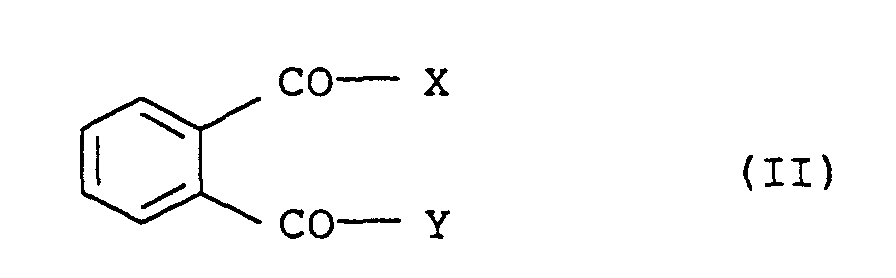
- Preferred electron donor compounds within the titanium-containing solid component are carboxylic acid derivatives and in particular phthalic acid derivatives of the general formula (II) used, where X and Y each represent a chlorine or bromine atom or a C 1 -C 10 alkoxy radical or together represent oxygen in anhydride function.
- Particularly preferred electron donor compounds are phthalic esters, where X and Y are a C 1 -C 8 -alkoxy radical, for example a methoxy, ethoxy, n-propyloxy, iso-propyloxy-n-butyloxy, sec-butyloxy, iso-butyloxy - Or a tert-butyloxy radical.
- phthalic acid esters preferably used are diethyl phthalate, di-n-butyl phthalate, di-iso-butyl phthalate, dipentyl phthalate, dihexyl phthalate, di-neptyl phthalate, di-n-octyl phthalate or di-2-ethylhexyl phthalate.
- Further preferred electron donor compounds within the titanium-containing solid component are diesters of 3- or 4-membered, optionally substituted cycloalkyl-1,2-dicarboxylic acids, and monoesters of substituted benzophenone-2-carboxylic acids or substituted benzophenone-2-carboxylic acids.
- the hydroxy compounds used in these esters are the alkanols customary in esterification reactions, for example C 1 -C 15 alkanols or C 5 -C 7 cycloalkanols, which in turn can carry one or more C 1 -C 10 alkyl groups, and also C 6 -C 10 -phenols.
- the titanium-containing solid component a) can be prepared by methods known per se, which are described, for example, in EP-A 171 200, GB-A 2 111 066, US-A 48 57 613 and US-A 52 88 824. However, it is characterized in that in the first stage of its preparation the chlorine-free compound of magnesium is used in an inert solvent and this is reacted with the carrier and the C 1 -C 8 -alkanol to form a chlorine-free intermediate product, which is advantageous without purification or Extraction is processed further.
- an inert solvent preferably a liquid alkane or an aromatic hydrocarbon, for example toluene or ethylbenzene
- a temperature of 10 to 120 ° C can usually react with stirring.
- the C 1 -C 8 -alkanol is usually added at least 1.3 times, preferably in 1.6 times to 3-, with constant stirring at from -20 to 80 ° C., preferably from 0 to 40 ° C. times, and in particular in 1.8 times to 2.0 times the molar excess, based on the magnesium-containing compound.
- the titanium halide and the electron donor compound are added to this intermediate at a temperature of 10 to 50 ° C.
- the solid obtained from the first stage is extracted at temperatures in the range from 100 to 150 ° C. with excess titanium tetrachloride or an excess solution of titanium tetrachloride in an inert solvent, preferably a C 7 -C 10 alkylbenzene, where the solvent contains at least 5% by weight of titanium tetrachloride.
- the extraction is usually carried out for at least 30 minutes.
- the product is then washed with a liquid alkane until the titanium tetrachloride content in the washing liquid is less than 2% by weight.
- the titanium-containing solid component obtainable in this way a) is with cocatalysts as a Ziegler-Natta catalyst system used.
- Aluminum compounds come as cocatalysts b) and other electron donor compounds c) into consideration.
- Suitable aluminum compounds b) are trialkyl aluminum also those compounds in which an alkyl group is replaced by a Alkoxy group or by a halogen atom, for example by Chlorine or bromine.
- the alkyl groups can be the same or be different from each other. There are linear or branched Alkyl groups into consideration.
- Trialkyl aluminum compounds are preferred used, the alkyl groups of 1 to 8 carbon atoms have, for example trimethyl aluminum, triethyl aluminum, Tri-iso-butyl aluminum, trioctyl aluminum or methyl diethyl aluminum or mixtures thereof.
- electron donor compounds c) such as, for example, monofunctional or polyfunctional carboxylic acids, carboxylic acid anhydrides and carboxylic acid esters, furthermore ketones, ethers, alcohols, lactones, and organophosphorus and organosilicon compounds are used as further cocatalyst, the electron donor compounds c) being identical or different from which can be used for the production of the titanium-containing solid component a) electron donor compounds.
- Preferred electron donor compounds are organosilicon compounds of the general formula (I) R 1 n Si (OR 2 ) 4-n where R 1 is the same or different and a C 1 -C 20 alkyl group, a 5- to 7-membered cycloalkyl group, which in turn can be substituted by C 1 -C 10 alkyl, a C 6 -C 18 aryl group or C 6 -C 18 aryl-C 1 -C 10 alkyl group, R 2 is the same or different and denotes a C 1 -C 20 alkyl group and n represents the integers 1, 2 or 3.
- R 1 is a C 1 -C 8 alkyl group or a 5- to 7-membered cycloalkyl group and R 2 is a C 1 -C 4 alkyl group and n is the number 1 or 2 are particularly preferred.
- These compounds include, in particular, dimethoxydiisopropylsilane, Dimethoxyisobutylisopropylsilane, dimethoxydiisobutylsilane, Dimethoxydicyclopentylsilane, dimethoxydicyclohexylsilane, dimethoxycyclohexylmethylsilane, Dimethoxyisopropyl tert-butylsilane, dimethoxyisobutyl sec-butylsilane and dimethoxyisopropyl-sec-butylsilane emphasized.
- Compounds b) and c) which act as cocatalysts can can be used individually or as a mixture in any order. You can use them both one after the other and together on the allow titanium-containing solid component a) to act. Usually this happens at temperatures from 0 to 150 ° C, in particular from 20 to 90 ° C and pressures from 1 to 100 bar, in particular from 1 to 40 bar.
- the cocatalysts b) are preferred in such an amount used that the atomic ratio between aluminum from the Aluminum compound b) and titanium from the titanium-containing solid component a) 10: 1 to 800: 1, in particular 20: 1 to 200: 1.
- the method according to the invention is i.a. characterized by that the molar ratio between the aluminum compound b) and the further electron donor compound c) to 1.5: 1 to 9: 1, in particular 2: 1 to 8: 1. Becomes a molar ratio used greater than 9: 1, the stereospecificity of the educated Propylene homopolymers are not sufficient. Is the relationship below 1.5: 1, the process is for economic reasons, especially because of the large amounts of the other then used Electron donor compound c), not very advantageous.
- the process according to the invention can be carried out in the usual manner, for the polymerization of reactors used either batchwise or preferably continuously etc. as suspension polymerization or preferably carried out as a gas phase polymerization become.
- Suitable reactors include continuously operated Stirred reactors, loop reactors or fluidized bed reactors, wherein continuously operated stirred reactors that consist of a fixed bed contain finely divided polymer, which usually by suitable stirring devices are kept in motion, preferred are.
- the reaction can also be in a row carried out by several reactors connected in series (reactor cascade).
- the inventive method is carried out in such a way that propylene at temperatures in the range of 20 to 150 ° C and Pressures in the range of 1 to 100 bar and medium residence times polymerized from 0.5 to 5 hours. Temperatures are preferred from 60 to 90 ° C, pressures from 20 to 35 bar and medium Residence times from 0.5 to 3 hours.
- the molecular weight of the propylene homopolymers obtained can be determined by Addition of regulators used in polymerization technology, For example, controlled by hydrogen and over a wide range Range can be set. It is also possible to use inert Solvents such as toluene or hexane, inert gases such as Use nitrogen or argon and smaller amounts of polypropylene powder.
- the propylene homopolymers according to the invention have preferably molecular weights (weight average) between 20,000 and 500,000 g / mol. Your melt flow rates, at 230 ° C and below a weight of 2.16 kg according to ISO 1133, are in the range of 0.1 to 100 g / 10 min, in particular in the range from 0.5 to 50 g / 10 min.
- the propylene homopolymers obtained using the process according to the invention Additives such as stabilizers, Lubricants and mold release agents, fillers, nucleating agents, Antistatic agents, dyes, pigments or flame retardants be added in usual amounts. Usually these become powdery when granulating the resulting polymerization products in the polymer incorporated.
- Common stabilizers are antioxidants such as sterically hindered ones Phenols, processing stabilizers such as phosphites or Phosphonites, acid scavengers such as calcium or zinc stearate or dihydrotalcite, sterically hindered amines or UV stabilizers.
- the propylene homopolymers according to the invention contain one or more of the stabilizers in amounts up to 2% by weight.
- Suitable lubricants and mold release agents are, for example, fatty acids, Calcium or zinc salts of fatty acids, fatty acid amides or low molecular weight polyolefin waxes, usually in Concentrations up to 2 wt .-% are used.
- fillers for statistical propylene copolymers e.g. Talc, chalk, or fiberglass are considered, here Amounts up to 50 wt .-% can be used.
- Suitable nucleating agents are, for example, inorganic additives such as talc, silica or kaolin, salts of mono- or polycarboxylic acids such as sodium benzoate or aluminum tert-butyl benzoate, dibenzylidene sorbitol or its C 1 -C 8 -alkyl-substituted derivatives such as methyl or dimethyldibenzylidene sorbitol or salts of diesters of phosphoric acid such as sodium 2,2'-methylene-bis (4,6-di-tert-butylphenyl) phosphate. Their content is usually up to 2% by weight.
- the propylene homopolymers obtained using the process according to the invention stand out compared to the previously known Propylene homopolymers in particular by a higher proportion on polymer chains with long, error-free isotactic polymer sequences and further reduced xylene soluble fractions. This expresses u.a. in an increased melting point, an increased one Crystallization rate and increased material rigidity and an increase in the highly isotactic TREF factions.
- the propylene homopolymers according to the invention also reduced levels of chlorine. The productivity to produce these propylene homopolymers The method used is compared to the known methods clearly increased.
- the obtained propylene homopolymers especially for the production of films, fibers and moldings.
- the polymerization was carried out in a vertically stirred gas phase reactor with a usable volume of 800 l in the presence of Hydrogen carried out as a molecular weight regulator.
- the reactor contained a moving fixed bed made of finely divided polymer.
- Example Aa Analogously to Example 1 according to the invention, propylene was added polymerized under the same conditions, but with that in Example Aa) described titanium-containing solid component used has been. There were 8.4 g of the titanium-containing solid component per hour Aa), 360 mmol of triethyl aluminum and 45 mmol of dimethoxydicyclopentylsilane used as cocatalyst:
- Example 1 according to the invention was stirred vertically 800 1-gas phase reactor repeated analogously. Propylene was added an average residence time of 1.5 hours continuously polymerized, 5.7 g per hour of those described in Example 1a) titanium-containing solid component 1a), 360 mmol of Aluminum component and 120 mmol dimethoxydicyclopentylsilane as Catalyst components were used.
- Example 2 It was analogous to Example 2 according to the invention under polymerized under the same conditions, but in the comparative example Aa) produced titanium-containing solid component Aa) was used.
- Example 1 according to the invention was stirred vertically 800 1-gas phase reactor repeated analogously. Propylene was added an average residence time of 1.5 hours continuously polymerized, with 7.3 g per hour of those described in Example 1a) titanium-containing solid component 1a), 360 mmol of Aluminum component and 45 mmol dimethoxyisobutylisopropylsilane were used as catalyst components.
- Example 3 It was analogous to Example 3 according to the invention under polymerized under the same conditions, but in the comparative example Aa) produced titanium-containing solid component Aa) was used.
- the following table shows the following properties for examples 1 to 3 according to the invention and also for comparative examples A to C: the propylene homopolymers obtained in each case: xylene-soluble fraction, fraction of the TREF fractions (measure of the stereospecificity of the polymer) and the one calculated therefrom , part insoluble in xylene, Q value, melting point, stiffness (tensile modulus of elasticity) and chlorine content.
- the molar ratios of the aluminum compounds b) and further electron donor compounds c) used in the polymerization and the productivities of the catalyst systems used are also included.
Landscapes
- Chemical & Material Sciences (AREA)
- Health & Medical Sciences (AREA)
- Chemical Kinetics & Catalysis (AREA)
- Medicinal Chemistry (AREA)
- Polymers & Plastics (AREA)
- Organic Chemistry (AREA)
- Transition And Organic Metals Composition Catalysts For Addition Polymerization (AREA)
- Addition Polymer Or Copolymer, Post-Treatments, Or Chemical Modifications (AREA)
- Polymerization Catalysts (AREA)
- Manufacture Of Macromolecular Shaped Articles (AREA)
- Artificial Filaments (AREA)
- Processes Of Treating Macromolecular Substances (AREA)
- Organic Low-Molecular-Weight Compounds And Preparation Thereof (AREA)
Description

Claims (9)
- Verfahren zur Herstellung von Propylenhomopolymerisaten durch Polymerisation von Propylen bei Temperaturen von 20 bis 150°C und Drücken von 1 bis 100 bar in Gegenwart eines Ziegler-Natta-Katalysatorsystems, enthaltend als aktive Bestandteilewobei man bei der Polymerisation das Molverhältnis zwischen der Aluminiumverbindung b) und der weiteren Elektronendonorverbindung c) auf ein Verhältnis von 1,5 : 1 bis 9 : 1 einstellt.a) eine titanhaltige Feststoffkomponente, die durch Umsetzung eines Titanhalogenids mit einer chlorfreien Verbindung des Magnesiums, einem anorganischen Oxid als Träger, einem C1- bis C8-Alkanol und einer Elektronendonorverbindung in der Weise erhalten wird, daß man
in einer ersten Stufe das anorganische Oxid als Träger mit einer Lösung der chlorfreien Verbindung des Magnesiums in einem inerten Lösungsmittel versetzt, dabei dieses Gemisch von 0,5 bis 5 Stunden bei einer Temperatur von 10 bis 120°C reagieren läßt und anschließend bei einer Temperatur von -20 bis 80°C unter ständigem Durchmischen mit einem C1- bis C8-Alkanol im wenigstens 1,3-fachen molaren Überschuß, bezogen auf die Verbindung des Magnesiums, zu einem chlorfreien Zwischenprodukt umsetzt, danach diesem das Titanhalogenid und die Elektronendonorverbindung hinzufügt, das daraus resultierende Gemisch wenigstens 10 Minuten bei einer Temperatur von 10 bis 150°C reagieren läßt, den so erhaltenen festen Stoff anschließend abfiltriert, wäscht und
in einer zweiten Stufe den aus der ersten Stufe erhaltenen Feststoff in einem inerten Lösungsmittel, welches wenigstens 5 Gew.-% Titantetrachlorid enthält, extrahiert und mit einem flüssigen Alkan wäscht,
sowie als Cokatalysatorenb) eine Aluminiumverbindung undc) eine weitere Elektronendonorverbindung, - Verfahren zur Herstellung von Propylenhomopolymerisaten nach Anspruch 1, dadurch gekennzeichnet, daß man das Molverhältnis zwischen der Aluminiumverbindung b) und der weiteren Elektronendonorverbindung c) auf ein Verhältnis von 2 : 1 bis 8 : 1 einstellt.
- Verfahren zur Herstellung von Propylenhomopolymerisaten nach Anspruch 1 oder 2, dadurch gekennzeichnet, daß man bei der Herstellung der titanhaltigen Feststoffkomponente a) in der ersten Stufe Ethanol als C1- bis C8-Alkanol verwendet.
- Verfahren zur Herstellung von Propylenhomopolymerisaten nach den Ansprüchen 1 bis 3, dadurch gekennzeichnet, daß man bei der Herstellung der titanhaltigen Feststoffkomponente a) ein Magnesiumdi-(C1-C10-alkyl) als chlorfreie Verbindung des Magnesiums einsetzt.
- Verfahren zur Herstellung von Propylenhomopolymerisaten nach den Ansprüchen 1 bis 4, dadurch gekennzeichnet, daß man bei der Herstellung der titanhaltigen Feststoffkomponente a) ein anorganisches Oxid als Träger verwendet, das einen pH-Wert von 1 bis 6,5, einen mittleren Teilchendurchmesser von 5 bis 200 µm und Hohlräume bzw. Kanäle mit einem mittleren Durchmesser von 1 bis 20 µm aufweist, deren makroskopischer Volumenanteil am Gesamtpartikel im Bereich von 5 bis 30 % liegt.
- Verfahren zur Herstellung von Propylenhomopolymerisaten nach den Ansprüchen 1 bis 5, dadurch gekennzeichnet, daß man bei der Herstellung der titanhaltigen Feststoffkomponente a) ein sprühgetrocknetes anorganisches Oxid verwendet.
- Verfahren zur Herstellung von Propylenhomopolymerisaten nach den Ansprüchen 1 bis 6, dadurch gekennzeichnet, daß man bei der Herstellung der titanhaltigen Feststoffkomponente a) ein Kieselgel als anorganisches Oxid verwendet.
- Verfahren zur Herstellung von Propylenhomopolymerisaten nach den Ansprüchen 1 bis 7, dadurch gekennzeichnet, daß man als Aluminiumverbindung b) eine Trialkylaluminiumverbindung einsetzt, deren Alkylgruppen jeweils 1 bis 8 C-Atome aufweisen.
- Verfahren zur Herstellung von Propylenhomopolymerisaten nach den Ansprüchen 1 bis 8, dadurch gekennzeichnet, daß man als weitere Elektronendonorverbindung c) mindestens eine siliciumorganische Verbindung der allgemeinen Formel (I)
Applications Claiming Priority (2)
| Application Number | Priority Date | Filing Date | Title |
|---|---|---|---|
| DE19710761A DE19710761A1 (de) | 1997-03-14 | 1997-03-14 | Hochkristalline Propylenhomopolymerisate |
| DE19710761 | 1997-03-14 |
Publications (2)
| Publication Number | Publication Date |
|---|---|
| EP0864591A1 EP0864591A1 (de) | 1998-09-16 |
| EP0864591B1 true EP0864591B1 (de) | 2002-06-12 |
Family
ID=7823464
Family Applications (1)
| Application Number | Title | Priority Date | Filing Date |
|---|---|---|---|
| EP98103998A Expired - Lifetime EP0864591B1 (de) | 1997-03-14 | 1998-03-06 | Verfahren zu herstellung von hochkristallinen Propylenhomopolymerisaten |
Country Status (5)
| Country | Link |
|---|---|
| EP (1) | EP0864591B1 (de) |
| JP (1) | JP4767374B2 (de) |
| AT (1) | ATE219110T1 (de) |
| DE (2) | DE19710761A1 (de) |
| ES (1) | ES2183246T3 (de) |
Families Citing this family (3)
| Publication number | Priority date | Publication date | Assignee | Title |
|---|---|---|---|---|
| US6432860B1 (en) * | 1999-03-22 | 2002-08-13 | Fina Technology, Inc. | Supported metallocene catalysts |
| DE19962130A1 (de) * | 1999-12-21 | 2001-07-05 | Basell Polypropylen Gmbh | Teilkristalline Propylenpolymerisat-Zusammensetzungen mit guter Eignung zur Herstellung von biaxial orientierten Folien |
| JP4497414B2 (ja) * | 2005-04-27 | 2010-07-07 | 東邦チタニウム株式会社 | アルコキシマグネシウム被覆固形物の調製方法、オレフィン類重合用固体触媒成分の製造方法および触媒の製造方法 |
Family Cites Families (7)
| Publication number | Priority date | Publication date | Assignee | Title |
|---|---|---|---|---|
| JP3016880B2 (ja) * | 1991-02-01 | 2000-03-06 | 三菱化学株式会社 | フィルム成形用高結晶性ポリプロピレン |
| DE4242486A1 (de) * | 1992-12-16 | 1994-06-23 | Basf Ag | Propylen-Homopolymere |
| DE69426859T2 (de) * | 1993-12-07 | 2001-07-26 | Sumitomo Chemical Co., Ltd. | Verfahren zur Herstellung von Polyolefinen für biaxial orientierte Folie und Katalysator für Olefinpolymerisation |
| WO1995031490A1 (en) * | 1994-05-12 | 1995-11-23 | Showa Denko K. K. | Propylene polymer, process for producing the same, composition thereof, polymerization catalyst component, and process for producing the same |
| ATE164598T1 (de) * | 1995-08-09 | 1998-04-15 | Basf Ag | Katalysatorsysteme vom typ der ziegler-natta- katalysatoren |
| DE19623226A1 (de) * | 1996-06-11 | 1997-12-18 | Basf Ag | Katalysatorsysteme vom Typ der Ziegler-Natta-Katalysatoren |
| DE19637370A1 (de) * | 1996-09-13 | 1998-03-19 | Basf Ag | Bei ihrer Herstellung modifizierte Ziegler-Natta-Katalysatorsysteme |
-
1997
- 1997-03-14 DE DE19710761A patent/DE19710761A1/de not_active Withdrawn
-
1998
- 1998-03-06 DE DE59804380T patent/DE59804380D1/de not_active Expired - Fee Related
- 1998-03-06 ES ES98103998T patent/ES2183246T3/es not_active Expired - Lifetime
- 1998-03-06 EP EP98103998A patent/EP0864591B1/de not_active Expired - Lifetime
- 1998-03-06 AT AT98103998T patent/ATE219110T1/de not_active IP Right Cessation
- 1998-03-16 JP JP06519798A patent/JP4767374B2/ja not_active Expired - Fee Related
Also Published As
| Publication number | Publication date |
|---|---|
| JPH10338718A (ja) | 1998-12-22 |
| ATE219110T1 (de) | 2002-06-15 |
| ES2183246T3 (es) | 2003-03-16 |
| EP0864591A1 (de) | 1998-09-16 |
| JP4767374B2 (ja) | 2011-09-07 |
| DE19710761A1 (de) | 1998-09-17 |
| DE59804380D1 (de) | 2002-07-18 |
Similar Documents
| Publication | Publication Date | Title |
|---|---|---|
| EP0887357B1 (de) | Propylenpolymerisate | |
| EP0881239B1 (de) | Statistische Propylencopolymerisate | |
| EP0515855B2 (de) | Hochfliessfähige Propylen-Ethylen-Copolymerisate | |
| EP0463406B1 (de) | Verfahren zur Herstellung von Homopolymerisaten des Propylens mit breitem Molmassenverhältnis | |
| EP0778295B1 (de) | Verbesserte statistische Propylenpolymerisate | |
| EP0761696B1 (de) | Katalysatorsysteme vom Typ der Ziegler-Natta-Katalysatoren | |
| DE19529240A1 (de) | Katalysatorsysteme vom Typ der Ziegler-Natta-Katalysatoren | |
| EP0812861B1 (de) | Katalysatorsysteme vom Typ der Ziegler-Natta-Katalysatoren | |
| EP0969044B1 (de) | Stanzplatte | |
| EP0702038B1 (de) | Hochflexible Propylen-Ethylen-Copolymerisate | |
| EP0438068B1 (de) | Verfahren zur Herstellung vo Propylen-Ethylen-Copolymerisaten | |
| EP0829489B1 (de) | Bei ihrer Herstellung modifizierte Ziegler-Natta-Katalysatorsysteme | |
| EP0778294B1 (de) | Verbesserte Propylenpolymerisate | |
| EP0518093B1 (de) | Propylen-Ethylen-Copolymerisate mit hohem Kautschukgehalt | |
| EP0829490B1 (de) | Bei ihrer Herstellung modifizierte Ziegler-Natta-Katalysatorsysteme | |
| EP0864591A1 (de) | Hochkristalline Propylenhomopolymerisate | |
| EP0670349B1 (de) | Hochsteifes Polypropylenpolymerisat | |
| EP0558981B2 (de) | Verfahren zur Herstellung von Propylen-Ethylen-Copolymerisaten | |
| EP0529377B1 (de) | Mit Aluminiumphosphat geträgerte Ziegler-Natta-Katalysatorsysteme | |
| DE4001157A1 (de) | Propylen-ethylen-copolymerisate | |
| EP0775714A2 (de) | Copolymerisate des Propylens | |
| EP0680980A1 (de) | Copolymerisate des Propylens mit hohem Kautschukgehalt | |
| DE4019453A1 (de) | Propylen-ethylen-copolymerisate mit vermindertem weissbruch | |
| DE4119282A1 (de) | Propylenpolymerisate mit nukleierungsmitteln | |
| DE19545497A1 (de) | Verbesserte Propylenhomopolymerisate |
Legal Events
| Date | Code | Title | Description |
|---|---|---|---|
| PUAI | Public reference made under article 153(3) epc to a published international application that has entered the european phase |
Free format text: ORIGINAL CODE: 0009012 |
|
| AK | Designated contracting states |
Kind code of ref document: A1 Designated state(s): AT BE DE ES FI FR GB IT NL SE |
|
| AX | Request for extension of the european patent |
Free format text: AL;LT;LV;MK;RO;SI |
|
| 17P | Request for examination filed |
Effective date: 19980817 |
|
| 17Q | First examination report despatched |
Effective date: 19990112 |
|
| AKX | Designation fees paid |
Free format text: AT BE DE ES FI FR GB IT NL SE |
|
| RBV | Designated contracting states (corrected) |
Designated state(s): AT BE DE ES FI FR GB IT NL SE |
|
| GRAG | Despatch of communication of intention to grant |
Free format text: ORIGINAL CODE: EPIDOS AGRA |
|
| RTI1 | Title (correction) |
Free format text: PROCESS FOR PRODUCING HIGH CRYSTALLINE PROPYLENE HOMOPOLYMERS |
|
| GRAG | Despatch of communication of intention to grant |
Free format text: ORIGINAL CODE: EPIDOS AGRA |
|
| GRAH | Despatch of communication of intention to grant a patent |
Free format text: ORIGINAL CODE: EPIDOS IGRA |
|
| GRAH | Despatch of communication of intention to grant a patent |
Free format text: ORIGINAL CODE: EPIDOS IGRA |
|
| GRAA | (expected) grant |
Free format text: ORIGINAL CODE: 0009210 |
|
| RAP1 | Party data changed (applicant data changed or rights of an application transferred) |
Owner name: BASELL POLIOLEFINE ITALIA S.P.A. |
|
| AK | Designated contracting states |
Kind code of ref document: B1 Designated state(s): AT BE DE ES FI FR GB IT NL SE |
|
| PG25 | Lapsed in a contracting state [announced via postgrant information from national office to epo] |
Ref country code: FI Free format text: LAPSE BECAUSE OF FAILURE TO SUBMIT A TRANSLATION OF THE DESCRIPTION OR TO PAY THE FEE WITHIN THE PRESCRIBED TIME-LIMIT Effective date: 20020612 |
|
| REF | Corresponds to: |
Ref document number: 219110 Country of ref document: AT Date of ref document: 20020615 Kind code of ref document: T |
|
| REG | Reference to a national code |
Ref country code: GB Ref legal event code: FG4D Free format text: NOT ENGLISH |
|
| REF | Corresponds to: |
Ref document number: 59804380 Country of ref document: DE Date of ref document: 20020718 |
|
| GBT | Gb: translation of ep patent filed (gb section 77(6)(a)/1977) |
Effective date: 20020721 |
|
| PG25 | Lapsed in a contracting state [announced via postgrant information from national office to epo] |
Ref country code: SE Free format text: LAPSE BECAUSE OF FAILURE TO SUBMIT A TRANSLATION OF THE DESCRIPTION OR TO PAY THE FEE WITHIN THE PRESCRIBED TIME-LIMIT Effective date: 20020912 |
|
| ET | Fr: translation filed | ||
| PG25 | Lapsed in a contracting state [announced via postgrant information from national office to epo] |
Ref country code: AT Free format text: LAPSE BECAUSE OF NON-PAYMENT OF DUE FEES Effective date: 20030306 |
|
| PGFP | Annual fee paid to national office [announced via postgrant information from national office to epo] |
Ref country code: DE Payment date: 20030313 Year of fee payment: 6 |
|
| REG | Reference to a national code |
Ref country code: ES Ref legal event code: FG2A Ref document number: 2183246 Country of ref document: ES Kind code of ref document: T3 |
|
| PG25 | Lapsed in a contracting state [announced via postgrant information from national office to epo] |
Ref country code: BE Free format text: LAPSE BECAUSE OF NON-PAYMENT OF DUE FEES Effective date: 20030331 |
|
| PLBE | No opposition filed within time limit |
Free format text: ORIGINAL CODE: 0009261 |
|
| STAA | Information on the status of an ep patent application or granted ep patent |
Free format text: STATUS: NO OPPOSITION FILED WITHIN TIME LIMIT |
|
| REG | Reference to a national code |
Ref country code: ES Ref legal event code: PC2A |
|
| 26N | No opposition filed |
Effective date: 20030313 |
|
| BERE | Be: lapsed |
Owner name: *BASELL POLIOLEFINE ITALIA S.P.A. Effective date: 20030331 |
|
| PG25 | Lapsed in a contracting state [announced via postgrant information from national office to epo] |
Ref country code: DE Free format text: LAPSE BECAUSE OF NON-PAYMENT OF DUE FEES Effective date: 20041001 |
|
| REG | Reference to a national code |
Ref country code: FR Ref legal event code: ST |
|
| PGFP | Annual fee paid to national office [announced via postgrant information from national office to epo] |
Ref country code: GB Payment date: 20050316 Year of fee payment: 8 |
|
| NLS | Nl: assignments of ep-patents |
Owner name: NOVOLEN TECHNOLOGY HOLDINGS C.V. |
|
| REG | Reference to a national code |
Ref country code: FR Ref legal event code: TP |
|
| REG | Reference to a national code |
Ref country code: GB Ref legal event code: 732E |
|
| REG | Reference to a national code |
Ref country code: FR Ref legal event code: RN |
|
| REG | Reference to a national code |
Ref country code: FR Ref legal event code: FC |
|
| PG25 | Lapsed in a contracting state [announced via postgrant information from national office to epo] |
Ref country code: GB Free format text: LAPSE BECAUSE OF NON-PAYMENT OF DUE FEES Effective date: 20060306 |
|
| GBPC | Gb: european patent ceased through non-payment of renewal fee |
Effective date: 20060306 |
|
| PGFP | Annual fee paid to national office [announced via postgrant information from national office to epo] |
Ref country code: IT Payment date: 20070519 Year of fee payment: 10 |
|
| PG25 | Lapsed in a contracting state [announced via postgrant information from national office to epo] |
Ref country code: IT Free format text: LAPSE BECAUSE OF NON-PAYMENT OF DUE FEES Effective date: 20080306 |
|
| PGFP | Annual fee paid to national office [announced via postgrant information from national office to epo] |
Ref country code: NL Payment date: 20110317 Year of fee payment: 14 Ref country code: FR Payment date: 20110317 Year of fee payment: 14 |
|
| PGFP | Annual fee paid to national office [announced via postgrant information from national office to epo] |
Ref country code: ES Payment date: 20110414 Year of fee payment: 14 |
|
| REG | Reference to a national code |
Ref country code: NL Ref legal event code: V1 Effective date: 20121001 |
|
| REG | Reference to a national code |
Ref country code: FR Ref legal event code: ST Effective date: 20121130 |
|
| PG25 | Lapsed in a contracting state [announced via postgrant information from national office to epo] |
Ref country code: FR Free format text: LAPSE BECAUSE OF NON-PAYMENT OF DUE FEES Effective date: 20120402 |
|
| PG25 | Lapsed in a contracting state [announced via postgrant information from national office to epo] |
Ref country code: NL Free format text: LAPSE BECAUSE OF NON-PAYMENT OF DUE FEES Effective date: 20121001 |
|
| REG | Reference to a national code |
Ref country code: ES Ref legal event code: FD2A Effective date: 20130710 |
|
| PG25 | Lapsed in a contracting state [announced via postgrant information from national office to epo] |
Ref country code: ES Free format text: LAPSE BECAUSE OF NON-PAYMENT OF DUE FEES Effective date: 20120307 |