EP0859659B1 - Verfahren zum entfernen von stickstoffoxiden aus einem diese enthaltenden gasstrom - Google Patents
Verfahren zum entfernen von stickstoffoxiden aus einem diese enthaltenden gasstrom Download PDFInfo
- Publication number
- EP0859659B1 EP0859659B1 EP96931068A EP96931068A EP0859659B1 EP 0859659 B1 EP0859659 B1 EP 0859659B1 EP 96931068 A EP96931068 A EP 96931068A EP 96931068 A EP96931068 A EP 96931068A EP 0859659 B1 EP0859659 B1 EP 0859659B1
- Authority
- EP
- European Patent Office
- Prior art keywords
- stage
- gas stream
- nitrogen oxides
- heat exchanger
- gas
- Prior art date
- Legal status (The legal status is an assumption and is not a legal conclusion. Google has not performed a legal analysis and makes no representation as to the accuracy of the status listed.)
- Expired - Lifetime
Links
- MWUXSHHQAYIFBG-UHFFFAOYSA-N nitrogen oxide Inorganic materials O=[N] MWUXSHHQAYIFBG-UHFFFAOYSA-N 0.000 title claims description 191
- 239000007789 gas Substances 0.000 title claims description 112
- 238000000034 method Methods 0.000 title claims description 52
- GRYLNZFGIOXLOG-UHFFFAOYSA-N Nitric acid Chemical compound O[N+]([O-])=O GRYLNZFGIOXLOG-UHFFFAOYSA-N 0.000 claims description 17
- 238000010521 absorption reaction Methods 0.000 claims description 17
- 229910017604 nitric acid Inorganic materials 0.000 claims description 17
- 239000002250 absorbent Substances 0.000 claims description 15
- 230000002745 absorbent Effects 0.000 claims description 15
- XLYOFNOQVPJJNP-UHFFFAOYSA-N water Substances O XLYOFNOQVPJJNP-UHFFFAOYSA-N 0.000 claims description 11
- 229910052760 oxygen Inorganic materials 0.000 claims description 9
- QVGXLLKOCUKJST-UHFFFAOYSA-N atomic oxygen Chemical compound [O] QVGXLLKOCUKJST-UHFFFAOYSA-N 0.000 claims description 8
- 239000001301 oxygen Substances 0.000 claims description 8
- 238000003421 catalytic decomposition reaction Methods 0.000 claims description 7
- 238000005979 thermal decomposition reaction Methods 0.000 claims description 4
- 239000007864 aqueous solution Substances 0.000 claims description 3
- 238000011144 upstream manufacturing Methods 0.000 claims description 2
- 239000003054 catalyst Substances 0.000 description 26
- GQPLMRYTRLFLPF-UHFFFAOYSA-N Nitrous Oxide Chemical compound [O-][N+]#N GQPLMRYTRLFLPF-UHFFFAOYSA-N 0.000 description 24
- 238000006243 chemical reaction Methods 0.000 description 17
- 238000000354 decomposition reaction Methods 0.000 description 12
- 238000010531 catalytic reduction reaction Methods 0.000 description 11
- 229910004013 NO 2 Inorganic materials 0.000 description 10
- WNLRTRBMVRJNCN-UHFFFAOYSA-N adipic acid Chemical compound OC(=O)CCCCC(O)=O WNLRTRBMVRJNCN-UHFFFAOYSA-N 0.000 description 10
- 238000006722 reduction reaction Methods 0.000 description 9
- QGZKDVFQNNGYKY-UHFFFAOYSA-N Ammonia Chemical compound N QGZKDVFQNNGYKY-UHFFFAOYSA-N 0.000 description 8
- IJGRMHOSHXDMSA-UHFFFAOYSA-N Atomic nitrogen Chemical compound N#N IJGRMHOSHXDMSA-UHFFFAOYSA-N 0.000 description 8
- 229910052757 nitrogen Inorganic materials 0.000 description 7
- 230000003647 oxidation Effects 0.000 description 7
- 238000007254 oxidation reaction Methods 0.000 description 7
- GNTDGMZSJNCJKK-UHFFFAOYSA-N divanadium pentaoxide Chemical compound O=[V](=O)O[V](=O)=O GNTDGMZSJNCJKK-UHFFFAOYSA-N 0.000 description 6
- LEQAOMBKQFMDFZ-UHFFFAOYSA-N glyoxal Chemical compound O=CC=O LEQAOMBKQFMDFZ-UHFFFAOYSA-N 0.000 description 6
- 238000004519 manufacturing process Methods 0.000 description 6
- 229910052751 metal Inorganic materials 0.000 description 6
- 239000002184 metal Substances 0.000 description 6
- MGWGWNFMUOTEHG-UHFFFAOYSA-N 4-(3,5-dimethylphenyl)-1,3-thiazol-2-amine Chemical compound CC1=CC(C)=CC(C=2N=C(N)SC=2)=C1 MGWGWNFMUOTEHG-UHFFFAOYSA-N 0.000 description 5
- 235000011037 adipic acid Nutrition 0.000 description 5
- 239000001361 adipic acid Substances 0.000 description 5
- JCXJVPUVTGWSNB-UHFFFAOYSA-N nitrogen dioxide Inorganic materials O=[N]=O JCXJVPUVTGWSNB-UHFFFAOYSA-N 0.000 description 5
- 150000003839 salts Chemical class 0.000 description 5
- 229910021529 ammonia Inorganic materials 0.000 description 4
- 238000002485 combustion reaction Methods 0.000 description 4
- JHIVVAPYMSGYDF-UHFFFAOYSA-N cyclohexanone Chemical compound O=C1CCCCC1 JHIVVAPYMSGYDF-UHFFFAOYSA-N 0.000 description 4
- JBKVHLHDHHXQEQ-UHFFFAOYSA-N epsilon-caprolactam Chemical compound O=C1CCCCCN1 JBKVHLHDHHXQEQ-UHFFFAOYSA-N 0.000 description 4
- HHLFWLYXYJOTON-UHFFFAOYSA-N glyoxylic acid Chemical compound OC(=O)C=O HHLFWLYXYJOTON-UHFFFAOYSA-N 0.000 description 4
- 239000000203 mixture Substances 0.000 description 4
- 239000001272 nitrous oxide Substances 0.000 description 4
- 229910018072 Al 2 O 3 Inorganic materials 0.000 description 3
- OMBRFUXPXNIUCZ-UHFFFAOYSA-N dioxidonitrogen(1+) Chemical compound O=[N+]=O OMBRFUXPXNIUCZ-UHFFFAOYSA-N 0.000 description 3
- HNPSIPDUKPIQMN-UHFFFAOYSA-N dioxosilane;oxo(oxoalumanyloxy)alumane Chemical compound O=[Si]=O.O=[Al]O[Al]=O HNPSIPDUKPIQMN-UHFFFAOYSA-N 0.000 description 3
- 229940015043 glyoxal Drugs 0.000 description 3
- 150000002443 hydroxylamines Chemical class 0.000 description 3
- XEEYBQQBJWHFJM-UHFFFAOYSA-N iron Substances [Fe] XEEYBQQBJWHFJM-UHFFFAOYSA-N 0.000 description 3
- BASFCYQUMIYNBI-UHFFFAOYSA-N platinum Chemical compound [Pt] BASFCYQUMIYNBI-UHFFFAOYSA-N 0.000 description 3
- 239000010457 zeolite Substances 0.000 description 3
- IKHGUXGNUITLKF-UHFFFAOYSA-N Acetaldehyde Chemical compound CC=O IKHGUXGNUITLKF-UHFFFAOYSA-N 0.000 description 2
- UQSXHKLRYXJYBZ-UHFFFAOYSA-N Iron oxide Chemical compound [Fe]=O UQSXHKLRYXJYBZ-UHFFFAOYSA-N 0.000 description 2
- AIJULSRZWUXGPQ-UHFFFAOYSA-N Methylglyoxal Chemical compound CC(=O)C=O AIJULSRZWUXGPQ-UHFFFAOYSA-N 0.000 description 2
- PVNIIMVLHYAWGP-UHFFFAOYSA-N Niacin Chemical compound OC(=O)C1=CC=CN=C1 PVNIIMVLHYAWGP-UHFFFAOYSA-N 0.000 description 2
- ATUOYWHBWRKTHZ-UHFFFAOYSA-N Propane Chemical compound CCC ATUOYWHBWRKTHZ-UHFFFAOYSA-N 0.000 description 2
- 229910021536 Zeolite Inorganic materials 0.000 description 2
- 150000001298 alcohols Chemical class 0.000 description 2
- 150000001299 aldehydes Chemical class 0.000 description 2
- 230000015572 biosynthetic process Effects 0.000 description 2
- 230000003197 catalytic effect Effects 0.000 description 2
- 238000003776 cleavage reaction Methods 0.000 description 2
- 230000006835 compression Effects 0.000 description 2
- 238000007906 compression Methods 0.000 description 2
- 229910052802 copper Inorganic materials 0.000 description 2
- HPXRVTGHNJAIIH-UHFFFAOYSA-N cyclohexanol Chemical compound OC1CCCCC1 HPXRVTGHNJAIIH-UHFFFAOYSA-N 0.000 description 2
- 230000006378 damage Effects 0.000 description 2
- 230000000694 effects Effects 0.000 description 2
- 229930195733 hydrocarbon Natural products 0.000 description 2
- 150000002430 hydrocarbons Chemical class 0.000 description 2
- 229910052742 iron Inorganic materials 0.000 description 2
- 150000002576 ketones Chemical class 0.000 description 2
- 239000000463 material Substances 0.000 description 2
- VNWKTOKETHGBQD-UHFFFAOYSA-N methane Chemical compound C VNWKTOKETHGBQD-UHFFFAOYSA-N 0.000 description 2
- 229910052759 nickel Inorganic materials 0.000 description 2
- QJGQUHMNIGDVPM-UHFFFAOYSA-N nitrogen group Chemical group [N] QJGQUHMNIGDVPM-UHFFFAOYSA-N 0.000 description 2
- 229910052763 palladium Inorganic materials 0.000 description 2
- 229910052697 platinum Inorganic materials 0.000 description 2
- 239000010970 precious metal Substances 0.000 description 2
- 238000011946 reduction process Methods 0.000 description 2
- 229910052703 rhodium Inorganic materials 0.000 description 2
- 230000007017 scission Effects 0.000 description 2
- 239000005437 stratosphere Substances 0.000 description 2
- 239000000126 substance Substances 0.000 description 2
- 239000002912 waste gas Substances 0.000 description 2
- UFHFLCQGNIYNRP-UHFFFAOYSA-N Hydrogen Chemical compound [H][H] UFHFLCQGNIYNRP-UHFFFAOYSA-N 0.000 description 1
- CBENFWSGALASAD-UHFFFAOYSA-N Ozone Chemical compound [O-][O+]=O CBENFWSGALASAD-UHFFFAOYSA-N 0.000 description 1
- 229910004298 SiO 2 Inorganic materials 0.000 description 1
- RTAQQCXQSZGOHL-UHFFFAOYSA-N Titanium Chemical compound [Ti] RTAQQCXQSZGOHL-UHFFFAOYSA-N 0.000 description 1
- 239000003513 alkali Substances 0.000 description 1
- PNEYBMLMFCGWSK-UHFFFAOYSA-N aluminium oxide Inorganic materials [O-2].[O-2].[O-2].[Al+3].[Al+3] PNEYBMLMFCGWSK-UHFFFAOYSA-N 0.000 description 1
- 239000001273 butane Substances 0.000 description 1
- 239000006227 byproduct Substances 0.000 description 1
- UNYSKUBLZGJSLV-UHFFFAOYSA-L calcium;1,3,5,2,4,6$l^{2}-trioxadisilaluminane 2,4-dioxide;dihydroxide;hexahydrate Chemical compound O.O.O.O.O.O.[OH-].[OH-].[Ca+2].O=[Si]1O[Al]O[Si](=O)O1.O=[Si]1O[Al]O[Si](=O)O1 UNYSKUBLZGJSLV-UHFFFAOYSA-L 0.000 description 1
- 229910002091 carbon monoxide Inorganic materials 0.000 description 1
- 229910052676 chabazite Inorganic materials 0.000 description 1
- 239000007795 chemical reaction product Substances 0.000 description 1
- 239000003638 chemical reducing agent Substances 0.000 description 1
- 229910052804 chromium Inorganic materials 0.000 description 1
- 229910017052 cobalt Inorganic materials 0.000 description 1
- 239000010941 cobalt Substances 0.000 description 1
- GUTLYIVDDKVIGB-UHFFFAOYSA-N cobalt atom Chemical compound [Co] GUTLYIVDDKVIGB-UHFFFAOYSA-N 0.000 description 1
- 239000002826 coolant Substances 0.000 description 1
- 238000001816 cooling Methods 0.000 description 1
- 239000000498 cooling water Substances 0.000 description 1
- 230000003247 decreasing effect Effects 0.000 description 1
- 238000010586 diagram Methods 0.000 description 1
- 238000005516 engineering process Methods 0.000 description 1
- 230000007613 environmental effect Effects 0.000 description 1
- 239000003546 flue gas Substances 0.000 description 1
- 239000005431 greenhouse gas Substances 0.000 description 1
- 239000001257 hydrogen Substances 0.000 description 1
- 229910052739 hydrogen Inorganic materials 0.000 description 1
- 239000012535 impurity Substances 0.000 description 1
- 229910052741 iridium Inorganic materials 0.000 description 1
- 239000007791 liquid phase Substances 0.000 description 1
- 150000002739 metals Chemical class 0.000 description 1
- 238000002156 mixing Methods 0.000 description 1
- 229910000476 molybdenum oxide Inorganic materials 0.000 description 1
- IJDNQMDRQITEOD-UHFFFAOYSA-N n-butane Chemical compound CCCC IJDNQMDRQITEOD-UHFFFAOYSA-N 0.000 description 1
- OFBQJSOFQDEBGM-UHFFFAOYSA-N n-pentane Natural products CCCCC OFBQJSOFQDEBGM-UHFFFAOYSA-N 0.000 description 1
- 239000003345 natural gas Substances 0.000 description 1
- 229960003512 nicotinic acid Drugs 0.000 description 1
- 235000001968 nicotinic acid Nutrition 0.000 description 1
- 239000011664 nicotinic acid Substances 0.000 description 1
- QGLKJKCYBOYXKC-UHFFFAOYSA-N nonaoxidotritungsten Chemical compound O=[W]1(=O)O[W](=O)(=O)O[W](=O)(=O)O1 QGLKJKCYBOYXKC-UHFFFAOYSA-N 0.000 description 1
- 150000002894 organic compounds Chemical class 0.000 description 1
- 239000007800 oxidant agent Substances 0.000 description 1
- PQQKPALAQIIWST-UHFFFAOYSA-N oxomolybdenum Chemical compound [Mo]=O PQQKPALAQIIWST-UHFFFAOYSA-N 0.000 description 1
- 238000002360 preparation method Methods 0.000 description 1
- 239000000047 product Substances 0.000 description 1
- 239000001294 propane Substances 0.000 description 1
- 229910052761 rare earth metal Inorganic materials 0.000 description 1
- 230000001172 regenerating effect Effects 0.000 description 1
- 230000000630 rising effect Effects 0.000 description 1
- 229910052707 ruthenium Inorganic materials 0.000 description 1
- 238000005245 sintering Methods 0.000 description 1
- 229910052723 transition metal Inorganic materials 0.000 description 1
- 150000003624 transition metals Chemical class 0.000 description 1
- 229910001930 tungsten oxide Inorganic materials 0.000 description 1
- 229910052720 vanadium Inorganic materials 0.000 description 1
- 238000010792 warming Methods 0.000 description 1
Images
Classifications
-
- C—CHEMISTRY; METALLURGY
- C01—INORGANIC CHEMISTRY
- C01B—NON-METALLIC ELEMENTS; COMPOUNDS THEREOF; METALLOIDS OR COMPOUNDS THEREOF NOT COVERED BY SUBCLASS C01C
- C01B21/00—Nitrogen; Compounds thereof
- C01B21/20—Nitrogen oxides; Oxyacids of nitrogen; Salts thereof
- C01B21/38—Nitric acid
-
- B—PERFORMING OPERATIONS; TRANSPORTING
- B01—PHYSICAL OR CHEMICAL PROCESSES OR APPARATUS IN GENERAL
- B01D—SEPARATION
- B01D53/00—Separation of gases or vapours; Recovering vapours of volatile solvents from gases; Chemical or biological purification of waste gases, e.g. engine exhaust gases, smoke, fumes, flue gases, aerosols
- B01D53/34—Chemical or biological purification of waste gases
- B01D53/46—Removing components of defined structure
- B01D53/54—Nitrogen compounds
- B01D53/56—Nitrogen oxides
-
- B—PERFORMING OPERATIONS; TRANSPORTING
- B01—PHYSICAL OR CHEMICAL PROCESSES OR APPARATUS IN GENERAL
- B01D—SEPARATION
- B01D53/00—Separation of gases or vapours; Recovering vapours of volatile solvents from gases; Chemical or biological purification of waste gases, e.g. engine exhaust gases, smoke, fumes, flue gases, aerosols
- B01D53/34—Chemical or biological purification of waste gases
-
- B—PERFORMING OPERATIONS; TRANSPORTING
- B01—PHYSICAL OR CHEMICAL PROCESSES OR APPARATUS IN GENERAL
- B01D—SEPARATION
- B01D53/00—Separation of gases or vapours; Recovering vapours of volatile solvents from gases; Chemical or biological purification of waste gases, e.g. engine exhaust gases, smoke, fumes, flue gases, aerosols
- B01D53/34—Chemical or biological purification of waste gases
- B01D53/74—General processes for purification of waste gases; Apparatus or devices specially adapted therefor
- B01D53/86—Catalytic processes
- B01D53/8621—Removing nitrogen compounds
- B01D53/8625—Nitrogen oxides
-
- B—PERFORMING OPERATIONS; TRANSPORTING
- B01—PHYSICAL OR CHEMICAL PROCESSES OR APPARATUS IN GENERAL
- B01D—SEPARATION
- B01D2257/00—Components to be removed
- B01D2257/40—Nitrogen compounds
- B01D2257/402—Dinitrogen oxide
-
- Y—GENERAL TAGGING OF NEW TECHNOLOGICAL DEVELOPMENTS; GENERAL TAGGING OF CROSS-SECTIONAL TECHNOLOGIES SPANNING OVER SEVERAL SECTIONS OF THE IPC; TECHNICAL SUBJECTS COVERED BY FORMER USPC CROSS-REFERENCE ART COLLECTIONS [XRACs] AND DIGESTS
- Y02—TECHNOLOGIES OR APPLICATIONS FOR MITIGATION OR ADAPTATION AGAINST CLIMATE CHANGE
- Y02C—CAPTURE, STORAGE, SEQUESTRATION OR DISPOSAL OF GREENHOUSE GASES [GHG]
- Y02C20/00—Capture or disposal of greenhouse gases
- Y02C20/10—Capture or disposal of greenhouse gases of nitrous oxide (N2O)
-
- Y—GENERAL TAGGING OF NEW TECHNOLOGICAL DEVELOPMENTS; GENERAL TAGGING OF CROSS-SECTIONAL TECHNOLOGIES SPANNING OVER SEVERAL SECTIONS OF THE IPC; TECHNICAL SUBJECTS COVERED BY FORMER USPC CROSS-REFERENCE ART COLLECTIONS [XRACs] AND DIGESTS
- Y02—TECHNOLOGIES OR APPLICATIONS FOR MITIGATION OR ADAPTATION AGAINST CLIMATE CHANGE
- Y02P—CLIMATE CHANGE MITIGATION TECHNOLOGIES IN THE PRODUCTION OR PROCESSING OF GOODS
- Y02P20/00—Technologies relating to chemical industry
- Y02P20/151—Reduction of greenhouse gas [GHG] emissions, e.g. CO2
Definitions
- the invention relates to a method for removing nitrogen oxides such as NO, NO 2 and N 2 O from a gas stream containing them.
- Nitrogen oxides are produced as by-products in many processes in which HNO 3 is used as an oxidizing agent in the liquid phase.
- aldehydes and ketones such as in the conversion of cyclohexanol and cyclohexanone to adipic acid, from acetaldehyde to glyoxal or from glyoxal to glyoxylic acid, as well as in the production of nicotinic acid and hydroxylamines, for example, considerable amounts of N 2 O released along with other nitrogen oxides.
- N 2 O has a certain damage potential for the earth's atmosphere.
- N 2 O is considered an essential source of NO in the stratosphere, which in turn has a significant influence on the depletion of ozone in the stratosphere.
- N 2 O is also considered a greenhouse gas, although the global warming potential of N 2 O is said to be approximately 290 times greater than that of CO 2 .
- US Pat. No. 5,200,162 describes that the exothermic reaction in the decomposition of N 2 O to nitrogen and oxygen can lead to a large number of process difficulties which are associated with high process temperatures.
- a process for the decomposition of N 2 O in a gas stream is described, wherein a N 2 O-containing gas stream is brought into contact with a catalyst for the decomposition of N 2 O into nitrogen and oxygen under N 2 O decomposition conditions, a portion of the Outlet gas, the content of N 2 O is reduced, is first cooled and then returned to the N 2 O decomposition zone.
- Non-selective catalytic reduction processes NSCR
- selective catalytic reduction processes selective catalytic reduction, SCR
- the object of the present invention is to provide a method for removing nitrogen oxides from a gas stream containing them.
- Another object of the invention is to provide a process for removing nitrogen oxides from a gas stream containing them, which has both large amounts of N 2 O and other nitrogen oxides.
- Another object of the invention is to provide a method for removing nitrogen oxides from a gas stream containing them, whereby nitric acid (HNO 3 ) is to be obtained.
- Another object of the invention is to provide a method for removing nitrogen oxides from a gas stream containing them, the process being carried out under simple process conditions is.
- Another object of the invention is to provide a device for the above procedures.
- nitrogen oxides denotes the oxides of nitrogen, in particular nitrous oxide (N 2 O), nitrogen monoxide (NO), nitrous oxide (N 2 O 3 ), nitrogen dioxide (NO 2 ), Nitrous oxide (N 2 O 4 ), nitrous oxide (N 2 O 5 ), nitrogen peroxide (NO 3 ).
- the invention particularly relates to a method for removing nitrogen oxides from gas flows, such as those used as exhaust gas flows Process for the preparation of adipic acid, nitric acid, hydroxylamine derivatives, Caprolactam, glyoxal, methylglyoxal, glyoxylic acid or in processes incineration of nitrogenous materials.
- reaction products containing nitrogen oxides are formed.
- an exhaust gas is produced with, for example, the following composition: NO 2 20 vol .-% N 2 O 23 vol .-% O 2 10 vol .-% CO + CO 2 2 vol .-% N 2 + Ar 45 vol .-%
- the absorption of the nitrogen oxides except N 2 O in an absorbent or the reaction of the nitrogen oxides except N 2 O with an absorbent can be carried out with any suitable absorbent.
- Water is preferably used as the absorbent, the absorption preferably taking place in the presence of free oxygen and the nitrogen oxides, apart from N 2 O, preferably being converted to HNO 3 .
- nitrogen monoxide is oxidized to nitrogen dioxide and nitrogen dioxide is absorbed in water to form HNO 3 .
- Such a method is described in Ullmann's Encyclopedia of Industrial Chemistry, 5th edition, volume A17, 1991, pages 293-339.
- the process for converting to nitric acid can be exothermic by two Reaction steps are characterized:
- the reactions are favored by high pressures and low temperatures. Pressures of 1.5-20 bar are used, preferably 3 to 12 bar, particularly preferably 5 to 10 bar.
- the gas inlet temperature when entering stage A is preferably 10 up to 100 ° C, particularly preferably 20-60 ° C, in particular 30 to 40 ° C.
- the gas streams resulting from the oxidation of alcohols, aldehydes and ketones often contain NO 2 in a concentration of more than 1% by volume, so that the NO 2 cannot be regarded as an impurity but as a valuable substance and therefore by reaction with water Nitric acid can be transferred.
- the reaction can be carried out in absorption columns, such as, for example in Ullmann, loc. cit.
- the heat generated during the exothermic reaction can be used for generation be used by process steam and / or to heat the nitrogen oxides containing gas streams, for example in a gas / gas heat exchanger.
- Stage B is a stage for reducing the N 2 O content.
- the N 2 O content can be reduced by thermal and / or catalytic decomposition.
- the process can be carried out adiabatically or isothermally, preferably using the pressure level prevailing in process A.
- the removal of the N 2 O can be carried out, for example, heterogeneously in various ways.
- the gas inlet temperature at the entry into stage B is 200-700 ° C., preferably 300-600 ° C., preferably 400-550 ° C. particularly preferably 430-550 ° C, in particular 450-500 ° C.
- the gas inlet temperature may depend on the activity of the catalyst.
- the temperature of the gas stream at the outlet from the reactor (stage B) should not substantially exceed 800 ° C. This can be achieved, for example, in that the concentration of N 2 O in the gas stream when entering stage B does not exceed 40% by volume, preferably 0.1 to 20% by volume, particularly preferably 0.5 to 15% by volume. -%, in particular 1 to 13 vol .-%.
- gas flows often contain N 2 O contents of> 20 vol.%.
- a reduction in the N 2 O concentration can be achieved, for example, by adding an essentially N 2 O-free gas stream to the gas stream before stage B. Mixing can also take place before stage A, provided that the gas stream is first passed through stage A.
- the gas stream leaving stage B or, as explained below, the gas stream leaving stage C and / or a gas stream containing free oxygen and / or a process gas can be used as an essentially N 2 O-free gas stream.
- the N 2 O removal can also be carried out isothermally. This is possible, for example, in a tube bundle reactor with salt bath or metal bath cooling.
- This process is characterized in that the temperature of the gas stream on leaving the reactor (stage B) corresponds to the temperature of the salt bath or metal bath and the salt or metal melt absorbs the amount of heat released by the N 2 O decomposition reaction.
- the salt bath or metal bath temperature is preferably 400-650 ° C or corresponds to the temperature of the adiabatic reaction.
- the gas stream can either be heated before stage B by a heat exchanger, such as a gas / gas heat exchanger, or directly in the salt bath or metal bath reactor of stage B.
- Suitable catalysts can consist, for example, of CuO, ZnO and Al 2 O 3 or additionally contain Ag. Catalysts with Ag as the active component, applied to a gamma-Al 2 O 3 support , can be used. Further examples of catalysts which can be used are those with CoO and / or NiO on a ZrO 2 support . It is also possible to use zeolitic catalysts, for example mordenites, which are in the H + or NH 4 + form and are optionally exchanged with V, Cr, Fe, Co, Ni, Cu and / or Bi.
- catalysts which consist of zeolites with an SiO 2 / Al 2 O 3 ratio of at least 550, for example beta zeolite, ZSM-5, 4 zeolite, mordenite or chabazite, and in which H + - or NH 4 + Form and are optionally exchanged with alkali, alkaline earth, transition metals or rare earth elements, with cobalt being particularly preferred.
- Zeolite-based catalysts for example exchanged with Cu, Co, Rh, Pd or Ir.
- thermal decomposition is also possible, for example in a regenerative heat exchanger (thermoreactor).
- stage C the gas stream is passed through stage C to reduce nitrogen oxides other than N 2 O.
- nitrogen oxides NO x can be formed under certain circumstances. These nitrogen oxides formed can preferably be removed in stage C.
- Stage C is used to reduce nitrogen oxides other than N 2 O.
- the gas stream can be in stage C, for example by means of the selective catalytic Reduction (selective catalytic reduction, SCR) can be implemented.
- SCR selective catalytic reduction
- DENOX catalysts can be used become.
- the nitrogen oxides are converted to nitrogen and water.
- a stage for non-selective reduction can also be used as stage C. (non selective catalytic reduction, NSCR) with catalysts. In doing so Hydrocarbons used to reduce nitrogen oxides and catalysts, containing precious metals.
- NSCR non selective catalytic reduction
- catalysts can be used as catalysts in this process be used.
- catalysts for non-selective Reduction process to platinum, vanadium pentoxide, iron oxide or Titan based.
- Catalysts containing precious metals, such as Pt, Rh, Ru, Pd and / or metals of the iron group, such as Fe, Co, Ni can be used.
- platinum, vanadium pentoxide, tungsten oxide or molybdenum oxide can be used.
- Another suitable catalyst is vanadium pentoxide on an alumina support.
- suitable hydrocarbons such as natural gas, propane, butane, naphtha, but also hydrogen become.
- the temperature of the gas stream when entering stage C can be, for example 150-500 ° C, preferably 200-350 ° C, particularly preferably 260-300 ° C.
- the reactions of stages A, B and C can preferably be carried out at a pressure stage.
- the pressure is at least 3 bar, preferably 3 to 20 bar, particularly preferably 5 to 10 bar.
- Stages A, B, and C can thus be integrated in an integrated printing apparatus be arranged, which consists of the two or three reactors, i.e. as an integrated unit in which the gas flow before entering one of the Stages is brought to the outlet pressure, for example by compression, and no further devices between the individual stages are provided with which the pressure of the gas stream increases significantly or is reduced.
- the Pressure in the gas vary depending on the stages used. Preferably however, the pressure of the gas stream is not changed. After the last stage has been discharged, the gas flow can reach atmospheric pressure brought, for example by means of a relaxation turbine.
- the ability to perform the overall process at a pressure level enables a simple procedure and a simplified structure the entire device for removing nitrogen oxides.
- the procedure can be greatly simplified.
- the gas stream is passed through stages A, B, C in this order, before entering stage A with air and / or a gas stream leaving stage B or C and / or a process gas, so that preferably the N 2 O content is not more than 20% by volume.
- the heat of reaction released in the individual stages can be used for generation of steam and mechanical drive energy.
- gas flow upstream of stage A with a compressor (V1) a pressure of 1.5 to 20 bar abs. brought and after level C are brought to ambient pressure by means of an expansion turbine (T1), the energy released in the expansion turbine (T1), if appropriate together with additional energy (M), such as from an engine can be provided, the compressor (V1) is supplied.
- the energy released in the individual reaction stages can also be used for Preheating the gas stream can be used.
- the gas flow can be in one before entering stage A. Cooled heat exchanger (WT1) with the gas stream emerging from stage A. become. Likewise, the gas flow before entering stage B in one Heat exchanger (WT3) heated with the gas stream emerging from stage B. become. In addition, the gas flow can precede the heat exchanger (WT1) entry into stage A with an additional heat exchanger (WT2) be further cooled to the desired temperature. Furthermore, the Gas flow after the heat exchanger (WT3) before entering stage C. a heat exchanger (WT4) can be further cooled.
- WT1 Cooled heat exchanger
- WT3 Heat exchanger
- WT4 heat exchanger
- the invention relates to from a gas stream containing this also a device for This method.
- the device includes those described above Levels A, B, C in that order.
- the individual stages are connected in this way with suitable lines, that the gas stream can be passed through the stages in succession.
- the device for removing nitrogen oxides a gas stream containing them before the first stages of a device with which the gas flow can be brought to a desired pressure can, and no other devices for additional significant increase or reducing the pressure of the gas flow between each Stages.
- the device has the same as above described compressor (V1) and expansion turbine (T1), and a motor (M) as described above.
- the device has the arranged as described above heat exchangers (WT1) and (WT3) on.
- the device has the arranged as described above heat exchangers (WT2) and (WT4) on.
- the invention also relates to the use of those described above Device for removing nitrogen oxides from a containing them Gas flow.
- the nitrogen oxide-containing gas stream preferably comprises an exhaust gas stream from processes for the production of adipic acid, nitric acid, Hydroxylamine derivatives or caprolactam, or from processes for Combustion of nitrogenous materials.
- the invention also relates to the use of the device for producing HNO 3 as described above.
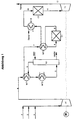
- the numbers describe the individual gas flows.
- nitrogen oxides-containing process or flue gases (line 1) via line 2 with air and / or via line 3 2 O-poor with N or NO and NO 2 -containing mixed process gases.
- line 1 nitrogen oxides-containing process or flue gases
- line 2 nitrogen oxides-containing process or flue gases
- line 3 nitrogen oxides-containing process or flue gases
- the temperature increase of the adiabatically operated N 2 O decomposition in the subsequent reactor C1 is limited to a maximum of 350 ° C.
- the addition of air supports the oxidation of NO according to equation (I) above and thus the formation of nitric acid according to equation (II) in the absorption column K1.
- the addition of NO and / or NO 2 -containing gases can additionally increase the production of nitric acid (HNO 3 ) in the absorption column K1.
- process gases from ammonia oxidation reactors can be fed in via line 3.
- the gas mixture (the gas stream containing nitrogen oxides) is then compressed by means of the compressor (V).
- the increased pressure of the gas mixture increases the effectiveness of the subsequent absorption column K1 (stage A) of the N 2 O cleavage reactor C1 (stage B) and the reactor for catalytic NO x reduction C2 (stage C) in a preferred embodiment.
- the released heat of compression and the simultaneous oxidation of NO to NO 2 raise the temperature of the gas flow in line 4 to 250-350 ° C.
- the gas flow is cooled in a gas / gas heat exchanger (WT1) with cold gas flow from the absorption and then in the heat exchanger (cooler) (WT2) with a suitable cooling medium such as air or cooling water to 30-40 ° C.
- stage A The NO 2 absorption and reaction with water to form nitric acid is carried out in the subsequent absorption column K1 (stage A), in which the gas stream and the absorbent (for example water or aqueous nitric acid) are passed in countercurrent via suitable internals and the nitric acid formed at the bottom is withdrawn from the column.
- the gas stream and the absorbent for example water or aqueous nitric acid
- the gas flow (line 6) freed from the majority of the NO 2 and NO is then in a gas / gas heat exchanger (WT1) to 200-300 ° C (line 7) and in the subsequent gas / gas heat exchanger (WT3) to 450 -500 ° C (line 8) warmed up.
- the N 2 O is removed in reactor C1 (stage B), the temperature rising to 825 ° C. (line 9).
- the gas stream is then cooled to 260-300 ° C. in the gas / gas heat exchanger (WT3) and then in the steam generator (heat exchanger WT4) (line 10). Then the gas stream in the reactor C2 (stage C) is freed of traces of nitrogen oxide by catalytic reduction.
- the adiabatic temperature increase is approx. 10 ° C.
- the gas stream is then fed via line 11 at a temperature of 265-310 ° C. to an expansion turbine (T1), in which it is expanded to atmospheric pressure and is released into the atmosphere via line 12 at approximately 100 ° C.
- T1 expansion turbine
- the drive energy generated in the turbine (T1) can be shared Shaft mm drive of the compressor (V1) can be used.
- the missing Drive energy is then applied via an additional motor (M).
Landscapes
- Chemical & Material Sciences (AREA)
- Engineering & Computer Science (AREA)
- Environmental & Geological Engineering (AREA)
- General Chemical & Material Sciences (AREA)
- Biomedical Technology (AREA)
- Analytical Chemistry (AREA)
- Health & Medical Sciences (AREA)
- Oil, Petroleum & Natural Gas (AREA)
- Chemical Kinetics & Catalysis (AREA)
- Organic Chemistry (AREA)
- Inorganic Chemistry (AREA)
- Treating Waste Gases (AREA)
- Catalysts (AREA)
- Exhaust Gas Treatment By Means Of Catalyst (AREA)
Applications Claiming Priority (3)
| Application Number | Priority Date | Filing Date | Title |
|---|---|---|---|
| DE19533715A DE19533715A1 (de) | 1995-09-12 | 1995-09-12 | Verfahren zum Entfernen von Stickstoffoxiden aus einem diese enthaltenden Gasstrom |
| DE19533715 | 1995-09-12 | ||
| PCT/EP1996/003971 WO1997010042A1 (de) | 1995-09-12 | 1996-09-10 | Verfahren zum entfernen von stickstoffoxiden aus einem diese enthaltenden gasstrom |
Publications (2)
| Publication Number | Publication Date |
|---|---|
| EP0859659A1 EP0859659A1 (de) | 1998-08-26 |
| EP0859659B1 true EP0859659B1 (de) | 1999-12-01 |
Family
ID=7771925
Family Applications (1)
| Application Number | Title | Priority Date | Filing Date |
|---|---|---|---|
| EP96931068A Expired - Lifetime EP0859659B1 (de) | 1995-09-12 | 1996-09-10 | Verfahren zum entfernen von stickstoffoxiden aus einem diese enthaltenden gasstrom |
Country Status (11)
| Country | Link |
|---|---|
| US (1) | US6056928A (enExample) |
| EP (1) | EP0859659B1 (enExample) |
| JP (1) | JP4249258B2 (enExample) |
| KR (1) | KR100457933B1 (enExample) |
| CN (1) | CN1090521C (enExample) |
| CA (1) | CA2229416C (enExample) |
| DE (2) | DE19533715A1 (enExample) |
| PL (1) | PL325600A1 (enExample) |
| TW (1) | TW422729B (enExample) |
| UA (1) | UA65527C2 (enExample) |
| WO (1) | WO1997010042A1 (enExample) |
Families Citing this family (49)
| Publication number | Priority date | Publication date | Assignee | Title |
|---|---|---|---|---|
| WO1998046334A1 (en) * | 1997-04-16 | 1998-10-22 | Ebara Corporation | Method for removing nitrogen oxides in exhaust gas |
| EP0919278A1 (en) * | 1997-11-06 | 1999-06-02 | Basf Corporation | Process for the catalytic abatement of nitrogen oxides |
| DE19819882A1 (de) * | 1998-04-27 | 1999-10-28 | Basf Ag | Verfahren zur katalytischen Zersetzung von N2O |
| DE19902109A1 (de) * | 1999-01-20 | 2000-07-27 | Basf Ag | Verfahren zur thermischen N¶2¶O-Zersetzung |
| CA2387561C (en) * | 1999-10-15 | 2003-12-16 | Abb Lummus Global, Inc. | Conversion of nitrogen oxides in the presence of a catalyst supported of a mesh-like structure |
| US6667017B2 (en) | 1999-10-15 | 2003-12-23 | Abb Lummus Global, Inc. | Process for removing environmentally harmful compounds |
| DE10001539B4 (de) * | 2000-01-14 | 2006-01-19 | Uhde Gmbh | Verfahren zur Beseitigung von NOx und N2O |
| DE10001541B4 (de) * | 2000-01-14 | 2005-04-28 | Uhde Gmbh | Verfahren zur Beseitigung von NOx und N¶2¶O aus dem Restgas der Salpetersäureproduktion |
| DE10001540B4 (de) * | 2000-01-14 | 2005-06-23 | Uhde Gmbh | Beseitigung von Lachgas bei der Salpetersäureproduktion |
| US6506351B1 (en) * | 2000-08-11 | 2003-01-14 | The Boc Group, Inc. | Removal of nitrogen oxides from gas streams |
| US7438878B2 (en) * | 2001-03-12 | 2008-10-21 | Basf Catalysts Llc | Selective catalytic reduction of N2O |
| WO2003048037A1 (en) * | 2001-12-04 | 2003-06-12 | Dsm Ip Assets B.V. | Process for treating an aqueous medium containing phosphate salt and organic compounds |
| DE10207627A1 (de) * | 2002-02-22 | 2003-09-11 | Uhde Gmbh | Verfahren zur Herstellung von Salpetersäure |
| DE10215605A1 (de) * | 2002-04-09 | 2003-10-30 | Uhde Gmbh | Entstickungsverfahren |
| US20060115403A1 (en) * | 2004-11-29 | 2006-06-01 | Chevron U.S.A. Inc. | Reduction of oxides of nitrogen in a gas stream using high-silics molecular sieve CHA |
| BRPI0719676A2 (pt) * | 2006-12-04 | 2013-12-24 | Basf Se | Processo para o reprocessamento de gás de exaustão a partir de uma instalação para a produção de hidroxilamina ou de sais de hidroxilamônio |
| WO2008071632A2 (de) * | 2006-12-11 | 2008-06-19 | Basf Se | Verfahren zur isolierung von n2o |
| ITMI20070096A1 (it) * | 2007-01-23 | 2008-07-24 | Sued Chemie Catalysts Italia Srl | Processo per la decomposizione catalitica di protossido d'azoto. |
| US10092895B2 (en) | 2007-01-23 | 2018-10-09 | Sued-Chemie Catalysts Italia S.R.L. | Process for catalytic decomposition of nitrogen protoxide |
| US8715618B2 (en) * | 2008-05-21 | 2014-05-06 | Basf Se | Process for the direct synthesis of Cu containing zeolites having CHA structure |
| DE102009037882A1 (de) * | 2009-01-13 | 2010-07-15 | Linde Aktiengesellschaft | Vorrichtung und Verfahren zur Zersetzung von Lachgas in einem adiabaten Festbettreaktor |
| DE102011014007A1 (de) * | 2011-03-15 | 2012-09-20 | Linde Aktiengesellschaft | Verfahren und Anlage zur Rauchgasentstickung |
| US9352270B2 (en) | 2011-04-11 | 2016-05-31 | ADA-ES, Inc. | Fluidized bed and method and system for gas component capture |
| DE102011121188A1 (de) | 2011-12-16 | 2013-06-20 | Thyssen Krupp Uhde Gmbh | Vorrichtung und Verfahren zur Beseitigung von NOx und N20 |
| US9694317B2 (en) | 2012-05-03 | 2017-07-04 | Altira Technology Fund V L.P. | Multi-pollutant abatement device and method |
| DE102012010017A1 (de) * | 2012-05-22 | 2013-11-28 | Thyssenkrupp Uhde Gmbh | Verfahren zur Verminderung der Stickoxid-Abgaskonzentration in einer Salpetersäureanlage beim Ab- und/oder Anfahren sowie dafür geeignete Salpetersäureanlagen |
| CN104812467B (zh) | 2012-09-20 | 2017-05-17 | Ada-Es股份有限公司 | 用于恢复被热稳定盐污染的吸附剂上的功能位置的方法和系统 |
| KR102055038B1 (ko) * | 2013-11-08 | 2019-12-11 | 란세스 도이치란트 게엠베하 | 적색 산화철 안료의 제조 |
| CN104923033A (zh) * | 2014-03-19 | 2015-09-23 | 内蒙古乌拉山化肥有限责任公司 | 一种硝酸氮氧化物尾气回收的方法 |
| US10479893B2 (en) | 2014-09-05 | 2019-11-19 | Lanxess Deutschland Gmbh | Preparation of iron (III) oxide pigment |
| KR102470829B1 (ko) | 2014-09-11 | 2022-11-28 | 란세스 도이치란트 게엠베하 | 헤마타이트 안료 및 그의 제조 방법 |
| JP6546738B2 (ja) * | 2014-11-12 | 2019-07-17 | 日立造船株式会社 | アルデヒド分解触媒および排ガス処理設備ならびに排ガス処理方法 |
| US10105645B2 (en) * | 2015-03-26 | 2018-10-23 | Corning Incorporated | Method and system for selective noncatalytic NOx reduction |
| CN105126584A (zh) * | 2015-08-17 | 2015-12-09 | 兰州大学 | 一种处理氮氧化物的方法 |
| CN105396460B (zh) * | 2015-12-25 | 2019-12-24 | 华烁科技股份有限公司 | 一种高效联合脱除N2O和NOx的方法 |
| EP3216764A1 (de) | 2016-03-09 | 2017-09-13 | LANXESS Deutschland GmbH | Herstellung von eisenoxid-rot-pigmenten |
| CN106110848A (zh) * | 2016-07-13 | 2016-11-16 | 成都普瑞得科技有限公司 | 氮氧化物减排系统与氮氧化物减排的方法 |
| EP3533512A1 (en) | 2018-03-01 | 2019-09-04 | Casale Sa | Process for reducing the content of nox and n2o from a tail gas of a nitric acid process |
| CN109603531A (zh) * | 2019-01-08 | 2019-04-12 | 大连理工大学 | 一种多流股催化氧化处理高浓度有机废气系统及工艺流程 |
| SE544603C2 (en) * | 2021-01-19 | 2022-09-20 | Nitrocapt Ab | Method for the synthesis of nitrogen oxides in a thermal reactor |
| CN111608806A (zh) * | 2020-04-20 | 2020-09-01 | 中国石油化工股份有限公司 | 一种环己酮氧化法生产过程中尾气能量的回收方法及回收装置 |
| CN111608805A (zh) * | 2020-04-20 | 2020-09-01 | 中国石油化工股份有限公司 | 氧化法生产环己酮中氧化尾气能量回收的方法 |
| CN112023557A (zh) * | 2020-09-23 | 2020-12-04 | 南京星诺新材料有限公司 | 一种分解氮氧化合物模组结构 |
| US20240216862A1 (en) * | 2021-01-13 | 2024-07-04 | Basf Se | Process for working-up a nitrous oxide comprising off-gas stream |
| CN113289467B (zh) * | 2021-06-29 | 2022-08-26 | 成都达奇环境科技有限公司 | 金属催化剂生产烟气的处理方法 |
| CN117715692A (zh) | 2021-07-28 | 2024-03-15 | 巴斯夫欧洲公司 | DeN2O催化剂的新几何结构 |
| EP4452465A1 (en) * | 2021-12-23 | 2024-10-30 | Topsoe A/S | A process for treating gas streams with high concentration of n2o |
| CN118632940A (zh) * | 2022-02-25 | 2024-09-10 | 卡萨勒有限公司 | 处理含NOx气体的方法 |
| CN114749005A (zh) * | 2022-05-09 | 2022-07-15 | 盛隆资源再生(无锡)有限公司 | 一种VOCs废气的处理方法 |
Family Cites Families (18)
| Publication number | Priority date | Publication date | Assignee | Title |
|---|---|---|---|---|
| JPS52156168A (en) * | 1976-06-22 | 1977-12-26 | Mitsubishi Chem Ind Ltd | Waste gas treatment of nitric acid plant |
| DE3008012A1 (de) * | 1980-03-01 | 1981-09-10 | Nukem Gmbh, 6450 Hanau | Verfahren und vorrichtung zur entfernung von nitrosen gasen aus gasgemischen |
| DE3108075A1 (de) * | 1981-03-04 | 1982-09-16 | Basf Ag, 6700 Ludwigshafen | Verfahren zur entfernung von distickstoffoxid aus solches enthaltenden abgasen |
| NO165539C (no) * | 1988-09-16 | 1991-02-27 | Norsk Hydro As | Fremgangsmaate ved reduksjon av nitrogenoksid. |
| JPH0475173A (ja) * | 1990-07-17 | 1992-03-10 | Matsushita Electric Ind Co Ltd | 集積回路設計支援装置 |
| CA2049528A1 (en) * | 1990-09-13 | 1992-03-14 | Heinrich Aichinger | The catilytic decomposition of dinitrogen monoxide which is pure or present in gas mixtures |
| DE4128629A1 (de) * | 1991-08-29 | 1993-03-04 | Basf Ag | Silberhaltiger traegerkatalysator und verfahren zur katalytischen zersetzung von distickstoffmonoxid |
| US5171553A (en) * | 1991-11-08 | 1992-12-15 | Air Products And Chemicals, Inc. | Catalytic decomposition of N2 O |
| FR2687138A1 (fr) * | 1992-02-07 | 1993-08-13 | Hoechst France | Procede d'oxydation thermochimique de l'oxyde de diazote. |
| US5314673A (en) * | 1992-02-18 | 1994-05-24 | E. I. Du Pont De Nemours And Company | Process for the conversion of N2 O |
| US5200162A (en) * | 1992-04-01 | 1993-04-06 | Uop | Process for N2 O decomposition |
| DE4224881A1 (de) * | 1992-07-28 | 1994-02-03 | Basf Ag | Silberhaltiger Aluminiumoxid-Trägerkatalysator und Verfahren zur katalytischen Zersetzung von reinem oder in Gasgemischen enthaltenem Distickstoffmonoxid |
| DE4301470A1 (de) * | 1993-01-21 | 1994-07-28 | Basf Ag | Verfahren zur katalytischen Zersetzung von reinem oder in Gasgemischen enthaltenem Distickstoffmonoxid |
| DE4308940A1 (de) * | 1993-03-19 | 1994-09-22 | Heyer Gmbh Carl | Verfahren und Vorrichtung zum Trennen und Rückgewinnen von Inhalationsanästhetika aus einer Mischung dieser Stoffe mit Lachgas |
| FR2705036B1 (fr) * | 1993-05-10 | 1995-06-16 | Paroisse Sa Grande | Procédé pour abaisser la teneur en protoxyde d'azote dans les effluents gazeux, en particulier dans ceux qui sont issus de synthèses par oxydation nitrique. |
| WO1994027709A1 (en) * | 1993-05-28 | 1994-12-08 | Engelhard Corporation | Nitrous oxide decomposition catalyst |
| US5552128A (en) * | 1993-08-03 | 1996-09-03 | Mobil Oil Corporation | Selective catalytic reduction of nitrogen oxides |
| US5465690A (en) * | 1994-04-12 | 1995-11-14 | A. Ahlstrom Corporation | Method of purifying gases containing nitrogen oxides and an apparatus for purifying gases in a steam generation boiler |
-
1995
- 1995-09-12 DE DE19533715A patent/DE19533715A1/de not_active Withdrawn
-
1996
- 1996-09-10 JP JP51067897A patent/JP4249258B2/ja not_active Expired - Lifetime
- 1996-09-10 EP EP96931068A patent/EP0859659B1/de not_active Expired - Lifetime
- 1996-09-10 CN CN96197967A patent/CN1090521C/zh not_active Expired - Lifetime
- 1996-09-10 PL PL96325600A patent/PL325600A1/xx unknown
- 1996-09-10 DE DE59603806T patent/DE59603806D1/de not_active Expired - Lifetime
- 1996-09-10 KR KR10-1998-0701843A patent/KR100457933B1/ko not_active Expired - Lifetime
- 1996-09-10 US US09/029,833 patent/US6056928A/en not_active Expired - Lifetime
- 1996-09-10 WO PCT/EP1996/003971 patent/WO1997010042A1/de not_active Ceased
- 1996-09-10 CA CA002229416A patent/CA2229416C/en not_active Expired - Fee Related
- 1996-09-11 TW TW085111115A patent/TW422729B/zh not_active IP Right Cessation
- 1996-10-09 UA UA98041838A patent/UA65527C2/uk unknown
Also Published As
| Publication number | Publication date |
|---|---|
| CN1200681A (zh) | 1998-12-02 |
| US6056928A (en) | 2000-05-02 |
| KR19990044593A (ko) | 1999-06-25 |
| CA2229416C (en) | 2007-05-29 |
| DE59603806D1 (de) | 2000-01-05 |
| KR100457933B1 (ko) | 2005-01-15 |
| PL325600A1 (en) | 1998-08-03 |
| TW422729B (en) | 2001-02-21 |
| WO1997010042A1 (de) | 1997-03-20 |
| CA2229416A1 (en) | 1997-03-02 |
| UA65527C2 (en) | 2004-04-15 |
| JP4249258B2 (ja) | 2009-04-02 |
| DE19533715A1 (de) | 1997-03-13 |
| JPH11512021A (ja) | 1999-10-19 |
| CN1090521C (zh) | 2002-09-11 |
| EP0859659A1 (de) | 1998-08-26 |
Similar Documents
| Publication | Publication Date | Title |
|---|---|---|
| EP0859659B1 (de) | Verfahren zum entfernen von stickstoffoxiden aus einem diese enthaltenden gasstrom | |
| EP3573927B1 (de) | Verfahren und anlage zur herstellung von salpetersäure | |
| EP3075435B1 (de) | Verfahren zur verringerung des gehaltes an stickoxiden in gasen | |
| EP2759329B1 (de) | Verfahren und vorrichtung zur reinigung von abgasen | |
| EP1497014B1 (de) | Entstickungsverfahren | |
| EP1515791B1 (de) | Verfahren und vorrichtung zur verringerung des gehalts an nox und n2o in gasen | |
| EP2678270B1 (de) | Verfahren zur beseitigung von n2o und nox aus dem prozess zur salpetersäureherstellung und dafür geeignete anlage | |
| EP2408541B1 (de) | Kombinierte abgasbehandlung ammoniak- und stickoxid-haltiger abgasströme in industrieanlagen | |
| EP4631604A1 (de) | Vorrichtung und verfahren zur beseitigung von nox und n2o | |
| DE68906223T2 (de) | Methode zur reduktion von stickoxid. | |
| EP1001910B1 (de) | Verfahren zur herstellung von salpetersäure und vorrichtung zur durchführung des verfahrens | |
| EP1022047A1 (de) | Verfahren zur thermischen N2O-Zersetzung | |
| EP2696958A1 (de) | Verfahren und anlage zur abreicherung von stickoxiden aus sauerstoffhaltigen gasströmen | |
| WO2019038045A1 (de) | Verfahren zur herstellung von salpetersäure und vorrichtung zur herstellung von salpetersäure | |
| DE19805202A1 (de) | Verfahren zur Herstellung von Salpetersäure und Vorrichtung zur Durchführung des Verfahrens | |
| WO2024133916A1 (de) | Verminderung von nox und n2o im abgas von mit nh3 betriebenen feuerungsanlagen | |
| DE102024117634A1 (de) | Entfernung von Cyanwasserstoff bei der Abgasnachbehandlung | |
| DE102024113978A1 (de) | Verfahren zur Erzeugung von Stickstoffmonoxid und Rauchgasreinigungsvorrichtung | |
| WO2001087465A1 (de) | Verfahren zur katalytischen zersetzung von n2o | |
| CH565712A5 (en) | Nitrous oxide by oxidation of ammonia |
Legal Events
| Date | Code | Title | Description |
|---|---|---|---|
| PUAI | Public reference made under article 153(3) epc to a published international application that has entered the european phase |
Free format text: ORIGINAL CODE: 0009012 |
|
| 17P | Request for examination filed |
Effective date: 19980327 |
|
| AK | Designated contracting states |
Kind code of ref document: A1 Designated state(s): DE FR GB IT |
|
| GRAG | Despatch of communication of intention to grant |
Free format text: ORIGINAL CODE: EPIDOS AGRA |
|
| 17Q | First examination report despatched |
Effective date: 19990201 |
|
| GRAG | Despatch of communication of intention to grant |
Free format text: ORIGINAL CODE: EPIDOS AGRA |
|
| GRAH | Despatch of communication of intention to grant a patent |
Free format text: ORIGINAL CODE: EPIDOS IGRA |
|
| GRAH | Despatch of communication of intention to grant a patent |
Free format text: ORIGINAL CODE: EPIDOS IGRA |
|
| GRAA | (expected) grant |
Free format text: ORIGINAL CODE: 0009210 |
|
| AK | Designated contracting states |
Kind code of ref document: B1 Designated state(s): DE FR GB IT |
|
| REF | Corresponds to: |
Ref document number: 59603806 Country of ref document: DE Date of ref document: 20000105 |
|
| ITF | It: translation for a ep patent filed | ||
| GBT | Gb: translation of ep patent filed (gb section 77(6)(a)/1977) |
Effective date: 20000128 |
|
| ET | Fr: translation filed | ||
| PLBE | No opposition filed within time limit |
Free format text: ORIGINAL CODE: 0009261 |
|
| STAA | Information on the status of an ep patent application or granted ep patent |
Free format text: STATUS: NO OPPOSITION FILED WITHIN TIME LIMIT |
|
| 26N | No opposition filed | ||
| REG | Reference to a national code |
Ref country code: GB Ref legal event code: IF02 |
|
| REG | Reference to a national code |
Ref country code: FR Ref legal event code: PLFP Year of fee payment: 20 |
|
| PGFP | Annual fee paid to national office [announced via postgrant information from national office to epo] |
Ref country code: GB Payment date: 20150930 Year of fee payment: 20 |
|
| PGFP | Annual fee paid to national office [announced via postgrant information from national office to epo] |
Ref country code: FR Payment date: 20150928 Year of fee payment: 20 |
|
| PGFP | Annual fee paid to national office [announced via postgrant information from national office to epo] |
Ref country code: IT Payment date: 20150925 Year of fee payment: 20 Ref country code: DE Payment date: 20151130 Year of fee payment: 20 |
|
| REG | Reference to a national code |
Ref country code: DE Ref legal event code: R071 Ref document number: 59603806 Country of ref document: DE |
|
| REG | Reference to a national code |
Ref country code: GB Ref legal event code: PE20 Expiry date: 20160909 |
|
| PG25 | Lapsed in a contracting state [announced via postgrant information from national office to epo] |
Ref country code: GB Free format text: LAPSE BECAUSE OF EXPIRATION OF PROTECTION Effective date: 20160909 |