EP0855770A2 - Augensicheres Lasersystem unter Verwendung von mit Übergangsmetallen dotierten II-VI Halbleitern als passiv sättigbare Absorber-Güteschalter - Google Patents
Augensicheres Lasersystem unter Verwendung von mit Übergangsmetallen dotierten II-VI Halbleitern als passiv sättigbare Absorber-Güteschalter Download PDFInfo
- Publication number
- EP0855770A2 EP0855770A2 EP98101022A EP98101022A EP0855770A2 EP 0855770 A2 EP0855770 A2 EP 0855770A2 EP 98101022 A EP98101022 A EP 98101022A EP 98101022 A EP98101022 A EP 98101022A EP 0855770 A2 EP0855770 A2 EP 0855770A2
- Authority
- EP
- European Patent Office
- Prior art keywords
- laser system
- laser
- saturable absorber
- eyesafe
- switch
- Prior art date
- Legal status (The legal status is an assumption and is not a legal conclusion. Google has not performed a legal analysis and makes no representation as to the accuracy of the status listed.)
- Withdrawn
Links
Images


Classifications
-
- H—ELECTRICITY
- H01—ELECTRIC ELEMENTS
- H01S—DEVICES USING THE PROCESS OF LIGHT AMPLIFICATION BY STIMULATED EMISSION OF RADIATION [LASER] TO AMPLIFY OR GENERATE LIGHT; DEVICES USING STIMULATED EMISSION OF ELECTROMAGNETIC RADIATION IN WAVE RANGES OTHER THAN OPTICAL
- H01S3/00—Lasers, i.e. devices using stimulated emission of electromagnetic radiation in the infrared, visible or ultraviolet wave range
- H01S3/10—Controlling the intensity, frequency, phase, polarisation or direction of the emitted radiation, e.g. switching, gating, modulating or demodulating
- H01S3/11—Mode locking; Q-switching; Other giant-pulse techniques, e.g. cavity dumping
- H01S3/1123—Q-switching
- H01S3/113—Q-switching using intracavity saturable absorbers
-
- H—ELECTRICITY
- H01—ELECTRIC ELEMENTS
- H01S—DEVICES USING THE PROCESS OF LIGHT AMPLIFICATION BY STIMULATED EMISSION OF RADIATION [LASER] TO AMPLIFY OR GENERATE LIGHT; DEVICES USING STIMULATED EMISSION OF ELECTROMAGNETIC RADIATION IN WAVE RANGES OTHER THAN OPTICAL
- H01S3/00—Lasers, i.e. devices using stimulated emission of electromagnetic radiation in the infrared, visible or ultraviolet wave range
- H01S3/14—Lasers, i.e. devices using stimulated emission of electromagnetic radiation in the infrared, visible or ultraviolet wave range characterised by the material used as the active medium
- H01S3/16—Solid materials
- H01S3/1601—Solid materials characterised by an active (lasing) ion
- H01S3/1603—Solid materials characterised by an active (lasing) ion rare earth
- H01S3/1608—Solid materials characterised by an active (lasing) ion rare earth erbium
-
- H—ELECTRICITY
- H01—ELECTRIC ELEMENTS
- H01S—DEVICES USING THE PROCESS OF LIGHT AMPLIFICATION BY STIMULATED EMISSION OF RADIATION [LASER] TO AMPLIFY OR GENERATE LIGHT; DEVICES USING STIMULATED EMISSION OF ELECTROMAGNETIC RADIATION IN WAVE RANGES OTHER THAN OPTICAL
- H01S3/00—Lasers, i.e. devices using stimulated emission of electromagnetic radiation in the infrared, visible or ultraviolet wave range
- H01S3/14—Lasers, i.e. devices using stimulated emission of electromagnetic radiation in the infrared, visible or ultraviolet wave range characterised by the material used as the active medium
- H01S3/16—Solid materials
- H01S3/163—Solid materials characterised by a crystal matrix
- H01S3/164—Solid materials characterised by a crystal matrix garnet
Definitions
- This invention relates to lasers, and, more particularly, to a Q-switched laser system having a passive saturable absorber.
- a laser is a device that emits a spatially coherent beam of light of a specific wavelength.
- a lasing element within a laser resonator cavity is pumped with an energy source such as a flash lamp.
- the pumping action produces stored energy and gain within the lasing element. If the gain exceeds the losses so that there is a net light amplification per round trip of the light in the resonator cavity, laser light begins to build up in the cavity, and the stored energy can be released in the form of a very short, intense light pulse by using a device called a Q-switch.
- a saturable absorber can be used as a passive Q-switch.
- the saturable absorber is a crystal having transmittance properties that vary as a function of the intensity of the incident light that impinges on upon the crystal.
- When light of low intensity is incident upon the saturable absorber its light transmittance is relatively low, resulting in high cavity losses.
- the incident light energy increases due to the buildup of energy within the laser resonator cavity, the light transmittance of the crystal increases. At some point, the light transmittance increases to a level such that the crystal "beaches", i.e., becomes transparent, so that the cavity losses become low, and an intense Q-switched light pulse is emitted.
- a saturable absorber crystal depends upon the wavelength of the incident light.
- a crystal which performs as a saturable absorber at one wavelength typically will not perform in the same manner at significantly different wavelengths.
- a crystal may act as a saturable absorber for relatively low incident Intensities, but once bleaching is achieved, the resultant higher intensities may damage the crystal.
- a significant limitation on the performance of many known saturable absorber Q-switch materials is their susceptibility to damage from an intense light beam. The high intensity light pulse passing through the crystal causes permanent damage, so that the ability of the crystal to function as a saturable absorber for subsequent cycles is impaired. There is therefore an ongoing search for effective saturable absorber crystals for use as Q-switches in particular wavelength ranges which are robust (i.e., have high damage thresholds).
- One of the laser operating ranges of interest is at the "eyesafe" range from about 1.5 micrometers to about 1.8 micrometers.
- This wavelength range is of particular interest because light in this range will not damage the human eye at moderate intensities.
- the Er:glass laser emits infra-red light at about 1.53 ⁇ m wavelength, and is of interest as an eye-safe laser.
- A:B indicates a material having an ion of A doped into a B host crystal.
- Another example is the Er:YAG laser, which emits infra-red light at about 1.64 ⁇ m.
- Co 2+ in materials such as M g F 2 and Kz n F 3 , has been used as a tunable laser source from 1.5 ⁇ m to 2.3 ⁇ m and possesses a broad absorption band in the eyesafe band.
- Co 2+ -doped garnets have been demonstrated to function as saturable absorber Q-switches for the Er:glass laser.
- the known Co 2+ -doped garnet Q-switches have high saturation intensities and require an intra cavity focusing lens, and also have an excited-state lifetime which is very short (less than l ns for Co 2+ ).
- Known saturable absorbers suitable for use with the eyesafe wavelengths produced by Er:glass and/or Er:YAG lasers include Er 3+ :Ca 5 (PO 4 ) 3 F, U 4+ :SrF 2 , U 4+ :SrF 2 , U 4+ :CaF 2 , and Er 3+ :CaF 2 .
- these particular absorbers have relatively long relaxation lifetimes, but lower absorption cross sections, relative to Co 2+ : ZnSe.
- Zinc selenide (ZnSe) and the other zinc chalcogenides are members of a compositional class of II-VI semiconductor crystals which also includes the cadmium chalcogenides end zinc oxide. These particular semiconductors have similar crystalline properties (noncentrosymmetric tetrahedral substitutional sites) and are known to provide a comparatively favorable environment for IR emission from transition metal (TM) ions.
- TM transition metal
- doped with Co 2+ or other similar TM ions such as Cr 2+ , Fe 2+ , or Ni 2+
- none of the II-VI semiconductor crystals have been demonstrated to have utility as a robust saturable absorber for reliably producing short, high intensity pulses from eyesafe lasers.
- the present invention provides a laser system having a passive Q-switch.
- the laser system can produce relatively high-intensity output pulses of very short duration and high repetition rate.
- the Q-switch material is operable over a range of eyesafe wavelengths at about 1.5 ⁇ m, and is therefore operable with a number of types of lasing elements.
- a laser system comprises a laser resonator cavity having a resonant axis and a lasing element within the laser resonator cavity.
- the lasing element under stimulation by a flash lamp or other suitable optical pumping means, emits light at an eyesafe wavelength greater than about 1.35 ⁇ m, and less than about 1.9 ⁇ m,
- the Q-switch crystal of the present invention comprises a crystaline II-VI semiconductor material doped with transition metal ions and functions as a passive saturable absorber for the eyesafe wavelength light emitted by the lasing element.
- the crystalline II-VI semiconductor material is zinc selenide and the transition metal ions are Co 2+ ions, which has been demonstrated to provide a passive saturable absorber at both 1.53 ⁇ m and 1.64 ⁇ m which has an advantageously high absorption cross section and an advantageously long relaxation lifetime.
- the resultant Q-switch does not require additional focusing optics inside the cavity and has a saturation fluence which is approximately one order of magnitude less than other state of the art saturable absorbers, thereby permitting substantially faster operation, lower thermal loads, and less potential for damage than was hitherto possible.
- Fig 1 schematically illustrates an experimental setup for a laser system 2 according to the present invention.
- the laser system 2 includes a laser resonator cavity 4 having a resonant axis 6.
- a reflector 10 At a first end 8 of the cavity 4 is a reflector 10, which has a reflectivity of substantially 100 percent at the operating wavelength, and a 50cm concave radius of curvature.
- an outcoupler 14 At a second end 12 of the cavity 4 is an outcoupler 14, having a reflectivity that is less than 100 percent at the operating wavelength.
- a lasing element 16 is positioned within the laser resonator cavity 4.
- the lasing element 16 is in the form of a cylindrical solid rod (3x50mm) of Kigre Er:Yb:phosphate glass (QE-7S), whose cylindrical axis coincides with the resonant axis 6.
- QE-7S Kigre Er:Yb:phosphate glass
- the lasing element 16 emits coherent light having an operating wavelength in the eyesafe range, and more specifically a wavelength greater than about 1.35 ⁇ m and less than about 1.9 ⁇ m.
- Examples of materials believed to be appropriate for a lasing element 16 operable at eyesafe wavelengths include not only Er:glass (erbium doped into a phosphate glass host), but also Tm 3+ :YLF (thulium doped into a yttrium-lithium fluoride host), and Er 3+ :YAG (erbium doped into a yttrium-aluminum garnet host). These lasing elements are all known in the art.
- a conventional means for optically pumping the lasing element is provided, for example a linear flash lamp 18 positioned adjacent to the lasing element 16.
- a Q-switch crystal 20 is positioned within the laser resonator cavity 4 with the resonant axis 6 passing therethrough,
- the Q-switch crystal 20 is shown as lying between the lasing element 16 and outcoupler 14; however, the system 2 would also be operable if Q-switch crystal were located at the other end of cavity 4 adjacent reflector 10.
- the Q-switch crystal 20 is a saturable absorber of light in the wavelength range at about 1.5 micrometers, and more specifically from about 1.35 to about 1.9 micrometers.
- the Q-switch crystal 20 is formed of a host semiconductor material with a sufficient concentration of transition metal ions (e.g., ions therein to act as a saturable absorber in the eyesafe wavelength range).
- the Q-switch material desirably has a higher absorption cross section, preferably a much higher absorption cross section, than the stimulated emission cross section of the lasing element 16, so that no separate focusing elements are required inside cavity 4.
- zinc selenide is presently preferred as the host semiconductor material
- other zinc chalcogenides, cadmium chalcogenides and zinc oxide which have similar crystaline properties (noncentrosymmetric tetrahedral substitutional sites), when doped with a suitable transition metal ion which provides a relatively long relaxation lifetime (such as Co 2+ ) in concentrations from about 0.001 to about 0.10 atomic percent, are believed to also have potential utility as saturable absorbers in the eyesafe range.
- a laser system 2 similar to that illustrated in Fig 1 was built and operated to demonstrate the performance of the Q-switched laser system.
- the laser resonator cavity 4 was about 19 centimeters long.
- the outcoupler mirror 14 was flat and had a 95% percent reflectance.
- the other mirror 10 was curved and had a 50 centimeter radius of curvature and a reflectance of 95 percent at a wavelength of about 1.53 micrometers.
- the lasing element 16 used for the demonstration was a Kigre QE-7S Er:Yb:phosphate glass rod, having a diameter of 3 millimeters and a length of 50 millimeters; however, other lasing elements functioning in the eyesafe range could be substituted.
- the Q-switch 20 was fabricated from a relatively lightly doped (nominal 0.001 atomic percent) Co 2+ :ZnSe boule fragment obtained from the Eagle-Picher Co, which has a Co 2+ absorption hand 22 (transmittance at small signals before any bleaching has occurred) with a peak 24 at around 1.54 ⁇ m (Fig 2).
- a thickness of 1.5mm provided an internal loss of about 6% and the Co 2+ ions had a calculated ion concentration of about 9 x 10 17 cm -3. ; however the invention is believed to be operable with a wide range of transistion metal ion concentrations up to at least about 0.10 nominal atomic percent.
- a typical output pulse from the experimental setup is shown in the oscilloscope trace of Fig 3.
- the full-width-half-maximum 26 for the pulse is about 100 ns.
- the tail 28 in the pulse is an artifact of the Judson InGsAs photodiode used in the experiment.
- Fig 4 is an oscilloscope trace showing an observed relaxation lifetime 30 (time to decay by a factor of 1/e) of about 350 ⁇ s for the Co 2+ :ZnSe saturable absorber 20 when pumped with a 1.5 ⁇ m source.
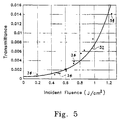
- Fig 5 is a graph showing the change in transmittance 32 of the Co:ZnSe saturable absorber 20 as a function of incident fluence at 1.5 ⁇ m.
- the experimental data 34 corresponds to a calculated fluence at saturation of 0.21J/cm 2 , which is an order of magnitude less than the corresponding saturation fluence for what was heretofor considered a state of the art saturable absorber for eyesafe wavelengths (U:CaF 2 , 1.9J/cm 2 ).
- an Er:YAG laser (15%Yb:0.3%Er:YAG, 0.6cm x 7.6cm) was pumped longitudinally with a Er:Yb:phosphate glass laser at 1.53 ⁇ m.
- the output beam from the pumping laser 18 was focused on the middle of the Er:YAG laser.
- the laser resonator cavity was formed by pair of mirrors 10, 14 with reflectivities of about 100% and 97% at the output wavelength (1.64 ⁇ m) of the Er:YAG laser, and essentially 100% transmissive at the output wavelength (1.53 ⁇ m) of the pumping laser.
- the saturable absorber 20 was 1.525 mm thick and produced pulses of about 250ns and 1.1mJ, as shown in Fig 4.
- the calculated absorption cross section at saturation was 6.2 x 10 -19 cm 2 , which is one order of magnitude higher than known state of the art eyesafe saturable absorber materials such as U:CaF 2 .
- Co 2+ -doped zinc selenide and other transition element-doped semiconductor crystals having similar absorption and emission properties should be suitable for use used with a variety of lasing elements 16 in the eyesafe range such as Er:glass (1.53 micrometers wavelength), Tm 3+ :YLF (1.45 micrometers wavelength), and Er 3+ :YAG (1.64 micrometers wavelength), as well as other lasing elements that produce light in this wavelength range.
- lasing elements 16 in the eyesafe range such as Er:glass (1.53 micrometers wavelength), Tm 3+ :YLF (1.45 micrometers wavelength), and Er 3+ :YAG (1.64 micrometers wavelength
- lasing elements 16 in the eyesafe range such as Er:glass (1.53 micrometers wavelength), Tm 3+ :YLF (1.45 micrometers wavelength), and Er 3+ :YAG (1.64 micrometers wavelength
- lasing elements 16 in the eyesafe range such as Er:glass (1.53 micrometers wavelength), Tm 3+
- the present invention thus provides a laser system 2 with a passive Q-switch 20 having a high damage threshold, operating in the eyesafe range of about 1.4 to about 2.0 ⁇ m and not requiring any intracavity focusing elements.
- an eyesafe laser system 2 including a Q-switch crystal 20 formed of a semiconductor host material having noncentrosymmetric tetrahedral substitutional sites doped with transition metal ions in concentrations from about 0.001 to about 0.10 atomic percent, which functions as to be a saturable absorber of light at eyesafe wavelengths with a relatively long relaxation lifetime.
- Co 2+ :ZnSe has been demonstrated to have advantageously high relaxation lifetime at both 1.54 ⁇ m (Er:glass laser) and 1.64 ⁇ m (Er:YAG laser).
- Other candidate host materials include other zinc chalcogenides, cadmium chalcogenides and zinc oxide.
- the resultant Q-switch 20 does not require additional focusing optics inside the cavity 4 and has a saturation fluence which is approximately one order of magnitude less than other state of the art saturable absorbers in the "eyesafe" wavelength region, thereby permitting substantially faster Q-switch bleaching, lower thermal loads, and less potential for damage than was hitherto possible
Landscapes
- Physics & Mathematics (AREA)
- Electromagnetism (AREA)
- Engineering & Computer Science (AREA)
- Plasma & Fusion (AREA)
- Optics & Photonics (AREA)
- Lasers (AREA)
Applications Claiming Priority (2)
| Application Number | Priority Date | Filing Date | Title |
|---|---|---|---|
| US08/790,350 US5832008A (en) | 1997-01-24 | 1997-01-24 | Eyesafe laser system using transition metal-doped group II-VI semiconductor as a passive saturable absorber Q-switch |
| US790350 | 1997-01-24 |
Publications (2)
| Publication Number | Publication Date |
|---|---|
| EP0855770A2 true EP0855770A2 (de) | 1998-07-29 |
| EP0855770A3 EP0855770A3 (de) | 2000-10-18 |
Family
ID=25150414
Family Applications (1)
| Application Number | Title | Priority Date | Filing Date |
|---|---|---|---|
| EP98101022A Withdrawn EP0855770A3 (de) | 1997-01-24 | 1998-01-22 | Augensicheres Lasersystem unter Verwendung von mit Übergangsmetallen dotierten II-VI Halbleitern als passiv sättigbare Absorber-Güteschalter |
Country Status (4)
| Country | Link |
|---|---|
| US (1) | US5832008A (de) |
| EP (1) | EP0855770A3 (de) |
| IL (1) | IL123027A (de) |
| NO (1) | NO980304L (de) |
Cited By (1)
| Publication number | Priority date | Publication date | Assignee | Title |
|---|---|---|---|---|
| US20080101423A1 (en) * | 2002-09-19 | 2008-05-01 | Sergey Mirov | Saturable absorbers for q-switching of middle infrared laser cavaties |
Families Citing this family (9)
| Publication number | Priority date | Publication date | Assignee | Title |
|---|---|---|---|---|
| US6400495B1 (en) | 2000-02-15 | 2002-06-04 | Massachusetts Institute Of Technology | Laser system including passively Q-switched laser and gain-switched laser |
| US7606274B2 (en) * | 2001-09-20 | 2009-10-20 | The Uab Research Foundation | Mid-IR instrument for analyzing a gaseous sample and method for using the same |
| JP2005504437A (ja) * | 2001-09-20 | 2005-02-10 | ユニバーシティ・オブ・アラバマ・アット・バーミンガム・リサーチ・ファウンデーション | 中間赤外マイクロチップレーザ:飽和可能吸収体材料を有するZnS:Cr2+レーザ |
| JP4856850B2 (ja) * | 2002-03-19 | 2012-01-18 | ライトウェーブ エレクトロニクス コーポレイション | 受動q−スイッチレーザの位相同期ループ制御 |
| US20060007965A1 (en) * | 2004-07-12 | 2006-01-12 | Nikolai Tankovich | Passive Q-switch modulated fiber laser |
| US7203209B2 (en) * | 2005-01-19 | 2007-04-10 | Bae Systems Information And Electronic Systems Integration Inc. | System and method for a passively Q-switched, resonantly pumped, erbium-doped crystalline laser |
| US7391794B2 (en) * | 2005-05-25 | 2008-06-24 | Jds Uniphase Corporation | Injection seeding of frequency-converted Q-switched laser |
| IL251520A0 (en) * | 2017-04-02 | 2017-06-29 | Jerusalem College Of Tech | Tolerable inversion of quality factor in a pumped-diode laser |
| EP4257573B1 (de) * | 2020-09-08 | 2025-06-25 | Trieye Ltd. | Neuartiger passiv gütegeschalteter laser |
Family Cites Families (6)
| Publication number | Priority date | Publication date | Assignee | Title |
|---|---|---|---|---|
| US4723248A (en) * | 1983-06-10 | 1988-02-02 | Allied Corporation | Optical limiter |
| US5394413A (en) * | 1994-02-08 | 1995-02-28 | Massachusetts Institute Of Technology | Passively Q-switched picosecond microlaser |
| US5388114A (en) * | 1994-03-17 | 1995-02-07 | Polaroid Corporation | Miniaturized self-Q-switched frequency-doubled laser |
| US5541948A (en) * | 1994-11-28 | 1996-07-30 | The Regents Of The University Of California | Transition-metal doped sulfide, selenide, and telluride laser crystal and lasers |
| US5557624A (en) * | 1995-01-20 | 1996-09-17 | Hughes Aircraft Company | Laser system using U-doped crystal Q-switch |
| US5802083A (en) * | 1995-12-11 | 1998-09-01 | Milton Birnbaum | Saturable absorber Q-switches for 2-μm lasers |
-
1997
- 1997-01-24 US US08/790,350 patent/US5832008A/en not_active Expired - Lifetime
-
1998
- 1998-01-22 IL IL12302798A patent/IL123027A/xx not_active IP Right Cessation
- 1998-01-22 EP EP98101022A patent/EP0855770A3/de not_active Withdrawn
- 1998-01-23 NO NO980304A patent/NO980304L/no not_active Application Discontinuation
Cited By (5)
| Publication number | Priority date | Publication date | Assignee | Title |
|---|---|---|---|---|
| US20140362879A1 (en) * | 2001-09-20 | 2014-12-11 | The Uab Research Foundation | Saturable absorbers for q-switching of middle infrared laser cavaties |
| US9391424B2 (en) * | 2001-09-20 | 2016-07-12 | The Uab Research Foundation | Saturable absorbers for Q-switching of middle infrared laser cavaties |
| US10027085B2 (en) | 2001-09-20 | 2018-07-17 | The Uab Research Foundation | Saturable absorbers for Q-switching of middle infrared laser cavities |
| US20080101423A1 (en) * | 2002-09-19 | 2008-05-01 | Sergey Mirov | Saturable absorbers for q-switching of middle infrared laser cavaties |
| US8817830B2 (en) * | 2002-09-19 | 2014-08-26 | The Uab Research Foundation | Saturable absorbers for Q-switching of middle infrared laser cavaties |
Also Published As
| Publication number | Publication date |
|---|---|
| EP0855770A3 (de) | 2000-10-18 |
| NO980304L (no) | 1998-07-27 |
| IL123027A (en) | 2000-12-06 |
| US5832008A (en) | 1998-11-03 |
| NO980304D0 (no) | 1998-01-23 |
| IL123027A0 (en) | 1998-09-24 |
Similar Documents
| Publication | Publication Date | Title |
|---|---|---|
| EP0744089B1 (de) | Passiv guetegeschalteter pikosekunden-mikrolaser | |
| Denisov et al. | Co 2+: LiGa 5 O 8 saturable absorber passive Q switch for 1.34 μm Nd 3+: YAlO 3 and 1.54 μm Er 3+: Glass lasers | |
| Tsai et al. | Co 2+: ZnS and Co 2+: ZnSe saturable absorber Q switches | |
| US5557624A (en) | Laser system using U-doped crystal Q-switch | |
| US5802083A (en) | Saturable absorber Q-switches for 2-μm lasers | |
| US5652756A (en) | Glass fiber laser system using U-doped crystal Q-switch | |
| US5832008A (en) | Eyesafe laser system using transition metal-doped group II-VI semiconductor as a passive saturable absorber Q-switch | |
| Funk et al. | Tuning, temporal, and spectral characteristics of the green (/spl lambda//spl sim/549 nm), holmium-doped fluorozirconate glass fiber laser | |
| US5414724A (en) | Monolithic self Q-switched laser | |
| US4841530A (en) | Cr-doped scandium borate laser | |
| US5654973A (en) | Laser system using Co2+ -doped crystal Q-switch | |
| US5742632A (en) | Ho:LuLF and Ho:Tm:LuLF laser materials | |
| GB2116772A (en) | Emerald laser | |
| US6360040B1 (en) | Method for coupling of laser beams into waveguides | |
| US3975694A (en) | Self Q-switched laser | |
| CA2195597C (en) | Diode-pumped laser system using uranium-doped q-switch | |
| Galagan et al. | Efficient bleachable filter based on Co2+: MgAl2O4 crystals for Q-switching of λ= 1.54 μm erbium glass lasers | |
| US5734669A (en) | 1.3 μm lasers using Nd3+ doped apatite crystals | |
| Philippov et al. | Passively Q-switched Er-Yb double-clad fiber laser with Cr2+: ZnSe and Co2+: MgAl2O4 as a saturable absorber | |
| Danger et al. | Diode-pumped cw laser around 1.54/spl mu/m using Yb, Er-doped silico-boro-phosphate glass | |
| Esterowitz | Diode Pumped Holmium, Thulium And Erbium Lasers Between 2 And 3pm Operating CW At Room Temperature | |
| Esterowitz | Diode pumped solid state lasers at 2 and 3 micron for the biomedical field | |
| Podlipensky et al. | Passive Q-switching of Er: glass laser with Cr2+: ZnSe and Co2+: ZnSe saturable absorbers | |
| Šulc et al. | Pulsed self-Raman laser operation in Nd: SrMoO4 at 1.57 um | |
| Kisel et al. | Emission lifetime measurements and laser performance of Cr: ZnSe under diode pumping at 1770 nm |
Legal Events
| Date | Code | Title | Description |
|---|---|---|---|
| PUAI | Public reference made under article 153(3) epc to a published international application that has entered the european phase |
Free format text: ORIGINAL CODE: 0009012 |
|
| AK | Designated contracting states |
Kind code of ref document: A2 Designated state(s): CH DE ES FR GB IT LI |
|
| AX | Request for extension of the european patent |
Free format text: AL;LT;LV;MK;RO;SI |
|
| RAP1 | Party data changed (applicant data changed or rights of an application transferred) |
Owner name: RAYTHEON COMPANY |
|
| PUAL | Search report despatched |
Free format text: ORIGINAL CODE: 0009013 |
|
| RIC1 | Information provided on ipc code assigned before grant |
Free format text: 7H 01S 3/113 A, 7G 02F 1/35 B |
|
| AK | Designated contracting states |
Kind code of ref document: A3 Designated state(s): AT BE CH DE DK ES FI FR GB GR IE IT LI LU MC NL PT SE |
|
| AX | Request for extension of the european patent |
Free format text: AL;LT;LV;MK;RO;SI |
|
| 17P | Request for examination filed |
Effective date: 20010406 |
|
| AKX | Designation fees paid |
Free format text: CH DE ES FR GB IT LI |
|
| 17Q | First examination report despatched |
Effective date: 20010921 |
|
| STAA | Information on the status of an ep patent application or granted ep patent |
Free format text: STATUS: THE APPLICATION IS DEEMED TO BE WITHDRAWN |
|
| 18D | Application deemed to be withdrawn |
Effective date: 20020202 |