EP0854938B1 - Verzweigte sonde und verfahren zum nachweis eines analyten - Google Patents
Verzweigte sonde und verfahren zum nachweis eines analyten Download PDFInfo
- Publication number
- EP0854938B1 EP0854938B1 EP96934572A EP96934572A EP0854938B1 EP 0854938 B1 EP0854938 B1 EP 0854938B1 EP 96934572 A EP96934572 A EP 96934572A EP 96934572 A EP96934572 A EP 96934572A EP 0854938 B1 EP0854938 B1 EP 0854938B1
- Authority
- EP
- European Patent Office
- Prior art keywords
- probe
- analyte
- dnp
- lin
- label
- Prior art date
- Legal status (The legal status is an assumption and is not a legal conclusion. Google has not performed a legal analysis and makes no representation as to the accuracy of the status listed.)
- Expired - Lifetime
Links
Images




Classifications
-
- C—CHEMISTRY; METALLURGY
- C12—BIOCHEMISTRY; BEER; SPIRITS; WINE; VINEGAR; MICROBIOLOGY; ENZYMOLOGY; MUTATION OR GENETIC ENGINEERING
- C12Q—MEASURING OR TESTING PROCESSES INVOLVING ENZYMES, NUCLEIC ACIDS OR MICROORGANISMS; COMPOSITIONS OR TEST PAPERS THEREFOR; PROCESSES OF PREPARING SUCH COMPOSITIONS; CONDITION-RESPONSIVE CONTROL IN MICROBIOLOGICAL OR ENZYMOLOGICAL PROCESSES
- C12Q1/00—Measuring or testing processes involving enzymes, nucleic acids or microorganisms; Compositions therefor; Processes of preparing such compositions
- C12Q1/68—Measuring or testing processes involving enzymes, nucleic acids or microorganisms; Compositions therefor; Processes of preparing such compositions involving nucleic acids
- C12Q1/6813—Hybridisation assays
-
- C—CHEMISTRY; METALLURGY
- C12—BIOCHEMISTRY; BEER; SPIRITS; WINE; VINEGAR; MICROBIOLOGY; ENZYMOLOGY; MUTATION OR GENETIC ENGINEERING
- C12Q—MEASURING OR TESTING PROCESSES INVOLVING ENZYMES, NUCLEIC ACIDS OR MICROORGANISMS; COMPOSITIONS OR TEST PAPERS THEREFOR; PROCESSES OF PREPARING SUCH COMPOSITIONS; CONDITION-RESPONSIVE CONTROL IN MICROBIOLOGICAL OR ENZYMOLOGICAL PROCESSES
- C12Q1/00—Measuring or testing processes involving enzymes, nucleic acids or microorganisms; Compositions therefor; Processes of preparing such compositions
- C12Q1/68—Measuring or testing processes involving enzymes, nucleic acids or microorganisms; Compositions therefor; Processes of preparing such compositions involving nucleic acids
- C12Q1/6813—Hybridisation assays
- C12Q1/6816—Hybridisation assays characterised by the detection means
Definitions
- the present invention is a method for detecting an analyte in a sample using a nucleobase-containing probe.
- US-A-4,683,202 discloses a method for detecting nucleic acids, which is based on the amplification of segments of an original nucleic acid. This method has become known as polymerase chain reaction. A disadvantage of this However, the method is the difficult quantification of the analysis result.
- the resulting chain of identical nucleotide sequences can also be closed to a cycle.
- US-A-5,124,246 it is described that the identical Nucleotide sequences may be linked together via a branched structure can. It is here between fork-like branches and comb-like Branches distinguished.
- branching were described several possibilities (Nucleic Acids Research 16/11, 4937-4956, Gene 61, 253-264, Nucleic Acids Research 17/17, 6959-6967, Clinical Chemistry 35/8, 1571 1575 (1989), Bioorganic and Medicinal Chemistry Letters 4/8, 1011-1018 (1994), Nucleic Acids Research Symposium 24, 197-200 (1991) and Clin. Chem.
- WO 9S / 01365 also describes a branching method in which the side arms via a reaction between phosphorothioates and haloazyl groups tied a probe backbone.
- Method in which the probe is a variety of identical nucleotide sequences for hybridization with secondary probes can often lead to an increase in calibration curve sensitivity. The required for this However, probes are 1) difficult to produce and 2) does not find stoichiometric Saturation of the nucleic acid sequences on the probes by the labeled probes. The achieved test sensitivity therefore remains clearly behind that of the PCR method (AIDS 7 / Suppl., 11-14 (1993); J. Med. Virol. 43, 262-268 (1994); J. Infect. Dis. 1172-1179 (1994); AIDS Res. & Human Retrovir. 11/3, 353-361 (1995).
- the object of the invention was therefore to improve the state of the art and in particular a probe and a sensitive and direct-quantifying detection method provide.
- the subject of the invention is therefore a probe with an analytical part of a part, contains the nucleobases on a backbone and a method for detecting a Analytes in a sample by contacting the sample with the probe under conditions in which the analyte binds directly or indirectly to the nucleobase-containing probe and proof of Binding product, wherein the probe is labeled, non-nucleosidic Has groups.
- An analyte in the sense of the method according to the invention can be any ingredient of a Be a sample.
- the analyte is an immunological or molecule recognizable by base pairing.
- Immunologically recognizable analytes are z.
- base pairing detectable analytes are Nucleic acids, eg. B. ribonucleic acids and deoxyribonucleic acids.
- Such analytes can be detected by the present method in virtually all samples.
- analyte may also be act a compartment itself, if this recognizable on its surface Ingredients, eg. B. surface antigens having.
- the actual analyte also be amplified prior to the method of the invention, e.g. by PCR, but preferably only to a degree at which the amplification is still quantifiable.
- suitable liquids from which a sample suitable for detection is made can be blood, urine, sputum or smears have proven.
- another possible preparation step may be the liquefaction of viscous samples or the partial Purification of the analyte, z. B. by immobilization on a solid phase viewed become.
- the analyte may be in a liquid, e.g. B. in dissolved or suspended Shape.
- the analyte may also be bound to a solid phase.
- a solid phase For example, latex particles, magnetic particles or walls of vessels may be used become.
- a molecule is understood which a first part containing nucleobases on a backbone, and a second part, having analyte-specific or contact-mediating part to the analyte.
- Nucleobases are z. B. the naturally occurring bases A, G, C, T and U or also derived bases thereof.
- the backbone for example, is the natural one Sugar phosphate scaffold in question. More recently, molecules that have a Polyamide backbone described (eg, WO 91/20702). With the help of the analyte-specific Part of the probe can bind the analyte directly or indirectly.
- analyte - specific part depends on the nature of the direct binding Analytes. If it is an immunologically active analyte, the Binding on the immunologically complementary partner to the analyte done. So can z. B. for the detection of an antigen, a probe can be used which a Antibodies to this antigen covalently or through noncovalent binding to the contains nucleic acid-like part bound. If the analyte is a nucleic acid, then the Probe a nucleobase sequence that forms part of the base sequence of the analyte is complementary.
- the mediator probe therefore contains prefers an analyte-specific part and a part that belongs to the analyte-specific part the probe is capable of binding.
- the probe and the Bind mediator probe via base pairing.
- the Mediator probe is preferably selected to be complementary to the analyte Part and has a complementary to the probe part.
- the portion of the probe containing nucleobases on a backbone is designed to be not with others, occurring in the reaction mixture or sample mixture Nucleic acids, hybrids can form. This part is sterically demanding, in particular several times branched.
- This branching is preferably chemically covalent, particularly preferably via functional groups between (deoxy) ribose units, branched. It is also preferable to have a part which is a plurality contains identical nucleotide sequences.
- the production of such branched molecules is described in detail in the initially described prior art.
- nucleic acids prepared by incorporation of N 4 - (N- (6-trifluorooctethyl-amidocaproyl) -2-aminoethyl) -2'-deoxycytidine in the context of phosphoramidite synthesis nucleic acids using p-phenylenediisothyocyanate (DITC ) is cross-linked as a homo-bi functional linker and a suitable double-stranded fraction isolated from the product mixture, e.g. B. stem-shaped multimers.
- DITC p-phenylenediisothyocyanate
- branching monomers which have a total of 3 hydroxyl groups per nucleotide.
- the additional hydroxyl group which is orthogonal to the 5 ', 3' axis may for example be bound in cytidine in position N4 via a hexamethylene group.
- a core of the invention is that the probe within the part, the nucleobases on a Backbone contains, mark-promoting, non-nucleoside groups. from State of the art, therefore, the invention differs in that the previously Labeling agents used long identical nucleotide sequences low molecular weight relatively small, at relatively close distances from each other incorporated, (preferably flexibly gespacerte from the backbone) non-nucleoside Groups are replaced. These label-mediating groups are sterically less demanding.
- Preferred label-conferring groups are relative small immunologically recognizable residues, such as. B. haptens. Particularly preferred in the sense The invention features well-solvatable haptens which are a strong antigenic determinant. Candidates are z.
- nitrophenols such as e.g. Dinitrophenol or nitroiodophenol
- special sugars such as. As lactosamine, or suitable medicines.
- the 4-hydroxy-3-nitro-phenacetyl group can be listed by way of example (NP), e.g. B.
- the label-conferring groups may be in the part of the nucleobases on a Backbone contains, are introduced following its synthesis. This can For example, by reacting the nucleic acid-specific part with Compounds capable of covalent binding of residues with nucleic acids are. These are, in particular, reagents containing functional radicals the nucleic acid, z. B. of exocyclic amino groups of the bases are suitable.
- reagents containing functional radicals the nucleic acid, z. B. of exocyclic amino groups of the bases are suitable.
- One suitable method is described for example in EP-A-0 173 251.
- the label-mediating group by photo linkage of the nucleic acid with a photoactivatable reagent. Such a method is exemplary described in US-A-5,344,757. There is the label with a digoxigenin residue described.
- phosphoramidites are used in which exocyclic Amino groups of a base, or on the resulting internucleoside phospho-diesters, label-mediating groups or protected precursor residues are attached.
- the probes according to the invention are preferably single-stranded, chemically synthesized compounds.
- a first step one at the 5'-end amino or Aminoalkyl-derivatized first oligonucleotide with N-hydroxysuccinimedyl beta-bromoacetate reacted to form a terminal beta-bromo-acetamido function.
- a second step is a second oligonucleotide at the 3'-end as 3'-O-phosphoryl (2-aminomethyl) ethyl thiophosphate ester functionalized.
- the terminal thiophosphate group of the second oligonucleotide then reacts under nucleophilic attack on the bromine-substituted beta-C atom at the 5 'end of the first oligonucleotide under ligation both oligonucleotides. Subsequently, the aminomethyl function becomes a beta-bromo-acetamido function by condensation with N-hydroxysuccinimidyl-beta-bromo-acetate activated.
- oligonucleotides By appropriate functionalizations at 3 'and 5' ends of several oligonucleotides and by carrying out the above steps, larger pieces of oligonucleotides can be made having any number of functionalized beta-bromo-acetamido groups, which represent potential branch points.
- Activatable amino groups can also in the context of a Phosphoramiditsynthese directly with the help of Aminoalkylphosphitderivaten be incorporated into the oligonucleotide strand. This has the advantage that the Continuous sequence with potential branching points on a CPG carrier can be synthesized.
- a third Oligonucleotide which incorporates by means of a labeling-mediating group functionalized nucleotides was prepared, at the 5 'end in the thiophosphate ester transformed.
- This oligonucleotide with the incorporated beta-bromo-acetamido functions can now be branched directly (without matrices) Produce multimers, which indicate the number of branch points and the number detectable markers per branch the basis for the desired Represent signal amplification.
- relatively short third oligonucleotides become. As described above These are preferably already in their Anknupfung at the branch points by labeled a label-promoting group, eg during their synthesis over the Phosphoramidite method (eg according to EP-A-0 399 330)
- the label-mediating group is preferably detected indirectly. It is preferred by means of a conjugate of an affinity to the label-mediating group Restes and a signaling component detected
- affine residues are, for example Groups immunologically associated with the label-mediating group Binding of the conjugate to the label-promoting group react.
- Haptens can therefore be considered as affine antibodies directed against this hapten
- digoxigenin stand for the Formation of conjugates antibodies against digoxigenin available
- Signaling components within the meaning of the invention are groups which can be detected either directly or, preferably, those which can be converted into a detectable component in a chemical reaction.
- Particularly preferred signaling components are relatively small proteins, especially the calcium-activated photoproteins.
- the term Ca 2 -activatable photoproteins encompasses a family of luminescent molecular systems having the following common features
- the signaling component and the marker-promoting group affine Components are preferred via a well-solvated linker of length at least 4, preferably at least 8 atoms linked. This means an increase in the Conformational degrees of freedom and thus less steric hindrance. This in turn can mean that the underlying binding reactions can proceed faster.
- One The core of the invention is that the distance between adjacent bound to the probe signaling components may be very small in the present invention. This is achieved in particular by that used in the prior art identical Nucleotide sequences by mononucleosides labeled with a label-mediating group be replaced. The distance between the centers of two on one Nucleotide strand of adjacent label-promoting groups is in the invention less than 18 nucleotides, preferably less than 15 nucleotides, but preferably greater than 3 nucleotides.
- the distance between branch points in chemically covalently branched multimers Molecules are preferably less than 7 nucleotides; is however preferred at least 1 nucleotide.
- the label-promoting group is preferably via a spacer, d. H. a bridge link of 4 or more atoms, linked.
- the label-mediating groups can with branched probes, d. H. Probes that have a central primary sequence with multiple branch points and peripheral secondary sequences linked to the branching points contained, either in the primary or the secondary sequence or in both Sequences incorporated. Preferably, they are incorporated in both.
- the method according to the invention can be used particularly well in nucleic acid tests, d. H. when the analyte is a nucleic acid.
- the advantages of the invention Process now show even in very simple process, eg. B the proof of molecules on a surface, e.g. As of streptavidin, which to the surface is tied to a tube wall.
- an oligonucleotide can be used as a probe which contains a biotin molecule as the analyte-specific part.
- the Oligonucleotide part is the part containing nucleobases on a backbone to the label-mediating groups, e.g. As digoxigenin, are bound.
- an advantage of the method according to the invention is that the probe remains the same Signal strength can be much smaller than in concepts with signal-transmitting hybridization zones. It should be noted that the solubility of branched nucleic acids with increasing size decreases very much. Characterized in that the inventive probe in the same number of label-mediating groups be significantly smaller can as the previously known probes, either a higher solubility or, at constant molecular size and solubility, achieved an increased labeling density become. It has been found that when using non-nucleosidic hapten groups and relatively small signaling components and thus conjugates (preferably smaller than 100 KD) a significantly better stoichiometry of the binding of the conjugates to the probe can be achieved, i.
- the introduced multiple mark will be functional too more accessible.
- Reasons for this are on the one hand less space filling than with enzyme (z. Alkaline phosphatase, ⁇ -galactosidase) labeled detection oligomer probes, on the other hand, more conformational degrees of freedom, ie. more flexible spatial orientation through clever spacer between hapten and backbone as well as between anti-hapten component and signaling component of the conjugate. This facilitates the Quantification of the analysis.
- the Labet or conjugate incubation at comparatively moderate temperatures, eg 37 ° C which has considerable advantages in in terms of retention of the added specific activity of the conjugate means.
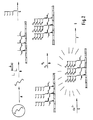
- FIG. 1 shows a complex which in the course of a method according to the invention for the Detection of a nucleic acid can be formed
- FIG. 2 describes a method for detecting ribonucleic acids from cells.
- FIG. 3 describes a method for detecting DNA from cells.
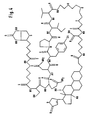
- FIG. 4 shows the structure of a peptide (MDP) used in the examples.
- Figure 5 shows schematically the structure of oligonucleotide 1, a branched Oligonucleotide according to the present invention.
- Figures 6-11 show the sequence of other oligonucleotides, either as an intermediate or End products can be used according to the present invention.
- Figure 12 shows the structure of a starting reagent used in the Examples the marking groups.
- FIG. 13 shows comparative signal measurements for the manufactured and in methods for Detection of nucleic acids applied oligonucleotides.
- nucleic acid to be detected (4) via so-called Capture probes (3) to a universal solid phase consisting of z.
- this can be done without a special solid-phase probe and the reaction complex be immobilized directly via biotinylated capture probes.
- the thus bound Nucleic acid to be detected is via a mediating probe (5) and the inventive Probes (6) detected on the solid phase.
- the binding of the nucleic acid to the solid phase can happen in several places at the same time.
- the binding of the invention Probe on the nucleic acid to be detected can also be done several times.
- the intermediate probes (5) play a the Universal Ensuring Roller
- the probe shown in FIG Primary sequence which has 16 branch points and bound to it 16 secondary sequences. In the primary sequence are in areas that are not with the Branch points overlap non-nucleosidic label-mediating groups (7) installed.
- each of the secondary sequences contains 3 label-promoting non-nucleoside groups. Due to the steric conditions of the invention Probe is a near-stoichiometric saturation of the non-nucleosidic, Labeling groups by binding of conjugates from a antibodies directed against the label-mediating group and a calcium-dependent antibody Promoted photoprotein.
- FIG. 2 shows the sequence of a determination procedure for a ribonucleic acid (RNA) a cell shown schematically.
- the ribonucleic acid is in the Cell before.
- a first step A the cell is broken up (according to known methods, z. B. lysis with the aid of proteases), possibly existing RNAs degraded and the RNA released.
- the oligonucleotides (5), the capture probes (3) and the RNA-containing sample combined in a microtiter plate and incubated. hereby The nucleic acids and the added probes are bound to the solid phase.
- a step C is (after washing off unbound sample components and excess Capture probes and oligonucleotides (5)) probes (6) according to the invention in excess on the expected amount of bound oligonucleotides (5) under conditions incubated in which the universal nucleotide portion of the probe with the universal portion of the oligonucleotide (5) can hybridize.
- An excess of unbound inventive Probes are removed by a wash step.
- step D the About the nucleic acid to be detected bound to the solid phase probe molecules or the label-mediating non-nucleosidic groups present on them Add a conjugate (8) and incubate. Again, there is an excess Washed off conjugate.
- step E those for the proof the signaling component required reagents, in the special case as calcium ions added as a trigger.
- step F the resulting light flash G is measured signal, expressed in relative luminescence units [RLU] for direct quantification of the amount
- RLU relative luminescence units
- the same procedure but using DNA as to be detected Nucleic acid shown schematically. Again, the cells are first broken to release the DNA.
- the first step A also contains a denaturing of possibly double-stranded DNA. This can, for example, by a heat step or under alkaline conditions.
- Recombinant Aequonn (AquaLite TM, Fa SeaLite Sciences, Inc) is presented at a concentration of 2.4 mg / ml in buffer of the following composition: 10mM HEPES, 200mM NaCl, 2mM EDTA, 2mM DTT, pH 8.0).
- the reaction is stopped by addition of L-lysine ( ⁇ 15 min / 25 ° C / stirring, Final concentration 10 mM) and the reaction solution buffered in conjugate buffer and concentrated.
- Affinity chromatography (positive immunosorption) purified anti-DIG Fab fragment (obtained from sheep antiserum) is in a concentration of ⁇ 5 mg / dl in Dissolved 30 mM Na phosphate buffer pH 7 l and with a 1 3 to 1.7-fold molar excess MHS (maleimidohexanoyl-N-hydroxysuccinimidate) or SMCC (succinimidyl-4- [N-maleimidomethyl) -cyclohexane-1-carboxylate], dissolved in DMSO, reacted (60 min / 25 ° C / stirring). This incorporates about one MH group per Fab fragment. The Reaction is stopped by addition of L-lysine (30 min / 25 ° C / stirring, final concentration 10 mM) and the reaction solution buffered in conjugation buffer and concentrated.
- MHS maleimidohexanoyl-N-hydroxysuccinimidate
- SMCC succinimid
- the concentration of Aequorin-SH is about 1 mg / ml.
- the reaction is carried out for 60 min at 25 ° C with stirring.
- the reaction stop is carried out by adding Cysteine or dithiothreitol (2 mM or 5 mM final concentration).
- the resulting ⁇ DIG> Fab aequorin conjugate is finally purified by a Combination of separation by charge (ion exchange column, Q Sepharose FF or DEAE 5PW) and molecular size separation (gel filtration column, Sephacryl S 200-HR), concentrated and stored in a HEPES storage buffer at -70 ° C aliquot.
- the biotin phosphoramidite becomes (ABI 401395) and at the Y position the 9-fluorenyl-methoxycarbonyl-3-amino-1-dimethoxytrityl-2-propanediol - [(2-cyanoethyl) (N, N-diisopropyl)] phosphoramidite used.
- the synthesis scale is 1.3 ⁇ mol on a 5'-dimethoxytrityl-2'-deoxythymidine 3-succinoyl-long chain alkylamino Controlled Pore Glass Carrier
- the oligonucleotide becomes the carrier and simultaneously the ⁇ -cyanoethyl groups and the protective groups of the free amino radicals cleaved off.
- the crude product is purified by HPLC (Lichrosorb RP 18.8 x 250 mm, from CS-chromatography Service) over a 0.1 M triethylammonium acetate / acetonitrile Gradient purified and desalted by dialysis.
- the oligonucleotide After removal of the solvent in Vacuum becomes the oligonucleotide according to the Boehringer Mannheim protocol (EP 0 371 262) with the digoxigenin-3-O-methylcarbonyl-5-aminocaproic acid N-hydroxysuccinimide ester labeled. After the labeling reaction, the oligonucleotide is dialyzed, concentrated and chromatographically (HPLC Lichrosorb RP 18. 8 x 250 mm, CS-chromatography Service) over a 0.1 M triethylammonium acetate / acetonitrile Gradient purified and desalted by dialysis. The detection of the digoxigenin label takes place to Gebevechu. G et al (1987), Nucl Acids Res 15, 4513
- Test sensitivity with anti-DIG Fab aequorin conjugate test carriers white microtiter plates from Nunc, type MaxiSorb, coated at the Fa MicroCoat with tRSA-SA (thermo RSA streptavidin) Volumes. 25 ⁇ l of DIG reagent (mono-biotin-mono-digoxigenin-heptapeptide, FIG. 4, (MDP), in various concentrations) + 50 ⁇ l of ⁇ DIG> -equorin conjugate from Example I in test buffer (approx.
- DIG reagent mono-biotin-mono-digoxigenin-heptapeptide, FIG. 4, (MDP), in various concentrations
- 5 X indicate branching points via 3-amino-1,2-propanediol phosphate
- Y Marker points via DNP-TEG phosphoramidite and Z linkage via Mercaptohexyl.
- the sequences are the To take sequence protocols.
- the sequences are shown in the figures. The syntheses take place on a Gene Assembler Plus of the company Pharmacia after the Standard protocols of the operating instructions and the specifications of the Phosphoramidit even.
- the synthesis scale is 1.3 ⁇ mol on a 5'-dimethoxytriryl-2'-deoxy Thymidine 3'-succinoyl-long chain alkylamino Controlled Pore Glass Carrier After 5 hours at 55 ° C in a 32% ammonia solution, the oligonucleotides from the carrier and simultaneously the ⁇ -cyanoethyl groups and the base-labile amino-protecting groups cleaved.
- the crude products are purified by HPLC (Lichrosorb RP 18, 8 X 250 mm, from CS chromatography service) over a 0.1 M triethylammonium acetate / acetonitrile Gradient purified and desalted by dialysis.
- the thiol group of oligonucleotide 2 is deprotected according to the Glen Research User Guide and then 5 times with ethyl acetate extracted and lyophilized in Speedvac.
- the lyophilized oligonucleotide 1 is dissolved in 350 ⁇ l of sodium bicarbonate buffer, 0.1 mol / l, pH 8.5, dissolved. To this is added a solution of 1 mg of maleimido-hexyl-N-hydroxysuccinimide ester in 50 ⁇ l of acetonitrile The reaction solution is added overnight in Thermomixer shaken at 20 ° C The oligonucleotide is passed through a NAP-25 column (Pharmacia) separated from free maleimide and salt, then concentrated and Chromatographic (HPLC Lichrosorb RP 18, 8 X 250 mm, CS - Chromatography Service) on a 0, 1 M triethylammonium acetate / acetonitrile gradient and purified desalted by dialysis.
- a concentration range of 20 nt-HBV-oligo-5'-biotin of 0-1000 pmol / l was measured.
- the DNP-labeled probes were used in a concentration of 10 nmol / l, the ⁇ DNP> Aequonn conjugate in a concentration of approx.
- the unspecific binding increases moderately with increasing DNP incorporation, but above all there is an enormous increase in the specific binding as a function of the DNP labeling strength, in particular in the lower concentration range.
- the higher the DNP installation the better the slope of the curve.
- the signal amplification according to the invention allows a much better differentiation of small analyte concentrations of "zero", as both the signal quotients and the absolute signal gains relative to 1X lin occupy. This is underlined by calculations of the corresponding analytical sensitivity via linear regression between 0 - 10 pmol / l on the basis of twice the standard deviation above the mean of a quadruplicate determination of the zero value.
- UNG f -1 . (X DNP).
- the inventive concept is additionally confirmed by the fact that the do not significantly differentiate specific binding with 2X lin and 2X 'lin probes, i. 2 Hapten labels lead to an almost via reaction with MAK ⁇ DNP> Fab aequorin identical signal increase over 1X lin, no matter if the two marks are 9 nt or 19 nt are positioned separately from each other.
- the Hapten labels here 3-aminopropyl-triethylene glycol-glyceryl spacer in DNP-TEG
- sterically less demanding anti-hapten conjugate here ⁇ DNP> Fab aequorin [1.1], M, about 70 kD, via 14 atom linker flexibly linked
Landscapes
- Chemical & Material Sciences (AREA)
- Organic Chemistry (AREA)
- Life Sciences & Earth Sciences (AREA)
- Zoology (AREA)
- Wood Science & Technology (AREA)
- Proteomics, Peptides & Aminoacids (AREA)
- Health & Medical Sciences (AREA)
- Engineering & Computer Science (AREA)
- Microbiology (AREA)
- Immunology (AREA)
- Physics & Mathematics (AREA)
- Molecular Biology (AREA)
- Biotechnology (AREA)
- Biophysics (AREA)
- Analytical Chemistry (AREA)
- Biochemistry (AREA)
- Bioinformatics & Cheminformatics (AREA)
- General Engineering & Computer Science (AREA)
- General Health & Medical Sciences (AREA)
- Genetics & Genomics (AREA)
- Measuring Or Testing Involving Enzymes Or Micro-Organisms (AREA)
Description
- fertig ausgebildeter Reaktionskomplex aus einem proteinösen Katalysator (= Apo-Photoprotein), einem organisch-chemischen Substrat, welches fest aber nicht kovalent gebunden ist und den eigentlichen Emitter darstellt (= Luminophor), und ebenfalls fest fixiertem molekularem Sauerstoff (vermutlich kovalent protein-gebunden als Hydroperoxid), der erforderlich ist fur die Inituerung der Lumineszenzreaktion (= Oxidans)
- Unterscheidung von Enzymsystemen durch Gebundensein aller für die Lumineszenzreaktion notwendigen Komponenten
- relative Molmasse im Bereich 22000 Dalton
- "Coelenterazin" ([2-(p-Hydroxybenzyl)-6-(p-hydroxyphenyl)-8-benzyl-7-hydro-imidazopyrazin-3-on] als Luminophor
- Emissionspeakwellenlänge (λmax) im Blaubereich (ca 470 nm)
- Auslösung der Lumineszenzreaktion durch Bindung von 2-3 Ca2+-Ionen an das Apo-Photoprotein
- Vorhandensein von Ca2+-Bindedomanen im Apo-Photoprotein in Form von EF-Hand- (= Helix-Schleife-Helix-)strukturen
- Unabhängigkeit der Lumineszenzreaktion von Sauerstoff aus der Umgebung, d.h. das komplette Photoprotein luminesziert in Gegenwart wie auch in Abwesenheit von O2 in der umgebenden Atmosphäre
- Photoprotein-Reaktion verlauft in Form einer Blitzkinetik, d.h. konzertierte Lichtemission als Folge von Ca2+-lonen-Zugabe
- funktionstaugliche Apo-Photoproteine mit einer Peptidlänge von i.d.R 189-196 Aminosäuren
- hohe Übereinstimmung der Nucleobasen- und Aminosäuresequenzen (> 60% Homologie) der einzelnen Vertreter der Familie der Ca2+-aktivierbaren Photoproteine, wie es die Klonierung von Aequorin (Prasher D , et al . Biochemical and Biophysical Research Communications 126/3, 1259-1268, 1985, Prasher D., et al , Methods in Enzymology 133, 288-299, 1986, Prasher D , et al , Biochemistry 26, 1326-1332, 1987; Cormier M., et al., Photochemistry and Photobiology 49/4, 509-512, 1989), Obelin (Illarionov Boris A., et al., Gene 153, 273-274, 1995), Clytin (Inouye S & Tsuji F., FEBS 315/3, 343-346, 1993) und Mitrocomin (Fagan T F , et al., FEBS 333/3, 301-305, 1993) deutlich gemacht hat.
10 mM HEPES, 200 mM NaCl, 2 mM EDTA, 2 mM DTT, pH 8.0)

Y = 3-Amino-1,2-Propandiolphosphat, wobei Y nachträglich mit Digoxigenin-3-O-methylcarbonyl-6-aminocapronsäure-N-hydroxy-succinimidester markiert wird.
| Testsensitivitat mit Anti-DIG-Fab-Aequorin-Konjugat | |
| Testträger | weiße Mikrotiterplatten von der Fa. Nunc, Typ MaxiSorb, bei der Fa MicroCoat mit tRSA-SA (thermo RSA-Streptavidin) beschichtet |
| Volumina. | 25 µl DIG-Reagenz (Mono-Biotin-mono-Digoxigenin-Heptapeptid, FIG 4, (MDP), in verschiedenen Konzentrationen) + 50 µl <DIG>-Aequorin-Konjugat aus Beispiel I in Testpuffer (ca 4 x 10⁶ RLU / Test) |
| Testformat | 15 min Simultaninkubation (I-Schritt-Assay) |
| b/f-Trennung | SLT plate washer SW 812 A2, Prog 2 (= 4 x Waschen) |
| Testpuffer | 25 mM HEPES, 150 mM Kcl, 10 mM EGTA. 2 mg/ml RSA, 1 5 mg/ml RSA-c, 0 05 % (v/v) Tween-20, 0 1 % (w/v) NaN3, pH 7.0 |
| Meßgerat | Dynatech ML 3000 plate reader, Peak-Modus (0 1 sec vor Peak- + 2 0 sec nach Peak-Intervall) |
| pmol/l DIG-Reagenz | gebundenes Signal [RLU] (Mittelwert ± Standardabweichung) | Steilheit (S/N) |
| 0 0 | 3346 ± 457 | |
| 0 2 | 9079 | 2 71 |
| 2 0 | 53405 | 15 96 |
| 20 0 | 611900 | 182.86 |
| 200 0 | 5290000 | 1581 00 |
| 1000 0 | 26400000 | 7890 00 |
* berechnet auf Basis Nullwert + 2fach Standardabweichung aus Replikatmessung
| Testtrager | weiße Mikrotiterplatten von der Fa Nunc, Typ MaxiSorb, bei der Fa. MicroCoat mit tRSA-SA (thermo RSA-Streptavidin) beschichtet |
| Volumina. | 25 µl DIG-Reagenz (Mono-Biotin-mono-Digoxigenin-Heptapeptid, in verschiedenen Konzentrationen) + 50 µl <DIG>-Aequorin-Konjugat aus Beispiel 1 in Testpuffer (ca 4 x 10⁶ RLU / Test) |
| Testformat. | 15 min Simultaninkubation (1-Schritt-Assay) |
| b/f-Trennung | SLT plate washer SW 812 A3, Prog 2 (= 4 x Waschen) |
| Testpuffer | 25 mM HEPES, 150 mM Kcl, 10 mM EGTA, 2 mg/ml RSA, 1.5 mg/ml RSA-c, 0 05 % (v/v) Tween-20, 0 1 % (w/v) NaN3, pH 7 0 |
| Meßgerat | Dynatech ML 3000 plate reader, Integrationsmodus |
| gebundes Signal | |||||
| DIG-Reagenz [pmol/l] | [RLU]- TDN | [RLU] - MDP | Faktor TDN/MDP | ||
| Exp 1 | Exp 2 | Exp 1 | Exp. 2 | ||
| 0.0 | 378 | 383 | 143 | 119 | |
| (170 | 182) | (200 | 196) | ||
| 0 1 | 498 | -173 | 109 | 115 | |
| 1.0 | 1075 | 1150 | 323 | 289 | 3.33 |
| 399 | |||||
| 10.0 | 7055 | 7150 | 1895 | 1935 | 3 72 |
| 3 70 | |||||
| 100 0 | 60850 | 54350 | 19550 | 19250 | 3 11 |
| 2 82 |
- 1X lin = lineares 31 mer DNA-Ohgo mit einer DNP-Markierung 5'-terminal und einer zu dem HBV-Oligo #33-1 (FIG 7) complementären 20nt-Sequenz 3'-terminal
- 2X lin (auch 2Xeng in FIG 13) = lineares 41mer DNA-Oligo mit zwei DNP-Markierungen (Pos 1 und 11. 5'→3', d h durch einen 9nt-Spacer voneinander getrennt), und einer zu dem HBV-Oligo #33-1 complementaren 20nt-Sequenz 3'-terminal
- 2X' lin (auch 2Xweit in FIG 13) = lineares 51mer DNA-Oligo mit zwei DNP-Markierungen (Pos 1 und 21, 5'→3', d h durch einen 19nt-Spacer voneinander getrennt), und einer zu dem HBV-Oligo #33-1 complementaren 20nt-Sequenz 3'-terminal
- 6X bNA = verzweigtes (branched) 83mer DNA-Oligo mit insgesamt 6 DNP-Markierungen, 2 in der Stammsequenz und je 2 in den beiden Zweigsequenzen, gemäß FIG 10
- 8X bNA = verzweigtes (branched) 104mer DNA-Oligo mit insgesamt 8 DNP-Markierungen. 2 in der Stammsequenz und je 2 m den drei Zweigsequenzen, gemaß FIG 11
- Testtrager weiße MaxiSorp™ Mikrotiterplatten der Fa. Nunc, SA-beschichtet, bzw weiße unbeschichtete MicroLite™ Mikrotiterplatten der Fa. Dynatech.
- Immobilisierung via 20nt-Oligo-5'-Biotin (FIG 7) im Konzentrationsbereich 0, 1 - 10000 pmol/l. welches zugleich als nachzuweisender Analyt fungiert.
- Testpuffer für Hybridisierungsexperimente
- 25 mM Hepes pH 7 4
- 150 mM NaCl
- 10 mM EGTA
- 0 5% (w/v) RSA
- 0 5% (w/v) Tween-20
- 0 1% NaN2 Optionale Zusatzadditive 0 15 (v/v) RSA-c (teilweise linearisiertes und acetyliertes RSA-Praparat von der Fa Aurion/NL. bzw 200 mM Na2-Tartrat x 2H2O
- Testformat 3-Schritt delayed solid phase-Assay
- Testschritte Hybridisierung in Losung von 20nt-Oligo-Biotin und jeweils einer der beschriebenen DNP-markierten Indikatorsonden für 60 min/RT/Schüttein in unbeschichteten Mikrotiterplatten, danach Transfer in SA-beschichtete Mikrotiterplatten via Multikanalpipette und Inkubation fur 15 min bei RT/Schutteln zwecks Immobilisierung via SA-Biotin-Wechselwirkung, Waschen (d h. Trennung von festphasengebundenen und ungebundenen Reaktionskomplexen), und abschließend 30 min Inkubation bei RT/Schütteln zwecks Reaktion der festphasengebundenen Hybridisierungskomplexe mit einem MAK<DNP>M-Fab-Aequorin-Konjugat (hergestellt analog dem <DIG>-Aequorin von Beispiel 1). Nach abermaligem Waschen erfolgt die Messung der Aequorin-Biolumineszenz, die Signalstärke ist der Analytkonzentration direkt proportional
- Reaktionsvolumen 50 µl 20nt Oligo-5'-Biotin (= Analyt) + 50 µl Indikatorsonde, davon Transfer von 50 µl Reaktionslosung pro Kavitat; 50 µl Konjugat
- Waschmodul SLT Columbus Plate Washer
- Meßmodul Dynatech ML 3000 Plate Luminometer
- Trigger 10 mM Tns, pH 7 4, mit 100 mM CaCl2
- Meßmodus integrated flash mode. 0 I sec before peak + 1 0 sec after peak, gain high
| DNA-Hybridisierungsimmunoassay mit DNP-markierten Indikatorsonden | |||||
| Analyt = 20nt-Oligo-5'-Biotin [pmol/l] | gebundene Signale [RLU] | ||||
| 1X lin | 2X lin | 2X' lin | 6X bNA | 8X bNA | |
| 0 | 3,38E+03 | 5,27E+03 | 4,02E+03 | 9,13E+03 | 1,58E+04 |
| 1 | 3,78E+03 | 2,26E+04 | 2,17E+04 | 3,84E+04 | 6,39E+04 |
| 10 | 4,52E+03 | 8,83E+04 | 8,43E+04 | 1,36E+05 | 1,91E+05 |
| 100 | 4.51E+04 | 3,58E+05 | 4,23E+05 | 4,95E+05 | 5,46E+05 |
| 500 | 3.62E+05 | 7,06E+05 | 6,90E+05 | 1,07E+06 | 1,28E+06 |
| 1000 | 5.51E+05 | 8,82E+05 | 1,00E+06 | 1,59E+06 | 1,85E+06 |
| Signalquotienten (Dynamiksteigerung) auf 1X lin normiert | |||||
| Analyt = 20nt-Oligo-5'-Biotin [pmol/l] | gebundene Signale [RLU] | ||||
| 1X lin | 2X lin | 2X' lin | 6X bNA | 8X bNA | |
| 0 | 1,00 | 1,56 | 1,19 | 2,70 | 4,6 |
| 1 | 1,00 | 5,98 | 5,74 | 10,16 | 16,90 |
| 10 | 1,00 | 19.54 | 18,65 | 30,09 | 42,2 |
| 100 | 1,00 | 7,94 | 9.38 | 10,98 | 12,11 |
| 500 | 1,00 | 1,95 | 1,91 | 2,96 | 3,54 |
| 1000 | 1,00 | 1,60 | 1,81 | 2,89 | 3,36 |
| Signalzuwächse absolut, bezogen auf 1X lin | |||||
| Analyt = 20nt-Oligo-5'-Biotin [pmol/l] | gebundene Signale [RLU] | ||||
| 1X lin | 2X lin | 2X' lin | 6X bNA | 8X bNA | |
| 0 | 1,89E+03 | 6,40E+02 | 5,75E+03 | 1,24E+04 | |
| 1 | 1,88E+04 | 1,79E+04 | 3,46E+04 | 6.01E+04 | |
| 10 | 8,38E+04 | 7,98E+04 | 1,31E+05 | 1,86E+05 | |
| 100 | 3,13E+05 | 3,78E+05 | 4,50E+05 | 5.01E+05 | |
| 500 | 3.44E+05 | 3,28E+05 | 7,08E+05 | 9.18E+05 | |
| 1000 | 3,31E+05 | 4,49E+05 | 1,04E+06 | 1,30E+06 |
Dies wird unterstrichen durch Berechnungen der korrespondierenden analytischen Sensitivität via linearer Regression zwischen 0 - 10 pmol/l auf Basis der zweifachen Standardabweichung uber dem Mittelwert einer Quadruplikatbestimmung des Nullwertes.
| Steilheit 0-10 pM [RLU] | Nullwertsprazision [% VK] | UNG [pmol/l] | |
| 1X lin | 1140 | 11.23 | 6.65 |
| 2X lin | 83030 | 16.32 | 0.21 |
| 2X' lin | 80280 | 40.01 | 0 40 |
| 6X bNA | 126870 | 2 83 | 0.04 |
| 8X bNA | 175200 | 9 30 | 0.167 |
- 2X lin- und 2X' lin-Sonden sind bezüglich Generierung von spezifische Bindung ununterscheidbar, d h. hohe Markierungsdichte ist voll umsetzbar
- spezifische Bindung ist durchgehend streng eine Funktion der Anzahl der eingeführten DNP-Markierungen, d h Pluralnat der Markierungspunkie ist voll umsetzbar.
| DNA-Hybridisierungsimmunoassay mit DNP-markierten Indikatorsonden | |||||
| Analyt = 20nt-Oligo-5'-Biotin [pmol/l] | gebundene Signale [RLU] | ||||
| 1X lin | 2X lin | 2X' lin | 6X bNA | 8X bNA | |
| 0 | 4,38E+03 | 6,47E+03 | 4,76E+03 | 7,82E+03 | 1,45E+04 |
| 1 | 4,07E+03 | 1 12E+04 | 1,26E+04 | 1,89E+04 | 3,02E+04 |
| 10 | 5,07E+03 | 7,05E+04 | 7,49E+04 | 9,68E+04 | 1,53E+05 |
| 100 | 3,98E+04 | 3,57E+05 | 3,63E+05 | 4,78E+05 | 4,87E+05 |
| 1000 | 4,78E+05 | 8,36E+05 | 8,72E+05 | 1,34E+06 | 1,61E+06 |
| 10000 | 2,05E+06 | 3,26E+06 | 3,28E+06 | 4,27E+06 | 5,02E+06 |
| Signalquotienten (Dynamiksteigerung) auf 1X lin normiert | |||||
| Analyt = 20nt-Oligo-5'-Biotin [pmol/l] | gebundene Signale [RLU] | ||||
| 1X lin | 2X lin | 2X' lin | 6X bNA | 8X bNA | |
| 0 | 1 | 1,48 | 1,09 | 1,79 | 3,31 |
| 1 | 1 | 2,75 | 3,10 | 4,64 | 7,42 |
| 10 | 1 | 13,91 | 14,77 | 19,09 | 30,18 |
| 100 | 1 | 8,97 | 9,12 | 12,01 | 12,24 |
| 1000 | 1 | 1,75 | 1,82 | 2,80 | 3,37 |
| 10000 | 1 | 1,59 | 1,60 | 2,08 | 2,45 |
| Signalzuwächse absolut, bezogen auf 1X lin | |||||
| Analyt = 20nt-Oligo-5'-Biotin [pmol/l] | gebundene Signale [RLU] | ||||
| IX lin | 2X lin | 2X' lin | 6X bNA | 8X bNA | |
| 0 | 2.09E+03 | 3,80E+02 | 3,44E+03 | 1,01E+04 | |
| 1 | 7,13E+03 | 8,53E+03 | 1,48E+04 | 2,61E+04 | |
| 10 | 6,54E+04 | 6,98E+04 | 9,17E+04 | 1,48E+05 | |
| 100 | 3,17E+05 | 3,23E+05 | 4,38E+05 | 4,47E+05 | |
| 1000 | 3,58E+05 | 3.94E+05 | 8,62E+05 | 1,13E+06 | |
| 10000 | 1.21E+06 | 1,23E+06 | 2,22E+06 | 2,97E+06 |
| DNA-Hybridisierungsimmunoassay mit DNP-markierten Indikatorsonden | |||||
| Analyt = 20nt-Oligo-5'-Biotin [pmol/l] | gebundene Signale [RLU] | ||||
| 1X lin | 2X lin | 2X' lin | 6X bNA | 8X bNA | |
| 0 | 2.72E+03 | 2,54E+03 | 4,02E+03 | 4,58E+03 | 6,86E+03 |
| 1 | 2,65E+03 | 7,54E+03 | 6,88E+03 | 1,04E+04 | 1,54E+04 |
| 10 | 2,72E+03 | 4,04E+04 | 3,66E+04 | 6,25E+04 | 9,66E+04 |
| 50 | 5,79E+03 | 1,56E+05 | 1,72E+05 | 2,50E+05 | 3,17E+05 |
| 100 | 1,49E+04 | 2,37E+05 | 2,59E+05 | 3,74E+05 | 3,93E+05 |
| 1000 | 3,12E+05 | 5,85E+05 | 6,25E+05 | 8,35E+05 | 9,29E+05 |
| Signalquotienten (Dynamiksteigerung), auf 1X lin normiert | |||||
| Analyt = 20nt-Oligo-5'-Biotin [pmol/l] | gebundene Signale [RLU] | ||||
| 1X lin | 2X lin | 2X' lin | 6X bNA | 8X bNA | |
| 0 | 1 | 0,93 | 1.48 | 1,68 | 2,52 |
| 1 | 1 | 2,85 | 2,60 | 3,92 | 5,81 |
| 10 | 1 | 14,85 | 13,46 | 22,98 | 35,50 |
| 50 | 1 | 26,94 | 29.71 | 43,18 | 54,66 |
| 100 | 1 | 15,91 | 17,38 | 25,10 | 26,34 |
| 1000 | 1 | 1,88 | 2,00 | 2,68 | 2,98 |
| Signalzuwächse absolut, bezogen auf 1X lin | |||||
| Analyt = 20nt-Oligo-5'-Biotin [pmol/l] | gebundene Signale [RLU] | ||||
| 1X lin | 2X lin | 2X' lin | 6X bNA | 8X bNA | |
| 0 | -1,80E+02 | 1,30E+03 | 1,86E+03 | 4,14E+03 | |
| 1 | 4,89E+03 | 4,23E+03 | 7,75E+03 | 1,28E+04 | |
| 10 | 3,77E+04 | 3,39E+04 | 5,98E+04 | 9,38E+04 | |
| 50 | 1,50E+05 | 1,66E+05 | 2,44E+05 | 3,11E+05 | |
| 100 | 2,22E+05 | 2,44E+05 | 3,59E+05 | 3,78E+05 | |
| 1000 | 2,73E+05 | 3,13E+05 | 5,23E+05 | 6,17E+05 |
| DNA-Hybridisierungsimmunoassay mit DNP-markierten Indikatorsonden | |||||
| Analyt = 20nt-Oligo-5'-Biotin [pmol/l] | gebundene Signale [RLU] | ||||
| 1X lin | 2X lin | 2X' lin | 6X bNA | 8X bNA | |
| 0 | 1,85E+03 | 2,36E+03 | 1,23E+03 | 1,33E+03 | 4,94E+03 |
| 1 | 2,17E+03 | 4,27E+03 | 3,26E+03 | 6,00E+03 | 7,96E+03 |
| 10 | 2,38E+03 | 1,16E+04 | 1,21E+04 | 2,00E+04 | 2,75E+04 |
| 50 | 2,94E+03 | 4,49E+04 | 4,81E+04 | 9,49E+04 | 1,28E+05 |
| 100 | 3,41E+03 | 7.83E+04 | 8,90E+04 | 1,69E+05 | 2,07E+05 |
| 1000 | 1,00E+05 | 3,63E+05 | 3,33E+05 | 5,24E+05 | 5,42E+05 |
| Signalquotienten (Dynamiksteigerung), auf 1X lin normiert | |||||
| Analyt = 20nt-Oligo-5'-Biotin [pmol/l] | gebundene Signale [RLU] | ||||
| 1X lin | 2X lin | 2X' lin | 6X bNA | 8X bNA | |
| 0 | 1 | 1,28 | 0,66 | 0,72 | 2,67 |
| 1 | 1 | 1,97 | 1,50 | 2,76 | 3,67 |
| 10 | 1 | 4,87 | 5,08 | 8,40 | 11,55 |
| 50 | 1 | 15,27 | 16,36 | 32,28 | 43,54 |
| 100 | 1 | 22,96 | 26,10 | 49,56 | 60,70 |
| 1000 | 1 | 3,63 | 3,33 | 5,24 | 5,42 |
| Signalzuwächse absolut, bezogen auf 1X lin | |||||
| Analyt = 20nt-Oligo-5'-Biotin [pmol/l] | gebundene Signale [RLU] | ||||
| 1X lin | 2X lin | 2X' lin | 6X bNA | 8X bNA | |
| 0 | 5,10E+02 | -6,20E+02 | -5,20E+02 | 3,09E+03 | |
| 1 | 2,10E+03 | 1,09E+03 | 3,83E+03 | 5,79E+03 | |
| 10 | 9,22E+03 | 9,72E+03 | 1,76E+04 | 2,51E+04 | |
| 100 | 4,20E+04 | 4,52E+04 | 9,20E+04 | 1,25E+05 | |
| 500 | 7,49E+04 | 8,56E+04 | 1,66E+05 | 2,04E+05 | |
| 1000 | 2,63E+05 | 2,33E+05 | 4.24E+05 | 4,42E+05 |
| maximale spezifische Bindung (1000 pmol/l Analyt) | |
| 1X lin | 32% recovery relativ zu Beispiel 6C (= frisch) |
| 2X lin | 62% |
| 2X' lin | 53% |
| 6X bNA | 62% |
| 8X bNA | 60% |
| analytische Sensitivität = UNG [pmol/l] | |
| 1X lin | 21.80 |
| 2X lin | 0.89 |
| 8X bNA | 0.39 |
- DNP
- Dinitrophenyl
- HBV
- Hepatitis B Virus
- SA
- Streptavidin
- RSA
- Rinderserumalbumin
- RT
- Raumtemperatur
- MAK<X>
- Monoklonaler Antikörper gegen X
- DIG
- Digoxigenin
- RLU
- Relative Light Units
- VK
- Variationskoeffizient






III-Maleinimido oder AM
III-Maleinimido-S-TTTTTTTTTTTTTTTTTTTYT-3'. wobei Y DNP ueber DNP-TEG eingebaut bedeutet"

Claims (10)
- Sonde zum Nachweis eines Analyten, dadurch gekennzeichnet, dass sie aufgebaut ist auseinem analytspezifischen Teil, mit dem die Sonde den Analyten direkt oder indirekt binden kann, undeinem Teil, der Nukleobasen an einem Backbone enthält,
der über Verzweigungsmonomere mehrfach in sich verzweigt ist und eine zentrale Primärsequenz mit mehreren Verzweigungspunkten und an die Verzweigungspunkte geknüpfte periphere Sekundärsequenzen enthält,
welcher nicht-nukleosidische, markierungsvermittelnde Gruppen enthält, wobei der Abstand zwischen den Mitten zweier aufeinanderfolgender mit einer markierungsvermittelnden Gruppe markierter Mononukleoside der Sonde kleiner ist als 18 Nukleotide. - Sonde gemäß Anspruch 1, dadurch gekennzeichnet, dass der Abstand zwischen Verzweigungspunkten kleiner ist als 11, bevorzugt weniger als 7 Nukleotide.
- Sonde gemäß einem der Ansprüche 1 bis 2, dadurch gekennzeichnet, dass die markierungsvermittelnden Gruppen und der Sonden-Backbone über einen Spacer von ≥ 4 Atomen verknüpft sind.
- Sonde gemäß einem der Ansprüche 1 bis 3, dadurch gekennzeichnet, daß die markierungsvermittelnden Gruppen in die Primär- und Sekuridärsequenz eingebaut sind.
- Verfahren zum Nachweis eines Analyten in einer Probe durch Kontaktieren der Probe mit einer nukleobasenhaltigen Sonde gemäß einem der Ansprüche 1 bis 4 unter Bedingungen, bei denen der Analyt mittelbar oder unmittelbar an die Sonde bindet, und Nachweis des Bindungsprodukts.
- Verfahren gemäß Anspruch 5, dadurch gekennzeichnet, dass das Bindeprodukt über ein Konjugat nachgewiesen wird, welches eine molare Masse von ≤ 100 kDa hat und welches aus einer zur markierungsvermittelnden Gruppe affinen Gruppe und einer damit über einen Linker mit einer Länge von ≥ 4 Atomen verknüpften signalgebenden Komponente besteht.
- Verfahren gemäß Anspruch 6, dadurch gekennzeichnet, dass die markierungsvermittelnde Gruppe ein Hapten ist.
- Verfahren gemäß einem der Ansprüche 5 bis 7, dadurch gekennzeichnet, dass die signalgebende Komponente ein natives oder rekombinant hergestelltes Calciumaktivierbares Photoprotein ist.
- Testkit zur Durchführung eines Verfahrens gemäß einem der Ansprüche 5 bis 8, dadurch gekennzeichnet, dass es eine Sonde gemäß einem der Ansprüche 1 bis 4 sowie alle zur Erzeugung eines Meßsignals erforderlichen Reagenzien beinhaltet.
- Verwendung einer Sonde gemäß einem der Ansprüche 1 bis 4 zum Nachweis eines Analyten in einer Probe.
Applications Claiming Priority (3)
| Application Number | Priority Date | Filing Date | Title |
|---|---|---|---|
| DE19537952A DE19537952A1 (de) | 1995-10-12 | 1995-10-12 | Verfahren zum Nachweis eines Analyten |
| DE19537952 | 1995-10-12 | ||
| PCT/EP1996/004358 WO1997013874A1 (de) | 1995-10-12 | 1996-10-08 | Verfahren zum nachweis eines analyten |
Publications (2)
| Publication Number | Publication Date |
|---|---|
| EP0854938A1 EP0854938A1 (de) | 1998-07-29 |
| EP0854938B1 true EP0854938B1 (de) | 2005-12-07 |
Family
ID=7774630
Family Applications (1)
| Application Number | Title | Priority Date | Filing Date |
|---|---|---|---|
| EP96934572A Expired - Lifetime EP0854938B1 (de) | 1995-10-12 | 1996-10-08 | Verzweigte sonde und verfahren zum nachweis eines analyten |
Country Status (6)
| Country | Link |
|---|---|
| US (2) | US6214549B1 (de) |
| EP (1) | EP0854938B1 (de) |
| JP (1) | JP4097289B2 (de) |
| DE (2) | DE19537952A1 (de) |
| ES (1) | ES2253757T3 (de) |
| WO (1) | WO1997013874A1 (de) |
Families Citing this family (10)
| Publication number | Priority date | Publication date | Assignee | Title |
|---|---|---|---|---|
| DE19537952A1 (de) | 1995-10-12 | 1997-04-17 | Boehringer Mannheim Gmbh | Verfahren zum Nachweis eines Analyten |
| GB0016813D0 (en) * | 2000-07-07 | 2000-08-30 | Lee Helen | Improved dipstick assays (4) |
| GB0016836D0 (en) * | 2000-07-07 | 2000-08-30 | Lee Helen | Improved dipstick assays (1) |
| US20030175828A1 (en) * | 2002-03-15 | 2003-09-18 | Lazar James G. | Signal amplification by Hybrid Capture |
| US7920906B2 (en) | 2005-03-10 | 2011-04-05 | Dexcom, Inc. | System and methods for processing analyte sensor data for sensor calibration |
| US9247900B2 (en) | 2004-07-13 | 2016-02-02 | Dexcom, Inc. | Analyte sensor |
| US8989833B2 (en) | 2004-07-13 | 2015-03-24 | Dexcom, Inc. | Transcutaneous analyte sensor |
| WO2006127694A2 (en) | 2004-07-13 | 2006-11-30 | Dexcom, Inc. | Analyte sensor |
| ES2562821T3 (es) | 2010-10-21 | 2016-03-08 | Advanced Cell Diagnostics, Inc. | Método ultrasensible para la detección in situ de ácidos nucleicos |
| DK3362462T3 (da) | 2015-10-12 | 2021-10-11 | Advanced Cell Diagnostics Inc | In situ-detektion af nukleotidvarianter i prøver med højt støjniveau, og sammensætninger og fremgangsmåder relateret dertil |
Family Cites Families (16)
| Publication number | Priority date | Publication date | Assignee | Title |
|---|---|---|---|---|
| ES8607563A1 (es) * | 1983-10-13 | 1986-06-01 | Univ Georgia Res Found | Un metodo para detectar una interaccion ligante |
| US4882269A (en) * | 1985-12-13 | 1989-11-21 | Princeton University | Amplified hybridization assay |
| US5124246A (en) * | 1987-10-15 | 1992-06-23 | Chiron Corporation | Nucleic acid multimers and amplified nucleic acid hybridization assays using same |
| US5359100A (en) * | 1987-10-15 | 1994-10-25 | Chiron Corporation | Bifunctional blocked phosphoramidites useful in making nucleic acid mutimers |
| DE3813278A1 (de) * | 1988-01-12 | 1989-07-20 | Boehringer Mannheim Gmbh | Verfahren zum nachweis von nukleinsaeuren |
| WO1991008307A1 (en) * | 1989-12-04 | 1991-06-13 | Microprobe Corporation | Enhanced capture of target nucleic acid by the use of oligonucleotides covalently attached to polymers |
| CA2039517C (en) * | 1990-04-03 | 2006-11-07 | David Segev | Dna probe signal amplification |
| US5719262A (en) * | 1993-11-22 | 1998-02-17 | Buchardt, Deceased; Ole | Peptide nucleic acids having amino acid side chains |
| DE4123540A1 (de) * | 1991-07-16 | 1993-01-21 | Boehringer Mannheim Gmbh | Immobilisierung von nukleinsaeuren |
| US5424413A (en) * | 1992-01-22 | 1995-06-13 | Gen-Probe Incorporated | Branched nucleic acid probes |
| WO1994018342A1 (en) * | 1993-02-12 | 1994-08-18 | Sealite Sciences, Inc. | Preparation of photoprotein conjugates and methods of use thereof |
| JPH09500378A (ja) * | 1993-07-02 | 1997-01-14 | リンクス セラピューティクス,インコーポレイティド | 枝分れされそして複雑に結合された高分子構造体の集中的合成 |
| FR2710075B1 (fr) * | 1993-09-15 | 1995-10-27 | Bio Merieux | Réactif et procédé pour la détection d'une séquence nucléotidique avec amplification de signal. |
| US5681697A (en) * | 1993-12-08 | 1997-10-28 | Chiron Corporation | Solution phase nucleic acid sandwich assays having reduced background noise and kits therefor |
| SE9400522D0 (sv) * | 1994-02-16 | 1994-02-16 | Ulf Landegren | Method and reagent for detecting specific nucleotide sequences |
| DE19537952A1 (de) | 1995-10-12 | 1997-04-17 | Boehringer Mannheim Gmbh | Verfahren zum Nachweis eines Analyten |
-
1995
- 1995-10-12 DE DE19537952A patent/DE19537952A1/de not_active Withdrawn
-
1996
- 1996-10-08 JP JP51469797A patent/JP4097289B2/ja not_active Expired - Fee Related
- 1996-10-08 EP EP96934572A patent/EP0854938B1/de not_active Expired - Lifetime
- 1996-10-08 DE DE59611311T patent/DE59611311D1/de not_active Expired - Lifetime
- 1996-10-08 ES ES96934572T patent/ES2253757T3/es not_active Expired - Lifetime
- 1996-10-08 US US09/051,079 patent/US6214549B1/en not_active Expired - Fee Related
- 1996-10-08 WO PCT/EP1996/004358 patent/WO1997013874A1/de not_active Ceased
-
2000
- 2000-11-16 US US09/713,031 patent/US6503714B1/en not_active Expired - Fee Related
Also Published As
| Publication number | Publication date |
|---|---|
| DE59611311D1 (de) | 2006-01-12 |
| WO1997013874A1 (de) | 1997-04-17 |
| US6503714B1 (en) | 2003-01-07 |
| JPH11513257A (ja) | 1999-11-16 |
| ES2253757T3 (es) | 2006-06-01 |
| JP4097289B2 (ja) | 2008-06-11 |
| US6214549B1 (en) | 2001-04-10 |
| EP0854938A1 (de) | 1998-07-29 |
| DE19537952A1 (de) | 1997-04-17 |
Similar Documents
| Publication | Publication Date | Title |
|---|---|---|
| DE69432709T2 (de) | Nukleinsäure - Sandwichassay in Lösungsphase mit reduzierten Hintergrundsignalen | |
| DE69528839T2 (de) | Reduzierung von nicht spezifischer hybridisierung unter verwendung neuer basenpaarschemata | |
| DE3486400T2 (de) | Bestimmungsmethode unter Verwendung von Polynucleotidsequenzen. | |
| DE69328699T2 (de) | Hybridisierungsassay unter Verwendung von verzweigten Nukleinsäuresonden | |
| DE3854969T2 (de) | Polynukleotid-Bestimmung mit selektierbaren Spaltstellen | |
| DE3688931T2 (de) | Arabinonukleinsäure-Sonden für DNS/RNS-Bestimmungen. | |
| DE68927373T2 (de) | Verfahren und mittel zum nachweis von nukleinsäuresequenzen | |
| DE69233630T2 (de) | Sätze von HIV-Sonden zur Verwendung in Sandwich-Hydridisierungsassays in Lösungsphase | |
| US5571677A (en) | Convergent synthesis of branched and multiply connected macromomolecular structures | |
| DE69725611T2 (de) | Nicht-Nukleotid verknüpfende Reagentien | |
| EP0373956B1 (de) | Nukleotid Sonden | |
| EP0669395A2 (de) | 3'-RNA-Markierung mit Terminaler Transferase | |
| DE4302459A1 (de) | Sulfocumarinhaltige Nukleotide und deren Verwendung in Nachweisverfahren für Nukleinsäuren | |
| DE3888653T2 (de) | Verfahren und Testsatz zum Nachweis einer Nukleinsäure-Sequenz. | |
| DE69716706T2 (de) | Verfahren zur Identifizierung einer Nukleinsäure unter Ausbildung einer Tripelhelix mit aneinander angrenzenden Sonden | |
| EP0854938A1 (de) | Verfahren zum nachweis eines analyten | |
| DE68923608T2 (de) | Verfahren zur Vorbereitung von Nukleotid-Sonden unter Verwendung eines hybridizierbaren Komplementärelements. | |
| KR970005899B1 (ko) | 뉴클레오티드 프로브의 아크리디늄 에스테르 표지 및 정제 | |
| EP0523557B1 (de) | Immobilisierung von Nukleinsäuren | |
| DE10142643A1 (de) | Detektion von Wechselwirkungen auf Sonden-Arrays | |
| DE68907305T2 (de) | Methode zur Analyse einer spezifischen Sequenz von DNS oder RNS, Reagenzien und Kits dafür. | |
| US6979729B1 (en) | Metal cluster containing nucleotides and nucleic acids, and intermediates therefor | |
| DE69728370T2 (de) | Analyseverfahren basierend auf Signalverstärkung | |
| EP0857791B1 (de) | Analyseverfahren basierend auf Signalverstärkung | |
| DE69132535T2 (de) | Multichromophore fluoreszierende sonden |
Legal Events
| Date | Code | Title | Description |
|---|---|---|---|
| PUAI | Public reference made under article 153(3) epc to a published international application that has entered the european phase |
Free format text: ORIGINAL CODE: 0009012 |
|
| 17P | Request for examination filed |
Effective date: 19980512 |
|
| AK | Designated contracting states |
Kind code of ref document: A1 Designated state(s): DE ES FR GB IT |
|
| RAP3 | Party data changed (applicant data changed or rights of an application transferred) |
Owner name: ROCHE DIAGNOSTICS GMBH |
|
| 17Q | First examination report despatched |
Effective date: 20020521 |
|
| GRAP | Despatch of communication of intention to grant a patent |
Free format text: ORIGINAL CODE: EPIDOSNIGR1 |
|
| RTI1 | Title (correction) |
Free format text: BRANCHED PROBE AND METHOD OF DETECTING A SUBSTANCE TO BE ANALYZED |
|
| GRAS | Grant fee paid |
Free format text: ORIGINAL CODE: EPIDOSNIGR3 |
|
| GRAA | (expected) grant |
Free format text: ORIGINAL CODE: 0009210 |
|
| AK | Designated contracting states |
Kind code of ref document: B1 Designated state(s): DE ES FR GB IT |
|
| PG25 | Lapsed in a contracting state [announced via postgrant information from national office to epo] |
Ref country code: IT Free format text: LAPSE BECAUSE OF FAILURE TO SUBMIT A TRANSLATION OF THE DESCRIPTION OR TO PAY THE FEE WITHIN THE PRE;WARNING: LAPSES OF ITALIAN PATENTS WITH EFFECTIVE DATE BEFORE 2007 MAY HAVE OCCURRED AT ANY TIME BEFORE 2007. THE CORRECT EFFECTIVE DATE MAY BE DIFFERENT FROM THE ONE RECORDED.SCRIBED TIME-LIMIT Effective date: 20051207 |
|
| REG | Reference to a national code |
Ref country code: GB Ref legal event code: FG4D Free format text: NOT ENGLISH |
|
| REF | Corresponds to: |
Ref document number: 59611311 Country of ref document: DE Date of ref document: 20060112 Kind code of ref document: P |
|
| RIN2 | Information on inventor provided after grant (corrected) |
Inventor name: LASSONCZYK, GERHARD Inventor name: SEIDEL, CHRISTOPH Inventor name: WEINDEL, KURT |
|
| GBT | Gb: translation of ep patent filed (gb section 77(6)(a)/1977) |
Effective date: 20060227 |
|
| REG | Reference to a national code |
Ref country code: ES Ref legal event code: FG2A Ref document number: 2253757 Country of ref document: ES Kind code of ref document: T3 |
|
| ET | Fr: translation filed | ||
| PLBE | No opposition filed within time limit |
Free format text: ORIGINAL CODE: 0009261 |
|
| STAA | Information on the status of an ep patent application or granted ep patent |
Free format text: STATUS: NO OPPOSITION FILED WITHIN TIME LIMIT |
|
| 26N | No opposition filed |
Effective date: 20060908 |
|
| PGFP | Annual fee paid to national office [announced via postgrant information from national office to epo] |
Ref country code: GB Payment date: 20090914 Year of fee payment: 14 |
|
| PGFP | Annual fee paid to national office [announced via postgrant information from national office to epo] |
Ref country code: ES Payment date: 20091014 Year of fee payment: 14 Ref country code: DE Payment date: 20091030 Year of fee payment: 14 |
|
| PGFP | Annual fee paid to national office [announced via postgrant information from national office to epo] |
Ref country code: IT Payment date: 20091014 Year of fee payment: 14 Ref country code: FR Payment date: 20091020 Year of fee payment: 14 |
|
| GBPC | Gb: european patent ceased through non-payment of renewal fee |
Effective date: 20101008 |
|
| PG25 | Lapsed in a contracting state [announced via postgrant information from national office to epo] |
Ref country code: FR Free format text: LAPSE BECAUSE OF NON-PAYMENT OF DUE FEES Effective date: 20101102 |
|
| REG | Reference to a national code |
Ref country code: FR Ref legal event code: ST Effective date: 20110630 |
|
| PG25 | Lapsed in a contracting state [announced via postgrant information from national office to epo] |
Ref country code: GB Free format text: LAPSE BECAUSE OF NON-PAYMENT OF DUE FEES Effective date: 20101008 |
|
| REG | Reference to a national code |
Ref country code: DE Ref legal event code: R119 Ref document number: 59611311 Country of ref document: DE Effective date: 20110502 |
|
| REG | Reference to a national code |
Ref country code: ES Ref legal event code: FD2A Effective date: 20111118 |
|
| PG25 | Lapsed in a contracting state [announced via postgrant information from national office to epo] |
Ref country code: IT Free format text: LAPSE BECAUSE OF NON-PAYMENT OF DUE FEES Effective date: 20101008 |
|
| PG25 | Lapsed in a contracting state [announced via postgrant information from national office to epo] |
Ref country code: ES Free format text: LAPSE BECAUSE OF NON-PAYMENT OF DUE FEES Effective date: 20101009 |
|
| PG25 | Lapsed in a contracting state [announced via postgrant information from national office to epo] |
Ref country code: DE Free format text: LAPSE BECAUSE OF NON-PAYMENT OF DUE FEES Effective date: 20110502 |