EP0854352A2 - Navigation system for guiding a driver - Google Patents
Navigation system for guiding a driver Download PDFInfo
- Publication number
- EP0854352A2 EP0854352A2 EP98200014A EP98200014A EP0854352A2 EP 0854352 A2 EP0854352 A2 EP 0854352A2 EP 98200014 A EP98200014 A EP 98200014A EP 98200014 A EP98200014 A EP 98200014A EP 0854352 A2 EP0854352 A2 EP 0854352A2
- Authority
- EP
- European Patent Office
- Prior art keywords
- route
- navigation system
- vehicle
- driver
- guidance
- Prior art date
- Legal status (The legal status is an assumption and is not a legal conclusion. Google has not performed a legal analysis and makes no representation as to the accuracy of the status listed.)
- Granted
Links
Images
Classifications
-
- G—PHYSICS
- G01—MEASURING; TESTING
- G01C—MEASURING DISTANCES, LEVELS OR BEARINGS; SURVEYING; NAVIGATION; GYROSCOPIC INSTRUMENTS; PHOTOGRAMMETRY OR VIDEOGRAMMETRY
- G01C21/00—Navigation; Navigational instruments not provided for in groups G01C1/00 - G01C19/00
- G01C21/26—Navigation; Navigational instruments not provided for in groups G01C1/00 - G01C19/00 specially adapted for navigation in a road network
- G01C21/34—Route searching; Route guidance
- G01C21/3407—Route searching; Route guidance specially adapted for specific applications
- G01C21/3415—Dynamic re-routing, e.g. recalculating the route when the user deviates from calculated route or after detecting real-time traffic data or accidents
Definitions
- the invention relates to a navigation system for guiding a driver of a vehicle along a first route, the system comprising:
- the known system has a planning module that finds an optimal route from the current vehicle position to a desired destination, given a certain route characteristic.
- the desired destination and the route characteristic are specified by the driver.
- the specified destination can be a city, a street, a street crossing, a service or a facility.
- the route characteristic indicates the kind of route the driver prefers: fastest route, shortest route, as much as possible on motor-ways or as little as possible on motor-ways.
- the system has a guidance module that guides the driver along the planned route to the destination by means of guidance information.
- the guidance information is presented to the driver in an audible way, by spoken voice messages, and in a visible way, by displaying pictures on an LCD screen.
- the planned route is analyzed to select those junctions for which guidance information has to be presented.
- a new route will immediately be planned and subsequently guidance information will be presented to guide the driver along this new route to the destination.
- the planning of the new route takes only little time and the driver will hardly notice the deviation from the original route because the guidance information for the new route is almost instantly after the deviation presented to the driver. If the driver deviates at a certain location from the planned route in order to follow a personally preferred route, the guidance information that is subsequently presented by the known system will be based on repeatedly planned new routes trying to guide the driver to the destination along one of those routes.
- This object is achieved according to the invention in a navigation system that is characterized in that the navigation system is arranged to deactivate the guidance module when it detects that the vehicle has left the first route. By deactivating the guidance module if the driver deviates from the route, the system does not present guidance information to the driver that is of no relevance. Then the driver is no longer confronted with superfluous, potentially misleading and annoying, guidance information while following the deviating route.
- a further advantage is that the system automatically deactivates the guidance module and does not require the driver to take any action to switch off that part of the system.
- An embodiment of the navigation system according to the invention is characterized in that the navigation system is arranged to activate, when it detects that the vehicle has left the first route, the planning module to plan a second route between the current position and the destination. By planning the second route the system has available a new route to the desired destination. When guidance is to be resumed, the system can present the guidance information directly without the need of first planning the new route.
- An embodiment of the navigation system according to the invention is characterized in that the navigation system is arranged to reactivate the guidance module and that the guidance module is arranged to present the driver guidance information along the second route. Through reactivating the guidance module, the system presents guidance information to guide the driver along the new route to the destination.
- An embodiment of the navigation system according to the invention is characterized in that the navigation system is arranged to reactivate the guidance module after a predetermined time interval following the deactivation.
- the navigation system is arranged to reactivate the guidance module after a predetermined time interval following the deactivation.
- the system starts again presenting guidance information to follow the then current route to the destination.
- An embodiment of the navigation system according to the invention is characterized in that the navigation system is arranged to reactivate the guidance module after receipt of a reactivate command from the driver. In this way the driver is able to reactivate the guidance module in order to receive guidance information along the then current route to the destination. This is particularly useful if the deviating route has ended before the system automatically resumes giving guidance or if the deviation from the original route was accidental.
- An embodiment of the navigation system according to the invention is characterized in that the navigation system is arranged to present a notification to the driver when the guidance module is deactivated. In this way, the driver is notified that system has deactivated the guidance module and that no guidance information will be presented.
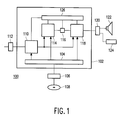
- FIG. 1 schematically shows a navigation system according to the invention.
- the system 100 comprises a central unit 102 including various modules for performing specific tasks.
- the central unit can be implemented on a computer comprising a central processor and working memory loaded with software programs for carrying out the specific tasks.
- the system 100 has a database module 104 for managing and providing information on roads.
- the system has reading means 106 to read information from a map database stored on a data carrier, like CD-ROM 108. Other types of carrier can also be used, e.g. magnetic disk and IC Card.
- the map database comprises information on roads of the area to which the particular map relates, e.g. all roads of a country or of a state.
- the system 100 further comprises a vehicle position determining module 110 for determining the current position of the vehicle.
- module 110 receives position information via an interface 112.
- This information can be supplied by a position determining system like a GPS receiver, using information broadcast by dedicated satellites.
- the position information can also be supplied in another way, for instance using one or more distance sensors, for measuring the distance travelled by the vehicle, and a compass or a gyro, for measuring the heading of the vehicle.
- the system 100 further comprises a planning module 114 that is suitable to plan a route between the current position of the vehicle and a desired destination.
- the desired destination is entered into the system in a convenient way, e.g. by entering the post code via a keyboard, by entering road names, by entering co-ordinates or by pointing to a position on a map displayed by the system.
- the planning module 114 searches through the map database for a route that is optimal according to some characteristic.
- the characteristic can be the travel time, the travel distance, a combination of time and distance, or some other criterion that can be derived from information in the map database, like the preferred type of road.
- the resulting route is stored in memory space 116 and the driver of the vehicle is given guidance to follow this route.
- the system 100 has a guidance module 118 that presents guidance information to the driver of the vehicle, based on the planned route and the current position of the vehicle.
- the guidance information is presented via an interface 120 in an audible way via loudspeaker 122 and/or in a visible way via display screen 124.
- the system further includes a control module 126 that co-ordinates the operation of the various modules and interfaces with other modules not shown in the figure, e.g. with a user interface for entering the various commands and information like the desired destination.
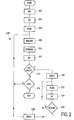
- FIG. 2 schematically shows the presenting of guidance in an embodiment of the navigation system according to the invention.
- the principle behaviour of the system for presenting guidance information is shown in the flow chart in a simplified way, for ease of illustrating the invention.
- Various steps can be executed in a different order than the one shown and many detailed steps are not shown in flow chart.
- Initialisation step 202 includes determining the desired destination and the characteristic to be optimised in route planning.
- step 204 the current position of the vehicle is determined and in step 206 a route is planned between the current position and the destination.
- the planned route is analyzed in step 208 in order to determine the specific guidance information to be presented next to the driver and the moment at which this information should be given.
- step 210 the specific guidance information is presented to the driver and in step 212 the current position of the vehicle is determined in order to follow the progress of the vehicle.
- step 214 it is verified whether the vehicle is still on the planned route and if this is the case, then in step 216 it is verified whether the vehicle has reached the destination. If this is not the case, then the loop 218 with steps 208-216 is repeated again and if the vehicle has reached the destination, then a message indicating this situation is presented to the driver and this part of the system operation is finished.
- execution of the loop 218 is ended and the system continues with step 220.
- step 220 the guidance module is deactivated in order to prevent subsequent presenting of guidance information to the driver. Then in step 222 a new route is planned between the current position of the vehicle and the destination and in step 224 the then current position of the vehicle is determined. In step 226 it is verified whether the presenting of guidance information to the driver should be resumed. There are various conditions which lead to the situation in which guidance should be resumed. This can be if a certain predetermined time interval since the deactivation of the guidance module has lapsed or if the vehicle has travelled a certain predetermined distance from the location where it left the original route. Furthermore guidance should be resumed if the driver has entered a command requesting the resumption.
- step 222-226 the loop with steps 222-226 is executed again.
- step 226 the execution is continued with step 228 in which the guidance module is reactivated.
- loop 218 is entered for presenting guidance information and for following the vehicle along the route, most recently planned in step 222.
- the guidance module is deactivated in step 220 after that it has been detected in step 214 that the vehicle has left the planned route, a driver is able to follow a deviating route without being presented unsolicited guidance information.
- This guidance information would include directions to the destination via a potentially newly planned route, while the driver wants to follow the deviating route.
- Such deviating route could be desired for instance when the vehicle is in an area where the driver is very familiar or when the driver knows there is a problem on the planned route not known to the system.
- the system continuously plans a new route in step 222 when the vehicle has left the originally planned route. This has the advantage that a new route from the current position to the destination is immediately available when the presentation of guidance information is resumed.
- the new route could be planned after the step 226 where it is established that guidance should be resumed. This saves the computational effort of frequently planning a new route but gives some delay for planning the new route after the establishment that guidance is to be resumed.
- Figure 2 shows the operation of an embodiment of the invention in a simplified way to illustrate the principle of the invention.
- Some of the processes like the process determine position (DP), are executed continuously so that its output is immediately available when required by another part of the system.
- a step in Figure 2 involving such a process merely means obtaining the output rather then executing the process at that moment.
Landscapes
- Engineering & Computer Science (AREA)
- Radar, Positioning & Navigation (AREA)
- Remote Sensing (AREA)
- Automation & Control Theory (AREA)
- Physics & Mathematics (AREA)
- General Physics & Mathematics (AREA)
- Navigation (AREA)
Abstract
Description
- a vehicle position determining module for determining a current position of the vehicle,
- a planning module for planning the first route between the current position and a destination,
- a guidance module for presenting the driver guidance information along the first route,
Claims (7)
- A navigation system for guiding a driver of a vehicle along a first route, the system comprising:and being arranged to detect when the vehicle has left the first route,a vehicle position determining module for determining a current position of the vehicle,a planning module for planning the first route between the current position and a destination,a guidance module for presenting the driver guidance information along the first route,
characterized in that the navigation system is arranged to deactivate the guidance module when it detects that the vehicle has left the first route. - A navigation system according to Claim 1, characterized in that the navigation system is arranged to activate, when it detects that the vehicle has left the first route, the planning module to plan a second route between the current position and the destination.
- A navigation system according to Claim 2, characterized in that the navigation system is arranged to reactivate the guidance module and that the guidance module is arranged to present the driver guidance information along the second route.
- A navigation system according to Claim 3, characterized in that the navigation system is arranged to reactivate the guidance module after a predetermined time interval following the deactivation.
- A navigation system according to Claim 3 or 4, characterized in that the navigation system is arranged to reactivate the guidance module after the vehicle has travelled a predetermined distance following the deactivation.
- A navigation system according to any of the Claims 3 to 5, characterized in that the navigation system is arranged to reactivate the guidance module after receipt of a reactivate command from the driver.
- A navigation system according to any of the Claims 1 to 6, characterized in that the navigation system is arranged to present a notification to the driver when the guidance module is deactivated.
Priority Applications (1)
| Application Number | Priority Date | Filing Date | Title |
|---|---|---|---|
| EP19980200014 EP0854352B1 (en) | 1997-01-10 | 1998-01-06 | Navigation system for guiding a driver |
Applications Claiming Priority (3)
| Application Number | Priority Date | Filing Date | Title |
|---|---|---|---|
| EP97200066 | 1997-01-10 | ||
| EP97200066 | 1997-01-10 | ||
| EP19980200014 EP0854352B1 (en) | 1997-01-10 | 1998-01-06 | Navigation system for guiding a driver |
Publications (3)
| Publication Number | Publication Date |
|---|---|
| EP0854352A2 true EP0854352A2 (en) | 1998-07-22 |
| EP0854352A3 EP0854352A3 (en) | 1999-10-13 |
| EP0854352B1 EP0854352B1 (en) | 2005-04-13 |
Family
ID=26146044
Family Applications (1)
| Application Number | Title | Priority Date | Filing Date |
|---|---|---|---|
| EP19980200014 Expired - Lifetime EP0854352B1 (en) | 1997-01-10 | 1998-01-06 | Navigation system for guiding a driver |
Country Status (1)
| Country | Link |
|---|---|
| EP (1) | EP0854352B1 (en) |
Cited By (4)
| Publication number | Priority date | Publication date | Assignee | Title |
|---|---|---|---|---|
| EP1528362A1 (en) * | 2003-10-29 | 2005-05-04 | Harman/Becker Automotive Systems GmbH | Navigation system with improved voice output control |
| EP2128568A1 (en) | 2008-05-26 | 2009-12-02 | Continental Automotive GmbH | Method for determining a route in a navigation system |
| CN102735254A (en) * | 2011-04-11 | 2012-10-17 | 哈曼贝克自动系统股份有限公司 | Method for guiding a user of a navigation device |
| WO2016009125A1 (en) * | 2014-07-17 | 2016-01-21 | Bull Sas | Method of guiding a consumer within a shop |
Family Cites Families (3)
| Publication number | Priority date | Publication date | Assignee | Title |
|---|---|---|---|---|
| JP2955073B2 (en) * | 1991-08-05 | 1999-10-04 | ビステオン・テクノロジーズ,エル・エル・シー | Vehicle navigation system |
| US5291414A (en) * | 1992-04-14 | 1994-03-01 | Zexel Corporation Diahatsu-Nissan Ikebukuro | Navigation system for guiding a vehicle along a precomputed optimal route |
| EP0580166B1 (en) * | 1992-07-23 | 1999-06-16 | Aisin Aw Co., Ltd. | Vehicle navigation system |
-
1998
- 1998-01-06 EP EP19980200014 patent/EP0854352B1/en not_active Expired - Lifetime
Cited By (10)
| Publication number | Priority date | Publication date | Assignee | Title |
|---|---|---|---|---|
| EP1528362A1 (en) * | 2003-10-29 | 2005-05-04 | Harman/Becker Automotive Systems GmbH | Navigation system with improved voice output control |
| US7177762B2 (en) | 2003-10-29 | 2007-02-13 | Harman/Becker Automotive Systems Gmbh | Navigation system with voice output control |
| EP2128568A1 (en) | 2008-05-26 | 2009-12-02 | Continental Automotive GmbH | Method for determining a route in a navigation system |
| DE102008025130A1 (en) | 2008-05-26 | 2009-12-03 | Continental Automotive Gmbh | Method for determining a route in a navigation system |
| CN102735254A (en) * | 2011-04-11 | 2012-10-17 | 哈曼贝克自动系统股份有限公司 | Method for guiding a user of a navigation device |
| EP2511662A1 (en) * | 2011-04-11 | 2012-10-17 | Harman Becker Automotive Systems GmbH | Method for guiding a user of a navigation device |
| US9043142B2 (en) | 2011-04-11 | 2015-05-26 | Harman Becker Automotive Systems Gmbh | Navigation guidance system |
| CN102735254B (en) * | 2011-04-11 | 2017-12-05 | 哈曼贝克自动系统股份有限公司 | The method and apparatus being oriented to for the user of guider |
| WO2016009125A1 (en) * | 2014-07-17 | 2016-01-21 | Bull Sas | Method of guiding a consumer within a shop |
| FR3023952A1 (en) * | 2014-07-17 | 2016-01-22 | Bull Sas | METHOD FOR GUIDING A CONSUMER WITHIN A STORE |
Also Published As
| Publication number | Publication date |
|---|---|
| EP0854352B1 (en) | 2005-04-13 |
| EP0854352A3 (en) | 1999-10-13 |
Similar Documents
| Publication | Publication Date | Title |
|---|---|---|
| US6298304B1 (en) | Local navigation alternatives | |
| KR100429128B1 (en) | Navigation device | |
| US6694255B1 (en) | Navigation system and storage medium | |
| JPH0588614A (en) | Navigation device | |
| US8649971B2 (en) | Navigation device | |
| US6104315A (en) | Navigation system for guiding a driver | |
| US20040143388A1 (en) | Navigation apparatus, navigation map data acquisition method and computer-readable recorded medium in which navigation map data acquisition program is recorded | |
| JP2005181020A (en) | Navigation device | |
| WO2005022086A1 (en) | Moving object position display device and method | |
| JPH10332404A (en) | Navigation device | |
| EP2259025B1 (en) | Navigation System, Method for Guidance along Guide Route, and Route Guidance Program | |
| EP0854352B1 (en) | Navigation system for guiding a driver | |
| US20100138148A1 (en) | Navigation apparatus | |
| JP3580458B2 (en) | Vehicle navigation system | |
| JP4394426B2 (en) | Navigation device and history information display method | |
| JP2001227961A (en) | Navigation device | |
| JP3353472B2 (en) | Road information display device | |
| JP2002156238A (en) | Navigation device | |
| JP4097553B2 (en) | Navigation device | |
| JPH09287971A (en) | Navigation apparatus | |
| KR101151997B1 (en) | Method and apparatus for searching travel route of vehicle in navigation system | |
| JP2001255164A (en) | Navigation system | |
| JP2002139327A (en) | Navigation apparatus, mark-compatible operation attribute registration method, and operation execution method in navigation apparatus | |
| JPH10153448A (en) | Navigation device for vehicle and storage medium | |
| JPH1151680A (en) | Navigation system |
Legal Events
| Date | Code | Title | Description |
|---|---|---|---|
| PUAI | Public reference made under article 153(3) epc to a published international application that has entered the european phase |
Free format text: ORIGINAL CODE: 0009012 |
|
| AK | Designated contracting states |
Kind code of ref document: A2 Designated state(s): DE FR GB |
|
| AX | Request for extension of the european patent |
Free format text: AL;LT;LV;MK;RO;SI |
|
| RAP3 | Party data changed (applicant data changed or rights of an application transferred) |
Owner name: KONINKLIJKE PHILIPS ELECTRONICS N.V. |
|
| PUAL | Search report despatched |
Free format text: ORIGINAL CODE: 0009013 |
|
| AK | Designated contracting states |
Kind code of ref document: A3 Designated state(s): AT BE CH DE DK ES FI FR GB GR IE IT LI LU MC NL PT SE |
|
| RAP1 | Party data changed (applicant data changed or rights of an application transferred) |
Owner name: MANNESMANN VDO AKTIENGESELLSCHAFT |
|
| 17P | Request for examination filed |
Effective date: 20000413 |
|
| AKX | Designation fees paid |
Free format text: DE FR GB |
|
| RAP1 | Party data changed (applicant data changed or rights of an application transferred) |
Owner name: SIEMENS AKTIENGESELLSCHAFT |
|
| 17Q | First examination report despatched |
Effective date: 20040329 |
|
| GRAP | Despatch of communication of intention to grant a patent |
Free format text: ORIGINAL CODE: EPIDOSNIGR1 |
|
| GRAS | Grant fee paid |
Free format text: ORIGINAL CODE: EPIDOSNIGR3 |
|
| GRAA | (expected) grant |
Free format text: ORIGINAL CODE: 0009210 |
|
| AK | Designated contracting states |
Kind code of ref document: B1 Designated state(s): DE FR GB |
|
| REG | Reference to a national code |
Ref country code: GB Ref legal event code: FG4D |
|
| REF | Corresponds to: |
Ref document number: 69829699 Country of ref document: DE Date of ref document: 20050519 Kind code of ref document: P |
|
| PLBE | No opposition filed within time limit |
Free format text: ORIGINAL CODE: 0009261 |
|
| STAA | Information on the status of an ep patent application or granted ep patent |
Free format text: STATUS: NO OPPOSITION FILED WITHIN TIME LIMIT |
|
| ET | Fr: translation filed | ||
| 26N | No opposition filed |
Effective date: 20060116 |
|
| REG | Reference to a national code |
Ref country code: FR Ref legal event code: TP |
|
| REG | Reference to a national code |
Ref country code: GB Ref legal event code: 732E Free format text: REGISTERED BETWEEN 20110825 AND 20110831 |
|
| PGFP | Annual fee paid to national office [announced via postgrant information from national office to epo] |
Ref country code: GB Payment date: 20130122 Year of fee payment: 16 |
|
| GBPC | Gb: european patent ceased through non-payment of renewal fee |
Effective date: 20140106 |
|
| PG25 | Lapsed in a contracting state [announced via postgrant information from national office to epo] |
Ref country code: GB Free format text: LAPSE BECAUSE OF NON-PAYMENT OF DUE FEES Effective date: 20140106 |
|
| REG | Reference to a national code |
Ref country code: FR Ref legal event code: PLFP Year of fee payment: 18 |
|
| PGFP | Annual fee paid to national office [announced via postgrant information from national office to epo] |
Ref country code: DE Payment date: 20150131 Year of fee payment: 18 |
|
| PGFP | Annual fee paid to national office [announced via postgrant information from national office to epo] |
Ref country code: FR Payment date: 20150122 Year of fee payment: 18 |
|
| REG | Reference to a national code |
Ref country code: DE Ref legal event code: R119 Ref document number: 69829699 Country of ref document: DE |
|
| REG | Reference to a national code |
Ref country code: FR Ref legal event code: ST Effective date: 20160930 |
|
| PG25 | Lapsed in a contracting state [announced via postgrant information from national office to epo] |
Ref country code: DE Free format text: LAPSE BECAUSE OF NON-PAYMENT OF DUE FEES Effective date: 20160802 |
|
| PG25 | Lapsed in a contracting state [announced via postgrant information from national office to epo] |
Ref country code: FR Free format text: LAPSE BECAUSE OF NON-PAYMENT OF DUE FEES Effective date: 20160201 |