EP0849929B1 - Sheet conveying apparatus - Google Patents
Sheet conveying apparatus Download PDFInfo
- Publication number
- EP0849929B1 EP0849929B1 EP97122285A EP97122285A EP0849929B1 EP 0849929 B1 EP0849929 B1 EP 0849929B1 EP 97122285 A EP97122285 A EP 97122285A EP 97122285 A EP97122285 A EP 97122285A EP 0849929 B1 EP0849929 B1 EP 0849929B1
- Authority
- EP
- European Patent Office
- Prior art keywords
- sheet
- original
- convey
- skew
- control
- Prior art date
- Legal status (The legal status is an assumption and is not a legal conclusion. Google has not performed a legal analysis and makes no representation as to the accuracy of the status listed.)
- Expired - Lifetime
Links
Images


Classifications
-
- B—PERFORMING OPERATIONS; TRANSPORTING
- B65—CONVEYING; PACKING; STORING; HANDLING THIN OR FILAMENTARY MATERIAL
- B65H—HANDLING THIN OR FILAMENTARY MATERIAL, e.g. SHEETS, WEBS, CABLES
- B65H9/00—Registering, e.g. orientating, articles; Devices therefor
- B65H9/002—Registering, e.g. orientating, articles; Devices therefor changing orientation of sheet by only controlling movement of the forwarding means, i.e. without the use of stop or register wall
-
- B—PERFORMING OPERATIONS; TRANSPORTING
- B65—CONVEYING; PACKING; STORING; HANDLING THIN OR FILAMENTARY MATERIAL
- B65H—HANDLING THIN OR FILAMENTARY MATERIAL, e.g. SHEETS, WEBS, CABLES
- B65H9/00—Registering, e.g. orientating, articles; Devices therefor
- B65H9/004—Deskewing sheet by abutting against a stop, i.e. producing a buckling of the sheet
- B65H9/006—Deskewing sheet by abutting against a stop, i.e. producing a buckling of the sheet the stop being formed by forwarding means in stand-by
-
- H—ELECTRICITY
- H04—ELECTRIC COMMUNICATION TECHNIQUE
- H04N—PICTORIAL COMMUNICATION, e.g. TELEVISION
- H04N1/00—Scanning, transmission or reproduction of documents or the like, e.g. facsimile transmission; Details thereof
- H04N1/00681—Detecting the presence, position or size of a sheet or correcting its position before scanning
-
- H—ELECTRICITY
- H04—ELECTRIC COMMUNICATION TECHNIQUE
- H04N—PICTORIAL COMMUNICATION, e.g. TELEVISION
- H04N1/00—Scanning, transmission or reproduction of documents or the like, e.g. facsimile transmission; Details thereof
- H04N1/00681—Detecting the presence, position or size of a sheet or correcting its position before scanning
- H04N1/00684—Object of the detection
- H04N1/00708—Size or dimensions
- H04N1/00713—Length
-
- H—ELECTRICITY
- H04—ELECTRIC COMMUNICATION TECHNIQUE
- H04N—PICTORIAL COMMUNICATION, e.g. TELEVISION
- H04N1/00—Scanning, transmission or reproduction of documents or the like, e.g. facsimile transmission; Details thereof
- H04N1/00681—Detecting the presence, position or size of a sheet or correcting its position before scanning
- H04N1/00684—Object of the detection
- H04N1/00718—Skew
-
- H—ELECTRICITY
- H04—ELECTRIC COMMUNICATION TECHNIQUE
- H04N—PICTORIAL COMMUNICATION, e.g. TELEVISION
- H04N1/00—Scanning, transmission or reproduction of documents or the like, e.g. facsimile transmission; Details thereof
- H04N1/00681—Detecting the presence, position or size of a sheet or correcting its position before scanning
- H04N1/00729—Detection means
- H04N1/00734—Optical detectors
-
- H—ELECTRICITY
- H04—ELECTRIC COMMUNICATION TECHNIQUE
- H04N—PICTORIAL COMMUNICATION, e.g. TELEVISION
- H04N1/00—Scanning, transmission or reproduction of documents or the like, e.g. facsimile transmission; Details thereof
- H04N1/00681—Detecting the presence, position or size of a sheet or correcting its position before scanning
- H04N1/00742—Detection methods
- H04N1/00745—Detecting the leading or trailing ends of a moving sheet
-
- H—ELECTRICITY
- H04—ELECTRIC COMMUNICATION TECHNIQUE
- H04N—PICTORIAL COMMUNICATION, e.g. TELEVISION
- H04N1/00—Scanning, transmission or reproduction of documents or the like, e.g. facsimile transmission; Details thereof
- H04N1/00681—Detecting the presence, position or size of a sheet or correcting its position before scanning
- H04N1/00742—Detection methods
- H04N1/00755—Detecting an interruption of light
-
- H—ELECTRICITY
- H04—ELECTRIC COMMUNICATION TECHNIQUE
- H04N—PICTORIAL COMMUNICATION, e.g. TELEVISION
- H04N1/00—Scanning, transmission or reproduction of documents or the like, e.g. facsimile transmission; Details thereof
- H04N1/00681—Detecting the presence, position or size of a sheet or correcting its position before scanning
- H04N1/00785—Correcting the position of a sheet before scanning
-
- H—ELECTRICITY
- H04—ELECTRIC COMMUNICATION TECHNIQUE
- H04N—PICTORIAL COMMUNICATION, e.g. TELEVISION
- H04N1/00—Scanning, transmission or reproduction of documents or the like, e.g. facsimile transmission; Details thereof
- H04N1/00795—Reading arrangements
-
- B—PERFORMING OPERATIONS; TRANSPORTING
- B65—CONVEYING; PACKING; STORING; HANDLING THIN OR FILAMENTARY MATERIAL
- B65H—HANDLING THIN OR FILAMENTARY MATERIAL, e.g. SHEETS, WEBS, CABLES
- B65H2301/00—Handling processes for sheets or webs
- B65H2301/30—Orientation, displacement, position of the handled material
- B65H2301/36—Positioning; Changing position
- B65H2301/361—Positioning; Changing position during displacement
- B65H2301/3613—Lateral positioning
-
- B—PERFORMING OPERATIONS; TRANSPORTING
- B65—CONVEYING; PACKING; STORING; HANDLING THIN OR FILAMENTARY MATERIAL
- B65H—HANDLING THIN OR FILAMENTARY MATERIAL, e.g. SHEETS, WEBS, CABLES
- B65H2403/00—Power transmission; Driving means
- B65H2403/40—Toothed gearings
- B65H2403/41—Rack-and-pinion, cogwheel in cog railway
-
- B—PERFORMING OPERATIONS; TRANSPORTING
- B65—CONVEYING; PACKING; STORING; HANDLING THIN OR FILAMENTARY MATERIAL
- B65H—HANDLING THIN OR FILAMENTARY MATERIAL, e.g. SHEETS, WEBS, CABLES
- B65H2404/00—Parts for transporting or guiding the handled material
- B65H2404/10—Rollers
- B65H2404/14—Roller pairs
- B65H2404/142—Roller pairs arranged on movable frame
- B65H2404/1424—Roller pairs arranged on movable frame moving in parallel to their axis
-
- B—PERFORMING OPERATIONS; TRANSPORTING
- B65—CONVEYING; PACKING; STORING; HANDLING THIN OR FILAMENTARY MATERIAL
- B65H—HANDLING THIN OR FILAMENTARY MATERIAL, e.g. SHEETS, WEBS, CABLES
- B65H2404/00—Parts for transporting or guiding the handled material
- B65H2404/10—Rollers
- B65H2404/14—Roller pairs
- B65H2404/144—Roller pairs with relative movement of the rollers to / from each other
- B65H2404/1442—Tripping arrangements
-
- B—PERFORMING OPERATIONS; TRANSPORTING
- B65—CONVEYING; PACKING; STORING; HANDLING THIN OR FILAMENTARY MATERIAL
- B65H—HANDLING THIN OR FILAMENTARY MATERIAL, e.g. SHEETS, WEBS, CABLES
- B65H2404/00—Parts for transporting or guiding the handled material
- B65H2404/60—Other elements in face contact with handled material
- B65H2404/61—Longitudinally-extending strips, tubes, plates, or wires
- B65H2404/611—Longitudinally-extending strips, tubes, plates, or wires arranged to form a channel
- B65H2404/6111—Longitudinally-extending strips, tubes, plates, or wires arranged to form a channel and shaped for curvilinear transport path
-
- B—PERFORMING OPERATIONS; TRANSPORTING
- B65—CONVEYING; PACKING; STORING; HANDLING THIN OR FILAMENTARY MATERIAL
- B65H—HANDLING THIN OR FILAMENTARY MATERIAL, e.g. SHEETS, WEBS, CABLES
- B65H2511/00—Dimensions; Position; Numbers; Identification; Occurrences
- B65H2511/10—Size; Dimensions
- B65H2511/11—Length
-
- B—PERFORMING OPERATIONS; TRANSPORTING
- B65—CONVEYING; PACKING; STORING; HANDLING THIN OR FILAMENTARY MATERIAL
- B65H—HANDLING THIN OR FILAMENTARY MATERIAL, e.g. SHEETS, WEBS, CABLES
- B65H2511/00—Dimensions; Position; Numbers; Identification; Occurrences
- B65H2511/50—Occurence
- B65H2511/51—Presence
- B65H2511/512—Marks, e.g. invisible to the human eye; Patterns
-
- B—PERFORMING OPERATIONS; TRANSPORTING
- B65—CONVEYING; PACKING; STORING; HANDLING THIN OR FILAMENTARY MATERIAL
- B65H—HANDLING THIN OR FILAMENTARY MATERIAL, e.g. SHEETS, WEBS, CABLES
- B65H2515/00—Physical entities not provided for in groups B65H2511/00 or B65H2513/00
- B65H2515/815—Slip
-
- B—PERFORMING OPERATIONS; TRANSPORTING
- B65—CONVEYING; PACKING; STORING; HANDLING THIN OR FILAMENTARY MATERIAL
- B65H—HANDLING THIN OR FILAMENTARY MATERIAL, e.g. SHEETS, WEBS, CABLES
- B65H2557/00—Means for control not provided for in groups B65H2551/00 - B65H2555/00
- B65H2557/20—Calculating means; Controlling methods
- B65H2557/24—Calculating methods; Mathematic models
- B65H2557/242—Calculating methods; Mathematic models involving a particular data profile or curve
-
- B—PERFORMING OPERATIONS; TRANSPORTING
- B65—CONVEYING; PACKING; STORING; HANDLING THIN OR FILAMENTARY MATERIAL
- B65H—HANDLING THIN OR FILAMENTARY MATERIAL, e.g. SHEETS, WEBS, CABLES
- B65H2801/00—Application field
- B65H2801/03—Image reproduction devices
- B65H2801/06—Office-type machines, e.g. photocopiers
-
- H—ELECTRICITY
- H04—ELECTRIC COMMUNICATION TECHNIQUE
- H04N—PICTORIAL COMMUNICATION, e.g. TELEVISION
- H04N1/00—Scanning, transmission or reproduction of documents or the like, e.g. facsimile transmission; Details thereof
- H04N1/04—Scanning arrangements, i.e. arrangements for the displacement of active reading or reproducing elements relative to the original or reproducing medium, or vice versa
- H04N1/12—Scanning arrangements, i.e. arrangements for the displacement of active reading or reproducing elements relative to the original or reproducing medium, or vice versa using the sheet-feed movement or the medium-advance or the drum-rotation movement as the slow scanning component, e.g. arrangements for the main-scanning
-
- H—ELECTRICITY
- H04—ELECTRIC COMMUNICATION TECHNIQUE
- H04N—PICTORIAL COMMUNICATION, e.g. TELEVISION
- H04N1/00—Scanning, transmission or reproduction of documents or the like, e.g. facsimile transmission; Details thereof
- H04N1/04—Scanning arrangements, i.e. arrangements for the displacement of active reading or reproducing elements relative to the original or reproducing medium, or vice versa
- H04N1/19—Scanning arrangements, i.e. arrangements for the displacement of active reading or reproducing elements relative to the original or reproducing medium, or vice versa using multi-element arrays
- H04N1/191—Scanning arrangements, i.e. arrangements for the displacement of active reading or reproducing elements relative to the original or reproducing medium, or vice versa using multi-element arrays the array comprising a one-dimensional [1D] array
- H04N1/192—Simultaneously or substantially simultaneously scanning picture elements on one main scanning line
- H04N1/193—Simultaneously or substantially simultaneously scanning picture elements on one main scanning line using electrically scanned linear arrays, e.g. linear CCD arrays
Definitions
- the present invention relates to a sheet conveying apparatus used with an image forming apparatus or an image reading apparatus such as a copying machine, a scanner, a printer and the like. More particularly, it relates to a sheet conveying apparatus having a skew correction means for correcting skew-feed of a sheet conveyed to an image forming portion or an image reading portion.
- a regist means acting as a skew correction means for correcting skew-feed of a sheet is disposed in front of an image forming portion or an image reading portion in order to correct posture and position of a sheet.
- regist means there is a loop regist means in which a tip end of a sheet abuts against a nip between a pair of regist rollers which are now stopped to form a loop in the sheet, so that skew-feed of the sheet is corrected by aligning the tip end of the sheet with the nip by elasticity of the sheet.
- a shutter regist means in which a shutter member for stopping the tip end of the sheet is retractably disposed in a sheet convey path and the skew-feed of the sheet is corrected by retarding the shutter member from the sheet convey path after the tip end of the sheet is aligned with the shutter member.
- image information of the original can be electrically coded to be stored in a memory.
- the information in the memory is read out, and an image corresponding to the image information of the original is formed on a photosensitive member by an exposure device such as laser light or an LED array. To this end, even when a plurality of copies are formed, a mechanical movement of the optical device is not required.
- two sensors are disposed in the sheet convey path with a predetermined distance therebetween along a direction substantially perpendicular to the sheet conveying direction so that inclination of the sheet can be detected on the basis of signals representing the fact that the tip end of the sheet is detected by the respective sensors, and, by controlling sheet conveying speeds of a pair of regist rollers which are disposed coaxially in a direction substantially perpendicular to the sheet conveying direction and spaced apart from each other with a predetermined distance therebetween and which are driven independently, the skew-feed of the sheet is corrected.
- the skew correction without stopping the sheet temporarily in this way, the distance between the sheets (sheet interval) can be reduced more than the other methods.
- the skew correction should be effected by the pair of regist rollers while a trail end of the sheet is being pinched between a pair of upstream convey rollers.
- the skew correction is effected by advancing delayed side of the sheet with respect to one of the pair of regist rollers for skew correction or by delaying advanced side of the sheet with respect to the other of the pair of regist rollers.
- rotational movement of the entire sheet is required.
- it is difficult to rotate the sheet by a required amount which makes the accurate skew correction difficult.
- sliding resistance of a sheet convey guide is increased to worsen accuracy of the skew correction.
- Document EP-A-0 529 538 describes a sheet conveying apparatus wherein a pair convey rollers arranged upstream of a registration means for correcting a skew-feed of a sheet in a sheet conveying direction can be abutted against or separated from each other, or can be shifted in accordance with a length of the sheet in the sheet conveying direction.
- Document US-A-5 219 159 describes a translating nip registration device.
- An apparatus is provided to bilaterally register and deskew sheets in an electrophotographic printing machine by driving the sheet against a pair of stalled drive rolls and then activating the drive rolls when the sheet is deskewed. The drive rolls are then laterally translated while the sheet is within the nips of the drive rolls. The proper side registration position of the sheet is sensed and stored and the sheet is brought to that proper registration position. Once the sheet has passed through the drive rolls, the rolls return to the center of the paper path to receive subsequent sheets.
- a stepper motor is used to translate the roll pairs in a lateral direction and the pulse counts are utilized to store the side registration and sheet acquisition positions.
- the present invention aims to provide an improved sheet conveying apparatus, a corresponding image reading apparatus having such a sheet conveying apparatus, and a corresponding image forming apparatus having such a sheet conveying apparatus, in which skew correction can be effected with high accuracy while a high throughput can be achieved.
- the sheet convey means is disposed at an upstream side of the skew correction means for correcting the skew-feed of the sheet in the sheet conveying direction and the sheet convey means can be shifted by the shift means in a direction substantially perpendicular to the sheet conveying direction.
- the control means controls the driving of the shift means to shift the sheet convey means (pinching the sheet to be skew-corrected by the skew correction means) by a distance corresponding to the skew amount of the sheet, to thereby shift the sheet toward the skew correction direction.
- the sheet conveying apparatus to an original image reading apparatus or an image forming apparatus, in apparatuses having the same conveying speed, the number of sheets to be treated per unit time can be increased, thereby improving productivity.
- Fig. 1 showing a sectional view of an image reading apparatus having a sheet conveying apparatus according to a first embodiment of the present invention
- the reference numeral 1A denotes a sheet conveying apparatus
- 1 denotes a pair of regist rollers constituting a skew correction means (regist means) for effecting skew correction of a sheet (original) to correct posture and position of the sheet in front of an image reading portion
- 4 denotes pass detect sensors for detecting passage of the sheet.
- the pair of regist rollers 1 and the pass detect sensor 4 will be described later with reference to Fig. 3 .
- the originals S are contained in a sheet supply portion 50 with imaged surfaces facing upwardly.
- the reference numeral 9 denotes a pick-up roller coated by material (such as rubber) having relatively high coefficient of friction; and 10 denotes a pair of separation/supply rollers for separating the originals (fed by the pick-up roller 9) one by one.
- the reference numeral 11 denotes a first pair of original convey rollers (upstream side sheet convey means) disposed at a down stream side of the pair of separation/supply rollers and engageable with and disengageable from each other and normally contacted with each other (described later); and 3S and 3L denote original length detect sensors (sheet size detect means) for detecting lengths l S1 and l S2 of the original S in a conveying direction, which sensors are photo-electric sensors of reflection type for detecting the length of the original S in the conveying direction when the originals are set. Detection signals from the original length detect sensors 3S, 3L are inputted to a control device 70.
- the reference numeral 2 denotes a second pair of original convey rollers (sheet convey means) which will be described later fully.
- An original detect sensor 3 is disposed near and at a down stream side of the pair of original convey rollers 2, where presence/absence of the original is detected.
- L 1 , L 2 and L 3 represent distances from the pair of regist rollers 1 to the second pair of original convey rollers 2, the first pair of original convey rollers 11 and the pair of separation/supply rollers 10, respectively, and, regarding the original lengths l S1 and l S2 , the following relations are established: L 1 ⁇ l S ⁇ 1 , and , L 2 ⁇ l S ⁇ 2 ⁇ L 3 .
- lengths obtained by adding a distance L S between the pair of regist rollers 1 and the pass detect sensor 4 to the above-mentioned distances L 1 , L 2 , L 3 have the following relation: L 1 + L S ⁇ l S ⁇ 1 ⁇ L 2 + L S ⁇ l S ⁇ 2 ⁇ L 3 .
- an L-shaped lever has a first arm member 17a and a second arm member 17b and can be rotated around a rotation shaft 17c.
- the first arm member 17a of the lever 17 is connected to a central shaft 11c of an original convey roller 11a of the first original convey roller pair 11.
- An elongated slot 17d is formed in a free end portion of the second arm member 17b of the lever 17, and a solenoid 19 is connected to the slot 17d via an actuator 19a.
- a position of the actuator is controlled by the solenoid 19 and a return spring 18 so that, when the solenoid 19 is turned OFF, the actuator is shifted to the right in Fig. 2 by a spring force of the return spring, while when the solenoid 19 is turned ON, the actuator is shifted to the left in Fig. 2 by an electromagnetic attracting force.
- the switching between engagement and disengagement of the first pair of original convey rollers 11 due to ON/OFF of the solenoid 19 is effected by the control device (engagement/disengagement control means) on the basis of the length of the original S. That is to say, when the original being conveyed has small length l S1 , the first pair of original convey rollers 11 are engaged with each other during a skew correcting operation (described later), because movement of the original in a rotational direction is not obstructed since the trail end of the original has already been passed through a nip of the first original convey roller pair 11.
- the reference numeral 12 denotes a scanner portion for reading-in the image on the original; 13 denotes an illumination lamp for illuminating the imaged surface of the original being moved on the reading glass 5; 14 denotes mirrors; 15 denotes a lens; and 16 denotes an image reading element such as a CCD.
- Fig. 3 is an explanatory view showing an original convey portion 51, a regist portion 52 and an image reading portion 53.
- regist rollers 1a and 1b (constituting the regist roller pair 1) are spaced apart from each other with a predetermined distance therebetween along a direction substantially perpendicular to a conveying direction shown by the fat arrow and are driven by independent first and second drive motors M 1 and M 2 , respectively.
- the pass detect sensors 4a, 4b of light permeable type are spaced apart from each other with a predetermined distance therebetween along the direction substantially perpendicular to the conveying direction to detect a skew amount of the original S by detecting the tip end of the original S conveyed through a sheet convey path 55 defined between convey guides 54.
- the sensors When the two pass detect sensors 4a and 4b detect the tip end of the original S, the sensors generate detection signals which are in turn inputted to the control device 70.
- the control device 70 determines the skew amount of the original S on the basis of the detection signals (skew amount information).
- the second pair of original convey rollers 2 are disposed at an upstream side of the regist roller pair 1 in the conveying direction, and a thrust position of the second original convey roller pair 2 can be controlled.
- the second original convey roller pair 2 includes a convey roller 2a and a driven roller 2b.
- the convey roller 2a is rotatably supported by a frame (not shown) for shifting movement in a thrust direction (shown by the arrow B in Fig. 4 ), and the driven roller 2b is urged against the convey roller 2a by a biasing means (not shown).
- Roller shafts 2A, 2B of the convey roller 2a and the driven roller 2b are rotatably supported by bearings 20, 22, respectively, and are regulated by slide regulating members 23, 24, 25 and 26 in the thrust direction. With this arrangement, the convey roller 2a and the driven roller 2b can integrally be shifted in the thrust direction.
- the bearing 20 is provided with a rack gear 20a meshed with a pinion gear 21 provided on a third drive motor (shift means) M 3 for shifting the second original convey roller pair 2, so that the shifting of the convey rollers 2a, 2b in the thrust direction (shown by the arrow B in Fig. 4 ) can be controlled in accordance with a rotation amount of the third drive motor M 3 .
- the driving of the third drive motor M 3 is controlled by the control device 70 shown in Fig. 5 .
- the bearing 20 is provided at its one end with a projection 20b and a microswitch 27 is disposed in a confronting relation to the projection, so that home positions of the bearing 20 and the convey roller pair 2a, 2b in the thrust direction can be detected by the projection 20b and the microswitch 27.
- the microswitch 27 is turned ON, and an ON signal from the microswitch is inputted to the control device 70, as shown in Fig. 5 .
- the size of the original (original length) is detected by the original length detect sensors 3S, 3L, and the detection signals are inputted to the control device 70. If the original S has small length, the control device 70 turns the solenoid 19 OFF to achieve the engagement condition of the first original convey roller pair 11; whereas, if the original S has great length, the control device 70 turns the solenoid 19 ON to achieve the disengagement condition of the first original convey roller pair 11.
- the pick-up roller 9 is rotated by a drive mechanism (not shown) to fed out an uppermost original on the original stack S toward the pair of separation/supply rollers 10.
- the pair of separation/supply rollers 10 feeds the original toward a downstream side as it is; whereas, if two or more originals are fed out, the lower roller (in the separation/supply roller pair 10) is rotated in a direction opposite to the feeding direction to separate the originals, to thereby convey only the uppermost original S to ward the downstream side. Since the separation mechanism does not directly relate to the present invention, detailed explanation thereof will be omitted.
- the original S is conveyed to the regist roller pair 1 through the original convey path 55 by the first and second pairs of convey rollers 2, 11 (or only by the second pair of convey rollers 2 when the original has great length lS 2 ).
- the pair of regist rollers 1 are rotated at the same speeds as the original conveying speeds of the first and second pairs of convey rollers 2, 11 so that the original S pinched between the pair of regist rollers 1 is conveyed toward the image reading portion 53 as it is; meanwhile, the original passes through the pass detect sensors 4a, 4b.
- the detection signal (from the pass detect sensors 4a, 4b) representing the fact that the original S is passed through these sensors is inputted to the control device 70.
- the control device 70 first of all, inclination of the tip end of the original S is calculated by a calculate circuit 71 on the basis of the detection signals. Then, the rotational speeds of the regist rollers 1a, 1b and the first and second drive motors M 1 , M 2 are controlled on the basis of the calculated inclination.
- the regist roller 1b relating to the advanced side of the original is delayed (i.e., the rotational speed of the first drive motor M 1 is delayed) to correct the skew-feed.
- a shift control amount (described later) of the second original convey roller pair 2 is calculated by the calculate circuit 71 on the basis of the inclination of the tip end of the original S, and, by rotating the third drive motor M 3 by a required amount, the control is effected so that the thrust position of the second original convey roller pair 2 is shifted.
- the second original convey roller pair 2 is shifted by an amount of ⁇ l 1 in the direction (shown by the arrow B 1 in Fig. 3 ) substantially perpendicular to the sheet conveying direction.
- the original S being skew-corrected by the regist roller pairs 1 is shifted in the direction substantially perpendicular to the sheet conveying direction, thereby effecting the skew correction with high accuracy.
- the trail end of the original S is detected by the original detect sensor 3.
- the third drive motor M 3 is rotated reversely by the control device 70. Due to the reverse rotation of the third motor M 3 , the second original convey roller pair 2 is shifted to a direction shown by the arrow B 2 , and the projection 20b of the bearing 20 is shifted to the home position to turn the microswitch 27 ON. As a result, in response to the ON signal from the microswitch 27, the control device 70 stops the driving of the third drive motor M 3 for preparation for next skew correction of original.
- the skew correction is effected by the regist rollers 1a, 1b in this way, by controlling the thrust position of the second original convey roller pair 2, the movement of the entire original in the rotational direction (skew correction direction) is promoted, and, by not obstructing the movement of the original, the skew correction can be achieved with high accuracy.
- the rotational speed of the third drive motor M 3 and the start/stop timing of the rotation of the third drive motor M 3 are most preferably depended upon the rotational direction movement of the original S given by the first and second drive motors M 1 , M 2 during the skew correction, but may be selected to be finished at least during the skew correction effected by the first and second drive motors M 1 , M 2 .
- the shift amount of the second original convey roller pair 2 may be determined and controlled.
- Fig. 8 is a view showing an example of an original thickness detect sensor (sheet thickness detect sensor) 33 (for effecting the above control) in an image reading apparatus having a sheet conveying apparatus according to a fourth embodiment of the present invention.
- the sensor 33 is constituted by a potentiometer of no contact type and is disposed in the vicinity of the second original convey roller pair 2.
- a shift amount of the driven roller 2b corresponds to a thickness of the original S, and a movable element 33a of the potentiometer as the original thickness detect sensor 33 can follow the movement of the driven roller 2b in the engagement/disengagement direction (shown by the arrow a).
- the potentiometer outputs a voltage value corresponding to the movement of the movable element 33a, and, in the control device 70, on the basis of the voltage value, the thickness of the original S is judged and the shift amount of the second original convey roller pair 2 is determined.
- the thickness of the original S can be determined on the basis of the voltage value outputted from the potentiometer.
- Fig. 9 is a plan view of a skew correction portion of the sheet conveying apparatus.
- Fig. 9 the same elements as those shown in Fig. 3 are designated by the same reference numerals and detailed explanation thereof will be omitted.
- a sensor 31 of permeable type (referred to as “lateral regist sensor” hereinafter) as a sheet end detect means disposed at a predetermined position in the vicinity of and at a downstream side of the second original convey roller pair 2 is arranged side by side with the original detect sensor 3 in the direction substantially perpendicular to the conveying direction and in the vicinity of the end of the original stack.
- the lateral regist sensor 31 serves to detect the end of the original S when the tip end of the original S reaches the original detect sensor 3, and a detection signal from the lateral regist sensor is inputted to the control device 70.
- the lateral regist sensor 31 outputs the detection signal when the original S is positioned above (or below) the lateral regist sensor 31.
- the tip end of the original S being conveyed reaches the original detect sensor 3
- the third drive motor M 3 is rotated to shift the second original convey roller pair 2 in the direction B 1 .
- the control device 70 judges that the end of the original reaches the lateral regist sensor 31 and stops the driving of the third drive motor M 3 .
- the tip end of the original S being conveyed reaches the original detect sensor 3
- the detection signal is outputted to the control device 70, so that the control device 70 rotates the third drive motor M 3 to shift the second original convey roller pair 2 in the direction B 2 .
- the original S is pinched by the nip of the second original convey roller pair 2, the original is shifted in the direction B 2 together with the second original convey roller pair 2.
- the control device 70 judges that the end of the original reaches the lateral regist sensor 31 and stops the driving of the third drive motor M 3 .
- the positions of the sensors 3, 31 and the control number of revolutions of the third drive motor M 3 are selected so that such controls are finished before the tip end of the original S reaches the nip of the regist roller pair 1.
- a plurality of lateral regist sensors may be provided in accordance with the original size (length in the lateral direction) or the lateral regist sensor may be shifted in accordance with the original size or the lateral regist sensor may be set at any position by the operator.
- a third pair of convey rollers 2' there is provided a thrust position of the third convey roller pair 2' can be controlled by a fourth drive motor M 4 .
- a fourth drive motor M 4 since the construction and operation (including detection of home position by using the microswitch) of the third convey roller pair 2' are the same as those of the second original convey roller pair 2, explanation thereof will be omitted.
- the original S entered into and pinched by the nip of the regist roller pair 1 is conveyed to the image reading portion 53 as it is; meanwhile, the original passes through the pass detect sensors 4a, 4b.
- a control device 70A shown in Fig. 12 calculates the inclination of the original S and controls the rotational speeds of the pair of regist rollers 1a, 1b and the first and second drive motors M 1 , M 2 on the basis of the calculated result.
- the shift control amounts of the second and third convey roller pairs 2, 2' are calculated by the calculate circuit 71 on the basis of the inclination of the tip end of the original S, and, by rotating the third and fourth drive motors M 3 , M 4 by required amounts, the thrust positions of the second and third convey roller pairs 2, 2' are shifted.
- the second convey roller pair 2 is shifted in the direction B 1 by an amount of ⁇ l 1 ' and the third convey roller pair 2' is shifted in the direction B 1 by an amount of ⁇ l 1 .
- the trail end of the original S is detected by the original detect sensor 3.
- the third and fourth drive motors M 3 , M 4 are rotated reversely. Further, when the fact that the microswitch 27 of the second convey roller pair 2 and a microswitch 27a of the original detect sensor 3 reach their home positions is detected, the third and fourth drive motors are stopped, to thereby prepare for the next original skew correction.
- inclination detect sensors 32a, 32b of light permeable type for detecting the inclination of the tip end of the original after the sheet supply are spaced apart from each other with a predetermined distance therebetween along the direction substantially perpendicular to the conveying direction and are disposed in the vicinity of and at a downstream side of the separation/supply roller 10.
- the second convey roller pair 2 may be shifted in the direction B 1 by an amount of ⁇ l 2 and the third convey roller pair 2' may be shifted in the direction B 2 by an amount of ⁇ l 2 '.
- the rotational speeds of the motors M 3 , M 4 are selected so that the control is finished before the trail end of the original leaves the third convey roller pair 2'.
- the original S skew-corrected in this way reaches the regist roller pair 1.
- the present invention is not limited to such an example. Further, a plurality of engageable/disengageable convey rollers may be used. Of course, the lateral regist correction function may be incorporated into the seventh embodiment. In addition, as described in connection with the first embodiment, the shift amounts of the second and third convey roller pairs 2, 2' may be changed in accordance with the sheet thickness information and/or sheet length information.
- the present invention was applied to the original image reading apparatus, the present invention may be applied to an image forming apparatus such as a copying machine and a printer, as well.
- a "sheet convey means” corresponds to a second convey roller pair 2
- a "skew amount detection means” corresponds to pass detect sensors 4a, 4b and inclination detect sensors 32a, 32b
- a "roller pair” corresponds to a regist roller pair 1a, 1b
- drive sources corresponds to a first drive motor M 1 and a second drive motor M 2
- a "skew correction means” corresponds to a control device 70.
- a “shift means” corresponds to a third drive motor M 3
- a "control means” corresponds to the control device 70.
- An “upstream side sheet convey means” corresponds to a first convey roller pair 1
- a “sheet size detection means” corresponds to original length detect sensors 3S, 3L
- an “engagement/disengagement means” corresponds to the control device 70.
- a “control amount” i.e., “difference in drive speed of drive sources”, “difference in rotation angular speed of the drive sources”, “imaginary shift amount” and “imaginary positional information" is determined by M 1 Clk, M 2 Clk or on the basis of M 1 Clk, M 2 Clk.
- a “sheet end detection means” corresponds to a lateral regist sensor 31 and a “sheet thickness detection sensor” corresponds to a thick detect sensor 33.
- An eighth embodiment of the present invention is embodied as an image reading apparatus having a sheet conveying apparatus, which includes a sheet conveying apparatus 1A and an image reading portion 1B, as shown in Fig. 15 . Since a main characteristic of this embodiment resides in the sheet conveying apparatus 1A, the sheet conveying apparatus 1A will be described mainly.
- the sheet conveying apparatus 1A includes a sheet supply portion 50, original length detect sensors 3S, 3L, a pick-up roller 9, a separation/supply roller pair 10, a first convey roller pair 11, a second convey roller 2, an original detect sensor 3, a regist roller pair 1a, 1b, pass detect sensors 4a, 4b and a control device 70.
- Fig. 16 shows an engagement/disengagement mechanism for the first convey roller pair 11.
- Figs. 17 and 18 show a shift means for shifting the second convey roller pair 2 in a rotational direction.
- Fig. 19 is a control block diagram of this embodiment. These elements are the same as those in the first embodiment.
- the size of the original (original length) is detected by the original length detect sensors 3S, 3L, and the detection signals are inputted to the control device 70. If the original S has small length, the control device 70 turns a solenoid 19 OFF to achieve the engagement condition of the first original convey roller pair 11; whereas, if the original S has great length, the control device 70 turns the solenoid 19 ON to achieve the disengagement condition of the first original convey roller pair 11.
- the pick-up roller 9 is rotated by a drive mechanism (not shown) to fed out an uppermost original on the original stack S toward the pair of separation/supply rollers 10.
- the pair of separation/supply rollers 10 feeds the original toward a downstream side as it is; whereas, if two or more originals are fed out, the lower roller (in the separation/supply roller pair 10) is rotated in a direction opposite to the feeding direction to separate the originals, to thereby convey only the uppermost original S to ward the downstream side. Since the separation mechanism does not directly relate to the present invention, detailed explanation thereof will be omitted.
- the original S is conveyed to the regist roller pair 1 through an original convey path 55 by the first and second pairs of convey rollers 2, 11 (or only by the second pair of convey rollers 2 when the original has great length lS 2 ).
- the pair of regist rollers 1 are rotated at the same speeds as the original conveying speeds of the first and second pairs of convey rollers 2, 11 so that the original S pinched between the pair of regist rollers 1 is conveyed toward the image reading portion 1B as it is; meanwhile, the original S is detected by the pass detect sensors 4a, 4b, and detection signals from the sensors are inputted to the control device 70.
- inclination of the tip end of the original S is calculated by a calculate circuit 71 on the basis of the detection signals. Then, the rotational speeds of first drive motor M 1 for driving the regist roller 1a and of the second drive motor M 2 for driving the regist roller 1b are controlled on the basis of the calculated inclination, to thereby effect the skew correction.
- the regist roller 1b relating to the advanced side of the original is delayed (i.e., the rotational speed of the first drive motor M 1 is delayed) to correct the skew-feed.
- the rotational angle per one pulse is varied with the kind of stepping motor and exciting method.
- the rotational angle per one pulse in the two-phase excitation drive of the two-phase hybrid stepping motor, the rotational angle per one pulse is 1.8 deg/pulse, and, in 1 - 2 phase excitation drive of the two-phase hybrid stepping motor, the rotational angle per one pulse is 0.9 deg/pulse, and, in four-phase excitation drive of a five-phase hybrid stepping motor, the rotational angle per one pulse is 0.72 deg/pulse, and, in 4 - 5 phase excitation drive of five-phase hybrid stepping motor, the rotational angle per one pulse is 0.36 deg/pulse.
- the correction time t is a time duration from start of correction and finish of correction and is physically determined by the convey path. For example, when it is assumed that the conveying speed is 314 mm/sec and the correction is desired to be finished within a distance of 31.4 mm, the correction time becomes 0.1 second.
- the skew amount of 6.28 mm is corrected within 0.1 second when the motor is driven with 1000 pps (it is assumed that a back side of the original is delayed). In this case, a back side motor continues to rotate with 1000 pps. On the other hand, a this side motor is driven by 0.1 second with 800 pps (temporarily deduced from 1000 pps), and, thereafter, 1000 pps is returned. By effecting such control, a this side of the original is delayed by an amount of 6.28 mm. While the this side motor is being driven with 800 pps, the original is advanced by 31.4 mm.
- Such coefficient has a value previously determined by tests and is stored in a memory (as a table).
- Figs. 20A and 20B are timing charts showing the speed reduction of the motors. Difference in time (time difference) when the original reaches the pass detect sensors 4a and 4b has a value reflecting the skew amount. Accordingly, speed reduction curves for the motors are determined in accordance with the time difference. As shown in Fig. 20A , the speed reduction amount of the motors are changed in accordance with three different skew amounts represented by three lines (broken line : small skew mount, solid line : average skew amount, dot and chain line : great skew amount). An area of speed reduction (area shown by the hatched region in Fig. 20B ) corresponds to a delayed amount ( ⁇ l 1 ) delayed with respect to the feed amount during the normal conveyance at the normal speed. This delayed amount is represented by product of motor speed difference and time.
- the rotational speed of the motor corresponds to difference in frequency of applied clocks.
- the rotational speed of the motor can be detected by a magnetic encoder or an optical encoder (both are not shown).
- the control device 70 controls the thrust position of the second convey roller pair 2. Now, the control of the thrust position of the second convey roller pair 2 will be described.
- the shift control amount of the second convey roller pair 2 is calculated by the calculate circuit 71 on the basis of the inclination of the tip end of the original S, and the thrust position of the second convey roller pair 2 is shifted by rotating the third drive motor M 3 on the basis of the calculated shift control amount.
- a condition shown in Fig. 17 is considered.
- the second convey roller pair 2 is shifted by an amount of ⁇ l 1 in a direction (shown by the arrow B 1 ) substantially perpendicular to the sheet conveying direction.
- the original S being skew-corrected by the regist roller pair 1 is shifted to the direction substantially perpendicular to the sheet conveying direction, to thereby correct the skew-feed with high accuracy.
- the original S has small length, during the shifting movement of the original, since the trail end of the original S has already been passed through the nip of the first original convey roller pair 11, the movement of the original S during the skew correction is not obstructed. Even if the original S being conveyed has great length, since the first original convey roller pair 11 is previously set to the disengagement condition, the movement of the original S during the skew correction is not obstructed similarly.
- the control device 70 detect the fact that the trail end of the original is passed through the second original convey roller pair 2 on the basis of the detection signal from the original detect sensor 3.
- the third drive motor M 3 is rotated reversely by the control device 70. Due to the reverse rotation of the third motor M 3 , the second original convey roller pair 2 is shifted to a direction shown by the arrow B 2 in Fig. 17 .
- the control device 70 stops the driving of the third drive motor M 3 for preparation for next skew correction of original.
- a microswitch 27 Fig. 18
- the microswitch 27 is turned ON by a projection 20b provided on a bearing 20.
- the skew correction is effected by the regist rollers 1a, 1b in this way, by controlling the thrust position of the second original convey roller pair 2, the movement of the entire original in the rotational direction (skew correction direction) is promoted, and, by not obstructing the movement of the original, the skew correction can be achieved with high accuracy.
- the rotational speed of the third drive motor M 3 and the start/stop timing of the rotation of the third drive motor M 3 are most preferably depended upon the rotational direction movement of the original S given by the first and second drive motors M 1 , M 2 during the skew correction, but may be selected to be finished at least during the skew correction effected by the first and second drive motors M 1 , M 2 .
- the rotational direction movement of the original S during the skew correction does not coincide with the speed and timing of the thrust direction movement of the second original convey roller pair 2 given by the third motor M 3 , flexion is generated in the original during the skew correction due to torsion of the original, so that the sliding resistance between the original and the convey guides 54 is increased, to thereby worsen the accuracy of skew correction.
- the accuracy of the skew correction is improved by controlling the driving of the motor. Since the other arrangements are substantially the same as those in the eighth embodiment, the difference from the eighth embodiment will be mainly described.
- control contents of the control device 70 differs from that in the eighth embodiment.
- timing charts shown in Figs. 21A and 21B will be explained.
- the skew correction is effected by reducing the speed of the second drive motor M 2 associated with the pass detect sensor 4a. Meanwhile, the first drive motor M 1 continues to convey the original at a speed of V mm/sec. In a time period t 2 during which the speed of the second drive motor M 2 is being reduced, the third drive motor M 3 is rotated to shift the second convey roller pair 2 in the thrust direction. In this case, the speed of the third drive motor M 3 corresponds to the speed reduction of the first drive motor M 1 .
- the shift amount (positional change) of the original during the skew correction is represented by the integrated value of the speed reduction period.
- the integrated value is changed not linearly but in a square manner. Accordingly, if the third drive motor M 3 is rotated at a uniform speed, the speed of the motor does not coincide with the movement of the original during the skew correction.
- the acceleration of the third drive motor M 3 depends upon inclination of acceleration (acceleration inclination) of the speed reduction of the second drive motor M 2 so that the thrust shifting movement of the second convey roller pair 2 can follow the movement of the original during the skew correction completely.
- acceleration acceleration inclination
- inclination of a line indicating the speed of each motor corresponds to the acceleration.
- the control shown in Fig. 21A is actually effected as shown in Fig. 21B . That is to say, M 1 Clk is maintained as constant frequency, and, regarding M 2 Clk, frequency is reduced linearly. And, when the frequency reaches a predetermined value, the frequency is increased linearly again to the original or initial frequency. Meanwhile, frequency of M 3 Clk for controlling the third drive motor M 3 is increased linearly and then reduced linearly from the change point of M 2 Clk and is stopped. Inclination of change (acceleration) of M 3 Clk in this case depends upon inclination of change (acceleration) of M 2 Clk.
- the drive motors M 1 , M 2 and M 3 were controlled by the control device 70.
- the drive motors can be controlled in a hardware manner. An example of a circuit used in such hardware control is shown in Fig. 22 .
- the third drive motor M 3 is controlled by a circuit including an M1 counter 80, an M2 counter 82, a differentiate device 84, a priority comparator 86 and a frequency variable oscillator 88.
- M 1 Clk is inputted to the M1 counter 80 and M 2 Clk is inputted to the M2 counter 82.
- M 2 Clk is inputted to enable of the M1 counter 80 and M 1 Clk is inputted to enable of the M2 counter 82 so that clocks of the partner can be counted by Clk of itself.
- the M1 counter 80 and the M2 counter 82 can output their count values to the differentiate device 84.
- An output value from the frequency variable oscillator 88 (described later) is inputted to CLRs of the M1 counter 80 and the M2 counter 82.
- the differentiate device 84 serves to output difference between the input value from the M1 counter 80 and the input value from the M2 counter 82. If M 1 Clk and M 2 Clk have the same frequency, an absolute value of the output of the differentiate device 84 is "1" or "0". Since phases of M 1 Clk and M 2 Clk are not necessarily coincide with each other, the count value may becomes “1", but, since the frequency values are the same, the count value is returned to "0" again. Accordingly, if M 1 Clk and M 2 Clk have the same frequency, the differentiate device 84 outputs "1" and "0" repeatedly.
- the differentiate device 84 is connected to the priority comparator 86 having an output value which varies with a range of the input value In from the differentiate device 84.
- the frequency variable oscillator 88 serves to generate M 3 Clk for driving the third drive motor M 3 .
- An output value of the priority comparator 86 is inputted to the frequency variable oscillator 88, and the oscillation frequency is varied with the input value (output value of the priority comparator 86).
- the frequency variable oscillator 88 itself may be a V-F converter or carry output of a counter circuit.
- Clk frequency of the first or second drive motor M 1 or M 2 is changed in dependence upon the skew condition.
- the difference (output value of the differentiate device 84) between the count value of the M1 counter 80 and the count value of the M2 counter 82 becomes greater.
- the frequency variable oscillator 88 outputs an oscillation signal (M 3 Clk) having frequency corresponding to the difference.
- the grater the difference the greater the oscillation frequency.
- the driving of the third drive motor M 3 is controlled by M 3 Clk generated in this way.
- the sliding resistance between the original and the guides 54 is great.
- the original S is slipped in the nip of the second convey roller pair 2, so that the thrust direction movement of the second convey roller pair 2 does not become coincidence with the movement of the original S, to thereby worsen the accuracy of the skew correction.
- the shift amount of the second convey roller pair 2 may be determined and controlled.
- the size and thickness of the original may be used as control parameters. The size and thickness of the original are detected by the original size detect sensor and the original thickness detect sensor.
- both the size and thickness of the original are not necessarily used as the parameters, either of the size or the thickness may be used as the parameter.
- the tenth embodiment is obtained by considering the above problem and is characterized in that a thickness detect sensor is provided to cope with a thick original. Now, the tenth embodiment will be fully described.
- the fundamental arrangement of the tenth embodiment is the same as the above-mentioned embodiments, except that the original thickness detect sensor is provided and a detection result (thickness of the original) from the original thickness detect sensor is used as a control parameter.
- a detection result thickness of the original
- the thickness detect sensor 33 includes a movable element 33a which follows the movement of the driven roller 2b of the second convey roller pair 2 to be shifted in directions shown by the arrow a, and a potentiometer 33b of non-contact type for detecting a position of the movable element 33a.
- the thickness detect sensor 33 is positioned in the vicinity of the second convey roller pair 2.
- the original S When the tip end of the original S enters into the nip of the second convey roller pair 2, the original S is shifted to the left as shown by the fat arrow in Fig. 23 while lowering the driven roller 2b in opposition to the biasing force of the pressurizing spring (not shown).
- a shift amount of the driven roller 2b corresponds to a thickness of the original S.
- the movable element 33a follows the movement of the driven roller 2b in the engagement/disengagement direction (shown by the arrow a) to change its position.
- the potentiometer 33b outputs a voltage value corresponding to the movement of the movable element 33a (thickness of the original).
- Data (or calculation equations) indicating the thickness of the original S and the voltage value outputted from the potentiometer are previously stored in the control device 70.
- the control device 70 on the basis of the voltage value, the thickness of the original S is judged by referring to the data (or using the voltage value in the calculation equations). And, on the basis of the judged result, the shift amount of the second original convey roller pair 2 is determined.
- An eleventh embodiment of the present invention is characterized in that the second convey roller pair 2 is shifted in the thrust direction while ascertaining the position of the original by the lateral regist sensor 31.
- Fig. 24 is a plan view a skew correction portion of a sheet conveying apparatus of an image reading apparatus according to the eleventh embodiment.
- the same elements as those in Fig. 17 are designated by the same reference numerals and explanation thereof will be omitted.
- the lateral regist sensor 31 serves to detect the end of the original S after the tip end of the original S being conveyed reaches the original detect sensor 3. More specifically, the lateral regist sensor 31 according to the illustrated embodiment is constituted by an optical sensor of permeable type disposed at a predetermined position in the vicinity of and at a downstream side of the second convey roller pair 2 (i.e., disposed side by side with the original detect sensor 3 in the direction substantially perpendicular to the conveying direction and in the vicinity of the end of the original stack). The lateral regist sensor 31 outputs a detection signal to the control device 70 when the original S is positioned above (or below) the lateral regist sensor 31.
- the third drive motor M 3 is rotated to shift the second convey roller pair 2 in the direction B 1 .
- the original is shifted in the direction B 1 together with the second convey roller pair 2.
- the control device 70 judges that the end of the original reaches the lateral regist sensor 31 and stops the driving of the third drive motor M 3 .
- the control device 70 rotates the third drive motor M 3 to shift the second convey roller pair 2 in the direction B 2 .
- the control device 70 judges that the end of the original reaches the lateral regist sensor 31 and stops the driving of the third drive motor M 3 .
- the positions of the sensors 3, 31 and the control number of revolutions of the third drive motor M 3 are selected so that such controls are finished before the tip end of the original S reaches the nip of the regist roller pair 1.
- a plurality of lateral regist sensors may be provided in accordance with the original size (length in the lateral direction) or the lateral regist sensor may be shifted in accordance with the original size or the lateral regist sensor may be set at any position by the operator.
- an image reading apparatus includes a third pair of convey rollers 2' disposed at a downstream side of the second convey roller pair 2, and a thrust position of the third convey roller pair 2' can be controlled by a fourth drive motor M 4 .
- a fourth drive motor M 4 a fourth drive motor
- Fig. 27 shows a control arrangement
- the original S entered into and pinched by the nip of the regist roller pair 1 is conveyed to the image reading portion 53 as it is; meanwhile, the original passes through the pass detect sensors 4a, 4b.
- a control device 70A shown in Fig. 27 calculates the inclination of the original S on the basis of the detection signals from the pass detect sensors 4a, 4b and controls the rotational speeds of the first and second drive motors M 1 , M 2 on the basis of the calculated result.
- the thrust positions of the second and third convey roller pairs 2, 2' are shifted. Now, the control of the thrust positions will be fully described.
- the calculate circuit 71 of the control device 70A calculates the shift control amounts of the second and third convey roller pairs 2, 2' on the basis of the inclination of the tip end of the original S.
- the third and fourth drive motors M 3 , M 4 By rotating the third and fourth drive motors M 3 , M 4 by required amounts on the basis of the calculated result, the thrust positions of the second and third convey roller pairs 2, 2' are shifted.
- the second convey roller pair 2 is shifted in the direction B 1 by an amount of ⁇ l 1 ' and the third convey roller pair 2' is shifted in the direction B 1 by an amount of ⁇ l 1 (refer to Fig. 26 ).
- ⁇ l 1 is the shift amount of the third convey roller pair 2'
- ⁇ l 1 ' is the shift amount of the second convey roller pair 2
- ⁇ l is the inclination of the tip end of the original S
- L is a distance from the regist roller pair 1 to the second convey roller pair 2
- L' is a distance from the regist roller pair 1 to the third convey roller pair 2'
- L s is a width of the original S.
- the control device 70A judges that the trail end of the original S has passed through the second convey roller pair 2 on the basis of the detection signal from the original detect sensor 3. As a result, the third and fourth drive motors M 3 , M 4 are rotated reversely by the control device 70.
- the control device 70A stops the third and fourth drive motors M 3 , M 4 , to thereby prepare for the next original skew correction. Since the further operations are the same as those of the eighth embodiment, explanation thereof will be omitted.
- inclination detect sensors 32a, 32b are disposed at an upstream side. Since the other arrangements are the same as those in the twelfth embodiment, the difference from the twelfth embodiment will be described mainly hereinbelow.
- the inclination detect sensors, 32a, 32b serve to detect the inclination of the tip end of the original after the sheet supply and are spaced apart from each other with a predetermined distance therebetween along the direction substantially perpendicular to the conveying direction and are disposed in the vicinity of and at a downstream side of the separation/supply roller pair 10.
- a control arrangement of the thirteenth embodiment is shown in Fig. 29 .
- the skew-feed of the original is corrected by controlling the third and fourth drive motors M 3 , M 4 by means of the control device 70B on the basis of the calculated result.
- the second convey roller pair 2 may be shifted in the direction B 1 by an amount of ⁇ l 2 and the third convey roller pair 2' may be shifted in the direction B 2 by an amount of ⁇ l 2 '.
- the rotational speeds of the motors M 3 , M 4 are selected so that the control is finished before the trail end of the original leaves the third convey roller pair 2'.
- ⁇ l 2 is the shift control amount of the second convey roller pair 2
- ⁇ l 2 ' is the shift control amount of the third convey roller pair 2'
- (L 1 ' - L 1 ) is a distance between the second convey roller pair 2 and the third convey roller pair 2'
- ⁇ l is the skew amount of the original
- L s is a width of the original.
- the lateral regist correction function as described in connection with the eleventh embodiment may be incorporated into the thirteenth embodiment.
- the shift amounts of the second and third convey roller paris 2, 2' may be changed in accordance with the sheet thickness information (representing the original thickness) and/or sheet length information (representing the original length).
- the present invention was applied to the original image reading apparatus, the present invention may be applied to an image forming apparatus such as a copying machine and a printer, as well.
- the rotational direction movement of the original during the skew correction can be promoted, to thereby improve the accuracy of the skew correction.
- the accuracy of the skew correction can be maintained regarding various originals having various thicknesses and sizes and the originals can be conveyed with minimum sheet interval.
- the sheet conveying apparatus to the image reading apparatus or the image forming apparatus, in apparatus having the same conveying speed, the number of sheet to be treated per unit time can be increased and productivity can be improved.
- the present invention is not limited to such an example, but, the skew-feed may be corrected by increasing the conveying speed of the convey roller pair regarding the delayed side of the original with respect to the other convey roller pair. Further, the skew-feed may be corrected by decreasing the conveying speed of the convey roller pair regarding the advanced side of the original and by increasing the conveying speed of the convey roller pair regarding the delayed side of the original.
- the present invention provides a sheet conveying apparatus, and an image reading apparatus and an image forming apparatus having such a sheet conveying apparatus, in which skew correction of a sheet can be effected with high accuracy.
- a sheet convey means is provided at an upstream side of a skew correction means for correcting skew-feed of a sheet, and the sheet convey means is shifted by a shift means in a direction substantially perpendicular to the sheet conveying direction.
- a control means drives the shift means to shift the sheet convey means pinching the sheet to be skew-corrected by the skew correction means by a distance corresponding to a sheet skew amount on the basis of sheet skew amount information from a sheet skew amount detection means for detecting a skew amount of the sheet, thereby shifting the sheet in a skew correction direction.
Landscapes
- Engineering & Computer Science (AREA)
- Multimedia (AREA)
- Signal Processing (AREA)
- Registering Or Overturning Sheets (AREA)
- Controlling Sheets Or Webs (AREA)
Description
- The present invention relates to a sheet conveying apparatus used with an image forming apparatus or an image reading apparatus such as a copying machine, a scanner, a printer and the like. More particularly, it relates to a sheet conveying apparatus having a skew correction means for correcting skew-feed of a sheet conveyed to an image forming portion or an image reading portion.
- In some conventional image forming apparatuses and image reading apparatuses such as copying machines, printers or scanners, a regist means acting as a skew correction means for correcting skew-feed of a sheet is disposed in front of an image forming portion or an image reading portion in order to correct posture and position of a sheet.
- Among such regist means, there is a loop regist means in which a tip end of a sheet abuts against a nip between a pair of regist rollers which are now stopped to form a loop in the sheet, so that skew-feed of the sheet is corrected by aligning the tip end of the sheet with the nip by elasticity of the sheet. As another regist means, there is a shutter regist means in which a shutter member for stopping the tip end of the sheet is retractably disposed in a sheet convey path and the skew-feed of the sheet is corrected by retarding the shutter member from the sheet convey path after the tip end of the sheet is aligned with the shutter member.
- Recently, as the image forming apparatus and the image reading apparatus have been digitalized. For example in the image forming apparatus, a substantial image forming speed has been increased by treating many sheets for a short time without increasing a process speed of image formation by decreasing a distance between the sheets (sheet interval). On the other hand, in conventional analogue apparatuses (for example, copying machines), even when a copying operation is continued after a single sheet (original) is read, an optical device for exposing the original must be reciprocated by times corresponding to the number of copies, so that the distance between the sheets (sheet interval) is determined accordingly.
- However, since the image reading and the image formation are digitalized, after the original is read once, image information of the original can be electrically coded to be stored in a memory. And, in the image formation, the information in the memory is read out, and an image corresponding to the image information of the original is formed on a photosensitive member by an exposure device such as laser light or an LED array. To this end, even when a plurality of copies are formed, a mechanical movement of the optical device is not required.
- As a method for reducing a time for the above-mentioned registration which is one of factors for determining the distance between the sheets (sheet interval), there has been proposed an active regist method for correcting the skew-feed of the sheet while conveying the sheet without stopping the sheet temporarily.
- In this method, two sensors are disposed in the sheet convey path with a predetermined distance therebetween along a direction substantially perpendicular to the sheet conveying direction so that inclination of the sheet can be detected on the basis of signals representing the fact that the tip end of the sheet is detected by the respective sensors, and, by controlling sheet conveying speeds of a pair of regist rollers which are disposed coaxially in a direction substantially perpendicular to the sheet conveying direction and spaced apart from each other with a predetermined distance therebetween and which are driven independently, the skew-feed of the sheet is corrected. By effecting the skew correction without stopping the sheet temporarily in this way, the distance between the sheets (sheet interval) can be reduced more than the other methods.
- However, in the above-mentioned conventional sheet conveying apparatus, and the image reading apparatus and the image forming apparatus having such a sheet conveying apparatus, when sizes of sheets to be conveyed are not constant or identical (particularly, when a sheet having a long size is conveyed), the skew correction should be effected by the pair of regist rollers while a trail end of the sheet is being pinched between a pair of upstream convey rollers.
- Further, in the active regist method, the skew correction is effected by advancing delayed side of the sheet with respect to one of the pair of regist rollers for skew correction or by delaying advanced side of the sheet with respect to the other of the pair of regist rollers. However, in both cases, rotational movement of the entire sheet is required. Thus, in the condition that the trail end of the sheet is pinched between the pair convey rollers, it is difficult to rotate the sheet by a required amount, which makes the accurate skew correction difficult. Further, depending upon the size of the sheet, sliding resistance of a sheet convey guide is increased to worsen accuracy of the skew correction.
- Document
EP-A-0 529 538 describes a sheet conveying apparatus wherein a pair convey rollers arranged upstream of a registration means for correcting a skew-feed of a sheet in a sheet conveying direction can be abutted against or separated from each other, or can be shifted in accordance with a length of the sheet in the sheet conveying direction. - Document
US-A-5 219 159 describes a translating nip registration device. An apparatus is provided to bilaterally register and deskew sheets in an electrophotographic printing machine by driving the sheet against a pair of stalled drive rolls and then activating the drive rolls when the sheet is deskewed. The drive rolls are then laterally translated while the sheet is within the nips of the drive rolls. The proper side registration position of the sheet is sensed and stored and the sheet is brought to that proper registration position. Once the sheet has passed through the drive rolls, the rolls return to the center of the paper path to receive subsequent sheets. A stepper motor is used to translate the roll pairs in a lateral direction and the pulse counts are utilized to store the side registration and sheet acquisition positions. - The present invention aims to provide an improved sheet conveying apparatus, a corresponding image reading apparatus having such a sheet conveying apparatus, and a corresponding image forming apparatus having such a sheet conveying apparatus, in which skew correction can be effected with high accuracy while a high throughput can be achieved.
- This object is achieved by a sheet conveying
apparatus according claim claim 19 and an image forming apparatus according toclaim 20. Advantageous further developments are as set forth in the dependent claims. - Further, as is in the present invention, the sheet convey means is disposed at an upstream side of the skew correction means for correcting the skew-feed of the sheet in the sheet conveying direction and the sheet convey means can be shifted by the shift means in a direction substantially perpendicular to the sheet conveying direction. And, on the basis of the sheet skew amount information from the sheet skew amount detection means for detecting the skew amount of the sheet, the control means controls the driving of the shift means to shift the sheet convey means (pinching the sheet to be skew-corrected by the skew correction means) by a distance corresponding to the skew amount of the sheet, to thereby shift the sheet toward the skew correction direction.
- Further, by applying the sheet conveying apparatus to an original image reading apparatus or an image forming apparatus, in apparatuses having the same conveying speed, the number of sheets to be treated per unit time can be increased, thereby improving productivity.
-
-
Fig. 1 is a sectional view of an image reading apparatus having a sheet conveying apparatus according to a first embodiment of the present invention; -
Fig. 2 is an explanatory view showing an engagement/disengagement mechanism for a first pair of original convey rollers of the sheet conveying apparatus; -
Fig. 3 is a plan view a skew correction portion of the sheet conveying apparatus; -
Fig. 4 is a plan view showing a shift mechanism for a second pair of convey rollers of the sheet conveying apparatus; -
Fig. 5 is a block diagram of a control device of the image reading apparatus; -
Fig. 6 is a sectional view of an image reading apparatus having a sheet conveying apparatus according to a second embodiment of the present invention; -
Fig. 7 is a sectional view of an image reading apparatus having a sheet conveying apparatus according to a third embodiment of the present invention; -
Fig. 8 is a sectional view showing an original thickness detection portion of an image reading apparatus having a sheet conveying apparatus according to a fourth embodiment of the present invention; -
Fig. 9 is a plan view of a skew correction portion of an image reading apparatus having a sheet conveying apparatus according to a fifth embodiment of the present invention; -
Fig. 10 is a sectional view of an image reading apparatus having a sheet conveying apparatus according to a sixth embodiment of the present invention; -
Fig. 11 is a plan view of a skew correction portion of the sheet conveying apparatus ofFig. 10 ; -
Fig. 12 is a block diagram of a control device of the image reading apparatus ofFig. 10 ; -
Fig. 13 is a plan view of a skew correction portion of an image reading apparatus having a sheet conveying apparatus according to a seventh embodiment of the present invention; -
Fig. 14 is a block diagram of a control device of the image reading apparatus ofFig. 13 ; -
Fig. 15 is a schematic view briefly showing an image reading apparatus according to an eighth embodiment of the present invention; -
Fig. 16 is a view showing an engagement/disengagement mechanism for a first pair of convey rollers; -
Fig. 17 is a plan view of a skew correction portion; -
Fig. 18 is a plan view showing a shift mechanism for a second pair of convey rollers; -
Fig. 19 is a block diagram showing a control portion; -
Figs. 20A and 20B are timing charts for skew correction; -
Figs. 21A and 21B are timing charts showing thrust shift control in an image reading apparatus according to a ninth embodiment of the present invention; -
Fig. 22 is a block diagram showing an example of a circuit for controlling a third drive motor; -
Fig. 23 is an explanatory view showing an original thickness detection portion of an image reading apparatus according to a tenth embodiment of the present invention; -
Fig. 24 is a plan view of a skew correction portion of an image reading apparatus according to an eleventh embodiment of the present invention; -
Fig. 25 is a schematic view briefly showing an image reading apparatus according to a twelfth embodiment of the present invention; -
Fig. 26 is a plan view of a skew correction portion; -
Fig. 27 is a block diagram showing a control portion; -
Fig. 28 is a schematic view briefly showing an image reading apparatus according to a thirteenth embodiment of the present invention; and -
Fig. 29 is a block diagram showing a control portion. - The present invention will now be explained in connection with embodiments thereof with reference to the accompanying drawings.
- In
Fig. 1 showing a sectional view of an image reading apparatus having a sheet conveying apparatus according to a first embodiment of the present invention, thereference numeral 1A denotes a sheet conveying apparatus; 1 denotes a pair of regist rollers constituting a skew correction means (regist means) for effecting skew correction of a sheet (original) to correct posture and position of the sheet in front of an image reading portion; and 4 denotes pass detect sensors for detecting passage of the sheet. The pair ofregist rollers 1 and the pass detectsensor 4 will be described later with reference toFig. 3 . - The
reference numeral 5 denotes a reading glass for reading an image on the original; 6 denotes a pair of discharge rollers; and 7 denotes a discharge tray. The originals S are contained in asheet supply portion 50 with imaged surfaces facing upwardly. Thereference numeral 9 denotes a pick-up roller coated by material (such as rubber) having relatively high coefficient of friction; and 10 denotes a pair of separation/supply rollers for separating the originals (fed by the pick-up roller 9) one by one. - The
reference numeral 11 denotes a first pair of original convey rollers (upstream side sheet convey means) disposed at a down stream side of the pair of separation/supply rollers and engageable with and disengageable from each other and normally contacted with each other (described later); and 3S and 3L denote original length detect sensors (sheet size detect means) for detecting lengths ℓS1 and ℓS2 of the original S in a conveying direction, which sensors are photo-electric sensors of reflection type for detecting the length of the original S in the conveying direction when the originals are set. Detection signals from the original length detectsensors control device 70. - The
reference numeral 2 denotes a second pair of original convey rollers (sheet convey means) which will be described later fully. An original detectsensor 3 is disposed near and at a down stream side of the pair of original conveyrollers 2, where presence/absence of the original is detected. - Symbols L1, L2 and L3 represent distances from the pair of
regist rollers 1 to the second pair of original conveyrollers 2, the first pair of original conveyrollers 11 and the pair of separation/supply rollers 10, respectively, and, regarding the original lengths ℓS1 and ℓS2, the following relations are established:
regist rollers 1 and the pass detectsensor 4 to the above-mentioned distances L1, L2, L3 have the following relation:
- In
Fig. 2 showing an engagement/disengagement mechanism for the first pair of original conveyrollers 11, an L-shaped lever has afirst arm member 17a and asecond arm member 17b and can be rotated around arotation shaft 17c. Thefirst arm member 17a of thelever 17 is connected to acentral shaft 11c of an original conveyroller 11a of the first original conveyroller pair 11. Anelongated slot 17d is formed in a free end portion of thesecond arm member 17b of thelever 17, and asolenoid 19 is connected to theslot 17d via anactuator 19a. A position of the actuator is controlled by thesolenoid 19 and areturn spring 18 so that, when thesolenoid 19 is turned OFF, the actuator is shifted to the right inFig. 2 by a spring force of the return spring, while when thesolenoid 19 is turned ON, the actuator is shifted to the left inFig. 2 by an electromagnetic attracting force. - In this engagement/disengagement mechanism for the first pair of original convey
rollers 11, when thesolenoid 19 is turned OFF, thelever 17 is rotated in an anti-clockwise direction via theshaft 17c by the spring force of thereturn spring 18, so that the original conveyroller 11a is urged against an original conveyroller 11b (the other roller of the first original convey roller pair 11) (as shown by the solid line inFig. 2 ). On the other hand, when thesolenoid 19 is turned ON, theactuator 19a is shifted to the left in opposition to the spring force of thereturn spring 18, so that the lever is rotated in a clockwise direction, to thereby separate the original conveyroller 11a from the original conveyroller 11b (as shown by the two dot and chain inFig. 2 ). - The switching between engagement and disengagement of the first pair of original convey
rollers 11 due to ON/OFF of thesolenoid 19 is effected by the control device (engagement/disengagement control means) on the basis of the length of the original S. That is to say, when the original being conveyed has small length ℓS1, the first pair of original conveyrollers 11 are engaged with each other during a skew correcting operation (described later), because movement of the original in a rotational direction is not obstructed since the trail end of the original has already been passed through a nip of the first original conveyroller pair 11. On the other hand, when the original being conveyed has great length ℓS2, since the trail end of the original has not yet been passed through a nip of the first original conveyroller pair 11, the first pair of original conveyrollers 11 are disengaged from each other not to obstruct the movement of the original in the rotational direction. - Incidentally, in
Fig. 1 , thereference numeral 12 denotes a scanner portion for reading-in the image on the original; 13 denotes an illumination lamp for illuminating the imaged surface of the original being moved on thereading glass 5; 14 denotes mirrors; 15 denotes a lens; and 16 denotes an image reading element such as a CCD. -
Fig. 3 is an explanatory view showing an original conveyportion 51, aregist portion 52 and animage reading portion 53. InFig. 3 ,regist rollers - The pass detect
sensors path 55 defined between convey guides 54. When the two pass detectsensors control device 70. Thecontrol device 70 determines the skew amount of the original S on the basis of the detection signals (skew amount information). - The second pair of original convey
rollers 2 are disposed at an upstream side of theregist roller pair 1 in the conveying direction, and a thrust position of the second original conveyroller pair 2 can be controlled. As shown inFig. 4 , the second original conveyroller pair 2 includes a conveyroller 2a and a drivenroller 2b. The conveyroller 2a is rotatably supported by a frame (not shown) for shifting movement in a thrust direction (shown by the arrow B inFig. 4 ), and the drivenroller 2b is urged against the conveyroller 2a by a biasing means (not shown).Roller shafts roller 2a and the drivenroller 2b are rotatably supported bybearings slide regulating members roller 2a and the drivenroller 2b can integrally be shifted in the thrust direction. - The
bearing 20 is provided with arack gear 20a meshed with apinion gear 21 provided on a third drive motor (shift means) M3 for shifting the second original conveyroller pair 2, so that the shifting of the conveyrollers Fig. 4 ) can be controlled in accordance with a rotation amount of the third drive motor M3. The driving of the third drive motor M3 is controlled by thecontrol device 70 shown inFig. 5 . - Further, the
bearing 20 is provided at its one end with aprojection 20b and amicroswitch 27 is disposed in a confronting relation to the projection, so that home positions of thebearing 20 and the conveyroller pair projection 20b and themicroswitch 27. When thebearing 20 and the conveyroller pair microswitch 27 is turned ON, and an ON signal from the microswitch is inputted to thecontrol device 70, as shown inFig. 5 . - Next, the skew correcting operation of the image reading apparatus will be explained.
- First of all, when the originals S are set on the
sheet supply portion 50, the size of the original (original length) is detected by the original length detectsensors control device 70. If the original S has small length, thecontrol device 70 turns thesolenoid 19 OFF to achieve the engagement condition of the first original conveyroller pair 11; whereas, if the original S has great length, thecontrol device 70 turns thesolenoid 19 ON to achieve the disengagement condition of the first original conveyroller pair 11. - Then, when a start button (not shown) is depressed, the pick-up
roller 9 is rotated by a drive mechanism (not shown) to fed out an uppermost original on the original stack S toward the pair of separation/supply rollers 10. When the single original is fed out, the pair of separation/supply rollers 10 feeds the original toward a downstream side as it is; whereas, if two or more originals are fed out, the lower roller (in the separation/supply roller pair 10) is rotated in a direction opposite to the feeding direction to separate the originals, to thereby convey only the uppermost original S to ward the downstream side. Since the separation mechanism does not directly relate to the present invention, detailed explanation thereof will be omitted. - Thereafter, the original S is conveyed to the
regist roller pair 1 through the original conveypath 55 by the first and second pairs of conveyrollers 2, 11 (or only by the second pair of conveyrollers 2 when the original has great length ℓS2). The pair ofregist rollers 1 are rotated at the same speeds as the original conveying speeds of the first and second pairs of conveyrollers regist rollers 1 is conveyed toward theimage reading portion 53 as it is; meanwhile, the original passes through the pass detectsensors - The detection signal (from the pass detect
sensors control device 70. In thecontrol device 70, first of all, inclination of the tip end of the original S is calculated by a calculatecircuit 71 on the basis of the detection signals. Then, the rotational speeds of theregist rollers Fig. 3 , theregist roller 1b relating to the advanced side of the original is delayed (i.e., the rotational speed of the first drive motor M1 is delayed) to correct the skew-feed. - At the same time, in the
control device 70, a shift control amount (described later) of the second original conveyroller pair 2 is calculated by the calculatecircuit 71 on the basis of the inclination of the tip end of the original S, and, by rotating the third drive motor M3 by a required amount, the control is effected so that the thrust position of the second original conveyroller pair 2 is shifted. For example, in case ofFig. 3 , the second original conveyroller pair 2 is shifted by an amount of Δℓ1 in the direction (shown by the arrow B1 inFig. 3 ) substantially perpendicular to the sheet conveying direction. As a result, the original S being skew-corrected by the regist roller pairs 1 is shifted in the direction substantially perpendicular to the sheet conveying direction, thereby effecting the skew correction with high accuracy. - When the original S being conveyed has small length, during the shifting movement of the original, since the trail end of the original S has already been passed through the nip of the first original convey
roller pair 11, the movement of the original S during the skew correction is not obstructed. Even when the original S being conveyed has great length, since the first original conveyroller pair 11 is previously set to the disengagement condition, the movement of the original S during the skew correction is not obstructed similarly. - The shift amount Δℓ1 of the second original convey
roller pair 2 is approximately represented by the following equation, when the inclination of the tip end of the original S is ℓ, a distance between theregist roller pair roller pair 2 is L and a width of the original S is LS:
roller pair 2 in the thrust direction in this way, the skew-corrected original S reaches the readingglass 5, where the image on the original is read. - Thereafter, the trail end of the original S is detected by the original detect
sensor 3. When it is judged that the trail end of the original is passed through the second original conveyroller pair 2 on the basis of the detection signal from the original detectsensor 3, the third drive motor M3 is rotated reversely by thecontrol device 70. Due to the reverse rotation of the third motor M3, the second original conveyroller pair 2 is shifted to a direction shown by the arrow B2, and theprojection 20b of thebearing 20 is shifted to the home position to turn themicroswitch 27 ON. As a result, in response to the ON signal from themicroswitch 27, thecontrol device 70 stops the driving of the third drive motor M3 for preparation for next skew correction of original. - When the skew correction is effected by the
regist rollers roller pair 2, the movement of the entire original in the rotational direction (skew correction direction) is promoted, and, by not obstructing the movement of the original, the skew correction can be achieved with high accuracy. - In the illustrated embodiment, while an example that one pair of engageable/disengageable original convey rollers are used was explained, a plurality of pairs of such convey rollers may be used. Further, the rotational speed of the third drive motor M3 and the start/stop timing of the rotation of the third drive motor M3 are most preferably depended upon the rotational direction movement of the original S given by the first and second drive motors M1, M2 during the skew correction, but may be selected to be finished at least during the skew correction effected by the first and second drive motors M1, M2.
- If the rotational direction movement of the original S during the skew correction does not coincide with the speed and timing of the thrust direction movement of the second original convey
roller pair 2 given by the third motor M3, flexion is generated in the original during the skew correction due to torsion of the original, so that the sliding resistance between the original and the convey guides 54 is increased, to thereby worsen the accuracy of skew correction. - If it is guessed that such a case occurs, in an image reading apparatus having a sheet conveying apparatus according to a second embodiment of the present invention shown in
Fig. 6 , by providing a widenedportion 55a in the sheet conveypath 55 between the second original conveyroller pair 2 and theregist roller pair 1, the flexion of the original S may be absorbed to reduce the sliding resistance. - Further, as shown in
Fig. 7 , in an image reading apparatus having a sheet conveying apparatus according to a third embodiment of the present invention, by providing arockable member 54a forming a part of theguide members 54 defining the sheet conveypath 55 between the second original conveyroller pair 2 and theregist roller pair 1, the flexion of the original S may be released. - On the other hand, if the original has large size or/and a thickness (rigidity) of the original S is great, it is guessed that the accuracy of the skew correction is worsened. That is to say, in such a case, since the sliding resistance between the original and the
guides 54 is increased, in dependence upon a pressurizing force and material of the second original conveyroller pair 2 and surface features of theguides 54, even when the second original conveyroller pair 2 is shifted in the thrust direction during the skew correction, the original S is slipped in the nip of the second original conveyroller pair 2, so that the thrust direction movement of the second original conveyroller pair 2 does not become coincidence with the movement of the original S. In such a case, by using either or both of original size information obtained by the original size detect sensor and original thickness information obtained by the original thickness detect sensor as parameters and by considering the slip between the second original conveyroller pair 2 and the original S, the shift amount of the second original conveyroller pair 2 may be determined and controlled. - Incidentally,
Fig. 8 is a view showing an example of an original thickness detect sensor (sheet thickness detect sensor) 33 (for effecting the above control) in an image reading apparatus having a sheet conveying apparatus according to a fourth embodiment of the present invention. Thesensor 33 is constituted by a potentiometer of no contact type and is disposed in the vicinity of the second original conveyroller pair 2. - When the tip end of the original S enters into the nip of the second original convey
roller pair 2, the original S is shifted to the left as shown by the fat arrow inFig. 8 while lowering the drivenroller 2b in opposition to the biasing force of the spring (not shown). In this case, a shift amount of the drivenroller 2b corresponds to a thickness of the original S, and amovable element 33a of the potentiometer as the original thickness detectsensor 33 can follow the movement of the drivenroller 2b in the engagement/disengagement direction (shown by the arrow a). The potentiometer outputs a voltage value corresponding to the movement of themovable element 33a, and, in thecontrol device 70, on the basis of the voltage value, the thickness of the original S is judged and the shift amount of the second original conveyroller pair 2 is determined. - Incidentally, when such a potentiometer is used, by checking a relation between the thickness of the original S and the voltage value outputted from the potentiometer previously, the thickness of the original S can be determined on the basis of the voltage value outputted from the potentiometer.
- Next, an image reading apparatus having a sheet conveying apparatus according to a fifth embodiment of the present invention will be explained with reference to
Fig. 9 which is a plan view of a skew correction portion of the sheet conveying apparatus. InFig. 9 , the same elements as those shown inFig. 3 are designated by the same reference numerals and detailed explanation thereof will be omitted. - A
sensor 31 of permeable type (referred to as "lateral regist sensor" hereinafter) as a sheet end detect means disposed at a predetermined position in the vicinity of and at a downstream side of the second original conveyroller pair 2 is arranged side by side with the original detectsensor 3 in the direction substantially perpendicular to the conveying direction and in the vicinity of the end of the original stack. Thelateral regist sensor 31 serves to detect the end of the original S when the tip end of the original S reaches the original detectsensor 3, and a detection signal from the lateral regist sensor is inputted to thecontrol device 70. - More specifically, the
lateral regist sensor 31 outputs the detection signal when the original S is positioned above (or below) thelateral regist sensor 31. When the tip end of the original S being conveyed reaches the original detectsensor 3, if the presence of the original is detected by thelateral regist sensor 31, the third drive motor M3 is rotated to shift the second original conveyroller pair 2 in the direction B1. On the other hand, when the end of the original reaches thelateral regist sensor 31 to detect the absence of the original by thelateral regist sensor 31, on the basis of the change in detection signal, thecontrol device 70 judges that the end of the original reaches thelateral regist sensor 31 and stops the driving of the third drive motor M3. - To the contrary, when the tip end of the original S being conveyed reaches the original detect
sensor 3, if the absence of the original is detected by thelateral regist sensor 31, the detection signal is outputted to thecontrol device 70, so that thecontrol device 70 rotates the third drive motor M3 to shift the second original conveyroller pair 2 in the direction B2. In this case, since the original S is pinched by the nip of the second original conveyroller pair 2, the original is shifted in the direction B2 together with the second original conveyroller pair 2. Thereafter, when the end of the original reaches thelateral regist sensor 31 to detect the presence of the original by thelateral regist sensor 31 and the detection signal from thelateral regist sensor 31 is inputted to thecontrol device 70, thecontrol device 70 judges that the end of the original reaches thelateral regist sensor 31 and stops the driving of the third drive motor M3. - The positions of the
sensors regist roller pair 1. With the above-mentioned arrangement and controls, while the original S is being pinched by the nip of theregist roller pair 1, the end of the original S is always positioned in the lateralregist sensor portion 31, thereby permitting the lateral registration. - In the illustrated embodiment, while an example that the single
lateral regist sensor 31 is used was explained, a plurality of lateral regist sensors may be provided in accordance with the original size (length in the lateral direction) or the lateral regist sensor may be shifted in accordance with the original size or the lateral regist sensor may be set at any position by the operator. - Next, an image reading apparatus having a sheet conveying apparatus according to a sixth embodiment of the present invention will be explained with reference to
Figs. 10 and11 . - In
Figs. 10 and11 , there is provided a third pair of convey rollers 2', and a thrust position of the third convey roller pair 2' can be controlled by a fourth drive motor M4. Incidentally, since the construction and operation (including detection of home position by using the microswitch) of the third convey roller pair 2' are the same as those of the second original conveyroller pair 2, explanation thereof will be omitted. - In the image reading apparatus including such third convey roller pair 2', the original S entered into and pinched by the nip of the
regist roller pair 1 is conveyed to theimage reading portion 53 as it is; meanwhile, the original passes through the pass detectsensors sensors control device 70A shown inFig. 12 calculates the inclination of the original S and controls the rotational speeds of the pair ofregist rollers - At the same time, the shift control amounts of the second and third convey
roller pairs 2, 2' are calculated by the calculatecircuit 71 on the basis of the inclination of the tip end of the original S, and, by rotating the third and fourth drive motors M3, M4 by required amounts, the thrust positions of the second and third conveyroller pairs 2, 2' are shifted. - Regarding the shift control amounts of the second and third convey
roller pairs 2, 2', in case ofFig. 11 , the second conveyroller pair 2 is shifted in the direction B1 by an amount of Δℓ1' and the third convey roller pair 2' is shifted in the direction B1 by an amount of Δℓ1. Incidentally, the shift amount Δℓ1' of the second conveyroller pair 2 and the shift amount Δℓ1 of the third convey roller pair 2' are represented by the following equations, when it is assumed that the inclination of the tip end of the original S is Δℓ, a distance from theregist roller pair 1 to the second conveyroller pair 2 is L, a distance from theregist roller pair 1 to the third convey roller pair 2' is L' and a width of the original S is LS: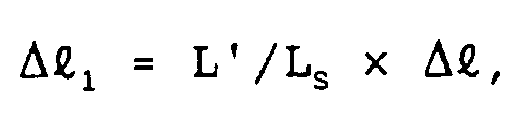

- Thereafter, the trail end of the original S is detected by the original detect
sensor 3. When thecontrol device 70A judges that the trail end of the original S has passed through the second conveyroller pair 2 on the basis of the detection signal from the original detectsensor 3, the third and fourth drive motors M3, M4 are rotated reversely. Further, when the fact that themicroswitch 27 of the second conveyroller pair 2 and amicroswitch 27a of the original detectsensor 3 reach their home positions is detected, the third and fourth drive motors are stopped, to thereby prepare for the next original skew correction. - Since the further operations are the same as those of the first embodiment, explanation thereof will be omitted.
- Next, an image reading apparatus having a sheet conveying apparatus according to a seventh embodiment of the present invention will be explained with reference to
Fig. 13 . - In
Fig. 13 , inclination detectsensors supply roller 10. - When the original S conveyed by the separation/
supply roller 10 is detected by the inclination detectsensors control device 70B shown inFig. 14 , and inclination of the original is calculated by the calculatecircuit 71 on the basis of the detection signals. When the original S is further conveyed and the tip end of the original S reaches the original detect sensor 3 (i.e., when the original is pinched by both second conveyroller pair 2 and third convey roller pair 2'), the skew-feed of the original is corrected by controlling the third and fourth drive motors M3, M4 on the basis of the calculated result. - In case of
Fig. 13 , the second conveyroller pair 2 may be shifted in the direction B1 by an amount of Δℓ2 and the third convey roller pair 2' may be shifted in the direction B2 by an amount of Δℓ2'. Incidentally, the rotational speeds of the motors M3, M4 are selected so that the control is finished before the trail end of the original leaves the third convey roller pair 2'. - The shift control amounts Δℓ2, Δℓ2' of the roller pairs 2, 2' are represented by the following equation, when it is assumed that a distance between the second convey
roller pair 2 and the third convey roller pair 2' is (L1' - L1), skew amount of the original is Δℓ and a width of the original is LS:
regist roller pair 1. - Since a further operations are the same as those of the sixth embodiment, explanation thereof will be omitted.
- In this embodiment, while an example that two pairs of shiftable convey rollers are provided was explained, the present invention is not limited to such an example. Further, a plurality of engageable/disengageable convey rollers may be used. Of course, the lateral regist correction function may be incorporated into the seventh embodiment. In addition, as described in connection with the first embodiment, the shift amounts of the second and third convey
roller pairs 2, 2' may be changed in accordance with the sheet thickness information and/or sheet length information. - In the above explanations, while the present invention was applied to the original image reading apparatus, the present invention may be applied to an image forming apparatus such as a copying machine and a printer, as well.
- Next, an eighth embodiment of the present invention will be explained with reference to the accompanying drawings.
- Incidentally, in embodiments described hereinbelow, a "sheet convey means" corresponds to a second convey
roller pair 2, a "skew amount detection means" corresponds to pass detectsensors sensors regist roller pair control device 70. A "shift means" corresponds to a third drive motor M3, and a "control means" corresponds to thecontrol device 70. An "upstream side sheet convey means" corresponds to a first conveyroller pair 1, a "sheet size detection means" corresponds to original length detectsensors control device 70. A "control amount" (i.e., "difference in drive speed of drive sources", "difference in rotation angular speed of the drive sources", "imaginary shift amount" and "imaginary positional information") is determined by M1Cℓk, M2Cℓk or on the basis of M1Cℓk, M2Cℓk. A "sheet end detection means" corresponds to alateral regist sensor 31 and a "sheet thickness detection sensor" corresponds to a thick detectsensor 33. - An eighth embodiment of the present invention is embodied as an image reading apparatus having a sheet conveying apparatus, which includes a
sheet conveying apparatus 1A and animage reading portion 1B, as shown inFig. 15 . Since a main characteristic of this embodiment resides in thesheet conveying apparatus 1A, thesheet conveying apparatus 1A will be described mainly. - As shown in
Fig. 15 , thesheet conveying apparatus 1A includes asheet supply portion 50, original length detectsensors roller 9, a separation/supply roller pair 10, a first conveyroller pair 11, a second conveyroller 2, an original detectsensor 3, aregist roller pair sensors control device 70. -
Fig. 16 shows an engagement/disengagement mechanism for the first conveyroller pair 11.Figs. 17 and18 show a shift means for shifting the second conveyroller pair 2 in a rotational direction.Fig. 19 is a control block diagram of this embodiment. These elements are the same as those in the first embodiment. - Since a skew correcting operation and a control means for controlling such a skew correcting operation are characteristics of this embodiment, such an operation and control means will be described hereinbelow.
- First of all, when the originals S are set on the
sheet supply portion 50, the size of the original (original length) is detected by the original length detectsensors control device 70. If the original S has small length, thecontrol device 70 turns asolenoid 19 OFF to achieve the engagement condition of the first original conveyroller pair 11; whereas, if the original S has great length, thecontrol device 70 turns thesolenoid 19 ON to achieve the disengagement condition of the first original conveyroller pair 11. - Then, when a start button (not shown) is depressed, the pick-up
roller 9 is rotated by a drive mechanism (not shown) to fed out an uppermost original on the original stack S toward the pair of separation/supply rollers 10. When the single original is fed out, the pair of separation/supply rollers 10 feeds the original toward a downstream side as it is; whereas, if two or more originals are fed out, the lower roller (in the separation/supply roller pair 10) is rotated in a direction opposite to the feeding direction to separate the originals, to thereby convey only the uppermost original S to ward the downstream side. Since the separation mechanism does not directly relate to the present invention, detailed explanation thereof will be omitted. - Thereafter, the original S is conveyed to the
regist roller pair 1 through an original conveypath 55 by the first and second pairs of conveyrollers 2, 11 (or only by the second pair of conveyrollers 2 when the original has great length ℓS2). The pair ofregist rollers 1 are rotated at the same speeds as the original conveying speeds of the first and second pairs of conveyrollers regist rollers 1 is conveyed toward theimage reading portion 1B as it is; meanwhile, the original S is detected by the pass detectsensors control device 70. - In the
control device 70, first of all, inclination of the tip end of the original S is calculated by a calculatecircuit 71 on the basis of the detection signals. Then, the rotational speeds of first drive motor M1 for driving theregist roller 1a and of the second drive motor M2 for driving theregist roller 1b are controlled on the basis of the calculated inclination, to thereby effect the skew correction. For example, in case ofFig. 17 , theregist roller 1b relating to the advanced side of the original is delayed (i.e., the rotational speed of the first drive motor M1 is delayed) to correct the skew-feed. Now, the skew correction will be fully described. - The pulse rate of the skew correction is calculated on the basis of the skew amount, feed amount per one pulse, conveying speed and correction time. For example, in two-phase excitation drive of a two-phase hybrid stepping motor, since the motor is rotated by one revolution by 200 pulses, the motor is rotated by 1.8 degrees per one pulse. When a roller having a diameter of 20 mm is attached to a shaft of this motor to convey the original, a feed amount of 62.8 mm (= 20 mm × π) is obtained when the motor shaft is rotated by one revolution. Regarding one pulse, a feed amount of 0.314 mm (= 20 mm × π / 200 pulse/rot) is obtained. If it is assumed that the skew amount is 6.28 mm, this skew amount corresponds to 20 pulses. If it is assumed that the original conveying speed is 314 mm/sec, the rotational speed of the motor including the roller having the diameter of 20 mm becomes 5 rps (= 314/20π), which corresponds to 1000 pps (regarding the pulse rate).
- Incidentally, the rotational angle per one pulse is varied with the kind of stepping motor and exciting method. Explaining a typical example, in the two-phase excitation drive of the two-phase hybrid stepping motor, the rotational angle per one pulse is 1.8 deg/pulse, and, in 1 - 2 phase excitation drive of the two-phase hybrid stepping motor, the rotational angle per one pulse is 0.9 deg/pulse, and, in four-phase excitation drive of a five-phase hybrid stepping motor, the rotational angle per one pulse is 0.72 deg/pulse, and, in 4 - 5 phase excitation drive of five-phase hybrid stepping motor, the rotational angle per one pulse is 0.36 deg/pulse.
- Motor clock frequency f during normal conveyance and motor clock frequency fr during skew correction are represented as follows:


- Incidentally, the correction time t is a time duration from start of correction and finish of correction and is physically determined by the convey path. For example, when it is assumed that the conveying speed is 314 mm/sec and the correction is desired to be finished within a distance of 31.4 mm, the correction time becomes 0.1 second.
- As a concrete example, it is considered that the skew amount of 6.28 mm is corrected within 0.1 second when the motor is driven with 1000 pps (it is assumed that a back side of the original is delayed). In this case, a back side motor continues to rotate with 1000 pps. On the other hand, a this side motor is driven by 0.1 second with 800 pps (temporarily deduced from 1000 pps), and, thereafter, 1000 pps is returned. By effecting such control, a this side of the original is delayed by an amount of 6.28 mm. While the this side motor is being driven with 800 pps, the original is advanced by 31.4 mm.
- Such coefficient has a value previously determined by tests and is stored in a memory (as a table).
- On the basis of the above-mentioned principle, by controlling the number of revolutions of the first and second drive motors M1, M2 by means of the
control device 70, the skew-feed can be corrected. However, if the skew amount is great, since the great speed reduction of the motors is required, it is considered that the motors themselves cannot follow the speed reduction. Thus, in actual, the back side feed amount and this side feed amount of the original are changed by gradually changing the number of revolutions of the motors. Now, control for effecting the gradual speed reduction will be explained with reference toFigs. 20A and 20B . -
Figs. 20A and 20B are timing charts showing the speed reduction of the motors. Difference in time (time difference) when the original reaches the pass detectsensors Fig. 20A , the speed reduction amount of the motors are changed in accordance with three different skew amounts represented by three lines (broken line : small skew mount, solid line : average skew amount, dot and chain line : great skew amount). An area of speed reduction (area shown by the hatched region inFig. 20B ) corresponds to a delayed amount (Δℓ1) delayed with respect to the feed amount during the normal conveyance at the normal speed. This delayed amount is represented by product of motor speed difference and time. - In case of a stepping motor, the rotational speed of the motor corresponds to difference in frequency of applied clocks. In case of a DC motor, the rotational speed of the motor can be detected by a magnetic encoder or an optical encoder (both are not shown).
- In parallel with the skew correction effected by controlling the
regist rollers control device 70 controls the thrust position of the second conveyroller pair 2. Now, the control of the thrust position of the second conveyroller pair 2 will be described. - In the
control device 70, the shift control amount of the second conveyroller pair 2 is calculated by the calculatecircuit 71 on the basis of the inclination of the tip end of the original S, and the thrust position of the second conveyroller pair 2 is shifted by rotating the third drive motor M3 on the basis of the calculated shift control amount. - For example, a condition shown in
Fig. 17 is considered. The second conveyroller pair 2 is shifted by an amount of Δℓ1 in a direction (shown by the arrow B1) substantially perpendicular to the sheet conveying direction. As a result, the original S being skew-corrected by theregist roller pair 1 is shifted to the direction substantially perpendicular to the sheet conveying direction, to thereby correct the skew-feed with high accuracy. Incidentally, if the original S has small length, during the shifting movement of the original, since the trail end of the original S has already been passed through the nip of the first original conveyroller pair 11, the movement of the original S during the skew correction is not obstructed. Even if the original S being conveyed has great length, since the first original conveyroller pair 11 is previously set to the disengagement condition, the movement of the original S during the skew correction is not obstructed similarly. - The shift amount Δℓ1 of the second original convey
roller pair 2 is approximately represented by the following equation:
roller pair 2, L is a distance between theregist roller pair roller pair 2, Ls is a width of the original S and Δℓ is the inclination of the tip end of the original S. - By shifting the second original convey
roller pair 2 in the thrust direction in this way, the skew correction is effected. Thereafter, the original S reaches the readingglass 5, where the image on the original is read. - Thereafter, when the trail end of the original S is detected by the original detect
sensor 3, thecontrol device 70 detect the fact that the trail end of the original is passed through the second original conveyroller pair 2 on the basis of the detection signal from the original detectsensor 3. As a result, the third drive motor M3 is rotated reversely by thecontrol device 70. Due to the reverse rotation of the third motor M3, the second original conveyroller pair 2 is shifted to a direction shown by the arrow B2 inFig. 17 . When the second original conveyroller pair 2 is returned to the home position, thecontrol device 70 stops the driving of the third drive motor M3 for preparation for next skew correction of original. Incidentally, on the basis of an output signal from a microswitch 27 (Fig. 18 ), it is judged whether or not the second original conveyroller pair 2 is returned to the home position. When the second original conveyroller pair 2 is returned to the home position, themicroswitch 27 is turned ON by aprojection 20b provided on abearing 20. - When the skew correction is effected by the
regist rollers roller pair 2, the movement of the entire original in the rotational direction (skew correction direction) is promoted, and, by not obstructing the movement of the original, the skew correction can be achieved with high accuracy. - In the illustrated embodiment, while an example that one pair of engageable/disengageable original convey rollers are used was explained, a plurality of pairs of such convey rollers may be used. Further, the rotational speed of the third drive motor M3 and the start/stop timing of the rotation of the third drive motor M3 are most preferably depended upon the rotational direction movement of the original S given by the first and second drive motors M1, M2 during the skew correction, but may be selected to be finished at least during the skew correction effected by the first and second drive motors M1, M2.
- Next, a ninth embodiment of the present invention will be explained with reference to
Figs. 21A and 21B . - If the rotational direction movement of the original S during the skew correction does not coincide with the speed and timing of the thrust direction movement of the second original convey
roller pair 2 given by the third motor M3, flexion is generated in the original during the skew correction due to torsion of the original, so that the sliding resistance between the original and the convey guides 54 is increased, to thereby worsen the accuracy of skew correction. In the ninth embodiment, the accuracy of the skew correction is improved by controlling the driving of the motor. Since the other arrangements are substantially the same as those in the eighth embodiment, the difference from the eighth embodiment will be mainly described. - In the ninth embodiment, the control contents of the
control device 70 differs from that in the eighth embodiment. Now, timing charts shown inFigs. 21A and 21B will be explained. - In this case, a case where the original firstly reaches the pass detect
sensor 4a is considered. As shown inFig. 21A , where the original firstly reaches the pass detectsensor 4a, the skew correction is effected by reducing the speed of the second drive motor M2 associated with the pass detectsensor 4a. Meanwhile, the first drive motor M1 continues to convey the original at a speed of V mm/sec. In a time period t2 during which the speed of the second drive motor M2 is being reduced, the third drive motor M3 is rotated to shift the second conveyroller pair 2 in the thrust direction. In this case, the speed of the third drive motor M3 corresponds to the speed reduction of the first drive motor M1. - As described in connection with
Fig. 20B , the shift amount (positional change) of the original during the skew correction is represented by the integrated value of the speed reduction period. In the skew correction control according to this embodiment, since the speed of the first drive motor M1 (or second drive motor M2) is increased or decreased at uniform acceleration, the integrated value is changed not linearly but in a square manner. Accordingly, if the third drive motor M3 is rotated at a uniform speed, the speed of the motor does not coincide with the movement of the original during the skew correction. In the illustrated embodiment, the acceleration of the third drive motor M3 depends upon inclination of acceleration (acceleration inclination) of the speed reduction of the second drive motor M2 so that the thrust shifting movement of the second conveyroller pair 2 can follow the movement of the original during the skew correction completely. Incidentally, inFig. 21A , inclination of a line indicating the speed of each motor corresponds to the acceleration. - When the first, second and third drive motors M1, M2 and M3 are stepping motors, the control shown in
Fig. 21A is actually effected as shown inFig. 21B . That is to say, M1Cℓk is maintained as constant frequency, and, regarding M2Cℓk, frequency is reduced linearly. And, when the frequency reaches a predetermined value, the frequency is increased linearly again to the original or initial frequency. Meanwhile, frequency of M3Cℓk for controlling the third drive motor M3 is increased linearly and then reduced linearly from the change point of M2Cℓk and is stopped. Inclination of change (acceleration) of M3Cℓk in this case depends upon inclination of change (acceleration) of M2Cℓk. - When the first and second drive motor M1, M2, are DC motors, clocks corresponding to M1Cℓk, M2Cℓk are obtained by using encoders to achieve the similar control.
- In the ninth embodiment, the drive motors M1, M2 and M3 were controlled by the
control device 70. However, the drive motors can be controlled in a hardware manner. An example of a circuit used in such hardware control is shown inFig. 22 . - In the example shown in
Fig. 22 , the third drive motor M3 is controlled by a circuit including anM1 counter 80, anM2 counter 82, a differentiatedevice 84, apriority comparator 86 and afrequency variable oscillator 88. M1Cℓk is inputted to theM1 counter 80 and M2Cℓk is inputted to theM2 counter 82. - M2Cℓk is inputted to enable of the
M1 counter 80 and M1Cℓk is inputted to enable of theM2 counter 82 so that clocks of the partner can be counted by Cℓk of itself. TheM1 counter 80 and theM2 counter 82 can output their count values to the differentiatedevice 84. An output value from the frequency variable oscillator 88 (described later) is inputted to CLRs of theM1 counter 80 and theM2 counter 82. - The differentiate
device 84 serves to output difference between the input value from theM1 counter 80 and the input value from theM2 counter 82. If M1Cℓk and M2Cℓk have the same frequency, an absolute value of the output of the differentiatedevice 84 is "1" or "0". Since phases of M1Cℓk and M2Cℓk are not necessarily coincide with each other, the count value may becomes "1", but, since the frequency values are the same, the count value is returned to "0" again. Accordingly, if M1Cℓk and M2Cℓk have the same frequency, the differentiatedevice 84 outputs "1" and "0" repeatedly. - The differentiate
device 84 is connected to thepriority comparator 86 having an output value which varies with a range of the input value In from the differentiatedevice 84. Thefrequency variable oscillator 88 serves to generate M3Cℓk for driving the third drive motor M3. An output value of thepriority comparator 86 is inputted to thefrequency variable oscillator 88, and the oscillation frequency is varied with the input value (output value of the priority comparator 86). - In the illustrated embodiment, if the difference is smaller than ℓ, no output is generated from the
frequency variable oscillator 88. Thefrequency variable oscillator 88 itself may be a V-F converter or carry output of a counter circuit. - Now, a controlling operation of the circuit will be explained with reference to
Fig. 21B . When the original is conveyed in the normal condition, the first and second drive motors M1, M2 are controlled to have the same speed (M1Cℓk=M2Cℓk). Accordingly, in this case, the output of the differentiatedevice 84 is "0" or "1" and no output is generated from thefrequency variable oscillator 88. - If the original passes through the pass detect
sensors 4 in the skew condition, Cℓk frequency of the first or second drive motor M1 or M2 is changed in dependence upon the skew condition. As a result, the difference (output value of the differentiate device 84) between the count value of theM1 counter 80 and the count value of theM2 counter 82 becomes greater. And, when the output value of the differentiatedevice 84 becomes 2 or more, thefrequency variable oscillator 88 outputs an oscillation signal (M3Cℓk) having frequency corresponding to the difference. The grater the difference the greater the oscillation frequency. The driving of the third drive motor M3 is controlled by M3Cℓk generated in this way. - Regarding a large size original and a thick original (having great rigidity), the sliding resistance between the original and the
guides 54 is great. Thus, in dependence upon a pressurizing force and material of the second conveyroller pair 2 and surface features of theguides 54, even when the second conveyroller pair 2 is shifted in the thrust direction during the skew correction, the original S is slipped in the nip of the second conveyroller pair 2, so that the thrust direction movement of the second conveyroller pair 2 does not become coincidence with the movement of the original S, to thereby worsen the accuracy of the skew correction. In such a case, by considering the slip between the second conveyroller pair 2 and the original S, the shift amount of the second conveyroller pair 2 may be determined and controlled. In the control, in order to consider the slip between the second conveyroller pair 2 and the original S, the size and thickness of the original may be used as control parameters. The size and thickness of the original are detected by the original size detect sensor and the original thickness detect sensor. - Incidentally, both the size and thickness of the original are not necessarily used as the parameters, either of the size or the thickness may be used as the parameter. The tenth embodiment is obtained by considering the above problem and is characterized in that a thickness detect sensor is provided to cope with a thick original. Now, the tenth embodiment will be fully described.
- The fundamental arrangement of the tenth embodiment is the same as the above-mentioned embodiments, except that the original thickness detect sensor is provided and a detection result (thickness of the original) from the original thickness detect sensor is used as a control parameter. Thus, the characteristic parts of the tenth embodiment will be mainly explained.
- As shown in
Fig. 23 , the thickness detectsensor 33 includes amovable element 33a which follows the movement of the drivenroller 2b of the second conveyroller pair 2 to be shifted in directions shown by the arrow a, and apotentiometer 33b of non-contact type for detecting a position of themovable element 33a. The thickness detectsensor 33 is positioned in the vicinity of the second conveyroller pair 2. - When the tip end of the original S enters into the nip of the second convey
roller pair 2, the original S is shifted to the left as shown by the fat arrow inFig. 23 while lowering the drivenroller 2b in opposition to the biasing force of the pressurizing spring (not shown). In this case, a shift amount of the drivenroller 2b corresponds to a thickness of the original S. - The
movable element 33a follows the movement of the drivenroller 2b in the engagement/disengagement direction (shown by the arrow a) to change its position. As a result, thepotentiometer 33b outputs a voltage value corresponding to the movement of themovable element 33a (thickness of the original). - Data (or calculation equations) indicating the thickness of the original S and the voltage value outputted from the potentiometer are previously stored in the
control device 70. In thecontrol device 70, on the basis of the voltage value, the thickness of the original S is judged by referring to the data (or using the voltage value in the calculation equations). And, on the basis of the judged result, the shift amount of the second original conveyroller pair 2 is determined. - An eleventh embodiment of the present invention is characterized in that the second convey
roller pair 2 is shifted in the thrust direction while ascertaining the position of the original by thelateral regist sensor 31. -
Fig. 24 is a plan view a skew correction portion of a sheet conveying apparatus of an image reading apparatus according to the eleventh embodiment. InFig. 24 , the same elements as those inFig. 17 are designated by the same reference numerals and explanation thereof will be omitted. - The
lateral regist sensor 31 serves to detect the end of the original S after the tip end of the original S being conveyed reaches the original detectsensor 3. More specifically, thelateral regist sensor 31 according to the illustrated embodiment is constituted by an optical sensor of permeable type disposed at a predetermined position in the vicinity of and at a downstream side of the second convey roller pair 2 (i.e., disposed side by side with the original detectsensor 3 in the direction substantially perpendicular to the conveying direction and in the vicinity of the end of the original stack). Thelateral regist sensor 31 outputs a detection signal to thecontrol device 70 when the original S is positioned above (or below) thelateral regist sensor 31. - When the tip end of the original S being conveyed reaches the original detect
sensor 3, if the presence of the original is detected by thelateral regist sensor 31, the third drive motor M3 is rotated to shift the second conveyroller pair 2 in the direction B1. In this case, since the original S is pinched by the second conveyroller pair 2, the original is shifted in the direction B1 together with the second conveyroller pair 2. When the detection result of thelateral regist sensor 31 is changed to a condition representing "absence" of the original, thecontrol device 70 judges that the end of the original reaches thelateral regist sensor 31 and stops the driving of the third drive motor M3. - To the contrary, when the tip end of the original S being conveyed reaches the original detect
sensor 3, if the "absence" of the original is detected by thelateral regist sensor 31, thecontrol device 70 rotates the third drive motor M3 to shift the second conveyroller pair 2 in the direction B2. When the detection result of thelateral regist sensor 31 is changed to a condition representing "presence" of the original, thecontrol device 70 judges that the end of the original reaches thelateral regist sensor 31 and stops the driving of the third drive motor M3. - The positions of the
sensors regist roller pair 1. With the above-mentioned arrangement and controls, while the original S is being pinched by the nip of theregist roller pair 1, the end of the original S is always positioned in the lateralregist sensor portion 31, to thereby permit the lateral registration. - In the illustrated embodiment, while an example that the single
lateral regist sensor 31 is used was explained, a plurality of lateral regist sensors may be provided in accordance with the original size (length in the lateral direction) or the lateral regist sensor may be shifted in accordance with the original size or the lateral regist sensor may be set at any position by the operator. - Next, an image reading apparatus having a sheet conveying apparatus according to a twelfth embodiment of the present invention will be explained with reference to
Figs. 25 ,26 and27 . - As shown in
Figs. 25 and26 , an image reading apparatus according to the twelfth embodiment includes a third pair of convey rollers 2' disposed at a downstream side of the second conveyroller pair 2, and a thrust position of the third convey roller pair 2' can be controlled by a fourth drive motor M4. Incidentally, since the construction and operation (including detection of home position by using themicroswitch 27a) of the third convey roller pair 2' are the same as those of the second conveyroller pair 2, explanation thereof will be omitted. - Now, an operation will be described (
Fig. 27 shows a control arrangement). - The original S entered into and pinched by the nip of the
regist roller pair 1 is conveyed to theimage reading portion 53 as it is; meanwhile, the original passes through the pass detectsensors control device 70A shown inFig. 27 calculates the inclination of the original S on the basis of the detection signals from the pass detectsensors roller pairs 2, 2' are shifted. Now, the control of the thrust positions will be fully described. - The calculate
circuit 71 of thecontrol device 70A calculates the shift control amounts of the second and third conveyroller pairs 2, 2' on the basis of the inclination of the tip end of the original S. By rotating the third and fourth drive motors M3, M4 by required amounts on the basis of the calculated result, the thrust positions of the second and third conveyroller pairs 2, 2' are shifted. The second conveyroller pair 2 is shifted in the direction B1 by an amount of Δℓ1' and the third convey roller pair 2' is shifted in the direction B1 by an amount of Δℓ1 (refer toFig. 26 ). In this case, the shift amount Δℓ1' of the second conveyroller pair 2 and the shift amount Δℓ1 of the third convey roller pair 2' are represented by the following equations:

roller pair 2, Δℓ is the inclination of the tip end of the original S, L is a distance from theregist roller pair 1 to the second conveyroller pair 2, L' is a distance from theregist roller pair 1 to the third convey roller pair 2' and Ls is a width of the original S. - Thereafter, when the trail end of the original S is detected by the original detect
sensor 3, thecontrol device 70A judges that the trail end of the original S has passed through the second conveyroller pair 2 on the basis of the detection signal from the original detectsensor 3. As a result, the third and fourth drive motors M3, M4 are rotated reversely by thecontrol device 70. - By the reverse rotations of the third and fourth drive motors M3, M4, the second and third convey
roller pairs 2, 2' are sifted in the direction B2 inFig. 26 . When the second and third conveyroller pairs 2, 2' are returned to their home positions, thecontrol device 70A stops the third and fourth drive motors M3, M4, to thereby prepare for the next original skew correction. Since the further operations are the same as those of the eighth embodiment, explanation thereof will be omitted. - Next, an image reading apparatus having a sheet conveying apparatus according to a thirteenth embodiment of the present invention will be explained with reference to
Figs. 28 and29 . - In the thirteenth embodiment, in place of the pass detect
sensors sensors - The inclination detect sensors, 32a, 32b serve to detect the inclination of the tip end of the original after the sheet supply and are spaced apart from each other with a predetermined distance therebetween along the direction substantially perpendicular to the conveying direction and are disposed in the vicinity of and at a downstream side of the separation/
supply roller pair 10. A control arrangement of the thirteenth embodiment is shown inFig. 29 . - Now, an operation will be explained. When the original S conveyed by the separation/
supply roller pair 10 is detected by the inclination detectsensors control device 70B, and inclination of the original S is calculated by a calculatecircuit 71 of thecontrol device 70B on the basis of the detection signals. - Thereafter, when the original S is further conveyed and the tip end of the original S reaches the original detect sensor 3 (i.e., when the original is pinched by both second convey
roller pair 2 and third convey roller pair 2'), the skew-feed of the original is corrected by controlling the third and fourth drive motors M3, M4 by means of thecontrol device 70B on the basis of the calculated result. - In case of
Fig. 28 , the second conveyroller pair 2 may be shifted in the direction B1 by an amount of Δℓ2 and the third convey roller pair 2' may be shifted in the direction B2 by an amount of Δℓ2'. Incidentally, the rotational speeds of the motors M3, M4 are selected so that the control is finished before the trail end of the original leaves the third convey roller pair 2'. - The shift control amounts Δℓ2, Δℓ2' of the roller pairs 2, 2' are represented by the following equation:

roller pair 2, Δℓ2' is the shift control amount of the third convey roller pair 2', (L1' - L1) is a distance between the second conveyroller pair 2 and the third convey roller pair 2', Δℓ is the skew amount of the original and Ls is a width of the original. - The original S skew-corrected in this way reaches the
regist roller pair 1. Since a further operations are the same as those of the twelfth embodiment, explanation thereof will be omitted. - In this embodiment, while an example that two pairs of shiftable convey rollers are provided was explained, the present invention is not limited to such an example. Further, a plurality of engageable/disengageable convey rollers may be used.
- Of course, the lateral regist correction function as described in connection with the eleventh embodiment may be incorporated into the thirteenth embodiment. In addition, as described in connection with the eighth embodiment, the shift amounts of the second and third convey
roller paris 2, 2' may be changed in accordance with the sheet thickness information (representing the original thickness) and/or sheet length information (representing the original length). - In the above explanations, while the present invention was applied to the original image reading apparatus, the present invention may be applied to an image forming apparatus such as a copying machine and a printer, as well.
- As mentioned above, according to the present invention, by controlling the thrust positions of the convey roller pairs during the skew correction, the rotational direction movement of the original during the skew correction can be promoted, to thereby improve the accuracy of the skew correction.
- By changing the thrust positions of the convey roller pairs in accordance with the thickness and/or size of the original, the accuracy of the skew correction can be maintained regarding various originals having various thicknesses and sizes and the originals can be conveyed with minimum sheet interval.
- Further, by applying the sheet conveying apparatus to the image reading apparatus or the image forming apparatus, in apparatus having the same conveying speed, the number of sheet to be treated per unit time can be increased and productivity can be improved.
- Incidentally, in the above-mentioned embodiments, while an example that the conveying speed of the convey roller pair regarding the advanced side (front corner) of the original is delayed with respect to the other convey roller pair to correct the skew-feed was explained, the present invention is not limited to such an example, but, the skew-feed may be corrected by increasing the conveying speed of the convey roller pair regarding the delayed side of the original with respect to the other convey roller pair. Further, the skew-feed may be corrected by decreasing the conveying speed of the convey roller pair regarding the advanced side of the original and by increasing the conveying speed of the convey roller pair regarding the delayed side of the original.
- The present invention provides a sheet conveying apparatus, and an image reading apparatus and an image forming apparatus having such a sheet conveying apparatus, in which skew correction of a sheet can be effected with high accuracy. A sheet convey means is provided at an upstream side of a skew correction means for correcting skew-feed of a sheet, and the sheet convey means is shifted by a shift means in a direction substantially perpendicular to the sheet conveying direction. A control means drives the shift means to shift the sheet convey means pinching the sheet to be skew-corrected by the skew correction means by a distance corresponding to a sheet skew amount on the basis of sheet skew amount information from a sheet skew amount detection means for detecting a skew amount of the sheet, thereby shifting the sheet in a skew correction direction.
Claims (20)
- A sheet conveying apparatus (1A) comprising a skew correction function for correcting skew-feed of a sheet (S), wherein the skew correction function is executed while conveyance of the sheet is continued without a stop, comprising:a sheet convey portion (51) comprising at least one sheet convey means (2) having at least one set of roller pair (2a, 2b), and at least one shift means adapted to shift a respective one of said sheet convey means pinching the sheet in a direction (B) perpendicular to the sheet conveying direction,a regist portion (52) located downstream to the sheet convey portion (51), said regist portion comprising two sets of roller pairs (1a, 1b) independently disposed on a line perpendicular to the sheet conveying direction and two drive sources (M1, M2) for driving said roller pairs independently,a sheet skew amount detection means (4a, 4b) adapted to detect a skew amount of the sheet conveyed by said sheet convey portion, anda control means (70, 70A) adapted
to process the detected skew amount of said sheet and to determine an inclination value of the sheet,
to effect skew correction by controlling the regist portion (52) to adjust the speeds of the two sets of roller pairs (1a, 1b) to different values on the basis of determined inclination so as to turn the sheet for correcting skew, and
to control, during the skew correction by the regist portion (52), the at least one shift means to shift said at least one sheet convey means (2) by an amount (All) determined on the basis of the skew amount. - A sheet conveying apparatus comprising a skew correction function for correcting skew-feed of a sheet (S), wherein the skew correction function is executed while conveyance of the sheet is continued without a stop, comprising:a sheet convey portion comprising a plurality of sheet convey means (2, 2') having a set of roller pairs, and a plurality of shift means (21, 21') adapted to independently shift a respective one of said sheet convey means pinching the sheet in a direction (B) perpendicular to the sheet conveying direction, wherein the sheet convey means are located parallel to each other in the sheet convey direction,a sheet skew amount detection means (32a, 32b) adapted to detect a skew amount of the sheet conveyed by said sheet convey portion, anda control means (70B) adapted
to process the detected skew amount of said sheet, and
to effect skew correction by controlling the sheet convey portion to drive the plurality of shift means to shift said plurality of sheet convey means by an amount determined on the basis of the skew amount and to adjust a driving speed of the shift means on the basis of the detected skew amount so as to finish the skew correction before a trail end of the sheet leaves the plurality of sheet convey means. - A sheet conveying apparatus according to claim 1, wherein the control means (70, 70A) is adapted to determine the amount used for controlling the at least one shift means to shift said at least one sheet convey means on the basis of the inclination value or on the basis of a control amount of driving speeds of said drive sources.
- A sheet conveying apparatus according to claim 1 or 2, further comprising:at least one engageable/disengageable upstream sheet convey means (11) disposed upstream of said sheet convey means in the sheet conveying direction;a sheet size detection means (3S, 3L) disposed upstream of said upstream side sheet convey means (11) in the sheet conveying direction for detecting a length of the sheet (S) in the sheet conveying direction; andan engagement/disengagement control means (70, 70A, 70B) for selectively effecting engagement or disengagement of said upstream sheet convey means on the basis of sheet length information detected by said sheet size detection means.
- A sheet conveying apparatus according to one of claims 1 to 4, wherein said plurality of sheet convey means are arranged side by side along a direction perpendicular to the sheet conveying direction, and said control means (70, 70A, 70B) is adapted to control the respective sheet convey means independently on the basis of sheet skew amount information detected by said sheet skew amount detection means.
- A sheet conveying apparatus according to claim 1, 2 or 5, wherein said control means (70, 70A, 70B) is adapted to effect a position control of said sheet convey means to coincide with a movement of the sheet (S) in the sheet skew correction direction during the skew correction.
- A sheet conveying apparatus according to claim 1, 2 or 5, wherein said control means (70, 70A, 70B) is adapted to effect a position control of said sheet convey means during the skew correction performed by said skew correction means.
- A sheet conveying apparatus according to one of claims 1 to 7, further comprising an enlarged portion (54) formed in a part of a sheet convey path (55) for conveying the sheet (S) from said sheet convey means to said skew correction means.
- A sheet conveying apparatus according to one of claims 1 to 7, wherein apart of walls defining a sheet convey path (55) for conveying the sheet from said sheet convey means to said skew correction means is constituted by a rockable member (54a).
- A sheet conveying apparatus according to claim 1 or 2, further comprising a sheet end detection means (3) disposed in the vicinity of said sheet convey means (2) for detecting an end of the sheet (S), and wherein said control means (70, 70A, 70B) is adapted to control the shifting movement of said sheet convey means until the end of the sheet is detected by said sheet end detection means.
- A sheet conveying apparatus according to claim 10, wherein said control means (70, 70A, 70B) is adapted to control the shifting movement of said sheet convey means (2) from when the sheet is pinched by said sheet convey means till when the tip end of the sheet reaches said skew correction means.
- A sheet conveying apparatus according to claim 1 or 2, further comprising a sheet thickness detection means (33) disposed upstream of said sheet convey means (2) in the sheet conveying direction and adapted to detect a thickness of the sheet (S), and wherein said control means (70, 70A, 70B) is adapted to control the shifting movement of said sheet convey means on the basis of sheet thickness information detected by said sheet thickness detection means and the sheet skew amount information.
- A sheet conveying apparatus according to claim 1 or 2, further comprising a sheet size detection means (3S, 3L) disposed upstream of said sheet convey means (2) in the sheet conveying direction and adapted to detect a size of the sheet (S), and wherein said control means (70, 70A, 70B) is adapted to control the shifting movement of said sheet convey means on the basis of sheet size information detected by said sheet size detection means and the sheet skew amount information.
- A sheet conveying apparatus according to claim 1 or 2, further comprising:at least one engageable/disengageable upstream sheet convey means (11) disposed upstream of said sheet convey means (2) in the sheet conveying direction;a sheet size detection means (3S, 3L) disposed upstream of said upstream side sheet convey means (11) in the sheet conveying direction for detecting a length of the sheet (S) in the sheet conveying direction; andan engagement/disengagement control means (70, 70A, 70B) for effecting engagement or disengagement of said upstream sheet convey means on the basis of a detection result of said sheet size detection means.
- A sheet conveying apparatus according to one of claims 1, 2 and 14, wherein said control means (70, 70A, 70B) is adapted to control the shifting movement of said sheet convey means (2) during the skew correction effected by said control means (70, 70A, 70B) .
- A sheet conveying apparatus according to one of claims 1 and 15, wherein said control means (70, 70A, 70B) is adapted to effect the control so that driving speeds or rotational angular speeds of said drive sources (M1, M2) differ from each other.
- A sheet conveying apparatus according to one of claims 1 and 14 to 15, wherein a control amount is imaginary shift amount or imaginary position information of the sheet member (S) when the sheet member is conveyed by said drive sources (M1, M2).
- A sheet conveying apparatus according to claim 10, wherein said control means (70, 70A, 70B) is adapted to control the shifting movements of said sheet convey means (2) from when the sheet member is pinched by said sheet convey means till when the tip end of the sheet member reaches said roller pairs.
- An image reading apparatus comprising:an image reading portion (5, 12) for reading an image on a sheet member (S); andsaid sheet conveying apparatus according to one of claims 1 to 18 disposed upstream of said image reading portion.
- An image forming apparatus comprising:an image forming portion for reading an image on a sheet member (S); andsaid sheet conveying apparatus according to one of claims 1 to 18 disposed upstream of said image forming portion.
Applications Claiming Priority (6)
| Application Number | Priority Date | Filing Date | Title |
|---|---|---|---|
| JP33875596A JP3592013B2 (en) | 1996-12-18 | 1996-12-18 | Sheet conveying device, image reading device and image forming device provided with the same |
| JP338755/96 | 1996-12-18 | ||
| JP33875596 | 1996-12-18 | ||
| JP17870297 | 1997-07-03 | ||
| JP178702/97 | 1997-07-03 | ||
| JP17870297A JP3592038B2 (en) | 1997-07-03 | 1997-07-03 | Sheet conveying device, and image reading device and image forming device provided with the same |
Publications (3)
| Publication Number | Publication Date |
|---|---|
| EP0849929A2 EP0849929A2 (en) | 1998-06-24 |
| EP0849929A3 EP0849929A3 (en) | 2001-01-24 |
| EP0849929B1 true EP0849929B1 (en) | 2009-07-29 |
Family
ID=26498794
Family Applications (1)
| Application Number | Title | Priority Date | Filing Date |
|---|---|---|---|
| EP97122285A Expired - Lifetime EP0849929B1 (en) | 1996-12-18 | 1997-12-17 | Sheet conveying apparatus |
Country Status (3)
| Country | Link |
|---|---|
| US (1) | US6059285A (en) |
| EP (1) | EP0849929B1 (en) |
| DE (1) | DE69739514D1 (en) |
Cited By (3)
| Publication number | Priority date | Publication date | Assignee | Title |
|---|---|---|---|---|
| CN102050339A (en) * | 2009-11-02 | 2011-05-11 | 株式会社理光 | Rotation measuring mechanism, sheet conveyance apparatus, and image forming apparatus |
| DE102022125020A1 (en) * | 2022-09-28 | 2024-03-28 | Koenig & Bauer Ag | Method for the axial adjustment of transport sections of at least one alignment section |
| WO2024068150A1 (en) | 2022-09-28 | 2024-04-04 | Koenig & Bauer Ag | Processing machine, and method for controlling at least one alignment line of a processing machine |
Families Citing this family (81)
| Publication number | Priority date | Publication date | Assignee | Title |
|---|---|---|---|---|
| CN1256709C (en) * | 1996-01-25 | 2006-05-17 | 三洋电机株式会社 | Method for determining true and false of paper documents and input direction of paper documents |
| US6682068B1 (en) * | 1997-11-28 | 2004-01-27 | Diebold, Incorporated | Document alignment mechanism for currency recycling automated banking machine |
| US6290351B1 (en) * | 1999-11-01 | 2001-09-18 | Xerox Corporation | Printer having precision sheet transport control method and apparatus |
| DE10023290A1 (en) * | 2000-05-12 | 2001-11-15 | Nexpress Solutions Llc | Aligning unit for sheets in offset printing machine comprises pairs of rollers which grip sheet, at least two rollers which lie in same plane being able to slide sideways with respect to remaining rollers |
| DE10023940B4 (en) | 2000-05-17 | 2008-07-17 | Eastman Kodak Co. | Device for aligning sheet material during transport |
| US6622582B1 (en) | 2000-07-14 | 2003-09-23 | Lexmark International, Inc. | Assembly for limiting axial motion of shaft in an imaging apparatus |
| DE10059004A1 (en) * | 2000-11-28 | 2002-07-25 | Nexpress Solutions Llc | Device for generating an offset of transported flexible flat material |
| JP4580602B2 (en) * | 2001-09-21 | 2010-11-17 | 株式会社東芝 | Paper sheet processing equipment |
| US6901237B2 (en) * | 2002-06-05 | 2005-05-31 | Sharp Kabushiki Kaisha | Image reading device and image forming apparatus |
| DE10236028A1 (en) * | 2002-08-06 | 2004-02-19 | Giesecke & Devrient Gmbh | Alignment method for banknotes in transport system with alignment of individual notes detected, and corrected dependent upon any measured wrong alignment |
| US6634521B1 (en) * | 2002-08-28 | 2003-10-21 | Xerox Corporation | Sheet registration and deskewing system with independent drives and steering |
| JP2004099244A (en) * | 2002-09-10 | 2004-04-02 | Canon Inc | Sheet transport device |
| US6952556B2 (en) * | 2002-10-25 | 2005-10-04 | Canon Kabushiki Kaisha | Heating apparatus, sheet feeding apparatus and image forming apparatus |
| DE102004004253B4 (en) * | 2003-02-24 | 2008-07-24 | Heidelberger Druckmaschinen Ag | Method and device for aligning individual moving sheet-shaped substrates |
| JP2004352402A (en) * | 2003-05-27 | 2004-12-16 | Sharp Corp | Sheet conveying device, image reading device, and image forming device |
| JP4194437B2 (en) * | 2003-07-17 | 2008-12-10 | キヤノン株式会社 | Image forming apparatus |
| JP2005041604A (en) * | 2003-07-23 | 2005-02-17 | Canon Inc | Sheet conveying apparatus, image forming apparatus, and image reading apparatus |
| JP4235503B2 (en) * | 2003-07-23 | 2009-03-11 | キヤノン株式会社 | Sheet conveying apparatus, image forming apparatus, and image reading apparatus |
| JP4350450B2 (en) * | 2003-08-04 | 2009-10-21 | キヤノン株式会社 | Sheet conveying apparatus, image forming apparatus, and image reading apparatus |
| US20050082746A1 (en) * | 2003-08-04 | 2005-04-21 | Yoshiyuki Tsuzawa | Sheet member transporting device and method of controlling the same |
| US7140605B2 (en) * | 2003-08-26 | 2006-11-28 | Canon Kabushiki Kaisha | Sheet feeding apparatus and image forming apparatus equipped with this sheet feeding apparatus |
| US20050067757A1 (en) * | 2003-08-26 | 2005-03-31 | Takeshi Suga | Sheet feeding apparatus and image forming apparatus having the same |
| US6910689B2 (en) * | 2003-08-29 | 2005-06-28 | Xerox Corporation | Precision paper registration using a stepper motor without employing micro-stepping techniques |
| US7209695B2 (en) * | 2003-09-24 | 2007-04-24 | Canon Kabushiki Kaisha | Image forming apparatus with detaching mechanism for fixing heater |
| US7283778B1 (en) | 2003-09-24 | 2007-10-16 | Canon Kabushiki Kaisha | Image forming apparatus with heating member control based on door opening state and heating member position |
| JP4402508B2 (en) * | 2004-04-28 | 2010-01-20 | キヤノン株式会社 | Image forming apparatus |
| JP4324047B2 (en) * | 2004-07-20 | 2009-09-02 | キヤノン株式会社 | Sheet conveying apparatus, image forming apparatus, and image reading apparatus |
| US7643161B2 (en) | 2004-10-27 | 2010-01-05 | Hewlett-Packard Development Company, L.P. | Inter-device media handler |
| US7684749B2 (en) | 2005-06-17 | 2010-03-23 | Konica Minolta Business Technologies, Inc. | Image forming apparatus with transfer attitude correcting section |
| JP4307429B2 (en) * | 2005-09-13 | 2009-08-05 | キヤノン株式会社 | Sheet processing apparatus and image forming apparatus |
| JP4785474B2 (en) * | 2005-09-13 | 2011-10-05 | キヤノン株式会社 | Sheet processing apparatus and image forming apparatus |
| JP4176754B2 (en) * | 2005-09-21 | 2008-11-05 | シャープ株式会社 | Document feeder |
| CN1986219B (en) * | 2005-12-23 | 2011-04-20 | 海德堡印刷机械股份公司 | Method for correcting the lateral position of a printing material, device, conveying system and processing machine |
| GB0602207D0 (en) * | 2006-02-04 | 2006-03-15 | Mach Shop Special Effects Ltd | Discharge of paper and other leaves from a stack |
| JP4724603B2 (en) * | 2006-05-26 | 2011-07-13 | キヤノン株式会社 | Sheet conveying apparatus, image forming apparatus, and image reading apparatus |
| JP2007326708A (en) * | 2006-06-09 | 2007-12-20 | Sharp Corp | Off-center adjustment device |
| JP4750748B2 (en) * | 2006-06-21 | 2011-08-17 | 株式会社リコー | Paper transport device and image forming apparatus using the same |
| JP4739127B2 (en) * | 2006-06-22 | 2011-08-03 | キヤノン株式会社 | Sheet conveying apparatus, image forming apparatus, and image reading apparatus |
| JP4764282B2 (en) * | 2006-08-08 | 2011-08-31 | キヤノン株式会社 | Sheet conveying apparatus and image forming apparatus |
| US7669842B2 (en) * | 2006-08-22 | 2010-03-02 | Xerox Corporation | Sheet rotator |
| US7527263B2 (en) * | 2006-09-13 | 2009-05-05 | Xerox Corporation | Pre-registration apparatus |
| US8056897B2 (en) * | 2007-03-29 | 2011-11-15 | Xerox Corporation | Moving sensor for sheet edge position measurement |
| US7641188B2 (en) * | 2007-04-24 | 2010-01-05 | Canon Kabushiki Kaisha | Sheet feeding apparatus and image forming apparatus |
| JP4958670B2 (en) * | 2007-07-24 | 2012-06-20 | キヤノン株式会社 | Image processing device |
| US7775518B2 (en) * | 2007-08-30 | 2010-08-17 | Kabushiki Kaisha Toshiba | Sheet carrying device and sheet carrying method |
| JP5078532B2 (en) * | 2007-10-05 | 2012-11-21 | キヤノン株式会社 | Sheet conveying apparatus and image forming apparatus |
| US7819399B2 (en) * | 2008-02-04 | 2010-10-26 | Xerox Corporation | Method and apparatus for relieving stress in a pre-registration nip |
| TW200940343A (en) * | 2008-03-25 | 2009-10-01 | Kinpo Elect Inc | Skew rectification mechanism for fed paper |
| JP5197162B2 (en) * | 2008-05-28 | 2013-05-15 | キヤノン株式会社 | Sheet conveying apparatus and image forming apparatus |
| DE102008038771B4 (en) * | 2008-08-12 | 2019-12-19 | Wincor Nixdorf International Gmbh | Device for aligning at least one note during transport along a transport route |
| US20100090391A1 (en) * | 2008-10-10 | 2010-04-15 | Xerox Corporation | Nip release system |
| US7845635B2 (en) * | 2008-11-19 | 2010-12-07 | Xerox Corporation | Translating registration nip systems for different width media sheets |
| JP5177683B2 (en) * | 2009-03-12 | 2013-04-03 | 株式会社リコー | Image reading apparatus and copying machine |
| US8180272B2 (en) * | 2009-04-30 | 2012-05-15 | Xerox Corporation | Movable trail edge sensor for duplex registration |
| US8746692B2 (en) * | 2009-04-30 | 2014-06-10 | Xerox Corporation | Moveable drive nip |
| US8571460B2 (en) * | 2009-06-09 | 2013-10-29 | Xerox Corporation | Calculation of correction factors for lead edge sensor measurement in duplex registration |
| US8020859B2 (en) * | 2009-08-26 | 2011-09-20 | Xerox Corporation | Edge sensor gain calibration for printmaking devices |
| US8494430B2 (en) * | 2009-09-10 | 2013-07-23 | Xerox Corporation | Apparatus and method for the registration and de-skew of substrate media |
| KR101113424B1 (en) | 2010-08-19 | 2012-03-02 | 삼성에스디아이 주식회사 | apparatus of correcting belt-meandering for secondary battery |
| JP5618704B2 (en) | 2010-08-25 | 2014-11-05 | キヤノン株式会社 | Sheet feeding apparatus and image forming apparatus |
| JP5445510B2 (en) * | 2011-05-11 | 2014-03-19 | コニカミノルタ株式会社 | Conveying apparatus and image forming apparatus |
| JP5533794B2 (en) * | 2011-06-23 | 2014-06-25 | コニカミノルタ株式会社 | Image forming apparatus |
| US9296584B2 (en) * | 2011-09-30 | 2016-03-29 | Lexmark International, Inc. | Translatable roller media aligning mechanism |
| JP5893642B2 (en) * | 2011-11-29 | 2016-03-23 | キヤノン株式会社 | Skew correction device and image forming apparatus |
| US8851470B2 (en) * | 2012-02-17 | 2014-10-07 | Ricoh Company, Limited | Conveying device and image forming apparatus |
| JP5582159B2 (en) | 2012-03-28 | 2014-09-03 | コニカミノルタ株式会社 | Sheet conveying apparatus and image processing apparatus |
| JP5606486B2 (en) * | 2012-04-09 | 2014-10-15 | キヤノン株式会社 | Skew correction device and image forming apparatus |
| US10079948B2 (en) * | 2016-04-26 | 2018-09-18 | Panasonic Intellectual Property Management Co., Ltd. | Image reading apparatus provided with original document skew correction function |
| JP7040005B2 (en) * | 2017-12-27 | 2022-03-23 | セイコーエプソン株式会社 | Media feeder and image reader |
| JP2019156582A (en) * | 2018-03-14 | 2019-09-19 | コニカミノルタ株式会社 | Image forming apparatus |
| JP7119835B2 (en) * | 2018-09-26 | 2022-08-17 | コニカミノルタ株式会社 | Post-processing device |
| JP7274859B2 (en) | 2018-12-20 | 2023-05-17 | 株式会社Pfu | MEDIUM CONVEYING DEVICE, CONTROL METHOD AND CONTROL PROGRAM |
| JP7211794B2 (en) | 2018-12-20 | 2023-01-24 | 株式会社Pfu | MEDIUM CONVEYING DEVICE, CONTROL METHOD AND CONTROL PROGRAM |
| JP7125366B2 (en) | 2019-03-20 | 2022-08-24 | 株式会社Pfu | MEDIUM CONVEYING DEVICE, CONTROL METHOD AND CONTROL PROGRAM |
| JP7189055B2 (en) | 2019-03-20 | 2022-12-13 | 株式会社Pfu | MEDIUM CONVEYING DEVICE, CONTROL METHOD AND CONTROL PROGRAM |
| JP7321805B2 (en) | 2019-07-09 | 2023-08-07 | キヤノン株式会社 | Sheet feeding device, image reading device and image forming device |
| JP7848553B2 (en) * | 2022-03-29 | 2026-04-21 | 富士フイルムビジネスイノベーション株式会社 | Sheet transport device and image forming apparatus |
| JP2023145856A (en) * | 2022-03-29 | 2023-10-12 | 富士フイルムビジネスイノベーション株式会社 | Media transport device and image forming device |
| JP2023146508A (en) * | 2022-03-29 | 2023-10-12 | 富士フイルムビジネスイノベーション株式会社 | Sheet conveyance device and image forming device |
| JP7848551B2 (en) * | 2022-03-29 | 2026-04-21 | 富士フイルムビジネスイノベーション株式会社 | Sheet transport device and image forming apparatus |
| JP2026067088A (en) * | 2024-10-08 | 2026-04-20 | 京セラドキュメントソリューションズ株式会社 | Electronic device, resist unit, and method for driving resist unit |
Family Cites Families (26)
| Publication number | Priority date | Publication date | Assignee | Title |
|---|---|---|---|---|
| JPS5878937A (en) * | 1981-11-05 | 1983-05-12 | Toshiba Corp | Document feeding device |
| US4621801A (en) * | 1984-12-06 | 1986-11-11 | Xerox Corporation | Document edge registration system |
| GB8515272D0 (en) * | 1985-06-17 | 1985-07-17 | De La Rue Syst | Monitoring sheet length |
| JPS6382255A (en) * | 1986-09-22 | 1988-04-13 | Canon Inc | Sheet conveyor |
| EP0300095A1 (en) * | 1987-07-20 | 1989-01-25 | Agfa-Gevaert N.V. | An electrophotographic printer with angular sheet alignment |
| US4995601A (en) * | 1987-12-28 | 1991-02-26 | Canon Kabushiki Kaisha | Anti-skew sheet feeding device for image forming apparatus and sheet storage device for use therein |
| JPH028133A (en) * | 1988-06-27 | 1990-01-11 | Canon Inc | Sheet conveyor |
| EP0398187B1 (en) * | 1989-05-12 | 1994-08-31 | Canon Kabushiki Kaisha | Sheet inverting apparatus |
| ES2088400T3 (en) * | 1989-12-07 | 1996-08-16 | Mars Inc | DEVICE FOR ORIENTATION OF LEAVES. |
| JPH03211147A (en) * | 1990-01-11 | 1991-09-13 | Toyo Commun Equip Co Ltd | Skew detecting device for paper sheet conveyor |
| US5090683A (en) * | 1990-07-31 | 1992-02-25 | Xerox Corporation | Electronic sheet rotator with deskew, using single variable speed roller |
| JPH04173643A (en) * | 1990-11-05 | 1992-06-22 | Mita Ind Co Ltd | Paper feed mechanism for image forming device |
| US5078384A (en) * | 1990-11-05 | 1992-01-07 | Xerox Corporation | Combined differential deskewing and non-differential registration of sheet material using plural motors |
| JPH04277151A (en) * | 1991-03-04 | 1992-10-02 | Canon Inc | Sheet material transport device |
| JPH04327445A (en) * | 1991-04-25 | 1992-11-17 | Murata Mach Ltd | Bias feed correcting device |
| JP2527508B2 (en) * | 1991-07-29 | 1996-08-28 | 株式会社三井ハイテック | Lead frame and manufacturing method thereof |
| US5982400A (en) | 1991-08-22 | 1999-11-09 | Canon Kabushiki Kaisha | Sheet feeding apparatus and image forming system |
| US5156391A (en) * | 1991-11-04 | 1992-10-20 | Xerox Corporation | Short paper path electronic deskew system |
| US5219159A (en) | 1992-06-01 | 1993-06-15 | Xerox Corporation | Translating nip registration device |
| US5273274A (en) * | 1992-09-04 | 1993-12-28 | Xerox Corporation | Sheet feeding system with lateral registration and method for registering sheets |
| JP3298982B2 (en) * | 1993-06-10 | 2002-07-08 | キヤノン株式会社 | Image forming device |
| EP0658503B1 (en) * | 1993-12-17 | 2001-04-04 | Canon Kabushiki Kaisha | Sheet conveying apparatus |
| JPH07319241A (en) * | 1994-05-23 | 1995-12-08 | Canon Inc | Sheet material feeding device and image forming apparatus |
| JPH0881091A (en) * | 1994-09-08 | 1996-03-26 | Canon Inc | Image forming device |
| US5681036A (en) * | 1994-10-07 | 1997-10-28 | Canon Kabushiki Kaisha | Sheet feeding device with control of skew-correction |
| US5697609A (en) * | 1996-06-26 | 1997-12-16 | Xerox Corporation | Lateral sheet pre-registration device |
-
1997
- 1997-12-16 US US08/991,856 patent/US6059285A/en not_active Expired - Lifetime
- 1997-12-17 EP EP97122285A patent/EP0849929B1/en not_active Expired - Lifetime
- 1997-12-17 DE DE69739514T patent/DE69739514D1/en not_active Expired - Lifetime
Cited By (9)
| Publication number | Priority date | Publication date | Assignee | Title |
|---|---|---|---|---|
| CN102050339A (en) * | 2009-11-02 | 2011-05-11 | 株式会社理光 | Rotation measuring mechanism, sheet conveyance apparatus, and image forming apparatus |
| US8478561B2 (en) | 2009-11-02 | 2013-07-02 | Ricoh Company, Ltd. | Rotation measuring mechanism, sheet conveyance apparatus, original reading apparatus, and image forming apparatus |
| CN102050339B (en) * | 2009-11-02 | 2014-06-04 | 株式会社理光 | Rotation measuring mechanism, sheet conveyance apparatus, and image forming apparatus |
| DE102022125020A1 (en) * | 2022-09-28 | 2024-03-28 | Koenig & Bauer Ag | Method for the axial adjustment of transport sections of at least one alignment section |
| WO2024068151A1 (en) | 2022-09-28 | 2024-04-04 | Koenig & Bauer Ag | Method for controlling at least one alignment line of a processing machine |
| WO2024068150A1 (en) | 2022-09-28 | 2024-04-04 | Koenig & Bauer Ag | Processing machine, and method for controlling at least one alignment line of a processing machine |
| US12351427B2 (en) | 2022-09-28 | 2025-07-08 | Koenig & Bauer Ag | Processing machine and method for activating at least one alignment segment of a processing machine |
| US12358744B2 (en) | 2022-09-28 | 2025-07-15 | Koenig & Bauer Ag | Method for activating at least one alignment segment of a processing machine |
| DE102022125020B4 (en) | 2022-09-28 | 2026-04-02 | Koenig & Bauer Ag | Method for axial adjustment of transport sections of at least one alignment section of a machining center |
Also Published As
| Publication number | Publication date |
|---|---|
| US6059285A (en) | 2000-05-09 |
| DE69739514D1 (en) | 2009-09-10 |
| EP0849929A2 (en) | 1998-06-24 |
| EP0849929A3 (en) | 2001-01-24 |
Similar Documents
| Publication | Publication Date | Title |
|---|---|---|
| US6059285A (en) | Sheet conveying apparatus | |
| JP2731963B2 (en) | Paper attitude control device and printer | |
| US5681036A (en) | Sheet feeding device with control of skew-correction | |
| US5091754A (en) | Image forming apparatus comprising lateral movement means | |
| JP2552311B2 (en) | Sheet skew correction and side alignment method | |
| US7520497B2 (en) | Sheet processing apparatus and image forming apparatus having same | |
| US5169140A (en) | Method and apparatus for deskewing and side registering a sheet | |
| JP3720059B2 (en) | Differential device for driving roll with sheet registration having strain detection mechanism | |
| US7631867B2 (en) | Moving carriage lateral registration system | |
| JP2907592B2 (en) | Document rotation device | |
| EP0943567B1 (en) | Sheet feeding apparatus and sheet processing apparatus | |
| EP0658503B1 (en) | Sheet conveying apparatus | |
| US10239715B2 (en) | Sheet folding method, image forming system, and sheet folding device with motor employing being controlled to perform a feedback control with an integral gain | |
| JP3592038B2 (en) | Sheet conveying device, and image reading device and image forming device provided with the same | |
| JP3323758B2 (en) | Sheet conveying apparatus, image reading apparatus and image forming apparatus including the same | |
| US7422210B2 (en) | Sheet deskewing system with final correction from trail edge sensing | |
| US20140283661A1 (en) | Punch unit, sheet post-processing apparatus having the same, and method of punching sheets | |
| JP2758186B2 (en) | Paper transport device for image forming apparatus | |
| EP1510485B1 (en) | Paper registration method and system | |
| JP3592013B2 (en) | Sheet conveying device, image reading device and image forming device provided with the same | |
| JP2002308469A (en) | Paper transport apparatus | |
| JP2724829B2 (en) | Paper sheet correction device | |
| JP3262064B2 (en) | Sheet feeding device | |
| JP2002370850A (en) | Paper conveyance device and image forming device | |
| JP3323757B2 (en) | Sheet skew correction device and sheet processing device |
Legal Events
| Date | Code | Title | Description |
|---|---|---|---|
| PUAI | Public reference made under article 153(3) epc to a published international application that has entered the european phase |
Free format text: ORIGINAL CODE: 0009012 |
|
| AK | Designated contracting states |
Kind code of ref document: A2 Designated state(s): DE FR GB IT |
|
| AX | Request for extension of the european patent |
Free format text: AL;LT;LV;MK;RO;SI |
|
| PUAL | Search report despatched |
Free format text: ORIGINAL CODE: 0009013 |
|
| AK | Designated contracting states |
Kind code of ref document: A3 Designated state(s): AT BE CH DE DK ES FI FR GB GR IE IT LI LU MC NL PT SE |
|
| AX | Request for extension of the european patent |
Free format text: AL;LT;LV;MK;RO;SI |
|
| 17P | Request for examination filed |
Effective date: 20010607 |
|
| AKX | Designation fees paid |
Free format text: DE FR GB IT |
|
| 17Q | First examination report despatched |
Effective date: 20070705 |
|
| GRAP | Despatch of communication of intention to grant a patent |
Free format text: ORIGINAL CODE: EPIDOSNIGR1 |
|
| GRAS | Grant fee paid |
Free format text: ORIGINAL CODE: EPIDOSNIGR3 |
|
| GRAA | (expected) grant |
Free format text: ORIGINAL CODE: 0009210 |
|
| AK | Designated contracting states |
Kind code of ref document: B1 Designated state(s): DE FR GB IT |
|
| REG | Reference to a national code |
Ref country code: GB Ref legal event code: FG4D |
|
| REF | Corresponds to: |
Ref document number: 69739514 Country of ref document: DE Date of ref document: 20090910 Kind code of ref document: P |
|
| PLBE | No opposition filed within time limit |
Free format text: ORIGINAL CODE: 0009261 |
|
| STAA | Information on the status of an ep patent application or granted ep patent |
Free format text: STATUS: NO OPPOSITION FILED WITHIN TIME LIMIT |
|
| 26N | No opposition filed |
Effective date: 20100503 |
|
| REG | Reference to a national code |
Ref country code: FR Ref legal event code: ST Effective date: 20100831 |
|
| PG25 | Lapsed in a contracting state [announced via postgrant information from national office to epo] |
Ref country code: FR Free format text: LAPSE BECAUSE OF NON-PAYMENT OF DUE FEES Effective date: 20091231 |
|
| PG25 | Lapsed in a contracting state [announced via postgrant information from national office to epo] |
Ref country code: IT Free format text: LAPSE BECAUSE OF FAILURE TO SUBMIT A TRANSLATION OF THE DESCRIPTION OR TO PAY THE FEE WITHIN THE PRESCRIBED TIME-LIMIT Effective date: 20090729 |
|
| PGFP | Annual fee paid to national office [announced via postgrant information from national office to epo] |
Ref country code: GB Payment date: 20141222 Year of fee payment: 18 Ref country code: DE Payment date: 20141231 Year of fee payment: 18 |
|
| REG | Reference to a national code |
Ref country code: DE Ref legal event code: R119 Ref document number: 69739514 Country of ref document: DE |
|
| GBPC | Gb: european patent ceased through non-payment of renewal fee |
Effective date: 20151217 |
|
| PG25 | Lapsed in a contracting state [announced via postgrant information from national office to epo] |
Ref country code: DE Free format text: LAPSE BECAUSE OF NON-PAYMENT OF DUE FEES Effective date: 20160701 Ref country code: GB Free format text: LAPSE BECAUSE OF NON-PAYMENT OF DUE FEES Effective date: 20151217 |