EP0848629B1 - Verfahren zur herstellung von elastischem schutzmaterial und das elastische schutzmaterial - Google Patents
Verfahren zur herstellung von elastischem schutzmaterial und das elastische schutzmaterial Download PDFInfo
- Publication number
- EP0848629B1 EP0848629B1 EP96926403A EP96926403A EP0848629B1 EP 0848629 B1 EP0848629 B1 EP 0848629B1 EP 96926403 A EP96926403 A EP 96926403A EP 96926403 A EP96926403 A EP 96926403A EP 0848629 B1 EP0848629 B1 EP 0848629B1
- Authority
- EP
- European Patent Office
- Prior art keywords
- protective material
- same
- knitting
- knitted layer
- knitted
- Prior art date
- Legal status (The legal status is an assumption and is not a legal conclusion. Google has not performed a legal analysis and makes no representation as to the accuracy of the status listed.)
- Expired - Lifetime
Links
Images
Classifications
-
- B—PERFORMING OPERATIONS; TRANSPORTING
- B32—LAYERED PRODUCTS
- B32B—LAYERED PRODUCTS, i.e. PRODUCTS BUILT-UP OF STRATA OF FLAT OR NON-FLAT, e.g. CELLULAR OR HONEYCOMB, FORM
- B32B27/00—Layered products comprising a layer of synthetic resin
- B32B27/12—Layered products comprising a layer of synthetic resin next to a fibrous or filamentary layer
-
- A—HUMAN NECESSITIES
- A41—WEARING APPAREL
- A41D—OUTERWEAR; PROTECTIVE GARMENTS; ACCESSORIES
- A41D19/00—Gloves
- A41D19/0055—Plastic or rubber gloves
-
- A—HUMAN NECESSITIES
- A41—WEARING APPAREL
- A41D—OUTERWEAR; PROTECTIVE GARMENTS; ACCESSORIES
- A41D31/00—Materials specially adapted for outerwear
- A41D31/04—Materials specially adapted for outerwear characterised by special function or use
- A41D31/24—Resistant to mechanical stress, e.g. pierce-proof
- A41D31/245—Resistant to mechanical stress, e.g. pierce-proof using layered materials
-
- B—PERFORMING OPERATIONS; TRANSPORTING
- B32—LAYERED PRODUCTS
- B32B—LAYERED PRODUCTS, i.e. PRODUCTS BUILT-UP OF STRATA OF FLAT OR NON-FLAT, e.g. CELLULAR OR HONEYCOMB, FORM
- B32B27/00—Layered products comprising a layer of synthetic resin
- B32B27/30—Layered products comprising a layer of synthetic resin comprising vinyl (co)polymers; comprising acrylic (co)polymers
- B32B27/306—Layered products comprising a layer of synthetic resin comprising vinyl (co)polymers; comprising acrylic (co)polymers comprising vinyl acetate or vinyl alcohol (co)polymers
-
- B—PERFORMING OPERATIONS; TRANSPORTING
- B32—LAYERED PRODUCTS
- B32B—LAYERED PRODUCTS, i.e. PRODUCTS BUILT-UP OF STRATA OF FLAT OR NON-FLAT, e.g. CELLULAR OR HONEYCOMB, FORM
- B32B27/00—Layered products comprising a layer of synthetic resin
- B32B27/32—Layered products comprising a layer of synthetic resin comprising polyolefins
-
- B—PERFORMING OPERATIONS; TRANSPORTING
- B32—LAYERED PRODUCTS
- B32B—LAYERED PRODUCTS, i.e. PRODUCTS BUILT-UP OF STRATA OF FLAT OR NON-FLAT, e.g. CELLULAR OR HONEYCOMB, FORM
- B32B27/00—Layered products comprising a layer of synthetic resin
- B32B27/40—Layered products comprising a layer of synthetic resin comprising polyurethanes
-
- B—PERFORMING OPERATIONS; TRANSPORTING
- B32—LAYERED PRODUCTS
- B32B—LAYERED PRODUCTS, i.e. PRODUCTS BUILT-UP OF STRATA OF FLAT OR NON-FLAT, e.g. CELLULAR OR HONEYCOMB, FORM
- B32B5/00—Layered products characterised by the non- homogeneity or physical structure, i.e. comprising a fibrous, filamentary, particulate or foam layer; Layered products characterised by having a layer differing constitutionally or physically in different parts
- B32B5/02—Layered products characterised by the non- homogeneity or physical structure, i.e. comprising a fibrous, filamentary, particulate or foam layer; Layered products characterised by having a layer differing constitutionally or physically in different parts characterised by structural features of a fibrous or filamentary layer
- B32B5/026—Knitted fabric
-
- D—TEXTILES; PAPER
- D04—BRAIDING; LACE-MAKING; KNITTING; TRIMMINGS; NON-WOVEN FABRICS
- D04B—KNITTING
- D04B1/00—Weft knitting processes for the production of fabrics or articles not dependent on the use of particular machines; Fabrics or articles defined by such processes
- D04B1/22—Weft knitting processes for the production of fabrics or articles not dependent on the use of particular machines; Fabrics or articles defined by such processes specially adapted for knitting goods of particular configuration
- D04B1/24—Weft knitting processes for the production of fabrics or articles not dependent on the use of particular machines; Fabrics or articles defined by such processes specially adapted for knitting goods of particular configuration wearing apparel
- D04B1/28—Weft knitting processes for the production of fabrics or articles not dependent on the use of particular machines; Fabrics or articles defined by such processes specially adapted for knitting goods of particular configuration wearing apparel gloves
-
- B—PERFORMING OPERATIONS; TRANSPORTING
- B32—LAYERED PRODUCTS
- B32B—LAYERED PRODUCTS, i.e. PRODUCTS BUILT-UP OF STRATA OF FLAT OR NON-FLAT, e.g. CELLULAR OR HONEYCOMB, FORM
- B32B2262/00—Composition or structural features of fibres which form a fibrous or filamentary layer or are present as additives
- B32B2262/02—Synthetic macromolecular fibres
- B32B2262/0253—Polyolefin fibres
-
- B—PERFORMING OPERATIONS; TRANSPORTING
- B32—LAYERED PRODUCTS
- B32B—LAYERED PRODUCTS, i.e. PRODUCTS BUILT-UP OF STRATA OF FLAT OR NON-FLAT, e.g. CELLULAR OR HONEYCOMB, FORM
- B32B2262/00—Composition or structural features of fibres which form a fibrous or filamentary layer or are present as additives
- B32B2262/02—Synthetic macromolecular fibres
- B32B2262/0261—Polyamide fibres
- B32B2262/0269—Aromatic polyamide fibres
-
- B—PERFORMING OPERATIONS; TRANSPORTING
- B32—LAYERED PRODUCTS
- B32B—LAYERED PRODUCTS, i.e. PRODUCTS BUILT-UP OF STRATA OF FLAT OR NON-FLAT, e.g. CELLULAR OR HONEYCOMB, FORM
- B32B2323/00—Polyalkenes
- B32B2323/04—Polyethylene
-
- B—PERFORMING OPERATIONS; TRANSPORTING
- B32—LAYERED PRODUCTS
- B32B—LAYERED PRODUCTS, i.e. PRODUCTS BUILT-UP OF STRATA OF FLAT OR NON-FLAT, e.g. CELLULAR OR HONEYCOMB, FORM
- B32B2329/00—Polyvinylalcohols, polyvinylethers, polyvinylaldehydes, polyvinylketones or polyvinylketals
- B32B2329/04—Polyvinylalcohol
-
- B—PERFORMING OPERATIONS; TRANSPORTING
- B32—LAYERED PRODUCTS
- B32B—LAYERED PRODUCTS, i.e. PRODUCTS BUILT-UP OF STRATA OF FLAT OR NON-FLAT, e.g. CELLULAR OR HONEYCOMB, FORM
- B32B2375/00—Polyureas; Polyurethanes
-
- B—PERFORMING OPERATIONS; TRANSPORTING
- B32—LAYERED PRODUCTS
- B32B—LAYERED PRODUCTS, i.e. PRODUCTS BUILT-UP OF STRATA OF FLAT OR NON-FLAT, e.g. CELLULAR OR HONEYCOMB, FORM
- B32B2437/00—Clothing
- B32B2437/02—Gloves, shoes
-
- B—PERFORMING OPERATIONS; TRANSPORTING
- B32—LAYERED PRODUCTS
- B32B—LAYERED PRODUCTS, i.e. PRODUCTS BUILT-UP OF STRATA OF FLAT OR NON-FLAT, e.g. CELLULAR OR HONEYCOMB, FORM
- B32B2571/00—Protective equipment
- B32B2571/02—Protective equipment defensive, e.g. armour plates or anti-ballistic clothing
-
- Y—GENERAL TAGGING OF NEW TECHNOLOGICAL DEVELOPMENTS; GENERAL TAGGING OF CROSS-SECTIONAL TECHNOLOGIES SPANNING OVER SEVERAL SECTIONS OF THE IPC; TECHNICAL SUBJECTS COVERED BY FORMER USPC CROSS-REFERENCE ART COLLECTIONS [XRACs] AND DIGESTS
- Y10—TECHNICAL SUBJECTS COVERED BY FORMER USPC
- Y10T—TECHNICAL SUBJECTS COVERED BY FORMER US CLASSIFICATION
- Y10T442/00—Fabric [woven, knitted, or nonwoven textile or cloth, etc.]
- Y10T442/20—Coated or impregnated woven, knit, or nonwoven fabric which is not [a] associated with another preformed layer or fiber layer or, [b] with respect to woven and knit, characterized, respectively, by a particular or differential weave or knit, wherein the coating or impregnation is neither a foamed material nor a free metal or alloy layer
- Y10T442/2041—Two or more non-extruded coatings or impregnations
- Y10T442/2049—Each major face of the fabric has at least one coating or impregnation
-
- Y—GENERAL TAGGING OF NEW TECHNOLOGICAL DEVELOPMENTS; GENERAL TAGGING OF CROSS-SECTIONAL TECHNOLOGIES SPANNING OVER SEVERAL SECTIONS OF THE IPC; TECHNICAL SUBJECTS COVERED BY FORMER USPC CROSS-REFERENCE ART COLLECTIONS [XRACs] AND DIGESTS
- Y10—TECHNICAL SUBJECTS COVERED BY FORMER USPC
- Y10T—TECHNICAL SUBJECTS COVERED BY FORMER US CLASSIFICATION
- Y10T442/00—Fabric [woven, knitted, or nonwoven textile or cloth, etc.]
- Y10T442/20—Coated or impregnated woven, knit, or nonwoven fabric which is not [a] associated with another preformed layer or fiber layer or, [b] with respect to woven and knit, characterized, respectively, by a particular or differential weave or knit, wherein the coating or impregnation is neither a foamed material nor a free metal or alloy layer
- Y10T442/2369—Coating or impregnation improves elasticity, bendability, resiliency, flexibility, or shape retention of the fabric
- Y10T442/2377—Improves elasticity
-
- Y—GENERAL TAGGING OF NEW TECHNOLOGICAL DEVELOPMENTS; GENERAL TAGGING OF CROSS-SECTIONAL TECHNOLOGIES SPANNING OVER SEVERAL SECTIONS OF THE IPC; TECHNICAL SUBJECTS COVERED BY FORMER USPC CROSS-REFERENCE ART COLLECTIONS [XRACs] AND DIGESTS
- Y10—TECHNICAL SUBJECTS COVERED BY FORMER USPC
- Y10T—TECHNICAL SUBJECTS COVERED BY FORMER US CLASSIFICATION
- Y10T442/00—Fabric [woven, knitted, or nonwoven textile or cloth, etc.]
- Y10T442/20—Coated or impregnated woven, knit, or nonwoven fabric which is not [a] associated with another preformed layer or fiber layer or, [b] with respect to woven and knit, characterized, respectively, by a particular or differential weave or knit, wherein the coating or impregnation is neither a foamed material nor a free metal or alloy layer
- Y10T442/2615—Coating or impregnation is resistant to penetration by solid implements
-
- Y—GENERAL TAGGING OF NEW TECHNOLOGICAL DEVELOPMENTS; GENERAL TAGGING OF CROSS-SECTIONAL TECHNOLOGIES SPANNING OVER SEVERAL SECTIONS OF THE IPC; TECHNICAL SUBJECTS COVERED BY FORMER USPC CROSS-REFERENCE ART COLLECTIONS [XRACs] AND DIGESTS
- Y10—TECHNICAL SUBJECTS COVERED BY FORMER USPC
- Y10T—TECHNICAL SUBJECTS COVERED BY FORMER US CLASSIFICATION
- Y10T442/00—Fabric [woven, knitted, or nonwoven textile or cloth, etc.]
- Y10T442/20—Coated or impregnated woven, knit, or nonwoven fabric which is not [a] associated with another preformed layer or fiber layer or, [b] with respect to woven and knit, characterized, respectively, by a particular or differential weave or knit, wherein the coating or impregnation is neither a foamed material nor a free metal or alloy layer
- Y10T442/2861—Coated or impregnated synthetic organic fiber fabric
-
- Y—GENERAL TAGGING OF NEW TECHNOLOGICAL DEVELOPMENTS; GENERAL TAGGING OF CROSS-SECTIONAL TECHNOLOGIES SPANNING OVER SEVERAL SECTIONS OF THE IPC; TECHNICAL SUBJECTS COVERED BY FORMER USPC CROSS-REFERENCE ART COLLECTIONS [XRACs] AND DIGESTS
- Y10—TECHNICAL SUBJECTS COVERED BY FORMER USPC
- Y10T—TECHNICAL SUBJECTS COVERED BY FORMER US CLASSIFICATION
- Y10T442/00—Fabric [woven, knitted, or nonwoven textile or cloth, etc.]
- Y10T442/40—Knit fabric [i.e., knit strand or strip material]
- Y10T442/45—Knit fabric is characterized by a particular or differential knit pattern other than open knit fabric or a fabric in which the strand denier is specified
-
- Y—GENERAL TAGGING OF NEW TECHNOLOGICAL DEVELOPMENTS; GENERAL TAGGING OF CROSS-SECTIONAL TECHNOLOGIES SPANNING OVER SEVERAL SECTIONS OF THE IPC; TECHNICAL SUBJECTS COVERED BY FORMER USPC CROSS-REFERENCE ART COLLECTIONS [XRACs] AND DIGESTS
- Y10—TECHNICAL SUBJECTS COVERED BY FORMER USPC
- Y10T—TECHNICAL SUBJECTS COVERED BY FORMER US CLASSIFICATION
- Y10T442/00—Fabric [woven, knitted, or nonwoven textile or cloth, etc.]
- Y10T442/40—Knit fabric [i.e., knit strand or strip material]
- Y10T442/45—Knit fabric is characterized by a particular or differential knit pattern other than open knit fabric or a fabric in which the strand denier is specified
- Y10T442/456—Including additional strand inserted within knit fabric
Definitions
- the invention relates to a method for producing elastic protective material for a glove and such an elastic protective material according to the preambles of the appended claims 1 and 7, respectively.
- the method according to the invention is applicable for manufacturing of protective material for most heterogeneous purposes.
- the protective material according to the invention may be advantageously used as manufacturing material particularly for example for protective clothings, such as for safety gloves or the like intended particularly for medical purposes.
- safety gloves made of most heterogeneous materials are nowadays very generally being used, that are usually made by soaking method or dipping.
- dangerous deseases e.g. AIDS
- Safety gloves, that are being used in this purpose today do not work well enough, that is why it is very common to use two safety gloves one on another, which naturally makes the use of the safety gloves slower and more difficult.
- the use of two gloves one on another does not, however, improve mechanical strength of the basic material of the safety glove decisively particularly considering durability against injections or cuts.
- the safety glove that is included in the solution in question, comprises as an advantageous embodiment an elastic structure part, that is knitted or woven from high-tenacity fibers made of polymer, whereby as the fiber types different kinds of coal and polyethene fibers, aramid fibers, tissues and/or the like are being used, in which case the protective glove stands further e.g. both autoclaving and ethylene claving, that is performed e.g. in connection of a sterilization of the safety glove enabling re-use of the same.
- the inner layer When making the type of clothing or protective glove in question multi-layered e.g. the inner layer by knitting as said before from strong artifical fibers and the outer layer e.g. from rubber, plastic material or like, that stands chemicals and bacteria, a mechanically strong and well protecting clothing in practice is achieved.
- the said lighting effect is achieved by a second structure part, that is attached removeably or in an integrated manner with the inner layer, that has light fibers or like to lead light.
- the solution in question comprises as an advantageous embodiment for certain purposes a safety glove or like with a light effect, which is not, however, necessary under all circumstances.
- the principle of the structure represented in the solution above is disadvantageous in that sense, that the knitted layer produced from artifical fibers is, when being placed the way described above, directly against the skin, that is why an adequate sterilization of the same is difficult and expensive to carry out.
- a crucial problem that was found at that time was inadequate sensibility of the protective glove, that was being developed in that connection. This is why there had to be stated in the Patent Application about the use of the safety glove for e.g. operative surgical operations of neurosurgery, that for this kind of purpose the fingertips must be left open to achieve better sensibility.
- a method of the type defined in the introduction is known through US-A-4 858 245, which discloses surgical gloves with reinforced fingers.
- a knitted finger shape (for example a finger tube) is produced, which is then impregnated with rubber to form a surgical glove.
- the reinforcement can be a discrete article, which may be used in between two standard gloves. This document stresses that the denier of the yarn used in combination with the knit density should be set so that the reinforced glove is both effective against cuts and puncture and provides a good sensitivity or "feel".
- US-A-5 423 168 discloses complete knitted gloves, which are discrete an used with separate rubber gloves.
- the object of the present invention is to provide gloves in which the reinforcement is better able to provide a good balance between a good protection and sensitivity.
- the profitability particularly considering both safety and usability of the protective material enabled by the same may be mentioned.
- the protective material being produced according to the invention, it is possible to solve simultaneously the problems concerning both sensibility and adequate mechanical strength as well as non-mechanical protection.
- a rather fine machine gauge when knitting the knitted layer, it is possible to achieve a thin enough knitted layer particularly considering sensibility, in which the surface area enabling free penetration is extremely minimal.
- the method according to the invention enables thus production of a protective material, which when being used particularly as a manufacturing material for clothing, such as for a safety glove to be used particularly for medical purposes, offers in the same connection significantly better hygienic protection, mechanical protection against cuts, injections or the like as well as sensibility, when compared to present corresponding solutions.
- the protective material may in this connection furthermore be strengthened in certain respects either by solutions based on knitting techniques or process techniques in connection of the manufacturing process; e.g. the thickness of the safety glove may be varied at various points of the same, e.g. to be thicker from the back side than from the palm side, preferably by adapting e.g. intarsia techniques during knitting.
- the protective material may comprise e.g. a built-in colouring or patterning, that has been arranged during the manufacturing of the same.
- the invention relates to an elastic protective material, also.
- the protective material is represented in greater detail in the preamble of independent claim 7 related to the same.
- the primary characteristics of the protective material are represented in the characterizing part of the corresponding claim.
- the protective material according to the invention it is possible to achieve better protection simultaneously both against mechanical and hygienical strain, than with present materials being used for corresponding purposes.
- the significantly high numbers of needles per inch being used during production of the knitted layer belonging to the protective material according to the invention combined to the use of significantly fine polymer fiber material, enables furthermore that, that the sensibility of a protective clothing formed of the protective material, such as of a safety glove or a like, is significantly better than those of the same being used nowadays.
- One primary advantage of the protective material according to the invention is thus, when being used particularly as a manufacturing material for a safety glove, that it is possible to get protected by only one glove well enough under all circumstances during extremely demanding surgical operations, also.
- the mechanical characteristics of the protective material according to the invention may furthermore be improved e.g. by using a knitted layer in the same, the tightness of which, such as cover factor value has been improved by means of process techniques or knitting techniques.
- a knitted layer in the same, the tightness of which, such as cover factor value has been improved by means of process techniques or knitting techniques.
- the protective material according to the invention it is furthermore possible to achieve e.g. a three-dimensional, completely fully fashioned end product, that has been finished to the very end during production of the same, also the colouring, material thickness, total dimensions and/or the like of which are as determined in advance. In this case it is furthermore possible to adjust e.g. the mutual material thicknesses of palm side/back side of the glove.
- the invention relates to a method for producing elastic protective material, which is formed of at least two part materials being in connection with each other.
- the first part material 1 is intended particularly to give mechanical protection, such as to prevent a concrete object from breaking through the same
- the second part material 2 is intended particularly to give non-mechanical protection, such as to prevent gas and/or liquid from going through the same.
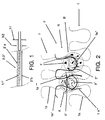
- the first part material 1 is being produced at least partly by knitting preferably from polymer fiber material la or like, whereby the second part material 2, such as one or several polymer material layers 2' or like, is being arranged in connection with the knitted layer 1', that has been produced at least partly built-in during production.
- At least one knitted layer 1' belonging to the first part material is being produced, preferably from a single jersey knitting or from a derivative of the same by adapting a machine gauge of at least 10 needles per English inch (2,54 cm).
- the protective material is intended to be used particularly as manufacturing material of a three-dimensional protective equipment that is meant to be dressed.
- the first part material 1 belonging to the same is being produced from yarn preferably made of high-tenacity organic polymer fiber material la, such as polyethene fiber (UHMPE), aramid fiber (PPTA), liquid crystal fiber (LCP) and/or like.
- the knitted structure 1' belonging to the first part material 1 is being produced from thin polymer fiber material la, the thickness of which is preferably between 80 - 440 dtex (8 ⁇ 10 -6 kg/m - 4,4 ⁇ 10 -5 kg/m).
- a flat knitting machine being preferably based on sinker techniques and having a gauge of 13 needles per inch (2,54 cm) or more and enabling a completely fully fashioned knitted structure (1'), is being used.
- completely fully fashioned means, that the stitch density is essentially constant at various part areas of the three-dimensional knitted clothing, when it is being dressed.
- the method is being adapted in connection, whereby the purpose of the protective material is to serve as manufacturing material for medical purposes, such as to be used for production of protective bandages, safety gloves, protective footwears or headpieces and/or the like.
- the second part material 2 surrounding the first part material 1 entirely is being produced preferably from antiseptic and sterilizeable elastomer and/or polymer, such as from polyurethane (PUR), ethyl-vinyl-acetate (EVA) and/or polyethene (PE).
- PUR polyurethane
- EVA ethyl-vinyl-acetate
- PE polyethene
- the protective material is being strengthened during manufacturing of the same by means of knitting techniques, process techniques and/or correspondingly, to reduce particularly the surface area of one or several part-materials 1, 2 of the protective material enabling free mechanical permeability.
- the protective material is being strengthened by means of knitting techniques during production of the same, to reduce particularly the surface area of the knitted layer 1', such as cover factor value of the same or like, belonging to the first part material 1, enabling free mechanical permeability, by adapting whiskers 1a", staple yarns, fibers and/or the like as the polymer fiber material 1a or as part of the same, as shown detail B of fig. 2.
- whiskers 1a staple yarns, fibers and/or the like as the polymer fiber material 1a or as part of the same, as shown detail B of fig. 2.
- an other compound layer 2' belonging to the second part material (2) preferably by a coating method and/or like, such as by dipping, injection, painting, spraying and/or accordingly.
- a coating method and/or like such as by dipping, injection, painting, spraying and/or accordingly.
- Whiskers y' in this connection as shown in the detail B of fig. 2.
- yarn material as the polymer fiber material la or as part of the same, the cross-sectional surface area of which is extendable preferably by a thermal, pressure, chemical and/or corresponding after-treatment (cf. mercerizing).
- the characteristics of the knitted layer 1' belonging to the protective material is being varied by forming the knitted layer 1' from part layers I, II, that differ from each other by characteristics of the same.
- intarsia techniques is being adapted during knitting according to fig. 2.
- the knitted layer 1' is formed of successive part layers I, II, in which case there are not any so called plush-loop or lay-in yarns at the back side of the knitting.
- At least one compound layer 2' belonging to the second part material 2 is being arranged in connection with at least one knitted layer 1' belonging to the first part material 1, by forming a uniform polymer film or a like three-dimensionally, preferably by means of positive pressure, such as by blow moulding or accordingly, and/or by means of negative pressure, such as by vacuum forming or accordingly, whereby the said layers 2', 1' are being connected to each other at least partly in an integrated manner preferably by means of e.g. a thermal, pressure and/or chemical lamination treatment.
- the mechanical protection effect of the protective material according to the invention is achieved by means of a knitted layer 1' knitted particularly of a thin filament yarn.
- a plane knitting machine based on sinker techniques and e.g. having a gauge of 13 needles per inch or more, by means of which it is possible to produce as described above a uniform and exact measured fashion knitting (tailor made).
- the various part areas of the knitting may be strengthened both in the sense of strength of materials and physically as desired if needed e.g. by producing the upper side of the so called safety glove e.g. thicker than the lower side of the same as explained above.
- the knitted structure further e.g. a two-dimensional single jersey-structure or a three-dimensional e.g. pigue-structure. E.g. in a single jersey-structure an advantageous width of the stitch is proved out to be 1 and the height of the same 1.3.
- the protective material according to the invention may be produced as explained above to a three-dimensional shape e.g. in a way, that the polymer material layers 2'a, 2'b, that have been separately integrated to the knitted layer 1' according to the principle as shown in fig. 1, are achieved by dipping and/or by vacuum forming and/or blow moulding as been described before.
- one possible way to produce e.g. gloves from protective material according to the invention is e.g. two-stage dipping, whereby first of all the inner surface 2'a of the glove is being formed by using hand mold, whereafter the knitted layer 1' is placed on the coated hand mold. After this the knitted layer will be furthermore integrated throughout inside the polymer material 2 with a second dipping 2'b.
- blow moulding and vacuum forming in the same connection, whereby a glove preform is being formed first of all by blowing a film on a negative mold, which is thereafter being formed by vacuum on the surface of a positive glove mold.
- An elastic protective material according to the invention is formed thus according to fig. 1 of the first part material 1 that gives particularly mechanical protection and of the second part material 2 that gives particularly non-mechanical protection.
- the first part material 1 is produced by knitting from polymer fiber material la, whereby the second part material 2, such as one or several polymer material layers 2' is arranged in connection with the knitted layer 1', that has been produced as explained above partly or totally built-in during production.
- the knitted layer 1' belonging to the first part material 1 of the protective material according to the invention is produced, by single jersey knitting or from a derivative of the same by adapting a machine gauge at least 10 needles per English inch (2,54 cm), and comprises a three dimensional fully fashioned knitted structure.
- the knitted layer 1' in the protective material to be used particularly as manufacturing material of a three-dimensional protective equipment or a like, that is ment to be dressed is produced from yarn preferably made of high-tenacity and thin organic polymer fiber material, the thickness of which is preferably between 80 - 440 dtex (8 ⁇ 10 -6 kg/m - 4,4 ⁇ 10 -5 kg/m).
- a flat knitting machine being preferably based on sinker techniques and having a gauge of 13 needles per inch (2,54 cm) or more, is being used.
- protective material in which the thickness h1 of the knitted layer 1' is for example 100 pmeter, whereby the total thickness h2 of the protective material is for example 110 ⁇ meter.
- the knitted layer 1' belonging to the protective material is formed of part layers I, II connected to each other by intarsia-techniques , the characteristics, such as strenght, colour, thickness and/or like of which differ from each other.
- the characteristics such as strenght, colour, thickness and/or like of which differ from each other.
- varying of the characteristics, such as durability, appearance, sensibility and/or the like of the end product being produced from the protective material is enabled at various part areas of the same.
- this enables attaching of different kinds of product marks in an integrated manner during manufacturing or direct adjustment of the direct sensibility by using differing yarn thicknesses 1a, 1a' or yarn types 1a" in various parts of e.g. a protective or safety glove.
Landscapes
- Engineering & Computer Science (AREA)
- Textile Engineering (AREA)
- Gloves (AREA)
- Professional, Industrial, Or Sporting Protective Garments (AREA)
- Knitting Of Fabric (AREA)
- Laminated Bodies (AREA)
- Springs (AREA)
- Materials For Medical Uses (AREA)
- Prostheses (AREA)
Claims (11)
- Verfahren zur Herstellung elastischen Schutzmaterials für einen Sicherheits-Handschuh, der zumindest für medizinische Zwecke einsetzbar ist und aus wenigstens zwei Teilwerkstoffen besteht, die miteinander verbunden sind, wobei der erste Teilwerkstoff (1) vorgesehen ist, um einen mechanischen Schutz in der Weise zu geben, daß ein konkreter Gegenstand daran gehindert wird, den ersten Teilwerkstoff zu durchbrechen, während der zweite Teilwerkstoff (2) für den nichtmechanischen Schutz dient derart, daß Gas und/oder Flüssigkeit gehindert wird, den zweiten Teilwerkstoff zu durchdringen, wobei zur Erzeugung des elastischen Schutzmaterials der erste Teilwerkstoff (1) durch Stricken eines Garns aus einem hoch zugfesten, organischen Polymerfasermaterial (1a) hergestellt wird und der zweite Teilwerkstoff (2), der aus einer oder mehreren Polymerschichten (2') gebildet wird und aus einem antiseptischen, sterilisierbaren Elastomer und/oder Polymer besteht, während der Herstellung in Verbindung mit der zuvor gewirkten Lage (1') so angebracht wird, daß er diese vollständig umschließt, dadurch gekennzeichnet, daß zur Optimierung der Sensibilität und der Sicherheit, die das Schutzmaterial bewirkt, wenigstens eine gewirkte Lage (1') des ersten Teilwerkstoffs (1) durch Single-Jerseystricken oder einer Abart davon in eine dreidimensionale Paßform-Wirkstruktur (1') gebracht wird, wobei ein Maschinen-Gauge von wenigstens 10 Nadeln je englische Zoll (2,54 cm) angewandt wird.
- Verfahren nach Anspruch 1, dadurch gekennzeichnet, daß die gewirkte Lage (1') aus einem dünnen Polymerfasermaterial (1a) mit einer Stärke zwischen 80 und 440 dtex (8 x 10-6 kg/m bis 4,4 x 10⁻⁵ kg/m) hergestellt wird, wobei eine flache Strickmaschine mit Platinentechnik verwendet wird, die ein Gauge von 13 Nadeln je englische Zoll (2,54 cm) oder mehr hat, wodurch eine vollständige Paßform-Wirkstruktur (1') hergestellt wird, bei welcher die Maschendichte in den verschiedenen Teilflächen des Materials im angezogenen Zustand konstant ist.
- Verfahren nach Anspruch 1 oder 2, dadurch gekennzeichnet, daß das Schutzmaterial durch Einsatz von Stricktechniken während der Herstellung verstärkt wird, um den Oberflächenbereich der gewirkten Lage (1') zu reduzieren, der eine freie mechanische Durchlässigkeit zuläßt, zu welchem Zweck Plüsch-Schlingengarne (1a''') oder Beilauf-Garne verwendet werden, die das Stricken ergänzen.
- Verfahren nach einem der Ansprüche 1 bis 3, dadurch gekennzeichnet, daß das Schutzmaterial verstärkt wird durch Prozeßtechniken während der Herstellung desselben, um den Oberflächenbereich der gewirkten Lage (1') zu reduzieren, der eine freie mechanische Durchlässigkeit zuläßt, wozu Garnmaterial wie Polymerfasermaterial (1a) oder ein Teil davon verwendet wird, dessen Querschnittsoberflächenbereich erweiterbar ist durch Wärme-, Druck- und/oder chemische Nachbehandlung.
- Verfahren nach einem der Ansprüche 1 bis 4, dadurch gekennzeichnet, daß die Eigenschaften der gewirkten Lage (1'), die Teil des Schutzmaterials ist, an verschiedenen Teilflächen derselben dadurch variiert werden, daß die gewirkte Lage (1') aus Teilschichten (I, II) gebildet wird, die voneinander abweichende Eigenschaften haben, wozu beim Stricken Intarsiatechniken verwendet werden.
- Verfahren nach einem der Ansprüche 1 bis 5, dadurch gekennzeichnet, daß wenigstens eine Verbundschicht (2'), die Bestandteil des zweiten Teilwerkstoffs (2) ist, in Verbindung mit der gewirkten Lage (1') des ersten Teilwerkstoffes (1) so angeordnet wird, daß ein gleichförmiger Polymerfilm mit Hilfe eines positiven Druckes und/oder eines negativen Druckes dreidimensional geformt wird, wobei die Lagen (2', 1') mit Hilfe einer Wärme-, Druck-, und/oder chemischen Beschichtungstechnik miteinander in integrierender Weise verbunden werden.
- Elastisches Schutzmaterial für einen Sicherheits-Handschuh, der zumindest für medizinische Zwecke einsetzbar ist und aus wenigstens zwei Teilwerkstoffen besteht, die miteinander verbunden sind, wobei der erste Teilwerkstoff (1) vorgesehen ist, um einen mechanischen Schutz in der Weise zu geben, daß ein konkreter Gegenstand daran gehindert wird, den ersten Teilwerkstoff zu durchbrechen, während der zweite Teilwerkstoff (2) für den nichtmechanischen Schutz dient derart, daß Gas und/oder Flüssigkeit gehindert wird, den zweiten Teilwerkstoff zu durchdringen, wobei zur Erzeugung des elastischen Schutzmaterials der erste Teilwerkstoff (1) durch Stricken eines Garns aus einem hoch zugfesten, organischen Polymerfasermaterial (1a) hergestellt wird und der zweite Teilwerkstoff (2), der aus einer oder mehreren Polymerschichten (2') gebildet wird und aus einem antiseptischen, sterilisierbaren Elastomer und/oder Polymer besteht, während der Herstellung in Verbindung mit der zuvor gewirkten Lage (1') so angebracht wurde, daß er diese vollständig einschließt, dadurch gekennzeichnet, daß zur Optimierung der Sensibilität und der Sicherheit, die das Schutzmaterial bewirkt, wenigstens eine gewirkte Lage (1') des ersten Teilwerkstoffs (1), die durch Single-Jerseystricken oder einer Abart davon durch Anwendung eines Maschinen-Gauge von wenigstens 10 Nadeln je englische Zoll (2,54 cm) hergestellt wurde, eine dreidimensionale Paßform-Wirkstruktur (1') aufweist.
- Schutzmaterial nach Anspruch 7, dadurch gekennzeichnet, daß die gewirkte Lage (1') eine vollständige Paßform-Wirkstruktur (1') aufweist, bei welcher die Maschendichte an unterschiedlichen Teilbereichen des Materials im angezogenen Zustand im wesentlichen konstant ist, wobei die gewirkte Lage mit Hilfe einer flachen Strickmaschine mit Platinentechnik mit einem Gauge von 13 Nadeln je Zoll oder mehr aus einem dünnen Polymerfasermaterial (1a) hergestellt ist, dessen Stärke zwischen 80 und 440 dtex (8 x 10-6 kg/m bis 4,4 x 10⁻⁵ kg/m) beträgt.
- Schutzmaterial nach Anspruch 7 oder 8, dadurch gekennzeichnet, daß das Schutzmaterial in verstärkter Form eingesetzt wird durch Anwendung von Stricktechniken, die während der Herstellung geeignet sind, um den Oberflächenbereich der gewirkten Lage (1') zu reduzieren, der eine freie mechanische Durchlässigkeit zuläßt, zu welchem Zweck Plüsch-Schlingengarne (1a'') oder Beilauf-Garne verwendet werden, die das Stricken ergänzen.
- Schutzmaterial nach Anspruch 8 oder 9, dadurch gekennzeichnet, daß das Schutzmaterial in verstärkter Form eingesetzt wird durch Prozeßtechniken, die während der Herstellung geeignet sind, um den Oberflächenbereich der gewirkten Lage (1') zu reduzieren, der eine freie mechanische Durchlässigkeit zuläßt, wozu Garnmaterial wie Polymerfasermaterial (1a) oder ein Teil davon verwendet wird, dessen Querschnittsoberflächenbereich erweiterbar ist durch Wärme-, Druck- und/oder chemische Nachbehandlung.
- Schutzmaterial nach einem der Ansprüche 7 bis 10, dadurch gekennzeichnet, daß die gewirkte Lage (1') des Schutzmaterials aus miteinander durch Intarsiatechniken verbundenen Teilschichten (I, II) besteht, die voneinander abweichende Eigenschaften haben, um dem Sicherheits-Handschuh wenigstens Eigenschaften zu verleihen, die an verschiedenen Teilflächen des Schutzmaterials unterschiedlich sind.
Applications Claiming Priority (3)
| Application Number | Priority Date | Filing Date | Title |
|---|---|---|---|
| FI953976A FI100583B (fi) | 1995-08-24 | 1995-08-24 | Menetelmä elastisen turvamateriaalin valmistamiseksi ja elastinen turv amateriaali |
| FI953976 | 1995-08-24 | ||
| PCT/FI1996/000430 WO1997007859A1 (en) | 1995-08-24 | 1996-08-06 | Method for producing elastic protective material and elastic protective material |
Publications (2)
| Publication Number | Publication Date |
|---|---|
| EP0848629A1 EP0848629A1 (de) | 1998-06-24 |
| EP0848629B1 true EP0848629B1 (de) | 2000-04-12 |
Family
ID=8543908
Family Applications (1)
| Application Number | Title | Priority Date | Filing Date |
|---|---|---|---|
| EP96926403A Expired - Lifetime EP0848629B1 (de) | 1995-08-24 | 1996-08-06 | Verfahren zur herstellung von elastischem schutzmaterial und das elastische schutzmaterial |
Country Status (15)
| Country | Link |
|---|---|
| US (1) | US6077793A (de) |
| EP (1) | EP0848629B1 (de) |
| JP (1) | JP4544650B2 (de) |
| CN (1) | CN1084635C (de) |
| AT (1) | ATE191654T1 (de) |
| AU (1) | AU6660096A (de) |
| CA (1) | CA2227249C (de) |
| DE (1) | DE69607759T2 (de) |
| DK (1) | DK0848629T3 (de) |
| ES (1) | ES2146891T3 (de) |
| FI (1) | FI100583B (de) |
| GR (1) | GR3033951T3 (de) |
| PT (1) | PT848629E (de) |
| RU (1) | RU2157711C2 (de) |
| WO (1) | WO1997007859A1 (de) |
Families Citing this family (35)
| Publication number | Priority date | Publication date | Assignee | Title |
|---|---|---|---|---|
| US6080474A (en) * | 1997-10-08 | 2000-06-27 | Hoechst Celanese Corporation | Polymeric articles having improved cut-resistance |
| US6044498A (en) * | 1997-12-16 | 2000-04-04 | E. I. Du Pont Nemours And Company | Slash and cut resistant garments for protecting a person from injury |
| ATE353757T1 (de) * | 1999-11-03 | 2007-03-15 | Oms Optomedical Systems Ltd Oy | Elastische verbundstruktur |
| US8142382B2 (en) * | 2001-08-27 | 2012-03-27 | Matscitechno Licensing Company | Vibration dampening material and method of making same |
| US6652398B2 (en) * | 2001-08-27 | 2003-11-25 | Innercore Grip Company | Vibration dampening grip cover for the handle of an implement |
| US20060168710A1 (en) * | 2001-08-27 | 2006-08-03 | Sting Free Company | Vibration dampening material and method of making same |
| US20050137038A1 (en) * | 2001-08-27 | 2005-06-23 | Vito Robert A. | Vibration dampening material and method of making same |
| US20060157901A1 (en) | 2001-08-27 | 2006-07-20 | Sting Free Company | Vibration dampening material and method of making same |
| US20070149079A1 (en) * | 2001-08-27 | 2007-06-28 | Sting Free Company | Vibration dampening material and method of making same |
| US8413262B2 (en) | 2004-05-28 | 2013-04-09 | Matscitechno Licensing Company | Sound dissipating material |
| US20050137025A1 (en) * | 2001-08-27 | 2005-06-23 | Vito Robert A. | Vibration dampening material and method of making same |
| US7150113B2 (en) * | 2001-08-27 | 2006-12-19 | Sting Free Technologies Company | Vibration dampening material and method of making same |
| US20050142967A1 (en) * | 2001-08-27 | 2005-06-30 | Vito Robert A. | Vibration dampening material and method of making same |
| US8545966B2 (en) | 2001-08-27 | 2013-10-01 | Matscitechno Licensing Company | Vibration dampening material and uses for same |
| US7171697B2 (en) | 2001-08-27 | 2007-02-06 | Sting Free Company | Vibration dampening material and method of making same |
| US20100247856A1 (en) * | 2001-08-27 | 2010-09-30 | Vito Robert A | Vibration dampening material and method of making same |
| US20050144808A1 (en) * | 2001-08-27 | 2005-07-07 | Vito Robert A. | Vibration dampening material and method of making same |
| US6880269B2 (en) | 2001-10-16 | 2005-04-19 | Sting Free Company | Athletic clothing with sting reduction padding |
| US6843078B2 (en) * | 2002-01-25 | 2005-01-18 | Malden Mills Industries, Inc. | EMI shielding fabric |
| GB0211027D0 (en) * | 2002-05-14 | 2002-06-26 | Ssl Internat | Double-donnable glove |
| DE112004002400T5 (de) * | 2003-12-05 | 2008-03-13 | K-2 Corp., Vashon | Gleitbrett mit Schwingung absorbierender Schicht |
| JP4960885B2 (ja) * | 2004-12-23 | 2012-06-27 | ディーエスエム アイピー アセッツ ビー.ブイ. | カーゴネット |
| US7788737B2 (en) * | 2005-12-08 | 2010-09-07 | Kimberly-Clark Worldwide, Inc. | Cut resistant glove and apparel |
| CN100441765C (zh) * | 2006-06-22 | 2008-12-10 | 时准 | 一种高性能纤维非织造布的制造方法 |
| JP5645656B2 (ja) * | 2007-04-28 | 2014-12-24 | アラヴィ,カマル | 好ましくは拡張可能バルーン・ケーシング用の可撓性多層材料、および拡張可能ケーシングの製造方法 |
| US8037550B2 (en) * | 2008-02-01 | 2011-10-18 | Gore Enterprise Holdings, Inc. | Stretchable chemical protective material |
| US7934395B2 (en) * | 2009-01-26 | 2011-05-03 | E. I. Du Pont De Nemours And Company | Cut-resistant gloves containing fiberglass and para-aramid |
| WO2012092585A2 (en) * | 2010-12-30 | 2012-07-05 | Saint-Gobain Performance Plastics Corporation | Glove having barrier properties |
| JP6038461B2 (ja) * | 2012-02-13 | 2016-12-07 | ヨツギ株式会社 | 手袋及び手袋の製造方法 |
| WO2014059467A1 (en) * | 2012-10-18 | 2014-04-24 | Ansell Limited | Polymeric articles comprising a decoration and method of manufacturing |
| WO2014107614A1 (en) * | 2013-01-03 | 2014-07-10 | Batt Michael J | Dip-coated mesh protective glove and method of making |
| US12250980B2 (en) | 2015-12-18 | 2025-03-18 | Matscitechno Licensing Company | Apparatuses, systems and methods for equipment for protecting the human body by absorbing and dissipating forces imparted to the body |
| US11864599B2 (en) | 2015-12-18 | 2024-01-09 | Matscitechno Licensing Company | Apparatuses, systems and methods for equipment for protecting the human body by absorbing and dissipating forces imparted to the body |
| AU2017366196B2 (en) * | 2016-11-28 | 2019-12-05 | Granberg AS | Three-dimensional, 3D, knitted fabric, and method of manufacturing same |
| CN115024543B (zh) * | 2022-06-20 | 2025-11-11 | 苏州天华超净科技股份有限公司 | 一种复合型防护手套及其成型、无尘清洗工艺 |
Family Cites Families (18)
| Publication number | Priority date | Publication date | Assignee | Title |
|---|---|---|---|---|
| FR2375839B1 (fr) * | 1977-01-04 | 1980-07-11 | Sofiman Sa | Procede de fabrication d'un article d'habillement et machine pour la mise en oeuvre du procede |
| JPS57156036A (en) * | 1981-03-20 | 1982-09-27 | Toyobo Co Ltd | Protecting material against poisonous chemical material |
| ES286913Y (es) * | 1983-03-11 | 1986-06-01 | Bettcher Industries Inc | Guante protector contra cortes y similares. |
| US5423168A (en) * | 1985-08-16 | 1995-06-13 | Kolmes; Nathaniel H. | Surgical glove and yarn |
| US4742578A (en) * | 1985-12-02 | 1988-05-10 | Seid Arnold S | Penetration-resistant surgical glove |
| JPS63303733A (ja) * | 1987-06-04 | 1988-12-12 | Toray Ind Inc | 細菌透過防止布帛 |
| US4858245A (en) * | 1988-05-19 | 1989-08-22 | Sullivan Thomas M | Armored glove fingers |
| US5224363A (en) * | 1988-12-16 | 1993-07-06 | Golden Needles Knitting & Glove Co., Inc. | Method of making garment, garment, and strand material |
| WO1991002466A1 (en) * | 1989-08-25 | 1991-03-07 | Kennedy Charles D | Tear and puncture-resistant hospital examination and surgical glove |
| US5087499A (en) * | 1990-05-09 | 1992-02-11 | Sullivan Thomas M | Puncture-resistant and medicinal treatment garments and method of manufacture thereof |
| RU2041676C1 (ru) * | 1991-01-25 | 1995-08-20 | Сапар Тусупбекович Тусупбеков | Защитная перчатка и способ ее выполнения |
| US5173240A (en) * | 1991-04-26 | 1992-12-22 | E. I. Du Pont De Nemours And Company | Tension-free heat-treatment of aramid fiber and fibrids |
| JP2980738B2 (ja) * | 1991-08-21 | 1999-11-22 | 三重化学工業株式会社 | 滑り止め作業手袋及びその製造法 |
| EP0642418A1 (de) * | 1992-05-29 | 1995-03-15 | E.I. Du Pont De Nemours And Company | Chemikalienbeständiger mehrschichtstoff für schutzbekleidung |
| US5357636A (en) * | 1992-06-30 | 1994-10-25 | Dresdner Jr Karl P | Flexible protective medical gloves and methods for their use |
| FI931396A7 (fi) * | 1993-03-26 | 1994-09-27 | Leo Hatjasalo | Menetelmä ja laite kehon tai sen osan suojaamiseksi ja/tai sen toiminnan tehostamiseksi |
| JPH06280140A (ja) * | 1993-03-27 | 1994-10-04 | Kanebo Ltd | 切創防止手袋 |
| US5564127A (en) * | 1995-04-27 | 1996-10-15 | Manne; Joseph | Puncture proof surgical glove |
-
1995
- 1995-08-24 FI FI953976A patent/FI100583B/fi not_active IP Right Cessation
-
1996
- 1996-08-06 ES ES96926403T patent/ES2146891T3/es not_active Expired - Lifetime
- 1996-08-06 DK DK96926403T patent/DK0848629T3/da active
- 1996-08-06 AU AU66600/96A patent/AU6660096A/en not_active Abandoned
- 1996-08-06 CN CN96197726A patent/CN1084635C/zh not_active Expired - Lifetime
- 1996-08-06 CA CA002227249A patent/CA2227249C/en not_active Expired - Fee Related
- 1996-08-06 DE DE69607759T patent/DE69607759T2/de not_active Expired - Lifetime
- 1996-08-06 PT PT96926403T patent/PT848629E/pt unknown
- 1996-08-06 RU RU98103514/12A patent/RU2157711C2/ru active IP Right Revival
- 1996-08-06 WO PCT/FI1996/000430 patent/WO1997007859A1/en not_active Ceased
- 1996-08-06 AT AT96926403T patent/ATE191654T1/de active
- 1996-08-06 US US09/029,079 patent/US6077793A/en not_active Expired - Lifetime
- 1996-08-06 EP EP96926403A patent/EP0848629B1/de not_active Expired - Lifetime
- 1996-08-06 JP JP50987597A patent/JP4544650B2/ja not_active Expired - Fee Related
-
2000
- 2000-07-12 GR GR20000401636T patent/GR3033951T3/el unknown
Also Published As
| Publication number | Publication date |
|---|---|
| DE69607759T2 (de) | 2000-11-23 |
| FI953976A0 (fi) | 1995-08-24 |
| US6077793A (en) | 2000-06-20 |
| CN1200046A (zh) | 1998-11-25 |
| DK0848629T3 (da) | 2000-09-11 |
| AU6660096A (en) | 1997-03-19 |
| CA2227249C (en) | 2007-07-03 |
| FI100583B (fi) | 1998-01-15 |
| GR3033951T3 (en) | 2000-11-30 |
| DE69607759D1 (de) | 2000-05-18 |
| JP4544650B2 (ja) | 2010-09-15 |
| WO1997007859A1 (en) | 1997-03-06 |
| RU2157711C2 (ru) | 2000-10-20 |
| ATE191654T1 (de) | 2000-04-15 |
| JPH11511996A (ja) | 1999-10-19 |
| CA2227249A1 (en) | 1997-03-06 |
| ES2146891T3 (es) | 2000-08-16 |
| FI953976A7 (fi) | 1997-02-25 |
| PT848629E (pt) | 2000-09-29 |
| CN1084635C (zh) | 2002-05-15 |
| EP0848629A1 (de) | 1998-06-24 |
Similar Documents
| Publication | Publication Date | Title |
|---|---|---|
| EP0848629B1 (de) | Verfahren zur herstellung von elastischem schutzmaterial und das elastische schutzmaterial | |
| US5628172A (en) | Composite yarns for protective garments | |
| US10081889B2 (en) | Hybrid fabric | |
| US5087499A (en) | Puncture-resistant and medicinal treatment garments and method of manufacture thereof | |
| US5224363A (en) | Method of making garment, garment, and strand material | |
| US5632137A (en) | Composite yarns for protective garments | |
| RU98103514A (ru) | Способ изготовления эластичного защитного материала и эластичный защитный материал | |
| US4858245A (en) | Armored glove fingers | |
| US5113532A (en) | Method of making garment, garment and strand material | |
| CA2071926A1 (en) | Cut resistant protective glove | |
| ES2445324T3 (es) | Guante de protección | |
| JP5213495B2 (ja) | 医療用積層布帛、これを用いた医療用ドレープ、これを用いた医療用被服 | |
| KR20040105586A (ko) | 절단 저항성을 갖는 실 | |
| ES2129212T3 (es) | Fibras polimeras termoplasticas suaves y resistentes y genero no tejido fabricado a partir de las mismas. | |
| NO305533B1 (no) | Puteelementbeskyttelse for klesplagg og anvendelse derav | |
| AU773021B2 (en) | Elastic composite structure | |
| CN111748898A (zh) | 具黏性织物结构及使用其制成的衣物 | |
| RU2159825C1 (ru) | Текстильный материал для одежды и защитная медицинская одежда краткосрочного пользования из этого материала | |
| JP2008006664A (ja) | 医療用積層編地、それを用いた手術衣、それを用いた手術用資材 | |
| KR102651069B1 (ko) | 절단강도, 그립성 및 내약품성이 우수하고 착용감이 향상된 코팅장갑 | |
| FI127907B (en) | Knitted glove | |
| Mudoi et al. | Advanced Fiber Materials in Textiles | |
| CN210881202U (zh) | 一种高强度不织布 | |
| KR102725856B1 (ko) | 손가락 부위 절단 방지용 장갑 | |
| EP3563704B1 (de) | Gestrickter handschuh und verfahren zur herstellung davon |
Legal Events
| Date | Code | Title | Description |
|---|---|---|---|
| PUAI | Public reference made under article 153(3) epc to a published international application that has entered the european phase |
Free format text: ORIGINAL CODE: 0009012 |
|
| 17P | Request for examination filed |
Effective date: 19980309 |
|
| AK | Designated contracting states |
Kind code of ref document: A1 Designated state(s): AT BE CH DE DK ES FR GB GR IE IT LI LU MC NL PT SE |
|
| 17Q | First examination report despatched |
Effective date: 19990305 |
|
| GRAG | Despatch of communication of intention to grant |
Free format text: ORIGINAL CODE: EPIDOS AGRA |
|
| RTI1 | Title (correction) |
Free format text: METHOD FOR PRODUCING ELASTIC PROTECTIVE MATERIAL AND THE ELASTIC PROTECTIVE MATERIAL |
|
| GRAG | Despatch of communication of intention to grant |
Free format text: ORIGINAL CODE: EPIDOS AGRA |
|
| GRAH | Despatch of communication of intention to grant a patent |
Free format text: ORIGINAL CODE: EPIDOS IGRA |
|
| GRAH | Despatch of communication of intention to grant a patent |
Free format text: ORIGINAL CODE: EPIDOS IGRA |
|
| GRAA | (expected) grant |
Free format text: ORIGINAL CODE: 0009210 |
|
| AK | Designated contracting states |
Kind code of ref document: B1 Designated state(s): AT BE CH DE DK ES FR GB GR IE IT LI LU MC NL PT SE |
|
| REF | Corresponds to: |
Ref document number: 191654 Country of ref document: AT Date of ref document: 20000415 Kind code of ref document: T |
|
| RIC1 | Information provided on ipc code assigned before grant |
Free format text: 7A 62D 5/00 A, 7A 61B 19/04 B, 7B 32B 27/00 B |
|
| REG | Reference to a national code |
Ref country code: CH Ref legal event code: EP |
|
| REF | Corresponds to: |
Ref document number: 69607759 Country of ref document: DE Date of ref document: 20000518 |
|
| REG | Reference to a national code |
Ref country code: IE Ref legal event code: FG4D |
|
| ITF | It: translation for a ep patent filed | ||
| REG | Reference to a national code |
Ref country code: CH Ref legal event code: NV Representative=s name: FELBER & PARTNER AG PATENTANWAELTE |
|
| ET | Fr: translation filed | ||
| REG | Reference to a national code |
Ref country code: ES Ref legal event code: FG2A Ref document number: 2146891 Country of ref document: ES Kind code of ref document: T3 |
|
| REG | Reference to a national code |
Ref country code: DK Ref legal event code: T3 |
|
| REG | Reference to a national code |
Ref country code: PT Ref legal event code: SC4A Free format text: AVAILABILITY OF NATIONAL TRANSLATION Effective date: 20000621 |
|
| PLBE | No opposition filed within time limit |
Free format text: ORIGINAL CODE: 0009261 |
|
| 26N | No opposition filed | ||
| REG | Reference to a national code |
Ref country code: GB Ref legal event code: IF02 |
|
| PGFP | Annual fee paid to national office [announced via postgrant information from national office to epo] |
Ref country code: NL Payment date: 20100823 Year of fee payment: 15 Ref country code: MC Payment date: 20100824 Year of fee payment: 15 Ref country code: IE Payment date: 20100823 Year of fee payment: 15 Ref country code: ES Payment date: 20100826 Year of fee payment: 15 |
|
| PGFP | Annual fee paid to national office [announced via postgrant information from national office to epo] |
Ref country code: SE Payment date: 20100826 Year of fee payment: 15 Ref country code: LU Payment date: 20100809 Year of fee payment: 15 Ref country code: IT Payment date: 20100825 Year of fee payment: 15 Ref country code: FR Payment date: 20100910 Year of fee payment: 15 |
|
| PGFP | Annual fee paid to national office [announced via postgrant information from national office to epo] |
Ref country code: GR Payment date: 20100827 Year of fee payment: 15 Ref country code: GB Payment date: 20100827 Year of fee payment: 15 |
|
| PGFP | Annual fee paid to national office [announced via postgrant information from national office to epo] |
Ref country code: PT Payment date: 20100714 Year of fee payment: 15 Ref country code: DK Payment date: 20100824 Year of fee payment: 15 |
|
| PGFP | Annual fee paid to national office [announced via postgrant information from national office to epo] |
Ref country code: BE Payment date: 20100826 Year of fee payment: 15 |
|
| REG | Reference to a national code |
Ref country code: PT Ref legal event code: MM4A Free format text: LAPSE DUE TO NON-PAYMENT OF FEES Effective date: 20120206 |
|
| BERE | Be: lapsed |
Owner name: OY OPTOMEDICAL SYSTEMS LTD *OMS Effective date: 20110831 |
|
| REG | Reference to a national code |
Ref country code: NL Ref legal event code: V1 Effective date: 20120301 |
|
| PG25 | Lapsed in a contracting state [announced via postgrant information from national office to epo] |
Ref country code: MC Free format text: LAPSE BECAUSE OF NON-PAYMENT OF DUE FEES Effective date: 20110831 |
|
| REG | Reference to a national code |
Ref country code: CH Ref legal event code: PL |
|
| REG | Reference to a national code |
Ref country code: SE Ref legal event code: EUG |
|
| GBPC | Gb: european patent ceased through non-payment of renewal fee |
Effective date: 20110806 |
|
| REG | Reference to a national code |
Ref country code: GR Ref legal event code: ML Ref document number: 20000401636 Country of ref document: GR Effective date: 20120302 |
|
| PG25 | Lapsed in a contracting state [announced via postgrant information from national office to epo] |
Ref country code: LI Free format text: LAPSE BECAUSE OF NON-PAYMENT OF DUE FEES Effective date: 20110831 Ref country code: CH Free format text: LAPSE BECAUSE OF NON-PAYMENT OF DUE FEES Effective date: 20110831 |
|
| REG | Reference to a national code |
Ref country code: DK Ref legal event code: EBP |
|
| REG | Reference to a national code |
Ref country code: FR Ref legal event code: ST Effective date: 20120430 |
|
| REG | Reference to a national code |
Ref country code: IE Ref legal event code: MM4A |
|
| PG25 | Lapsed in a contracting state [announced via postgrant information from national office to epo] |
Ref country code: BE Free format text: LAPSE BECAUSE OF NON-PAYMENT OF DUE FEES Effective date: 20110831 Ref country code: GR Free format text: LAPSE BECAUSE OF NON-PAYMENT OF DUE FEES Effective date: 20120302 Ref country code: PT Free format text: LAPSE BECAUSE OF NON-PAYMENT OF DUE FEES Effective date: 20120206 Ref country code: NL Free format text: LAPSE BECAUSE OF NON-PAYMENT OF DUE FEES Effective date: 20120301 Ref country code: IT Free format text: LAPSE BECAUSE OF NON-PAYMENT OF DUE FEES Effective date: 20110806 |
|
| REG | Reference to a national code |
Ref country code: CH Ref legal event code: AEN Free format text: DAS PATENT IST AUFGRUND DES WEITERBEHANDLUNGSANTRAGS VOM 30.05.2012 REAKTIVIERT WORDEN. |
|
| REG | Reference to a national code |
Ref country code: DE Ref legal event code: R119 Ref document number: 69607759 Country of ref document: DE Effective date: 20120301 |
|
| REG | Reference to a national code |
Ref country code: DE Ref legal event code: R073 Ref document number: 69607759 Country of ref document: DE |
|
| REG | Reference to a national code |
Ref country code: DE Ref legal event code: R073 Ref document number: 69607759 Country of ref document: DE |
|
| REG | Reference to a national code |
Ref country code: DE Ref legal event code: R082 Ref document number: 69607759 Country of ref document: DE Representative=s name: PUSCHMANN BORCHERT BARDEHLE PATENTANWAELTE PAR, DE |
|
| PG25 | Lapsed in a contracting state [announced via postgrant information from national office to epo] |
Ref country code: IE Free format text: LAPSE BECAUSE OF NON-PAYMENT OF DUE FEES Effective date: 20110806 Ref country code: DK Free format text: LAPSE BECAUSE OF NON-PAYMENT OF DUE FEES Effective date: 20110831 |
|
| PGFP | Annual fee paid to national office [announced via postgrant information from national office to epo] |
Ref country code: CH Payment date: 20120530 Year of fee payment: 16 |
|
| PGRI | Patent reinstated in contracting state [announced from national office to epo] |
Ref country code: LI Effective date: 20120530 Ref country code: CH Effective date: 20120530 |
|
| REG | Reference to a national code |
Ref country code: FR Ref legal event code: RN Effective date: 20120702 Ref country code: FR Ref legal event code: RN |
|
| PG25 | Lapsed in a contracting state [announced via postgrant information from national office to epo] |
Ref country code: FR Free format text: LAPSE BECAUSE OF NON-PAYMENT OF DUE FEES Effective date: 20110831 Ref country code: GB Free format text: LAPSE BECAUSE OF NON-PAYMENT OF DUE FEES Effective date: 20110806 |
|
| REG | Reference to a national code |
Ref country code: DE Ref legal event code: R074 Ref document number: 69607759 Country of ref document: DE Effective date: 20120805 Ref country code: DE Ref legal event code: R074 Ref document number: 69607759 Country of ref document: DE Effective date: 20120802 |
|
| PGFP | Annual fee paid to national office [announced via postgrant information from national office to epo] |
Ref country code: AT Payment date: 20120601 Year of fee payment: 16 |
|
| REG | Reference to a national code |
Ref country code: AT Ref legal event code: MM01 Ref document number: 191654 Country of ref document: AT Kind code of ref document: T Effective date: 20120806 |
|
| PG25 | Lapsed in a contracting state [announced via postgrant information from national office to epo] |
Ref country code: SE Free format text: LAPSE BECAUSE OF NON-PAYMENT OF DUE FEES Effective date: 20110807 |
|
| REG | Reference to a national code |
Ref country code: FR Ref legal event code: IC Effective date: 20130409 |
|
| REG | Reference to a national code |
Ref country code: ES Ref legal event code: FD2A Effective date: 20130530 |
|
| PG25 | Lapsed in a contracting state [announced via postgrant information from national office to epo] |
Ref country code: LU Free format text: LAPSE BECAUSE OF NON-PAYMENT OF DUE FEES Effective date: 20110806 |
|
| PG25 | Lapsed in a contracting state [announced via postgrant information from national office to epo] |
Ref country code: AT Free format text: LAPSE BECAUSE OF NON-PAYMENT OF DUE FEES Effective date: 20120806 |
|
| PG25 | Lapsed in a contracting state [announced via postgrant information from national office to epo] |
Ref country code: ES Free format text: LAPSE BECAUSE OF NON-PAYMENT OF DUE FEES Effective date: 20110807 |
|
| REG | Reference to a national code |
Ref country code: CH Ref legal event code: PL |
|
| PG25 | Lapsed in a contracting state [announced via postgrant information from national office to epo] |
Ref country code: CH Free format text: LAPSE BECAUSE OF NON-PAYMENT OF DUE FEES Effective date: 20130831 Ref country code: LI Free format text: LAPSE BECAUSE OF NON-PAYMENT OF DUE FEES Effective date: 20130831 |
|
| PGFP | Annual fee paid to national office [announced via postgrant information from national office to epo] |
Ref country code: DE Payment date: 20150925 Year of fee payment: 20 |
|
| REG | Reference to a national code |
Ref country code: DE Ref legal event code: R071 Ref document number: 69607759 Country of ref document: DE |