EP3563704B1 - Gestrickter handschuh und verfahren zur herstellung davon - Google Patents
Gestrickter handschuh und verfahren zur herstellung davon Download PDFInfo
- Publication number
- EP3563704B1 EP3563704B1 EP17888645.3A EP17888645A EP3563704B1 EP 3563704 B1 EP3563704 B1 EP 3563704B1 EP 17888645 A EP17888645 A EP 17888645A EP 3563704 B1 EP3563704 B1 EP 3563704B1
- Authority
- EP
- European Patent Office
- Prior art keywords
- yarns
- glove
- linear density
- yarn
- tex
- Prior art date
- Legal status (The legal status is an assumption and is not a legal conclusion. Google has not performed a legal analysis and makes no representation as to the accuracy of the status listed.)
- Active
Links
Images

Classifications
-
- A—HUMAN NECESSITIES
- A41—WEARING APPAREL
- A41D—OUTERWEAR; PROTECTIVE GARMENTS; ACCESSORIES
- A41D19/00—Gloves
- A41D19/015—Protective gloves
- A41D19/01505—Protective gloves resistant to mechanical aggressions, e.g. cutting. piercing
-
- D—TEXTILES; PAPER
- D04—BRAIDING; LACE-MAKING; KNITTING; TRIMMINGS; NON-WOVEN FABRICS
- D04B—KNITTING
- D04B1/00—Weft knitting processes for the production of fabrics or articles not dependent on the use of particular machines; Fabrics or articles defined by such processes
- D04B1/22—Weft knitting processes for the production of fabrics or articles not dependent on the use of particular machines; Fabrics or articles defined by such processes specially adapted for knitting goods of particular configuration
- D04B1/24—Weft knitting processes for the production of fabrics or articles not dependent on the use of particular machines; Fabrics or articles defined by such processes specially adapted for knitting goods of particular configuration wearing apparel
- D04B1/28—Weft knitting processes for the production of fabrics or articles not dependent on the use of particular machines; Fabrics or articles defined by such processes specially adapted for knitting goods of particular configuration wearing apparel gloves
Definitions
- This invention relates to working garments, particularly gloves. More specifically, the invention relates to knitted gloves.
- Working gloves can be classified in various categories. Depending on the material the gloves are made of, they may be textile, rubber, knitted, leather gloves, or a combination between these classes. Depending on the method of manufacture, the gloves may be prepared as one piece, put together from two halves or assembled from several pieces that are prepared separately.
- Working gloves normally require protection of the hands from various hazards. These hazards may also be classified in groups, such as biological (provided e.g. by sterile hospital rubber gloves), chemical, mechanical, short-term and long-term thermal, weather, vibrational and others. Mechanical hazards include any hazards that can cause cuts, abrasion or piercing of the skin.
- a cut-resistant knit glove is described in US 2010/0186455 A1 , the glove comprising pre-manufactured composite yarns and a companion yarn. This glove has a limited density of its knit due to the method of its manufacture and can thus only be effective against some types of damage such as cuts.
- Short-term thermal protection relates to sudden temperature spikes caused by short exposure to hot surfaces or flames, sparkles, or to extreme cold.
- Long-term thermal protection usually relates to outside cold.
- Vibrational protection ensures safe handling of vibrating devices that may cause damage to the hands.
- Examples of such devices may include trimmers, drills, jackhammers and other instruments.
- the fabric in knitted working gloves is usually thin, has low linear density (around 200 tex) and is manufactured from one or two materials.
- An uncoated knitted glove can be comfortable to wear, but requires thick or multilayered coating to provide protection from the abovementioned hazards, and often still do not protect from all of them. The coating significantly reduces the comfort of wearing.
- knitted gloves are prepared by automatic knitting. There are a few types of knitting machines available on the market, with different rates of gloves per hour and differing accuracy or rate of errors resulting in defects.
- This invention relates to a knitted working glove that overcomes some of the drawbacks present in the prior art.
- the glove of the present invention also has additional advantageous properties and technical effects.
- a knitted glove comprising a combination of five or more yarns made of three or more different materials.
- the five or more yarns comprise two or more primary reinforcing yarns, one or more secondary reinforcing yarns and two or more soft base yarns.
- the glove can be a composite knitted glove, or a knitted glove of composite material.
- the combination of five or more yarns means that the knitted material of the glove is prepared from a combination of five or more yarns (from a yarn bundle that comprises five or more yarns). Therefore, the number of yarns in the glove represents their proportion in the material, as compared to the other yarns therein.
- each yarn in the material is directly dependent on the number of yarns that the material comprises, but each yarn may have a linear density different from the other yarns.
- Linear densities of yarns are more representative of the proportion of a certain material in the glove, and their values will be used throughout this application along with the number of yarns that were used in preparation of the glove.
- the primary reinforcing yarns determine primary protective properties of the knitted glove. These protective properties can include mechanical protection, vibrational protection, thermal protection or a combination of those.
- the primary reinforcing yarns can be made of various reinforcing materials that contribute to these protective properties, as discussed in the embodiments below.
- the secondary reinforcing yarns have a lower linear density than the primary reinforcing yarn.
- the secondary reinforcing yarns are thinner individually than the primary reinforcing yarns.
- the lower linear density and lower thickness allows the secondary reinforcing yarns to take up space left between more dense and thicker primary reinforcing yarns, and base yarns.
- the secondary reinforcing yarns may also envelop the other yarns and/or tie the primary reinforcing yarns with the base yarns. This leads to increased protective properties of the glove, since the material can become stronger and filled more densely, without causing the glove to become less flexible.
- the base yarns comprise soft base material that determines elastic and ergonomic properties of the knitted glove.
- the properties can include the tactile sensations, elasticity in all directions, and air permeability that can prevent palms from sweating.
- the elasticity of the base yarns, combined with the protective properties of the reinforcing yarns, can additionally provide further protection from cuts, abrasion and piercing.
- Each individual base yarn has a linear density between 20 and 125 tex
- each individual primary reinforcing yarn has a linear density between 20 and 150 tex
- each individual secondary reinforcing yarn has a linear density between 2 and 50 tex and lower than the linear density of each individual primary reinforcing yarn.
- the overall combined linear density of the five or more yarns comprised in the knitted glove is between 320 and 450 tex.
- the combined linear density of the one or more base yarns can be more than the combined linear density of the remaining yarns.
- This combination of linear density ranges, and the overall combined linear density of the glove material provides optimal protective properties to the glove. These properties can include any combination of: protection against cuts, abrasion, ripping of the glove, piercing the glove; protection against inflammation or other heat spikes; protection against short exposure to liquids; protection against vibration; and protection against dirt and dust.
- the number of yarns that is more than 5 makes it possible to obtain an overall linear density between 320 and 450 tex. More than 5 yarns make the glove stronger in mechanical and other protection as compared to a glove with fewer yarns and same overall linear density. The combination of different yarns can also have an effect of further strengthening the knitted material
- the number of different materials that the yarns are made of provide the properties of each yarn described above, and allow the combined linear density between 320 and 450 tex to be achieved while maintaining comfortable wearing properties.
- the number of materials is aligned accordingly with the number of yarns to provide optimal proportions, protective properties and comfort of wear. Different materials can also contribute to different protective properties, for example fire resistant material makes the whole glove more fire resistant. By adjusting proportions of the materials and yarns used in the knitted glove, protective and ergonomic properties can be adjusted.
- the overall number of yarns is between 5 and 20.
- a glove that has more than 20 yarns may be used, however adding more than 20 yarns is normally not necessary. More yarns in a glove means the knitted material is more densely filled.
- the overall number of different materials can be between 3 and 10.
- the combined linear density of the two or more base yarns is between 200 and 350 tex
- the combined linear density of the two or more primary reinforcing yarns is between 50 and 150 tex
- the combined linear density of the one or more secondary reinforcing yarns is between 8 and 70 tex.
- This proportion of linear densities can provide an optimal combination of comfort and protective properties. The proportion can also reduce the defect rate during manufacture because of the even filling of the knitted material that is formed at these linear densities.
- the base yarn can additionally comprise polyester. Cotton yarns with polyester can be strong against wear and tear.
- the primary reinforcing yarn comprises a primary reinforcing material.
- This material is selected from: polypropylene, aramids, basalt fibre, quartz fibre, glass fibre, carbon fibre and a combination thereof.
- Aramids include para-aramids and other aramid fibers. The materials in this list can provide good protective properties to the glove, and make strong yarns.
- the secondary reinforcing yarn comprises a secondary reinforcing material, which can be selected from: polyamide, polyester, elastane, acryl, nylon and a combination thereof. These materials can be quite thin and have a low linear density compared to the primary reinforcing materials. At the same time, the listed materials are strong against tear and abrasion.
- the knitted glove can be coated with a polymer material to increase its protective properties.
- An aspect not forming part of the present invention is a method for manufacture of a knitted glove by a knitting machine.
- the method comprises: providing, into a yarn carrier of the knitting machine, a yarn bundle comprising five or more yarns made of three or more different materials; knitting from the yarn bundle at least eight sections of the glove at a predetermined rate, the at least eight sections including: a first finger section, a second finger section, a third finger section, a fourth finger section, a palmar section positioned adjacent to the knitted first to fourth finger sections, a thumb finger section, a pre-cuff section positioned adjacent to the palmar section with the thumb finger section, and a cuff section including an elastic wristband; and knitting the sections together to form a knitted glove at a rate at least four times lower than the predetermined rate.
- Knitting the sections together at a rate at least four times lower than the original knitting rate provides higher accuracy to the complex operations that "stitch the glove together". Additionally, the beginning of knitting operations relating to fingers can also be performed at the reduced rate four times lower than the predetermined rate. This can be beneficial to reduce the number of defects that fingers have at the tips, because forming finger-tips by knitting can be a complex operation.
- the method further can comprise coating the knitted glove with a polymer coating by compression or spraying under pressure, followed by temperature curing. Spraying under pressure and compression provide an even coating along the glove, and reduces the amount of wasted coating material.
- the coated knitted material can become soaked with the coating, effectively saturating the coating into the knitted material, forming a new composite material of the glove.
- the method further comprises overedging the knitted cuff section with an overlock.
- This operation can complete certain types of glove with a "band" that holds the glove better on the wrist.
- the overlock can also prevent back-winding of the glove.
- the method can further comprise separating the first, second, third, fourth section from the yarn carrier. This can be done, for example, by cutting the yarn bundle. This allows to produce each finger of the glove individually, and possibly knit some of them again in case of defects.
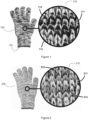
- Figure 1 shows a knitted glove 100 comprising combination of six yarns made of three different materials.
- the combined linear density of all yarns comprised of the glove 100 is between 320 and 450 tex, and in this example it is 410 tex.
- the area of the glove zoomed in to illustrate the knitted material 110 may be selected anywhere on the glove 100.
- the zoomed in knitted material 110 shows base yarns 111 made of cotton.
- This yarn 111 has the brightest color, almost white, and provides elastic and ergonomic properties to the glove. Cotton can provide flexibility and resistance against cuts and tears, and provides the glove 100 with good air permeability.
- the linear density of each cotton base yarn 111 is 100 tex.
- the knitted material 110 of the glove 100 comprises three base yarns 111, and the combined linear density of the three base yarns 111 is 300 tex.
- the cotton base yarns 111 may also include polyester.
- the primary reinforcing yarn 112 is made of polypropylene and determines primary protective properties of the glove 100.
- the polypropylene yarn 112 has a dark and thick black texture on the black and white image. It contributes to mechanical resistance of the glove 100.
- the linear density of the primary reinforcing yarn 112 is 78 tex.
- the knitted material 110 of the glove 100 according to this example comprises one primary reinforcing yarn.
- the secondary reinforcing yarns 113 are made of polyester and show on the Figure as the thinnest yarns running through the knitted material 110.
- Each polyester yarn 113 has a linear density of 16 tex
- the glove has two secondary reinforcing yarns 113 with a combined linear density of 32 tex. These yarns are "weaved" within the knitted material and can bind the other yarns together, improving the overall strength of the glove, while also providing additional mechanical protection due to the properties of polyester.
- the glove 100 may include an overedged cuff section 101 for comfort of wear.
- the glove 100 due to the combination of yarns and their properties, provides good mechanical protection against cuts, abrasion and vibration.
- Figure 2 shows similarly a different knitted glove 200 made of 5 yarns.
- the combined linear density of all yarns comprised in the glove 200 is 340 tex.
- the area of the glove zoomed in to illustrate the knitted material 210 may be selected anywhere on the glove 200.
- the zoomed in knitted material 210 shows base yarns 211 made of recycled cotton.
- This yarns 211 have the brightest color, almost white, and provide elastic and ergonomic properties to the glove.
- Recycled cotton can provide flexibility and resistance against cuts and tears, and provides the glove 100 with good air permeability.
- the linear density of each individual base yarn 211 is 100 tex, and the glove 200 comprises two of these yarns, summing up their combined linear density to 200 tex.
- the base yearn 211 may comprise polyester.
- the primary reinforcing yarns 212 are made of an aramid, for example a para-aramid synthetic fiber, and determines primary protective properties of the glove 200.
- the aramid yarns 212 have a grey and wattled texture on Figure 2 . They greatly contribute to mechanical resistance of the glove 200.
- the linear density of each aramid primary reinforcing yarn 212 is 60 tex, and the knitted material 210 of the glove 200 in this example includes two primary reinforcing yarns 212. Their combined linear density is 120 tex.
- the secondary reinforcing yarn 213 is made of polyester and shows on the Figure as the thinnest yarn of darkest color, running through the knitted material 210.
- the polyester yarn 213 has a linear density of 20 tex. This yarn is "weaved" within the knitted material and can bind the other yarns together, improving the overall strength of the glove, while also providing additional protective properties due to the qualities of polyester.
- the glove includes one secondary reinforcing yarn 213.
- the glove 200 due to the combination of yarns and their properties, provides good protection against short-term thermal spikes up to 650 °C, abrasion and cuts.
- each yarn may be made of alternative materials.
- the technical effect of improved mechanical, thermal and vibrational protection can be achieved with different combinations of materials, and different numbers of yarns.
- the combined linear density of the yarns is still between 320 and 450 tex to provide the above technical effects, and each of the primary reinforcing, secondary reinforcing and base yarns should have a density in the claimed ranges. It is clear to a skilled person that the exact values of linear densities, and the exact numbers of yarns used in the knitted material, are provided as an example only and may be chosen differently within the claimed ranges.
- Figure 3 is a schematic illustration of a glove 300 separated into numbered sections.
- a method according to an aspect not forming part of the claimed invention is a method for manufacturing a knitted glove by a knitting machine. The method comprises providing, into a yarn carrier of the knitting machine, a yarn bundle comprising five or more yarns made of three or more different materials. The method then includes knitting from the yarn bundle eight sections of the glove at a predetermined rate.
- These sections include: a first finger section 1, a second finger section 2, a third finger section 3, a fourth finger section 4, a palmar section 5 positioned adjacent to the knitted first to fourth finger sections 1-4, a thumb finger section 6, a pre-cuff section 7 positioned adjacent to the palmar section 5 with the thumb finger section 6, and a cuff section 8 with an elastic wristband.
- the method concludes with knitting the sections 1-8 together to form the knitted glove 300 at a rate at least four times lower than the predetermined rate.
- Knitting the sections together at a rate at least four times lower than the original knitting rate provides higher accuracy to the complex operations that knit the glove together.
- the beginning of knitting operations relating to fingers 1-4, 6 can also be performed at the reduced rate four times lower than the predetermined rate. This can be beneficial to reduce the number of defects that fingers have at the tips, because forming finger-tips by knitting can be a complex operation.
- the method further can comprise coating the knitted glove with a polymer coating by compression or spraying under pressure, followed by temperature curing. Pressured spraying or compression provide an even coating along the glove, and reduces the amount of wasted coating material.
- the coated knitted material can become soaked with the coating, effectively saturating the coating into the yarns to enhance or form a new composite material of the glove.
- the method further comprises overedging the knitted cuff section with an overlock 310.
- This operation can complete certain types of glove with a "band" that holds the glove better on the wrist.
- the overlock 310 can also prevent back-winding of the glove.
- the method can further comprise separating sections 1-4 and 6 from the yarn carrier. This can be done, for example, by cutting the yarn bundle. This allows to produce each finger of the glove individually, and possibly knit some of them again in case of defects.
Landscapes
- Engineering & Computer Science (AREA)
- Textile Engineering (AREA)
- Gloves (AREA)
- Professional, Industrial, Or Sporting Protective Garments (AREA)
- Knitting Of Fabric (AREA)
Claims (7)
- Gestrickter Handschuh (100), der eine Kombination von fünf oder mehr Garnen aus drei oder mehr verschiedenen Materialien umfasst, dadurch gekennzeichnet, dass die fünf oder mehr Garne aus einem Garnbündel bereitgestellt werden, das fünf oder mehr Garne umfasst, und die Garne umfassen:zwei oder mehr primäre Verstärkungsgarne (112, 212), die ein primäres Verstärkungsmaterial umfassen, das ausgewählt ist aus: Polypropylen, Aramiden, Basaltfasern, Quarzfasern, Glasfasern, Kohlenstofffasern und einer Kombination davon;ein oder mehrere sekundäre Verstärkungsgarne (113, 213) mit einer geringeren linearen Dichte und einer höheren Flexibilität als das primäre Verstärkungsgarn; undzwei oder mehr Grundgarne (111, 211) aus einem weichen Grundmaterial;wobeijedes einzelne Grundgarn eine lineare Dichte zwischen 20 und 125 tex aufweist,jedes einzelne primäre Verstärkungsgarn eine lineare Dichte zwischen 20 und 150 tex aufweist,jedes einzelne sekundäre Verstärkungsgarn eine lineare Dichte zwischen 2 und 50 tex aufweist, wobei diese niedriger ist als die lineare Dichte jedes einzelnen primären Verstärkungsgarns,die kombinierte lineare Dichte der zwei oder mehr Grundgarne (111, 211) zwischen 200 und 350 tex liegt, die kombinierte lineare Dichte der zwei oder mehr primären Verstärkungsgarne (112, 212) zwischen 50 und 150 tex liegt, und die kombinierte lineare Dichte des einen oder der mehreren sekundären Verstärkungsgarne (113, 213) zwischen 8 und 70 tex liegt, unddie kombinierte lineare Dichte der fünf oder mehr Garne, die in dem gestrickten Handschuh (100) enthalten sind, zwischen 320 und 450 tex liegt.
- Der gestrickte Handschuh nach Anspruch 1, wobei das Grundmaterial ausgewählt ist aus: Baumwolle, recycelter Baumwolle, Wolle, Hanf und Flachs.
- Der gestrickte Handschuh nach Anspruch 2, wobei das Grundmaterial Baumwolle oder recycelte Baumwolle ist und wobei das Grundgarn auch Polyester umfasst.
- Der gestrickte Handschuh nach Anspruch 1, wobei das sekundäre Verstärkungsgarn ein sekundäres Verstärkungsmaterial umfasst, das ausgewählt ist aus: Polyamid, Polyester, Elastan, Acryl, Nylon und einer Kombination davon.
- Der gestrickte Handschuh nach Anspruch 1, wobei die Gesamtzahl der Fäden zwischen 5 und 20 liegt.
- Der gestrickte Handschuh nach Anspruch 1, wobei die Gesamtzahl der verschiedenen Materialien zwischen 3 und 10 liegt.
- Der gestrickte Handschuh nach Anspruch 1, beschichtet mit einem Polymermaterial.
Applications Claiming Priority (3)
| Application Number | Priority Date | Filing Date | Title |
|---|---|---|---|
| FI20166043A FI127907B (en) | 2016-12-29 | 2016-12-29 | Knitted glove |
| RU2016152278A RU2731869C2 (ru) | 2016-12-29 | 2016-12-29 | Трикотажная перчатка и способ ее изготовления |
| PCT/RU2017/050132 WO2018124947A2 (ru) | 2016-12-29 | 2017-12-28 | Трикотажная перчатка и способ ее изготовления |
Publications (4)
| Publication Number | Publication Date |
|---|---|
| EP3563704A2 EP3563704A2 (de) | 2019-11-06 |
| EP3563704A4 EP3563704A4 (de) | 2021-01-27 |
| EP3563704B1 true EP3563704B1 (de) | 2025-02-19 |
| EP3563704C0 EP3563704C0 (de) | 2025-02-19 |
Family
ID=62711044
Family Applications (1)
| Application Number | Title | Priority Date | Filing Date |
|---|---|---|---|
| EP17888645.3A Active EP3563704B1 (de) | 2016-12-29 | 2017-12-28 | Gestrickter handschuh und verfahren zur herstellung davon |
Country Status (4)
| Country | Link |
|---|---|
| EP (1) | EP3563704B1 (de) |
| HU (1) | HUE070980T2 (de) |
| PL (1) | PL3563704T3 (de) |
| WO (1) | WO2018124947A2 (de) |
Family Cites Families (6)
| Publication number | Priority date | Publication date | Assignee | Title |
|---|---|---|---|---|
| US4777789A (en) * | 1986-10-03 | 1988-10-18 | Kolmes Nathaniel H | Wire wrapped yarn for protective garments |
| WO2005002375A1 (en) * | 2003-07-02 | 2005-01-13 | Ansell Healthcare Products Llc | Textured surface coating for gloves and method of making |
| US6962064B1 (en) * | 2004-07-16 | 2005-11-08 | Ansell Healthcare Products Llc | Knitted glove |
| US7934394B2 (en) * | 2009-01-26 | 2011-05-03 | E. I. Du Pont De Nemours And Company | Cut-resistant gloves containing fiberglass and para-aramid |
| EP2468122A1 (de) * | 2010-12-22 | 2012-06-27 | Sperian Protection Europe | Schnittfester, gewirkter Handschuh |
| EP2468121B1 (de) * | 2010-12-22 | 2013-07-10 | Honeywell Safety Products Europe | Gewirkter, schnittfester Handschuh ohne Fiberglas |
-
2017
- 2017-12-28 HU HUE17888645A patent/HUE070980T2/hu unknown
- 2017-12-28 PL PL17888645.3T patent/PL3563704T3/pl unknown
- 2017-12-28 EP EP17888645.3A patent/EP3563704B1/de active Active
- 2017-12-28 WO PCT/RU2017/050132 patent/WO2018124947A2/ru not_active Ceased
Also Published As
| Publication number | Publication date |
|---|---|
| EP3563704A4 (de) | 2021-01-27 |
| EP3563704C0 (de) | 2025-02-19 |
| PL3563704T3 (pl) | 2025-06-30 |
| EP3563704A2 (de) | 2019-11-06 |
| WO2018124947A2 (ru) | 2018-07-05 |
| WO2018124947A3 (ru) | 2018-08-23 |
| HUE070980T2 (hu) | 2025-07-28 |
Similar Documents
| Publication | Publication Date | Title |
|---|---|---|
| EP2393967B1 (de) | Verbesserte schnittfeste handschuhe mit glasfasern und para-aramid | |
| EP2389466B1 (de) | Verbesserte schnittfeste handschuhe mit glasfasern und para-aramid | |
| EP2389467B1 (de) | Verbesserte schnittfeste handschuhe mit glasfasern und para-aramid | |
| US7143570B2 (en) | Thread having properties of resistance to cutting | |
| US7934397B2 (en) | Cut-resistant gloves containing fiberglass and para-aramid | |
| EP2389465B1 (de) | Verbesserte schnittfeste handschuhe mit glasfasern und para-aramid | |
| US6155084A (en) | Protective articles made of a composite fabric | |
| EP2468121B1 (de) | Gewirkter, schnittfester Handschuh ohne Fiberglas | |
| AU2007237262B2 (en) | Cut protection glove | |
| KR101890566B1 (ko) | 텅스텐사를 이용한 장갑 제조방법 및 장갑 | |
| US20140157832A1 (en) | Multifunctional knitted glove | |
| FI127907B (en) | Knitted glove | |
| EP3563704B1 (de) | Gestrickter handschuh und verfahren zur herstellung davon | |
| WO2013156790A1 (en) | Knitted glove | |
| RU2731869C2 (ru) | Трикотажная перчатка и способ ее изготовления | |
| KR102651069B1 (ko) | 절단강도, 그립성 및 내약품성이 우수하고 착용감이 향상된 코팅장갑 | |
| KR102683357B1 (ko) | 절단강도 및 내약품성이 우수하고 착용감이 향상된 코팅장갑 | |
| KR102725856B1 (ko) | 손가락 부위 절단 방지용 장갑 | |
| WO2025198586A1 (en) | Protective and comfortable cut resistant lining and glove | |
| KR20090009348U (ko) | 작업용 장갑 | |
| HK1074226A (en) | Cut resistant yarn |
Legal Events
| Date | Code | Title | Description |
|---|---|---|---|
| STAA | Information on the status of an ep patent application or granted ep patent |
Free format text: STATUS: THE INTERNATIONAL PUBLICATION HAS BEEN MADE |
|
| PUAI | Public reference made under article 153(3) epc to a published international application that has entered the european phase |
Free format text: ORIGINAL CODE: 0009012 |
|
| STAA | Information on the status of an ep patent application or granted ep patent |
Free format text: STATUS: REQUEST FOR EXAMINATION WAS MADE |
|
| 17P | Request for examination filed |
Effective date: 20190729 |
|
| AK | Designated contracting states |
Kind code of ref document: A2 Designated state(s): AL AT BE BG CH CY CZ DE DK EE ES FI FR GB GR HR HU IE IS IT LI LT LU LV MC MK MT NL NO PL PT RO RS SE SI SK SM TR |
|
| AX | Request for extension of the european patent |
Extension state: BA ME |
|
| DAV | Request for validation of the european patent (deleted) | ||
| DAX | Request for extension of the european patent (deleted) | ||
| RIC1 | Information provided on ipc code assigned before grant |
Ipc: D04B 1/28 20060101AFI20200921BHEP Ipc: A41D 19/015 20060101ALI20200921BHEP |
|
| REG | Reference to a national code |
Ref country code: DE Ref legal event code: R079 Free format text: PREVIOUS MAIN CLASS: A41D0019000000 Ipc: D04B0001280000 |
|
| A4 | Supplementary search report drawn up and despatched |
Effective date: 20210113 |
|
| RIC1 | Information provided on ipc code assigned before grant |
Ipc: D04B 1/28 20060101AFI20201222BHEP Ipc: A41D 19/015 20060101ALI20201222BHEP |
|
| STAA | Information on the status of an ep patent application or granted ep patent |
Free format text: STATUS: EXAMINATION IS IN PROGRESS |
|
| 17Q | First examination report despatched |
Effective date: 20220914 |
|
| GRAP | Despatch of communication of intention to grant a patent |
Free format text: ORIGINAL CODE: EPIDOSNIGR1 |
|
| STAA | Information on the status of an ep patent application or granted ep patent |
Free format text: STATUS: GRANT OF PATENT IS INTENDED |
|
| RAP3 | Party data changed (applicant data changed or rights of an application transferred) |
Owner name: ZAVODIUK, VLADIMIR GRIGORIEVICH |
|
| RIN1 | Information on inventor provided before grant (corrected) |
Inventor name: ZAVODIUK, VLADIMIR GRIGORIEVICH |
|
| INTG | Intention to grant announced |
Effective date: 20240916 |
|
| GRAS | Grant fee paid |
Free format text: ORIGINAL CODE: EPIDOSNIGR3 |
|
| GRAA | (expected) grant |
Free format text: ORIGINAL CODE: 0009210 |
|
| STAA | Information on the status of an ep patent application or granted ep patent |
Free format text: STATUS: THE PATENT HAS BEEN GRANTED |
|
| AK | Designated contracting states |
Kind code of ref document: B1 Designated state(s): AL AT BE BG CH CY CZ DE DK EE ES FI FR GB GR HR HU IE IS IT LI LT LU LV MC MK MT NL NO PL PT RO RS SE SI SK SM TR |
|
| REG | Reference to a national code |
Ref country code: GB Ref legal event code: FG4D |
|
| REG | Reference to a national code |
Ref country code: CH Ref legal event code: EP |
|
| REG | Reference to a national code |
Ref country code: IE Ref legal event code: FG4D |
|
| REG | Reference to a national code |
Ref country code: DE Ref legal event code: R096 Ref document number: 602017087932 Country of ref document: DE |
|
| U01 | Request for unitary effect filed |
Effective date: 20250313 |
|
| U07 | Unitary effect registered |
Designated state(s): AT BE BG DE DK EE FI FR IT LT LU LV MT NL PT RO SE SI Effective date: 20250319 |
|
| REG | Reference to a national code |
Ref country code: SK Ref legal event code: T3 Ref document number: E 46319 Country of ref document: SK |
|
| PG25 | Lapsed in a contracting state [announced via postgrant information from national office to epo] |
Ref country code: RS Free format text: LAPSE BECAUSE OF FAILURE TO SUBMIT A TRANSLATION OF THE DESCRIPTION OR TO PAY THE FEE WITHIN THE PRESCRIBED TIME-LIMIT Effective date: 20250519 |
|
| PG25 | Lapsed in a contracting state [announced via postgrant information from national office to epo] |
Ref country code: ES Free format text: LAPSE BECAUSE OF FAILURE TO SUBMIT A TRANSLATION OF THE DESCRIPTION OR TO PAY THE FEE WITHIN THE PRESCRIBED TIME-LIMIT Effective date: 20250219 |
|
| PG25 | Lapsed in a contracting state [announced via postgrant information from national office to epo] |
Ref country code: IS Free format text: LAPSE BECAUSE OF FAILURE TO SUBMIT A TRANSLATION OF THE DESCRIPTION OR TO PAY THE FEE WITHIN THE PRESCRIBED TIME-LIMIT Effective date: 20250619 Ref country code: NO Free format text: LAPSE BECAUSE OF FAILURE TO SUBMIT A TRANSLATION OF THE DESCRIPTION OR TO PAY THE FEE WITHIN THE PRESCRIBED TIME-LIMIT Effective date: 20250519 |
|
| PG25 | Lapsed in a contracting state [announced via postgrant information from national office to epo] |
Ref country code: HR Free format text: LAPSE BECAUSE OF FAILURE TO SUBMIT A TRANSLATION OF THE DESCRIPTION OR TO PAY THE FEE WITHIN THE PRESCRIBED TIME-LIMIT Effective date: 20250219 |
|
| PG25 | Lapsed in a contracting state [announced via postgrant information from national office to epo] |
Ref country code: GR Free format text: LAPSE BECAUSE OF FAILURE TO SUBMIT A TRANSLATION OF THE DESCRIPTION OR TO PAY THE FEE WITHIN THE PRESCRIBED TIME-LIMIT Effective date: 20250520 |
|
| REG | Reference to a national code |
Ref country code: HU Ref legal event code: AG4A Ref document number: E070980 Country of ref document: HU |
|
| PG25 | Lapsed in a contracting state [announced via postgrant information from national office to epo] |
Ref country code: SM Free format text: LAPSE BECAUSE OF FAILURE TO SUBMIT A TRANSLATION OF THE DESCRIPTION OR TO PAY THE FEE WITHIN THE PRESCRIBED TIME-LIMIT Effective date: 20250219 |
|
| PLBE | No opposition filed within time limit |
Free format text: ORIGINAL CODE: 0009261 |
|
| STAA | Information on the status of an ep patent application or granted ep patent |
Free format text: STATUS: NO OPPOSITION FILED WITHIN TIME LIMIT |
|
| U20 | Renewal fee for the european patent with unitary effect paid |
Year of fee payment: 9 Effective date: 20251216 |
|
| 26N | No opposition filed |
Effective date: 20251120 |