EP0848174B1 - Bearing system comprising a magnetic thrust compensator - Google Patents
Bearing system comprising a magnetic thrust compensator Download PDFInfo
- Publication number
- EP0848174B1 EP0848174B1 EP97310032A EP97310032A EP0848174B1 EP 0848174 B1 EP0848174 B1 EP 0848174B1 EP 97310032 A EP97310032 A EP 97310032A EP 97310032 A EP97310032 A EP 97310032A EP 0848174 B1 EP0848174 B1 EP 0848174B1
- Authority
- EP
- European Patent Office
- Prior art keywords
- stator
- bearing
- additional
- mechanical
- electromagnets
- Prior art date
- Legal status (The legal status is an assumption and is not a legal conclusion. Google has not performed a legal analysis and makes no representation as to the accuracy of the status listed.)
- Expired - Lifetime
Links
- 238000004804 winding Methods 0.000 claims description 31
- 230000009977 dual effect Effects 0.000 claims description 9
- 230000005284 excitation Effects 0.000 claims description 9
- 238000005259 measurement Methods 0.000 claims 1
- 239000000463 material Substances 0.000 description 15
- 230000004907 flux Effects 0.000 description 10
- 230000001052 transient effect Effects 0.000 description 7
- XWHPIFXRKKHEKR-UHFFFAOYSA-N iron silicon Chemical compound [Si].[Fe] XWHPIFXRKKHEKR-UHFFFAOYSA-N 0.000 description 5
- 230000005415 magnetization Effects 0.000 description 5
- XEEYBQQBJWHFJM-UHFFFAOYSA-N Iron Chemical compound [Fe] XEEYBQQBJWHFJM-UHFFFAOYSA-N 0.000 description 4
- 230000009467 reduction Effects 0.000 description 4
- 239000002253 acid Substances 0.000 description 3
- FQMNUIZEFUVPNU-UHFFFAOYSA-N cobalt iron Chemical compound [Fe].[Co].[Co] FQMNUIZEFUVPNU-UHFFFAOYSA-N 0.000 description 3
- 239000000696 magnetic material Substances 0.000 description 3
- 230000007246 mechanism Effects 0.000 description 3
- PXHVJJICTQNCMI-UHFFFAOYSA-N Nickel Chemical compound [Ni] PXHVJJICTQNCMI-UHFFFAOYSA-N 0.000 description 2
- OJIJEKBXJYRIBZ-UHFFFAOYSA-N cadmium nickel Chemical compound [Ni].[Cd] OJIJEKBXJYRIBZ-UHFFFAOYSA-N 0.000 description 2
- 239000012141 concentrate Substances 0.000 description 2
- 230000005347 demagnetization Effects 0.000 description 2
- 230000001419 dependent effect Effects 0.000 description 2
- 229910052742 iron Inorganic materials 0.000 description 2
- 238000012423 maintenance Methods 0.000 description 2
- VYZAMTAEIAYCRO-UHFFFAOYSA-N Chromium Chemical compound [Cr] VYZAMTAEIAYCRO-UHFFFAOYSA-N 0.000 description 1
- 229910000831 Steel Inorganic materials 0.000 description 1
- 239000000956 alloy Substances 0.000 description 1
- -1 aluminum-nickel-cobalt Chemical compound 0.000 description 1
- 238000013459 approach Methods 0.000 description 1
- 230000004888 barrier function Effects 0.000 description 1
- 238000004364 calculation method Methods 0.000 description 1
- 229910052804 chromium Inorganic materials 0.000 description 1
- 239000011651 chromium Substances 0.000 description 1
- KPLQYGBQNPPQGA-UHFFFAOYSA-N cobalt samarium Chemical compound [Co].[Sm] KPLQYGBQNPPQGA-UHFFFAOYSA-N 0.000 description 1
- 238000010276 construction Methods 0.000 description 1
- 238000007796 conventional method Methods 0.000 description 1
- 230000008878 coupling Effects 0.000 description 1
- 238000010168 coupling process Methods 0.000 description 1
- 238000005859 coupling reaction Methods 0.000 description 1
- 125000004122 cyclic group Chemical group 0.000 description 1
- 238000013461 design Methods 0.000 description 1
- 230000003467 diminishing effect Effects 0.000 description 1
- 238000006073 displacement reaction Methods 0.000 description 1
- 230000000694 effects Effects 0.000 description 1
- 239000003792 electrolyte Substances 0.000 description 1
- 238000005516 engineering process Methods 0.000 description 1
- 239000000446 fuel Substances 0.000 description 1
- 238000005470 impregnation Methods 0.000 description 1
- 230000002427 irreversible effect Effects 0.000 description 1
- 239000000314 lubricant Substances 0.000 description 1
- 238000004519 manufacturing process Methods 0.000 description 1
- 229910001092 metal group alloy Inorganic materials 0.000 description 1
- 238000000034 method Methods 0.000 description 1
- 239000003595 mist Substances 0.000 description 1
- 238000012986 modification Methods 0.000 description 1
- 230000004048 modification Effects 0.000 description 1
- 229910052759 nickel Inorganic materials 0.000 description 1
- 230000000737 periodic effect Effects 0.000 description 1
- 230000003094 perturbing effect Effects 0.000 description 1
- 238000005096 rolling process Methods 0.000 description 1
- 229910000938 samarium–cobalt magnet Inorganic materials 0.000 description 1
- 239000000523 sample Substances 0.000 description 1
- 239000007787 solid Substances 0.000 description 1
- 239000010959 steel Substances 0.000 description 1
Images



Classifications
-
- F—MECHANICAL ENGINEERING; LIGHTING; HEATING; WEAPONS; BLASTING
- F16—ENGINEERING ELEMENTS AND UNITS; GENERAL MEASURES FOR PRODUCING AND MAINTAINING EFFECTIVE FUNCTIONING OF MACHINES OR INSTALLATIONS; THERMAL INSULATION IN GENERAL
- F16C—SHAFTS; FLEXIBLE SHAFTS; ELEMENTS OR CRANKSHAFT MECHANISMS; ROTARY BODIES OTHER THAN GEARING ELEMENTS; BEARINGS
- F16C39/00—Relieving load on bearings
- F16C39/06—Relieving load on bearings using magnetic means
-
- F—MECHANICAL ENGINEERING; LIGHTING; HEATING; WEAPONS; BLASTING
- F16—ENGINEERING ELEMENTS AND UNITS; GENERAL MEASURES FOR PRODUCING AND MAINTAINING EFFECTIVE FUNCTIONING OF MACHINES OR INSTALLATIONS; THERMAL INSULATION IN GENERAL
- F16C—SHAFTS; FLEXIBLE SHAFTS; ELEMENTS OR CRANKSHAFT MECHANISMS; ROTARY BODIES OTHER THAN GEARING ELEMENTS; BEARINGS
- F16C32/00—Bearings not otherwise provided for
- F16C32/04—Bearings not otherwise provided for using magnetic or electric supporting means
- F16C32/0406—Magnetic bearings
- F16C32/044—Active magnetic bearings
- F16C32/0444—Details of devices to control the actuation of the electromagnets
-
- F—MECHANICAL ENGINEERING; LIGHTING; HEATING; WEAPONS; BLASTING
- F16—ENGINEERING ELEMENTS AND UNITS; GENERAL MEASURES FOR PRODUCING AND MAINTAINING EFFECTIVE FUNCTIONING OF MACHINES OR INSTALLATIONS; THERMAL INSULATION IN GENERAL
- F16C—SHAFTS; FLEXIBLE SHAFTS; ELEMENTS OR CRANKSHAFT MECHANISMS; ROTARY BODIES OTHER THAN GEARING ELEMENTS; BEARINGS
- F16C32/00—Bearings not otherwise provided for
- F16C32/04—Bearings not otherwise provided for using magnetic or electric supporting means
- F16C32/0406—Magnetic bearings
- F16C32/044—Active magnetic bearings
- F16C32/0474—Active magnetic bearings for rotary movement
- F16C32/0476—Active magnetic bearings for rotary movement with active support of one degree of freedom, e.g. axial magnetic bearings
-
- F—MECHANICAL ENGINEERING; LIGHTING; HEATING; WEAPONS; BLASTING
- F16—ENGINEERING ELEMENTS AND UNITS; GENERAL MEASURES FOR PRODUCING AND MAINTAINING EFFECTIVE FUNCTIONING OF MACHINES OR INSTALLATIONS; THERMAL INSULATION IN GENERAL
- F16C—SHAFTS; FLEXIBLE SHAFTS; ELEMENTS OR CRANKSHAFT MECHANISMS; ROTARY BODIES OTHER THAN GEARING ELEMENTS; BEARINGS
- F16C2360/00—Engines or pumps
- F16C2360/23—Gas turbine engines
Definitions
- High power turbo-machinery can generate substantial load requirements for axial thrust bearings. These load requirements are especially high in fanless stationary aero-derivative engines and in gas turbine engines which typically use compressor bleed gas to push against a thrust piston and thus offload a mechanical rolling element thrust bearing.
- the compressor bleed gas approach is subject to large variations in leakage which cannot be actively controlled and produce a substantial reduction in operating efficiency.
- Gas turbine engines can generate bi-directional thrust with a large maximum aft thrust force generated during steady state operation and a smaller forward transient thrust force generated during shutdown. The maximum aft thrust force generated by a gas-turbine can exceed the transient load capability of a mechanical thrust bearing.
- US-A-5 386 166 discloses a bearing system comprising the magnetic thrust compensator according to claim 1.
- US-A-5 300 842 discloses the controlling algorithm defined in claim 13 employing thrust bearings.
- These bearing systems do not comprise mechanical bearings.
- the present invention is particularly useful for stationary aero-derivative engines, as well as gas turbines, steam turbines, and hydrogenerators, for example.
- a bearing system according to claim 13 is provided.
- a magnetical controller is used to magnetically control and limit the axial load on a conventional mechanical thrust bearing by using a parallel operating bi-directional magnetic thrust bearing and a particular compliant spring mount for the mechanical bearing.
- This embodiment is more convenient than performing the substantial engine redesign which would be necessary to create a magnetic replacement for the mechanical thrust bearing.
- the inductance characteristic of one electromagnet of the bi-directional axial magnetic bearing (or other position sensing means such as an eddy current sensor for gap lengths) can be used to infer mechanical bearing force while a second electromagnet can generate the requisite electromagnetic force to maintain a desired thrust load on the mechanical bearing.
- the physical structure of the magnetic bearing includes an integral auxiliary or backup mechanical bearing for safely stopping the machine in the event of an overload or component failure.
- the magnetic thrust compensator can be made fault-tolerant so that it will continue functioning in the presence of one or more component failures.
- bias magnet may comprise either a uni-directional permanent magnet or a uni-directional electromagnetic bia . magnet.
- a uni-directional permanent magnet can supply a uni-directional force sufficient to insure that the transien load rating on the mechanical bearing is not exceeded in the event of a control failure.
- the thrust compensator thus maintains a moderate constant unidirectional axial force on the mechanical thrust bearing to prevent skidding while no creating excessive steady state bearing forces.
- the permanent magnet can be fabricated with a magnetization winding capable of either magnetizing or demagnetizing the permanent magnet.
- a uni-directional electromagnetic bias magnet can be slightly less reliable than the permanent magnet, but the electromagnetic bias magnet is less expensive and permits significant simplification in construction and maintenance of the magnetic bearing system.
- FIG. 1 is a side view of one embodiment of a magnetic thrust compensator system mounted on a machine shaft 12 (in close proximity to a mechanical thrust bearing 10 - shown in FIG. 2) and including axial magnetic bearing rotor disks 1, 2, and 3, axial magnetic bearing stator extensions 4, 5, and 6 from a stator frame 24, and axial magnetic bearing dual annular electromagnetic windings 7, 8, and 9.
- the rotor disks can be made of a high strength non-laminated magnetic material (such as American Iron and Steel Institute (AISI) 4340) and be welded onto a non-magnet sleeve (not shown) which is fitted onto the engine shaft 12.
- AISI American Iron and Steel Institute
- Each of the dual annular electromagnetic windings can be embedded into a stator annular E core electromagnet structure comprising a material such as silicon-iron, for example.
- the thrust bearing is capable of maintaining axial force control with two of the three available individual bearings functioning.
- An additional stator extension 11 can be configured so as to attract one of the rotor disks in an opposing direction from the other two of the rotor disks.
- Stator extension 11 can be fabricated, for example, with three smaller embedded electromagnet windings 13 with each of these windings being separated by a non-magnetic flux barrier 11a which may comprise INCONELTM (a trademark of Inco Alloys International for a metal alloy including 75% nickel, 15%Chromium, and 9% iron) and serves to minimize the magnetic coupling between adjacent windings and thus permits non-faulted force-producing stator electromagnets to continue functioning in the proximity of faulted electromagnets.
- INCONELTM a trademark of Inco Alloys International for a metal alloy including 75% nickel, 15%Chromium, and 9% iron
- the individual bearings are grouped into three control axes with each axis controlled by a computer based controller 19, 17, or 15, respectively, which utilizes power electronic switching devices and a respective digital signal processor 25, 23, or 21, respectively, to control the current in the windings in order to produce the desired force.
- each of the controllers can be equipped with a proximity probe (not shown) so that each controller can measure the relative displacement of a rotor disk to the respective stator extension (i.e., an air gap length).
- each of the controllers can apply high frequency probing pulses to the unused winding for purposes of sensing the air gap length.
- controllers are partitioned into actuation and supervisory sections (not shown).
- supervisory digital signal processors are configured in a dual redundant configuration so that either controller is capable of commanding power electronic switching.
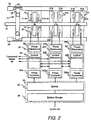
- FIG. 2 is a side view of a magnetic compensator system of the present invention for a mechanical thrust bearing 10.
- the mechanical thrust bearing is mounted on machine shaft 12 in close proximity to an axial magnetic bearing 14 including an axial magnetic bearing rotor disk 16, an axial magnetic bearing stator extension 18, and axial magnetic bearing annular windings 20.
- Axial magnetic bearings 214 and 314 are optional bearings for fault-tolerant applications, as discussed below.
- an outer race 22 of mechanical thrust bearing 10 can be attached to stator frame 24 by a bi-directional spring 26 having a controlled compliance.
- a direct relationship is thus present between the axial force load on the mechanical thrust bearing and the relative axial position between the magnetic bearing stator extension and rotor disk.
- Axial magnetic bearing rotor disk 16 comprises a passive rotor disk which is magnetically attracted by either of two axial magnetic bearing annular windings 20 (hereinafter referred to stator electromagnets 20).
- stator electromagnets 20 One of the two stator electromagnets will be energized by power electronics 27 controlled by control electronics 28 in a thrust compensator control system 30 to attract the rotor . disk according to the sign of the desired axial force with the magnitude of stator current being controlled to establish the attractive force amplitude.
- the non-energized stator electromagnet is available for high frequency probing. Probing pulses can be applied to the non-energized electromagnet to measure the stator electromagnet inductance which is a function of an air gap 31 length between the rotor disk and the stator extension. Power can be supplied to a power converter 30a by a power supply 33 which can include a battery 35 and a battery charger 37. If desired, conventional air gap estimation techniques, such as the use of eddy current sensors can
- models of air flow are used to predict the needed flux.
- the mechanical thrust bearing can be mounted in such a manner as to prevent any significant axial rotor disk motion.
- the thrust compensator would be unable to actually regulate or control force on the mechanical bearing.
- the thrust compensator would be commanded by the engine control unit to create a specific force with a level computed by the engine control unit base on an engine thrust model algorithm.
- the magnetic thrust compensator would create the bulk of the axial force required and thereby limit the mechanical thrust bearing force to safe levels.
- the open loop thrust compensation system would be limited by the accuracy of the feed-forward engine thrust and magnetic force models, so a constant uni-directional mechanical bearing force could not be guaranteed.
- the surface of the magnetic bearing rotor disk 16 and stator extension 18 of FIG. 2 can also function as a mechanical bumper bearing to prevent overload of the mechanical bearing in the event of a magnetic compensator failure by keeping the nominal air gap length 31 less than the maximum spring deflection.
- the bearing stator extension/rotor disk surface can be self-lubricating by proper selection of wear surfaces or by impregnation with a lubricating agent.
- the stator extension and rotor disk surfaces can be lubricated by a more conventional technique such as an oil mist system.
- a fault-tolerant magnetic thrust compensator can be made by including three identical parallel acting electromagnetic structures, including redundant electromagnets 20, 220, and 320, compensator control systems 30, 230, and 330, power electronics 27, 227, and 327, control electronics 28, 228, and 328, and power converters 30a, 230a, .and 330a, as shown in FIG. 2.
- each of the three electromagnet structures can produce fifty percent of the required axial force, so the system thus requires only two of the three available electromagnetic structures to effectively function.
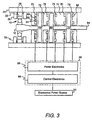
- FIG. 3 is a side view of an embodiment of a magnetic thrust compensator system similar to that of FIG. 2 with the addition of a bias magnet shown as an annular permanent magnet 60.
- the permanent magnet of the axial magnetic bearing generates a fixed forward bias force while the controllable electromagnets 78, 79, 80, and 82 of the axial magnetic bearings can generate a net force in either forward or aft directions.
- An electronic power source 90 supplies power to the control electronics 88 and power electronics 86 of compensator control system 30.
- Axial disk deflection is constrained by mechanical stops 56.
- the axial spring constant of compliance spring 26 is selected such that the desired load for the mechanical . bearing is achieved half way between the mechanical stops.
- Rotor disk 66 on shaft 84 is attracted by the annular ring of permanent magnet material 60 (such as samarium cobalt) suitable for the required operating temperature range of the machine.
- the permanent magnet material is positioned in a magnetic annular stator extension 58 and covered with a tapered magnetic cap 64 which concentrates the magnet flux at the air gap to maximize the attractive force.
- the annular stator extension comprises a non-laminated magnetic material such as silicon-iron or cobalt-iron.
- the permanent magnet material is encapsulated by nonmagnetic wedge shaped rings 61 so that the brittle permanent magnet material is supported after magnet assembly.
- the permanent magnet is sized to generate a forward force on the shaft which is sufficient to ensure that the maximum transient load rating of the mechanical thrust bearing will not be exceeded in the event that the parallel operating electromagnets 78, 79, 80, and 82, which operate as discussed above with respect to FIG. 2, are not functioning.
- stator segment 74 if desired, a single stator segment can support electromagnets for two rotor disks located on opposite sides of that stator segment.
- each of the electromagnets 78, 79, 80, and 82 is a dual annular winding.
- a single annular winding, as shown in FIG. 2 can also be employed.
- the dual annular windings of FIGs. 1 and 3 can also be used in the embodiment of FIG. 2.
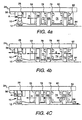
- FIGs. 4a-4e are side views of a magnetic thrust compensator system under a variety of load conditions.
- the descriptions of FlGs. 4a-4e are generally applicable to the operations of each of FlGs. 3, 5, and 7. Therefore, a bias magnet extension 59 is used without explicitly showing the permanent magnet in the manner that the permanent magnet is shown in FIG. 3.
- FIG. 4a illustrates the compensator system at initial power up in the home or parked position.
- the strength of the permanent magnet will force the mechanical disk spring against the forward stop 56 with the full magnet force in the B direction, which is opposite the force in the A direction on the mechanical bearing. Because the permanent magnet forces the system to a known fixed position, the control electronics can verify the correctness of the air gap calculations from all four available electromagnets 78, 79, 80, and 82.
- FIG. 4b illustrates the compensator system in the engine start position under conditions wherein the two electromagnetic axial bearings produce forces in a direction represented by arrows E and F opposite to that of the forces C and D on the mechanical bearing and rotor disk 66 adjacent the permanent magnet, respectively.
- the mechanical thrust bearing therefore deflects in the aft direction.
- control electronics 88 in FIG. 3 can measure and verify the stiffness of the compliant disk structure and the permanent magnet strength using an electromagnetic model of a controlled axial bearing which computes both force and air gap length between a stator extension and a rotor disk from the magnet terminal quantities of voltage and current. Once the magnetic thrust compensation is active it will attempt to maintain the mechanical thrust bearing at this position irrespective of engine thrust conditions and thereby achieve the desired moderate bearing load.
- FIG. 4c illustrates compensator system operation with maximum aft engine thrust in the direction represented by arrow K.
- the controller will generate a forward force in each of the two electromagnetic axial bearings in a direction represented by arrows I and J in the same direction as the forces G and H on the mechanical bearing and rotor disk 66.
- the controller will continually check the veracity of its inferred axial position feedback and the continued operation of compliant disk structure by perturbing the desired axial position of the mechanical thrust bearing. The cyclic perturbation will allow the controller to compute an effective stiffness for the spring mount, thus continuously self-checking the operation of the compensator system.
- FIG. 4d illustrates compensator system operation with maximum forward engine thrust in the M direction requiring each to of the controlled axial bearings to transiently create an aft force represented by arrows 0 and P in the opposite direction from the forward forces on the mechanical thrust bearing and rotor disk 66 represented by arrows L and N, respectively.
- FIG. 4e illustrates the compensator system in the event of a total failure of the controlled electromagnets with the engine generating a maximum aft thrust represented by arrow S in an opposite direction from the force of the mechanical thrust bearing (represented by arrow Q).
- the axial deflection of mechanical thrust bearing is limited by the aft stop 56 at maximum deflection producing force in the compliant disk structure represented by arrow R.
- FIG. 5 is a side view of an embodiment of a magnetic thrust compensator system similar to that of FIG. 3 with of a permanent magnet 112 having a winding 114 capable of magnetizing and demagnetizing the permanent magnet.
- the permanent magnet material 112 comprises material suitable for the operating temperature range.
- aluminum-nickel-cobalt permanent magnet material is used for a temperature range of up to and including 200 °C.
- the permanent magnet material is placed in a magnetic stator extension and covered with a tapered magnetic cap 116 which concentrates the magnetic flux at the air gap to maximize the attractive force.
- the stator extension 58 comprises a non-laminated magnetic material such as silicon-iron or cobalt-iron.
- the structure of the permanent magnet of FIG. 5 differs from that of FIG. 3 in that the annular ring of permanent magnet material is encircled by excitation winding 114 which is capable of generating sufficient ampere-turns to either magnetize or demagnetize the permanent magnet material.
- excitation winding 114 which is capable of generating sufficient ampere-turns to either magnetize or demagnetize the permanent magnet material.
- a controlled ac current of diminishing amplitude must be created in the excitation winding which will create a B-H magnetization curve trajectory required to demagnetize the material.
- the compensator control system 30 of FIG. 5 can be similar to those discussed with respect to FIGs. 2 and 3 with power electronics 86, control electronics 88, a digital signal processor (DSP) 96, and a DC/DC power converter 98 and with the addition of a magnetization/demagnetization control block 110 providing instructions to power electronics 87 for the permanent magnet 112 and the excitation winding 114.
- DSP digital signal processor
- FIG. 6 illustrates the compensator of FIG. 5 in the event of a total failure of the controlled electromagnets with the engine generating a maximum forward thrust represented by arrow U.
- Forward thrust is produced by the engine when the fuel is rapidly shut off as in an emergency shutdown.
- the engine control unit will instigate a turnoff of the permanent magnet causing the current (and the forces in the directions of arrows T and V) to decay.
- the engine control unit can cause a partial demagnetization of the permanent magnet by triggering a fixed width voltage pulse forcing along the B-H magnetization curve trajectory to provide an irreversible magnetization loss and reduction of the force capacity of the permanent magnet.
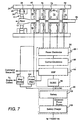
- FIG. 7 is a side view of an embodiment of a magnetic thrust compensator system similar to that of FIG. 2 with the addition of a bias annular electromagnet winding 92 (hereinafter referred to as an electromagnetic bias magnet).
- the thrust compensator thus has both an electromagnetic bias magnet which generates a fixed forward bias force while the controllable electromagnets 78, 79, 80, and 82 of the axial magnetic bearings can generate a net force in either forward or aft directions.
- the permanent magnet although preferably at least two rotors 68 and 70 are controlled on both sides by controllable electromagnets 78, 79, 80, and 82, one such rotor can be sufficient in certain applications.
- the electromagnetic bias magnet is sized to generate a fixed secure forward force on the shaft 84 which is sufficient to insure that the maximum transient load rating of the mechanical thrust bearing 10 will not be exceeded in the event that the parallel operating controlled electromagnets are not functioning.
- the electromagnetic bias magnet may comprise a simple, uncontrolled electromagnet fed either from a constant, reliable voltage source which may be an independent battery system (not shown) or from a battery system (shown as a power supply 90) also supplying power to the controlled annular electromagnet windings. Because uncontrolled electromagnetic bias magnets are quite reliable, they are not subject to the common failure modes of controlled electromagnets such as shorted power electronic switches and control computer failures.
- the magnetic thrust compensator DSP controller 96 can monitor current flow into the electromagnetic bias magnet and thus readily detect the different possible winding failures (i.e. ground fault, shorted turns, open connector, etc.) and initiates a controlled shutdown in the event of a electromagnetic bias magnet failure.
- the electromagnetic bias magnet is energized via two parallel acting solid state relays 100 and 102, one commanded from the magnetic thrust compensator control system 30 and the second commanded from the engine controller (not shown). To de-energize the electromagnetic bias magnet after the engine is shut down, both controllers must act together.
- the entire biased magnetic thrust compensator can continue . operating through transient ac power outages without losing axial force control. If ac power outages are unlikely, the battery backup can be limited to the electromagnetic bias magnet and still provide a safe shutdown in the unlikely event of an ac power outage. If a dual battery system is used, the most cost efficient battery technology is sealed maintenance-free lead-acid type batteries which are widely used for computer and telephone backup power systems. Because such batteries have both sudden failure mechanisms and inherent wear mechanisms, reliability is increased by using a dual battery charger system.
- Nickel cadmium batteries are inherently more reliable, lack the wear mechanisms of lead-acid batteries, and can be used where one common battery 106 and charger 108 feeds both the electromagnetic bias magnet and the controlled electromagnets, as shown in FIG. 7.
- Nickel cadmium batteries are more expensive than lead-acid batteries and require periodic electrolyte maintenance.
- Various permutations of redundant batteries and chargers are possible, and the preferred design will depend on overall system reliability requirements.
- axial disk deflection is constrained by mechanical stops 56.
- the axial spring constant of compliance spring 26 is selected such that the large load for the mechanical bearing is achieved half way between the mechanical stops.
- Rotor disk 66 is attracted by an annular "E" core stator extension 58 of magnet material such as silicon-iron or cobalt-iron suitable for the required operating temperature range of the machine.
- the electromagnetic bias magnet is sized for specific distributed resistance so that, when excited by a constant voltage source, a desired nominal winding current is achieved. This winding current excitation level is thus subject to variability due to temperature dependent winding resistance changes and voltage source variations which create changes in the axial force produced by the electromagnetic bias magnet.
- the attractive force produced by the electromagnetic bias magnet is also affected by air gap variations with axial rotor disk motion which result from leakage flux increases at larger air gaps and the consequent reduction of rotor flux density.
- FIGs. 4a-4e and FIG. 6 are similar for the electromagnetic bias magnet. With respect to FIG. 6, a turnoff will cause the bias current to exponential decay at its inherent UR indicative time constant. Because force is roughly proportional to i 2 , the force will decay at a faster rate.
Landscapes
- Engineering & Computer Science (AREA)
- General Engineering & Computer Science (AREA)
- Mechanical Engineering (AREA)
- Physics & Mathematics (AREA)
- Electromagnetism (AREA)
- Magnetic Bearings And Hydrostatic Bearings (AREA)
Applications Claiming Priority (2)
| Application Number | Priority Date | Filing Date | Title |
|---|---|---|---|
| US764186 | 1985-08-09 | ||
| US08/764,186 US5969451A (en) | 1996-12-13 | 1996-12-13 | Current-controlled magnetic thrust compensators for mechanical thrust bearings |
Publications (3)
| Publication Number | Publication Date |
|---|---|
| EP0848174A2 EP0848174A2 (en) | 1998-06-17 |
| EP0848174A3 EP0848174A3 (en) | 2000-07-19 |
| EP0848174B1 true EP0848174B1 (en) | 2004-03-17 |
Family
ID=25069929
Family Applications (1)
| Application Number | Title | Priority Date | Filing Date |
|---|---|---|---|
| EP97310032A Expired - Lifetime EP0848174B1 (en) | 1996-12-13 | 1997-12-12 | Bearing system comprising a magnetic thrust compensator |
Country Status (4)
| Country | Link |
|---|---|
| US (1) | US5969451A (https=) |
| EP (1) | EP0848174B1 (https=) |
| JP (2) | JPH10281157A (https=) |
| DE (1) | DE69728118T2 (https=) |
Families Citing this family (17)
| Publication number | Priority date | Publication date | Assignee | Title |
|---|---|---|---|---|
| FR2741486B1 (fr) * | 1995-11-20 | 1998-02-20 | Jeumont Ind | Procede et dispositif de compensation des forces d'attraction magnetique a l'interieur d'une machine discoide |
| JP3725323B2 (ja) * | 1998-02-23 | 2005-12-07 | 日創電機株式会社 | 駆動モータ及び成形機用駆動装置 |
| US6585995B1 (en) | 1999-09-21 | 2003-07-01 | Hanson Stephen R | Methods and compositions for treating platelet-related disorders |
| JP2002320363A (ja) * | 2001-04-20 | 2002-10-31 | Denso Corp | 車両用発電電動機 |
| DE102007028935B4 (de) * | 2007-06-22 | 2018-12-27 | Saurer Spinning Solutions Gmbh & Co. Kg | Verfahren und Vorrichtung zum Starten einer elektrischen Maschine mit einem magnetisch gelagerten Rotor |
| GB0720628D0 (en) * | 2007-10-20 | 2007-11-28 | Rolls Royce Plc | Bearing arrangement |
| IT1399157B1 (it) * | 2010-04-06 | 2013-04-11 | Nuova Pignone S R L | Rivestimento autolubrificante e metodo |
| WO2012135586A2 (en) * | 2011-03-30 | 2012-10-04 | Abb Technology Ag | An improved axial magnetic bearing |
| US8963393B2 (en) | 2012-12-18 | 2015-02-24 | Abb Research Ltd. | Magnetic thrust bearings |
| AT513498B1 (de) | 2013-01-22 | 2014-05-15 | Univ Wien Tech | Vorrichtung und Verfahren zur magnetischen Axiallagerung eines Rotors |
| US10465557B2 (en) | 2015-09-01 | 2019-11-05 | Rolls-Royce North American Technologies, Inc. | Magnetic squeeze film damper system for a gas turbine engine |
| JP6596749B2 (ja) * | 2015-10-28 | 2019-10-30 | 三菱日立パワーシステムズ株式会社 | 回転機械及び回転機械の制御方法 |
| US20190089221A1 (en) * | 2017-09-20 | 2019-03-21 | Upwing Energy, LLC | Magnetic thrust load support for downhole-type system |
| CN110925305B (zh) * | 2019-05-21 | 2021-03-12 | 北京泓慧国际能源技术发展有限公司 | 一种双核控制的磁悬浮系统 |
| CN114962451B (zh) * | 2022-05-07 | 2026-03-31 | 中国船舶重工集团公司第七一九研究所 | 推力轴承 |
| EP4339469B1 (en) * | 2022-09-15 | 2025-05-28 | Skf Magnetic Mechatronics | Device for controlling a magnetic bearing and associated system |
| CN115680887B (zh) * | 2022-10-13 | 2024-05-17 | 中国航发四川燃气涡轮研究院 | 一种航空发动机磁轴承控制系统及方法 |
Family Cites Families (22)
| Publication number | Priority date | Publication date | Assignee | Title |
|---|---|---|---|---|
| FR2110581A5 (https=) * | 1970-10-22 | 1972-06-02 | Habermann Helmut | |
| US3779618A (en) * | 1971-02-26 | 1973-12-18 | Comitato Naz Per I Engergia Nu | Self-centering magnetic suspension |
| DE2738175C2 (de) * | 1977-08-24 | 1982-09-16 | Siemens AG, 1000 Berlin und 8000 München | Dauermagneterregte elektrische Maschine |
| JPS57154517A (en) * | 1981-03-18 | 1982-09-24 | Toshiba Corp | Magnetic bearing |
| JPS5865321A (ja) * | 1981-10-15 | 1983-04-19 | Seiko Instr & Electronics Ltd | 磁気軸受 |
| JPS6034121U (ja) * | 1983-08-12 | 1985-03-08 | 三菱重工業株式会社 | スラスト軸受 |
| JPH056419Y2 (https=) * | 1988-12-20 | 1993-02-18 | ||
| US4920291A (en) * | 1989-01-19 | 1990-04-24 | Contraves Goerz Corporation | Magnetic thrust bearing with high force modulation capability |
| GB2239295B (en) * | 1989-08-04 | 1993-04-21 | Glacier Metal Co Ltd | Magnetic bearings |
| US5003211A (en) * | 1989-09-11 | 1991-03-26 | The United States Of America As Represented By The Administrator Of The National Aeronautics And Space Administration | Permanent magnet flux-biased magnetic actuator with flux feedback |
| RU2089761C1 (ru) * | 1991-02-27 | 1997-09-10 | Лейболд Акциенгезельшафт | Магнитная опора |
| DE4216481A1 (de) * | 1992-05-19 | 1993-12-02 | Forschungszentrum Juelich Gmbh | Magnetlagerregler |
| US5300843A (en) * | 1992-11-02 | 1994-04-05 | General Electric Company | Fault tolerant active magnetic bearing |
| US5300841A (en) * | 1992-11-02 | 1994-04-05 | General Electric Company | Inductive air gap estimation method for active magnetic bearings |
| US5300842A (en) * | 1992-11-02 | 1994-04-05 | General Electric Company | Flux/current air gap estimation method for active magnetic bearings |
| JP3040633B2 (ja) * | 1993-03-31 | 2000-05-15 | 光洋精工株式会社 | 磁気軸受装置 |
| US5543673A (en) * | 1993-07-27 | 1996-08-06 | Sundstrand Corporation | High performance magnetic bearing |
| JPH0754846A (ja) * | 1993-08-11 | 1995-02-28 | Nippon Seiko Kk | 高速回転軸装置 |
| EP0693630A3 (en) * | 1994-07-18 | 1998-01-07 | General Electric Company | Magnetic thrust bearing |
| US5578880A (en) * | 1994-07-18 | 1996-11-26 | General Electric Company | Fault tolerant active magnetic bearing electric system |
| US5627421A (en) * | 1994-10-28 | 1997-05-06 | Barber-Colman Company | High efficiency drive circuit for an active magnetic bearing system |
| US5749700A (en) * | 1996-07-17 | 1998-05-12 | Allison Engine Company, Inc. | High speed, high temperature hybrid magnetic thrust bearing |
-
1996
- 1996-12-13 US US08/764,186 patent/US5969451A/en not_active Expired - Lifetime
-
1997
- 1997-12-12 EP EP97310032A patent/EP0848174B1/en not_active Expired - Lifetime
- 1997-12-12 DE DE69728118T patent/DE69728118T2/de not_active Expired - Lifetime
- 1997-12-12 JP JP9341785A patent/JPH10281157A/ja not_active Ceased
-
2009
- 2009-10-20 JP JP2009240960A patent/JP4966359B2/ja not_active Expired - Fee Related
Also Published As
| Publication number | Publication date |
|---|---|
| JP2010048420A (ja) | 2010-03-04 |
| EP0848174A3 (en) | 2000-07-19 |
| JP4966359B2 (ja) | 2012-07-04 |
| DE69728118D1 (de) | 2004-04-22 |
| JPH10281157A (ja) | 1998-10-20 |
| US5969451A (en) | 1999-10-19 |
| DE69728118T2 (de) | 2005-02-10 |
| EP0848174A2 (en) | 1998-06-17 |
Similar Documents
| Publication | Publication Date | Title |
|---|---|---|
| JP4966359B2 (ja) | 磁気スラスト補償装置 | |
| US6359357B1 (en) | Combination radial and thrust magnetic bearing | |
| US8378543B2 (en) | Generating electromagnetic forces in large air gaps | |
| EP2697893B1 (en) | Air gap control systems and methods | |
| US6794780B2 (en) | Magnetic bearing system | |
| Allaire et al. | Design and test of a magnetic thrust bearing | |
| RU2372535C2 (ru) | Устройство увеличения допустимой осевой нагрузки в подшипниковой системе ротора | |
| US20080122308A1 (en) | Method for Stabilizing a Magnetically Levitated Object | |
| JP2010530516A (ja) | フライホイール電力貯蔵システムのためのリフトマグネット機構 | |
| US20250042519A1 (en) | Roll stabilization and related apparatuses | |
| WO1997024535A1 (en) | Backup bearings for positive re-centering of magnetic bearings | |
| US8133004B2 (en) | Jet engine with active-magnetic bearing | |
| JP2001008406A (ja) | 磁界内で発電機の回転子を支承するための装置 | |
| McMullen et al. | Flywheel energy storage system with AMB’s and hybrid backup bearings | |
| KR100589720B1 (ko) | 자기 베어링의 고장 진단/치료 시스템과 그 방법 | |
| Kalsi et al. | Iron-core superconducting magnet design and test results for maglev application | |
| GB2297361A (en) | Active magnetic bearing system | |
| US20110140559A1 (en) | Magnetic Bearing Device of a Rotor Shaft Against a Stator With Rotor Disc Elements, Which Engage Inside One Another, and Stator Disc Elements | |
| Wu et al. | Finite element analysis of eight-pole homopolar hybrid magnetic bearing | |
| Katyayn et al. | Comparative analysis of conical and conventional active magnetic bearings for complete support of a 5-dof rotor system | |
| KR20200094764A (ko) | 로터 베어링을 자기적으로 언로딩하기 위한 장치 및 방법 | |
| AU2001270796B2 (en) | Magnetic bearings | |
| CN121984272A (en) | Stepping servo motor with power-off braking function | |
| Jiang et al. | Optimization Design of Asymmetric Axial Magnetic Bearing with Unidirectional Large Bearing Capacity for Turbomachinery | |
| Na | Design and Analysis of an Electromagnet Biased Integrated Radial-Axial Magnetic Bearing |
Legal Events
| Date | Code | Title | Description |
|---|---|---|---|
| PUAI | Public reference made under article 153(3) epc to a published international application that has entered the european phase |
Free format text: ORIGINAL CODE: 0009012 |
|
| AK | Designated contracting states |
Kind code of ref document: A2 Designated state(s): DE FR GB IT |
|
| AX | Request for extension of the european patent |
Free format text: AL;LT;LV;MK;RO;SI |
|
| PUAL | Search report despatched |
Free format text: ORIGINAL CODE: 0009013 |
|
| AK | Designated contracting states |
Kind code of ref document: A3 Designated state(s): AT BE CH DE DK ES FI FR GB GR IE IT LI LU MC NL PT SE |
|
| AX | Request for extension of the european patent |
Free format text: AL;LT;LV;MK;RO;SI |
|
| 17P | Request for examination filed |
Effective date: 20010119 |
|
| AKX | Designation fees paid |
Free format text: DE FR GB IT |
|
| 17Q | First examination report despatched |
Effective date: 20010810 |
|
| RTI1 | Title (correction) |
Free format text: BEARING SYSTEM COMPRISING A MAGNETIC THRUST COMPENSATOR |
|
| GRAP | Despatch of communication of intention to grant a patent |
Free format text: ORIGINAL CODE: EPIDOSNIGR1 |
|
| RTI1 | Title (correction) |
Free format text: BEARING SYSTEM COMPRISING A MAGNETIC THRUST COMPENSATOR |
|
| GRAS | Grant fee paid |
Free format text: ORIGINAL CODE: EPIDOSNIGR3 |
|
| GRAA | (expected) grant |
Free format text: ORIGINAL CODE: 0009210 |
|
| AK | Designated contracting states |
Kind code of ref document: B1 Designated state(s): DE FR GB IT |
|
| REG | Reference to a national code |
Ref country code: GB Ref legal event code: FG4D |
|
| REF | Corresponds to: |
Ref document number: 69728118 Country of ref document: DE Date of ref document: 20040422 Kind code of ref document: P |
|
| ET | Fr: translation filed | ||
| PLBE | No opposition filed within time limit |
Free format text: ORIGINAL CODE: 0009261 |
|
| STAA | Information on the status of an ep patent application or granted ep patent |
Free format text: STATUS: NO OPPOSITION FILED WITHIN TIME LIMIT |
|
| 26N | No opposition filed |
Effective date: 20041220 |
|
| PGFP | Annual fee paid to national office [announced via postgrant information from national office to epo] |
Ref country code: IT Payment date: 20121221 Year of fee payment: 16 Ref country code: GB Payment date: 20121227 Year of fee payment: 16 |
|
| PGFP | Annual fee paid to national office [announced via postgrant information from national office to epo] |
Ref country code: FR Payment date: 20130110 Year of fee payment: 16 |
|
| PGFP | Annual fee paid to national office [announced via postgrant information from national office to epo] |
Ref country code: DE Payment date: 20121231 Year of fee payment: 16 |
|
| REG | Reference to a national code |
Ref country code: DE Ref legal event code: R119 Ref document number: 69728118 Country of ref document: DE |
|
| GBPC | Gb: european patent ceased through non-payment of renewal fee |
Effective date: 20131212 |
|
| REG | Reference to a national code |
Ref country code: FR Ref legal event code: ST Effective date: 20140829 |
|
| REG | Reference to a national code |
Ref country code: DE Ref legal event code: R119 Ref document number: 69728118 Country of ref document: DE Effective date: 20140701 |
|
| PG25 | Lapsed in a contracting state [announced via postgrant information from national office to epo] |
Ref country code: DE Free format text: LAPSE BECAUSE OF NON-PAYMENT OF DUE FEES Effective date: 20140701 |
|
| PG25 | Lapsed in a contracting state [announced via postgrant information from national office to epo] |
Ref country code: GB Free format text: LAPSE BECAUSE OF NON-PAYMENT OF DUE FEES Effective date: 20131212 Ref country code: FR Free format text: LAPSE BECAUSE OF NON-PAYMENT OF DUE FEES Effective date: 20131231 |
|
| PG25 | Lapsed in a contracting state [announced via postgrant information from national office to epo] |
Ref country code: IT Free format text: LAPSE BECAUSE OF NON-PAYMENT OF DUE FEES Effective date: 20131231 |
|
| PG25 | Lapsed in a contracting state [announced via postgrant information from national office to epo] |
Ref country code: IT Free format text: LAPSE BECAUSE OF NON-PAYMENT OF DUE FEES Effective date: 20131212 |