EP0845799A2 - Halbleiterbehandlungsgerät - Google Patents
Halbleiterbehandlungsgerät Download PDFInfo
- Publication number
- EP0845799A2 EP0845799A2 EP97308618A EP97308618A EP0845799A2 EP 0845799 A2 EP0845799 A2 EP 0845799A2 EP 97308618 A EP97308618 A EP 97308618A EP 97308618 A EP97308618 A EP 97308618A EP 0845799 A2 EP0845799 A2 EP 0845799A2
- Authority
- EP
- European Patent Office
- Prior art keywords
- electrode
- aperture
- suppression
- seat
- set forth
- Prior art date
- Legal status (The legal status is an assumption and is not a legal conclusion. Google has not performed a legal analysis and makes no representation as to the accuracy of the status listed.)
- Granted
Links
Images
Classifications
-
- H—ELECTRICITY
- H01—ELECTRIC ELEMENTS
- H01J—ELECTRIC DISCHARGE TUBES OR DISCHARGE LAMPS
- H01J37/00—Discharge tubes with provision for introducing objects or material to be exposed to the discharge, e.g. for the purpose of examination or processing thereof
- H01J37/30—Electron-beam or ion-beam tubes for localised treatment of objects
- H01J37/317—Electron-beam or ion-beam tubes for localised treatment of objects for changing properties of the objects or for applying thin layers thereon, e.g. for ion implantation
- H01J37/3171—Electron-beam or ion-beam tubes for localised treatment of objects for changing properties of the objects or for applying thin layers thereon, e.g. for ion implantation for ion implantation
-
- H10P30/20—
-
- H—ELECTRICITY
- H01—ELECTRIC ELEMENTS
- H01J—ELECTRIC DISCHARGE TUBES OR DISCHARGE LAMPS
- H01J37/00—Discharge tubes with provision for introducing objects or material to be exposed to the discharge, e.g. for the purpose of examination or processing thereof
- H01J37/02—Details
- H01J37/04—Arrangements of electrodes and associated parts for generating or controlling the discharge, e.g. electron-optical arrangement or ion-optical arrangement
- H01J37/08—Ion sources; Ion guns
-
- H—ELECTRICITY
- H01—ELECTRIC ELEMENTS
- H01J—ELECTRIC DISCHARGE TUBES OR DISCHARGE LAMPS
- H01J2237/00—Discharge tubes exposing object to beam, e.g. for analysis treatment, etching, imaging
- H01J2237/04—Means for controlling the discharge
- H01J2237/045—Diaphragms
Definitions
- This invention is related in general to the field of semiconductor processing apparatus. More particularly, the invention is related to an ion implantation suppression electrode assembly.
- Ion implantation is an important processing step in manufacturing semiconductor devices.
- a beam of impurity ions is accelerated to kinetic energies ranging from several keV to several MeV and directed onto the surface of the semiconductor.
- a typical ion implanter ionizes the desired impurity gas in an arc chamber and the ions are extracted by an energized extraction electrode assembly into an acceleration tube toward the semiconductor.
- the extraction electrode assembly typically includes two electrodes, a suppression electrode and an extraction electrode.
- ions are drawn out of the arc chamber or ion source, they pass through an aperture in the suppression electrode and toward an aperture in the extraction electrode.
- the majority of the ions pass through the extraction electrode aperture, but some strike the extraction electrode and generate secondary electrons.
- These secbndary electrons are drawn by the highly positive source and accelerate toward it.
- the striking of the secondary electrons on the ion source would have resulted in the release of X-rays. However, these secondary electrons are stopped by the suppression electrode so that the generation of X-rays is greatly minimized.
- the extraction electrode assembly In addition to extracting the ions from the arc chamber, the extraction electrode assembly further performs beam steering and focusing functions.
- the extraction electrode can be tilted and moved relative to the stationary ion source to center and focus the ion beam.
- the aperture is worn down quickly.
- a worn aperture may no longer have a well-defined opening and cannot steer and focus the ion beam in an effective manner.
- the suppression electrode is manufactured from a fragile material, typically graphite, careless mishandling also can easily damage the aperture and the electrode itself. Carelessness during the alignment process while installing the suppression electrode also may chip the aperture. When the aperture is damaged, the entire suppression electrode must be replaced, which is costly. Further, because of the porous and hydrophilic properties of graphite, substantial time is required to completely pump out the extraction chamber and out gas the suppression electrode after maintenance and servicing.
- a suppression electrode assembly is provided which eliminates or substantially reduces the disadvantages associated with prior suppression electrodes used in ion implanters.
- a suppression electrode assembly comprises an electrode suppression plate constructed of a material having substantial strength and durability and that has an aperture seat with an opening defined therein.
- An aperture insert constructed from graphite is slidably engageable with the aperture seat.
- the aperture insert which defines an elongated slit is in general alignment with the opening in the aperture seat when the aperture insert is installed in the seat.
- a technical advantage of the present invention is the durability of the suppression electrode and the disposability of the aperture insert. When worn or damaged beyond acceptable limits, the fragile aperture inserts may be replaced easily with a new one. Because the suppression electrode plate is constructed from durable materials such as stainless steel, it is substantially more resistant to possible damage caused by mishandling. Further, since the suppression electrode is constructed from a less porous and hydrophilic material than graphite, considerably less time is required to evacuate the extraction chamber to achieve vacuum after maintenance and servicing.
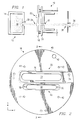
- FIGURES 1-6 The preferred embodiment(s) of the present invention is (are) illustrated in FIGURES 1-6, like reference numerals being used to refer to like and corresponding parts of the various drawings.
- an extraction electrode assembly 10 is shown positioned in front of an ion source 12.
- Ion source 12 is an arc chamber 14 containing an highly energized and ionized impurity gas 16, such as boron.
- Extraction electrode assembly 10 includes a first electrode 18 placed at a predetermined distance in front of arc chamber 14, and a second electrode 20 placed behind first electrode 18.
- First electrode 18 is commonly called the suppression electrode
- second electrode 20 is commonly called the extraction electrode.
- Suppression electrode 18 may have more than one aperture to allow the passage of extracted ions at different energies.
- suppression electrode 18 When suppression electrode 18 has two apertures 22 and 24, it is sometimes referred to as a dual-slit electrode, such as one used in model NV-20A manufactured by Eaton Corporation, Beverly, Massachusetts.
- suppression electrode 18 is constructed out of an inert but fragile material, such as graphite.
- extraction electrode 20 is charged and maintained at a voltage significantly lower or more negative than the arc chamber potential to attract and extract the positive ions 16 out of arc chamber 14 through an arc chamber aperture 30.
- the ions then pass through aperture 22 or 24 in suppression electrode 18 and pass through an aperture 32 in extraction electrode 20.
- Some of the ions strike electrode 20 and generate secondary electrons. These electrons are stopped from rebounding and hitting arc chamber 14 by suppression electrode 18, which is maintained at a more negative potential than extraction electrode 20.
- the X-rays that would otherwise have been generated by the secondary electrons hitting arc chamber 14 are thus substantially reduced or eliminated.
- the resultant stream of extracted ions form an ion beam 36, which travels through downstream equipment of the ion implanter toward the target semiconductor (not shown).
- Extraction electrode assembly 10 can be displaced or moved along three axis to steer and focus ion beam 36 through a source housing aperture 38, so that the majority of the ions pass through aperture 38 and are in good alignment with downstream equipment in the ion implanter.
- Suppression electrode 18 includes an electrode suppression plate 40 constructed from a material with suitable mechanical, chemical, and thermal properties. For example, it is desirable to use a material that does not warp or have high thermionic emissions when subjected to temperatures experienced in the extraction chamber.
- stainless steel has been selected as the material used to fashion electrode suppression plate 40 therefrom.
- Electrode suppression plate 40 constructed from stainless steel can withstand large forces and can be easily cleaned.
- Conventional electrode suppression plates 40 are constructed from graphite, which is fragile, easily contaminated, and more difficult to clean.
- Electrode suppression plate 40 preferably has a flat disc profile and includes a number of through holes 42 located at predetermined locations for receiving fasteners therethrough to securely hold electrode suppression plate 40 in extraction electrode assembly 10 (FIGURE 1). It is obvious that the number, location and size of through holes 42, some of which may be countersunk, is determined by the nature of the seat or fixture (not shown explicitly) that receives suppression electrode 18.
- a first seat 48 for a first aperture 46 may be provided.
- aperture 46 is for extracting ions biased at a first range of voltage potential, for example, voltage levels greater than 30 KeV.
- Aperture seat 48 may include one or more openings 50 for receiving fasteners (not shown) to secure the insert therein.
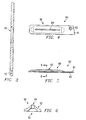
- FIGURES 4-6 are also provided.
- Aperture 70 includes an elongated opening 72 and at least one opening 74 for receiving a fastener (not shown).
- FIGURE 3 is a cross-sectional view of electrode suppression plate 40 along line 3-3 in FIGURE 2.
- Seat 76 extends to the perimeter of electrode suppression plate 40 to allow the aperture insert to be positioned in seat 76 by sliding it from the perimeter toward the center of plate 40.
- Aperture insert 80 includes a bottom plate 81 from which a generally domed aperture portion 86 arises.
- Bottom plate 81 is shaped and sized to slidably engage seat 76 formed in suppression electrode plate 40. It may be seen that aperture insert 80 may engage seat 76 from the perimeter of electrode suppression plate 40 and may be slid into seat 76. Once seated, aperture insert 80 cannot be removed by turning electrode suppression plate 40 upside down since the top lip of seat 76 is narrower than the bottom.
- At least one opening 82 is formed in bottom plate 81 of aperture insert, which corresponds in size and position with opening 74 formed in seat 76 for receiving a fastener.
- a fastener such as a bolt or screw
- Opening 74 may be countersunk.
- the desirable insert material preferably does not contain elements that are mobile in the semiconductor crystal lattice, such as chromium, nickel, and aluminum.
- aperture insert 80 is fashioned from graphite or any other suitable material that is not electrically active in silicon.
- Domed portion 86 of aperture insert 80 includes an elongated slit 84 of a predetermined width and length for the passage of accelerated ions from the ion source to their target.
- Domed portion 86 is substantially hollow with an elongated and domed void 90 that has a generally semi-circular cross-section. Void 90 echoes the shape of elongated slit 84 and is connected thereto, forming a continuous passageway through aperture insert 80.
- Dome portion 86 may further have a generally curved top surface 92 having a predetermined degree of curvature. This curvature is again echoed in the ceiling of void 90.
- aperture insert 80 may be easily replaced by a new insert when it is worn or damaged beyond the required specifications.
- Electrode suppression plate 40 because of the strength and more durable properties of stainless steel, can be used and reused many times as a more permanent fixture with replacement aperture inserts.Aperture inserts may be replaced without the removal and realignment of the entire suppression electrode 18, thus reducing the likelihood of contamination and increase the efficiency and speed of system maintenance. Less time and effort is also required to pump out the extraction chamber because the electrode suppression plate is fashioned from a less porous and hydrophilic material than graphite, such as stainless steel. As a result, the cost of operating the ion implanter is significantly reduced.
Landscapes
- Chemical & Material Sciences (AREA)
- Analytical Chemistry (AREA)
- Electron Sources, Ion Sources (AREA)
- Electrical Discharge Machining, Electrochemical Machining, And Combined Machining (AREA)
- Physical Vapour Deposition (AREA)
Applications Claiming Priority (2)
| Application Number | Priority Date | Filing Date | Title |
|---|---|---|---|
| US3040596P | 1996-10-29 | 1996-10-29 | |
| US30405P | 1996-10-29 |
Publications (3)
| Publication Number | Publication Date |
|---|---|
| EP0845799A2 true EP0845799A2 (de) | 1998-06-03 |
| EP0845799A3 EP0845799A3 (de) | 2000-09-20 |
| EP0845799B1 EP0845799B1 (de) | 2003-07-09 |
Family
ID=21854049
Family Applications (1)
| Application Number | Title | Priority Date | Filing Date |
|---|---|---|---|
| EP97308618A Expired - Lifetime EP0845799B1 (de) | 1996-10-29 | 1997-10-28 | Elektrode |
Country Status (6)
| Country | Link |
|---|---|
| US (1) | US5959396A (de) |
| EP (1) | EP0845799B1 (de) |
| JP (1) | JPH10144250A (de) |
| KR (1) | KR19980033220A (de) |
| DE (1) | DE69723404T2 (de) |
| TW (1) | TW442852B (de) |
Cited By (1)
| Publication number | Priority date | Publication date | Assignee | Title |
|---|---|---|---|---|
| WO2005038856A3 (en) * | 2003-10-17 | 2005-06-30 | Applied Materials Inc | Kinematic ion implanter electrode mounting |
Families Citing this family (9)
| Publication number | Priority date | Publication date | Assignee | Title |
|---|---|---|---|---|
| US6291827B1 (en) * | 1999-03-26 | 2001-09-18 | Mosel Vitelic Inc. | Insulating apparatus for a conductive line |
| GB2367685B (en) * | 2000-07-26 | 2004-06-16 | Masslab Ltd | Ion source for a mass spectrometer |
| KR100712494B1 (ko) * | 2001-08-31 | 2007-05-02 | 삼성전자주식회사 | 이온주입장치의 레졸빙 어퍼쳐 |
| KR100551338B1 (ko) * | 2003-07-25 | 2006-02-09 | 동부아남반도체 주식회사 | 이온빔 발생장치의 일렉트로드 헤드 |
| KR100510559B1 (ko) * | 2003-12-30 | 2005-08-26 | 삼성전자주식회사 | 이온 주입 장비의 매니퓰레이터 어셈블리 |
| KR100553716B1 (ko) * | 2004-08-02 | 2006-02-24 | 삼성전자주식회사 | 이온 주입 설비의 이온 소스부 |
| US20090101834A1 (en) * | 2007-10-23 | 2009-04-23 | Applied Materials, Inc. | Ion beam extraction assembly in an ion implanter |
| US20130045339A1 (en) * | 2011-08-15 | 2013-02-21 | Varian Semiconductor Equipment Associates, Inc. | Techniques for diamond nucleation control for thin film processing |
| US10714296B2 (en) * | 2018-12-12 | 2020-07-14 | Axcelis Technologies, Inc. | Ion source with tailored extraction shape |
Family Cites Families (5)
| Publication number | Priority date | Publication date | Assignee | Title |
|---|---|---|---|---|
| US4847504A (en) * | 1983-08-15 | 1989-07-11 | Applied Materials, Inc. | Apparatus and methods for ion implantation |
| GB8623453D0 (en) * | 1986-09-30 | 1986-11-05 | Tecvac Ltd | Ion implantation |
| DE3708716C2 (de) * | 1987-03-18 | 1993-11-04 | Hans Prof Dr Rer Nat Oechsner | Hochfrequenz-ionenquelle |
| US5218210A (en) * | 1992-02-18 | 1993-06-08 | Eaton Corporation | Broad beam flux density control |
| JP3054302B2 (ja) * | 1992-12-02 | 2000-06-19 | アプライド マテリアルズ インコーポレイテッド | イオン注入中の半導体ウェハにおける帯電を低減するプラズマ放出システム |
-
1997
- 1997-10-16 US US08/951,717 patent/US5959396A/en not_active Expired - Lifetime
- 1997-10-28 KR KR1019970055501A patent/KR19980033220A/ko not_active Withdrawn
- 1997-10-28 DE DE69723404T patent/DE69723404T2/de not_active Expired - Lifetime
- 1997-10-28 EP EP97308618A patent/EP0845799B1/de not_active Expired - Lifetime
- 1997-10-29 JP JP9297070A patent/JPH10144250A/ja active Pending
- 1997-11-21 TW TW086116240A patent/TW442852B/zh active
Cited By (3)
| Publication number | Priority date | Publication date | Assignee | Title |
|---|---|---|---|---|
| US7145157B2 (en) | 2003-09-11 | 2006-12-05 | Applied Materials, Inc. | Kinematic ion implanter electrode mounting |
| WO2005038856A3 (en) * | 2003-10-17 | 2005-06-30 | Applied Materials Inc | Kinematic ion implanter electrode mounting |
| CN1868029B (zh) * | 2003-10-17 | 2013-05-22 | 应用材料公司 | 动态离子注入器电极安装 |
Also Published As
| Publication number | Publication date |
|---|---|
| EP0845799A3 (de) | 2000-09-20 |
| DE69723404D1 (de) | 2003-08-14 |
| US5959396A (en) | 1999-09-28 |
| TW442852B (en) | 2001-06-23 |
| JPH10144250A (ja) | 1998-05-29 |
| DE69723404T2 (de) | 2004-04-15 |
| EP0845799B1 (de) | 2003-07-09 |
| KR19980033220A (ko) | 1998-07-25 |
Similar Documents
| Publication | Publication Date | Title |
|---|---|---|
| EP1981058B1 (de) | Ionenimplantationsvorrichtung und Ionenimplantationsverfahren | |
| KR101236563B1 (ko) | 하전된 빔 덤프 및 입자 어트랙터 | |
| US5343047A (en) | Ion implantation system | |
| US5670217A (en) | Method for capturing and removing contaminant particles from an interior region of an ion implanter | |
| EP1981059B1 (de) | Ionenimplantationsvorrichtung | |
| EP0845799B1 (de) | Elektrode | |
| GB2390221A (en) | Ion beam neutralizer and method therefor | |
| KR20170019386A (ko) | 텍스쳐링된 내부 표면들을 갖는 이온 주입 소스 | |
| JPH10330939A (ja) | イオン注入装置、二重排気チューブ組立体及びその交換方法 | |
| EP1314182B1 (de) | Vorrichtung und verfahren zum entfernen von, in einem ionenstrahl mitgeführten teilchen | |
| TWI396765B (zh) | 具有污染物收集表面的離子植入器 | |
| JP5042451B2 (ja) | ビーム空間電荷中和装置及びこれを備えたイオン注入装置 | |
| US7772576B2 (en) | Shielding assembly for semiconductor manufacturing apparatus and method of using the same | |
| WO2009083733A1 (en) | Improvements relating to ion implanters | |
| JPH11329316A (ja) | 傾斜ディセル装置とそのイオンビームの形成方法 | |
| JPS5827620B2 (ja) | イオン衝撃装置 | |
| US6084241A (en) | Method of manufacturing semiconductor devices and apparatus therefor | |
| KR102540006B1 (ko) | 이온 주입기 및 이온 주입 장치 | |
| WO2014176516A1 (en) | Flourine and hf resistant seals for an ion source | |
| US7199383B2 (en) | Method for reducing particles during ion implantation | |
| JP2968955B2 (ja) | イオン注入設備のウェーハ汚染防止装置 | |
| KR100821837B1 (ko) | 이온주입기의 매니플레이터 | |
| KR100774813B1 (ko) | 이온주입장치의 추출 전극 및 이온 빔 포커싱 방법 | |
| JP2002008580A (ja) | イオン注入装置 | |
| CN111146068A (zh) | 清扫离子注入机束流通道的方法 |
Legal Events
| Date | Code | Title | Description |
|---|---|---|---|
| PUAI | Public reference made under article 153(3) epc to a published international application that has entered the european phase |
Free format text: ORIGINAL CODE: 0009012 |
|
| AK | Designated contracting states |
Kind code of ref document: A2 Designated state(s): DE FR GB IT NL |
|
| AX | Request for extension of the european patent |
Free format text: AL;LT;LV;RO;SI |
|
| PUAL | Search report despatched |
Free format text: ORIGINAL CODE: 0009013 |
|
| AK | Designated contracting states |
Kind code of ref document: A3 Designated state(s): AT BE CH DE DK ES FI FR GB GR IE IT LI LU MC NL PT SE |
|
| AX | Request for extension of the european patent |
Free format text: AL;LT;LV;RO;SI |
|
| 17P | Request for examination filed |
Effective date: 20010314 |
|
| AKX | Designation fees paid |
Free format text: DE FR GB IT NL |
|
| 17Q | First examination report despatched |
Effective date: 20011205 |
|
| RTI1 | Title (correction) |
Free format text: ELECTRODE |
|
| GRAH | Despatch of communication of intention to grant a patent |
Free format text: ORIGINAL CODE: EPIDOS IGRA |
|
| RTI1 | Title (correction) |
Free format text: ELECTRODE |
|
| GRAH | Despatch of communication of intention to grant a patent |
Free format text: ORIGINAL CODE: EPIDOS IGRA |
|
| GRAA | (expected) grant |
Free format text: ORIGINAL CODE: 0009210 |
|
| AK | Designated contracting states |
Designated state(s): DE FR GB IT NL |
|
| PG25 | Lapsed in a contracting state [announced via postgrant information from national office to epo] |
Ref country code: NL Free format text: LAPSE BECAUSE OF FAILURE TO SUBMIT A TRANSLATION OF THE DESCRIPTION OR TO PAY THE FEE WITHIN THE PRESCRIBED TIME-LIMIT Effective date: 20030709 Ref country code: IT Free format text: LAPSE BECAUSE OF FAILURE TO SUBMIT A TRANSLATION OF THE DESCRIPTION OR TO PAY THE FEE WITHIN THE PRESCRIBED TIME-LIMIT;WARNING: LAPSES OF ITALIAN PATENTS WITH EFFECTIVE DATE BEFORE 2007 MAY HAVE OCCURRED AT ANY TIME BEFORE 2007. THE CORRECT EFFECTIVE DATE MAY BE DIFFERENT FROM THE ONE RECORDED. Effective date: 20030709 |
|
| REG | Reference to a national code |
Ref country code: GB Ref legal event code: FG4D |
|
| REF | Corresponds to: |
Ref document number: 69723404 Country of ref document: DE Date of ref document: 20030814 Kind code of ref document: P |
|
| NLV1 | Nl: lapsed or annulled due to failure to fulfill the requirements of art. 29p and 29m of the patents act | ||
| ET | Fr: translation filed | ||
| PLBE | No opposition filed within time limit |
Free format text: ORIGINAL CODE: 0009261 |
|
| STAA | Information on the status of an ep patent application or granted ep patent |
Free format text: STATUS: NO OPPOSITION FILED WITHIN TIME LIMIT |
|
| 26N | No opposition filed |
Effective date: 20040414 |
|
| PGFP | Annual fee paid to national office [announced via postgrant information from national office to epo] |
Ref country code: GB Payment date: 20120925 Year of fee payment: 16 |
|
| PGFP | Annual fee paid to national office [announced via postgrant information from national office to epo] |
Ref country code: FR Payment date: 20121010 Year of fee payment: 16 Ref country code: DE Payment date: 20121031 Year of fee payment: 16 |
|
| GBPC | Gb: european patent ceased through non-payment of renewal fee |
Effective date: 20131028 |
|
| PG25 | Lapsed in a contracting state [announced via postgrant information from national office to epo] |
Ref country code: GB Free format text: LAPSE BECAUSE OF NON-PAYMENT OF DUE FEES Effective date: 20131028 |
|
| REG | Reference to a national code |
Ref country code: DE Ref legal event code: R119 Ref document number: 69723404 Country of ref document: DE Effective date: 20140501 |
|
| REG | Reference to a national code |
Ref country code: FR Ref legal event code: ST Effective date: 20140630 |
|
| PG25 | Lapsed in a contracting state [announced via postgrant information from national office to epo] |
Ref country code: FR Free format text: LAPSE BECAUSE OF NON-PAYMENT OF DUE FEES Effective date: 20131031 Ref country code: DE Free format text: LAPSE BECAUSE OF NON-PAYMENT OF DUE FEES Effective date: 20140501 |