EP0845341A1 - Verfahren und Vorrichtung zum Vulkanisieren von Gummigegenständen - Google Patents
Verfahren und Vorrichtung zum Vulkanisieren von Gummigegenständen Download PDFInfo
- Publication number
- EP0845341A1 EP0845341A1 EP97120945A EP97120945A EP0845341A1 EP 0845341 A1 EP0845341 A1 EP 0845341A1 EP 97120945 A EP97120945 A EP 97120945A EP 97120945 A EP97120945 A EP 97120945A EP 0845341 A1 EP0845341 A1 EP 0845341A1
- Authority
- EP
- European Patent Office
- Prior art keywords
- mould
- article
- profile
- rubber
- vulcanisation
- Prior art date
- Legal status (The legal status is an assumption and is not a legal conclusion. Google has not performed a legal analysis and makes no representation as to the accuracy of the status listed.)
- Withdrawn
Links
- 229920001971 elastomer Polymers 0.000 title claims abstract description 32
- 238000000034 method Methods 0.000 title claims abstract description 32
- 239000005060 rubber Substances 0.000 title claims abstract description 32
- 238000004073 vulcanization Methods 0.000 claims abstract description 30
- 230000005684 electric field Effects 0.000 claims abstract description 16
- 238000001125 extrusion Methods 0.000 claims abstract description 10
- 238000002347 injection Methods 0.000 claims abstract description 10
- 239000007924 injection Substances 0.000 claims abstract description 10
- 230000006835 compression Effects 0.000 claims abstract description 8
- 238000007906 compression Methods 0.000 claims abstract description 8
- 239000000463 material Substances 0.000 claims description 3
- 150000002978 peroxides Chemical class 0.000 claims description 2
- 239000011810 insulating material Substances 0.000 claims 1
- 239000012815 thermoplastic material Substances 0.000 claims 1
- 238000010438 heat treatment Methods 0.000 description 9
- 239000000203 mixture Substances 0.000 description 5
- 239000000243 solution Substances 0.000 description 4
- 241000196324 Embryophyta Species 0.000 description 2
- 244000043261 Hevea brasiliensis Species 0.000 description 2
- 239000004809 Teflon Substances 0.000 description 2
- 229920006362 Teflon® Polymers 0.000 description 2
- 239000006185 dispersion Substances 0.000 description 2
- 238000004519 manufacturing process Methods 0.000 description 2
- 229920003052 natural elastomer Polymers 0.000 description 2
- 229920001194 natural rubber Polymers 0.000 description 2
- 230000009466 transformation Effects 0.000 description 2
- 229910000831 Steel Inorganic materials 0.000 description 1
- 238000010521 absorption reaction Methods 0.000 description 1
- 239000000654 additive Substances 0.000 description 1
- 230000015572 biosynthetic process Effects 0.000 description 1
- 239000004020 conductor Substances 0.000 description 1
- 230000001419 dependent effect Effects 0.000 description 1
- 230000006866 deterioration Effects 0.000 description 1
- 238000005265 energy consumption Methods 0.000 description 1
- 238000005516 engineering process Methods 0.000 description 1
- 238000002474 experimental method Methods 0.000 description 1
- 239000011152 fibreglass Substances 0.000 description 1
- 229920001821 foam rubber Polymers 0.000 description 1
- 229920002521 macromolecule Polymers 0.000 description 1
- 239000002184 metal Substances 0.000 description 1
- 239000004033 plastic Substances 0.000 description 1
- 238000003825 pressing Methods 0.000 description 1
- 239000010959 steel Substances 0.000 description 1
- 230000008961 swelling Effects 0.000 description 1
- 238000003856 thermoforming Methods 0.000 description 1
- 229920001169 thermoplastic Polymers 0.000 description 1
- 239000004416 thermosoftening plastic Substances 0.000 description 1
Images
Classifications
-
- B—PERFORMING OPERATIONS; TRANSPORTING
- B30—PRESSES
- B30B—PRESSES IN GENERAL
- B30B15/00—Details of, or accessories for, presses; Auxiliary measures in connection with pressing
- B30B15/34—Heating or cooling presses or parts thereof
-
- B—PERFORMING OPERATIONS; TRANSPORTING
- B29—WORKING OF PLASTICS; WORKING OF SUBSTANCES IN A PLASTIC STATE IN GENERAL
- B29C—SHAPING OR JOINING OF PLASTICS; SHAPING OF MATERIAL IN A PLASTIC STATE, NOT OTHERWISE PROVIDED FOR; AFTER-TREATMENT OF THE SHAPED PRODUCTS, e.g. REPAIRING
- B29C35/00—Heating, cooling or curing, e.g. crosslinking or vulcanising; Apparatus therefor
- B29C35/02—Heating or curing, e.g. crosslinking or vulcanizing during moulding, e.g. in a mould
- B29C35/12—Dielectric heating
-
- B—PERFORMING OPERATIONS; TRANSPORTING
- B29—WORKING OF PLASTICS; WORKING OF SUBSTANCES IN A PLASTIC STATE IN GENERAL
- B29C—SHAPING OR JOINING OF PLASTICS; SHAPING OF MATERIAL IN A PLASTIC STATE, NOT OTHERWISE PROVIDED FOR; AFTER-TREATMENT OF THE SHAPED PRODUCTS, e.g. REPAIRING
- B29C35/00—Heating, cooling or curing, e.g. crosslinking or vulcanising; Apparatus therefor
- B29C35/02—Heating or curing, e.g. crosslinking or vulcanizing during moulding, e.g. in a mould
- B29C35/12—Dielectric heating
- B29C35/14—Dielectric heating for articles of indefinite length
-
- B—PERFORMING OPERATIONS; TRANSPORTING
- B29—WORKING OF PLASTICS; WORKING OF SUBSTANCES IN A PLASTIC STATE IN GENERAL
- B29C—SHAPING OR JOINING OF PLASTICS; SHAPING OF MATERIAL IN A PLASTIC STATE, NOT OTHERWISE PROVIDED FOR; AFTER-TREATMENT OF THE SHAPED PRODUCTS, e.g. REPAIRING
- B29C35/00—Heating, cooling or curing, e.g. crosslinking or vulcanising; Apparatus therefor
- B29C35/02—Heating or curing, e.g. crosslinking or vulcanizing during moulding, e.g. in a mould
- B29C35/08—Heating or curing, e.g. crosslinking or vulcanizing during moulding, e.g. in a mould by wave energy or particle radiation
- B29C35/0805—Heating or curing, e.g. crosslinking or vulcanizing during moulding, e.g. in a mould by wave energy or particle radiation using electromagnetic radiation
- B29C2035/0861—Heating or curing, e.g. crosslinking or vulcanizing during moulding, e.g. in a mould by wave energy or particle radiation using electromagnetic radiation using radio frequency
Definitions
- This invention concerns a method to vulcanise rubber articles or profiles, and also the device which achieves the method, as set forth in the respective main claims.
- the invention is applied in the production of rubber articles or profiles made of all types of rubber, such as SBR, natural rubber, NBR, peroxide rubber or foam rubber and other types; it provides considerable advantages at least in terms of production times and energy saving.
- the invention is applied both in the vulcanisation of articles obtained by compression and also of continuous profiles obtained by injection and/or extrusion.
- the vulcanisation of rubber is a process of chemical-physical transformation through which natural rubber loses its essentially plastic characteristics in order to acquire essentially elastic ones.
- This process of vulcanisation allows the rubber article to acquire a stability of size and defined mechanical characteristics, such as hardness, elasticity, resistance to traction and stretching to break point.
- Air vulcanisation and continuous vulcanisation can only be applied to particular articles or profiles, such as for example those extruded through an extruder, which have already acquired the required shape.
- Press vulcanisation is based on the principle that a particular amount of non-vulcanised mix is placed in a pre-heated metal mould and pressure is exerted thereon, so that the mix becomes soft and fills the cavity of the mould.
- Press vulcanisation can be achieved both in an open mould and in a closed mould, by injecting or transferring the rubber.
- Heating the planes of the mould involves a long time to prepare for the process, a long time to cool down at the end of the cycle, high energy consumption and high levels of power used, also because so much is lost in the environment.
- a further disadvantage in these methods is that, since the heat is transferred to the article from the outside towards the inside, there is a risk of surface burns, and a lack of uniformity and homogeneity in the final article.
- the state of the art also includes vulcanisation methods which use the emission of micro-waves applied to the article which is to be vulcanised.
- This solution uses either ringing chambers inside which the article to be vulcanised is placed, or wave guide systems which include a localized outlet in correspondence with an article which is normally moving on a conveyor belt.
- the micro-waves are emitted from the appropriate source and spread inside the ringing chamber, bouncing on the walls; in this way, only some of the micro-waves hit the article to be vulcanised, and this causes a considerable dispersion of the power delivered and therefore an increase in the time required for vulcanisation.
- the micro-waves are applied only at various points and therefore are not distributed uniformly on the article to be vulcanised; this causes a lack of homogeneity and uniformity in the processing and therefore the final article is not of a satisfactory quality.
- the generated power of the micro-waves must necessarily be dissipated, either on the article to be vulcanised or elsewhere, and therefore it is inevitable that the generation systems are over-sized and the yield rather low.
- the purpose of the invention is to provide a method to vulcanise rubber articles, according to the press vulcanisation technology, which will eliminate the problem of heating the walls of the mould wherein the mix to be vulcanised is inserted.
- the vulcanisation process is performed in air on profiles obtained by extrusion from an extruder.
- Another purpose of the invention is to obtain a method of vulcanisation which will reduce the times of the process and which requires extremely limited power.
- the mix or article to be vulcanised has been placed inside the mould maintained at ambient temperature, it is subjected to the action of a variable radio-frequency electric field.
- the heating is achieved in much shorter times and with a much more limited power compared with methods known to the state of the art.
- the heating affects only the polar molecules of the rubber, that is to say, those which have electrically positive polarities on one side and electrically negative polarities on the opposite side, and therefore vary their spatial position with the same frequency of the electrical field applied.
- the article may be subjected to a polarisation of the molecules, for example by adding polarising additives.
- the rubber can be introduced inside the closed mould either by injection or by transfer.
- the method according to the invention also obviates the problems of a deterioration in the surface quality which are caused by the contact between one heated surface and the faces of the article to be vulcanised.
- the two planes of the mould connected to electrodes of opposite polarity, must necessarily be separated by an intermediate insulating plane so that they do not act as conductors, so that the electric field is generated through the planes themselves, and not through the metallic parts associated with the rubber article.
- a further advantage of the invention is that, during the injection step, it is not necessary to include a heat-adjustment chamber since the rubber article is not heated except when it is inside the action of the variable electric field.
- the invention is applied also in the case of thermoforming and extrusion of articles which have polar molecules and which can therefore be subjected to a process of radio-frequency heating.
- vulcanisation is performed in air, making the extruded profile interact with the electrodes which generate the radio-frequency electric field; these electrodes can be arranged, for example, on opposite sides of the transport or supporting plane of the article, or at the side of the extruded profile passing through.
- the invention also obtains a saving in terms of power required, for example compared with using micro-waves; in fact, absorption only occurs when the electric field actually affects the article or the profile to be vulcanised, that is, only for the time when the article or the profile is between the electrodes.
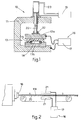
- the vulcanisation device 10 comprises a mechanical press 11, of which the upper and lower planes cooperate with the upper wall 13a and the lower wall 13b of the mould 13 which contains the rubber article 14, in this case toric in section, which is to be vulcanised.
- the mould 13 has an intermediate insulating layer 15, such as for example teflon, placed directly in contact with the rubber article 14.
- the device 10 also comprises a radio-frequency generator 16 consisting, in this case, of a power triode 17 suitable to generate a variable electric field with a high frequency, at least more than 1 MHz, between the two electrically insulated walls 13a and 13b of the mould 13.
- the insulating layer 15 may also be charged, for example with fibre glass, in order to increase its mechanical characteristics.
- the mechanical press 11 comprises a pressing element 22, activated by the hydraulic plant 19 by means of the connectors 23 and electrically insulated from the upper wall 13a of the mould 13 by means of a layer 12.
- variable electric field is generated between the two electrically insulated electrodes, in this case consisting of the structure of the mechanical press 11 and the upper wall 13a of the mould 13.
- the rubber article 14 reaches a temperature of at least 140°C, advantageously about 160 ⁇ 170°C, in an extremely short time, while the mould 13 and the insulating layer 15 made of teflon remain substantially at ambient temperature.
- the vulcanisation is the compression type; however, results are the same in the case of injection vulcanisation and, more simply, using extrusion, by making the extruded profile pass between two electrodes.
- the continuous profile 114 leaving the mouth 18 of the extruder and deposited on a transport or supporting plane 20, is subjected to the action of two electrodes 21, fed by the power triode 17, which generate the variable radio-frequency electric field.
- the electrodes 21 are arranged on opposite sides of the transport or supporting plane 20, made of material which is transparent to radio-frequencies and therefore, in practice, it does not heat up.
Landscapes
- Physics & Mathematics (AREA)
- Health & Medical Sciences (AREA)
- Oral & Maxillofacial Surgery (AREA)
- Thermal Sciences (AREA)
- Engineering & Computer Science (AREA)
- Mechanical Engineering (AREA)
- Heating, Cooling, Or Curing Plastics Or The Like In General (AREA)
Applications Claiming Priority (2)
| Application Number | Priority Date | Filing Date | Title |
|---|---|---|---|
| ITUD960231 IT1289034B1 (it) | 1996-12-02 | 1996-12-02 | Procedimento di vulcanizzazione di manufatti o profili in gomma e relativo dispositivo |
| ITUD960231 | 1996-12-02 |
Publications (1)
| Publication Number | Publication Date |
|---|---|
| EP0845341A1 true EP0845341A1 (de) | 1998-06-03 |
Family
ID=11422242
Family Applications (1)
| Application Number | Title | Priority Date | Filing Date |
|---|---|---|---|
| EP97120945A Withdrawn EP0845341A1 (de) | 1996-12-02 | 1997-11-28 | Verfahren und Vorrichtung zum Vulkanisieren von Gummigegenständen |
Country Status (2)
| Country | Link |
|---|---|
| EP (1) | EP0845341A1 (de) |
| IT (1) | IT1289034B1 (de) |
Cited By (1)
| Publication number | Priority date | Publication date | Assignee | Title |
|---|---|---|---|---|
| CN107791419A (zh) * | 2017-11-24 | 2018-03-13 | 江苏爱德福乳胶制品有限公司 | 一种采用高频硫化生产乳胶床垫的设备及生产工艺 |
Citations (8)
| Publication number | Priority date | Publication date | Assignee | Title |
|---|---|---|---|---|
| GB586209A (en) * | 1944-09-05 | 1947-03-11 | Henleys Telegraph Works Co Ltd | Improvements relating to the vulcanising or like heat treatment of the rubber or other coverings of insulated electric wires |
| GB599193A (en) * | 1945-01-01 | 1948-03-08 | Herm Hans Giodvad Grell | Method of and apparatus for electrically treating material |
| CH486307A (de) * | 1967-12-19 | 1970-02-28 | Degussa | Hochfrequenz-Gelier-Verfahren für Kunststoffschichten, insbesondere für Polyvinylchloridschichten |
| US3803274A (en) * | 1969-05-15 | 1974-04-09 | K Nakashima | Process for manufacturing foamed elastomeric materials having an interior foamed cellular structure covered with a non-foamed skin layer |
| US4268238A (en) * | 1978-03-13 | 1981-05-19 | Clint, Inc. | Flow molding |
| EP0333538A1 (de) * | 1988-02-29 | 1989-09-20 | Automobiles Peugeot | Verfahren und Vorrichtung zum Herstellen eines Dichtungsstreifens auf dem Randteil einer Glasscheibe und erhaltene Glasscheibe |
| EP0404380A1 (de) * | 1989-06-05 | 1990-12-27 | Kinugawa Rubber Industrial Co., Ltd. | Verfahren zum Formen und Vulkanisieren von Kautschuk |
| EP0432011A1 (de) * | 1989-12-07 | 1991-06-12 | Anver S.A. | Vorrichtung zum Giessen von Kunststoffen, zugehörige Form und entsprechende Produkte |
-
1996
- 1996-12-02 IT ITUD960231 patent/IT1289034B1/it active IP Right Grant
-
1997
- 1997-11-28 EP EP97120945A patent/EP0845341A1/de not_active Withdrawn
Patent Citations (8)
| Publication number | Priority date | Publication date | Assignee | Title |
|---|---|---|---|---|
| GB586209A (en) * | 1944-09-05 | 1947-03-11 | Henleys Telegraph Works Co Ltd | Improvements relating to the vulcanising or like heat treatment of the rubber or other coverings of insulated electric wires |
| GB599193A (en) * | 1945-01-01 | 1948-03-08 | Herm Hans Giodvad Grell | Method of and apparatus for electrically treating material |
| CH486307A (de) * | 1967-12-19 | 1970-02-28 | Degussa | Hochfrequenz-Gelier-Verfahren für Kunststoffschichten, insbesondere für Polyvinylchloridschichten |
| US3803274A (en) * | 1969-05-15 | 1974-04-09 | K Nakashima | Process for manufacturing foamed elastomeric materials having an interior foamed cellular structure covered with a non-foamed skin layer |
| US4268238A (en) * | 1978-03-13 | 1981-05-19 | Clint, Inc. | Flow molding |
| EP0333538A1 (de) * | 1988-02-29 | 1989-09-20 | Automobiles Peugeot | Verfahren und Vorrichtung zum Herstellen eines Dichtungsstreifens auf dem Randteil einer Glasscheibe und erhaltene Glasscheibe |
| EP0404380A1 (de) * | 1989-06-05 | 1990-12-27 | Kinugawa Rubber Industrial Co., Ltd. | Verfahren zum Formen und Vulkanisieren von Kautschuk |
| EP0432011A1 (de) * | 1989-12-07 | 1991-06-12 | Anver S.A. | Vorrichtung zum Giessen von Kunststoffen, zugehörige Form und entsprechende Produkte |
Cited By (1)
| Publication number | Priority date | Publication date | Assignee | Title |
|---|---|---|---|---|
| CN107791419A (zh) * | 2017-11-24 | 2018-03-13 | 江苏爱德福乳胶制品有限公司 | 一种采用高频硫化生产乳胶床垫的设备及生产工艺 |
Also Published As
| Publication number | Publication date |
|---|---|
| ITUD960231A1 (it) | 1998-06-02 |
| IT1289034B1 (it) | 1998-09-25 |
Similar Documents
| Publication | Publication Date | Title |
|---|---|---|
| CA1126456A (fr) | Dispositif et procede de moulage de matieres plastiques expansees, par rayonnement ultra-haute frequence | |
| AU2492495A (en) | Method for manufacturing biodegradable molded articles | |
| US2760228A (en) | Manufacture of tubular insulators for electric conductors | |
| ES2147723T3 (es) | Procedimiento para producir articulos moldeados a partir de laminas termoplasticas reforzadas. | |
| RU2011131918A (ru) | Отверждение с помощью микроволн формованных тел из керамики/пены | |
| ES2153984T3 (es) | Procedimiento de formacion de balon mediante estrechamiento por estirado en frio. | |
| US2436732A (en) | High-frequency electric field heating | |
| PT1025976E (pt) | Processo para a formacao de corpos acos vulcanizados | |
| MX171620B (es) | Metodo y aparato para elaborar un moldeado lateral de carroceria para un vehiculo y el producto obtenido | |
| ES2152542T3 (es) | Procedimiento y dispositivo para la fabricacion de un producto semiacabado de superficie estructurada y forma de lamina hecho de un termoplastico. | |
| CO4990988A1 (es) | Composiciones elastomericas para vulcanizacion y su proceso de obtencion | |
| BRPI1100339A2 (pt) | Método de fabricação de formas prévias de recipientes, e, instalação para a fabricação de formas prévias de recipientes | |
| CN117561153A (zh) | 生产多孔塑料颗粒的方法 | |
| ES8604808A1 (es) | Procedimiento para producir cuerpos moldeados de material esponjado | |
| EP0845341A1 (de) | Verfahren und Vorrichtung zum Vulkanisieren von Gummigegenständen | |
| US2990580A (en) | Process for improving bursting strength of polyethylene pipe | |
| US2200262A (en) | Rubber molding and vulcanizing process | |
| NZ331732A (en) | Method and apparatus for producing biodegradable molded article | |
| IL93007A0 (en) | Production of latex foam material | |
| US1538789A (en) | Float and method of making same | |
| EP0404380B1 (de) | Verfahren zum Formen und Vulkanisieren von Kautschuk | |
| US2779847A (en) | Electronic vulcanization of rubber | |
| KR900000177A (ko) | 플라스틱 연속 성형체의 제조방법 및 그 장치 | |
| CN113977823A (zh) | 一种耦合的半环形弯曲波导的微波反应器 | |
| US6294116B1 (en) | Method for producing a crosslinked formed article |
Legal Events
| Date | Code | Title | Description |
|---|---|---|---|
| PUAI | Public reference made under article 153(3) epc to a published international application that has entered the european phase |
Free format text: ORIGINAL CODE: 0009012 |
|
| AK | Designated contracting states |
Kind code of ref document: A1 Designated state(s): AT BE CH DE DK ES FI FR GB GR IE IT LI LU MC NL PT SE |
|
| AX | Request for extension of the european patent |
Free format text: AL;LT;LV;MK;RO;SI |
|
| AKX | Designation fees paid | ||
| RBV | Designated contracting states (corrected) | ||
| STAA | Information on the status of an ep patent application or granted ep patent |
Free format text: STATUS: THE APPLICATION IS DEEMED TO BE WITHDRAWN |
|
| 18D | Application deemed to be withdrawn |
Effective date: 19981204 |