EP0841407B1 - Copper-nickel-beryllium alloy - Google Patents
Copper-nickel-beryllium alloy Download PDFInfo
- Publication number
- EP0841407B1 EP0841407B1 EP97306811A EP97306811A EP0841407B1 EP 0841407 B1 EP0841407 B1 EP 0841407B1 EP 97306811 A EP97306811 A EP 97306811A EP 97306811 A EP97306811 A EP 97306811A EP 0841407 B1 EP0841407 B1 EP 0841407B1
- Authority
- EP
- European Patent Office
- Prior art keywords
- strip
- nickel
- copper
- beryllium
- higher order
- Prior art date
- Legal status (The legal status is an assumption and is not a legal conclusion. Google has not performed a legal analysis and makes no representation as to the accuracy of the status listed.)
- Expired - Lifetime
Links
Classifications
-
- C—CHEMISTRY; METALLURGY
- C22—METALLURGY; FERROUS OR NON-FERROUS ALLOYS; TREATMENT OF ALLOYS OR NON-FERROUS METALS
- C22F—CHANGING THE PHYSICAL STRUCTURE OF NON-FERROUS METALS AND NON-FERROUS ALLOYS
- C22F1/00—Changing the physical structure of non-ferrous metals or alloys by heat treatment or by hot or cold working
- C22F1/08—Changing the physical structure of non-ferrous metals or alloys by heat treatment or by hot or cold working of copper or alloys based thereon
-
- C—CHEMISTRY; METALLURGY
- C22—METALLURGY; FERROUS OR NON-FERROUS ALLOYS; TREATMENT OF ALLOYS OR NON-FERROUS METALS
- C22C—ALLOYS
- C22C9/00—Alloys based on copper
- C22C9/06—Alloys based on copper with nickel or cobalt as the next major constituent
-
- H—ELECTRICITY
- H10—SEMICONDUCTOR DEVICES; ELECTRIC SOLID-STATE DEVICES NOT OTHERWISE PROVIDED FOR
- H10W—GENERIC PACKAGES, INTERCONNECTIONS, CONNECTORS OR OTHER CONSTRUCTIONAL DETAILS OF DEVICES COVERED BY CLASS H10
- H10W70/00—Package substrates; Interposers; Redistribution layers [RDL]
- H10W70/40—Leadframes
- H10W70/456—Materials
Definitions
- the present invention relates generally to alloys and more particularly to a lean alloy of beryllium-nickel-copper having high conductivity and stress relaxation resistance.
- Beryllium-copper alloys are notable for their superior combination of high conductivity, formability, strength and resistance to corrosion. For these reasons, they are considered particularly suited to the construction of electronic connectors for automobiles and lead frames for semi-conductor chips.
- WO-A-80/01169 describes addition of Zr to Be-Co-Cu alloys and overaging to enhance the notch tensile strength ratio.
- EP-A-0271991 describes a process for refining the matrix grain size and precipitated grain size of Be-CU alloys containing Co or Ni with optionally Si, Al, Mg, Zr, Sn and/or Cr, in which the intermediate anneal is carried out at a higher temperature than the final anneal.
- JP-A-1309948 describes Ni-modified Ti-Cu alloys with optional Zn, Mg, Ca, Be, Zr and/or Cr, in which the Ni and Ti may form intermetallic particles to assist in strengthening.
- Chem. Abs. AN81:110149 discloses Be-Ni-Ti-Cu alloys containing relatively high amounts of Ni, for the purpose of making welding electrodes having high hardness stability at elevated temperatures.
- US-A-4599120 describes Be-Ni-Co-Cu alloys treated to improve stress relaxation, formability, ductility, conductivity and strength by solution annealing, cold working and age hardening.
- Another object of the present invention is to provide a high performance alloy with superior electrical conductivity.
- a further object of the present invention is to provide a lower cost beryllium-nickel-copper alloy with enhanced mechanical properties.
- Still another object of the present invention is to provide a method of producing beryllium-nickel-copper alloys which improves bend formability without sacrificing other desirable alloy characteristics.
- Yet another object of the present invention is to provide simple, efficient and economical production of novel high performance alloys using conventional methods.
- a further object of the present invention is to provide lean alloy of beryllium-nickel-copper while enhancing its properties.
- Yet a further object of the present invention is to improve performance of electronic connectors.
- Still another object of the present invention is to enhance performance of semi-conductor lead-frames.
- Another object of the present invention is to enable direct recycling of tin-plated scrap upon processing beryllium-nickel-copper alloys without the expense of chemical detinning and while retaining a high degree of hot workability.
- a higher order beryllium-nickel-copper alloy comprising 0.15-0.5% Be, 0.40-1.25% Ni, 0-0.25% Sn and 0.06-1% Zr and/or Ti, balance copper and impurities, the alloy being produced by a process which includes age hardening without overaging and exhibiting a yield strength of at least 448 MPa (65 ksi).
- One embodiment of the invention comprises a higher order beryllium-nickel-copper alloy comprising 0.15-0.5% Be, 0.40-1.25% Ni, 0-0.25% Sn, 0.06-1% Zr and 0.06-1% Ti, the balance copper and impurities, the alloy being produced by a process which includes age hardening without overaging and exhibiting a yield strength of at least 448MPa (65ksi).
- a lean beryllium-nickel-copper alloy with tin and zirconium and/or titanium additions comprising 0.15-0.5% Be, 0.40-1.25% Ni, 0-0.25% Sn and 0.06-1% Zr and/or 0.06-1% Ti, the balance copper and impurities, the method comprising the steps of:
- age hardening is preferably carried out at 371 to 454°C (700 to 850°F).
- the hot rolled strip may be subject to intermediate annealing or cold rolling followed by intermediate annealing.
- the present invention relates to the discovery of a unique combination of constituents which, when added to beryllium-nickel-copper alloys, not only reduces the proportion of beryllium necessary to maintain the alloys' performance, but also improves properties of the material.
- Exemplary lead frames are shown, for example, in U.S. Patent Nos. 5,437,096 and 5,525,836, which issued on August 1, 1995 and June 11, 1996, respectively, the disclosures of which are hereby incorporated by reference in their entirety.
- Sample electronic connectors are set forth in U.S. Patent No. 5,037,311, which issued on August 6, 1991 and in the "Connector Engineering Design Guide” - Material Selection in the Design of Spring Contact and Interconnection, by Brush Wellman Inc.-Technical Staff July, 1995, the disclosures of which are hereby incorporated by reference in their entirety.
- circuit integrity in electronic connectors often depends upon maintenance of a minimum contact normal force over the life of a mated connector.
- stress relaxation a phenomenon known as "stress relaxation” may occur. Stress relaxation, by one definition, is a thermally-activated loss in normal force at a constant spring deflection over time at an elevated temperature. It has been found that connectors which require a specified minimum normal force for electrical continuity must necessarily be over designed with respect to the normal force at room temperature, in order to compensate for any expected time-dependent stress loss through relaxation at usual operating temperatures.
- Stress relaxation is normally measured on tapered cantilever beam specimens, deflected in a fixture to impart an initial stress that is a predetermined fraction of the 0.2% offset yield strength at room temperature of the strip being tested. Stress relaxation is measured as the "% remaining" initial stress after exposure for various times (as long as about 1000 hrs. and, in some cases, up to about 10,000 hrs.) at a selected temperature.
- Stress relaxation resistance typically falls within three categories among conductive spring alloys, depending on the strengthening mechanism at work in the alloy. The lowest grade relaxation resistance is found in copper alloys strengthened only by solid solution and cold work (e.g., C26000 brass and C51000 phosphor bronze). Next are precipitation (nucleation and growth) hardened copper alloys (e.g., C17200, C17510, C17500, C17410, and C7025) whose heat treated strength generation offer significantly higher stress relaxation resistance. Further increase in relaxation resistance has been found in copper alloys strengthened by spinodal decomposition (or spinodal alloys) in response to heat treatment (e.g., C72900 and 4 wt. % Ti-Cu).
- spinodal decomposition or spinodal alloys
- Bend formability is the minimum punch radius without cracking "R” divided by the strip thickness "t” when bent by a male punch in a 90 degree V-block under conditions of "plane strain” (specimen width to thickness ratio much greater than about 8:1).
- an alloy represented by the formula (0.15-0.5% Be) + (0.40-1.25% Ni) + (0-0.25% Sn) + (0.06-1% Zr) + (0.06-1% Ti), the balance copper, has improved electrical conductivity, bend formability and stress relaxation resistance and strength is maintained.
- the foregoing combinations and constituent ranges have consistently improved properties of beryllium-nickel-copper alloys for purposes of high performance applications.
- Such alloys not only provide strength comparable to conventional alloys, but also improved formability, conductivity and stress relaxation resistance over competitive alloys such as C7025, C7026 and other heat treated copper-based alloys for strip products.
- the percent of each constituent is preferably weight based, as will be appreciated by those skilled in the art.
- compositions and methods according to the present invention were first induction melted in air in a commercial-scale furnace and semi-continuously cast into strip billets about 18 cm (7 inches) thick nominal. Conventional manufacturing processes were then employed to convert the cast billets to strip, as follows.
- lean beryllium-nickel-copper alloys with tin and zirconium and/or titanium additions are produced.
- the alloys are represented by the formula (0.15-0.5% Be) + (0.40-1.25% Ni) + (0.-0.25% Sn) + [(0.06-1% Zr) and/or (0.06-1% Ti)], the balance copper, where the sum of %Zr and %Ti is generally within a range of 0.06% and 1%.
- the alloys may be produced by a method which comprises the steps of: (i) melting a composition represented by the formula, (ii) casting the melt into billets, (iii) hot rolling the billets into strip, (iv) cold rolling the strip to a selected ready-to-finish thickness, (v) final solution annealing the cold rolled strip at a temperature generally within a range of 843 and 927°C (1550 and 1700°F) followed by rapid quenching, (vi) cold working the annealed strip generally within a range of 0% and 90% to final thickness, and (vii) final age hardening the cold worked strip at a temperature generally within a range of 400 and 510°C (750 and 950°F) for a time generally within a range of 1 and 16 hrs.
- Alloys according to the invention represented by the formula (0.15-0.5% Be) + (0.40-1.25% Ni) + (0-0.25% Sn) + [(0.06-1% Zr) and/or (0.06-1% Ti)], the balance copper, the sum of %Zr and %Ti generally being within a range of 0.06% and 1%, may be produced by a method which comprises the steps of: (i) induction melting a composition represented by the formula, (ii) casting the induction melt into billets, (iii) hot rolling the billets into strip, (iv) intermediate annealing the hot rolled strip to improve bend formability, (v) cold rolling the annealed strip to a selected ready-to-finish thickness, (vi) final solution annealing the cold rolled strip at a temperature generally within a range of 843 and 927°C (1550 and 1700°F) followed by rapid quenching, (vii) cold working the final annealed strip generally within a range of 0% and 90% to final thickness, and
- Lean beryllium-nickel-copper alloys with tin and zirconium and/or titanium additions represented by the formula (0.15-0.5% Be) + (0.40-1.25% Ni) + (0-0.25% Sn) + [(0.06-1% Zr) and/or (0.06-1% Ti)], the balance copper, where the sum of %Zr and %Ti is generally within the range of 0.06% and 1%, may be produced by the following method.
- a composition represented by the formula is first melted, e.g. by induction, and cast into billets.
- the billets are hot rolled into strip, and the strip cold-rolled to intermediate thickness.
- Intermediate annealing is performed on the cold rolled strip to improve bend formability.
- the annealed strip is then cold rolled to a selected ready-to-finish thickness.
- the cold rolled strip is final solution annealed at a temperature generally with a range of 843 and 927°C (1550 and 1700°F) followed by rapid quenching, and cold worked generally within a range of 0% and 90% to final thickness.
- Final age hardening is performed on the cold worked strip at a temperature generally within a range of 400 and 510°C (750 and 950°F) for a time generally within a range of 1 and 16 hrs.
- the billets are hot rolled to strip preferably about 0.8 cm (0.3 in.) to about 2.0 cm (0.8 in.) thick nominal.
- the strip is air cooled (or, alternatively, water quenched) from a hot finishing temperature to room temperature after being rolled into coils on a hot mill.
- the coils may also be intermediate annealed at hot rolled thickness.
- the hot rolled coils are then preferably milled to remove any oxide scale, and cold rolled to ready-to-finish thickness on the order of about 0.05 cm (0.020 in.).
- the ready-to-finish thickness by one definition, is the predetermined thickness (intended for application of a final solution annealing step) sufficient to allow a selected amount of additional cold work to a final thickness.
- second intermediate anneal and cleaning steps are performed part way through the cold rolling process between the milled thickness and ready-to-finish thickness.
- the second annealing step may be inserted, alternatively, after hot rolling.
- the coils are solution annealed at a temperature generally within a range of 843 to 927°C (1550 to 1700°F), as shown in Table I, followed by rapid quenching and chemical cleaning. Coils are then cold rolled 0% to about 60%, 80% or up to about 90% to final thickness.
- Final age hardening is preferably performed at a temperature generally within a range of 400 and 510°C (750 and 950°F) for about 1 hr. to about 16 hrs., preferably about 5 hrs., at such temperature.
- selected strip samples are evaluated for tensile properties (0.2% offset yield strength, ultimate tensile strength and elongation), bend formability, electrical conductivity and stress relaxation resistance at about 175°C for up to about 1000 hrs., at an initial stress of about 75% of the 0.2% offset yield strength.
- a yield strength lower than a desirable minimum i.e., about 448 MPa (65 ksi) for a low strength electronic connector or lead frame, were found in lean beryllium-nickel-copper alloys with compositions generally within a range of (0.12-0.31% Be) + (0.48-0.74% Ni), the balance copper, with optional Sn and/or Zr.
- insufficient annealing temperatures e.g., about 843°C (1550°F) for the leanest Be contents
- insufficient cold work e.g., 0 to about 20%
- final age hardening at conditions considered to be either (i) under aged e.g., at temperatures that are considered too low such as about 371°C (700°F), or for times believed too short to reach maximum possible aged strength, e.g., about 1 hr., or (ii) over aged at, e.g., about 510°C (950°F), or for times such as about 8-16 hrs., so long that precipitates responsible for age hardening become coarse, resulting in irrecoverable loss of strength.
- insufficient annealing temperatures e.g., about 843°C (1550°F) for the leanest Be contents
- insufficient cold work e.g., 0 to about 20%
- final age hardening at conditions considered to be either (i) under aged e.g., at temperatures that are
- yield strengths generally within a range from 448 - 641 MPa (65 - 93 ksi) are achieved in the composition range (0.12-0.19) wt% Be, (0.48-0.76) wt% Ni, balance Cu and optional Sn and/or Zr, processed by annealing at about 871 to 927°C (1600 to about 1700°F), cold rolling up to about 20% and age hardening generally between 400 and 510°C (750 and 950°F) for about 5 hrs.
- Yield strengths between about 448 and about 738 MPa are achieved in alloys in the range (0.22-0.34) wt% Be, (0.43-0.89) wt% Ni, the balance Cu and optional Sn and/or Zr, by the following process: annealing at a temperature generally within a range of 843 and 927°C (1550 and 1700°F), cold rolling up to about 90% to and age hardening at a temperature generally within a range of 400 and 510°C (750 - 950°F) for about 1 hr. to about 16 hrs. Preferably, a time of at least about 5 hrs. is used for the lower aging temperatures of this range.
- yield strengths were achieved in alloys in the composition range (0.22-0.33) wt% Be, (1.04-1.22) wt% Ni, balance Cu and optional Sn and/or Zr, processed by annealing at a temperature between about 843 and about 927°C (about 1550 and about 1700°F), cold rolling up to about 20% and age hardening between about 400 and 510°C (750 and 950°F) for about 1 to about 16 hrs. Again, at least 5 hrs. is desired at aging temperatures low in this range.
- the preferred lean beryllium-nickel-copper alloys in accordance with various aspects of the present invention, were found to lie within the following nominal composition ranges: (0.1-0.4% Be) + (0.4-1.25% Ni), the balance Cu, with additions of (0.1-0.25% Sn nominal) and (0.15% Zr nominal).
- the addition of about 0.12-0.15 wt% Zr improved stress relaxation resistance at about 175°C in the lean alloys to a level consistent with at least the lower desired target, e.g., about 85% remaining stress, established for the strip tempers selected. Even greater improvement in stress relaxation resistance was achieved, above the upper desired target, e.g., about 90% remaining stress, with addition of about 0.47% Zr or about 1.12% Zr as well as with addition of about 0.46% Ti or about 1% Ti. Absent Zr or Ti, this competitive advantage was not achieved. Also, the addition of up to about 0.15 wt% Zr was found to be of no consequence to yield strength or electrical conductivity, and had either no impact on, or was slightly beneficial to, bend formability. At about 1.12% Zr, some loss in strength and electrical conductivity was apparent, although within selected target ranges. Addition of about 0.46% Ti or about 1% Ti significantly reduced electrical conductivity and had a variable impact on strength.
- a sum of %Zr and %Ti generally within a range of 0.06% and 1% has been found relatively important to operation and effectiveness of the present invention. For instance, below this range no measurable improvement in stress relaxation has been achieved. Above the range, age hardening response and/or electrical conductivity were found to be adversely affected.
- the present invention advantageously eliminates the need for cobalt and reduces the amount of beryllium necessary, permitting cost-effective mass production of lead frames and connectors while enhancing the performance characteristics of the alloys for electronic applications.
- the alloy compositions illustrate increased resistance to stress relaxation associated with the addition of these specified amounts of zirconium and/or titanium. They also provide the benefit of tin-plated scrap consumption up to selected maximum tin levels to be cast into billet form, without the added expense of a scrap detinning step, yet retaining commercially desirable electrical conductivity and a high degree of hot workability.
Landscapes
- Chemical & Material Sciences (AREA)
- Engineering & Computer Science (AREA)
- Materials Engineering (AREA)
- Mechanical Engineering (AREA)
- Metallurgy (AREA)
- Organic Chemistry (AREA)
- Physics & Mathematics (AREA)
- Thermal Sciences (AREA)
- Crystallography & Structural Chemistry (AREA)
- Conductive Materials (AREA)
- Lead Frames For Integrated Circuits (AREA)
Description
- The present invention relates generally to alloys and more particularly to a lean alloy of beryllium-nickel-copper having high conductivity and stress relaxation resistance.
- Beryllium-copper alloys are notable for their superior combination of high conductivity, formability, strength and resistance to corrosion. For these reasons, they are considered particularly suited to the construction of electronic connectors for automobiles and lead frames for semi-conductor chips.
- In conventional beryllium-copper alloys, cobalt has been used as an additive to improve strength. In this connection, nickel has also been added, alternatively or concurrently with cobalt, with the added benefit of increasing the alloy's conductivity. In an attempt to lower cost, decreased beryllium content has been considered. However, the results have been concurrent loss of strength, formability, stress relaxation resistance, and in some cases conductivity.
- WO-A-80/01169 describes addition of Zr to Be-Co-Cu alloys and overaging to enhance the notch tensile strength ratio.
- EP-A-0271991 describes a process for refining the matrix grain size and precipitated grain size of Be-CU alloys containing Co or Ni with optionally Si, Al, Mg, Zr, Sn and/or Cr, in which the intermediate anneal is carried out at a higher temperature than the final anneal.
- JP-A-1309948 describes Ni-modified Ti-Cu alloys with optional Zn, Mg, Ca, Be, Zr and/or Cr, in which the Ni and Ti may form intermetallic particles to assist in strengthening.
- Inst. Metals, Monograph No. 34 (1970) describes cast Cu-Be-Ni-Zr alloys, the Zr being added to improve conductivity and mechanical properties.
- Chem. Abs. AN81:110149 discloses Be-Ni-Ti-Cu alloys containing relatively high amounts of Ni, for the purpose of making welding electrodes having high hardness stability at elevated temperatures.
- US-A-4599120 describes Be-Ni-Co-Cu alloys treated to improve stress relaxation, formability, ductility, conductivity and strength by solution annealing, cold working and age hardening.
- It is an object of the present invention to provide a high performance beryllium-nickel-copper alloy with superior stress relaxation resistance without sacrificing formability, conductivity or strength.
- Another object of the present invention is to provide a high performance alloy with superior electrical conductivity.
- A further object of the present invention is to provide a lower cost beryllium-nickel-copper alloy with enhanced mechanical properties.
- Still another object of the present invention is to provide a method of producing beryllium-nickel-copper alloys which improves bend formability without sacrificing other desirable alloy characteristics.
- Yet another object of the present invention is to provide simple, efficient and economical production of novel high performance alloys using conventional methods.
- A further object of the present invention is to provide lean alloy of beryllium-nickel-copper while enhancing its properties.
- Yet a further object of the present invention is to improve performance of electronic connectors.
- Still another object of the present invention is to enhance performance of semi-conductor lead-frames.
- Another object of the present invention is to enable direct recycling of tin-plated scrap upon processing beryllium-nickel-copper alloys without the expense of chemical detinning and while retaining a high degree of hot workability.
- According to one aspect of the present invention there is provided a higher order beryllium-nickel-copper alloy comprising 0.15-0.5% Be, 0.40-1.25% Ni, 0-0.25% Sn and 0.06-1% Zr and/or Ti, balance copper and impurities, the alloy being produced by a process which includes age hardening without overaging and exhibiting a yield strength of at least 448 MPa (65 ksi).
- One embodiment of the invention comprises a higher order beryllium-nickel-copper alloy comprising 0.15-0.5% Be, 0.40-1.25% Ni, 0-0.25% Sn, 0.06-1% Zr and 0.06-1% Ti, the balance copper and impurities, the alloy being produced by a process which includes age hardening without overaging and exhibiting a yield strength of at least 448MPa (65ksi).
- In accordance with still another aspect of the present invention there is provided a method of producing a lean beryllium-nickel-copper alloy with tin and zirconium and/or titanium additions comprising 0.15-0.5% Be, 0.40-1.25% Ni, 0-0.25% Sn and 0.06-1% Zr and/or 0.06-1% Ti, the balance copper and impurities, the method comprising the steps of:
- i. melting a composition represented by the formula;
- ii. casting the melt into billets;
- iii. hot rolling the billets into strip;
- iv. cold rolling the strip to a selected ready-to-finish thickness;
- v. final solution annealing the cold rolled strip at a temperature generally within a range of 843 to 927°C (1550 to 1700°F) followed by rapid quenching;
- vi. cold working the annealed strip to within a range of 0% and 90% to final thickness, and
- vii. final age hardening the cold worked strip at a temperature within a range of 371 to 454°C (700 to 850°F) for a time within a range of 1 and 16 hours.
-
- In alloys according to the invention, age hardening is preferably carried out at 371 to 454°C (700 to 850°F). In the method according to the invention, the hot rolled strip may be subject to intermediate annealing or cold rolling followed by intermediate annealing.
- Although the present invention is shown and described in connection with beryllium-nickel-copper alloys, it may be adapted for improving characteristics of other precipitation hardenable materials such as aluminium-based alloys and other copper or nickel-based alloys.
- Still other objects and advantages of the present invention will become apparent from the following description of the preferred embodiments.
- The present invention relates to the discovery of a unique combination of constituents which, when added to beryllium-nickel-copper alloys, not only reduces the proportion of beryllium necessary to maintain the alloys' performance, but also improves properties of the material.
- Such materials have been found particularly desirable for use in lead frames and electronic connectors for high technology applications. Exemplary lead frames are shown, for example, in U.S. Patent Nos. 5,437,096 and 5,525,836, which issued on August 1, 1995 and June 11, 1996, respectively, the disclosures of which are hereby incorporated by reference in their entirety. Sample electronic connectors are set forth in U.S. Patent No. 5,037,311, which issued on August 6, 1991 and in the "Connector Engineering Design Guide" - Material Selection in the Design of Spring Contact and Interconnection, by Brush Wellman Inc.-Technical Staff July, 1995, the disclosures of which are hereby incorporated by reference in their entirety.
- To illustrate, circuit integrity in electronic connectors often depends upon maintenance of a minimum contact normal force over the life of a mated connector. During operation of the connector at elevated temperatures, a phenomenon known as "stress relaxation" may occur. Stress relaxation, by one definition, is a thermally-activated loss in normal force at a constant spring deflection over time at an elevated temperature. It has been found that connectors which require a specified minimum normal force for electrical continuity must necessarily be over designed with respect to the normal force at room temperature, in order to compensate for any expected time-dependent stress loss through relaxation at usual operating temperatures.
- An undesirable side effect of "overdesigning" is an increase in insertion force. Alloys with a high stress relaxation resistance not only allow the use of a lower insertion force but also enable thinner strip and/or smaller spring beams to be used, thereby reducing cost. And, this is done without sacrificing contact performance.
- Stress relaxation is normally measured on tapered cantilever beam specimens, deflected in a fixture to impart an initial stress that is a predetermined fraction of the 0.2% offset yield strength at room temperature of the strip being tested. Stress relaxation is measured as the "% remaining" initial stress after exposure for various times (as long as about 1000 hrs. and, in some cases, up to about 10,000 hrs.) at a selected temperature.
- Stress relaxation resistance typically falls within three categories among conductive spring alloys, depending on the strengthening mechanism at work in the alloy. The lowest grade relaxation resistance is found in copper alloys strengthened only by solid solution and cold work (e.g., C26000 brass and C51000 phosphor bronze). Next are precipitation (nucleation and growth) hardened copper alloys (e.g., C17200, C17510, C17500, C17410, and C7025) whose heat treated strength generation offer significantly higher stress relaxation resistance. Further increase in relaxation resistance has been found in copper alloys strengthened by spinodal decomposition (or spinodal alloys) in response to heat treatment (e.g., C72900 and 4 wt. % Ti-Cu).
- Another significant parameter is bend formability. Bend formability is the minimum punch radius without cracking "R" divided by the strip thickness "t" when bent by a male punch in a 90 degree V-block under conditions of "plane strain" (specimen width to thickness ratio much greater than about 8:1).
- The foregoing discussion is provided for purposes of illustration and is not intended to limit the intended environment. The remaining aspects of connectors and lead frames are known by those skilled in the art and further description is believed unnecessary for illustration of the present invention.
- Higher order beryllium-nickel-copper alloys represented by the formula (0.15-0.5% Be) + (0.40-1.25% Ni) + (0-0.25% Sn) + (0.06-1% Zr), the balance copper, are advantageous in having improved electrical conductivity, bend formability and stress relaxation resistance, but without sacrificing strength.
- Higher order beryllium-nickel-copper alloys represented by the formula (0.15-0.5% Be) + (0.40-1.25% Ni) + (0-0.25% Sn) + (0.06-1% Ti), the balance copper, are similarly characterised by improved electrical conductivity, bend formability and stress relaxation resistance. Again, strength is not sacrificed.
- Alternatively, an alloy represented by the formula (0.15-0.5% Be) + (0.40-1.25% Ni) + (0-0.25% Sn) + (0.06-1% Zr) + (0.06-1% Ti), the balance copper, has improved electrical conductivity, bend formability and stress relaxation resistance and strength is maintained.
- Generally speaking, the foregoing combinations and constituent ranges have consistently improved properties of beryllium-nickel-copper alloys for purposes of high performance applications. Such alloys not only provide strength comparable to conventional alloys, but also improved formability, conductivity and stress relaxation resistance over competitive alloys such as C7025, C7026 and other heat treated copper-based alloys for strip products. It is noted, the percent of each constituent is preferably weight based, as will be appreciated by those skilled in the art.
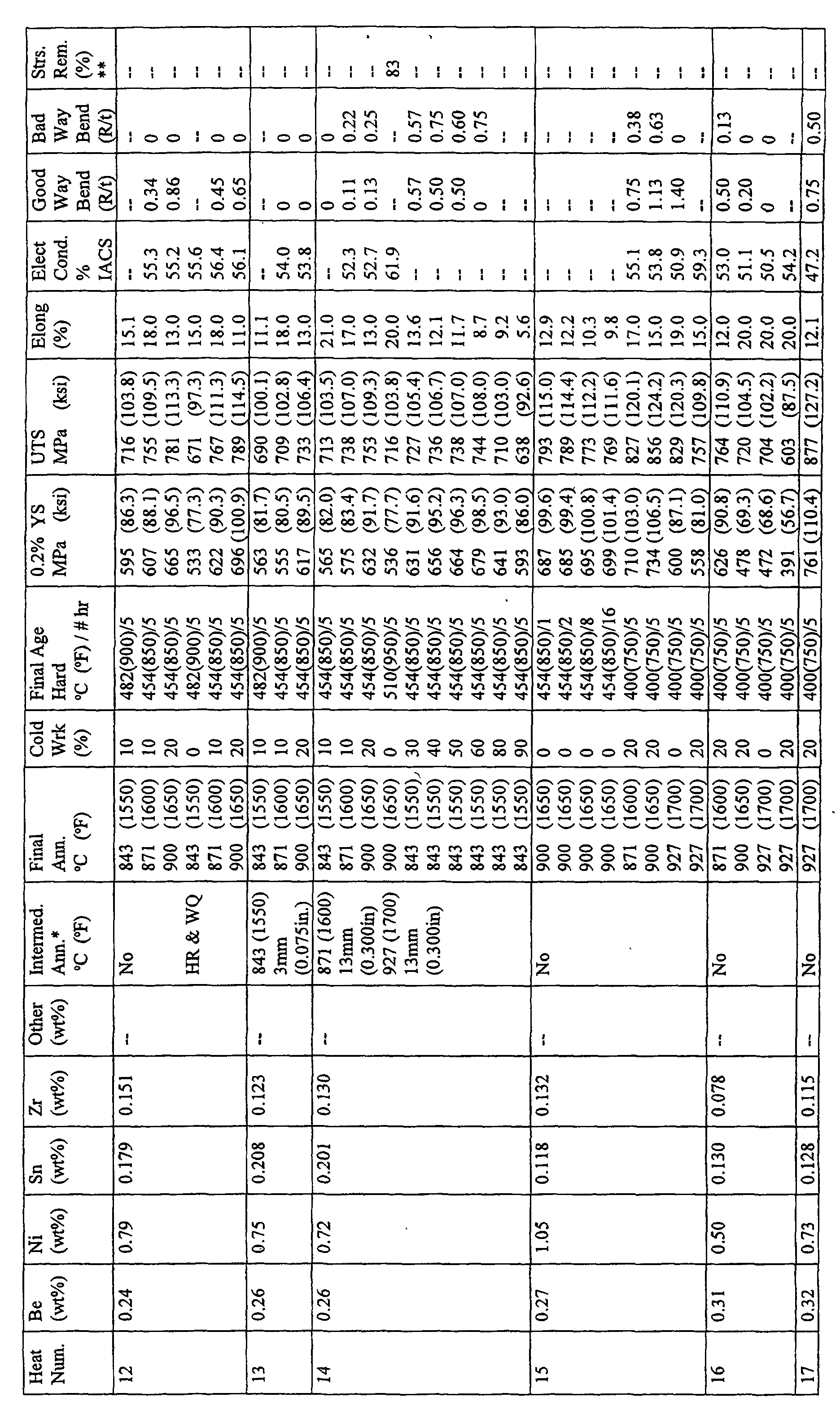
- Referring now to Table I, there are provided specific, illustrative compositions and methods according to the present invention. Each composition was first induction melted in air in a commercial-scale furnace and semi-continuously cast into strip billets about 18 cm (7 inches) thick nominal. Conventional manufacturing processes were then employed to convert the cast billets to strip, as follows.
- In accordance with one aspect of the present invention, lean beryllium-nickel-copper alloys with tin and zirconium and/or titanium additions are produced. The alloys are represented by the formula (0.15-0.5% Be) + (0.40-1.25% Ni) + (0.-0.25% Sn) + [(0.06-1% Zr) and/or (0.06-1% Ti)], the balance copper, where the sum of %Zr and %Ti is generally within a range of 0.06% and 1%. The alloys may be produced by a method which comprises the steps of: (i) melting a composition represented by the formula, (ii) casting the melt into billets, (iii) hot rolling the billets into strip, (iv) cold rolling the strip to a selected ready-to-finish thickness, (v) final solution annealing the cold rolled strip at a temperature generally within a range of 843 and 927°C (1550 and 1700°F) followed by rapid quenching, (vi) cold working the annealed strip generally within a range of 0% and 90% to final thickness, and (vii) final age hardening the cold worked strip at a temperature generally within a range of 400 and 510°C (750 and 950°F) for a time generally within a range of 1 and 16 hrs.
- Alloys according to the invention, represented by the formula (0.15-0.5% Be) + (0.40-1.25% Ni) + (0-0.25% Sn) + [(0.06-1% Zr) and/or (0.06-1% Ti)], the balance copper, the sum of %Zr and %Ti generally being within a range of 0.06% and 1%, may be produced by a method which comprises the steps of: (i) induction melting a composition represented by the formula, (ii) casting the induction melt into billets, (iii) hot rolling the billets into strip, (iv) intermediate annealing the hot rolled strip to improve bend formability, (v) cold rolling the annealed strip to a selected ready-to-finish thickness, (vi) final solution annealing the cold rolled strip at a temperature generally within a range of 843 and 927°C (1550 and 1700°F) followed by rapid quenching, (vii) cold working the final annealed strip generally within a range of 0% and 90% to final thickness, and (viii) final age hardening the cold worked strip at a temperature generally within a range of 400 and 510°C (750 and 950°F) for a time generally within a range of 1 and 16 hrs.
- Lean beryllium-nickel-copper alloys with tin and zirconium and/or titanium additions, represented by the formula (0.15-0.5% Be) + (0.40-1.25% Ni) + (0-0.25% Sn) + [(0.06-1% Zr) and/or (0.06-1% Ti)], the balance copper, where the sum of %Zr and %Ti is generally within the range of 0.06% and 1%, may be produced by the following method.
- A composition represented by the formula is first melted, e.g. by induction, and cast into billets. Next, the billets are hot rolled into strip, and the strip cold-rolled to intermediate thickness. Intermediate annealing is performed on the cold rolled strip to improve bend formability. The annealed strip is then cold rolled to a selected ready-to-finish thickness. Thereafter, the cold rolled strip is final solution annealed at a temperature generally with a range of 843 and 927°C (1550 and 1700°F) followed by rapid quenching, and cold worked generally within a range of 0% and 90% to final thickness. Final age hardening is performed on the cold worked strip at a temperature generally within a range of 400 and 510°C (750 and 950°F) for a time generally within a range of 1 and 16 hrs.
- More particularly, the billets are hot rolled to strip preferably about 0.8 cm (0.3 in.) to about 2.0 cm (0.8 in.) thick nominal. Also, the strip is air cooled (or, alternatively, water quenched) from a hot finishing temperature to room temperature after being rolled into coils on a hot mill. The coils may also be intermediate annealed at hot rolled thickness. The hot rolled coils are then preferably milled to remove any oxide scale, and cold rolled to ready-to-finish thickness on the order of about 0.05 cm (0.020 in.). The ready-to-finish thickness, by one definition, is the predetermined thickness (intended for application of a final solution annealing step) sufficient to allow a selected amount of additional cold work to a final thickness.
- Optionally, second intermediate anneal and cleaning steps are performed part way through the cold rolling process between the milled thickness and ready-to-finish thickness. The second annealing step may be inserted, alternatively, after hot rolling.
- At ready-to-finish thickness, the coils are solution annealed at a temperature generally within a range of 843 to 927°C (1550 to 1700°F), as shown in Table I, followed by rapid quenching and chemical cleaning. Coils are then cold rolled 0% to about 60%, 80% or up to about 90% to final thickness. Final age hardening is preferably performed at a temperature generally within a range of 400 and 510°C (750 and 950°F) for about 1 hr. to about 16 hrs., preferably about 5 hrs., at such temperature.
- Finally, selected strip samples are evaluated for tensile properties (0.2% offset yield strength, ultimate tensile strength and elongation), bend formability, electrical conductivity and stress relaxation resistance at about 175°C for up to about 1000 hrs., at an initial stress of about 75% of the 0.2% offset yield strength.
- Although the present invention is shown and described in connection with the production of strip, analogous processes may be practised to produce the alloy in wire or rod form, within the spirit and scope of the present invention.
- As shown in Table I, a yield strength lower than a desirable minimum, i.e., about 448 MPa (65 ksi) for a low strength electronic connector or lead frame, were found in lean beryllium-nickel-copper alloys with compositions generally within a range of (0.12-0.31% Be) + (0.48-0.74% Ni), the balance copper, with optional Sn and/or Zr. This was also true where the alloy was processed with apparent combinations of insufficient annealing temperatures, e.g., about 843°C (1550°F) for the leanest Be contents, insufficient cold work, e.g., 0 to about 20%, and/or final age hardening at conditions considered to be either (i) under aged e.g., at temperatures that are considered too low such as about 371°C (700°F), or for times believed too short to reach maximum possible aged strength, e.g., about 1 hr., or (ii) over aged at, e.g., about 510°C (950°F), or for times such as about 8-16 hrs., so long that precipitates responsible for age hardening become coarse, resulting in irrecoverable loss of strength.
- It has been found that yield strengths generally within a range from 448 - 641 MPa (65 - 93 ksi) are achieved in the composition range (0.12-0.19) wt% Be, (0.48-0.76) wt% Ni, balance Cu and optional Sn and/or Zr, processed by annealing at about 871 to 927°C (1600 to about 1700°F), cold rolling up to about 20% and age hardening generally between 400 and 510°C (750 and 950°F) for about 5 hrs.
- Yield strengths between about 448 and about 738 MPa (about 65 and about 107 ksi) are achieved in alloys in the range (0.22-0.34) wt% Be, (0.43-0.89) wt% Ni, the balance Cu and optional Sn and/or Zr, by the following process: annealing at a temperature generally within a range of 843 and 927°C (1550 and 1700°F), cold rolling up to about 90% to and age hardening at a temperature generally within a range of 400 and 510°C (750 - 950°F) for about 1 hr. to about 16 hrs. Preferably, a time of at least about 5 hrs. is used for the lower aging temperatures of this range.
- From about 448 - 827 MPa (65 - 120 ksi), yield strengths were achieved in alloys in the composition range (0.22-0.33) wt% Be, (1.04-1.22) wt% Ni, balance Cu and optional Sn and/or Zr, processed by annealing at a temperature between about 843 and about 927°C (about 1550 and about 1700°F), cold rolling up to about 20% and age hardening between about 400 and 510°C (750 and 950°F) for about 1 to about 16 hrs. Again, at least 5 hrs. is desired at aging temperatures low in this range.
- Overall, the preferred lean beryllium-nickel-copper alloys, in accordance with various aspects of the present invention, were found to lie within the following nominal composition ranges: (0.1-0.4% Be) + (0.4-1.25% Ni), the balance Cu, with additions of (0.1-0.25% Sn nominal) and (0.15% Zr nominal).
- Alloys which contain the full stated constituent ranges and are processed in accordance with the present invention, it has been found, meet or exceed the desired property combinations for representative strip tempers as follow:
- (a) 448 - 586 MPa (65 - 85 ksi) 0.2% offset yield strength with bend formability of 0.25-0.5 R/t in both "good way" and "bad way" bend directions (applicable to low strength electronics connectors and lead frames)
- (b) 586 - 724 MPa (85 - 105 ksi) yield strength with bend formability of 0.5-1.0 R/t in both bend directions (applicable to moderate strength electronic connectors and selected lead frames)
- (c) 724 - 827 MPa (105 - 120 ksi) yield strength with 1.0-1.5 R/t bend formability in both bend directions (applicable primarily to high strength electronic connectors)
- (d) a minimum of 45 - 50 %IACS electrical conductivity at all strength levels; and
- (e) a minimum of 85 - 90% remaining stress in stress relaxation tests for 1000 hrs, at 175°C and an initial stress of 75% of the 0.2% offset yield strength.
-
- Each composition and process combinations which met target yield strengths for each of the selected strip tempers also met target bend formability levels for the tempers. As Ni content approached about 1.22 wt%, the risk that electrical conductivity would fall below about 50 %IACS increased. However the alloys surveyed met the target minimum of about 45 %IACS.
- These lean beryllium-nickel-copper alloys also hot rolled satisfactorily. Additions of up to about 0.25 wt% Sn, with or without Zr, had no apparent effect. Further, up to about 0.25 wt% Sn was tolerated at acceptable electrical conductivity of finish age hardened strip where no more than about 1.04 wt% Ni was present. When Ni content exceeded about 1.04 wt%, up to about 0.13 wt% Sn was tolerated in terms of acceptable finished strip electrical conductivity. In general, Sn additions seemed to have no impact upon yield strength, bend formability or stress relaxation resistance.
- Finally, the addition of about 0.12-0.15 wt% Zr improved stress relaxation resistance at about 175°C in the lean alloys to a level consistent with at least the lower desired target, e.g., about 85% remaining stress, established for the strip tempers selected. Even greater improvement in stress relaxation resistance was achieved, above the upper desired target, e.g., about 90% remaining stress, with addition of about 0.47% Zr or about 1.12% Zr as well as with addition of about 0.46% Ti or about 1% Ti. Absent Zr or Ti, this competitive advantage was not achieved. Also, the addition of up to about 0.15 wt% Zr was found to be of no consequence to yield strength or electrical conductivity, and had either no impact on, or was slightly beneficial to, bend formability. At about 1.12% Zr, some loss in strength and electrical conductivity was apparent, although within selected target ranges. Addition of about 0.46% Ti or about 1% Ti significantly reduced electrical conductivity and had a variable impact on strength.
- Intermediate anneals at hot rolled thickness or at any thickness between hot rolled and ready-to-finish thickness improved bend formability at all strength levels of the finished strip. In addition, final age hardening at a temperature generally within a range of 400 and 454°C (750 and 850°F) provided greater resistance to stress relaxation than final age hardening at 510°C (950°F).
- By traditional processing, the property combinations achieved are superior to competitive copper alloys such as C7025, C7026 and like heat treated copper-based alloys. In addition, these alloys provided improved electrical conductivity and "bad way" bend formability without sacrificing strength, as compared to C17410 lean beryllium-cobalt-copper alloys.
- Adding nominal 0.15% Zr to lean Be-Ni-Cu alloys yielded improvements in stress relaxation resistance at 175°C so substantial that their relaxation behaviour exceeded that of alloy C17410. It has also been discovered that the addition of up to about 0.25% Sn can be made to lean Be-Ni-Cu alloys without sacrificing hot rollability of cast billets and electrical conductivity for Ni contents up to nominal 1%. Above about 1% Ni, nominal 0.15% Sn was tolerated somewhat better in terms of electrical conductivity.
- Turning now to the economic benefits, three factors are believed to contribute to the relatively lower cost of these alloys. First is their capacity to develop useful properties at reduced beryllium contents relative to those of prior beryllium-cobalt-copper alloys. Second, nickel rather than higher cost cobalt has been found workable as an alternative charge material. Finally, the combination of constituents of the present invention provides an apparently higher tolerance for impurity solid solution alloying elements, such as tin. This enables direct melting of Sn-plated scrap without the added expense of scrap detinning operations. Tin contamination in C17410 has been found to degrade electrical conductivity and make hot rolling more difficult.
- A sum of %Zr and %Ti generally within a range of 0.06% and 1% has been found relatively important to operation and effectiveness of the present invention. For instance, below this range no measurable improvement in stress relaxation has been achieved. Above the range, age hardening response and/or electrical conductivity were found to be adversely affected.
- Although the present invention is shown and described in connection with beryllium-nickel-copper alloys, it may be adapted for improving desirable characteristics of other precipitation hardable materials such as aluminium-based alloys as well as copper or nickel-based alloys. Tin, according to at least one aspect of the present invention, may be excluded from the composition, giving consideration to the purpose for which the present invention is intended.
- Other lean beryllium-copper alloys having enhanced stress relaxation resistance, at somewhat higher nickel content, have also been achieved. Alloys of this type are described, for example, in a co-pending U.S. patent application, filed on the same date herewith by John C, Harkness and Shelley J. Wolf, entitled "Lean, High Conductivity, Relaxation-Resistant Beryllium-Copper Alloys", the disclosure of which is hereby incorporated by reference in its entirety.
- Various impurities e.g., lead, iron, cobalt, chromium, silicon, aluminium, zinc, magnesium and silver are believed inherent in alloys of present invention, as will be appreciated by those skilled in the art.
- The present invention advantageously eliminates the need for cobalt and reduces the amount of beryllium necessary, permitting cost-effective mass production of lead frames and connectors while enhancing the performance characteristics of the alloys for electronic applications.
- The alloy compositions illustrate increased resistance to stress relaxation associated with the addition of these specified amounts of zirconium and/or titanium. They also provide the benefit of tin-plated scrap consumption up to selected maximum tin levels to be cast into billet form, without the added expense of a scrap detinning step, yet retaining commercially desirable electrical conductivity and a high degree of hot workability.
- Various modifications and alterations to the present invention may be appreciated based on a review of this disclosure. These changes and additions are intended to be within the scope and spirit of this invention as defined by the following claims.



Claims (13)
- A higher order beryllium-nickel-copper alloy comprising 0.15-0.5% Be, 0.40-1.25% Ni, 0-0.25% Sn and 0.06-1% Zr and/or Ti, balance copper and impurities, the alloy being produced by a process which includes age hardening without overaging and exhibiting a yield strength of at least 448 MPa (65 ksi).
- A higher order beryllium-nickel-copper alloy according to claim 1 comprising 0.15%-0.5% Be, 0.40-1.25% Ni, 0-0.25% Sn and 0.06-1% Zr, the balance copper and impurities, in which the age hardening is carried out at 371 to 454°C (700 to 850°F).
- A higher order beryllium-nickel-copper alloy according to claim 1 comprising 0.15-0.5% Be, 0.40-1.25% Ni, 0-0.25% Sn and 0.06-1% Ti, the balance copper and impurities, in which the age hardening is carried out at 371 to 454°C (700 to 850°F).
- A higher order beryllium-nickel-copper alloy according to claim 1 comprising 0.15-0.5% Be, 0.40-1.25% Ni, 0-0.25% Sn, 0.06-1% Zr and 0.06-1% Ti, the balance copper and impurities, the alloy being produced by a process which includes age hardening without overaging and exhibiting a yield strength of at least 448MPa (65 ksi).
- A higher order beryllium-nickel-copper alloy according to claim 4, in which the age hardening is carried out at 371 to 454°C (700-850°F).
- A higher order beryllium-nickel-copper alloy according to any preceding claim, in which the Zr content is 0.12 to 0.47%.
- A higher order beryllium-nickel-copper alloy according to any preceding claim, in which the alloy is made by a process including:a. cold rolling a strip of material having the composition of the alloy to a ready-to-finish thickness;b. final solution annealing the cold rolled strip at 843 to 927°C (1550 to 1700°F);c. cold rolling the strip to 20 to 90% of its final thickness; andd. age hardening the strip at 371 to 454°C (700 to 850°F) for 1 to 16 hours without overaging.
- A method of producing lean beryllium-nickel-copper alloys with tin and zirconium and/or titanium additions comprising 0.15-0.5% Be, 0.40-1.25% Ni, 0-0.25% Sn and 0.06-1% Zr and/or 0.06-1% Ti, the balance copper and impurities, the method comprising the steps of:i. melting a composition represented by the formula; ii. casting the melt into billets;iii. hot rolling the billets into strip;iv. cold rolling the strip to a selected ready-to-finish thickness;v. final solution annealing the cold rolled strip at a temperature generally within a range of 843 to 927°C (1550 to 1700°F) followed by rapid quenching;vi. cold working the annealed strip to within a range of 0% and 90% to final thickness, andvii. final age hardening the cold worked strip at a temperature within a range of 371 to 454°C (700 to 850°F) for a time within a range of 1 and 16 hours.
- A method according to claim 8, including the additional step of:(iv)intermediate annealing the hot rolled strip of step (iii) to improve bend formability.
- A method according to claim 8, including the additional steps of:(iv)cold rolling the hot rolled strip of step (iii) to a selected intermediate thickness and(v) intermediate annealing the cold rolled strip.
- An article of manufacture comprising a higher order beryllium-nickel-copper alloy according to any of claims 1 to 7.
- An article according to claim 11, in which the article comprises a lead frame.
- An article according to claim 11, in which the article comprises an electronic connector.
Applications Claiming Priority (2)
| Application Number | Priority Date | Filing Date | Title |
|---|---|---|---|
| US08/738,880 US6001196A (en) | 1996-10-28 | 1996-10-28 | Lean, high conductivity, relaxation-resistant beryllium-nickel-copper alloys |
| US738880 | 1996-10-28 |
Publications (2)
| Publication Number | Publication Date |
|---|---|
| EP0841407A1 EP0841407A1 (en) | 1998-05-13 |
| EP0841407B1 true EP0841407B1 (en) | 2002-01-16 |
Family
ID=24969875
Family Applications (1)
| Application Number | Title | Priority Date | Filing Date |
|---|---|---|---|
| EP97306811A Expired - Lifetime EP0841407B1 (en) | 1996-10-28 | 1997-09-03 | Copper-nickel-beryllium alloy |
Country Status (5)
| Country | Link |
|---|---|
| US (3) | US6001196A (en) |
| EP (1) | EP0841407B1 (en) |
| JP (2) | JP4456186B2 (en) |
| CA (1) | CA2215338C (en) |
| DE (1) | DE69709610T2 (en) |
Families Citing this family (18)
| Publication number | Priority date | Publication date | Assignee | Title |
|---|---|---|---|---|
| US6001196A (en) * | 1996-10-28 | 1999-12-14 | Brush Wellman, Inc. | Lean, high conductivity, relaxation-resistant beryllium-nickel-copper alloys |
| JP2001176805A (en) * | 1999-12-16 | 2001-06-29 | Sony Corp | Method for producing nitride-based III-V compound crystal, method for producing nitride-based III-V compound crystal substrate, method for producing nitride-based III-V compound crystal film, and device |
| US6585833B1 (en) | 2000-03-14 | 2003-07-01 | Brush Wellman, Inc. | Crimpable electrical connector |
| RU2186868C2 (en) * | 2000-03-23 | 2002-08-10 | ОАО "Научно-производственное объединение энергетического машиностроения им. академика В.П.Глушко" | Copper-base corrosion-resisting alloy |
| US6584132B2 (en) * | 2000-11-01 | 2003-06-24 | Cymer, Inc. | Spinodal copper alloy electrodes |
| US6387195B1 (en) | 2000-11-03 | 2002-05-14 | Brush Wellman, Inc. | Rapid quench of large selection precipitation hardenable alloys |
| US6527512B2 (en) | 2001-03-01 | 2003-03-04 | Brush Wellman, Inc. | Mud motor |
| US6591894B2 (en) | 2001-06-15 | 2003-07-15 | Brush Wellman, Inc. | Shot blocks for use in die casting |
| CN1688732B (en) * | 2002-09-13 | 2010-05-26 | Gbc金属有限责任公司 | Age hardening copper base alloy and its preparing process |
| US20040216817A1 (en) * | 2003-01-24 | 2004-11-04 | Harkness John C. | Copper-beryllium alloy strip |
| JP4578925B2 (en) * | 2004-10-08 | 2010-11-10 | Jx日鉱日石エネルギー株式会社 | Cold rolling oil composition and cold rolling method |
| CN100387740C (en) * | 2005-03-10 | 2008-05-14 | 泰兴市无氧铜材厂 | Titanium Bronze for Turbine Generator Rotor Slot Wedge and Its Processing Technology |
| EP1762630B1 (en) | 2005-09-09 | 2008-09-03 | Ngk Insulators, Ltd. | Beryllium nickel copper alloy sheet and method of manufacturing the same |
| CN101333609B (en) * | 2007-06-28 | 2011-03-16 | 周水军 | Low copper beryllium mold material for gravitation and low-pressure casting and production process thereof |
| US20100006191A1 (en) * | 2008-07-09 | 2010-01-14 | Brush Wellman, Inc. | HIGH STRENGTH Be/Cu ALLOYS WITH IMPROVED ELECTRICAL CONDUCTIVITY |
| US8851940B2 (en) * | 2012-07-13 | 2014-10-07 | Deutsch Engineered Connecting Devices, Inc. | Multi-piece socket contact assembly |
| US9331400B1 (en) | 2014-12-19 | 2016-05-03 | Tyco Electronics Corporation | Male contact assembly |
| CN117512386A (en) * | 2023-11-21 | 2024-02-06 | 宁夏中色新材料有限公司 | Beryllium copper alloy with high fatigue strength and high resistance to high temperature elasticity reduction and preparation method thereof |
Family Cites Families (31)
| Publication number | Priority date | Publication date | Assignee | Title |
|---|---|---|---|---|
| US4179314A (en) * | 1978-12-11 | 1979-12-18 | Kawecki Berylco Industries, Inc. | Treatment of beryllium-copper alloy and articles made therefrom |
| US4377424A (en) * | 1980-05-26 | 1983-03-22 | Chuetsu Metal Works Co., Ltd. | Mold of precipitation hardenable copper alloy for continuous casting mold |
| US4425168A (en) * | 1982-09-07 | 1984-01-10 | Cabot Corporation | Copper beryllium alloy and the manufacture thereof |
| US4657601A (en) * | 1983-11-10 | 1987-04-14 | Brush Wellman Inc. | Thermomechanical processing of beryllium-copper alloys |
| JPS60245751A (en) * | 1984-05-22 | 1985-12-05 | Nippon Mining Co Ltd | High strength copper alloy having high electric conductivity |
| JPS60245754A (en) * | 1984-05-22 | 1985-12-05 | Nippon Mining Co Ltd | High strength copper alloy having high electric conductivity |
| JPS60258440A (en) * | 1984-06-02 | 1985-12-20 | Nippon Gakki Seizo Kk | Precipitation strengthening copper alloy |
| US4551187A (en) * | 1984-06-08 | 1985-11-05 | Brush Wellman Inc. | Copper alloy |
| US4724013A (en) * | 1984-06-08 | 1988-02-09 | Brush Wellman, Inc. | Processing of copper alloys and product |
| US4565586A (en) * | 1984-06-22 | 1986-01-21 | Brush Wellman Inc. | Processing of copper alloys |
| JPS6164840A (en) * | 1984-09-03 | 1986-04-03 | Ngk Insulators Ltd | Material for conductive spring |
| US4599120A (en) * | 1985-02-25 | 1986-07-08 | Brush Wellman Inc. | Processing of copper alloys |
| US4579603A (en) * | 1985-03-18 | 1986-04-01 | Woodard Dudley H | Controlling distortion in processed copper beryllium alloys |
| US4594221A (en) * | 1985-04-26 | 1986-06-10 | Olin Corporation | Multipurpose copper alloys with moderate conductivity and high strength |
| US4728372A (en) * | 1985-04-26 | 1988-03-01 | Olin Corporation | Multipurpose copper alloys and processing therefor with moderate conductivity and high strength |
| JPS62182240A (en) * | 1986-02-06 | 1987-08-10 | Furukawa Electric Co Ltd:The | Conductive high-tensile copper alloy |
| DE3773470D1 (en) * | 1986-11-13 | 1991-11-07 | Ngk Insulators Ltd | PRODUCTION OF COPPER-BERYLLIUM ALLOYS. |
| JPS63223151A (en) * | 1987-03-12 | 1988-09-16 | Ngk Insulators Ltd | Formed body for parts composed of berylium-copper alloy material and its production |
| JPH01119635A (en) * | 1987-10-30 | 1989-05-11 | Ngk Insulators Ltd | Spring material having electric conductivity |
| JPH0689440B2 (en) * | 1988-06-08 | 1994-11-09 | 同和鉱業株式会社 | Manufacturing method of high-strength conductive copper-based alloy with excellent press formability |
| JPH0266131A (en) * | 1988-08-29 | 1990-03-06 | Dowa Mining Co Ltd | High-strength and high-conductivity copper-base alloy |
| JPH0778266B2 (en) * | 1988-10-17 | 1995-08-23 | 同和鉱業株式会社 | High strength and high conductivity copper base alloy |
| JPH02122039A (en) * | 1988-10-31 | 1990-05-09 | Nippon Mining Co Ltd | High strength and high conductivity copper alloy having excellent adhesion of oxidized film |
| JPH02122035A (en) * | 1988-10-31 | 1990-05-09 | Nippon Mining Co Ltd | High strength and high conductivity copper alloy having excellent adhesion of oxidized film |
| JPH08960B2 (en) * | 1989-03-15 | 1996-01-10 | 日本碍子株式会社 | Beryllium copper alloy hot forming method and hot forming product |
| US5037311A (en) * | 1989-05-05 | 1991-08-06 | International Business Machines Corporation | High density interconnect strip |
| JPH0499839A (en) * | 1990-08-14 | 1992-03-31 | Nikko Kyodo Co Ltd | Conductive material |
| JPH0499835A (en) * | 1990-08-14 | 1992-03-31 | Nikko Kyodo Co Ltd | High strength and high conductivity copper alloy for electronic equipment |
| JPH04231432A (en) * | 1990-12-27 | 1992-08-20 | Nikko Kyodo Co Ltd | conductive material |
| EP0725157B1 (en) * | 1995-02-01 | 2001-03-07 | BRUSH WELLMAN Inc. | Processing of alloys and products so produced |
| US6001196A (en) * | 1996-10-28 | 1999-12-14 | Brush Wellman, Inc. | Lean, high conductivity, relaxation-resistant beryllium-nickel-copper alloys |
-
1996
- 1996-10-28 US US08/738,880 patent/US6001196A/en not_active Expired - Lifetime
-
1997
- 1997-09-03 DE DE69709610T patent/DE69709610T2/en not_active Expired - Lifetime
- 1997-09-03 EP EP97306811A patent/EP0841407B1/en not_active Expired - Lifetime
- 1997-09-12 CA CA002215338A patent/CA2215338C/en not_active Expired - Lifetime
- 1997-10-28 JP JP29567197A patent/JP4456186B2/en not_active Expired - Lifetime
- 1997-11-07 US US08/965,878 patent/US5993574A/en not_active Expired - Lifetime
-
1999
- 1999-09-07 US US09/390,907 patent/US6153031A/en not_active Expired - Lifetime
-
2007
- 2007-11-26 JP JP2007305139A patent/JP2008081846A/en not_active Withdrawn
Also Published As
| Publication number | Publication date |
|---|---|
| DE69709610T2 (en) | 2002-09-12 |
| DE69709610D1 (en) | 2002-02-21 |
| US5993574A (en) | 1999-11-30 |
| CA2215338A1 (en) | 1998-04-28 |
| JP2008081846A (en) | 2008-04-10 |
| JP4456186B2 (en) | 2010-04-28 |
| EP0841407A1 (en) | 1998-05-13 |
| JPH10183276A (en) | 1998-07-14 |
| CA2215338C (en) | 2007-05-15 |
| US6001196A (en) | 1999-12-14 |
| US6153031A (en) | 2000-11-28 |
Similar Documents
| Publication | Publication Date | Title |
|---|---|---|
| US6001196A (en) | Lean, high conductivity, relaxation-resistant beryllium-nickel-copper alloys | |
| US6099663A (en) | Copper alloy and process for obtaining same | |
| US9284628B2 (en) | Copper alloy sheet and method for producing same | |
| US20040079456A1 (en) | Copper alloy containing cobalt, nickel and silicon | |
| US20120241056A1 (en) | Copper alloy sheet material having a low young's modulus and method of producing the same | |
| KR20010080447A (en) | Stress relaxation resistant brass | |
| JP2002180165A (en) | Copper base alloy excellent in press punching property and method for producing the same | |
| EP0841408A2 (en) | Copper alloy and process for obtaining same | |
| CN1007909B (en) | Multipurpose copper alloy with moderate electrical conductivity and high strength and method for producing same | |
| JP2011508081A (en) | Copper-nickel-silicon alloy | |
| US20110005644A1 (en) | Copper alloy material for electric/electronic parts | |
| JP2593107B2 (en) | Manufacturing method of high strength and high conductivity copper base alloy | |
| CN1086207C (en) | Grain refined tin brass | |
| US5882442A (en) | Iron modified phosphor-bronze | |
| JP3511648B2 (en) | Method for producing high-strength Cu alloy sheet strip | |
| JP5107093B2 (en) | Copper alloy with high strength and high conductivity | |
| US6679956B2 (en) | Process for making copper-tin-zinc alloys | |
| JP4186095B2 (en) | Copper alloy for connector and its manufacturing method | |
| US5865910A (en) | Copper alloy and process for obtaining same | |
| JPH06220594A (en) | Manufacturing method of copper alloy for electric parts with good workability | |
| CN115652134A (en) | High-strength high-bending-property copper-nickel-silicon alloy and preparation method thereof | |
| JP2007126739A (en) | Copper alloy for electronic material | |
| JP2006291356A (en) | Ni-Sn-P copper alloy | |
| US6436206B1 (en) | Copper alloy and process for obtaining same | |
| EP0854200A1 (en) | Copper-beryllium alloy |
Legal Events
| Date | Code | Title | Description |
|---|---|---|---|
| PUAI | Public reference made under article 153(3) epc to a published international application that has entered the european phase |
Free format text: ORIGINAL CODE: 0009012 |
|
| AK | Designated contracting states |
Kind code of ref document: A1 Designated state(s): CH DE FI FR GB IT LI SE |
|
| 17P | Request for examination filed |
Effective date: 19980814 |
|
| AKX | Designation fees paid |
Free format text: CH DE FI FR GB IT LI |
|
| RBV | Designated contracting states (corrected) |
Designated state(s): CH DE FI FR GB IT LI |
|
| 17Q | First examination report despatched |
Effective date: 19990111 |
|
| RBV | Designated contracting states (corrected) |
Designated state(s): CH DE FR GB IT LI SE |
|
| RBV | Designated contracting states (corrected) |
Designated state(s): CH DE FI FR GB IT LI SE |
|
| GRAG | Despatch of communication of intention to grant |
Free format text: ORIGINAL CODE: EPIDOS AGRA |
|
| GRAG | Despatch of communication of intention to grant |
Free format text: ORIGINAL CODE: EPIDOS AGRA |
|
| GRAH | Despatch of communication of intention to grant a patent |
Free format text: ORIGINAL CODE: EPIDOS IGRA |
|
| GRAH | Despatch of communication of intention to grant a patent |
Free format text: ORIGINAL CODE: EPIDOS IGRA |
|
| GRAA | (expected) grant |
Free format text: ORIGINAL CODE: 0009210 |
|
| REG | Reference to a national code |
Ref country code: GB Ref legal event code: IF02 |
|
| AK | Designated contracting states |
Kind code of ref document: B1 Designated state(s): CH DE FI FR GB IT LI SE |
|
| REG | Reference to a national code |
Ref country code: CH Ref legal event code: EP |
|
| REF | Corresponds to: |
Ref document number: 69709610 Country of ref document: DE Date of ref document: 20020221 |
|
| REG | Reference to a national code |
Ref country code: CH Ref legal event code: NV Representative=s name: AMMANN PATENTANWAELTE AG BERN |
|
| EN | Fr: translation not filed | ||
| PLBE | No opposition filed within time limit |
Free format text: ORIGINAL CODE: 0009261 |
|
| STAA | Information on the status of an ep patent application or granted ep patent |
Free format text: STATUS: NO OPPOSITION FILED WITHIN TIME LIMIT |
|
| REG | Reference to a national code |
Ref country code: FR Ref legal event code: RN |
|
| 26N | No opposition filed | ||
| REG | Reference to a national code |
Ref country code: FR Ref legal event code: FC |
|
| ET | Fr: translation filed | ||
| REG | Reference to a national code |
Ref country code: FR Ref legal event code: PLFP Year of fee payment: 20 |
|
| PGFP | Annual fee paid to national office [announced via postgrant information from national office to epo] |
Ref country code: FI Payment date: 20160927 Year of fee payment: 20 Ref country code: GB Payment date: 20160927 Year of fee payment: 20 Ref country code: CH Payment date: 20160927 Year of fee payment: 20 |
|
| PGFP | Annual fee paid to national office [announced via postgrant information from national office to epo] |
Ref country code: SE Payment date: 20160928 Year of fee payment: 20 Ref country code: FR Payment date: 20160926 Year of fee payment: 20 |
|
| PGFP | Annual fee paid to national office [announced via postgrant information from national office to epo] |
Ref country code: DE Payment date: 20160928 Year of fee payment: 20 |
|
| PGFP | Annual fee paid to national office [announced via postgrant information from national office to epo] |
Ref country code: IT Payment date: 20160923 Year of fee payment: 20 |
|
| REG | Reference to a national code |
Ref country code: DE Ref legal event code: R071 Ref document number: 69709610 Country of ref document: DE |
|
| REG | Reference to a national code |
Ref country code: CH Ref legal event code: PL |
|
| REG | Reference to a national code |
Ref country code: GB Ref legal event code: PE20 Expiry date: 20170902 |
|
| REG | Reference to a national code |
Ref country code: SE Ref legal event code: EUG |
|
| PG25 | Lapsed in a contracting state [announced via postgrant information from national office to epo] |
Ref country code: GB Free format text: LAPSE BECAUSE OF EXPIRATION OF PROTECTION Effective date: 20170902 |