EP0836299A2 - Vorrichtung zur Gewährleistung eines starken sequentiellen geordneten Paketflusses in einem Ring-Netzwerk mit besetzten und fehlerhaften Knoten - Google Patents
Vorrichtung zur Gewährleistung eines starken sequentiellen geordneten Paketflusses in einem Ring-Netzwerk mit besetzten und fehlerhaften Knoten Download PDFInfo
- Publication number
- EP0836299A2 EP0836299A2 EP97304573A EP97304573A EP0836299A2 EP 0836299 A2 EP0836299 A2 EP 0836299A2 EP 97304573 A EP97304573 A EP 97304573A EP 97304573 A EP97304573 A EP 97304573A EP 0836299 A2 EP0836299 A2 EP 0836299A2
- Authority
- EP
- European Patent Office
- Prior art keywords
- node
- packet
- packets
- busy
- subsystem
- Prior art date
- Legal status (The legal status is an assumption and is not a legal conclusion. Google has not performed a legal analysis and makes no representation as to the accuracy of the status listed.)
- Withdrawn
Links
Images






















Classifications
-
- H—ELECTRICITY
- H04—ELECTRIC COMMUNICATION TECHNIQUE
- H04L—TRANSMISSION OF DIGITAL INFORMATION, e.g. TELEGRAPHIC COMMUNICATION
- H04L12/00—Data switching networks
- H04L12/28—Data switching networks characterised by path configuration, e.g. LAN [Local Area Networks] or WAN [Wide Area Networks]
- H04L12/40—Bus networks
- H04L12/40052—High-speed IEEE 1394 serial bus
-
- H—ELECTRICITY
- H04—ELECTRIC COMMUNICATION TECHNIQUE
- H04L—TRANSMISSION OF DIGITAL INFORMATION, e.g. TELEGRAPHIC COMMUNICATION
- H04L1/00—Arrangements for detecting or preventing errors in the information received
- H04L1/12—Arrangements for detecting or preventing errors in the information received by using return channel
- H04L1/16—Arrangements for detecting or preventing errors in the information received by using return channel in which the return channel carries supervisory signals, e.g. repetition request signals
- H04L1/18—Automatic repetition systems, e.g. Van Duuren systems
- H04L1/1806—Go-back-N protocols
-
- H—ELECTRICITY
- H04—ELECTRIC COMMUNICATION TECHNIQUE
- H04L—TRANSMISSION OF DIGITAL INFORMATION, e.g. TELEGRAPHIC COMMUNICATION
- H04L12/00—Data switching networks
- H04L12/28—Data switching networks characterised by path configuration, e.g. LAN [Local Area Networks] or WAN [Wide Area Networks]
- H04L12/40—Bus networks
- H04L12/40052—High-speed IEEE 1394 serial bus
- H04L12/40091—Bus bridging
-
- H—ELECTRICITY
- H04—ELECTRIC COMMUNICATION TECHNIQUE
- H04L—TRANSMISSION OF DIGITAL INFORMATION, e.g. TELEGRAPHIC COMMUNICATION
- H04L12/00—Data switching networks
- H04L12/28—Data switching networks characterised by path configuration, e.g. LAN [Local Area Networks] or WAN [Wide Area Networks]
- H04L12/42—Loop networks
-
- H—ELECTRICITY
- H04—ELECTRIC COMMUNICATION TECHNIQUE
- H04L—TRANSMISSION OF DIGITAL INFORMATION, e.g. TELEGRAPHIC COMMUNICATION
- H04L12/00—Data switching networks
- H04L12/28—Data switching networks characterised by path configuration, e.g. LAN [Local Area Networks] or WAN [Wide Area Networks]
- H04L12/42—Loop networks
- H04L12/427—Loop networks with decentralised control
- H04L12/433—Loop networks with decentralised control with asynchronous transmission, e.g. token ring, register insertion
-
- H—ELECTRICITY
- H04—ELECTRIC COMMUNICATION TECHNIQUE
- H04L—TRANSMISSION OF DIGITAL INFORMATION, e.g. TELEGRAPHIC COMMUNICATION
- H04L1/00—Arrangements for detecting or preventing errors in the information received
- H04L1/12—Arrangements for detecting or preventing errors in the information received by using return channel
- H04L1/16—Arrangements for detecting or preventing errors in the information received by using return channel in which the return channel carries supervisory signals, e.g. repetition request signals
- H04L1/18—Automatic repetition systems, e.g. Van Duuren systems
- H04L1/1809—Selective-repeat protocols
Definitions
- the invention relates to systems for maintaining strongly sequentially ordered packet flow in a ring network system with busy and failed nodes.
- Serial interconnects in computer systems are subject to a number of different types of service interruptions. For example, when a node on a network encounters a CRC (cyclical redundantcy check) error in a packet, that packet cannot be accepted. The node that sent the packet learns, generally indirectly (such as by a timeout or through the use of idle packets) of the error, and eventually must resend the packet.
- CRC cyclical redundantcy check
- Resending the packet may not be a simple matter, especially if the network implements an ordering scheme, such as relaxed memory ordering (RMO), strong sequential ordering (SSO), or orderings of other or intermediate stringency.
- RMO relaxed memory ordering
- SSO strong sequential ordering
- packets preceding and following a packet giving rise to a CRC error may need to be resent by the producer node to the target node.
- a nonidempotent command i.e. a command which, once it is executed at the target node, changes the state of that node, such that reexecution of the command at that node would yield different results from the first execution; in this case, if the command is resent to the node and executed again, undesired or unforeseen results are likely to take place.
- a system is needed wherein errors in packets can be accommodated by resending the packets to the target node, while maintaining support for idempotent commands.
- a system is needed that also supports various levels of ordering schemes.
- a particular need is present for such a system that can accommodate ill-behaved nodes, i.e. nodes that fail or take unacceptably long to reply.
- this node can impede forward progress of the new packets by forcing the repeated sending of the same busy packet to complete before new packets are introduced.
- a sysetm is needed that deals with this potential pitfall.
- Embodiments of the present invention are directed to a system for support of packet transmission in processor-based networks using serial interconnects.
- embodiments of the system of the invention provide dynamic ordering support for packets in response to errors in such networks, in particular in ringlet topologies, accommodating both busy conditions at nodes on the network and nodes that fail to respond or respond for long periods of time with busy acknowledgments, due either to overload or node failure.
- a system which provides for resending of packets that have resulted in CRC errors at the same time as dealing with busy acks, by maintaining a state at each receive node of all known good packets.
- the local nodes know whether they have processed the resent packets before, and know which the last known good packet was, and in this way are able to avoid reprocessing already executed commands, including nonidempotent commands.
- a busy loop can be effectively suspended while the error loop is executed, and once a reordering of the packets takes place, the busy loop can be completed.
- the system provides for an ill-behaved, e.g. nonresponding node, which does not send any response back to the producer node.
- Such an ill-behaved node can be effectively neutralized by a queued retry policy, wherein busy packets are accumulated in a retry packet queue, until some predetermined threshold is reached, after which the continually busy node is effectively removed from the system by the producer node ending its attempts to retry the packets to that node. In this way, the system can proceed with other outstanding packets.
- the system can be implemented as part of a computer apparatus, using hardware, software or combinations thereof.
- This application thus relates to a complex system achieving the resolution of three simultaneously occurring problems on a ringlet network: error conditions, busy conditions at one or more nodes, and the failure or overloading of a node.
- a suitable error retry mechanism is described both herein and in applicant's copending patent application filed entitled System for Dynamic Ordering Support in a Ringlet Serial Interconnect.
- a system based upon such an error retry mechanism and at the same time able to handle busy retry operations is described in applicant's copending patent application entitled System for Preserving Sequential Ordering and Supporting Idempotent Commands in a Ring Network with Busy Nodes. Copies of these patent applications are placed on the file of this application as additional background documents.
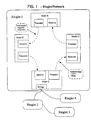
- Figure 1 is a block diagram showing ringlets on a larger network.
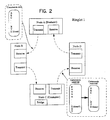
- Figure 2 is a block diagram showing a single ringlet, illustrating commands sent and received on the ringlet.
- FIGS 3-4 illustrate commands sent and received in the cases of strong sequential ordering (SSO) and SSO with nonidempotent requests or commands, respectively.
- SSO strong sequential ordering
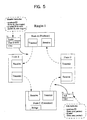
- Figure 5 shows the ringlet of Figure 2, showing the data structure of send packets and acknowledgments.
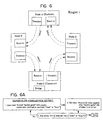
- Figures 6 and 6A show the ringlet of Figure 2. illustrating the resending of packets.
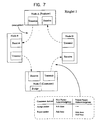
- Figure 7 shows the ringlet of Figure 2, illustrating the actions of a consumer node.
- Figure 8 is block diagram illustrating the operation of the invention from the point of view of a send interface.
- Figure 8A is a timing diagram illustrating a busy loop operation of the invention, with respect to a send port.
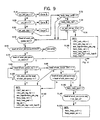
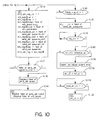
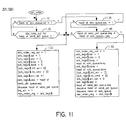
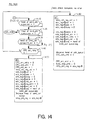
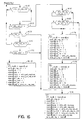
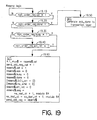
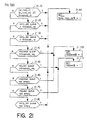
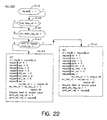
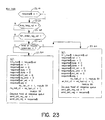
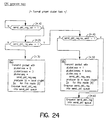
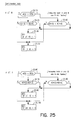
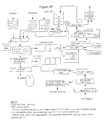
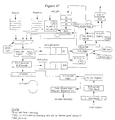
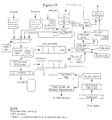
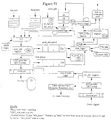
- Figures 9-25 are logic diagrams illustrating logic subsystems of the system of the invention, and their operation, in which (in the informal drawings) hexagons are decision boxes and rectangles are steps at which variable values are set.
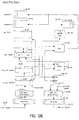
- Figure 26 is a block diagram illustrating the operation of the invention from the point of view of a receive interface.
- Figure 27A is a timing diagram illustrating receive packet timing.
- Figure 27B is a timing diagram illustrating acknowledge timing.
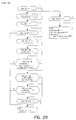
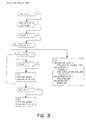
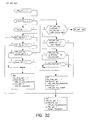
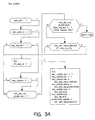
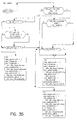
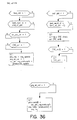
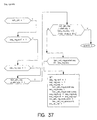
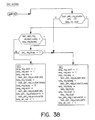
- Figures 28-38 are logic diagrams illustrating logic subsystems of the system of the invention, and their operation, with respect to receive nodes.
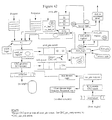
- Figure 39 is a block diagram indicating both the structure and the flow of packets in a preferred embodiment of the invention.
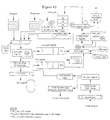
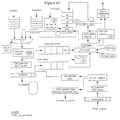
- Figures 40-60 illustrate successive states of the block diagram of Figure 39 according to the operation of the system of the invention.
- Figure 1 shows a standard ringlet 1 with four nodes A-D, each with transmit and receive capability. Requests and responses are sent out by a producer node, e.g. node A, while acknowledges (e.g. ack_done and ack_busy) are sent by a consumer node, e.g. node C. Node C may also communicate with other ringlets 2, 3 and 4, in a conventional fashion.
- the present embodiment is directed in particular to solutions for packets that are subject to errors in a ring network such as ringlet 1, which can cause unpredictable packet delivery and acceptance, since, although a producer knows what it has sent, it does not know (except by indirect means), whether a packet for which no acknowledgment has been received was in fact processed by the intended node.
- Figure 2 shows commands sent in a particular order A, B, C... by node A, and because of ringlet and transmission vagaries, reception in a different order, e.g. B, A, A, A,.... A well-behaved system should be able to reorder the sent packets and execute them properly, in the originally sent sequence.
- Figure 3 illustrates strong sequential ordering (SSO): no packet is received out of the order in which it was sent -- although it may appear twice, it does not appear out of order.
- Figure 4 illustrates the use of both SSO and nonidempotent commands; not only is the sequence preserved, but because of the nature of nonidempotent commands, no command in a conventional system may be executed twice by the destination node. Note in Figure 4 that ⁇ producerId, pLabel ⁇ are common to send_pkt and acknowledge; also, ⁇ producerId, pLabel ⁇ are visible to each node, absent errors.
- Figure 5 shows date structure suitable for applicant's solution to the above challenges; the packets include fields called producerID and pLabel, whose details are discussed below. These two fields are included in the acknowledge packets sent back from the consumer to the producer.
- the present embodiment resends packets, both known good (already accepted/done) packets and others, in a pattern as shown in Figure 6.
- Figure 6A summarizes at a high level the basic approach of the system of the invention: a known good SSO packet is resent, repeatedly if necessary, until a valid acknowledgment (which may be "done” or "busy") is received at the producer node. Then the producer node resends all other packets after the known good packet, even those that have been properly processed, i.e. for which ack_dones have been received. (See Figure 7.) As the acks come back from the resent packets, the producer node checks to see that all are valid acks -- i.e.
- the present embodiment is enabled by the fact that the consumer node continually maintains the state for packet actions (accept and reject states) and for acks (done and busy); this goes for all packets and acks that each node sees.
- each consumer node is aware of the disposition for every packet traveling the ringlet at the time that each packet passed through that node. This information is important in the resend process.
- each consumer node maintains a record of the sequence of packets that have gone through, and a sequence number of the last known good packet (for which an ack_done or ack_busy was issued). This provides a point to which the system can back up, if needed, when e.g. a CRC error is encountered. This will be more clearly seen in the discussion below of the example of Figures 39 et seq.
- Figure 8 is a block diagram showing a suitable hardware environment, and serves also to show the possible flow of packets in the producer node. It can be understood in detail in light of the flow/state diagrams of Figures 39 et seq. and the logic diagrams of Figures 8A-38.
- Packets are inserted from the transaction layer into the link layer through the request and response FIFO queues. Packets are selected through the multiplexer (MUX) for (possible) transmission to the ringlet through the send_pkt register, the CRC generator and 8/20 encoder, and the serializer, to the ringlet, as illustrated.
- MUX multiplexer
- Acks are queued in the ack queue, and matched with send packets in the send_pkt queue,, in the ack_logic block. In the absence of SSO support, all packets would flow through the non_order register; with SSO, all SSO packet flow through the retry_pkt register, and non_SSO packets continue through the non-order register.
- the resend logic basically examines ack status to determine whether a packet is completed (ack_done) or requires retry because of a busy receiver (ack_busy). Ack_done packets return status to the transaction layer through the "ack to command level" block.
- Non-SSO busy retry packets may be selected to retry through the MUX logic and the 4:1 (or 3:1, depending upon the selected embodiment of the invention) MUX. SSO busy retry packets are enqueued into the retry_pkt FIFO queue. They are selected from this queue through the MUX logic, and the MUX, by the SSO busy retry logic, which is distributed throughout the system and described in the flowcharts for send logic, figures 9-25.
- the receive node and send node have some common components with common names. These include: send node receive node deserializer 7.240 26.80 8/10 decode/CRC check 7.230 26.70 rec_pkt register 7.220 26.60 ack decode logic 7.140 26.140 ack queue 7.130 26.150
- the present system may be used in either non-SSO or fully SSO environments.
- the role of the SSO ordering logic can be understood from -comparison with the basic packet flow for non-SSO packets.
- the blocks 9.10, 9.20, and 9.30 inhibit the normal packet handling if the CRC error handling control sequence of CRC_init_err, CRC_err, and CRC_ack_chk are active. If all packets are non-SSO, then the block 9.50, which identifies the packet as non-SSO, sends packet control to figure 11.10.
- Figure 11 describes the basic non-SSO error detection logic, comparing the head of the send_pkt queue (see Figures 8 and 39) with the head of the ack queue to see if the acknowledge matches the packet. (Comparisons are done in blocks 11.10 through 11.40.) If the packet has an error, the block 11.50 sets the state "err_ret” to signal this as an error packet. Otherwise, the block 11.60 forwards the "busy” and “done” states from the packet's acknowledge (at the head of the ack queue, 9.130). In both cases, the packet is written into the non_order_reg.
- the non_order_reg is tested for validity. If valid, the packet is tested for "done” status in block 9.20, and "done” status is sent to the transaction layer in 9.50. If the packet is either "busy” or has "err_ret” state set, then the 4:1_mux is set for resend$ and the packet is forwarded to the send_pkt register, in block 9.60. Finally, in this block the sequence count for non-S SO packets is incremented and assigned to this retried packet.
- the send_pkt register is tested for validity in 24.10 and then forwarded to CRC generation in block 24.30.
- the pLabel field is defined by the fact that this is a non-SSO packet and by the assigned "seq" field in the same block 24.30. Also, the packet is again enqueued into the send_pkt queue to await an acknowledge packet.
- the MUX logic described in fig 21 to start the busy loop (set in 21.90) is unique to implementations with SSO support. Other logic, selecting request or response packets, would be similar for both SSO and non-SSO implementations.
- the MUX logic to initiate a request or response packet described in fig 22 and 23 would be similar for both SSO and non-SSO implementations.
- the CRC generate logic in Figure 24 tests the "no_xmit" state bit in 24.40 to determine whether a packet is to be transferred to the serializing logic. Such a gating is unique for SSO support.
- the logic supporting modulo 64 comparisons is also uniquely required for SSO support.
- Fig 26, like Figures 8 and 39, is a potential block diagram of a receive node (send node for fig 7), used to illustrate how the concepts of the SSO mechanism may be implemented. It is recognized that this is but one of many possible instantiations of a receive (send) node embodying the concepts of this mechanism. Packet flow in Fig 26 is fundamentally as follows:
- Figure 27A and 27B show receive packet and acknowledge timing diagrams, respectively.
- the receive node logic is shown in Figures 28 et seq., and is described as follows.
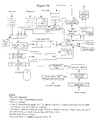
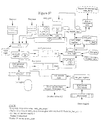
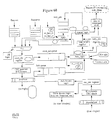
- Figures 39 et seq. demonstrate and exemplary operation of the system of the invention, with the state and actions described in those Figures, which conform to the logic in the foregoing figures.
- Figures 39 et seq. show, step by step, the state of the producer node for each transfer of packets among the registers and queues, and by inspection of those diagrams, it will be seen that the system does accommodate SSO, nonidempotent commands in the case of errors in connection with a busy retry loop and an ill-behaved node.
- the following presents an overview and summary of a proposed mechanism to support fully pipelined packet initiation in a ringlet topology based on IEEE P1394.2, where the pipelined packets may include send packets and response packets from address spaces requiring strong sequential ordering (SSO) and support for non-idempotent commands.
- This mechanism can be extended over arbitrary P1394.2 switch topologies by ensuring that every communication link in the topology, in turn, maintains SSO ordering.
- the proposed mechanism supports SSO and non-idempotent commands in a fully pipelined mode of operation for non-busy, non-error packet transmission, while tolerating both CRC errors and busy receiver conditions through an efficient hardware retry mechanism. It supports a variety of resend policies for mixing new packets with retried busy packets. It enables a "correctable error” kind of error handling policy, since CRC error packets may be retried to any programmable limit. This capability, in turn, enables a "preventative maintenance" function for nodes reporting successful retry operations of CRC error packets.
- a write command for a 2 KB block from an IEEE 1394-1995 node which expects a single response packet from the receiving node at its conclusion, can be implemented as a series of move commands (no response) and a concluding write, with the guarantee that the operation of the IEEE 1394-1995 packet will be preserved over the bridge.
- the cost of SSO ordering is 2 bytes of state per node supported on the ringlet, plus state machines, a separate register for non-SSO packets, muxes, and a 6 bit comparator.
- the flow description is now based on simple FIFO queues and registers, rather than more complicated array structures. Since the maximum configuration for a ringlet is 63 nodes, this bounds the required state to support SSO to ⁇ 128 B max (plus pointers and state machines). "Profiles" of smaller supported configurations can further reduce the cost by cutting the supported ringlet node count.
- IEEE P1394.2 or Serial Express
- Serial Express is a proposed extension of IEEE 1394-1995, or Serial Bus, to Gigabit+ transmission levels.
- the protocol supports the fundamental command set of IEEE 1394-1995 while rearchitecting the transfer protocol to emphasize low latency and high throughput with 16 B and 64 B packets.
- IEEE P1394.2 is based on an insertion buffer architecture with a ringlet topology. What this means is that a each node includes two unidirectional wires, one for packets and idles (for synchronization and flow control) coming in, and one for packets and idles going out.
- a bypass buffer shunts packets and idles coming in over to the outgoing wire, possibly with delays.
- a single new send or response packet (defined below) may be inserted by the node into the ringlet if its bypass buffer is not full; this is the "insertion buffer” architecture. Any packet that enters the bypass buffer while the node is inserting the new packet is delayed until the new packet is sent.
- the packet format includes a 16 bit field for packet routing usage plus a 48 bit extended address.
- Each node supports full duplex operation over a single cable with separate send and receive paths.
- initialization software breaks redundant loops and configures those nodes as a single ringlet.
- Multiple ringlets (with as few as 2 connections) can be interconnected through switches, up to a maximum topology of 16K nodes.
- the IEEE P1394.2 protocol supports four modes of operation, based on two address modes (directed and multicast) and two service types (asynchronous and isochronous).
- the SSO ordering is of particular interest for asynchronous, directed service, which includes (read, write, move, and lock) operations, but the proposed mechanism is not limited to only this mode of service.
- One reliable mechanism for example, that can be used with IEEE 1394-1995 to serialize an interrupt generating write request with a prior data packet, is to send a write command (which requires a response from the destination) for a large, say 2KB packet, and then send the write command to generate the interrupt after the response for the data has come back.
- Each command in (asynchronous, directed) mode is executed by the originating (sender) node generating a send packet and, depending on the command, the ultimate destination node (possibly) generating a response packet.
- the "send" packet is removed by a single receiving node on the sender's local ringlet and replaced with an "acknowledge” packet from that local receiving node back to the sending node.
- the local receiving node may be either the final destination for the send packet or an agent that forwards the packet, perhaps through a switch, to its destination.
- the ultimate destination node may send a "response" packet, which is also captured by some node on its local ringlet and replaced by an "acknowledge” packet back to the "response” generator.
- the term "producer node” is sometimes used to indicate the node that initiates the packet, whether that node is a sender node initiating a send packet, a receiver node initiating a response packet, or a bridge or switch node forwarding a send or response packet.
- targetId The target for both send and receive packets is identified by a global, 16 bit "targetId” field. In the absence of errors, some unique node on the ringlet, perhaps a bridge or switch node, will recognize the targetId address and strip the packet.
- a "sourceId” field uniquely identifies the global address of the sending node.
- Other fields which are included within the packet for returning local ringlet acknowledgment, are fundamental to the proposed SSO ordering enhancement. These include the (6 bit) "producerId” field, which identifies the nodeId that originated this packet **on its local ringlet**, and the (8 bit) "pLabel” field, which is assigned by the "producerId” node to uniquely identify this packet. Both the producerId and pLabel fields have meaning only within a local ringlet and will be reassigned, for example, if the packet is forwarded through a switch. Similarly, the "producerId” and “pLabel” fields are also reassigned by the destination node when it sends a response packet.
- the acknowledgment packet generated by the receiver node echoes some of the fields from the send or response packet back to the "producer node", so that it can uniquely recognize the packet being acknowledged:
- the "targetId" address field of the original packet is replaced by a "localBus” identifier (all 1's, typically), plus the 6 bit producerId field from the original packet.
- the pLabel field uniquely identifies the original packet to the "producer node”.
- the "type” field encodes the type of acknowledgment.
- the crc32 field for the acknowledge packet may be replaced by some other error detection code without loss of generality for the SSO mechanism described here.
- the P1394.2 protocol supports split response transactions, where a response is required. Packets for (asynchronous, directed) service are subject to two conditions that may inhibit packet delivery:
- the receiver node substitutes an ACK_busy acknowledgment packet for the send or response packet in (asynchronous, directed) service.
- the claim that the pLabel and producerId fields can be used to implement an SSO ordering mechanism in a ringlet topology depends on certain information being unambiguously known to both the producer node and the receiver node. Here is a summary of this information.
- each packet may have two uses in the ringlet: to transmit commands or data in the SSO program space, and to transfer ringlet sequence state information. Only the sender knows the sequence number of transmitted packets, and only the receiver knows the last valid, accepted packet. Pictorially:
- the "bzseq”, or busy sequence bit has meaning only in SSO ordering space and is used to help a receiver node determine whether it must issue a busy retry acknowledgment to a send / response packet.
- the 6 bit “seq” field is a wrapping, modulo 64 "counter” used by all local ringlet nodes for identifying valid packet sequences from this producerId.
- the maintenance of SSO ordering between each producerId node and the other nodes on the ringlet depends on the producerId "metering" its send and receive packets and setting their pLabel fields to ensure that each other node can maintain proper state information. By comparing that state information with incoming pLabel fields from the producerId, packets can be properly dispositioned to maintain SSO ordering.
- the pLabel.seq field is incremented by 1, modulo 64, with each new send/response packet or with each retried busy packet. If a CRC error is detected, the SSO state for all local ringlet nodes must first be resynched by resending some packets (below).
- CRC error used below may be generally understood to include not only CRC errors, but any non-corrected error condition for a packet (send, response, or acknowledge) that can be detected by the sending node.
- CRC error loop reset Once a CRC error is detected at the producer node, the SSO state values maintained for this producerId at every node in the ringlet are in question. Each ringlet node's SSO state information for this producerID must be reset, without any change in either the SSO programming space for this producerId or for any other producer node.
- a receiver node can detect a valid packet sequence from any producerId if its SSO state information is correct. This state is initialized by the producerId on reset and then re-initialized if a CRC error is detected by the producerID.
- a receiving node may or may not detect a CRC error send packet or acknowledge. Even if it does, since the packet's contents are unreliable, no node state information can be updated. It is the sending node's responsibility to detect a timeout and resend any CRC error packet.
- the receiving node can detect an out-of-sequence transmission of a valid ordered packet following a CRC error packet from some producerID. Each such out-of-sequence packet must be detected and rejected at the receiver while being acknowledged as ACK_error.
- the node sending this packet marks the packet and retries it in its error loop.
- a packet may be rejected in asynchronous operation if the receiving node is busy or, with SSO ordering support, if the packet is a retransmission of a packet that had been previously accepted.
- SSO ordered mode once a first packet from a given producerId has been rejected as busy, then all subsequent ordered-packets from this producerID must also be rejected as busy until the first busy packet is retried.
- the state of the receiver for SSO must then support the acceptance of new packets into a non-busy receiver buffer and the rejection of previously accepted packets that are resent for error recovery and any new packet sent following a "busy" rejection. Since the acknowledge packet returned to the producer is subject to error, the receiver state must be able to reproduce the ack_done and ack_busy packets if any packet is retried.
- each receiver node requires a state array, called seqTable, indexed by the producerId, with the following six fields:
- the seqTable fields are used as follows.
- the "verif” field indicates both that this seqTable has been initialized and that the producerId is a verified source.
- the “sso” field defines the (static) capability of this producerId node to support SSO ordering. (By comparison, the pLabel.sso bit is a dynamic bit set according to the address space ordering for the producer node.)
- the "seq” field is compared with the pLabel "seq” field for packet sequencing by the receiver node.
- the "bzseq” bit is compared with the corresponding pLabel "bzseq” bit for SSO packets to identify the retransmission of first busy packets.
- the "busy” bit is set on the first busy acknowledgment of an SSO packet to the producerId and (possibly) reset when this busy packet is retried, depending on the receiver buffer.
- the "acpt" field is used in both the acceptance and rejection of SSO packets and in determining whether to acknowledge as "done” or "busy". These determinations require comparison with the incoming packet's "seq” field.
- seqTable.seq[producerId] pLabel.seq
- packets are eligible for acceptance if a busy retry loop is being started and the receiver buffer is not busy, or if a busy retry loop is not being started and the "busy" state is reset and the receiver buffer is not busy and the sequence comparison shows that the producer node is not in an error retry loop. Packets are rejected if not accepted.
- packets are sent ack_don if a busy retry loop is being started and the receiver is not busy, or if the "busy" state is reset and the receiver is not busy, or if the sequence comparison shows that in an error retry loop, the packet being retried had been sent before the first "busy” packet. Packets are acknowledged as ack_bzy if they are not acknowledged as ack_don (again with the assumption of valid sequence comparison).
- seqTable entries are set a follows:
- each node can detect a packet with a sequence error from the producerId if: pLabel.seq > seqTable.seq[producerId] + 1
- a "trusted producer” policy may be supported with the proposed seqTable state bits and write send packets to initialize the seqTable. Three steps are needed:
- Each node in the ringlet must be verified and initialized separately.
- a policy like the above can be utilized to dynamically add (or subtract) nodes from an existing ring as well as initialize a newly powered-on ring.
- a policy like the above can enable selective "trusted node” exchanges. For example, node A can exchange with node B, node C with node B, but A and B can be prevented from SSO exchanges.
- the proposed mechanism can operate in a generalized 1394.2 network topology which includes:
- SSO ordering mechanism applies to the IEEE P1394.2 (asynchronous, directed) service. This does not mean that it cannot apply to other modes as well.
- This mechanism supports an arbitrary stream of commands from multiple address spaces, meaning that SSO commands may be interspersed with commands from other programming models.
- SSO ordering is to be maintained, end-to-end, from an SSO address space (or SSO domain) to a destination node, then it is clear that the destination node for SSO domain commands must be SSO-ordering capable, and that all intermediate nodes in switches or bridges must be SSO-ordering capable.
- the proposed SSO support mechanism can be implemented with the current 0.6 version of the spec without modification as an undocumented optional feature.
- this mechanism When patents covering this mechanism are filed, however, it is planned that this mechanism will be added to the IEEE P1394.2 documentation as (at least) an optional feature.
- the encoding addition for bridging is specifying bits to delineate the starting, middle, and ending 64 B packets whose destination is reached through an interconnect that supports longer packet types. For example, 2KB packets over Ethernet or 1394 can be broken up into three types of packets:
- Start packet possibly a partial block, aligned at its end on a 64B boundary.
- Middle packet always 64B, always aligned.
- End packet possibly a partial block, aligned at its start on a 64B boundary.
- a large packet entering a P1394.2 ringlet through a bridge may be broken up into smaller packets (for example, a large write packet broken into multiple 64B moves plus a 64B write, for example).
- reassembling a large packet from even SSO ordered 64B packets, for example to bridge to a 1394 destination node requires that the component parts of the large packet be easily identified. The need is particularly strong because of the typically low inefficiency of protocols designed for large packets when dealing with small 64B packets.
- a start/middle/end encoding when combined with the SSO ordering capability, allow a bridge to very efficiently reassemble packets for delivery.
- CRC error packets (either send/response packets or ACKs) are ultimately detected at the sending node.
- this detection might be either as a "sequence error" (an ACK_err response is detected before a time out) or as a ringlet time out (two revolutions with no acknowledgment).
- receiver nodes have the responsibility of sending an ACK_error to reject each send/response packet following a CRC error occurrence if a sequence error is detected from some node, but otherwise must maintain no error state information.
- the sending node When the sending node does detect that a CRC error has occurred in either its packet or an ACK, then it must retry all outstanding SSO ordered domain packets from the point of the last valid, completed packet up through the last outstanding packet sent before the error is detected and packet transmission is halted.
- the policy for retrying CRC errors in non-SSO domains is unspecified here.
- Packets are generated through the send port, but the busy acknowledgment is detected asynchronously in the receive port.
- the busy retry loop requires that all outstanding prior transactions be acknowledged prior to retransmitting the first retried busy packet (24).
- the decision on when to retry busy packets may depend on other implementation considerations, such as the arrival rate of new transactions.
- packet 23 is the last packet sent before the busy loop resends packets 21 and 23 as renumbered (pLabel.seq) packets 24 and 25.
- New sequence numbers are assigned by node A to the retried packets.
- SSO ordering is maintained, pairwise, from the sending node to each of its potential receiving nodes. However, if node A send SSO ordered packets to node B, and A also sends SSO ordered packets to node C, it does **not** follow that the relative ordering packet arrival between nodes B and C must be maintained for pairwise SSO correctness.
- the beginning of a busy retry loop by this producerId node is signalled to all ringlet nodes by complementing the pLabel.bzseq field (from 1 to 0).
- seqTable.busy[producerId] 0.
- seqTable.busy[producerId] 0.
- Case 1 CRC error on send packet to node C, detected at node C.
- the detection of a CRC error occurs within the receive node, asynchronously from the send node.
- packets 22 and 23 are transmitted before the CRC error for 21 is detected.
- nodes may detect - or fail to detect the error in different ways.
- the CRC error occurs after node B, so it never sees any sequence error.
- Node C fails to detect packet 21 and then detects that subsequent packets/acks 22 and 23 have sequence errors, since its last recorded sequence value is 20.
- seqTable.bzseq[producerId] value is reset, each node's seqTable.busy[] and seqTable.acpt[] fields must be preserved. They represent the state necessary to accept or reject packets in the CRC error retry loop with the correct ack done or busy response for this destination.
- node B rejects send/response packet 22
- node C accepts as new both packets 21 and 23.
- the sender must resend all packets that had been transmitted up to the point that it halted new packets, in this case through packet 23. With no errors, nodes B and C track the sequence numbers.
- Packet sequencing from standpoint of the send packet This example illustrates the inability of the sender node to detect whether a packet has been accepted at its destination. Since node C in this example has seen no error, both packets 21 and 23 have valid pLabel.seq fields and are given ACK_done responses.
- Case 3 CRC error on send packet to node C, detected at node C before beginning busy retry loop for node B.
- Node B is sent 2 send/response packets, 21 and 23, which it rejects as busy.
- Node C is sent a packet 22 which it never sees because of a CRC error at its node; no error is detected at node B.
- Node A begins its busy retry for node B packets by first waiting for the completion of outstanding Acks. Now node A detects the CRC error. It begins a CRC error loop, which must include all packets from 21 (last good packet before the error) through 23 (last packet sent before the error is detected).
- the seqTable.bzseq[producerId] field from node A makes a transition when the busy loop is finally started and packet 21 is retransmitted as packet 24.
- Node B detects this transaction and now evaluates whether packet 24 can be accepted, based on whether its receive buffer is full. In the assumed example, both retried packets 24 and 25 are accepted.
- the basic concept for initiating a busy retry loop in the potential presence of errors is to wait in starting the loop until acknowledgments for all packets prior to the first retried busy packet are received and verified as good. This is necessary since changing the state of the pLabel.bzseq bit causes all node packets to reset their seqTable.busy[] and seqTable.acpt[] fields. These fields had maintained error retry state for generating packet accept/reject and acknowledgments prior to the busy retry loop. These fields are reset only when node A verifies that no error conditions remain outstanding.
- each producer node may have up to the following three types of outgoing queues in addition to a register, and two types of incoming queues or structures (see Figure 39) Outgoing:
- the queues may be in some cases multiple queues, where there is no ordering dependency between the queues.
- An example is the multiple ports of a switch.
- IEEE P1394.2 specifies two types of operations to write data to a destination node: a responseless move transaction and a write transaction with a response.
- the SSO ordering structure guarantees ordered delivery of data; what then is the difference between move and write transactions?
- Write send packets provide a positive indication, generated by the destination node, that the write data actually reached this node. That is, it positively indicates completion of the operation. Move send packets have no positive indication of completion. There are two questions that arise from this distinction:
- write transactions can be used as the basis for a reliability architecture. If a send packet failed to receive a response in a specified period of time, a node timeout could be reported. In this usage, there is no a priori requirement for response completion prior to starting the next send packet.
- This proposed structure consists of three fields: Send_pkt SSO structure, one per send or response packet send_pkt.val (1) /* Entry valid */ send_pkt.sso (1) /* From command address space */ send_pkt.done (1) /* ACK_done recvd, response may be reqd */ send_pkt.busy (1) /* ACK_busy received, awaiting retry */ send_pkt.init_er (1) /* Initial (first) packet in error retry loop */ send_pkt.no_xmit (1) /* No transmit to ringlet during error loop */ send _pkt.err_ret (1) /* Error retry state in error retry loop */ send_pkt.seq (6)
- send_pkt[] may be viewed as a FIFO queue, with newly sent packets entering at the top and concluded packets coming out the bottom as acknowledgment packets in a corresponding FIFO are received. Any send packets acknowledged as "ack_done" may in turn may be awaiting a response.
- Certain producer node variables are needed for CRC error loop and busy retry loop handling.
- Global variables for CRC error loop operation include these, where the prefix "or_" indicated “ordered”. or_last_ct (6) /* Sequence count for latest SSO ordered pkt sent to the local ringlet */ no_last_ct (6) /* Sequence count for latest non-SSO ordered pkt sent to the local ringlet */ or_rcvd_ct (6) /* Sequence count for latest SSO ordered pkt received from the local ringlet */
- send_pkt fields When a packet is sent to the local ringlet, its pLabel field is set to correspond with send_pkt fields, which are carried in the packet path into the send_pkt register.
- a simple solution to this problem is for the producerId node performing the error handling loop to begin its error loop by transmitting - in non-pipelined mode - the last known good, completed packet.
- the producerID node would retry this packet until it received a valid acknowledgment. Once this is received, then every node on the ring must have its seqTable.seq[] field for this producerID set to the same value. The same argument holds for resetting the seqTable.bzseq[] field.
- the seqTable.busy[] field reflects the state of the acknowledgment to the last valid, completed packet delivered from this producerId to this receiving node. In considering how to handle the next valid packet (any retried packet will be rejected), this field has validity. This field, consequently, must not be reset in the reset interval.
- the seqTable.acpt[] field is also left unmodified.
- the producerID node is transmitting a packet for only its the packet sequence number, rather than its data content.
- the second problem with the original proposal dealt with the question of ambiguity in the producerId node determining whether packets in its error loop had been completed or not. That is, if any (send/receive) and acknowledge pair is found to have a CRC error, then the producerID node cannot determine whether the CRC error occurred before the packet reached its ringlet destination, or after. So it cannot reliably mark a retried packet as "completed".
- Figures 39-60 show the state of the system of the invention at successive stages of processing packets wherein a busy condition has arisen with respect to a consumer node, a CRC (or other) error condition has also arisen, and the "busy" node is not well-behaved -- i.e., it has been persistently busy for longer than some predetermined length of time or number of packets sent or received, or it is erroneously transmitting ack_busy responses.
- the or_last_ct is the count number of the last ordered packet sent, and that or_rcvd_ct refers to the count of the last ordered packet received.
- the or_rcvd_ct value is frozen if a busy retry is required (which is detected in the resend logic).
Landscapes
- Engineering & Computer Science (AREA)
- Computer Networks & Wireless Communication (AREA)
- Signal Processing (AREA)
- Data Exchanges In Wide-Area Networks (AREA)
- Small-Scale Networks (AREA)
- Computer And Data Communications (AREA)
Applications Claiming Priority (2)
| Application Number | Priority Date | Filing Date | Title |
|---|---|---|---|
| US08/673,849 US6065052A (en) | 1996-07-01 | 1996-07-01 | System for maintaining strongly sequentially ordered packet flow in a ring network system with busy and failed nodes |
| US673849 | 1996-07-01 |
Publications (2)
| Publication Number | Publication Date |
|---|---|
| EP0836299A2 true EP0836299A2 (de) | 1998-04-15 |
| EP0836299A3 EP0836299A3 (de) | 2005-07-20 |
Family
ID=24704340
Family Applications (1)
| Application Number | Title | Priority Date | Filing Date |
|---|---|---|---|
| EP97304573A Withdrawn EP0836299A3 (de) | 1996-07-01 | 1997-06-26 | Vorrichtung zur Gewährleistung eines starken sequentiellen geordneten Paketflusses in einem Ring-Netzwerk mit besetzten und fehlerhaften Knoten |
Country Status (3)
| Country | Link |
|---|---|
| US (3) | US6065052A (de) |
| EP (1) | EP0836299A3 (de) |
| JP (1) | JPH10164140A (de) |
Cited By (1)
| Publication number | Priority date | Publication date | Assignee | Title |
|---|---|---|---|---|
| EP1085706A3 (de) * | 1999-09-10 | 2002-10-30 | Matsushita Electric Industrial Co., Ltd. | Netzwerkbrücke für IEEE 1394-Busnetz |
Families Citing this family (73)
| Publication number | Priority date | Publication date | Assignee | Title |
|---|---|---|---|---|
| US6064672A (en) * | 1996-07-01 | 2000-05-16 | Sun Microsystems, Inc. | System for dynamic ordering support in a ringlet serial interconnect |
| FR2779301B1 (fr) * | 1998-05-26 | 2000-07-21 | Thomson Multimedia Sa | Procede d'identification d'appareils dans un reseau de communication et appareil de mise en oeuvre |
| US7159005B1 (en) | 1998-10-16 | 2007-01-02 | International Business Machines Corporation | Methods, systems and computer program products for restartable multiplexed file transfers |
| US6401136B1 (en) * | 1998-11-13 | 2002-06-04 | International Business Machines Corporation | Methods, systems and computer program products for synchronization of queue-to-queue communications |
| US7283476B2 (en) * | 1999-01-11 | 2007-10-16 | Hewlett-Packard Development Company, L.P. | Identity negotiation switch protocols |
| US6628607B1 (en) | 1999-07-09 | 2003-09-30 | Apple Computer, Inc. | Method and apparatus for loop breaking on a serial bus |
| US6691096B1 (en) | 1999-10-28 | 2004-02-10 | Apple Computer, Inc. | General purpose data container method and apparatus for implementing AV/C descriptors |
| US6671768B1 (en) | 1999-11-01 | 2003-12-30 | Apple Computer, Inc. | System and method for providing dynamic configuration ROM using double image buffers for use with serial bus devices |
| US6959343B1 (en) | 1999-11-01 | 2005-10-25 | Apple Computer, Inc. | Method and apparatus for dynamic link driver configuration |
| US6813663B1 (en) | 1999-11-02 | 2004-11-02 | Apple Computer, Inc. | Method and apparatus for supporting and presenting multiple serial bus nodes using distinct configuration ROM images |
| US6631426B1 (en) | 1999-11-02 | 2003-10-07 | Apple Computer, Inc. | Automatic ID allocation for AV/C entities |
| US8762446B1 (en) | 1999-11-02 | 2014-06-24 | Apple Inc. | Bridged distributed device control over multiple transports method and apparatus |
| US6618750B1 (en) | 1999-11-02 | 2003-09-09 | Apple Computer, Inc. | Method and apparatus for determining communication paths |
| US6587904B1 (en) | 1999-11-05 | 2003-07-01 | Apple Computer, Inc. | Method and apparatus for preventing loops in a full-duplex bus |
| US6636914B1 (en) | 1999-11-05 | 2003-10-21 | Apple Computer, Inc. | Method and apparatus for arbitration and fairness on a full-duplex bus using dual phases |
| US6457086B1 (en) | 1999-11-16 | 2002-09-24 | Apple Computers, Inc. | Method and apparatus for accelerating detection of serial bus device speed signals |
| US7266617B1 (en) * | 2000-01-18 | 2007-09-04 | Apple Inc. | Method and apparatus for border node behavior on a full-duplex bus |
| US6639918B1 (en) | 2000-01-18 | 2003-10-28 | Apple Computer, Inc. | Method and apparatus for border node behavior on a full-duplex bus |
| US7421507B2 (en) * | 2000-02-16 | 2008-09-02 | Apple Inc. | Transmission of AV/C transactions over multiple transports method and apparatus |
| US7050453B1 (en) | 2000-02-17 | 2006-05-23 | Apple Computer, Inc. | Method and apparatus for ensuring compatibility on a high performance serial bus |
| US6831928B1 (en) | 2000-02-17 | 2004-12-14 | Apple Computer, Inc. | Method and apparatus for ensuring compatibility on a high performance serial bus |
| US6850967B1 (en) * | 2000-02-19 | 2005-02-01 | Hewlett-Packard Development Company, L.P. | System and method for ensuring transparent sychronization of multiple applications across remote systems |
| US6618785B1 (en) * | 2000-04-21 | 2003-09-09 | Apple Computer, Inc. | Method and apparatus for automatic detection and healing of signal pair crossover on a high performance serial bus |
| US6718497B1 (en) | 2000-04-21 | 2004-04-06 | Apple Computer, Inc. | Method and apparatus for generating jitter test patterns on a high performance serial bus |
| US6917588B1 (en) * | 2000-05-16 | 2005-07-12 | Nortel Networks Limited | Apparatus and method for classifying data packet flows |
| US6912608B2 (en) * | 2001-04-27 | 2005-06-28 | Pts Corporation | Methods and apparatus for pipelined bus |
| DE60226627D1 (de) * | 2001-08-24 | 2008-06-26 | Intel Corp | Ehörige verfahren um datenintegrität zu verwalten |
| US6981110B1 (en) * | 2001-10-23 | 2005-12-27 | Stephen Waller Melvin | Hardware enforced virtual sequentiality |
| US20030158883A1 (en) * | 2002-02-04 | 2003-08-21 | Drudis Antoni N. | Message processing |
| US7584262B1 (en) | 2002-02-11 | 2009-09-01 | Extreme Networks | Method of and system for allocating resources to resource requests based on application of persistence policies |
| US7447777B1 (en) * | 2002-02-11 | 2008-11-04 | Extreme Networks | Switching system |
| US7814204B1 (en) | 2002-02-11 | 2010-10-12 | Extreme Networks, Inc. | Method of and system for analyzing the content of resource requests |
| US7321926B1 (en) | 2002-02-11 | 2008-01-22 | Extreme Networks | Method of and system for allocating resources to resource requests |
| US7298746B1 (en) | 2002-02-11 | 2007-11-20 | Extreme Networks | Method and system for reassembling and parsing packets in a network environment |
| DE10223007A1 (de) * | 2002-05-22 | 2003-12-11 | Bosch Gmbh Robert | Verfahren und Vorrichtung zur Übertragung von Informationen in einem Netzwerk sowie entsprechendes Netzwerk |
| WO2004010288A1 (en) * | 2002-07-19 | 2004-01-29 | Xelerated Ab | Method and apparatus for pipelined processing of data packets |
| US7417973B1 (en) | 2002-12-31 | 2008-08-26 | Apple Inc. | Method, apparatus and computer program product for ensuring node participation in a network bus |
| US7457302B1 (en) | 2002-12-31 | 2008-11-25 | Apple Inc. | Enhancement to loop healing for malconfigured bus prevention |
| US6965564B2 (en) | 2003-02-14 | 2005-11-15 | America Online, Inc. | Wireless datagram transaction protocol system |
| US7668099B2 (en) * | 2003-06-13 | 2010-02-23 | Apple Inc. | Synthesis of vertical blanking signal |
| US7353284B2 (en) | 2003-06-13 | 2008-04-01 | Apple Inc. | Synchronized transmission of audio and video data from a computer to a client via an interface |
| US8275910B1 (en) | 2003-07-02 | 2012-09-25 | Apple Inc. | Source packet bridge |
| KR100557068B1 (ko) | 2003-08-06 | 2006-03-03 | 삼성전자주식회사 | 실내 백본망을 위한 ieee 1394 기반의 단방향 링 시스템 |
| US7788567B1 (en) | 2003-11-18 | 2010-08-31 | Apple Inc. | Symbol encoding for tolerance to single byte errors |
| US7995606B1 (en) | 2003-12-03 | 2011-08-09 | Apple Inc. | Fly-by and ack-accelerated arbitration for broadcast packets |
| US7308517B1 (en) | 2003-12-29 | 2007-12-11 | Apple Inc. | Gap count analysis for a high speed serialized bus |
| US7237135B1 (en) | 2003-12-29 | 2007-06-26 | Apple Inc. | Cyclemaster synchronization in a distributed bridge |
| US7349978B2 (en) * | 2004-01-15 | 2008-03-25 | Microsoft Corporation | Spurious timeout detection in TCP based networks |
| JP4459018B2 (ja) * | 2004-10-28 | 2010-04-28 | 富士通株式会社 | ノード装置 |
| US7765305B2 (en) * | 2005-04-07 | 2010-07-27 | Microsoft Corporation | Retry request overload protection |
| US8005879B2 (en) * | 2005-11-21 | 2011-08-23 | Sap Ag | Service-to-device re-mapping for smart items |
| US8156208B2 (en) * | 2005-11-21 | 2012-04-10 | Sap Ag | Hierarchical, multi-tiered mapping and monitoring architecture for service-to-device re-mapping for smart items |
| US20070118496A1 (en) * | 2005-11-21 | 2007-05-24 | Christof Bornhoevd | Service-to-device mapping for smart items |
| US20090265485A1 (en) * | 2005-11-30 | 2009-10-22 | Broadcom Corporation | Ring-based cache coherent bus |
| US8522341B2 (en) * | 2006-03-31 | 2013-08-27 | Sap Ag | Active intervention in service-to-device mapping for smart items |
| US8065411B2 (en) | 2006-05-31 | 2011-11-22 | Sap Ag | System monitor for networks of nodes |
| US8296413B2 (en) * | 2006-05-31 | 2012-10-23 | Sap Ag | Device registration in a hierarchical monitor service |
| US8131838B2 (en) | 2006-05-31 | 2012-03-06 | Sap Ag | Modular monitor service for smart item monitoring |
| US7792137B2 (en) * | 2006-07-05 | 2010-09-07 | Abidanet, Llc | Self-organized and self-managed ad hoc communications network |
| US7765385B2 (en) * | 2007-04-18 | 2010-07-27 | International Business Machines Corporation | Fault recovery on a parallel computer system with a torus network |
| US8880716B2 (en) * | 2009-05-08 | 2014-11-04 | Canon Kabushiki Kaisha | Network streaming of a single data stream simultaneously over multiple physical interfaces |
| US8396960B2 (en) * | 2009-05-08 | 2013-03-12 | Canon Kabushiki Kaisha | Efficient network utilization using multiple physical interfaces |
| US8325601B2 (en) * | 2009-05-08 | 2012-12-04 | Canon Kabushiki Kaisha | Reliable network streaming of a single data stream over multiple physical interfaces |
| US8396952B2 (en) * | 2009-08-12 | 2013-03-12 | International Business Machines Corporation | Provisioning and commissioning a communications network with a virtual network operations center and interface |
| US8504660B2 (en) * | 2009-08-12 | 2013-08-06 | International Business Machines Corporation | Validation of the configuration of a data communications network using a virtual network operations center |
| US8488960B2 (en) * | 2009-08-12 | 2013-07-16 | International Business Machines Corporation | Synchronizing events on a communications network using a virtual command interface |
| US8356109B2 (en) | 2010-05-13 | 2013-01-15 | Canon Kabushiki Kaisha | Network streaming of a video stream over multiple communication channels |
| US9042874B2 (en) * | 2012-02-29 | 2015-05-26 | Alcatel Lucent | System and/or method for using mobile telephones as extensions |
| US9037122B2 (en) | 2012-02-29 | 2015-05-19 | Alcatel Lucent | Fixed line extension for mobile telephones |
| WO2013152097A1 (en) | 2012-04-03 | 2013-10-10 | Nevion Usa, Inc. | Signal protection |
| US9402107B2 (en) * | 2013-03-15 | 2016-07-26 | Time Warner Cable Enterprises Llc | Apparatus and methods for delivery of multicast and unicast content in a content delivery network |
| US9596297B2 (en) | 2013-05-16 | 2017-03-14 | Toshiba Global Commerce Solutions Holdings Corporation | Managing communications in a multi-client, multi-server environment |
| CN111224885B (zh) * | 2020-01-07 | 2023-05-26 | 联合汽车电子有限公司 | 节点标序方法、节点标序系统及车载无钥匙系统 |
Family Cites Families (20)
| Publication number | Priority date | Publication date | Assignee | Title |
|---|---|---|---|---|
| JPH0638600B2 (ja) * | 1983-12-28 | 1994-05-18 | 株式会社東芝 | ローカルエリアネットワークシステム |
| US4725834A (en) * | 1984-02-27 | 1988-02-16 | American Telephone And Telegraph Company, At&T Bell Laboratories | Reliable broadcast protocol for a token passing bus network |
| JPH0640643B2 (ja) * | 1984-12-03 | 1994-05-25 | ザ・ユニバ−シティ・オブ・ウェスタン・オ−ストラリア | データパケットの待ち合わせ方法、通信ネットワークシステム及びパケット通信用アクセス装置 |
| US4922408A (en) * | 1985-09-27 | 1990-05-01 | Schlumberger Technology Corporation | Apparatus for multi-processor communications |
| US4807118A (en) * | 1987-01-14 | 1989-02-21 | Hewlett-Packard Company | Method for handling slot requests over a network |
| US5055999A (en) * | 1987-12-22 | 1991-10-08 | Kendall Square Research Corporation | Multiprocessor digital data processing system |
| US5341483A (en) * | 1987-12-22 | 1994-08-23 | Kendall Square Research Corporation | Dynamic hierarchial associative memory |
| US5084877A (en) * | 1989-05-05 | 1992-01-28 | At&T Bell Laboratories | High speed transport protocol |
| JP2764896B2 (ja) * | 1992-04-09 | 1998-06-11 | 日本電気株式会社 | データ送達確認システム |
| US5260933A (en) * | 1992-05-15 | 1993-11-09 | International Business Machines Corporation | Acknowledgement protocol for serial data network with out-of-order delivery |
| US5781715A (en) * | 1992-10-13 | 1998-07-14 | International Business Machines Corporation | Fault-tolerant bridge/router with a distributed switch-over mechanism |
| AU7322694A (en) * | 1993-07-09 | 1995-02-06 | Apple Computer, Inc. | System and method for sending and responding to information requests in a communications network |
| US5577211A (en) * | 1994-05-11 | 1996-11-19 | Ibm Corporation | System and method using chained structure queues for ordering of message delivery between connected nodes wherein unsuccessful message portion is skipped and retried |
| JP3041200B2 (ja) * | 1994-07-21 | 2000-05-15 | シャープ株式会社 | データ通信装置およびその方法 |
| US5495481A (en) * | 1994-09-30 | 1996-02-27 | Apple Computer, Inc. | Method and apparatus for accelerating arbitration in a serial bus by detection of acknowledge packets |
| US5548728A (en) * | 1994-11-04 | 1996-08-20 | Canon Information Systems, Inc. | System for reducing bus contention using counter of outstanding acknowledgement in sending processor and issuing of acknowledgement signal by receiving processor to indicate available space in shared memory |
| US5592486A (en) * | 1995-03-17 | 1997-01-07 | Advanced Micro Devices, Inc. | System and method for efficiently monitoring information in a network having a plurality of repeaters |
| US5774479A (en) * | 1995-03-30 | 1998-06-30 | Motorola, Inc. | Method and system for remote procedure call via an unreliable communication channel using multiple retransmission timers |
| US5870540A (en) * | 1995-11-20 | 1999-02-09 | Ncr Corporation | Low overhead method for detecting communication failures on a network |
| US5828847A (en) * | 1996-04-19 | 1998-10-27 | Storage Technology Corporation | Dynamic server switching for maximum server availability and load balancing |
-
1996
- 1996-07-01 US US08/673,849 patent/US6065052A/en not_active Expired - Lifetime
-
1997
- 1997-06-26 EP EP97304573A patent/EP0836299A3/de not_active Withdrawn
- 1997-07-01 JP JP9211428A patent/JPH10164140A/ja active Pending
-
2000
- 2000-01-28 US US09/493,925 patent/US6233615B1/en not_active Expired - Lifetime
-
2001
- 2001-05-10 US US09/854,294 patent/US6463472B1/en not_active Expired - Lifetime
Cited By (3)
| Publication number | Priority date | Publication date | Assignee | Title |
|---|---|---|---|---|
| EP1085706A3 (de) * | 1999-09-10 | 2002-10-30 | Matsushita Electric Industrial Co., Ltd. | Netzwerkbrücke für IEEE 1394-Busnetz |
| US6611892B1 (en) | 1999-09-10 | 2003-08-26 | Matsushita Electric Industrial Co., Ltd. | Network bus bridge and system |
| AU777075B2 (en) * | 1999-09-10 | 2004-09-30 | Matsushita Electric Industrial Co., Ltd. | Network bus bridge and system |
Also Published As
| Publication number | Publication date |
|---|---|
| JPH10164140A (ja) | 1998-06-19 |
| US20020059442A1 (en) | 2002-05-16 |
| US6233615B1 (en) | 2001-05-15 |
| US6463472B1 (en) | 2002-10-08 |
| US6065052A (en) | 2000-05-16 |
| EP0836299A3 (de) | 2005-07-20 |
Similar Documents
| Publication | Publication Date | Title |
|---|---|---|
| US6065052A (en) | System for maintaining strongly sequentially ordered packet flow in a ring network system with busy and failed nodes | |
| US5864677A (en) | System for preserving sequential ordering and supporting nonidempotent commands in a ring network with busy nodes | |
| US6597665B1 (en) | System for dynamic ordering support in a ringlet serial interconnect | |
| US5301186A (en) | High speed transmission line interface | |
| US6545981B1 (en) | System and method for implementing error detection and recovery in a system area network | |
| US6493343B1 (en) | System and method for implementing multi-pathing data transfers in a system area network | |
| EP0823165B1 (de) | Asynchrone paketvermittlung | |
| US6990098B1 (en) | Reliable multicast using merged acknowledgements | |
| US6661773B1 (en) | Method for detection of stale cells following route changes in a data communication | |
| US6952419B1 (en) | High performance transmission link and interconnect | |
| JP3560423B2 (ja) | パケット送受信装置及びパケット受信装置 | |
| JP2004180295A (ja) | 通信デバイスのモジュール間で伝送された喪失メッセージを検出するためのシステムおよび方法 | |
| WO1983001359A1 (en) | A local area contention network data communication system | |
| JP2772367B2 (ja) | データ・パケットを送信する方法およびデータ処理システム | |
| US20030110422A1 (en) | Method and system for detecting dropped micro-packets | |
| TW448650B (en) | Method for processing error of received packet in Ethernet MAC layer | |
| JP4759218B2 (ja) | データ伝送方法 | |
| KR100204586B1 (ko) | 선입선출 버퍼를 가지는 내장형 통신 보드에서의 수신 패킷의 파손 검출 및 복구 방법_ | |
| GB2120055A (en) | Data communication system | |
| US20020191606A1 (en) | Network system-wide error handling utilizing control bit modification | |
| WO2002035768A2 (en) | High performance transmission link and interconnect | |
| JPS61208939A (ja) | デ−タ通信中継装置 | |
| JPWO2000042738A1 (ja) | Atmセルの連続性検査装置及び方法 |
Legal Events
| Date | Code | Title | Description |
|---|---|---|---|
| PUAI | Public reference made under article 153(3) epc to a published international application that has entered the european phase |
Free format text: ORIGINAL CODE: 0009012 |
|
| AK | Designated contracting states |
Kind code of ref document: A2 Designated state(s): AT BE CH DE DK ES FI FR GB GR IE IT LI LU MC NL PT SE |
|
| RAP1 | Party data changed (applicant data changed or rights of an application transferred) |
Owner name: SUN MICROSYSTEMS, INC. |
|
| PUAL | Search report despatched |
Free format text: ORIGINAL CODE: 0009013 |
|
| AK | Designated contracting states |
Kind code of ref document: A3 Designated state(s): AT BE CH DE DK ES FI FR GB GR IE IT LI LU MC NL PT SE |
|
| RIC1 | Information provided on ipc code assigned before grant |
Ipc: 7H 04L 12/56 B Ipc: 7H 04L 12/43 B Ipc: 7H 04L 29/06 B Ipc: 7H 04L 12/42 B Ipc: 7H 04L 1/18 A |
|
| 17P | Request for examination filed |
Effective date: 20060105 |
|
| AKX | Designation fees paid |
Designated state(s): DE FR GB |
|
| 17Q | First examination report despatched |
Effective date: 20060207 |
|
| STAA | Information on the status of an ep patent application or granted ep patent |
Free format text: STATUS: THE APPLICATION IS DEEMED TO BE WITHDRAWN |
|
| 18D | Application deemed to be withdrawn |
Effective date: 20070719 |