EP0830397B1 - Process for preparing low molecular, highly reactive polyisobutylene - Google Patents
Process for preparing low molecular, highly reactive polyisobutylene Download PDFInfo
- Publication number
- EP0830397B1 EP0830397B1 EP96917494A EP96917494A EP0830397B1 EP 0830397 B1 EP0830397 B1 EP 0830397B1 EP 96917494 A EP96917494 A EP 96917494A EP 96917494 A EP96917494 A EP 96917494A EP 0830397 B1 EP0830397 B1 EP 0830397B1
- Authority
- EP
- European Patent Office
- Prior art keywords
- polymerization
- isobutene
- reactor
- polymerization stage
- boron trifluoride
- Prior art date
- Legal status (The legal status is an assumption and is not a legal conclusion. Google has not performed a legal analysis and makes no representation as to the accuracy of the status listed.)
- Expired - Lifetime
Links
- 229920002367 Polyisobutene Polymers 0.000 title claims description 89
- 238000004519 manufacturing process Methods 0.000 title description 12
- VQTUBCCKSQIDNK-UHFFFAOYSA-N Isobutene Chemical compound CC(C)=C VQTUBCCKSQIDNK-UHFFFAOYSA-N 0.000 claims description 194
- 238000006116 polymerization reaction Methods 0.000 claims description 188
- WTEOIRVLGSZEPR-UHFFFAOYSA-N boron trifluoride Chemical compound FB(F)F WTEOIRVLGSZEPR-UHFFFAOYSA-N 0.000 claims description 69
- 238000006243 chemical reaction Methods 0.000 claims description 40
- 239000003054 catalyst Substances 0.000 claims description 39
- 238000000034 method Methods 0.000 claims description 37
- 229910015900 BF3 Inorganic materials 0.000 claims description 34
- 230000008569 process Effects 0.000 claims description 27
- 239000000203 mixture Substances 0.000 claims description 26
- KFZMGEQAYNKOFK-UHFFFAOYSA-N Isopropanol Chemical compound CC(C)O KFZMGEQAYNKOFK-UHFFFAOYSA-N 0.000 claims description 20
- 229930195733 hydrocarbon Natural products 0.000 claims description 18
- 150000002430 hydrocarbons Chemical class 0.000 claims description 15
- XLYOFNOQVPJJNP-UHFFFAOYSA-N water Chemical group O XLYOFNOQVPJJNP-UHFFFAOYSA-N 0.000 claims description 15
- 239000004215 Carbon black (E152) Substances 0.000 claims description 11
- BTANRVKWQNVYAZ-UHFFFAOYSA-N butan-2-ol Chemical compound CCC(C)O BTANRVKWQNVYAZ-UHFFFAOYSA-N 0.000 claims description 6
- 229910052799 carbon Inorganic materials 0.000 claims description 4
- 239000007791 liquid phase Substances 0.000 claims description 3
- 230000036961 partial effect Effects 0.000 claims description 3
- 238000002360 preparation method Methods 0.000 claims description 2
- 125000005011 alkyl ether group Chemical group 0.000 claims 1
- 238000002955 isolation Methods 0.000 claims 1
- YCKRFDGAMUMZLT-UHFFFAOYSA-N Fluorine atom Chemical compound [F] YCKRFDGAMUMZLT-UHFFFAOYSA-N 0.000 description 22
- 229910052731 fluorine Inorganic materials 0.000 description 22
- 239000011737 fluorine Substances 0.000 description 22
- VLKZOEOYAKHREP-UHFFFAOYSA-N n-Hexane Chemical compound CCCCCC VLKZOEOYAKHREP-UHFFFAOYSA-N 0.000 description 21
- 238000001816 cooling Methods 0.000 description 17
- 238000004821 distillation Methods 0.000 description 14
- 239000008139 complexing agent Substances 0.000 description 13
- WEVYAHXRMPXWCK-UHFFFAOYSA-N Acetonitrile Chemical compound CC#N WEVYAHXRMPXWCK-UHFFFAOYSA-N 0.000 description 12
- KRHYYFGTRYWZRS-UHFFFAOYSA-M Fluoride anion Chemical compound [F-] KRHYYFGTRYWZRS-UHFFFAOYSA-M 0.000 description 10
- 150000001768 cations Chemical class 0.000 description 10
- 230000014759 maintenance of location Effects 0.000 description 10
- 230000015572 biosynthetic process Effects 0.000 description 9
- 238000010626 work up procedure Methods 0.000 description 9
- 229920000642 polymer Polymers 0.000 description 8
- 239000007858 starting material Substances 0.000 description 8
- VXNZUUAINFGPBY-UHFFFAOYSA-N 1-Butene Chemical class CCC=C VXNZUUAINFGPBY-UHFFFAOYSA-N 0.000 description 7
- 239000002904 solvent Substances 0.000 description 7
- KRHYYFGTRYWZRS-UHFFFAOYSA-N Fluorane Chemical compound F KRHYYFGTRYWZRS-UHFFFAOYSA-N 0.000 description 6
- 239000004809 Teflon Substances 0.000 description 6
- 229920006362 Teflon® Polymers 0.000 description 6
- -1 aluminum alkyl chlorides Chemical class 0.000 description 6
- 230000000694 effects Effects 0.000 description 6
- 229910000040 hydrogen fluoride Inorganic materials 0.000 description 6
- NNPPMTNAJDCUHE-UHFFFAOYSA-N isobutane Chemical compound CC(C)C NNPPMTNAJDCUHE-UHFFFAOYSA-N 0.000 description 6
- 239000000243 solution Substances 0.000 description 6
- 150000001298 alcohols Chemical class 0.000 description 5
- 239000006227 byproduct Substances 0.000 description 5
- 239000002826 coolant Substances 0.000 description 5
- 238000009826 distribution Methods 0.000 description 5
- 238000000605 extraction Methods 0.000 description 5
- 229920002521 macromolecule Polymers 0.000 description 5
- KAKZBPTYRLMSJV-UHFFFAOYSA-N Butadiene Chemical compound C=CC=C KAKZBPTYRLMSJV-UHFFFAOYSA-N 0.000 description 4
- 239000000654 additive Substances 0.000 description 4
- 150000001983 dialkylethers Chemical class 0.000 description 4
- 238000011065 in-situ storage Methods 0.000 description 4
- 238000006317 isomerization reaction Methods 0.000 description 4
- FPYJFEHAWHCUMM-UHFFFAOYSA-N maleic anhydride Chemical compound O=C1OC(=O)C=C1 FPYJFEHAWHCUMM-UHFFFAOYSA-N 0.000 description 4
- 239000000178 monomer Substances 0.000 description 4
- 238000012545 processing Methods 0.000 description 4
- GSMZLBOYBDRGBN-UHFFFAOYSA-N 2-fluoro-2-methylpropane Chemical compound CC(C)(C)F GSMZLBOYBDRGBN-UHFFFAOYSA-N 0.000 description 3
- QGZKDVFQNNGYKY-UHFFFAOYSA-N Ammonia Chemical compound N QGZKDVFQNNGYKY-UHFFFAOYSA-N 0.000 description 3
- YMWUJEATGCHHMB-UHFFFAOYSA-N Dichloromethane Chemical compound ClCCl YMWUJEATGCHHMB-UHFFFAOYSA-N 0.000 description 3
- OKKJLVBELUTLKV-UHFFFAOYSA-N Methanol Chemical compound OC OKKJLVBELUTLKV-UHFFFAOYSA-N 0.000 description 3
- OFBQJSOFQDEBGM-UHFFFAOYSA-N Pentane Chemical compound CCCCC OFBQJSOFQDEBGM-UHFFFAOYSA-N 0.000 description 3
- 150000002222 fluorine compounds Chemical group 0.000 description 3
- 239000007789 gas Substances 0.000 description 3
- 239000001282 iso-butane Substances 0.000 description 3
- 238000002156 mixing Methods 0.000 description 3
- IJDNQMDRQITEOD-UHFFFAOYSA-N n-butane Chemical compound CCCC IJDNQMDRQITEOD-UHFFFAOYSA-N 0.000 description 3
- 239000002685 polymerization catalyst Substances 0.000 description 3
- 239000011541 reaction mixture Substances 0.000 description 3
- 230000009257 reactivity Effects 0.000 description 3
- 230000008707 rearrangement Effects 0.000 description 3
- 238000000926 separation method Methods 0.000 description 3
- 238000003756 stirring Methods 0.000 description 3
- 230000007306 turnover Effects 0.000 description 3
- 238000001644 13C nuclear magnetic resonance spectroscopy Methods 0.000 description 2
- HEDRZPFGACZZDS-UHFFFAOYSA-N Chloroform Chemical compound ClC(Cl)Cl HEDRZPFGACZZDS-UHFFFAOYSA-N 0.000 description 2
- LFQSCWFLJHTTHZ-UHFFFAOYSA-N Ethanol Chemical compound CCO LFQSCWFLJHTTHZ-UHFFFAOYSA-N 0.000 description 2
- ATUOYWHBWRKTHZ-UHFFFAOYSA-N Propane Chemical compound CCC ATUOYWHBWRKTHZ-UHFFFAOYSA-N 0.000 description 2
- RAHZWNYVWXNFOC-UHFFFAOYSA-N Sulphur dioxide Chemical compound O=S=O RAHZWNYVWXNFOC-UHFFFAOYSA-N 0.000 description 2
- HEDRZPFGACZZDS-MICDWDOJSA-N Trichloro(2H)methane Chemical compound [2H]C(Cl)(Cl)Cl HEDRZPFGACZZDS-MICDWDOJSA-N 0.000 description 2
- VSCWAEJMTAWNJL-UHFFFAOYSA-K aluminium trichloride Chemical compound Cl[Al](Cl)Cl VSCWAEJMTAWNJL-UHFFFAOYSA-K 0.000 description 2
- 150000001412 amines Chemical class 0.000 description 2
- 238000004458 analytical method Methods 0.000 description 2
- 150000001450 anions Chemical class 0.000 description 2
- 239000007864 aqueous solution Substances 0.000 description 2
- 235000013844 butane Nutrition 0.000 description 2
- 238000002485 combustion reaction Methods 0.000 description 2
- 239000000470 constituent Substances 0.000 description 2
- 238000006356 dehydrogenation reaction Methods 0.000 description 2
- 230000005595 deprotonation Effects 0.000 description 2
- 238000010537 deprotonation reaction Methods 0.000 description 2
- 238000013461 design Methods 0.000 description 2
- 125000002573 ethenylidene group Chemical group [*]=C=C([H])[H] 0.000 description 2
- 239000000446 fuel Substances 0.000 description 2
- 238000005227 gel permeation chromatography Methods 0.000 description 2
- 239000011968 lewis acid catalyst Substances 0.000 description 2
- 238000012423 maintenance Methods 0.000 description 2
- 239000000463 material Substances 0.000 description 2
- 239000002808 molecular sieve Substances 0.000 description 2
- 239000012071 phase Substances 0.000 description 2
- 239000000047 product Substances 0.000 description 2
- 230000002829 reductive effect Effects 0.000 description 2
- URGAHOPLAPQHLN-UHFFFAOYSA-N sodium aluminosilicate Chemical compound [Na+].[Al+3].[O-][Si]([O-])=O.[O-][Si]([O-])=O URGAHOPLAPQHLN-UHFFFAOYSA-N 0.000 description 2
- 239000013589 supplement Substances 0.000 description 2
- 238000005406 washing Methods 0.000 description 2
- CURLTUGMZLYLDI-UHFFFAOYSA-N Carbon dioxide Chemical compound O=C=O CURLTUGMZLYLDI-UHFFFAOYSA-N 0.000 description 1
- OTMSDBZUPAUEDD-UHFFFAOYSA-N Ethane Chemical compound CC OTMSDBZUPAUEDD-UHFFFAOYSA-N 0.000 description 1
- UFHFLCQGNIYNRP-UHFFFAOYSA-N Hydrogen Chemical compound [H][H] UFHFLCQGNIYNRP-UHFFFAOYSA-N 0.000 description 1
- NHTMVDHEPJAVLT-UHFFFAOYSA-N Isooctane Chemical compound CC(C)CC(C)(C)C NHTMVDHEPJAVLT-UHFFFAOYSA-N 0.000 description 1
- XUIMIQQOPSSXEZ-UHFFFAOYSA-N Silicon Chemical compound [Si] XUIMIQQOPSSXEZ-UHFFFAOYSA-N 0.000 description 1
- 239000002253 acid Substances 0.000 description 1
- 230000002411 adverse Effects 0.000 description 1
- 229910000272 alkali metal oxide Inorganic materials 0.000 description 1
- 150000001340 alkali metals Chemical class 0.000 description 1
- 229910001860 alkaline earth metal hydroxide Inorganic materials 0.000 description 1
- 150000001336 alkenes Chemical group 0.000 description 1
- 125000000217 alkyl group Chemical group 0.000 description 1
- 229910052782 aluminium Inorganic materials 0.000 description 1
- 229910021529 ammonia Inorganic materials 0.000 description 1
- 239000002585 base Substances 0.000 description 1
- 239000001273 butane Substances 0.000 description 1
- 238000011088 calibration curve Methods 0.000 description 1
- 150000001721 carbon Chemical group 0.000 description 1
- 125000004432 carbon atom Chemical group C* 0.000 description 1
- 235000011089 carbon dioxide Nutrition 0.000 description 1
- 238000001460 carbon-13 nuclear magnetic resonance spectrum Methods 0.000 description 1
- 150000004649 carbonic acid derivatives Chemical class 0.000 description 1
- 150000001244 carboxylic acid anhydrides Chemical class 0.000 description 1
- 150000001735 carboxylic acids Chemical class 0.000 description 1
- 230000003197 catalytic effect Effects 0.000 description 1
- 238000006555 catalytic reaction Methods 0.000 description 1
- 230000002153 concerted effect Effects 0.000 description 1
- 230000008602 contraction Effects 0.000 description 1
- 230000001276 controlling effect Effects 0.000 description 1
- 238000007796 conventional method Methods 0.000 description 1
- 229920001577 copolymer Polymers 0.000 description 1
- 230000007797 corrosion Effects 0.000 description 1
- 238000005260 corrosion Methods 0.000 description 1
- 238000005336 cracking Methods 0.000 description 1
- 230000007423 decrease Effects 0.000 description 1
- 230000003247 decreasing effect Effects 0.000 description 1
- 230000018044 dehydration Effects 0.000 description 1
- 238000006297 dehydration reaction Methods 0.000 description 1
- 230000001419 dependent effect Effects 0.000 description 1
- 230000029087 digestion Effects 0.000 description 1
- JVSWJIKNEAIKJW-UHFFFAOYSA-N dimethyl-hexane Natural products CCCCCC(C)C JVSWJIKNEAIKJW-UHFFFAOYSA-N 0.000 description 1
- 150000002009 diols Chemical class 0.000 description 1
- 238000001035 drying Methods 0.000 description 1
- 238000000921 elemental analysis Methods 0.000 description 1
- RTZKZFJDLAIYFH-UHFFFAOYSA-N ether Substances CCOCC RTZKZFJDLAIYFH-UHFFFAOYSA-N 0.000 description 1
- 150000002170 ethers Chemical class 0.000 description 1
- 238000001704 evaporation Methods 0.000 description 1
- 230000008020 evaporation Effects 0.000 description 1
- 239000000284 extract Substances 0.000 description 1
- 230000002349 favourable effect Effects 0.000 description 1
- 239000012530 fluid Substances 0.000 description 1
- 239000002816 fuel additive Substances 0.000 description 1
- 238000004817 gas chromatography Methods 0.000 description 1
- 150000008282 halocarbons Chemical class 0.000 description 1
- 229910052736 halogen Inorganic materials 0.000 description 1
- 150000002367 halogens Chemical class 0.000 description 1
- 239000001257 hydrogen Substances 0.000 description 1
- 229910052739 hydrogen Inorganic materials 0.000 description 1
- 238000010348 incorporation Methods 0.000 description 1
- 239000012442 inert solvent Substances 0.000 description 1
- 229910052500 inorganic mineral Inorganic materials 0.000 description 1
- 150000002500 ions Chemical class 0.000 description 1
- 125000000959 isobutyl group Chemical group [H]C([H])([H])C([H])(C([H])([H])[H])C([H])([H])* 0.000 description 1
- 239000007788 liquid Substances 0.000 description 1
- 239000000314 lubricant Substances 0.000 description 1
- 239000010687 lubricating oil Substances 0.000 description 1
- 229910052751 metal Inorganic materials 0.000 description 1
- 239000002184 metal Substances 0.000 description 1
- 150000002739 metals Chemical class 0.000 description 1
- 239000011707 mineral Substances 0.000 description 1
- 238000006386 neutralization reaction Methods 0.000 description 1
- 150000002825 nitriles Chemical class 0.000 description 1
- JRZJOMJEPLMPRA-UHFFFAOYSA-N olefin Natural products CCCCCCCC=C JRZJOMJEPLMPRA-UHFFFAOYSA-N 0.000 description 1
- 239000011368 organic material Substances 0.000 description 1
- 239000001301 oxygen Substances 0.000 description 1
- 229910052760 oxygen Inorganic materials 0.000 description 1
- 238000005191 phase separation Methods 0.000 description 1
- 229920002959 polymer blend Polymers 0.000 description 1
- 230000037048 polymerization activity Effects 0.000 description 1
- 239000001294 propane Substances 0.000 description 1
- 230000005588 protonation Effects 0.000 description 1
- 238000005086 pumping Methods 0.000 description 1
- 238000000746 purification Methods 0.000 description 1
- 239000002994 raw material Substances 0.000 description 1
- 239000000376 reactant Substances 0.000 description 1
- 239000012429 reaction media Substances 0.000 description 1
- 238000004064 recycling Methods 0.000 description 1
- 230000009467 reduction Effects 0.000 description 1
- 230000001105 regulatory effect Effects 0.000 description 1
- 238000011160 research Methods 0.000 description 1
- 230000002441 reversible effect Effects 0.000 description 1
- 238000005070 sampling Methods 0.000 description 1
- 229930195734 saturated hydrocarbon Natural products 0.000 description 1
- 150000003333 secondary alcohols Chemical class 0.000 description 1
- 229910052710 silicon Inorganic materials 0.000 description 1
- 239000010703 silicon Substances 0.000 description 1
- 238000001179 sorption measurement Methods 0.000 description 1
- 239000000126 substance Substances 0.000 description 1
- RINCXYDBBGOEEQ-UHFFFAOYSA-N succinic anhydride Chemical class O=C1CCC(=O)O1 RINCXYDBBGOEEQ-UHFFFAOYSA-N 0.000 description 1
- 125000000383 tetramethylene group Chemical group [H]C([H])([*:1])C([H])([H])C([H])([H])C([H])([H])[*:2] 0.000 description 1
- CZDYPVPMEAXLPK-UHFFFAOYSA-N tetramethylsilane Chemical compound C[Si](C)(C)C CZDYPVPMEAXLPK-UHFFFAOYSA-N 0.000 description 1
- 230000008646 thermal stress Effects 0.000 description 1
Images
Classifications
-
- C—CHEMISTRY; METALLURGY
- C08—ORGANIC MACROMOLECULAR COMPOUNDS; THEIR PREPARATION OR CHEMICAL WORKING-UP; COMPOSITIONS BASED THEREON
- C08F—MACROMOLECULAR COMPOUNDS OBTAINED BY REACTIONS ONLY INVOLVING CARBON-TO-CARBON UNSATURATED BONDS
- C08F110/00—Homopolymers of unsaturated aliphatic hydrocarbons having only one carbon-to-carbon double bond
- C08F110/04—Monomers containing three or four carbon atoms
- C08F110/08—Butenes
- C08F110/10—Isobutene
-
- C—CHEMISTRY; METALLURGY
- C08—ORGANIC MACROMOLECULAR COMPOUNDS; THEIR PREPARATION OR CHEMICAL WORKING-UP; COMPOSITIONS BASED THEREON
- C08F—MACROMOLECULAR COMPOUNDS OBTAINED BY REACTIONS ONLY INVOLVING CARBON-TO-CARBON UNSATURATED BONDS
- C08F4/00—Polymerisation catalysts
- C08F4/06—Metallic compounds other than hydrides and other than metallo-organic compounds; Boron halide or aluminium halide complexes with organic compounds containing oxygen
- C08F4/12—Metallic compounds other than hydrides and other than metallo-organic compounds; Boron halide or aluminium halide complexes with organic compounds containing oxygen of boron, aluminium, gallium, indium, thallium or rare earths
- C08F4/14—Boron halides or aluminium halides; Complexes thereof with organic compounds containing oxygen
-
- Y—GENERAL TAGGING OF NEW TECHNOLOGICAL DEVELOPMENTS; GENERAL TAGGING OF CROSS-SECTIONAL TECHNOLOGIES SPANNING OVER SEVERAL SECTIONS OF THE IPC; TECHNICAL SUBJECTS COVERED BY FORMER USPC CROSS-REFERENCE ART COLLECTIONS [XRACs] AND DIGESTS
- Y02—TECHNOLOGIES OR APPLICATIONS FOR MITIGATION OR ADAPTATION AGAINST CLIMATE CHANGE
- Y02P—CLIMATE CHANGE MITIGATION TECHNOLOGIES IN THE PRODUCTION OR PROCESSING OF GOODS
- Y02P20/00—Technologies relating to chemical industry
- Y02P20/50—Improvements relating to the production of bulk chemicals
- Y02P20/582—Recycling of unreacted starting or intermediate materials
Definitions
- the present invention relates to a process for the preparation of low molecular weight, highly reactive polyisobutene having an average molecular weight M n of 500 to 20,000 daltons and a content of terminal double bonds of over 80 mol% by the polymerization of isobutene or isobutene-containing hydrocarbon streams in the liquid phase and with the help of a boron trifluoride complex catalyst at temperatures from 0 to -40 ° C and at a pressure of 1 to 20 bar.
- polyisobutene-maleic anhydride adducts especially polyisobutenyl succinic anhydrides, generated, which then to manufacture with certain amines Be implemented additively. Since in the adduct formation with maleic anhydride mainly the vinylidene double bonds react, whereas those further inside the macromolecules Double bonds depending on their position in the macromolecule without the Addition of halogens to none or to a significantly lower amount Lead sales is the proportion of terminal double bonds in the molecule the most important quality criterion for this type of polyisobutene.
- the polyisobutene cation formed in the course of the polymerization reaction I can by splitting a proton into that skip the polyisobutene in question.
- the proton can both from one of the ⁇ -methyl groups or from the internal ⁇ -methylene group be split off.
- the polyisobutene cation I is relatively unstable and tries stabilize by rearrangement into higher substituted cations. Both 1,3-methyl group shifts to the polyisobutene cation IV as well as successive or concerted 1,2-hydride - and 2,3-methyl group shifts to the polyisobutene cation V occur. Cations IV and V can, depending on from which position the proton is split off, three each form different double bond isomers polyisobutenes. It but there is also the possibility that the cations IV and V rearrange, with the effect that the double bond still migrates further inside the polyisobutene macromolecule.
- a disadvantage of these processes is that fluorine-containing by-products are formed due to the use of a BF 3 complex catalyst.
- the fluorine contents of the polyisobutenes produced by these processes can be up to 200 ppm.
- hydrogen fluoride which is highly corrosive, is split off.
- This problem is particularly serious when using isobutene-containing C 4 cuts as the starting material, since - due to the content of n-butenes - relatively stable secondary fluorides of polyisobutene are formed, which then further derivatize the polyisobutene to form fuel. and lubricating oil additives or when later using these fuel additives in the engine with the formation of hydrogen fluoride and thereby cause corrosion damage.
- Another disadvantage of the one-stage polymerization when using C 4 cuts is due to the n-butenes contained in these hydrocarbon streams.
- the polymerization can be terminated and the selectivity for the formation of highly reactive polyisobutene, ie polyisobutene with a high content of vinylidene double bonds, decreases.
- the present invention was therefore based on the object of finding a process for producing low molecular weight, highly reactive polyisobutene (PIB), the fluorine content of which is significantly below the fluorine content of the polyisobutene prepared by the known processes.
- the process should also enable the production of PIB with low fluorine content and high finality of the double bonds from C 4 hydrocarbon streams and be economical.
- the PIB thus produced should have a narrow molecular weight distribution D.
- the starting point in this formula scheme is the polyisobutyl cation Ia which is formed in the course of the isobutene polymerization and whose counterion is the [BF 3 OR] - anion. From this anion, a fluoride anion can be transferred to the polyisobutyl cation Ia to form the polyisobutyl fluoride VI and BF 2 OR. In the presence of protons present in the polymerization mixture, this is in equilibrium with the polyisobutene II and hydrogen fluoride. The hydrogen fluoride formed can add to the monomer isobutene VII, which is also present in the polymerization mixture and is in equilibrium with the tert-butyl fluoride VIII formed in the presence of protons. The establishment of these equilibria is prevented by extraction or neutralization of the BF3 complex catalyst or the polymerization mixture.
- the setting of the equilibria shown in the formula as well as their shift depends on the reaction conditions used, in particular the quantitative ratios of polymer and monomers present in the polymerization mixture, the type of BF 3 complex catalyst and the quantitative ratio of BF 3 complexing agents, and also on set polymerization temperature.
- This goal was achieved through the measure of performing isobutene polymerization in at least two polymerization stages reached, the second polymerization stage or further subsequent polymerization stages at a generally lower one Temperature operated as the first polymerization stage.
- the invention Process operated with two polymerization stages. To achieve high levels of terminal double bonds and a low one Fluorine content of the polyisobutene can be in various ways Way to proceed.
- the first polymerization stage an isobutene conversion of 5 to 98%, preferably from 50 to 95%, in particular from 50 to 90%, adjust and in the second stage to complete the polymerization.
- the second polymerization stage is advantageous in one operated lower polymerization temperature than the first Polymerization stage, usually the temperature difference is 1 to 20 ° C, preferably 2 to 10 ° C.
- the Polymerization temperature in the first polymerization stage predetermined coolant temperature and depending on the Reactivity of the catalyst used by supplying fresh Isobutens controlled so that they are technically unavoidable Apart from fluctuations, remains essentially constant.
- the isobutene conversion in the first polymerization stage becomes taking into account the above parameters, namely coolant temperature, Polymerization temperature and an average residence time of the reaction mixture in the reactor, by setting the reactivity of the catalyst complex via the dosage of Controlled complexing agent.
- the discharge from the first polymerization stage is preferably passed into the second polymerization stage without further working up.
- the polymerization is carried out without the addition of fresh isobutene at a lower polymerization temperature than in the first polymerization stage.
- This can be caused by a lower temperature of the coolant, or when using a coolant of the same temperature as in the first polymerization stage, for example when the cooling device used there, by controlling the cooling so that more heat is removed from the polymerization mixture than there the polymerization of the remaining isobutene is released.
- the residence time of the polymerization mixture in the first polymerization stage is when setting an isobutene conversion from 50 to 90%, usually 5 to 60 minutes but also shorter or longer, depending on whether a very active or less active catalyst is used.
- In the second polymerization stage is generally a residence time from 1 to 180, preferably from 5 to 120 minutes.
- the isobutene conversion in the second polymerization stage set so that the total turnover of the isobutene in the first and second polymerization stages generally at 80 to 100%, preferably 90 to 100%, especially 95 to 100%.
- the discharge from the second polymerization stage can be worked up in a conventional manner, for example by adding the catalyst by adding further Complexing agents, for example water, alcohols, amines or Nitriles, inactivated, the inactivated catalyst from the Extracts polyisobutene and the PIB from the PIB-containing phase by separating volatile constituents, such as Solvents, volatile isobutene oligomers and low molecular weight, volatile by-products, isolated.
- PIB obtained contains a very high proportion of terminal Double bonds and has very low fluorine contents.
- the discharge from the second polymerization stage still contains larger amounts of unreacted isobutene, this isobutene, if pure isobutene as the starting material in the polymerization was used, after separation by distillation from the polymerization discharge, again advantageous in the first polymerization stage to be led back.
- the unreacted isobutene can be used together with the Polymerization discharge from the second polymerization stage without further workup fed to a third polymerization stage and there, at a lower polymerization temperature than be polymerized to the end in the second polymerization stage.
- the polymerization temperature is such third polymerization stage by 1 to 20 ° C, preferably 2nd to 10 ° C, set lower than the polymerization temperature in the previous second polymerization stage.
- the setting the polymerization temperature can be measured using the measures take place as previously for setting the polymerization temperature were explained in the second polymerization stage.
- the residence time of the polymerization mixture in the third polymerization stage will depend on the catalyst activity and set the desired sales, in general it is 5 to 180, preferably 10 to 120 minutes. As in the explanation of the implementation of the second polymerization stage described, it may be necessary or appropriate be used catalyst by adding boron trifluoride supplement or the catalyst activity by adding boron trifluoride to increase.
- C 4 hydrocarbon streams containing isobutene such as C 4 raffinates or C 4 cuts from the isobutene
- Dehydrogenation can be used as the starting material in the process according to the invention, since it avoids loss of isobutene, no leveling up of undesired hydrocarbons as a result of recycling unreacted isobutene containing other hydrocarbons enters the first polymerization stage and as a result a high-quality, practically fluorine-free PIB with a high content of terminal double bonds is obtained.
- the polymerization discharge from the third polymerization stage can be worked up in the same manner as described for the processing of the discharge from the second polymerization stage.
- the retention container can operate at the same polymerization temperature become like the previous polymerization step, in general but a higher temperature is set in it.
- So can be the temperature of the polymerization mixture in the retention tank -40 to + 40 ° C, preferably the Temperature increased to 0 to 40 ° C, preferably to 0 to 30 ° C.
- the residence time of the polymerization mixture in the residence container can be 0.1 to 3 hours, preferably they 0.3 to 2 hours, with this residence time correspondingly the polymerization temperature in the retention tank is regulated.
- Fresh catalyst is the polymerization discharge from the previous polymerization stage, which in the the rest get into the retention tank without further processing, generally no longer fed. Except for a completion the isobutene polymerization is conducted through of the polymerization discharge through the residence time container further reduction in the fluorine content of the resulting polyisobutene causes.
- the still remains in the polymerization discharge of the previous polymerization stage contained polyisobutyl fluoride with equilibrium Split off hydrogen fluoride to form polyisobutene, partly from still in the polymerization mixture Isobutene present to form volatile isobutyl or tert-butyl fluoride is trapped. So much for this volatile Fluoride is not already in the processing of the Dwell time leaving polymerization discharge, which in the the rest as described above, can be dismantled, they can easily be worked out during further distillative work-up the PIB can be removed and destroyed by adsorption.
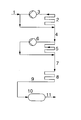
- the isobutene or the one containing isobutene is fed via feed 1 Hydrocarbon stream, optionally diluted with an inert Solvent in which by means of a cooling bath (not shown) thermostatted reactor 2 passed.
- Reactor 2 is as Tube reactor loop designed in which the polymerization mixture is kept in circulation by means of the pump 3.
- a high Pumping power is conducive to heat removal from the reactor ensures thorough mixing of the polymerization mixture, therefore for a constant, stationary isobutene concentration.
- the polymerization catalyst can precede the feed Entry into the polymerization reactor 2 have been mixed or by - not shown - feeds to practical can be metered in anywhere in the reactor 2. It is both possible, preformed, i.e.
- reactor 5 which is advantageously configured as a tubular reactor loop like reactor 2 in which the polymerization mixture by means of pump 6 is circulated.
- Reactor 5 is shown by a Cooled cooling bath.
- boron trifluoride is metered into the reactor loop become.
- the residence time in this reactor can e.g. by setting the Length of the reactor tube depending on its diameter can be set. If necessary, can not over Inlets into the feed 7 or preferably the reactor 8 additional boron trifluoride can be added.
- the discharge from reactor 8 is fed via line 9 to the retention tank 10, which is usually not cooled, and in terms of equipment, for example as a tank with an overflow or also as a tubular reactor can be designed.
- the method according to the invention as shown in the figure in many ways can be modified, for example in which the polymerization only carried out in two or three polymerization stages becomes.
- the polymerization can already take place in the two first polymerization stages ⁇ corresponding to the reactors 2 and 5 in Fig. 1 - to the end.
- the polymerization in polymerization stage 1 (reactor 2) up to perform a relatively high isobutene conversion and the polymerization without the use of a reactor 5 according to FIG. 1 corresponding reactor in a reactor 8 according to FIG. 1 corresponding reactor and, if desired, additionally in one To carry out dwell containers.
- Such an embodiment corresponds essentially to the design of the invention Process in which the reactors 2 and 5 according to FIG.
- the conversion of the isobutene can also be up to a partial turnover can be carried out with a high Guaranteed content of terminal double bonds in the polyisobutene is then the polymerization by adding larger Amounts of a complexing agent, e.g. Water, broken off that Highly reactive discharge containing PIB, as shown above worked up and the separated during the workup, not converted hydrocarbon mixture containing isobutene on conventional way to with low molecular weight polyisobutene processed a lower content of terminal double bonds become.
- a complexing agent e.g. Water
- Boron trifluoride complexes with complexing agents are used as catalysts in the process according to the invention which influence the polymerization activity of the boron trifluoride in such a way that, on the one hand, the polymerization results in a low molecular weight polyisobutene and, on the other hand, the isomerization activity of the boron trifluoride with regard to the isomerization of terminal residues to those located inside the polyisobutene molecule is not or only slightly reactive double bonds is reduced.
- Suitable complexing agents are, for example, water, C 1 to C 10 alcohols, C 2 to C 10 diols, C 1 to C 20 carboxylic acids, C 4 to C 12 carboxylic anhydrides and C 2 to C 20 dialkyl ethers .
- Complexing agents from the class of the C 1 to C 20 alcohols, in particular the C 1 -C 4 alcohols, and the class of the C 1 to C 20 dialkyl ethers, of which such dialkyl ethers are preferred are preferably used in the process according to the invention which the ether oxygen is bound to the tertiary carbon atom of a tertiary alkyl group, especially those ethers as described in WO 93/10063.
- the monohydric, secondary alcohols C 3 -C 20 -alcohols as described in EP-A 628 575, have a particularly favorable influence as a complexing agent on the polymerization and isomerization activity of the boron trifluoride catalyst, isopropanol and 2 -Butanol are particularly noteworthy.
- Boron trifluoride complex catalysts are preferably used in the process according to the invention, in which the molar ratio of boron trifluoride / complexing agent is less than 1, in particular from 0.4 to 0.95 and particularly preferably from 0.5 to 0.8.
- the boron trifluoride complex catalysts can be preformed before use, as described, for example, in EP-A 145 235 or generated in situ in the polymerization reactor, as described in EP-A 628 575.
- Gaseous boron trifluoride is expediently used as the raw material for producing the boron trifluoride complex catalysts, technical boron trifluoride (purity: 96.5% by weight) still containing small amounts of sulfur dioxide, but preferably highly pure boron trifluoride (purity: 99.5% by weight). %) can be used. Silicon tetrafluoride-free boron trifluoride is particularly preferably used for catalyst production.
- the polymerization of the isobutene can be carried out in the presence or absence of solvents which are inert under the reaction conditions, such as saturated hydrocarbons, for example pentane, hexane, isooctane or halogenated hydrocarbons, such as methylene chloride or chloroform.
- solvents which are inert under the reaction conditions
- saturated hydrocarbons for example pentane, hexane, isooctane or halogenated hydrocarbons, such as methylene chloride or chloroform.
- Polymerization to PIB is preferred on an industrial scale run continuously. This can be done in a conventional manner Reactors, such as tubular reactors, tube bundle reactors or Stirring kettles are worked, preferably in the invention Process in the first two polymerization stages Loop reactors are used, i.e. tube or tube bundle reactors with constant circulation of the reaction material, which is usually the Feed / circulation ratio 1: 1 to 1: 1000, preferably 1:50 up to 1: 200 v / v. It goes without saying that the Intake quantity after adjustment of the stationary equilibrium in Polymerization reactor equal to the amount of the polymerization discharge is.
- the cause of double bond shifts can give, it is useful both the introduction of preformed catalyst complexes into the reactor as well as in the in situ representation of the boron trifluoride complexes in the reactor for thorough mixing of all reactants generate a turbulent flow of the reaction material in the reactor, for which the reactor, for example, with suitable internals, like baffles, or the pipe cross-sections like this can be dimensioned so that there is a suitable flow rate sets.
- the residence time of the isobutene to be polymerized in the individual Polymerization levels can vary depending on the particular Polymerization stage 5 seconds to several hours, is preferably in the individual polymerization stages depending on the desired degree of conversion of the isobutene in these stages a residence time of 1 to 180, preferably 5 to 120 minutes chosen.
- the dwell time in the dwell container up to several hours.
- the gross reaction rate is from the crowd, but above all that Depending on the molar ratio of the catalyst used.
- the boron trifluoride / sec. alcohol and / or dialkyl ether catalyst in amounts of 0.05 to 1% by weight, based on the amount used Isobutene or that contained in the hydrocarbon mixture Isobutene supplied.
- the polymerization is advantageously carried out at temperatures below 0 ° C. Although isobutene is still much lower Temperatures successfully polymerized to highly reactive polyisobutene can be generally at temperatures between 0 and -40 ° C, especially between -4 and -30 ° C and especially preferably worked between -10 and -25 ° C. Deviating from this can consistently higher temperatures in the retention tank be used, for example temperatures up to 40 ° C.
- the Polymerization can be carried out under atmospheric pressure Applying increased pressure up to 20 bar as well as working under the autogenous pressure of the reaction system, is appropriate for the result of the polymerization is usually irrelevant.
- the polymerization reaction under isothermal is advantageous Conditions and setting a constant, steady Operated monomer concentration in the reaction medium, in particular up to an isobutene conversion of up to 90%.
- the residual amounts of isobutene contained in the polymerization mixture can be worked with decreasing isobutene concentration.
- the stationary isobutene concentration can be arbitrary should be chosen, usually a monomer concentration is expedient from 0.1 to 50, preferably from 0.2 to 10% by weight, based on the total polymerization mixture.
- the heat of polymerization becomes usually with the help of a cooling device, which operated for example with liquid ammonia as a coolant can be dissipated.
- a cooling device which operated for example with liquid ammonia as a coolant can be dissipated.
- Another possibility is the heat of polymerization deriving is the evaporative cooling on the product side of the reactor. This releases the heat evaporation of isobutene and / or other more volatile Components of the isobutene feedstock or, if appropriate volatile solvent such as ethane, propane or butane removed, which keeps the temperature constant.
- the cooling can through internal or external cooling, depending on the type of reactor used, respectively.
- Tube reactors are preferably by means of external cooling cooled, the reaction tubes advantageously in a cooling bath stirred tank reactors are preferred by internal cooling, e.g. by means of cooling coils or by evaporative cooling, product side, thermostatted.
- the reaction discharge is expediently in passed a medium that deactivates the polymerization catalyst and in this way the polymerization stops.
- a medium that deactivates the polymerization catalyst for working up, the reaction discharge is expediently in passed a medium that deactivates the polymerization catalyst and in this way the polymerization stops.
- a medium that deactivates the polymerization catalyst for working up, the reaction discharge is expediently in passed a medium that deactivates the polymerization catalyst and in this way the polymerization stops.
- a medium that deactivates the polymerization catalyst for working up, the reaction discharge is expediently in passed a medium that deactivates the polymerization catalyst and in this way the polymerization stops.
- mineral bases such as alkali metal and Alkaline earth metal hydroxide solutions, solutions of carbonates of these Metals and the like be used.
- the polyisobutene is expediently separated by distillation into C 4 -carbons, solvents, oligomers and polyisobutene, advantageously after several extractions to remove residual amounts of catalyst - usually methanol or water washes.
- the hydrogen wash also removes hydrogen fluoride formed in the course of the polymerization.
- isobutene is used as the starting material, this, like isobutene oligomers and solvents, can be recycled into the polymerization.
- isobutene C 4 cuts the unreacted isobutene and other C 4 hydrocarbons are not recirculated in general and for other purposes.
- Volatile fluorine-containing by-products such as tert-butyl fluoride, can be removed from the polyisobutene together with the other hydrocarbons and separated from these hydrocarbons by distillation or extraction.
- the process according to the invention enables the economical production of highly reactive polyisobutenes both from pure isobutene and, particularly advantageously, from hydrocarbon streams containing isobutene. Very high contents of the PIB in terminal double bonds of over 80 mol% are achieved with very good selectivities and at very high conversions.
- the polyisobutenes thus produced have average molecular weights M n in the molecular weight range from M n 500 to 20,000 daltons, preferably from 500 to 5000 daltons, and a narrow molecular weight distribution D.
- the average molecular weights (M n ) of the polymers prepared according to the examples were determined by means of gel permeation chromatography (GPC), using standardized polyisobutenes for calibration.
- vinylidene double bonds or terminal double bonds are understood to mean those double bonds whose position in the polyisobutene macromolecule is represented by the general formula IIa is described in which R represents the polyisobutylene radical in question.
- the type and the proportion of the double bonds present in the polyisobutene prepared according to the invention was determined using the method of 13 C-NMR spectroscopy, the two carbon atoms of the terminal double bond in the 13 C-NMR spectrum marked by ⁇ and ⁇ in formula IIa by their Signals with a chemical shift of 114.4 or 143.6 ppm are identifiable and the proportion of terminal double bonds with respect to other types of double bonds is calculated by determining the peak areas of the signals in relation to the total integral of the olefin signals.
- deuterated chloroform was used as the solvent and tetramethylsilane as the internal standard.
- the content of organically bound fluorine in the polymerization solution as well as in polyisobutene was made according to conventional elemental analytical methods: For this, the organic Material by combustion digestion according to Wickbold or Schöniger open-minded, which absorbs the released fluoride in water and the fluoride content of the obtained fluoride aqueous solution potentiometric with the help of commercially available, selective for fluoride ions Electrodes determined using a calibration curve. From that measured fluoride content of the solution and that used for combustion Sample amount can be the content of organically bound Simply calculate fluoride in the sample (Lit .: F. Ehrenberger: Quantitative elemental analysis; VCH publishing company, Weinheim, P. 436 ff, p. 424 ff, p. 617 ff).
- the reactor ( ⁇ reactor 2 according to FIG.) Consisted of a Teflon tube of 7.6 m in length with an inner diameter of 4 mm, through which 50 1 reactor contents were circulated through a gear pump.
- Hose and pump had a content of 100 ml.
- Teflon hose and pump head were in a cold bath at -19 ° C (cryostat).
- Raffinate I (composition: Table 1) was used as feed, the feed was 300 g / h. It was dried over 3 ⁇ molecular sieve to a water content of less than 3 ppm and fed to the circulation reactor through a capillary with a 2 mm inside diameter, which had been pre-cooled to -19 ° C.
- the amounts of BF 3 and isopropanol were varied until an isobutene conversion of 80% PIB resulted in a molecular weight M n of 1000.
- the amount of BF 3 was 10 mmol, the amount of isopropanol 15 mmol.
- the reactor temperature was -13 ° C.
- the isobutene conversion was determined by gas chromatography by analyzing the exhaust gas. Through the inlets, the reactor volumes and the volume contraction by polymerization resulted in one average residence time of about 13 minutes. Immediately behind the Pressure was maintained in the discharge pipe or sampling nozzle Polymerization terminated with 15 ml / h acetonitrile.
- the pressure conditions in the reactor are determined by its geometry, the circulation quantity, the viscosity of the reaction mixture and the pressure maintenance certainly.
- the pressure maintenance directly at the reactor outlet on the pressure side of the pump is set to 7 bar existing concentration ratios were on the suction side the pump measured about 4 bar.
- the pressure loss of the system was 3 bar.
- the reactor discharge was stopped after the polymerization using acetonitrile with 600 ml / h of hot water (60 ° C) in a 1 l Stirring flask guided and the remaining liquid gas evaporated.
- LPG also contained 14.1% isobutene. It was condensed on a dry ice cooler, azeotropically entrained water froze on the surface of the cooler. The separation layer in the stirring flask was maintained via a siphon that runs through the side of the mixing phase Siphon.
- the viscosity measured in an Ubbelohde viscometer, was 198 mm 2 / s, the average molecular weight M n was 1005 daltons and the molecular weight distribution D 1.5.
- the fluorine content was 65 ppm.
- the condensed exhaust gas was transferred to a pressure vessel, heated to 50 ° C and passed through a riser pipe under autogenous pressure into the previously described reactor and there with 2 mmol of BF 3 and 1 mmol of isopropanol at an isobutene concentration of the polymerization mixture of 0.6 wt .-% implemented.
- a polymerization apparatus consisting of 2 circulation reactors ( ⁇ reactors 2 and 5 according to FIG.), As described in Example 1, was used. Deviating from this description, the Teflon hoses in the first reactor were 4.5 m and in the second reactor 2.7 m long.
- the feeds of 150 g / h each of hexane and isobutene were dried as described and fed separately to the reactor system via capillaries with an internal diameter of 2 mm.
- the quantities of BF 3 and isopropanol supplied were varied until a reactor temperature of -7 ° C. and an isobutene conversion of 50% resulted in polyisobutene having an average molecular weight M n of 1040 daltons. 15 mmol of BF 3 and 27 mmol of isopropanol were required.
- the reactor discharge was passed without further additives and without working up into the second reactor, which was operated at a reactor temperature of -14 ° C.
- the isobutene was further polymerized until the total conversion reached 79%.
- the discharge from this reactor was then treated as in Example 1 to terminate the polymerization and for working up.
- the polyisobutene obtained had a terminal double bond content of 95 mol%, its viscosity (100 ° C.) was 203 mm 2 / s, the average molecular weight M n was 1040 daltons and the dispersity D 1.5. Further information on this example is given in Table 2.
- a polymerization apparatus consisting of 2 circulation reactors, as described in Example 1, was used.
- the Teflon tube was 0.7 m long in the first reactor and 6.5 m in the second reactor.
- Raffinate I (composition: Table 1) was used as starting material.
- the feed of raffinate I was dried as described.
- the quantities of BF 3 and isopropanol supplied were varied until a reactor temperature of -11 ° C. in the first reactor and an isobutene conversion of 6% formed polyisobutene with an average molecular weight M n of 1000 daltons.
- the discharge from the first reactor was passed into the second reactor without further workup.
- the reactor temperature of which had been set to -13 ° C. the polymerization was continued until the isobutene contained in the feed had a total conversion of 90%.
- the polymerization reaction had been terminated by adding acetonitrile and extracting the inactivated BF 3 catalyst with water, unreacted isobutene was removed by distillation together with the other hydrocarbons contained in the raffinate I.
- the polyisobutene residue was taken up in the same amount of hexane and distilled again to remove traces of water.
- the polyisobutene solution obtained had an organically bound fluorine content of 143 ppm and, after the distillative workup, 3 ppm.
- the distillative workup was carried out as described.
- the PIB obtained after working up by distillation had an average molecular weight M n of 960 daltons, a dispersity of 1.6 and a content of terminal double bonds of 86 mol%.
- the reactor discharge from the first reactor ( ⁇ reactor 2 according to Fig.) was worked up in another reactor ( ⁇ reactor 8 according to FIG.) - a 50 cm long Teflon tube with 4 mm Inner diameter - transferred and through this in a single pass headed.
- the reactor 8 was in the same cooling bath as Reactor 2, due to the lower isobutene conversion, fell Reactor temperature to -16 ° C. In this reactor 8 the rest Isobutene almost completely implemented.
- the reactor discharge from this reactor 8 was without working up passed into a retention tank and there at a medium one Dwell time of 3 hours at a temperature of + 20 ° C.
- the isobutene was in the discharge from the residence time container practically completely implemented, the polyisobutene obtained was for its analytical data with the polyisobutene completely identical to the previous reactor, the organic content bound fluorine before distillation was only another 5 ppm.
- Reactor 2 according to Example 1 was charged with a dried C 4 cut from the isobutane dehydrogenation (composition: Table 1). With 12 mmol of BF 3 and 18 mmol of isopropanol, 80% isobutene conversion was set at a reactor temperature of -13 ° C.
- the polyisobutene obtained had an average molecular weight M n of 1030 daltons and a content of terminal double bonds of 92% and a dispersity D of 1.5.
- the level of organically bound fluorine was 124 ppm before and 15 ppm after the distillation.
- the discharge from reactor 2 was passed through a tubular reactor 8 from a Teflon tube 1 m long and 4 mm inside diameter in a single pass without further workup.
- the reactor temperature was -21 ° C. After passing through this reactor 8, the isobutene conversion had increased to 99%. According to the analysis results, the polyisobutene obtained after working up was completely identical to that of the sample
Landscapes
- Chemical & Material Sciences (AREA)
- Health & Medical Sciences (AREA)
- Chemical Kinetics & Catalysis (AREA)
- Medicinal Chemistry (AREA)
- Polymers & Plastics (AREA)
- Organic Chemistry (AREA)
- Engineering & Computer Science (AREA)
- Materials Engineering (AREA)
- Addition Polymer Or Copolymer, Post-Treatments, Or Chemical Modifications (AREA)
- Polymerization Catalysts (AREA)
- Polymerisation Methods In General (AREA)
Description
Die vorliegende Erfindung betrifft ein Verfahren zur Herstellung von niedermolekularem, hochreaktivem Polyisobuten eines mittleren Molekulargewichts Mn von 500 bis 20000 Dalton und einem Gehalt an endständigen Doppelbindungen von über 80 mol-% durch die Polymerisation von Isobuten oder Isobuten-haltigen Kohlenwasserstoffströmen in der flüssigen Phase und mit Hilfe eines Bortrifluorid-Komplex-Katalysators bei Temperaturen von 0 bis -40°C und bei einem Druck von 1 bis 20 bar.The present invention relates to a process for the preparation of low molecular weight, highly reactive polyisobutene having an average molecular weight M n of 500 to 20,000 daltons and a content of terminal double bonds of over 80 mol% by the polymerization of isobutene or isobutene-containing hydrocarbon streams in the liquid phase and with the help of a boron trifluoride complex catalyst at temperatures from 0 to -40 ° C and at a pressure of 1 to 20 bar.
Niedermolekulare und hochmolekulare Polyisobutene mit Molekulargewichten bis zu mehreren 100000 Dalton sind seit langem bekannt und ihre Herstellung wird beispielsweise in H. Güterbock: Polyisobutylen und Mischpolymerisate, S. 77 bis 104, Springer, Berlin 1959, beschrieben. Die zur Zeit erhältlichen Polyisobutene dieses Molekulargewichtsbereiches werden meist mit Hilfe von Lewis-Säure-Katalysatoren, wie Aluminiumchlorid, Aluminiumalkylchloriden oder Bortrifluorid, hergestellt und haben meist weniger als 10 Mol-% endständige Doppelbindungen (Vinylidengruppierungen) und eine Molekulargewichtsverteilung (Dispersizität) zwischen 2 und 7.Low molecular and high molecular polyisobutenes with molecular weights up to several 100,000 daltons have long been known and their manufacture is described, for example, in H. Güterbock: polyisobutylene and copolymers, pp. 77 to 104, Springer, Berlin 1959. The currently available polyisobutenes this Molecular weight range are mostly with the help of Lewis acid catalysts, such as aluminum chloride, aluminum alkyl chlorides or boron trifluoride, and usually have fewer as 10 mol% terminal double bonds (vinylidene groupings) and a molecular weight distribution (dispersity) between 2 and 7.
Von diesen herkömmlichen Polyisobutenen sind die sogenannten hochreaktiven Polyisobutene zu unterscheiden, welche in der Regel mittlere Molmassen von 500 bis 5000 Dalton und einen hohen Gehalt an Vinylidengruppierungen von vorzugsweise deutlich über 60 Mol-% haben. Solche hochreaktiven Polyisobutene werden als Zwischenprodukt zur Herstellung von Additiven für Schmier- und Kraftstoffe verwendet, wie sie beispielsweise in DE-A 27 02 604 beschrieben sind. Zur Herstellung dieser Additive werden zunächst durch Reaktion der endständigen Doppelbindungen des Polyisobutens mit Maleinsäureanhydrid, Polyisobuten-Maleinsäureanhydrid-Addukte, insbesondere Polyisobutenylbernsteinsäureanhydride, erzeugt, welche anschließend mit bestimmten Aminen zum fertigen Additiv umgesetzt werden. Da bei der Adduktbildung mit Maleinsäureanhydrid hauptsächlich die Vinylidendoppelbindungen reagieren, wohingegen die weiter im Innern der Makromoleküle liegenden Doppelbindungen je nach ihrer Lage im Makromolekül ohne die Zugabe von Halogenen zu keinem oder zu einem deutlich geringeren Umsatz führen, ist der Anteil an endständigen Doppelbindungen im Molekül das wichtigste Qualitätakriterium für diesen Polyisobutentypus. Of these conventional polyisobutenes, the so-called to distinguish highly reactive polyisobutenes, which as a rule medium molecular weights from 500 to 5000 daltons and a high content on vinylidene groups of preferably well above 60 mol% to have. Such highly reactive polyisobutenes are used as an intermediate for the production of additives for lubricants and fuels used as described for example in DE-A 27 02 604 are. To produce these additives, first of all by reaction of the terminal double bonds of the polyisobutene with maleic anhydride, polyisobutene-maleic anhydride adducts, especially polyisobutenyl succinic anhydrides, generated, which then to manufacture with certain amines Be implemented additively. Since in the adduct formation with maleic anhydride mainly the vinylidene double bonds react, whereas those further inside the macromolecules Double bonds depending on their position in the macromolecule without the Addition of halogens to none or to a significantly lower amount Lead sales is the proportion of terminal double bonds in the molecule the most important quality criterion for this type of polyisobutene.
Über das Zustandekommen der Vinylidendoppelbindungen und die
Isomerisierung der endständigen Doppelbindungen in den Isobutenmakromolekülen
zu internen Doppelbindungen bestehen nach Puskas
et al., J. Polymer Sci.: Symposium No. 56, 191 (1976) die im
folgenden Formelschema wiedergegebenen Vorstellungen:
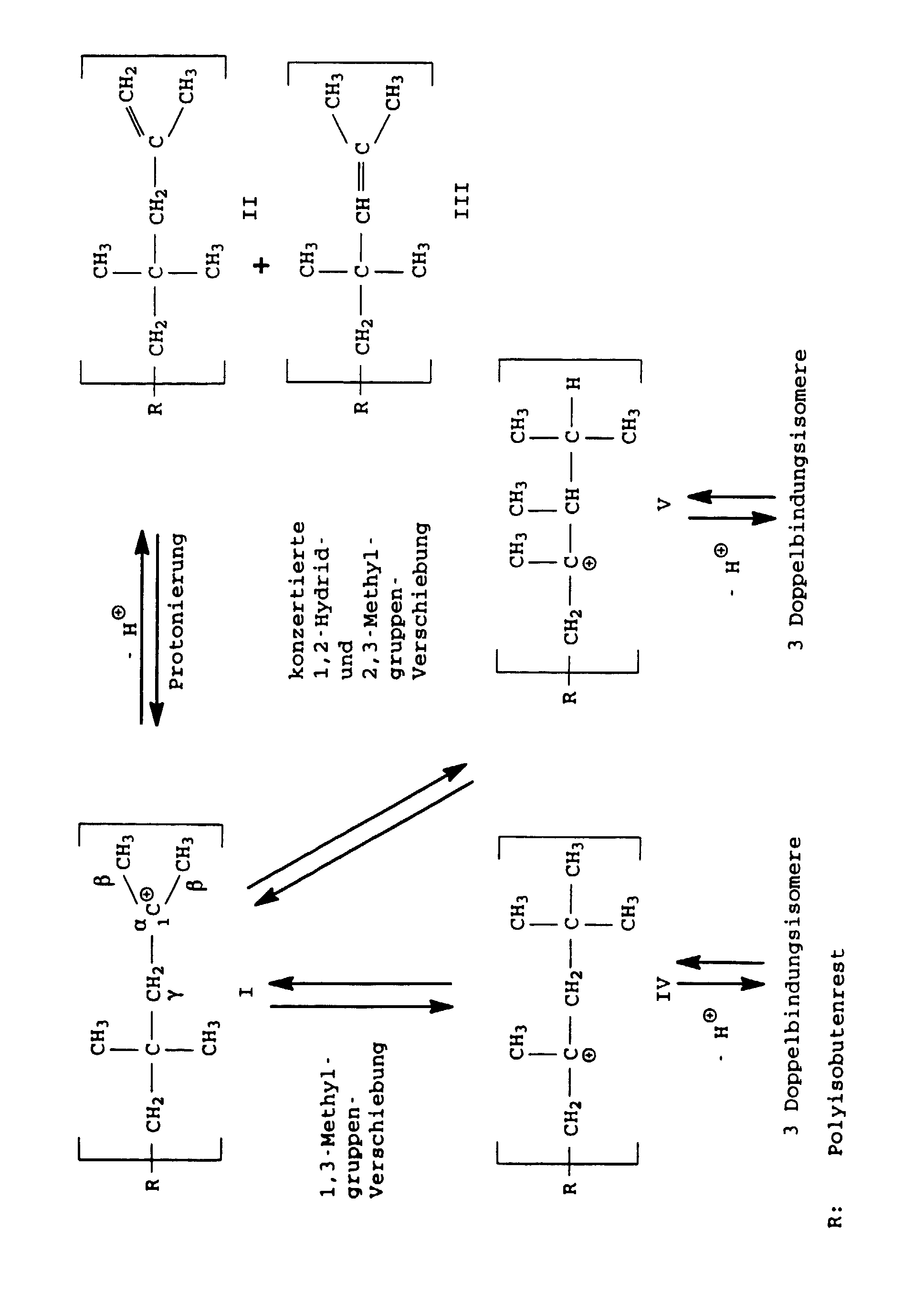
Das im Laufe der Polymerisationsreaktion entstehende Polyisobutenkation I kann durch die Abspaltung eines Protons in das betreffende Polyisobuten übergehen. Dabei kann das Proton sowohl aus einer der β-Methylgruppen oder aus der internen γ-Methylengruppe abgespalten werden. Je nachdem aus welcher dieser beiden Positionen das Proton abgespalten wird, entsteht dabei ein Polyisobuten mit einer Vinylidendoppelbindung II oder mit einer trisubstituierten, nahe dem Ende des Moleküls befindlichen Doppelbindung III.The polyisobutene cation formed in the course of the polymerization reaction I can by splitting a proton into that skip the polyisobutene in question. The proton can both from one of the β-methyl groups or from the internal γ-methylene group be split off. Depending on which of these two Positions that the proton is split off, a Polyisobutene with a vinylidene double bond II or with a trisubstituted, located near the end of the molecule Double bond III.
Das Polyisobutenkation I ist relativ instabil und versucht sich durch Umlagerung in höhersubstituierte Kationen zu stabilisieren. Dabei können sowohl 1,3-Methylgruppenverschiebungen zum Polyisobutenkation IV als auch sukzessive oder konzertierte 1,2-Hydrid - und 2,3-Methylgruppenverschiebungen zum Polyisobutenkation V stattfinden. Aus den Kationen IV und V können sich, je nachdem aus welcher Position das Proton abgespalten wird, jeweils drei verschiedene doppelbindungsisomere Polyisobutene bilden. Es besteht aber auch die Möglichkeit, daß sich die Kationen IV und V weiter umlagern, mit der Wirkung, daß die Doppelbindung noch weiter ins Innere des Polyisobutenmakromoleküls wandert.The polyisobutene cation I is relatively unstable and tries stabilize by rearrangement into higher substituted cations. Both 1,3-methyl group shifts to the polyisobutene cation IV as well as successive or concerted 1,2-hydride - and 2,3-methyl group shifts to the polyisobutene cation V occur. Cations IV and V can, depending on from which position the proton is split off, three each form different double bond isomers polyisobutenes. It but there is also the possibility that the cations IV and V rearrange, with the effect that the double bond still migrates further inside the polyisobutene macromolecule.
Alle diese Deprotonierungen und Umlagerungen sind Gleichgewichtsreaktionen und somit reversibel, wobei allerdings, letztendlich die Bildung stabilerer, höhersubstituierter Kationen und somit die Bildung von Polyisobutenen mit innenständiger Doppelbindung unter Einstellung des thermodynamischen Gleichgewichtes bevorzugt ist. Diese Deprotonierungen, Protonierungen und Umlagerungen werden durch gegebenenfalls im Reaktionsgemisch enthaltende Säurespuren, insbesondere jedoch vom zur Katalyse der Polymerisation benötigten Lewis-Säure-Katalysator selbst katalysiert. Aufgrund dieser Sachlage und da lediglich Polyisobutene mit Vinylidendoppelbindungen gemäß Formel II sehr gut unter Adduktbildung mit Maleinsäureanhydrid reagieren, Polyisobutene der Formel III im Vergleich dazu bereits eine deutlich verminderte Reaktivität haben und andere Polyisobutene mit höhersubstituierten Doppelbindungen gegenüber Maleinsäureanhydrid praktisch unreaktiv sind, wird das fortwährende Bemühen vieler Forschungsgruppen, verbesserte Verfahren zur Herstellung hochreaktiver Polyisobutene mit immer höheren Gehalten an endständigen Doppelbindungen zu finden, verständlich.All of these deprotonations and rearrangements are equilibrium reactions and thus reversible, although, ultimately the formation of more stable, more substituted cations and thus the formation of polyisobutenes with an internal double bond preferred while adjusting the thermodynamic equilibrium is. These are deprotonations, protonations and rearrangements by traces of acid which may be present in the reaction mixture, but especially from for the catalysis of the polymerization required Lewis acid catalyst itself catalyzed. Because of this situation and since only polyisobutenes with vinylidene double bonds according to formula II very well with adduct formation Maleic anhydride react, polyisobutenes of the formula III in In comparison, a significantly reduced reactivity have and other polyisobutenes with higher substituted double bonds are practically unreactive with maleic anhydride, the ongoing efforts of many research groups is being improved Process for the production of highly reactive polyisobutenes with ever higher contents of terminal double bonds find, understandable.
Die Herstellung von niedermolekularem, hochreaktivem Polyisobuten aus Isobuten oder Isobuten haltigen Kohlenwasserstoffströmen, insbesondere aus von darin ursprünglich enthaltenem 1,3-Butadien weitgehend befreiten C4-Schnitten aus Steamcrackern, FCC-Crackern (FCC:Fluid Catalyzed Cracking), sogenannten C4-Raffinaten, ist aus einer Reihe von Schutzrechten bekannt, beispielsweise aus EP-A 145 235, EP-A 481 297, DE-A 27 02 604, EP-A 628 575, EP-A 322 241 und WO 93/10063. Alle diese Verfahren betreffen die Polymerisation von Isobuten in einer einzigen Polymerisationsstufe.The production of low molecular weight, highly reactive polyisobutene from isobutene or hydrocarbon streams containing isobutene, in particular from C 4 cuts from steam crackers, FCC crackers (FCC: Fluid Catalyzed Cracking), so-called C 4 raffinates, largely freed of 1,3-butadiene originally contained therein , is known from a number of property rights, for example from EP-A 145 235, EP-A 481 297, DE-A 27 02 604, EP-A 628 575, EP-A 322 241 and WO 93/10063. All of these processes relate to the polymerization of isobutene in a single polymerization stage.
Ein Nachteil dieser Verfahren ist, daß infolge der Verwendung eines BF3-Komplex-Katalysators Fluor-haltige Nebenprodukte gebildet werden. Die Fluorgehalte der nach diesen Verfahren hergestellten Polyisobutene können bis zu 200 ppm betragen. Bei der thermischen Belastung dieser Fluor-haltigen Polyisobutene kommt es zur Abspaltung von Fluorwasserstoff, der stark korrosiv ist. Besonders gravierend ist dieses Problem bei der Verwendung von Isobuten-haltigen C4-Schnitten als Ausgangsmaterial, da sich hierbei - aufgrund des Gehaltes an n-Butenen - relativ stabile sekundäre Fluoride des Polyisobutens bilden, welche dann bei der weiteren Derivatisierung des Polyisobutens zu Kraftstoff- und Schmieröladditiven oder bei der späteren Verwendung dieser Kraftstoffadditive im Motor unter Fluorwasserstoffbildung abgespalten werden können und dabei Korrosionsschäden verursachen.A disadvantage of these processes is that fluorine-containing by-products are formed due to the use of a BF 3 complex catalyst. The fluorine contents of the polyisobutenes produced by these processes can be up to 200 ppm. When these fluorine-containing polyisobutenes are subjected to thermal stress, hydrogen fluoride, which is highly corrosive, is split off. This problem is particularly serious when using isobutene-containing C 4 cuts as the starting material, since - due to the content of n-butenes - relatively stable secondary fluorides of polyisobutene are formed, which then further derivatize the polyisobutene to form fuel. and lubricating oil additives or when later using these fuel additives in the engine with the formation of hydrogen fluoride and thereby cause corrosion damage.
Ein weiterer Nachteil der einstufigen Polymerisationsführung beim Einsatz von C4-Schnitten ist auf die in diesen Kohlenwasserstoffströmen enthaltenen n-Butene zurückzuführen. Durch deren Einbau in die wachsende Polymerkette kann es zum Abbruch der Polymerisation kommen und die Selektivität für die Bildung hochreaktiven Polyisobutens, d.h. Polyisobuten mit einem hohen Gehalt an Vinylidendoppelbindungen nimmt ab.Another disadvantage of the one-stage polymerization when using C 4 cuts is due to the n-butenes contained in these hydrocarbon streams. By incorporating them into the growing polymer chain, the polymerization can be terminated and the selectivity for the formation of highly reactive polyisobutene, ie polyisobutene with a high content of vinylidene double bonds, decreases.
Zur Vermeidung dieses Nachteils muß nach den bislang bekannten Verfahren die Polymerisation bei einem noch relativ hohen Restisobutengehalt des in die Polymerisation eingesetzten C4-Schnitts abgebrochen werden. Dies führt aber zu einem hohen Verlust an Einsatzstoff, weshalb die Herstellung von PIB aus C4-Schnitten nach diesen herkömmlichen Verfahren unwirtschaftlich ist.In order to avoid this disadvantage, the polymerization must be terminated according to the processes known hitherto if the residual isobutene content of the C 4 cut used in the polymerization is still relatively high. However, this leads to a high loss of starting material, which is why the production of PIB from C 4 cuts using these conventional methods is uneconomical.
Der vorliegenden Erfindung lag deshalb die Aufgabe zugrunde, ein Verfahren zur Herstellung niedermolekularen, hochreaktiven Polyisobutens (PIB) zu finden, dessen Fluorgehalt deutlich unter dem Fluorgehalt des nach den bekannten Verfahren hergestellten Polyisobutens liegt. Das Verfahren sollte insbesondere auch die Herstellung von PIB niederen Fluorgehalts und hoher Endständigkeit der Doppelbindungen aus C4-Kohlenwasserstoffströmen ermöglichen und wirtschaftlich sein. Des weiteren sollte das so hergestellte PIB eine enge Molekulargewichtsverteilung D haben. The present invention was therefore based on the object of finding a process for producing low molecular weight, highly reactive polyisobutene (PIB), the fluorine content of which is significantly below the fluorine content of the polyisobutene prepared by the known processes. In particular, the process should also enable the production of PIB with low fluorine content and high finality of the double bonds from C 4 hydrocarbon streams and be economical. Furthermore, the PIB thus produced should have a narrow molecular weight distribution D.
Dementsprechend wurde ein Verfahren zur Herstellung von niedermolekularem,
hochreaktivem Polyisobuten eines mittleren Molekulargewichts
Mn von 500 bis 20000 Dalton, einem Gehalt an
endständigen Doppelbindungen von über 80 Mol-% durch die Polymerisation
von Isobuten oder Isobuten-haltigen Kohlenwasserstoffströmen
in der flüssigen Phase und mit Hilfe eines Bortrifluorid-Komplex-Katalysators
bei Temperaturen von -40 bis 0°C und bei
einem Druck von 1 bis 20 bar gefunden, das dadurch gekennzeichnet
ist, daß man die Polymerisationsreaktion in mindestens zwei Polymerisationsstufen
durchführt, wobei in der ersten Polymerisationsstufe
das zugeführte Isobuten bis zu einem Teilumsatz von
bis zu 98 % polymerisiert und die Polymerisation des restlichen
Isobutens ohne oder nach vorheriger Abtrennung des in der ersten
Polymerisationsstufe gebildeten Polyisobutens in einer oder
mehreren nachfolgenden Polymerisationsstufen weiterführt und daß man die Polymerisation in der zweiten Polymerisationsstufe bei einer tieferen Polymerisationstemperatur durchführt als in der ersten Polymerisationsstufe.
Das erfindungsgemäße Verfahren beruht auf Erkenntnissen, welche
von den Erfindern im Zusammenhang mit Untersuchungen zur Bildung
Fluor-haltiger organischer Nebenprodukte bei der PIB-Herstellung
mittels BF3-Komplex-Katalysatoren gewonnen wurden und die gemäß
dem folgenden Formelschema interpretiert und als Arbeitshypothese
für die vorliegende Erfindung benutzt wurden. In diesem Formelschema
wird stellvertretend für andere BF3-Komplex-Katalysatoren
ein BF3-Alkohol-Komplex verwendet.
- R:
- organischer Rest
- R:
- organic rest
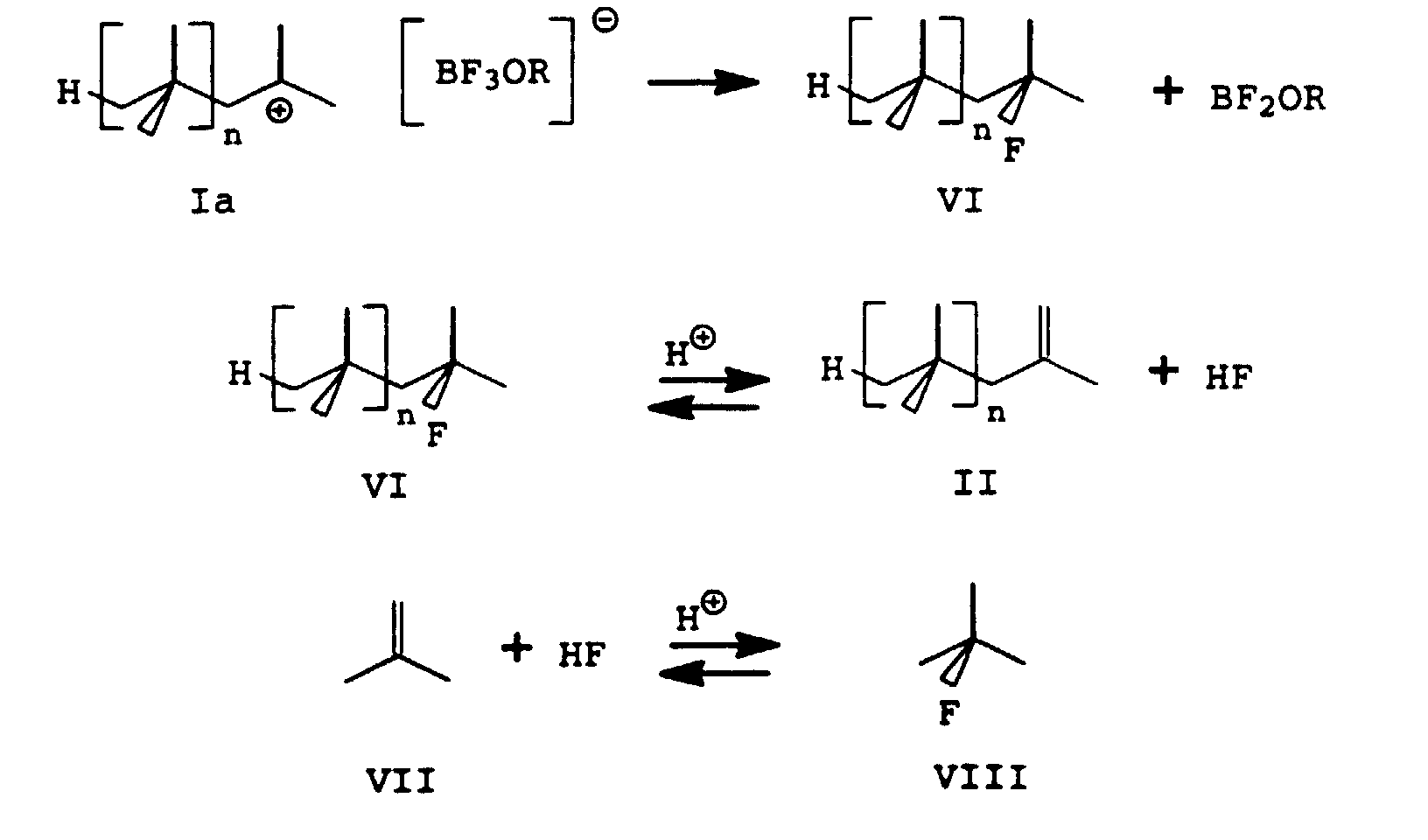
Ausgangspunkt in diesem Formelschema ist das im Zuge der Isobuten-Polymerisation entstehende Polyisobutyl-Kation Ia, dessen Gegenion das [BF3OR]- ·Anion ist. Aus diesem Anion kann ein Fluoridanion auf das Polyisobutylkation Ia unter Bildung des Polyisobutylfluorids VI und BF2OR übertragen werden. Dieses steht in Gegenwart von in der Polymerisationsmischung vorhandenen Protonen im Gleichgewicht mit dem Polyisobuten II und Fluorwasserstoff. Der gebildete Fluorwasserstoff kann sich an das ebenfalls in der Polymerisationsmischung enthaltene Monomer Isobuten VII addieren, das in Gegenwart von Protonen mit dem hierbei gebildeten tert.-Butylfluorid VIII im Gleichgewicht steht. Durch Extraktion oder Neutralisation des BF3-Komplex-Katalysators bzw. der Polymerisationsmischung wird die Einstellung dieser Gleichgewichte unterbunden.The starting point in this formula scheme is the polyisobutyl cation Ia which is formed in the course of the isobutene polymerization and whose counterion is the [BF 3 OR] - anion. From this anion, a fluoride anion can be transferred to the polyisobutyl cation Ia to form the polyisobutyl fluoride VI and BF 2 OR. In the presence of protons present in the polymerization mixture, this is in equilibrium with the polyisobutene II and hydrogen fluoride. The hydrogen fluoride formed can add to the monomer isobutene VII, which is also present in the polymerization mixture and is in equilibrium with the tert-butyl fluoride VIII formed in the presence of protons. The establishment of these equilibria is prevented by extraction or neutralization of the BF3 complex catalyst or the polymerization mixture.
Bei Verwendung von Isobuten-haltigen C4-Schnitten, die außerdem noch lineare Butene enthalten, wird die im Formelschema dargestellte Reaktionsfolge noch weiter dadurch kompliziert, daß durch den Einbau von 1-Buten in die wachsende Polyisobutenkette sekundäre Carbeniumionen im Polymer gebildet werden, die im Falle einer Fluorid-Übertragung aus dem Anion, zu sekundären Polyisobutylfluoriden reagieren können, aus denen das Fluor unter den Polymerisationsbedingungen nur noch schwierig abzuspalten ist.When using isobutene-containing C 4 cuts, which also contain linear butenes, the reaction sequence shown in the formula is further complicated by the fact that the incorporation of 1-butene into the growing polyisobutene chain forms secondary carbenium ions in the polymer, which are formed in the If fluoride is transferred from the anion, it can react to form secondary polyisobutyl fluorides, from which the fluorine can only be split off with difficulty under the polymerization conditions.
Die Einstellung der im Formelschema dargestellten Gleichgewichte als auch deren Verschiebung ist von den angewandten Reaktionsbedingungen, insbesondere der im Polymerisationsgemisch vorliegenden Mengenverhältnisse von Polymer und Monomeren, der Art des BF3-Komplex-Katalysators und dem Mengenverhältnis BF3-Komplexbildner abhängig, weiterhin auch von der eingestellten Polymerisationstemperatur.The setting of the equilibria shown in the formula as well as their shift depends on the reaction conditions used, in particular the quantitative ratios of polymer and monomers present in the polymerization mixture, the type of BF 3 complex catalyst and the quantitative ratio of BF 3 complexing agents, and also on set polymerization temperature.
In Anbetracht dieser Ergebnisse war es das Ziel der vorliegenden Erfindung, die Reaktionsführung der Isobuten-Polymerisation so zu gestalten, daß die Bildung Fluor-haltiger organischer Nebenprodukte, insbesondere von Polyisobutylfluoriden, auf ein Minimum unterdrückt wird, ohne daß dabei die Bildung von niedermolekularem Polyisobuten mit einem hohen Gehalt an Vinylidendoppelbindungen beeinträchtigt wird.In view of these results, it was the aim of the present Invention, the reaction of the isobutene polymerization so to ensure that the formation of fluorine-containing organic by-products, especially of polyisobutyl fluorides, to a minimum is suppressed without the formation of low molecular weight Polyisobutene with a high content of vinylidene double bonds is affected.
Dieses Ziel wurde durch die Maßnahme der Durchführung der Isobuten-Polymerisation in mindestens zwei Polymerisationsstufen erreicht, wobei die zweite Polymerisationsstufe oder weitere nachfolgende Polymerisationsstufen bei einer in der Regel tieferen Temperatur betrieben werden als die erste Polymerisationsstufe.This goal was achieved through the measure of performing isobutene polymerization in at least two polymerization stages reached, the second polymerization stage or further subsequent polymerization stages at a generally lower one Temperature operated as the first polymerization stage.
Das erfindungsgemäße Verfahren und einige vorteilhafte Ausgestaltungen dieses Verfahrens werden im folgenden erläutert. The method according to the invention and some advantageous configurations this method is explained below.
In seiner einfachsten Ausgestaltung wird das erfindungsgemäße Verfahren mit zwei Polymerisationsstufen betrieben. Zur Erzielung hoher Gehalte an endständigen Doppelbindungen und eines niedrigen Fluorgehalts des Polyisobutens kann dabei auf verschiedenerlei Weise vorgegangen werden.In its simplest embodiment, the invention Process operated with two polymerization stages. To achieve high levels of terminal double bonds and a low one Fluorine content of the polyisobutene can be in various ways Way to proceed.
Beispielsweise ist es möglich, in der ersten Polymerisationsstufe einen Isobutenumsatz von 5 bis 98 %, vorzugsweise von 50 bis 95 %, insbesondere von 50 bis 90 %, einzustellen und in der zweiten Stufe die Polymerisation dann zu Ende zu führen.For example, it is possible in the first polymerization stage an isobutene conversion of 5 to 98%, preferably from 50 to 95%, in particular from 50 to 90%, adjust and in the second stage to complete the polymerization.
Die zweite Polymerisationsstufe wird dabei vorteilhaft bei einer niedrigeren Polymerisationstemperatur betrieben als die erste Polymerisationsstufe, in der Regel beträgt die Temperaturdifferenz dabei 1 bis 20°C, vorzugsweise 2 bis 10°C.The second polymerization stage is advantageous in one operated lower polymerization temperature than the first Polymerization stage, usually the temperature difference is 1 to 20 ° C, preferably 2 to 10 ° C.
Da die Polymerisation des Isobutens exotherm verläuft, wird die Polymerisationstemperatur in der ersten Polymerisationsstufe bei vorgegebener Kühlmitteltemperatur und in Abhängigkeit von der Reaktivität des eingesetzten Katalysators durch die Zufuhr frischen Isobutens so gesteuert, daß sie, von technisch unvermeidbaren Schwankungen abgesehen, im wesentlichen konstant bleibt. Der Isobutenumsatz in der ersten Polymerisationsstufe wird dabei unter Berücksichtigung obengenannter Parameter, nämlich Kühlmitteltemperatur, Polymerisationstemperatur und einer mittleren Verweilzeit des Reaktionsgemisches im Reaktor, durch die Einstellung der Reaktivität des Katalysatorkomplexes über die Dosierung des Komplexbildners gesteuert.Since the polymerization of the isobutene is exothermic, the Polymerization temperature in the first polymerization stage predetermined coolant temperature and depending on the Reactivity of the catalyst used by supplying fresh Isobutens controlled so that they are technically unavoidable Apart from fluctuations, remains essentially constant. The isobutene conversion in the first polymerization stage becomes taking into account the above parameters, namely coolant temperature, Polymerization temperature and an average residence time of the reaction mixture in the reactor, by setting the reactivity of the catalyst complex via the dosage of Controlled complexing agent.
Der Austrag aus der ersten Polymerisationsstufe wird vorzugsweise ohne weitere Aufarbeitung in die zweite Polymerisationsstufe geleitet. Hier wird die Polymerisation ohne Zusatz frischen Isobutens bei einer tieferen Polymerisationstemperatur als in der ersten Polymerisationsstufe vorgenommen. Dies kann durch eine tiefere Temperatur des Kühlmittels bewirkt werden, oder bei Verwendung eines Kühlmittels gleicher Temperatur wie in der ersten Polymerisationsstufe, beispielsweise bei Mitbenutzung der dort verwendeten Kühlvorrichtung, indem man die Kühlung so steuert, daß mehr Wärme aus dem Polymerisationsgemisch abgeführt wird als dort bei der Polymerisation des restlichen Isobutens freigesetzt wird. Unter Umständen kann es erforderlich oder zweckmäßig sein, im Zuge der Polymerisationsreaktion inaktivierten Katalysator durch Zufuhr von Bortrifluorid zu ergänzen oder die katalytische Aktivität des BF3-Komplexkatalysators durch Zufuhr von Bortrifluorid zu erhöhen, damit die Polymerisation nicht vorzeitig zum Stillstand kommt. Dieser Zusatz von Bortrifluorid kann vor oder nach der Einleitung des Polymerisationsgemisches in die zweite Polymerisationsstufe erfolgen.The discharge from the first polymerization stage is preferably passed into the second polymerization stage without further working up. Here the polymerization is carried out without the addition of fresh isobutene at a lower polymerization temperature than in the first polymerization stage. This can be caused by a lower temperature of the coolant, or when using a coolant of the same temperature as in the first polymerization stage, for example when the cooling device used there, by controlling the cooling so that more heat is removed from the polymerization mixture than there the polymerization of the remaining isobutene is released. Under certain circumstances it may be necessary or expedient to supplement the catalyst inactivated in the course of the polymerization reaction by adding boron trifluoride or to increase the catalytic activity of the BF 3 complex catalyst by adding boron trifluoride so that the polymerization does not come to an early standstill. This addition of boron trifluoride can take place before or after the introduction of the polymerization mixture into the second polymerization stage.
Die Verweilzeit des Polymerisationsgemisches in der ersten Polymerisationsstufe beträgt bei der Einstellung eines Isobutenumsatzes von 50 bis 90 % üblicherweise 5 bis 60 Minuten, kann aber auch kürzer oder länger sein, je nachdem, ob ein sehr aktiver oder weniger aktiver Katalysator verwendet wird. In der zweiten Polymerisationsstufe wird im allgemeinen eine Verweilzeit von 1 bis 180, vorzugsweise von 5 bis 120 Minuten eingestellt. Im allgemeinen wird in der zweiten Polymerisationsstufe der Isobutenumsatz so eingestellt, daß der Gesamtumsatz des Isobutens in der ersten und zweiten Polymerisationsstufe im allgemeinen bei 80 bis 100 %, vorzugsweise bei 90 bis 100 %, insbesondere bei 95 bis 100 %, liegt. Der Austrag aus der zweiten Polymerisationsstufe kann auf an sich herkömmliche Weise aufgearbeitet werden, beispielsweise indem man den Katalysator durch Zusatz von weiteren Komplexbildnern, beispielsweise Wasser, Alkoholen, Aminen oder Nitrilen, inaktiviert, den inaktivierten Katalysator aus dem Polyisobuten extrahiert und das PIB aus der PIB-haltigen Phase durch die destillative Abtrennung flüchtiger Bestandteile, wie Lösungsmittel, flüchtige Isobutenoligomere und niedermolekulare, flüchtige Nebenprodukte, isoliert. Das nach dieser Verfahrensweise erhaltene PIB enthält einen sehr hohen Anteil an endständigen Doppelbindungen und hat sehr geringe Fluorgehalte.The residence time of the polymerization mixture in the first polymerization stage is when setting an isobutene conversion from 50 to 90%, usually 5 to 60 minutes but also shorter or longer, depending on whether a very active or less active catalyst is used. In the second polymerization stage is generally a residence time from 1 to 180, preferably from 5 to 120 minutes. In general, the isobutene conversion in the second polymerization stage set so that the total turnover of the isobutene in the first and second polymerization stages generally at 80 to 100%, preferably 90 to 100%, especially 95 to 100%. The discharge from the second polymerization stage can be worked up in a conventional manner, for example by adding the catalyst by adding further Complexing agents, for example water, alcohols, amines or Nitriles, inactivated, the inactivated catalyst from the Extracts polyisobutene and the PIB from the PIB-containing phase by separating volatile constituents, such as Solvents, volatile isobutene oligomers and low molecular weight, volatile by-products, isolated. This according to this procedure PIB obtained contains a very high proportion of terminal Double bonds and has very low fluorine contents.
Enthält der Austrag aus der zweiten Polymerisationsstufe noch größere Mengen an nichtumgesetztem Isobuten, kann dieses Isobuten, falls in die Polymerisation Reinisobuten als Ausgangsstoff eingesetzt wurde, nach destillativer Abtrennung vom Polymerisationsaustrag, wieder vorteilhaft in die erste Polymerisationsstufe zurückgeführt werden.The discharge from the second polymerization stage still contains larger amounts of unreacted isobutene, this isobutene, if pure isobutene as the starting material in the polymerization was used, after separation by distillation from the polymerization discharge, again advantageous in the first polymerization stage to be led back.
Alternativ kann das nicht umgesetzte Isobuten gemeinsam mit dem Polymerisationsaustrag aus der zweiten Polymerisationsstufe ohne weitere Aufarbeitung einer dritten Polymerisationsstufe zugeführt werden und dort, bei einer tieferen Polymerisationstemperatur als in der zweiten Polymerisationsstufe zu Ende polymerisiert werden. Im allgemeinen wird die Polymerisationstemperatur in einer solchen dritten Polymerisationsstufe um 1 bis 20°C, vorzugsweise 2 bis 10°C, tiefer eingestellt als die Polymerisationstemperatur in der vorausgehenden zweiten Polymerisationsstufe. Die Einstellung der Polymerisationstemperatur kann unter Anwendung der Maßnahmen erfolgen, wie sie zuvor für die Einstellung der Polymerisationstemperatur in der zweiten Polymerisationsstufe erläutert wurden. Die Verweilzeit der Polymerisationsmischung in der dritten Polymerisationsstufe wird in Abhängigkeit von der Katalysatoraktivität und dem gewünschten Umsatz eingestellt, im allgemeinen beträgt sie 5 bis 180, vorzugsweise 10 bis 120 Minuten. Wie bei der Erläuterung der Durchführung der zweiten Polymerisationsstufe geschildert, kann es gegebenenfalls erforderlich oder zweckmäßig sein, verbrauchten Katalysator durch Zufuhr von Bortrifluorid zu ergänzen oder die Katalysatoraktivität durch Zusatz von Bortrifluorid zu erhöhen.Alternatively, the unreacted isobutene can be used together with the Polymerization discharge from the second polymerization stage without further workup fed to a third polymerization stage and there, at a lower polymerization temperature than be polymerized to the end in the second polymerization stage. In general, the polymerization temperature is such third polymerization stage by 1 to 20 ° C, preferably 2nd to 10 ° C, set lower than the polymerization temperature in the previous second polymerization stage. The setting the polymerization temperature can be measured using the measures take place as previously for setting the polymerization temperature were explained in the second polymerization stage. The residence time of the polymerization mixture in the third polymerization stage will depend on the catalyst activity and set the desired sales, in general it is 5 to 180, preferably 10 to 120 minutes. As in the explanation of the implementation of the second polymerization stage described, it may be necessary or appropriate be used catalyst by adding boron trifluoride supplement or the catalyst activity by adding boron trifluoride to increase.
Obgleich die Anwendung einer zweiten und dritten Polymerisationsstufe auch beim Einsatz von Reinisobuten in die Polymerisation von Vorteil ist, erweist sie sich als besonders vorteilhaft, wenn Isobuten-haltige C4-Kohlenwasserstoffströme, wie C4-Raffinate oder C4-Schnitte aus der Isobuten-Dehydrierung als Einsatzstoff im erfindungsgemäßen Verfahren verwendet werden, da durch sie Isobutenverluste vermieden werden, keine Aufpegelung unerwünschter Kohlenwasserstoffe infolge Rückführung nicht umgesetzten, andere Kohlenwasserstoffe enthaltenden Isobutens in die erste Polymerisationsstufe eintritt und hierdurch ein qualitativ hochwertigeres, praktisch Fluor-freies PIB mit einem hohen Gehalt an endständigen Doppelbindungen erhalten wird. Die Aufarbeitung des Polymerisationsaustrags aus der dritten Polymerisationsstufe kann auf die gleiche Weise erfolgen, wie sie bei der Aufarbeitung des Austrags aus der zweiten Polymerisationsstufe geschildert wurde.Although the use of a second and third polymerization stage is also advantageous when pure isobutene is used in the polymerization, it proves to be particularly advantageous when C 4 hydrocarbon streams containing isobutene, such as C 4 raffinates or C 4 cuts from the isobutene Dehydrogenation can be used as the starting material in the process according to the invention, since it avoids loss of isobutene, no leveling up of undesired hydrocarbons as a result of recycling unreacted isobutene containing other hydrocarbons enters the first polymerization stage and as a result a high-quality, practically fluorine-free PIB with a high content of terminal double bonds is obtained. The polymerization discharge from the third polymerization stage can be worked up in the same manner as described for the processing of the discharge from the second polymerization stage.
Nach der zweiten oder gegebenenfalls nach der dritten Polymerisationsstufe noch im Polymerisationsaustrag enthaltene Restmengen an Isobuten von weniger als 2 %, vorzugsweise von bis zu 1 %, des ursprünglich im Zulauf zur ersten Polymerisationsstufe enthaltenen Isobutens, können, falls ein praktisch vollständiger Isobutenumsatz gewünscht wird, in einem der zweiten oder dritten Polymerisationsstufe nachgeschalteten Verweilzeitbehälter, der in diesem Fall die Funktion einer dritten bzw. vierten Polymerisationsstufe erfüllt, zu Ende polymerisiert werden. Der Verweilzeitbehälter kann bei der gleichen Polymerisationstemperatur betrieben werden wie die vorausgegangene Polymerisationsstufe, im allgemeinen wird darin aber eine höhere Temperatur eingestellt. So kann die Temperatur der Polymerisationsmischung im Verweilzeitbehälter -40 bis +40°C betragen, vorzugsweise wird darin die Temperatur auf 0 bis 40°C, vorzugsweise auf 0 bis 30°C, erhöht. Die Verweilzeit der Polymerisationsmischung im Verweilzeitbehälter kann 0,1 bis 3 Stunden betragen, vorzugsweise beträgt sie 0,3 bis 2 Stunden, wobei diese Verweilzeit naturgemäß entsprechend der Polymerisationstemperatur im Verweilzeitbehälter eingeregelt wird. Frischer Katalysator wird dem Polymerisationsaustrag aus der vorausgegangenen Polymerisationsstufe, der im übrigen ohne weitere Aufarbeitung in den Verweilzeitbehälter gelangt, im allgemeinen nicht mehr zugeführt. Außer einer Vervollständigung der Isobutenpolymerisation wird durch die Durchleitung des Polymerisationsaustrags durch den Verweilzeitbehälter eine weitere Reduzierung des Fluorgehaltes des entstandenen Polyisobutens bewirkt. Vermutlich wird im Verweilzeitbehälter aus noch im Polymerisationsaustrag der vorausgegangenen Polymerisationsstufe enthaltenem Polyisobutylfluorid unter Gleichgewichtseinstellung Fluorwasserstoff unter Bildung von Polyisobuten abgespalten, der teilweise von noch in der Polymerisationsmischung vorhandenem Isobuten unter Bildung von leichtflüchtigem Isobutyl- oder tert.-Butylfluorid abgefangen wird. Soweit diese leichtflüchtigen Fluoride nicht schon bei der Aufarbeitung des den Verweilzeitbehälter verlassenden Polymerisationsaustrags, die im übrigen wie zuvor geschildert erfolgen kann, abgebaut werden, können sie bei der weiteren destillativen Aufarbeitung leicht aus dem PIB adsorptiv entfernt und zerstört werden. Obgleich der Einsatz eines Verweilzeitbehälters zu vorteilhaften Ergebnissen führt, ist dieser eine fakultative Maßnahme des erfindungsgemäßen Verfahrens, da die Wirtschaftlichkeit der Verwendung dieses Verweilzeitbehälters selbstverständlich im wesentlichen von Faktoren, wie der Höhe des Isobutenumsatzes in den vorausgegangenen Polymerisationsstufen und dem Fluorgehalt des dabei erhaltenen Polyisobutens, abhängig ist.After the second or optionally after the third polymerization stage Residual amounts still contained in the polymerization discharge of isobutene of less than 2%, preferably of up to 1%, of originally included in the feed to the first polymerization stage Isobutene, if there is practically complete isobutene conversion is desired in one of the second or third Polymerization stage downstream dwell, which in in this case the function of a third or fourth polymerization stage fulfilled, polymerized to the end. The retention container can operate at the same polymerization temperature become like the previous polymerization step, in general but a higher temperature is set in it. So can be the temperature of the polymerization mixture in the retention tank -40 to + 40 ° C, preferably the Temperature increased to 0 to 40 ° C, preferably to 0 to 30 ° C. The residence time of the polymerization mixture in the residence container can be 0.1 to 3 hours, preferably they 0.3 to 2 hours, with this residence time correspondingly the polymerization temperature in the retention tank is regulated. Fresh catalyst is the polymerization discharge from the previous polymerization stage, which in the the rest get into the retention tank without further processing, generally no longer fed. Except for a completion the isobutene polymerization is conducted through of the polymerization discharge through the residence time container further reduction in the fluorine content of the resulting polyisobutene causes. Presumably the still remains in the polymerization discharge of the previous polymerization stage contained polyisobutyl fluoride with equilibrium Split off hydrogen fluoride to form polyisobutene, partly from still in the polymerization mixture Isobutene present to form volatile isobutyl or tert-butyl fluoride is trapped. So much for this volatile Fluoride is not already in the processing of the Dwell time leaving polymerization discharge, which in the the rest as described above, can be dismantled, they can easily be worked out during further distillative work-up the PIB can be removed and destroyed by adsorption. Although the Use of a retention tank for advantageous results leads, this is an optional measure of the invention Procedure because the economy of using this retention container of course essentially from factors like the amount of isobutene conversion in the previous ones Polymerization stages and the fluorine content of the resultant Polyisobutene, is dependent.
Zur weiteren Erläuterung des erfindungsgemäßen Verfahrens dient Figur 1, in der zum Zwecke der Veranschaulichung beispielhaft eine Ausgestaltung des erfindungsgemäßen Verfahrens mit vier Polymerisationsstufen für einen einfachen Rohrreaktor schematisch dargestellt ist.Serves to further explain the method according to the invention Figure 1, in the example for the purpose of illustration an embodiment of the method according to the invention with four Polymerization stages for a simple tubular reactor schematically is shown.
Über den Zulauf 1 wird das Isobuten oder der Isobuten-haltige
Kohlenwasserstoffstrom, gegebenenfalls verdünnt mit einem inerten
Lösungsmittel, in den mittels eines Kühlbads (nicht eingezeichnet)
thermostatisierten Reaktor 2 geleitet. Reaktor 2 ist als
Rohrreaktorschlaufe ausgestaltet, in dem die Polymerisationsmischung
mittels der Pumpe 3 in Umlauf gehalten wird. Eine hohe
Pumpleistung ist der Wärmeabfuhr aus dem Reaktor förderlich und
sorgt für eine gute Durchmischung der Polymerisationsmischung,
mithin für eine gleichbleibende, stationäre Isobutenkonzentration.
Der Polymerisationskatalysator kann bereits dem Zulauf vor
Eintritt in den Polymerisationsreaktor 2 zugemischt worden sein
oder durch - nicht eingezeichnete - Zuführungen an praktisch
beliebiger Stelle des Reaktors 2 zudosiert werden. Dabei ist es
sowohl möglich, vorgeformten, d.h. außerhalb des Polymerisationsreaktors
gebildeten Bortrifluorid·Komplex·Katalysator einzuleiten,
als auch den verwendeten Komplexbildner und das Bortrifluorid
separat in den Reaktor zu dosieren und den Polymerisationskatalysator
in situ im Reaktor 2 zu erzeugen. Im letzten Fall
ist darauf zu achten, daß keine hohe temporäre Bortrifluorid-Konzentration
auftritt, da sich eine solche nachteilig auf den
Gehalt an endständigen Doppelbindungen auswirken kann. Zweckmäßigerweise
wird im Falle der in situ-Erzeugung des Katalysators
der Komplexbildner vorgelegt und das Bortrifluorid erst nach
Einleitung des Komplexbildners zudosiert. Nach Einstellung des
gewünschten stationären Gleichgewichts im Reaktor 2 wird über die
Leitung 4 der Polymerisationsaustrag aus Reaktor 2 ausgeschleust
und der zweiten Polymerisationsstufe, dem Reaktor 5, zugeführt,
der vorteilhaft wie Reaktor 2 als Rohrreaktorschlaufe ausgestaltet
ist, in dem die Polymerisationsmischung mittels Pumpe 6
zirkuliert wird. Reaktor 5 wird durch ein nicht eingezeichnetes
Kühlbad gekühlt. Zur Erhöhung der Katalysatoraktivität kann über
- nicht eingezeichnete - Einlässe in die Zuleitung 4 oder vorzugsweise
in die Reaktorschlaufe 5 weiteres Bortrifluorid nachdosiert
werden. Nach Einstellung des gewünschten stationären
Polymerisationsgleichgewichts in Reaktor 5, wird die Polymerisationsmischung
aus diesem Reaktor 5 über Leitung 7 ausgetragen und
dem in einem - nicht eingezeichneten - Kühlbad befindlichen Rohrreaktor
8 zugeführt, der auch als Rohrbündelreaktor ausgestaltet
sein kann und vorzugsweise als Durchlaufreaktor betrieben wird.
Die Verweilzeit in diesem Reaktor kann z.B. durch Einstellung der
Länge des Reaktorrohres in Abhängigkeit von dessen Durchmesser
eingestellt werden. Erforderlichenfalls kann über nicht eingezeichnete
Einlässe in die Zuführung 7 oder vorzugsweise den Reaktor
8 zusätzliches Bortrifluorid nachdosiert werden. Der Austrag
aus Reaktor 8 wird über Leitung 9 dem Verweilzeitbehälter 10 zugeführt,
der in der Regel nicht gekühlt wird, und apparativ beispielsweise
als Tank mit Überlauf oder ebenfalls als Rohrreaktor
ausgestaltet sein kann. Über Leitung 11 wird der Austrag aus dem
Verweilzeitbehälter, erforderlichenfalls nach vorhergehender Entspannung,
der Aufarbeitung zugeführt, die auf an sich konventionelle
Weise, vorzugsweise durch eine Wäsche mit einem Komplexbildner,
durch die der Katalysator inaktiviert und die Polymerisation
abgebrochen wird, besonders bevorzugt durch eine Wasserwäsche,
anschließende Phasentrennung und destillative Reinigung
des erhaltenen PIB von flüchtigen Bestandteilen, bewerkstelligt
wird. Die vorausgegangenen Darlegungen gelten entsprechend bei
Anwendung von, bei der Durchführung des Verfahrens in technischem
Maßstab bevorzugten, Rohrbündelreaktoren.The isobutene or the one containing isobutene is fed via
Es versteht sich von selbst, daß das erfindungsgemäße Verfahren,
wie es in der Figur dargestellt ist, auf vielerlei Art und Weise
modifiziert werden kann, beispielsweise in dem die Polymerisation
lediglich in zwei oder drei Polymerisationsstufen durchgeführt
wird. Beispielsweise kann die Polymerisation bereits in den beiden
ersten Polymerisationsstufen · entsprechend den Reaktoren 2
und 5 in Fig. 1 - zu Ende geführt werden. Ebenso ist es möglich,
die Polymerisation in Polymerisationsstufe 1 (Reaktor 2) bis zu
einem relativ hohen Isobuten-Umsatz durchzuführen und die Polymerisation
ohne den Einsatz eines dem Reaktor 5 gemäß Fig. 1
entsprechenden Reaktors in einem dem Reaktor 8 gemäß Fig. 1
entsprechenden Reaktor und gewünschtenfalls zusätzlich in einem
Verweilzeitbehälter durchzuführen. Einer solchen Ausführungsform
entspricht im wesentlichen auch die Ausgestaltung des erfindungsgemäßen
Verfahrens, bei der die Reaktoren 2 und 5 gemäß Fig. 1
praktisch zu einer einzelnen Polymerisationsstufe zusammengefaßt
sind, wobei unter praktisch gleichen Polymerisationsbedingungen
die Umsetzung in einem Reaktor 2 von Fig. 1 entsprechenden Polymerisationsreaktor
nur bis zu einem Isobutenumsatz von z.B. 4 bis
10 % durchgeführt wird und der Austrag aus diesem ersten Reaktor
ohne weitere Aufarbeitung dem zweiten Reaktor, der in Fig. 1 dem
Reaktor 5 entspricht, zugeführt wird, wo dann die Polymerisation
bis zu einem höheren Umsatz vorangetrieben wird, bevor der Austrag
dieses zweiten Reaktors einem die zweite Polymerisationsstufe
darstellenden dritten Reaktor zugeführt wird, beispielsweise
einem dem Reaktor 8 gemäß Fig. 1 entsprechenden Reaktor, wo
die Polymerisation ganz oder weitestgehend zu Ende geführt wird.
Die Wahl, nach welcher dieser Ausgestaltungen oder nach welchen
weiteren möglichen Ausgestaltungen des erfindungsgemäßen Verfahrens
im Einzelfall am vorteilhaftesten gearbeitet wird, ist unter
Berücksichtigung der des in der Anlage umzusetzenden Isobuten-haltigen
Ausgangsmaterials, der Art des verwendeten Bortrifluorid-Katalysators,
der gewünschten PIB-Qualität und den zur
Verfügung stehenden Kühlvorrichtungen usw. zu treffen, und ist
eine Routinearbeit des Fachmanns bei der Auslegung der Anlage.It goes without saying that the method according to the invention
as shown in the figure, in many ways
can be modified, for example in which the polymerization
only carried out in two or three polymerization stages
becomes. For example, the polymerization can already take place in the two
first polymerization stages · corresponding to the
Gewünschtenfalls kann die Umsetzung des Isobutens auch bis zu einem Teilumsatz durchgeführt werden, bei dem noch ein hoher Gehalt an endständigen Doppelbindungen im Polyisobuten gewährleistet ist, danach die Polymerisation durch Zusatz größerer Mengen eines Komplexbildners, z.B. Wasser, abgebrochen, der das hochreaktive PIB enthaltende Austrag, wie oben dargestellt, aufgearbeitet und das bei der Aufarbeitung abgetrennte, nicht umgesetzte Isobuten enthaltende Kohlenwasserstoffgemisch auf an sich herkömmliche Weise zu niedermolekularem Polyisobuten mit einem geringeren Gehalt an endständigen Doppelbindungen weiterverarbeitet werden.If desired, the conversion of the isobutene can also be up to a partial turnover can be carried out with a high Guaranteed content of terminal double bonds in the polyisobutene is then the polymerization by adding larger Amounts of a complexing agent, e.g. Water, broken off that Highly reactive discharge containing PIB, as shown above worked up and the separated during the workup, not converted hydrocarbon mixture containing isobutene on conventional way to with low molecular weight polyisobutene processed a lower content of terminal double bonds become.
Als Katalysatoren werden im erfindungsgemäßen Verfahren Bortrifluorid-Komplexe mit Komplexbildnern verwendet, die die Polymerisationsaktivität des Bortrifluorids so beeinflussen, daß zum einen die Polymerisation ein niedermolekulares Polyisobuten ergibt und zum anderen die Isomerisierungsaktivität des Bortrifluorids hinsichtlich der Isomerisierung von endständigen zu im Inneren des Polyisobutenmoleküls gelegenen, nicht oder nur wenig reaktiven Doppelbindungen verringert wird. Geeignete Komplexbildner sind z.B. Wasser, C1- bis C10-Alkohole, C2- bis C10-Diole, C1- bis C20-Carbonsäuren, C4- bis C12-Carbonsäureanhydride sowie C2- bis C20-Dialkylether. Bevorzugt werden im erfindungsgemäßen Verfahren Komplexbildner aus der Klasse der C1- bis C20-Alkohole, insbesondere der C1-C4-Alkohole, und der Klasse der C1 bis C20-Dialkylether eingesetzt, wovon wiederum solche Dialkylether bevorzugt sind, in denen das Ethersauerstoff an das tertiäre Kohlenstoffatom einer tertiären Alkylgruppe gebunden ist, insbesondere solche Ether, wie sie in WO 93/10063 beschrieben sind. Von den Alkoholen haben die einwertigen, sekundären Alkohole C3- bis C20-Alkohole, wie sie in EP-A 628 575 beschrieben sind, als Komplexbildner einen besonders günstigen Einfluß auf die Polymerisations- und Isomerisierungsaktivität des Bortrifluorid-Katalysators, wobei Isopropanol und 2-Butanol besonders hervorzuheben sind. Vorzugsweise werden Bortrifluorid-Komplex-Katalysatoren im erfindungsgemäßen Verfahren eingesetzt, in denen das Molverhältnis Bortrifluorid/Komplexbildner weniger als 1, insbesondere von 0,4 bis 0,95 und besonders bevorzugt von 0,5 bis 0,8 beträgt. Wie bereits erwähnt, können die Bortrifluorid-Komplex-Katalysatoren vor ihrem Einsatz vorgeformt werden, wie dies z.B. in EP-A 145 235 beschrieben ist oder in situ im Polymerisationsreaktor erzeugt werden, wie dies in EP-A 628 575 beschrieben ist. Als Rohstoff zur Herstellung der Bortrifluorid-Komplex-Katalysatoren wird zweckmäßigerweise gasförmiges Bortrifluorid benutzt, wobei technisches, noch geringe Mengen Schwefeldioxid enthaltendes Bortrifluorid (Reinheit: 96,5 Gew.-%), vorzugsweise aber hochreines Bortrifluorid (Reinheit: 99,5 Gew.-%) verwendet werden kann. Besonders bevorzugt wird Siliciumtetrafluorid-freies Bortrifluorid zur Katalysatorherstellung verwendet.Boron trifluoride complexes with complexing agents are used as catalysts in the process according to the invention which influence the polymerization activity of the boron trifluoride in such a way that, on the one hand, the polymerization results in a low molecular weight polyisobutene and, on the other hand, the isomerization activity of the boron trifluoride with regard to the isomerization of terminal residues to those located inside the polyisobutene molecule is not or only slightly reactive double bonds is reduced. Suitable complexing agents are, for example, water, C 1 to C 10 alcohols, C 2 to C 10 diols, C 1 to C 20 carboxylic acids, C 4 to C 12 carboxylic anhydrides and C 2 to C 20 dialkyl ethers . Complexing agents from the class of the C 1 to C 20 alcohols, in particular the C 1 -C 4 alcohols, and the class of the C 1 to C 20 dialkyl ethers, of which such dialkyl ethers are preferred, are preferably used in the process according to the invention which the ether oxygen is bound to the tertiary carbon atom of a tertiary alkyl group, especially those ethers as described in WO 93/10063. Of the alcohols, the monohydric, secondary alcohols C 3 -C 20 -alcohols, as described in EP-A 628 575, have a particularly favorable influence as a complexing agent on the polymerization and isomerization activity of the boron trifluoride catalyst, isopropanol and 2 -Butanol are particularly noteworthy. Boron trifluoride complex catalysts are preferably used in the process according to the invention, in which the molar ratio of boron trifluoride / complexing agent is less than 1, in particular from 0.4 to 0.95 and particularly preferably from 0.5 to 0.8. As already mentioned, the boron trifluoride complex catalysts can be preformed before use, as described, for example, in EP-A 145 235 or generated in situ in the polymerization reactor, as described in EP-A 628 575. Gaseous boron trifluoride is expediently used as the raw material for producing the boron trifluoride complex catalysts, technical boron trifluoride (purity: 96.5% by weight) still containing small amounts of sulfur dioxide, but preferably highly pure boron trifluoride (purity: 99.5% by weight). %) can be used. Silicon tetrafluoride-free boron trifluoride is particularly preferably used for catalyst production.
Die Polymerisation des Isobutens kann in An- oder Abwesenheit von unter den Reaktionsbedingungen inerten Lösungsmitteln, wie gesättigten Kohlenwasserstoffen, beispielsweise Pentan, Hexan, Isooctan oder halogenierten Kohlenwasserstoffen, wie Methylenchlorid oder Chloroform, durchgeführt werden. Bei Verwendung von C4-Schnitten als Ausgangsmaterial wirken die außer dem Isobuten im C4-Schnitt enthaltenen Kohlenwasserstoffe praktisch als Lösungsmittel.The polymerization of the isobutene can be carried out in the presence or absence of solvents which are inert under the reaction conditions, such as saturated hydrocarbons, for example pentane, hexane, isooctane or halogenated hydrocarbons, such as methylene chloride or chloroform. When using C 4 cuts as the starting material, the hydrocarbons present in the C 4 cut in addition to the isobutene act practically as solvents.
Die Polymerisation zu PIB wird im technischen Maßstab vorzugsweise kontinuierlich ausgeführt. Dazu kann in an sich herkömmlichen Reaktoren, wie Rohrreaktoren, Rohrbündelreaktoren oder Rührkesseln, gearbeitet werden, vorzugsweise werden im erfindungsgemäßen Verfahren in den ersten beiden Polymerisationsstufen Schlaufenreaktoren verwendet, also Rohr- oder Rohrbündelreaktoren mit stetem Umlauf des Reaktionsgutes, wobei in der Regel das Verhältnis von Zulauf/Umlauf 1:1 bis 1:1000, vorzugsweise 1:50 bis 1:200 v/v beträgt. Es versteht sich von selbst, daß die Zulaufmenge nach Einstellung des stationären Gleichgewichts im Polymerisationsreaktor gleich der Menge des Polymerisationsaustrages ist.Polymerization to PIB is preferred on an industrial scale run continuously. This can be done in a conventional manner Reactors, such as tubular reactors, tube bundle reactors or Stirring kettles are worked, preferably in the invention Process in the first two polymerization stages Loop reactors are used, i.e. tube or tube bundle reactors with constant circulation of the reaction material, which is usually the Feed / circulation ratio 1: 1 to 1: 1000, preferably 1:50 up to 1: 200 v / v. It goes without saying that the Intake quantity after adjustment of the stationary equilibrium in Polymerization reactor equal to the amount of the polymerization discharge is.
Zur Vermeidung hoher lokaler und stationärer Katalysatorkonzentrationen in der Polymerisationsapparatur, die Anlaß zu Doppelbindungsverschiebungen geben können, ist es zweckmäßig sowohl bei der Einleitung vorgeformter Katalysatorkomplexe in den Reaktor als auch bei der in situ-Darstellung der Bortrifluorid-Komplexe im Reaktor für eine gute Durchmischung aller Reaktionspartner eine turbulente Strömung des Reaktionsgutes im Reaktor zu erzeugen, wozu der Reaktor beispielsweise mit geeigneten Einbauten, wie Umlenkblechen, versehen oder die Rohrquerschnitte so dimensioniert werden können, daß sich eine geeignete Strömungsgeschwindigkeit einstellt.To avoid high local and stationary catalyst concentrations in the polymerization apparatus, the cause of double bond shifts can give, it is useful both the introduction of preformed catalyst complexes into the reactor as well as in the in situ representation of the boron trifluoride complexes in the reactor for thorough mixing of all reactants generate a turbulent flow of the reaction material in the reactor, for which the reactor, for example, with suitable internals, like baffles, or the pipe cross-sections like this can be dimensioned so that there is a suitable flow rate sets.
Die Verweilzeit des zu polymerisierenden Isobutens in den einzelnen
Polymerisationsstufen kann in Abhängigkeit von der betreffenden
Polymerisationsstufe 5 sec. bis mehrere Stunden betragen,
vorzugsweise wird in den einzelnen Polymerisationsstufen je nach
dem gewünschten Umsetzungsgrad des Isobutens in diesen Stufen
eine Verweilzeit von 1 bis 180, vorzugsweise von 5 bis 120 Minuten
gewählt. Wie bereits erwähnt, kann die Verweilzeit im Verweilzeitbehälter
bis zu mehreren Stunden betragen. Die Bruttoreaktionsgeschwindigkeit
ist von der Menge, vor allem aber dem
Molverhältnis des eingesetzten Katalysators abhängig. Üblicherweise
wird der Bortrifluorid/sek.-Alkohol- und/oder Dialkylether-Katalysator
in Mengen von 0,05 bis 1 Gew.%, bezogen auf das eingesetzte
Isobuten oder das im Kohlenwasserstoffgemisch enthaltene
Isobuten, zugeführt.The residence time of the isobutene to be polymerized in the individual
Polymerization levels can vary depending on the
Die Polymerisation wird zweckmäßigerweise bei Temperaturen unterhalb 0°C durchgeführt. Obwohl Isobuten noch bei wesentlich tieferen Temperaturen erfolgreich zu hochreaktivem Polyisobuten polymerisiert werden kann, wird im allgemeinen bei Temperaturen zwischen 0 und -40°C, insbesondere zwischen -4 und -30°C und besonders bevorzugt zwischen -10 und -25°C gearbeitet. Abweichend hiervon können im Verweilzeitbehälter durchweg höhere Temperaturen angewandt werden, beispielsweise Temperaturen bis zu 40°C. Die Polymerisation kann unter Atmosphärendruck ausgeführt werden, die Anwendung erhöhten Drucks bis zu 20 bar als auch das Arbeiten unter dem Eigendruck des Reaktionssystems, ist zweckmäßig, für das Resultat der Polymerisation aber in der Regel unerheblich. Vorteilhaft wird die Polymerisationsreaktion unter isothermen Bedingungen und unter Einstellung einer konstanten, stationären Monomerkonzentration im Reaktionsmedium betrieben, insbesondere bis zu einem Isobutenumsatz bis ca. 90 %. Bei der Polymerisation der im Polymerisationsgemisch enthaltenen Restmengen an Isobuten kann mit sinkender Isobutenkonzentration gearbeitet werden.The polymerization is advantageously carried out at temperatures below 0 ° C. Although isobutene is still much lower Temperatures successfully polymerized to highly reactive polyisobutene can be generally at temperatures between 0 and -40 ° C, especially between -4 and -30 ° C and especially preferably worked between -10 and -25 ° C. Deviating from this can consistently higher temperatures in the retention tank be used, for example temperatures up to 40 ° C. The Polymerization can be carried out under atmospheric pressure Applying increased pressure up to 20 bar as well as working under the autogenous pressure of the reaction system, is appropriate for the result of the polymerization is usually irrelevant. The polymerization reaction under isothermal is advantageous Conditions and setting a constant, steady Operated monomer concentration in the reaction medium, in particular up to an isobutene conversion of up to 90%. During the polymerization the residual amounts of isobutene contained in the polymerization mixture can be worked with decreasing isobutene concentration.
Die stationäre Isobutenkonzentration kann im Prinzip beliebig gewählt werden, zweckmäßigerweise wird in der Regel eine Monomerkonzentration von 0,1 bis 50, vorzugsweise von 0,2 bis 10 Gew.-%, bezogen auf die gesamte Polymerisationsmischung, eingestellt.In principle, the stationary isobutene concentration can be arbitrary should be chosen, usually a monomer concentration is expedient from 0.1 to 50, preferably from 0.2 to 10% by weight, based on the total polymerization mixture.
Da die Polymerisationsreaktion exotherm verläuft, wird die Polymerisationswärme in der Regel mit Hilfe einer Kühlvorrichtung, die beispielsweise mit flüssigem Ammoniak als Kühlmittel betrieben werden kann, abgeführt. Eine andere Möglichkeit die Polymerisationswärme abzuleiten, ist die Siedekühlung auf der Produktseite des Reaktors. Dabei wird die freiwerdende Wärme durch die Verdampfung des Isobutens und/oder anderer leicht flüchtiger Bestandteile des Isobuten-Feedstocks oder des gegebenenfalls leichtflüchtigen Lösungsmittels wie Ethan, Propan oder Butan abgeführt, wodurch die Temperatur konstant bleibt. Die Kühlung kann durch Innen- oder Außenkühlung, je nach verwendetem Reaktortyp, erfolgen. Rohrreaktoren werden vorzugsweise mittels Außenkühlung gekühlt, wobei sich die Reaktionsrohre vorteilhaft in einem Kühlbad befinden, Rührkesselreaktoren werden bevorzugt durch Innenkühlung, z.B. mittels Kühlschlangen oder durch Siedekühlung, produktseitig, thermostatisiert.Since the polymerization reaction is exothermic, the heat of polymerization becomes usually with the help of a cooling device, which operated for example with liquid ammonia as a coolant can be dissipated. Another possibility is the heat of polymerization deriving is the evaporative cooling on the product side of the reactor. This releases the heat evaporation of isobutene and / or other more volatile Components of the isobutene feedstock or, if appropriate volatile solvent such as ethane, propane or butane removed, which keeps the temperature constant. The cooling can through internal or external cooling, depending on the type of reactor used, respectively. Tube reactors are preferably by means of external cooling cooled, the reaction tubes advantageously in a cooling bath stirred tank reactors are preferred by internal cooling, e.g. by means of cooling coils or by evaporative cooling, product side, thermostatted.
Zur Aufarbeitung wird der Reaktionsaustrag zweckmäßigerweise in ein Medium geleitet, das den Polymerisationskatalysator desaktiviert und auf diese Weise die Polymerisation abbricht. Dazu können beispielsweise Wasser, Alkohole, Acetonitril, Ammoniak oder wäßrige Lösungen von Mineralbasen, wie Alkalimetall- und Erdalkalimetall-Hydroxidlösungen, Lösungen von Carbonaten dieser Metalle u.ä. verwendet werden.For working up, the reaction discharge is expediently in passed a medium that deactivates the polymerization catalyst and in this way the polymerization stops. To can, for example, water, alcohols, acetonitrile, ammonia or aqueous solutions of mineral bases, such as alkali metal and Alkaline earth metal hydroxide solutions, solutions of carbonates of these Metals and the like be used.
Im weiteren Gang der Aufarbeitung wird das Polyisobuten, zweckm&ßigerweise nach mehreren Extraktionen zur Entfernung von Restmengen an Katalysator - üblicherweise Methanol- oder Wasserwäschen - destillativ in C4-Kohlenwaaaerstoffe Lösungsmittel, Oligomere und Polyisobuten getrennt. Bei der Wasserwäsche wird außer dem Katalysator auch im Zuge der Polymerisation entstandener Fluorwasserstoff entfernt. In the further course of the work-up, the polyisobutene is expediently separated by distillation into C 4 -carbons, solvents, oligomers and polyisobutene, advantageously after several extractions to remove residual amounts of catalyst - usually methanol or water washes. In addition to the catalyst, the hydrogen wash also removes hydrogen fluoride formed in the course of the polymerization.
Wird Reinisobuten als Ausgangsstoff verwendet, kann dieses, ebenso wie Isobutenoligomere und Lösungsmittel, in die Polymerisation zurückgeführt werden. Bei Verwendung von isobutenhaltigen C4-Schnitten werden das nichtumgesetzte Isobuten und die übrigen C4-Kohlenwasserstoffe im allgemeinen nicht zurückgeführt und für andere Zwecke eingesetzt. Leichtflüchtige Fluor-haltige Nebenprodukte, wie tert.-Butylfluorid, können vom Polyisobuten zusammen mit den anderen Kohlenwasserstoffen entfernt und destillativ oder extraktiv von diesen Kohlenwasserstoffen abgetrennt werden.If pure isobutene is used as the starting material, this, like isobutene oligomers and solvents, can be recycled into the polymerization. When using isobutene C 4 cuts the unreacted isobutene and other C 4 hydrocarbons are not recirculated in general and for other purposes. Volatile fluorine-containing by-products, such as tert-butyl fluoride, can be removed from the polyisobutene together with the other hydrocarbons and separated from these hydrocarbons by distillation or extraction.
Das erfindungsgemäße Verfahren ermöglicht die wirtschaftliche Herstellung hochreaktiver Polyisobutene sowohl aus Reinisobuten als auch, besonders vorteilhaft, aus isobutenhaltigen Kohlenwasserstoffströmen. Dabei werden sehr hohe Gehalte des PIB an endständigen Doppelbindungen von über 80 Mol.-% mit sehr guten Selektivitäten und bei sehr hohen Umsätzen erzielt. Die so hergestellten Polyisobutene haben mittlere Molekulargewichte Mn im Molekulargewichtsbereich von Mn 500 bis 20000 Dalton, bevorzugt von 500 bis 5000 Dalton und eine enge Molekulargewichtsverteilung D.The process according to the invention enables the economical production of highly reactive polyisobutenes both from pure isobutene and, particularly advantageously, from hydrocarbon streams containing isobutene. Very high contents of the PIB in terminal double bonds of over 80 mol% are achieved with very good selectivities and at very high conversions. The polyisobutenes thus produced have average molecular weights M n in the molecular weight range from M n 500 to 20,000 daltons, preferably from 500 to 5000 daltons, and a narrow molecular weight distribution D.
Die mittleren Molmassen (Mn) der gemäß den Beispielen hergestellten
Polymeren wurden mittels Gelpermeationschromatographie (GPC)
bestimmt, wobei standardisierte Polyisobutene zur Eichung
verwendet wurden. Aus den erhaltenen Chromatogrammen wurde das
Zahlenmittel Mn nach der Gleichung
Unter Vinylidendoppelbindungen oder endständigen Doppelbindungen
werden im Sinne der vorliegenden Anmeldung solche Doppelbindungen
verstanden, deren Lage im Polyisobutenmakromolekül, durch die
allgemeine Formel IIa
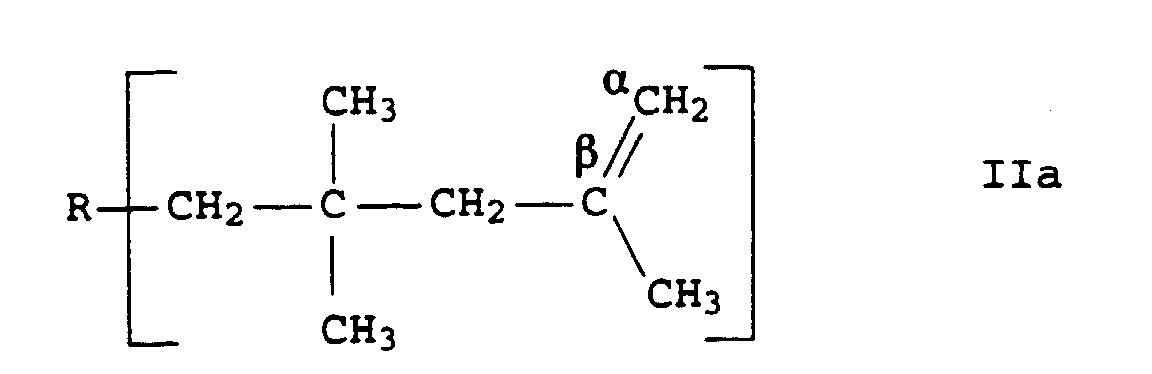
Der Gehalt an organisch gebundenem Fluor in der Polymerisationslösung als auch im Polyisobuten wurde nach herkömmlichen elementaranalytischen Methoden bestimmt: Dazu wird das organische Material durch Verbrennungsaufschluß nach Wickbold oder Schöniger aufgeschlossen, das dabei freigesetzte Fluorid in Wasser absorbiert und der Fluoridgehalt der erhaltenen wäßrigen Fluoridlösung potentiometrisch mit Hilfe handelsüblicher, für Fluoridionen selektiven Elektroden anhand einer Eichkurve bestimmt. Aus dem so gemessenen Fluoridgehalt der Lösung und der zur Verbrennung eingesetzten Probenmenge läßt sich der Gehalt an organisch gebundenem Fluorid in der Probe einfach errechnen (Lit.: F. Ehrenberger: Quantitative Elementaranalyse; VCH Verlagsgesellschaft, Weinheim, S. 436 ff, S. 424 ff, S. 617 ff).The content of organically bound fluorine in the polymerization solution as well as in polyisobutene was made according to conventional elemental analytical methods: For this, the organic Material by combustion digestion according to Wickbold or Schöniger open-minded, which absorbs the released fluoride in water and the fluoride content of the obtained fluoride aqueous solution potentiometric with the help of commercially available, selective for fluoride ions Electrodes determined using a calibration curve. From that measured fluoride content of the solution and that used for combustion Sample amount can be the content of organically bound Simply calculate fluoride in the sample (Lit .: F. Ehrenberger: Quantitative elemental analysis; VCH publishing company, Weinheim, P. 436 ff, p. 424 ff, p. 617 ff).
Für die nachfolgenden Beispiele wurden außer Reinisobuten
C4-Schnitte der Zusammensetzung gemäß Tabelle 1 verwendet.
Der Reaktor (≙ Reaktor 2 gemäß Fig.) bestand aus einem Teflonschlauch
von 7,6 m Länge mit einem Innendurchmesser von 4 mm,
über den durch eine Zahnradpumpe 50 1 Reaktorinhalt im Kreis geführt
wurden. Schlauch und Pumpe hatten einen Inhalt von 100 ml.
Teflonschlauch und Pumpenkopf befanden sich in einem Kältebad von
-19°C (Kryostat). Als Feed wurde Raffinat I (Zusammensetzung:
Tabelle 1) verwendet, der Zulauf betrug 300 g/h. Er wurde über
Molekularsieb 3 Å auf einen Wassergehalt von weniger als 3 ppm
getrocknet und durch eine Kapillare mit 2 mm Innendurchmesser,
die auf -19°C vorgekühlt war, dem Umlaufreaktor zugeführt. Die
BF3- und Isopropanolmengen wurden so lange variiert, bis bei einem
Isobutenumsatz von 80 % PIB eines Molgewichts Mn von 1000 entstand.
Die BF3-Menge betrug 10 mmol, die Isopropanolmenge 15 mmol.
Die Reaktortemperatur betrug -13°C.The reactor (≙
Die Bestimmung des Isobutenumsatzes erfolgte gaschromatographisch durch Analyse des Abgases. Durch die Zuläufe, die Reaktorvolumina und die Volumenkontraktion durch Polymerisation ergab sich eine mittlere Verweilzeit von etwa 13 Minuten. Unmittelbar hinter der Druckhaltung im Austragsrohr bzw. Probenahmestutzen wurde die Polymerisation mit 15 ml/h Acetonitril abgebrochen.The isobutene conversion was determined by gas chromatography by analyzing the exhaust gas. Through the inlets, the reactor volumes and the volume contraction by polymerization resulted in one average residence time of about 13 minutes. Immediately behind the Pressure was maintained in the discharge pipe or sampling nozzle Polymerization terminated with 15 ml / h acetonitrile.
Die Druckverhältnisse im Reaktor werden von seiner Geometrie, der umlaufmenge, der Viskosität des Reaktionsgemisches und der Druckhaltung bestimmt. Die Druckhaltung unmittelbar am Reaktoraustritt auf der Druckseite der Pumpe ist auf 7 bar eingestellt, bei den vorliegenden Konzentrationsverhältnissen wurden auf der Saugseite der Pumpe etwa 4 bar gemessen. Der Druckverlust des Systems betrug damit 3 bar. The pressure conditions in the reactor are determined by its geometry, the circulation quantity, the viscosity of the reaction mixture and the pressure maintenance certainly. The pressure maintenance directly at the reactor outlet on the pressure side of the pump is set to 7 bar existing concentration ratios were on the suction side the pump measured about 4 bar. The pressure loss of the system was 3 bar.
Der Reaktoraustrag wurde nach dem Abbruch der Polymerisation mittels Acetonitril mit 600 ml/h heißem Wasser (60°C) in einen 1 l Rührkolben geführt und restliches Flüssiggas verdampft. Dieses Flüssiggas enthielt neben Butanen und n-Butenen noch 14,1 % Isobuten. Es wurde an einem Trockeneiskühler kondensiert, azeotrop mitgeschlepptes Wasser fror an der Oberfläche des Kühlers aus. Die Standhaltung der Trennschicht im Rührkolben erfolgte über einen Siphon, die der Mischphase durch seitlichen Ablauf mit Siphon.The reactor discharge was stopped after the polymerization using acetonitrile with 600 ml / h of hot water (60 ° C) in a 1 l Stirring flask guided and the remaining liquid gas evaporated. This In addition to butanes and n-butenes, LPG also contained 14.1% isobutene. It was condensed on a dry ice cooler, azeotropically entrained water froze on the surface of the cooler. The separation layer in the stirring flask was maintained via a siphon that runs through the side of the mixing phase Siphon.
Bis zur Einstellung des stationären Gleichgewichts wurden etwa 2 Stunden benötigt, danach wurde während eines Zeitraums von einer Stunde eine Mischprobe gesammelt, wie beschrieben aufgearbeitet und in gleichen Teilen Hexan aufgenommen und weiteres Wasser abgetrennt. Der Gehalt der Lösung an organisch gebundenem Fluor betrug 114 ppm. Nach destillativer Entfernung des Hexans wurden restliche flüchtige Bestandteile, wie Wasser und Oligomere, bei einem Druck von 1 mbar abs. unter Erhöhung der Temperatur bis 230°C destillativ abgetrennt. Das im Sumpf des Rotationsverdampfers verbliebene Polyisobuten wurde anschließend charakterisiert. Der Anteil an endständigen Doppelbindungen betrug 90 Mol.-%. Die Viskosität, gemessen in einem Ubbelohde-Viskosimeter betrug 198 mm2/s, das mittlere Molekulargewicht Mn betrug 1005 Dalton und die Molekulargewichtsverteilung D 1,5. Der Fluorgehalt betrug 65 ppm.It took about 2 hours to reach steady-state equilibrium, after which a mixed sample was collected over a period of one hour, worked up as described and taken up in equal parts of hexane and further water was separated off. The organic fluorine content of the solution was 114 ppm. After removal of the hexane by distillation, remaining volatile constituents, such as water and oligomers, were abs at a pressure of 1 mbar. separated by distillation by increasing the temperature to 230 ° C. The polyisobutene remaining in the bottom of the rotary evaporator was then characterized. The proportion of terminal double bonds was 90 mol%. The viscosity, measured in an Ubbelohde viscometer, was 198 mm 2 / s, the average molecular weight M n was 1005 daltons and the molecular weight distribution D 1.5. The fluorine content was 65 ppm.
Das kondensierte Abgas wurde nach Trocknung über einem 3 Å Molekularsieb in einen Druckbehälter überführt, auf 50°C erwärmt und über ein Steigrohr unter Eigendruck in den vorher beschriebenen Reaktor geleitet und dort mit 2 mmol BF3 und 1 mmol Isopropanol bei einer Isobutenkonzentration der Polymerisationsmischung von 0,6 Gew.-% umgesetzt.After drying over a 3 Å molecular sieve, the condensed exhaust gas was transferred to a pressure vessel, heated to 50 ° C and passed through a riser pipe under autogenous pressure into the previously described reactor and there with 2 mmol of BF 3 and 1 mmol of isopropanol at an isobutene concentration of the polymerization mixture of 0.6 wt .-% implemented.
Nach der Aufarbeitung wurde ein konventionelles Polyisobuten mit einem Gehalt an endständigen Doppelbindungen von 28 Mol.-%, einer Viskosität (100°C) von 219 mm2/s, eines mittleren Molekulargewichts Mn von 980 Dalton und einer Dispersizität D von 1,8 erhalten.After working up, a conventional polyisobutene with a content of terminal double bonds of 28 mol%, a viscosity (100 ° C.) of 219 mm 2 / s, an average molecular weight M n of 980 daltons and a dispersity D of 1.8 receive.
Weitere Angaben zur Durchführung dieses Beispiels finden sich in Tabelle 2. Further information on the implementation of this example can be found in Table 2.
Es wurde eine Polymerisationsapparatur aus 2 Umlaufreaktoren
(≙ Reaktoren 2 und 5 gemäß Fig.) verwendet, wie sie in Beispiel 1
beschrieben ist. Abweichend von dieser Beschreibung waren bei
diesem Versuch die Teflonschläuche im ersten Reaktor 4,5 m und im
zweiten Reaktor 2,7 m lang. Die Zuläufe von je 150 g/h Hexan und
Isobuten wurden, wie beschrieben, getrocknet und dem Reaktorsystem
getrennt über Kapillaren mit 2 mm Innendurchmesser zugeführt.
Die zugeführten BF3- und Isopropanolmengen wurden so
lange variiert, bis bei einer Reaktortemperatur von -7°C und bei
einem Isobutenumsatz von 50 % Polyisobuten eines mittleren Molekulargewichts
Mn von 1040 Dalton entstand. Es wurden 15 mmol BF3
und 27 mmol Isopropanol benötigt.A polymerization apparatus consisting of 2 circulation reactors (≙
Der Reaktoraustrag wurde ohne weitere Zusätze und ohne Aufarbeitung
in den zweiten Reaktor geleitet, der bei einer Reaktortemperatur
von -14°C betrieben wurde. Hier wurde das Isobuten
weiter polymerisiert, bis der Gesamtumsatz 79 % erreichte. Der
Austrag dieses Reaktors wurde dann zum Abbruch der Polymerisation
und zur Aufarbeitung wie in Beispiel 1 behandelt.
Das erhaltene Polyisobuten hatte einen Gehalt an endständigen
Doppelbindungen von 95 Mol.-%, seine Viskosität (100°C) betrug
203 mm2/s, das mittlere Molekulargewicht Mn betrug 1040 Dalton
und die Dispersizität D 1,5. Weitere Angaben zu diesem Beispiel
sind in Tabelle 2 enthalten.The reactor discharge was passed without further additives and without working up into the second reactor, which was operated at a reactor temperature of -14 ° C. Here the isobutene was further polymerized until the total conversion reached 79%. The discharge from this reactor was then treated as in Example 1 to terminate the polymerization and for working up.
The polyisobutene obtained had a terminal double bond content of 95 mol%, its viscosity (100 ° C.) was 203 mm 2 / s, the average molecular weight M n was 1040 daltons and the dispersity D 1.5. Further information on this example is given in Table 2.
Es wurde eine Polymerisationsapparatur aus 2 Umlaufreaktoren verwendet, wie sie in Beispiel 1 beschrieben wurde. Abweichend von der Beschreibung in Beispiel 1 war bei diesem Versuch der Teflonschlauch im ersten Reaktor 0,7 und im zweiten Reaktor 6,5 m lang. Als Einsatzstoff wurde Raffinat I (Zusammensetzung: Tabelle 1) verwendet. Der Zulauf an Raffinat I wurde wie beschrieben getrocknet. Die zugeführten BF3-und Isopropanolmengen wurden so lange variiert, bis bei einer Reaktortemperatur von -11°C im ersten Reaktor und bei einem Isobutenumsatz von 6 % Polyisobuten eines mittleren Molekulargewichts Mn von 1000 Dalton gebildet wurde. Der Austrag aus dem ersten Reaktor wurde ohne weitere Aufarbeitung in den zweiten Reaktor geleitet. Im zweiten Reaktor, dessen Reaktortemperatur auf -13°C eingestellt worden war, wurde die Polymerisation bis zu einem Gesamtumsatz des im Zulauf enthaltenen Isobutens von 90 % weitergeführt. Nach Abbruch der Polymerisationsreaktion durch Zusatz von Acetonitril und Extraktion des inaktivierten BF3-Katalysators mit Wasser wurde nicht umgesetztes Isobuten zusammen mit den übrigen im Raffinat I enthaltenen Kohlenwasserstoffen destillativ entfernt. Der Polyisobutenrückstand wurde in der gleichen Menge Hexan aufgenommen und zur Abtrennung von Wasserspuren nochmals destilliert. Nach der Extraktion hatte die erhaltene Polyisobutenlösung einen Gehalt an organisch gebundenem Fluor von 143 ppm, nach der destillativen Aufarbeitung von 3 ppm. Die destillative Aufarbeitung wurde wie beschrieben durchgeführt. Das nach der destillativen Aufarbeitung erhaltene PIB hatte ein mittleres Molekulargewicht Mn von 960 Dalton, eine Dispersität von 1,6 und einen Gehalt an endständigen Doppelbindungen von 86 mol-%.A polymerization apparatus consisting of 2 circulation reactors, as described in Example 1, was used. In a departure from the description in Example 1, the Teflon tube was 0.7 m long in the first reactor and 6.5 m in the second reactor. Raffinate I (composition: Table 1) was used as starting material. The feed of raffinate I was dried as described. The quantities of BF 3 and isopropanol supplied were varied until a reactor temperature of -11 ° C. in the first reactor and an isobutene conversion of 6% formed polyisobutene with an average molecular weight M n of 1000 daltons. The discharge from the first reactor was passed into the second reactor without further workup. In the second reactor, the reactor temperature of which had been set to -13 ° C., the polymerization was continued until the isobutene contained in the feed had a total conversion of 90%. After the polymerization reaction had been terminated by adding acetonitrile and extracting the inactivated BF 3 catalyst with water, unreacted isobutene was removed by distillation together with the other hydrocarbons contained in the raffinate I. The polyisobutene residue was taken up in the same amount of hexane and distilled again to remove traces of water. After the extraction, the polyisobutene solution obtained had an organically bound fluorine content of 143 ppm and, after the distillative workup, 3 ppm. The distillative workup was carried out as described. The PIB obtained after working up by distillation had an average molecular weight M n of 960 daltons, a dispersity of 1.6 and a content of terminal double bonds of 86 mol%.
Weitere Angaben zu diesem Beispiel befinden sich in Tabelle 2.Further information on this example can be found in Table 2.
In einem Reaktor gemäß Beispiel 1 wurden je 150 g getrocknetes Hexan und Isobuten gemäß Beispiel 2 zugeführt. BF3 und Isopropanol wurden, wie beschrieben, in den vorgekühlten Hexanstrom eingespeist und die Zufuhr so lange variiert bis bei einem Isobutenumsatz von 90 %, Polyisobuten eines mittleren Molekulargewichts Mn von 1015 Dalton entstand. Die Reaktortemperatur betrug -13°C, die Kühlbadtemperatur -19°C. Eine Probe des Reaktoraustrags wurde nach Abbruch der Polymerisation, Extraktion und Destillation analysiert: Der Gehalt an organisch gebundenem Fluor betrug 98 ppm, er fiel nach der destillativen Aufarbeitung auf unter 1 ppm. Der Gehalt an endständigen Doppelbindungen betrug 88 Mol.-%, die Dispersizität D 1,5.150 g each of dried hexane and isobutene according to Example 2 were fed into a reactor according to Example 1. BF 3 and isopropanol were, as described, fed into the precooled hexane stream and the feed varied until an isobutene conversion of 90% resulted in polyisobutene having an average molecular weight M n of 1015 daltons. The reactor temperature was -13 ° C, the cooling bath temperature -19 ° C. A sample of the reactor discharge was analyzed after termination of the polymerization, extraction and distillation: the content of organically bound fluorine was 98 ppm, and it fell below 1 ppm after working up by distillation. The content of terminal double bonds was 88 mol%, the dispersity D 1.5.
Der Reaktoraustrag aus dem ersten Reaktor (≙ Reaktor 2 gemäß
Fig.) wurde ohne Aufarbeitung in einen weiteren Reaktor (≙ Reaktor
8 gemäß Fig.) - einen 50 cm langen Teflonschlauch mit 4 mm
Innendurchmesser - überführt und durch diesen im einfachen Durchgang
geleitet. Der Reaktor 8 befand sich im gleichen Kühlbad wie
Reaktor 2, aufgrund des geringeren Isobutenumsatzes fiel die
Reaktortemperatur auf -16°C. In diesem Reaktor 8 wurde das restliche
Isobuten nahezu vollständig umgesetzt.The reactor discharge from the first reactor (≙
Eine Probe des Austrags aus diesem Reaktor wurde analysiert: Bei einem Gesamtumsatz des Isobutens von über 99 % betrug das mittlere Molekulargewicht Mn des erhaltenen Polyisobutens 1015 Dalton, der Gehalt an endständigen Doppelbindungen 88 Mol.-%, die Dispersizität 1,5 und der Gehalt an organisch gebundenem Fluor vor der Destillation 93 ppm und nach der Destillation weniger als 1 ppm.A sample of the discharge from this reactor was analyzed: With a total conversion of the isobutene of more than 99%, the average molecular weight M n of the polyisobutene obtained was 1015 daltons, the content of terminal double bonds was 88 mol%, the dispersity 1.5 and the content of organically bound fluorine before distillation 93 ppm and after distillation less than 1 ppm.
Der Reaktoraustrag aus diesem Reaktor 8 wurde ohne Aufarbeitung
in einen Verweilzeitbehälter geleitet und dort bei einer mittleren
Verweilzeit von 3 Stunden bei einer Temperatur von +20°C gehalten.
Im Austrag aus dem Verweilzeitbehälter war das Isobuten
praktisch vollständig umgesetzt, das erhaltene Polyisobuten war
hinsichtlich seiner analytischen Daten mit dem Polyisobuten aus
dem vorausgehenden Reaktor völlig identisch, der Gehalt an organisch
gebundenem Fluor vor der Destillation betrug jedoch nur
noch 5 ppm.The reactor discharge from this
Weitere Angaben zu diesem Beispiel befinden sich in Tabelle 2.Further information on this example can be found in Table 2.
Reaktor 2 gemäß Beispiel 1 wurde mit einem getrockneten C4-Schnitt
aus der Isobutandehydrierung (Zusammensetzung: Tabelle 1)
beschickt. Mit 12 mmol BF3 und 18 mmol Isopropanol wurden bei
-13°C Reaktortemperatur 80 % Isobutenumsatz eingestellt. Das
erhaltene Polyisobuten hatte ein mittleres Molekulargewicht Mn von
1030 Dalton und einen Gehalt an endständigen Doppelbindungen von
92 % sowie eine Dispersizität D von 1,5. Der Gehalt an organisch
gebundenem Fluor betrug 124 ppm vor und 15 ppm nach der Destillation.
Der Austrag aus Reaktor 2 wurde ohne weitere Aufarbeitung
im geraden Durchgang durch einen Rohrreaktor 8 aus einem Teflonschlauch
von 1 m Länge und 4 mm Innendurchmesser geleitet. Die
Reaktortemperatur betrug -21°C. Nach Durchlauf durch diesen Reaktor
8 hatte sich der Isobutenumsatz auf 99 % erhöht. Das nach
Aufarbeitung erhaltene Polyisobuten war nach den Analyseergebnissen
mit dem der Probe aus Reaktor 2 völlig identisch.
Weitere Angaben zu diesem Beispiel befinden sich in Tabelle 2.

Claims (8)
- A process for the preparation of low molecular weight, highly reactive polyisobutene having an average molecular weight Mn of from 500 to 20000 Dalton and containing over 80 mol% of terminal double bonds by the polymerization of isobutene or an isobutene-containing hydrocarbon stream in the liquid phase and with the aid of a boron trifluoride complex catalyst at from -40 to 0°C and at from 1 to 20 bar, which comprises carrying out the polymerization reaction in at least two polymerization stages, the added isobutene being polymerized to a partial conversion of up to 98% in the first polymerization stage and the polymerization of the remaining isobutene being continued in one or more subsequent polymerization stages, without ot after prior isolation of the polyisobutene formed in the first polymerization stage, and carrying out the polymerization in the second polymerization stage at a polymerization temperature which is lower than that in the first polymerization stage.
- A process as claimed in claim 1, wherein, in the first polymerization stage, the isobutene is polymerized to a conversion of 5-95%, based on the amount of isobutene fed to the first polymerization stage.
- A process as claimed in claims 1 and 2, wherein, in the first polymerization stage, the isobutene is polymerized to a conversion of from 50 to 90%, based on the amount of isobutene fed to the first polymerization stage.
- A process as claimed in any of claims 1 to 3, wherein the discharge from the first polymerization stage is passed, without further working up, into the second or a subsequent polymerization stage.
- A process as claimed in any of claims 1 to 4, wherein boron trifluoride is subsequently metered into the second or a subsequent polymerization stage.
- A process as claimed in any of claims 1 to 5, wherein the polymerization mixture obtained after passage to the second or a further polymerization stage is treated in a dwell container serving as a downstream reactor, at a temperature which is higher than that in the preceding polymerization stages, in order to polymerize residual amounts of isobutene still present in said polymerization mixture.
- A process as claimed in any of claims 1 to 6, wherein the boron trifluoride complex catalyst used comprises a complex or complexes of boron trifluoride with a C1-C20-alcohol, a tertiary alkyl ether or water.
- A process as claimed in any of claims 1 to 7, wherein the boron trifluoride complex catalyst used is a complex of boron trifluoride with isopropanol or 2-butanol.
Applications Claiming Priority (3)
| Application Number | Priority Date | Filing Date | Title |
|---|---|---|---|
| DE19520078A DE19520078A1 (en) | 1995-06-07 | 1995-06-07 | Process for the production of low molecular weight, highly reactive polyisobutene |
| DE19520078 | 1995-06-07 | ||
| PCT/EP1996/002414 WO1996040808A1 (en) | 1995-06-07 | 1996-06-04 | Process for preparing low molecular, highly reactive polyisobutylene |
Publications (2)
| Publication Number | Publication Date |
|---|---|
| EP0830397A1 EP0830397A1 (en) | 1998-03-25 |
| EP0830397B1 true EP0830397B1 (en) | 1999-09-08 |
Family
ID=7763391
Family Applications (1)
| Application Number | Title | Priority Date | Filing Date |
|---|---|---|---|
| EP96917494A Expired - Lifetime EP0830397B1 (en) | 1995-06-07 | 1996-06-04 | Process for preparing low molecular, highly reactive polyisobutylene |
Country Status (14)
| Country | Link |
|---|---|
| US (1) | US5962604A (en) |
| EP (1) | EP0830397B1 (en) |
| JP (1) | JP3761578B2 (en) |
| KR (1) | KR100424825B1 (en) |
| CN (1) | CN1104448C (en) |
| AU (1) | AU702804B2 (en) |
| BR (1) | BR9609425A (en) |
| CA (1) | CA2217848C (en) |
| CZ (1) | CZ357197A3 (en) |
| DE (2) | DE19520078A1 (en) |
| ES (1) | ES2137701T3 (en) |
| HU (1) | HUP9801818A3 (en) |
| NO (1) | NO975702D0 (en) |
| WO (1) | WO1996040808A1 (en) |
Families Citing this family (74)
| Publication number | Priority date | Publication date | Assignee | Title |
|---|---|---|---|---|
| DE19645430A1 (en) * | 1996-11-04 | 1998-05-07 | Basf Ag | Polyolefins and their functionalized derivatives |
| US6407186B1 (en) | 1997-12-12 | 2002-06-18 | Basf Aktiengesellschaft | Method for producing low-molecular, highly reactive polyisobutylene |
| DE19825334A1 (en) * | 1998-06-05 | 1999-12-09 | Basf Ag | Process for the production of highly reactive polyisobutenes |
| DE19834593A1 (en) | 1998-07-31 | 2000-02-03 | Basf Ag | Process for the production of halogen-free, reactive polyisobutene |
| EP1026175A4 (en) * | 1998-08-25 | 2003-01-22 | Nippon Petrochemicals Co Ltd | PROCESS FOR PRODUCING BUTENIC POLYMER |
| WO2000050472A1 (en) * | 1999-02-23 | 2000-08-31 | Nippon Petrochemicals Company, Limited | Method of dehalogenating hydrocarbon containing carbon-carbon double bond |
| US6884858B2 (en) * | 1999-10-19 | 2005-04-26 | Texas Petrochemicals Lp | Process for preparing polyolefin products |
| ATE507247T1 (en) | 1999-09-16 | 2011-05-15 | Tpc Group Llc | METHOD FOR PRODUCING POLYOLEFIN PRODUCTS |
| JP5670874B2 (en) * | 1999-09-16 | 2015-02-18 | ティーピーシー グループ リミティド ライアビリティ カンパニー | Method for liquid phase polymerization of polyisobutylene |
| US6562913B1 (en) | 1999-09-16 | 2003-05-13 | Texas Petrochemicals Lp | Process for producing high vinylidene polyisobutylene |
| DE19948947A1 (en) | 1999-10-11 | 2001-04-12 | Basf Ag | Process for the continuous production of polyisobutenes |
| US6992152B2 (en) * | 1999-10-19 | 2006-01-31 | Texas Petrochemicals Lp | Apparatus and method for controlling olefin polymerization process |
| US7037999B2 (en) | 2001-03-28 | 2006-05-02 | Texas Petrochemicals Lp | Mid-range vinylidene content polyisobutylene polymer product and process for producing the same |
| US6858188B2 (en) | 2003-05-09 | 2005-02-22 | Texas Petrochemicals, Lp | Apparatus for preparing polyolefin products and methodology for using the same |
| DE19952030A1 (en) * | 1999-10-28 | 2001-05-03 | Basf Ag | Process for the production of highly reactive polyisobutenes |
| DE19952031A1 (en) * | 1999-10-28 | 2001-05-03 | Basf Ag | Process for the production of highly reactive polyisobutenes |
| KR100486044B1 (en) * | 2000-11-13 | 2005-04-29 | 대림산업 주식회사 | Method for producing polybutene |
| HUP0301859A3 (en) | 2000-11-17 | 2005-03-29 | Basf Ag | Method for deactivating and recovering boron trifluoride when producing polyisobutenes |
| DE10125583A1 (en) * | 2001-05-25 | 2002-11-28 | Basf Ag | Production of homo- or co-polymers of isobutene involves continuous cationic polymerisation in special tubular flow reactor with several bends in alternating directions |
| WO2002100153A2 (en) * | 2001-06-08 | 2002-12-19 | Texas Petrochemicals Lp | Improved cling film with enhanced polyisobutylene tackifier |
| RU2203910C2 (en) * | 2001-08-08 | 2003-05-10 | Открытое акционерное общество "Ефремовский завод синтетического каучука" | High-reactivity low-molecular polyisobutylene production |
| DE10161250B4 (en) * | 2001-12-13 | 2004-05-06 | Daimlerchrysler Ag | Method for mechanical joining of metal sheets |
| DE10211418A1 (en) * | 2002-03-15 | 2003-09-25 | Bayer Ag | Process for the production of highly reactive polyisobutenes |
| RU2229480C1 (en) * | 2003-07-07 | 2004-05-27 | Открытое акционерное общество "Уралоргсинтез" | Method for preparing highly reactive low-molecular polyisobutylene |
| DE10361633A1 (en) | 2003-12-30 | 2005-07-28 | Basf Ag | Preparation of highly reactive low halogen polyisobutenes |
| EP1598380A1 (en) | 2004-05-19 | 2005-11-23 | Basf Aktiengesellschaft | Isobutene polymerisation in the presence of complexes of donor and fluor containing acid |
| US20060287202A1 (en) * | 2005-06-15 | 2006-12-21 | Malcolm Waddoups | Low ash or ashless two-cycle lubricating oil with reduced smoke generation |
| US7906598B2 (en) * | 2006-08-30 | 2011-03-15 | Intertape Polymer Corp. | Recirculation loop reactor bulk polymerization process |
| US20100105847A1 (en) | 2006-01-24 | 2010-04-29 | Intertape Polymer Corp. | Plug flow bulk polymerization of vinyl monomers |
| JP2010502786A (en) * | 2006-08-30 | 2010-01-28 | インターテープ ポリマー コーポレーション | Bulk polymerization process with recirculation loop reactor |
| KR100787851B1 (en) | 2006-12-05 | 2007-12-27 | 대림산업 주식회사 | Polybutene Polymer Compositions and Methods for Making the Same |
| US8193402B2 (en) | 2007-12-03 | 2012-06-05 | Gevo, Inc. | Renewable compositions |
| EP2225351A4 (en) | 2007-12-03 | 2016-11-09 | Gevo Inc | Renewable compositions |
| US20100298507A1 (en) | 2009-05-19 | 2010-11-25 | Menschig Klaus R | Polyisobutylene Production Process With Improved Efficiencies And/Or For Forming Products Having Improved Characteristics And Polyisobutylene Products Produced Thereby |
| MY159813A (en) | 2010-01-08 | 2017-02-15 | Gevo Inc | Integrated methods of preparing renewable chemicals |
| EP2566830B1 (en) | 2010-05-07 | 2017-03-22 | GEVO, Inc. | Renewable jet fuel blendstock from isobutanol |
| US20130059927A1 (en) | 2010-05-12 | 2013-03-07 | Basf Se | Emulsions of Polyisobutenes, Substance and Process |
| CN101921352B (en) * | 2010-09-28 | 2011-10-26 | 潍坊滨海石油化工有限公司 | Method for producing low-molecular-weight high-activity polyisobutene |
| EP2699618A4 (en) | 2011-04-19 | 2014-12-17 | Gevo Inc | Variations on prins-like chemistry to produce 2,5-dimethylhexadiene from isobutanol |
| CN102807640B (en) * | 2011-06-02 | 2014-04-02 | 北京化工大学 | A kind of initiation system based on boron trifluoride and the method for preparing polyisobutylene |
| SG194908A1 (en) | 2011-06-08 | 2013-12-30 | Tpc Group L L C | Production of highly reactive low molecular weight pib oligomers |
| US8524843B2 (en) | 2011-06-08 | 2013-09-03 | Tpc Group Llc | Production of highly reactive low molecular weight PIB oligomers |
| WO2013062758A1 (en) | 2011-10-26 | 2013-05-02 | Tpc Group Llc | Polyisobutylene prepared at high velocity and circulation rate |
| KR101929082B1 (en) | 2011-10-26 | 2018-12-13 | 티피씨 그룹 엘엘씨 | Polyisobutylene prepared with low diluent content reaction medium |
| MX354421B (en) | 2011-10-26 | 2018-03-02 | Tpc Group Llc | Mid-range vinylidene content, high viscosity polyisobutylene polymers. |
| CN103930194B (en) | 2011-11-11 | 2016-06-22 | 巴斯夫欧洲公司 | Emulsions, materials and methods comprising polymeric cationic emulsifiers |
| US8759274B2 (en) | 2011-11-11 | 2014-06-24 | Basf Se | Self-emulsifiable polyolefine compositions |
| US20130118531A1 (en) | 2011-11-11 | 2013-05-16 | The Procter & Gamble Company | Emulsions containing polymeric cationic emulsifiers, substance and process |
| EP2776007A1 (en) | 2011-11-11 | 2014-09-17 | Basf Se | Self-emulsifiable polyolefine compositions |
| WO2013068272A1 (en) | 2011-11-11 | 2013-05-16 | Basf Se | Self-emulsifiable polyolefine compositions |
| US11072570B2 (en) | 2012-01-09 | 2021-07-27 | Basf Se | Process for continuously preparing polyisobutylene |
| MY174854A (en) * | 2012-01-09 | 2020-05-19 | Basf Se | Method for the continuous production of polyisobutylene |
| KR101523568B1 (en) | 2013-05-16 | 2015-05-28 | 대림산업 주식회사 | Apparatus and method for selectively preparing reactive polyisobutylene and non-reactive polyisobutylene |
| KR101457452B1 (en) * | 2013-06-05 | 2014-11-03 | 대림산업 주식회사 | Apparatus and method for preparing polyisobutylene having a various molecular weight |
| KR101511707B1 (en) | 2014-02-20 | 2015-04-13 | 대림산업 주식회사 | Apparatus and method for preparing polyisobutylene which is easy to adjust molecular weight |
| EP3205674B1 (en) | 2013-06-05 | 2022-08-03 | DL Chemical CO., LTD | Apparatus and method for preparing polybutene having various molecular weights |
| KR102222524B1 (en) * | 2013-07-17 | 2021-03-03 | 바스프 에스이 | Highly reactive polyisobutylene having a high percentage of vinylidene double bonds in the side chains |
| KR101511701B1 (en) | 2013-07-30 | 2015-04-13 | 대림산업 주식회사 | Apparatus and method for recirculation of raw material used during the polyisobutylene preparation process |
| US9759830B2 (en) * | 2013-10-30 | 2017-09-12 | Schlumberger Technology Corporation | Method and apparatus for determining mud contamination of formation fluid |
| KR101628897B1 (en) | 2014-06-18 | 2016-06-09 | 대림산업 주식회사 | Method for preparing polyisobutylene using the normal propanol |
| US20180066200A1 (en) | 2015-03-03 | 2018-03-08 | Basf Se | Pib as high viscosity lubricant base stock |
| US10066035B2 (en) | 2015-12-07 | 2018-09-04 | Bridgestone Corporation | Catalyst systems and methods for preparation of 1,4-polybutadiene rubber |
| US9617366B1 (en) * | 2016-03-03 | 2017-04-11 | Tpc Group Llc | Low-fluoride, reactive polyisobutylene |
| US9617363B1 (en) * | 2016-03-03 | 2017-04-11 | Tpc Group Llc | Low-fluoride, reactive polyisobutylene |
| WO2017151341A1 (en) * | 2016-03-03 | 2017-09-08 | Tpc Group Llc | Low-fluoride, reactive polyisobutylene |
| WO2018007165A1 (en) * | 2016-07-06 | 2018-01-11 | Ineos Europe Ag | Polymerisation process |
| EP3585822B1 (en) | 2017-02-21 | 2025-05-07 | NTP Tec, LLC | Processes for making polyisobutylene compositions |
| KR102762108B1 (en) | 2017-10-14 | 2025-02-03 | 티피씨 그룹 엘엘씨 | Isobutylene copolymer, method for producing isobutylene copolymer and isobutylene copolymer product |
| EP3813968A4 (en) | 2018-06-29 | 2022-08-17 | NTP Tec, LLC | Processes for the manufacture of isobutylene, polyisobutylene, and derivatives thereof |
| KR102203006B1 (en) | 2019-04-24 | 2021-01-13 | 대림산업 주식회사 | Method for producing highly reactive polybutene |
| EP3943518A1 (en) | 2020-07-22 | 2022-01-26 | Indian Oil Corporation Limited | Polymerization catalyst system and process to produce highly reactive polyisobutylene |
| CN116023570B (en) * | 2021-10-27 | 2025-01-28 | 中国石油天然气股份有限公司 | Method for copolymerizing isobutylene with maleic anhydride |
| KR102701702B1 (en) * | 2022-03-15 | 2024-08-30 | 디엘케미칼 주식회사 | Method for producing polyalphaolefin, and polyalphaolefin produced thereby, and reaction apparatus therefor |
| WO2024242906A1 (en) | 2023-05-19 | 2024-11-28 | Ntp Tec, Llc | Processes for converting c4 feeds to isobutylene, polyisobutylene, or derivatives thereof |
Family Cites Families (7)
| Publication number | Priority date | Publication date | Assignee | Title |
|---|---|---|---|---|
| DE2702604C2 (en) * | 1977-01-22 | 1984-08-30 | Basf Ag, 6700 Ludwigshafen | Polyisobutenes |
| GB8329082D0 (en) * | 1983-11-01 | 1983-12-07 | Bp Chem Int Ltd | Low molecular weight polymers of 1-olefins |
| DE3509272A1 (en) * | 1985-03-15 | 1986-09-18 | Basf Ag, 6700 Ludwigshafen | CATALYST SYSTEM FOR THE CATIONIC POLYMERIZATION OF ISOBUTYLENE |
| US4849572A (en) * | 1987-12-22 | 1989-07-18 | Exxon Chemical Patents Inc. | Process for preparing polybutenes having enhanced reactivity using boron trifluoride catalysts (PT-647) |
| DE4033195A1 (en) * | 1990-10-19 | 1992-04-23 | Basf Ag | METHOD FOR PRODUCING POLYISOBUTES |
| BE1006694A5 (en) * | 1991-06-22 | 1994-11-22 | Basf Ag | PREPARATION PROCESS EXTREMELY REACTIVE polyisobutenes. |
| WO1993010063A1 (en) * | 1991-11-18 | 1993-05-27 | Amoco Corporation | Bf3-tertiary etherate complexes for isobutylene polymerization |
-
1995
- 1995-06-07 DE DE19520078A patent/DE19520078A1/en not_active Withdrawn
-
1996
- 1996-06-04 US US08/973,643 patent/US5962604A/en not_active Expired - Lifetime
- 1996-06-04 AU AU60048/96A patent/AU702804B2/en not_active Ceased
- 1996-06-04 BR BR9609425A patent/BR9609425A/en not_active Application Discontinuation
- 1996-06-04 EP EP96917494A patent/EP0830397B1/en not_active Expired - Lifetime
- 1996-06-04 CZ CZ973571A patent/CZ357197A3/en unknown
- 1996-06-04 HU HU9801818A patent/HUP9801818A3/en unknown
- 1996-06-04 KR KR1019970708826A patent/KR100424825B1/en not_active Expired - Fee Related
- 1996-06-04 WO PCT/EP1996/002414 patent/WO1996040808A1/en not_active Ceased
- 1996-06-04 ES ES96917494T patent/ES2137701T3/en not_active Expired - Lifetime
- 1996-06-04 CA CA002217848A patent/CA2217848C/en not_active Expired - Fee Related
- 1996-06-04 CN CN96194532A patent/CN1104448C/en not_active Expired - Fee Related
- 1996-06-04 DE DE59603014T patent/DE59603014D1/en not_active Expired - Lifetime
- 1996-06-04 JP JP50013697A patent/JP3761578B2/en not_active Expired - Fee Related
-
1997
- 1997-12-05 NO NO975702A patent/NO975702D0/en not_active Application Discontinuation
Also Published As
| Publication number | Publication date |
|---|---|
| DE19520078A1 (en) | 1996-12-12 |
| BR9609425A (en) | 1999-05-25 |
| ES2137701T3 (en) | 1999-12-16 |
| JPH11506492A (en) | 1999-06-08 |
| NO975702L (en) | 1997-12-05 |
| HUP9801818A3 (en) | 1999-03-01 |
| CN1104448C (en) | 2003-04-02 |
| HUP9801818A2 (en) | 1998-11-30 |
| CA2217848C (en) | 2004-11-09 |
| WO1996040808A1 (en) | 1996-12-19 |
| AU702804B2 (en) | 1999-03-04 |
| MX9708837A (en) | 1998-03-31 |
| NO975702D0 (en) | 1997-12-05 |
| JP3761578B2 (en) | 2006-03-29 |
| KR100424825B1 (en) | 2004-06-23 |
| EP0830397A1 (en) | 1998-03-25 |
| CA2217848A1 (en) | 1996-12-19 |
| CN1187208A (en) | 1998-07-08 |
| KR19990022346A (en) | 1999-03-25 |
| CZ357197A3 (en) | 1998-05-13 |
| US5962604A (en) | 1999-10-05 |
| DE59603014D1 (en) | 1999-10-14 |
| AU6004896A (en) | 1996-12-30 |
Similar Documents
| Publication | Publication Date | Title |
|---|---|---|
| EP0628575B2 (en) | Process for the manufacture of highly reactive polyisobutenes | |
| EP0830397A1 (en) | Process for preparing low molecular, highly reactive polyisobutylene | |
| EP0807641B1 (en) | Process for the preparation of medium molecular highly reactive polyisobutene | |
| EP1095070B1 (en) | Method for producing highly reactive polyisobutenes | |
| EP1040143B1 (en) | Method for producing low-molecular, highly reactive polyisobutylene | |
| DE3843631B4 (en) | Method for producing a polybutene | |
| EP1301546B1 (en) | Method for producing polyisobutylenes | |
| DE4033196C1 (en) | ||
| EP1311565B1 (en) | Method for producing polyisobutenes | |
| EP1224229B1 (en) | Method for the production of highly reactive polyisobutenes | |
| EP1337564B1 (en) | Method for deactivating and recovering boron trifluoride when producing polyisobutenes | |
| EP1344785A1 (en) | Process to prepare high reactive polyisobutene | |
| EP1240216A1 (en) | Method for continuous production of polyisobutene | |
| EP0687276B1 (en) | Non-drying chlorine-free isobutene/diene copolymers | |
| EP0481297A2 (en) | Process for preparing polyisobutylene | |
| EP2814852A1 (en) | Boron trifluoride catalyst complex and method for producing highly reactive isobutene homopolymers | |
| DE1957167B2 (en) | PROCESS FOR THE PRODUCTION OF CARBONIC ACIDS BY REACTING OLEFINS WITH CARBON MONOXIDE AND WATER IN THE PRESENCE OF A CATALYST AVAILABLE FROM ORTHOPHOSPHORIC ACID, BORON TRIFLUORIDE AND WATER | |
| EP1546213A1 (en) | Method for the production of polyisobutene | |
| WO2005066222A1 (en) | Production of highly reactive polyisobutenes with a low fluorine content by means of a moderator | |
| WO2001096421A1 (en) | Method for producing polyisobutenes | |
| DE10361638A1 (en) | Production of polyisobutene, used e.g. as intermediate for lubricating oil and fuel additives, involves polymerization using boron trifluoride catalyst with cyanide or nitrile as moderator and/or contacting product with inorganic adsorbent | |
| DE102004033988A1 (en) | Production of polyisobutene, used e.g. as intermediate for lubricating oil and fuel additives, involves polymerization using boron trifluoride catalyst with cyanide or nitrile as moderator and/or contacting product with inorganic adsorbent | |
| DE102007049949A1 (en) | Terminally unsaturated polymer, particularly isobutene polymer production for producing fuel and lubrication material additives involves carrying out dehydrohalogenation of polymer in presence of solvent |
Legal Events
| Date | Code | Title | Description |
|---|---|---|---|
| PUAI | Public reference made under article 153(3) epc to a published international application that has entered the european phase |
Free format text: ORIGINAL CODE: 0009012 |
|
| 17P | Request for examination filed |
Effective date: 19971022 |
|
| AK | Designated contracting states |
Kind code of ref document: A1 Designated state(s): BE CH DE ES FI FR GB IT LI NL |
|
| 17Q | First examination report despatched |
Effective date: 19980401 |
|
| GRAG | Despatch of communication of intention to grant |
Free format text: ORIGINAL CODE: EPIDOS AGRA |
|
| GRAG | Despatch of communication of intention to grant |
Free format text: ORIGINAL CODE: EPIDOS AGRA |
|
| GRAH | Despatch of communication of intention to grant a patent |
Free format text: ORIGINAL CODE: EPIDOS IGRA |
|
| GRAH | Despatch of communication of intention to grant a patent |
Free format text: ORIGINAL CODE: EPIDOS IGRA |
|
| GRAA | (expected) grant |
Free format text: ORIGINAL CODE: 0009210 |
|
| AK | Designated contracting states |
Kind code of ref document: B1 Designated state(s): BE CH DE ES FI FR GB IT LI NL |
|
| REG | Reference to a national code |
Ref country code: CH Ref legal event code: EP |
|
| GBT | Gb: translation of ep patent filed (gb section 77(6)(a)/1977) |
Effective date: 19990920 |
|
| REF | Corresponds to: |
Ref document number: 59603014 Country of ref document: DE Date of ref document: 19991014 |
|
| ITF | It: translation for a ep patent filed | ||
| REG | Reference to a national code |
Ref country code: ES Ref legal event code: FG2A Ref document number: 2137701 Country of ref document: ES Kind code of ref document: T3 |
|
| ET | Fr: translation filed | ||
| PGFP | Annual fee paid to national office [announced via postgrant information from national office to epo] |
Ref country code: CH Payment date: 20000524 Year of fee payment: 5 |
|
| PLBE | No opposition filed within time limit |
Free format text: ORIGINAL CODE: 0009261 |
|
| STAA | Information on the status of an ep patent application or granted ep patent |
Free format text: STATUS: NO OPPOSITION FILED WITHIN TIME LIMIT |
|
| 26N | No opposition filed | ||
| PG25 | Lapsed in a contracting state [announced via postgrant information from national office to epo] |
Ref country code: LI Free format text: LAPSE BECAUSE OF NON-PAYMENT OF DUE FEES Effective date: 20010630 Ref country code: CH Free format text: LAPSE BECAUSE OF NON-PAYMENT OF DUE FEES Effective date: 20010630 |
|
| REG | Reference to a national code |
Ref country code: GB Ref legal event code: IF02 |
|
| REG | Reference to a national code |
Ref country code: CH Ref legal event code: PL |
|
| PGFP | Annual fee paid to national office [announced via postgrant information from national office to epo] |
Ref country code: FI Payment date: 20020607 Year of fee payment: 7 |
|
| PG25 | Lapsed in a contracting state [announced via postgrant information from national office to epo] |
Ref country code: FI Free format text: LAPSE BECAUSE OF NON-PAYMENT OF DUE FEES Effective date: 20030604 |
|
| PGFP | Annual fee paid to national office [announced via postgrant information from national office to epo] |
Ref country code: NL Payment date: 20040603 Year of fee payment: 9 |
|
| PG25 | Lapsed in a contracting state [announced via postgrant information from national office to epo] |
Ref country code: NL Free format text: LAPSE BECAUSE OF NON-PAYMENT OF DUE FEES Effective date: 20060101 |
|
| NLV4 | Nl: lapsed or anulled due to non-payment of the annual fee |
Effective date: 20060101 |
|
| PGFP | Annual fee paid to national office [announced via postgrant information from national office to epo] |
Ref country code: ES Payment date: 20080717 Year of fee payment: 13 |
|
| PGFP | Annual fee paid to national office [announced via postgrant information from national office to epo] |
Ref country code: GB Payment date: 20080604 Year of fee payment: 13 |
|
| GBPC | Gb: european patent ceased through non-payment of renewal fee |
Effective date: 20090604 |
|
| PG25 | Lapsed in a contracting state [announced via postgrant information from national office to epo] |
Ref country code: GB Free format text: LAPSE BECAUSE OF NON-PAYMENT OF DUE FEES Effective date: 20090604 |
|
| REG | Reference to a national code |
Ref country code: ES Ref legal event code: FD2A Effective date: 20090605 |
|
| PG25 | Lapsed in a contracting state [announced via postgrant information from national office to epo] |
Ref country code: ES Free format text: LAPSE BECAUSE OF NON-PAYMENT OF DUE FEES Effective date: 20090605 |
|
| PGFP | Annual fee paid to national office [announced via postgrant information from national office to epo] |
Ref country code: IT Payment date: 20120621 Year of fee payment: 17 |
|
| PGFP | Annual fee paid to national office [announced via postgrant information from national office to epo] |
Ref country code: DE Payment date: 20120830 Year of fee payment: 17 Ref country code: BE Payment date: 20120726 Year of fee payment: 17 Ref country code: FR Payment date: 20120720 Year of fee payment: 17 |
|
| BERE | Be: lapsed |
Owner name: *BASF A.G. Effective date: 20130630 |
|
| REG | Reference to a national code |
Ref country code: DE Ref legal event code: R119 Ref document number: 59603014 Country of ref document: DE Effective date: 20140101 |
|
| REG | Reference to a national code |
Ref country code: FR Ref legal event code: ST Effective date: 20140228 |
|
| PG25 | Lapsed in a contracting state [announced via postgrant information from national office to epo] |
Ref country code: BE Free format text: LAPSE BECAUSE OF NON-PAYMENT OF DUE FEES Effective date: 20130630 |
|
| PG25 | Lapsed in a contracting state [announced via postgrant information from national office to epo] |
Ref country code: DE Free format text: LAPSE BECAUSE OF NON-PAYMENT OF DUE FEES Effective date: 20140101 |
|
| PG25 | Lapsed in a contracting state [announced via postgrant information from national office to epo] |
Ref country code: FR Free format text: LAPSE BECAUSE OF NON-PAYMENT OF DUE FEES Effective date: 20130701 Ref country code: IT Free format text: LAPSE BECAUSE OF NON-PAYMENT OF DUE FEES Effective date: 20130604 |